Asian Social Science; Vol. 12, No. 10; 2016 ISSN 1911-2017 E-ISSN 1911-2025 Published by Canadian Center of Science and Education
152
Towards Ethical Framework for Personal Care Robots: Review and
Reflection
Nazanin Mansouri1 & Khaled Goher2
1 ELM Graduate School, HELP University, Damansara Heights, Kuala Lumpur, Malaysia
2 Department of Informatics and Enabling Technologies, Lincoln University, Lincoln, Canterbury, New Zealand
Correspondence: Nazanin Mansouri, ELM Graduate School, HELP University, Damansara Heights, 50490 Kuala Lumpur, Malaysia. E-mail: [email protected]
Received: July 20, 2016 Accepted: August 17, 2016 Online Published: September 19, 2016 doi:10.5539/ass.v12n10p152 URL: http://dx.doi.org/10.5539/ass.v12n10p152
Abstract
In recent decades, robots have been used noticeably at various industries. Autonomous robots have been embedded in human lives especially in elderly and disabled lives. Elderly population is growing worldwide significantly; therefore there is an increased need of personal care robots to enhance mobility and to promote independence. A great number of aging and disabled hold appeals for using robots in daily routine tasks as well as for various healthcare matters. It is essential to follow a proper framework in ethics of robot design to fulfill individual needs, whilst considering potential harmful effects of robots. This paper primarily focuses on the existing issues in robot ethics including general ethics theories and ethics frameworks for robots. Consequentialism ethics will be recommended to be applied in robot ethics frameworks.
Keywords:robot ethics, robot ethics framework, deontology ethics, virtue ethics, consequential ethics
1. Introduction
Technology is a universal phenomenon and it has significant impact on human lives. Robots have been known as successful technological achievements. Human lives as well as industry have witnessed substantial improvement by the advent of robotics. Nowadays, robots are widely utilized in various fields including: manufacturing, medical services, household services, military, and entertainment (Yampolskiy, 2013).
There have been debates around the discipline of medical robot ethics. Elderly population is increasing over the world which makes their needs are of a great importance to health authorities, governments, caregivers and families. These results in having healthcare robots to have an imperative role to assist older adults to carry out care tasks autonomously and also relieve the lack of caretakers (WHO, 2016). This includes daily routine tasks, companionship, and monitoring health condition and behavior. Though deployment of assistive medical robots gives benefits to elderly and their caregivers, there are ethical concerns such as the rise in social isolation, the loss of self-esteem, and the including deception (Sparrow & Sparrow 2006; Sharkey & Sharkey 2012; Wallach et al., 2009). Sharkey and Sharkey (2012) specified that there are specific issues in the use of assistive medical robots which have potential effects on the rights of aged population as well as the roles of caretakers. These ethical issues are mainly related to the loss of privacy, the feeling of being considered as an object, the loss of independence and control, the drop in human contact, the feeling of being treated as an infant, and the control of aged people over robots.
Medical assistive robots play a crucial role in human lives, therefore, it is important to form frameworks for assistive robot ethics (Veruggio & Operto, 2006) and to propose ethical dimensions of robots (Asaro, 2006). There is a lack of standard in standardization of International Organization (ISO, 2011) and this make a significant opportunity to consider ethics into the design process of assistive robots to overcome the existing issues (Van Wynsberghe, 2013).
robots in Section five (5).
2. Ethical Theories
General theories of ethics can be applied in various fields including robotics. Since robots simulate human actions and behaviors, general theories of ethics can be utilized in the design of robots. As an example; codes of robot’s program can be written in accordance with ethics theories. In this section, the concept of three related ethics theories; deontology, virtue, and consequentialism ethics, are explained.
2.1 Deontology Ethics
Deontology ethics, shown in Figure 1, known as duty-based and non-consequentialist has been established by Immanuel Kant in 1788 (Shaw & Barry, 2015). The word “Deontology” is derived from Greek words called duty and study. In accordance with this theory, individuals are obliged morally to take action based on a range of rules and principles regardless of result (Johnson, 2008). In other words, deontology theory primarily focuses on rightness or wrongness of an action itself rather than concentrating on rightness or wrongness of the action’s consequence or the characteristics of the actor (Alexander & Moore, 2007). Deontology is the first ethics theory giving priority of decision making to an individual agent (Sullivan, 1989). Kant stated that in moral actions individual’s motivations, emotions, and consequences declines to play role. Thus motivation of an action is required with obligation before the action is taken. If an individual practices duty-based ethics, she/he is required to take the right action even though the action causes destructive consequence (Sullivan, 1994). This theory consists of six main theoretical concepts including: obligation, intention, law of independency, categorical imperative, transcendentalism and rationality, and dignity and respect (Bowen, 2004).
As an example of applying deontology theory is when an elderly is in need of a specific medication such as a pain killer. Even if the elderly is allergic to this particular medication, according to deontology theory the autonomous agent is required to give the medication to elderly despite potential impacts due to his allergy. In contrast, according to consequentialism theory, it is not acceptable to give the pain killer to the elderly since the medication triggers his allergy. In this case, the robot is required provide another alternative to alleviate elderly’s pain.
Figure 1. Deontology ethics
2.2 Virtue Ethics
Virtue ethics, as shown in Figure 2, is known as character-based ethics emphasizing on the right action of a virtuous individual who is performing the action in all the same situations (Hursthouse, 2013). This ethics theory is primarily individual-based rather than action-based. It is underlining on the moral and virtue character of an individual accomplishing an action rather than focusing on the consequences of this action or ethical rule and duty (Sandler, 2013).
Virtue ethics theory is not only concentrating on the rightness or wrongness of a person’s action but also provides a set of behaviors and characteristics that needs to be acquire by which a good individual (Van Hooft, 2014). This ethics theory is a useful if an individual prefers to evaluate the character of another individual rather than to assess goodness or badness of a specific action. According to this theory, individuals are required to possess a range of characteristics for being virtuous (Crossan et al., 2013). Based on character-based ethics, a good society is established when members of society are assisted to practice being good rather than being forced by punishment and law to avoid bad actions (Shaw & Barry, 2015).
This theory intermittently inclines to the side of the deontology ethics theory however it comes in contrast to consequentialism ethics theory. Considering assisting the needy as an example, according to consequentialism theory assisting the needy promotes well-being. However, the deontology ethics theory argues that assisting needy is based on moral rule whilst the virtue ethics theory considers this help as a character of generosity.
Figure 2. Virtue ethics
Deontology Ethics Right Action Duty and Rule
ass.ccsenet.org Asian Social Science Vol. 12, No. 10; 2016
154
2.3 Consequentialism Ethics
Consequentialism ethics, as shown in Figure 3, is result-based theory which primarily underlining two main principles. The first principle indicates that an action is considered wrong or right based on the result of the action, whilst the second principle implies that an action is considered more right when the action results has better consequences (Morin & Dick, 2015). According to this theory, when an individual encounter a dilemma, the action producing great consequences is favorable.
There are two different forms of consequentialism ethics which are utilitarianism and hedonism (Hoffman et al., 2014). Utilitarianism indicates that individuals are required to optimize human well-being, whilst hedonism states that it is essential for individuals to optimize human. The other form of result-based ethics indicates that it is necessary for individuals to maximize their happiness and satisfaction of their coherent preferences.
The consequentialism ethics concludes that a murder action is not intrinsically wrong if the action results in good consequences (Cummiskey, 2013). For example, if a murderer tends to kill ten innocent people, in accordance with consequentialism it is accepted to kill the murderer to rescue the other people lives. On the other hand, deontology and virtue theories state that it is wrong to kill any murderer even though the murder results in death of those people (Peterson, 2013).
Figure 3. Consequentialism ethics
3. Ethical Issues in Robotics
A significant number of ethical issues are identified in the robotics discipline. Amongst ethical issues of robotics, there are main issues which are of great importance in literature. This includes: security and safety, having equal access to robot, privacy, data protection, errors and safety, social impact, responsibility of robot actions, and development of technology issues. These issues have a crucial role in the design and use of robots in human life.
3.1 Privacy
The ethical issue of elderly’s privacy has been widely discussed in literature (Caire et al., 2014; Brown & Adams, 2007; Brey, 2005; Oishi et al., 2010; Van Heerde et al., 2006; Bohn et al., 2004; Albrechtslund, 2007; Chan et al., 2009; Aarts, 2004; Sadri, 2011). Privacy is one of the critical boundaries that prevent individuals from adopting and utilizing smart home technologies. Smart home technologies collect, transfer, distribute, and replaces huge private information of users. This makes them not favorable to a big number of robot users (Kaasinen et al., 2013; Aarts, 2004; Ikonen et al., 2009; Brey, 2005). As an example, the use of home healthcare robots to offer remote sensing and monitoring of elderly at different location. These robots assist professionals to check their patients at remote places especially during emergency situation by use of speaker, light, camera, remote control, ultra sound, and electronic medical recording access (Alaiad & Zhou, 2014).
Ambient intelligent technology (AIT) raises the collection, distribution, and storing details of private information of robot users (Friedewald et al., 2005). The primary features of AIT are to monitor robot’s users and combining data from various sources using sensors to find out the details of situation and environment (Bohn et al. 2004). Great quality and huge quantity of information can be collected with the purse of not only running AIT but also creating privacy challenge (Van Heerde et al., 2006). The process of AIT requires collection of sensitive and private personal information as well as medical data of the robot user and this creates significant concerns. Moreover, this imposes substantial treat to the robot user’s privacy since the personal data can be accessed and controlled by other parties. This may also encounter data abuse of the user’s personal information (Schu¨lke et al., 2010; Friedwald et al., 2005).
3.2 Data Protection
Personal data protection is well-related to the privacy of robot users. Data protection issues have been the focus of a significant number of research studies. These include private data preserve, storage, and revelation as well as the access and use of confidential information by third parties (Sadri, 2011; Price et al., 2005). The main concern from users is whether the amount and details of gathered private data is needed the required information by AIT. Home healthcare services require a connection between user’s home and staff in a hospital for the purpose of
Consequentialism
providing day-to-day services, social care and safety services (Chan et al., 2009). For multi-user situations, the intelligent system is required to efficiently differentiate various data such as user’s confidential information, data of caregivers, and other related data for health monitoring purposes (Mittelstadt et al., 2013). Accordingly, collected data from various sources by AIT needs to be subjected to data protection laws and regulations (Hert et al., 2009).
3.3 Security and Safety
Privacy anxiety of robot’s users declines to be uniform. Privacy concern of robot’s users is related to other significances namely the need for safety and security (Jones, Hara, & Augusto, 2015). Service providers and policy supports are primarily obsessive about robot ethics deliberations in smart home technology in terms of privacy and trust, home monitoring all the time, and utilization of behavioral information by commercial entities (Coughlin, D’Ambrosio, Reimer, & Pratt, 2007). On the other hand, in an observation study of a household autonomous observation system for elderly, senior citizens declined to be concerned about privacy issues and that they are monitored and observed by the autonomous system (Van Hoof et al., 2011).
(Schu¨lke et al., 2010) highly recommended having a balance between privacy, safety, and security. A focus group research has been conducted to identify the balance between elderly’s need for safety while maintaining privacy and independency (Landau et al., 2010). In this research Global Positioning System (GPS) technology was used to follow the movements of senior citizens with dementia, whilst considering ethical aspects.
(Schu¨lke et al., 2010) found that there is a conflict between perspective of elderlies, caretakers and family members about safety, privacy, and security factors. In this study, family members and caregivers of elderly were found to be far more concerned about safety and security compared to privacy and independency. The issue of safety and security of elderly is of a substantial importance according to (Van Hoof, 2007; Aarts, 2004; Rashidi & Mihailidis, 2013; Nixon et al., 2004), whilst (Sharkey & Sharkey, 2012; Landau et al., 2010) focused on the balance between privacy and safety.
3.4 Error and Safety
Software and design of robots have an imperative role on safety of their users. Safety of robot’s users is of significant concern. Robots are programmed with a set of codes; therefore, negligible errors in robot software may endanger robot stakeholders’ lives and also may create fatal and destructive implications (Lin et al., 2011).
3.5 Equal Access to Robots
One of the ethical issues in robotics is to have equal access to technology. This issue has given rise to a significant range of questions. One of the questions appealing consideration is whether AIT is affordable to benefit every individual over the world or specific groups of people (Wright et al., 2010; Bohn et al., 2004). Having unequal access to healthcare systems may lead to aggravation of injustice (Brown & Adams, 2007).
3.6 Responsibility of Robot Action
In AIT, individuals and artificial agents interact with each other. This interaction gives rise to surrounding issues including: task accountability, allocation of control, delegation of decision making, and diminution of human agency (Brey, 2005; Lin et al., 2011; Rouvroy, 2008; Bohn et al., 2004; Aarts, 2004). Nowadays, artificial agents are becoming significantly independent leading to reducing human involvement in decision making and taking actions. As a consequence, responsibility and liability of incidents are open to big debate (Bohn et al., 2004; Langheinrich et al., 2004).
3.7 Development of Technology
Technology is developing rapidly in a way that creates difficulties for users to learn and understand modern technologies. According to Weiser and Brown (1996), computer technology should be invisible whilst assisting users. This opinion stands on an idea that users are not required to have knowledge about technological degree. On the other hand, (Augusto et al., 2011) stated that it is significant to inform users about effective and negative impact of technology on their lives.
3.8 Social Impact
ass.ccsenet.
Despite th be conside words, how This may l alike are d robots as h issue in ro
4. Curren
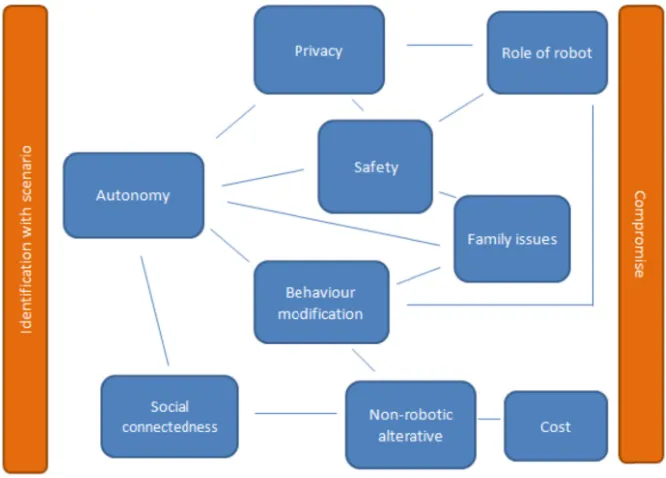
Forming a the tasks r been a lim Ethical pri a research been used of social, p feature of enablemen values, a te Figure 4 d forming ap
There are based on p conflict w robot. Dec the user’s usually ap framework Primary p suggested ability of judgment
.org
he significance ered in robot e
w the assistiv lead to creatin directly interac humans and ex
bot ethics.
nt Robot Ethic
an ethical fram equired from t mited number inciples and va h study on the
as the study p physical, and this robot is c nt are values w entative frame describes the i ppropriate ethi
Figure 4
ethical feature past research c with robot ethic cision feature i perspective w plied (Belloni k.
principles of i by Beaucham users for mak amongst cont
e of the above ethics framew e robots shou ng human-like cting with use xchange emoti
cs Framework
mework for per the robot, iden of ethical fram alues have bee
users of Acce latform. This r cognitive as w companionship which have bee ework has been inter-relationsh ical framework
4. The inter-rel
es which may c case studies. B cs. Contextual implies a situa while considerin
et al., 2014).
intelligent tec mp and Childre king decisions tradictory clai
Asian
mentioned eth orks. One of t ld be designed
emotions betw ers for long pe
ons with them
k
rsonal care rob ntifying deploy
meworks in th en recognized eptable Roboti robot has been well as assistin p which is soc en considered n formed accor hip amongst v k for design an
lationship amo
conflict in auto Belloni et al. (2
l feature refers ation when an a ng social and
Theses ethics
chnology are t ss (2001). In a s. Justice is e ims. Beneficen
n Social Science
156 hical issues, th
those issues is d and interact ween the user eriods of time m. The authors
bots mainly re yment situation he design of p in various rese c Companions n developed wi ng elderly to ac
cially accepted in its design ( rding to philos values obtaine nd practical use
ongst robot eth
onomous robot 2014) have sta s to autonomy
agent needs to collective data
conflicts can
taken from m accordance wi expressed as t nce is explain
here are still ot s the user’s em t with their us
and the robot. . There is a p
believe that it
equires identif n, and the tech personal care r
earch studies. s for Aging Ye ith the purpose ccomplish the d. Safety, indep
(Draper et al., sophical literat ed from elderly
e of social assi
hics values (Dr
t systems. The ated that conte y when an indi o take into acco a. In this proce be taken into
medical ethics ith these princi the moral resp ned as perform
V
ther issues in motions with t ers to alleviat Medical assis ossibility that will be substa
fying the speci hnical ability of robots (Van W (Hewson et al Years (ACCOM
e of providing ir tasks autono pendency, soc
2014). In acc ture and consid
y responses w istive robots.
raper et al., 201
ese features hav extual and dec ividual interac ount principles ess, global and consideration
. Some of th iples, autonom ponsibility to ming tasks wi
Vol. 12, No. 10;
robots that ne the robots. In te users’ emoti stive robots an the users con antial to embed
ific needs of u f robot. There Wynsberghe, 2
l., 2014) condu MPANY) which assistance in t omously. The ial interaction cordance with
derations. with the purpo
14)
ve been recogn cision features ct with at least s which are be d social model in any robot e
hose principles my is defined a perform on a ith the purpos
benefiting individuals, whilst non-maleficence is expressed as taking action without causing harms (Beauchamp & Childress, 2001). These principles were studied by Schu¨lke et al. (2010) and Perry et al. (2009).
Schu¨lke et al. (2010) proposed ethical guidelines for development, assessment, and utilization of ambient assistive technology of an Ambient Lighting Assistance for an Ageing Population (ALADIN). They suggested principles of an ethical hierarchy including: non-harm, autonomy, well-being, and equality. Non-harm means that utilization of technology should decline harms to users. Autonomy indicates that technology is required to be utilized based on values, ambitions, and desires of users. Well-being expresses that technology is required to optimize benefits and diminish disadvantages with the purpose of enhancing user’s life quality and welfare. Equity indicates that technology is required to be available and affordable to all users regardless of factors such as disability, gender, and age.
A practice-based ethics is proposed with the intention of considering ethical healthcare challenges in terms of privacy, accountability, justice, and agency (Brown & Adams, 2007). Ethical concepts of autonomy and life quality have been studied by (Magnusson & Hanson, 2003) in a research project aiming at supporting ageing and their caregivers by using information and community technology.
Though privacy is far important in the design and use of AIT, (Coeckelbergh, 2010; Nussbaum, 2006) stated that privacy should be traded off with other healthcare values including: physical integrity and health, preservation and improvement of human life, and dignity.
Technology should be offered to senior citizens with dementia without requiring learning, maintaining user’s authority and control, putting user’s mind at ease, and diminishing user’s interaction (Van Hoof, 2007).
Ikonen et al. (2009) recommended six primary principles in the design process of a mobile phone platform for AIT including: privacy, autonomy, e-inclusion, integrity and dignity, reliability, and benefit to the society. Privacy indicates that users should be able to control, protect, and have access to their private data. Autonomy implies that the right should be given to users to choose their own purpose for using technology. Based on integrity and dignity, users should be treated with respect and also technical solutions should be identified to trigger their dignity. Based on accountability, technical solutions should be responsible for the intention it is used for. Based on e-inclusion, services should be offered to users regardless of their mental or physical disabilities. Benefit to societies indicates that society is required to implement technology with the purpose of boosting life quality, whilst diminishing harms to individuals.
Nixon et al. (2004) recommended an array of principles for maintaining user’s privacy in the design stage of a smart environment. The proposed principles consist of notifying users about activities of the smart environment, giving right to the user for making decision whether to interact or not, seeking user’s agreement, provision of device to hide user’s identification, distribution of data in accordance with rules and a provision of sufficient security.
Users’ perspectives about intelligent environment are assessed by (Ball & Challaghan, 2011). The result of this research revealed that preserving control and independency in terms of having authority to make decision are far more substantial to the users. It is stated that having more control in gesture sensor system appeals senior citizen noticeably to utilize the system (Zaad & Allouch, 2008).
Callaghan et al. (2009) classified intelligent agents in terms of two significant methods. These methods are the end-user programming and autonomous-agent programming. The user-driven not only authorizes users but also boosts control, supports innovation, and establishes trust. On the other hand, agent-driven enhances utilization, however reduces control, trust, and creativity. These principles are form control of both intelligent agent as well as users in terms of operation and topology and user technology acceptance.
Faden et al. (2013) introduced a framework with seven primary responsibilities including: treating patients’ with dignity and the right of respect, having respect on medical judgment of medical staff, provision of great care to every patient, prevention of nonclinical burdens and threat to patients, diminution of health disparities amongst patients, running responsible exercises fostering learning from clinical information and care, and participation in boosting value and quality of clinical healthcare system and care.
eFRIEND is another holistic ethical framework and methodology proposed by Jones et al. (2015). This user-centered framework supports four chief principles including: maintaining user’s privacy, giving priority to user’s safety at all times, providing assistance based on the preference and needs of individuals are offered assistance, and adhering to user’s commands.
ass.ccsenet.org Asian Social Science Vol. 12, No. 10; 2016
158
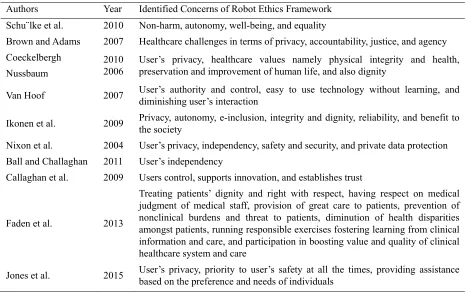
commonly considered amongst them. It can be noticed that some of the frameworks considered a greater number of robot ethics issues, whereas some frameworks focused on a fewer number of issues.
Amongst the proposed ethics robot frameworks, scholars such as Ikonen, Nixon, Faden, and Jones brought significant principles in their frameworks to recover robot ethics issues.
Faden and his group proposed a new framework differing from the other traditional frameworks. Jones and his crews primarily give priority to users and involved stakeholders whereby users opinions are the main consideration in all the processes of design. In other words, main robot ethics issues namely user’s privacy, control, and needs are considered in Jones and his group members’ framework which is eFRIEND. The other two (2) frameworks are conceptual or philosophical at conceptual level, and also ethical issues decline to be considered in practical process of design and actual system. Above listed robot ethics frameworks can be improved by applying ethics general theories to the frameworks.
Table 1. Summary of robot ethics framework
Authors Year Identified Concerns of Robot Ethics Framework Schu¨lke et al. 2010 Non-harm, autonomy, well-being, and equality
Brown and Adams 2007 Healthcare challenges in terms of privacy, accountability, justice, and agency Coeckelbergh
Nussbaum
2010 2006
User’s privacy, healthcare values namely physical integrity and health, preservation and improvement of human life, and also dignity
Van Hoof 2007 User’s authority and control, easy to use technology without learning, and diminishing user’s interaction
Ikonen et al. 2009 Privacy, autonomy, e-inclusion, integrity and dignity, reliability, and benefit to the society
Nixon et al. 2004 User’s privacy, independency, safety and security, and private data protection Ball and Challaghan 2011 User’s independency
Callaghan et al. 2009 Users control, supports innovation, and establishes trust
Faden et al. 2013
Treating patients’ dignity and right with respect, having respect on medical judgment of medical staff, provision of great care to patients, prevention of nonclinical burdens and threat to patients, diminution of health disparities amongst patients, running responsible exercises fostering learning from clinical information and care, and participation in boosting value and quality of clinical healthcare system and care
Jones et al. 2015 User’s privacy, priority to user’s safety at all the times, providing assistance based on the preference and needs of individuals
5. Recommendations and Conclusion
Privacy has principal importance in robotic ethics compared to the other ethical issues. Furthermore, privacy has noticeable impacts on the other ethical issues such as safety, security, and protection of personal data. Moreover, the action of robots, in particular assistive medical robots, has dramatic role on robot users’ control, independency, and decision making. It is undeniably obvious that robot’s performance can create both useful and harmful consequences to the user. There are circumstances which assistive robot faces dilemma to decide about taking the right action minimizing risks and destructive consequences. The action is derived from the frameworks which are used to program robots during the design process. This makes the framework itself the main cause of negative or positive implications and also ethical issues.
action minimizing ethics issue.
References
Aarts, E. (2004). Ambient intelligent: A multimedia perspective. IEEE Multimedia, 11(1), 12-19. http://dx.doi.org/10.1007/978-3-540-73281-5_11
Alaiad, A., & Zhou, L. (2014). The determinants of home healthcare robots adoption: An empirical investigation.
International Journal of Medical Informatics, 83(11), 825-840. http://dx.doi.org/10.1016/j.ijmedinf.2014. 07.003
Albrechtslund, A. (2007). House 2.0: Towards an ethics for surveillance in intelligent living and working environments. Proceedings of the Seventh International Conference of Computer Ethics Philosophical Enquiry, 7-16. San Diego, USA: University of San Diego.
Alexander, L., & Moore, M. (2007). Deontological Ethics.
Asaro, P. (2006). What should we want from a robot ethic? In R. Capurro, & M. Nagenborg (Eds.), Ethics and robotics. Amsterdam, the Netherlands: IOS Press.
Augusto, J. C., McCullagh, P. J., & Augusto-Walkden, J.-A. (2011). Living without a safety net in an intelligent environment. ICST Transactions on Ambient Systems, 11(10-12), e6. http://dx.doi.org/10.4108/trans.amsys. 2011.e6
Ball, M., & Callaghan, V. (2011). Perceptions of autonomy: A survey of users’ opinions towards autonomy in intelligent environments. In Proceedings of the 7th International Conference on Intelligent Environments,
(pp. 277-284). Amsterdam: IOS Press. http://dx.doi.org/10.1109/IE.2011.68
Beauchamp, T. L., & Childress, J. F. (2001). Principles of biomedical ethics. Oxford: Oxford University Press. Belloni, A., Berger, A., Besson, V., Boissier, O., Bonnet, G., Bourgne, G., & Jaillon, P. (2014, June). Towards a
Framework to Deal with Ethical Conflicts in Autonomous Agents and Multi-Agent Systems. In CEPE 2014 Well-Being, Flourishing, and ICTs.
Bohn, J., Coroama, V., Langheinrich, M., Mattern, F., & Rohs, M. (2004). Living in a world of smart everyday objects-Social, economic, and ethical implications. Human and Ecological Risk Assessment, 10(5), 763-785. http://dx.doi.org/10.1080/10807030490513793
Bowen, S. A. (2004). Expansion of ethics as the tenth generic principle of public relations excellence: A Kantian theory and model for managing ethical issues. Journal of Public Relations Research, 16(1), 65-92. http://dx.doi.org/10.1207/s1532754xjprr1601_3
Brey, P. (2005). Freedom and privacy in ambient intelligent. Ethics and Information Technology, 7(3), 157-166. http://dx.doi.org/10.1007/s10676-006-0005-3
Brown, I., & Adams, A. (2007). Ethical challenges of ubiquitous healthcare. International Review of Information Ethics, 8(12), 53-60.
Caire, P., Moawad, A., Efthymiou, V., Bikakis, A., & Le Traon, Y. (2014). Privacy challenges in ambient intelligent systems: Lessons learned, gaps and perspectives. Journal of Ambient intelligent and Smart Environments, 1, 1-23.
Callaghan, V., Clarke, G., & Chin, J. (2009). Some socio-technical aspects of intelligent buildings and pervasive computing research. Intelligent Buildings International, 1(1), 56-74. http://dx.doi.org/10.3763/inbi.2009. 0006
Chan, M., Campo, E., Este`ve, D., & Fourniols, J.-Y. (2009). Smart homes-Current features and future perspectives. Maturitas, 64, 90-97. http://dx.doi.org/10.1016/j.maturitas.2009.07.014
Coeckelbergh, M. (2010). Health care, capabilities, and AI assistive technologies. Ethical Theory and Moral Practice, 13(2), 181-190. http://dx.doi.org/10.1007/s10677-009-9186-2
Coughlin, J. F., D’Ambrosio, L. A., Reimer, B., & Pratt, M. R. (2007). Older adult perceptions of smart home technologies: Implications for research, policy & market innovations in healthcare. In Proceedings of the 29th Annual International Conference of IEEE Engineering in Medicine and Biology Society (pp. 1810-1815). http://dx.doi.org/10.1109/IEMBS.2007.4352665
ass.ccsenet.org Asian Social Science Vol. 12, No. 10; 2016
160
Cummiskey, D. (2013). Consequentialism. The international encyclopedia of ethics. http://dx.doi.org/10.1002/ 9781444367072.wbiee428
Draper, H., Sorell, T., Ruiz, S. B. C. G., Lehmann, H., Hervé, M., Gelderblom, G. J., Dautenhahn, K., & Amirabdollahian, F. (2014). What asking potential users about ethical values adds to our understanding of an ethical framework for social robots for older people, Proceeding of the MEMCA-14.
Faden, R. R., Kass, N. E., Goodman, S. N., Pronovost, P., Tunis, S., & Beauchamp, T. L. (2013). An ethics framework for a learning health care system: a departure from traditional research ethics and clinical ethics.
Hastings Center Report, 43(s1), S16-S27. http://dx.doi.org/10.1002/hast.134
Friedewald, M., Da Costa, O., Punie, Y., Alahuhta, P., & Heinonen, S. (2005). Perspectives of ambient intelligent in the home environment. Telematics Informatics, 22, 221-238. http://dx.doi.org/10.1016/j.tele.2004.11.001 Hert, P. D., Gutwirth, S., Moscibroda, A., Wright, D., & Gonza´lez Fuster, G. (2009). Legal safeguards for
privacy and data protection in ambient intelligent. Personal and Ubiquitous Computing, 13(6), 435-444. http://dx.doi.org/10.1007/s00779-008-0211-6
Hewson, D. J., Gutierrez Ruiz, C., & Michel, H. (2014). Development of a multidimensional evaluation method for the use of a robotic companion as a function of care relationships. Gerontechnology, 13(2), 79.
Hoffman, W. M., Frederick, R. E., & Schwartz, M. S. (Eds.). (2014). Business ethics: Readings and cases in corporate morality. John Wiley & Sons.
Hursthouse, R. (2013). Normative virtue ethics. ETHICA, 645.
Ikonen, V., Kaasinen, E., & Niemelaa, M. (2009). Defining ethical guidelines for ambient intelligent applications on a mobile phone. Proceedings of the 5th International Conference on Intelligent Environments (pp.
261-268). Amsterdam: IOS Press.
Johnson, R. (2008). Kant's moral philosophy. Stanford encyclopedia of philosophy.
Jones, S., Hara, S., & Augusto, J. C. (2015). eFRIEND: an ethical framework for intelligent environments development. Ethics and Information Technology, 17(1), 11-25. http://dx.doi.org/10.1007/s10676-014-93 58-1
Kaasinen, E., Kyma¨la¨inen, T., Niemela¨, M., Olsson, T., Kanerva, M., & Ikonen, V. (2013). A user-centric view of intelligent environments: User expectations, user experience and user role in building intelligent environments. Computers, 2, 1-33. http://dx.doi.org/10.3390/computers2010001
Landau, R., Auslander, G. K., Werner, S., Shoval, N., & Heinik, J. (2010). Families’ and professional caregivers’ views of using advanced technology to track people with dementia. Qualitative Health Research, 20(3), 409-419. http://dx.doi.org/10.1177/1049732309359171
Langheinrich, M., Coroama, V., Bohn, J., & Friedemann, M. (2004). Living in a smart environment-implications for the coming ubiquitous information society. Telecommunications Review, 15(1), 132-143. http://dx.doi.org/10.1109/ICSMC.2004.1401091
Lin, P., Abney, K., & Bekey, G. (2011). Robot ethics: Mapping the issues for a mechanized world. Artificial Intelligence, 175(5), 942-949. http://dx.doi.org/10.1016/j.artint.2010.11.026
Lin, P., Abney, K., & Bekey, G. A. (2011). Robot ethics: the ethical and social implications of robotics. MIT Press.
Magnusson, L., & Hanson, E. J. (2003). Ethical issues arising from a research, technology and development project to support frail older people and their family carers at home. Health and Social Care in the Community, 11(5), 431-439. http://dx.doi.org/10.1046/j.1365-2524.2003.00446.x
Mittelstadt, B., Fairweather, N. B., McBride, N., & Shaw, M. (2013). Privacy, risk and personal health monitoring. Proceedings of ETHICOMP 2013: The possibilities of ethical ICT, 340-351.
Morin, C., & Dick, D. G. (2015). The Development of the Ethical Approach Scale: An Operationalization of Moral Theory. In Academy of Management Proceedings, 1, 13236. http://dx.doi.org/10.5465/AMBPP.2015. 13236abstract
Nixon, P., Wagealla, W., English, C., & Terzis, S. (2004). Security, privacy and trust issues in smart environments. In D. Cook, & S. Das (Eds.), Smart environments: Technology, protocols and applications
(pp. 220-240).
University Press. http://dx.doi.org/10.1353/mod.2008.0014
Oishi, M. M. K., Mitchell, I., & Machiel Van der Loos, H. F. M. (Eds.). (2010). Design and use of assistive technology: Social, technical, ethical, and economic challenges. New York:Springer.
Perry, J., Beyer, S., & Holm, S. (2009). Assistive technology, telecare and people with intellectual disabilities: Ethical considerations. Journal of Medical Ethics, 35, 81-86. http://dx.doi.org/10.1136/jme.2008.024588 Peterson, M. (2013). The dimensions of consequentialism: Ethics, equality and risk. Cambridge University Press. Price, B. A., Adam, K., & Nuseibeh, B. (2005). Keeping ubiquitous computing to yourself: A practical model for
user control of privacy. International Journal of Human-Computer Studies, 63(1-2), 228-253. http://dx.doi.org/10.1016/j.ijhcs.2005.04.008
Rashidi, P., & Mihailidis, A. (2013). A survey on ambient assisted living tools for older adults. IEEE Journal of Information Technology in Biomedicine, 17(3), 579-590. http://dx.doi.org/10.1109/JBHI.2012.2234129 Rouvroy, A. (2008). Privacy, data protection, and the unprecedented challenges of ambient intelligent. Studies in
Ethics, Law, Technology, 2(1), 1-51. http://dx.doi.org/10.2202/1941-6008.1001
Sadri, F. (2011). Ambient intelligent: A survey. ACM Computing Surveys. http://dx.doi.org/10.1145/1978802. 1978815
Sandler, R. L. (2013). Environmental Virtue Ethics. Blackwell Publishing Ltd.
Schu¨lke, A., Plischke, H., & Kohls, N. (2010). Ambient Assistive Technologies (AAT): Socio-technology as a powerful tool for facing the inevitable sociodemographic challenges? Philosophy, Ethics, and Humanities in Medicine. http://dx.doi.org/10.1186/1747-5341-5-8
Sharkey, A., & Sharkey, N. (2012). Granny and the robots: ethical issues in robot care for the elderly. Ethics and Information Technology, 14(1), 27-40. http://dx.doi.org/10.1007/s10676-010-9234-6
Shaw, W., & Barry, V. (2015). Moral issues in business. Cengage Learning.
Sparrow, R., & Sparrow, L. (2006). In the hands of machines? The future of aged care. Mind and Machine, 16,
141-161. http://dx.doi.org/10.1007/s11023-006-9030-6
Sullivan, R. J. (1989). Immanuel Kant’s moral theory. Cambridge, England: Cambridge University Press. Sullivan, R. J. (1994). An introduction to Kant’s ethics. New York: Cambridge University Press.
Sun, H., De Florio,V., Gui, N., & Blondia, C. (2009). Promises and challenges of ambient assisted living systems. In Proceedings of the 6th International Conference on Information Technology: New Generations (pp. 1201-1207). IEEE. http://dx.doi.org/10.1109/ITNG.2009.169
Van Heerde, H. J. W., Anciaux, N. L. G., Feng, L., & Apers, P. M. G. (2006). Balancing smartness and privacy for ambient intelligent. Proceedings of the 1st European conference on Smart Sensing and Context (EuroSSC) Lecture Notes in Computer Science 4272, 255-258.
Van Hoof, J., Kort, H. S. M., Markopoulos, P., & Soede, M. (2007). Ambient intelligent, ethics and privacy.
Gerontechnology, 6(3), 155-163. http://dx.doi.org/10.4017/gt.2007.06.03.005.00
Van Hoof, J., Kort, H. S. M., Rutten, P. G. S., & Duijnstee, M. S. H. (2011). Ageing-in-place with the use of ambient intelligent technology: Perspectives of older users. International journal of medical informatics, 80(5), 310-331. http://dx.doi.org/10.1016/j.ijmedinf.2011.02.010
Van Hooft, S. (2014). Understanding virtue ethics. Routledge.
Van Wynsberghe, A. (2013). Designing robots for care: Care centered value-sensitive design. Science and engineering ethics, 19(2), 407-433. http://dx.doi.org/10.1007/s11948-011-9343-6.
Veruggio, G., & Operto, F. (2006). Roboethics: A bottom-up interdisciplinary discourse in the field of applied ethics in robotics. In International Review of Information Ethics. Ed. Ethics in Robotics, 2-8.
Wallach, W., Franklin, S., & Allen, C. (2010). A conceptual and computational model of moral decision making in human and artificial agents. Topics in Cognitive Science, 2(3), 454-485. http://dx.doi.org/10.1111/j.1756- 8765.2010.01095.x
Weiser, M., & Brown, J. S. (1996). Designing calm technology. Power Grid Journal, 1(1), 75-85. WHO. (2016). Health topics: Ageing. Retrieved from http://www.who.int/topics/ageing/en/
ass.ccsenet.org Asian Social Science Vol. 12, No. 10; 2016
162
ambient intelligent. New York: Springer.
Yampolskiy, R. V. (2013). Artificial intelligence safety engineering: Why machine ethics is a wrong approach
(pp. 389-396). Springer Berlin Heidelberg. http://dx.doi.org/10.1007/978-3-642-31674-6_29
Zaad, L., & Allouch, S. B. (2008). The influence of control on the acceptance of Ambient intelligent by elderly people: An explorative study. In Proceedings of AmI European Conference 2008, Nuremberg. Lecture Notes in Computer Science, 5355, 58-74. http://dx.doi.org/10.1007/978-3-540-89617-3_5
Copyrights
Copyright for this article is retained by the author(s), with first publication rights granted to the journal.