PARALLEL ROUGH SET APPROXIMATION USING
MAPREDUCE TECHNIQUE IN HADOOP
Ms.Suruchi V. Nandgaonkar
1, Prof.A.B.Raut
2 1Student ME CSE,
2Associate Prof. HVPM COET Amravati Maharashtra, (India)
ABSTRACT
Rough set theory can be considered as a tool to study the uncertain, indescendent data by classifying the set into
ternary classification as lower, upper and boundary region. This paper helps explaining the rough set theory
using map-reduce in Hadoop. Some features can reduce the number of input dimension, so that the process
can be executed in comparative less time. Using this method this can help many organizations that are facing
problem related to the data handling and data analysis. Existing method calculates rough set approximation in
serial way. Therefore a parallel method used Map-Reduce have developed to manage many large-scale
computations. Recently introduced Map-Reduce technique has received much consideration from both scientific
community and industry for its applicability in big data analysis. The effective computation of approximation is
essential step in improving the performance of rough set. For mining the massive data, parallel computing
modes, algorithms and different methods get used in research fields. In this paper, we have explained a parallel
method for computing rough set. Using map-reduce we can achieve the same. Because of map-reduce we can
generate rules and abstract attributes of massive data. To mine knowledge from big data, we present
consequently algorithm corresponding to the MapReduce based on roughest theory are put forward to deal with
the massive data.
Keywords
:
Data Mining, Mapreduce, Hadoop, Rough Set
I. INTRODUCTION
Handling the huge amount of data has been the serious problem now days and with this massive data comes the
application associated with it such as association rule mining, sequential pattern mining, text mining and
temporal mining. But, with the emergence of hadoop implementation into the map-reduce technique we can
solve the problem of the many organizationthat they are facing with it. From last few decenniums, the size of
the data stored in the databases has been increasing each day and therefore we face lots of difficulties about
obtaining the worthful data. It has become difficult to reach accurate and useful information as the data stored in
the databases is growing each day. To find out the rules or interesting and useful patterns within stored data in
the databases, data mining techniques are used. Storing huge amount of increasing data in the databases, which
is called information explosion, it is necessary to transform these data into necessary and useful information.
Using conventional statistics techniques fail to satisfy the requirements for analyzing the data. Data mining is a
nontrivial process of determination of valid, unknown and potential useful and easily understandable
requirements. For massive data is always a hot topic in data mining data mining is the deficiency and
indeterminateness. This problem is solved by using new theories and procedures, for example fuzzy sets, genetic
algorithms or rough sets. Data processing and knowledge discovery for massive data has always been an active
research area in data
Dean and Ghemawat from Google firstly presented a parallel programming model in MapReduce, which was a
framework for processing huge data sets on certain kinds of distributable problems using a large number of
computers (nodes), collectively referred to as a cluster. MapReduce is a popular computing model. MapReduce
framework offers clean abstraction between data analysis task and the underlying systems challenges involved
in ensuring reliable large-scale computation. Finally, the MapReduce runtime system can be transparently
explore the parallelism and schedule these components to distribute resource for execution.
II. ROUGH SET THEORY
Rough set theory was proposed by Zdzislaw pawlak in1982.This method is considered as one of the non-static
approach in data analysis and deals with the uncertain, indescendent and incomplete data.
Finding rough approximations comes in following steps.
Finding decision set
Equivalence class
Association class
Lower, Upper and Boundary approximations
Consider a set X is a subset of U. We want to characterize the set with respect to Y using rough set theory then,
Lower approximations: It is a set of items which can be definitely classified as X.
Upper approximation: It is defined as a set of item which can be possibly classified as item of X.
Boundary Approximation: It is a set of items which can be classifies either as items of X or may not be.
Consider the following example for the better understanding of data. In the following example, first column
refers to the objects while the next columns such as „Income‟, ‟Student „and „Credit Rating‟ are the attributes
while the last column refers to the decision of the attribute.
In the below table we can see person X3 and X3 have same attributes still the results are different. we call this
type of data as indescendent or inconsistent data. In such situations rough set proves very useful.
Decision class Yes=[X3,X4,X5,X7,X9,X10,X11,X12,X13]
Decision class No=[X1, X2, X6, X8, X14]
Equivalence class: Eq1=[X1, X3] Eq2=[X6, X7] Eq3=[X4, X8] Eq4=[X5, X9] Eq5=[X6, X7] Eq6=[X10]
Eq7=[X11] Eq8=[X12, X14]
Association class: We compare each of the equivalence class with the decision class.
Approximations:
Lower approximation = [{X5, X9},{X10},{X11}]
Upper Approximation=[{X2}]
Boundary region= [{X2,{X6,X7},{X12,X14},{X1,X3},
The regularity hidden in the data are generally expressed in terms of the rules. Which are the basic tool of data
mining .Rule are expressed of the form If (attribute1, value1) and (attribute2, value2) and Then (decision value)
The number of consistent rule in the table is known as factor of consistence which is denoted by ᵧ (C,D)=1.
Here, C is the condition and D is the decision, if ᵧ(C, D)≠1 then the table is not consistent.
Table 1: An Example of Data Set (Decision Table S)
2.1 Advantages of Implementing Rough Set in Hadoop
Design for huge data: Hadoop is mainly design to handle and process a large amount of data systematically and
using parallel method.
1. Reliability: It achieves reliability by replicating the data across multiple hosts, and hence theoretically does
not require RAID storage on hosts .Replication is by default set to 3.
2. Streaming pattern: It can handle lots of streaming reads and infrequent writes.
3. Not fully POSIX: HDFS is not completely POSIX (Portable Operating System Interface)-compliant, because
the requirements for a POSIX file-system differ from the target goals for a Hadoop application.
4. Increased Bock size: The increase in the block size (64MB) results in handling reduced numbers of blocks
and fast processing.
5. Parallel processing: The rough set that we are using is parallel in nature and again parallel processing of it
will reduce time processing at much extend.
MAPREDUCE
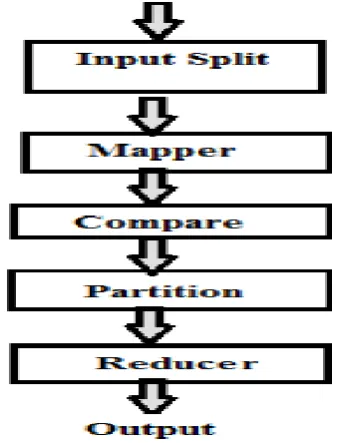
Map-Reduce allows for distributed processing of the Map and Reduce functions. The Map-Reduce divides the
input file into no of blocks by method “input split”. It is used for processing data on commodity hardware.
Person Income Student Credit rating Buys computer
X1 High No Fair No
X2 High No Excellent No
X3 High No Fair Yes
X4 Medium No Fair Yes
X5 Low Yes Fair Yes
X6 Low Yes Excellent No
X7 Low Yes Excellent Yes
X8 Medium No Fair No
X9 Low Yes Fair Yes
X10 Medium Yes Fair Yes
X11 Medium Yes Excellent Yes
X12 Medium No Excellent Yes
X13 High Yes Fair Yes
Step 1: Input reader:
It divides the input into appropriate size splits i.e. blocks and assigns one split to each map function. The input
reader reads data from stable storage and generates key/value pairs.
Step 2: Mapper
It processes a key/value pair and generates another key/value pair. A number of such map functions
running in parallel on the data that is partitioned across the cluster, produce a set of intermediate key/value
Pairs. Mapk, v → <k′, v′ >
Step 3: Compare function
The input for each reduces is pulled from the machine where the map ran and stored using the applications
comparison function. Computek′, v′ → <k′, v′ >
Step 4: Partition Function
The partition function is given the key and the number of reducers and returns the indexes of the desired reduce.
It is important to pick a partition function that gives an approximately uniform distribution of data reducers
assigned more than their share of data for load-balancing operation to finish.
Step 5: Reducer
The reduce function then merge all intermediate values that are associated with the same intermediate key.
Reducek′, v′ → <k′, v′ >
Step 6: Output
Map-Reduce allows developers to write and deploy code that runs directly on each data-node server in the
cluster. That code understands the format of the data stored in each block in the file and can implement simple
algorithms and much more complex ones. It can be used to process vast amounts of data in-parallel on large
clusters in a reliable and fault tolerant fashion. Consequently, it renders the advantages of the Map/Reduce
available to the users
The rough set approximations obtained by the parallel method are the same as those obtained by the serial
method. But using map reduce we can run independent phases in parallel as computing equivalence class,
computing decision class, constructing associations based on map-reduce. Therefore time required is very less
as compared to traditional method of rough set calculation. In addition to that we can also generate the rules for
massive data and able to abstract attributes in more efficient way using map-reduce with rough set.
III. PARALLEL ROUGH SET SYSTEM
Existing method for calculating rough set performs in-memory processing. Firstly, it calculates the equivalence
class and then decision class. And at the last approximation of decision class calculated. Existing method
calculates the rough set serially. It cannot deal with large data sets. Therefore we have used parallel method
performs on the Hadoop platform which may remove the data size limit due to transparent spilling. Data
partitioning, fault tolerance, execution scheduling is provided by MapReduce framework itself. MapReduce was
designed to handle large data volumes and huge clusters (thousands of servers). MapReduce is a programming
framework that allows executes user code in a large cluster. All the user has to write two functions: Map and
Reduce .During the Map phase, the input data are distributed across the mapper machines, where each machine
then processes a subset of the data in parallel and produces one or more <key; value> pairs for each data record.
Next during the Shuffle phase, those <key, value> pairs are repartitioned (and sorted within each partition) so
that values corresponding to the same key are grouped together into values {v1; v2; :::}. Finally, during the
Reduce phase, each reducer machine processes a subset of the <key, {v1; v2; :::}> pairs in parallel and writes
the final results to the distributed file system. The map and reduce tasks are defined by the user while the shuffle
is accomplished by the system .Even though the former pseudo code is written in terms of string inputs and
outputs, conceptually the map and reduce functions supplied by the user have associated types.
Map (k1, v1) → list (k2, v2)
Reduce (k2, list (v2)) → list (v2)
Two programmer specified f• Map Input: key/value pairs (k1, v1)
Output: intermediate key/value pairs list (k2, v2)
• Reduce Input: intermediate key/value pairs (k2, list (v2))
Output: List of values list (v2)
That is, the input keys and values are drawn from a different domain than the output keys and values. The k1,k2
are the two different keys used in MapReduce phase and same as v1, v2 are the different values. The
intermediate keys and values are from the same domain as the output keys and values
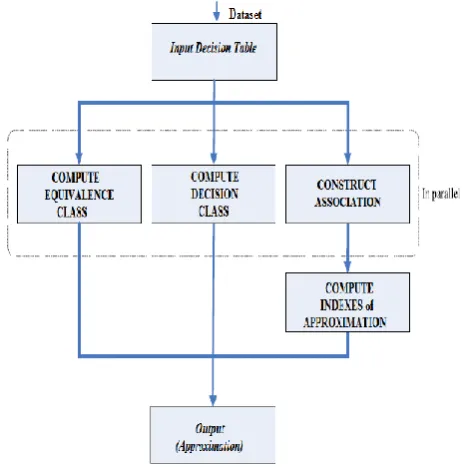
In this system we can compute both rough set equivalence classes and decision classes in parallel using the
Map-Reduce technique. The associations between equivalence classes and decision classes of the decision table
can also be executed in parallel. Lower and upper approximations are computed by associations between
equivalence classes and decision classes. However, if we compute the approximations directly, memory may
overflow since equivalence classes and decision classes both contain too many objects while dealing the large
data set. Hence we can compute the Indexes of Rough Set Approximations i.e. the set of information for each
After computing the indexes of approximations, we output the approximations directly. The diagram of the
parallel method for computing rough set approximations is shown below.
Fig 2: Method to Calculate Approximation Based on Map Reduce
The rough set approximations obtained by the parallel method are the same as those obtained by the serial
method. But using map reduce we can run independent phases in parallel as computing equivalence class,
computing decision class, constructing associations based on map-reduce. Therefore time required is very less
as compared to traditional method of rough set calculation. In addition to that we can also generate the rules for
massive data and able to abstract attributes in more efficient way using map-reduce with rough set. Map-Reduce
framework offers clean abstraction between data analysis task and the underlying systems challenges involved
in ensuring reliable large-scale computation. Map-Reduce runtime system can be transparently explore the
parallelism and schedule components to distribute resource for execution.
3.1 Characeristics of Parallel Rough Set System
We can measure the performance of this system using three characteristics as described below.
• Speed up:
To measure the speedup, we keep the data set constant and increase the number of nodes (computers) in the
system. Speedup given by the larger system is defined by the following formula :
Speedup (p) = T1 / Tp;
where p is the number of nodes (computers), T1 is the execution time on one node, Tp is the execution time on p
nodes. We can perform the speedup evaluation on data sets with quite different sizes and structures. The number
of nodes (computers) varied from one to many. In Serial existing system with p times the number of computers
yields a speedup of p. However, linear speedup is difficult to achieve because the communication cost increases
with the number of clusters becomes large.
Scale up is defined as the ability of a p-times larger system to perform a p-times larger job in the same execution
time Scale up (D, p) = TD1/TDp where D is the data set, TD1 is the execution time for D on one node, TDp is
the execution time for p × D on p nodes .To check whether the proposed system handles larger data sets when
more nodes are available. Therefore we can perform scale up experiments, where we can increase the size of the
data sets in direct proportion to the number of nodes in the system
• Size up:
Size up is defined as the following formula :
Size up (D, p) = TSp/ TS1
where TSp is the execution time for p × D, TS1 is the execution time for D.Size up analysis holds the number of
computers in the system constant, and grows the size of the data sets by the factor p. Size up measures how
much longer it takes on a given system, when the size of data set is p-times larger than that of the original data
set.
IV. LIMITATIONS
Hadoop is not meant for storing large number of small files.
1. HDFS is not suitable to efficiently access small files: it is primarily designed for streaming access of large
files. Reading through small files normally causes lots of seeks and lots of hopping from data node to data node
to retrieve each small file, which is an inefficient data access pattern?
2. Every file, directory and block in HDFS is represented as an object in the name node‟s memory, each of
which occupies 150 bytes. The block size is 64 Mb. So even if the file is of 20 kb, it would be allocated an entire
block of 64 Mb. That‟s a waste disk space
V. CONCLUSION
Up till now, many rough sets based algorithms have been developed for data mining. But enlarged data in
applications made these algorithms based on rough sets a challenging task. Computation of rough set
approximation is very important step. We can improve the quality and speed of calculating approximation. This
is one way where we have lots of opportunities to achieve speed and accuracy.
In this paper, we proposed a parallel method for rough set. Using map-reduce we can achieve the same. Because
of map-reduce we can generate rules and abstract attributes of massive data. Future work will involve the
parallel frequentpattern mining exploration of an alternative method that calculate the attribute space, so that
information systems with a large number of attributes, such as those used in mathematical, may be analyzed
effectively.
VI. ACKNOWLEDGMENT
I am thankful to all the teachers and the principal for their valuable guidance. I would like to sincerely thank
Prof. Anjali Raut Madam whose knowledgeable guidance helped me to make more descriptive. I would also
REFERENCE
[1] Ing.Pavel Jurka, Using rough set in data mining.
[2] Z. Pawlak, W.Ziarko CommunicationofACM,38,1995,p.88
[3] Zdzislaw.pawlak,Rough set theory and its applications ,Journals of telecommunication and information
technology.
[4] DevarajDas,Owen O‟Melly,Sanjay Radia,KanZang,Adding security to apache hadoop,
HortonworksTechnical Re-port,www.Hortonworks.com
[5] Junbo Zhang a, Tianrui Li , Da Ruan, ZizheGao, Chengbing Zhaoa,‟ A parallel method for computing
rough set approximations‟, J. Zhang et al./ Information Sciences 194 (2012) 209–223
[6] A.Pradeepa1,Dr.AntonySelvadossThanamaniLee2,‟hadoop file system and Fundamental concept of
MapReduce interior and closure Rough set approximations‟, International Journal of Advanced Research
in Computer and Communication EngineeringVol. 2, Issue 10, October 2013
[7] „Rough set based decision support‟ Roman Slowinski Institute of Computing Science Poznan University
of Technology and Institute for Systems Research Polish Academy of Sciences Warsaw, Poland
[8] MertBaMathematical Engineering Department, Yildiz Technical University, Esenler, İstanbul, TURKEY
„Rough Sets Theory as Symbolic Data Mining Method: An Application on Complete Decision Table
[9] J. Han, M. Kamber, Data Mining: Concepts and Techniques, second ed., Morgan Kaufman, San Francisco,
2006.
[10] P.Y. Hsu, Y.L. Chen, C.C. Ling, Algorithms for mining association rules in bag databases, Information