506 |
P a g e
A DISTRIBUTED CLUSTRING ROUTING METHOD
FOR QOS OPTIMIZING IN WSN USING NDC
ALGORITHM
Mr. Pranil Nandeshwar
1, Prof. Gajendra Singh Chandel
21
M.Tech Student, Software Engineering, S.S.S.I.S.T. Sihore, (India)
2
H.O.D, Software Engineering, S.S.S.I.S.T. Sihore, (India)
ABSTRACT
Today’s world is highly influenced by technology consists of sensors. Applications based on Wireless sensor
nodes are evolving rapidly with complex nature that demands fast, reliable, timeliness and energy effectiveness.
One of the most important constraints of WSN is energy consumption. Since the micro sensors are small in
dimension, batteries are necessary to produce power to the network. The paper proposed an algorithm for
distributed clustering based protocols of wireless sensor networks. The proposed protocol optimises route and
perform load balancing in intra as well as inter cluster nodes. The protocol consists of setup, data transmission
and optimal balancing phases. Setup phase chooses cluster heads (CH) and form clusters. Data transmission
phase gather sensed information at cluster head in individual cluster and then the gathered data is transmitted
to the sink via mobile agent. Hence efficient way of data transmission is possible with larger group of nodes. In
this approach of using hierarchy based protocols; the lifetime of the sensor network is increased. This paper
proposes an innovative approach of cluster head election. The results are compared with LEACH and HEED
cluster based routing protocol and proved to be energy, delay and lifetime efficient.
Keywords: Cluster Head (CH), Distributed Clustering, Quality Of Service (QOS), Wireless
Sensor Network (WSN).
I. INTRODUCTION
With the advancements in Wireless communication, the design and implementation of WSNs have become a
sizzling and important area of research. The micro-sensors along with compact and portable computing devices
have made the distributed sensing of greater importance. It enables the applications to connect the physical
world to the virtual world due to the latent of sensor networks. Furthermore, to obtain the information about the
physical environment was in fact difficult or almost impossible in more conventional ways. But by introducing
the sensor networks with tiny sensor nodes, the whole picture turned upside-down, turned impossible possible.
As micro-fabrication technology will become advanced in the future it will ultimately allow the increase
deployments of wireless sensor networks and cost of manufacturing sensor nodes to fall, where the networks are
growing rapidly to large number of nodes, for e.g., thousands[1]. When compared to data processing, the data
transmission consumes more energy in WSN. The data aggregation will balance the energy consumption of each
507 |
P a g e
networks are accuracy, low cost, greater coverage area and reliability. The WSN perform a specific datagathering and transmission by deploying large number of sensor nodes randomly. It has a base station called as
sink, which receives the transmitted data. For such large scale wireless sensor networks large number of
potential applications exist in a variety of fields like medical monitoring, environmental monitoring,
surveillance, security, military operations and industrial machine monitoring. For better view and understanding
as to why traditional protocols are not best suited for these types of sensor network applications, the unique
features of sensor networks and the performance metrics with which the protocols for the sensor networks must
be evaluated will be categorized in the remainder of this section. To achieve the specific performance
requirements of these networks one of the popular approaches used is Clustering. After clustering, the cluster
head collects and gathers the sensed data and transmits to the sink. The cluster head election is rotated to share
the burden of the head and balance the energy consumption [4]. There is always a limitation on the cost and size
of the network, because the power of the nodes depends on the actual power embedded in the nodes [5]. The
paper consist of introduction, literature survey, proposed methodology, simulation experiment and result
followed by conclusion. The next section explains the restrictions and challenges in designing WSNs
application. Literature survey focusing on distributed approach for the solution of problems. Proposed approach
is the adapted from LEACH, but load balancing and route optimisation is somehow different. Simulation
experiment is performed and obtained results are concluded respectively in last three sections.
II. QOS CHALLENGES IN WSNs
WSN design is motivated and influenced by one or more of the following technical challenge: WSN has four
design constraints, which are bandwidth, memory energy and consumption. Because of its small size micro
sensors could only be attached with bounded battery energy supply. The WSN batteries are non-rechargeable
and/or irreplaceable. The memory limitation allows them to perform with restricted computational functionality.
The connectivity and topology of WSNs may frequently vary due to the unreliability of the individual wireless
micro sensors. Sensor nodes incur more errors since it uses wireless medium. The communication environment
is mostly noisy and can cause severe signal distortion. WSN is used for wide range of tasks, such as target
detection and tracking, environment monitoring, remote sensing, military surveillance, etc., Requirements for
the different applications may vary significantly. Privacy and safety should be essential considerations in the
design of WSNs because many of them are used for surveillance or military purposes. The accuracy of data
reported to what is actually occurring in the environment represents the quality of WSN. The way to measure
accuracy is the amount of data. Latency is another aspect of accuracy. Data collected by WSNs are typically
time sensitive, e.g., early warning of fires. It is therefore important to receive the data at the destination/control
centre in a timely manner. With long latency may be outdated and lead to wrong reactions [6] due to processing
or communication data.
III. TAXONOMY OF CLUSTER BASED ROUTING
Clustering attributes in WSNs, generally, can be roughly classified into cluster characteristics, cluster-head
characteristics, clustering process and entire proceeding of the algorithm. The categories included in the
508 |
P a g e
Fig.1. Taxonomy of Clustering Methods in WSNs.
3.1 Cluster Characteristics
3.1.1 Variability of Cluster Count
Based on variability of cluster count, clustering schemes can be classified into two types: fixed and variable
ones. In the fixed scheme, the set of cluster-head are predetermined and the number of clusters is fixed.
However, the number of clusters is variable in the variable scheme, in which CHs are selected, randomly or
based on some rules, from the deployed sensor nodes.
3.1.2 Uniformity of Cluster Sizes
In the light of uniformity of cluster sizes, clustering routing protocols in WSNs can be classified into two
classes: even and uneven ones, respectively with the same size clusters and different size clusters in the network.
In general, clustering with different sizes clusters is used to achieve more uniform energy consumption and
avoid energy hole.
3.1.3 Intra-Cluster Routing
According to the methods of inter-cluster routing, clustering routing manners in WSNs also include two classes:
single-hop intra-cluster routing methods and multiple-hop ones. For the manner of intra-cluster single-hop, all
MNs in the cluster transmit data to the corresponding CH directly. Instead, data relaying is used when MNs
communicate with the corresponding CH in the cluster.
3.1.4 Inter-Cluster Routing
Based on the manners of inter-cluster routing, clustering routing protocols in WSNs include two classes:
509 |
P a g e
communicate with the BS directly. In contrast to it, data relaying is used by CHs in the routing scheme ofinter-cluster multiple-hop.
3.2 Clusters-Head Characteristics
3.2.1 Existence
Based on whether there exist cluster-heads within a cluster, clustering schemes can be grouped into cluster-head
based and non-cluster-head based clustering. In the former schemes, there exist at least one CH within a cluster,
but there aren’t any CHs within a cluster in the latter schemes, such as some chain based clustering algorithms.
3.2.2 Difference of Capabilities
Based on uniformity of energy assignment for sensor nodes, clustering schemes in WSNs can be classified into
homogeneous or heterogeneous ones. In homogeneous schemes, all the sensor nodes are assigned with equal
energy, computation, and communication resources and CHs are designated according to a random way or other
criteria. However, sensor nodes are assigned with unequal capabilities in heterogeneous environment, in which
the roles of CHs are pre-assigned to sensor nodes with more capabilities.
3.2.3 Mobility
According to the mobility attributes of CHs, clustering approaches in WSNs also can be grouped into mobile
and stationary manners. In the former manners, CHs are mobile and membership dynamically change, thus a
cluster would need to be continuously maintained. Contrary to it, CHs are stationary and can keep a stable
cluster, which is easier to be managed. Sometimes, a CH can travel for limited distances to reposition itself for
better network performance [7].
3.2.4 Role
A CH can simply act as a relay for the traffic generated by the sensor nodes in its cluster or perform
aggregation/fusion of collected information from sensor nodes in its cluster. Sometime, a cluster head acts as a
sink/BS that takes actions based on the detected phenomena or targets [7]. It is worth mentioning, sometimes a
CH acts in more than one role.
4.1 Clustering Process
4.1.1 Control Manners
Based on control manners of clustering, clustering routing methods in WSNs can be grouped into centralized,
distributed and hybrid ones. In centralized methods, a sink or CH requires global information of the network or
the cluster to control the network or the cluster. In distributed approaches, a sensor node is able to become a CH
or to join a formed cluster on its own initiative without global information of the network or the cluster. Hybrid
schemes are composed of centralized and distributed approaches. In this environment, distributed approaches
are used for coordination between CHs, and centralized manners are performed for CHs to build individual
510 |
P a g e
4.1.2 Execution Nature
Considering the execution nature of cluster formation, clustering modes in WSNs can be classified into two
classes: probabilistic or iterative ones. In probabilistic clustering, a probability assigned to all sensor nodes is
used to determine the roles of the sensor nodes. In other words, each sensor node can independently decide on
its own roles. Nevertheless, every node must wait until a certain number of iterations is achieved or for certain
nodes to decide their roles before making a decision in iterative clustering manner.
4.1.3 Convergence Time
Considering the convergence time, clustering methods in WSNs can be grouped into variable and constant
convergence time ones. The convergence time depends on the number of nodes in the network in variable
convergence algorithms, which accommodate well to small-scale networks. After a fixed number of iterations,
constant convergence time algorithms certainly converge regardless of the scale of the networks.
4.1.4 Parameters for CH Election
Based on the parameters used for CH election, clustering approaches can be categorized as deterministic,
adaptive, and random ones. In deterministic schemes, special inherent attributes of the sensor nodes are
considered, such as the identifier (ID), number of neighbors they have. In adaptive manners, CHs are elected
from the deployed sensor nodes with higher weights, which includes such as residual energy, communication
cost, and etc. In random modes, mainly used in secure clustering algorithms, CHs are elected randomly without
regard to any other metrics like residual energy, communication cost, etc.
4.1.5 Entire Proceeding of Algorithm
Algorithm Stages: In general, a complete clustering routing algorithm comprises two basic stages, i.e., cluster
construction and data transmission, but the consideration degree of algorithms may differ in different stages.
Based on algorithm stages of whole process of clustering algorithms, clustering routing protocols in WSNs can
be classified into cluster construction based and data transmission based ones. In the former algorithm, cluster
construction is mainly discussed, while data transmission is concerned less or performed by a relatively simple
way. As contrary to it, the latter one chiefly takes data transmission into account, but care less about cluster
formation.
IV. LITERATURE SURVEY
Cluster based routing is a two or more tier routing scheme. Nodes in the upper tier are called CHs and act as a
routing backbone, while nodes in the lower tier perform sensing tasks. Many clustering algorithms have been
previously investigated, both independently and in the context of routing protocols. This section, reviews some
clustering protocols and references there in for a comprehensive survey of recent clustering algorithms. Low
Energy Adaptive Clustering Hierarchy (LEACH) [8], a hierarchical protocol in which most nodes transmit to
cluster heads, is presented. LEACH is one of the first clustering-based protocols that utilizes randomized
rotation of the CH role to evenly distribute the energy load among nodes in the network. LEACH is well-suited
for applications where constant monitoring is needed and data collection occurs periodically to a centralized
511 |
P a g e
aggregation. HEED produces balanced clusters with low message overhead using information about residualenergy and a second parameter such as node degree. HEED out-performs generic clustering protocols on various
factors including energy efficiency. However, HEED is still heuristic in nature and suffers a high network delay
due to the complexity of the CH selection algorithm. Besides which, HEED provides only a two level hierarchy.
Power-Efficient GAthering in Sensor Information Systems (PEGASIS) is an energy efficient protocol [10],
which provides improvements over LEACH. In PEGASIS, each node communicates only with a nearby
neighbor in order to exchange data. In PEGASIS, the cluster head selection does not take into consideration
neither the residual energy of the nodes nor the location of the base station. PEGASIS has better performance
compared to LEACH, but the nodes are grouped into chains that cause redundant data transmissions. There
exists a considerable research effort for the development of routing protocols in WSNs. The development of
these protocols is based on the particular application needs and the architecture of the network. However, there
are several factors that should be taken into consideration when developing routing protocols for WSNs. Energy
efficiency is the most important among these factors, since it directly affects the lifetime of the network
V. PROPOSED APPROACH
The Proposed routing algorithm optimizes the route and balances load at each node and thus leads to timeliness
energy efficiency and network lifetime. The operation of proposed approach can be split into three phases:
Set-up phase, Data transmission phase and Optimal Cluster balancing phase.
5.1 Set-Up Phase
During the set-up phase, CHs are selected and clusters are formed. The sink randomly selects 10% of the nodes
as CHs and floods the network with this information. Every node that receives the sink’s discovery message
changes its state from waiting to discovered and examines the message to check whether it has been selected as
CH or not. If yes, it starts a new cluster by broadcasting an advertisement message. Otherwise, it broadcasts the
original discovery message to its neighbors. Every CH broadcasts an advertisement message with the hop count
set to 0. Upon receiving an advertisement message, a node does the following:
a) If it already belongs to a cluster, it ignores the received message.
b) Else, if the received message carries a smaller hop count than the stored one, the latter is deleted and
the former is retained and it continues listening for new advertisements.
After the delay expires, the node re-broadcasts the message with the smallest hop count after incrementing it by
1. A node remembers the node from which it received the message as the nearest neighbor to its CH. Then, the
node calculates a value Ei based on its available energy to represent its desire to become a CH in the next
clustering round. Ei is included in the join request message that the node sends back to register with the chosen
CH. The CH registers the node as a member of the cluster and adds the nodes with the highest Ei to its CH
backup list. Compounding different functions into a single multi-purpose message reduces setup communication
overhead.
5.2 Data Transmission Phase
During this phase, nodes transmit data to their CH. The CH aggregates the received data before transmission to
512 |
P a g e
node transmits data on its assigned time slot scheduled by the TDMA schedule. Furthermore, each clustercommunicates with the sink using unique Code Division Multiple Access (CDMA) codes to avoid interference
with traffic generated by other clusters. Nodes in intra-cluster communication uses TDMA schedule whereas
nodes in inter-cluster uses CDMA codes.
5.3 Optimal Cluster Balancing Phase
This section proposes an optional cluster balancing plug-in called Nutrient-flow-based Distributed Clustering,
NDC. This plug in can be used with any clustering algorithm. The aims of the NDC algorithm are:
a) To equalize so far as is possible, the diameter of the clusters.
b) To equalize so far as is possible, the membership of the clusters.
NDC lends itself naturally to dealing with failure recovery in an integrated mode during the resource
distribution process. The concept is to provide a limited supply of nutrient and allow the nodes to ally
themselves with a CH which will provide the largest nutrient supply. Across the network the sequence of events
in each phase is as follows:
3.1Nutrient allocation: Each node transmits to its dependents (if any) the total amount of nutrient available to
that cluster and the current number of members (including the CH) at that level of the hierarchy. Each dependent
calculates its share of nutrient, S, for this phase, which as:
(1)
where is the total nutrient available to the cluster, is the number of members, is a constant of
proportionality for the distance adjustment and is the distance between the node and the CH.
3.2CH advertisement: Each node which has a supply of nutrient selects another node (or set of nodes, to speed
up the evolution of the system) at random and forwards the above information, along with the identity of the
CH.
Nutrient estimation: The receiving node calculates the amount of nutrient, S’, it could have received in this
phase as a member of that cluster. If the amount is greater than its actual allocation in this phase it
communicates with the CH and joins the cluster (also communicates with its old CH to leave that cluster).
3.3CH propagation: CHs propagate upward through the network the number of members. The sink calculates
the amount of nutrient available to each clustered for the next phase using the formula:
(2)
where is the nutrient available for the next phase, is the nutrient available this phase, is the
membership reported, is the membership reported for the previous phase. The effect of this redistribution of
nutrients is to advantage CHs gaining members, in order to avoid cyclical movement of members between
clusters.
The operation of the NDC clustering is summarized in Algorithm 1.
Algorithm 1. NDC cluster balancing.
Begin
Some nodes become initial CHs;
513 |
P a g e
Each CH sends the values of n and m;
Nodes receiving the CH message do the following:
Calculate S;
Forward current CH id & the received n and m values;
Nodes receiving the forwarded message do the following:
Calculate S0;
IF S0 > S
THEN Leave current CH;
Join the CH in the forwarded message;
END IF;
All CH send their m value to the sink;
The sink calculate nnext;
The sink broadcast nnext value;
End
To accommodate nutrient flow in the network scenario, the problem of local maxima need to be solved. This
means that NDC has to ensure that there exists a path from any node to its CH and the nutrient levels of all
nodes along the path are strictly increasing towards the CH, i.e. there exists a neighbour of Ɵi, Ɵj, and Si <
Sj. This is achieved by normalising the node to CH distance (d). When d > 1, the probability of local maxima is
≥ 0. Therefore, the original function is modified to use dNorm(0, 1). By negation, assume that there is no
neighbour with Si < Sj, for every node Ɵj, Si ≥ Sj. Then, from the iterative calculation of the nutrient, Si, we can
write:
S
i=
^ S
j≥ S
j (3)Thus
≥ S
jand d
Norm≥ 1
(4)which contradicts the previous assumption that dNorm(0, 1). Therefore, for every sensor node connected to
the network, there exists at least one link from that node to the CH.
VI. SIMULATION EXPERIMENT AND RESULTS
The simulation of proposed work is developed in Visual Studio 2005.The prototype of nodes in simulation are
specified such that it makes the simulation adhere to the real hardware parameters of WSNs. Random nodes are
dispersed in a region such that no two nodes share the same location and identification number. The bandwidth
of the channel is set to 250kbps. Each data packet is 50 bytes long and the packet header for various message
types is set to 30 bytes. A simple model for radio hardware energy dissipation is also assumed. All the nodes
were given an initial 100J supply of energy. For the experiments the free space and the multi-path finding power
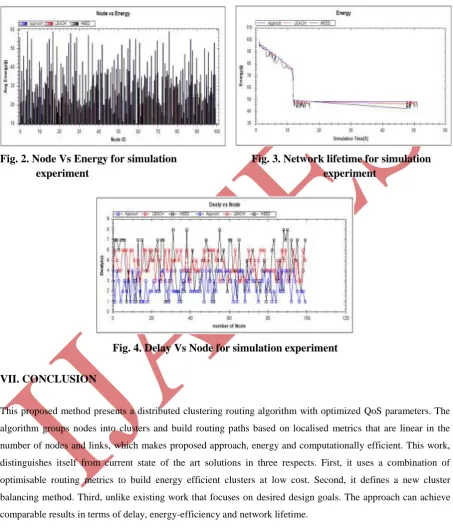
loss is assumed. The processing delay for transmitting a message is 5ms. Simulation experiment for network
configuration of 100 nodes and 200m of transmission range of nodes is done and the obtained results is shown
514 |
P a g e
LEACH and HEED. It also shows that the approach better performing than LEACH and HEED in terms ofnetwork lifetime. Also Fig.4 shows comparison of delay parameter in approach, LEACH and HEED. The delay
for approach, LEACH and HEED is 2.41ms, 4.52ms and 4.98ms respectively. From Fig.4 it is clear that the
approach is showing 50% less delay as compared to LEACH and HEED.
Fig. 2. Node Vs Energy for simulation
Fig. 3. Network lifetime for simulation
experiment
experiment
Fig. 4. Delay Vs Node for simulation experiment
VII. CONCLUSION
This proposed method presents a distributed clustering routing algorithm with optimized QoS parameters. The
algorithm groups nodes into clusters and build routing paths based on localised metrics that are linear in the
number of nodes and links, which makes proposed approach, energy and computationally efficient. This work,
distinguishes itself from current state of the art solutions in three respects. First, it uses a combination of
optimisable routing metrics to build energy efficient clusters at low cost. Second, it defines a new cluster
balancing method. Third, unlike existing work that focuses on desired design goals. The approach can achieve
comparable results in terms of delay, energy-efficiency and network lifetime.
REFERENCES
[1] Y. Xu, J. Heinemann and D. Estrin., Geography-informed energy conservation for ad hoc routing, In
Proceedings of the Seventh Annual International Conference on Mobile Computing and Networking
515 |
P a g e
[2] Boulis A, Ganeriwal S and Srivastava M B, Aggregation in sensor networks: an Energy-AccuracyTrade-Off, Elsevier journal of Ad Hoc Networks, 2003, 1(1), pp.317-331.
[3] C. Intanagonwiwat, R. Govindan and Estrin D. Directed diffusion: A scalable and robust communication
paradigm for sensor networks. In Proceedings of theSixth Annual International Conference on Mobile
Computing and Networks (MobiCom), 2000.
[4] Abdul Sattar Malik, Jingmingkuang, Jiakang Liu, Wang Chong, Energy Consumption & Lifetime Analysis
in Cluster-based Wireless Sensor Networks for Periodic monitoring Applications, International conference
on Network security, wireless Communications and trusted computing, IEEE November2009, pp:657-661.
[5] Xia F. QoS Challenges and Opportunities in Wireless Sensor/Actuator Networks, Sensors 2008; 8:
1099-12.
[6] Keyhan Khamforoosh, Hana Khamforoush, A New Routing Algorithm for Energy Reduction in Wireless
sensor Networks, IEEE conference 2009, pp: 505-509.
[7] Mohammad Ilyas and ImadMahgoub, Handbook of Sensor Networks: Compact Wireless and Wired sensing
systems by CRC press.
[8] Abbasi, A.A.; Younis, M. A survey on clustering algorithms for wireless sensor networks. Computer
Communication 2007, 30, 2826–2841.
[9] W. Heinzelman, A. Chandrakasan, H. Balakrishna, Energy-efficient communication protocol for wireless
micro-sensor networks, in: Proceedings of the 33rdInternational Conference on System Sciences, 2000.
[10]O. Younis, S. Fahmy, Heed: a hybrid, energy-efficient, distributed clustering approach for ad hoc sensor
networks, IEEE Transactions onMobile Computing, 2004, pp. 366–379.
[11]S. Chunyan, Z. Huazhong, Z. Xiuyang, Clustering hierarchy tree routing algorithm based on leach, Journal