
IMPACT OF OVER COAT APPLICATION ON ENTERIC COATED DRUG PELLETS: DESIGNED TO PROTECT FROM STOMACH ENVIRONMENT
5
0
0
Full text
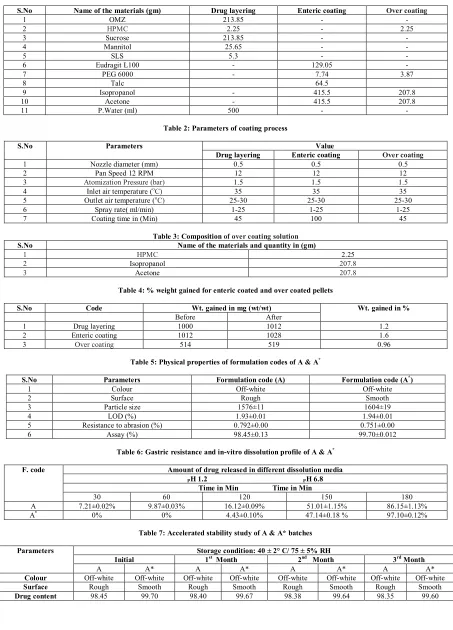
(2) Swamykannu Dinesh Mohan et al. Int. Res. J. Pharm. 2016, 7 (10) prevent brittleness of the polymer and improve the stability of the product8. 2.25gms of HPMC and 3.87gms of PEG 6000 were dissolved in 207 ml of each of isopropanol and acetone under magnetic stirrer it would be considered as an over coating solution. Coating process 1000 gm of non-pareil seeds (NPS) were placed in the lab model conventional coating pan (PCP-12” Prism Pharma machinery, Ahmadabad, India) and the suspension containing the OMZ is coated at a product temperature of 35-45 oC; an atomization pressure of 1.5 bar and a pump rate of 1-25ml/minute, starting with a slow rate of pumping to avoid agglomeration and increasing the rate of pumping consistent with the avoidance of the formation of agglomerates. After coating is complete the pellets are dried at a temperature of 50°C for 1hr and coated pellets were weighed to identify the weight gain. Next, 1012 gm of drug layered active pellets were placed coating pan and the enteric coating mixture was applied on to the drug layered active pellets, finally dried at a same temperature of 50°C and weighed again to know the weight gain. 1020 gm of coated pellets were divided in to two groups namely; A and A+ (50:50) 514 gm of A+ group of pellets were coated again with over coating polymer of HPMC under the same conditions. After completion of over coating process A+ pellets were weighed and identified the weight gain. The coating composition and process utilizes for coating were shown in Table 1-4. CHARACTERIZATION PELLETS. AND. EVALUATION. OF. Particle size and shape The average particle size of the pellet formulations of OZ were analyzed by simple sieve analysis method9. The particle size of various batches of pellets was given in the table (5). The surface roughness of pellets were studied by scanning electron microscope (SEM) (JEOL JSM – 6490 LA, Japan) to characterize the surface of the pellets and the results are shown in Figure 1,2. Loss on Drying The moisture content (% loss on drying; % LOD) of the pellets of A & A* was determined by using Mettler Toledo Halogen Moisture Analyzer (Model: HB43, USA) where the working temperature was 105°C and the results are shown in Table 5. Resistance to abrasion Resistance to abrasion of the drug-layered cores or coated pellets was determined with a Roche friabilator. Briefly, 25 g of sample was mixed with 25 g of glass spheres (1.5–2 mm in diameter) and uniformly tumbled for 4 min at 25 rpm and subsequently strained through a 40-mesh sieve. Friability (%) was calculated based on the percentage of weight loss. The measurements were made in triplicate. Initial weight - Final weight / Initial weight X 100 Assay Standard preparation Weigh accurately about 20 mg of OMZ working standard into 50ml volumetric flask and 25ml of 0.1N NaoH was added. The flask was shaken for 15 min and made the volume with remaining quantity of 0.1N NaoH. 3ml of this solution was withdrawn and transferred in to 100ml of fresh volumetric flask and diluted with same solution of 0.1N NaoH it would be consider as a standard solution.. Sample preparation Enteric coated and over coated pellets were weighed accurately equivalent to 20 mg of OMZ in two 100 ml volumetric flasks separately then 0.1N NaoH solution was added and the contents were diluted to 100 ml and filtered through Whatman filter paper (No.41). 1 ml of each solution was then diluted to 50 ml of 0.1N NaoH solution separately. Absorbance of the sample solutions was recorded, at 302 nm by UV Spectrophotometer (Lambda 25, Perkin Elmer, Wellesley, (USA). Drug content was determined by following validated formula (Bioleo analytical laboratory, Hyderabad) Results of the triplicate analysis are given in Table 5. Sample Abs W STD 3 50 50 ----------------- X -------- X ---- X ------- X ------X 100 Std Abs 50 50 WSPL 3 WSTD = Weight of the standard taken in (mg) WSPL. = Weight of the sample taken (mg) Gastric resistance and in-vitro dissolution test Dissolution testing of the pellets was performed using USP Type II Dissolution apparatus (Lab India) at 75 rpm starting with 750 ml solution at 37±0.5°C. The method of preparation of the dissolution medium was as follows. First, pellets were placed in a 0.1 M HCl solution for 2hrs and the samples were collected every 30 min up to 2hrs. Then, 250 ml of 0.05M phosphate buffer was added and the pH was adjusted with a solution of sodium hydroxide (NaOH) to pH 6.8. Samples were collected 10, 15, 30 and 45min finally the samples were analyzed at 302 nm by UV Spectrophotometer. Stability studies To investigate the influence of temperature and humidity onto the pellets. Pellets with enteric coating alone and pellets with over coating were placed in humidity chamber (Newtronics NW DSU 52) and exposed to a temperature of 40±20C and also a relative humidity of 75±5 % RH. The samples were removed from the humidity chamber at the end of 0, 15,30,45 and 60 days and checked for the shape, drug content, gastric resistant and in vitro dissolution studies and the results are shown in the Figures 5,6. Scanning Electron Microscopy The micrographs of the coated pellets were taken with a scanning electron microscopy (SEM) (S-3500N, SEM, Hitachi, Tokyo, Japan) to examine the surfaces and the morphology of the pellets. The pellets were mechanically cleaved transversely and sputtered with gold for 5min by a sputter. RESULTS AND DISCUSSION Omeprazole was loaded on NPS by solution layer technology. The prepared pellets were used to perform several physical parameters with in vitro dissolution study using the USP paddle method. Then 3 months stability study was performed at RT, 40°±20C, 75±5 % RH conditions. The results were mentioned on Table 6. Physical characterization Initially the colour of the pellet was white to off white and there were no difference in colour was found from A and A*. Hence, formulation variables have no effect on the colour of the pellets. Particle size of the pellets was in the range of 1685-1706µ determined by sieve analysis. The SEM result was revealed that, the enteric coated pellets were spherical in shape with rough surface (Figure 2). Whereas the over coated pellets were spherical in shape with smooth surface (Figure 1).. 15.
(3) Swamykannu Dinesh Mohan et al. Int. Res. J. Pharm. 2016, 7 (10) Table 1: Formula for preparation of OMZ pellets S.No 1 2 3 4 5 6 7 8 9 10 11. Name of the materials (gm) OMZ HPMC Sucrose Mannitol SLS Eudragit L100 PEG 6000 Talc Isopropanol Acetone P.Water (ml). Drug layering 213.85 2.25 213.85 25.65 5.3 500. Enteric coating 129.05 7.74 64.5 415.5 415.5 -. Over coating 2.25 3.87 207.8 207.8 -. Table 2: Parameters of coating process S.No 1 2 3 4 5 6 7. Parameters Nozzle diameter (mm) Pan Speed 12 RPM Atomization Pressure (bar) Inlet air temperature (oC) Outlet air temperature (oC) Spray rate( ml/min) Coating time in (Min). Drug layering 0.5 12 1.5 35 25-30 1-25 45. Value Enteric coating 0.5 12 1.5 35 25-30 1-25 100. Table 3: Composition of over coating solution Name of the materials and quantity in (gm) HPMC Isopropanol Acetone. S.No 1 2 3. Over coating 0.5 12 1.5 35 25-30 1-25 45. 2.25 207.8 207.8. Table 4: % weight gained for enteric coated and over coated pellets S.No. Code. 1 2 3. Drug layering Enteric coating Over coating. Wt. gained in mg (wt/wt) Before After 1000 1012 1012 1028 514 519. Wt. gained in % 1.2 1.6 0.96. Table 5: Physical properties of formulation codes of A & A* S.No 1 2 3 4 5 6. Parameters Colour Surface Particle size LOD (%) Resistance to abrasion (%) Assay (%). Formulation code (A) Off-white Rough 1576±11 1.93±0.01 0.792±0.00 98.45±0.13. Formulation code (A*) Off-white Smooth 1604±19 1.94±0.01 0.751±0.00 99.70±0.012. Table 6: Gastric resistance and in-vitro dissolution profile of A & A* F. code. A A*. 30 7.21±0.02% 0%. Amount of drug released in different dissolution media P H 6.8 P H 1.2 Time in Min Time in Min 60 120 150 9.87±0.03% 16.12±0.09% 51.01±1.15% 0% 4.43±0.10% 47.14±0.18 %. 180 86.15±1.13% 97.10±0.12%. Table 7: Accelerated stability study of A & A* batches Parameters Initial Colour Surface Drug content. A Off-white Rough 98.45. A* Off-white Smooth 99.70. Storage condition: 40 ± 2° C/ 75 ± 5% RH 1st Month 2nd Month A A* A A* Off-white Off-white Off-white Off-white Rough Smooth Rough Smooth 98.40 99.67 98.38 99.64. 3rd Month A A* Off-white Off-white Rough Smooth 98.35 99.60. 16.
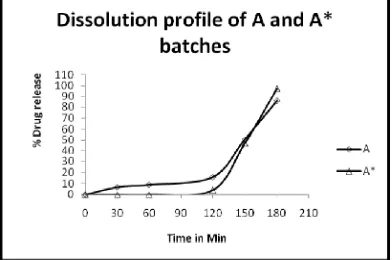
(4) Swamykannu Dinesh Mohan et al. Int. Res. J. Pharm. 2016, 7 (10) Table 8: In vitro study of A & A* batches after accelerated stability study F. code. A A*. 30 9.25±0.04% 0%. Amount of drug released in different dissolution media pH 1.2 Time in Min 60 120 150 30.17±0.01% 60.25±0.05% 74.00±1.18% 0% 4.43±0.10% 47.14±0.18 %. pH 6.8 Time in Min 180 90.25±1.21% 98.00±0.12%. Figure 1: SEM image of over coated pellet. Figure 2: SEM image of enteric coated pellet. Figure 3: SEM image of enteric coated pellet after stability. Figure 4: SEM image of over coated pellet after stability. Figure 5: In-vitro dissolution Profile of A and A*. This might be owing to an over coat application of HPMC around enteric coated pellets. The friability loss of the all batches was in the range of 0.792-0.751%. The percentage of drug present in the formulations was found to be in the range of 98.45-99.70% and the loss on drying of pellets was in the range of 1.93-1.94% respectively. All the parameters evaluated for A and A* formulations of pellets were given in Table 5. Gastric resistance and in-vitro dissolution The effort of this work was to resist the enteric coated pellets in an acidic environment. The drug release of the pellets coated. Figure 6: In-vitro dissolution Profile of A and A* at stability period. with HPMC and Eudragit L100 (A) and coated with drug and HPMC layer coat Eudragit L100 and HPMC over coat (A*) was performed for 2 h in acid media and later in PBS. At the end of 2h it was found that only 4% drug release occurred in group A* pellets whereas 16% of drug release was occurred in group A pellets. The most important properties of the extended release dosage form is its resistance against gastric conditions. It requires that no more than 10% drug release would occur after 2 h in 0.1N HCl solution10. The results confirmed that over coat application protect the drug in acdic conditions, moreover the over coat application provides uniform shapes Figure 1 and 4.. 17.
(5) Swamykannu Dinesh Mohan et al. Int. Res. J. Pharm. 2016, 7 (10) Stability studies The results for 3 month stability testing revealed no significant change in color, drug content (98.4 – 99.7%). Pellets with only enteric coated alone (A) ruptured surface was observed Figure 3 moreover; more than 50% of drug were release at the end of 2h Figure 5, Table (8). Whereas Pellets with over coated (A*) was showed smooth surface Figure 4 and no significant change in drug release pattern Figure 5, Table 8. CONCLUSION Over coating application (HPMC) system on to the enteric coated pellets provided good acid resistance in 0.1N HCl. Those pellets exhibited spherical shape with uniform and smooth coating as evidenced by SEM photomicrographs. Based on the result, 0.96% weight gained over coated pellets provided excellent acid resistance than enteric coated pellets. From the present investigation, it can be concluded that the over coating application system can be used for many acid sensitive drugs to protect them from stomach environment. ACKNOWLEDGEMENTS The authors are grateful to Mr. Nageshwara Rao, Chairman, (Yeluri formulations Hyderabad) for supplying omeprazole, microcrystalline cellulose and disodium hydrogen phosphate as a gift samples of this work. All the authors gratefully acknowledge Mrs. Y. Sujani, Director (Bioleo analytical laboratory Hyderabad) for providing the facility to carry out the evaluation tests of capsules.. 3. Kammili, Varun R. Pelletization technology: A quick review, Journal of Pharmacy & Pharmaceutical sciences 2011;2:1337-1355 4. Tang E, Chan L and Heng P. Coating of Multiparticulates for Sustained Release: Drug Delivery, 2005; 3: 17-28. 5. Stenhoff H, Blomqvist A, Lagerstrom PO. Determination of the Enantiomers of Omeprazole in Blood Plasma by Normal-Phase Liquid Chromatography and Detection by Atmospheric Pressure Ionization Tandem Mass Spectrometry: Journal of Chromatography B, 1999; 734: 191–201. 6. Singh DH, Roy CS, Verma P, Bhandari V. A review on recent advances of enteric coating, International Organization of Scientific Research Journal of Pharmacy, 2012; 05-115. 7. Patrı´cia Severino et al.. Preparation of gastro-resistant pellets containing chitosan microspheres for improvement of oral didanosine bioavailability, Journal of Pharmaceutical Analysis, 2012;2(3):188–192. 8. Noelia L. Gonzalez Vidal, Marta I. V. Brevedan, Maria A. Varillas, Laura D. Simionato, and Maria T. Pizzorno. Effect of accelerated aging conditions on the dissolution stability of ciprofloxacin tablets, Dissolution technologies, 2010; 2: 2329. 9. Wu XY, Eshun G, Zhou Y. Effect of interparticulate interaction on release kinetics of microspheres ensembles, Journal of Pharmaceutical Sciences., 1998; 87: 586-593. 10. Murat T, Hakan V, Mine C. Tableting and Stability Evaluation of Enteric-Coated Omeprazole Pellets. European Journal of Pharmaceutics and Biopharmaceutics, 2004; 57 (2): 279-86.. REFERENCES 1. Abdul S, Chandewar A and Sunil B. A flexible technology for modified-release drugs: Multiple-unit pellet system (MUPS), Journal of Control Release, 2010; 147, 2-16. 2. Damanjeet G. Pelletization: An Alternate to Granulation, Pharma Times, 2011; 43: 13-15.. Cite this article as: Swamykannu Dinesh Mohan, Vangadari Rama Mohan Gupta, Yalamanchili Manaswini. Impact of over coat application on enteric coated drug pellets: Designed to protect from stomach environment. Int. Res. J. Pharm. 2016;7(10):14-18 http://dx.doi.org/10.7897/2230-8407.0710115. Source of support: Nil, Conflict of interest: None Declared Disclaimer: IRJP is solely owned by Moksha Publishing House - A non-profit publishing house, dedicated to publish quality research, while every effort has been taken to verify the accuracy of the content published in our Journal. IRJP cannot accept any responsibility or liability for the site content and articles published. The views expressed in articles by our contributing authors are not necessarily those of IRJP editor or editorial board members.. 18.
(6)
Figure
Related documents
inflate the error associated with NIRS prediction equations, and better performance could be obtained if the equation were applied to validation sets without outlier samples..
Dagegen war bei "trockenen" Stricken bisweilen schon nach 4 Std, meist aber erst nach einer l~ingeren Zeit eine teilweise Verlagerung der Plastiden in den
Considering that knowledge sharing processes and probable multicultural influences are contextual, the purpose of the article is to establish the extent of knowledge flows in
Patient 3 had a succes- sion of recurrent severe acute attacks of pancreatitis in her mid-to-late 30s, which occurred over a relatively short period of time; a diagnosis of LPLD
Another way of using multiple fingers for input is to manipulate physical tools and props whose properties (e.g., orientation) are mapped to parameters of the
These communities of “Palenqueros” communicated in Spanish and their native languages or in a pidgin used on the African coast which spawned the “Palenquero” (Patiño Rosselli,
Due to time constraints and unavailability of the pile load test and soil investigations data, this study is aimed at covering only analyzed the comparison of vertically loaded
The aim of the study was to describe the work processes and collaboration in a hybrid OR during endovascular procedures where staff categories from anesthesia, surgery and
