Indian J.Plant Physiol., Vol. 8, No.4, (N.S.) pp. 359-363 (Oct.-Dec., 2003)
PHYSIOLOGICAL AND BIOCHEMICAL EVALUATION OF GROUNDNUT
CULTIVARS DIFFERING IN DROUGHT TOLERANCE
T.V.B.REDDY, J.S.PRAKASARAO* AND K. VIJAYALAKSHMI
Department of Plant Physiology, S. V. Agricultural Col1ege, ANGRAU, Tirupati - 517 502 Received on 11 Sept., 2002, Revised on 17 Oct., 2003
SUMMARY
Six cultivars of groundnut were screened for relative drought tolerance based on the chlorophyll stability index (CSI), membrane stability index (MSI), peroxidase activity and ash content. CSI and ash content showed significant and positive correlation whereas MSI and peroxidase activity showed significant negative correlation with pod yield under moisture stress conditions. It is suggested that such traits should be utilized in future breeding programmes for drought tolerance. Among the cultivars TCGP-5,6 and 10performed better than JL-24, TCGS 320 and 596 throughout crop growth period under moisture stress conditions. Benzyl adenine (BA) seed treatment increased the growth rates and pod yields under moisture stress compared to water soaked seeds.
Key words: Ash content, benzyladenine, chlorophyll stability index, drought tolerance, membrane
stability index, peroxidase, yield.
INTRODUCTION
Groundnut (Arachis hypogaea L.) is the important oil seed crop grown in India underrainfed conditions. Although this crop shows wide adaptability, but the yield is destabilized due to various biotic and abiotic stresses. Therefore, improvement for drought tolerance in groundnut is vital to stabilize the yield to previously unsuited regions and seasons.
Moisutre stress affects many physiological processes and photosynthesis is the most sensitive (Balasubramanyam et al. 1993 and Saxena et al. 1996). Moisture stress is reported to cause decrease in water potential and relative water content and increase in peroxidase acti vity (Tyagi et ai. 1999, MandaI and Singh 2000). Reddy et ai. (2000)
observed higher ash content in tolerant groundnut genotypes as compared to susceptible ones. Chlorophyll stability and membrane stability has also been associated with water
*Corresponding authors
Indian 1.Plant Physiol., Vol. 8, No.4, (N.S.) pp. 359-363 (Oct.-Dec., 2(03)
and high temperature stress tolerance in various crop plants (Raja Rajeswari 1995, Tyagi etai.1999andTalwer et ai. 2002). The rapidity and easiness of these methods would provide the guidelines to the plant breeders to screen the genotypes for drought tolerance in groundnut. In view of the paucity of experimental data, the present study was conducted to identify genotypes for relative drought tolerance based on above parameters and to establish their relationship with yield.
MATERIALS AND METHODS
A field experiment was conducted during Rabi 2000-01 at wetland farm ofS.V. Agricultural College, Tirupati, AndhraPradesh(13°N, 79°E). The soil was red sandy clay loam in texture and medium in fertility status with 0.14% organic carbon, 190 kg availableN, 24 kg available PzOs and 147 kg available KzO/ha with alkaline in reaction. Seeds of six contrastingcultivars of groundnut viz.,
T.Y.B. REDDY etat. 5, 6, 10, JL 24, TCGS 320, TCGS 596 were surface
sterilized with 0.1 % mercuric chloride and subsequently washed thoroughly with distilled water. Three treatments consisting of Tj-presoaking in water +no moisture stress (control); Tzpresoaking in 100 ppm benzyladenine (BA) for 6 hours + moisture stress at flowering (43-64DAS) and T3 - presoaking in water + moisture stress at flowering
stage were tested in a factorial randomized design, replicated thrice. Moisture stress was created by with holding of irrigation from 43-64 DAS till the cumulative pan evaporation (CPE) values reaches 10.59 cms. Following this, the plots received regular irrigations similar like control plants. Sowing was done at a spacing of22.5 X 10 cm which accommodates a population of 44 plants m-z.A basal dose of 20 N, 40 Pz05and 40 Kz0 kg/ha was
applied in the form of urea, SSP and MOP respectively. The remaining 10kg N combined with gypsum (500 kg)/ha was top dressed at 50 per cent flowering stage. Five plants from each plot were collected randomly for estimating the physiological and biochemical parameters, viz. relative water content (Smart 1974), peroxidase activity (Sadasivam and Manickam 1996) and ash content (Mas Ieet aZ.1992). Chlorophyll stability index (CSI) was estimated by the method described elsewhere (Sairam1994).
Membrane stability index was estimated by recording the electrical conducti vity (EC) of ions leached in distilled water from 2 cm leaf discs subjected to 55°C temperature treatment for 1h followed by incubation at 10°C for 24 h and again after boiling the same for 15 min. The per cent injury was determined according to Blum and Ebercon (1981). Yield components and yield were recorded at harvest while yield stability index (YSI) was calculated following Lewis (1954).
RESULTS AND DISCUSSION
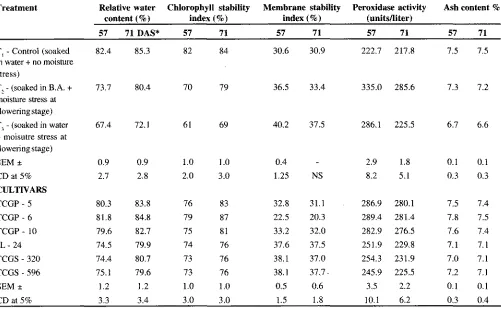
The perusal of data (Table 1) indicated significant decrease in relative water content (19.3%), chlorophyll stability index (25.6%) and ash content (10.7%) under moisture stress compared to control plants. This might be due to decrease in internal water content of protoplasm and loss of chlorophyll a:b ratio which might be the result of premature senescence of leaves (Reddy et aZ. 2000).
The susceptible genotypes JL 24, TCGS-320 and 596 exhibited lower values, on the other hand the tolerant
360
genotypes TCGP-5, 6 and 10 maintained comparatively higher values under stress as well as exhibited lower reduction under stress. Relatively higher RWC and CSI have been reported in drought tolerant cultivars of wheat (Sairam 1994 and Martin et aZ.1997). The reduction of above characters was more with untreated plants compared to BA pretreated plants indicating beneficial effect ofBA treatment to overcome inhibition of chlorophyll synthesis caused by moisture stress (Narendra Reddy et aZ. 1997).
Membrane stability index or percentage of injury was significantly high with moisture stressed plants compared to control. Lower percentage of injury was recorded with tolerant cultivarTCGP-6 closely followed by TCGP- 5 and maximum MSI with susceptible cultivar TCGS-320. Premchandra et aZ. (1990) have reported that cell membrane stability is an indicator of drought tolerance. Higher percentage of injury under water stress have also reported in susceptible genotypes in wheat (Sairam et aZ.
1997). However, BA treated seed maintained lower per cent of injury values than untreated seed which might be due to beneficial effectofBAin providing betterbiochemical defence mechanism against free radicles generated due to moisture stress or mechanism for reducing even their generation or both (Leibler et aZ. 1986).
Peroxidase is an antioxidant enzyme which exhibits higher activity under water and high temperature stress. In this study the peroxidase activity of groundnut plants was significantly increased (28 %) due to imposition of stress compared to control plants. Mandal and Singh (2000) have reported that peroxidase may prevent the degradation of membrane integrity ofthe cells against the radicles formed under moisture stress. The peroxidase activity due to moisutre stress was further improved with BA seed treatment (50% ) compared to untreated seed. The tolerant genotypes TCGP-5, 6 and 10 showed (30%) increase in peroxidase activity under water stress, while susceptible genotypes JL 24, TCGS-320 and 596 showed negligible increase of peroxidase activity under water stress. Similar reports regarding differences in stress tolerance of cultivars was made by Jha and Singh (1997) and MandaI and Singh (2000).
Moisture stress decreased the pod yield (Table 2) significantly primarily due to reduction in number of pods per plant (41.2 %) followed by 100 kernel weight (22.5 %)
DROUGHT TOLERANCE IN GROUNDNUT CUL TIV ARS
Table 1. Physiological and biochemical parameters of different groundnut cultivars as influenced by moisture stress and benzyladenine (BA) seed treatment during crop growth period.
Treatment Relative water Chlorophyll stability Membrane stability Peroxidase activity Ash content %
content (%) index (%) index (%) (unitslIiter)
57 71 DAS* 57 71 57 71 57 71 57 71
T, - Control (soaked 82.4 85.3 82 84 30.6 30.9 222.7 217.8 7.5 7.5
in water+no moisture stress)
T2 - (soaked in B.A.+ 73.7 80.4 70 79 36.5 33.4 335.0 285.6 7.3 7.2
moisture stress at flowering stage)
T, - (soaked in water 67.4 72.1 61 69 40.2 37.5 286.1 225.5 6.7 6.6
+moisutre stress at flowering stage)
SEM ± 0.9 0.9 1.0 1.0 0.4 2.9 1.8 0.1 0.1
CD at 5% 2.7 2.8 2.0 3.0 1.25 NS 8.2 5.1 0.3 0.3
CULTIVARS
TCGP-5 80.3 83.8 76 83 32.8 31.1 286.9 280.1 7.5 7.4
TCGP - 6 81.8 84.8 79 87 22.5 20.3 289.4 281.4 7.8 7.5
TCGP - 10 79.6 82.7 75 81 33.2 32.0 282.9 276.5 7.6 7.4
JL - 24 74.5 79.9 74 76 37.6 37.5 251.9 229.8 7.1 7.1
TCGS - 320 74.4 80.7 73 76 38.1 37.0 254.3 231.9 7.0 7.1
TCGS - 596 75.1 79.6 73 76 38.1 37.7. 245.9 225.5 7.2 7.1
SEM± 1.2 1.2 1.0 1.0 0.5 0.6 3.5 2.2 0.1 0.1
CD at 5% 3.3 3.4 3.0 3.0 1.5 1.8 10.1 6.2 0.3 0.4
DAS*= Days after sowing
Table 2. Effects of moisture stress and benzyl adenine (BA) seed treatment on yield and its components of different groundnut cultivars at maturity.
Cultivars (v) Pod yield Pod number/ 100 kernel Yield
(g mo2) plant weight (g) stability
T) T2 T3 T) T2 T3 T) T2 T3 index (%)
TCGP - 5 340.01 310.49 289.49 21.05 20.06 18.88 37.15 33.42 28.91 75.71
TCGP - 6 365.65 345.92 328.85 23.18 21.77 20.73 37.95 35.56 30.44 82.21
TCGP - 10 325.28 290.85 267.88 21.45 19.58 18.82 36.12 31.97 27.61 71.90
JL - 24 270.45 220.68 188.68 19.91 19.19 18.38 34.56 27.37 24.92 55.16
TCGS - 320 254.48 218.75 190.89 20.85 19.90 19.61 32.25 30.89 25.77 57.31
TCGS - 596 170.24 130.28 98.95 19.01 18.74 18.46 31.75 25.94 24.88 44.47
T V TXV T V TXV T V TXV
SEM ± 3.16 3.87 NS 0.41 0.50 NS 0.60 0.74 NS
CD at 5% 9.02 11.05 1.17 1.44 1.73 2.11
T, = Control - water soaked +no moisture stress; T2= Soaked in BA+moisture stress at flowering stage; T3= Soaked in water+moisture stress
at flowering stage
T.V.B. REDDYetal.
and number of seeds per pod (20.4%). In addition the reduction in pod yield with BA treated seed under moisture stress was less (15.8%) than the untreated plants (21.1 %). Beneficial effect of BA on seed yield (Sivakumar and Virendranath 2000) has also been reported. The genotypic variation to drought were also evident in this study. Tolerant genotypes showed significantly higher pod yield and yield components under moisture stress compared to susceptible ones. Further, variation in yield stability
index (YSI) was observed among the cultivars under moisture stress. The susceptible genotypes showed lower values than the tolerant genotypes indicating that tolerant genotypes have the ability to with stand drought and gives higher yield under moisture stress conditions. Moreover, CSI (0.59) and ash content (0.70) were positively and significantly correlated, while MSI (-0.78) and peroxidase activity (-0.65) was negatively and significantly correlated with pod yield under moisture stress conditions (data not shown). Thus the perusal of results shows that BA seed treatment improves the metabolic activity and drought tolerance capacity of the cultivars during moisture stress conditions. Therefore, for proper evaluation of tolerance/ susceptibility of a given cultivar, either membrane stability index or chlorophyll stability index and biochemical parameters, either peroxidase activity or ash content should be examined.
REFERENCES
Balasubramanian, V., Jayaram, Reddy, G. and Maheswari, H. (1993). Photosynthesis and plant water status of irrigated and dry land cultivars of groundnut. Indian J. Plant Physiol. 36: 236-238.
Blum A. and Ebercon, A (1981). Cell membrane stability as a measurement of drought and heat tolerance in wheat. Crop. Sci.21: 43-48.
Jha, B.N. and Singh, RS. (1997). Physiological responses of rice varieties to different levels of moisture stress. Indian J. Plant Physiol. 2: 81-84.
Liebler, D.C., Kling, D.S. and Reed, D.J. (1986). Antioxidant protection of phospholipids bilayers by tocopherol. Control of tocopherol status and lipid peroxidation by ascorbic acid and glutathione. J. BioI. Chern.261: 12114-12119.
362
Lewis, E.B. (1954). Gene-environment interaction. Heridity, 8: 333-356.
Mandai, M.P. and Singh, RA (2000). Effect of salt stress on amylase, peroxidase and protease activity in rice seedlings. Indian J.Plant Physiol. 5: 183-185.
Martin, M., Morgan, J.A. Zerbi, G. and Lecain, D.R (1997). Water stress imposition rate affects osmotic adjustment and cell wall properties in winter wheat. ItalianJ.Agron. 1: 11-20.
MasIe, J., Graham, D., Fraquhar, G.D. and Suan Chinwang. (1992). Transpiration and plant mineral content related among genotypes of a range of species.Aust. J.Plant Physiol. 19: 709-721.
Narendra Reddy, S., Gopal Singh, B. and Reddy, V.V. (1997). Influence of sulphur and benzyladenine on growth and productivity in sunflower. J. Oil Seed Res. 14: 288-293.
Premchandra, G.S., Sanoella, H. and Ogata, S. (1990). Cell membrance stability, an indicator of drought tolerance as affected by applied nitrogen in soybean. J. Agric. Sci. (Camb.) 115: 63-66.
Raja Rajeswari, V. (1995). Evaluation of cotton genotypes for drought tolerance under rainfed conditions. Annals PI. Physiol. 9: 109-112.
Reddy, P.V., Asalatha, M. and Babitha, M. (2000). Relationship of mineral ash and chlorophyll content with transpiration efficiency in groundnut under different moisture regions. Indian J. Plant Physiol. 5: 59-63.
Sadasivam, S. and Manickam, AL. (1996). Biochemical Methods, New age International (P.) Ltd., New Delhi.
Sairam, RK. (1994). Effect of moisture stress on physiological activities of two contrasing wheat genotypes. Indian, J. Exp. BioI.32: 594-597.
Sairam, RK., Dashmukh, P.S. and Shukla, D.C. (1997). Tolerance of drought and temperature stress in relation to increased antioxidant enzyme activity in wheat.J.Agron. Crop. Sci. 178: 171-178.
Saxena, H.K., Yadav, RS. and Mathur, RK. (1996). Effect of moisture stress on metabolic activity and grain yield in wheat genotypes. Indian. J. Plant Physiol. 14: 303-306.
DROUGHT TOLERANCE IN GROUNDNUT CULTrVARS
Siva Kumar, T. and Virendranath (2000). Effect of Benzyl adenine on photosynthesis and pigment concentration in the flag leaf and ear of wheat and triticale. Indian J.Plant Physiol. 5:345-357.
Smart, R.E. (1974). Rapid estimation of relative water content. Plant Physiol. 53: 258-260.
Indian J.Plant Physiol., Vol. 8, No.4, (N.S.) pp. 359-363 (Oct.-Dec., 2(03)
Talwar, H.S., Chandra Sekhar, A and Nageswara Rao, R.C. (2002). Genotypic variability in membrane thermostability in groundnut. Indian J. Plant Physiol. 7: 97-102.
Tyagi, A,Narendra Kumar and Sairam, R.K. (1999). Efficacy of RWC, MSI, osmatic potential, endogenous ABA and root biomass as indices for selection against water stress in rice. Indian J. Plant Physiol. 4: 302-306.