1459
Volume LXI 162 Number 5, 2013
http://dx.doi.org/10.11118/actaun201361051459
CHANGES OF LANDSCAPE STRUCTURE AND
CULTURAL VALUES OF VINEYARD LANDSCAPE
Martina Verešová, Ján Supuka
Received: March 8, 2013
Abstract
VEREŠOVÁ MARTINA, SUPUKA JÁN: Changes of landscape structure and cultural values of vineyard landscape. Acta Universitatis Agriculturae et Silviculturae Mendelianae Brunensis, 2013, LXI, No. 5, pp. 1459–1470
The aim of this paper is to assess the structural changes development of vineyard type of cultural agriculture landscape in Čajkov cadastre. In landscape space out of built up rural settlement Čajkov the vineyards create a specifi c landscape segment which covers 6% of the whole cadastre area. Two time development periods are compared, i.e. 1896s and 2010s, or 2011s with emphasis to land use form changes and area size changes of vineyard parcels. The result shows that vineyards represent more than 100 hundred years continuity of historical valuable cultural landscape which was not infl uenced by agricultural collectivisation processes within the second part of the 20th century. The second part of the paper is aimed to assess cultural value of the vineyards by using 9 diff erent criteria such as: age of vineyards, area plots and mosaic structures, archaic vine technology, anthropogenic relief, old vineyard’s buildings and sacral architectural elements, old large and rare fruit trees, traditional and local vine sorts, archaeological locality and fi nds. Assessed vineyards landscape of Čajkov cadastre is unique, has well preserved historical continuity in landscape structure and a high cultural and historic value.
vinicultural landscape, structural changes, cultural values
The wine as a cultural plant (Vitis vinifera L., subspecies sativa) has been cultivated on the territory of Slovakia already by the Celtic population (400–500 B.C.), in the Slovak period from the time of Great Moravia (9th century A.D.) until present day (Libant, 2009). According to historical documents and statistical databases the largest vineyard areas on the Slovak territory were recorded in 1720 at 57,000 ha. Since then area development of vineyards has had the following trends: 1870 – 40,000 ha, 1920 – 8,800 ha, 1937– 14,700 ha, 1945 – 1,200 ha, 1956 – 15,000 ha, 1978 – 32,000 ha, 1999 – 26,000 ha, 2008 – 21,477 ha. A signifi cant reduction in vineyard areas at the turn of 19th and 20th centuries was caused by phyloxera attack (Phylloxera vastatrix) and in the time period 1990 to 2002 by structural changes in the Slovak agriculture (Farkaš, 2002; Supuka, Verešová and Šinka, 2011). Nowadays (2012) almost 18,000 ha of vineyards in Slovakia are actively managed in 6 vineyards regions, 40 zones and 624 cadastre territories. The European Commission has
approved vineyard planting rights of 22,227 ha for Slovakia (Farkaš, 2012; Verešová, 2011).
Cultural vineyard landscape is a subcategory of agriculture cultural landscape. Both experienced structural changes in the course of history. Historical maps and especially aerial photos (of Slovakia from 1946) show that vineyard landscape has had mosaic small area structure in the past. Rare fruit trees, old vineyard houses, cellars and purpose constructions, distribution of small sacral architecture were typical representatives. Moreover marks of anthropogenic relief (terraces, stone walls and other) were visible especially on the steep slopes. Those features represent today already rare historical landscape structures with traditional forms of vine growing.
converted to large-scale plots. A lot of localities and landscape segments have lost typical features of the historical landscape structure and traditional (archaic) growing technologies (Babicová and Gerhátová, 2011; Špulerová et al., 2011). But the vineyards especially on slopes and less fertile soils have not changed their growing technology and have not gone through collectivisation processes and changes of large area plots.
For already a long time the vineyards have formed landscape structure when their area portion in typical vineyard regions have achieved diff erent proportionality level in the frame of a cadastral territory, e.g. Sv. Jur cadastre – 29% portion (Štefunková and Cebecauer, 2006), Hosťová, Pohranice, Štitáre cadastres – from 6 to 14% (Pucherová, 2004), Nitrianske Hrnčiarovce cadastre – 11.8% (Supuka, Verešová and Šinka, 2011).
Viticultural landscape by its area and inner structure represents a specifi c landscape image phenomenon and a visually perceived element. It contains features and characteristics of cultural, historic and aesthetic values. Many features are dynamic and progressively changeable, but vineyard as a spatial element of landscape has also had important historical values in its continual changes (Antrop and Van Eetvelde, 2000; Huba, 2000). Vineyards are representative landscape elements in many regions and geographical units not only in Slovakia but also abroad. In a reference to a historical document, Janota (1968) has suggested, that the Malé Karpaty territory near Bratislava capital should be declared a protected study area, because it has a specifi c type of the viticulture landscape and a vine has been cultivated there since 270 B.C.
Historically documented and currently actively managed vineyard landscape segments are lively spaces for agrotourism development where so called wine routes or king ones are being established. Those have cultural, aesthetic, educational, gastronomy, wine tasting and recreation services and are popular abroad and in Slovakia as well (Otepka and Habán, 2007).
The aim of this contribution is to assess the development aspect of the cultural vineyard landscape of Čajkov cadastre with an emphasis to structure changes in the compared periods and to cultural and historical values.
The fi rst written historical records about the Čajkov village were identifi ed in 1279, but it is believed to have existed before 1241. The village was a property of the Saint Benedictine monastery, later Tekov province (zhupah). Vine growing tradition dates back to this period that has important and continual infl uence at forming of cultural vineyard landscape. Wine production has had economy and market profi tability. Along with vine growing and wine production traditional culture, specifi c folk wear, fi ne art, hand cra s, and traditional vine harvesting festival have been developed. The specifi c folk architecture of rural family houses and vineyard cellars and sacral architecture elements
were found in the studied area. Čajkov´s vineyards belong to Nitra king vine route (Muráni, 2006). Those cultural and historical values, vineyard traditions and technologies were the reason why this region was chosen for the study.
MATERIALS AND METHODS
Characteristics of the study area
Nature conditions are elaborated by using two basic published sources (Miklós, Hrnčiarová et al., 2002; Muráni, 2006). Čajkov cadastre is located on the southern slopes of the western part of Štiavnické vrchy Mts at the elevation of 190 to 747 m.a.s.l. From the phytogeography point of view the territory belongs to the Western Carpathian (carpaticum occidentale) fl ora domain. The dominant plant communities are oak-hornbeam Carpathian forests. Natural vegetation formations are markedly changed by the agricultural land use form including vine growing. The territory belongs to warm and moderately warm climate region with an average annual temperature 9.5 ˚C and 600 to 680 mm precipitation. Čajkov cadastre is a part of the Štiavnické vrchy Mts. Protected Landscape Area where 10 localities of NATURA 2000 are delineated. The climate and the bedrock (e.g. volcanic andesine, tuff rock) create excellent conditions for vine growing as well, which has historical roots and traditions there since the 13th century.
The aims and contents of evaluation
The aim of the paper is to assess the secondary landscape structure of the cadastre territory with an emphasis on the vineyard landscape segment. Changes of area structure vineyards are compared between 1896 and 2010 and/or 1896 and 2011 as a result of social economy activities, intensifi cation processes in agriculture, vine growing technologies and vineyard plots ownership.
by the Cadastre Administration in Levice. The dates were converted to GIS media and the parcel areas were determined through classifi cation of 5 area sizes (Supuka, Verešová and Šinka, 2011).
RESULTS
Contemporary landscape structure of the cadastre territory and area space characteristics of the assessed vineyards
The contemporary landscape structure represents nature potential and land use forms (Fig. 1). The
results of area inventory according to landscape element are shown in Tab. I. The largest part of all the cadastre area of 2,394.52 ha is covered by forests at its northern part as the segment of Štiavnické vrchy Mts. and amounts to 55.5%. From the south border of the forests the middle part takes over vineyard landscape segment at moderate slopes and variable relief in the course from the north to the south and covers 6% of all cadastre area. Arable land follows as the next landscape segment on the south and takes up 30% on the deeper and more fertile soils. Permanent grasslands are located between vineyard and arable land plots but in
1: The current landscape structure of the Čajkov cadastre (author: M. Verešová)
I: Secondary landscape structure of the Čajkov cadastre, 2010
Landscape elements Area (ha) Percentage (%)
Roads 8.52 0.35
Water 16.00 0.60
Other areas 37.00 1.52
Arable land 720.00 30.00
Non-forest woody vegetation 14.10 0.60
Built-up areas 57.40 2.40
Grassland 65.00 2.80
Forests 1,334.00 55.50
Vineyards 138.00 6.00
a lesser share of 2.8%. Built-up area is represented by the Čajkov village and covers 2.4% of the cadastre area. The settlement is predominantly surrounded by intensively managed agricultural arable land. In visual characteristics of the landscape image there are oak and beach-oak forest complexes visible in the background, the middle part is taken by
vineyard complex and the foreground is covered by a newly established large area vineyard which continues to a large area composed of blocks of arable land. Those structures visually create a very interesting sequence of landscape elements from the northern slopes to the southern lowlands and show high visual potential.
II: Area of the vineyard parcels according to size categories
Category Area (m2) Number of parcels Area parcels together
(ha) Percentage (%)
1 < 500 232 7.037 5.08
2 500–1,000 331 24.755 17.87
3 1,000–5,000 345 61.067 44.10
4 5,000–10,000 5 3.366 2.43
5 > 10,000 2 42.287 30.52
Total 915 138.512 100.00
From the viewpoint of the plot area structure and the changes of vineyard landscape segment the structure of parcels according to 5 category of the area size were assessed (Table II.) Higher number of the plots was identifi ed of area size 1,000 to 5,000 m² (0.1–0.5 ha). There are 345 parcels in the total area of 61.067 ha that represents 44.1% of all the vineyards area. The second area size category of over 10,000 m² (1.0 ha) is represented by two parcels only and takes up altogether 42.287 ha, it means 30.52%. From this group 1 parcel reaches 27.92 ha. Both parcels belong to large size plots. They were established between 2007 and 2010 and represent new progressive vine growing technologies and new plant sorts and cultivars. The third area size group of 500 to 1,000 m² takes up 17.87% of all vineyard areas and was inventoried especially at slopes and more shallow soils, very o en terraces such as anthropogenic relief forms with anti-erosion eff ect occur. The vineyard parcels space distribution in the countryside according to area size is shown in Fig. 2.
The dominant shape of smaller parcels is a narrow striped rectangle, coursed downhill on slopes reasonably for reception of more solar radiation that is benefi cial for grape quality. Older and small scale vineyard parcels have more dense inner structure in distance between rows. Spread out old vine growing forms as vine-stakes are very rare. At the borderline of vine plots, close to wine cellars and along with roads the common known fruit trees such as cherries, plums, pears and apples are spread out. Relatively in high abundance at small scale vine plots were recorded rare thermophile fruit trees e.g.
black mulberry, service tree, almond tree, medlar, and quince tree. In many cases objects of sacral architecture such as a crucifi x, chapel and the statue of Saint Urban were inventoried.
The large area vineyard parcels generally over 0.5 ha have such inner structure which enables usage of technologies including machinery techniques. There are no additional fruit trees or anthropogenic relief forms and rows are in larger distance from each other. Large area vineyards are spread at lowlands or moderate slopes. Small wine houses and cellars are absent and/or might be substituted by built–up areas such as large buildings with multifunctional services related to vine growing, wine production, wine storing, gastronomy and complex of agrotourism.
Cultural and historical assessment of vineyards
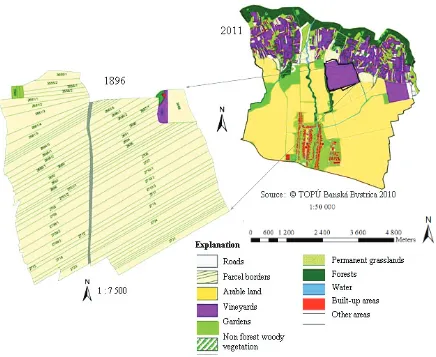
The assessment of historical values of vineyard landscape at the Čajkov cadastre is based on the structure of vineyards plots and is compared in the periods between 1896 and 2010, or 2011 (Fig. 3, 4). Vineyard structure of landscape segments also shows level and land-use form changes as well as measure of quality preservation and historical continuity in the course of almost 100 years. Fig. 3 shows the landscape segment in the northern part of vineyards spread out in the vicinity of the forest zone. In this part the relief is more dynamic, with steeper slopes, shallow soil and terraced plots, where no changes or very insignifi cant ones were recorded in the area size, number of parcels and
land use forms. The area share of vineyards is increased and the share of gardens decreased only within the compared periods of 1896 to 2011. This situation is a refl ection of vineyards ownerships, when in the 50s of 20th century the processes of agriculture collectivisation did not take place. It also confi rms human generation continuity in vine growing activities which refl ect into continuity of the vineyard landscape structure. The mosaic form of landscape image is dominant as a component of remarkable culture historical values. This pattern structure is well preserved at almost 70% of all vineyards in the Čajkov cadastre.
Fig. 4 shows the landscape structure changes at the southern border area of vineyards in transition to the large blocks of arable land. Compared time sequences are 1896 to 2010. Cadastre map from 1896 shows a narrow striped parcel structure in predominant land use forms such as grasslands. On the northern border of the landscape segment there are two plots with a diff erent land use such as gardens and vineyards. In comparison to the situation in 2010 substantial changes took place. The so narrow striped parcel structure was replaced by large-scale vineyard with area of 27.92 ha planted
segments and large-scale blocks of progressive agricultural technologies.
In the second part of the cultural and historical values assessment we have provided questionnaire investigation with 145 respondents - owners of vineyard parcels representing 20 ha vineyards altogether. From a wide spectrum of received data the regards were laid also to characteristics of cultural and historical values of vineyards. The following marks and characteristics registered at the vineyard parcels were assessed as contributes to their cultural and historical values:
a) Age of vineyards – as historically valuable the vineyards over 100 years old are taken into consideration. This age limit is true for 70% of all contemporary vineyards and 100% of historical small scale vineyards in the landscape segment.
b) Area size of vineyard parcels under 0.5 ha – as a mark of small mosaic vineyard structure, when in this category there were 67.05% vineyards registered.
c) Occurrence of old and specimen rare fruit trees –trees over 80 or 100 years of age are considered valuable, when from registered trees 16% were delineated to this category, e.g. especially black mulberry, and service tree.
d) Archaic vine growing technologies especially climbing support of vine-stakes - they are rare and seen sporadically, less than 3% of all vineyard area was registered in the assessed vineyards. e) Occurrence of old local or regional sorts of vine
in rare utilisation, because vine plant sorts have undergone modernizing.
f) Vineyard houses and cellars with typical attributes of regional architecture – results received from questionnaire investigation are as follows: 7% of the houses and cellars were built before World war I, 17% – between 1920 and 1945, 19% – between 1946 and 1968, 17% – between 1969 and 1989, 40% – between 1990 and 2009. The fi rst two groups represent historically and architectonically valuable objects. A er World war II the larger vineyard constructions were built with poly-functional services, e.g. wine production and storing, recreation and leisure, hospitality.
g) Elements of anthropogenic relief – occurred very o en especially on the steep slopes and small – scale parcels, e.g. terraces, stone walls, drainage canals.
h) Elements of sacral architecture with spiritual and symbolic meaning – the Saint Urban statue, i.e. the vineyard patron, occurred most frequently. Altogether 7 elements of sacral architecture (statue, chapel, and sacrum) were recorded in the examined vineyards.
i) Occurrence of archaeological locality and fi ndings – artefacts from the age of Lengyel culture (stone instruments and jewellers) were found in the area of established and new large scale vineyards.
According to the described characteristics the cultural and historical values were evaluated as follows: high (occurrence of 6–9 marks), medium (3–5 marks), low (1–2 marks), in accordance with the method of Supuka and Verešová (2012). We consider the segment of the studied vineyard landscape structure at the Čajkov cadastre high with emphasis on cultural and historical values.
DISCUSSION
The changes and development of the historical landscape of Slovakia have been the focus of study by many authors already for a longer time. Huba (2000) paid attention to the historical importance of culture, traditional land use forms and regional variability of the Slovak rural country. Rural values in later day approaches are assessed for recreation and agrotourism services (Otepka and Habán, 2010), also contributed by vineyard type of cultural landscape, accompanied by traditional events and activities related to so-called vine routes (Supuka, Verešová and Šinka, 2011). Rural and especially
vineyard landscape creates a specifi c landscape image with high aesthetic values (Antrop and Van Eetvelde, 2000; Štefunková and Cebecauer, 2006), where valuable elements of rural architecture are also represented (Štěpánková and Feriancová, 2011; Verešová, 2011). Petit, Konold and Höchtl (2012) worked-out particular methodical approaches for assessment of cultural and historical values of the vineyard landscape in Germany according to occurrence of features such as parallel cultivation, fruit trees, retaining walls and stairs, ownership structure, hoeing of the soils. Similar indicators were used in historical vineyard assessment in Slovakia, in the Small Carpathian region (Špulerová et al., 2011; Štefunková et al., 2011), in the Nitrianske Hrnčiarovce cadastre (Supuka, Verešová and Šinka, 2011), but supplemented by other marks such as anthropogenic relief, age of vineyards, viticulture traditional technology, regional cellar architecture, etc. Salašová and Štefunková (2009) describe aesthetic values of vineyard landscape, and pay attention to 13 features important in vineyard aesthetic assessment, e.g. visual exposition and interconnection, shape and size of plots and mosaic structure occurrence, proportion of aesthetic elements in the landscape structure, technical equipment and the level of vineyard maintenance. Some diff erences are seen in a number of assessed characteristics and occurrence of specifi c regional marks. All published articles evaluated marks and functions of vineyard landscape in high range because architectonical image and man-made cultural artefacts were very specifi c in the context of landscape.
CONCLUSIONS
6: Historical vineyard structure with small area plots (author: J. Supuka)
8: Terraced small area vineyards with old fruit trees in background (author: J. Supuka)
SUMMARY
The cultural landscape as a product of long-term infl uence of the man to the natural elements is in the spotlight of a contemporary cultural society. One of those are vineyards as a subcategory of the rural landscape. Their space characteristics and internal structure as a refl ection of cultivation technologies are the objective of the visual aesthetic and historical value assessment. The contribution is aimed at assessment of landscape structure changes and historical value of the Čajkov cadastre, where vineyard takes up 6% of the defi ned territory. The land use changes are compared within two periods: 1896 and 2010, or 2011, where vineyards maintain an almost 100-year continual structure in plot size and in land distribution. This reality is confi rmed by aerial photos from 1949 and 2010 as well. Cultural and historical values of vineyards were assessed by using 9 diff erential criteria. The following classifi cation characteristics were used: age of vineyards, occurrence of archaic cultivation technologies, anthropogenic relief forms, vineyard cellars and sacral architecture elements, rare and historical fruit trees, local vine sorts and archaeological localities. Resulting in fi nal values, the assessed segment of viticulture landscape has a high historical value and unique landscape structure in the framework of the Čajkov cadastre.
Acknowledgement
Paper was elaborated thanks to the fi nancial support of the grant project KEGA No. 020SPU-4/2011 of the Ministry of Education, Science, Research and Sport of the Slovak Republic.
REFERENCES
ANTROP, M. and VAN EETVELDE, V., 2000: Holistic aspects of suburban landscapes: visual image interpretation and landscape matrices. Landsc. Urban Plann., 50, 1: 43–58. ISSN 0169-2046.
BABICOVÁ, D. and GERHÁTOVÁ, K., 2011: Mosaics of historical structures of agricultural landscape in the Juhoslovenská kotlina basin. In: DOBROVODSKÁ, M., ŠPULEROVÁ, J. and ŠTEFUNKOVÁ, D., (ed.): Research and management of the historical agricultural landscape. Bratislava: Institute of Landscape Ecology SAS, p. 87–95. ISBN 978-80-89325-19-1.
FARKAŠ, J., 2002: Všetko o víne [Everything about wine]. Martin: Neografi a, 171 p.
HUBA, M., 2000: Challenge of historical landscapes in Slovakia. In: PEDROLI, B. (ed.) Landscape – our home. Stuttgart: Indigo Zeist, p. 109–118.
JANOTA, D., 1968: Malokarpatský vinohradnícky región a jeho ochrana [Small Carpathian vineyard region and its preservation]. In: BOROVSKÝ, Š. (ed).
Pre prírodu a človeka. Bratislava: Vyd. KPU, p. 128– 141.
PETIT, C., KONOLD, W. and HÖCHTL, F., 2012: Historic terraced vineyards: impressive witness of vernacular architecture. Landscape History, 33, 1: 5–28. ISSN 0143-3768.
LIBANT, V., 2009: História pestovania viniča a výroby vína od najstarších dôb vo svete, v Európe a na Slovensku [History of vine growing and wine-making from the oldest periods in the word, Europe and Slovakia]. In: HÚSKA, D. (ed.). Viti– Viniculture Forum Slovakia 2009, Skalica. Nitra: vyd. SPU, CD, 3p. ISBN 978-80-552-0308-9.
MIKLÓS, L. and HRNČIAROVÁ, T. et al., 2002: Atlas krajiny Slovenskej republiky [Landscape Atlas of the Slovak Republic]. Banská Bystrica: Slovenská
agentúra životného prostredia, Banská Štiavnica: ESPRIT, spol. s r. o., 344 p. ISBN 80-88833-27-2. MURÁNI, J., 2006: Čajkov spomína a ďakuje. [Čajkov
reminisces and thanks]. Tlmače: SB Press, 177 p. ISBN 80-968633-5-5.
OTEPKA, P. and HABÁN, M., 2007: Vidiecky turizmus a agroturizmus [Rural tourism and agrotourism.] Nitra: UVTIP, 120 p.
PUCHEROVÁ, Z., 2004: Vývoj využitia krajiny na rozhraní Zobora a Žitavskej pahorkatiny [Land use form development on the boundary of Zobor and Žitava highland]. Nitra: FPV UKF, 147 p. ISBN 80-8050-735-X.
SALAŠOVÁ, A. and ŠTEFUNKOVÁ, D., 2009: Estetické atribúty vinohradníckej krajiny [Aesthetic values of vineyard landscape]. Životné prostredie, 43, 1: 18–23. ISSN 0044-4863.
SUPUKA, J., VEREŠOVÁ, and ŠINKA, K., 2011: Development of vineyards landscape structure with regard to historical and cultural values. Ekológia (Bratislava), 30, 2: 229–238. ISSN 1335-342X.
SUPUKA, J. and VEREŠOVÁ, M., 2012: Aesthetic and cultural values of the vineyard landscape. In: DYMITRYSZYN, I., KACZYNSKA, M. and MAKSYMIUK, G. p.94–98. ISBN 978-83-935884-0-4. (eds.) The power of landscape, Warszaw: Warsaw University of Life Science, 175.
ŠPULEROVÁ, J., DOBROVODSKÁ, M., LIESKOVSKÝ, J., BAČA, A., HALABUK, A., KOHÚT, F., MOJSES, M., KENDERESSY, P., PISCOVÁ, V., BARANČOK, P., GERHÁTOVÁ, K., KRAJČÍ, J. and BOLTIŽIAR, M., 2011: Inventory and classifi cation of historical structures of the agricultural landscape in Slovakia. Ekológia, 30, 2: 157–170. ISSN 1335-342X.
quality assessment. Ekológia, 25, 1: 229–239. ISSN 1335-342X.
ŠTEFUNKOVÁ, D., DOBROVODSKÁ, M., KANKA, R., KRNÁČOVÁ, Z. et al., 2011: Atraktivita malokarpatskej vinohradníckej krajiny s dôrazom na historické agrárne štruktúry a biodiverzitu [Attractiveness of the Small Carpathian vineyard landscape with emphasis to historical agrarian
structure and biodiversity]. Bratislava: ÚKE SAV, 163 p. + attachments. ISBN 978-80-89325-22-1. ŠTĚPÁNKOVÁ, R. and FERIANCOVÁ, Ľ., 2011:
Znaky a hodnoty ľudovej architektúry súčasného vidieckeho sídla [Marks and values of folk architecture in present rural settlements]. Životné prostredie, 45, 1: 48–52. ISSN 0044-4863.
Address