ScholarlyCommons
Publicly Accessible Penn Dissertations
Fall 12-22-2009
Aura: Programming with Authorization and Audit
Jeffrey A. Vaughan
University of Pennsylvania, [email protected]
Follow this and additional works at:
http://repository.upenn.edu/edissertations
Part of the
Programming Languages and Compilers Commons
This paper is posted at ScholarlyCommons.http://repository.upenn.edu/edissertations/48 For more information, please [email protected].
Recommended Citation
Abstract
Standard programming models do not provide direct ways of managing secret or untrusted data. This is a problem because programmers must use ad hoc methods to ensure that secrets are not leaked and, conversely, that tainted data is not used to make critical decisions. This dissertation advocates integrating cryptography and language-based analyses in order to build programming environments for declarative information security, in which high-level specifications of confidentiality and integrity constraints are automatically enforced in hostile execution environments.
This dissertation describes Aura, a family of programing languages which integrate functional programming, access control via authorization logic, automatic audit logging, and confidentially via encryption. Aura's programming model marries an expressive, principled way to specify security policies with a practical policy-enforcement methodology that is well suited for auditing access grants and protecting secrets.
Aura security policies are expressed as propositions in an authorization logic. Such logics are suitable for discussing delegation, permission, and other security-relevant concepts. Aura's (dependent) type system cleanly integrates standard data types, like integers, with proofs of authorization-logic propositions; this lets programs manipulate authorization proofs just like ordinary values. In addition, security-relevant
implementation details---like the creation of audit trails or the cryptographic representation of language constructs---can be handled automatically with little or no programmer intervention.
Degree Type Dissertation
Degree Name
Doctor of Philosophy (PhD)
Graduate Group
Computer and Information Science
First Advisor Steve Zdancewic
Keywords
access control, audit, cryptography, programming languages, types
Subject Categories
Programming Languages and Compilers
AUTHORIZATION AND AUDIT
Jeffrey A. Vaughan
A DISSERTATION
in
Computer and Information Science
Presented to the Faculties of the University of Pennsylvania in Partial
Fulfillment of the Requirements for the Degree of Doctor of Philosophy
2009
Prof. Steve Zdancewic of Computer and Information Science Supervisor of Dissertation
Prof. Jianbo Shi of Computer and Information Science Graduate Group Chair
Dissertation Committee
Prof. Stephanie Weirich of Computer and Information Science, Chair Prof. Frank Pfenning of Computer Science, Carnegie Mellon University
Jeffrey A. Vaughan
Acknowledgments
I could not have contemplated, never mind completed, writing this dissertation without the help,
patience, and understanding of my colleagues, friends, and family.
Thank you first to Steve Zdancewic. As my academic advisor he taught me how think like a
computer scientist. His office door was open, and I learned something new every time I walked
through it.
I am grateful to my thesis committee, Frank Pfenning, Benjamin C. Pierce, Andre Scedrov and
Stephanie Weirich, for their valuable input and feedback on this dissertation.
Over the last five years I’ve learned that computer science is social endeavor. To my
collab-orators and colleagues: our reading groups, seminars, late-night writing sessions, and informal
conversations formed the heart of my graduate education. A special thanks to Aaron Bohannon,
Limin Jia, Andrew Hilton, Justin Kozer, Karl Mazurak, Joseph Schorr, Haakon Ringberg, Luke
Zarko, Jianzhou Zhao, and the University of Pennsylvania PL Club.
Computer and Information Science’s administrative and business support staff, especially Mike
Felker, cut through miles of red tape over the years.
Thank you to the teachers and professors who encouraged and inspired my interest in
math-ematics, logic, and computer science. Richard Gaudio and James VanHaneghan first introduced
me to the beauty and power of mathematical reasoning. As Andrew Myers’s student and teaching
assistant I learned the difference between computer engineering and computer science.
My friends in Philadelphia, particularly Aaron, Drew, Hanna, Kristin, Maggie, Nick, and Rob,
kept me sane throughout graduate school.
My parents, Joanne and Mark, and my sister, Emily, have always been a consistent source of
love and support. My newest family members, Carol Wortman, Dennis Wortman, and Joan Linskey,
have adopted me as their own.
Most of all, I thank my wife Jenn. She is my best friend, travel companion, cooking partner,
academic strategist, animal trainer, and so much more. She encouraged me during the late nights
and early mornings of research and writing, and helped me enjoy even the hardest days of graduate
school. And, not least of all, Jenn corrected the spelling of “Jeffrey” on this document’s title page.
Aura: Programming with Authorization and Audit
Jeffrey A. Vaughan
Supervisor: Steve Zdancewic
Standard programming models do not provide direct ways of managing secret or untrusted data.
This is a problem because programmers must use ad hoc methods to ensure that secrets are not
leaked and, conversely, that tainted data is not used to make critical decisions. This dissertation
advocates integrating cryptography and language-based analyses in order to build programming
en-vironments for declarative information security, in which high-level specifications of confidentiality
and integrity constraints are automatically enforced in hostile execution environments.
This dissertation describes Aura, a family of programing languages which integrate functional
programming, access control via authorization logic, automatic audit logging, and confidentially via
encryption. Aura’s programming model marries an expressive, principled way to specify security
policies with a practical policy-enforcement methodology that is well suited for auditing access
grants and protecting secrets.
Aura security policies are expressed as propositions in an authorization logic. Such logics are
suitable for discussing delegation, permission, and other security-relevant concepts. Aura’s
(depen-dent) type system cleanly integrates standard data types, like integers, with proofs of
authorization-logic propositions; this lets programs manipulate authorization proofs just like ordinary values.
In addition, security-relevant implementation details—like the creation of audit trails or the
cryp-tographic representation of language constructs—can be handled automatically with little or no
programmer intervention.
Contents
1 Introduction 1
1.1 Motivation . . . 1
1.2 An Overview of Aura . . . 4
1.3 Aura in the Context of Practical Programming . . . 7
1.4 Contributions . . . 14
1.5 Bibliographic Notes . . . 15
2 Aura: Programming with Audit in Aura 17 2.1 Introduction . . . 17
2.2 Kernel Mediated Access Control . . . 19
2.3 The Logic . . . 29
2.4 Examples . . . 39
2.5 Discussion . . . 46
2.6 Related Work . . . 48
3 Aura: A Language for Authorization and Audit 51 3.1 Introduction . . . 51
3.2 Programming in Aura . . . 53
3.3 The Aura Core Language . . . 57
3.4 Validation and Prototype Implementation . . . 69
3.5 An Extended Example . . . 70
3.6 Related Work . . . 75
4 Confidentiality in Aura 78 4.1 Introduction . . . 78
4.2 Confidential Computations and the For-Monad . . . 79
4.3 Examples . . . 82
4.4 Language Definition . . . 87
4.5 Discussion . . . 106
4.6 Related Work . . . 108
5 Conclusion 111 5.1 Summary . . . 111
5.2 Possible Extensions . . . 112
References 115 A Proofs for Aura0 128 B Formal Aura language definitions 145 C Mechanized Auraconfdefinitions 154 C.1 Syntax . . . 155
C.2 Environments . . . 156
C.3 Constants and Worlds . . . 157
C.4 Values . . . 159
C.5 Type Signatures . . . 161
C.6 Conversion Relation . . . 166
C.7 Atomic Types . . . 168
C.8 Fact Contexts . . . 169
C.9 Notation for Syntax . . . 170
C.10 Typing Relation . . . 171
C.11 Signature Well Formedness . . . 186
C.12 Step Relation . . . 190
C.13 Blame . . . 195
List of Figures
1.1 Schematic diagram of an Aura jukebox system . . . 2
2.1 Schematic of the Aura runtime environment . . . 21
2.2 Operational semantics . . . 25
2.3 Syntax of Aura0 . . . 30
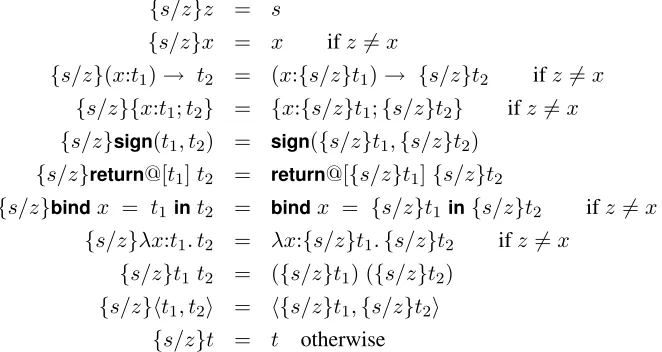
2.4 Substitution and free variable functions are defined as usual. . . 32
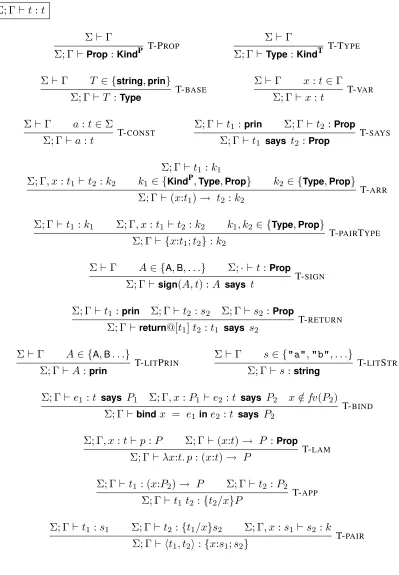
2.5 Expression typing . . . 33
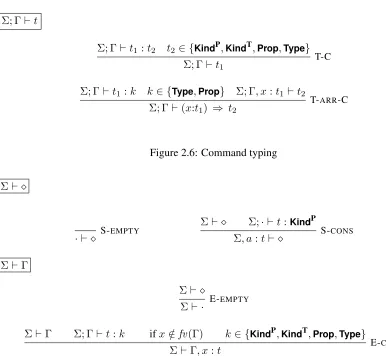
2.6 Command typing . . . 34
2.7 Well formed signature and environment judgments (defined mutually with typing relation) 34 2.8 Reduction relation . . . 37
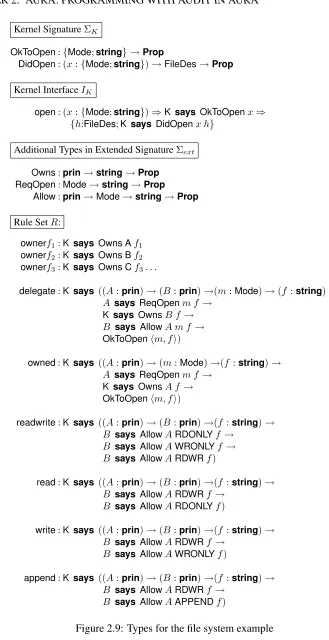
2.9 Types for the file system example . . . 42
3.1 Aura typing rules for standard functional language constructs. . . 60
3.2 Aura typing rules for access control constructs. . . 61
3.3 Conversion . . . 65
3.4 Reduction Relation . . . 67
3.5 Aura code for a music store . . . 71
4.1 A simple communications library . . . 82
4.2 Code for confidential storage server . . . 84
4.3 AuraconfSyntax . . . 88
4.4 Selected Auraconfevaluation rules . . . 91
4.5 Selected typing rules for Auraconf . . . 94
4.6 Major auxiliary judgments for Auraconf’s static semantics . . . 98
4.7 Approximate typing judgment used byWF-TM-ASBITS . . . 101
4.8 Selected rules from the definition of similar terms . . . 104
A.1 Translation of Aura0’s terms to CC . . . 134
A.2 Translation of Aura0contexts to CC . . . 135
B.1 Aura value and applied value relations . . . 146
B.2 Auxiliary Definitions . . . 147
B.3 Aura signature typing rules . . . 148
B.4 Aura environment typing rules . . . 150
B.5 Aura typing rules, extended, functional programing . . . 151
B.6 Aura typing rules, extended, access control . . . 152
Introduction
Standard programming models do not provide direct ways of managing secret or untrusted data.
This is a problem because programmers must use ad hoc methods to ensure that secrets are not
leaked and, conversely, that tainted data is not used to make critical decisions. This dissertation
advocates integrating cryptography and language-based analyses in order to build programming
en-vironments fordeclarative information security, in which high-level specifications of confidentiality
and integrity constraints are automatically enforced in hostile execution environments.
This document describes a programming language, Aura, that marries a security-sensitive type
system for policy specification with cryptography for policy enforcement. In the following, I argue
that Aura provides an expressive and sound way to specify and enforce
declarative-information-security properties. The remainder of this chapter sketches the Aura system at a high level and
outlines the contributions of this dissertation.
1.1
Motivation
Aura is designed to enable mutually distrusting principals to share resources and secrets, subject to
a potentially complicated set of policy rules.
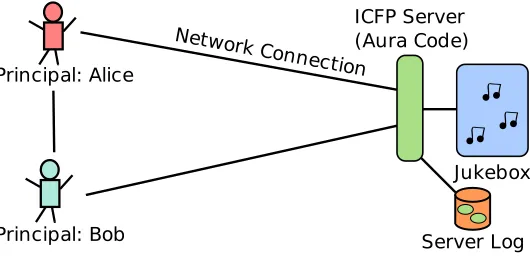
For instance, imagine the jukebox system depicted in Figure 1.1. Here two principals (Alice and
Bob) are connected to each other and to a server that mediates access to a jukebox. The jukebox
is assumed to be completely security-oblivious, and the server is responsible for forwarding valid
Jukebox
Principal: Bob Principal: Alice
say (sign(ICFP, sharePolicy ) : ICFP says sharePolicy
say (sign(ICFP, sharePolicy ) : ICFP says sharePolicy
say (sign(ICFP, sharePolicy ) : ICFP says sharePolicy
say (s ign (IC FP, sh are Pol icy ) : IC FP say s s har ePo lic y say (sign (ICFP, share Pol
icy ) :licyePos sharFP say IC
Network ConnectionICFP Server(Aura Code)
Server Log
Figure 1.1: Schematic diagram of an Aura jukebox system
requests—and only valid requests—to it. The server itself may be acting on behalf of a principal,
such as the RIAA or theInternational Cartel for Fonograph Players, ICFP.
The system might need to enforce a range of policies, and the difficulty of enforcement increases
with increasing policy complexity. When ICFP specifies “Alice may play all songs,” the server’s
job is relatively easy. When ICFP specifies “If the Goldbach conjecture holds, then Bob may play
songs,” the server’s job is prohibitively difficult.
Between these extremes, we find more interesting and reasonable policy sets: “ICFP says Alice
may play London Calling,” “Alice says Bob may play her music,” “Bob says Alice may play his
new wave songs,” and “Bob says Blue Monday is new wave.” These policies are interesting for
several reasons.
• They contain prominent use of delegation. Sometimes Bob may only play a song because
Alice has delegated her rights.
• They are heterogeneous and not necessarily coordinated by a central authority. Alice and Bob
might classify songs differently (e.g. “Alice says Blue Monday is pop”), and we will assume
that this is a feature of realistic policy sets among potentially mutually distrusting principals.
• Determining access rights is an exercise in distributed decision making. Deciding if Alice is
permitted to play a song may require reasoning from several points of view and collecting
The need for these sorts of policies may be found throughout contemporary computer systems.
Users of wikis, distributed files systems, and even electronic door locks employ such access control
schemes, or struggle to approximate them when lacking appropriate technological support.
For example, traditional Unix file systems lack a way for unprivileged principals to establish
precise file-sharing policies. Files are shared primarily though the creation of groups, an operation
that requires administrator intervention. This would not be a problem if users did not wish to share
files, or were satisfied with the sharing that can accomplished using a small number of groups.
However, a variety of application-specific, access-control regimes, typified by Apache’s .htaccess
files (Apache, 2009) and techniques for sharing subversion repositories via ssh-tunneling
(Collins-Sussman et al., 2008), attest to the fact that users wish to delegate their file-access rights in a
fine-grained manner. As in the music example, realistic file-access policies such as “Bob says Alice
may update files when subversion agrees,” and “Charlie may read.htmlfiles under ˜/ public,” feature
delegation and lack of central coordination.
Additionally, Bauer et al. (2005a) have demonstrated the utility of decentralized,
delegation-rich policies for physical access control. They use computers to check access request for doors,
and accommodate expressive policies, such as “Eve says her guests may open her office door,” and
“Charlie is Eve’s guest on January 10th.”
Aura builds-on and refines the notion of proof carrying access control (PCA) as a technique
to enforce policies like those described above (Appel and Felten, 1999). In Aura, and other PCA
systems, processes are required to present, at runtime, proofs that resource accesses conform to
policy. In contrast with previous PCA systems, Aura is a single language with fragments tuned
for programming and policy definition. Its design ensures that well-typed programs only attempt
valid resource accesses. Additionally, Aura’s flexible type system can describe a wide variety of
security policies. This means that individual applications can use Aura types for PCA in lieu of
implementing and debugging a new access control scheme. Such techniques promise to enhance
1.2
An Overview of Aura
The Aura family of programming languages integrates functional programming, access control via
authorization logic, automaticaudit logging, andconfidentiality types for protecting secret
confi-dential data. Except when it would cause confusion, we refer to any member the language family—
Aura0, Aura, or Auraconf—as Aura. Evidence-based access control
Aura security policies are expressed as propositions in an authorization logic based on Abadi’s
(2007) Dependency Core Calculus (DCC). Such logics are suitable for discussing delegation,
per-mission, and other security-relevant concepts. Aura’s type system cleanly integrates standard data
types (like integers) with proofs of authorization logic propositions, and programs manipulate
au-thorization proofs just as they might other values.
In authorization logics, the proposition A says P denotes “Principal A says (or endorses)
proposition P.” Chapter 2 presents a small-scale model of the Aura language, and describes the role
that such endorsed propositions play in authorization and audit. Aura authorization proofs serve
asevidenceof access-control decisions, and programs must present appropriate proofs in order to
access resources. Evidence is composed of a mix of cryptographic signatures, which capture
prin-cipals’ “utterances,” and standard rules of logical deduction. We argue that automatically logging
such evidence enables useful post-hoc analysis of the authorization decisions made during a
sys-tem’s execution, and that log entries should contain proof-evidence documenting access grants. The
automated logging of evidence done in Aura provides several compelling benefits. The approach
provides a principled way of determining what to log, and logged proofs contain structure that can
illuminate policy flaws or misconfigurations. Most importantly, storing unforgeable cryptographic
evidence reduces the size and complexity of a system’s trusted computing base.
To explain these observations concretely, we develop a rich authorization logic based on a
de-pendently typed variant of DCC and prove the metatheoretic properties of subject-reduction and
normalization. We show that untrusted but well-typed applications, which access resources through
also show the utility of proof-based auditing in a number of examples and discuss several pragmatic
issues, such as proof size, which must be addressed in this context.
Core Aura
Chapter 3 discusses Aura’s design in detail. Aura has ML-like evaluation semantics,
character-ized by call-by-value reduction and effectful operators. Its static semantics are substantially more
novel and are based onweak dependent typesthat can express a variety of useful propositions. For
instance, the proposition
Alice says((P: Prop)→BobsaysP→P)
means that principalAlicewill endorse any proposition thatBobendorses. This proposition, which
may be pronounced “Bob speaks for Alice,” means thatAlice is delegatingallof her authority to
Bob. In contrast, the proposition
Alice says((s: Song)→isJazz s→
Bobsays(MayPlay Bob s)→MayPlay Bob s)
describes a more limited form of delegation, whereAlicedelegates some, but not all, of her authority
toBob (only her rights to play jazz songs). The latter proposition follows the principle of least
privilege and represents a safer, more secure form of delegation than the former. The ability to
express such restricted delegation is an advantage of Aura compared with simpler authorization
logics containing only polymorphism.
Weak dependent types are simpler than the full-spectrum dependent types found in Coq (Coq,
2006) or Agda (Norell, 2007), and, consequently, Aura enjoys two useful properties: terms have
unique types, and type equality is decidable even in the presence of effects. This is achieved by
restricting some forms of application and making the use of conversion explicit. These design
choices work harmoniously with Aura’s call-by-value evaluation relation; many other reduction
strategies are incompatible with weak dependency and would induce metatheoretic complexity, or
even unsoundness.
The key technical challenge met in Chapter 3 is the elegant combination of functional
program-ming features—including inductive types, general recursion, and world effects—with authorization
ten-sions inherent in this feature set and admits important properties including syntactic soundness and
decidable type-checking. This document focuses on the language design itself and provides only a
high-level account of the large-scale Coq proofs that demonstrate Aura’s metatheoretic properties.
Confidentiality types in Auraconf
Chapter 4 describes new techniques for creating, manipulating, and accessing confidential data.
This methodology is compatible with Aura’s computation and audit models, and is realized in the
Auraconf programming language extension. Confidential data and computations are given special
types and are automatically encrypted as needed. For instance, the typeint for Alicerepresents an
integer readable only by principalAlice. In this system, any user can build secret computationsfor
any other. To unprivileged users, confidential data values and computations are opaque.
The fortype constructor behaves as an indexed monad; treating confidentiality in this manner
is both technically robust and aesthetically aligned with Aura’s design. As withsays-propositions,
objects withfor-types are created using the monadic operators returnandbind. A runconstruct
takes, for example, an int for Alice and returns an int. Values with for-types are represented by
(annotated) ciphertexts. This provides security against adversaries that are outside the system and
able to, for example, intercept network traffic.
Auraconf integrates a novel mix of conventional and new ideas to provide intuitive
confiden-tiality operators backed by encryption. The language contains ciphertexts as first-class values. To
enable precise, typed-based analysis of these entities, the typechecker can access statically available
private keys and examine ciphertexts atcompiletime. When an appropriate key cannot be found,
facts about particular ciphertexts (recorded in the runtime’sfact context) may be used by the
type-checker. Ensuring that this enhanced typing regime satisfies preservation is subtle, and is solved
here using ideas from modal type theory (Pfenning and Davies, 2001; Jia and Walker, 2004;
Mur-phy, 2008). Auraconfprograms can dynamically access private keys, and soundness requires effects
analysis (Lucassen and Gifford, 1988; Talpin and Jouvelot, 1992) that works in concert with modal
types. In addition to syntactic soundness, Auraconf satisfies a noninterference property that gives
1.3
Aura in the Context of Practical Programming
The bulk of this dissertation presents a theory-oriented account of Aura. This section shows how a
full Aura implementation would function as a platform for applications development, identifies the
boundaries of this work, and describes how Aura concepts can be applied in other settings.
Toward practical programming with Aura
This section sketches how a production-ready Aura implementation could be used for practical
programming. Aura applications are intended to run in open, distributed settings. Toward this
end, programmers and system architects will need to take a few specific steps to build applications.
These steps are introduced below and explained more thoroughly in the following subsections.
First, the programmer must establish a shared vocabulary for programs to describe policies and
express data. This ontology is encoded as atype signaturemade up of inductive type definitions
and assertion declarations. For instance the following type signature could support this chapter’s
jukebox example:
(∗ Elements of type Song are built from strings . ∗)
dataSong:Type{|new song: string→Song}
(∗ MayPlay constructs a proposition from a principal and a song.∗)
assertMayPlay:prin→Song→Prop
(∗ isJazz constructs a proposition from a song.∗)
assertisJazz: Song→Prop
Second, the programmer must identify principals that are mentioned directly in source code.
Key configuration files,as described below, bind principal objects likeAliceorSqlServer to public
keys that establish identity. The association between principal objects and keys can be changed
before deployment without affecting code or recompilation; this allows programs to be reused in
different settings.
Third, programmers can write applications that interoperate—a client and server, for instance—
using the shared type signature and principal declarations. At this point programming teams could
coordination between system components. Of course, producing correct code may require
collabo-ration for conventional design and quality control reasons. Note that it’s not necessary to implement
complete systems in Aura alone; programs can access foreign functions and data from .Net libraries.
Fourth, to deploy a system, administrators must install and configure application binaries on
par-ticular hosts. Unlike standard applications, Aura programs must be directed to a key configuration
file that provides final bindings between principal objects and their cryptographic keys. Type
signa-tures can be safely compiled into applications and need not be treated specially during deployment.
Finally, while Aura is intended to produce logs automatically in a default location, administrators
might choose to override the default at this time.
Type signatures
Aura’s programming model assumes all components of a distributed system can communicate using
a shared type signature that establishes a vocabulary of datatypes, propositions, and policy
asser-tions. It is critical for security that all hosts understand these objects in the same way.
In Aura we have assumed that system nodes maintain independent copies of the type signature,
and processes check that data read from the network is well formed with respect to the local copy.
When a broken, out-of-date, or malicious client sends bad data due to an incorrect signature, correct
clients will be able to reject the message.
Sophisticated systems for distributed programming, including AliceML (Rossberg et al., 2007)
and Acute (Sewell et al., 2007) provide a more comprehensive treatment of distribution in a
higher-order, typed setting. These systems each provide a careful account of marshaling data values and
mobile code. Additionally, Acute programs can selectivelyrebinda type so it refers to definitions
that have been updated or that are site-specific. A similar mechanism for associating version and
lo-cation metadata with Aura type signatures may enable more precise reasoning about system objects
and logged proofs.
Log files
Aura is intended to create high-integrity logs of system actions. A full implementation should
pro-duce logs automatically, perhaps in ˜/. aura/logs/appname.txtby default. Administrators or advanced
This dissertation does not discuss the interesting issue of tool support for audit. Aura programs
will create many log entries during execution and these entries will very often contain digital
sig-natures and other inscrutable binary objects. For this reason a full implementation of Aura should
include tools to assist auditors with browsing, querying, and interpreting logs.
Principals and modules in Aura
The notion of principal is key to Aura. Principals are intended to be entities that can make policy
statements, such as users, organizations, or trusted computer services. We require that a principal’s
identity can be unambiguously associated with a public cryptography key. A variety of different
mechanisms could bind principal identities with public keys. Suitable choices include X.509
cer-tificates in conjunction with global certificate authorities (Cooper et al., 2008), local name bindings
via SPKI/SDSI (Ellison et al., 1999), and file based key-management as found in SSH (Ylonen,
1996). Key configuration files would import these externally meaningful identifiers as Aura values
of typeprin. For instance, the following configuration defines Aura principalsAliceandBobusing
SPKI/SDSI and SSH identities.
(∗ Hash value identifies a unique SPKI/SDSI certificate linking
∗ Alice0s name to a public key. ∗)
alias SDSI prinAlice =
(name (hash sha1|SLCgPLFlGTzgUbacUMW8kGTEnUk=|) alice liddell)
(∗ Filename identifies a public key stored in ˜/. ssh/ ∗)
alias SSH prinBob = id rsa bob.pub
Such aliases are only needed when principals are mentioned by name in source code.
Every process must also provide a binding forself, as follows:
(∗ Self must bind both public and private keys. ∗)
alias SSH self= id rsa vaughan.pubwithid rsa vaughan
A goal of this design is to free programmers from managing keys directly in code. Indeed, keys
are loaded by the runtime using key configuration files and are referenced in code only implicitly,
directly. Unfortunately, no methodology can completely rule out key leakage via side channels,
such as power or timing.
We anticipate that developers will write and debug Aura programs when some relevant keys are
unknown. It may be useful to enable placeholder principal declarations like the following:
alias FAKE prinCharlie = ()
PrincipalCharliewould not be bound to a key, and the runtime would use simple symbolic
expres-sions to stand in forCharlie’s signatures and ciphertexts. The runtime system should only permit
such behavior in debug builds, and release builds of Aura programs should not acceptFAKE
princi-pal declarations.
Programs may interact with unknown as well as known principals. For instance, a middleware
service might communicate with a distinguished database server represented by principalSqlServer
and also process requests from anonymous clients. Aura uses public keys to represent both known
(aliased) and unknown (anonymous) principals at runtime. Principals are first-class and can be
treated like any other dynamically computed value. In particular, anonymous clients need not appear
in the key configuration file. Programmatically, anonymous clients are often handled by packaging
principals in inductive datatypes. For instance, Chapter 4 discusses an example program that accepts
requests of the following type.
datarequest:Type{
|r get : prin→Nat→request
|r put : (a: prin) →Nat→String for a→request }
Both put and get requests are represented by data constructors that take a principal as their first
argu-ment. Importantly,requestobjects may range over any principal—even those unknown at compile
or link time. Aura allows comparisons on principals, and it possible to recognize and to specially
treat distinguished principals. For instance, the following code skeleton processes a request, giving
special consideration to a particular, very important, principal.
matchrwithrequest{
|r get →λa:prin. λn: Nat→ if a = VIPthen ... else ...
Programs run on behalf of principals. Technically, programpruns withAlice’s authority when
p can use Alice’s private key to sign propositions or decrypt data. We anticipate using a module
system to capture a program’s authority requirements. For instance, the following module usessay
to sign a proposition withAlice’s key. The annotation on its first line indicates that it requiresAlice’s
authority.
ModuleMusicOfAlice
let stringBeanJean: Song = ...
let share: (s: Song)→Bobsays(MayPlay Bob s)→
Alice says(MayPlay Bob s) =say(...)
End Module
In contrast, the following defines a module that runs with any authority:
Module Of∗
let affirmTwo: (P: Prop)→(Q:Prop)→self says(And P Q) = ...
End Module
Language interoperability
Aura is specialized for writing programs that deal with authorization decisions and confidential data.
For this reason, it contains many features unfamiliar to most programmers and lacks others, such
as a large standard library, that are common in industrial software platforms. Aura is implemented
using the .Net framework, and can interoperate closely with .Net languages such as C]or F].
Mixed-language development provides an appealing strategy that combines Aura’s security features with
mainstream languages and libraries.
Aura can easily import objects and procedures from foreign languages. This enables a software
architecture in which a top-level Aura program interacts with the network, while using .Net modules
for major computational work and to interface with resources not protected by Aura policies.
Aura’s security guarantees are based the language’s type-safety property. However, because
Aura’s type system is not directly comparable with .Net’s, care must be taken to ensure that Aura
objects touched by .Net procedures are well-formed. One reasonable programming discipline only
objects and mangling them at unpredictable times. Additional runtime type checking may enable a
more liberal programming style, albeit with some overhead cost.
An inverted architecture, where a top level .Net language calls Aura libraries for proof search,
is possible in principle, but we have not thoroughly explored this design space. Static typing for
programs built in this style would require either encoding Aura types within .Net interfaces—an
interesting research topic—or rewriting the Aura library to expose a simplified type signature.
Al-ternatively, a limited form of dynamic typing may ameliorate the effects of the impedance mismatch.
It is unclear how usable the Aura security model would be for clients that cannot understand Aura
types.
More critically, there are some fundamentally troubling issues surrounding the use of Aura
with .Net languages. The main difficulty is that .Net does not, out of the box, provide a complete
mechanism for enforcing abstraction boundaries. For instance, .Net’s reflection mechanism can
easily query and update the private fields of an abstract datatype.1 While client code can block
particular uses of reflection using .Net’s security infrastructure, we are not aware implementation
techniques that would affirmatively protect Aura invariants in all contexts. Washburn (2007) studied
this problem in the context of functional programming.
This impacts Aura in at least the following specific ways. Aura’s type system is too complicated
for a shallow embedding in .Net types. Instead, Aura proofs and propositions must handled as a
deep embedding. That is, proofs and propositions must be represented by .Net objects. .Net contains
both reflection and concurrency. A malicious client may not only damage proofs by tampering with
their internal structure, but can also exploit time-of-check-to-time-of-use attacks to subvert local
attempts to validate purported proofs. For this reason Aura’s end-to-end security properties (such
as noninterference, see Chapter 4) are weakened in a mixed-language setting.
Yet all hope is not lost.
First, further research may reduce the magnitude of these problems. Higher-assurance proof
handling could be realized with mechanisms—such as moving proof checking to a separate
process—that protect proof objects from tampering. It would also be interesting to identify a subset
of, for instance, C]that can be safely mixed with Aura.
1This is accomplished using methodsType.GetFields()andFieldInfo.SetValue()from theSystem.Reflectionnamespace.
See Microsoft’s documentation,http://msdn.microsoft.com/en-us/library/system.reflection.
Second, the problems that occur when mixing .Net and Aura appear at the edges of .Net. In a
pedantic sense OCaml is not typesafe due to the standard library function
Obj.magic : 0a→0b
which performs an unsafe cast. And Haskell has no reasonable evaluation semantics due to
unsafePerformIO :: IO a→a.
Despite these issues, it is widely accepted that programming in OCaml or Haskell is, in an informal
sense, safer than programming in C. Similarly, although specific—nearly pathological—uses of
.Net may undermine parts of Aura, .Net programmers could see a real, practical benefit from mixing
Aura into their applications.
As it stands, we claim that Aura mixed with .Net provides a substantially more secure platform
than .Net alone, and a more immediately practical platform than Aura alone.
Scope of Aura
This dissertation’s primary goal is to investigate type-based approaches to access control, audit,
and confidentiality. Toward this end, the languages discussed in the thesis—Aura0, Aura, and
Auraconf—are defined as intermediate languages. To simplify definition, compilation, and
anal-ysis, they omit less relevant surface-language features including type inference, exceptions, and
general mutable state. Chapter 5 does, however, briefly address some of these issues. Likewise a
full treatment of a modern module system (Dreyer and Rossberg, 2008) or tighter integration with
.Net (Syme et al., 2007) is outside the scope of this work.
We adopt the stance that the programmer should be able to use Aura without directly thinking
about authentication, cryptography, or logging mechanisms. Primitive operations such as nonce
generation and explicit encryption are therefore excluded from the Aura programming model.
Sev-eral researchers have investigated programming languages for low-level protocol definition,
no-tably Bengtson et al. (2008). As mentioned above, Aura explicitly does not discuss the related
issues of establishing and maintaining a public key infrastructure (Ellison and Schneier, 2000).
Ad-ditionally, we do not investigate mechanisms for ensuring the integrity of audit logs; this has been
Technology transfer
Aura brings to the table several general concepts useful for building pragmatic secure systems.
Systematically auditing why access control decisions are made is important. Because fully
predicting the consequences of access-control policy changes is, in nontrivial systems,
undecid-able (Harrison et al., 1976), reference monitors may always make some surprising decisions.
Chap-ter 2 demonstrates that afChap-ter-the-fact audit of access grants can be used to understand, refine, and
improve security policy. Furthermore, recording why a grant occurred enables policies to include
escape hatches that permit resource access in emergency situations. Such escape hatches are
valu-able when the expected cost of false denies exceeds the cost of false allows.
Access-control policies should be defined in flexible, expressive logics. Aura’s access-control
logic is based on constructive type theory, and, as shown in examples throughout the
disserta-tion, this provides a framework for defining and reasoning about fine-grained polices. Similar
de-signs have been used to mediate access to file systems (Garg and Pfenning, 2009) and physical
doors (Bauer et al., 2005a). As argued above, conventional mechanisms, like .htaccess files, are
less able to express desired policies, compared with logic-based mechanisms. This informal
obser-vation has been affirmed when comparing access-control logics with physical keys (Bauer et al.,
2008).
Aura’s model of secure programming is based on authentic credentials and explicitly
confiden-tial data values. In contrast, many standard security models focus on the integrity and confidenconfiden-tiality
of channels or locations, such as network connections (Ylonen, 1996) or program variables
(Vol-pano et al., 1996). An advantage of the Aura approach is that confidential data can be written to
disk or the network without requiring that these output devices satisfy particular security constraints.
Likewise, proofs serving as authentic credentials can be trusted even when they are delivered by low
integrity methods, such as http.
1.4
Contributions
• The design of core Aura, a language with support for first-class, dependent authorization
policies. Aura’s design includes weak dependency, unique typing of expressions, and
data-centric access control via thesaysmodality.
• The main metatheory results for Aura: syntactic soundness and decidable typechecking. Full
proofs of these properties are mechanized in Coq. (As noted below, these proofs are the result
of collaboration.)
• The design and description of Aura’s audit model and related system architecture. Aura uses
a small, trusted interface to realize access control policies specified by mutually distrustful
principals using Aura’ssaysconstruct.
• Examples and discussion showing that proof-theoretic properties, such as subject reduction
and normalization, can play a useful role in audit and that this architecture minimizes the
system’s trusted computing base.
• The design of Auraconf including the confidentiality type constructorforand a sophisticated
type system that enforces both key-management and code-mobility constraints.
• A mechanized proof that Auraconfis syntactically sound and satisfies a noninterference
prop-erty.
1.5
Bibliographic Notes
The work described in this document would not have been possible with out the help and hard
work of my collaborators. Chapter 2 reports on joint work with Limin Jia, Karl Mazurak, and
Steve Zdancewic that was originally published at CSF (Vaughan et al., 2008). Chapter 3 describes
research conducted with Limin Jia, Karl Mazurak, Jianzhou Zhao, Luke Zarko, Joseph Schorr, and
Steve Zdancewic. The original paper was published at ICFP (Jia et al., 2008). Long versions of
these papers are available as University of Pennsylvania technical reports numbers MS-CIS-08-09
and MS-CIS-08-10. Although I initiated the formal development of the mechanized proofs therein,
This research is supported in part by NSF grants CNS-0346939, CCF-0524035, CNS-0524059,
Aura: Programming with Audit in Aura
This chapter describes Aura’s setting and introduces a simplified version of the language, Aura0,
that is useful for discussing authorization and audit. We demonstrate that Aura0’s propositional
fragment is a consistent logic, via proofs of syntactic soundness and strong normalization, and
describe how Aura0’s (and by extension Aura’s) use of proof-carrying authorization facilitates the
design of secure software.
This chapter’s results are joint work with Limin Jia, Karl Mazurak, and Steve Zdancewic.
2.1
Introduction
Logging,i.e.recording for subsequent audit significant events that occur during a system’s
execu-tion, has long been recognized as a crucial part of building secure systems. A typical use of logging
is found in a firewall, which might record the access control decisions that it makes when deciding
whether to permit connection requests. In this case, the log might consist of a sequence of
time-stamped strings written to a file, where each entry indicates some information about the nature of
the request (IP addresses, port numbers,etc.) and whether the request was permitted. Other
sce-narios place more stringent requirements on the log. For example, a bank server’s transactions log
should be tamper resistant, and log entries should be authenticated and not easily forgeable. Logs
are useful because they can help administrators audit the system both to identify sources of unusual
or malicious behavior and to find flaws in the authorization policies enforced by the system.
Despite the practical importance of auditing, there has been surprisingly little research into what
constitutes good auditing procedures.1 There has been work on cryptographically protecting logs
to prevent or detect log tampering (Schneier and Kelsey, 1998; Bellare and Yee, 1997), efficiently
searching confidential logs (Waters et al., 2004), and experimental research on effective, practical
logging (Axelsson et al., 1998; Ko et al., 1997). But there is relatively little work onwhatthe
con-tents of an audit log should be or how to ensure that a system implementation performs appropriate
logging (see Wee’s (1995) paper on a logging and auditing file system for one approach to these
issues, however).
In this chapter, we argue that audit log entries should constituteevidencethat justifies the
autho-rization decisions made during the system’s execution. Following an abundance of prior work on
authorization logic (Abadi et al., 1993; Jajodia et al., 1997; DeTreville, 2002; Abadi, 2003; Li et al.,
2003; Abadi, 2006; Garg and Pfenning, 2006; DeYoung et al., 2008) we adopt the stance that log
en-tries should containproofsthat access should be granted. Indeed, the idea of logging such proofs is
implicit in the proof-carrying authorization literature (Appel and Felten, 1999; Bauer, 2003; Bauer
et al., 2005b), but, to our knowledge, the use of proofs for auditing purposes has not been studied
directly.
There are several compelling reasons why it is advantageous to include proofs of authorization
decisions in the log. First, by connecting the contents of log entries directly to the authorization
policy (as expressed by a collection of rules stated in terms of the authorization logic), we obtain a
principled way of determining what information to log. Second, proofs contain structure that can
potentially help administrators find flaws or misconfigurations in the authorization policy. Third,
storing verifiable evidence helps reduce the size of the trusted computing base; if every
access-restricting function automatically logs its arguments and result, the reasoning behind any particular
grant of access cannot be obscured by a careless or malicious programmer.
The impetus for this chapter is our experience with the design and implementation of Aura. The
primary goal of this work is to find mechanisms that can be used to simplify the task of manipulating
authorization proofs and to ensure that appropriate logging is always performed regardless of how a
reference monitor is implemented. Among other features intended to make building secure software
1Note that the term auditing can also refer to the practice of
staticallyvalidating a property of the system. Code review, for example, seeks to find flaws in software before it is deployed. Such auditing is, of course, very important, but
easier, Aura provides a built-in notion of principals, and its type system treats authorization proofs
as first-class objects; the authorization policies may themselves depend on program values.
This chapter focuses on the use of proofs for logging purposes and the way in which we envision
structuring Aura software to take advantage of the authorization policies to minimize the size of the
trusted computing base. The contributions of this chapter can be summarized as follows.
Section 2.2 proposes a system architecture in which logging operations are performed by a
trusted kernel, which can be thought of as part of the Aura runtime system. Such a kernel accepts
proof objects constructed by programs written in Aura and logs them while performing
security-relevant operations.
To illustrate Aura more concretely, Section 2.3 develops a dependently typed authorization logic
based on DCC (Abadi, 2006) and similar to that found in the work by Fournet, Gordon, and Maffeis
(2005, 2007). This language, Aura0, is intended to model the fragment of Aura relevant to auditing.
We show how proof-theoretic properties such as subject reduction and normalization can play a
useful role in this context. Of particular note is the normalization result for Aura0 authorization
proofs.
Section 2.4 presents an extended example of a file system interface; as long as a client cannot
circumvent this interface, any reference monitor code is guaranteed to provide appropriate logging
information. This example also demonstrates how additional domain-specific rules can be built on
top of the general kernel interface, and how the logging of proofs can be useful when it isn’t obvious
which of these rules are appropriate.
Of course, there are many additional engineering problems that must be overcome before
proof-enriched auditing becomes practical. Although it is not our intent to address all of those issues here,
Section 2.5 highlights some of the salient challenges and sketches future research directions.
2.2
Kernel Mediated Access Control
A common system design idiom protects a resource with a reference monitor, which takes
quests from (generally) untrusted clients and decides whether to allow or deny access to the
set ofrulesthat define the current access-control policy and mirror the intent of some institutional
policy.
Unfortunately, access-control decisions are not always made in accordance with institutional
intent. This can occur for a variety of reasons including the following:
1. The reference monitor implementation or rule language may be insufficient to express
insti-tutional intent. It this case, the rules must necessarily be too restrictive or too permissive.
2. The reference monitor may be configured with an incorrect set of rules.
3. The reference monitor itself may be buggy. That is, it may reach an incorrect decision even
when starting from correct rules.
The first and second points illustrate an interesting tension: rule language expressiveness is both
necessary and problematic. While overly simple languages prevent effective realization of policy
intent, expressive languages make it more likely that a particular rule set has unintended
conse-quences. The latter issue is particularly acute in light of Harrison and colleagues’ observation that
determining the ultimate effect of policy changes—even in simple systems—is generally
undecid-able (Harrison et al., 1976). The third point recognizes that reference monitors may be complex and
consequently vulnerable to implementation flaws.
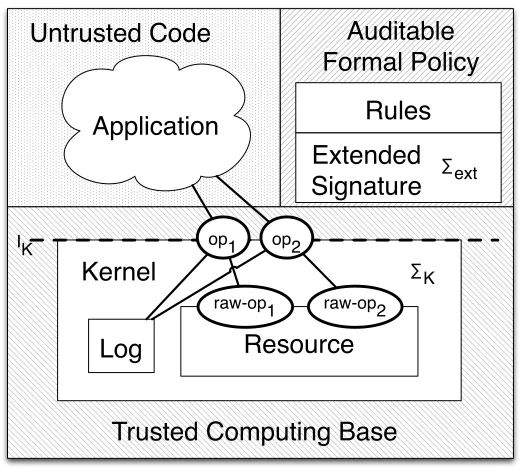
The Aura programming model suggests a different approach to protecting resources, illustrated
in Figure 2.1. There are three main components in the system: a trusted kernel, an untrusted
ap-plication, and a set of rules that constitute the formal policy. The kernel itself contains a log and a
resource to be protected. The application may only request resource access through kernel interface
IK. This interface (made up of theopis in the figure) wraps each of the resource’s native operations
(theraw-opis) with new operations taking an additional argument—a proof that access is permitted.
ΣKandΣextcontain constant predicate symbols that may be occur in these proofs.
Unlike the standard reference monitor model, an Aura kernel forwards every well-typed request
to its underlying resource. Each opi function takes as an additional argument a proof that the operation is permitted and returns a corresponding proof that the operation was performed, so the
well-typedness of a call ensures that the requested access is permitted. Proofs can be typechecked
Rules
Kernel
Resource
Log
raw-op1 raw-op2
Application
Trusted Computing Base
Untrusted Code
Auditable
Formal Policy
∑K ∑ext
Extended
Signature
op1 op2 IK
Figure 2.1: Schematic of the Aura runtime environment
a well-typed application. Moreover, logging these proofs is enough to allow an auditor to ascertain
precisely why any particular access was allowed.
We define a language Aura0 to provide an expressive policy logic for writing rules and
ker-nel interface types. It is a cut-down version of full Aura, which itself is a polymorphic and
dependent variant of Abadi’s Dependency Core Calculus (Abadi et al., 1999; Abadi, 2006). In
Aura0, software components may be explicitly associated with one or more principals.
Typi-cally, a trusted kernel is identified with principal K, and an untrusted application may work on
behalf of several principals: A, B, etc. Principals can make assertions; for instance, the
(inad-visable) rule “the kernel asserts that all principals may open any file,” is written as proposition
K says ((A:prin)→ (f:string)→ OkToOpenA f). Evidence for this rule contains one or more
signature objects—possibly implemented as cryptographic signatures—that irrefutably tie
princi-pals to their utterances.
The above design carries several benefits. Kernels log the reasoning used to reach access control
decisions; if a particular access control decision violates policy intent but is allowed by the rules,
accompanied by a proof, the trusted computing base is limited to the proof checker and kernel. As
small, off-the-shelf programs these components are less likely to suffer from software vulnerabilities
than traditional, full-scale reference monitors.
A key design principle is that kernels should be small and general; this is realized by removing
complex, specialized reasoning about policy (e.g. proof search) from the trusted computing base.
In this sense, Aura programs are to traditional reference monitors as operating system microkernels
are to monolithic kernels.
The formal system description
We model a system consisting of a trusted kernelKwrapping a security-oblivious resourceRand
communicating with an untrusted application. The kernel is the trusted system component that
mediates between the application and resource by checking and logging access control proofs; we
assume that applications are prevented from accessing resources directly by using standard resource
isolation techniques deployed in operating systems or type systems.
A resource R is a stateful object with a set of operators that may query and update its state.
Formally,R= (σ,States, IR, δ)whereσ ∈Statesand
IR=raw-op1 :T1 ⇒ S1, . . . ,raw-opn:Tn ⇒ Sn
The current stateσis an arbitrary structure representingR’s current state, andStatesis the set of all
possible resource states. IRis the resource’s interface; eachraw-opi :Ti ⇒ Siis an operator with
its corresponding type signature. TypeTi ⇒ Si indicates that the operation takes an element of
Ti, returns an element ofSi, and may have side effects; types will be explained in detail later. The
transition functionδ describes how the raw operations update state, as well as their input-output
behavior. For instance,(u, σ0) =δ(raw-opi, v, σ)when raw operationi—given inputvand initial resource stateσ—produces outputuand updates the resource state toσ0.
We formalize a trusted kernelKas a tuple(L, R,ΣK, IK); the authority of the kernel is denoted
by the constant principalK. The first component, L, is a list of proofs representing the log. The
second component is the resource encapsulated by the kernel. SignatureΣKcontains pairs of
pred-icates,OkToOpi :Ti → PropandDidOpi :Ti → Si → Propfor eachraw-opiof typeTi ⇒ Siin
P :T → S → Propdeclares a binary proposition constructor; see Section 2.3 for details.) These
predicates serve as the core lexicon for composing access control rules: a proof ofK says OkToOpt
signifies that an operationraw-opis permitted with inputt, and a proof ofK says DidOpt smeans
thatraw-opwas run with inputtand returneds. Associatingtandswith this proof lets system
au-ditors establish how some values were computed, not just what events occurred. Lastly, the kernel
exposes an application programming interfaceIK, containing a security-aware wrapper operation
opi : (x:Ti) ⇒ K says (OkToOpi x) ⇒
{y:Si;K says DidOpi x y}
for eachraw-opiinIR. Applications must accessRthroughIKrather thanIR.
The type ofopishows that the kernel requires two arguments before it will provide access to raw-opi. The first argument is simplyraw-opi’s input; the second is a proof that the kernel approves the operation, typically a composition of policy rules (globally known statements signed byK) and
statements made by other relevant principals. The return value ofopi is a pair ofraw-opi’s output with a proof that acts as a receipt, affirming that the kernel calledraw-opiand linking the call’s input and output. Note thatOkToOpiandDidOpidepend on the argumentsxandy.
The final components in the model are the application, the rule set, and the extended signature.
We assume either that the application is well-typed—and thus that it respectsIK—or, equivalently,
that the kernel performs dynamic typechecking (i.e., proof-checking) on incoming untrusted
argu-ments. The rule set is simply a well-known set of proofs intended to represent some access control
policy. As we will see, proofs in the rule set may contain interesting internal structure. The
ex-tended signature (Σextin Figure 2.1) defines predicate symbols that these rules may use in addition
to those defined inΣK.
Remote procedure call example Consider a simple remote procedure call resource with only the
single raw operation,raw-rpc:string ⇒ string. The kernel associated with this resource exposes
the following predicates:
ΣK = OkToRPC:string→Prop,
and the kernel interface
IK=rpc: (x:string) ⇒ K says OkToRPCx ⇒
{y:string;K says DidRPCx y}.
A trivial policy could allow remote procedure calls on all strings. This policy may be realized by
the singleton rule set
Rules={r0 :K says ((x:string)→ OkToRPCx)}.
State transition semantics
While the formalism presented thus far is sufficient to describe what Aura0systems look like at one
instant in time, it is much more interesting to consider an evolving system. Here we semi-formally
describe three alternative operational semantics for Aura0 systems, making comparisons based on
audit capability.
To demonstrate the key components of authorization and auditing in Aura0, we consider
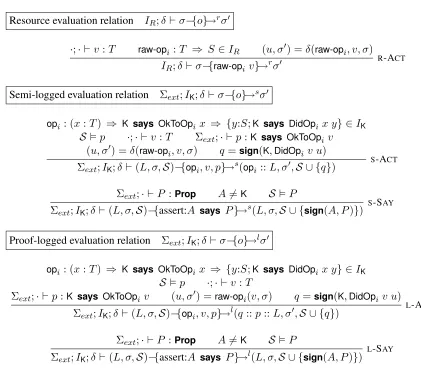
eval-uation from the three perspectives described below. Each updates state according to the transition
relations defined in Figure 2.2.
1. Resource evaluation, written with−{}→r, models the state transition for raw resources. This
relation does no logging and does not consider access control.
2. Logged evaluation, written with −{}→l, models state transitions of an Aura
0 system
imple-menting logging as described in this paper. All proofs produced or consumed by the kernel
are recorded in the log.
3. Semi-logged evaluation, written with −{}→s, models the full system update with weaker
logging. While proofs are still required for access control, the log contains only operation
names, not the associated proofs.
Resource evaluation is the simplest evaluation system. A transitionIR;δ`σ−{raw-opiv}→rσ0
may occur whenvis a well typed input forraw-opiaccording to resource interfaceIRandδspecifies
Resource evaluation relation IR;δ`σ−{o}→rσ0
·;· `v:T raw-opi :T ⇒ S∈IR (u, σ0) =δ(raw-opi, v, σ)
IR;δ `σ−{raw-opi v}→rσ
0 R-ACT
Semi-logged evaluation relation Σext;IK;δ`σ−{o}→sσ0
opi: (x:T) ⇒ K says OkToOpi x ⇒ {y:S;K says DidOpi x y} ∈IK S p ·;· `v:T Σext;· `p:K says OkToOpi v
(u, σ0) =δ(raw-opi, v, σ) q =sign(K,DidOpi v u) Σext;IK;δ`(L, σ,S)−{opi, v, p}→s(opi::L, σ
0
,S ∪ {q}) S-ACT
Σext;· `P :Prop A6=K S P
Σext;IK;δ`(L, σ,S)−{assert:A says P}→s(L, σ,S ∪ {sign(A, P)}) S-SAY
Proof-logged evaluation relation Σext;IK;δ `σ−{o}→lσ0
opi : (x:T) ⇒ K says OkToOpi x ⇒ {y:S;K says DidOpi x y} ∈IK S p ·;· `v:T
Σext;· `p:K says OkToOpi v (u, σ0) =raw-opi(v, σ) q =sign(K,DidOpiv u)
Σext;IK;δ`(L, σ,S)−{opi, v, p}→l(q::p::L, σ0,S ∪ {q})
L-ACT
Σext;· `P :Prop A6=K SP
Σext;IK;δ `(L, σ,S)−{assert:A says P}→l(L, σ,S ∪ {sign(A, P)}) L-SAY
Figure 2.2: Operational semantics
resource state toσ0. (In the following we will generally omit the`and objects to its left, as they are
constant and can be inferred from context.)
The logged evaluation relation is more interesting: instead of simply updating resource states,
it updates configurations. A configurationC, is a triple(L, σ,S), whereLis a list of proofs
rep-resenting a log,σis an underlying resource state, andS is a set of proofs of the formsign(A, P)
intended to track all assertions made by principals. There are two logged evaluation rules,L-SAY
andL-ACT.
Intuitively, L-SAY allows principals other than the kernel K to add objects of the form
all signatures found withinPalready appear inS. This last condition is writtenS P and prevents
principals from forging evidence—in particular, from forging evidence signed byK. S P holds
when all signatures embedded inP appear inS.
Rule L-ACT models the use of a resource through its public interface. The rules ensure that
both of the operation’s arguments—the data componentvand the proofp—are well typed, and all
accepted access control proofs are appended to the log. After the resource is called through its raw
interface, the kernel signs a new proof term,q, as a receipt; it is both logged and added toS. Again,
the premiseSP guarantees the unforgeability ofsignobjects.
The semi-logged relation functions similarly (see rulesS-SAYandS-ACT), although it logs only
the list of operations performed rather than any proofs.
By examining the rules in Figure 2.2, we can see that the kernel may only signDidOpreceipts
during evaluation. Since statements signed by any other principal may be added toS at any time,
we may identify the initial set ofsignobjects inSwith the system’s policy rules.
Observe that rules S-SAYand L-SAYdo not specify that only principalAcan createsign(A, P)
objects. Though desirable, such a property is not necessary for this chapter’s treatment of signing.
The language introduced in Chapter 3 enforces such a restriction implicitly, and Chapter 4 provides
an explicit and precise formalism for understanding a program’s runtime authority. In Chapter 4 a
program is run with a private key specifying a principal on whose authority it acts, and a program
can only generate signatures with an appropriate private key. In contrast, S-SAYand L-SAYrecord
that a new signature was created—but do not addresshoworwherethis occurred.
Audit and access control The three transition relations permit different operations and record
different information about allowed actions. Resource evaluation allows all well-typed calls to the
raw interface, and provides no information to auditors. Semi-logged evaluation allows only
autho-rized access to the raw interface via access control, and provides audit information of the list of
allowed operations. Logged evaluation, like semi-logged evaluation, allows only authorized access
to the raw interface; it also produces a more informative log of the proofs of the authorization
de-cisions. Intuitively, semi-logged and logged evaluation, which deploy access control, allow strictly
semi-logged evaluation for auditing, and semi-logged evaluation provides more information than
resource evaluation.
The rest of this section sketches a technical framework in which the above claims are formalized
and verified. The main result, Lemma 1, states that logged evaluation provides more information
during audit than resource evaluation; similar results hold when comparing the logged and
semi-logged relations or the semi-semi-logged and resource relations. The result is unsurprising, but it is not
trivial to make precise. Furthermore, as will be discussed in Section 2.6, surprisingly little work has
addressed the formal semantics of logging, and it is worthwhile to verify that this logging model
behaves as expected.
The lemma’s formal statement requires a few auxiliary concepts.
Each of the three relations can be lifted to define traces. For instance, a resource trace is a
sequence of the form
τ =σ0−{raw-op1v1}→rσ1· · · −{raw-opnvn}→rσn
Logged and semi-logged traces are defined similarly.
The following meta-function, pronounced “erase”, shows how a logged trace is implemented in
terms of its encapsulated resource:
b(L, σ,S)cl/r =σ bC−{assert: }→lτc
l/r =bτcl/r
bC−{op, v, }→lτc
l/r =bCcl/r−{(raw-op, v)}→rbτcl/r
For a set of traces,b(H)cl/r is defined as {bτcl/r |τ ∈ H}. Thel/rsubscript indicates erasure from logged to resource traces. Analogous functions,b·cl/sandb·cs/r, can be defined to relate other pairs of evaluation schemes.
The σ0,S0-histories of a configuration C, written Hl(σ0,S0, C), is defined as the set of all
traces that terminate at configurationCand begin with an initial state of the form(nil, σ0,S0). The
σ0-histories of a resource stateσ, writtenHr(σ0, σ), is defined as the set of all resource traces that
terminate atσ.
The following lemma makes precise the claim that logged evaluation is more informative for
a logged evaluation configuration or its erasure as a resource state. In either case the auditor can
consider the histories leading up to his observation. The lemma shows that there are histories
consistent with resource evaluation that are not consistent with logged evaluation. Intuitively, this
means logged evaluation makes more distinctions than—and is more informative than—resource
evaluation.
Lemma 1. There exists a kernelK, extended signatureΣext, configurationC= (L, σ,S), rule set
S0, initial traceσ0and resource traceτ such thatτ ∈Hr(σ0, σ), butτ /∈ b(Hl(σ0,S0, C))cl/r.
Proof Sketch. By construction. Let States = {up, down}, with initial state up. Pick
a configuration C whose log contains six proofs and reflects a trace of the form
( , up, )−{}→l( , down, )−{}→l( , up, ). Now consider trivial resource trace τ = up.
Ob-serve thatτ ∈Hr(up,bCcl/r), butτ /∈Hl(C).
Not surprisingly, it is possible to make similar distinctions between logged and semi-logged
histories, as logged histories can ensure that a particularL-ACTstep occurred, but this is not possible
in the logged case. As we will see in Section 2.3, this corresponds to the inability of the
semi-logged system to distinguish between different proofs of the same proposition and thus to correctly
assign blame.
We implement operations inIKby wrapping each underlyingraw-opwith trusted logging code.
Each wrapped operation is defined as follows2:
opi=λv.λp.
do logAppend(p)
let s= raw-opiv
let p0 =sign(K, DidOpiv s)
do logAppend(p0)
returnhs, p0i
The functionopi takes two inputs: a termv(to be passed to the underlyingraw-opi) and a proofp. It returns a pairhs, p0iwhose first component the result of applyingraw-opitovand whose second component is a proof generated by the kernel to provide evidence that the operation was performed.
2This example is written in simple imperative pseudocode. Its syntactic similarity to Aura
0, as specified in