SUPPLEMENT ARTICLE
Underage Drinking: A Developmental Framework
Ann S. Masten, PhDa, Vivian B. Faden, PhDb, Robert A. Zucker, PhDc,d, Linda P. Spear, PhDe
aInstitute of Child Development, University of Minnesota, Minneapolis, Minnesota;bDivision of Epidemiology and Prevention Research, National Institute on Alcohol Abuse and Alcoholism, Bethesda, Maryland;cDepartment of Psychiatry anddAddiction Research Center, University of Michigan, Ann Arbor, Michigan;eDepartment of Psychology, Binghamton University, State University of New York, Binghamton, New York
The authors have indicated they have no financial relationships relevant to this article to disclose.
ABSTRACT
A developmental framework for understanding and addressing the problem of un-derage alcohol consumption is presented. The first section presents the rationale for a developmental approach, including striking age-related data on patterns of onset, prevalence, and course of alcohol use and disorders in young people. The second section examines the fundamental meaning of a developmental approach to con-ceptualizing underage drinking. The third section delineates contemporary principles of developmental psychopathology as a guide to future research and intervention efforts. Strategic, sensitive, and effective efforts to address the problem of underage drinking will require a developmentally informed approach to research, prevention, and treatment.
D
EVELOPMENTAL APPROACHES TO understanding and addressing the problem of underage drinking are essential, not only because this problem occurs in a devel-oping organism but also because accumulating evidence strongly implicates the role of development in promising theories and interventions concerning this problem. It is increasingly clear that the emergence and progression of drinking behavior are influ-enced by development, that underage drinking has developmental consequences, thatalcohol use disorders (AUDs) are developmental in nature, and that efforts to prevent or to reduce underage drinking behavior must be developmentally informed to be strategic, sensitive, and effective. Our goals in this article are to summarize the case for a developmental perspective on underage drinking and to outline a developmental framework for underage drinking, to guide future theory, research, and practice. This framework emerged from the collaborative work of an advisory group assembled by the National Institute on Alcohol Abuse and Alcoholism in 2004 as part of the Underage Drinking Research Initiative.
The framework is presented in 3 sections. In the first section, we highlight the rationale for a developmental approach, including examples of data that the advisory group members found compelling as a rationale for developmental perspectives. In the second section, we discuss general developmental principles that guided our thinking, with examples of their application to drinking behavior. In the third section, we articulate principles of contemporary developmental psychopathology as applied to the problem of underage drinking.
RATIONALE FOR A DEVELOPMENTAL APPROACH TO UNDERAGE DRINKING
Focus
When the evidence on drinking behavior is examined through a developmental lens, the rationale for a develop-mental approach to understanding and preventing this problem comes into focus. In this section, we highlight conclusions based on the most salient data supporting a developmental approach.
There Are Striking Age-Related Patterns of Alcohol Use, Problems, Abuse, and Dependence
Alcohol use typically begins in the second decade of life, often in early adolescence. Although some young people begin drinking in elementary school, the first use of alcohol (defined as drinking a whole drink) typically occurs in early adolescence (at⬃13–14 years of age).1Data from multiple, nationally representative surveys indicate that rates
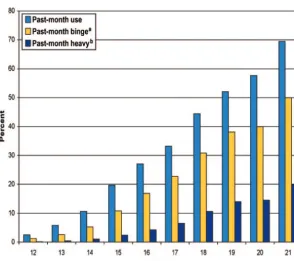
of alcohol use and binge alcohol use increase sharply between ages 12 and 21. As shown in Fig 1, for example, data from the 2005 National Survey on Drug Use and Health indicated that the proportion of people who have drunkⱖ1 whole drink increases steeply during adolescence and then plateaus at⬃21 years of age.2Furthermore, data from the
same study showed that all levels of past-month drinking, from use to binge drinking to heavy drinking, increase with increasing age during adolescence (Fig 2). Similarly, the number of reported binge-drinking days in the past 30 days shows important age-related patterns. As shown in Fig 3, this study also indicated that the number of binge-drinking days increases sharply during adolescence, more so for boys than for girls, and then decreases dramatically for both genders during the third decade of life and continues to decrease thereafter.
Drinking patterns also vary dramatically according to age. As shown in Fig 4, the National Survey on Drug Use and www.pediatrics.org/cgi/doi/10.1542/ peds.2007-2243A
doi:10.1542/peds.2007-2243A
Key Words
development, drinking, alcohol
Abbreviation
AUD—alcohol use disorder
Accepted for publication Nov 27, 2007 Address correspondence to Ann S. Masten, PhD, Institute of Child Development, University of Minnesota, 51 East River Rd, Minneapolis, MN 55455. E-mail: amasten@ umn.edu
Health data indicated that, whereas adolescents drink less often than young adults and older adults, they drink more per occasion. When youths between 12 and 20 years of age drink, they drink an average of⬃5 drinks, an amount in the binge-drinking range. (Binge drinking typically is defined as consumingⱖ5 drinks per occasion for men and ⱖ4 drinks per occasion for women.) The data shown in Fig 4 are consistent with those from multiple other studies, showing how common binge drinking is among adolescents. Moreover, some of the contexts that attract adolescents specifically, including
organized parties, college, and military service, are asso-ciated with high rates of drinking behavior.3,4
Underage drinking accounts for substantial propor-tions of all alcohol consumed in the United States and of estimated consumer expenditures for alcohol. The esti-mated short-term cash value to the alcohol industry of underage drinking was $22.5 billion in 2001.5
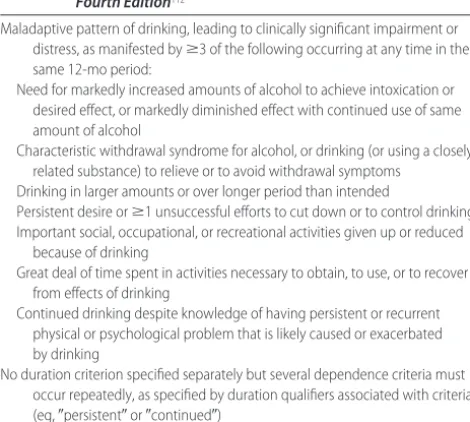
Alcohol dependence (defined according to the criteria of the American Psychiatric Association, which are sum-marized in Table 1) typically emerges during late ado-lescence or early adulthood, as shown in Fig 5.6 The
FIGURE 1
Proportion of individuals of a given age in the US who have ever drunk alcohol (a whole drink). Data source: Substance Abuse and Mental Health Services 2005 National Survey on Drug Use and Health.2
FIGURE 2
past-year prevalence of alcohol dependence is highest between the ages of 18 and 20 years, peaking before youths even reach the legal drinking age of 21 years in the United States. Prevalence remains quite high among 21- to 24-year-old individuals and declines thereafter. In addition, as shown in Fig 6, children and youths who begin alcohol use before the age of 14 years are much more likely to develop alcohol dependence at some point in their lives than are those who begin drinking after the age of 21 years.7
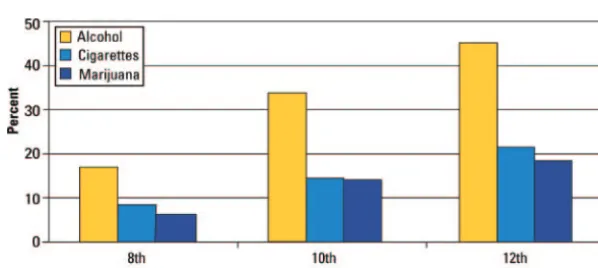
Multiple, nationally representative surveys indicate that alcohol is the drug of choice among US adoles-cents of all ages. As can be seen in Fig 7, data from the Monitoring the Future survey indicated that more youths drink alcohol than smoke cigarettes or use mari-juana; this is true among eighth-, 10th-, and 12th-grade youths.8 These figures are even more dramatic among
male students; for example, 50.7% of 12th-grade male students had consumed alcohol in the past month.
Alcohol is implicated in large proportions of deaths related to accidents, homicides, and suicides among young people. For example, each year ⬃1900 persons ⬍21 years of age die in motor vehicle crashes that in-volve underage drinking (and⬃500 additional persons ⬎21 years of age also die in those crashes).9Alcohol is
also involved in ⬃1600 homicides and ⬃300 suicides among persons ⬍21 years of age.10–13 Finally, ⬃1600
persons ⬍21 years of age die as a result of
alcohol-related, unintentional injuries (not related to motor vehicle crashes).11,13
Acute, Intermediate, and Longer-Term Effects of Alcohol Vary According to Age and Development
Evidence is accumulating in animal research and a lim-ited number of human studies that immediate, short-term, and long-term effects of alcohol on individuals can vary as a function of age or developmental status. For example, prenatal exposure to alcohol, which can result in fetal alcohol spectrum disorders, has profoundly dif-ferent consequences for development than does later exposure, in humans14–16 and in animals.17 In rhesus
monkeys, the timing of prenatal exposure has differen-tial effects on fetal development.18Animal research
sug-gests strongly that adolescent animals, compared with adults, are less sensitive to the aversive effects of acute alcohol intoxication (eg, sedation, hangover, and ataxia) but are more sensitive to alcohol’s effects on social facil-itation and disruption of spatial memory.19,20Additional
animal research has indicated that alcohol consumption before and during adolescence can produce long-lasting effects, including increases in alcohol consumption in adulthood.21
Research on stress and alcohol in nonhuman pri-mates provides additional evidence of developmental differences in the role of alcohol. For example, studies have shown that adolescent monkeys double their
alco-FIGURE 3
Number of days in the past 30 days in which drinkers consumed ⱖ5 drinks, according to age and gender. Data source: Substance Abuse and Mental Health Services Administration data from the 2005 National Survey on Drug Use and Health.2
FIGURE 4
hol intake under stress (peer raised versus mother raised) and also that excessive alcohol consumption is related to changes in levels of stress hormones and se-rotonin.22
Research on the long-term consequences of chronic alcohol exposure in animals also suggests differential sensitivity in adolescence.23In 1 study, rats experienced
chronic, intermittent, alcohol exposure during either adolescence or early adulthood.24After a 20-day
recov-ery period, there were no differences in spatial learning. When the animals were challenged with a low dose of alcohol, however, learning was significantly more im-paired in the animals exposed to alcohol in adolescence than in those exposed as adults. In a study using a high-dose, 4-day, binge alcohol-exposure paradigm applied to adolescent or adult rats, some brain damage was found in both age groups but only the animals that had been exposed to alcohol during adolescence manifested
dam-age in the frontal cortical olfactory regions and the an-terior portions of the piriform and perirhinal cortices.25
This finding suggests that, at least with a model of ex-treme, binge-type, alcohol exposure, certain brain re-gions may be more susceptible to alcohol-induced dam-age during adolescence.
Development Itself May Be Altered by Alcohol Exposure
Data on the effects of exposure to alcohol during fetal development and also during adolescence indicate that alcohol can alter development itself. Fetal alcohol expo-sure clearly contributes to physical anomalies in hu-mans14 and animals.17Animal research has shown that
repeated alcohol exposure during adolescence induces inflammatory cell death,26 as well as morphologic and
neurochemical changes in the brain that may persist into adulthood,27,28 although studies have yet to explore
whether adults would be less vulnerable to these effects than adolescents. Research with human adolescents in-dicates that severe AUD is associated with reduced hip-pocampal volume,29,30although these results should not
be interpreted as necessarily being causal.
Drinking also may alter the development of social and academic competence. Underage drinking is associated strongly with academic and social problems, potentially undermining success in domains of competence that are crucial for successful adult development.31,32The
as-sociations of underage drinking behaviors with prob-lems in social competence or school achievement likely arise from complex (and bidirectional) influences over the course of development, which are not yet fully elu-cidated. Nonetheless, there is growing evidence that drinking contributes to problems in key domains of be-havior among children and adolescents, such as peer relationships and school performance, which have con-sequences for future opportunities and success in terms of work, adult relationships, health, and well-being.
Alcohol Use and AUDs Have Predictability From Childhood
A substantial body of evidence implicates a set of risk factors that consistently precede and predict early use and/or dependence.31–34These factors include the
follow-FIGURE 5
Prevalence of past-year alcohol dependence (based onDiagnostic and Statistical Manual of Mental Disorders, Fourth Edition, criteria) in the United States. Data source: 2001/2002 National Epidemiologic Survey on Alcohol and Related Conditions.6
TABLE 1 Diagnostic Criteria for Alcohol Dependence, Adapted from theDiagnostic and Statistical Manual of Mental Disorders, Fourth Edition112
Maladaptive pattern of drinking, leading to clinically significant impairment or distress, as manifested byⱖ3 of the following occurring at any time in the same 12-mo period:
Need for markedly increased amounts of alcohol to achieve intoxication or desired effect, or markedly diminished effect with continued use of same amount of alcohol
Characteristic withdrawal syndrome for alcohol, or drinking (or using a closely related substance) to relieve or to avoid withdrawal symptoms
Drinking in larger amounts or over longer period than intended
Persistent desire orⱖ1 unsuccessful efforts to cut down or to control drinking Important social, occupational, or recreational activities given up or reduced
because of drinking
Great deal of time spent in activities necessary to obtain, to use, or to recover from effects of drinking
Continued drinking despite knowledge of having persistent or recurrent physical or psychological problem that is likely caused or exacerbated by drinking
ing: family history of alcohol abuse, parents with anti-social behavior, mothers with depression, poor parent-ing (eg, maltreatment, neglect, or poor monitorparent-ing), prenatal exposure to alcohol and clear fetal alcohol syn-drome, child maltreatment, child antisocial behavior, child smoking or substance abuse, self-regulation prob-lems that also predict antisocial and risk-taking behavior (eg, attention problems, effortful control problems, or impulsivity), cognitive learning difficulties in children, and various internalizing symptoms in children.
There seem to be some common pathways that lead toward AUDs.32,35 For example, considerable evidence
suggests a pathway associated with early signs of prob-lems regulating attention and emotion, impulsivity and aggression, early cognitive problems, academic and so-cial problems after school entry, later deviant peer affil-iations, and a course of escalating antisocial behavior. In the delinquency/antisocial literature, this pathway is described in terms of early starters or life-course persis-ters.36,37 This pathway leads to multiple problem
out-comes by adolescence and is associated with many of the risk factors listed above.
Most of the risk (or protective) factors for alcohol
use and AUDs are nonspecific, in that they also fore-cast many problems other than alcohol problems, in-cluding conduct problems, learning problems, school dropout, risk-taking behaviors, early sexual activity, pregnancy, antisocial personality disorder, and mood disorder.32,34,38–41Moreover, many of these factors are in
place early in development, before school begins, in-cluding the following: temperament differences related to behavioral and emotional control or dysregulation observable very early in development; problems with self-awareness, self-monitoring, attention, and effortful control; a history of adversity in multiple forms (family history of antisocial behavior, experiences of abuse or trauma, or other negative life experiences); and individ-ual differences in cognition related to response inhibi-tion, forethought, and planning. These major domains of functioning show developmental variations and broad individual differences from early in development, pre-dict many kinds of problems, and thus are nonspecific for alcohol involvement, although they clearly are risk factors for its emergence and progression to problem use.32
Risk and Protective Factors Associated With Higher or Lower Use/Dependence Have Age-Related Patterns
Data on expectancies about the effects of alcohol, intent to use alcohol, and access to alcohol all show age-related shifts. Expectancies about the effects of alcohol shift from predominantly negative to positive during later middle childhood and early adolescence.42,43These shifts
may be linked to the transition from childhood or ele-mentary school to adolescence or secondary school. Hip-well et al,44for example, found that positive expectancies
increased and negative expectancies decreased during the age period of 8 to 10 years in the Pittsburgh Girls Study. Findings from Dunn and Goldman42,43also
indi-cated that this shift occurs earlier than the transition to secondary schooling. Similarly, intent to use alcohol in-creases with age during elementary school,45and access
to alcohol tends to increase over the course of childhood and adolescence.8
Other data also hint at key shifts in risk factors or perspectives regarding alcohol that are related to age or development. Smoking (a risk factor) typically begins in early adolescence.46 Peer popularity in elementary
school generally is associated with low risk for alcohol
FIGURE 6
Association of age of initiation of alcohol use and lifetime dependence (meeting Diag-nostic and Statistical Manual of Mental Disorders, Fourth Edition,criteria for dependence at some point in one’s life). Data source: 2001–2002 National Epidemiologic Survey on Alcohol and Related Conditions.7
FIGURE 7
use,32but popular high school students may have higher
risk.47Exposure to alcohol at parties increases in
adoles-cence, which may account for some of the increasing risk of use among popular youths, who are more likely to be invited to parties. Underage drinking is viewed as a rite of passage by many US parents and also by many adolescents.48,49Clearly, however, this rite of passage is
associated with adolescence and not early childhood, and cultural expectations about this rite of passage re-flect an age-related shift in adult expectations or tacit approval of drinking.
Another shift seems to occur with transitions into college. The risk for binge drinking increases sharply among college students, and the first few months of college may be a period of particularly heightened risk for hazardous drinking.50 Some college students follow
very different trajectories, however, with level or de-creasing risk during this period.51,52
Contextual risk or protective factors embedded in peer and family relationships also show prominent age-related changes.53 Deviant peer association and
delin-quent behaviors among deviant peers, both of which are key risk factors for alcohol use, increase in early adoles-cence, particularly among youths with a cluster of risk factors for antisocial and risky behavior.36Parental and
other adult monitoring (which can be protective) often decreases during adolescence, as unmonitored time in-creases.
BASIC FEATURES OF A DEVELOPMENTAL APPROACH
Focus
These age-patterned data on alcohol, including data on incidence, prevalence, use, progression, binging, depen-dence, expectancies, timing, and consequences, collec-tively constitute a compelling case for a developmental approach to the problem of underage drinking. Data on onset, offset, use, dependence, developmental con-sequences, individual and contextual risk and protective factors, and alcohol effects all show striking patterns related to age and developmental changes. In this sec-tion, we delineate the core elements of a developmental approach, with particular application to underage drink-ing. Given our assertion that a developmental perspec-tive is essential for understanding and addressing under-age drinking, it is important to consider what it means to have a developmental approach.
What Is Developmental Change?
Developmental science is the study of change over the life course of living organisms, focused on patterns of orderly change as organisms begin to form, mature, and decline. People develop and change throughout life but particularly during childhood and adolescence, when individuals undergo periods of rapid change in many aspects of form, function, and status, including growth, coordination, strength, and movement skills; brain size, organization, connectivity, and function; cognitive, emo-tional, and social capabilities; motivation and self-directed behavior; physical, financial, and emotional
independence from parents; reproductive maturity; and education and knowledge.
People also routinely experience many changes of context in childhood and adolescence, some of which are designed to foster learning and maturation into societal roles (eg, school changes), some of which are precipitated by children for their own enjoyment or interest (eg, friends and activities), and some of which befall people (eg, stressful life experiences). There are dramatic changes in the contexts in which young people spend their time and engage their minds and bodies during these years.53
Many behavior problems and disorders emerge in the first 2 decades of life, during these years of dra-matic change,53–59 including alcohol-related problems
and AUDs. It is highly likely that the causes and conse-quences of alcohol use and AUDs are related to these changes in individuals, their contexts, and their inter-actions. Consequently, it is also likely that interven-ing effectively to prevent, to delay, or to treat underage drinking must take these changes into account.
Time is required for change to occur, but not all changes are developmental. For example, imagine that a person loses an arm suddenly in a car accident. The change from having 2 arms to having 1 arm, although dramatic, is not in itself a developmental change. How-ever, many developmental changes could have contrib-uted to the car accident, and the consequences of the accident could have far-reaching effects on future devel-opment. Moreover, the kind of change through which an embryo develops arms originally is fundamentally developmental, as is the growth of the arms during childhood and adolescence.
Development is related to age, but it is not the same thing as just growing older. This is most clear during periods of rapid development, such as early adolescence, when the timing and pace of development vary widely for individuals.20,53 Development is slow in some
chil-dren and faster in others, and it occurs earlier in some children than others. Therefore, a group of adolescents who are all the same age may vary widely in develop-ment, because of differences in the timing of pubertal processes. These differences are readily apparent at ballet recitals and in gym classes grouped according to age in early adolescence. Some 12-year-old girls look very grown up, whereas others still look like little girls.
Maturing early can cause problems or advantages, depending on the context. Early-maturing girls who be-come involved in dating older boys who are drinking at parties may experience trouble. Early-maturing athletes in sports where strength or height is an advantage may benefit in their sport from early maturation. If team-mates encourage drinking, however, then the advan-tages of success on a team may be undermined by the hazards posed by early drinking.
pro-cesses. Girls typically enter and complete the growth spurt of puberty earlier than boys do. On average, boys grow to be taller than girls, although they reach peak growth velocity later, and they also end up considerably stronger than girls.
In the case of behaviors (such as alcohol use) that are legally proscribed among children but accepted among adults in many societies, it is important to distinguish between normative patterns of use and acceptable pat-terns of use. Alcohol use is normative at some point in development among youths or adults in many societies and cultural groups around the world; however, alcohol use often occurs earlier than the age of legally or socially accepted use. It is not normative or acceptable for young children to drink alcohol in most societies. Alcohol use typically becomes acceptable and common sometime during the end of the second decade or the beginning of the third decade of life in drinking societies.
Human development can be described in terms of particular domains or levels of functioning or change (eg, brain development, language development, social development, and puberty) or in terms of major eras of development (eg, prenatal period, infancy, and adoles-cence). Changes also can be described in relation to developmental tasks and issues characteristic of a given period (eg, school achievement, identity, autonomy, and rites of passage) or changing developmental contexts (eg, home, peer groups, preschool, schools and class-rooms, and college).
What Is Changing in Development?
Many kinds of changes can be observed in development; there are changes in form, function, organization, and context. There are changes in the structure, function, and organization of the brain and changes in appear-ance, strength, language, self-control, attitudes, motiva-tion, how individuals spend their time, where and who they spend it with, and expertise. Many developmental scientists describe the major kinds of changes that occur over time, particularly in the first 3 decades of life, in terms of changes in context, developmental processes or behavior, and developmental tasks. These contexts, pro-cesses, and tasks are often described for particular age periods bounded by important transitions, such as birth, school transitions, and puberty.
The most common categories marking developmental time periods are probably the following: prenatal devel-opment (conception to birth), early childhood (birth to ⬃5 years of age, including infancy, toddler, and pre-school periods), middle childhood (from pre-school entry to the beginning of puberty, ie,⬃4 –5 years through⬃8 –10 years of age), adolescence (early, middle, and late, often encompassing secondary school and the second decade of life, ie, ⬃8 –10 years through⬃18 –20 years of age), and the transition to adulthood (⬃18 –25 years of age). The boundaries of developmental eras are not fixed, for multiple reasons, including the following: development itself is a continuous process that does not have pre-cisely defined beginning and ending points; there are many individual differences in the timing and pace of change; and there are cultural, national, and historical
differences in the definitions of these developmental periods and in the timing of major transitions, such as when school begins. Broad cohort changes in devel-opmental timing also occur for multiple reasons, in-cluding changes in diet, exercise, contexts, and cultural practices. For example, it has been widely noted that milestone markers of pubertal development are occur-ring at earlier ages in modern societies, whereas entry into full adult status has been delayed.53 As a result,
adolescence or the time between childhood and adult-hood has increased, whereas the middle childadult-hood years have decreased. Some developmental theorists have ar-gued that a new epoch of development between ado-lescence and adulthood, sometimes termed “emerging adulthood,” has been created by the combined influ-ences of biological and societal changes that have pro-duced earlier physical maturation and later adult status.60
As contexts change, the nature of supports, challenges, and complexity of life for individuals often changes. As children grow older, they spend less time at home and with parents and more time with peers, in school, and in the community. Monitoring by responsible adults also varies across contexts. The opportunities for observing alcohol use and access to alcohol vary across contexts in relation to age and development.
The contexts in which children spend their time change over the course of individual development and also over historical time. These contexts include physical environments (eg, home, playground, school, city, and farm), relationships (eg, family and peer groups of var-ious kinds), cultural groups (eg, ethnic, religvar-ious, and social), and media or virtual environments (computer games, Internet, music, radio, and television).
In a living system as complex as a human individual, development involves a variety of changes across many levels. Vulnerabilities, risks, supports, protective influ-ences, and contexts all change and, from their com-plex interplay, the observable measurable patterns of an individual’s life and behavior emerge. It is tempting to describe the behavior of an individual as though it re-sulted solely from the motives, thoughts, desires, and actions of the individual observed. However, individual behavior carries influences from many past interac-tions within and across persons and contexts, at many levels of interaction. Moreover, current behavior is often constrained or afforded by current contexts and circumstances. Current alcohol use is influenced by availability, price, cultural and subcultural norms, adult monitoring (both that institutionalized via community law enforcement and school rules and that performed at the family level), and peer reinforcement, as well as by individual motives, desires, expectancies, values, and vulnerabilities.
Significance of Developmental Tasks
Throughout the world, parents and other adults have developed expectations and standards about what chil-dren should be doing to move toward successful roles in the family and society, often called developmental tasks.61Children come to share these expectations (and
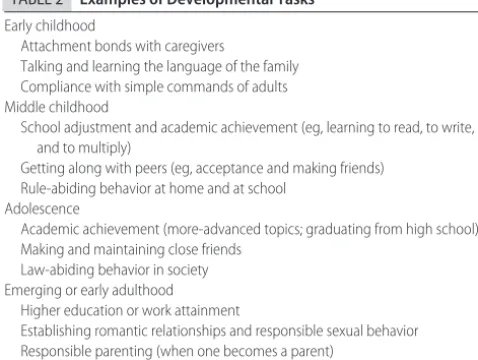
develop-mental tasks are physical milestones, and many are so-cial achievements. Some are universal and others are highly specific to a culture or region. Judgments based on these achievements are rendered by parents, self, and society regarding how development is proceeding and how it will proceed in the future. Table 2 provides ex-amples of widely held developmental task expectations from early childhood to early adulthood.
In early childhood, adults expect children to learn to communicate in the language of their group, to walk, to obey simple rules, and to listen to adults. In most societies, children 6 or 7 years of age are expected to go to school, to behave appropriately, to learn to read, to write, and to perform arithmetic, to get along with oth-ers, and to show respect for authority. As children be-come adolescents, academic/work expectations increase in complexity and responsibility, youths are expected to learn and to follow the rules and laws that govern con-duct in adult society, and they begin to learn about responsible dating and romantic social conduct in their community and culture. Learning to drive a car and passing a driving test are milestones for many youths, as are rites of passage involving acceptance as a committed member of a religious community. Many parents also consider it important for a child to contribute to the family or community through chores or good deeds, or at least not to destroy and to harm others or community property. Many of these expectations are codified in religious texts and early writings about the education of children, and they also are evident in screening mea-sures for healthy development.
Acceptable performances in these tasks represent important milestones in the eyes of the stakeholders for positive child development, including parents, teachers, other community members, and children themselves. Failing in these domains by not meeting expectations may have serious consequences for children’s current and future opportunities, peer reputation, social sup-port, self-esteem, and relationships with their parents.
Alcohol may interfere with or facilitate developmen-tal task achievement in multiple ways. Alcohol use by adults who play a key role in child development (eg,
parents and teachers) can undermine the achievement of developmental tasks by the children in their care. In addition to prenatal or postnatal exposure to alcohol, alcohol use by adults can interfere with parenting, con-tribute to poverty, increase the risk of exposure to devi-ant peers, and in other ways increase the general level of adversity and risk faced by a child.
Alcohol use by children may have lasting effects on competence in age-salient developmental tasks that rep-resent the foundation on which progress in future tasks depends, by interfering with school attendance or con-centration, by ruining relationships, and by potentially damaging brain function or altering brain development. However, alcohol use that is acceptable in society and facilitates social functioning (perceived or actual) may have positive influences on developmental tasks. It is crucial to know how alcohol use alters the achievement of developmental tasks, because success or failure in these tasks plays such a salient role in individual devel-opment and in the future of a community.
In societies in which alcohol use is pervasive and widely accepted behavior for adults, it could be argued that appropriate alcohol use itself is an important devel-opmental task.48It is not clear whether parents approach
the issue of responsible alcohol use (whether they view this as abstinence or socially appropriate use) as a de-velopmental task for their children. If they do, adults should actively teach their children responsible adult use or prepare them with the skills to achieve responsible adult use (or to achieve abstinence).
Developmental Transitions and Scaffolding
Windows of vulnerability and opportunity have been noted in development, often reflecting periods of par-ticularly concentrated change in individuals, their contexts, and interactions of individuals and contexts.53,54,56,57 In
biological and cultural evolution, supportive roles prob-ably coevolved with these windows of vulnerability. In developmental theory, scaffolding refers to the supports and guidance provided by parents, mentors, or organi-zations to help children function effectively beyond their independent capabilities or despite their vulnerabili-ties.62Vygotsky62 popularized this idea in his theory of
learning, particularly in the concept of a zone of proxi-mal development, referring to the range of behavior of which a child is capable when supported by others, particularly teaching adults.
Transitions into school, into adolescence, out of the home for the first time, into college, into marriage or parenthood, and into other new situations have been viewed as periods of vulnerability or opportunity, when much of an individual’s life is in flux. Families, religions, and societies often provide young people with extra support during these transitions, in the form of extra attention, rituals, activities, or structured experiences to support successful transitions.
There is some concern in contemporary US society that children are not being provided with the level of support or scaffolding that they need to make successful transitions into adolescence and adulthood.53,56,57In the
case of alcohol use, there are specific concerns regarding
TABLE 2 Examples of Developmental Tasks Early childhood
Attachment bonds with caregivers
Talking and learning the language of the family Compliance with simple commands of adults Middle childhood
School adjustment and academic achievement (eg, learning to read, to write, and to multiply)
Getting along with peers (eg, acceptance and making friends) Rule-abiding behavior at home and at school
Adolescence
Academic achievement (more-advanced topics; graduating from high school) Making and maintaining close friends
Law-abiding behavior in society Emerging or early adulthood
Higher education or work attainment
insufficient monitoring of young people and inadequate support for young adolescents who are maturing earlier and encountering increasing risks for alcohol use in di-verse ways, including media exposure, disrupted fami-lies, and increased alcohol use among deviant peers.20,53
Historical Changes in Development and the New Maturity Gaps
As noted above, historical changes occur in the timing of physical and social development and in the timing of transitions to new contexts.53,63,64 Children in modern
industrialized societies grow taller and mature earlier than did young people in the same societies in earlier times, probably because of changes in diet and health in modern societies. At the same time, it takes much longer for young people to become established adults in con-temporary societies, taking on full adult responsibilities in work and family life. Education and training last longer than they did previously, and more education is needed for many job opportunities. Young people often marry later, if at all, and have fewer children than did the generations of their parents and grandparents. This combination of earlier sexual maturity and delayed adult status has extended the period of development termed adolescence (often referring to the period from the be-ginning of puberty to the establishment of adult roles and status). It has also created what may be the widest “maturity gap” in human history (the time between reaching sexual maturity and reaching social maturity). There is another kind of maturity gap that also might have been created by the earlier onset of puberty and sexual maturation. As young adolescents become sexu-ally mature, with hormonal and related brain changes in reward systems and motivation, there seems to be an increase in risk-taking behaviors and changes in emo-tional intensity, but there is little evidence that the ex-ecutive control systems associated with higher cognitive processes are maturing any earlier.53The executive
func-tioning gains that track brain development and changes in brain connectivity in the first, second, and third de-cades of life do not seem to have accelerated. Therefore, a maturity gap might have emerged between the early-maturing changes of emotional/motivational systems, perhaps related to earlier onset puberty, and the later-maturing cognitive executive control functions provided by more slowly developing neurocircuits.53,54,58Scientists
in the MacArthur Network on Adolescence and Psycho-pathology compared the results of this gap to “starting the engines without a skilled driver.”53
As these adolescent maturity gaps widen, the devel-opmental period that used to be called middle childhood or “latency” (the time between the beginning of school and puberty) has decreased. While writers lament the loss of childhood or describe the “hurried child,”65capital
markets and media are responding rapidly to younger pubescent children, with clothing lines for “tweens” and special Internet sites, movies, and other products tai-lored to children in elementary school with the interests of adolescents.53,66There is growing concern that tweens
may acquire the attitudes and behaviors of their older
peers in relation to alcohol as well as clothing and dance moves.33
Development or Experience?
Some changes over the life course are the result of experience, some are the result of development, and some result from both. Learning to drive a car requires experience, but driving skills also depend on physical size, reflexes, judgment, and other aspects of human behavior that develop as the brain and body mature. A 10-year-old child with 2 years of driving experience is not likely to be the same kind of driver as an 18- or 25-year-old adult with the same experience, because the average capabilities that typical 10-, 18-, and 25-year-old individuals brings to the experience are so different (biologically, socially, and cognitively). Moreover, a novice driver is probably less safe driving on ice and snow than is an experienced driver. State driver-licensing agencies, insurance companies, and rental car companies all im-plicitly encode developmental differences in their rules and prices. They base those rules on age and passage of a skill-based driving test, rather than developmental ma-turity, because it is easier to document age and skills than developmental readiness. Similarly, laws allowing youths to purchase or to drink alcohol are based on presumed maturity according to age, because this is eas-ier to assess. When parents allow their own adolescent children to drive the family car is a different matter and is very likely to be influenced by what the parents know about that particular child in terms of maturity, driving skills, risk-taking behavior, and driving history and also their assessment of the particular situations (eg, current weather conditions, reasons for driving, who is going to be in the car, and time).
One of the most important roles of adults in the socialization of children and youths is to provide sup-ports until the immature or novice individual is able to do something consistently without support. Parents also monitor the lives of their children for danger. Parents have long known that development can be uneven, creating hazardous maturity gaps. Toddlers who have just learned to walk and adolescents who have just learned to drive have in common a surge in risks for accidents related to a disjunction between the capabili-ties of doing something new that is exhilarating and the judgments about when, where, and how fast to do it that come from experience. It is the job of adults to scaffold these gaps with the supports (or monitoring) necessary to protect the young person from harm but foster the development of adaptive competence.56,57 Adults can
provide external structures and executive functioning to children, in the form of monitoring, rules, discipline, and organized activities. Graduated driver licenses in some states attempt to reduce the risks of novice driving by adolescents by setting rules about when, with whom, and where beginning drivers can drive.
Interplay of Genes and Environments in Development
and environments do not influence development inde-pendently but rather interact inextricably in develop-ment. Epigenesis is an important idea in the contempo-rary understanding of the ways in which genes and environments in dynamic interaction produce develop-ment.
The idea of epigenesis came originally from embryol-ogy, referring to the processes by which 1 kind of cell differentiates into specialized cells and systems in a de-veloping organism.67More specifically, epigenesis refers
to environmentally influenced control of gene transcrip-tion that is long-lasting and can be inherited across cell divisions over the life span of the individual.68This term
has come to refer more broadly to the dynamic and complex processes by which genes and environments interact over the life course to produce a functioning and adapting individual.69 These dynamic processes explain
how the same genes can result in widely varying out-comes, depending on gene regulation (which genes are on and off when) and other kinds of gene-environment interactions, with the result that the lives of even mono-zygotic twins diverge over the course of development.
At a molecular level, the best studied means of epi-genetic control is through DNA methylation, a process by which the addition of methyl groups to promoter/ regulatory regions of DNA serves to suppress the tran-scription of genes regulated by those regions.67,69–71
This environmentally influenced “regulation through re-pression” increases progressively during development as cells become progressively locked into differentiated states. Through such gene repression, environmental influences can be imprinted on DNA, resulting in lasting alterations in phenotype that can be passed along to daughter cells with subsequent mitotic divisions. Under some circumstances, epigenetic regulation may be trans-mitted from parents to offsprings, findings reminiscent of the Larmarckian notion of acquired traits being inher-ited across generations.
Environmental factors induce epigenetic regulation through alterations in the microenvironment around specific cells, including growth factors, neurotransmitters, and energy supplies, as well as circulating levels of hormones, cytokines, and viruses. These aspects of the microenvironment may be influenced in turn by char-acteristics of the external environment that range widely from stressors to nutritional status and maternal care. For instance, provision of methyl group-rich supple-ments (eg, folic acid and vitamin B12) in the diet of
pregnant and lactating mice induced increases in DNA methylation in their offspring, with the offspring also exhibiting lower incidence rates of obesity and diabetes mellitus, attenuated tumor susceptibility, and a darker coat color.72 As another example, rat pups raised by
mothers who exhibit low levels of maternal licking and grooming have greater levels of methylation in the pro-moter region of the gene coding for a stress hormone receptor (the glucocorticoid receptor). Because of this methylation-induced suppression of the GR gene, off-spring of low-licking mothers have lower levels of glu-cocorticoid receptor expression in the hippocampus, a region where glucocorticoid receptors form part of a
feedback system terminating stress responses. Func-tionally, these offspring are more reactive behaviorally and neurally to stressors and take longer to recover from stressors, compared with offspring of high-licking moth-ers.73
Through environmentally induced epigenetic regula-tion, lasting effects of the environment can be exerted on the propensity for particular genes to be expressed. Re-search has just begun to relate specific environmental events to particular epigenetic changes even in simple animal models, much less in humans. However, research provides evidence that epigenetic regulation is environ-mentally influenced and increasingly expressed during development in humans, as in laboratory animals. For instance, studies of epigenetic regulation in identical twins revealed epigenetic differences between twin pairs in middle age that were not apparent early in life, as well as more epigenetic variation between twin pairs who had spent less time together in their lives, relative to pairs who had been associated more closely.74Epigenetic
regulation through methylation-induced repression “represents an entire level of cellular information on top of the DNA sequence”68 and provides a critical link
be-tween genes and the environment as phenotypic expres-sion is elaborated dynamically during development.
Genes respond to environmental signals as well as to other genes, and this responsiveness explains some of the extraordinary variation in human development and adaptability. Moreover, because no 2 organisms could possibly have exactly the same experiences, the course of development is probabilistic. Development is also con-strained by the human genome and an individual’s DNA; only genes that are present can be regulated. Hu-mans do not mature into mice, and identical twins are likely to resemble each other in many ways, no matter how different their nurturance may be.
There is increasing attention to the epigenetic features of neural and behavioral development,69,75 including
complex behavior such as alcohol use.76 Of particular
interest here is emerging interest in specific genes that may interact with experience over the course of devel-opment to increase or to decrease the likelihood of alcohol use and AUD and interest in the effects of eth-anol exposure on gene expression across development. There is keen interest in identifying the chemical pro-cesses, brain functions, and behaviors that are serving as intermediaries of gene-environment interactions, be-cause the genes of 1 person do not interact directly with the genes of other people or directly with the external environment. Behaviors that may serve such as inter-mediaries or “endophenotypes”67,69 of interest include
poor impulse control and sensation-seeking. These be-haviors might be influenced by genes and poor environ-ments in the course of development and eventually moderate the likelihood of a teenager accepting an offer to go drinking with a friend.
have lower risks for alcoholism, which suggests mod-erating effects.77 These results represent 1 of the most
thoroughly documented examples of possible protective effects for specific populations.78
Distinguishing gene-environment interactions in hu-man development is extremely difficult, for reasons of complexity as well as ethics. Therefore, animal models offer an important method for learning about develop-ment and alcohol.
Animal Models of Development
Development from birth to maturity consists of a range of ontogenetic transitions and challenges for both devel-oping humans and develdevel-oping young of other species. For instance, although adolescence is sometimes consid-ered a developmental phase specific to humans, young from other mammalian species similarly undergo an adolescent transition from a state of dependence to the relative independence of adulthood, during which they need to attain skills to permit survival away from paren-tal caretakers and to acquire the social circumstances to permit propagation of the species.79 Research has
re-vealed notable coherences between fundamental neural, hormonal, and behavioral characteristics of human ad-olescents and adad-olescents from other species, ranging from primates to rodents.54,58,79For example, to the
ex-tent that across-species data are available, considerable similarities are seen between humans and other mam-malian species in terms of the brain sculpting that occurs during adolescence; such transformations are particu-larly pronounced in mesocorticolimbic regions of the forebrain.79 Moreover, certain adolescent-characteristic
behaviors, including increases in risk-taking and sensa-tion- or novelty-seeking80,81 and an increased focus on
social interactions with peers,82,83 are evident not only
for human adolescents but also for their counterparts in other species.
Behavioral and neural similarities evident among adolescents from a variety of species seemingly repre-sent, in part, highly conserved developmental traits of adaptive significance. Risk-taking has been suggested to increase the probability of reproductive success for male individuals of a variety of species, including humans,84
as well as to facilitate the emigration of sexually matur-ing adolescents away from genetic relatives,85 thereby
avoiding inbreeding and the lower viability associated with inbred offspring.86 Such potential adaptive
signifi-cance may explain why risk-taking has been highly con-served in adolescence despite its high cost, with risky behaviors being primary sources of the elevated mortal-ity rates evident among adolescents of many species, including humans.87 Contributing to adolescent
risk-taking are the propensity to drink substantial amounts of alcohol, a tendency seen in human adolescents8and
adolescents of other species,88 and the various adverse
consequences resulting from that drinking.21,89
Considerable similarities seen across species in neural, behavioral, and hormonal characteristics of these devel-opmental transitions provide sufficiently promising evi-dence of face and construct validity to support the judi-cious use of animal models of adolescence and other
developmental transitions.79Despite some across-species
similarities, no other species demonstrates anything near the full complexity of human brain, behavior, and cog-nition seen at any time of life. Many critical areas of human development (eg, the impact of advertising on alcohol intake and ethnic differences in acceptability of alcohol use across age and gender) are not amenable to study with animal models. The appropriateness of ani-mal models differs considerably according to the aspect of human development to be modeled. Although animal models typically provide at best only simplified assess-ments of the dynamic interrelationships among genetic factors, brain function, behavior, and the environment during ontogeny, empirical studies with animal models can be used to address key issues that are ethically in-appropriate or challenging to examine in human youths. For example, animal models can be used to examine the ontogeny of sensitivity and tolerance to ethanol, to de-termine potential long-lasting neurocognitive and be-havioral consequences of early alcohol exposure, and to assess the impact of expression changes in particular brain regions or puberty-associated hormonal alterations on age-specific behaviors and environmental sensitivi-ties. Although simplified and restricted in which do-mains can be modeled, research using animal models can extend findings and fill difficult-to-address gaps in the human literature, contributing to our understanding of the dynamics of the brain-behavior-environment interrelationships that lead to excessive alcohol sumption in adolescence and the potential lasting con-sequences of that consumption.
PRINCIPLES OF DEVELOPMENTAL PSYCHOPATHOLOGY
Focus
The conceptual framework of the National Institute on Alcohol Abuse and Alcoholism advisory group to the Underage Drinking Research Initiative was grounded in developmental psychopathology, which has become the prevailing perspective for understanding and addressing behavioral problems and disorders in multiple disci-plines.90–93 At the heart of this perspective are a set of
core assumptions widely held by developmental psycho-pathologists and derived in large part from common features of contemporary developmental theories.91,94–101
These principles guided the organization and recom-mendations of the working group, as set forth in ar-ticles in this supplement, as well as in other publica-tions.34 In this section, we highlight these guiding
principles (adapted from the work of Masten93) and their
implications for addressing the problem of underage drinking.
Developmental Principle
during the early years of development, when there are periods of concentrated or rapid transformation. This principle has numerous corollaries. Development arises from complex interactions and coactions among genes, internal systems, people, and contexts at multiple lev-els.69,102Models that try to incorporate multiple aspects
of these interactions resort to compound terminology to convey the multiple levels and dynamic nature of de-velopment, such as “biopsychosocial systems model,” “neurobehavioral development,” or “gene-environment interplay.” Different DNA sets, different gene expressions, and different experiences of development all combine to produce variations among people, including identical twins.
The development of snowflakes provides a simple model of how context matters for development. Individ-ual snowflakes develop from simple molecules into in-finite variations on a 6-sided theme because the exact conditions in which any 2 snowflakes develop are never the same (and snowflakes do not skip school, go to the mall, break up with a romantic partner, search the In-ternet, drive drunk, or in myriad other ways influence the nature of their own developmental conditions and experiences, as do human individuals).
The course of individual development can take many directions. There are multiple pathways toward and away from problems and disorders, multiple causes, multiple paths to the same disorder, and different outcomes of the same risk exposure. The concepts of equifinality and multifinality in developmental psychopathology refer to multiple pathways leading toward the same disorder or multiple outcomes from the same risk factor; equifinality refers to multiple pathways with the same outcome, and multifinality refers to multiple outcomes or branching paths from the same beginning point.95
Development shows periods of continuity and or-derly change, but there also are periods of discontinuity and transformation. Some transformations involve de-velopmental progressions and cascades, in which 1 be-havior leads to another or 1 bebe-havior leads to a change in context, which in turn influences behavior. Periods of rapid change and transformation create windows of vulnerability and opportunity for altering the course of development to a different developmental pathway. When systems are unstable, there is more opportunity for change, good or bad. Developmental perspectives are likely to inform the nature and timing of interventions, with the aim of interrupting developmental progressions and cascades or taking advantage of developmentally relevant leverage for change (such as peer influence).
There are likely to be multiple risks and causes to be considered in explaining alcohol use and AUD, as well as multiple roads toward and away from problems re-lated to alcohol. Alcohol problems can develop for in-tact “normal” individuals and individuals whose devel-opment is impaired by some kind of illness, damage, or other nonnormality; the causes of alcohol problems among normal individuals, compared with impaired in-dividuals, are likely to differ. People with very different genotypes and backgrounds may end up with the same form of AUD. There are likely to be multiple risky roads
(not just 1 road) to some variant of AUD. Children who share the same risk factor for alcohol use problems, such as a father with alcohol dependence, would be expected to have different outcomes, varying from abstinence to limited use to dependence. Differences in genotypes, family relationships, social conditions, experiences, the interactions of these factors, and many other influences could contribute to variations in outcomes for children with the apparently same risk factor. Alcohol use can alter development in multiple ways. Predicting alcohol use, dependence, and recovery are probabilistic enter-prises.103 Gene-environment interactions are likely to
be involved in causes of AUDs. Aggression and atten-tion problems in early childhood could lead to peer rejection and reading problems, which could contribute subsequently to school dropout and affiliation with deviant peer groups that encourage substance abuse. Prevention and treatment of AUDs are likely to require attention to individual differences and multiple levels of influence. Developmental perspectives are likely to inform the nature and timing of interventions, for ex-ample, to interrupt developmental progressions and cas-cades, to identify developmental periods of greater via-bility (when levels of risk are developmentally lower and approachability is likely to be greater, such as in middle childhood), or to use developmentally relevant leverage for change (such as peer influence).61,104,105
Normative/Expected Principle
Psychopathological conditions are defined in relation to normative/expected development in cultural and histor-ical contexts. The definition of behavior problems and disorders, as well as judgments about whether and how such behavior is damaging to individuals or society, de-pends on a basic shared understanding of normal human development, what is expected at different times, and what is acceptable or not acceptable at a particular age. There can be a disjunction between normative behavior and acceptable behavior in a social group or society, as noted above. When normative behaviors change, judg-ments about what is expected and what is acceptable also are likely to change.
There is normative and nonnormative underage drinking, and there are related normative expectations about underage drinking. Normative patterns and ex-pectations about drinking change over time and vary in cultural subgroups within societies. It is possible for un-derage drinking to be deviant in the sense of earlier than typical or deviant in the sense of disapproval by the cultural group or society to which one belongs.
Systems Principle
Human individuals are living systems; therefore, be-havior problems and disorders emerge from complex interactions among systems within individuals and also between an individual and the multiple systems in which the life of the individual is embedded. Human individuals are complicated organisms who live and grow as a result of many interactions within the person and between the person and the environment.99,106Dynamic
change is the nature of living, developing systems; how-ever, living systems also maintain their own coherence, viability, and stability, even as they develop.
In developmental systems theory, epigenesis refers to the emergence of complex organisms from multiple levels of bidirectional interactions. This concept, which came from embryology, now broadly refers to all of the interactions and coactions, within and across levels, be-tween genes, neurons, behavior, and contexts, which together and sequentially produce an increasingly orga-nized and differentiated organism in the developing phenotype or person.69,97Individual development is the
form that emerges from bidirectional system interactions across multiple levels, constrained by the nature, timing, context, and other features of these interactions.97It is
interesting to note that it is only in recent years that the bidirectionality of the developmental systems view has been widely appreciated, although the concept of epi-genesis has been present for a long time. Vertical bi-directionality is now recognized along with horizontal bidirectionality. There is growing attention to top-down as well as bottom-up influences in the interactions across levels of analysis.102For example, there is intense interest
in the role of experience in influencing gene expression, as well as the bottom-up effect of gene expression on development.67,75Because of these interactions and
com-plexities, development is not fixed or certain but prob-abilistic. Human individuals are self-regulating in many ways at multiple levels, but much of their self-regulation develops as children mature. Infants are highly depen-dent on caregivers for multiple aspects of regulation, including temperature, food, arousal level, and sleep. Over the course of childhood and adolescence, self-regulation improves and becomes less dependent on caregivers and more dependent on the self and peers.
As humans develop, they become more complex and their behavior is more differentiated in relation to the context. Bronfenbrenner107 described the ecology
of human development in terms of the larger systems that influence human development, many extending well beyond the family. People interact with each other and with the larger systems in which they live, includ-ing school systems, peer systems, social systems, and even the solar system (which influences behaviors such as sleep). Some influences of systems outside the family on individuals are direct (eg, peers interacting with a child or jet lag), and others are indirect (eg, the father is fired from his job and becomes depressed and irritable toward the child).
Underage drinking is likely to be influenced in mul-tiple ways by mulmul-tiple genes and their coactions, indi-vidual differences in personality and cognition, family
functioning, community values and supports, media messages, friends, peer group norms, romantic partners, school norms, opportunities, historical trends in eco-nomics or culture, religious beliefs, and social policies, among many other kinds and levels of system interac-tions. Underage drinking and AUD emerge from the complex interplay of individuals and contexts at multi-ple levels over time. The salience of a particular level of interaction may vary during development; for example, peer influence on alcohol use becomes salient during late childhood or early adolescence, whereas parental influence begins much earlier. Interventions to change underage drinking could be directed at many aspects of these interacting systems, and it is clear that timing matters.108
Multilevel Principle
Psychopathological processes occur within and across multiple levels of functioning, from molecular or genetic to family, peer, cultural, or solar systems; therefore, multiple disciplines and multiple levels of analysis are often required for a complete understanding of causes and consequences. Many levels of interactions need to be considered to understand or to change the behavior and development of an individual, from molecules to media. The title of the influential volume Neurons to Neighborhoods: The Science of Early Childhood Develop-ment109captures the importance of a multilevel
account-ing of development. There is growaccount-ing interest in delin-eating the processes that link levels, that is, multilevel dynamics in developmental psychopathology.102
A full accounting of the causes, consequences, and methods of preventing or decreasing underage drinking would include multiple levels of analyses and their in-teractions, requiring the collaborative efforts of multiple disciplines. Extensive research pertinent to underage drinking is completed or underway.32,34There is
multi-disciplinary research on genetic vulnerability, disposi-tional vulnerabilities, gene expression, gene-environment interactions, brain development, age-related ethanol sensitivities, family and peer processes, cognitive devel-opment, general and specific risk/protective factors (for onset, progression, desistance, and severity), the roles of media, society, culture, and religion, and interventions that do and do not show promise. Interventions to change individual behavior related to alcohol use or dependence or to change systems that interact with in-dividuals can be directed at many levels, at different systems, and at system interactions. Integrating good science and theory across multiple levels provides a bet-ter basis for designing more-effective inbet-terventions to prevent and to ameliorate the occurrence and conse-quences of underage drinking.
Agency Principle
they choose to engage, and what they choose to ingest and when. In other words, children are active agents in their own lives, not passive receivers of experience, ed-ucation, or socialization. Children take an active role in the shaping of their own lives, by their actions and by their reactions and interactions with other people. Moreover, as children grow older, their agency increases along with their growing capacity for self-control and planning, problem-solving abilities, mobility, and access to other people and the media. Fourteen-year-old youths have more capacity to influence the direction of their lives than do 14-month-old children, because they have more capacity for problem-solving, more independent mobility, more choice about who they spend their time with and how they spend it, and better understanding of options, choices, and the consequences of their actions. Underage drinking arises not in a passive organism but in one that is thinking, motivated, self-regulating, and in many other ways actively and dynamically inter-acting with the people and objects in the environment. The development of self-regulation, planning, motiva-tion, decision-making, risk-taking, friendship, and other manifestations of agency are important aspects of an understanding of the development of alcohol use and its consequences. It also is important to understand how alcohol use may alter the processes of agency in development, altering the quality or nature of decision-making or actions that could have great consequences for the future.
Mutually Informative Principle
Variations in adaptation, including successful and un-successful development, normal and deviant behavior, and resilience and maladaptation, are important for understanding pathological and normal development. Studies of deviant and normal development are mutu-ally informative, which means that the study of normal development informs the study of abnormal develop-ment, and vice versa. In the case of underage drinking, it is important to understand who does not drink as well as who does, pathways to abstinence and appropriate drinking as well as roads to problematic drinking, pro-tective factors as well as risk factors, the causes of desis-tance and recovery as well as the causes of initiation and progression, positive as well as negative effects, and out-comes of underage normative drinking as well as non-normative drinking.
Longitudinal Principle
Prospective longitudinal studies are essential for under-standing the interplay of the systems that influence development and the many possible pathways toward and away from psychopathological conditions. Longitu-dinal studies are crucial for understanding developmen-tal problems and disorders. Cross-sectional data can be misleading in multiple ways, including the masking of dramatic turning points and individual differences in the timing and pace of development. Similarly, studies that gather retrospective reports to generate conclusions about development and the pathways leading to
disor-ders are risky and require confirmation. Conclusions based on such evidence must be regarded only as plau-sible hypotheses until they are confirmed in prospective studies.
Longitudinal data are necessary to study changes within individuals, to study progression from one behav-ior to another, and to determine whether intervention effects persist over time. For many reasons, preventive interventions and effective treatments need to be de-signed and evaluated from a developmental/longitudinal perspective.
Longitudinal studies are important for studying ante-cedents and consequences of alcohol use and AUDs, for elucidating the early signs of trouble, and for ascertain-ing whether interventions work and whether the effects persist or dissipate. AUDs could be classified, assessed, and diagnosed from a longitudinal/developmental per-spective. This approach is likely to be more fruitful for understanding and addressing AUDs than an approach that considers only current or very recent behavior.
CONCLUSIONS
Developmental patterns in alcohol use, consequences, predictors, and moderators present a convincing case in favor of a developmental approach to underage drinking. Underage drinking is a complex issue, deeply embedded in the developmental, multilevel, dynamic processes operating over time within and between in-dividuals and their contexts. This complexity presents a challenging agenda for those who seek to prevent this problem and to reduce the burden of its effects on individuals, families, and communities. Nonetheless, rapid advances in developmental theory, knowledge, and tech-nologies at multiple levels of analysis (from measuring genes to imaging the brain in action to statistically ana-lyzing growth and change) are making it feasible to examine the processes of development in relation to many problems of great public concern.102,110Advances
in developmental science across multiple disciplines are opening new horizons for research on underage drink-ing, conceptualized as a developmental problem, with the potential for innovative advances in developmen-tally informed and developmendevelopmen-tally strategic solutions. The persuasive Surgeon General’s Call to Action to Prevent and Reduce Underage Drinking111underscores not only the
importance of the task but also the quintessentially de-velopmental nature of the action agenda. The time has come for a developmentally informed and sensitive re-search agenda regarding the causes, consequences, pre-vention, and treatment of underage drinking.
REFERENCES
1. Faden VB. Trends in initiation of alcohol use in the United States 1975 to 2003.Alcohol Clin Exp Res.2006;30(6):1011–1022 2. Substance Abuse and Mental Health Services Administration.
Results From the 2005 National Survey on Drug Use and Health: National Findings.Rockville, MD: Substance Abuse and Mental Health Services Administration; 2006. NSDUH Series H-30, DHHS publication SMA 06-4194