R E V I E W
Open Access
Human longevity: Genetics or Lifestyle?
It takes two to tango
Giuseppe Passarino
*, Francesco De Rango and Alberto Montesanto
Abstract
Healthy aging and longevity in humans are modulated by a lucky combination of genetic and non-genetic factors. Family studies demonstrated that about 25 % of the variation in human longevity is due to genetic factors. The search for genetic and molecular basis of aging has led to the identification of genes correlated with the
maintenance of the cell and of its basic metabolism as the main genetic factors affecting the individual variation of the aging phenotype. In addition, studies on calorie restriction and on the variability of genes associated with nutrient-sensing signaling, have shown that ipocaloric diet and/or a genetically efficient metabolism of nutrients, can modulate lifespan by promoting an efficient maintenance of the cell and of the organism. Recently, epigenetic studies have shown that epigenetic modifications, modulated by both genetic background and lifestyle, are very sensitive to the aging process and can either be a biomarker of the quality of aging or influence the rate and the quality of aging.
On the whole, current studies are showing that interventions modulating the interaction between genetic background and environment is essential to determine the individual chance to attain longevity.
Keywords:Human longevity, Genetics of aging, Calorie restriction
Background
The research on aging, and in particular the search for the determinants of successful aging and longevity, has been continuously growing in the last decades also due to the social and medical burden correlated to the con-tinuous increase of lifespan in western countries and the consequent grow of the elderly population. One of the main questions in this field is the correlation between the genetic background and lifestyle in determining the individual chance of a delayed aging (possibly without age-related diseases and disabilities) and longevity. The results obtained by biogerontologists in these years, which highlighted most of the biological and biochem-ical mechanisms involved in the aging process, allowed to better understand such correlation. This has brought to elaborate important strategies focused on possible interventions to improve lifestyle in order to increase the chance to attain longevity by modulating the basic molecular mechanisms of aging.
The genetics of aging
Before the 1990ies it was largely spread the idea that aging is ineluctable and that genetics does not control it. It was important, in this view, the idea that aging occurs after reproduction, and then there is no need, but also no opportunity, for selection to act on genes that are expressed during this late period of life [1].
The researcher who pioneered the genetics of aging and
longevity was Tom Johnson, who studied groups of C.
eleganswhere he was able to separate long living individ-uals from short living subjects. The analysis of hybrids obtained from different strains ofC. elegans,allowed to es-timate that the heritability of life-span was between 20 and 50 % [2, 3]. Subsequently, he started the analysis of different mutants and, with M. Klass, found a number of mutants with longer lifespan. Subsequently, Tom Johnson found out that most of the mutants with long lifespan had mutations in the age1gene [4]. This gene turned out to be the cata-lytic subunit of class-I phosphatidylinositol 3-kinase (PI3K). The studies of Johnson clearly demonstrated that gen-etic variability could indeed affect lifespan. This trig-gered many studies in model organisms in order to disentangle the different biochemical pathways which
* Correspondence:[email protected]
Department of Biology, Ecology and Earth Science, University of Calabria, 87036 Rende, Italy
could affect lifespan, and to highlight the genes coding for the proteins involved in such pathways. In particular, yeast,C. elegans, drosophila and mice were analyzed and this highlighted numerous genes which could affect life-span if mutated (for an updated list of these genes see http://genomics.senescence.info/genes/models.html). Most of these genes are related to the maintenance of the integrity of the cell (especially the integrity of DNA). In C. elegans, however, some of the main genes which have been found to modulate lifespan (daf2, daf16) are related to the ability to enter thedauerstatus [5, 6], that is a quiescent status (usually entered in case of nutrient deprivation) with a minimum energy expense, which causes an arrest of the reproduction process and allows the organism to live longer“expecting” for the availabil-ity of nutrients. This suggested that longevavailabil-ity can be attained by means of an efficient maintenance of the cell but also by diverting resources from reproduction to self maintenance, in line with previous findings that dietary restriction can extend lifespan. After the characterization of these genes in C. elegans, it was found that in mice the ortholog of daf16 (FOXO) could affect lifespan. In mammals, FOXO is correlated to the Insulin/IGF1 axis which is stimulated by nutrient availability and, through FOXO, promotes protein synthesis [7–11].
It is of note that some Authors suggested these molecular mechanisms modulating lifespan could be due to a pleio-tropic effect of genes which have evolved for different pur-poses (such as the genes in the IGF-1 pathway which have evolved to face presence/absence of nutrients) but can, ul-timately affect lifespan; others proposed that some genes may have evolved to program aging and avoid“ immortal-ity”, as this would hamper the continuous substitution of old subjects with new, younger, ones [12, 13].
It was obviously inevitable that the research of the genetic basis of longevity turned to human beings and investigated whether the common genetic variability of human populations could affect inter individual differ-ences in lifespan but also whether the genes found to prolong lifespan in model organisms, on turn, were cor-related to human lifespan.
As to the first question (does common genetic vari-ability affect lifespan, and in particular does it affect lon-gevity?), this has been studied by two approaches. The first one was the reconstruction of the sibships of long-lived subjects [14, 15] and the comparison of their survival curves with those of the birth cohorts born in the same geographical area. This approach demonstrated that brothers and sisters of the long-lived subjects had a clear survival advantage (at any age) with respect to the general population. The second approach, with intrafamily con-trols, was started in order to distinguish the genetic from the“familiar”effect. Montesanto et al. [15] compared the survival function of brothers of centenarians with those
estimated for their brothers in law, that is with the men who married their sisters; these men were supposed to share with the brothers of the long lived subjects the fa-miliar environment. By using this second approach, it has been found that the survival advantage of siblings of long-lived subjects was not completely shared by their brothers in law, despite they shared the same environment for most of their life. This suggested that beyond the family envir-onment, there are genetic factors influencing survival and, consequently, lifespan. Interestingly, in this study, the sur-vival curve of the sisters of long-lived subjects did not dif-fer from the one of sisters in law, suggesting that the genetic component does explain lifespan in men more than in women. The genetic component of lifespan in humans has also been analyzed by comparing the age of death of monozygotic and dizygotic twins. This has allowed to estimate that about 25 % of the variation in human longevity can be due to genetic factors and indi-cated that this component is higher at older ages and is more important in males than in females [16–18].
A new way of looking at the genetic data has been proposed by Raule et al. [33] who analyzed the complete sequences of mitochondrial DNA from long-lived sub-jects coming from different areas of Europe. The avail-ability of complete sequences allowed to evaluate for the first time the cumulative effects of specific, concomitant mitochondrial DNA (mtDNA) mutations, including those that per se have a low, or very low, impact. The analysis indicated that the presence of single mutations on mtDNA complex I may be beneficial for longevity, while the co-occurrence of mutations on both com-plexes I and III or on both I and V might lower the indi-vidual’s chances for longevity. Previous analyses on single mutations falling on complex I (either specific mutations or mutations defining groups of haplotypes) had given contrasting results, showing association with longevity in some cases but not in others. It is likely that positive results were obtained in populations were muta-tions on complex I were not associated with mutamuta-tions on complex III or V, while negative results were ob-tained in populations with high prevalence of mtDNA haplotypes carrying mutations on complex I in associ-ation with mutassoci-ations in complex III and V. This ap-proach confirmed that most of the genetic variants have a very limited effect on longevity, and that only their cu-mulative effect can give a consistent appreciable effect and suggests that a limit of previous analyses has been to search for single mutations instead of cumulative ef-fects. On the other hand, it is very difficult to think of using such approach, which has been successful for mitochondrial DNA, on genomic DNA unless small fractions (or specific regions harboring genes involved in relevant pathways) are analyzed.
On the whole, the genetic association studies sug-gested that, also in humans, mutations in genes corre-lated with the maintenance of the cell and of its basic metabolism are essential in modulating lifespan. Indeed, genes involved in DNA repair [34], telomere conserva-tion [35–37], heat shock response [38, 39], and the man-agement of free radicals’ levels [33, 40] were found to contribute to longevity or, in case of reduced functional-ity, to accelerated senescence (cellular aging) and the consequent organism aging. In addition, as suggested by the studies in mice, the pathways involved in nutrient-sensing signaling and in regulating transcription, such as IGF-1/insulin axis [41] and TOR (target of rapamycin) [42] showed to be involved in modulating human longevity. Besides these genes involved in cellular main-tenance/metabolism and senescence, concurrent efforts, especially from clinical studies, also showed that genes implicated in important organismal process may have a strong impact on aging and longevity. For instance genes involved in lipoprotein metabolism (especially APOE), cardiovascular homeostasis, immunity, and inflammation
have been found to play an important role in aging, age-related disorders, and organism longevity [43–46].
Human longevity and life style
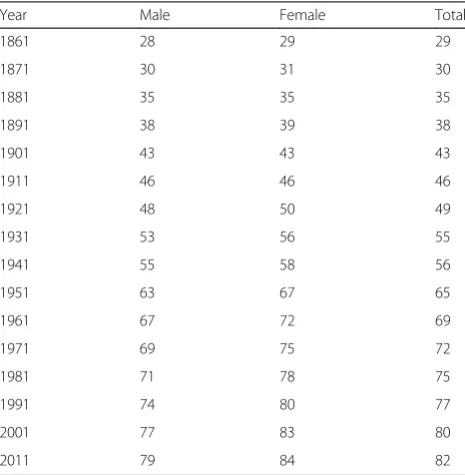
Life expectancy at birth has been increasing for most of the last century in western societies, thanks to the con-tinuous amelioration of medical assistance, to the im-provement of the environment (in particular clean, safe water and food), and to the improvement of nutrients. For instance, in Italy life expectancy went from 29 years in 1861 to 82 in 2011 (Table 1 reports the evolution of this data in women and men). Similarly, the extreme longevity has been growing in these years. Indeed, the number of centenarians (still in Italy) remarkably in-creased from 165 in 1951 to more than 15000 in 2011. These results have been attained first by a dramatic reduction of infectious diseases, which, on turn, has dra-matically reduced infantile mortality, but also mortality in adult age. In fact, in 2011 less than 10 % of deaths oc-curred in subjects under 60 years of age, while the corre-sponding figures were 74 % in 1872, 56 % in 1901 and 25 % in 1951. However, in the last decades, the continu-ous extension of lifespan was mainly due to the improvement of medical assistance with respect to age-related diseases, especially Cardiovascular Diseases and Cancer, which allowed to increase lifespan of 5 years in the last 2 decades and of 2 years in the last 10 years (data from www.mortality.org and www.istat.it).
These data clearly show that environmental factors have a very strong impact on lifespan and on longevity in humans. However, the extension of lifespan that there has been in the last decades have not been accompanied
Table 1Evolution of lifespan expectancy in Italy from 1861
Year Male Female Total
1861 28 29 29
1871 30 31 30
1881 35 35 35
1891 38 39 38
1901 43 43 43
1911 46 46 46
1921 48 50 49
1931 53 56 55
1941 55 58 56
1951 63 67 65
1961 67 72 69
1971 69 75 72
1981 71 78 75
1991 74 80 77
2001 77 83 80
by a similar extension of healthy lifespan. Indeed, in most cases this lifespan extension is due to the chronicit of the age-related diseases. This has brought the commu-nity of biogerontologists to study interventions, possibly modulated on the knowledge emerged from the studies on the genetic and biomolecular basis of longevity, to extend not only lifespan but also healthy lifespan, or, with a new word, “healthspan”. In fact, model organisms with muta-tions that extend lifespan have a healthy life also when they are old. This suggested that health span extension could be attained by targeting (stimulating or silencing) the genes, which had been highlighted to be involved in life extension in both model organisms and humans [47]. In support of this hypothesis, it has been reported that dietary restricted mice, which live much longer and show a very delayed aging phenotype than mice fedat libitum, at old age have an expression pattern very different from mice of the same age for a number of genes correlated with life extension, such as those related to DNA repair, stress response, im-mune response and others [48, 49]. Thus, dietary restriction can trigger a molecular-genetic response which postpones aging and age-related phenotypes. This has brought to search for drugs or interventions which may act on these mechanisms without the side effects of calorie restriction. Among the most important interventions which have been considered in this context, we may name the protein re-striction, the use of drugs targeting different genes of IGF-1 axis or of the FOXO/TOR pathway [47]. In addition, these studies have allowed to reconsider previous data on some areas characterized by exceptional longevity (such as Oki-nawa, Sardinia and Calabria) which are characterized by traditional ipoproteic diets, such as the “Mediterranean diet”[50–53]. In these cases, then, the environment, that is the traditional diet, has allowed to stimulate the molecular mechanisms which can increase life span.
Among the several changes that occur with the aging process, in the last decade Epigenomics has attracted the interest of many researchers. This was mainly due to the fact that epigenetic modifications summarizing, at least in part, the interaction between the individual genetic background and lifestyle characteristics, should be potentially able to capture part of the unexplained sus-ceptibility observed today for complex diseases (the so-called missing heritability problem).
Starting from the pioneeristic observations that epi-genetic modifications affect not only the aging process but also its quality (successful aging) [54], EpiGenome-Wide Association Studies identified hundreds of sites spread along the entire genome in which methylation levels change between oldest old and younger subjects. In particular, Horwat and co-workers, on the basis of the methylation levels of 353 CpG units, formulated a math-ematical model, the so-called epigenetic clock, that showed some important properties [55]. First, it was able
predict the chronological age of a subject starting from the methylation level of several cells and tissues of his body. Second, it represents one of the most accurate bio-marker of age (also superior to the estimates obtained from the telomere length). Third, using methylation levels of blood and brain tissues from subjects affected by Down syndrome, it showed that an accelerated aging occur in such a syndrome [56]. Fourth, it was able to predict all-cause mortality also after adjusting for traditional risk factors [57]. Finally, when it was used to estimate the biological age of several tissues from super-centenarians, it has been demonstrated that brain and muscle represent the youngest tissues of these excep-tional individuals [58].
However, even if the cause-effect relationship between methylation process and aging is still not clear, the potential applications of this discovery are very wide, ranging from detailed monitoring of changes occurring with age within individual systems or organs (muscle, brain, etc.) to forensic purposes. For this and several other reasons, future advances in this field could help the understanding of the complex physiology of aging, lifespan and age-associated diseases.
Conclusions
On the whole, although the common variability accounts for only 25 % of human lifespan variability, the know-ledge of the genetic basis modulating longevity may give significant hints on modulating lifestyle in order to at-tain longevity and extend healthspan. That is, a few sub-jects can attain longevity because a lucky combination of polymorphisms which allow them to have an efficient metabolism or an efficient response to different stress. Most of the others can attain a similar result by target-ing the same pathways with appropriate life style or in-terventions. In this context, the importance of epigenetic factors, both as biomarkers of aging and target of inter-ventions will certainly grow in the forthcoming future.
Abbreviations
APOE:apolipoprotein E; FOXO: forkhead box O; IGF-1: insulin-like growth factor 1; mtDNA: mitochondrial DNA; PI3K: phosphatidylinositol-3-kinase; TOR: target of rapamycin.
Competing interests
The authors declare that they have no competing interests.
Authors’contributions
The authors equally contributed to the drafting and finalization of the manuscript. All authors read and approved the final manuscript.
Acknowledgements
Received: 29 October 2015 Accepted: 30 March 2016
References
1. Johnson TE. A personal retrospective on the genetics of aging. Biogerontology. 2002;3(1–2):7–12.
2. Johnson TE, Wood WB. Genetic analysis of life-span in Caenorhabditis elegans. Proc Natl Acad Sci USA. 1982;79(21):6603–7.
3. Johnson TE. Aging can be genetically dissected into component processes using long-lived lines of Caenorhabditis elegans. Proc Natl Acad Sci USA. 1987;84(11):3777–81.
4. Friedman DB, Johnson TE. Three mutants that extend both mean and maximum life span of the nematode, Caenorhabditis elegans, define the age-1 gene. J Gerontol. 1988;43(4):B102–9.
5. Kenyon C, Chang J, Gensch E, Rudner A, Tabtiang R. A C. elegans mutant that lives twice as long as wild type. Nature. 1993;366(6454):461–4. doi:10.1038/366461a0.
6. Gottlieb S, Ruvkun G. daf-2, daf-16 and daf-23: genetically interacting genes controlling Dauer formation in Caenorhabditis elegans. Genetics. 1994; 137(1):107–20.
7. Taguchi A, Wartschow LM, White MF. Brain IRS2 signaling coordinates life span and nutrient homeostasis. Science. 2007;317(5836):369–72. doi:10.1126/ science.1142179.
8. Lin K, Dorman JB, Rodan A, Kenyon C. daf-16: An HNF-3/forkhead family member that can function to double the life-span of Caenorhabditis elegans. Science. 1997;278(5341):1319–22.
9. Ogg S, Paradis S, Gottlieb S, Patterson GI, Lee L, Tissenbaum HA, et al. The Fork head transcription factor DAF-16 transduces insulin-like metabolic and longevity signals in C. elegans. Nature. 1997;389(6654):994–9. doi:10.1038/40194. 10. Kenyon C. The plasticity of aging: insights from long-lived mutants. Cell.
2005;120(4):449–60. doi:10.1016/j.cell.2005.02.002.
11. Kenyon CJ. The genetics of ageing. Nature. 2010;464(7288):504–12. doi:10. 1038/nature08980.
12. Rose G, Passarino G, Franceschi C, De Benedictis G. The variability of the mitochondrial genome in human aging: a key for life and death? Int J Biochem Cell Biol. 2002;34(11):1449–60.
13. Skulachev VP. The programmed death phenomena, aging, and the Samurai law of biology. Exp Gerontol. 2001;36(7):995–1024.
14. Schoenmaker M, de Craen AJ, de Meijer PH, Beekman M, Blauw GJ, Slagboom PE, et al. Evidence of genetic enrichment for exceptional survival using a family approach: the Leiden Longevity Study. Eur J Human Genet EJHG. 2006;14(1):79–84. doi:10.1038/sj.ejhg.5201508.
15. Montesanto A, Latorre V, Giordano M, Martino C, Domma F, Passarino G. The genetic component of human longevity: analysis of the survival advantage of parents and siblings of Italian nonagenarians. Eur J Human Genet EJHG. 2011;19(8):882–6. doi:10.1038/ejhg.2011.40.
16. vB Hjelmborg J, Iachine I, Skytthe A, Vaupel JW, McGue M, Koskenvuo M, Kaprio J, Pedersen NL, Christensen K. Genetic influence on human lifespan and longevity. Hum Genet. 2006;119(3):312–21.
17. Herskind AM, McGue M, Holm NV, Sorensen TI, Harvald B, Vaupel JW. The heritability of human longevity: a population-based study of 2872 Danish twin pairs born 1870–1900. Hum Genet. 1996;97(3):319–23.
18. Skytthe A, Pedersen NL, Kaprio J, Stazi MA, Hjelmborg JV, Iachine I, et al. Longevity studies in GenomEUtwin. Twin Res Off J Int Soc Twin Studies. 2003;6(5):448–54. doi:10.1375/136905203770326457.
19. Capri M, Salvioli S, Sevini F, Valensin S, Celani L, Monti D, et al. The genetics of human longevity. Ann N Y Acad Sci. 2006;1067:252–63. doi:10.1196/annals.1354.033.
20. Passarino G, Montesanto A, Dato S, Giordano S, Domma F, Mari V, et al. Sex and age specificity of susceptibility genes modulating survival at old age. Hum Hered. 2006;62(4):213–20. doi:10.1159/000097305.
21. Perls TT, Wilmoth J, Levenson R, Drinkwater M, Cohen M, Bogan H, et al. Life-long sustained mortality advantage of siblings of centenarians. Proc Natl Acad Sci U S A. 2002;99(12):8442–7. doi:10.1073/pnas.122587599. 22. Pawlikowska L, Hu D, Huntsman S, Sung A, Chu C, Chen J, et al. Association
of common genetic variation in the insulin/IGF1 signaling pathway with human longevity. Aging Cell. 2009;8(4):460–72. doi:10.1111/j.1474-9726. 2009.00493.x.
23. Ziv E, Hu D. Genetic variation in insulin/IGF-1 signaling pathways and longevity. Ageing Res Rev. 2011;10(2):201–4. doi:10.1016/j.arr.2010.09.002.
24. Morris BJ, Willcox DC, Donlon TA, Willcox BJ. FOXO3: A Major Gene for Human Longevity - A Mini-Review. Gerontology. 2015. doi:10.1159/000375235. 25. Bellizzi D, Rose G, Cavalcante P, Covello G, Dato S, De Rango F, et al. A
novel VNTR enhancer within the SIRT3 gene, a human homologue of SIR2, is associated with survival at oldest ages. Genomics. 2005;85(2):258–63. doi:10.1016/j.ygeno.2004.11.003.
26. Sebastiani P, Solovieff N, Dewan AT, Walsh KM, Puca A, Hartley SW, et al. Genetic signatures of exceptional longevity in humans. PLoS One. 2012;7(1): e29848. doi:10.1371/journal.pone.0029848.
27. Beekman M, Blanche H, Perola M, Hervonen A, Bezrukov V, Sikora E, et al. Genome-wide linkage analysis for human longevity: Genetics of Healthy Aging Study. Aging Cell. 2013;12(2):184–93. doi:10.1111/acel.12039. 28. Hindorff LA, Sethupathy P, Junkins HA, Ramos EM, Mehta JP, Collins FS,
et al. Potential etiologic and functional implications of genome-wide association loci for human diseases and traits. Proc Natl Acad Sci USA. 2009; 106(23):9362–7. doi:10.1073/pnas.0903103106.
29. Deelen J, Beekman M, Uh HW, Broer L, Ayers KL, Tan Q, et al. Genome-wide association meta-analysis of human longevity identifies a novel locus conferring survival beyond 90 years of age. Hum Mol Genet. 2014;23(16): 4420–32. doi:10.1093/hmg/ddu139.
30. Novelli V, Viviani Anselmi C, Roncarati R, Guffanti G, Malovini A, Piluso G, et al. Lack of replication of genetic associations with human longevity. Biogerontology. 2008;9(2):85–92. doi:10.1007/s10522-007-9116-4.
31. Ferrario A, Villa F, Malovini A, Araniti F, Puca AA. The application of genetics approaches to the study of exceptional longevity in humans: potential and limitations. Immun Ageing. 2012;9(1):7. doi:10.1186/1742-4933-9-7. 32. Villa F, Carrizzo A, Spinelli CC, Ferrario A, Malovini A, Maciąg A, et al. Genetic
Analysis Reveals a Longevity-Associated Protein Modulating Endothelial Function and Angiogenesis. Circ Res. 2015;117(4):333–45. doi:10.1161/ CIRCRESAHA.117.305875.
33. Raule N, Sevini F, Li S, Barbieri A, Tallaro F, Lomartire L, et al. The co-occurrence of mtDNA mutations on different oxidative phosphorylation subunits, not detected by haplogroup analysis, affects human longevity and is population specific. Aging Cell. 2014;13(3):401–7. doi:10.1111/acel.12186. 34. Debrabant B, Soerensen M, Flachsbart F, Dato S, Mengel-From J, Stevnsner T, et al. Human longevity and variation in DNA damage response and repair: study of the contribution of sub-processes using competitive gene-set analysis. Eur J Human Genet EJHG. 2014;22(9):1131–6. doi:10.1038/ejhg.2013.299. 35. Soerensen M, Thinggaard M, Nygaard M, Dato S, Tan Q, Hjelmborg J, et al.
Genetic variation in TERT and TERC and human leukocyte telomere length and longevity: a cross-sectional and longitudinal analysis. Aging Cell. 2012; 11(2):223–7. doi:10.1111/j.1474-9726.2011.00775.x.
36. Crocco P, Barale R, Rose G, Rizzato C, Santoro A, De Rango F, et al. Population-specific association of genes for telomere-associated proteins with longevity in an Italian population. Biogerontology. 2015;16(3):353–64. doi:10.1007/s10522-015-9551-6.
37. Atzmon G, Cho M, Cawthon RM, Budagov T, Katz M, Yang X, et al. Evolution in health and medicine Sackler colloquium: Genetic variation in human telomerase is associated with telomere length in Ashkenazi centenarians. Proc Natl Acad Sci U S A. 2010;107 Suppl 1:1710–7. doi:10.1073/pnas.0906191106.
38. Altomare K, Greco V, Bellizzi D, Berardelli M, Dato S, DeRango F, et al. The allele (A)(−110) in the promoter region of the HSP70-1 gene is unfavorable to longevity in women. Biogerontology. 2003;4(4):215–20.
39. Ross OA, Curran MD, Crum KA, Rea IM, Barnett YA, Middleton D. Increased frequency of the 2437 T allele of the heat shock protein 70-Hom gene in an aged Irish population. Exp Gerontol. 2003;38(5):561–5.
40. Rose G, Crocco P, De Rango F, Montesanto A, Passarino G. Further support to the uncoupling-to-survive theory: the genetic variation of human UCP genes is associated with longevity. PLoS One. 2011;6(12):e29650. doi:10. 1371/journal.pone.0029650.
41. Junnila RK, List EO, Berryman DE, Murrey JW, Kopchick JJ. The GH/IGF-1 axis in ageing and longevity. Nat Rev Endocrinol. 2013;9(6):366–76. doi:10.1038/ nrendo.2013.67.
42. Johnson SC, Rabinovitch PS, Kaeberlein M. mTOR is a key modulator of ageing and age-related disease. Nature. 2013;493(7432):338–45. doi:10.1038/nature11861. 43. Schachter F, Faure-Delanef L, Guenot F, Rouger H, Froguel P, Lesueur-Ginot L, et al. Genetic associations with human longevity at the APOE and ACE loci. Nat Genet. 1994;6(1):29–32. doi:10.1038/ng0194-29.
parameters could explain why the short alleles (<35 repeats) are rare in centenarians. BMC Med Genet. 2004;5:3. doi:10.1186/1471-2350-5-3. 45. Cardelli M, Cavallone L, Marchegiani F, Oliveri F, Dato S, Montesanto A, et al.
A genetic-demographic approach reveals male-specific association between survival and tumor necrosis factor (A/G)-308 polymorphism. J Gerontol A Biol Sci Med Sci. 2008;63(5):454–60.
46. Di Bona D, Vasto S, Capurso C, Christiansen L, Deiana L, Franceschi C, et al. Effect of interleukin-6 polymorphisms on human longevity: a systematic review and meta-analysis. Ageing Res Rev. 2009;8(1):36–42. doi:10.1016/j.arr. 2008.09.001.
47. Longo VD, Antebi A, Bartke A, Barzilai N, Brown-Borg HM, Caruso C, et al. Interventions to Slow Aging in Humans: Are We Ready? Aging Cell. 2015; 14(4):497–510. doi:10.1111/acel.12338.
48. Prolla TA, Mattson MP. Molecular mechanisms of brain aging and neurodegenerative disorders: lessons from dietary restriction. Trends Neurosci. 2001;24(11 Suppl):S21–31.
49. Ghosh S, Wanders D, Stone KP, Van NT, Cortez CC, Gettys TW. A systems biology analysis of the unique and overlapping transcriptional responses to caloric restriction and dietary methionine restriction in rats. FASEB J Off Publication Federation Am Soc Exp Biol. 2014;28(6):2577–90. doi:10.1096/fj. 14-249458.
50. Willcox DC, Willcox BJ, Todoriki H, Suzuki M. The Okinawan diet: health implications of a low-calorie, nutrient-dense, antioxidant-rich dietary pattern low in glycemic load. J Am Coll Nutr. 2009;28(Suppl):500S–16S.
51. Poulain M, Pes GM, Grasland C, Carru C, Ferrucci L, Baggio G, et al. Identification of a geographic area characterized by extreme longevity in the Sardinia island: the AKEA study. Exp Gerontol. 2004;39(9):1423–9. doi:10.1016/j.exger.2004.06.016.
52. Pes GM, Tolu F, Dore MP, Sechi GP, Errigo A, Canelada A, et al. Male longevity in Sardinia, a review of historical sources supporting a causal link with dietary factors. Eur J Clin Nutr. 2015;69(4):411–8. doi:10.1038/ejcn.2014.230. 53. Montesanto A, Passarino G, Senatore A, Carotenuto L, De Benedictis G.
Spatial analysis and surname analysis: complementary tools for shedding light on human longevity patterns. Ann Hum Genet. 2008;72(Pt 2):253–60. doi:10.1111/j.1469-1809.2007.00405.x.
54. Bellizzi D, D’Aquila P, Montesanto A, Corsonello A, Mari V, Mazzei B, et al. Global DNA methylation in old subjects is correlated with frailty. Age. 2012; 34(1):169–79. doi:10.1007/s11357-011-9216-6.
55. Horvath S. DNA methylation age of human tissues and cell types. Genome Biol. 2013;14(10):R115. doi:10.1186/gb-2013-14-10-r115.
56. Horvath S, Garagnani P, Bacalini MG, Pirazzini C, Salvioli S, Gentilini D, et al. Accelerated epigenetic aging in Down syndrome. Aging Cell. 2015;14(3): 491–5. doi:10.1111/acel.12325.
57. Marioni RE, Shah S, McRae AF, Chen BH, Colicino E, Harris SE, et al. DNA methylation age of blood predicts all-cause mortality in later life. Genome Biol. 2015;16:25. doi:10.1186/s13059-015-0584-6.
58. Horvath S, Mah V, Lu AT, Woo JS, Choi OW, Jasinska AJ, et al. The cerebellum ages slowly according to the epigenetic clock. Aging. 2015;7(5): 294–306.
• We accept pre-submission inquiries
• Our selector tool helps you to find the most relevant journal • We provide round the clock customer support
• Convenient online submission
• Thorough peer review
• Inclusion in PubMed and all major indexing services • Maximum visibility for your research
Submit your manuscript at www.biomedcentral.com/submit