Irish Dependency Treebanking
and Parsing
Teresa Lynn
B.Sc. in Applied Computational Linguistics
A dissertation submitted in fulfilment of the requirements for the award of
Doctor of Philosophy (Ph.D.)
under a Double Award Agreement
at the
School of Computing
Dublin City University
Department of Computing
Macquarie University
Supervised by
Dr. Jennifer Foster
Associate Prof. Mark Dras
I hereby certify that this material, which I now submit for assessment on the programme of study leading to the award of Ph.D. is entirely my own work, that I have exercised reasonable care to ensure that the work is original, and does not to the best of my knowledge breach any law of copyright, and has not been taken from the work of others save and to the extent that such work has been cited and acknowledged within the text of my work.
Signed:
(Candidate) ID No.: 98300890
Contents
Acknowledgements xvii
Abstract xx
1 Introduction 1
1.1 Irish Language Technology . . . 4
1.2 Dependency Treebanking . . . 6
1.3 Dependency Parsing . . . 8
1.4 Expanding Irish NLP to Social Media . . . 10
1.5 Research Questions . . . 11
1.6 Thesis Structure . . . 12
1.7 Publications . . . 13
2 Background 15 2.1 The Irish Language . . . 16
2.2 An Overview of Irish linguistics . . . 19
2.2.1 Irish Syntax . . . 20
2.2.2 Irish Morphology . . . 24
2.3 Dependency Treebanks . . . 29
2.3.1 An Overview of Dependency Syntax . . . 30
2.3.2 Projectivity . . . 32
2.3.3 Dependency Tree Data Formats . . . 33
3 Irish Dependency Treebank 36
3.1 Building the Irish Dependency Treebank — the starting point . . . . 37
3.1.1 Choice of syntactic representation . . . 38
3.1.2 Choice of dependency labelling scheme . . . 42
3.1.3 Developing upon existing NLP tools . . . 47
3.2 Inter-annotator Agreement . . . 50
3.2.1 IAA and the Irish Dependency Treebank . . . 52
3.2.2 IAA Analysis and Treebank Update . . . 53
3.2.3 Sources of annotator disagreements . . . 55
3.3 Summary and Conclusion . . . 57
4 Defining the IDT Annotation scheme 59 4.1 Irish Dependency Labelling Scheme . . . 60
4.2 Language-specific choices . . . 60
4.2.1 Labelling of predicates . . . 62
4.2.2 Irish copula . . . 62
4.2.3 Copular subject complements . . . 68
4.2.4 Cleft constructions – cleftparticle . . . 68
4.2.5 Copula drop . . . 70
4.2.6 Copula – Complementiser form . . . 70
4.2.7 Copular subordinator . . . 71
4.2.8 Prepositional attachment . . . 71
4.2.9 Prepositions and complement phrases . . . 73
4.2.10 Gerund object attachment . . . 74
4.2.11 Gerund adverb attachment . . . 75
4.2.12 Complement phrase attachment to verbal nouns. . . 75
4.2.13 Objects of infinitive phrases . . . 76
4.2.14 Objects of autonomous verbs . . . 76
4.2.16 Relative particle . . . 77 4.2.17 English chunks . . . 79 4.2.18 Internal punctuation . . . 80 4.2.19 Multiple coordination . . . 80 4.2.20 Punctuation as a coordinator . . . 81 4.2.21 Wh-questions . . . 82
4.3 Summary and Conclusion . . . 83
5 Universal Dependencies 84 5.1 A Universal Dependency Scheme for the Irish Dependency Treebank . 87 5.1.1 Mapping the Irish POS tagset to the Universal POS tagset . . 87
5.1.2 Mapping the Irish Dependency Scheme to the Universal De-pendency Scheme (UD13) . . . 90
5.2 A new Universal Dependency Scheme (UD15) . . . 97
5.2.1 New Universal POS tagset . . . 97
5.2.2 2015 Universal Dependency Scheme . . . 100
5.3 Summary and Conclusion . . . 112
6 Parsing with the Irish Dependency Treebank 114 6.1 An Overview of Dependency Parsing . . . 115
6.1.1 How do Transition-Based Dependency Parsers work? . . . 117
6.1.2 Evaluation Metrics . . . 122
6.2 Establishing a Baseline Parsing Score . . . 123
6.3 Improvements over Baseline following IAA Study . . . 125
6.4 Bootstrapping Treebank Development – Active Learning . . . 126
6.4.1 Related Work . . . 128
6.4.2 Active Learning Experiments . . . 129
6.4.3 Results . . . 131
6.4.5 Making Use of Unlabelled Data . . . 135
6.4.6 Active Learning Conclusion . . . 136
6.5 Bootstrapping Parser Development – Semi-supervised Learning . . . 137
6.5.1 Self-Training . . . 139
6.5.2 Co-Training . . . 142
6.5.3 Sample-Selection-Based Co-Training . . . 144
6.5.4 Analysis . . . 148
6.5.5 Test Set Results . . . 149
6.5.6 Semi-supervised Learning Conclusion . . . 150
6.6 Parsing with Morphological Features . . . 151
6.6.1 Results and Conclusion . . . 152
6.7 Cross-lingual Transfer Parsing . . . 153
6.7.1 Data and Experimental Setup . . . 154
6.7.2 Results . . . 156
6.7.3 Discussion . . . 157
6.7.4 Cross-lingual Transfer Parsing Conclusion . . . 158
6.8 Summary . . . 159
7 Irish Twitter POS-tagging 163 7.1 Irish Tweets . . . 166
7.2 Building a corpus of annotated Irish tweets . . . 168
7.2.1 New Irish Twitter POS tagset . . . 168
7.2.2 Tweet pre-processing pipeline . . . 172
7.2.3 Annotation . . . 173
7.3 Inter-Annotator Agreement . . . 173
7.4 Experiments . . . 174
7.4.1 Data . . . 174
7.4.3 Results . . . 176
7.5 Summary and Conclusion . . . 178
8 Conclusion 180 8.1 Summary and Contributions . . . 180
8.2 Research Questions Answered . . . 183
8.3 Proposed Future Work . . . 185
8.3.1 Further Treebank Development . . . 185
8.3.2 Exploiting Morphological Features . . . 187
8.3.3 Exploiting the Hierarchical Dependency Scheme . . . 187
8.3.4 Semi-supervised Parsing . . . 187
8.3.5 Cross Lingual Studies . . . 188
8.3.6 NLP for Social Media . . . 189
8.3.7 Universal Dependencies Project . . . 190
8.4 Concluding Remarks . . . 190
Bibliography 193 A Annotation Guidelines for the Irish Dependency Treebank 218 A.1 Verb Dependents . . . 219
A.1.1 subj : subject – (Verb) . . . 219
A.1.2 obj : object – (Verb) . . . 219
A.1.3 obl/ obl2 : oblique nouns – (Verb) . . . 221
A.1.4 particlehead – (Verb) . . . 226
A.1.5 padjunct : prepositional adjunct – (Verb) . . . 227
A.1.6 advadjunct : adverbial adjunct – (Verb) . . . 230
A.1.7 subadjunct : subordinate adjunct– (Verb) . . . 232
A.1.8 adjunct – (Verb) . . . 237
A.1.9 xcomp : open complement – (Verb) . . . 239
A.1.11 pred : predicate – (Verb) . . . 244
A.1.12 relparticle : relative particle – (Verb) . . . 249
A.1.13 cleftparticle : cleft particle – (Verb) . . . 251
A.1.14 vparticle : verb particle – (Verb) . . . 252
A.1.15 particle : verb particle — (Verb) . . . 256
A.1.16 addr : addressee – (Verb) . . . 256
A.2 Noun Dependents . . . 257
A.2.1 det : determiner – (Noun) . . . 257
A.2.2 det2 : second determiner – (Noun) . . . 258
A.2.3 dem : demonstrative – (Noun) . . . 259
A.2.4 poss : possessive – (Noun) . . . 259
A.2.5 quant: quantifer – (Noun) . . . 260
A.2.6 adjadjunct – (Noun) . . . 263
A.2.7 nadjunct : nominal adjunct – (Noun) . . . 265
A.2.8 particle – (Noun) . . . 268
A.2.9 nparticle – (Noun) . . . 269
A.2.10 padjunct : prepositional adjunct – (Noun) . . . 269
A.2.11 aug : augment pronoun – (Noun) . . . 270
A.2.12 relmod : relative modifier – (Noun) . . . 271
A.2.13 app : nouns in apposition – (Noun) . . . 272
A.2.14 obl: oblique – (Noun) . . . 273
A.2.15 xcomp: open complement – (Noun) . . . 274
A.3 Preposition Dependents . . . 274
A.3.1 pobj: object of a preposition (Preposition) . . . 274
A.3.2 nadjunct: noun modifying a preposition (Preposition) . . . 276
A.3.3 padjunct (Preposition) . . . 276
A.4 Verbal Noun Dependents . . . 277
A.4.1 vnobj : objects of verbal noun – (Verbal Noun) . . . 277
A.4.3 obl : oblique preposition – (Verbal Noun) . . . 278
A.4.4 xcomp : open complement – (Verbal Noun) . . . 279
A.4.5 toinfinitive : infinitive marker – (Verbal Noun) . . . 279
A.4.6 comp : closed complement – (Verbal Noun) . . . 280
A.5 Adjective Dependents . . . 281
A.5.1 padjunct : prepositional adjunct – (Adjective) . . . 281
A.5.2 particle – (Adjective) . . . 282
A.5.3 advadjunct: adverbial intensifier – (Adjective) . . . 283
A.5.4 obl: obliques – (Adjective) . . . 284
A.6 Verbal Adjective Dependencies . . . 285
A.6.1 obl ag : oblique agent – (Verbal Adjective) . . . 285
A.6.2 obl : oblique argument – (Verbal Adjective) . . . 286
A.7 Adverb Dependents . . . 287
A.7.1 nadjunct : nominal adjunct – (Adverb) . . . 287
A.8 Subordinate Conjunction Dependencies . . . 287
A.8.1 comp : closed complement – (Subordinate Conjunction) . . . . 287
A.9 Copula Dependents . . . 288
A.9.1 subj : subject – (Copula) . . . 288
A.9.2 csubj : clausal subject – (Copula) . . . 290
A.9.3 pred : predicates – (Copula) . . . 291
A.9.4 xcomp : open complement – (Copula) . . . 294
A.10 Quant Dependents . . . 294
A.10.1 qparticle: quantifier particle (Quant) . . . 294
A.11 Foreign Words . . . 294
A.12 Sentence Root/ Head . . . 296
A.13 Coordination . . . 297
A.14 Punctuation . . . 299
A.15 Questions . . . 300
B Annotation Guidelines for Irish Twitter Part-of-Speech Tagging 302
B.1 Tokenisation of Irish tweets . . . 303
B.2 POS tagging Irish Tweets . . . 304
B.2.1 Prepostional pronouns/ pronominal prepositions . . . 304
B.2.2 Hashtags . . . 305 B.2.3 Multi-word hashtags . . . 305 B.2.4 At-mentions . . . 305 B.2.5 Retweets . . . 306 B.2.6 Verbal Nouns . . . 306 B.2.7 Names . . . 306 B.2.8 Foreign . . . 307
B.2.9 Typographical errors and non-standard spelling . . . 307
B.2.10 Abbreviations . . . 308
B.2.11 Particles . . . 309
B.2.12 Interjections . . . 309
List of Figures
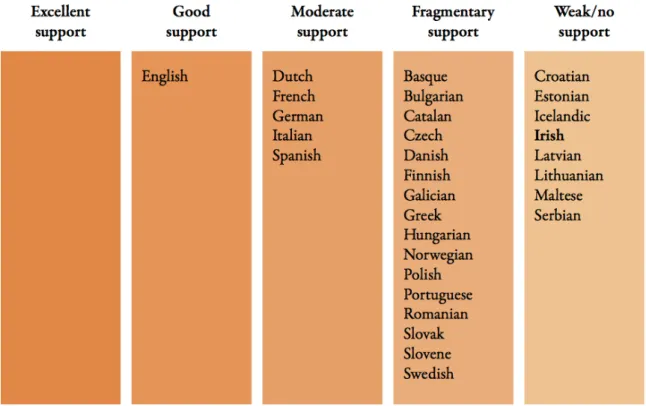
1.1 Text Analysis – state of language technology support for 30 EU
lan-guages (Judge et al., 2012) . . . 5
1.2 Speech and Text resources – state of language technology support for 30 EU languages (Judge et al., 2012) . . . 6
2.1 Flat VSO Constituent Structure . . . 22
2.2 Hierarchical SVO Constituent Structure . . . 22
2.3 A typed dependency graph . . . 30
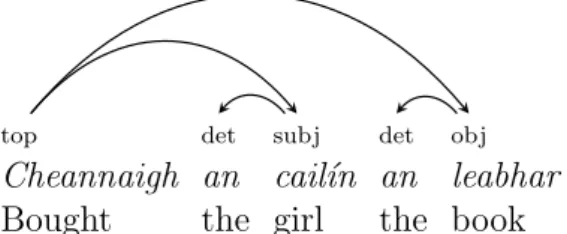
2.4 Dependency tree representation of Cheannaigh an cail´ın an leabhar ‘the girl bought the book’ . . . 32
2.5 Example of non-projective tree for an Irish sentence . . . 33
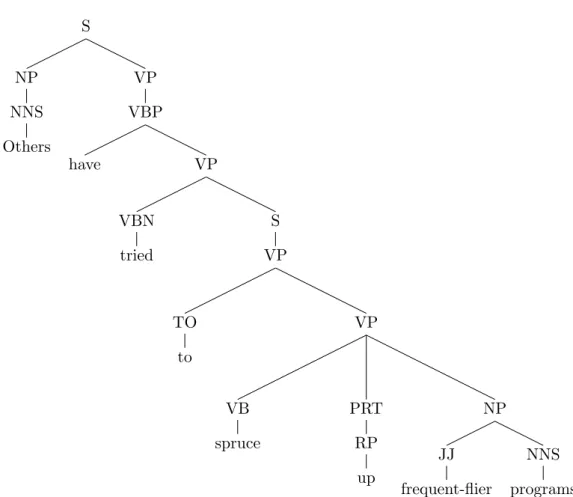
3.1 Constituency representation of parsed text . . . 40
3.2 Stanford dependency representation of parsed text . . . 40
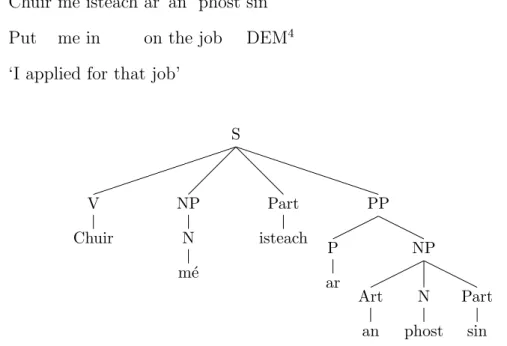
3.3 C-structure representation of Chuir m´e isteach ar an phost sin ‘I applied for that job’. (Bresnan, 2001) . . . 43
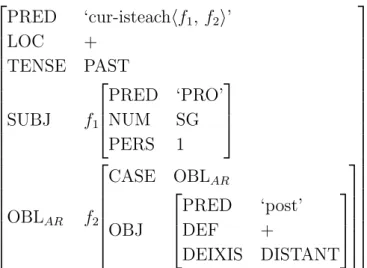
3.4 LFG F-structure representation of Chuir m´e isteach ar an phost sin ‘I applied for that job’ (adapted from Bresnan (2001)) . . . 44
3.5 LFG-inspired dependency representation of parsed text . . . 46
3.6 Stanford dependency representation of parsed text . . . 46
3.7 LFG-inspired dependency representation of parsed text . . . 47
3.8 Example of chunked output (with morphological tags) forD’fhan siad ansin le fiche bliain ‘They stayed there for twenty years’ . . . 48
3.9 Example of chunked output forD’fhan siad ansin le fiche bliain ‘They
stayed there for twenty years’ . . . 48
3.10 The fully parsed sentence of Figure 3.8 . . . 49
3.11 Prepositional phrase ambiguity, where the head of the preposition sa isobair. . . 50
3.12 Prepositional phrase ambiguity, where the head of the preposition sa isseirbh´ıs´ı. . . 50
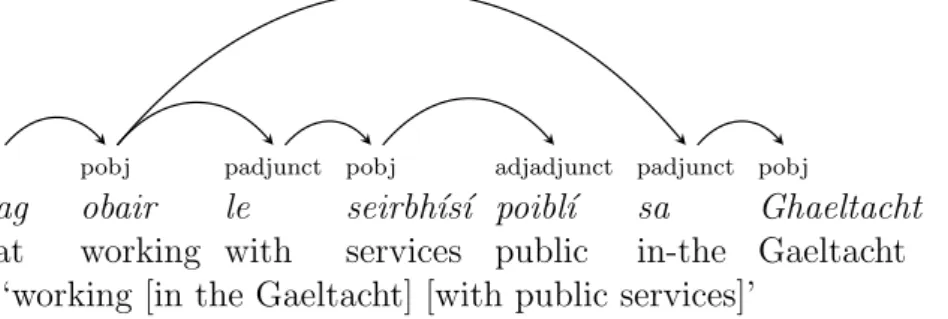
3.13 Example of chunked output for ag obair le seirbh´ıs´ı poibl´ı ‘working with public services in the Gaeltacht’ . . . 51
4.1 Copula construction with prepositional predicate. . . 63
4.2 Substantive verb construction with adjectival predicate. . . 63
4.3 Dependency tree for Irish copula equative construction. . . 65
4.4 Dependency tree for classificatory constructions. . . 66
4.5 Dependency tree for ownership constructions. . . 66
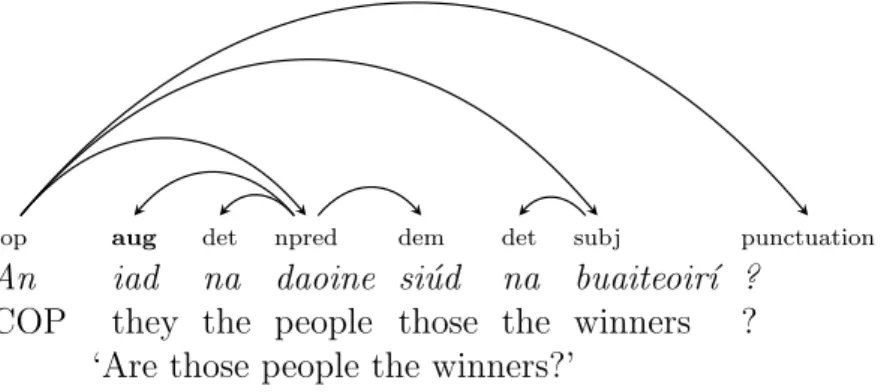
4.6 Dependency tree for identification constructions with an augment pro-noun. . . 67
4.7 Dependency tree for an Irish copula predicate with oblique argument. 67 4.8 Dependency structure with subject complement labelling. . . 68
4.9 Dependency structure for cleft construction (nominal fronting). . . 69
4.10 Dependency structure for cleft construction (prepositional fronting). . 70
4.11 Dependency structure for cleft construction with copula drop. . . 70
4.12 Dependency structure for copula complementiser form. . . 71
4.13 Dependency structure for copular-subordinator. . . 71
4.14 Attachment of prepositional pronoun . . . 72
4.15 Attachment of oblique preposition. . . 72
4.16 Attachment of idiomatic oblique preposition. . . 73
4.18 Dependency structure for attachment of complement phrases to
prepo-sitions. . . 74
4.19 Dependency structure for gerund object attachment. . . 74
4.20 Dependency structure for gerund adverb attachment. . . 75
4.21 Dependency structure for complement phrase attachment to verbal nouns . . . 76
4.22 Dependency structure for autonomous verbs . . . 77
4.23 Dependency structure for internal comma and quotation marks . . . . 77
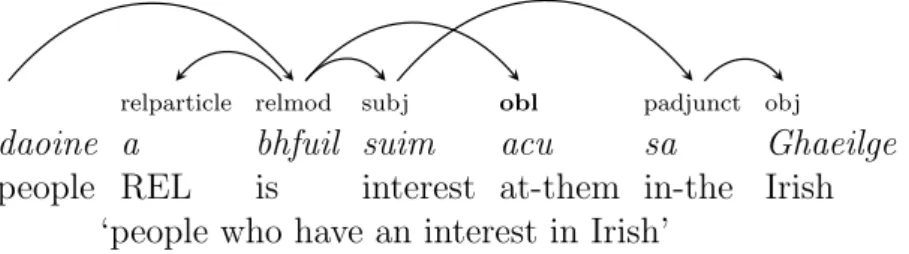
4.24 Dependency structure for indirect relative particles . . . 78
4.25 Dependency structure for relative particles following prepositions . . . 79
4.26 Dependency structure English chunks . . . 79
4.27 Dependency structure for internal comma and quotation marks . . . . 81
4.28 Dependency structure for parenthesis . . . 81
4.29 Dependency structure for clustered coordination . . . 81
4.30 Dependency structure for coordinate punctuation . . . 82
4.31 Dependency structure for question construction . . . 82
4.32 Dependency structure for question construction without a verb . . . . 83
5.1 LFG-style coordination of original Irish Dependency Treebank. . . 92
5.2 Stanford-style coordination changes to original Irish Dependency Tree-bank. . . 92
5.3 LFG-style subordinate clause analysis (with IDT labels) . . . 93
5.4 Stanford-style subordinate clause analysis (with IDT labels) . . . 93
5.5 UD13 adpcompcomplement clause . . . 94
5.6 UD13 advcl adverbial clause modifier . . . 95
5.7 UD13 parataxis clauses . . . 95
5.8 UD13 ccomp clausal complements . . . 96
5.9 UD15 dobj relative particle analysis . . . 104
5.11 UD15 compounding analysis . . . 105
5.12 IDT copula analysis . . . 106
5.13 UD15 copula analysis . . . 106
5.14 IDT name analysis . . . 106
5.15 UD15 name analysis . . . 107
5.16 IDT prepositional phrase analysis . . . 107
5.17 UD15 prepositional phrase analysis . . . 107
5.18 IDT progressive aspectual phrase analysis . . . 108
5.19 UD15 progressive aspectual phrase analysis . . . 108
5.20 IDT prepositional predicate analysis . . . 108
5.21 UD15 prepositional predicate analysis . . . 109
5.22 UD15 relative clause analysis . . . 109
5.23 UD15 vocative particle analysis . . . 110
5.24 UD15 copular clausal subject analysis . . . 110
5.25 UD15 possessive analysis . . . 111
5.26 UD15 prepositional pronoun analysis . . . 111
5.27 UD15 temporal modifier analysis . . . 112
5.28 UD15 adjectival predicate analysis . . . 112
6.1 The arc-eager shift-reduce algorithm. σ represents the stack,β is the buffer andA is the set of dependencies. . . 119
6.2 Passive versus Active Learning results on development set: Labelled Attachment Accuracy. The x-axis represents the number of train-ing iterations and the y-axis the labelled attachment score. . . 132
6.3 Passive versus Active Learning results on development set: Unla-belled Attachment Accuracy. The x-axis represents the number of training iterations and the y-axis the unlabelled attachment score. 132 6.4 Automatically generated annotation . . . 133
6.6 Adding Automatically Parsed Data to the Training set: the x-axis shows the number of automatically parsed trees that are added to the training set and the y-axis shows the unlabelled and labelled attachment accuracy on the development set. . . 136 6.7 Self-Training Results on the Development Set . . . 142 6.8 Co-Training Results on the Development Set . . . 144 6.9 Agreement-based Co-Training Results on the Development Set . . . . 145 6.10 Disagreement-based Co-Training Results on the Development Set . . 147
7.1 Example of noisy Irish tweet . . . 166
8.1 Applications of the treebanks developed in this thesis. . . 192 8.2 Applications of the Twitter POS-tagged corpus developed in this thesis.192
List of Tables
3.1 LFG-inspired conversion tagset (C¸ etino˘glu et al., 2010). Asterisks indicate newly introduced dependencies that are not part of LFG theory. . . 45 3.2 Inter-annotator Agreement results. . . 54 3.3 Landis and Koch’s interpretation of Cohens’s Kappa . . . 54
4.1 The Irish Dependency Treebank labels: sublabels are indicated in bold, indented below the parent label. . . 61
5.1 Mapping of Irish Coarse and Fine-grained POS pairs (coarse fine) to Universal POS tagset. . . 88 5.2 Mapping of Irish Dependency Annotation Scheme to UD13
Annota-tion Scheme . . . 91 5.3 Mapping of Irish Coarse and Fine-grained POS pairs (coarse fine) to
2015 Universal Dependency POS tagset. . . 98 5.4 Mapping of Irish Dependency Annotation Scheme to UD15
Annota-tion Scheme. †marks one-to-many mappings, and±marks structural changes . . . 101
6.1 Preliminary parsing results with MaltParser. LAS is Labelled At-tachment Score – the proportion of labels and atAt-tachments the parser correctly predicts. UAS is Unlabelled Attachment Score – the pro-portion of attachments the parser correctly predicts. . . 124
6.2 CoNLL 2007 Shared Task on Dependency Parsing: Treebank sizes and best LAS/UAS results, rounded to one decimal point. (Note: †
denotes treebanks converted from constituency trees to dependency format.) Ar:Arabic, Ba:Basque, Ca:Catalan, Ch:Chinese, Cz:Czech, En:English,
Gr:Greek, Hu:Hungarian, It:Italian, Tu:Turkish. . . 125
6.3 Preliminary MaltParser experiments with the Irish Dependency Tree-bank: pre-IAA results (as per Table 6.1) and post-IAA results. . . 125
6.4 Treebank Status . . . 126
6.5 Treebank Status . . . 129
6.6 Differences between active and passive training sentences. Correction effort is the level of disagreement between the automatic parse and its correction (1-LAS). . . 134
6.7 Treebank Status . . . 138
6.8 Results for best performing models . . . 150
6.9 Results with morphological features on the development set . . . 153
6.10 Treebank Status . . . 153
6.11 Multi-lingual transfer parsing results . . . 156
6.12 Summary of treebank parsing results throughout development. (Note: † indicates unchecked trees.) . . . 160
7.1 Mapping of Irish Twitter tagset to PAROLE tagset. († indicates the entire fine-grained set for that coarse tag is relevant.) . . . 171
7.2 Results of evaluation of POS-taggers on new Irish Twitter corpus . . 177
B.1 Irish Twitter part-of-speech tagset. . . 303
C.1 Basic statistics for the Irish Dependency Treebank (as of January 2016)312 C.2 Top 25 dependency labels used (% to the nearest one decimal point) . 312 C.3 Summary of edge lengths (distance between head and dependent) . . 313
C.5 Top 25 dependency paths of length 2 (% to the nearest one decimal point) . . . 314 C.6 Top 25 Coarse-grained POS/ dependency label pairs . . . 315
Irish Dependency Treebanking and Parsing
Teresa Lynn
Abstract
Despite enjoying the status of an official EU language, Irish is considered a mi-nority language. As with most mimi-nority languages, it is a ‘low-density’ language, which means it lacks important linguistic and Natural Language Processing (NLP) resources. Relative to better-resourced languages such as English or French, for ex-ample, little research has been carried out on computational analysis or processing of Irish.
Parsing is the method of analysing the linguistic structure of text, and it is an invaluable processing step that is required for many different types of language technology applications. As a verb-initial language, Irish has several features that are uncharacteristic of many languages previously studied in parsing research. Our work broadens the application of NLP methods to less-studied language structures and provides a basis on which future work in Irish NLP is possible.
We report on the development of a dependency treebank that serves as training data for the first full Irish dependency parser. We discuss the linguistic structures of Irish, and the motivation behind the design of our annotation scheme. Our work also examines various methods of employing semi-automated approaches to treebank development. We overcome the relatively small pool of linguistic and technological resources available for the Irish language with these approaches, and show that even in early stages of development, parsing results for Irish are promising. What counts as a sufficient number of trees for training a parser varies according to languages. Through empirical methods, we explore the impact our treebank’s size and content has on parsing accuracy for Irish. We also discuss our work in cross-lingual studies through converting our treebank to a universal annotation scheme.
Finally we extend our Irish NLP work to the unstructured user-generated text of Irish tweets. We report on the creation of a POS-tagged corpus of Irish tweets and the training of statistical pos-tagging models. We show how existing resources can be leveraged for this domain-adapted resource development.
Acknowledgments
What a journey – as much an emotional journey as an intellectual one! Firstly, thank you to my family (Mam, Captain Dermot and Stephen) for believing in me from the start, and in particular when times got tough. I am forever indebted.
I owe an immeasurable degree of gratitude to my two supervisors, both at op-posite ends of the world, who managed to seamlessly put me, and keep me, on the right track over this eventful journey. To Mark Dras, in Macquarie University for seeing my PhD potential in the first place, and being so supportive after the sudden and unexpected changes in geographical location. Thank you for being such an un-phased, steady and dependable mentor. You have been an inspiration in many ways. To Jennifer Foster, for being a friend, mentor and superb role-model. I couldn’t have been in better hands after moving back to Dublin. I am especially grateful for how you supported my ‘plan’ to finish up the writing of this thesis. Thank you so much for always being so dependable and timely with your feedback.
A particular thank you to Josef van Genabith who supervised me in the early days of the PhD, you set me off on a very concrete path from the beginning. Thank you for seeing my potential. Thank you also to Andy Way for encouraging me to pursue the possibility of a cotutelle PhD with DCU, back on Bloomsday 2010. It was particularly significant to submit this thesis on Bloomsday 2015! And collectively, thank you both for inspiring me to pursue this field back in my undergraduate days. I am grateful to Elaine U´ı Dhonnchacha for sharing your own research so will-ingly and generously with me, and for partaking in the early stages of the treebank development. Your input was invaluable and I am honoured to be able to join you in our quest for improving Irish LT.
A special thank you to Kevin Scannell for so graciously giving me the opportunity to work in St. Louis University with you on a Fulbright Scholarship – accepting my proposal without batting an eyelid, allowing me to share your enthusiasm for Irish LT, and of course, getting my spoken Irish back up to scratch! M´ıle bu´ıochas a
chara, t´aim ag tn´uth le n´ıos m´o taighde a dh´eanamh leat sa todhcha´ı.
To Nancy Stenson, to whom I was serendipitously led as a fellow Fulbrighter, thank you for your extensive and easy to digest discussion of Irish syntax. Your work made life so much easier than you can imagine. Thanks for your friendship and support also.
A huge thank you to Djam´e Seddah for his consistent encouragement with tree-bank development. It meant a lot to have that mutual enthusiasm to feed me when times were challenging! And of course to Corentin Ribeyre for his annotation tool and magic scripting skills to extract my treebank stats!
To the research group in Macquarie University who made the PhD student life that little bit more fun every day, in particular the LFG gang Francois, Jette, Yasaman and Benni. To the lab friends who showed such relentless support during my time in DCU – Maria, Lorraine, Jennifer, Zeliha and Lamia. To John Judge for jumping on board the Irish language technology bandwagon with me and proving to be a team to be reckoned with!
On a very personal note, I want to sincerely thank Adam McLean in Sydney and Susan Fitzpatrick in Dublin for keeping me on the road to sanity. A PhD is a difficult journey for anyone, the events you helped me through cannot be overlooked nor my gratitude summed up with a simple ”thank you”. There is no doubt that I would not have got this far without you both.
In the same vein, thank you to the friends and family, both in Australia and Ireland, who were my reinforced concrete during the near- ‘pack it in’ stages – Jane, Laura, Lasairfh´ıona, Anne-Marie, Ruth, Lisa, Clare, Sarah, Ciara and Sally. A special thanks to Nuala for being a fantastic housemate and for putting up with my flighty comings and goings over the last year!
Thanks to Eimear Maguire, one of our newest recruits in the Irish LT gang, for proof-reading, checking my Irish grammar and for your annotation work. Hope you are inspired to carry the torch...
Ireland for the wonderful opportunity to do research at St. Louis University, Mis-souri. What a memorable experience – made even more special through the support of Colleen Dube and Lisa Nic an Breitheamh of Fulbright, two wonderful female role-models!
Last, but certainly not the least, I am thankful to CNGL at DCU for funding my final year of research and for providing travel grants to allow me to present and discuss my work at wider range of venues.
Chapter 1
Introduction
The role of technology in our daily lives is evolving at an enormous speed. The way in which we access knowledge and information has taken a dramatic shift towards digital media in the last fifteen years. Most people now opt to inform themselves, not only through print newspapers, magazines or books, but also through alternative digital resources such as the Internet, accessing news sites, social media, and blogs for example, often favouring digital over print. Today, most people have access to these new media either through home or work computers, tablets or smart phone technology. Schools world-wide are engaging with technology as a means of providing educational content, while slowly setting aside the traditional books and paper-based approach to learning. The content of all of these media, of course, is communicated through human language.
Language technology is the meeting of information technology and human lan-guage. For a language to have a presence on these digital platforms, language content (text) needs to be both computationally accessible and processable. A recent EU report on the status of language technology for European languages (Judge et al., 2012) compares this digital revolution to Gutenberg’s invention of the printing press. At that time, printing made written content more widely available, facilitating com-munication, standardisation of written forms of major languages, and teaching and translation across languages. However, the repercussions of this meant that
minor-ity languages that thrived mostly on oral tradition did not have literature printed to the same degree as major languages. They slowly became restricted in their use, particularly in contexts where a major language was a dominant alternative, thus ultimately leading to their decline.
With this analogy, it is easy to understand the concerns that minority languages have in this new information technology age with regards to the impact that tech-nology may have on their survival. This concern is real in the case of Irish as a minority language, where all speakers of Irish in Ireland also speak English. This means that if users find that digital content or language technology tools are not accessible in Irish, they can easily default to using English resources instead. In schools, if language learning for other better-resourced languages such as French and German, for example, is more attractive and fun through the use of technology, then Irish could become a less appealing subject, and deemed out-of-date. Com-pared to other EU languages, Irish is regarded as a low-resourced language in terms of language technology (Judge et al., 2012). If the Irish language is not sufficiently digitally accessible, this digital revolution could contribute to a further decline in its use, thus threatening its survival.
In this thesis, we report on our contribution to addressing this lack of language technology resources by developing (i) a dependency treebank, (ii) a deep syntactic parsing model for Irish, (iii) a gold-standard POS-tagged corpus of Irish tweets and (iv) a domain-adapted part-of-speech tagging model for Irish tweets.
Our treebank is a resource that provides linguistic information on the Irish lan-guage in a digitally accessible format. This treebank will be valuable not only for linguistic research, but also for the development of Natural Language Processing (NLP) tools. The treebank has already proved to be invaluable for training the first Irish statistical dependency parser. This parser enables automatic extraction of syntactic (grammatical) information from previously unseen Irish text, contribut-ing to potential future development of other NLP tools such as hybrid machine translation, grammatical error detection, question answering, text summarisation,
sentiment analysis, information retrieval and information extraction systems. As part of a Fulbright1 research visit to St. Louis University, I worked with Professor Kevin Scannell on the development of a POS-tagged corpus of Irish tweets and statistical part-of-speech tagging models for Irish Twitter text. We also see this as a significant contribution to Irish language research in the context of social media. In the past few years, an increased online presence of Irish speakers has enabled new ways in which to communicate through Irish. The variation of Irish that is used on Twitter is representative of an evolving language, and will prove interesting to socio-linguistic studies of Irish language use today. This POS tagger is valuable for a digital analysis of this new use of Irish.
Research and development of NLP resources for Irish is not only valuable from a language conservation perspective, but it also contributes to work in the area of less-resourced languages (LRLs). It helps us to understand a language better, and by evaluating new NLP techniques the outcomes may be beneficial to work on other minority languages or texts of new domains.
This chapter presents an overview of the considerations required in the develop-ment of these new resources. In Section 1.1, we explain the current status of the Irish language in relation to language technology. Through this, we highlight the need for new resources such as our treebank and parser. From there, in Section 1.2, we outline the work involved in developing a treebank for Irish, reflecting the diffi-culties encountered when dealing with a low-resourced language. In Section 1.3, we focus on the development of our parsing models for Irish and introduce the various ways in which we carried out parsing experiments using the Irish treebank. We also highlight the steps we took to address the impact a lack of resources had on the per-formance of the parser. In Section 1.4 we discuss the expansion of our work to social media NLP, specifically a part-of-speech analysis of Irish Tweets. In Section 1.5, we outline our research questions, followed by an outline of the structure of the thesis in Section 1.6 and a list of our publications in Section 1.7.
1.1
Irish Language Technology
Many of the world’s languages are referred to as low density languages. In the field of Natural Language Processing (NLP), ‘low-density’ refers to a lack of resources, usually digital, for a language. Basic language text resources make invaluable con-tributions to NLP research and provide the basis of the development of advanced NLP tools. Such resources include, among others:
• electronic dictionaries: often known as lexicons. These lexicons can contain semantic information, translations, synonyms, hypernyms, part-of-speech in-formation and morphological inin-formation.
• bilingual corpora: aligned translations of text. Such resources are valuable for statistical machine translation.
• part-of-speech tagged corpora: text annotated with data which provides infor-mation on the part of speech of a word. This is particularly invaluable when confronted with ambiguous terms in a language. For example, in English, the word ‘walk’ may be a noun or a verb, and in Irish the word glac may be a noun (‘handful’) or a verb (‘accept’).
• treebanks: corpora that have been annotated with syntactic information. Parsing provides grammatical information regarding the structure of text, which is often crucial for successful computational analysis of a language.
• semantically tagged text: text which has been annotated with information that indicates the semantic category to which it belongs. For example, nouns may be animate or inanimate, countable or mass, common nouns or proper nouns, and so on.
To date, little research has been carried out on the Irish language with regards to computational analysis or processing, resulting in a lack of vital linguistic resources. From the list of basic resources above, only the first three items were available be-fore the completion of our treebank. There are a number of electronic dictionaries
and term bases available online, including focloir.ie, potafocal.com, tearma.ie and teanglann.ie.2 Some of these resources are also available through smart phone ap-plications. With regards to bilingual corpora, most of the parallel data that is freely available is legislative (e.g. gaois.ie, EU Joint Research Council3). A web-crawled parallel corpus is available for queries only (not for full download), and this text is more general domain.4 Finally, a 3,000 sentence gold-standard POS-tagged corpus was made available by U´ı Dhonnchadha (2009). There is no semantically annotated corpus available for Irish.
Figure 1.1: Text Analysis – state of language technology support for 30 EU languages (Judge et al., 2012)
Figures 1.1 and 1.2 from Judge et al. (2012)’s report show how Irish is positioned in relation to other European languages with regards to language technology. It is clear that Irish is significantly under-resourced when it comes to language technology. Since the publication of the report, a survey of Welsh language technology was also
2Fiontar, DCU is responsible for the development of the terminology databasetearma.ie. They
have also developed cultural online databases such asduchais.ie, ainm.ie andlogainm.ie.
3The JRC provides a number of corpora at https://ec.europa.eu/jrc/ 4Available to query at http://borel.slu.edu/corpas/index.html
Figure 1.2: Speech and Text resources – state of language technology support for 30 EU languages (Judge et al., 2012)
made available (Evas, 2013). Welsh, another Celtic minority language, is just as under-resourced and falls into the same category as Irish (weak/ no support) in both instances.
In light of the status of Irish language technology, the significance of the research and development involved in this project is:
- Development of linguistic resources as a platform for future work in Irish NLP
- Contribution to methods for constructing linguistic resources for low-density languages
- Contribution to research in dependency parsing for verb-initial languages
1.2
Dependency Treebanking
A major part of our work in this thesis is the development of a dependency tree-bank. A treebank is a large collection of texts (a corpus) that has been parsed at
the sentence level. In other words, its sentences have been annotated with infor-mation regarding its syntactic structure. Treebanks are invaluable resources for the development of NLP applications. They provide a rich representation of linguistic phenomena of a language and are a solid platform for linguistic analysis. Tradition-ally treebanks have played an important role in the discipline of corpus linguistics. More recently however, successful implementation of machine learning approaches to NLP have resulted in exploitation of parsed corpora for the development of parsers. To put their value into context, the Penn Treebank (Marcus et al., 1993) is one of the most influential pieces of work in NLP, with more than 5,000 citations to date. Traditionally treebanks were created using Phrase Structure Grammars (PSG), often known as Context Free Grammars (CFG), that identified phrases in text at a sentence level to produce phrase structure trees or constituents. In more recent years however, there has been much interest in the application of ‘dependency’ grammars to the development of treebanks: Arabic Prague Dependency Treebank (Hajiˇc and Zem´anek, 2004), Czech Prague Dependency Treebank (Hajiˇc, 1998), Turkish Dependency Treebank (Oflazer et al., 2003), Slovene Dependency Treebank (Dzeroski et al., 2006), Finnish (Haverinen et al., 2010), Greek (Prokopidis et al., 2005) and Danish Dependency Treebank (Kromann, 2003) for example.
Dependency grammars use links to define the relationship between words. The relationship exists only between two words and is identified by labelling one word as the head and the other as its dependent. The link between both words is referred to as the dependency relation. Dependency grammars vary depending on the re-lationships that are defined within the language. In this project, we have defined and implemented Lexical Functional Grammar (LFG) inspired dependencies for the Irish language upon which the treebank was built. As a verb initial language, with a Verb-Subject-Object word order, Irish diverges greatly from the structure of most languages of current research in the domain of treebank and parser development. Our work involved an extensive syntactic analysis of the Irish language, along with the design of a dependency annotation scheme suited to Irish syntax.
In the context of treebanking for other languages, we also report on work we carried out in a Universal Dependencies project, in which treebanks for several languages (including Irish) were mapped to a universal annotation scheme for the purposes of cross-lingual studies.
1.3
Dependency Parsing
Parsing is the process of analysing text in order to identify its grammatical struc-ture. Language parsing has changed greatly over recent years, profiting from the robustness of statistical methods. Traditionally, parsing was achieved by linguists who defined grammar rules and implemented them computationally through what is termed a rule-based parser. While some rule-based systems provide high-quality output, they are both time and language resource intensive. Current research focuses on the use of statistical models in the development of parsers. Statistical parsing models are developed using training data. This data consists of large collections of previously parsed text for the language in question, i.e. a treebank. Statistical parsers use this previously parsed text to assign probabilities to parse candidates of a sentence. The most likely parse is then identified.
In recent years, some progress has been made in the collection and development of syntactic linguistic resources for Irish. A part-of-speech (POS) tagger was developed by U´ı Dhonnchadha (2009) and used to create a gold-standard POS-tagged corpus, which proved to be a fundamental resource for our treebank. U´ı Dhonnchadha also reports on some initial attempts at parsing, and while the design of this constraint grammar partial parser was useful as a starting point for our own linguistic analysis, the output of this shallow parser was not sufficient to either (i) build a treebank or (ii) to allow for extraction of deep syntactic information for other NLP tools, such as hybrid machine translation or grammatical error detection systems, for example. Therefore, the need for the development of a full, deep parser for Irish was clear.
depen-dency parsing models for Irish. We used the treebank highlighted in Section 1.2 as our training and test data. We have developed parsing models specifically for de-pendency parsing, which identify relationships between words such as ‘subject of’, ‘modifier of’, and so on.
There are several frameworks available within which dependency parsers can be trained. These parsing platforms are data driven and rely on large collections of training data in the form of dependency treebanks. Frameworks such as MaltParser (Nivre et al., 2006), which we use in most of our experiments reported in this thesis, combine parsing algorithms, machine learning algorithms and feature models to induce dependency parsers. Parsing algorithms are used to build dependency graphs from text. Feature models combine features (such as parts-of speech, dependency relations) from the input string with features of the treebank to assist in parse decisions. The data-driven nature of these parsers means that they are language independent. With sufficient resources, parsers can therefore be developed for any language.
In our work, we explored various approaches to parsing with the Irish Depen-dency Treebank (IDT). We showed how parsing models built in the early days of the treebank’s development could help bootstrap further development of the corpus by semi-automating the annotation process with Passive and Active Learning. If the parser can be improved, ultimately it would result in a smaller annotation ef-fort within a bootstrapping (semi-automated) annotation environment. This leads us to consider improving the parser’s accuracy by leveraging existing un-annotated resources through means of semi-supervised parsing. In addition, we show how we explored the possibility of cross-lingual transfer parsing through mapping the tree-bank to a universal annotation scheme. We take all of these approaches as methods for overcoming the limited resources of a minority language. Yet, we show that the semi-supervised and cross-lingual transfer parsing approaches do not prove to be promising solutions for bootstrapping the Irish parser. In particular, we note from a cross-lingual perspective, that, similar to previous studies McDonald et al. (2013),
transfer parsing results are relatively low. We see that, as Irish is so typographically different from the languages for which there are large treebanks, it is an unlikely solution to our parser development. A clear conclusion we can draw from these un-remarkable bootstrapping parsing results, is that it is difficult to replace the efforts of a human annotator in the context of treebank development.
1.4
Expanding Irish NLP to Social Media
To date, all of the linguistic resources and NLP tools developed for Irish have been directed at processing standard and grammatical Irish text. However, in recent years there has been a notable increase in the Irish language content available online. Much of the content made available on social media such as Facebook and Twitter is user-generated, i.e. not edited or reviewed for grammatical accuracy. Previous POS tagging and parsing studies on user-generated unstructured English text (e.g. Foster et al. (2011)) has shown how this language variety affects the quality of standard NLP tools. For the same reasons, existing NLP tools are not equipped to deal with processing this variation of Irish language. Rule-based systems are tied to strict grammatical maxims and statistically-driven tools can only successfully process language similar to that seen in training data, which until now has been well-structured Irish text. We extend our contribution of Irish NLP resources to this social media domain by building a gold-standard POS-tagged corpus of Irish tweets. With this corpus, we successfully train statistical POS taggers, achieving state-of-the art results and show how they outperform a rule-based tagger that has been designed for grammatical text. Through this we demonstrate why domain adaptation is necessary for these kinds of tools when processing noisy user-generated Irish text.
1.5
Research Questions
The primary contribution of this thesis is the Irish Dependency Treebank. The work involved in the construction of such a resource related to many aspects of de-velopment. Firstly, it included extensive exploration of theoretical linguistic issues in order to establish a suitable syntactic analysis. From there further research was involved in deciding on the most suitable formalism to draw on, and how this for-malism should be adapted for Irish. It was also important to choose an appropriate set of dependency relations for our annotation scheme, ensuring that the set was comprehensive enough to cover all linguistic constructions we had encountered in our Irish data. The manual annotation effort required also played a significant part in this project, particularly in the early stages where the annotation guide was being developed concurrently as new linguistic phenomena were encountered.
However, in addition to developing this resource, we also seek to answer the following research questions:
• What is an appropriate linguistic analysis of Irish for a dependency treebank, drawing on and synthesising traditional descriptive analyses and theoretical work?
• Can an approach such as Active Learning, that has been suggested to be applicable to bootstrapping the development of treebanks, prove to be useful when deployed in the actual construction of a treebank?
• Given the existence of proposed techniques for development of parsers for low-resource language or improving performance of such a parser – cross-lingual transfer parsing and the use of unlabelled data – can these help when combined with a small gold standard treebank used for training?
• In what way can we leverage existing Irish NLP tools for processing Irish tweets?
1.6
Thesis Structure
This thesis comprises eight chapters including the current introductory chapter. Chapter 2 provides a summary of the status of the Irish language and an overview of its distinctive linguistic features. We also provide an overview of dependency syntax, which is the grammatical analysis we used in the creation of our treebank, along with an explanation of dependency treebank data formats. In Chapter 3, we summarise the processes involved in developing the treebank. With regards to our choice of syntactic representation, we discuss why we chose dependency syn-tax over constituency synsyn-tax. We also discuss our choice of labelling scheme, in addition to the existing resources upon which we built the treebank. This chapter also reports our inter-annotator agreement study. In Chapter 4, we introduce the treebank’s annotation scheme, and detail our choice of syntactic analysis for certain linguistic phenomenon that are specific to the Irish language. In Chapter 5, we present our work on mapping the Irish Dependency Treebank annotation scheme to a universal annotation scheme for the purposes of cross-lingual studies. All of our parsing experiments are presented in Chapter 6. The experiments include estab-lishing baseline scores, post IAA-study experiments, Active Learning experiments, semi-supervised parsing experiments and cross-lingual transfer parsing experiments. Finally, in Chapter 7, we report on how we extend our development of NLP resources to the social media domain. We present a gold standard POS-tagged Irish Twitter corpus and report on building statistical POS tagger models. This work also gives an overview of the differences involved with processing user-generated Irish text when compared with standard grammatical Irish text, and the impact this has on the development of NLP tools.
The Annotation Guidelines for the Irish Dependency Treebank are provided in Appendix A and the Annotation Guidelines for Irish Twitter Part-of-Speech Tagging are provided in Appendix B. Finally, some statistics on the content of the IDT are presented in Appendix C.
1.7
Publications
During the course of the treebank and parser development, much of our work was published at NLP workshops and conferences. We list them in chronological order here:
• Lynn et al. (2012a) describes the methodology behind building a treebank and the steps we took to leverage existing resources. We also report our baseline parsing scores.
Lynn, T., C¸ etino˘glu, ¨O., Foster, J., Dhonnchadha, E. U., Dras, M., and van Genabith, J. (2012a). Irish treebanking and parsing: A preliminary evaluation. In Proceedings of the Eight International Conference on Language Resources and Evaluation (LREC’12), pages 1939–1946, Istanbul, Turkey.
• Lynn et al. (2012b) reports our Inter-annotator agreement study and how it was used to improve our labelling scheme. As the treebank had grown in size at this stage, we reported on our efforts to use Active Learning as a bootstrapping mechanism.
Lynn, T., Foster, J., Dras, M., and Dhonnchadha, E. U. (2012b). Active learning and the Irish treebank. In Proceedings of the Australasian Language Technology Workshop (ALTA), pages 23–32, Dunedin, New Zealand
• Lynn et al. (2013) reports our semi-supervised experiments and the various ways we tried to improve parsing accuracy with unlabelled data.
Lynn, T., Foster, J., and Dras, M. (2013). Working with a small dataset – semi-supervised dependency parsing for Irish. In Proceedings of the Fourth Workshop on Statistical Parsing of Morphologically-Rich Languages, pages 1–11, Seattle, Washington, USA.
• Lynn et al. (2014) reports our cross-lingual transfer parsing and universal treebank studies.
Lynn, T., Foster, J., Dras, M., and Tounsi, L. (2014). Cross-lingual transfer parsing for low-resourced languages: An Irish case study. In Proceedings of the First Celtic Language Technology Workshop, pages 41–49, Dublin, Ireland.
• Nivre et al. (2015) and Agi´c et al. (2015) report respectively on the first and second release of the Universal Dependency project. The Irish Dependency Treebank is mapped to this UD scheme, and this Irish data and documentation is included in these releases.
Nivre, J., Bosco, C., Choi, J., de Marneffe, M.-C., Dozat, T., Farkas, R., Foster, J., Ginter, F., Goldberg, Y., Hajiˇc, J., Kanerva, J., Laippala, V., Lenci, A., Lynn, T., Manning, C., McDonald, R., Missil¨a, A., Montemagni, S., Petrov, S., Pyysalo, S., Silveira, N., Simi, M., Smith, A., Tsarfaty, R., Vincze, V., and Zeman, D. (2015). Universal Dependencies 1.0.
Agi´c, ˇZ., Aranzabe, M. J., Atutxa, A., Bosco, C., Choi, J., de Marneffe, M.-C., Dozat, T., Farkas, R., Foster, J., Ginter, F., Goenaga, I., Gojenola, K., Goldberg, Y., Hajiˇc, J., Johannsen, A. T., Kanerva, J., Kuokkala, J., Laippala, V., Lenci, A., Lind´en, K., Ljubeˇsi´c, N.,Lynn, T., Manning, C., Mart´ınez, H. A., McDonald, R., Missil¨a, A., Montemagni, S., Nivre, J., Nurmi, H., Osenova, P., Petrov, S., Piitulainen, J., Plank, B., Prokopidis, P., Pyysalo, S., Seeker, W., Seraji, M., Silveira, N., Simi, M., Simov, K., Smith, A., Tsarfaty, R., Vincze, V., and Zeman, D. (2015). Universal dependencies 1.1.
• Lynn et al. (2015) reports on our domain-adaptation approach to building a POS-tagged corpus of Irish tweets and training POS-tagging models for use with unstructured, user-generated Irish text.
Lynn, T., Scannell, K., and Maguire, E. (2015). Minority Language Twitter: Part-of- Speech Tagging and Analysis of Irish Tweets. In Proceedings of the 1st Workshop on Noisy User-generated Text (W-NUT 2015), Beijing, China.
Chapter 2
Background
Our work deals with the development of resources for a low-resourced, minority lan-guage. In Section 2.1, we give an overview of the status of the Irish language and explain how, as a national language, it came to be a minority and low-resourced language. We also provide an overview of some linguistic features of Irish in Sec-tion 2.2. Firstly, we describe some of the intricacies of Irish syntax and how there is still much disagreement regarding Irish structures in discussions of theoretical syntax. We highlight these issues as factors that have consequently impacted our linguistic analysis of the language, thus influencing the design of our treebank’s an-notation scheme. We also provide an overview of Irish morphology and describe the various inflectional processes that occur.
As we will see in Chapter 3, our treebank is based on dependency syntax anal-yses. In order to fully explain dependency structures, in Section 2.3, we provide an overview of dependency treebanks and dependency syntax. We show how a de-pendency syntax analysis is represented firstly as dede-pendency graphs and secondly in machine readable formats that are acceptable training and evaluation input for data-driven parsers.
2.1
The Irish Language
The history of the Irish language is covered in some depth in sources such as Mac Giolla Chr´ıost (2013) and Doyle (2015). Here we give an overview leading up to the status of the language today.
Irish is one of the oldest written forms of language in Europe. A Celtic language, it evolved from Old Irish (roughly 600-900 AD) to Middle Irish (900AD - 1200AD) to Early Modern Irish (1200–1600) to our present form of Modern Irish. There are three distinct Modern Irish dialects across Ireland - Ulster, Connacht and Munster. In the 1950’s and 1960’s an Official Standard (An Caighde´an Oifigi´uil) was introduced to standardise spelling (diverging from the old written script) and vocabulary in order to make Irish more accessible through the education system to all.
Historically, Irish has experienced centuries of both decline and revival. Much decline was seen during the English colonialism era as Ireland was slowly becoming more Anglicised. In the 14th century, under Anglo-Norman Rule, the English monar-chy forbade the Anglo-Normans from speaking Irish, which saw more widespread use and influence of the English language. However, by the start of the 16th century, the Anglo-Normans began to speak Irish and the percentage of Irish speakers rose again, with the language even adopting some English vocabulary. In the 17th cen-tury, during the time of the plantations (when Irish land was taken from native Irish and given to English and Scottish planters), the English language influence began to spread once more. Another sharp decline occurred in the early and mid 19th century, which was brought about by several factors. The secondary school system began to be modelled on the British education system with the English language at the fore. National schools did not even have Irish on the syllabus. Many of these schools forbade students from speaking Irish. More significantly, Irish people needed to learn English to be equipped to deal with legal matters, as English had become the administrative language in Ireland. The Catholic Church began to use English instead of Irish, and the Great Hunger resulted in both the death and emigration
of many of the country’s Irish speakers. By this stage, Irish had become mostly a spoken language in rural regions. In light of this, by the end of the 19th century, a movement known as the Gaelic Revival took strides towards reversing this decline, particularly in terms of the written language and literature. In particular, it saw the foundation of the Gaelic League (Conradh na Gaeilge) as a promotor of the Irish language, which is still in existence today. Following the establishment of Ireland as a Free State in the 1920’s, Irish was re-introduced as a compulsory subject at state-run schools.
These days, Irish, a minority EU language, is the first official and national lan-guage of the Republic of Ireland. English is the second official lanlan-guage. Yet, in the 2011 census, only 41% of the population are reported as Irish speakers. However, the figures for those who actually speak and use Irish on a daily basis as a first language are even lower. Despite Irish being a core subject in the Irish primary and secondary education curricula, following graduation, the majority of Irish people do not continue to speak Irish in their daily lives.
The use of Irish in daily activities as a first language is mostly restricted to the
Gaeltacht areas, which are predominantly in the West of Ireland. There are three categories of Gaeltacht areas as defined by the percentage of daily speakers, the en-vironment for use (family, community, schools, linguistic networks) and age-cohorts of Irish speakers (Giollag´ain et al., 2007). These Gaeltacht areas are protected by the State, with the government Department for Arts, Heritage and the Gaeltacht (DAHG) taking responsibility for ensuring that sufficient services and provisions are provided in order to allow people to use Irish as their first language, and to ensure that Irish continues as their primary medium of communication. In recent years, concerns have grown for the continued survival of these Gaeltacht areas as reports and studies show that younger generations in these communities are using English more frequently as their medium of communication outside of family life (Giollag´ain et al., 2007).
linguistic networks in urban areas, and also to those students studying Irish at school. Thus, Irish is listed as a UNESCO endangered language and an increased effort has been made by the Irish State to ensure its survival. There are four Irish language radio stations (Raidi´o na Gaeltachta, Raidi´o na Life, Raidi´o R´ı-R´a and Raidi´o F´ailte) and a dedicated Irish language TV channel (TG4) to cater for those who use Irish as their first language, and also to help promote the use of Irish language for those who are keen to continue using it as a second language. A number of printed Irish language publications such as Foinse and N´os also contribute to Irish language media. There are alsogaelscoileanna schools nationwide through which all subjects are taught in Irish.
In recent years, there has been a resurgence of Irish language use outside of Gaeltacht areas, particularly among a younger generation of speakers, and online. The internet has become a new haven for languages resources such as Irish language blogs, e-zines, news articles and forums. In particular, social media platforms such as Facebook and Twitter have allowed Irish-speaking networks to grow, connecting speakers from both across the country and across the world. The Indigenous Tweets project reports that there have been over one million Irish tweets since Twitter began.1 These tweets have been sent by over 8,000 tweeters worldwide, including countries such as the U.S., Canada, Australia, Brazil, Spain, Norway and Finland. In fact, there is also a growing interest in the use of Irish outside of Ireland with the formation of overseas linguistic groups. DAHG provides funding to these overseas organisations and directly assists funding of the teaching of Irish language at U.S. universities through the Fulbright Commission of Ireland.
In light of reports in a recent EU white paper on the status of Irish language technology (Judge et al., 2012), there has been an increased awareness of the need for technology in efforts to ensure the survival of the language. The DAHG have recognised the role that Machine Translation can play in meeting the State require-ment that official docurequire-ments need to be provided in both English and Irish (Official
Languages Act 2003). The ABAIR project has seen the development of a speech synthesiser which can assist language learners through CALL applications.2 The development of web-based termbases, electronic dictionaries, grammar checkers, a part-of-speech tagged corpus and morphological analyser have also contributed to this initiative. However, relatively speaking and at an EU level, Irish is regarded as a low-resourced language with much more work and investment needed the area of speech and language technology. It is worth noting that while Irish is a minority language, compared to many other languages in the world, it has a relatively larger speaking population which would support opportunities to build and use language technology resources.3
2.2
An Overview of Irish linguistics
The Irish language is a Celtic language of the Indo-European language family. There are six Celtic languages: Irish, Scots Gaelic, Manx, Welsh, Cornish and Breton. In linguistic terms, Irish, Scots Gaelic and Manx are most closely related. In fact, Scots Gaelic originated through migration from Ireland to Scotland before the 5th century AD. Cornish and Manx are spoken only by small communities of language revivalists. Irish shares distinctive features with other Celtic languages such as Verb-Subject-Object (VSO) word order and rich morphology (Stenson, 1981). Both of these distinct linguistic features strongly influenced our treebank and parser development. The development of our treebank and parser, as linguistic NLP resources for Irish, relied heavily on existing work in theoretical linguistics (where available) and previously developed NLP resources. Much of the groundwork for the development of the treebank involved an analysis of the syntax of Irish. In terms of literature on this topic, very early discussions of Irish linguistic studies appeared during the Gaelic Revival (e.g. Craig (1897)), but the most concise description of Irish grammar was not published until the 1960’s – originally in Irish (Christian-Brothers, 1960)
2Accessible at
www.abair.tcd.ie
and later in English (Christian-Brothers, 1962; The Christian Brothers, 1988). Since then there have been several syntax and grammar books published. Some examples that this thesis in particular draws on are McCloskey (1979), Stenson (1981), The Christian Brothers (1988) and ´O Siadhail (1989), articles such as Ahlqvist (1972), McCloskey (1983), and Carnie (2005), along with paper publications (e.g. Sulger (2009b) and Asudeh (2002)) and Sulger (2009a)’s Masters thesis. Of these resources, we found that The Christian Brothers (1988) and Stenson (1981) provided the most comprehensive description of Irish. All other materials focused on analyses or dis-cussions of only specific linguistic features of the language.4 We found however, that within the limited scope of previous work in this field, there is still significant disagreement as to how the structure of Irish should be analysed.
The following provides an overview of the type of syntactic structures and mor-phology present in the Irish language. It is not a comprehensive summary as the rules governing both syntax and morphological changes are too extensive and at times too complex to document here. Instead, our summary aims to outline (i) some of the aspects (and issues) of Irish syntax that affected the development of our treebank in Section 2.2.1 and (ii) the many inflectional processes in Irish that impacted the development of our parser in Section 2.2.2.
2.2.1
Irish Syntax
Comparative studies have been made across the Celtic languages, and there exists much disagreement in theoretical syntax as to the nature of these VSO languages. Here we summarise some of the distinctive features of Irish as a Celtic language. These features commonly occur in standard Irish use and therefore require discussion in the context of treebank development. As we have noted in Section 2.2, Irish theoretical syntax is relatively under-researched, yet this summary shows that even within the limited work carried out in this area thus far, there still remain many
4While ´O Siadhail (1989)’s coverage of the language is quite broad, it focusses mainly on the
unresolved disagreements as we show here.
VSO clause structure Both main clauses and subordinate clauses follow a VSO structure in Irish. There are only a couple of exceptional circumstances under which an element can appear between the verb and the subject (see Example 1) and while various elements may occur between the subject and object, such as prepositional phrases and adverbs (see Example 2), the verb-subject-object order is strict (Mc-Closkey, 1983, pp. 10-11).
(1) T´a ar nd´oigh daoine a chreideann... Are of-course people who believe... ‘There are of course people who believe...’
(2) Thug s´e dom inn´e ´e Gave he to-me yesterday it ‘He gave it to me yesterday’
VSO languages pose problems for theoretical grammar frameworks that assume a VP (verb phrase) constituent across all languages. VPs typically contain a verb followed by the object NP. However, in the case of Irish, the subject NP always directly follows the verb. Arising from this, much of the discussion and disagreement in Irish syntax literature revolves around the structure of an Irish sentence – whether it has a flat structure such as that in Figure 2.1 as argued by Stenson (1981, p.41) and employed in Lexical Functional Grammar (Bresnan, 2001, p.399), for example, or derived from an underlying SVO structure such as that in Figure 2.2, as argued by Bobaljik and Carnie (1996), for example. Even within the pro-SVO camp and those influenced by Chomskyan transformational grammar, there is further disagreement as to the transformational processes involved to realise the VSO surface structure.
Particles There are a number of different particles in Irish including verb particles, adverbial particles, numerical particles, quantifier particles, complementisers and
S
V NP1 NP2
Figure 2.1: Flat VSO Constituent Structure
S
NP1 VP
V NP2
Figure 2.2: Hierarchical SVO Constituent Structure
as a relativiser by Stenson (1981, p.32). However it is contested by McCloskey (1979, pg.11) that it is in fact a complementiser as it has the same phonetic and morphological realisations on a following verb as the complementisergo. Sells (1984) argues further that this is a preverbal particle marking resumptive pronouns.
(3) an fear a thug an litir duit the man REL gave the letter to-you ‘the man who gave the letter to you’
Copula There are two verbs ‘to be’ in Irish – the copula is and the substantive verb ‘b´ı’. Stenson (1981, p.92) and others consider the copula to be a verb form, although it does not inflect for mood, gender and number in the same way other verbs do. On the other hand, Ahlqvist (1972, p.271) argues that the copula is a particle that gives a verbal nature to its predicate, and Carnie (1997) claims it to be a complementizer particle which equates two noun phrases, without labelling either element as a subject or predicate.
Non-finite phrases There is no infinitive form in Irish (The Christian Brothers, 1988, p.128). Instead, a verbal noun is used to denote non-finite phrases (e.g. l´eamh/
a l´eamh ‘to read’). Verbal nouns in Irish are said to clearly originate from verbs, and are used in cases similar to the English gerund, yet they exhibit the same morphological inflection as nouns (Stenson, 1981, p.29). When an infinitive phrase expresses an object, that object precedes the verbal noun and is accompanied by
the particle a (see Example 4).
(4) leabhara l´eamh book INF read ‘to read a book’
The Christian Brothers (1988, p.128) refers to thisaas a preposition and Stenson (1981, p.32) as a particle. The disagreement over the labelling of this element aside, there is much debate on the positioning of the object to the left of the verbal noun in non-finite clauses, and how it came to be there (e.g. Chung and McCloskey (1987) vs Bobaljik and Carnie (1996)).
Progressive Aspectual Phrases There is no present participle in Irish (The Christian Brothers, 1988, p.128). Instead, ag + verbal noun construction is used to indicate progressive aspectuals (e.g. ag l´eamh ‘reading’). However, there is disagree-ment as to what ag really is. It resembles the prepositionag ‘at’ and is regarded as that by Stenson (1981, p.139), recognising the verbal noun as a prepositional phrase object. Yet, McCloskey (1983) rejects this in favour of a ‘progressive particle’ anal-ysis.
In terms of developing the treebank, we – like U´ı Dhonnchadha (2009) – have tended to adopt the syntactic analysis of Stenson in general. We explain this in more detail in Section 4, but in summary, Stenson’s flat structure analysis allows us to make a minimum of theoretical assumptions as to underlying structure; this philos-ophy aligns with the framework we draw on for our analysis, discussed in Section 3. Our treebank annotation focuses mainly on the functional roles of words in the Irish clause, such as subject or object, rather than the elements of constituents. Thus, we are more concerned with identifying relationships between words and ensuring that we are consistent in whatever labelling we choose to apply.
2.2.2
Irish Morphology
Inflection in Irish mainly occurs through suffixation, but initial mutation through lenition and eclipsis is also common (The Christian Brothers, 1988). Lenition is a phonological change that softens or weakens the articulation of a consonant. The eclipsis process renders voiced segments as nasalised and voiceless segments as being voiced (Stenson, 1981, p.18). A prominent feature of Irish (also of Scottish Gaelic and Manx), which influences inflection, is the existence of two sets of consonants, referred to as ‘broad’ and ‘slender’ consonants ( ´O Siadhail, 1989, p.9). Consonants can be slenderised by accompanying the consonant with a slender vowel, either e
or i. Broadening occurs through the use of broad vowels; a, o or u. In general, there needs to be vowel harmony (slender or broad) between stem endings and the initial vowel in a suffix. See Example 5 for the effect of this process on two forms of the verb buail. The verbal noun ending for buail is -adh. The stem is therefore broadened tobual to ensure vowel harmony. In contrast, the impersonal form has a slender suffix -eadh, which is in harmony with the slender form of the stem.
(5) buail ‘hit’ → ag bualadh na liathr´oide ‘hitting the ball’ (Verbal Noun)
buail ‘hit’ → buaileadh an liathr´oid ‘the ball was hit’ (Impersonal Form) A process known as syncopation also occurs when words with more than one syllable have a vowel-initial suffix added. See Example 6 where the verbs imir and
labhair drop the vowel(s) in the second syllable before adding a suffix.
(6) imir ‘to play’ →imr´ım ‘I play’
labhair ‘to speak’ → labhra´ım ‘I speak’
Verbs Verbs inflect for number and person, as well as mood and tense. Verbs can incorporate their subject, inflecting for person and number through suffixation. Such forms are referred to as synthetic verb forms. Most verbs tend to incorporate a subject when it is first person singular or plural. These synthetic forms are generally restricted to the Present Tense, Imperfect Tense, Conditional Mood and Imperative