COMPUTER GRAPHICS
forum
Volume 00 (2019), number 00 pp. 1–14Context-Aware Mixed Reality: A Learning-Based Framework for
Semantic-Level Interaction
L. Chen1, W. Tang1, N. W. John2, T. R. Wan3and J. J. Zhang4
1Creative Technology, Bournemouth University, Bournemouth, UK [email protected], [email protected] 2Department of Computer Science, University of Chester, Chester, UK
3School of Informatics, University of Bradford, Bradford, UK [email protected]
4National Centre for Computer Animation, Bournemouth University, Bournemouth, UK [email protected]
Abstract
Mixed reality (MR) is a powerful interactive technology for new types of user experience. We present a semantic-based interactive MR framework that is beyond current geometry-based approaches, offering a step change in generating high-level context-aware interactions. Our key insight is that by building semantic understanding in MR, we can develop a system that not only greatly enhances user experience through object-specific behaviours, but also it paves the way for solving complex interaction design challenges. In this paper, our proposed framework generates semantic properties of the real-world environment through a dense scene reconstruction and deep image understanding scheme. We demonstrate our approach by developing a material-aware prototype system for context-aware physical interactions between the real and virtual objects. Quantitative and qualitative evaluation results show that the framework delivers accurate and consistent semantic information in an interactive MR environment, providing effective real-time semantic-level interactions.
Keywords: interaction techniques, interaction, methods and applications-computer games, methods and applications, aug-mented reality, virtual environments
ACM CCS:•Computing methodologies→Scene understanding;•Human-centred computing→Interaction design
1. Introduction
Mixed reality (MR) as a cross-cutting technology combines computer vision with information science and computer graphics. It seamlessly connects a virtual space with the real world by not only superimposing computer-generated information onto the real-world environment, but also creating new user interactions for novel user experience. Although the boundary definition between MR and augmented reality (AR) is blurry. In this paper, we define AR as simple overlays of virtual graphics or information onto images; whereas MR is a general environment that users can interact with and manipulate both physical and virtual items as well as the environment [Int]. This interactive technology will soon become ubiquitous in many applications, ranging from personal information systems, industrial and military simulations, office uses, digital games to education and training.
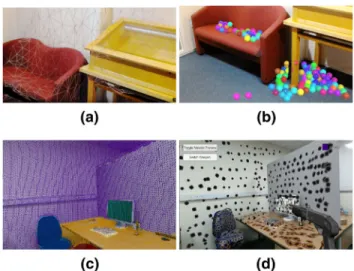
The latest research in simultaneous localization and mapping (SLAM) with greater camera tracking accuracy and robustness has enabled the rapid development of MR. Although sparse SLAM systems [DRMS07] [KM07] [MAMT15] are proven to be efficient in 3D tracking for monocular cameras, structural information is still missing from the system. In contrast, dense SLAM algorithms [NLD11] [NIH*11] [NFS15] have enabled the construction of object surfaces in order to provide geometric information of the real scene and allow geometric-based interactions in MR environments. Collision effects between virtual and real-world objects in these geometry-aware MR systems increase the immersion of user experience (as can be seen in Figures 2a and b for the Ball Pit MR game in Microsoft HoloLens). However, since the individual semantic property of various real-world objects remains undetected, geometry-aware MR systems are unable to distinguish object be-haviours due to different object properties. Such shortcomings could c
2019 The Authors. Computer Graphics Forum published by Eurographics - The European Association for Computer Graphics and John Wiley & Sons Ltd This is an open access article under the terms of the Creative Commons Attribution License, which permits use, distribution and reproduction in any medium, provided the original work is properly cited.
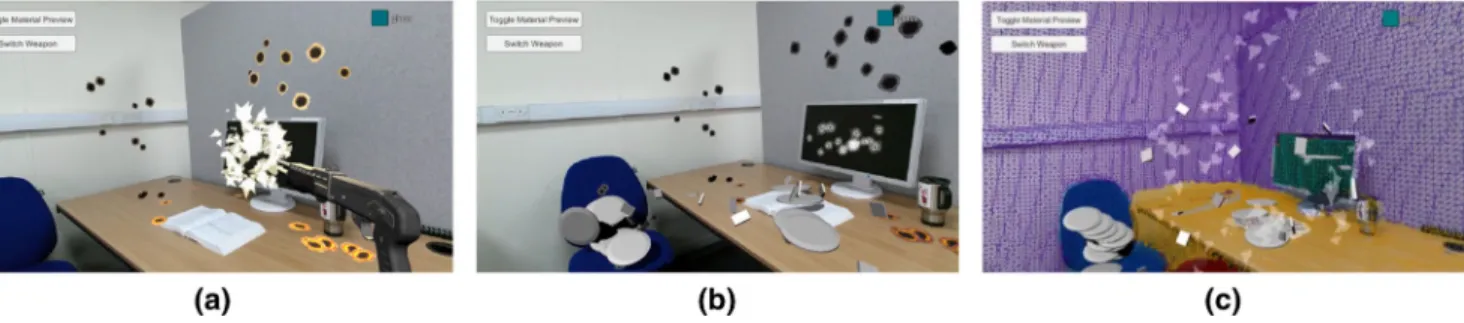
Figure 1: An MR shooting game (a) and a throwing plates game (b) developed by the proposed framework that can provide material-specific physical interactions detected by deep semantic material learning method. (c) The semantic interaction layer in which different materials are textured by different colours (green: glass, purple: painted, blue: fabric, yellow: wood and red: carpet).
always generate uniform object interactions. The lack of higher level context awareness regarding object properties may break the immersion continuum of users of such systems [GLZR17]. Figure 1 shows a MR shooting game that can provides material-specific physical interactions detected by deep semantic material learning method.
A natural first step moving away from purely geometric-based approaches is to enable semantic understanding of the real envi-ronment within MR, hence, generating context-aware interactions. Semantic segmentation [GGOEO*] [SLD17] [ZJRP*15] [CPK*17] [BKC17] leading to greater understanding of the environment is not new to computer vision. However, there is few reported prior work that utilizes the semantic information in MR. Semantic-based interactions via object understanding in MR present a number of ad-ditional challenges: (1) most of semantic segmentation approaches cannot be running in real-time for interactive environments; (2) it is hard to associate semantics with the structural information of the environment seamlessly on-the-go; and (3) retrieving seman-tics and then generating appropriate interactions is difficult for high computational performance and accuracy.
Realistic interactions in MR require not only geometric and struc-tural information, but also semantic understandings of the scene. Embedding semantic information extracted from a 2D image space into the 3D structure of an MR environment is hard, because of the required high accuracy from the semantic segmentation. Care-ful considerations are needed when designing semantic-based MR interactions. While geometric structure allows accurate object lo-calization, augmentations and placements, at the user experience level, semantic knowledge is the key to enable realistic interactions between the virtual and real objects. Realistic physical interactions (e.g. a virtual glass shunted on a real concrete floor in an MR environment) can be achieved through the semantic scene under-standing. More importantly, using semantic scene descriptions, we can develop high-level tools for efficient design and constructions of large and complex MR applications.
In this paper, we propose a novel context-aware semantic MR framework to address the research gap. Our proposed framework is a 2D-to-3D-to-2D computational pipeline. We demonstrate its effec-tiveness through example applications. To generate context-aware interactions, we use an end-to-end deep learning (DL) framework and a dense SLAM algorithm for semantic information integration in MR environment.
We present the labelling of material properties of the real environ-ment in 3D space as a novel example application to deliver realistic physical interactions between the virtual and real objects in MR. To the best of our knowledge, this is the first work that presents a context-aware MR by using DL-based semantic scene understand-ing and generatunderstand-ing semantic interactions at the object-specific level. Our approach is one step further towards the high-level conceptual interaction modelling in complex MR environment for enhanced user experience.
Dense SLAM KinectFusion [NIH*11] was used for camera pose recovery and 3D model reconstructions to create a classic geometry-aware MR environment first. We trained conditional random fields as recurrent neural networks (CRF-RNN) [ZJRP*15] by using a large-scale material database [BUSB15] for detecting material prop-erties of each object in the scene. The 3D geometry/model of the scene is then labelled with the semantic information of materials that made up of the scene. Therefore, with the semantic informa-tion available, realistic physical interacinforma-tions between objects can be generated based on the material properties of the objects, which the user is interacting with. Figures 2(c) and (d) show a shooting game example for object-specific material-aware interactions. Our frame-work is based on a 3D volume semantic construction, classification and occupancy mapping for the real objects (i.e. 2D-to-3D-to-2D computational pipeline).
Our proposed framework is both efficient and accurate in seman-tic labelling and inference for generating realisseman-tic context-aware interactions. Two tests are designed to evaluate the effectiveness of the framework. One test evaluates the end-to-end system accuracy by comparing the dense semantic ray-casting results with manually labelled ground truth of 25 key-frames of two different scenes. An-other test is a user experiment with 28 participants to qualitatively evaluate user experience under three different MR conditions. The results show that the framework delivers more accurate 3D seman-tic mappings than directly using the state-of-the-art 2D semanseman-tic segmentation.
In the next section, we review related work on geometry-based MR interactions and recent approaches to semantic segmentation using convolutional neural network (CNN). The following sections introduce our framework with SLAM dense reconstructions of the scene and the 3D semantic fusion, and describe our implemen-tation and the evaluation framework. Finally, we demonstrate our
results compared with the state-of-the-art semantic segmentation al-gorithms.
2. Previous Work
Our approach draws upon the recent success of dense SLAM al-gorithms [NLD11] [NIH*11] [NFS15] and DL methods for se-mantic segmentations [GGOEO*] [SLD17] [ZJRP*15] [CPK*17] [BKC17] that have been mostly used in the field of robotics un-til now.
2.1. Geometry-based MR interactions
Interaction modelling between virtual and real objects in MR is mostly geometry based through plane feature detection or full 3D reconstruction of the real world. Methods of using plane detec-tion [SMGKD14] [NOBW16] estimate planar surfaces in the real world, which virtual objects are placed onto and collided with. Random sample consensus algorithm [FB81] estimates planar sur-faces based on sparse 3D feature points extracted from a monocular camera. Plan detection does not require a depth camera, is compu-tationally efficient and can run on mobile phones, which is shown in the newly released mobile AR systems [App17] [Goo17]. One obvious shortcoming of the plane detection is the requirement for large planar surfaces to delivery MR interactions. Collision meshes for non-planar surfaces are impossible, hence, restricting user to only interact in certain areas and with types of objects.
Recent advances in depth sensors, display technologies and SLAM software [NLD11] [NIH*11] [WJK*13] [NFS15] have opened up the potential of MR systems. Spatial structures of the real environment can be generated at ease to provide accurate geometries for detecting collisions between virtual and real ob-jects. Examples of geometry-based interactions include: a virtual car ‘drives’ on an uneven real desk [NLD11]; the Super Mario game played on real building blocks [KTY*13] and the Ball Pit game in HoloLens [Mic17], where Figures 2(a) and (b) illustrate the concept. Impressive as they are, the state-of-the-art systems are still limited to basic and uniform geometry-based virtual and real object interactions. Lacking high-level semantic descriptions and basic scene understandings in MR have compromised the immer-sion of user experience, and the realism of interactions is reduced and easily broken. One example is in the Ball Pit game, material properties of the real objects are not recognized. Thus, a ball falling onto a soft surface would still bounce back unrealistically against the law of physics.
2.2. Deep semantic understanding
Semantic segmentation is an emerging technology in computer vi-sion. The recent success of CNN has achieved semantic-level image recognition and classifications with great accuracy [KSH12], en-abling many novel applications. In the last few years, more complex neural networks, such as FCN [SLD17], CRF-RNN [ZJRP*15], DeepLab [CPK*17] and SegNet [BKC17], have enabled image un-derstanding at the pixel level. After being trained on large-scale databases, these networks can predict and label semantic informa-tion at every pixel of an image.
Figure 2: (a): Microsoft HoloLens is capable of reconstructing an MR environment by its built-in ‘spatial mapping’ function and provides a geometric mesh for geometry-based interaction. (b): The Ball Pit MR game based on geometry interactions for Microsoft HoloLens. (c) Our proposed framework can provide a semantic mesh for more advanced context-aware interactions. (d) A shooting game based on our proposed framework. Note that the bullet holes on different objects are different according to material properties of the objects.
Recently, the joint learning of depth and semantics [PXZ*15] [JCSL18] [ZCX*18] approaches have achieved better results than a single learning task; however, the joint learning means a higher demand of data, so the availability of datasets is a challenge. With the development of 3D CNN, [QSMG17] [LS18] achieved novel learning of semantic information from 3D point clouds. However, the prediction of semantic attributes only in 3D does have its limita-tions – for example, for the material-aware interaction proposed in our paper, the material information is very hard to be inferred from 3D level (a chair-shape object can be made of wood, but can also be plastic or metal). Most of the semantic information about 3D point clouds is regarding the 3D shapes and geometry. In contrast, 2D semantic segmentation algorithms have been proven efficient and effective.
Combined with SLAM systems, 2D semantic segmentation can be achieved in 3D environments [RA17] [TTLN17] [ZSS17] [MHDL17], a promising future in robotic vision understanding and autonomous driving. Unlike these existing methods that aimed at providing the semantic understanding of the scene for robots, we are focusing our attention on human interactions. Our goal is to provide the user with realistic semantic-level interactions in MR. In this paper, we use MR as a bridge to connect artificial intelligence (AI) and human for a better understanding of the world via intelligent context-aware interactions.
2.3. Context and semantic awareness in MR environment
Prior approaches have studied context and semantic understand-ings in 3D virtual environments, for example semantic inferring in
interactive visual data exploration [NEF12]; enhancing software quality for multi-modal virtual reality (VR) systems [FWL17]; vi-sual text analytics [EFN12]; and interactive urban vivi-sualization [DZMQ16]. Context awareness is also introduced in computer-aided graphic design, such as inbetweening of animation[Yan18]; 3D particle clouds selection[YEII16]; and illustrative volume ren-dering [RBG07]. Virtual object classifications are proposed in VR applications using semantic associations to describe virtual object behaviours [CTB*12]. The notion ofconceptual modellingfor VR applications is pointed out by Troyeret al., highlighting a large gap between the conceptual modelling and VR implementations. It is suggested taking a phased approach (i.e. conceptual specification, mapping and generation phases) to bridge the gap [DTKPB07].
Recently, the idea of extending AR applications to become context-aware has been presented in computer graphics [GLZR17], which proposes to classify context sources and context targets for continuous user experience. A method is proposed for authentic simulating outdoor shadows to achieve seamless context-aware integration between the virtual and real objects for mobile AR [BBBM18].
2.4. The contributions of our work
Although SLAM and semantic segmentation are active research topics in the robotics and computer vision communities, there is a lack of work in computer graphics research by combining these approaches together for higher level context-aware MR interac-tions. In this paper, we address the idea of ‘ubiquitous interaction’ in the MR environment to explore a deep semantic understand-ing of the environment and take a step further towards the high-level interaction design for MR. The contributions of this paper are:
r
We propose the concept of ‘Context-Aware Mixed Reality’ in which everything in the real world is interactable in the virtual MR environment.r
We present a general framework for the proposed ‘Context-Aware Mixed Reality’ and implement two MR games to demon-strate the concept.r
We propose a fusion method with the 3D geometric label opti-mization for improving the accuracy of 3D semantic mesh.r
We have conducted the accuracy study and user experience eval-uations for the quantitative evaluation of the system accuracy and the improvement to immersive and natural interactions. Empowered by the latest computer vision and AI technologies, our proposed framework can intelligently assist the interaction de-sign in MR and seamlessly generates the higher level virtual-real interactions to increase the realism and naturalism of interactions in MR and deliver immersive user experience greatly.3. Framework Overview
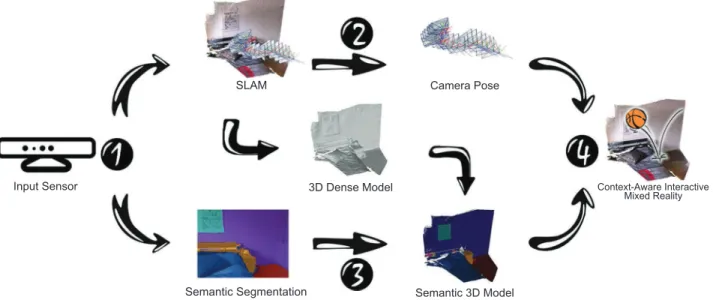
Figure 3 shows the proposed framework. Starting from an1 input sensor, two main computation streams are constructed:2 track-ing & reconstruction streamand3 context detection & fusion stream, which are finally merged and output to the4 interactive MR interfacefor generating context-aware virtual-real interactions.
3.1. Input sensor
An input sensor, an RGB-D camera, such as Microsoft Kinect, ASUS Xtion series, or built-in sensors on Microsoft HoloLens, is used to acquire the depth information directly for the 3D recon-struction of the environment. Monocular or stereo cameras would also work if combined with dense SLAM systems [NLD11], but the accuracy and real-time performance of Mono devices are not guaranteed.
3.2. Camera tracking & reconstruction stream
Thetracking & reconstruction streamshown in the upper path of Figure 3 processes the video captured by the input sensor. A SLAM system continuously estimates the camera pose and simultaneously reconstructs a 3D dense model. This is a typical method used in the latest MR systems, such as Microsoft HoloLens for implementing geometry-aware MR. A dense 3D model serves as a spatial collision mesh and the inverse of the camera pose extracted from the SLAM guides the movement of the collision mesh to visually correspond to the real-world objects.
3.3. Context detection & fusion stream
The lower path of Figure 3 shows thecontext detection stream. Image sequences from the input sensor are context sources to be processed by semantic segmentation algorithms to output dense pixel-wise object attributes and properties of the scene. Based on the semantically segmented information, the context information relevant to implementing context-aware experience is generated. The 2D semantic segmentation results are then projected onto the scene and fused with the 3D dense model (fromtracking & recon-struction stream) to generate a semantic 3D model based on the camera pose of the current frame.
3.4. Interactive MR interface
The semantic 3D model is combined with the camera pose to pro-vide a context-aware MR environment. High-level interactions are designed based on the semantics , and tools can be developed to facilitate the design and the automatic construction of complex MR interactions in different applications.
The advantages of the proposed framework are:
1) Accurate 3D semantic labelling: The context detection & fu-sion stream can predict a pixel-wise segmentation of the current frame, which is further fused onto the 3D dense model. The system builds a semantic 3D model that contains voxels, each voxel encoding the contextual knowledge of the environment. The voxel-based context-aware model delivers the semantic in-formation through ray-cast queries about the object properties to generate different user interactions. Object properties can be high-level descriptions (e.g. types of materials and interaction attributes.)
2) Real-time performance: In DL-based approaches, the
se-mantic segmentation is computationally expensive especially when processing frame by frame in real-time applications.
Figure 3: Flowchart demonstrates the whole framework. Starting from (1) an input sensor, frames go through (2) tracking and reconstruction stream and (3) semantic segmentation and fusion stream, and finally the poses and semantic 3D model are used to provide the context-aware interactive mixed reality.
The proposed framework achieves the real-time performance by embedding the semantic information into the 3D dense model after the initial segmentation process, and can be updated along with time. In doing so, the semantic segmentation does not need to be processed at each frame, but the whole system can deliver the real-time semantic information.
3) Computer-aided interaction design: With the context infor-mation available, virtual and real object interactions can be de-signed and computed by feeding attributes of the real-world objects to the target software module for processing (a physics module or an agent AI module). For example, realistic phys-ical interactions between the virtual and real objects can be computed by feeding the material properties of the real world objects to physically based simulation algorithm (such as our throwing plates game in the following section).
4. Implementation
We present our novel MR framework in the context of ob-ject material-aware interactions as an implementation example to demonstrate the concept of context-aware MR. Material properties of the real world in an MR environment enable the generation of realistic physical interactions. The example implementation is also used in the accuracy study and the user experiment presented in the following sections.
4.1. Camera tracking and model reconstruction
A dense SLAM system [NIH*11] is used to achieve the accurate camera tracking and dense 3D model reconstructions of the environ-ment, which estimates camera poses and reconstructs the 3D model in real time. Depth images from a Kinect sensor are projected into the 3D model. The camera pose and a single global surface model can be obtained simultaneously through a coarse-to-fine iterative
closest point (ICP) algorithm. The tracking and reconstruction pro-cesses consist of four steps:
1) Each pixel acquired by the depth camera is transformed into the 3D space by the camera’s intrinsic parameters, and the corre-sponding depth value is acquired by the camera.
2) An ICP alignment algorithm is performed to estimate the camera poses between the current frame and the reconstructed global model.
3) With the available camera poses, each consecutive depth frame can be fused incrementally into one single 3D reconstruction by a volumetric truncated signed distance function.
4) Finally, a ray-casting process is used to predict a surface model. A Microsoft Kinect is used as the input sensor with an OpenNI2 driver to capture RGB images and calibrated depth images at the resolution of 640 x 480 at 30 frames per second (FPS).
4.2. DL for material recognition
We have trained a deep neural network for the 2D material recog-nition task. Our neural network is implemented incaffe[JSD*14] based on the CRF-RNN architecture [ZJRP*15], which combines the FCN with CRFs based on the probabilistic graphical modelling for contextual boundary refinement. We have used the Materials in Context Database (MINC) [BUSB15] as the training database that contains three million labelled point samples and 7061 labelled material segmentations in 23 different material categories.
The VGG-16 pre-trained model for ImageNet Large-Scale Vi-sual Recognition Challenge (ILSVRC) [SZ15] is used as the initial weights of our neural network. Based on the MINC dataset, we then fine-tuned the network from 1000 different classes (ImageNet containing 1000 classes of labels) to 23 class labels as the output. VGG-16 is a CNN model specifically designed for classification
tasks and only produces a single classification result for a single image. Therefore, we manually cast the CNN into a fully convo-lutional network (FCN) for pixel-wise dense outputs [SLD17]. By transforming the last three inner product layers into convolutional layers, the network can learn to make dense predictions efficiently at the pixel level for tasks, such as semantic segmentation. The fully connected CRF model is then integrated into FCN to improve the semantic labelling results.
Fully connected CRF encodes pixel labels as random variables to form a Markov random field [KS80] conditioned on a global observation (the original image). By minimizing the CRF energy function in the Gibbs distribution [LRKT09], we obtain the most probable label assignment for each pixel in an image. With this process, the CRF refines the predicted label using the contextual information. It is also able to refine weak semantic label predictions to produce sharp boundaries and better segmentation results (see Figure 10 for the comparison of FCN and CRF-RNN). During the training process, CRF is implemented by multiple iterations, each takes parameters estimated from the previous iteration, which can be treated as an RNN structure [ZJRP*15].
As the error of CRF-RNN can be passed through the whole net-work during a backward propagation, the FCN can generate better estimations for the CRF-RNN optimization process during the for-ward propagation. Meanwhile, CRF parameters, such as weights of the label compatibility function and Gaussian kernels, can be learned from the end-to-end training process.
We use 80% of the 7061 densely labelled material segmentations in the MINC dataset as the training dataset and the rest of 20% as testing sets. The training dataset is trained using a single Nvidia Titan X GPU for 50 epochs, after which there is no significant decrease in loss. For testing results, we obtain a mean accuracy of 78.3% for the trained neural network. The trained network runs at around 5 FPS for the 2D dense semantic segmentation at the resolution of 480x270 pixels on a Nvidia Titan X GPU. We input 1 frame into our neural network for every 12 frames according to our test to achieve a trade-off between the speed and accuracy.
4.3. Bayesian fusion for 3D semantic label fusion
The trained neural network for material recognition only infers ob-ject material properties in the image space. As the camera pose for each image frame is known, we can project the semantic labels onto the 3D model as textures. A direct mapping can cause information overlapping, since accumulated weak predictions and noises can lead to a bad fusion result as shown in Figure 5 (a), where bound-aries between different materials are blurred. We solve this issue by utilizing the dense pixel-wise semantic probability distribution produced by the neural network over every class. Therefore, we can improve the fusion accuracy by projecting the labels with a statistical approach using the Bayesian fusion [ASZ*16] [HFL14] [ZSS17] [MHDL17]. Bayesian fusion enables us to update the label predictionlion 2D imagesIkwithin the common coordinate frame of the 3D model: Px=li|I1,...,k= 1 ZP x=li|I1,...,k−1 P(x=li|Ik), (1)
whereZis a constant for the distribution normalization. The label of each voxel is updated with the corresponding maximum probability p(xmax=li|I1,...,k). The Bayesian fusion guides the label fusion
pro-cess and ensures an accurate mapping result over time to overcome the accumulated errors to some extent. Figure 5(a) shows without the Bayesian fusion, the label fusion results are less clear due to the overlapping of weak predictions. In contrast, in Figure 5(b) with the Bayesian fusion, the fusion results are much cleaner.
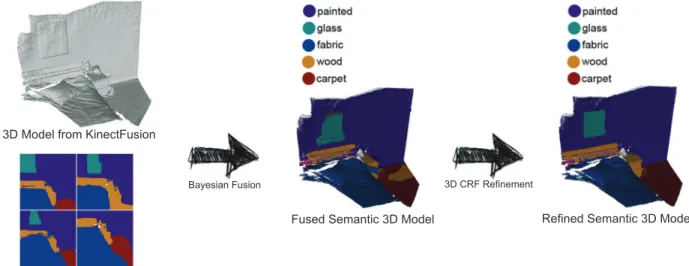
After semantic information fusion into the 3D model, we can get a semantic labelled 3D model. Although the Bayesian fusion is used to guide the fusion process, due to the accumulation of the 2D segmentation error and the tracking error, in some area, the semantic information still not perfectly matches the model structure (Figure 4). Next, we explain how to further improve the fusion accuracy by proposing a new CRF label refinement process on 3D structures.
4.4. 3D geometric label optimization
We further improve the accuracy of the 3D labelling with a final refinement step on the semantic information using the structural and colour information of vertices of the 3D semantic model. From the fully connected CRF model, the energy of a label assignment xcan be represented as the sum of unary potentials and pairwise potentials over allipixels:
E(x)= i ψu(xi)+ i j∈Ni ψpxi, xj, (2) where the unary potentialψu(xi) is the cost (inverse likelihood) of theith vertex assigning with the labelx. In our model implemen-tation, we use the final probability distribution from the previous Bayesian fusion step as the unary potential for each label of every vertex. The pairwise potential is the energy term of assigning the labelxto bothithandjthvertices. We follow the efficient pairwise edge potentials in [KK11] by defining the pairwise energy term as a linear combination of Gaussian kernels:
ψpxi, xj=μxi, xj M m=1 w(m)k(m) G fi, fj, (3)
wherewmare the weights for different linear combinations,kmGare mdifferent Gaussian kernels thatfiandfj correspond to different feature vectors. Here, besides the commonly used feature space in [KK11] [ZJRP*15], such as the colour and spatial location, the normal direction is also considered as a feature vector to take the full advantage of our 3D reconstruction step:
kG fi, fj =w(1)exp −pi−pj 2 2θ2 p +w(2)exp −pi−pj 2 2θ2 pI − Ii−Ij2 2θ2 I +w(3)exp −pi−pj 2 2θ2 pn −ni−nj 2 2θ2 n ,
Figure 4: 3D semantic label fusion and refinement. From left to right: the 3D model and 2D semantic segmentation results are fused by Bayesian Fusion into semantic 3D model; the semantic 3D model goes through the 3D CRF refinement for improving quality.
Figure 5: (a) 3D semantic label fusion using direct mapping. (b) 3D semantic label fusion with Bayesian fusion.
wherepiandpj are pairwise position vectors;IiandIjare pair-wise RGB colour vectors;niandnjare pairwise normal directional vectors. The first term is the smoothness kernel assuming that the nearby vertices are more likely to be in the same label, which can efficiently remove small isolated regions [SWRC09][KK11]. The second term represents the appearance kernel that takes into ac-count of colour consistency, since the adjacent vertices with similar colour(s) are more likely to have the same label. The third term is the surface kernel, which utilizes the 3D surface normal as a feature that vertices with similar normal directions are more likely to be the same label.
By minimizing Equation (2), semantic labels on our 3D model are further refined according to the colour and geometric information, which can efficiently eliminate the ‘label leaking’ problem caused by the 2D semantic segmentation errors and the camera tracking errors (Figure 4).
4.5. Interaction interface
A user interface is developed with two layers. The top layer dis-plays the current video stream from an RGB-D camera, while the
semantic 3D model serves as a hidden physical interaction layer to provide the interactive interface. In the interactive MR application, a virtual camera is synchronized with predicted camera poses for projecting the 3D semantic model onto the corresponding point of view of the video stream. Figure 9 shows that the back layer of the interface displays the video stream from an RGB-D camera; a semantic interaction 3D model is in the front of the video layer for handling interactions of different materials (green: glass, purple: painted, blue: fabric, yellow: wood and red: carpet). The virtual and the real physical interactions are performed on the interaction model. The context-aware interaction model is invisible to allow users to interact with the real-world objects to experience an immersive MR environment. The interaction layer also computes real-time shadows to make the MR experience even more realistic. An oct-tree data structure accelerates the ray-casting queries for the material prop-erties to improve the real-time performance. Finally, corresponding physical interactions based on the semantic information of different materials are achieved through physics simulations.
5. Example Applications
5.1. Context-aware interactive games
Based on our context-aware MR framework, two FPS games are developed to demonstrate the concept of the proposed material-aware interactive MR. Next, we describe the design of interactions and evaluations.
Games are interaction demanding applications that are driven by computational performance and accurate interactions in virtual spaces. We have designed two MR games that can directly interact with the real-world objects. A shooting game is designed to show material-aware interactions between bullets and the real-world ob-jects. The shooting scenario is chosen because we want to test the accuracy of the semantic 3D model using ray-cast queries. In this game, as shown in Figure 6, multiple interactions for different mate-rials have been implemented, including different bullet holes, flying
Figure 6: The screenshots of our MR shooting game. The interac-tion is different when shooting (a) walls, (b) desks, (c) computer screen and (d) chair.
chips and hitting sound when hitting different objects: (a) walls, (b) desks, (c) computer screen and (d) chair. The interaction for different material context is as real as possible.
Another way to show the capability of the context-aware frame-work is to match the interaction results to the user’s anticipation of the interaction results using everyday scenarios that are familiar to users, testing the immersive experience of the MR system from the user’s perspective. The second example is designed to match user expectations for material-specific physical interactions.
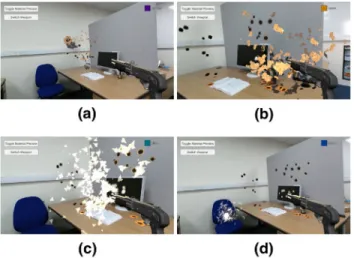
As shown in Figure 7, users throw virtual plates onto real-world objects of the MR environment, resulting in material-aware physical interactions induced by various material properties of the real ob-jects. In Figures 7(a) and (b), virtual plates are broken when falling onto the desk, but bounced back when colliding with a book; in (c) when colliding with a computer screen, the plate is broken with the flying glass chips; and in (d), the plate remains intact colliding with a soft chair.
5.2. Context-aware relighting
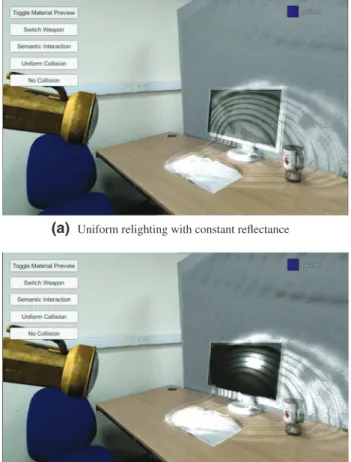
When virtual illuminated objects are involved in MR environment, relighting is an important technology that makes the user experience more realistic and immersive. With the 3D model available, it is possible to re-render the scene (such as Figure 8a) but lack of realism due to the unknown lighting property and constant reflectance.
Based on our proposed system, high fidelity 3D models can be acquired from SLAM reconstruction and the semantic mapping from semantic segmentation can provide the high-level context of object properties (such as material, metallicity, smoothness, etc.). Then, the material-specific relighting can be done automatically through the render engine (Unity3D in our example), by determin-ing the specular and diffuse reflections based on the object property (as shown in Figure 8b, that the screen was set to specular re-flections, while other materials were diffuse reflections). And this
Figure 7: The screen shots of our MR throwing plates game. The interaction is different when throwing plates to (a) book, (b) desks, (c) computer screen and (d) chair.
material-specific relighting is more realistic and accurate than pre-vious relight work [ZCC16] that relays on the Manhattan-world assumptions [CY00] without any object-level relighting.
6. Experimentation 6.1. Experimentation setup
The RGB and calibrated depth image sequences were acquired from Microsoft Kinect at30 FPS at the resolution of 640 x 480. The semantic segmentation neural networks, SLAM and semantic fusion modules are running as back-end services to provide semantic mesh for front-end game interface through Unity3D.
For the back-end services, our semantic segmentation networks were trained and running in Tensorflow on a workstation with a single Nvidia Titan X GPU (12G Memory), which can be running at3 FPS at the resolution of 640 x 480. The SLAM tracking and dense surface reconstruction module can be running at20 FPS.
For the front-end game interface, the background camera and virtual objects were rendered at24 FPS, while the semantic mesh was updated at1 FPS.
6.2. Accuracy study
Multiple factors affect the accuracy of the system: (1) the camera tracking, (2) the 3D model reconstruction; (3) the deep semantic material segmentation; (4) the 2D to 3D semantic model fusion; and (5) the implementation of the ray-casting. As the goal of our proposed framework is to deliver real-time and accurate semantic interaction in MR, so we would like to evaluate the dense ray-casting queries of the 3D semantic model, and we transform the dense ray-casting queries into a 2D projection from our semantic 3D model for evaluation. Here, we not only evaluated the whole framework (3D-2D w/CRF in Table 1), but we also conducted an ablation accuracy study to demonstrate how each component contributed to the final
(a)
(b)
Figure 8: A virtual torch in MR to illustrate the relighting in MR.
result. A total of 25 key-frames from two different scenes (office and bedroom) are selected, and at the same time, the 2D projections of the 3D semantic models are captured as the dense ray-casting query results at the corresponding key-frames (Figure 11). Ground truth for the accuracy evaluation is obtained by manually labelling 25 RGB images with the same material labels. The four common evaluation criteria [SLD17] [ZJRP*15] for semantic segmentation and scene parsing evaluations are used to evaluate the variations of pixel accuracy and region intersection over union (IoU).
1. Pixel accuracy inii iti 2. Mean accuracy 1 nc1 intiii 3. Mean IoU n1 c1 iti+jniinji−nii
4. Frequency weighted IoU 1
ktk
iti+tjinniiji−nii
wherenijrepresents the number of pixels of classipredicted to be classj;nc1 is the total number of classes; andti=jnij is the
total number of pixels of classi.
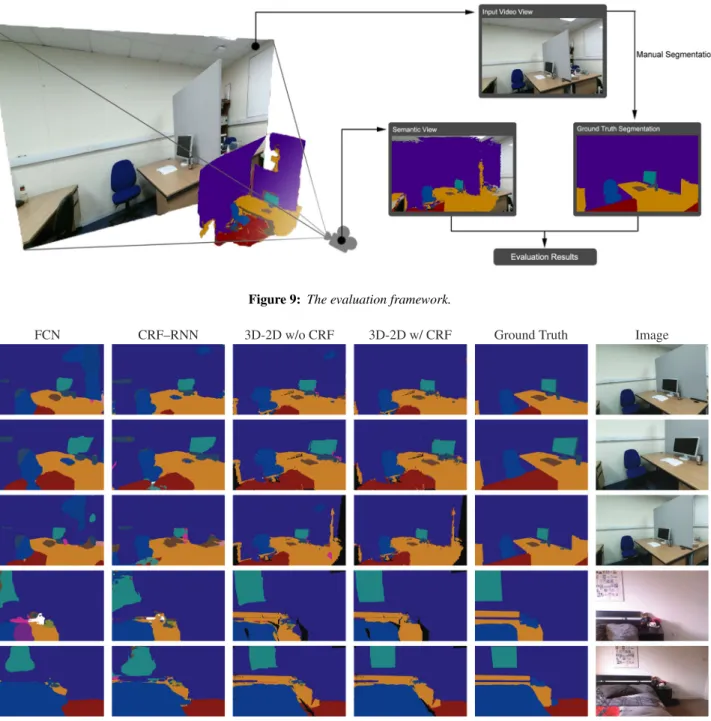
As can be seen from Table 1, after 2D-3D fusion, 3D CRF re-finement and finally 3D-2D projections, our framework can provide more accurate semantic segmentation results compared with the 2D methods, such as FCN and CRF-RNN. Figure 10 shows some semantic segmentation samples. Taking the advantages of the 3D
Table 1: Accuracy study results.
Stage Pixel acc. Mean acc. Mean IoU F.w. IoU
FCN[SLD17] 81.61 63.69 49.54 76.16
CRFRNN[ZJRP*15] 85.68 51.73 41.32 79.76
3D-2D w/o CRF 87.86 70.69 54.81 81.86
3D-2D w/CRF 89.42 72.06 56.32 84.30
constraints and refinement in our proposed framework, our semantic segmentation results are more uniform, sharp and accurate.
6.3. User experience evaluation
We conducted an interactive user study to evaluate the effective-ness of the semantic-based MR system. Using the throwing plates game, three test conditions are designed by setting different collision responses:
1) No collision mesh: Virtual plates were thrown into the real world without any collision being detected. The plates will fly to infi-nite distance.
2) Uniform collision mesh: Virtual plates interact with the real world with the uniform collision mesh being activated, but no object-specific interaction is generated. The plates will break when being contacted with any object.
3) Semantic collision mesh: Physics responses of the virtual plates with the real-world objects are dependent on the material prop-erties of the objects in the real world. The plates will break when contacted with defined hard objects: desk and wood; the plates will not break when contacted with defined soft objects: fabric. The objective of the user study is to assess the realism of the MR environment by measuring how much the semantic-based interac-tion matches the user anticipainterac-tion. We investigate whether or not the semantic-based interactions can significantly improve the realism of MR systems and delivers immersive user experience.
Firstly, we evaluate the realism of physical interactions, such as collision responses in MR systems. We test to see if users are able to detect differences in these three interaction conditions between virtual and real objects, and whether or not the realism in MR can be improved via context-aware physical responses. Secondly, to ensure the quality of qualitative study, we test if there is any risk that the user experience of the proposed MR system could be affected by gender factor and their previous engagement with MR or VR technologies.
6.3.1. Participants
We recruited 28 undergraduate students (22 were identified as males and 6 as females) for our user experience experiment. The session included a game play part and a questionnaire part. Each participant was invited to a room with a computer to play the ‘throwing plates’ MR game with three pre-defined conditions. On the screen, there was a simple interface with three buttons: ‘Game 1’, ‘Game 2’ and ‘Game 3’ for the ‘throwing plates’ MR game with ‘No Collision Mesh’, ‘Uniform Collision Mesh’ and ‘Semantic
Figure 9: The evaluation framework.
Figure 10: Semantic segmentation samples for each column from left to right: FCN, CRF-RNN, final results without CRF refinement, final results with CRF refinement, ground truth and input image.
Collision Mesh’ conditions. The users can select to enter which game, and can replay the MR game with each condition as much as they want, so that the participant can take time to digest and answer the questions. After three conditions were well played, the participants were asked to fill a questionnaire with four questions: the first question is to ask whether the participant had any previous experience with VR/AR games, the other three questions are the rating of the MR game experiences on the scale of 1 (very bad) to 10 (very good) based on the quality of the MR interactions and realism.
6.3.2. Results
We used the score from 1 to 10 as the interval data so that we can use parametric ANOVA to analyse the data. We have performed a repeated measure ANOVA test to analyse scores obtained for the three conditions.
Within-subjects results
Mauchly’s test shown that the assumption of sphericity is not significant (X2=2.478, p=0.290, ε=0.907 ). So, we can reject
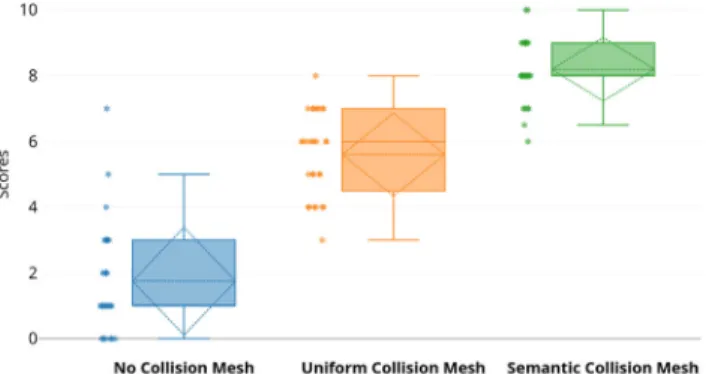
Figure 11: The box plot of the user experience evaluation results of the three conditions: blue: no collision mesh; orange: uniform collision mesh; and green: semantic collision mesh.
Table 2: The user experience evaluation results of three conditions.
Groups N Mean Std. dev. Std. err.
No collision mesh 28 1.75 1.6694 0.3155
Uniform collision mesh 28 5.6071 1.2864 0.2431 Semantic collision mesh 28 8.1964 0.9845 0.1861
the hypothesis that the variances of the differences between the three conditions were significantly different. Main effects were found within the three conditions (F2,48=152.043, p <0.001).
The following post hoc Bonferroni pairwise comparisons show that thesemantic collision mesh(M=8.196, SD=0.984) is sig-nificantly better than the other two MR conditions (p <0.001), indicating that the proposed semantic interactions through the in-ference of material properties can greatly improve the realism of the MR system. We also found that the uniform collision mesh(M=5.607, SD=1.286) offers much better MR experience (p <0.001) than theno collision mesh(M=1.750, SD=1.669) but less realistic compared with the semantic context-aware MR. The mean scores of the three system conditions are shown in Table 2 and the box plot is shown in Figure 11.
Between-subjects results
Furthermore, as our test group has unbalanced gender issue (78.57% are male), and some candidates (about 57.14%) had never played VR/AR games for at least once. We also conducted a between-subjects repeated measure ANOVA test to reveal whether gender and the previous VR/AR experience have influences on our previous results. It has been shown that the final test results are not affected by gender (p=0.210) or whether the candidate ever played VR/AR games or not (p=0.654).
7. Conclusion and Discussion
We show how deep semantic scene understanding methodology combined with dense 3D scene reconstruction can build high-level context-aware highly interactive MR environment. Recognizing this, we implement a material-aware physical interactive MR
envi-ronment to effectively demonstrate natural and realistic interactions between the real and the virtual objects. The accuracy study result shows that our 2D-3D-refinement-2D framework can greatly im-prove the accuracy of delivering the semantic information to users in the context of semantic MR interaction. Our user study reveals that the semantic interaction is very important to the realism of MR experience, and our proposed semantic interaction enabled MR system achieved the best MR user experience in terms of MR inter-actions. Our work is the first step towards the high-level interaction design in MR. This approach can lead to better system design and evaluation methodologies in this increasingly important technology field.
There are some immediate directions for future research and we mention two such directions now. Although in this paper we focus our discussions on material understanding and its seman-tic fusion with the virtual scene in MR environment, the concept and the framework presented here are applicable to address many other context-aware interactions in MR, AR and even VR. The framework can be extended by replacing the training dataset with more general object detection databases for constructing differ-ent interaction mechanisms and context. Realistic physics-based sound propagation and physics-based rendering using the proposed context-aware framework for MR are promising directions to pur-sue. Also, our studies are minimal and there are still potential ar-eas for improvements: bigger evaluation dataset, bigger scale of user study, bias-free user study (randomly present the three con-ditions) and design more questions to better understand the whole experience.
Our results have hinted that the study of semantic construc-tions in MR as a high-level interaction design tool is worth pur-suing, as more comprehensive methodologies emerging, complex rich MR applications will be developed in the near future. How-ever, it is worth notice that unlike physics, many natural interac-tions are not easily defined or represented for machines to under-stand (such as what will happen when pouring virtual water onto a real TV?). We believe that answering such big questions should be an essential part of our future work, which will enable the next generation of MR with the help of the next-generation artificial general intelligence. We hope that our initiative on the applica-tion of AI on MR offers a new insight for the future of MR, and bridges the gap between the virtual and real worlds in context-aware interactions.
References
[App17] Apple: Arkit - Apple Developer, 2017.
[ASZ*16] ARMENII., SENERO., ZAMIRA. R., JIANGH., BRILAKIS I., FISCHERM., SAVARESES.: 3D semantic parsing of large-scale indoor spaces. In2016 IEEE Conference on Computer Vision and Pattern Recognition (CVPR)(June 2016), pp. 1534–1543. [BBBM18] BARREIRA J., BESSA M., BARBOSA L., MAGALHES L.:
A context-aware method for authentically simulating outdoors shadows for mobile augmented reality. IEEE Transactions on Visualization and Computer Graphics 24, 3 (March 2018), 1223– 1231.
[BKC17] BADRINARAYANANV., KENDALL A., CIPOLLAR.: Segnet: A deep convolutional encoder-decoder architecture for scene segmentation.IEEE Transactions on Pattern Analysis and Ma-chine Intelligence 39, 12 (2017), 2481–2495.
[BUSB15] BELL S., UPCHURCH P., SNAVELY N., BALA K.: Ma-terial recognition in the wild with the maMa-terials in context database. Computer Vision and Pattern Recognition (2015), https://doi.org/10.1109/CVPR.2015.7298970.
[CPK*17] CHEN L. C., PAPANDREOU G., KOKKINOS I., MURPHY K., YUILLEA. L.: Deeplab: Semantic image segmentation with deep convolutional nets, atrous convolution, and fully connected CRFs.IEEE Transactions on Pattern Analysis and Machine In-telligence 40, 4 (2017), 834–848.
[CTB*12] CHEVAILLIERP., TRINHT.-H., BARANGEM., DELOORP., DEVILLERSF., SOLERJ., QUERRECR.: Semantic modeling of vir-tual environments using MASCARET. In2012 5th Workshop on Software Engineering and Architectures for Realtime Interactive Systems(2012), IEEE, pp. 1–8.
[CY00] COUGHLANJ. M., YUILLEA. L.: The Manhattan world as-sumption: Regularities in scene statistics which enable Bayesian inference. InProceedings of the 13th International Conference on Neural Information Processing Systems(Cambridge, MA, USA, 2000), NIPS’00, MIT Press, pp. 809–815.
[DRMS07] DAVISONA. J., REIDI. D., MOLTONN. D., STASSEO.: Monoslam: Real-time single camera SLAM.IEEE Transactions on Pattern Analysis and Machine Intelligence 29, 6 (June 2007), 1052–1067.
[DTKPB07] DETROYERO., KLEINERMANNF., PELLENSB., BILLEW.: Conceptual modeling for virtual reality. In Tutorials, Posters, Panels and Industrial Contributions at the 26th International Conference on Conceptual Modeling - Volume 83(Darlinghurst, Australia, 2007), ER ’07, Australian Computer Society, Inc., pp. 3–18.
[DZMQ16] DENGH., ZHANGL., MAOX., QUH.: Interactive urban context-aware visualization via multiple disocclusion operators.
IEEE Transactions on Visualization and Computer Graphics 22, 7 (July 2016), 1862–1874.
[EFN12] ENDERTA., FIAUXP., NORTHC.: Semantic interaction for visual text analytics. InProceedings of the SIGCHI Conference on Human Factors in Computing Systems(New York, NY, USA, 2012), CHI ’12, ACM, pp. 473–482.
[FB81] FISCHLERM. A., BOLLESR. C.: Random sample consensus: A paradigm for model fitting with applications to image analysis and automated cartography.Communications of the ACM 24, 6 (June 1981), 381–395.
[FWL17] FISCHBACHM., WIEBUSCHD., LATOSCHIKM. E.: Semantic entity-component state management techniques to enhance soft-ware quality for multimodal VR-systems.IEEE Transactions on Visualization and Computer Graphics 23, 4 (April 2017), 1342– 1351.
[GGOEO*] GARCIA-GARCIA A., ORTS-ESCOLANO S., OPREA S., VILLENA-MARTINEZ V., GARCIA-RODRIGUEZ J.: A review on deep learning techniques applied to semantic segmentation. arXiv:1704.06857v1.
[GLZR17] GRUBERTJ., LANGLOTZT., ZOLLMANNS., REGENBRECHT H.: Towards pervasive augmented reality: Context-awareness in augmented reality.IEEE Transactions on Visualization and Com-puter Graphics 23, 6 (June 2017), 1706–1724.
[Goo17] Google: Arcore - Google Developers, 2017.
[HFL14] HERMANSA., FLOROS G., LEIBEB.: Dense 3D semantic mapping of indoor scenes from RGB-D images. In2014 IEEE International Conference on Robotics and Automation(2014), IEEE, pp. 2631–2638.
[Int] http://www.intel.com/content/www/us/en/tech-tips-and-tricks/ virtual-reality-vs-augmented-reality.html.
[JCSL18] JIAOJ., CAOY., SONGY., LAUR. W. H.: Look deeper into depth: Monocular depth estimation with semantic booster and attention-driven loss. InECCV(2018).
[JSD*14] JIAY., SHELHAMERE., DONAHUEJ., KARAYEVS., LONGJ., GIRSHICKR., GUADARRAMAS., DARRELLT.: Caffe: Convolutional architecture for fast feature embedding. InProceedings of the 22nd ACM International Conference on Multimedia(New York, NY, USA, 2014), MM ’14, ACM, pp. 675–678.
[KK11] KRAHENB¨ UHL¨ P., KOLTUN V.: Efficient inference in fully connected CRFs with Gaussian edge potentials. In Advances in Neural Information Processing Systems 24, J. Shawe-Taylor, R. S. Zemel, P. L. Bartlett, F. Pereira and K. Q. Weinberger (Eds.). Curran Associates, Inc. (2011), pp. 109–117.
[KM07] KLEING., MURRAYD.: Parallel tracking and mapping for small AR workspaces. InProceedings of the 6th IEEE and ACM International Symposium on Mixed and Augmented Reality(Nov. 2007), pp. 225–234.
[KS80] KINDERMANN R., SNELL J. L.: Markov Random Fields
and Their Applications, vol. 1. American Mathematical Society, 1980.
[KSH12] KRIZHEVSKYA., SUTSKEVERI., HINTONG. E.: Imagenet clas-sification with deep convolutional neural networks. In Proceed-ings of the 25th International Conference on Neural Information Processing Systems(USA, 2012), NIPS’12, Curran Associates Inc., pp. 1097–1105.
[KTY*13] KIMH., TAKAHASHII., YAMAMOTOH., KAIT., MAEKAWA S., NAEMURAT.:MARIO: Mid-Air Augmented Reality Interaction with Objects. Springer International Publishing, Cham, 2013, pp. 560–563.
[LRKT09] LADICKA˜¡ L., RUSSELLC., KOHLIP., TORRP. H. S.: Asso-ciative hierarchical CRFs for object class image segmentation. In
2009 IEEE 12th International Conference on Computer Vision
[LS18] LANDRIEUL., SIMONOVSKYM.: Large-scale point cloud se-mantic segmentation with superpoint graphs. 2018 IEEE/CVF Conference on Computer Vision and Pattern Recognition(2018), pp. 4558–4567.
[MAMT15] MUR-ARTALR., MONTIELJ. M. M., TARDOS´ J. D.: Orb-SLAM: A versatile and accurate monocular SLAM system.IEEE Transactions on Robotics 31, 5 (Oct. 2015), 114–1163. [MHDL17] MCCORMACJ., HANDAA., DAVISONA., LEUTENEGGER
S.: Semanticfusion: Dense 3D semantic mapping with con-volutional neural networks. In 2017 IEEE International Con-ference on Robotics and Automation (May 2017), pp. 4628– 4635.
[Mic17] MICROSOFT: Ball pit - Microsoft Store, 2017.
[NEF12] NORTHC., ENDERTA., FIAUXP.: Semantic interaction for sensemaking: Inferring analytical reasoning for model steering.
IEEE Transactions on Visualization & Computer Graphics 18
(2012), 2879–2888.
[NFS15] NEWCOMBER. A., FOXD., SEITZS. M.: Dynamicfusion: Reconstruction and tracking of non-rigid scenes in real-time. In
Proceedings of the IEEE CVPR(2015), pp. 343–352.
[NIH*11] NEWCOMBER. A., IZADIS., HILLIGESO., MOLYNEAUXD., KIMD., DAVISONA. J., KOHIP., SHOTTONJ., HODGESS., FITZGIBBON A.: Kinectfusion: Real-time dense surface mapping and tracking. In2011 10th IEEE International Symposium on Mixed and Aug-mented Reality(2011), IEEE, pp. 127–136.
[NLD11] NEWCOMBER. A., LOVEGROVES. J., DAVISONA. J.: DTAM: Dense tracking and mapping in real-time. In 2011 Interna-tional Conference on Computer Vision(Nov. 2011), pp. 2320– 2327.
[NOBW16] NUERNBERGERB., OFEKE., BENKOH., WILSONA. D.: Snaptoreality: Aligning augmented reality to the real world. In
Proceedings of the 2016 CHI Conference on Human Factors in Computing Systems(New York, NY, USA, 2016), CHI ’16, ACM, pp. 1233–1244.
[PXZ*15] WANGP., SHENX., LINZ., COHENS., PRICEB., YUILLE A.: Towards unified depth and semantic prediction from a single image. In2015 IEEE Conference on Computer Vision and Pattern Recognition(June 2015), pp. 2800–2809.
[QSMG17] QIC. R., SUH., MOK., GUIBASL. J.: Pointnet: Deep learning on point sets for 3D classification and segmentation. In
The IEEE Conference on Computer Vision and Pattern Recogni-tion(July 2017).
[RA17] R¨UNZM., AGAPITOL.: Co-fusion: Real-time segmentation, tracking and fusion of multiple objects. In 2017 IEEE Inter-national Conference on Robotics and Automation(May 2017), pp. 4471–4478.
[RBG07] RAUTEKP., BRUCKNERS., GROLLER E.: Semantic layers for illustrative volume rendering. IEEE Transactions on
Visu-alization and Computer Graphics 13, 6 (Nov. 2007), 1336– 1343.
[SLD17] SHELHAMERE., LONGJ., DARRELLT.: Fully convolutional networks for semantic segmentation.IEEE Transactions on Pat-tern Analysis and Machine Intelligence 39, 4 (2017), 640–651. [SMGKD14] SALAS-MORENO R. F., GLOCKENB., KELLYP. H. J.,
DAVISONA. J.: Dense planar slam. In2014 IEEE International Symposium on Mixed and Augmented Reality(Sept. 2014), pp. 157–164.
[SWRC09] SHOTTONJ., WINNJ., ROTHERC., CRIMINISIA.: Texton-boost for image understanding: Multi-class object recognition and segmentation by jointly modeling texture, layout, and con-text.International Journal of Computer Vision 81, 1 (Jan. 2009), 2–23.
[SZ15] SIMONYANK., ZISSERMANA.: Very deep convolutional net-works for large-scale image recognition. InInternational Con-ference on Learning Representations(2015).
[TTLN17] TATENOK., TOMBARIF., LAINAI., NAVABN.: CNN-slam: Real-time dense monocular SLAM with learned depth prediction. InProceedings of the IEEE Conference on Computer Vision and Pattern Recognition (CVPR), CoRR abs/1704.03489(2017). [WJK*13] WHELANT., JOHANNSSONH., KAESSM., LEONARDJ. J.,
MCDONALDJ.: Robust real-time visual odometry for dense RGB-D mapping. In2013 IEEE International Conference on Robotics and Automation(May 2013), pp. 5724–5731.
[Yan18] YANGW.: Context-aware computer aided inbetweening.
IEEE Transactions on Visualization and Computer Graphics 24, 2 (Feb. 2018), 1049–1062.
[YEII16] YUL., EFSTATHIOU K., ISENBERG P., ISENBERG T.: Cast: Effective and efficient user interaction for context-aware selection in 3D particle clouds.IEEE Transactions on Visualization and Computer Graphics 22, 1 (Jan. 2016), 886–895.
[ZCC16] ZHANGE., COHENM. F., CURLESSB.: Emptying, refurnish-ing, and relighting indoor spaces.ACM Transactions on Graphics 35, 6 (Nov. 2016), 174:1–174:14.
[ZCX*18] ZHANGZ., CUIZ., XUC., JIEZ., LIX., YANGJ.: Joint task-recursive learning for semantic segmentation and depth esti-mation. InComputer Vision – ECCV 2018(Cham, 2018). V. Fer-rari , M. Hebert , C. Sminchisescu and Y. Weiss (Eds.), Springer International Publishing, pp. 238–255.
[ZJRP*15] ZHENGS., JAYASUMANAS., ROMERA-PAREDESB., VINEET V., SUZ., DUD., HUANGC., TORRP.: Conditional random fields as recurrent neural networks. In International Conference on Computer Vision(2015).
[ZSS17] ZHAOC., SUNL., STOLKINR.: A fully end-to-end deep learning approach for real-time simultaneous 3D reconstruction and material recognition. In2017 18th International Conference on Advanced Robotics(July 2017), pp. 75–82.