Contents lists available atScienceDirect
Land Use Policy
journal homepage:www.elsevier.com/locate/landusepol
Estimating welfare impacts where property rights are contested:
methodological and policy implications
O. Sarobidy Rakotonarivo
a,b,⁎, Jette Bredahl Jacobsen
c, Mahesh Poudyal
a,
Alexandra Rasoamanana
d, Neal Hockley
aaSchool of Environment, Natural Resources and Geography (SENRGY), Bangor University, LL57 2UW Bangor, Gwynedd, Wales, UK
bDepartment of Food and Resource Economics, Section for Global Development, University of Copenhagen, Rolighedsvej 25, 1958 Frederiksberg C, Denmark cDepartment of Food and Resource Economics, Section for Environment and Natural Resources, and Center for Macroecology, Evolution and Climate, University of Copenhagen, Rolighedsvej 23, 1958 Frederiksberg C, Denmark
dEcole Supérieure des Sciences Agronomiques, Département des Eaux et Forêts, Université d'Antananarivo, BP 175 ESSA Forêts Antananarivo 101, Madagascar
A R T I C L E I N F O
Keywords:
Discrete choice experiments Property rights
Conservation policy Willingness to accept Willingness to pay
A B S T R A C T
Where rights over natural resources are contested, the effectiveness of conservation may be undermined and it can be difficult to estimate the welfare impacts of conservation restrictions on local people. In particular, re-searchers face the dilemma of estimating respondents’Willingness To Pay (WTP) for rights to resources, or their Willingness To Accept (WTA) compensation for foregoing these rights. We conducted a discrete choice experi-ment with respondents living next to a new protected area in Madagascar, using a split-sample design to ad-minister both WTP and WTA formats, followed by debriefing interviews. Wefirst examined the differences in response patterns to the formats and their performance in our study context. We also used the two formats to elicit respondents’attitudes to conservation restrictions and property rights over forestlands. We found that the format affected the relative importance of different attributes: WTA respondents strongly favoured livelihood projects and secure tenure whereas neither attributes were significant for WTP respondents. The WTA format outperformed WTP format on three validity criteria: it was perceived to be more plausible and consequential; led to fewer protest responses; and was more appropriate given very low incomes. Seventy-three percent of re-spondents did not accept the legitimacy of state protection and strongly aspired to secure forest tenure. The use of a WTP format may thus be inappropriate even if respondents do not hold formal rights over resources. We conclude that estimating the opportunity costs of stopping de jure illegal activities is difficult and coercive conservation lacks procedural legitimacy and may not achieve full compensations. Ourfindings question the viability of the current conservation model and highlight the importance to conservation policy of locally le-gitimate property rights over forestlands.
1. Introduction
By forming and restoring soils, forests have underpinned agriculture worldwide (Sunderlin et al., 2005). The removal of forest cover pro-vides access to fertile soils for millions of small farmers in the tropics, and has therefore supported their livelihoods for decades (Sunderlin et al., 2005). In most low-income tropical countries, the conversion of natural forests to small scale swidden agriculture has been described as the main proximate cause of deforestation (van Rijnsoever et al., 2015) and primary forests continue to be used for swidden cultivation (Kim et al., 2015a). Small farmers often view swidden agriculture as a low labour, low capital, and risk minimising farming strategy promising greaterflexibility than more intensive agricultural systems that require
onerous investments and technical training (Nielsen et al., 2006;Scales, 2014). Clearing forests for swidden agriculture may provide higher returns to local communities than leaving them standing (Godoy et al., 2000). Local people may therefore incur net welfare losses from con-servation actions restricting forest clearance.
Protected areas are seen as a major conservation tool for preserving biodiversity. The continuing habitat loss in the tropics has motivated their expansion and the setting of more stringent protection targets (Perrings et al., 2010). However, much of the protected area network in low-income countries is characterised by considerable confusion and dispute over property rights (White and Martin, 2002). While govern-ments have de jure ownership of forestlands in many tropical countries (commonly inherited from colonial regimes), they have often been
http://dx.doi.org/10.1016/j.landusepol.2017.09.051
Received 12 October 2016; Received in revised form 16 June 2017; Accepted 27 September 2017
⁎Corresponding author at: Biological and Environmental Sciences, School of Natural Sciences, University of Stirling, FK9 4LA, UK. E-mail address:[email protected](O.S. Rakotonarivo).
Available online 18 October 2017
0264-8377/ © 2017 The Authors. Published by Elsevier Ltd. This is an open access article under the CC BY license (http://creativecommons.org/licenses/BY/4.0/). T
unable to enforce these claims owing to complex factors including funding shortfalls, recurrent political instability and exceptionally high levels of corruption (Bruner et al., 2004). In addition, state ownership is often contested by indigenous communities who claim customary rights over forestlands through settlement (White and Martin, 2002). Despite long-standing customary ownership rights, local communities may be completely excluded from forests, or devolved only the responsibility to manage forest resources (Dressler et al., 2010). Property rights to for-estlands are clearly a key and contentious issue in forest conservation in many tropical countries.
Ambiguous property rights also pose challenges to the ex-ante va-luation of the welfare impacts of forest use restrictions. Researchers must choose between estimating respondents’ Willingness To Accept (WTA) compensations for forgoing access to a resource or their Willingness To Pay (WTP) to access the resource. While discrete choice experiments (DCE) have been successfully used to value local people's WTA compensations to reduce illegal hunting activities in Tanzania (Kaczan et al., 2013;Moro et al., 2013;Nielsen et al., 2014), asking WTA questions when respondents do not perceive any rights over the good being valued leads to biased results (Freeman, 2003). Indeed, property rights are theorised to be the most important criterion de-termining the choice between WTP and WTA formats. In this paper we use property rights to mean a bundle of rights over forestlands as de-fined bySchlager and Ostrom (1992, p250–251), referring to access, withdrawal, management, exclusion and alienation rights). In practice, households may customarily perceive less than these full sets of rights and the reality often involves a complex operationalisation of these bundles of rights (e.g.Muttenzer, 2006).
The choice of WTA or WTP matters since they have consistently been found to be empirically different (Horowitz and McConnell, 2002; Tunçel and Hammitt, 2014). Standard Hicksian economic theory pro-vides two explanations for the WTA-WTP disparity (Randall and Stoll, 1980). Thefirst concerns the income effect: WTP is strictly limited by budget constraints while WTA is not. The second involves a closer ex-amination of the theory of preferences and relates to the availability of substitutes for the good being valued (Hanemann, 1999). The WTA-WTP disparity may also reflect limitations in the standard theory; prospect theory provides the most prominent alternative (Kahneman and Tversky, 1979). Prospect theory posits that people define gains and losses based on a reference point, normally the status quo, and losses measured relative to this reference point have greater subjective sig-nificance than gains. While the effect of the format on welfare estimates has been well demonstrated, the choice of format might also affect the sign and statistical significance of the attributes valued in a DCE survey
–the nature of such differences being less researched. A handful of DCE studies have designed the survey to allow respondents to trade both improvements and deterioration in the levels of attributes against the reference level, entitling them to both‘buy’or‘sell’the attributes (e.g. Hess, 2008; Bateman et al., 2009; Lanz et al., 2010; Masiero and Hensher, 2010; Glenk, 2011). While such designs explicitly allow a measure of WTA-WTP ratio, they have not explicitly framed the va-luation questions in terms of WTA and WTP, nor have they elicited whether the target population actually perceives a property right to the good being valued. By explicitly asking respondents to think in terms of receiving or paying money, and following up with debriefing questions, researchers may identify alternative explanations to the WTA-WTP disparity that have been to date less researched. Thefirst aim of this paper is therefore to examine the differences in the patterns of re-sponses between the WTA and WTP formats.
A second aim of this paper is to assess the performance of the two formats for estimating the welfare losses from forest conservation policy in low-income countries on three criteria that indicate validity (Rakotonarivo et al., 2016). Thefirst two criteria comprise measures of content validity, i.e. whether the survey descriptions and questions are
“conducive and sufficient to induce respondents to reveal valid stated values”(Bateman et al., 2002: 305). Thefirst criterion concerns the way
respondents perceive features of the survey. For example, whether re-spondents found the survey scenarios to be plausible or believed in the consequentiality of the survey (i.e. whether respondents care about the survey outcomes and view them as having real policy impact, see Carson and Groves 2011;Vossler et al., 2012). Therefore, all else equal, the best format results in the fewest respondents with problematic perceptions of the survey. The second criterion concerns the level of protest responses, that is, refusals to trade-offdifferent attributes due to a lack of compatibility between respondents’ beliefs and the given format. When property rights to forestlands (or other resources) are contested, respondents may have beliefs towards the policy that conflict with the selected format (Meyerhoffand Liebe, 2009). The third cri-terion pertains to budget constraints. Where restrictions on resource access have large welfare effects and where household incomes are close to survival levels, WTP may provide a biased estimate of the true welfare impacts because it is constrained by respondents’ ability to pay.1We evaluated the two formats against these three criteria using the DCE results, responses to six standardised debriefing questions (with all respondents) and qualitative debriefing interviews with a sub-sample of respondents.
Our third aim is to use the DCE and subsequent debriefing inter-views to investigate respondents’attitudes to conservation restrictions (irrespective of the valuation format) and perceptions of property rights, and discuss the policy implications for REDD+ (Reducing Emissions from forest Degradation and Deforestation) policy. REDD+ is often involuntary for local people who may be coerced into accepting it (Corbera, 2015). As such, REDD+ may lack legitimacy and under-mine social justice (Corbera, 2012; Martin et al., 2013). Strict en-forcement of restrictions in such a context may also impose local wel-fare losses that may not be mitigated by proposed compensation schemes (Martin et al., 2013;Poudyal et al., 2016). Justice principles enshrined in forest conservation policies in the tropics may not align with local perceptions of just and legitimate environmental manage-ment (Martin et al., 2014). In the next sections, we describe the study design and data analysis. Results are presented in Section4, followed by the discussion and conclusion in Sections5and 6.
2. Material and methods 2.1. Study site
Our study site is AmpahitraFokontany,2in the south-west corner of the Ankeniheny–Zahamena corridor REDD+ project in Madagascar, where most farmers rely on swidden agriculture, and on collecting wild products for subsidence use and trade (including building materials, fibres, foods). These people are, in the main, extremely poor and highly vulnerable to economic or environmental shocks. The Corridor Anke-niheny-Zahamena Protected Area aims to reduce deforestation in the eastern region of Madagascar and has been regarded as one of the is-land's top conservation priorities. It is the site of a pilot REDD+ project financed by the World Bank's BioCarbon Fund. It encompasses one of the largest remaining blocks of rainforest in Madagascar (which spans 382,000 ha) and was formally granted a category VI protected area status in April 2015 (Republic of Madagascar, 2015). It is co-managed by the Ministry of Environment in Madagascar, Conservation Interna-tional, and local community associations. Major pressures include ex-pansion of agricultural lands through forest clearance as well as illegal logging and artisanal mining (Ratsimbazafy et al., 2011). The average annual deforestation rate in the region was estimated to be 0.63 percent
1Local people heavily rely on subsistence farming. If their stated WTP estimates are
severely constrained by their monetary income, these estimates may not reflect the actual value of the policy or good being valued. Yet, if they do not take income constraints into account, their stated values suffer from hypothetical bias, i.e. their stated preferences would differ from their actual behaviour under real economic circumstances.
over the period 1990–2005 (Verified Carbon Standard, 2013). In many regions in Madagascar, forestlands (particularly those outside protected areas or in newly established protected areas) are not de facto subject to well-defined formal property right regimes: local systems of customary tenure frequently mix with, and evolve in re-sponse to, formal state-claimed ownership (Muttenzer, 2006). The Ankeniheny-Zahamena corridor was formally gazetted as a protected area in 2015. Before then, it was subject to successive waves of im-migration mixing with well-established customary rights, and resulting in the emergence of new rules and property rights regimes, which are clearly misaligned with the formal property rights vested exclusively in the state. These customary regulations determine who has rights to clear the land and how, depending on whether the individual belongs to an indigenous lineage, longer established settlers or more recent mi-grants.
Tavyis the widely used term for swidden agriculture in Madagascar. It is a central livelihood strategy for many rural Malagasy farmers, it is an efficient and low-input agricultural technique and represents a strategy to manage risks to food security amidst climatic hazards or market challenges (Harper, 2002). Tavy also takes on an important cultural meaning: the slash and burn process is often accompanied by rituals and blessings (Hume, 2006). Although rural people have long migrated to urban areas to seek alternative sources of income, the highly subsistence nature of many households, rapid population growth in rural areas, increased competition from immigration, as well as the very low adoption of alternative livelihood options still motivate most Malagasy farmers to clear new forests for agriculture (Kull, 2004).
Clearance of primary forest in thetavysystem is known specifically astevialaand has been criminalized in Madagascar since the colonial period (1896–1960), during whichtavyand all burning of land were strictly banned. State control over forest resources continued post-in-dependence, but was seen as illegitimate by rural communities pos-sessing de facto access to forests based on customary rights (Antona et al., 2004).Tavyhas often been viewed as a“necessary evil”by the Malagasy government (Kull, 2004, p225): forest clearance has always been considered a threat to Madagascar's unique biodiversity, however, the government recognised the necessity of fire (includingteviala) to rural farmers’ subsistence. During the first republic (1960–1972) a system of tavy authorisations existed and the legislation was less re-pressive than the colonial period, although fire enforcement still re-flected the previous colonial practices.Tavy legislation was relaxed further during the second republic under the“five-year plan”of the then President Ratsiraka (1975–1991) being characterised by a politi-cally pragmatic tolerance instead of prescribing a complete ban (Kull, 2004). Pasturefires andtavypermits (includingteviala) were delivered by local authorities throughout Ratsiraka's government, but in practice, thetavy permit system functioned imperfectly if at all. Most burners never sought atavypermit, the actual number offires outstripped the authorisations and the forest area cut and burned for agriculture was at least ten times greater because of the lack of funds and monitoring (Ramamonjisoa, 2001). Even to this day, while the issuing oftavy au-thorisations officially ended in the mid-1990s (Kull, 2004), andteviala is strictly prohibited on paper, the enforcement of thetevialaban is still weak (if not inexistent in many remote areas) and rural farmers con-tinue to clear forests to expand their agricultural lands according to local norms (Kull, 2004).
2.2. Sampling and data collection
Since no map or census of households was available, we worked with key informants at thefokontanylevel to construct a sketch map showing locations of all villages in the study area. We identified eight villages along the border ofAnkeniheny-Zahamenacorridor. We visited each village and carried out detailed mapping of the households en-suring that no isolated household was missed out. We identified in total 417 households residing within our study site across the eight villages.
With the aim of interviewing a minimum of 200 households in total (at least 100 for each survey format), we randomly sampled at 65% al-lowing for replacement from each village (proportional random sam-pling) and surveyed 203 households in total. Surveyed households were randomly allocated one of the two DCE formats (WTA or WTP), re-sulting in a total of 102 WTA and 101 WTP responses. Of the sampled households who were approached for the survey, only two declined to be interviewed, and three withdrew from their interviews before completion. Heads of households (95% were male headed) were the main respondents but all available household members also attended the interview. The DCE surveys were piloted in three phases between February and June 2014 in nearby villages. The actual surveys were carried out from June to August 2014.
The questionnaire comprised three sections: (1) socio-economic characteristics of the household including education, household fea-tures, land holdings and characteristics, other household assets, and wealth indicators (such as food security); (2) the DCE survey; and (3) six follow-up questions. Thefirst four follow-up questions were mea-sured on afive-point Likert scale and concerned the survey itself, re-lating to thefirst criterion that we set up to measure the performance of the formats: (i) trust in the payment vehicle, (ii) plausibility of the survey scenario, (iii) perceived consequentiality of the DCE survey, (iv) respondents’stated perceived ability to negotiate compensations with the government. The last two measured respondents’attitudes towards the policy, and are related to the second criterion: (v) perceptions of the benefits of forest protection, and vi) belief in the legitimacy of forest conservation policy. These were measured on a binary (yes/no) scale.
We also conducted in-depth qualitative debriefing interviews with a sub-sample of respondents (N = 11 (11%) and 9 (9%) for the WTA and WTP formats respectively). Interviews took place the day after the questionnaire survey, and lasted from 30 to 90 min. Interviewees were purposefully recruited to represent the full range of DCE responses to both the WTA and WTP surveys and the interview was aimed at un-derstanding respondents’motivations for their preferences as well as their thought processes. Similar inquiries have been carried out by a handful of environmental DCE studies, but hitherto have been confined to developed countries (e.g. Clark et al., 2000; Powe et al., 2005), mostly using focus group discussions. Although focus groups allow participants to deliberate with others, in our situation, where a very sensitive issue is at stake (illegal swidden agriculture), we felt that in-dividual interviews were more appropriate and avoided the influence of other participants in a focus group setting. The number of interviewees was determined by data saturation, i.e. we progressively built up a representation of respondents’views and perspectives until a point was reached when no new information was retrieved. Interviews were audio-recorded with respondents’consent.
2.3. Choice experiment design
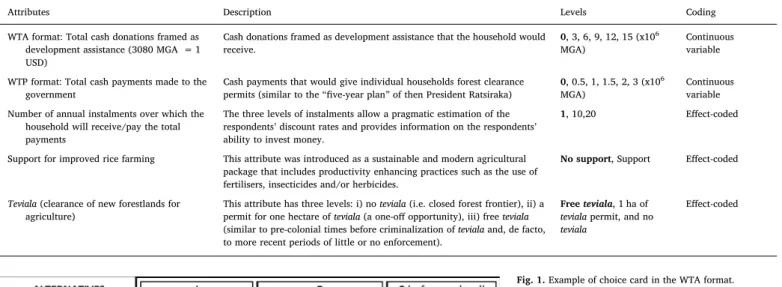
The WTA and WTP DCE surveys were both designed to measure ex-ante the welfare impacts of restricting forest clearance by examining the trade-offs local people would make between the right to clear for-ests for swidden agriculture, cash payment, and support for improved rice farming. The attributes and levels (Table 1) were informed by three focus group discussions and pilot testing of the design with 50 re-spondents in a park-adjacent community. The DCE questionnaires3 were administered by a team offive enumerators who all held at least a bachelor's degree. Although we aimed to use the same payment levels in both formats, extensive piloting showed that an acceptable level of trading offin each format necessitated that the payment levels in the WTP format are three times lower than those in the WTA format.4We
3Full DCE survey questionnaires are presented in sumplementary information. 4Bateman et al. (2002: 390)also recommend using different payment levels because
are not therefore able to directly compare the magnitude of the WTA and WTP, but we are able to compare the relative attractiveness of the DCE attributes between the two formats and identify the socio-demo-graphic and attitudinal variables driving respondents’choices.
For each format, we combined alternative levels of the attributes in choice tasks using an efficient design that seeks to minimize the stan-dard error of the coefficients to be estimated (Scarpa and Rose, 2008). The fractional factorial design was optimised for d-efficiency for the multinomial logit model using Ngene 1.1.1, and based on information on the signs of the parameters obtained from the piloting. The design generated 12 choice tasks that were divided into two blocks; each re-spondent was presented with six choice tasks. Rere-spondents were ran-domly assigned one of the two blocks in the experiment. The design with zero priors and adding the reference alternative had an ex-ante d-error of 0.04 and 0.07, and 0.003 and 0.002 when evaluated ex-post for the WTA and WTP format respectively.
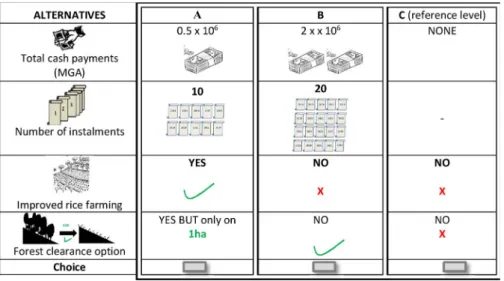
Each choice task was composed of three alternatives including the reference level alternative (seeFigs. 1, 2and Appendix C). DCE surveys usually include a status quo option (or do nothing or opt out). However, in our case the status quo (households’own current“levels”for each attribute) would vary enormously across respondents, and elucidating a status quo alternative would require respondents to reveal their current participation in (illegal) forest clearance. We therefore opted for a
counterfactual where protection is totally lifted for the WTA format and where protection is strictly enforced for the WTP format. Our study protocol was reviewed and approved by Bangor University's Ethics Review Committee.
2.4. Valuation scenarios
The background scenario of the WTA survey was presented to re-spondents as5:
“Please consider a major foreign donor who would like to provide you with some development assistance such as support for improved rice cultivation technique. Such support specifically targets rice cultivation on hills and aims to maintain soil fertility…Next consider that the donor gives you other options and lets you choose between an array of development assistance. For instance, the donor also offers to give you some cash that you can invest in any alternative income generating activities of your choice. Such cash payment would be managed by an independent external institution which will provide you with savings accounts…. Next, please consider that the government would make it possible for you to get a permit to clear forests on one hectare of forestland. This would be new addi-tional land, still very fertile on which you have a legal and en-forceable title, this would be similar to the five-year plan of Table 1
Attributes and levels of the DCE (reference levels in bold).
Attributes Description Levels Coding
WTA format: Total cash donations framed as development assistance (3080 MGA = 1 USD)
Cash donations framed as development assistance that the household would receive.
0, 3, 6, 9, 12, 15 (x106
MGA)
Continuous variable
WTP format: Total cash payments made to the government
Cash payments that would give individual households forest clearance permits (similar to the“five-year plan”of then President Ratsiraka)
0, 0.5, 1, 1.5, 2, 3 (x106
MGA)
Continuous variable Number of annual instalments over which the
household will receive/pay the total payments
The three levels of instalments allow a pragmatic estimation of the respondents’discount rates and provides information on the respondents’
ability to invest money.
1, 10,20 Effect-coded
Support for improved rice farming This attribute was introduced as a sustainable and modern agricultural package that includes productivity enhancing practices such as the use of fertilisers, insecticides and/or herbicides.
No support, Support Effect-coded
Teviala(clearance of new forestlands for agriculture)
This attribute has three levels: i) noteviala(i.e. closed forest frontier), ii) a permit for one hectare ofteviala(a one-offopportunity), iii) freeteviala
(similar to pre-colonial times before criminalization oftevialaand, de facto, to more recent periods of little or no enforcement).
Freeteviala, 1 ha of
tevialapermit, and no
teviala
Effect-coded
Fig. 1.Example of choice card in the WTA format.
(footnote continued)
President Ratsiraka's government (1975–1991) where teviala per-mits were formally granted to rural farmers. Please know that the forest clearance permit on one hectare is a one-offopportunity…
Next, please consider that the government would make it possible for you to get a permit to clear forests on an unlimited forestland (i.e. not limited to one hectare).
So if you were offered the choice below (Fig. 1), which one would you choose? i.e. which one would be the best option for your live-lihoods?”
Thus, in the WTA format, the reference level alternative is an open access scenario, whereas in the WTP format, it is a strict protection scenario. The WTP scenario was presented as follows:
“Please consider that you will be given the opportunity to invest in improved rice farming which specifically targets rice cultivation on hills and aims to maintain soil fertility…. Next, please consider that you would also be able to buy a permit to clear one hectare of forestlands. This would be like new additional land, still very fertile for which you have a legal title. This would be similar to the five-year plan of President Ratsiraka's government (1975–1991) where teviala permits were formally granted to rural farmers. Please know that the teviala permit on one hectare is a one-offopportunity. Note that you can pay only after harvest. But please we would like to kindly remind you to carefully consider whether you would be really able to afford the one you choose. Know that you would be paying the government through state agents, and the permit would be legal. Note that the Fokontany and independent stakeholders would also be involved to ensure transparency…. Next, please consider that the government would make it possible for you to buy a forest clearance permit on unlimited forestland (i.e. not limited to one hectare). So if you were offered the choice below (Fig. 2), which one would you choose? i.e. which one is the best option for your livelihoods?”
2.5. Data analysis
2.5.1. Treatment of debriefing statements
We conducted exploratory factor analyses on the six debriefing statements separately for the WTA and WTP samples. Factor analyses aimed to generate factor scores that represent the underlying constructs by condensing a large number of variables into a smaller set of latent variables or factors (Thompson, 2004). Results show that for both samples, thefirst four statements (trust in the payment vehicle, plau-sibility of the survey scenario, perceived consequentiality of the survey, perceived ability to negotiate compensations with the government)
loaded highly on the same factor. The one-dimensional factor solutions explained 44% and 42% of the total variance in the WTA and WTP samples respectively. These results are consistent with the first four statements measuring the same latent construct whereas perception of the benefits of forest protection and beliefs in the legitimacy of forest protection measure different constructs, relating more to the policy rather than the DCE survey. We therefore constructed an additive score for each respondent based on thefirst four statements related to the valuation scenarios, ranging from 4 to 20 (using thefive-point scales). The score had a high level of internal consistency, as determined by a Cronbach's alpha of 0.70 and 0.71 for the WTA and WTP samples re-spectively. A smaller score corresponds to more problematic percep-tions of the survey scenarios. We used this score together with attitudes towards the benefits of forest protection, and belief in the legitimacy of state's protection in the discrete choice models to explain preference heterogeneity.
2.5.2. Analysis of the DCE data
According to random utility theory, the utility of a choice is com-prised of a deterministic component (V) and a stochastic component(ε), which can be modelled to follow a predetermined distribution. The utility function of an individualifacing a choice between two experi-mentally created alternatives and a reference level alternative can be described as: = ⎡ ⎣ ⎢ ⎢ ⎢ + = + U V ASC X β ε n V X β ε
( , , ) if reference level alternative
, otherwiswe,
( , )
ni
ni k ni
ni k ni (1)
WhereUniis the utility function for individuali, for alternativen. Vis the observed indirect utility, which is a function ofXni, a vector of observable attributes and associatedfixed parametersβk. We specify an alternative specific constant (ASC) for the reference level. We effect coded all the categorical coefficient utilities to avoid inherent problems associated with using dummy coding when including a fixed com-parator in DCEs (Bech and Gyrd-Hansen, 2005). The sign and sig-nificance of ASC cannot be interpreted when variables are dummy coded as the ASC coefficient may be associated with the utility of the base levels instead of representing the utility of the ASC per se. For the effect coded variables, the magnitude of the omitted base level is equal to the negative sum of the utility weights for the other estimated ca-tegories (Louviere et al., 2000). We therefore added a column re-presenting the adjusted marginal utility gains from the base level for each of the effect-coded attributes inTables 2 and 4.
The random parameters logit (RPL) model or mixed logit model allows utility coefficients to be random variables to reflect unobserved
preference heterogeneity in a population. All parameters were assumed to be normally distributed across respondents. If there is statistically significant variation in preferences for a particular attribute, this shows up as a statistically significant parameter estimate for its standard de-viation (representing the spread of preferences around the average re-spondent). The model presenting the bestfit was selected as measured by improvements in McFadden's pseudo-R2 and Akaike Information Criterion (AIC).
While RPL models control for unobserved heterogeneity by as-suming that each individual in the sample has a different set of utility parameters, they require researchers to choose a particular parametric form for the distribution of parameters and may be better suited to assess individual level heterogeneity (Colombo et al., 2009). Latent class models (LCM) capture preference heterogeneity by identifying a grouping of individuals with homogenous preferences and readily allow inclusion of observed measures such as socio-economic characteristics or attitudinal scales to condition group membership and explain the source of heterogeneity (Boxall and Adamowicz, 2002). Investigating heterogeneity at the segment level would also be relevant to empirically test whether a typologyfits a given dataset.6We estimated a LCM for each format and found that a 2-class modelfitted the data from the two formats best according to AIC statistics and our judgement regarding the interpretability of the results. We used the additive score of per-ceptions of the survey (defined in3.1) and the two other attitudinal statements as covariates explaining class membership of the LCM (Table 3).7
Marginal WTP (MWTP) estimates were calculated as follows:
=
MWTP β
β i
price (2)
Where βiare the attribute coefficients andβpriceare the price coeffi -cients.
The standard errors and the 95% confidence intervals for these es-timates are obtained by using the Delta method (Hensher et al., 2005). 2.5.3. Analysis of the qualitative debriefing data
Each interview was professionally transcribed for the purpose of theoretical thematic analysis, which is explicitly analyst-driven. We therefore used a coding scheme intended to generate themes or general patterns that answer our research questions (Braun and Clarke, 2006). Codes and themes were constantly revised based on new insights from data analysis using Nvivo 10. We assigned each interviewee to one of the two segments identified for each format in the LCM analysis, based on the highest ex-post individual class membership probability (Table 4). The interviewees’ characteristics are summarised in Ap-pendix A.
3. Results
3.1. Sample characteristics
The two random samples differ significantly only with respect to self-reported literacy and ethnicity at the 10% significance level (Appendix B). The average official years of schooling (2–2.5 years) are, however, not significantly different between the two samples. In the WTA sample, Betsimisaraka, which is the indigenous and dominant ethnicity in the study site, account for 79% of the total whereas this share is 66% in the WTP sample. Due to the different distributions of ethnicity in the two samples, the ethnicity variable is included in our discrete choice models to separate the effect of valuation format from any ethnicity effect.
3.2. Difference in response patterns to the WTA and WTP formats We found that in both formats, the price coefficient had the ex-pected sign: higher payments would significantly increase and decrease respondents’utility in the WTA and WTP formats respectively (Table 2). We cannot compare the size of marginal WTA and WTP estimates be-cause of different payment levels in the two formats. In the WTA format respondents positively and significantly valued the rice project, yet in Table 2
Random parameters logit model (RPL) results. Mean effects show the effects on utility for discrete changes in each attribute for the average respondent away from the same baselines of no cash donation, no improved rice project, and closed forest frontier. Standard deviation parameters show the spread in preferences around this mean effect for each attribute and level change. All parameters are set as random with a normal distribution.
WTA WTP
Coefficient Standard error Adja Coefficient Standard error Adja
Random parameters
Total cash donations (WTA) or payments (WTP) 0.08*** 0.03 −1.78*** 0.31
Instalment = 10 years 0.68** 0.31 1.35 0.47 0.26 0.82
Instalment = 20 years 0.39 0.31 1.26 −0.10 0.27 0.26
Improved rice farming 0.87*** 0.16 1.74 0.09 0.17 0.19
Permit 1 ha 1.31*** 0.39 2.63 −0.36 0.33 −1.68
Open forest frontier 0.01 0.66 1.33 −0.95 0.56 −2.27
ASC (reference level alternative) −0.75* 0.36 −1.35*** 0.45 Standard deviation estimates
Stdev Total cash donations 0.10** 0.03 1.77*** 0.25
Stdev Instalment = 10 years 0.81 0.50 0.14 0.77
Stdev Instalment = 20 years 0.83* 0.43 0.22 0.74
Stdev Improved rice farming 0.71*** 0.18 0.22 0.74
StDev Permit 1 ha 1.33*** 0.44 0.47*** 0.14
Stdev open forest frontier 2.73*** 0.39 0.82** 0.42
Stdev ASC 1.83*** 0.38 1.67*** 0.45
Log-likelihood −446.07 −498.85
McFadden's pseudo R2 0.31 0.25
AIC/n 1.56 1.69
Nobs 612 (N = 102) 606 (N = 101)
6Recent advances in the modelling of choice experiment data and software packages
propose the use of random parameter latent class models to allow for an additional layer of unobserved taste heterogeneity within a latent class. However, such heavily para-meterised models have been criticised as being less robust and may introduce a poten-tially confounding effect (Hensher et al., 2013).
7While attitudinal data may be endogenous to the choice data and not a genuine
ex-pression of fundamental attitudes (Provencher and Moore 2006), including them in the model allows a pragmatic check of which attitudes are associated with differences in the patterns of responses to the WTA and WTP formats.
the WTP format respondents were indifferent to support for improved rice farming. WTA respondents strongly preferred to receive payments spread over ten years (compared to a lump sum and 20 years) whereas WTP respondents’ preferences for the instalment attributes did not suggest any significant patterns. WTA respondents preferred one hec-tare of forest clearance permit to a closed forest frontier whereas the WTP respondents appeared indifferent between one hectare teviala permit and a closed forest frontier scenario as well as between an open forest frontier and a closed forest frontier scenario. In the WTA sample, the ASC is negative and significant at 10% level indicating that households preferred a change compared with thefixed alternative of open forest frontier, ceteris paribus. The ASC representing the closed forest frontier with no payment and no support for improved rice farming is negative and highly significant in the WTP format, sug-gesting that moving away from the reference level of closed forest frontier scenario would increase the average households’utility com-pared to alternative scenarios. The standard deviations of the cash as well as forest clearance attributes (one hectare of permit and closed forest frontier) were highly significant in both formats, this implies that
there is significant heterogeneity in preferences for these attributes. 3.3. Validity of the two formats
3.3.1. Criterion 1: respondents’perceptions of the surveys
Respondents’ stated perceptions of the surveys are presented in Fig. 3. The two formats differed significantly only in the perceived plausibility of the survey scenarios and whether respondents viewed the survey outcomes as having real policy impact (Mann Whitney test, z-value =−6.57, p < 0.005 and z-value =−1.95, p = 0.061 respec-tively).8
Table 3
Covariates used in the latent class models.
Variables Description Summary statistics
WTA (N = 102) WTP (N = 101)
Food security Numeric variable indicating the number of months a household has sufficient food for two good meals per day.
Mean 5 6
Std. dev 5 6
Median 3 3
Ethnicity Binary variable indicating whether the household head isbetsimisaraka(the dominant and indigenous ethnic group in the study site) [0 = NO; 1 = YES]
YES 81 (79%) 67 (66%)
Perception score (from the factor analysis in4.1)
Additive score measuring perceptions of the survey scenario ranging from 4 to 20 (using thefive point scales) (A smaller score corresponds to more problematic perceptions.
Mean 13 11
Median 3 3
Median 13 12
Perceptions of the ecological benefits of forest protection
Binary variable indicating whether the household perceives any ecological benefits from forest protection [0 = NO; 1 = YES]
YES (missing) 63 (38%) 56 (55%)
7 4
Belief in the legitimacy of state's protection
Binary variable indicating whether the household believes that the state's protection is legitimate [0 = NO; 1 = YES]
YES (missing) 30 (29%) 23 (23%)
3 2
Table 4
Latent class models. Mean effects show the effects on utility for discrete changes in each attribute for the average respondent away from the same baselines inTable 2.
WTA WTP
Segment 1: Segment 2: Segment 1: Segment 2:
“Non-traders” “Traders” “Non-traders” “Traders”
Coef. s.e. Adja Coef. s.e. Adja Coef. s.e. Adja Coef. s.e. Adja
Total cash donations (WTA) or payments (WTP) −0.06 0.16 0.05** 0.02 −1.65*** 0.35 −0.72*** 0.17 Instalment = 10 years 1.27 1.68 4.41 0.14 0.20 0.38 −0.10 0.51 −1.03 0.42 0.26 1.41 Instalment = 20 years 1.85 1.61 4.99 0.10 0.19 0.34 −0.83 0.41 −1.76 0.55** 0.26 1.54 Improved rice farming 0.52 0.44 1.05 0.55*** 0.09 1.10 −0.40 0.27 −0.81 0.45** 0.18 0.91 Permit 1 ha 0.25 0.98 2.95 0.79*** 0.28 2.75 −1.50*** 0.48 −5.53 0.87** 0.43 3.11 Open forest frontier 2.45** 2.01 5.15 −0.39 0.46 1.96 −2.54*** 0.76 −6.56 1.37** 0.59 3.61 ASC (reference level alternative) 1.27 0.97 −1.03*** 0.35 −1.68*** 0.62 −0.65 0.40
Segment size (%) 14% 86% 53% 47%
Explanatory variables of class probability
Coef. s.e. Coef. s.e. Coef. s.e. Coef. s.e.
Constant 0.84 2.02 Fixed 3.66*** 1.39 Fixed
Food security −0.11 0.32 Fixed −0.22* 0.08 Fixed
Betsimisaraka 0.10 0.90 Fixed 1.05* 0.56 Fixed
Attitude scale −0.10* 0.09 Fixed −0.19* 0.08 Fixed
Perception of ecological services −1.47** 0.68 Fixed −0.18 0.55 Fixed Belief in the legitimacy of state's conservation policy −0.13 0.78 Fixed −2.02*** 0.68 Fixed
Log-likelihood −451.87 −491.93
McFadden's pseudo R2 0.33 0.26
AIC/n 1.53 1.68
Obs. 612 606
Note: ***, **, *→Significance at 1%, 5%, 10% level.
aAdjusted marginal utility gains from the base level situation for the effects-coded attributes.
8Mann-WhitneyUtests for the effect of socio-economic characteristics of the
house-holds found that only prior experience with World Bank social safeguard projects (de-signed to compensate for the negative impacts of the Ankeniheny-Zahamena REDD+ project - SeePoudyal et al., 2016) affect consequentiality beliefs: households who have received these projects have significantly higher belief in the consequentiality of the WTP survey (median Likert value = 4) than those who have not (median Likert value = 5) (z-value =−2.49, p = 0.013).
In the qualitative debriefings, a WTP non-trader expressed very low beliefs in the survey scenarios, particularly, the likelihood of a forest clearance permit, given what he perceived as a burgeoning interest among conservationists and the international community in forest protection.
3.3.2. Criterion 2: compatibility with respondents’beliefs about property rights and legitimacy of state conservation
For both formats, we labelled one of the two-latent classes “ non-traders”because the response patterns (utility parameters and covari-ates explaining class membership) and the qualitative debriefings in-dicate that these households did not trade offthe payments with sup-port for improved rice farming and/or forest clearance permits (Table 4). WTA non-traders (14%) significantly preferred an open forest frontier to strict protection but were indifferent to the payments while WTP non-traders (53%) were unwilling to pay for forest clearance permits; yet moving away from the closed forest frontier reference level
alternative (ASC) to alternative scenarios would significantly increase their utility (Table 4). WTA traders (86%) preferred secure rights to one hectare oftevialato a closed forest frontier. They also positively and highly valued the support for improved rice farming. Traders in the WTP sample (47%) stated positive willingness to pay for the improved rice project and for forest clearance permits (both on one hectare and unrestricted clearance). They also strongly favoured longer timeframe (20 years) to one lump sum payment. Conversely, WTP non-traders, appeared to be unwilling to trade-offthe payments with other attri-butes.
The acceptability of each format was measured by the rate of refusal to trade offdue to a lack of compatibility between the format and re-spondents’beliefs in the legitimacy of state's conservation policy. In both samples, membership of the non-trading class was associated with problematic perceptions of the survey. However, in the WTA sample, it was also driven by disbelief that forest protection would have positive impacts on their livelihoods (implying consideration of likely costs and Fig. 3.Diverging stacked bar charts of the follow-up attitudinal data.
benefits and a genuinely high WTA), whereas in the WTP sample, be-liefs that state forest protection was illegitimate were more important (implying protest responses), as well as low food security and Betsimisarakaethnicity.
The sign of the one-hectare permit and open forest frontier utility coefficients (negative and highly significant relative to the baseline of closed forest frontier) (Table 4) among the WTP non-traders seem to suggest a positive WTP for forest protection (or WTA compensations for weak or no protection enforcement). However, the qualitative evidence suggests that they are negatively affected by forest protection and their responses actually suggest a protest behaviour (i.e. rejection of the hypothetical scenario). These WTP non-traders experienced hardship from strict forest protection. Although they were not willing to pay for forest clearance permits, they claimed that the enforcement of strict forest protection, which would be materialised on the ground in the presence of armed law enforcement, would make their living much more precarious than the current enforcement levels. They also argued that they cared about forest protection but could not afford it. Non-traders in the WTA format shared similar rationales for their responses. Both WTP and WTA non-traders viewed forest clearance as a necessity amidst a declining standard of living and the ongoing influx of migrant smallholders.
However, WTA and WTP non-traders’accounts also differed in some areas. WTA non-traders (I2 and I69) claimed that the revenue they would get from clearing forests far outweighed the compensation levels (supporting the LCM evidence that these non-traders were considering costs and benefits, rather than protesting). They asserted that cash is fleeting andtevialais much more sustainable. Their accounts did not seem to allude to any objections to the survey scenarios, particularly trust in the cash donations or plausibility of the scenarios (though the LCM suggest this group are more likely to have problematic perceptions of these survey scenarios than WTA traders). Their preferences were instead anchored in the critical importance of new lands to their current households’livelihoods and their future descendants. However, they expressed a lack of ability to negotiate compensations with the gov-ernment.
We don’t really have the choice, do we? We’ve never had the choice, so whatever the government decides, we will have to go with it, even if the government gives as little as 600 Ariary [about US$ 0.2), we have no say, anyway, the government won’t listen to us locals hidden below the leaves.”(I2, WTA)
On the other hand, interviewees among the WTP non-traders (I14, I15, I16, I20) were strongly averse to paying for forest clearance rights, which they asserted as already theirs. They strongly objected to the state's protection and claimed that they must not pay for something they have been protecting for years from recent settlers. They appear determined to assert their rights over forestlands:
“The valuation exercise was very disturbing, because if I pay for something, that implies that I don’t own that thing yet, I cannot purchase what's already mine. Asking me to pay is so illegitimate because I have protected these forest patches and my efforts in-volved lots of sacrifice.”(I15, WTP)
3.3.3. Criterion 3: budget constraints
In addition to strong beliefs about their rights to forestlands, these WTP non-traders were also averse to paying for forest clearance that they saw as their subsistence livelihood. They claimed that asking local forest dwellers to pay fortevialais highly nonsensical and unrealistic because it ignores the very reasons for its practice (i.e. their poverty-stricken status). Instead of paying, they argued that they should be provided with some livelihood support. WTP non-traders also claimed
that the sale of forest clearance rights would likely favour those with higher purchasing power, mostly the non-Betsimisarakamigrants who have other non-agricultural sources of income.
However, only one WTP non-trader specifically mentioned that their ability to pay was constrained by their income and risks. They also asserted that if they had the means to pay for the improved rice farming, they would rather invest money in buying fallow lands or additional labour.
“You know that there are some good years and some bad years, so if ever we are unable to pay, the government will withdraw the permit and we will be left with nothing. Or could it be that the government will be more indulgent to such cases? I don’t think so, an agreement is an agreement….The support for the improved rice project is particularly very risky, we cannot simply risk starving for one whole year because we were too busy digging soils which will only yield meagre crops”. (I16, WTP).
WTA traders were very receptive to the support for improved rice project and stated that they would invest the cash mostly in the im-proved agricultural techniques. While WTP traders were also willing to pay for the rice project, they seemed to face considerable budget con-straints.
“Since forest clearance will be strongly prohibited, we will have to adapt. There is no other way round using fertilisers and using im-proved techniques but we could not afford the payments.” (I13, WTP).
Respondents’ average marginal WTP estimates (for the traders’
segment) for one hectare of forest clearance permit amount to 1.2 million MGA (∼389 USD10), and represent about 136 per cent of households’average income11in the region. Suchfigures confirm the subsistence-nature of swidden agricultural practices and the very low compatibility of the WTP format with low-income.
3.4. Respondents’perceptions of forest conservation policy
Over 70% of all respondents did not believe that state policy of protecting forests was legitimate. In the qualitative interviews, WTA and WTP traders strongly aspire to secure legal tenure over forestlands. Both groups stated that strict forest protection would result in severe hardship among local forest dwellers. They also expressed a strong aversion to state protection claiming that the state is unable to enforce protection and they are too vulnerable to the state representatives’ manipulation.
“I cannot imagine what would happen if this military protection becomes a reality. You surely know how gendarmes work, they will just impose whatever they want on us, and who are we to discuss or fight with them? They will always win, and they will restrict ev-erything, they won’t even allow us to takefirewood.”(I19, WTP)
“Thefirst thing that came to my mind was: will the state be able to protect these forests, with all its problems and its instability? You cannot rely on the state to do anything. Ever since I’ve lived here (25 years), our request to get a government-hired teacher has remained vain, our children cannot to go to school because parents cannot afford teachers’fees.”(I8, WTA)
Traders in both formats seem to care about forest protection and claimed that they want to“breed”their forests. Nonetheless, they as-pired to have the freedom to choose the forests’fate.
“If only people have legitimate rights to own forest patches and
9Interviewees’identification, see Appendix A.
103080 MGA = 1 USD.
11These income measures were computed for a randomly selected sub-sample of
protect them, life will be so much easier and conflicts with recent migrants will be reduced….But you can never predict what others think, I do intend to breed mine, but others may decide differently depending on their circumstances, as the saying goes: even if yams grow on the same valley and use the same nutrients, there will al-ways be ugly yams.”I10, WTA
However, while WTA traders (I1, I2-I5, I7-I11) only aspired to legal tenure on one hectare of forest clearance and feared a tragedy of the commons situation in an open access scenario, WTP traders were willing to secure rights not only for one hectare permit but also for an unrestricted access to forestlands; the act of paying for unlimited clearance rights made them assume that they would be able to exclude outsiders. A permit for one hectare would allow WTA respondents to exclude others and assert their rights over forestlands as opposed to customary ownership which are often disputed by recent settlers. WTP traders (I12-I13, I17-I19) were willing to pay for forest clearance per-mits to leave a legacy of natural forestlands with their future descen-dants. They however begrudged having to pay for these rights.
“There is simply no way that we agree to relinquish our rights to these forestlands, it is out of the question. But if we really have to pay for our descendants, then we will pay, although we strongly feel that we should not have to pay because we protected these forests.”
(I19, WTP)
4. Discussion
4.1. How do the patterns of responses differ between the WTA and WTP formats?
We found that response patterns differ between the WTA and WTP formats. The WTA respondents strongly favoured support for the im-proved rice project and secure tenure for one hectare of forestlands relative to no support and closed forest frontier respectively, whereas the WTP respondents expressed no significant preferences for either the improved rice farming ortevialapermits. Also, WTP respondents had surprisingly no preference for delaying payments whereas WTA re-spondents significantly preferred that the payments (cash donations) were spread over 10 years instead of a lump sum payment, due to a limited ability to invest cash for the future (Rakotonarivo, 2016). While the WTP and WTA formats have been shown to affect the size of welfare estimates (e.g.Bateman et al., 2009;Lanz et al., 2010), this study has provided evidence that the valuation format can also affect the response patterns, i.e. the relative importance of different attributes.
While we cannot rule out that the different response patterns ob-served between the WTP and WTP formats may be explained by severe budget constraints among the WTP respondents, the use of much lower payment levels in the WTP format could have lessened the disparity. Nonetheless, the disparity may remain because of respondents’strong disbeliefs in the legitimacy of state's protection (as suggested by both the quantitative and qualitative debriefings). We also made significant efforts when developing the valuation scenarios to ensure that the rates of refusals to trade-offbetween the two formats are not an artefact of respondents’ low incomes. We instructed respondents in the WTP format that they could pay after harvest time (in cash or in baskets of rice) if they run short of cash. We also used WTP bids that are at least three times smaller than the WTA bids.
4.2. Which format is best for estimating the welfare impacts of conservation?
This study also aimed to assess the performance of the WTA and WTP formats in our study context on three criteria of validity: re-spondents’perceptions of the survey itself; whether respondents were unwilling to trade offdifferent attributes due to moral beliefs; and the
effect of budget constraints. We found that the WTA format out-performed the WTP format on all three criteria. The WTA format eli-cited fewer problematic perceptions than the WTP. Only 15% of the total WTA sample did notfind it plausible that a donor genuinely in-terested in development would donate cash whereas 50% of the WTP sample strongly disbelieved that the state would be selling forest clearance permits (Fig. 1). Similarly, 73% in the WTA sample viewed the survey outcomes as having real policy impact against 60% of the WTP sample.
The WTP format resulted in higher rates of refusals to trade-off forest clearance permits with payments (53% against 14% in the WTA format) and this did not seem to be explicable simply by the payment levels: respondents’disagreement with the legitimacy of forest protec-tion was highly significant in explaining refusals to trade-offin the WTP survey (Table 4) but not in the WTA survey. This is corroborated by the qualitative debriefings which suggest that some respondents con-siderably begrudged paying for forest clearance, because such pay-ments would ignore their rights and past efforts to conserve the forest. Finally, the qualitative debriefings support the argument that the WTP format is problematic in our study context because respondents’ ability to pay is severely constrained. Forest protection results in large negative welfare impacts;tevialaprovides barely enough for subsistence living and its substitutability with money is critically low. The quali-tativefindings suggest that although respondents highly value forest conversion to agricultural lands,tevialamay not produce much surplus, but has a high labour efficiency which cannot be easily monetised, that is, it produces agricultural crops with minimal drudgery compared to improved agricultural techniques (Pollini, 2009; Scales, 2014). Swidden agriculture has also many advantages that are not easily substitutable by other alternatives (such as irrigated paddy fields) (Pollini, 2009; Scales, 2014). In effect, swidden agriculture allows households to minimize climatic risks (e.g.flooding or cyclones) asso-ciated with lowland agriculture while paddyfields require significant inputs of labour or capital (Pollini, 2012). Given the very slow rate of technological change (agricultural intensification), it is likely that swidden agricultural practices will remain widespread in the coming years as long as convertible forestlands are available.
Most stated preference surveys ask respondents their willingness to pay for a policy change, these are appropriate when respondents do not perceive any property rights over the good being valued, or when the value of the policy is likely to be small relative to their income (Freeman, 2003). However, our results suggest that even where de jure forest ownership rests with the government, suggesting that WTP should be estimated (Mitchell and Carson, 1989), respondents may hold strong protest beliefs that conflict with the WTP format and researchers should thus also consider estimating WTA. In the literature, other ar-guments against the use of the WTA format include the possibility of strategic behaviour and extremely high WTA estimates that are incon-sistent with neoclassical preferences (e.g. The NOAA panel–seeArrow et al., 1993). However, the qualitative debriefings do not suggest any evidence of strategic considerations. Our study therefore suggests that the WTA format may outperform the WTP format in a rural developing country context, which emphasises the importance of at least con-sidering both formats. While ourfindings hinge on three criteria that we have defined a priori, other criteria could have also been considered. Kim et al. (2015b)further suggest that where the WTA-WTP disparity genuinely reflects respondents’ underlying preferences, the choice of the correct welfare measure should be based on the likely explanations for the WTA-WTP disparity (e.g. bounded rationality or value learning). 4.3. What are respondents’attitudes to conservation restrictions and property rights over forestlands?
Finally, this study aimed to investigate respondents’ attitudes to conservation restrictions and property rights over forestlands. 73% objected to state protection, arguing that they have been protecting
forests by restricting, if not completely stopping, forest clearance. Most WTA traders (86% of the total sample) shared the WTP traders’ stron-gest aspiration, which is to secure their customary rights over forest-lands. Since strict protection has only been recently enforced in the Ankeniheny-Zahamena corridor and forest clearance used to be the legitimate way to claim new resources and territory (Muttenzer, 2006), the strong loss aversion exhibited by the WTA and WTP traders towards forestlands ownerships may not be unexpected. These results do not support other scholars’interpretations that the WTA and WTP formats both accentuate feelings of loss aversion, but in different dimensions (Bateman et al., 2002). That is, that by explicitly asking respondents to think in terms of paying money, WTP prompts loss aversion behaviour in the dimension of money whereas WTA prompts thoughts related to loss aversion in the dimension of the good being valued. We found that both WTA and WTP traders are loss averse with regard to the same dimension, the good being valued, i.e. their rights to forestlands. The WTP households’responses primarily reflected their beliefs about the legitimacy of the state's conservation policy.
The results indicate that the current model of coercive conservation (that is, REDD+ building upon protected area regimes in which clearing is strictly prohibited and forestlands are state-owned assets) combined with the provision of compensations for the costs of restric-tions may not be viable. Since REDD+ is involuntary for most local people, coercive conservation lacks procedural legitimacy and may not achieve full compensation, since estimating the opportunity costs of stopping de jure illegal activities is difficult, and compensations may be poorly targeted or delivered. If local people perceive the state's pro-tection policy as illegitimate or unjust, they may resist conservation actions and engage in environmentally harmful behaviours ( Milner-Gulland and Rowcliffe, 2007) or they may incur losses (such as the cultural values associated withteviala) that would not be mitigated by most common compensatory schemes (Rakotonarivo et al., 2017). Analyses of the REDD+ safeguard processes in the study site further showed that compensations were vulnerable to elite capture and failed to reach the most vulnerable or those who are most affected by the restrictions (Poudyal et al., 2016). Without a secure legal tenure, af-fected people were reluctant to self-identify as engaged in illegal nat-ural resource use because of fear of sanctions and consequently missed out on compensations that were aimed at offsetting the economic dis-placement generated by the REDD+ project.
An explicit recognition of customary rights may be more effective at slowing down deforestation than the current coercive conservation model embedded in REDD+ policy, especially given poor governance in many developing countries (e.g.Moyo et al., 2016). This could be achieved by establishing secure forestland tenure and enabling owners to exclude migrants and outsiders. Our study highlights the importance of locally legitimate property rights arrangements in REDD+ im-plementation or other market-based instruments (Lockie, 2013;Dokken et al., 2014;Sunderlin et al., 2014). As local communities may wish to continue some forest clearance (Godoy et al., 2000), conservation may then be negotiated with them, similar to the conservation contracts and agri-environment agreements used in many industrialised countries (e.g. Adams and Moon, 2013). When property rights are explicit and locally perceived as legitimate, contract negotiations would provide room for local people to claim incentives (cash or in-kind) for con-servation efforts. The voluntary and renewable nature of these agree-ments would help ensure that opportunity costs borne by some of the world's poorest people are fully compensated.
5. Conclusions
The patterns of responses to the WTA and WTP formats significantly differ. The WTA format is more suitable in our study context because it was perceived to be more plausible and consequential, it minimises the rates of refusal to trade offbecause of ethical beliefs, and it is not biased by severe budget constraints. Most respondents strongly aspired to
secure tenure and argued that they have better capabilities to protect forests than the government. Respondents in both WTA and WTP for-mats were very reluctant to relinquish their rights over forestlands and more than 70% of respondents in both formats perceived the state's conservation policy as illegitimate. Researchers using DCE in similar contexts should not simply use de jure property rights to determine which format to use. The choice of format may substantially affect welfare estimates, which attributes are significant, the level of proble-matic perceptions of the survey and willingness to trade offin the survey. An inappropriate valuation format may seriously compromise efforts to determine appropriate compensation levels for coercive con-servation.
Conservationists and REDD+ proponents should reconsider coer-cive models of conservation (even with compensation) where these align very poorly with local people's beliefs about customary rights. Otherwise, the current conservation model (REDD+ building upon protected area regimes in which clearing is strictly prohibited and forestlands are state-owned assets) would risk harming local welfare, and undermining a very significant driver of conservation: local people with secure property rights to the forest. Local people's inability to prevent migrants clearing the forest, due to their lack of formal tenure, as well as the difficulty of estimating the opportunity costs of pre-venting de jure illegal natural resource use and the resulting problem with delivering fair and legitimate compensations, all strengthen the case for an explicit recognition of customary rights. Such recognition might be achieved by the devolution of secure forestland tenure to local people accompanied by voluntary conservation contracts negotiated directly with forest owners.
Conflict of interest None.
Acknowledgements
Funding for this project was provided by the European Commission through the forest-for-nature-and-society (FONASO) joint doctoral programme, and the Ecosystem Services for Poverty Alleviation (ESPA) programme (p4ges project: NE/K010220/1). The ESPA programme is funded by the Department for International Development (DFID), the Economic and Social Research Council (ESRC) and the Natural Environment Research Council (NERC). Jette Bredahl Jacobsen thanks the Danish National Research Foundation for support through the Center for Macroecology, Evolution and Climate. We also thank Rina Mandimbiniaina, Nilsen Andrianantenaina and Domoina T. Rafanomezantsoa for their assistance with data collection, and the re-sidents of Ampahitra for their hospitality and participation. Research permission was granted by the Malagasy Ministry of Environment, Ecology, Sea and Forests (45/14/MEF/SG/DGP/DCB.SAP/SCBref). Appendices and supplementary data
Supplementary data associated with this article can be found, in the online version, at http://dx.doi.org/10.1016/j.landusepol.2017.09. 051.
References
Adams, V.M., Moon, K., 2013. Security and equity of conservation covenants: contra-dictions of private protected area policies in Australia. Land Use Policy 30 (1), 114–119.http://dx.doi.org/10.1016/j.landusepol.2012.03.009.
Antona, M., Bienabe, E.M., Salles, J.M., Pechard, G., Aubert, S., Ratsimbarison, R., 2004. Rights transfers in Madagascar biodiversity policies: achievements and significance. Environ. Dev. Econ. 9 (06), 825–847.http://dx.doi.org/10.1017/
S1355770X04001640.
Arrow, K., Solow, R., Portney, P.R., Leamer, E.E., Radner, R., Schuman, H., 1993. Report of the NOAA Panel on Contingent Valuation. (Washington).