This item was submitted to Loughborough’s Institutional Repository (https://dspace.lboro.ac.uk/) by the author and is made available under the
following Creative Commons Licence conditions.
For the full text of this licence, please go to: http://creativecommons.org/licenses/by-nc-nd/2.5/
Textual Data Mining Applications
for Industrial Knowledge
Management Solutions
By
Nadeem Ur-Rahman
A Doctoral Thesis
Submitted in partial fulfilment of the requirements for the award of
Doctor of Philosophy of Loughborough University
June 2010
Abstract
In recent years knowledge has become an important resource to enhance the business and many activities are required to manage these knowledge resources well and help companies to remain competitive within industrial environments. The data available in most industrial setups is complex in nature and multiple different data formats may be generated to track the progress of different projects either related to developing new products or providing better services to the customers. Knowledge Discovery from different databases requires considerable efforts and energies and data mining techniques serve the purpose through handling structured data formats. If however the data is semi-structured or unstructured the combined efforts of data and text mining technologies may be needed to bring fruitful results. This thesis focuses on issues related to discovery of knowledge from semi-structured or unstructured data formats through the applications of textual data mining techniques to automate the classification of textual information into two different categories or classes which can then be used to help manage the knowledge available in multiple data formats.
Applications of different data mining techniques to discover valuable information and knowledge from manufacturing or construction industries have been explored as part of a literature review. The application of text mining techniques to handle semi-structured or unsemi-structured data has been discussed in detail. A novel integration of different data and text mining tools has been proposed in the form of a framework in which knowledge discovery and its refinement processes are performed through the application of Clustering and Apriori Association Rule of Mining algorithms. Finally the hypothesis of acquiring better classification accuracies has been detailed through the application of the methodology on case study data available in the form of Post Project Reviews (PPRs) reports. The process of discovering useful knowledge, its interpretation and utilisation has been automated to classify the textual data into two classes.
Keywords:
Knowledge Discovery, Knowledge Management, Data Mining, Text Mining, Clustering, MKTPKS Termset Mining, Decision Trees, K-nearest Neighbouring (K-NN), Naïve Bayes, Support Vector Machines (SVMs), Post Project Reviews (PPRs)
Dedication
TO MY PARENTS
Who always stand with me and endeavoured to support me in attainment of ultimate goal of life
AND FAMILY
Who loved and cared me to collect sweet memories and had enjoyable moments in life
Acknowledgements
First of all thanks to Allah Almighty Who helped me to finish this thesis.
I thank to Dr. Jenny Harding whose generosity, kindness, patience, continuous support and professional guidance helped me to complete Ph.D. studies. I might not be able to find a personality like her as a supervisor who is fully touched with feelings, cooperative in work, constructive in thoughts and logical in her approach towards research. I really enjoyed working with Dr. Jenny Harding and hope that this would not be an end of relationship and cooperation but a beginning of new relationship where research work will be harnessed by her valuable suggestions and guidance in future.
I want to thank my parents and all my family members whose love provided me strength to stand against any hardship and helped me to attain my objective. I am also thankful to my wife who always stood beside me in every hour of need. I would also like to share the great moments of happiness that I had ever enjoyed as being a father of baby girl during writing up my thesis.
I am also thankful to Wolfson School of Mechanical and Manufacturing Engineering, Loughborough University, UK for giving me an opportunity as a Ph.D. student and provided financial support for pursuing research studies.
I would also like to pay special thank to Muhammad Shahbaz for his moral support and feel that there might be a few such friends in life.
I am also thankful to all my friends and colleagues specially George Guninderan, B.P. Das, Srinivas, A.K. Choudhary, Rahul Swarnkar, Natesh Khilwani and Claire Palmer for making lab a place where we can share our feelings, research ideas and have friendly environment.
I also thank to the industrial collaborators for providing case study data to perform experimental work during this research studies.
Glossary of Terms
AI Artificial Intelligence
ANN Artificial Neural Networks
APN Automated Perceptions Network
AR-rules Attribute Relationship Rules
BN Bayesian Network
CAD Computer Aided Design
CAM Computer Aided Manufacturing
CMM Coordinate Measuring Machine
CNC Computer Numerical Controlled
CRISP-DM Cross-Industry Standard Process for Data Mining
DM Data Mining
Document Set of textual data or information available in the form of case study data
DTE Decision Tree Expert
EBC Environment-Based Constraints
EDA Exploratory Data Analysis
EDM Evidential Data Mining
ELT Extraction-Transformation-Load
FTS Frequent Termset Sequences
GBOM Generic Bill of Material
HG-Trees Hierarchical Generalization Trees
HTML Hypertext Markup Language
IMS Intelligent Manufacturing Systems
IR Information Retrieval
IT Information Technology
KDD Knowledge Discovery from Databases
KDT Knowledge Discovery from Textual Data
KM Knowledge Management
K-NN K-Nearest Neighbouring
KREFS Knowledge Refinement System,
LS-SVM Least Square Support Vector Machines
MKTPKS Multiple Key Term Phrasal Knowledge Sequences
ML Machine Learning
NLP Natural Language Processing
NNs Neural Networks
OLAP Online Analytical Processing
PDD Product Design and Development
PDM Product Data Management
PLM Product Lifecycle Management
PPRs Post Project Reviews
SGML Standardized Markup Langauge
SVMs Support Vector Machines
TDM Textual Data Mining
TM Text Mining
VSM Vector Space Model
Table of Contents Abstract ... 1 Dedication ... 2 Acknowledgements ... 3 Glossary of Terms ... 4 Chapter 1 Introduction... 10
1.1 Research Context and Introduction ... 10
1.2 Thesis Structure ... 12
1.2.1 Background, Context and Scope of the Research ... 12
1.2.2 Concept Realization and Methodological Development ... 12
1.2.3 Implementation and Analysis ... 13
1.2.4 Conclusions and Future Work ... 13
Chapter 2 Research Scope... 15
2.1 Introduction ... 15
2.2 Research Issues ... 15
2.2.1 Research Background & Motivations ... 15
2.2.2 Gap Analysis and Research Scope ... 17
2.2.2.1 Data Mining ... 19
2.2.2.2 Text Mining... 19
2.3 Aims and Objectives of Research ... 20
2.4 Research Overview ... 20
2.4.1 Research Approach ... 21
2.5 Summary of the Chapter and Conclusion ... 21
Chapter 3 Literature Review ... 22
3.1 Introduction ... 22
3.2 Business Intelligence in Manufacturing... 22
3.3 Knowledge and Information Needs for Next Generation Intelligent Manufacturing Systems ... 24
3.3.1 Intelligent Systems and Learning Capabilities in Manufacturing ... 27
3.4 Knowledge and Information Management Methods ... 30
3.4.1 Knowledge Based Systems ... 31
3.4.2 Agent Based Systems ... 31
3.4.3 CAD/CAM and (PDM) Systems ... 32
3.4.4 Product Lifecycle Management (PLM) Systems ... 33
3.4.5 Web-based Systems ... 33
3.5 Need for Data Mining Techniques and Intelligent Decision Making in Manufacturing ... 34
3.5.1 Rules Extraction and Updating domain Knowledge ... 35
3.5.2 Decision Trees Analysis ... 38
3.5.3 Clustering Techniques ... 39
3.5.4 Association Rule Analysis ... 39
3.5.5 Support Vector Machines (SVMs) ... 40
3.5.6 Hybridized Approaches for Analysis ... 41
3.6 Information Retrieval (IR) for Textual Data Handling ... 41
3.6.1 Data Mining to Support IR Based Solutions ... 43
3.7.1 Manufacturing Product/ Service Quality Improvement ... 44
3.7.2 Business Process Improvement through Customer Knowledge Management ... 48
3.8 Summary of the Chapter and Conclusions ... 48
Chapter 4 Textual Data Mining (TDM ) for Knowledge Management (KM): A Conceptual Development of Methodology ... 50
4.1 Introduction ... 50
4.2 Text Mining Needs ... 50
4.3 Data and Text Mining For Discovering Knowledge... 53
4.3.1 Cross- Industry Standard Process for Data Mining (CRISP-DM) ... 54
4.3.1.1 Understanding and Defining the Business Problem ... 54
4.3.1.2 Understanding Data or Information ... 54
4.3.1.3 Preparing Data for Analysis ... 55
4.3.1.4 Modelling... 55
4.3.1.5 Model Evaluation ... 55
4.3.1.6 Model Deployment ... 55
4.3.2 Text Mining Process ... 56
4.3.2.1 Text preparation ... 56
4.3.2.2 Text processing ... 56
4.3.2.3 Text analysis ... 56
4.3.3 Text Mining and Core Technologies for Information Processing ... 57
4.3.3.1 Information Retrieval ... 58
4.3.3.2 Computational Linguistics... 59
4.3.3.3 Pattern Recognition ... 59
4.4 Text Mining Role for Advancement of KM and BI Solutions ... 60
4.4.1 Applications of Text Mining in Real Domains ... 63
4.4.2 Manufacturing Knowledge Management ... 65
4.5 Summary of the Chapter and Conclusion ... 66
Chapter 5 Knowledge Discovery Functions and Implementation Issues ... 68
5.1 Introduction ... 68
5.2 Expected Benefits Associated with Term Based Analysis ... 68
5.3 Clustering and Apriori Association Rule of Mining Techniques ... 69
5.3.1 K-means Clustering Algorithm ... 69
5.3.2 Apriori Algorithm for MKTPKS Generation ... 72
5.3.2.1 Background ... 72
5.3.2.2 Apriori Algorithm ... 73
5.4 Potential Strengths and Limitations of Clustering and Apriori Association Rule of Mining Techniques ... 78
5.4.1 Clustering ... 78
5.4.1.1 Strengths ... 78
5.4.1.2 Limitations/ Weaknesses ... 79
5.4.2 Apriori Association Rule of Mining ... 80
5.4.2.1 Strengths ... 80
5.4.2.2 Limitations ... 80
5.5 Structural Data Representation Methods ... 81
5.6 Summary of the Chapter and Conclusion ... 82
Chapter 6 Proposed Methodology and Architecture ... 83
6.1 Introduction ... 83
6.2 Proposed Architecture or Framework ... 83
6.3.1 Information Pre-processing Unit ... 86
6.3.2 Information Structuring Unit ... 87
6.4 Knowledge Generation and Classification Module ... 87
6.4.1 Level Knowledge Processing and Storing Unit ... 88
6.4.1.1 Term Based Information Selection ... 88
6.4.1.2 Clustering Techniques Application ... 88
6.4.1.3 Documents Indexing ... 89
6.4.1.4 Relational Database Formation ... 89
6.4.2 Level Knowledge Refinement Unit ... 89
6.4.3 Level Knowledge Utilisation and Text Classification Unit ... 90
6.4.3.1 Categorised Set of Documents: Good or Bad Information Documents ... 91
6.5 Summary of the Chapter and Conclusion ... 91
Chapter 7 Knowledge Mining in Post Project Reviews (PPRs): Case Study Part 1 ... 92
7.1 Introduction ... 92
7.2 Benefits Associated with Framework ... 92
7.3 Implementation of Different Functionalities of Methodology... 92
7.3.1 PPRs for Business Intelligence and Information Description ... 93
7.3.2 Implementation of Text Mining Module on PPRs ... 96
7.3.3 Implementation of 96 Level Knowledge Processing and Storing Unit on PPRs ... 7.3.4 Level Knowledge Refinement Unit ... 101
7.3.5 Evaluation of the Proposed Systems ... 104
7.4 Results and Discussion ... 105
7.5 Novelty in the Research Work ... 106
7.6 Summary of the Chapter and Conclusion ... 107
Chapter8 Text Classification Methods Implementation and Performance Measure: Case Study Part II ... 108
8.1 Introduction ... 108
8.2 Text Classification ... 108
8.2.1 Background Knowledge ... 108
8.2.2 Problem Description and Objective of Research... 109
8.3 Textual Data Mining for Information processing and Knowledge Discovery 110 8.4 Text Classification Methods ... 110
8.4.1 Decision Trees (C4.5) Algorithm ... 111
8.4.2 K-NN Algorithm ... 113
8.4.3 Naive Bayes Algorithm ... 115
8.4.4 Support Vector Machines (SVMs) ... 116
8.4.4.1 Benefits Associated with SVMs Applications... 117
8.4.4.2 Constructing SVM ... 118
8.4.4.3 Kernel Induced Feature Space ... 120
8.4.5 Illustrative Example for Information Handling ... 122
8.4.5.1 Decision Tree (C4.5) ... 123
8.4.5.2 K-Nearest Neighbouring Algorithm ... 124
8.4.5.3 Naïve Bayes Algorithm ... 125
8.4.5.4 Support Vector Machines (SVMs) ... 127
8.5 PPR Data for Classification ... 127
8.5.1 PPRs as Defining Good and Bad Information Documents ... 127
8.5.2 MKTPKS Based Matrix Model For PPRs Classification ... 128
8.6.1 Text Mining Module Application ... 130
8.6.2 Knowledge Generation and Classification Module ... 130
8.6.3 Classification Results and Accuracies of Models ... 133
8.6.4 Evaluation Measure and Comparison ... 139
8.7 Novelty of the Work and Discussion ... 141
8.8 Summary of the Chapter and Conclusion ... 142
Chapter 9 Semantic Analysis Methods for Text Classification ... 143
9.1 Introduction ... 143
9.2 LSA Models for Text Classification and Effectiveness ... 143
9.2.1 Defining Knowledgeable Relationships through Matrix Models ... 145
9.2.2 Classification Methods, Accuracies and Comparative Analysis ... 147
9.3 Summary of the Chapter and Conclusion ... 151
Chapter 10 Conclusions and Future Work ... 152
10.1 Conclusion ... 152
10.2 Future Work ... 154
10.2.1 Next Generation Knowledge Based Product or Service Quality Improvement System ... 154
10.3 Summary of the Chapter and Conclusion ... 157
Chapter 1
Introduction
1.1 Research Context and Introduction
In recent years Knowledge Management (KM) has become an important contributor to the success of enterprises. Increasing product complexity, globalization, virtual organizations and customer oriented demand require a more thorough and systematic management of knowledge both within individual enterprises and between several cooperating enterprises. Information Technology (IT) supported KM solutions are often built around an organizational memory that integrates informal, semi-formal and formal knowledge to facilitate the access, sharing and reuse of knowledge by members of the organization(s) to solve their individual or collective tasks. In such a context, knowledge has to be modelled, appropriately structured and interlinked to support flexible integration and its personalized presentation to the customer.
In this era of information technology a vast amount of data is collected, stored and reused to improve the product or service quality and for customer needs identification within industrial setups. Manual handling of such a large amount of data is expensive in terms of time and money spent, and it is particularly costly and difficult to fully exploit information that is available in different or mixed data formats (i.e. structured, semi-structured or unstructured).
Machine Learning (ML) and advanced Artificial Intelligence (AI) tools are gaining more importance in this data rich and information poor world of knowledge. Different data analysis tools are available to provide both online and off the shelf solutions to the problems associated with handling large amounts of data and information which is available in different data formats. These tools are used to discover useful information through exploiting relationships between different attributes of data and help to discover patterns which can ultimately be transformed into a source of knowledge. The most recent use of these tools can be categorized as forms of Data Mining technologies. The technological efforts available under this heading have potential to uncover useful patterns in data and discover valuable knowledge in any industrial setups (as seen in Chapter 3) but use of these technological efforts is still in its infancy. To handle multiple different formats (i.e. semi-structured or un-structured
data) existing tools may need to be combined with other technological efforts i.e. Text Mining (TM) which might be quite useful in discovering valuable information and converting it into a form of knowledge to help in providing knowledge based solutions.
(Nonaka and Takeuchi 1995) proposed that knowledge creation was achieved by the interaction of tacit and explicit knowledge which further helped to generate organizational knowledge. (Ler 1999) pointed out that knowledge management involves collecting information and transferring it to the demanders. These activities include knowledge obtaining (or creation), knowledge refinement, knowledge storing and knowledge sharing. Therefore knowledge management has become a major manufacturing tool and pre-requisite for success in production environments and competitive advantages can be obtained by taking into consideration and carefully selecting and applying appropriate knowledge management techniques.
This research will therefore consider the path defined by (Ler 1999) to manage knowledge but will approach this by using Data and Text Mining techniques. The aim of this research will be to examine how knowledge may be more accurately identified and classified automatically from textual reports, so that more reliable knowledge will available to be automatically identified, refined and transferred to the demanders as required by (Ler 1999).
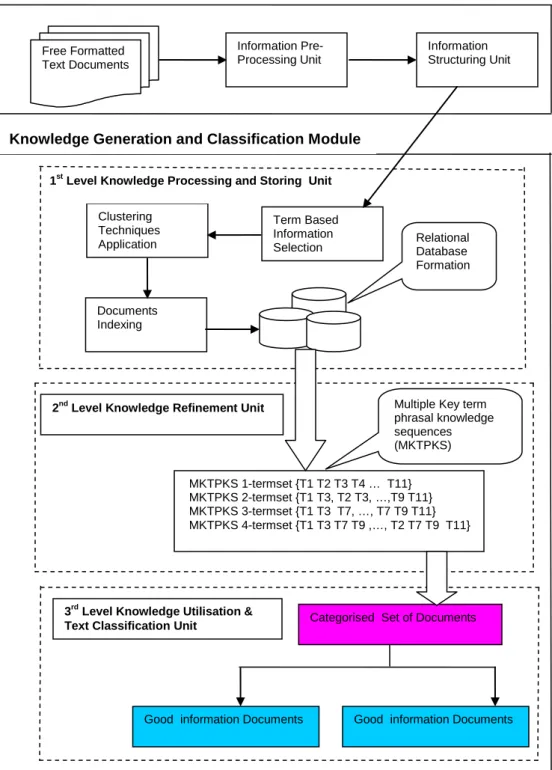
Different Data Mining tools including Clustering, Association Rules, Decision Trees, K-NN, Naïve Bayes, Support Vector Machines (SVMs) and Text Mining tools in particular based on Information Retrieval (IR) techniques for data structuring have been considered and well investigated for handling textual databases. Both individual and hybrid approaches have been used to harness Knowledge Discovery and Management Solutions for which a conceptual background is provided by the theoretical development of the methodology detailed in Chapter 4. Different knowledge discovery functions (i.e. Clustering and Frequent Termset Mining Methods) are discussed in Chapter 5 while an architecture has been detailed in Chapter 6 based on the hybridized efforts of both Data and Text Mining technologies.
The proposed methodology in Chapter 6 has been applied and tested on the semi-structured textual data available in the form of Post Project Reviews (PPRs) reports from real construction industry environments. The results, in the form of discovered knowledge, have been compared with the results of domain experts (detailed in Chapter 7) in the form of multiple key term phrases identified by the system. The limitations in terms of classifying textual data through unsupervised Clustering and Apriori Association Rule of Mining techniques have been addressed and consequently knowledge of how to apply these tools and methods have been advanced by this research. This advancement is done through use of Supervised methods of classifying textual data into two categories or classes (as discussed and implemented in Chapter 8 & Chapter 9).
1.2 Thesis Structure
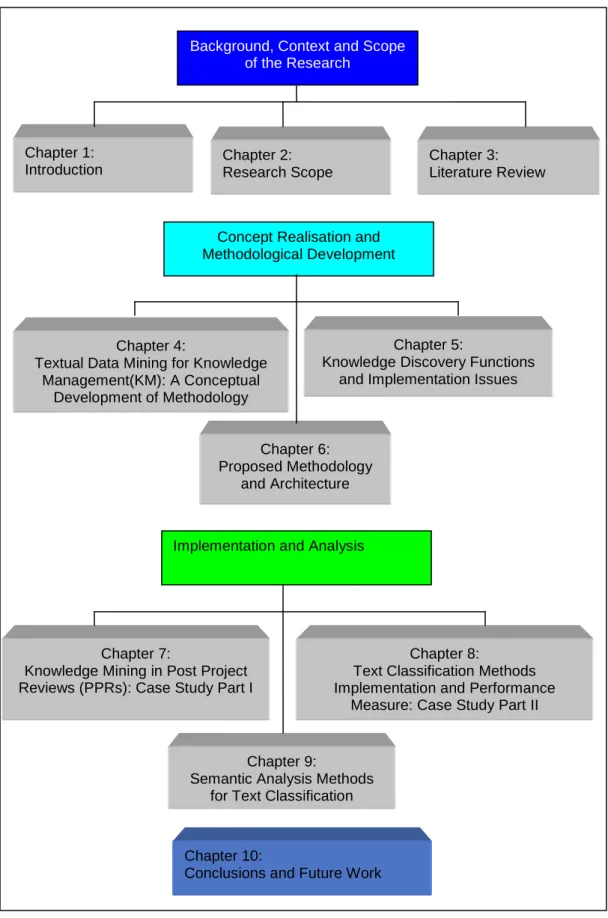
The overall thesis has been divided into four sections, detailed in the following paragraphs and shown in figure 1.1.
1.2.1 Background, Context and Scope of the Research
This section consists of three chapters. Chapter 1 discusses the introductory material containing research context and main aim of the research. Chapter 2 discusses the research problem, scope and issues. The aim and objectives of the research and research approach adopted are also detailed in this chapter. In Chapter 3 the literature is reviewed to form the basis of knowledge discovery process from multiple data formats through applications of different data mining techniques. The knowledge and information needs for intelligent decision making are also discussed in this chapter. It also provides support to identify the gap in terms of applications of different data mining techniques to exploit knowledge resources in new industrial and business setups.
1.2.2 Concept Realization and Methodological Development
This section is composed of three Chapters where Chapter 4 is focused on defining conceptual relationships among different parts of knowledge discovery and management technologies i.e. Data Mining, Text Mining and Business Intelligence to
develop a framework which is detailed in Chapter 6. Chapter 5 discusses knowledge discovery functions and their implementation issues to help in discovery of useful information in terms of finding term based relationships by forming Multiple Key Term Phrasal Knowledge Sequences (MKTPKS).
1.2.3 Implementation and Analysis
This section further consists of three chapters. Chapter 7 discusses the implementation of different functions required within the methodology for finding the knowledge relationships among different terms in the textual data available in the form of Post Project Reviews (PPRs). Chapter 8 discusses the text classification methods and their implementation on the PPRs data to classify it into two different categories of Good or Bad information documents. The accuracy of different classifiers is tested on the experimental data and better classification accuracies are reported by adopting the proposed methodology. Chapter 9 discusses the semantic analysis methods based on Information Retrieval (IR) techniques to classify the PPRs data into two different classes. The main hypothesis investigated in this research is that better classification accuracies will be achieved using the proposed methodology.
1.2.4 Conclusions and Future Work
This section contains chapter 10 which discusses the results obtained and their reliability and mentions some of the research limitations which could not be explored during this research. The further improvements to the proposed system are also discussed and future dimensions for improving the product or service quality based on the proposed methodology are also articulated at the end.
Figure 1.1: Overview of thesis structure Chapter 1: Introduction Chapter 3: Literature Review Chapter 4:
Textual Data Mining for Knowledge Management(KM): A Conceptual
Development of Methodology
Chapter 5:
Knowledge Discovery Functions and Implementation Issues
Chapter 6: Proposed Methodology
and Architecture
Chapter 7:
Knowledge Mining in Post Project Reviews (PPRs): Case Study Part I
Chapter 8:
Text Classification Methods Implementation and Performance
Measure: Case Study Part II
Chapter 9:
Semantic Analysis Methods for Text Classification
Chapter 10:
Conclusions and Future Work
Background, Context and Scope of the Research
Concept Realisation and Methodological Development
Implementation and Analysis Chapter 2:
Chapter 2
Research Scope
2.1 Introduction
This chapter provides the research background and explains the research problem scope and issues. It also details the aims and objectives of the research and briefly explains the adopted research approach.
2.2 Research Issues
The research reported in this thesis examines ways of discovering useful knowledge through the classification of textual data into one of two categories of document i.e. good or bad information classes. The system proposed is based on Hybrid Applications of Data and Text Mining Techniques to provide knowledge discovery and management solutions for industrial or business environments. The term
“document” used in this research work refers to the set of information available in the
form of textual data under different headings (i.e. time, cost, planning) in Post Project Reviews (PPRs).
2.2.1 Research Background & Motivations
Knowledge discovery and knowledge management solutions can provide great benefits and better services in many industrial contexts and these will be discussed further in Chapter 3. Business Intelligence Systems may be used to help to uncover useful information and convert it into a form of knowledge by utilising Data and Text Mining techniques. There is a wide range of these techniques available which can be used independently or in combinations with other tools, to discover valid, novel, potentially useful and ultimately understandable knowledge. These techniques will be discussed further in Chapter 3 and Chapter 4.
In current industrial business setups a large amount of information is transferred through the use of internet technologies. Most of this data is available in the form of online documents, customer feedback etc. which is used to update information about a product or service to help to improve quality and competitive performance. These data types include:
• Structured data files, information stored in database management systems or specific applications, such as data warehousing, enterprise resource planning, cost estimating, scheduling, payroll, finance and accounting packages;
• Semi-structured data files such as Hypertext Markup Language (HTML), Extensible Markup Language (XML), or Standardized Markup Langauge (SGML) files;
• Unstructured text data files, such as product catalogues, quality reports, internal documents, memos, Failure Mode and Effect analysis (FMEA) documents, contracts, specifications, catalogues, change orders , requests for information, field reports and meeting minutes;
• Unstructured graphic files stored in a binary format such as 2D and 3D drawings; and finally
• Unstructured multimedia files such as pictures, audio and video files.
These textual sources of information are read and understood by people but manual handling is very slow, tedious and prone to errors. Therefore automatic text classification or text categorization methods can be used to overcome these difficulties. The handling of these sources of information can provide benefits in various ways to engineers (Kasravi 2004) i.e.
• Improving the engineering processes through having access to the information and downstream analysis,
• Patent analysis, handling product warranty claims and quality issues of the product,
• Failure mode and effect analysis (FMEA) and finally
• gaining the competitive assessments by reviewing the product announcements information available in the form of web pages which are almost impossible to handle manually
In addition to the above some other specific advantages related to the manufacturing industry can be obtained by;
• Improving manufacturing product design (Dong and Agogino 1997) ,
• Analyzing customer service database for machine fault diagnosis (Fong and Hui 2001)
• In automotive industry mapping auto problems to some diagnostic categories such as engine, transmission, electrical, brakes etc. (Huang and Murphey 2006)
• Integrating supply chain into total process, capturing and re-using best practices and specifying key characteristics at early stages of product development. These are identified as needs for next generation product development (Rezyat 2000)
In the construction industry automated text classification methods can provide benefits in organizing and finding the desired information from project documents according to the project components (Cladas and Soibelman 2003). This information can further be used to extract new and interesting information like accessing facility condition assessments provided at different campuses (Ng et al. 2006). There are other areas of research which also benefit from data analysis techniques like DNA sequence analysis, pattern discovery, image recognition and speech recognition.
The above discussion shows the benefits that can be achieved through textual data analysis methods. Therefore analyzing this information provides new sources of information and knowledge to the knowledge workers and an enterprise can thereby gain some competitive advantages.
2.2.2 Gap Analysis and Research Scope
Data mining techniques have been used to discover knowledge from manufacturing or construction data to support decision makers to improve product design, integrate shop floor activities and manage the customer knowledge. However the literature reviewed in Chapter 3 and in (Harding et al. 2006) showed that these techniques are mainly used to exploit information hidden in the numerical or more structured forms of data whilst there are fewer reported applications in handling the semi-structured or unstructured data types. Key points which have motivated this research and determined the scope of the studies are as follow:-
1. Data Mining techniques are mainly used to discover knowledge from structured databases. Hence there may be opportunities to apply knowledge discovery techniques on semi-structured or unstructured databases.
2. The applications of Data Mining techniques for knowledge discovery processes are mostly by using individual tools which help to identify relationships among different attributes defined in the data but are limited in their ability to discover useful knowledge in an understandable pattern.
3. The hybrid applications of data mining techniques appear to have potential to handle data and information, but currently there are less reported applications of these approaches.
4. Discovering knowledge from semi-structured or unstructured databases requires some additional efforts but they have potential to help to uncover useful patterns of information and knowledge in textual data formats. Data mining techniques can be used on their own to find potentially useful knowledge but handling semi-structured or unstructured data requires additional efforts, possibly by applying Information Retrieval (IR) and Natural Language Processing (NLP) techniques.
5. The combined efforts of Data and Text Mining technologies could be used to manage multiple data and information resources and enhance knowledge management activities. The combined efforts of data and text mining techniques can be fruitful as shown in Chapter 3 and Chapter 4.
6. The rapid growth of information in electronic and digital formats in globally distributed industrial environments could capture useful information about customers needs. The identification of these needs and classification of information available in the form of free formatted textual data into two different classes (i.e. good or bad information) might help in retaining the customers to the industry. But little attention has been paid to this area of information and knowledge research.
7. Domain experts play an effective role in the process of discovering useful knowledge through applications of data mining techniques where the data mining expert and domain expert sometimes work interactively. However if the knowledge discovery process can be automated fully this would help to reduce the effort required by the knowledge workers in terms of time and money spent.
Therefore the scope of this research takes into account the above points related to Data and Text Mining techniques to manage the data and information sources for knowledge discovery and knowledge management purposes.
2.2.2.1 Data Mining
Data mining techniques have influenced various sectors of life ranging from finances to life sciences but these techniques have only been used for exploiting manufacturing data for discovery of useful knowledge in the last decade or two. Handling these data and information sources usually requires additional knowledge to be provided by domain experts. An overview of a range of data mining techniques is given in Chapter 3 and an introduction to new techniques or hybridized methods which gave useful results has been undertaken within this research. The reported tools such as clustering and association rules analysis have been tested in manufacturing related data analysis, so the implementation of these tools has been tested along with their scope for discovering useful knowledge by exploiting term based relationships and the refinement of this process has also been considered. Finally, some supervised classification techniques are used to classify data into two classes in terms of good or bad information documents .
2.2.2.2 Text Mining
Text mining techniques are examined in Chapter 4 and it is clear that to discover knowledge from semi-structured or unstructured text data requires some additional efforts which have been used from the area of Information Retrieval (IR).These methods are mainly based on term frequency, term frequency inverse document frequency, and binary representation methods. These methods provide solutions to structure data and make it ready for the application of different data mining techniques and also help to overcome the difficulty of losing key information in the textual databases. Classifying textual data into two classes is highly dependant on the choice of these structuring techniques where different data mining algorithms use various functions to measure the degree of closeness of one document from another i.e. to classify as either good or bad information documents in the current research context.
2.3 Aims and Objectives of Research
The main aim of this research was defined in Section 1.1 and it will be achieved by satisfying the following objectives:-
1. Understanding different applications of DM/ TM techniques which have been well reported in the literature, and testing them on the exemplary data relevant to the current research context.
2. Establish which current applications provide potentially useful knowledge in this context to establish a datum for comparison with new or hybridized applications of different data mining techniques.
3. Identify new or less commonly used DM / TM techniques in handling the real industrial data and test their reliability in managing the information and knowledge resources.
4. Determine a framework and methodology to analyse textual data and transfer identified knowledge to demanders as required. Thus further shifting the paradigm from knowledge discovery to knowledge management.
2.4 Research Overview
The proposed framework should be able to accommodate semi-structured or unstructured text data. The architecture proposed is entirely based on knowledge management methods defined by (Ler 1999) , but will utilize the combined efforts of data and text mining techniques. The efforts made under the cover of these technological efforts of data and text mining should play an effective role in integrating the KM activities by identifying valid, novel, potentially useful and ultimately understandable patterns in the data. The purpose of these combined efforts will therefore be to provide valuable understanding of the new ways of automatically identifying knowledge in textual reports. The research is based on the hypothesis that knowledge management methods and in particular knowledge generation methods have strong impact on the effective use and exploitation of valuable knowledge assets in many industrial contexts. The second hypothesis is that knowledge generation can be done effectively through the combined use of Data and Text Mining Techniques. The generated knowledge may require refinement and this will be achieved by the use of better predictive and classification techniques. These techniques will utilise either
single data mining techniques or a hybridization of several techniques available under the heading of textual data mining technologies.
2.4.1 Research Approach
The research approach used in the thesis is divided into two stages i.e. the conceptual development stage and the experimental stage to verify the research hypothesis. Conceptual development of the methodology is based on the knowledge discovery and management methods detailed in Section 4.3 which provide strength to handle textual databases. The detailed process of discovering knowledge from semi-structured or unsemi-structured databases is followed by using the path defined within this section. Thus the following activities have been carried out to develop the theoretical grounds for developing methodologies:
• Identification of different Data and Text Mining techniques used in industrial environments.
• Examination of different tools for discovering useful knowledge from semi-structured or unsemi-structured databases, defined in the Data Mining and Text Mining technologies.
• Revisiting of Data structuring methods used for discovering useful information available in the form of textual data.
The second phase consists of developing an architecture and testing different functions defined in the integrated framework to improve the knowledge discovery, its refinement and then utilizing the knowledge for categorizing of textual data into two different categories (i.e. as good or bad information documents within this research context). The data used was from Post Project Reviews (PPRs) taken from the construction industry.
2.5 Summary of the Chapter and Conclusion
In this chapter the research background and its scope has been discussed in detail where the focus was on two major area of knowledge discovery and management i.e. Data Mining and Text Mining technologies. The aim and objective of research are detailed as an outcome of the research gap found through detailed survey of the literature relevant to the data mining techniques applications in manufacturing and construction domains.
Chapter 3
Literature Review
3.1 Introduction
The purpose of this chapter is to provide a context for this research by giving an overview of the importance of knowledge in modern business environments, and a discussion on the types of knowledge and knowledge management needs for manufacturing companies. As the focus of this research is on Textual Data Mining (TDM) solutions to these challenges, a review has been carried out of the literature about the different DM techniques and their applications in Manufacturing or Construction Environments. It will serve the purpose of identifying the capabilities of these techniques to handle large amounts of information available in different databases and to discover valuable knowledge to support the activities carried out in manufacturing or construction industrial environments. This chapter will further explore the possible applications of data mining to analyse structured or semi-structured databases to manage the knowledge resources to improve the product or service quality within industrial environments.
Section 3.2 discusses the importance of business intelligence solutions in manufacturing. One of the roles of data mining techniques is to provide support in finding the optimal solutions to the existing problems. This is done through discovering useful knowledge in terms of rules which can be stored in knowledge bases. Knowledge can then be further updated through various applications of intelligent data analysis tools. Therefore knowledge and information needs for intelligent manufacturing systems and methods to handle these knowledge resources are discussed in sections 3.3 and 3.4. The role of data mining techniques for providing intelligent solutions is explored in section 3.5. The role of Information retrieval (IR) for handling textual data and data mining to support these activities are considered in sections 3.6. Finally section 3.7 reports textual data mining solutions in manufacturing business improvement environments.
3.2 Business Intelligence in Manufacturing
To survive in competitive business environments, lower cost, higher quality and rapid response are the important issues mentioned by most enterprises. The improvement of
manufacturing processes and controlling the product variables highly influence product quality. The manufacturing system needs to be robust to perform operational activities and should be designed to improve the product or operational process in such a manner that the company can attain the desired target with minimum variations (Peace 1993).
Business Intelligence (BI) can , therefore, bridge the gap between different parts of information and knowledge stored in databases and also can be viewed as an important tool for e-business (Grigori et al. 2001). Since the focus of BI and Enterprise Resource Planning (ERP) are to control the operation and execute activities in an organisation their main purpose is to deal with enterprise analysis and discovery of knowledge for decision making to help enterprise managers (Powell 2000; Reimer et al. 2000; Brezocnik et al. 2003). In any competitive business environment companies have to rely heavily on both design and process automation technologies and use professional manufacturing knowledge to enhance their intelligence solutions. But if these technologies and professional competencies are used together to advance product design and production capabilities then product development time can be shortened and the quality and competitive capabilities can be enhanced (Tong and Hsieh 2000; Hsieh and Tong 2001; Hsieh et al. 2005).
Business Intelligence can be interpreted as a term for decision support and is sometimes referred to as Enterprise Business Intelligence (EBI). Business Intelligence tools can be categorised into three different categories on the basis of producing answers to questions “what”, “where” and “why” i.e. what is required, where it is needed and why it is needed. The answers to the first two of these questions can be provided by utilising Data Warehouse and On-line Analytical Processing (OLAP) tools which apply different queries to the databases. But the third question i.e. “why” all this is happening and how this could be addressed is more difficult to answer. This leads to the use of different tools to answer “why” this is happening on the basis of existing data, and these tools include forecasting, Classification, Statistical Analysis, Data Mining and Text Mining techniques. These tools can be used to provide feedback information to support important decision making in any business environment. With the inception of knowledge centred product and service quality
improvement solutions, most enterprises have to pay particular attention to the issue of knowledge management to fully exploit their valuable knowledge resources.
3.3 Knowledge and Information Needs for Next Generation Intelligent Manufacturing Systems
Throughout modern history, the global concept of Manufacturing Systems has been closely related with the principles and findings of science, philosophy, and arts. The manufacturing concepts can be seen as reflecting those principles, criteria, and values which are generally accepted by society and considered as the most important. For example, scientific facts mainly exposed the concepts of exchangeability, determinism, rationality, exactness, and causality in the , , and the first half of the century. That period of history can be considered as an era when the society was predominated by the concept of production. The inception of information technology and its advancement in the second half of the century assured the formal conditions necessary for the expansion of various organizational forms. The second half of the century can thus be regarded as an era when organizational aspects were prevailing (Brezocnik et al. 2003).
Today the service life of products is reducing, the number of product versions is increasing and the time for product conception to their manufacture is reducing. The novelties are being introduced in many areas at a greater speed and changes in one area have a strong interdisciplinary character and often affect other areas which seem to be independent at first glance. Although there is a great advancement in the field of science and technology, the global purpose of human activities and subsequently the requirement for manufacturing concepts needs to be well defined in future. This is essential because human creativity and the manufacture of goods are obviously the basic needs of human beings. The central question is not only the rational manufacture of goods but defining the global meaning and purpose of goods will also be important.
The deterministic approaches are being used in particular for synchronization of material, energy, and information flows in present manufacturing systems and methods based on exact mathematical findings and the rules of logic are used in
practice for modelling, optimization, and functioning of systems. Since production is a very dynamic process where many unexpected events often occur and cause new requirements, conventional methods are insufficient for exact description of a system. Mathematical models are often derived by making simplifying assumptions and consequently may not be in accordance with the functioning of the real system. To develop new products or meet the needs of service oriented industrial environments, the systems based on Mathematical modelling are not suitable and flexible enough to respond efficiently to the requirements. In recent years the paradigm has shifted in other areas of science and technology where Intelligent Manufacturing Systems (IMS) have been introduced which are capable of learning and responding efficiently. Machine learning as an area of Artificial Intelligence (AI) has gained much importance in the last one and half decades as successful intelligent systems have been conceived by the methods of Machine Learning (ML) (Gen and Cheng 1997; Mitchell 1997; Brezocnik et al. 2002).
In this era of information technology, the information technology has great impact on every aspect of society and also influences the traditional manufacturing systems. Due to increased competition in the global market, companies have to respond to the needs of their customers by making the best use of their core technological competencies. Manufacturing companies are driven by a knowledge based economy where the acquisition, management and utilization of knowledge give them a leading edge. Use of both internal and external sources of information is of great importance while manufacturing a product. At the stage of a new product design eight different types of information needs have been defined in (Zahay et al. 2003). This information extends across both internal and external sources and includes the following points;
• Strategic • Financial • Project management • Customer • Customer needs • Technical • Competitor
• Regulatory
There are many knowledge management problems related to the integration and reuse of different knowledge sources as they are often generated and stored in different ways. Strategic information is taken in by the governing board or from the corporate business unit. Financial information is usually imported from the finance department. Project Management information is generated and controlled to a very large extent by the design teams. Customer information and customer needs have been defined separately in (Zahay et al. 2003). The customer information may be stored as a database about the potential customers while customer needs are separately identified as the needs, desires and preferences of customers. Technical information is available in various forms and sources such as Product Data Management (PDM) and Product Lifecycle Management (PLM) systems and external patent databases, to be used by design teams for product innovation, creation and trouble shooting. Finally the information collected from competitors and government regulatory agencies are also crucial since new products must be compatible with the newly issued government regulations and should either be superior to what competitors can offer or be distinct in some way in the market. For the purpose of utilisation of these information sources they are further categorised into two main categories i.e. internal and external sources (Liu et al. 2006).
From a technical perspective the internal information is divided into two major parts in which the internal portion refers to the technical experience and knowledge generated through a firm’s endeavours in Product Design and Development (PDD). This experience and knowledge should be owned and stored within the company and be accessible company-wide. The external source refers to the synthesis of broad information and knowledge out of the company, such as patent information managed by the government agency, breakthroughs and nascent technologies incubated at the public research institutes, customer information and needs investigated by marketing firms, competitors’ latest product developments and government’s recent law enforcements relevant to the company’s products. These sets of information and knowledge exist both as numeric data and textual documents and potentially these sources can hold useful but hidden or implicit knowledge about the organisation
operation or products and therefore they need to be used to discover patterns in terms of rules.
In a typical industrial supply chain, the information passes through many companies before reaching the final user of the product. Processing of this information manually requires a lot of efforts and causes errors (Toyryla 1999), and therefore printed information has commonly been replaced by digital data transfer as 70% of companies convey product information to their clientele, digitally. Many companies in the supply chain may not need the information for their own activities but they still have to be able both to receive and transmit the information to all their partners. To operate effectively, all companies have to be able to communicate with each other. If one of the companies in the supply chain is unable to receive and transmit the information then the information flow is interrupted. The product information that is sent and stored at various downstream companies is difficult to keep up-to-date. The producer of new information may not know what parties to inform about updates and thus companies with outdated information risk making decisions based on wrong information (Karkkainen et al. 2003), and transmission of product information may cause overflow of information at the downstream level of a supply chain (Beulens et al. 1999). It is therefore an established fact and has been widely accepted that the future of manufacturing organisations is information theoretic and knowledge driven. This information can be exploited to improve manufacturing operations and build global manufacturing environments (Rahman et al. 1999).
3.3.1 Intelligent Systems and Learning Capabilities in Manufacturing
Manufacturing systems are complex with many variables involved and there are complex hierarchical problems associated with these systems. Due to the large range of problems associated with each of these systems the synchronization of different material, energy and information flows becomes difficult. The learning capabilities of current intelligent systems can be divided into three groups where their learning is based on conventional knowledge bases, learning through interaction with the environment in which they exist and also from other environments as well.
• Learning through Knowledge Bases
A large number of applications of the intelligent systems are based on the knowledge bases which have capabilities to maintain information and knowledge in the form of rules (i.e. if-then rules, decision trees etc). If information about different scenarios is stored in these systems, it can provide a basis for taking any suitable action in many unexpected circumstances. These systems perform their functions based on the environmental properties and transform them into relevant actions in accordance with the instructions in the knowledge base. However if new situations occur which have not been previously defined in the system then these systems fail to respond intelligently (Brezocnik et al. 2003).
An example of an inference of rule in the knowledge base is given in (Kusiak 1990). Consider a semantic network space partially representing the concept of machine shown in figure 3.1 where application of inference rule helps to prove or disprove the conclusions or goals. Using the inference rule method of Modus Ponendo Ponens or modus ponens rule (i.e. A=> B, A ├ B stated as If A is TRUE Then B is TRUE, A is TRUE Therefore B is TRUE) it is possible to infer the new fact “L-001 has a motor” from the fact “L-001 is a machine” and the rule “If X is a machine, THEN X has a motor.”
Figure 3.1: Simple Semantic network partially representing the concept of a machine[adapted from (Kusiak 1990)]
• Learning with Interactions with Environment
The systems which learn through interactions with their environment are able to induce new knowledge on the basis of learning examples (Brezocnik et al. 2003). These environments may be static or dynamic. Their main characteristic is to show intelligent behaviour while working in a narrow space of the static business environment, with a large number of optimization parameters which are unpredictable and therefore cause difficulties in learning to these intelligent systems. These systems are meant to solve problems where the interpolation barriers cause an explosion of combinatorial factors. It therefore brings the need that the learning capabilities, in terms of knowledge upgradation, should be done within these systems to work in any static or dynamic manufacturing environment. The examples of such systems are software systems, assembly systems, manufacturing systems and information systems. For example dynamic scheduling in a flexible manufacturing environment a scheme was proposed in (Lee et al. 1997) which uses the decision tree C4.5 at first stage to select the best rule to control the input flow of jobs to the system. Then a genetic algorithm was used at second level to select the most appropriate dispatching rules for each of the system’s machines.
Machine Lathe Motor Turret L-002 L-003 Drilling machine Spindle is_a is_a is_a is_a has_a has_a has_a
• Learning through Interactions with the Internal Environment and External Environments
These systems not only learn through interactions with the environment in which they exist but also learn through interactions with other environments and can develop methods and techniques to deal with or handle the hardest problems (Brezocnik et al. 2003). This type of intelligent system works in any environment and interacts with other environments working like living organisms. These systems are therefore expected to behave like human beings and overcome the hardest problems of dialectic barriers. Such systems exist only in human beings where the complex hierarchical structures exist. For example living cells are associated with more complex structures of tissues which are then associated with organs and these organs are related with individuals which ultimately forms communities of most different shapes. The example of such an intelligent system for self organising assembly of parts into final products is presented in (Brezocnik 2001). The simulation of a self organising assembly of shaft is introduced in this research which imitates a general principle of evolution of organisms from basic to higher level of hierarchical units. Under the influence of a production environment and genetic contents of basic components, the basic parts of a shaft grow into a final shaft.
3.4 Knowledge and Information Management Methods
Knowledge is a valuable resource in a company’s business and is sometimes said to pass through the different phases of the ‘data-information-knowledge’ sequence. This can be defined as “a framework of different experiences, values, contextual information and experts insight that provides a framework for evaluating and incorporating new experiences and information” (Davenport and Prusak 1998). Knowledge can be divided mainly into two parts i.e. explicit and tacit knowledge (Polanyi 1967; Nonaka and Takeuchi 1995) where the explicit knowledge can be codified and stored in computer based systems while the tacit knowledge is hidden in a person’s mind and is difficult to codify, hard to formalise and communicate. In an organisational point of view the knowledge can be defined as a set of routines, processes, products, rules and culture that enable actions to be taken in any industrial environment (Beckman 1999). Nowadays, the focus of researchers is to consider the
emergent nature of knowledge processes (Markus et al. 2002). Three major schools of thought are at work in the Knowledge Management (KM) communities i.e. technocratic, commercial and behavioural (Earl 2001). Technocratic schools believe that it is possible to capture specialist knowledge and codify it so that the knowledge base can help to make it transferable and reusable. This school of thought can see the advantages that can be gained from the fast growing capabilities of information technology. The greatest flaw of this approach is that it implies that knowledge is static and hence discards the possibilities of embedding the knowledge gained through practice. Commercial schools of thought believe that KM is an economical perspective i.e. knowledge as an asset. The focus of the behavioural schools of thought is on the socialising aspects of knowledge and enhancing its productivity through exchanges within a social network of motivated people. Information Technology (IT) can play an effective role in the knowledge management capabilities of an organisation through the use of groupware and knowledge representation tools (Earl 2001).
3.4.1 Knowledge Based Systems
Knowledge based systems are defined to have four components i.e. a knowledge base, an inference engine, a knowledge engineering tool, and a specific user interface (Dhaliwal and Benbasat 1996). These are also supposed to include all those organizational information technology applications that may prove helpful for managing the knowledge assets of an organization such as Expert Systems, rule-based systems, groupware, and database management systems (Laudon and Laudon 2002).
3.4.2 Agent Based Systems
In agent based approaches, the challenging task of making information available about all the aspects of the product without having risk of overflow at the downstream level is controlled by using software agents. The use of these agents makes it possible to answer the challenges involved in information management systems. Agent technology was a big paradigm shift in computer programming during the 1980s, in which the old procedural programming paradigm changed and shifted into an object oriented paradigm. The main reason lying behind this shift was because it is easier to
manage data and functionality of a program by dividing it into objects. By having a reference of an object one can access information about the object through methods declared in the object’s public interface while hiding the object’s implementation. Object oriented programming has therefore become a dominant paradigm in software engineering. A number of characteristics available under the cover of object oriented programming can be used to create agent based product information management systems. In distributed intelligent manufacturing systems agents are used to represent the manufacturing resources such as workers, cells, machines, tools, products, parts and operations which are used to facilitate the manufacturing resource planning, scheduling and execution control (Shen and Norrie 1999).
3.4.3 CAD/CAM and (PDM) Systems
The product information that is created and required throughout the product lifecycle can be captured through the use of Computer Aided Design and Manufacturing (CAD/CAM) and Product Data Management (PDM) systems (Ameri and Dutta 2005). CAD systems emerged in the early 1980s and enabled designers to create geometric models of the product more easily than on paper. These digital models can easily be manipulated and reused. The Initial Graphic Exchange Specification (IGES) was designed as a neutral format to exchange CAD data and used as a standard for geometric information transfer by many CAD/ CAM systems. It does not however fulfil the complete requirements of representing product data (Bloor and Owen 1991). But due to limitations of these systems the inception of product data management systems appeared in 1980s (Dutta and Wolowicz 2005). A PDM system provides a framework that enables manufacturers to manage and control engineering information, specifically, data surrounding new product designs and engineering processes (Gascoigne 1995). PDM systems provide quick and secure access to data created during product design. The early PDM systems manage information about geometric models, bill of materials and finite element analysis and can provide any required engineering knowledge. However these systems have limitations as they do not support information and knowledge related to sales, marketing and supply chain and other external entities that play an important role like customers and suppliers. With the advent of the Internet, Web-based PDM Systems have became more accessible to suppliers and other parties outside of the enterprise. But still these
systems are confined to engineering information without considering other aspects of the product’s lifecycle (Ameri and Dutta 2005).
3.4.4 Product Lifecycle Management (PLM) Systems
PLM systems are generally defined as “a strategic business approach for the effective management and use of corporate intellectual capital” (Amann 2002). Product Lifecycle Management (PLM) appeared late in the 1990s with the aim of moving beyond mere engineering aspects of an enterprise. The aim of these systems was to manage information beyond the engineering domain in an enterprise by managing information throughout the stages of a product lifecycle such as design, manufacturing, marketing, sales and after-sales service (Ameri and Dutta 2004). Thus PLM systems can provide a number of benefits in terms of delivering more innovative products and services, shorter time-to-market and comprehensive and collaborative relationships among customers, suppliers, and business partners (Amann 2002; Ameri and Dutta 2004; Dutta and Wolowicz 2005). Several vendors are in the market like SAP, IBM, Dassault Systems and UGS which offer PLM solutions but still no comprehensive PLM system exists today as the application of these systems is still five years behind the state of the art solutions (Abramovici and Siege 2002) available.
In an extended enterprise the components of the product are fabricated by external suppliers with close relationships to the company designing the product. However, this means that the manufacturing knowledge no longer lives within the walls of the company therefore when a new product is conceptualized the manufacturing knowledge cannot be used easily to address issues such as manufacturability and cost during design (Rezyat 2000). There is a need to integrate the supply chain, its subsidiaries and affiliated partners with the lifecycle of a particular family of products while PLM systems are still limited to product design (Abramovici and Siege 2002).
3.4.5 Web-based Systems
Internet and extranet have facilitated the proliferation of information all over the world enabling some or all enterprise activities to be moved into virtual spaces. The success of an enterprise environment is based on successful or effective exchange of information. The heterogeneity of information resources poses some challenges to the
enterprise and proper knowledge is needed to handle appropriate information processes. There are two types of data or information which an enterprise needs to manage i.e. business data which includes accounting and personnel data etc. and product data e.g. CAD and CAM data. An integrated web based system using Java solution and CORBA-ORG broking technologies for design and manufacturing has been proposed in (Cheng et al. 2001 ).
The previous sections give details of methods and techniques that are prevalent in manufacturing industrial environments for using and managing valuable knowledge. The focus of this research is to look into methods that can be used as a source of generating or discovering knowledge from different databases or other file sources and transmitting it through the use of an IT infrastructure. This type of managing knowledge is related to the technocratic school of thought.
3.5 Need for Data Mining Techniques and Intelligent Decision Making in Manufacturing
One of the concepts for identifying useful knowledge from the codified information is Data Mining which can be defined as “the process of discovering interesting knowledge from large amounts of data stored either in databases, data warehouses or other information repositories.” (Han and Kamber 2001). The word interestingness is important to interpret in this definition as it refers to the fact that rules or patterns or relationships existed in databases, but not in a form that was easily understandable to human beings. The extraction of rules and making these rules interpretable is always a focus of the data mining process which goes through different stages in an interactive sequence of data cleaning, data integration, data selection, data transformation and knowledge representation (Han and Kamber 2001).
Current applications of data mining in Manufacturing generally explore large volume databases to discover valuable information and transform this into a valuable source of knowledge or patterns. Data Mining has been applied in various domains and has been used to explore knowledge sources ranging from finance to life sciences. Data Mining has been less commonly applied in manufacturing than in other domains and the reason for this may be because of the required effort in terms of time and expertise
from both Data Miner experts and Domain Experts (Shahbaz et al. 2006). Further reasons are explored in (Wang 2007) as follow:
• Researchers are lacking knowledge of how to apply data mining techniques in manufacturing
• The complex manufacturing processes are not understandable for theoretical based researchers in the field of Data Mining Application
• Manufacturing data are less accessible due to propriety and sensitivity issues to the data mining researchers
• The difficulty of evaluating the benefits of results during applications of Data Mining techniques in Manufacturing
Therefore, the value of using these techniques has not been fully ascertained in manufacturing environments but applications which have been made so far have provided better “Knowledge Management” solutions in various aspects of manufacturing. A detailed survey of applications of data mining techniques in manufacturing has been done in (Harding et al. 2006) . Therefore the term data mining tool which is used to extract useful knowledge from data can be taken as a tool of Business Intelligence. The applications of combined efforts of Data Mining, Business Intelligence and Knowledge Management (KM) can change the current competitive status of companies. It can help an enterprise to collect data or information, extract patterns from it and transform it into useful knowledge and deliver the best manufacturing information and knowledge to the remain competitive in a business environment (Wang 2007). The concurrent applications of data mining techniques could give useful results when compared to the applications of these techniques independently due to the increased complexities of the manufacturing systems (Wang 2005). That is the systematic application of hybridized applications of data mining approaches can give better results rather the application of a single technique.
3.5.1 Rules Extraction and Updating domain Knowledge
Understanding Domain knowledge is the first step in the data mining process and is used to guide the whole knowledge discovery process. It helps to evaluate the interestingness of the resulting patterns. Knowledge of user beliefs is used to assess
![Figure 3.1: Simple Semantic network partially representing the concept of a machine[adapted from (Kusiak 1990)]](https://thumb-us.123doks.com/thumbv2/123dok_us/9032050.2801039/31.892.162.736.121.476/figure-simple-semantic-network-partially-representing-concept-machine.webp)