UC Davis
IDAV Publications
Title
A Study of Persistent Threads Style GPU Programming for GPGPU Workloads
Permalink
https://escholarship.org/uc/item/3j76d3td
Authors
Gupta, Kshitij
Stuart, Jeff A.
Owens, John D.
Publication Date
2012
DOI
10.1109/InPar.2012.6339596
Peer reviewed
eScholarship.org
Powered by the California Digital Library
University of California
A Study of Persistent Threads Style GPU Programming for
GPGPU Workloads
Kshitij Gupta
Department of Electrical & Computer Engineering University of California, Davis
[email protected]
Jeff A. Stuart
Department of Computer Science
University of California, Davis
[email protected]
John D. Owens
Department of Electrical & Computer Engineering University of California, Davis
[email protected]
ABSTRACT
In this paper, we characterize and analyze an increasingly popular style of programming for the GPU called Persis-tent Threads (PT). We present a concise formal definition for this programming style, and discuss the difference be-tween the traditional GPU programming style (nonPT) and PT, why PT is attractive for some high-performance usage scenarios, and when using PT may or may not be appropri-ate. We identify limitations of the nonPT style and identify four primary use cases it could be useful in addressing— CPU-GPU synchronization, load balancing/irregular paral-lelism, producer-consumer locality, and global synchroniza-tion. Through micro-kernel benchmarks we show the PT approach can achieve up to an order-of-magnitude speedup over nonPT kernels, but can also result in performance loss in many cases. We conclude by discussing the hardware and software fundamentals that will influence the development of Persistent Threads as a programming style in future sys-tems.
1.
INTRODUCTION
GPGPU programming has spawned a new era in high performance computing by enabling massively parallel com-modity graphics processors to be utilized for non-graphics applications. This widespread adoption has been possible due to architectural innovations of transforming the GPU from fixed-function hardware blocks to a programmable uni-fied shader model, and programming languages like CUDA [11] and OpenCL [9] that present an easy-to-program coding style by heavily virtualizing processor hardware, and shift-ing the onus of extractshift-ing parallelism from the programmer (explicit SIMD) to the compiler (implicit SIMD) for instruc-tion generainstruc-tion.
There are numerous examples of the current GPGPU pro-gramming environment facilitating good speed-up over se-quential implementations [12]. This trend has been espe-cially true for core compute portions from a broad variety of application domains which quite often tend to be brute force, or generally embarrassingly parallel in nature. How-ever, from an application standpoint, the overall benefit of employing a GPU is governed by Amdahl’s Law, necessitat-ing the port of larger portions of an application to the GPU for achieving better overall application acceleration. As a wider variety of workloads are implemented on the GPU, many of which are highly irregular, limitations of GPU pro-gramming become apparent. We believe that the key source for these limitations stems from the programming environ-ment that was originally created in 2006 [10] lacking native
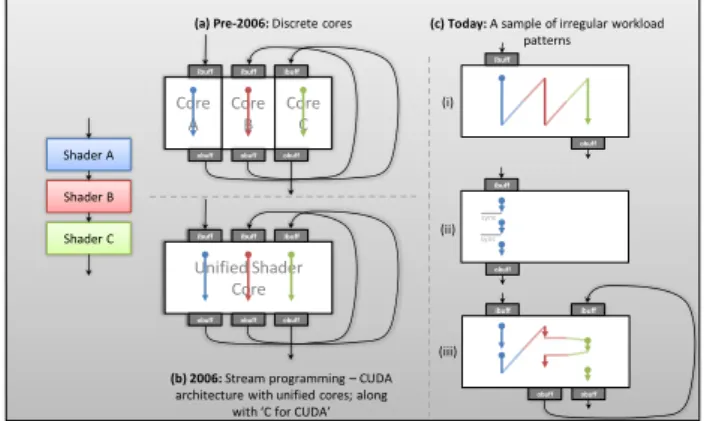
Unified Shader Core ibuff obuff ibuff obuff ibuff obuff Shader A Shader B Shader C (i) (ii) (iii) (a) Pre-2006: Discrete cores
Core C Core B Core A ibuff obuff ibuff obuff ibuff obuff
(b) 2006: Stream programming – CUDA architecture with unified cores; along
with ‘C for CUDA’
(c) Today: A sample of irregular workload patterns ibuff obuff obuff ibuff obuff ibuff ibuff obuff sync sync
Figure 1: An illustration of GPU architecture and workload evolution through an example of a three-shader application—A (blue), B (red) and
C (green)—(a) dedicated processor cores for each shader in the graphics pipeline; (b) unified proces-sor architecture supporting all three shaders, well suited for data-parallel stream workloads (kernels); (c) data-flow patterns of modern workloads: (i) mul-tiple kernels within an application to be executed successively (without having to write intermediate values to global memory), (ii) processing of a sin-gle kernel with synchronization requirement before the next iteration can be started, and (iii) strongly inter-dependent kernelsBandC producing variable work for the next stage to process.
support for handling the kinds of communication patterns shown in Figure 1(c).
Many application-specific solutions have been proposed in literature recently to address these limitations — rang-ing from fundamental parallel programmrang-ing primitives like scan and sort [8] and core algorithms like FFT [18] to pro-grammable graphics pipelines like ray tracing [1] and Reyes-style rendering [16] — to maximize performance. These solutions while seemingly disjoint in usage are all centered around a common programming principle, called Persistent Threads (PT). However, showing that PT is useful in a spe-cific instance does not address the larger questions: broadly, whenis the PT style applicable andwhyis it the right choice. We go a step further by providing insights into this success-fully used GPU-compute programming style in this paper.
the Persistent Threads model in a domain-independent way that is understandable to anyone with reasonable knowledge of GPU computing. We hope it contributes to a deeper understanding of this programming style. Our second ma-jor contribution is to concisely categorize the possible usage scenarios based on our needs and those encountered in lit-erature into four broad use cases, each of which have been clearly described and benchmarked in the paper. These use cases encompass a wide body of issues that are encountered with the irregular workloads addressed by PT and therefore this paper provides a good starting point for anyone try-ing to look at ways to improve their performance. As this paper is neither intended as a summary nor validation of results seen in past literature, our third and most important contribution is a deep distillation and analysis of the use cases via un-biased benchmarks developed by us to provide insight into the key questions of using PT—when andwhy is PT appropriate. We believe this understanding is sorely lacking today. In this paper we take a systematic approach that would be useful to a broad audience from a variety of application domains.
In specific cases, the reason that makes PT successful is because of inefficiencies in current hardware and program-ming systems. We hope that over time, many of these inef-ficiencies that we identify in this paper will be resolved as hardware and software continue to move forward. However, we believe that the use cases we describe in this paper are relevant today and will continue to be relevant in the fu-ture. So another contribution of this paper is the creation of a set of benchmarks (comparison points) to help evaluate implementations using PT against not only the traditional programming style but also (and most importantly) against future software and hardware advances. As these use cases will continue to exist despite hardware and software evolu-tion, the broader discussion we hope to initiate through this paper is the relative merits of hardware scheduling (as in the traditional GPU programming style) vs. software scheduling (as in PT).
We begin by describing the present programming style and identifying key performance bottlenecks in GPGPU pro-gramming today, followed by a description of the Persistent Threads style of programming in Section 2. In Section 3 we briefly describe each of the four use cases where we find PT to be applicable, and discuss them in detail sub-sequently. Through synthetic micro-kernel benchmarks, we present guidelines for when a PT formulation could be ben-eficial to programmers. We propose modifications to hard-ware and softhard-ware programming based on the experience gained while running our benchmarks for native-PT-style programming in Section 4. We conclude in Section 5 by ob-serving that the changes required for native support for PT style does not require a significant re-working of the proces-sor hardware, making it a potentially attractive option for inclusion in near-term hardware and software programming extensions of CUDA and OpenCL.
2.
PROGRAMMING STYLE BACKGROUND
2.1
Traditional Programming Style
GPU’s hardware and programming style are designed such that they rely heavily on Single Instruction Multiple Thread (SIMT) and Single Program Multiple Data (SPMD) pro-gramming paradigms. Both these paradigms virtualize the
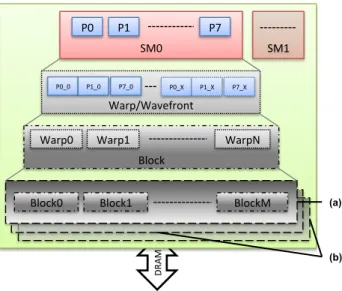
D RA M SM0 P0 P1 P7 Warp/Wavefront Block P0_0 P1_0 P7_0 P0_X P1_X P7_X
Warp0 Warp1 WarpN
Block0 Block1 BlockM SM1
(a)
(b)
Figure 2: An illustration of the various levels of hi-erarchy in GPGPU programming. Solid rectangu-lar boxes indicate a physical processor while dotted boxes indicate virtual entities. (a) Multiple blocks can simultaneously execute on a single SM; (b) Fur-ther virtualization of blocks on the SM scheduled over time.
underlying hardware at multiple levels, abstracting the view for the software programmer from actual hardware opera-tion. Every lane of the physical SIMD Streaming Multi-processor (SM) is virtualized into larger batches of threads, which are some multiple of the SIMD-lane width, called warps orwavefronts (SIMT processing). Just like in SIMD processing, each warp operates in lock-step and executes the same instruction, time-multiplexed on the hardware proces-sor. Multiple warps are combined to form a higher abstrac-tion calledthread blocks, with threads within each block al-lowed to communicate and share data at runtime via L1 cache/shared memory or registers. The process is further virtualized with multiple thread blocks being scheduled onto each SM simultaneously, and each block operating indepen-dently on different instances of the program on different data (SPMD processing). A hierarchy of these virtualizations are shown in Figure 2.
This programming style (which we shall refer to as ‘nonPT’) forces the developer to abstract units of work to virtual threads. As the number of blocks is dependent on the num-ber of work units, in most scenarios there are several hun-dreds or thousands more blocks to run on the hardware than can be initiated at kernel launch. In the traditional program-ming style, these extra blocks are scheduled at runtime. The switching of blocks is managed entirely by a hardware sched-uler, with the programmer having no means of influencing how blocks are scheduled onto the SM. So while these ab-stractions provide an easy-to-program model by presenting a low barrier to entry for developers from a wide variety of application domains, it gets in the way of seasoned program-mers working on highly irregular workloads that are already hard to parallelize. This exposes a significant limitation of the current SPMD programming style that neither guaran-tees order, location and timing, nor does it explicitly allow developers to influence the above three parameters without
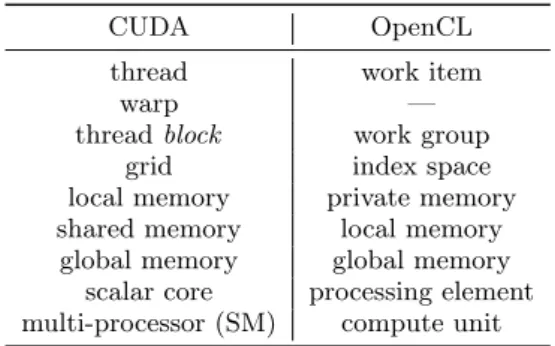
CUDA OpenCL
thread work item
warp —
threadblock work group
grid index space
local memory private memory shared memory local memory
global memory global memory scalar core processing element multi-processor (SM) compute unit
Table 1: Equivalent terminologies between CUDA and OpenCL are listed here. Although we make use of NVIDIA hardware and ‘C’ for CUDA terminolo-gies in this paper, the same discussion can be ex-tended to GPUs from other vendors using OpenCL.
bypassing the hardware scheduler altogether. To circumvent these limitations, developers have used a PT style and its lower level of abstraction to gain performance by directly controlling scheduling.
2.1.1
Core Limitations of GPGPU Programming
A brief summary of other major characteristics of the cur-rent GPGPU programming style, many of which impact per-formance and are directly targeted by the Persistent Threads programming style, are outlined below:
1. Host-Device Interface:
Master-slave processing: Only the host (master) pro-cessor has the ability to issue commands for data move-ment, synchronization, and execution on the device outside of a kernel.
Kernel size: The dimensions of a block, and the num-ber of blocks per kernel invocation, are passed as launch configuration parameters to the kernel invocation API. 2. Device-side Properties:
Lifetime of a block: Every block is assumed to per-form its function independent of other blocks, and re-tire upon completion of its task.
Hardware scheduler: The hardware manages a list of yet-to-be executed blocks and automatically schedules them onto a multi-processor (SM) at runtime. As scheduling is a runtime decision, the programming style offers no guarantees of when or where a block will be scheduled.
Block state: When a new block is mapped onto a par-ticular SM, the old state (register and shared memory) on that SM is considered stale, disallowing any com-munication between blocks, even when run on the same SM.
3. Memory Consistency:
Intra-block: Threads within a block communicate data via either local (per-block) or global (DRAM) mem-ory. Memory consistency is guaranteed between two sections within a block if they are separated by an appropriate intrinsic function (typically a block-wide
barrier).
Inter-block: The only mechanism for inter-block com-munication is global memory. Because blocks are in-dependent and their execution order is undefined, the most common method for communicating between blocks is to cause a global synchronization by ending a kernel and starting a new one. Inter-block communication through atomic memory operations is also an option, but may not be suitable or deliver sufficient perfor-mance for some application scenarios.
4. Kernel Invocations:
Producer-consumer: Due to the restrictions imposed on inter-block data sharing, kernels can only produce data as they run to completion. Consuming data on the GPU produced by this kernel requires another ker-nel.
Spawning kernels: A kernel cannot invoke another copy of itself (recursion), spawn other kernels, or dynami-cally add more blocks. This is especially costly in cases where data reuse exists between invocations.
2.2
Persistent Threads Programming Style
The requirement imposed by the nonPT programming style of dividing a workload into several blocks, more than can physically reside simultaneously at kernel launch time, is a design choice of the programming style, and not due to some constraint imposed by the SM. From a hardware perspective, threads are active throughout the execution of a kernel. This differs from a developer’s perspective using nonPT style coding guidelines by implying that as blocks run to completion, threads corresponding to these blocks are “retired”, while a batch of threads are “launched” as new blocks are scheduled onto the SM.The Persistent Threads style of programming alters the notion of the lifetime of virtual software threads, bring-ing them closer to execution lifetime of physical hardware threads, i.e. the developer’s view is that threads are active for the entire duration of a kernel. This is achieved by two simple modifications to kernel code: First, the virtualization of hardware SMs is limited to the level shown in Figure 2(a), also referred to asmaximal launch. Second, the lack of ad-ditional blocks shown in Figure 2(b) is compensated by em-ploying work queues. Both these are described in greater detail below. The PT style of coding is much closer to how one would program CPUs or Intel’s Larrabee processor [14], which exposes the scheduler for the programmer to influ-ence, if desired.
1. Maximal Launch: A kernel uses at most as many blocks as can be concurrently scheduled on the SM:
Since each thread remains persistent throughout the execution of a kernel, and is active across traditional block boundaries until no work remains, the program-mer schedules only as many threads as the GPU SMs can concurrently run. This represents the upper bound on the number of threads with which a kernel can launch. The lower bound can be as small as the num-ber of threads required to launch a single block. In order to distinguish nonPT and PT thread blocks, we will refer to blocks in PT style programming asthread
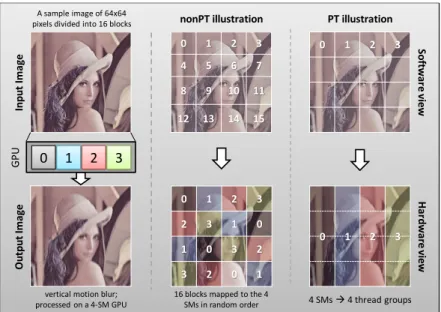
0 1 2 3 4 5 6 7 8 9 10 11 12 13 14 15 0 1 2 3 2 3 1 0 1 0 3 2 3 2 0 1 0 1 2 3 0 1 2 3 A sample image of 64x64 pixels divided into 16 blocks
So ft w ar e vi ew
nonPT illustration PT illustration
vertical motion blur; processed on a 4-SM GPU Ha rd w ar e vi ew In p u t Ima ge O u tp u t Ima ge GP U
0 1 2 3
16 blocks mapped to the 4
SMs in random order 4 SMs 4 thread groups
Figure 3: An illustration of nonPT and PT programming styles through an example image of 64x64 pixels undergoing vertical motion blur — In this example, 16x16 threads combine to form a block and process the image in a set of 4x4 blocks. The GPU has four SMs labeled 0-3. We assume a load-balanced system where each SM runs one block at a time and four blocks each. For nonPT, the kernel launches with 16 blocks. At run time the hardware non-deterministically schedules new blocks to SMs as other blocks complete. A PT kernel launches at-most the number of blocks corresponding to ‘maximal launch’, which in this example correspond to four thread groups, along with a 16-entry work queue; with each entry in this queue representing a block index. Through the work queue, developers can control scheduling of blocks onto SMs. In this example, each SM processes all blocks within a vertical sub-section of the image, thus helping data-reuse as pixels are shared across vertical block boundaries.
groupsfor the remainder of this paper. A thread group has the same dimensions as a thread block, but is formed by combining persistent threads launched at kernel invocation, processing work equivalent to zero, one, or many thread blocks, and remaining active until no more work is left for the kernel to process. 2. Software schedules work through work queues,
not hardware:
The traditional programming environment does not expose the hardware scheduler to the programmer, thus limiting the ability to exploit workload communication patterns. In contrast, the PT style bypasses the hard-ware scheduler by relying on a work queue of all blocks that are to be processed for kernel execution to com-plete. When a block finishes, it checks the queue for more work and continues doing so until no work is left, at which point the block retires.
Depending on the communication pattern exhibited by the algorithm, the queue can either be static (known at compile time) or dynamic (generated at runtime) and can be used to control the order, location, and timing of the execution of each block. There are several kinds of optimizations one could incorporate in how work is submitted and fetched from these queues – one exam-ple would be to incorporate distributed queues instead of a global queue that could lead to optimal load bal-ancing via work stealing/donating or a hybrid of the two approach. In this paper we focus on the base case of a single queue which primarily as a FIFO.
3.
USE CASES
Over the past two years, several researchers have used PT techniques in their applications to improve performance. We have categorized these into four use cases, each of which are described in detail in the following four subsections.
PT-style programming lacks native hardware and pro-gramming API support. While past studies have shown PT to be advantageous, the benefits and limitations of hack-ing the nonPT model to fit into a PT style in software is not well understood and documented, and therefore cannot be universally applied to all scenarios. Although a handful benchmark suites are available for GPU computing [5, 6], these workloads primarily deal with performance at a higher level than we wanted for our analysis. Hence, apart from distinctly categorizing use cases in this paper, another con-tribution of this paper is the creation of an un-biased micro-kernel benchmark suite that future studies can use/compare against, and that vendors can use to evaluate future designs. For each use case, we give a brief introduction and cite relevant studies that have utilized the use case. We pro-vide implementation details of our synthetic workloads fol-lowed by results and conclusions. We wrote our tests in both OpenCL and CUDA. Specifically, since OpenCL pro-vides the ability for fine-grain profiling, we wrote the first use case in OpenCL, and the remaining in CUDA. We ran all our use cases on an NVIDIA GeForce GTX2951. Un-1We also tested on a GTX580 (Fermi) and found the general
trends were similar, even though we made heavy use of atom-ics and the Fermi architecture supposedly has better atomic support (atomics in Fermi happen in the L2 cache/shared
Use Case Scenario Advantage of Persistent Threads CPU-GPU Synchronization Kernel A produces a variable amount
of data that must be consumed by Kernel B
nonPT implementations require a round-trip commu-nication to the host to launch Kernel B with the exact number of blocks corresponding to work items pro-duced by Kernel A.
Load Balancing Traversing an irregularly-structured, hierarchical data structure
PT implementations build an efficient queue to allow a single kernel to produce a variable amount of out-put per thread and load balance those outout-puts onto threads for further processing.
Maintaining Active State A kernel accumulates a single value across a large number of threads, or Kernel A wants to pass data to Kernel B through shared memory or registers
Because a PT kernel processes many more items per block than a nonPT kernel, it can effectively leverage shared memory across a larger block size for an appli-cation like a global reduction.
Global Synchronization Global synchronization within a ker-nel across thread blocks
In a nonPT kernel, synchronizing across blocks within a kernel is not possible because blocks run to comple-tion and cannot wait for blocks that have not yet been scheduled. The PT model ensures that all blocks are resident and thus allows global synchronization.
Table 2: Summary of Persistent Threads use cases
less otherwise stated, every block consists of 256 threads in our experiments, and as a proxy for work per thread, we perform a varying number of fused multiply-add (FMA) operations on single-precision floating-point values. In the following subsections, “more FMAs per item” is equivalent to “more work per item”. For each experiment, we imple-mented two versions of our synthetic benchmarks, nonPT and PT (both with equivalent functionality), to evaluate performance and identify tradeoffs. The four use cases are CPU-GPU synchronization, load balancing/irregular paral-lelism, producer-consumer locality, and global synchroniza-tion, which are summarized in Table 2.
3.1
CPU-GPU Synchronization
Since the CPU (host) and GPU (device) are coupled to-gether as a master and slave, the device lacks the ability to submit work to itself. Outside of the functionality built into a kernel, the device is dependent on the host for issuing all data movement, execution and synchronization commands. In cases where aproducer kernel generates a variable num-ber of items for theconsumer kernelto process at run time, the host must issue a readback, determine the number of blocks needed to consume the intermediate data, and then launch a new kernel. The readbacks have significant over-head, especially in systems where the host and device do not share the same memory space or are not on the same chip.
Boyer et al. present a systematic approach for accelerating the process of detecting and tracking in-vivo blood vessels of leukocytes [3]. By modifying memory access patterns, refor-mulating the computations within the kernel, and fusing ker-nels to minimize the CPU-GPU synchronization overhead, they report a 60× speedup over the baseline naive imple-mentation. Further, upon restructuring the computations that originally required 50,000 kernel invocations to just one PT invocation, they achieved a 211×speedup over the base-line. Tzeng et al. utilized a work-queue based task-donation strategy for efficiently handling split and dice stages in the Reyes pipeline [16]. Their work splits micropolygons of a scene into a variable number of patches at each step. With memory, not in DRAM).
the nonPT traditional programming style, this would re-quire a host readback of the number of patches to be split in the next iteration. But by combining these two stages into a single uberkernel and wrapping it in a PT kernel, they eliminated the need for this readback and created a self-sustaining Reyes engine that efficiently handles their ir-regular workload.
3.1.1
Implementation
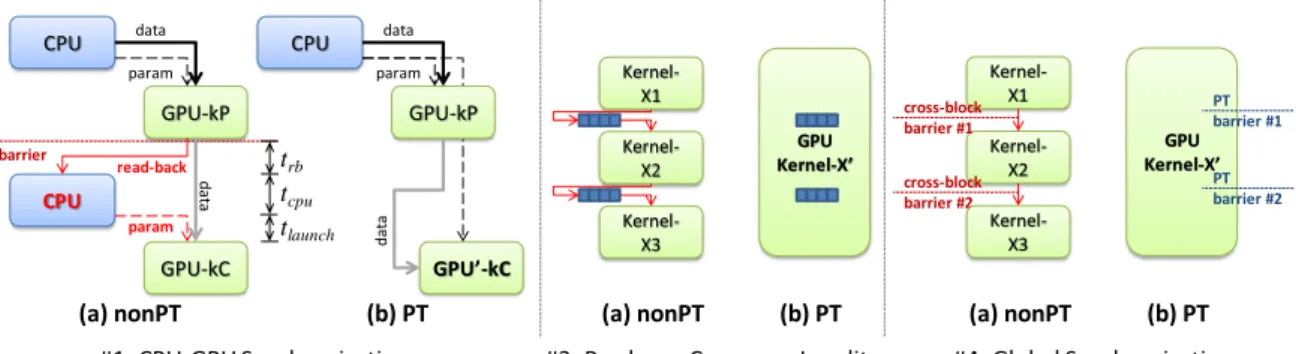
Overhead Characterization: In order to characterize the overhead of host-device synchronization, we performed a timing analysis of the three steps involved, shown in red as the critical path in Figure 4-I: a blocking readback by the host to determine the subsequent launch bounds, the host overhead of generating configuration parameters for a kernel with the appropriate number of items, and the kernel launch time from the moment of issue to the moment the device starts the kernel.
To obtain an accurate assessment of the synchronization overhead, we used the low-level profiling API, clGetEvent-ProfilingInfo(), provided in OpenCL (CUDA does not pro-vide the fine-grained control we need, hence why we did not implement this use case in CUDA). This call provides four instances pertaining to when a call in the command queue is issuedby the host,dispatchedto the device execution queue, begins execution on the device, and theend time. For this experiment, we computed the time it takes from the moment the producer kernel (GPU-kP) ends to when the consumer kernel (GPU-kC) starts.
Persistent Threads Alternative: The PT alternative
requires two modifications. First,GPU’-kC is reformulated to encapsulate the original kernel in awhileloop, along with an atomic operation to either increment or decrement the number of items remaining. Second, the modified kernel is launched with a fixed number of blocks by the host, re-gardless of how many items are to be processed. When the work queue counter exceeds the item count in the case of an incremental queue or goes below zero in the case of a decre-mental queue, the corresponding block exits. At runtime, the last block of the GPU-kP writes the number of items GPU’-kP must process to a predefined GPU-accessible
lo-cation.GPU’-kP then uses this value as its terminal count. Thread groups retire once they reach this count.
Both modifications outlined here in the PT formulation are sources of overhead. In order to further understand this overhead w.r.t. nonPT kernels, we created two synthetic workloads, one that was compute-intensive (CI), and the other a combination of compute and memory (CMI) op-erations. For the CI kernel we read data from memory, perform a variable number of FMAs, and then write the result to global memory. For the CMI kernel we perform strided access to memory for every iteration of FMA com-putation, committing the result to global memory after the pre-determined number of operations has been performed. In both cases, we unroll the FMA loop completely in order to minimize loop overhead. For the nonPT case, the time of execution is the sum of performing a synchronous data transfer from GPU to CPU, and kernel execution.
3.1.2
Results & Conclusions
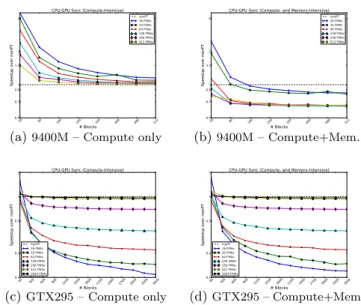
Using empty kernels we measured the round-trip cost of a synchronized copy to the CPU and the launch on the GPU to be around 400µs. In addition to running this use case on a NVIDIA GTX295, we also ran it on a GeForce 9400M processor. A more detailed analysis of PT vs. nonPT per-formance for a varying number of FMAs and blocks for our workloads on both the processors is shown in Figure 5.
From Figure 5(a) we see that non-compute-intensive ker-nels benefit from a PT formulation. As the number of blocks to process increases, the atomic pressure increases consider-ably, resulting in a slowdown. As the arithmetic intensity of the amount of work processed per block increases, the PT formulation generally results in a speedup, eventually dip-ping below the nonPT baseline. In Figure 5(b) we see a dif-ferent trend than for the CI case. While having fewer blocks results in significant speedup with a small amount of work per thread, as this work increases, we transition to a con-siderable slowdown. We attribute this, in part, to the drop inoccupancy, the ratio of number of thread groups started at launched time to the theoretical maximum supported by the hardware. As the number of iterations to be unrolled increases, the compiler requires more registers, and is more restricted in making optimizations within the while-loop for the PT case.
In stark contrast, we see a very distinct set of results for these workloads on the GTX295. On both CI and CMI workloads, the PT version is almost always slower than its nonPT counterpart. The slowdown further increases as the number of blocks to process increase. The only reasonable explanation we hypothesize for this is the cost of contention for atomics. The 9400M has only 2 SMs while the GTX295 has 30.
From these workloads we conclude that using PT to avoid CPU-GPU synchronization is beneficial for small workloads with few memory accesses and small arithmetic intensity. Further, PT through software is better for kernels launching fewer thread groups, and where the cost of synchronization is a significant fraction of the overall cost of the application.
3.2
Load Balancing / Irregular Parallelism
Efficiently processing poorly-structured algorithms or ir-regular data-structures is a challenge on any compute device, but especially the GPU. Extracting parallelism on the GPU16 80 160 240 320 400 480 512 # Blocks 0.5 0.7 0.91 1.5 2 4
Speedup over nonPT
CPU-GPU Sync (Compute-Intensive)
nonPT 16 FMAs 32 FMAs 64 FMAs 128 FMAs 256 FMAs 512 FMAs
(a)9400M – Compute only
16 80 160 240 320 400 480 512 # Blocks 0.5 0.7 0.91 1.5 2 4
Speedup over nonPT
CPU-GPU Sync (Compute- and Memory-Intensive)
nonPT 16 FMAs 32 FMAs 64 FMAs 128 FMAs 256 FMAs 512 FMAs (b)9400M – Compute+Mem. 60 300 600 900 1200 1500 1800 2100 2400 2700 3000 3300 3600 # Blocks 0.1 0.2 0.5 1 2
Speedup over nonPT
CPU-GPU Sync (Compute-Intensive)
nonPT 16 FMAs 32 FMAs 64 FMAs 128 FMAs 256 FMAs 512 FMAs 1024 FMAs (c)GTX295 – Compute only 60 300 600 900 1200 1500 1800 2100 2400 2700 3000 3300 3600 # Blocks 0.1 0.2 0.5 1 2
Speedup over nonPT
CPU-GPU Sync (Compute- and Memory-Intensive)
nonPT 16 FMAs 32 FMAs 64 FMAs 128 FMAs 256 FMAs 512 FMAs 1024 FMAs (d)GTX295 – Compute+Mem.
Figure 5: Results from CPU-GPU Synchronization on NVIDIA’s GeForce 9400M and GTX295.
Initial Inputs # of le ve ls Initial Inputs # of le ve ls
(a)Full Forest
(b)Tilted Forest
Figure 6: An illustration of our complete and tilted forest.
is left to the programmer, often requiring low-level control routines to be written in software. These workloads present two important issues—vector processor efficiency and han-dling variable work items being consumed or produced, Aila et al. present a thorough study of improving the efficiency of processing the irregular the trace() phase in ray tracing on vector processors through PT [1]. Their solution for han-dling the varying depths of traversal for each ray was by us-ing warp-wide blocks for avoidus-ing a sus-ingle ray holdus-ing several warps within a block hostage2,and bypassing the hardware scheduler by the use of PT. Tzeng et al. [16] addressed the
2
We surmise that the large speedups seen by Aila et al. and other researchers in this area were in large part due to warp retirement serialization issues with pre-Fermi NVIDIA hardware, and that newer hardware does not suffer from the same issues. However, we note that this presumed hardware issue is only relevant to this particular use case; the other three use cases do not retire warps out of order.
CPU GPU’-kC GPU-kP data param CPU CPU GPU-kP data param GPU-kC param d at a d at a read-back barrier t rb tcpu tlaunch (a) nonPT (b) PT Kernel-X2 Kernel-X1 Kernel-X3 GPU Kernel-X’ (a) nonPT (b) PT Kernel-X2 Kernel-X1 cross-block barrier #1 cross-block barrier #2 Kernel-X3 GPU Kernel-X’ PT barrier #1 PT barrier #2 (a) nonPT (b) PT
#1: CPU-GPU Synchronization #3: Producer-Consumer Locality #4: Global Synchronization
Figure 4: nonPT and PT illustrations of the use cases.
issue of variable producer/consumer work items using dis-tributed work queues coupled with a task-donation strategy to mitigate load-balancing issues of the split and dice phases in the Reyes pipeline.
3.2.1
Implementation
In order to explore Load Balancing and Irregular Paral-lelism (LBIP), we design a test (a forest expansion) that emits a variable amount of work per thread and requires multiple stages to complete. The algorithm starts with an initial number of input items. Each thread performs a pre-defined amount of FMAs in register space, after which the owning block generates zero, one, or two new items (we tried using a larger maximum branching factor, but it had little effect on the resulting performance trends). The result is a forest, where items that generate another item(s) are either roots or intermediate nodes, and items that do not generate work are leaves. Every block processes one item at a time using all available threads.
We experimented with two different types of forests. We call the first acomplete forest, since every input item gener-ates a complete binary tree of a shallow, pre-specified depth. The second we call atilted forest. In it, the “first half” of the items on any given level generate no new items, and every item in the “second half” generates two new items, shown in Figure 6. Work generation halts at a pre-specified depth. The tilted-tree model has the same number of nodes on ev-ery level (the first level might differ by one item). Instead of halting the forest growth at a shallow level, we let the tree grow to a pre-specified depth of at most one thousand.
nonPT Implementation: Each nonPT kernel
invoca-tion processes one or more items comprising a complete level of the forest. Each node generates zero or two new items. We can safely store only the current level and the next level of the forest since we work on a level at a time. Each level of the tree has a counter dictating how many items are in that level. For a given block, we check the global index of the block and terminate immediately if there are fewer items than this index, otherwise the block processes the input and helps to populate the next level of the forest (until the forest reaches a certain depth). To achieve perfect load balancing (a 1-to-1 matching of number of blocks and items at the current level), we could issue a readback before each kernel invocation to get a tight bound on the number of blocks we need, or since we know implicitly the new number of items in the next level (we know the initial number and that
ev-1 5 ev-10ev-15
30
45
60
90
120
Initial Input Elements
0.1
0.2
0.5
1
2
5
10
20
50
Speedup Over nonPT
LB/IP - Complete Tree
nonPT
4 lvl, 5000 FMAs/thr/lvl
8 lvl, 5000 FMAs/thr/lvl
4 lvl, 500 FMAs/thr/lvl
8 lvl, 500 FMAs/thr/lvl
Figure 7: Load Balancing/Irregular Parallelism Re-sults (Complete Forest): We run with a large variety of MADs per thread per level (0–50,000), maximum depth (1–12), and the number of PT blocks (1–240). The graph shows the general trends we notice from all runs. We see a general loss of speedup as the number of elements increases as the NonPT kernel has more work to do. We see PT speedup greater than 1.0 when the number of MADs is high, starting somewhere between 1000 and 5000 per thread per level.
0 1 5 10 50 100 500 10005000100001200013000150003000050000100000200000
FMAs per thread per level
0.1
0.2
0.5
1.0
1.2
1.4
Speedup over nonPT
LB/IP - Tilted Forest
1 blk
2 blk
4 blk
8 blk
15 blk
30 blk
60 blk
120 blk
240 blk
nonPT
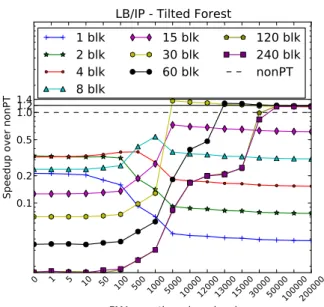
Figure 8: Load Balancing/Irregular Parallelism Re-sults (Tilted Forest): We again run with a large vari-ation in our configurvari-ation. However, we found that as we varied the maximum depth and the number of inputs, the trends stayed consistent. So we show our results from a maximum depth of 50 with 128 initial inputs. We found similar behavior as we var-ied the number of initial elements. This graph shows the general trends we notice from all runs. As we saturate the SMs with at least 30 blocks, we achieve better performance than the NonPT kernel when we have a high amount of work per thread per level.
ery item creates two new items at each level), we could just use that knowledge. But we felt doing either of these went against the spirit of the use case, since real application prob-ably would not have full expansion, and it might be slower to perform the readback than to just schedule the empty blocks.
When processing an item, we assume that a block knows how many new items its current item will generate before ac-tually processing the item. This enables us to cheat slightly by maximizing the distance between the atomic increment and the use of the calculated value. The complete forest application knows ahead of time how many levels of items to process, so it launches the correct number of kernels all at once in a single stream, thus lowering kernel-launch over-head. For the tilted forest, we do not allow the application to presume knowledge of the final level of work. Thus, the application schedulesX levels of work at a time and then performs a readback to determine if any work remains. We did not want to assume that either application knew how many items were on any level on either test, so we sched-uled the maximum number of blocks necessary to process a full level. This caused a performance hit for our nonPT kernel because we allowed each level to grow quite large (on the order of millions of elements for the complete forest and tens of thousands of element for the tilted forest).
PT Implementation: Our PT kernel is different from
our nonPT kernel in that it lacks implicit knowledge of the level of an item. We use a single work queue to store work items instead of two queues and a ping pong strategy (as with nonPT). Our queue grants access via an atomically guarded spin lock. Each block loops until it detects pro-gram termination via an atomically guarded variable. As a block enters an iteration of the loop, it locks the queue, reads an item, and releases the lock. If the block reads a valid item, it processes that item and determines how many new items to generate. The block locks the queue to add new items and then unlocks the queue. Locking is impor-tant both for adding and removing elements since it alone guarantees coherency of the queue pointers. When no more items are available and all blocks are idle, the kernel exits. In theory the implementation of our PT kernel is quite sim-ple, but correctly manipulating the locks and counters for the queue is tricky.
Our PT implementation uses a shared, global queue. There are other queuing implementations such as many global queues, or a global queue with local queues combined with task steal-ing and/or donation. We used a ssteal-ingle queue based on prior tests, implementation time, performance, and the desire to keep low the number of variables in our experiments. We also noted that with the complete-tree implementation, us-ing small local queues offered no significant performance im-provement because the queues fill up rapidly (often even at the end of every level). For the tilted tree, one or more blocks must constantly steal work from other queues, again mitigating any performance improvements.
3.2.2
Results & Conclusions
LBIP has a large number of variables, both for the nonPT and the PT kernel. The common variables between them are the initial number of input items, the amount of work per item, and the depth of the forest. We also varied the total number of blocks to use per SM for PT and the number of invoked kernels per read back (to check for termination in the nonPT kernel).
We conclude that the more items per level, the poorer per-formance for PT, because the hardware scheduler will always best an ad hoc software scheduler. The stable and downward trends in Figure 7 illustrate this point. Concurrent atomic pressure is a major factor in our PT kernel. We use only round-trip atomics, meaning we need to wait for the result of every atomic operation, and thus each block must wait for the atomic pipeline to flush. The atomic pipeline in NVIDIA GPUs (both on Tesla and Fermi) does not scale linearly with the number of concurrent atomics (in fact the behavior seems non-deterministic and suffers from starvation in cases where atomics are used as locks). However, as each block spaces out queue-access requests with significant amounts of work, the number of concurrent accesses decreases, the overall time to access the queue decreases rapidly, and the ratio between the two (and thus queue access time in gen-eral) quickly becomes negligible. Figure 8 shows this trend very well: once the number of MADs per thread per level increases beyond a certain threshold (dictated by the num-ber of active threads on the GPU), performance stabilizes in relation to nonPT.
Our experiments show two different trends. First, regard-less of the number of FMAs per item, PT tends to to outper-form nonPT with a small number of initial inputs. However,
as the number of inputs grows, PT only does well when the kernel executes a lot of work per item. This is due to concur-rent atomic pressure. With many items (regardless of work per item), nonPT blocks spend most of their time doing ac-tual work, instead of simply coming alive, seeing no work, and dying. With many items, but with little work per item though, PT blocks spend a significant fraction of their time accessing the high-contention queue. As the amount of work per item increases, access to the queue spreads out, thus low-ering contention and significantly speeding up queue-access time.
Based on our workloads on the GPU under study, we conclude that for the general case, PT is better on specific combinations of variables. PT outper-forms nonPT on small, irregular work and regular deeply-recursive work, and in either of our forest im-plementations PT tends to outperform nonPT when there are not many initial input elements and when the growth in elements is fairly constrained.
3.3
Producer-Consumer Locality
Many algorithms require data sharing between different threads within a kernel. Producer-consumer locality refers to the ability of one piece of work to pass its results to another piece of work with minimal cost. Current hardware allows data sharing by threads in the same block via on-chip memory, but threads in different blocks must communicate through DRAM and use expensive intrinsics to guarantee coherency. This limitation is an artifact of the lifetime of a block (threads retire after finishing a small amount of work), and the inability to express explicit communication patterns that aid in guaranteeing coherence without using DRAM. PT addresses this limitation.
In previous work in this area, Bell and Garland [2] use persistent warps for passing the “carry-out” of one iteration as the “carry-in” of the next in their COO format for SpMV computations. Breitbart [4] details a prefix-sum implemen-tation that requires a single kernel launch by using static workgroups as opposed to many kernel launches. Recent sorting and prefix-sum scan work also uses PT to minimize global memory traffic by exploiting producer-consumer lo-cality [8, 13].
3.3.1
Implementation
To test how PT deals with producer-consumer locality, we use two different workloads. The first is a large reduce function; given a set ofN floats, compute their sum. The second is a dummy benchmark that executes a synthetic workload of FMAs in two stages. We begin with a set of N inputs. In the first step, we perform a certain amount of arithmetic on each item, then in the second step, perform additional arithmetic on only a certain percentage of those items.
nonPT Reduce: We use a multi-kernel approach for our nonPT reduce. GivenN floats, we scheduledN/256eblocks to reduce the initial input set. Each block reduces 256 floats down to 1 float and stores it back to DRAM. This reduces the input set size fromN todN/256e. We continue to sched-ule kernels in the same manner until we reduce our set to a single item, the final value. This implies that we must scheduledlog256Nekernels to reduce any input set.
PT Reduce: We use a single kernel with at most 256
blocks to complete the two-stage process. The kernel
stati-cally divides the input. Each thread reads a value from the array, performs a reduction, and then when it has read all its values, performs a blockwise reduction. Once all blocks fin-ish their reductions, they write their single value to DRAM and the kernel executes a global barrier. After the barrier, block 0 reads all values from DRAM and performs one final reduction.
nonPT Synthetic Workload: For our nonPT synthetic
workload, we have two implementations; one for the case that most/all threads in the second stage would work on items passed from the first stage, and one for the case that relatively few threads in the second stage would work on items passed from the first stage.
The first implementation uses a single kernel. We param-eterize the number of items to pass per block. Each of the 256 threads in a block reads a single float from DRAM, per-forms a certain amount of FMAs, conditionally progresses to the second stage (or dies), and carries with it a single re-sultant float stored in a register. Once in the second stage, the thread performs the same amount of arithmetic as the first stage and stores a single float out to DRAM. This im-plementation is most efficient when all input items produce an output item, meaning every thread in the first stage re-mains active during the second stage and also passes with it a value to compute in the second stage.
Our second implementation is similar to the above in terms of compute characteristics but differs by storing inter-mediate values to DRAM and using two kernels (one pro-ducer, one consumer). As each block finishes stage one, the threads conditionally store their intermediate data into a tightly packed array in DRAM (those who do not pass the condition simply die). Next, we launch the consumer with as many threads as input items; each thread reads an element from the array, performs the same amount of arithmetic as in the producer kernel, and writes the result to DRAM.
Our second approach is most efficient when relatively few input items produce an output item. In this case, since the consumer kernel can be configured for the appropriate num-ber of items, it would better utilize hardware resources (in the first, many threads per block do not progress to the con-sumer stage, thus holding hostage many hardware threads per SM).
PT Synthetic Workload: We again use a single kernel written as an uberkernel, statically partition the entire in-put among blocks, and, as with the nonPT implementation, parameterize the number of items to keep per block. Each block has a shared-memory storage arena. Just as in the nonPT case, each thread again reads in one float, does a pre-determined number of FMAs, and conditionally stores the result into the shared memory queue. When the queue fills up, the entire block processes the queue until it is empty by moving an item from the queue into a register, performing the same amount of arithmetic per item as in the producer stage, and then storing the result to DRAM. The block then resumes processing more items from the producer stage.
3.3.2
Results & Conclusions
Reduce: Our PT implementation of reduce outperforms an optimized nonPT reduce at every size of input we tested, with speedup eventually leveling off around 1.1× as the amount of work to process increases. At small input sizes, the largest bottleneck in nonPT reduce is the global bar-rier accomplished via implicit kernel boundaries. By using a
0
1
2
4
8
16 32 64 128 256
Items passed to consumer per 256 inputs
0.8
0.9
1.0
1.1
1.2
1.3
1.4
1.5
Speedup over nonPT
Producer/Consumer Locality - Synthetic Workload
nonPT
PT (eq. 150000 nonPT)
PT (eq. 15000 nonPT)
PT (eq. 1500 nonPT)
PT (eq. 150 nonPT)
Figure 9: Producer-Consumer Results: We run our synthetic workload passing items from the producer stage to the consumer stage. We vary the number of items to pass, as well as the full number of initial items to process. As we vary the number of items to pass from 0 to 32 (per 256), we maintain perfor-mance between 0.95–1.05×that of a nonPT kernel. However, when we pass a large percentage (at least 25%) of the items to the consumer stage, we get up to 1.40×speedup, in large part because we have producer-consumer data locality and can pass items via registers and shared memory.
cheaper global barrier in our PT implementation we achieve a significant reduction in execution time, between 1.50×and 1.85×. As input size increases, the time taken to execute a barrier is small compared to DRAM access time. Thus, the performance improvements we see come not so much from using an explicit PT barrier, but from passing items via shared memory.
Synthetic Workload: We draw the following conclusions from the three major data points in Figure 9: When we pass no items from producer to consumer, we achieve slowdown with our PT implementation because the hardware sched-uler is much better at load-balancing the SMs than our PT kernel. As the number of passed input items ranges be-tween one and less than thirty-two (per block), we achieve only moderate speedup. As the number of input items to pass grows beyond thirty-two, we begin to achieve notice-able speedup, finishing off at approximately 1.45×for large input sizes where we pass every produced item to the con-sumer stage.
3.4
Global Synchronization
The GPU provides hardware support for synchronizing threads in a block, but not for synchronizing between ac-tive blocks on an the same SM, or the entire GPU. Cur-rent hardware guidelines dictate that the only way to
glob-ally synchronize is to launch separate kernels at would-be synchronization points. Kernel-launch overhead costs be-tween 3-7 µs [17], which can lead to significant overheads depending on the number of kernel invocations [3]. Stuart and Owens used PT-based global synchronization in their implementation of a message-passing API for GPUs [15] to efficiently implement collective communications such as bar-riers. Luo et al. [7] present a hierarchical kernel arrangement for building a BFS through the use a global barrier to syn-chronize between blocks to mitigate the cost of kernel launch overhead.
We, and others, specifically propose the use of Global Syn-chronization (GS) through PT to minimize kernel-launch overhead. The GS construct is a barrier implemented in soft-ware for inter-block communication. The GS barrier acts on every block concurrently on the GPU. It can be used for sep-arating different instances of the same kernel being processed recursively, or multiple sections of code within the same ker-nel in the case of uberkerker-nel formulations. The GS construct has been shown to consume between 1.3–2.0µs [18]. These results, however, only cover one data point, and in order to better understand the performance tradeoffs, we varied a wide number of parameters for our micro-benchmarks.
3.4.1
Implementation
nonPT:The nonPT implementation of our synthetic GS use case works as a two-step process, one on the GPU and one on the CPU. The GPU stage simply performs a prede-termined number of FMAs in register space, then stores a value in DRAM. The CPU stage then implictly synchronizes by launching another kernel. We do not explicitly synchro-nize, nor do we need to, since the hardware guarantees that if kernels are launched asynchronously in a single stream, all blocks of the preceding kernel will run to completion before the next kernel begins. The point of our synthetic workload is to determine roughly how much work on average a block must perform to mitigate the cost of GS.
PT: The PT implementation of GS use case works as a single-step process consisting of two stages, with both stages executing on the GPU. Like the nonPT version, each block in the first PT stage performs its pre-defined set of oper-ations. However, because blocks are persistent, each must perform the work of a variable number of blocks from the nonPT implementation. As each block completes an iter-ation, it begins processing the second stage. This stage is where blocks synchronize globally. Our implementation of GS is based on the lock-free version described by Xiao and Feng [18].
3.4.2
Results & Conclusions
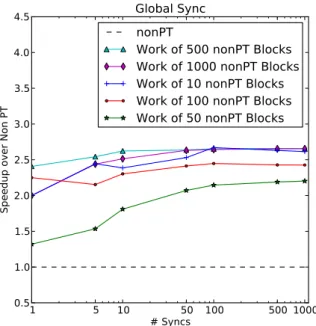
We varied the number of blocks, the number of FMAs to be performed per input item, and the total number of blocks to process. The overall trend remains the same un-til 2000 FMAs per thread, but falls off dramatically as the compute intensity is increased. After inspecting the PTX, this seems to be due to the compiler no longer unrolling for loops. Figure 10 shows the graph obtained on running GS on a workload performing 1000 FMAs, with a varying num-ber of items to process per block and a varying numnum-ber of syncs. We see a consistent speedup of 2–2.5×, which is in line with the previously-reported results3. From our tests we conclude two things. First, the amount of arithmetic to
3
run-1
5 10
50 100
500 1000
# Syncs
0.5
1.0
1.5
2.0
2.5
3.0
3.5
4.0
4.5
Speedup over Non PT
Global Sync
nonPT
Work of 500 nonPT Blocks
Work of 1000 nonPT Blocks
Work of 10 nonPT Blocks
Work of 100 nonPT Blocks
Work of 50 nonPT Blocks
Figure 10: Global Synchronization Results: The runs for this graph used 1000 FMAs per input item per sync.
be performed has little bearing on the performance of global synchronization. Second, the benefit of syncing on the GPU increases asymptotically with the number of syncs: when each PT block executes a significant amount of work, the time taken to launch a new kernel is small in relation to the total execution time. Thus the application provides little room for a PT-based speedup.
From these results we conclude that the amount of arithmetic to be performed has little bearing on the performance of global synchronization, and the ben-efit of syncing on the GPU increases asymptotically with the number of syncs.
4.
DISCUSSION
Based on previous work, and the micro-benchmarks dis-cussed in Section 3, we have shown that the PT program-ming style can be used to address a range of computational patterns. PT addresses many of the restrictions mentioned in Section 2.1.1 pertaining to the current hardware and pro-gramming style. Taking a long-term view, we discuss the potential impact use cases outlined in this paper are likely to have with eminent changes in future, and possible changes hardware vendors and Khronos partners might consider use-ful to look into for future iterations of the programming en-vironment.
1. CPU-GPU Synchronization: The cost of synchro-nization across the CPU and GPU is largely dependent on the round-trip time for data to be copied from GPU to CPU memory-space, and kernel launch overhead. For integrated processors with CPU and GPU on the same die, like AMD’s Llano and Intel’s Sandy Bridge ning the workload of 50 nonPT blocks and have yet to find a reasonable answer as to why.
processors, that will share dedicated on-chip memory for inter-processor communication in future revisions of the architecture, we see comparitively lesser benefit in using PT on such platforms when compared to dis-crete systems where the CPU and GPU are connected through a system interconnect bus like PCI-Express. 2. Load Balancing:Effectively utilizing all cores on any
parallel processor is a difficult problem. Quite often the best way to load balance is by running task-parallel workloads, an area that is emerging as an important primitive. Hence, for this use case to be handled effi-ciently, it is imperative that there be dedicated support for queues in hardware with API extensions that pro-vide tracking of head and tail pointers, queue wrap-around logic, overflow/underflow guard flags, nearly-full/empty flags, distributed queues, etc. Currently the developer is required to implement one in software, taking care of guaranteeing both data consistency and deadlock avoidance, which is non-trivial. In addition to this, the ability for kernels to generate and launch their own work would greatly ease the implementation of load-balanced and task-parallel systems.
3. Producer-Consumer:Extracting producer-consumer locality is the most challenging of all the use cases dis-cussed in this paper. The nonPT style provides no way of expressing data locality patterns, which is especially important on massively data-parallel machines. Using cache-coherence could be one way of addressing this, but would be expensive to build and does not scale very well, and hence not popular in most GPUs today. The PT style helps address these issues by giving more control over scheduling and exploiting locality exhib-ited by the underlying algorithm. We see this as the biggest benefit of using PT style programming, with use even in future processor generations.
4. Global Synchronization: As the number of proces-sors on GPU grows, so will the number of blocks that can be resident on it. This implies that beyond a point the cost of synchronizing on the GPU would be greater than the kernel launch overhead, and therefore for fu-ture systems might not be very useful at a global level. However, there are several patterns that require only a subset of blocks to communicate and synchronize, and hence it could still be quite useful to synchronize on the GPU. Ultimately, research into fast and good higher-level synchronization primitives than a barrier is required.
4.1
Implementation Aspects
As discussed in Section 2.2, the primary purpose of PT style programming is to bypass the default (traditional) pro-gramming style offered by CUDA and OpenCL by altering the lifetime of thread blocks and how they are scheduled. In providing a greater degree of flexibility to optimally deal with algorithms with complex compute, data movement and synchronization patterns, a much greater burden is put upon the developer as aspects that would otherwise have been handled transparently by the driver/hardware must now be donemanually.
Even minor modifications in code can lead to enough change in register and shared memory usage that ultimately affects
multi-processor occupancy (the number of thread groups that can be simultaneously scheduled on the SM). In the absence of formal support for PT kernels, the programmer is required to manually account for changes in occupancy as it directly influences maximal launch parameters (especially relevant to the global synchronization use case), and also impacts the implementation of the underlying algorithm us-ing complex queue-control structures. A list of portability aspects with reference to each use case are shown in Table 3. One possible means of extending support for PT is through a dedicated API. A sample of how simple this modification could be is shown in API 1.
4.2
Return-on-Investment
Our results clearly show that there is no guarantee of suc-cess for kernels designed via PTtoday. With limited native support either in the form of dedicated APIs or lower-level GPU primitives, developer time and effort involved in PT style programming, in a wide majority of cases, is signifi-cant. Further, due to the complexities involved in altering kernels to fit into a PT framework, debugging can also prove to be an extremely challenging task.
Based on our experiences and results, we suggest that any decision to use this programming style should be made af-ter careful consideration as a significant investment in all aspects of design, implementation, and debug are involved, that require considerably more effort to program successfully than any nonPT implementation.
4.3
Power
Although we have not done an analysis regards impact of PT on power consumption, we believe this to be an interest-ing aspect for future work to consider, particularly relevant to low-power GPUs in consumer electronic devices. On the one hand as atomic operations are inherently serial in na-ture, they are likely to exhibit a poor power profile (the power consumption of PT with a high degree of contention that gets resolved in L2 cache or global memory is likely to be quite high), it can also lead to bypassing the hard-ware scheduler (that is one of the most complex parts of the modern GPU) thereby providing dynamic power saving opportunities by putting these transistors into power-save mode for the duration of the PT kernel.
5.
CONCLUSION
GPU computing is still a nascent field, with its program-ming models and styles, and hardware that supports them, still in a rapid state of change. While GPU architectures have made steady strides since the adoption ofunified shaders for supporting GPU computing workloads, there is a long list of potential advancements from the CPU world, from the supercomputing world, and that have yet to be developed that may be required to unlock its full potential. Support for recursion, memory management, and preemption, just to name a few, may eventually be in the GPU, but only after potentially significant redesigns of the architecture.
Rather than only inheriting techniques from the CPU world, one of the most exciting aspects of GPU computing is how promising software techniques developed first on the GPU quickly become system and hardware features. Our discussion in Section 4 shows that extending native support for PT would not be a particularly expensive exercise, and we certainly expect that some of them are already on the
radar of future system architects. The most important use case in the broad sense is that of producer-consumer locality: locality is poorly supported by the traditional programming style, but PT shows a definite win over the traditional style in a realm that is absolutely critical for future system effi-ciency. Further investigation into how to expose locality in future programming models is an essential research direction for the community at large.
More broadly, the GPU is moving from an engine that sup-ports only regular workloads to one that increasingly targets irregular ones with complex parallelism and dependencies. These modifications, while certainly helping PT implemen-tations, promise to also allow the GPU the broader potential to support a wider variety of irregular workloads. Our tests clearly show that PT implementations are not necessarily an out-right winner, and do not in fact lead to significant gains for some use cases on our micro-benchmark workloads, today. However, these results could be markedly different in future as GPUs continue to evolve, and some of the sugges-tions discussed in this paper are incorporated by hardware vendors for PT style programming, natively. Our ultimate goal of this paper is to formally introduce this important programming style to the broader GPU computing commu-nity, and through an initial set of micro-kernel benchmarks to initiate a broader discussion on this topic. We hope that our work toward characterizing and understanding persis-tent threads will play an important role in simplifying and enhancing general-purpose applications on the GPU.
Acknowledgments
Thanks to our reviewers for their constructive and valu-able feedback, and to Mark Harris, David Luebke, Erik Lindholm, Aaron Lefohn and Mike Houston for thought-ful discussions and suggestions on this work. We appreci-ate the support of an Intel Microprocessor Technology Lab grant, the SciDAC Institute for Ultrascale Visualization, and the National Science Foundation (grants OCI-1032859 and CCF-1017399).
References
[1] Timo Aila and Samuli Laine. Understanding the ef-ficiency of ray traversal on GPUs. In Proceedings of High Performance Graphics 2009, pages 145–149, Au-gust 2009.
[2] Nathan Bell and Michael Garland. Implementing sparse matrix-vector multiplication on throughput-oriented processors. In SC ’09: Proceedings of the 2009 ACM/IEEE Conference on Supercomputing, pages 18:1–18:11, November 2009.
[3] Michael Boyer, David Tarjan, Scott T. Acton, and Kevin Skadron. Accelerating leukocyte tracking using CUDA: A case study in leveraging manycore coproces-sors. In Proceedings of the 2009 IEEE International Symposium on Parallel & Distributed Processing, May 2009.
[4] Jens Breitbart. Static GPU threads and an improved scan algorithm. InEuro-Par 2010 Workshops: Proceed-ings of the Third Workshop on UnConventional High Performance Computing (UCHPC 2010), volume 6586
Use Case # Occ. Sch. Comments
1. CPU-GPU Sync — — indirectly impacts portability in the form of CPU-GPUworkload partitioning based on application profiling analyses
2. LBIP — 3 for the simple case (of a single queue) we see minimal design and implementation impact, but when more complex queuing structures (local + global) and work stealing/donation optimizations are used, portability becomes non-trivial
3. Prod-Cons 3 3 requires differentkernel organizationandpartitioning strategies for parallel-friendly al-gorithm modification on processors with varying compute capabilities
4. Global Sync 3 — changes in occupancy makes PT-based kernels extremely difficult to debug as the number of thread groups that must synchronize must be entered manually by the programmer
Table 3: Fundamental aspects that affect PT portability and usability based on occupancy and scheduling issues for our four use cases.
API 1Example modifications to CUDA/OpenCL APIs for Persistent Threads. CUDA API:
current :<<< grid, block, shmem >>>
proposed :<<< grid, block, shmem, pt >>>
OpenCL API:
current :clEnqueueNDRangeKernel(cmdQ, kern, wkDim, gOff, *WrkGrp, *WrkItm, numEve, *EveList, *Eve)
proposed :clEnqueueNDRangeKernel(cmdQ, kern, pt, wkDim, gOff, *WrkGrp, *WrkItm, numEve, *EveList, *Eve)
Description: pt can take the following parameters – (a)NONPT: nonPT kernel launch; (b)MAX TGROUPS: PT kernel is invocated with maximal launch; (c)USER TGROUPS: PT kernel is invocated with user-suppliedgrid or wkDim. To avoid global synchronization deadlock issues, if the user-supplied thread group size is greater than that possible for maximal launch, the kernel would exit with a pre-set error code.
ofLecture Notes in Computer Science, pages 373–380. Springer, August 2010.
[5] Shuai Che, Michael Boyer, Jiayuan Meng, David Tar-jan, Jeremy W. Sheaffer, Sang-Ha Lee, and Kevin Skadron. Rodinia: A benchmark suite for heteroge-neous computing. In IEEE International Symposium on Workload Characterization, pages 44–54, October 2009.
[6] Anthony Danalis, Gabriel Marin, Collin McCurdy, Jeremy S. Meredith, Philip C. Roth, Kyle Spafford, Vinod Tipparaju, and Jeffrey S. Vetter. The scalable heterogeneous computing SHOC benchmark suite. In Proceedings of the 3rd Workshop on General-Purpose Computation on Graphics Processing Units, pages 63– 74, March 2010.
[7] Lijuan Luo, Martin Wong, and Wen-mei Hwu. An ef-fective GPU implementation of breadth-first search. In Proceedings of the 47th Design Automation Conference, pages 52–55, June 2010.
[8] Duane Merrill and Andrew Grimshaw. Parallel scan for stream architectures. Technical Report CS2009-14, De-partment of Computer Science, University of Virginia, December 2009.
[9] Aaftab Munshi. The OpenCL Specification (Version 1.1, Document Revision 48), June 2010.
[10] John Nickolls, Ian Buck, Michael Garland, and Kevin Skadron. Scalable parallel programming with CUDA. ACM Queue, pages 40–53, March/April 2008.
[11] NVIDIA Corporation. NVIDIA CUDA compute unified device architecture, programming guide, 2011. http: //developer.nvidia.com/.
[12] John D. Owens, Mike Houston, David Luebke, Simon Green, John E. Stone, and James C. Phillips. GPU computing. Proceedings of the IEEE, 96(5):879–899, May 2008.
[13] Nadathur Satish, Mark Harris, and Michael Garland. Designing efficient sorting algorithms for manycore GPUs. InProceedings of the 23rd IEEE International Parallel and Distributed Processing Symposium, May 2009.
[14] Larry Seiler, Doug Carmean, Eric Sprangle, Tom Forsyth, Michael Abrash, Pradeep Dubey, Stephen Junkins, Adam Lake, Jeremy Sugerman, Robert Cavin, Roger Espasa, Ed Grochowski, Toni Juan, and Pat Hanrahan. Larrabee: A many-core x86 architecture for visual computing. ACM Transactions on Graphics, 27(3):18:1–18:15, August 2008.
[15] Jeff A. Stuart and John D. Owens. Message passing on data-parallel architectures. In Proceedings of the 23rd IEEE International Parallel and Distributed Processing Symposium, May 2009.
[16] Stanley Tzeng, Anjul Patney, and John D. Owens. Task management for irregular-parallel workloads on the GPU. In Proceedings of High Performance Graph-ics 2010, pages 29–37, June 2010.
[17] Vasily Volkov and James W. Demmel. Benchmarking GPUs to tune dense linear algebra. InProceedings of the 2008 ACM/IEEE Conference on Supercomputing, pages 31:1–31:11, November 2008.
[18] Shucai Xiao and Wu-chun Feng. Inter-block GPU com-munication via fast barrier synchronization. In Pro-ceedings of the 2010 IEEE International Symposium on Parallel & Distributed Processing, April 2010.