Optimal Beam Search for Machine Translation
Alexander M. Rush Yin-Wen Chang
MIT CSAIL,
Cambridge, MA 02139, USA {srush, yinwen}@csail.mit.edu
Michael Collins
Department of Computer Science, Columbia University, New York, NY 10027, USA [email protected]
Abstract
Beam search is a fast and empirically effective method for translation decoding, but it lacks formal guarantees about search error. We de-velop a new decoding algorithm that combines the speed of beam search with the optimal cer-tificate property of Lagrangian relaxation, and apply it to phrase- and syntax-based transla-tion decoding. The new method is efficient, utilizes standard MT algorithms, and returns an exact solution on the majority of transla-tion examples in our test data. The algorithm is 3.5 times faster than an optimized incremen-tal constraint-based decoder for phrase-based translation and 4 times faster for syntax-based translation.
1 Introduction
Beam search (Koehn et al., 2003) and cube prun-ing (Chiang, 2007) have become thede facto decod-ing algorithms for phrase- and syntax-based trans-lation. The algorithms are central to large-scale machine translation systems due to their efficiency and tendency to produce high-quality translations (Koehn, 2004; Koehn et al., 2007; Dyer et al., 2010). However despite practical effectiveness, neither al-gorithm provides any bound on possible decoding error.
In this work we present a variant of beam search decoding for phrase- and syntax-based translation. The motivation is to exploit the effectiveness and ef-ficiency of beam search, but still maintain formal guarantees. The algorithm has the following bene-fits:
• In theory, it can provide a certificate of optimal-ity; in practice, we show that it produces opti-mal hypotheses, with certificates of optiopti-mality, on the vast majority of examples.
• It utilizes well-studied algorithms and extends off-the-shelf beam search decoders.
• Empirically it is very fast, results show that it is 3.5 times faster than an optimized incremental constraint-based solver.
While our focus is on fast decoding for machine translation, the algorithm we present can be applied to a variety of dynamic programming-based decod-ing problems. The method only relies on havdecod-ing a constrained beam search algorithm and a fast uncon-strained search algorithm. Similar algorithms exist for many NLP tasks.
We begin in Section 2 by describing constrained hypergraph search and showing how it generalizes translation decoding. Section 3 introduces a variant of beam search that is, in theory, able to produce a certificate of optimality. Section 4 shows how to improve the effectiveness of beam search by using weights derived from Lagrangian relaxation. Sec-tion 5 puts everything together to derive a fast beam search algorithm that is often optimal in practice.
Experiments compare the new algorithm with several variants of beam search, cube pruning, A∗ search, and relaxation-based decoders on two trans-lation tasks. The optimal beam search algorithm is able to find exact solutions with certificates of opti-mality on 99% of translation examples, significantly more than other baselines. Additionally the optimal
beam search algorithm is much faster than other ex-act methods.
2 Background
The focus of this work is decoding for statistical ma-chine translation. Given a source sentence, the goal is to find the target sentence that maximizes a com-bination of translation model and language model scores. In order to analyze this decoding problem, we first abstract away from the specifics of transla-tion into a general form, known as a hypergraph. In this section, we describe the hypergraph formalism and its relation to machine translation.
2.1 Notation
Throughout the paper, scalars and vectors are writ-ten in lowercase, matrices are writwrit-ten in uppercase, and sets are written in script-case, e.g. X. All vec-tors are assumed to be column vecvec-tors. The function
δ(j)yields an indicator vector with δ(j)j = 1 and
δ(j)i = 0for alli6=j.
2.2 Hypergraphs and Search
A directed hypergraph is a pair (V,E) whereV =
{1. . .|V|}is a set of vertices, andE is a set of di-rected hyperedges. Each hyperedgee∈ E is a tuple
hv2, . . . , v|v|i, v1
wherevi∈ V fori∈ {1. . .|v|}. The head of the hyperedge ish(e) = v1. Thetail
of the hyperedge is the ordered sequence t(e) =
hv2, . . . , v|v|i. The size of the tail |t(e)|may vary across different hyperedges, but |t(e)| ≥ 1 for all edges and is bounded by a constant. A directed graph is a directed hypergraph with |t(e)| = 1for all edgese∈ E.
Each vertex v ∈ V is either anon-terminalor a terminalin the hypergraph. The set of non-terminals
isN ={v∈ V :h(e) = vfor somee∈ E}.
Con-versely, the set of terminals is defined asT =V \N. All directed hypergraphs used in this work are acyclic: informally this implies that no hyperpath (as defined below) contains the same vertex more than once (see Martin et al. (1990) for a full definition). Acyclicity implies a partial topological ordering of the vertices. We also assume there is a distinguished rootvertex1where for alle∈ E,16∈t(e).
Next we define a hyperpath asx∈ {0,1}|E|where
x(e) = 1 if hyperedge eis used in the hyperpath,
procedureBESTPATHSCORE(θ, τ)
π[v]←0for allv∈ T
fore∈ Ein topological orderdo hhv2, . . . , v|v|i, v1i ←e
s←θ(e) + |v|
X
i=2 π[vi]
ifs > π[v1]thenπ[v1]←s
[image:2.612.312.534.283.345.2]returnπ[1] +τ
Figure 1: Dynamic programming algorithm for uncon-strained hypergraph search. Note that this version only returns the highest score:maxx∈Xθ>x+τ. The optimal
hyperpath can be found by including back-pointers.
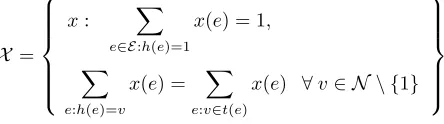
x(e) = 0otherwise. The set of valid hyperpaths is
defined as
X =
x: X
e∈E:h(e)=1
x(e) = 1,
X
e:h(e)=v
x(e) = X
e:v∈t(e)
x(e) ∀v∈ N \ {1}
The first problem we consider isunconstrained hy-pergraph search. Letθ ∈R|E|be the weight vector for the hypergraph and letτ ∈Rbe a weight offset.1 The unconstrained search problem is to find
max
x∈X
X
e∈E
θ(e)x(e) +τ = max
x∈X θ >
x+τ
This maximization can be computed for any weights and directed acyclic hypergraph in time
O(|E|) using dynamic programming. Figure 1 shows this algorithm which is simply a version of the CKY algorithm.
Next consider a variant of this problem: con-strainedhypergraph search. Constraints will be nec-essary for both phrase- and syntax-based decoding. In phrase-based models, the constraints will ensure that each source word is translated exactly once. In syntax-based models, the constraints will be used to intersect a translation forest with a language model. In the constrained hypergraph problem, hyper-paths must fulfill additional linear hyperedge con-straints. Define the set of constrained hyperpaths as
X0={x∈ X :Ax=b}
1
where we have a constraint matrix A ∈ R|b|×|E| and vector b ∈ R|b| encoding |b| constraints. The optimal constrained hyperpath is x∗ = arg maxx∈X0θ>x+τ.
Note that the constrained hypergraph search prob-lem may be NP-Hard. Crucially this is true even when the corresponding unconstrained search prob-lem is solvable in polynomial time. For instance, phrase-based decoding is known to be NP-Hard (Knight, 1999), but we will see that it can be ex-pressed as a polynomial-sized hypergraph with con-straints.
Example: Phrase-Based Machine Translation Consider translating a source sentencew1. . . w|w|to a target sentence in a language with vocabularyΣ. A simple phrase-based translation model consists of a tuple(P, ω, σ)with
• P; a set of pairs(q, r)whereq1. . . q|q| is a se-quence of source-language words andr1. . . r|r| is a sequence of target-language words drawn from the target vocabularyΣ.
• ω : R|P|; parameters for the translation model mapping each pair inP to a real-valued score.
• σ :R|Σ×Σ|; parameters of the language model mapping a bigram of target-language words to a real-valued score.
The translation decoding problem is to find the best derivation for a given source sentence. A derivation consists of a sequence of phrases p = p1. . . pn. Define a phrase as a tuple (q, r, j, k)
consisting of a span in the source sentence q = wj. . . wkand a sequence of target wordsr1. . . r|r|, with(q, r)∈ P. We say the source wordswj. . . wk aretranslatedtor.
The score of a derivation, f(p), is the sum of the translation score of each phrase plus the language model score of the target sentence
f(p) =
n X
i=1
ω(q(pi), r(pi)) +
|u|+1 X
i=0
σ(ui−1, ui)
where u is the sequence of words in Σ formed by concatenating the phrases r(p1). . . r(pn), with boundary casesu0 =<s>andu|u|+1=</s>.
Crucially for a derivation to be valid it must sat-isfy an additional condition: it must translate every source word exactly once. The decoding problem for phrase-based translation is to find the highest-scoring derivation satisfying this property.
We can represent this decoding problem as a con-strained hypergraph using the construction of Chang and Collins (2011). The hypergraph weights en-code the translation and language model scores, and its structure ensures that the count of source words translated is |w|, i.e. the length of the source sen-tence. Each vertex will remember the preceding target-language word and the count of source words translated so far.
The hypergraph, which for this problem is also a directed graph, takes the following form.
• Vertices v ∈ V are labeled (c, u) where c ∈ {1. . .|w|}is the count of source words trans-lated andu∈Σis the last target-language word produced by a partial hypothesis at this vertex. Additionally there is an initial terminal vertex labeled(0,<s>).
• There is a hyperedgee ∈ E with head(c0, u0)
and tailh(c, u)iif there is a valid corresponding phrase (q, r, j, k) such that c0 = c +|q| and
u0 =r|r|, i.e.c0is the count of words translated andu0 is the last word of target phrase r. We call this phrasep(e).
The weight of this hyperedge,θ(e), is the trans-lation model score of the pair plus its language model score
θ(e) =ω(q, r)+
|r|
X
i=2
σ(ri−1, ri)
+σ(u, r1)
• To handle the end boundary, there are hyper-edges with head 1 and tail h(|w|, u)i for all
u∈Σ. The weight of these edges is the cost of the stop bigram followingu, i.e.σ(u,</s>).
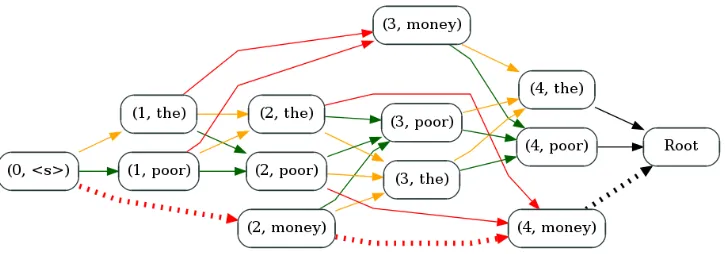
Figure 2: Hypergraph for translating the sentencew =les1pauvres2sont3demunis4with set of pairsP = {(les,the), (pauvres,poor), (sont demunis,don’t have any money)}. Hyperedges are color-coded by source words translated: orangeforles1,greenforpauvres2, andredforsont3demunis4. The dotted lines show an invalid hyperpathxthat has signatureAx=h0,0,2,2i 6=h1,1,1,1i.
We handle this problem by adding additional con-straints. For all source wordsi∈ {1. . .|w|}, define
ρas the set of hyperedges that translatewi
ρ(i) ={e∈ E :j(p(e))≤i≤k(p(e))}
Next define|w|constraints enforcing that each word in the source sentence is translated exactly once
X
e∈ρ(i)
x(e) = 1 ∀i∈ {1. . .|w|}
These linear constraints can be represented with a matrix A ∈ {0,1}|w|×|E| where the rows corre-spond to source indices and the columns correcorre-spond to edges. We call the product Ax the signature, where in this case(Ax)iis the number of times word
ihas been translated. The full set of constrained hy-perpaths isX0 ={x∈ X :Ax=1}, and the best derivation under this phrase-based translation model has scoremaxx∈X0θ>x+τ.
Figure 2.2 shows an example hypergraph with constraints for translating the sentence les pauvres sont demunis into English using a simple set of phrases. Even in this small exam-ple, many of the possible hyperpaths violate the constraints and correspond to invalid derivations.
Example: Syntax-Based Machine Translation Syntax-based machine translation with a language model can also be expressed as a constrained hyper-graph problem. For the sake of space, we omit the definition. See Rush and Collins (2011) for an in-depth description of the constraint matrix used for syntax-based translation.
3 A Variant of Beam Search
This section describes a variant of the beam search algorithm for finding the highest-scoring con-strained hyperpath. The algorithm uses three main techniques: (1) dynamic programming with ad-ditional signature information to satisfy the con-straints, (2) beam pruning where some, possibly op-timal, hypotheses are discarded, and (3) branch-and-bound-style application of upper and lower bounds to discard provably non-optimal hypotheses.
Any solution returned by the algorithm will be a valid constrained hyperpath and a member of X0. Additionally the algorithm returns a certificate flag
opt that, if true, indicates that no beam pruning was used, implying the solution returned is opti-mal. Generally it will be hard to produce a certificate even by reducing the amount of beam pruning; how-ever in the next section we will introduce a method based on Lagrangian relaxation to tighten the upper bounds. These bounds will help eliminate most so-lutions before they trigger pruning.
3.1 Algorithm
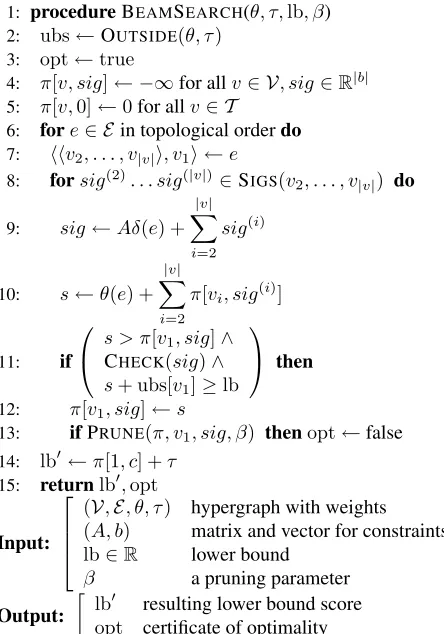
Figure 3 shows the complete beam search algorithm. At its core it is a dynamic programming algorithm filling in the chartπ. The beam search chart indexes hypotheses by vertex v ∈ V as well as a signature
re-turn the set of possible signature combinations
SIGS(v2, . . . v|v|) = |v|
Y
i=2
{sig:π[vi, sig]6=−∞}
where the product is the Cartesian product over sets. Line 8 loops over this entire set.2 For hypothesisx, the algorithm ensures that its signaturesigis equal toAx. This property is updated on line 9.
The signature provides proof that a hypothesis is still valid. Let the function CHECK(sig)return true if the hypothesis can still fulfill the constraints. For example, in phrase-based decoding, we will define CHECK(sig) = (sig ≤ 1); this ensures that each word has been translated 0 or 1 times. This check is applied on line 11.
Unfortunately maintaining all signatures is inef-ficient. For example we will see that in phrase-based decoding the signature is a bit-string recording which source words have been translated; the num-ber of possible bit-strings is exponential in the length of the sentence. The algorithm includes two meth-ods for removing hypotheses, bounding and prun-ing.
Bounding allows us to discard provably non-optimal solutions. The algorithm takes as arguments a lower bound on the optimal scorelb≤θ>x∗+τ, and computes upper bounds on the outside score for all vertices v: ubs[v], i.e. an overestimate of the score for completing the hyperpath from v. If a hypothesis has score s, it can only be optimal if
s+ ubs[v]≥lb. This bound check is performed on
line 11.
Pruning removes weak partial solutions based on problem-specific checks. The algorithm invokes the black-box function, PRUNE, on line 13, passing it
a pruning parameter β and a vertex-signature pair. The parameter β controls a threshold for pruning. For instance for phrase-based translation, it specifies a hard-limit on the number of hypotheses to retain. The function returns true if it prunes from the chart. Note that pruning may remove optimal hypotheses, so we set the certificate flagoptto false if the chart is modified.
2For simplicity we write this loop over the entire set. In
practice it is important to use data structures to optimize look-up. See Tillmann (2006) and Huang and Chiang (2005).
1: procedureBEAMSEARCH(θ, τ,lb, β) 2: ubs←OUTSIDE(θ, τ)
3: opt←true
4: π[v, sig]← −∞for allv∈ V, sig∈R|b|
5: π[v,0]←0for allv∈ T 6: fore∈ Ein topological orderdo
7: hhv2, . . . , v|v|i, v1i ←e 8: forsig(2). . . sig(|v|)∈SIGS(v
2, . . . , v|v|) do
9: sig←Aδ(e) + |v|
X
i=2 sig(i)
10: s←θ(e) + |v|
X
i=2
π[vi, sig(i)]
11: if
s > π[v1, sig]∧ CHECK(sig)∧
s+ ubs[v1]≥lb
then
12: π[v1, sig]←s
13: ifPRUNE(π, v1, sig, β) thenopt←false 14: lb0 ←π[1, c] +τ
15: returnlb0,opt
Input:
(V,E, θ, τ) hypergraph with weights
(A, b) matrix and vector for constraints
lb∈R lower bound
β a pruning parameter
Output:
lb0 resulting lower bound score
[image:5.612.312.534.59.376.2]opt certificate of optimality
Figure 3: A variant of the beam search algorithm. Uses dynamic programming to produce a lower bound on the optimal constrained solution and, possibly, a certificate of optimality. Function OUTSIDEcomputes upper bounds on outside scores. Function SIGSenumerates all possi-ble tail signatures. Function CHECKidentifies signatures that do not violate constraints. Bounds lb andubs are used to remove provably non-optimal solutions. Func-tion PRUNE, taking parameterβ, returns true if it prunes hypotheses fromπthat could be optimal.
This variant on beam search satisfies the follow-ing two properties (recall x∗ is the optimal con-strained solution)
Property 3.1 (Primal Feasibility). The returned score lb0 lower bounds the optimal constrained score, that islb0 ≤θ>x∗+τ.
Property 3.2(Dual Certificate). If beam search re-turns with opt = true, then the returned score is optimal, i.e. lb0 =θ>x∗+τ.
procedurePRUNE(π, v, sig, β) C ← {(v0, sig0) :||sig0||1=||sig||1,
π[v0, sig0]6=−∞} D ← C \mBEST(β,C, π)
π[v0, sig0]← −∞for allv0, sig0 ∈ D ifD=∅then returntrue
else returnfalse
Input:
(v, sig) the last hypothesis added to the chart
β∈Z # of hypotheses to retain
[image:6.612.330.517.513.577.2]Output: true, ifπis modified
Figure 4: Pruning function for phrase-based translation. SetCcontains all hypotheses with||sig||1source words translated. The function prunes all but the top-βscoring hypotheses in this set.
if we loosen the amount of beam pruning by adjust-ing the prunadjust-ing parameterβwe can produce tighter lower bounds and discard more hypotheses. We can then iteratively apply this idea with a sequence of parametersβ1. . . βK producing lower boundslb(1) throughlb(K). We return to this idea in Section 5.
Example: Phrase-based Beam Search. Recall that the constraints for phrase-based translation con-sist of a binary matrix A ∈ {0,1}|w|×|E| and vec-tor b = 1. The value sigi is therefore the num-ber of times source word i has been translated in the hypothesis. We define the predicate CHECK as CHECK(sig) = (sig ≤ 1) in order to remove hy-potheses that already translate a source word more than once, and are therefore invalid. For this reason, phrase-based signatures are calledbit-strings.
A common beam pruning strategy is to group together items into a set C and retain a (possibly complete) subset. An example phrase-based beam pruner is given in Figure 4. It groups together hypotheses based on ||sigi||1, i.e. the number of
source words translated, and applies a hard pruning filter that retains only the β highest-scoring items
(v, sig)∈ Cbased onπ[v, sig].
3.2 Computing Upper Bounds
Define the setO(v, x)to contain all outside edges of vertexvin hyperpathx(informally, hyperedges that do not havevas an ancestor). For allv∈ V, we set the upper bounds,ubs, to be the best unconstrained outside score
ubs[v] = max
x∈X:v∈x X
e∈O(v,x)
θ(e) +τ
This upper bound can be efficiently computed for all vertices using the standard outside dynamic pro-gramming algorithm. We will refer to this algorithm as OUTSIDE(θ, τ).
Unfortunately, as we will see, these upper bounds are often quite loose. The issue is that unconstrained outside paths are able to violate the constraints with-out being penalized, and therefore greatly overesti-mate the score.
4 Finding Tighter Bounds with Lagrangian Relaxation
Beam search produces a certificate only if beam pruning is never used. In the case of phrase-based translation, the certificate is dependent on all groups Chavingβ or less hypotheses. The only way to en-sure this is to bound out enough hypotheses to avoid pruning. The effectiveness of the bounding
inequal-ity, s+ ubs[v] <lb, in removing hypotheses is
di-rectly dependent on the tightness of the bounds. In this section we propose using Lagrangian re-laxation to improve these bounds. We first give a brief overview of the method and then apply it to computing bounds. Our experiments show that this approach is very effective at finding certificates.
4.1 Algorithm
In Lagrangian relaxation, instead of solving the con-strained search problem, we relax the constraints and solve an unconstrained hypergraph problem with modified weights. Recall the constrained hy-pergraph problem: max
x∈X:Ax=bθ
>x + τ
. The
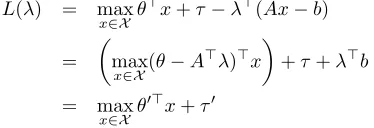
La-grangian dual of this optimization problem is
L(λ) = max x∈X θ
>x+τ−λ>(Ax−b)
=
max x∈X(θ−A
>λ)>x
+τ +λ>b
= max
x∈X θ
0>x+τ0
where λ ∈ R|b| is a vector of dual variables and define θ0 = θ −A>λ and τ0 = τ +λ>b. This maximization is overX, so for any value ofλ,L(λ)
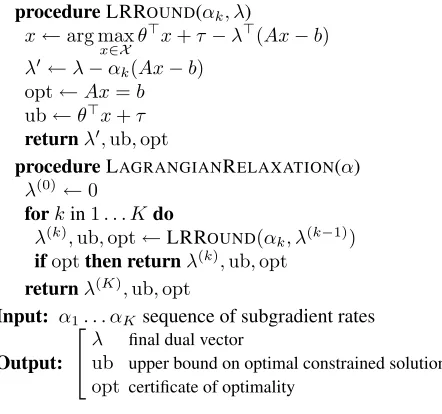
procedureLRROUND(αk, λ) x←arg max
x∈X θ
>x+τ−λ>(Ax−b)
λ0←λ−αk(Ax−b) opt←Ax=b
ub←θ>x+τ
returnλ0,ub,opt
procedureLAGRANGIANRELAXATION(α)
λ(0)←0
forkin1. . . Kdo
λ(k),ub,opt←LRROUND(α
k, λ(k−1))
ifoptthen returnλ(k),ub,opt
returnλ(K),ub,opt
Input: α1. . . αKsequence of subgradient rates
Output:
λ final dual vector
ub upper bound on optimal constrained solution
[image:7.612.74.295.59.266.2]opt certificate of optimality
Figure 5: Lagrangian relaxation algorithm. The algo-rithm repeatedly calls LRROUNDto compute the subgra-dient, update the dual vector, and check for a certificate.
wherex ∈ X is the hyperpath computed within the max,
Property 4.1(Dual Feasibility). The valueL(λ) up-per bounds the optimal solution, that is L(λ) ≥
θ>x∗+τ
Property 4.2 (Primal Certificate). If the hyperpath
x is a member of X0, i.e. Ax = b, then L(λ) =
θ>x∗+τ.
Property 4.1 states that L(λ) always produces some upper bound; however, to help beam search, we want as tight a bound as possible:minλL(λ).
The Lagrangian relaxation algorithm, shown in Figure 5, uses subgradient descent to find this min-imum. The subgradient of L(λ) is Ax−bwhere
x is the argmax of the modified objective x =
arg maxx∈Xθ0>x+τ0. Subgradient descent
itera-tively solves unconstrained hypergraph search prob-lems to compute these subgradients and updates λ. See Rush and Collins (2012) for an extensive discus-sion of this style of optimization in natural language processing.
Example: Phrase-based Relaxation. For phrase-based translation, we expand out the Lagrangian to
L(λ) = max x∈X θ
>x+τ−λ>(Ax−b) =
max x∈X
X
e∈E
θ(e)−
k(p(e))
X
i=j(p(e)) λi
x(e) +τ+
|s|
X
i=1 λi
The weight of each edgeθ(e) is modified by the dual variablesλifor each source word translated by the edge, i.e. if (q, r, j, k) = p(e), then the score is modified by Pk
i=jλi. A solution under these weights may use source words multiple times or not at all. However if the solution uses each source word exactly once (Ax = 1), then we have a certificate and the solution is optimal.
4.2 Utilizing Upper Bounds in Beam Search
For many problems, it may not be possible to satisfy Property 4.2 by running the subgradient algorithm alone. Yet even for these problems, applying sub-gradient descent will produce an improved estimate of the upper bound,minλL(λ).
To utilize these improved bounds, we simply re-place the weights in beam search and the outside al-gorithm with the modified weights from Lagrangian relaxation,θ0andτ0. Since the result of beam search must be a valid constrained hyperpath x ∈ X0, and for all x ∈ X0, θ>x+τ = θ0>x+τ0, this sub-stitution does not alter the necessary properties of the algorithm; i.e. if the algorithm returns withopt
equal to true, then the solution is optimal.
Additionally the computation of upper bounds now becomes
ubs[v] = max
x∈X:v∈x X
e∈O(v,x)
θ0(e) +τ0
These outside paths may still violate constraints, but the modified weights now include penalty terms to discourage common violations.
5 Optimal Beam Search
The optimality of the beam search algorithm is de-pendent on the tightness of the upper and lower bounds. We can produce better lower bounds by varying the pruning parameter β; we can produce better upper bounds by running Lagrangian relax-ation. In this section we combine these two ideas and present a complete optimal beam search algo-rithm.
[image:7.612.79.294.652.709.2]in stages. The algorithm first runs Lagrangian relax-ation to compute the best λ vector. The algorithm then iteratively runs beam search using the parame-ter sequenceβk. These parameters allow the algo-rithm to loosen the amount of beam pruning. For example in phrase based pruning, we would raise the number of hypotheses stored per group until no beam pruning occurs.
A clear disadvantage of the staged approach is that it needs to wait until Lagrangian relaxation is completed before even running beam search. Of-ten beam search will be able to quickly find an opti-mal solution even with good but non-optiopti-malλ. In other cases, beam search may still improve the lower boundlb.
This motivates the alternating algorithm OPT -BEAM shown Figure 6. In each round, the algo-rithm alternates between computing subgradients to tighten ubs and running beam search to maximize
lb. In early rounds we set β for aggressive beam pruning, and as the upper bounds get tighter, we loosen pruning to try to get a certificate. If at any point either a primal or dual certificate is found, the algorithm returns the optimal solution.
6 Related Work
Approximate methods based on beam search and cube-pruning have been widely studied for phrase-based (Koehn et al., 2003; Tillmann and Ney, 2003; Tillmann, 2006) and syntax-based translation mod-els (Chiang, 2007; Huang and Chiang, 2007; Watan-abe et al., 2006; Huang and Mi, 2010).
There is a line of work proposing exact algorithms for machine translation decoding. Exact decoders are often slow in practice, but help quantify the er-rors made by other methods. Exact algorithms pro-posed for IBM model 4 include ILP (Germann et al., 2001), cutting plane (Riedel and Clarke, 2009), and multi-pass A* search (Och et al., 2001). Zaslavskiy et al. (2009) formulate phrase-based decoding as a traveling salesman problem (TSP) and use a TSP decoder. Exact decoding algorithms based on finite state transducers (FST) (Iglesias et al., 2009) have been studied on phrase-based models with limited reordering (Kumar and Byrne, 2005). Exact decod-ing based on FST is also feasible for certain hier-archical grammars (de Gispert et al., 2010). Chang
procedureOPTBEAMSTAGED(α, β)
λ,ub,opt←LAGRANGIANRELAXATION(α) ifoptthen returnub
θ0←θ−A>λ τ0←τ+λ>b lb(0)← −∞ forkin1. . . Kdo
lb(k),opt←BEAMSEARCH(θ0, τ0,lb(k−1), βk)
ifoptthen returnlb(k)
returnmaxk∈{1...K}lb(k)
procedureOPTBEAM(α, β)
λ(0)←0 lb(0)← −∞ forkin1. . . Kdo
λ(k),ub(k)
,opt←LRROUND(αk, λ(k−1))
ifoptthen returnub(k)
θ0 ←θ−A>λ(k) τ0←τ +λ(k)>b
lb(k),opt←BEAMSEARCH(θ0, τ0,lb(k−1), βk)
ifoptthen returnlb(k)
returnmaxk∈{1...K}lb(k)
Input:
α1. . . αK sequence of subgradient rates β1. . . βK sequence of pruning parameters
[image:8.612.315.525.60.362.2]Output: optimal constrained score or lower bound
Figure 6: Two versions of optimal beam search: staged and alternating. Staged runs Lagrangian relaxation to find the optimalλ, usesλto compute upper bounds, and then repeatedly runs beam search with pruning sequence
β1. . . βk. Alternating switches between running a round
of Lagrangian relaxation and a round of beam search with the updatedλ. If either produces a certificate it returns the result.
and Collins (2011) and Rush and Collins (2011) de-velop Lagrangian relaxation-based approaches for exact machine translation.
Apart from translation decoding, this paper is closely related to work on column generation for NLP. Riedel et al. (2012) and Belanger et al. (2012) relate column generation to beam search and pro-duce exact solutions for parsing and tagging prob-lems. The latter work also gives conditions for when beam search-style decoding is optimal.
7 Results
decoders to several baseline methods.
7.1 Setup and Implementation
For phrase-based translation we used a German-to-English data set taken from Europarl (Koehn, 2005). We tested on 1,824 sentences of length at most 50 words. For experiments the phrase-based systems uses a trigram language model and includes standard distortion penalties. Additionally the unconstrained hypergraph includes further derivation information similar to the graph described in Chang and Collins (2011).
For syntax-based translation we used a Chinese-to-English data set. The model and hypergraphs come from the work of Huang and Mi (2010). We tested on 691 sentences from the newswire portion of the 2008 NIST MT evaluation test set. For ex-periments, the syntax-based model uses a trigram language model. The translation model is tree-to-string syntax-based model with a standard context-free translation forest. The constraint matrix A
is based on the constraints described by Rush and Collins (2011).
Our decoders use a two-pass architecture. The first pass sets up the hypergraph in memory, and the second pass runs search. When possible the base-lines share optimized construction and search code.
The performance of optimal beam search is de-pendent on the sequences α and β. For the step-size α we used a variant of Polyak’s rule (Polyak, 1987; Boyd and Mutapcic, 2007), substituting the unknown optimal score for the last computed lower bound: αk ← ub(k)−lb(k)
||Ax(k)−b||2 2
. We adjust the order of the pruning parameter β based on a function µ of the current gap:βk←10µ(ub(k)−lb(k)).
Previous work on these data sets has shown that exact algorithms do not result in a significant in-crease in translation accuracy. We focus on the effi-ciency and model score of the algorithms.
7.2 Baseline Methods
The experiments compare optimal beam search (OPTBEAM) to several different decoding
meth-ods. For both systems we compare to: BEAM, the beam search decoder from Figure 3 using the orig-inal weights θ and τ, and β ∈ {100,1000}; LR-TIGHT, Lagrangian relaxation followed by
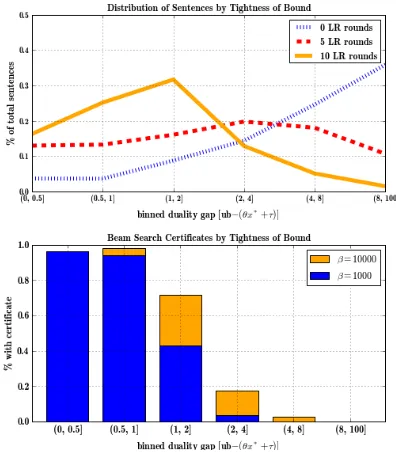
incre-Figure 7: Two graphs from phrase-based decoding. Graph (a) shows the duality gap distribution for 1,824 sentences after 0, 5, and 10 rounds of LR. Graph (b) shows the % of certificates found for sentences with dif-fering gap sizes and beam search parametersβ. Duality gap is defined as, ub - (θ>x∗+τ).
mental tightening constraints, which is a reimple-mentation of Chang and Collins (2011) and Rush and Collins (2011).
For phrase-based translation we compare with: MOSES-GC, the standard Moses beam search de-coder with β ∈ {100,1000} (Koehn et al., 2007); MOSES, a version of Moses without gap constraints more similar to BEAM (see Chang and Collins (2011)); ASTAR, an implementation of A∗ search using original outside scores, i.e. OUTSIDE(θ, τ), and capped at 20,000,000 queue pops.
For syntax-based translation we compare with: ILP, a general-purpose integer linear program-ming solver (Gurobi Optimization, 2013) and CUBEPRUNING, an approximate decoding method similar to beam search (Chiang, 2007), tested with
β ∈ {100,1000}.
7.3 Experiments
[image:9.612.323.521.65.291.2]11-20 (558) 21-30 (566) 31-40 (347) 41-50 (168) all (1824) Phrase-Based time cert exact time cert exact time cert exact time cert exact time cert exact
BEAM(100) 2.33 19.5 38.0 8.37 1.6 7.2 24.12 0.3 1.4 71.35 0.0 0.0 14.50 15.3 23.2
BEAM(1000) 2.33 37.8 66.3 8.42 3.4 18.9 21.60 0.6 3.2 53.99 0.6 1.2 12.44 22.6 36.9 BEAM(100000) 3.34 83.9 96.2 18.53 22.4 60.4 46.65 2.0 18.1 83.53 1.2 6.5 23.39 43.2 62.4
MOSES(100) 0.18 0.0 81.0 0.36 0.0 45.6 0.53 0.0 14.1 0.74 0.0 6.0 0.34 0.0 52.3
MOSES(1000) 2.29 0.0 97.8 4.39 0.0 78.8 6.52 0.0 43.5 9.00 0.0 19.6 4.20 0.0 74.6
ASTAR(cap) 11.11 99.3 99.3 91.39 53.9 53.9 122.67 7.8 7.8 139.61 1.2 1.2 67.99 58.8 58.8 LR-TIGHT 4.20 100.0 100.0 23.25 100.0 100.0 88.16 99.7 99.7 377.9 97.0 97.0 60.11 99.7 99.7 OPTBEAM 2.85 100.0 100.0 10.33 100.0 100.0 28.29 100.0 100.0 84.34 97.0 97.0 17.27 99.7 99.7 ChangCollins 10.90 100.0 100.0 57.20 100.0 100.0 203.4 99.7 99.7 679.9 97.0 97.0 120.9 99.7 99.7 MOSES-GC (100) 0.14 0.0 89.4 0.27 0.0 84.1 0.41 0.0 75.8 0.58 0.0 78.6 0.26 0.0 84.9 MOSES-GC (1000) 1.33 0.0 89.4 2.62 0.0 84.3 4.15 0.0 75.8 6.19 0.0 79.2 2.61 0.0 85.0
11-20 (192) 21-30 (159) 31-40 (136) 41-100 (123) all (691)
Syntax-Based time cert exact time cert exact time cert exact time cert exact time cert exact
BEAM(100) 0.40 4.7 75.9 0.40 0.0 66.0 0.75 0.0 43.4 1.66 0.0 25.8 0.68 5.72 58.7
BEAM(1000) 0.78 16.9 79.4 2.65 0.6 67.1 6.20 0.0 47.5 15.5 0.0 36.4 4.16 12.5 65.5
CUBE(100) 0.08 0.0 77.6 0.16 0.0 66.7 0.23 0.0 43.9 0.41 0.0 26.3 0.19 0.0 59.0
CUBE(1000) 1.76 0.0 91.7 4.06 0.0 95.0 5.71 0.0 82.9 10.69 0.0 60.9 4.66 0.0 85.0
[image:10.612.56.580.46.258.2]LR-TIGHT 0.37 100.0 100.0 1.76 100.0 100.0 4.79 100.0 100.0 30.85 94.5 94.5 7.25 99.0 99.0 OPTBEAM 0.23 100.0 100.0 0.50 100.0 100.0 1.42 100.0 100.0 7.14 93.6 93.6 1.75 98.8 98.8 ILP 9.15 100.0 100.0 32.35 100.0 100.0 49.6 100.0 100.0 108.6 100.0 100.0 40.1 100.0 100.0
Table 1: Experimental results for translation experiments. Column timeis the mean time per sentence in seconds,
certis the percentage of sentences solved with a certificate of optimality,exactis the percentage of sentences solved exactly, i.e.θ>x+τ =θ>x∗+τ. Results are grouped by sentence length (group 1-10 is omitted for space).
is seven times faster than the decoder of Chang and Collins (2011) and 3.5 times faster then our reim-plementation, LR-TIGHT. ASTARperforms poorly,
taking lots of time on difficult sentences. BEAMruns quickly, but rarely finds an exact solution. MOSES
without gap constraints is also fast, but less exact than OPTBEAMand unable to produce certificates.
For syntax-based translation. OPTBEAM finds a certificate on 98.8% of solutions with an average time of 1.75 seconds per sentence, and is four times faster than LR-TIGHT. CUBE (100) is an order of magnitude faster, but is rarely exact on longer sentences. CUBE (1000) finds more exact
solu-tions, but is comparable in speed to optimal beam search. BEAM performs better than in the phrase-based model, but is not much faster than OPTBEAM. Figure 7.2 shows the relationship between beam search optimality and duality gap. Graph (a) shows how a handful of LR rounds can significantly tighten the upper bound score of many sentences. Graph (b) shows how beam search is more likely to find opti-mal solutions with tighter bounds. BEAMeffectively uses 0 rounds of LR, which may explain why it finds so few optimal solutions compared to OPTBEAM.
Table 2 breaks down the time spent in each part of the algorithm. For both methods, beam search has the most time variance and uses more time on longer sentences. For phrase-based sentences, Lagrangian relaxation is fast, and hypergraph construction
dom-≥30 all
mean median mean median Hypergraph 56.6% 69.8% 59.6% 69.6% PB Lag. Relaxation 10.0% 5.5% 9.4% 7.6% Beam Search 33.4% 24.6% 30.9% 22.8% Hypergraph 0.5% 1.6% 0.8% 2.4% SB Lag. Relaxation 15.0% 35.2% 17.3% 41.4% Beam Search 84.4% 63.1% 81.9 % 56.1% Table 2: Distribution of time within optimal beam search, including: hypergraph construction, Lagrangian relax-ation, and beam search. Meanis the percentage of total time. Medianis the distribution over the median values for each row.
inates. If not for this cost, OPTBEAMmight be com-parable in speed to MOSES(1000).
8 Conclusion
In this work we develop an optimal variant of beam search and apply it to machine translation decod-ing. The algorithm uses beam search to produce constrained solutions and bounds from Lagrangian relaxation to eliminate non-optimal solutions. Re-sults show that this method can efficiently find exact solutions for two important styles of machine trans-lation.
[image:10.612.313.533.310.399.2]References
David Belanger, Alexandre Passos, Sebastian Riedel, and Andrew McCallum. 2012. Map inference in chains using column generation. InNIPS, pages 1853–1861. Stephen Boyd and Almir Mutapcic. 2007. Subgradient
methods.
Yin-Wen Chang and Michael Collins. 2011. Exact de-coding of phrase-based translation models through la-grangian relaxation. InProceedings of the Conference on Empirical Methods in Natural Language Process-ing, pages 26–37. Association for Computational Lin-guistics.
David Chiang. 2007. Hierarchical phrase-based transla-tion. computational linguistics, 33(2):201–228. Adria de Gispert, Gonzalo Iglesias, Graeme Blackwood,
Eduardo R. Banga, and William Byrne. 2010. Hierar-chical Phrase-Based Translation with Weighted Finite-State Transducers and Shallow-n Grammars. In Com-putational linguistics, volume 36, pages 505–533. Chris Dyer, Adam Lopez, Juri Ganitkevitch, Jonathen
Weese, Ferhan Ture, Phil Blunsom, Hendra Setiawan, Vlad Eidelman, and Philip Resnik. 2010. cdec: A decoder, alignment, and learning framework for finite-state and context-free translation models.
Ulrich Germann, Michael Jahr, Kevin Knight, Daniel Marcu, and Kenji Yamada. 2001. Fast decoding and optimal decoding for machine translation. In Proceed-ings of the 39th Annual Meeting on Association for Computational Linguistics, ACL ’01, pages 228–235. Inc. Gurobi Optimization. 2013. Gurobi optimizer
refer-ence manual.
Liang Huang and David Chiang. 2005. Better k-best parsing. In Proceedings of the Ninth International Workshop on Parsing Technology, pages 53–64. As-sociation for Computational Linguistics.
Liang Huang and David Chiang. 2007. Forest rescoring: Faster decoding with integrated language models. In
Proceedings of the 45th Annual Meeting of the Asso-ciation of Computational Linguistics, pages 144–151, Prague, Czech Republic, June. Association for Com-putational Linguistics.
Liang Huang and Haitao Mi. 2010. Efficient incremental decoding for tree-to-string translation. InProceedings of the 2010 Conference on Empirical Methods in Natu-ral Language Processing, pages 273–283, Cambridge, MA, October. Association for Computational Linguis-tics.
Gonzalo Iglesias, Adri`a de Gispert, Eduardo R. Banga, and William Byrne. 2009. Rule filtering by pattern for efficient hierarchical translation. InProceedings of the 12th Conference of the European Chapter of the ACL (EACL 2009), pages 380–388, Athens, Greece, March. Association for Computational Linguistics.
Kevin Knight. 1999. Decoding complexity in word-replacement translation models. Computational Lin-guistics, 25(4):607–615.
Philipp Koehn, Franz Josef Och, and Daniel Marcu. 2003. Statistical phrase-based translation. In Proceed-ings of the 2003 Conference of the North American Chapter of the Association for Computational Linguis-tics on Human Language Technology, NAACL ’03, pages 48–54.
Philipp Koehn, Hieu Hoang, Alexandra Birch, Chris Callison-Burch, Marcello Federico, Nicola Bertoldi, Brooke Cowan, Wade Shen, Christine Moran, Richard Zens, Chris Dyer, Ondˇrej Bojar, Alexandra Con-stantin, and Evan Herbst. 2007. Moses: Open source toolkit for statistical machine translation. In Proceed-ings of the 45th Annual Meeting of the ACL on Inter-active Poster and Demonstration Sessions, ACL ’07, pages 177–180.
Philipp Koehn. 2004. Pharaoh: a beam search decoder for phrase-based statistical machine translation mod-els.Machine translation: From real users to research, pages 115–124.
Shankar Kumar and William Byrne. 2005. Local phrase reordering models for statistical machine translation. InProceedings of Human Language Technology Con-ference and ConCon-ference on Empirical Methods in Nat-ural Language Processing, pages 161–168, Vancou-ver, British Columbia, Canada, October. Association for Computational Linguistics.
R. Kipp Martin, Rardin L. Rardin, and Brian A. Camp-bell. 1990. Polyhedral characterization of dis-crete dynamic programming. Operations research, 38(1):127–138.
Franz Josef Och, Nicola Ueffing, and Hermann Ney. 2001. An efficient A* search algorithm for statisti-cal machine translation. InProceedings of the workshop on Datadriven methods in machine translation -Volume 14, DMMT ’01, pages 1–8, Stroudsburg, PA, USA. Association for Computational Linguistics. Boris Polyak. 1987. Introduction to Optimization.
Opti-mization Software, Inc.
Sebastian Riedel and James Clarke. 2009. Revisiting optimal decoding for machine translation IBM model 4. InProceedings of Human Language Technologies: The 2009 Annual Conference of the North American Chapter of the Association for Computational Linguis-tics, Companion Volume: Short Papers, pages 5–8. As-sociation for Computational Linguistics.
Natural Language Learning, pages 732–743. Associa-tion for ComputaAssocia-tional Linguistics.
Alexander M Rush and Michael Collins. 2011. Exact decoding of syntactic translation models through la-grangian relaxation. In Proceedings of the 49th An-nual Meeting of the Association for Computational Linguistics: Human Language Technologies, vol-ume 1, pages 72–82.
Alexander M Rush and Michael Collins. 2012. A tutorial on dual decomposition and lagrangian relaxation for inference in natural language processing. Journal of Artificial Intelligence Research, 45:305–362.
Christoph Tillmann and Hermann Ney. 2003. Word re-ordering and a dynamic programming beam search al-gorithm for statistical machine translation. Computa-tional Linguistics, 29(1):97–133.
Christoph Tillmann. 2006. Efficient dynamic pro-gramming search algorithms for phrase-based SMT. In Proceedings of the Workshop on Computationally Hard Problems and Joint Inference in Speech and Lan-guage Processing, CHSLP ’06, pages 9–16.
Taro Watanabe, Hajime Tsukada, and Hideki Isozaki. 2006. Left-to-right target generation for hierarchical phrase-based translation. InProceedings of the 21st International Conference on Computational Linguis-tics and the 44th annual meeting of the Association for Computational Linguistics, ACL-44, pages 777–784, Morristown, NJ, USA. Association for Computational Linguistics.