RHODES UNIVERSITY DEPARTMENT OF EDUCATION
An exploration of problems experienced in the illterpretation of word problems by grade 12 leamers
Submitted by
Christian N. Neshuku
In partial fulfillment of the requirement for the degree of Master in Education (MATHEMATICS)
ABSTRACT
This research sought to investigate the problems experienced in the interpretation of word problems by senior secondary school learners, in particular to see how the language used in the articulation of word problems affects the interpretation. The study was conducted in a school in the Oshikoto region of Namibia, a school located in a semi-rural area of Namibia, and selected owing to the accessibility of the required participants. The research was located within an interpretive paradigm focusing on a study sample of 40 learners from a specified class in the selected school. Data were collected through written tests and a semi-structured interview based on written tests, and a comprehensive descriptive analysis of test results was prepared.
The findings of the study indicate that the language in which the word problem was articulated did not make a difference. The performance in both English and Oshindonga tests was almost the same. The findings also indicate that vocabulary, syntactic interpretation, semantic relationships, algebraic skills, and practical sense making in relation to real-life are all important for the successful interpretation and solving of word problems.
In view of these findings, the study has provided valuable insights into aspects of the teacher education curriculum that need to be revisited in order to improve the training of teachers In teaching word problems.
ACKNOWLEDGEMENTS
I would like to express my deep and sincere gratitude to all those learners who participated in this study, to the Acting Principal at the time, to the Principal of Omandengu Gomusilo Senior Secondary School for giving me permission to conduct my research in his school, and to the teachers who were so willing to help me in administering the tests. I wish also to extend my gratitude to the Director of the Oshikoto Education Region for permission to conduct this study in one of the schools in her region.
This research could not have been completed without the invaluable guidance, support and advice of my supervisor, Dr Bruce Brown. I am extremely grateful for his unwavering commitment in the many challenging days he spent in discussion with me and reading all my drafts. I also wish to acknowledge Mr Robert Kraft's assistance.
I would also like to acknowledge the following persons for their direct or indirect contributions to the success of this study. They are Pastor Jatileni, Dr Marc Shafer, the Matron of the National Institute for Educational Development (NIED), Mrs Nghihalwa-Amoomo, Mr Shipanga, and Mr Ekongo.
My deepest appreciation goes to my girlfriend for her professional understanding, and for giving me time to concentrate on this study. I wish also to extend my appreciation to my parents for their love and support, and for understanding my excuses throughout the past two years. Finally, I give thanks to God the Almighty who gave me the strength to complete this research.
ACRONYMS USED IN THIS STUDY CWI: Consistent with Interpretation
DNEA: Directorate of National Examinations and Assessment
DVI: Definite Validation ofInterpretation
NIED: National Institute for Educational Development
DI: Different Interpretation
NoI: No Information
Fencii, in~ :-;;;:;.;'~:; Q::<" highlighting ruin hooks
for other readers. TABLE OF CONTENTS
ABSTRACT... ii
ACKNOWLEDGEMENTS... ... ... iii
ACRONYMS USED IN TillS STUDy... ... ... iv
TABLE OF CONTENTS... ... ... v
CHAPTER ONE... 1
INTRODUCTION ... 1
1.1 Introduction... 1
1.2 Background to the study ... . 1.3 Research questions ... 3
1 .4 Structure of the thesis.. .. ... . .... ... .... ... .... . .. . .. . .. .. .. . .. .. .. .... ... ... .. . .. ... 3
CHAPTER TWO ... 5
LITERATURE REVIEW... 5
2.1 Introduction... 5
2.2 Word problem ... 6
2.2.1 What is a word problem? ... 6
2.2.2 Two type of word problems ... 7
2.2.2.1 Abstract word problem ... 7
2.2.2.2 A contextual word problem ... 8
2.5 The role of semantic structure in understanding a word problem... 10
2.5.\ What is semantic structure? ... II 2.5.2 Roles of semantic structure of word problems in learners' ability to interpret and identify correct solution strategies.. . . ... . .... . . . .... .. . ... .. . ... . .. .. .. . . .. . . .. . .. .. II 2.5.3 Language and Concepts.. ... ... ... ... 14
2.6 Language in word problems... ... ... 14
2.6.1 Vocabulary... ... 15
2.6.2 Syntactic structure of the word problem ... 16
2.7 Language verses semantic structures ... 17
2.8 The effects on solving mathematical word problem stated in student's first and second language ... 18
2.9 Algebra... 20
2.9.1 Equality formulation... 20
2.9.2 Manipulation of algebraic equation... 21
2.10. Conclusion ... 23
CHAPTER THREE... 24
RESEARCH METHODOLOGy... ... ... ... ... ... 24
3.1 Introduction... 24
3.2 Research site... 24
3.2.1 Location and regional context... ... 24
3.3 Research design... ... ... .... ... 25
3.4 Research Methodology... ... ... ... ... 26
3.4.2 Data collection... ... ... ... ... 27
3.4.3 Tests... ... ... 27
3.4.4 Choice and Alignment of questions... 27
3.4.5 Interviews... 28
3.4.6 Pilot test of the instruments ... 29
3.5 Data analysis.... ... .... ... ... 30 3.6 Triangulation... ... ... ... 31 3.7 Ethical standards... ... ... ... 32 3.8 Limitations ... 32 3.9 Conclusion ... 33 CHAPTER FOUR........ 34 ANALySIS... ... ... ... ... ... ... ... ... 34 4.1 Introduction ... 34 4.2 Initial analysis ... 34
4.2.1 Discussion ofthe approach ... 34
4.2.2. Detailed examples ... 36
4.2.2.1 Problem 1... 36
4.2.2.2. Problem 8 ... 42
4.3 Emergent themes ... 47
4.3.1 Language related issues ... 47
4.3.1.1 Vocabulary ... 47
4.3.2.1 Concept-related issues of the problem text... ... ... 48
4.3.2.2 Failure to relate the problem to practice... ... .... ... ... 50
4.3.3 Algebra... 50
4.3.3.1 Equality formulation... ... ... ... ... ... ... 50
4.3.3.2 Manipulation of algebraic equations... 51
4.3.3.3. Inconsistent use of a variable... ... 52
4.3.4 Making sense of the statement but not representing it into a useful solution strategy... ... ... 52
4.3.5 Minor errors... ... 53
4.4 Full thematic analysis.... ... ... ... ... ... ... 54
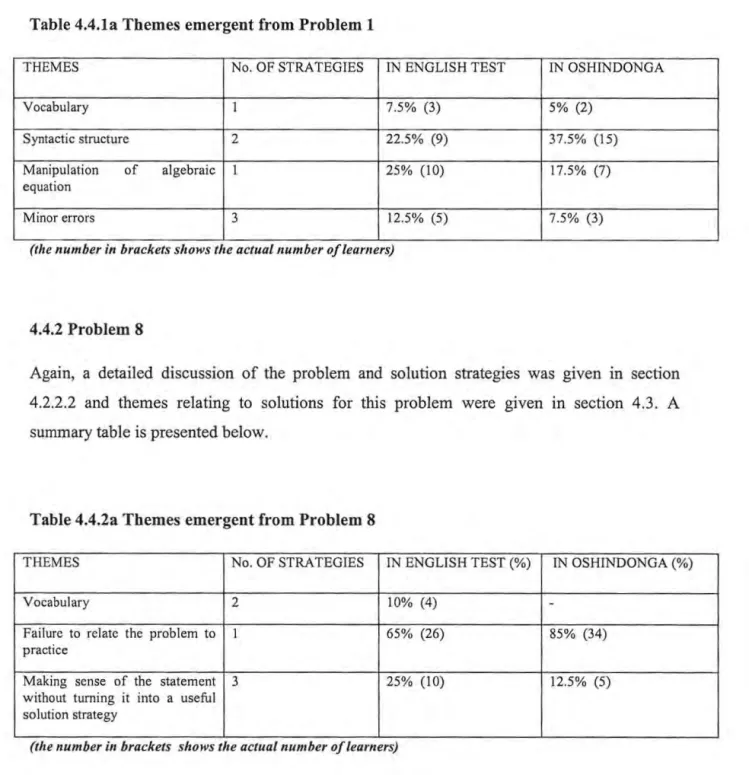
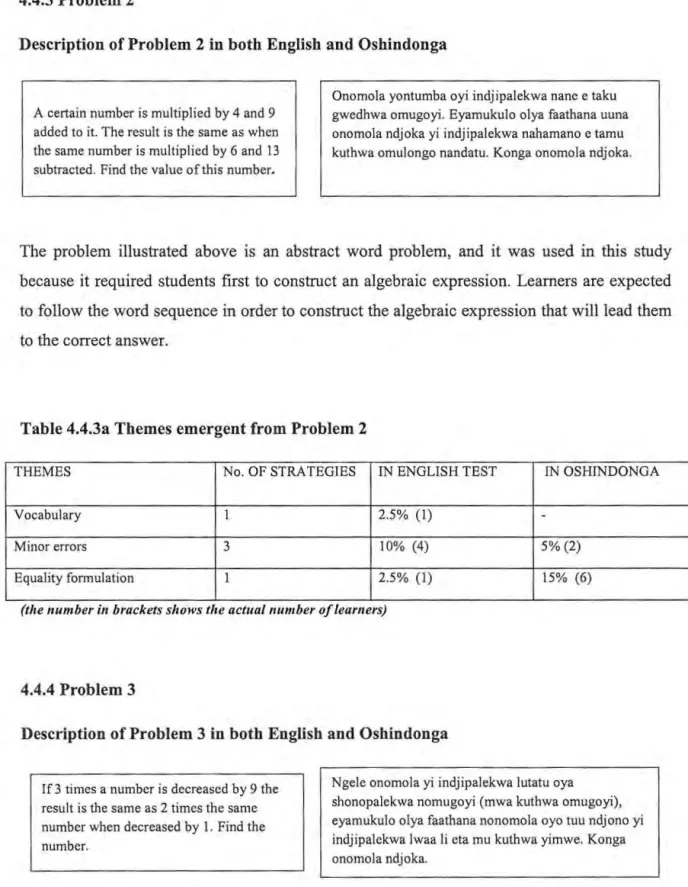
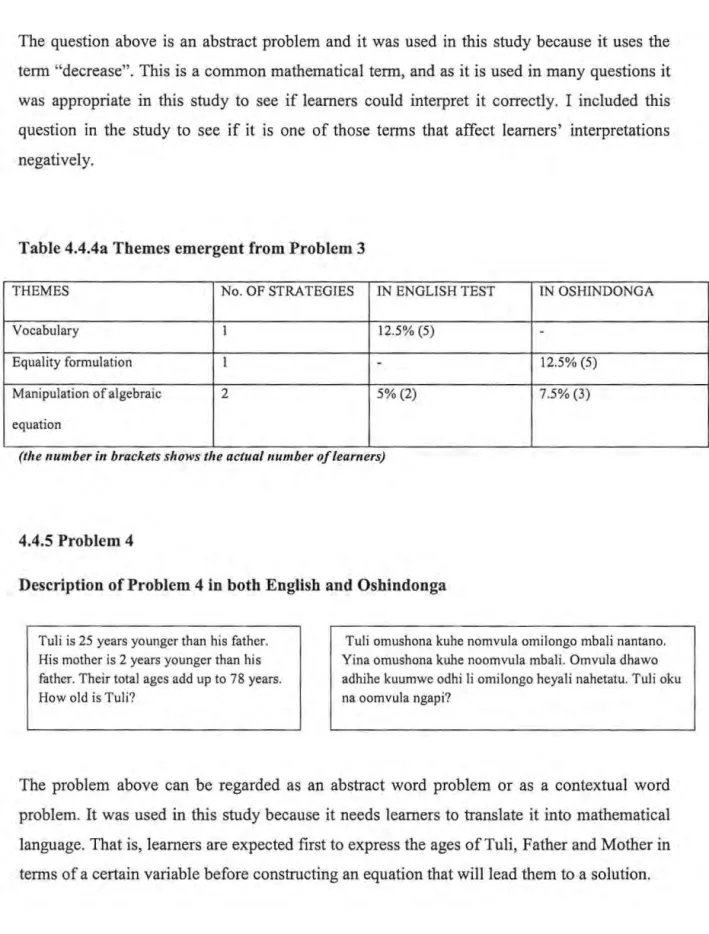
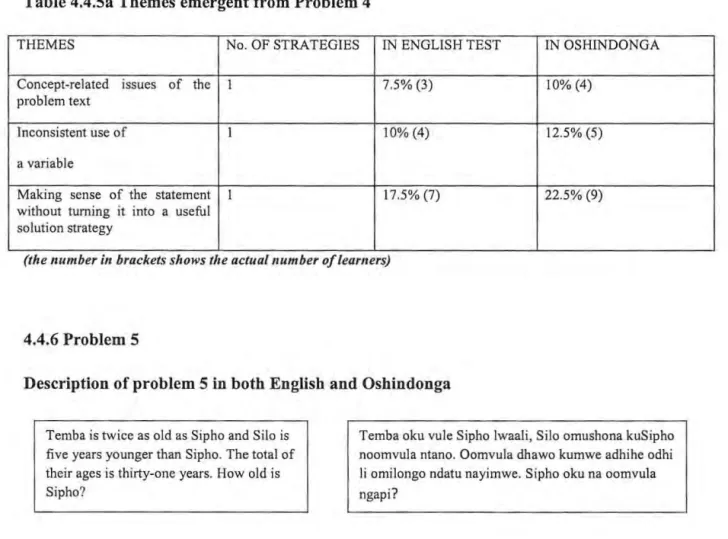
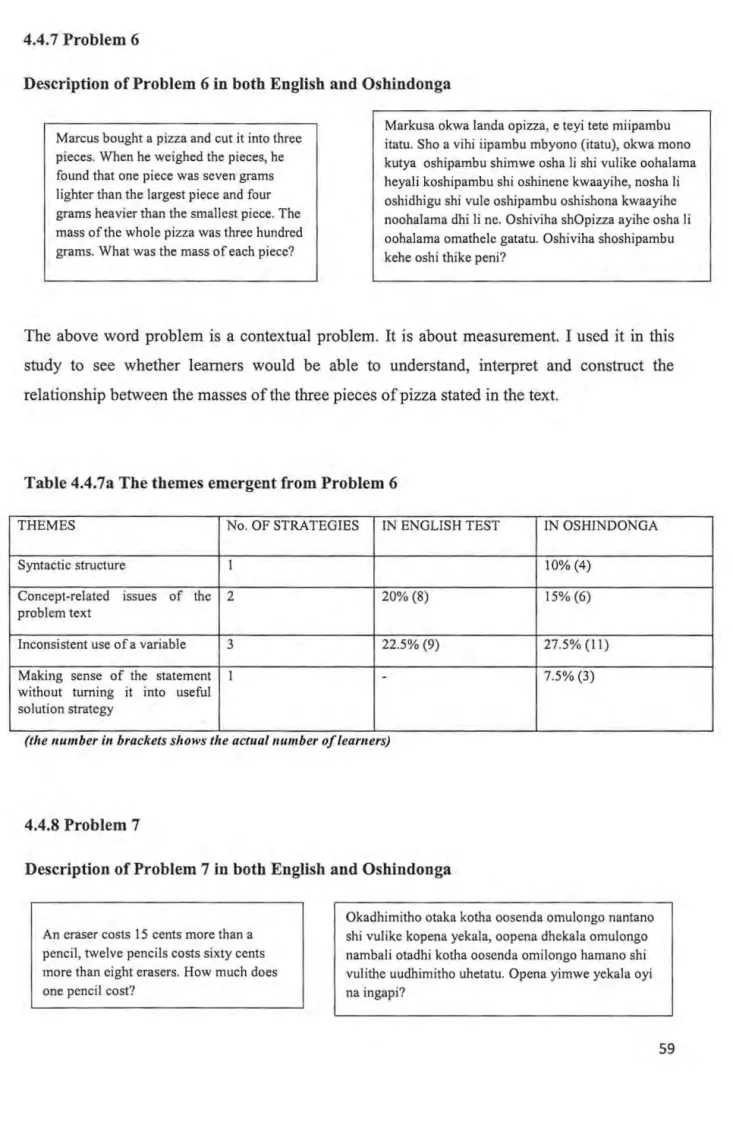
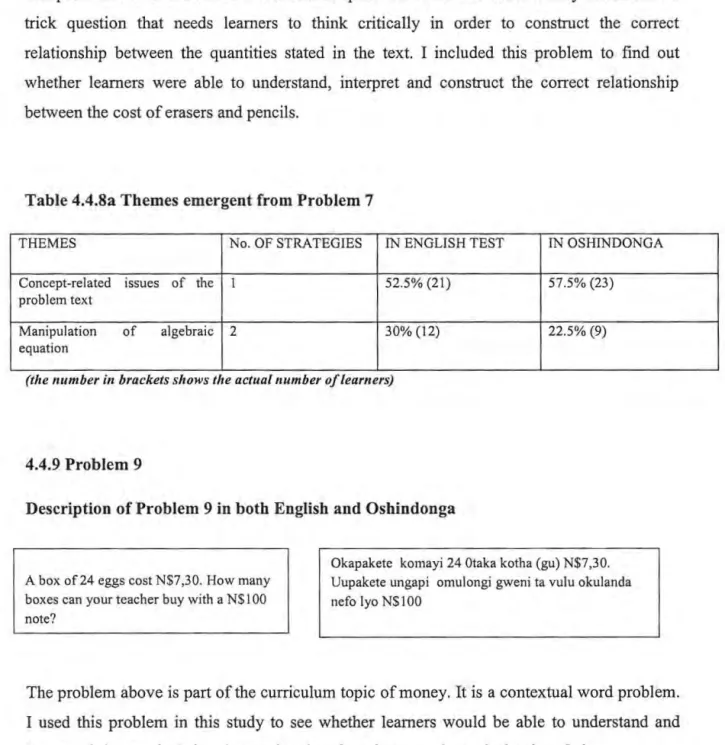
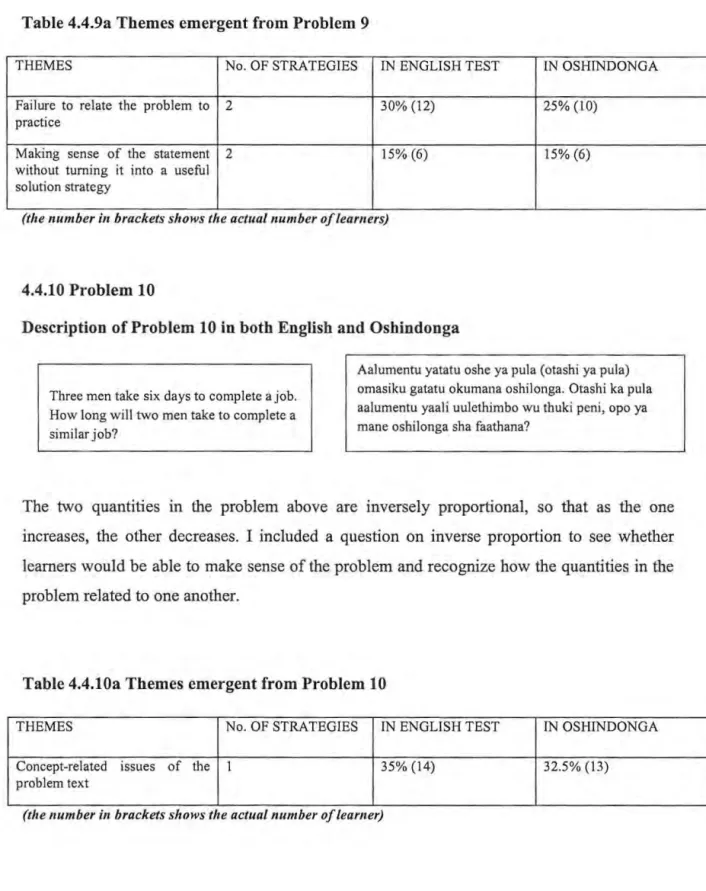
4.4.1 Problem I... ... ... 54 4.4.2 Problem 8... ... 55 4.4.3 Problem 2... ... 56 4.4.4 Problem 3... ... 56 4.4.5 Problem 4... 57 4.4.6 Problem 5 ... 58 4.4.7 Problem 6.. ... ... ... ... ... 59 4.4.8 Problem 7... ... 59 4.4.9 Problem 9... 60 4.4.10 Problem 10 ... 61 4.5 Conclusion ... 62
CHAPTER FIVE ... 63
DISCUSSION OF FINDINGS... ... ... 63
5.1 Introduction ... 63
5.2 Vocabulary... 63
5.3 Syntactic structure... 64
5.4 Concept-related issues of the problem text.. ... 65
5.5 Failure t relate to problem to practice... ... ... 66
5.6 Equality formulation ... " ... ' ... ,,' .. ' ... "." ... "." .. 67
5,7 Manipulation of algebraic equations" ." .. , " ... " . " " .. " " . " ' .. " .. " .. , .. " " , " "." 68 5,8 Making sense of the statement without turning it into a useful solution strategy ... 68
5,9 General Comments ... "" .. ""." .. " ... """""" .. "".,, ... , ... 69 5,10 Conclusion,.",., ... ,., .... , ... , ... ,., .. " .. ,',."., .. " .. ,.,', ... ,... 71 CHAPTER SIX... ... ... ... ... ... ... 72 CONCLUSION... ... ... ... 72 6, I Introduction."... 72 6.2 Summary of Findings. ... ... ... 72
6.3 Implications and Recommendations... 73
6.4 Significance of the Study... ... ... ... ... ... 74
6.5 Limitations of the Study... ... ... 75
6.6 Avenue for Future Research... ... ... 75
REFERENCES... 77
APPENDICES... ... ... ... ... 83
Appendix 1: Initial Analysis. . .. . . .. . . .. . . .. . ... . .. . .. . .. . .. . .. . . .. . . . .. .. . . ... 83
Appendix 2: Mathematics test 1 and 2. ... ... ... ... ... ... ... ... 118
Appendix 3: Transcription of interviews. . . .. . . .. . .. . . ... . .. . .. . . .. . .. . .... .. . . . 122
1.1 Introduction
CHAPTER ONE
INTRODUCTION AND BACKGROUND TO STUDY
This chapter provides an overview of the study. It starts by explaining why research of this nature was undertaken. The chapter highlights the background detail of the study, research questions, research approach and context, and finally gives a brief summary of the structure of the whole thesis.
1.2 Background to the study
In the area of learning mathematical word problems, one understands and masters a variety of mathematical skills, knowledge, concepts and processes in order to investigate and interpret numerical and spatial relationships and patterns that exist in the world (Schoenfeld, 1992).
Everybody uses mathematical word problems in their daily lives (Bernardo, 2002).
In my experience as a mathematics teacher, I have noticed that word problems playa vital
role in questions which are used in assessing learners' progress, particularly in higher grades. Also, the main problem that I have encountered while working with learners in the mathematics classroom is solving word problems correctly. Therefore, I became interested in the question of why learners perform poorly in solving word problems. My learners all study mathematics through English as the medium of instruction; and it is their second language.
Problem in solving word problems is not a new issue in mathematics education, and it has attracted many researchers, who have approached it from different angles (Schoenfeld, 1992).
Most researchers agree that "solving word problems in mathematics is influenced by linguistic factors" (Bernardo & Mariss, 2005: 1).
Some claim that factors such as "irrelevant numerical and linguistic information, mathematical terminology and the vocabulary level contained within the word problems can make the wording particularly difficult to understand" (Garderen, 2004: 226). However, Bernardo and Mariss (2005: 6) feel that "solving math word problems may not be a linguistically dependent phenomenon". Instead it was "likely to be associated with the problem modelling strategies that students were taught by their previous teachers".
According to Frey and Hohn (2002), finding a solution to word problems involves several phases: firstly, problem translation in which factual information in the problem statement is interpreted followed by problem integration in which knowledge of problem types is used to form an integrated structure of the relationships within the problem. The next phase is solution planning, in which learners select a solution procedure, and then use this to solve the problem and get the answer. After this process a learner will try to make sense of the answer by using solution execution and monitoring. The interpretation of problems in order to ultimately form an expression that leads to the solution depends on how well one understands the language used in those word problems (Warren, 2003).
Warren (2003: 3) states that "the main reason children have problems with solving word problems in mathematics is the learning of vocabulary". That is, a child needs to understand the vocabulary used and should be able to attach the meaning to everyday life. Having such an understanding could enable them to solve the word problem correctly. Other studies (Hubbard, 2003) indicate that translating word problems into expressions that lead to solution strategies not only depends on cognitive development but on various environmental factors. For example, how clearly the instructions are introduced to learners and also how well language used can be understood by learners (Hubbard, 2003).
Bernardo and Mariss (2005) explain that students performed better if the word problem was presented in their first language than if it were in their second language. This was because learners had a better comprehension of the problems, and thus the translation of the word problems to an expression that led to solution was more likely to be successful.
These different points of view prompted me to investigate the role of the language in which given word problems are articulated in the interpretation of word problems.
Sense-making in word problems (Schoenfeld, 1992) is something that needs to be addressed, particularly in the Namibian context where many learners study mathematics through English, which is their second language. This research aims to provide some insight into the role that language plays in the interpretation of word problems in order to form solution strategies. In particular, it may provide information about how learners make sense of word problems that are stated in English and in their home language.
1.3 Research question
The aim of this research was to investigate the interpretation of word problems by learners, and in particular to see how the language used in the articulation of word problems affects their interpretation. To achieve this goal, I investigated the following questions:
• How successful are learners in solving word problems stated in English or in their mother tongue?
• How do learners interpret, or make sense of, word problems stated in English or in their mother tongue?
• How do learners' interpretations of the word problems relate to their solution attempts?
1.4 Structure of the thesis
This document is structured as follows:
Chapter One provides an introduction to the study. It begins with background of the study and explains what prompted me to undertake this research. It also describes the research questions. Chapter Two gives an overview of the literature that shaped and informed this research, and provides the foundation to the study.
Chapter Three gives an overview of my research design and the methodology followed. I start by providing a brief overview of the research site, including location and regional context. I then describe the design and use of the different data collection tools such as tests and semi-structured interviews to investigate the problems experienced in interpreting word problems and developing solution strategies.
Chapter Four presents the analysis of the data collected using instruments described in Chapter 3.
Chapter Five discusses the findings in the light of the research questions and the literature reviewed in Chapter 2.
Chapter Six formulates a conclusion to the study. It provides the summary of the main findings, a number of implications and recommendations, and the areas that need further study in the same field so as to explore the other issues that emerge in this investigation. It also indicates the potential value of carrying out this work in Namibia.
CHAPTER TWO
LITERATURE REVIEW
Matbematics and word problems 2.1 Introduction
This chapter gives an overview of the literature that shaped and informed this research, and provides the foundation to the proposition for this study. My proposition for investigation in this study is that the particular language used in stating word problems could be an
important factor contributing to poor peiformance in solving such problems.
I start by defining what a word problem is, and also indicate the importance of word problems in mathematics. As this study is located within the Namibian context, I then give a
brief overview of word problems in Namibian education policy. This is followed by
discussion of semantic relations. I explain what the semantic structure of a word problem is, and how it plays a role in learners' ability to interpret and identify the correct solution strategies. Then
• I analyze the language and interpretation of word problems by looking at the representation of the problems, and show how language plays a role in translating word problems into solution strategies.
• I discuss the conflict between the semantic setting and language issue by discussing how learners develop the understanding required to interpret a word problem. In this section I discuss the implications of the 'semantic' and 'language' approaches for this study.
• I discuss related research in the study of bilingual word problems. In this section I look at specific results about 'comparisons' of comparative work discussed earlier in this chapter.
• I end this chapter by discussing the role played by algebraic skills in the interpretation and solving of word problems.
2.2 Word problems
According to Durkin (1991), word problems playa vital role in assessing learners' progress, particularly in grades 8-12 of high schools. This indicates that many mathematical exercises are given to learners as word problems. For example, two or more related pieces of information are presented, and the learners' task is to supply a missing number or required number by performing the appropriate mathematical operations and skills. Here is a typical example "A bottle has a mass of 280g when empty. When it is full of water, the total mass is 540g. What is the total mass, when the bottle is half full of water?" Frobisher (1994) states that word problems are excellent classroom examples of the task-environment, goal-oriented views of problems. Unfortunately, many learners perform poorly in solving word problems.
2.2.1 What is a word problem in mathematics?
Sam and Valentine (2004) define a word problem as a description of a problem situation in which some quantities are made explicit in the problem, while others are implicit. On the other hand, Stapel (2000) defines a word problem as a question which needs the use of mathematics skills in order to achieve a solution, but in which the requirement of procedures has first to be extracted from within sentences. For example, "a Mathematics class has 5 more girls thall boys alld there are 31 learners altogether. Find the number of boys in the mathematics class." Here, a learner needs to translate the problem text into algebraic expressions, as in "the number of girls in the classroom can be represented by x
+
5, and the number of boys can be represented by a variable x." Then a learner needs to form an equation, such as x+
x+
5=
31. It will be after forming an equation that a learner can manipulate it to find the number of boys in the classroom.This research states that "the word problems are often not particularly novel, being frequently simply another way of providing practice of simple algorithms. Indeed, they often only require the application of the four rules, which are addition, subtraction, multiplication and division" (Stapel, 2000: 172).
For the purpose of this research, I define a word problem as a statement describing a situation and a question, given in words (in sentence form), which requires learners to do the
following:
• Develop an understanding of the relationship between quantities given.
• Know the meaning of all or some key concepts used in the problem (this includes the key words or terms).
• Make sense of the problem text and see if it requires application of real life considerations when finding the solution.
• Interpret and develop solution strategies.
• Use those strategies to solve the problem.
2.2.2 Two types of word problem
For this research, I explore and discuss two types of word problems. The first type is abstract
and the second is contextual. The next section discusses these two types.
2.2.2.1 Abstract word problems
This type of word problem is referred to as a "story problem" set in the words using a
language such as English, but lacking real life context (Toom, 1999). This is more common
in abstract mathematics because it is often found at the end of a set of algorithmic exercises
in many mathematics textbooks. Learners are expected to apply mathematical algorithms in a pseudo real-life context (Polya, 1957).
For example, Petrus thinks of a number. He subtracts three from the number, doubles the answer and then gets an answer of 12. Find the number Petrus was thinking of It must be noted that this example does not provide any real-life context. It is the absence of a context that makes it abstract by this definition. This form of word problem can also be referred to as a mathematical question which is in symbolic mode, but expressed in words.
2.2.2.2 A contextual word problem
"A problem is contextualized if the mathematical practices in which students engage are integrated in a larger array of meaningful practices" (Roth, 1996: 487). This means contextual word problems are any problems that arise naturally in real world contexts and need mathematics skills for their solution. These problems are thus set in a real world context. Such problems can vary from being very simple, one-step arithmetic word problems, to highly complex problems. For example, "what will be the effect on the climate in Namibia
if
the world's exhaust emission remains at the current level?" This question needs one to use a higher order of critical thinking. And it should be answered by a student who understands what 'exhaust emission' is in everyday life.Both types of word problems (contextual and abstract) can vary from simple, one step calculations to highly complex interpretations and operations. Roth (1996) states that, problem solving of these types is a complex cognitive activity requiring students to see relationships in order to gain meaning and interpret them correctly in order to develop a solution strategy.
2.3 The importance of word problems in mathematics
This section discusses the importance of abstract and contextual word problems in mathematics. Abstract word problems are less relevant than concrete ones for real life, but are essential in mathematics for the development of critical thinking when approaching problems in practical life. Abstract problems can be used to train students to think creatively and develop problem-solving abilities (De Corte, Greer & Verschaffel, 2000).
Greeno and Riley (1987) suggest that through interpreting and solving contextual word problems learners see how they can use mathematics in everyday life, as they help learners with the following:
• They help them understand the part which mathematics plays in the world around them.
• They enable learners to recognise when and how a situation may be represented mathematically.
• They develop in learners the ability to apply mathematics in other disciplines.
• They develop the ability to understand, interpret and make sense of everyday
situations in mathematical terms.
2.4 Word problems in Namibian education policy
According to Namibian education policy, one of the major goals in mathematics is to "provide all learners with opportunities to shape the conditions which govern their access to knowledge, skills and understanding in classrooms and schools" (Namibia. Ministry of
Education (MoE), 2006: 5). Learners are viewed as active mathematical thinkers who try to construct meaning and make sense for themselves of what they are doing on the basis of their personal experience (Namibia. MoE, 2006)
National subject policy (Namibia. MoE, 2006) states clearly that in learner-centred education, word problems, with various structures, are recommended to be used, and learners should find solutions by first making sense of the problem text, and then interpreting it in a way that leads them to a solution strategy.
National subject policy (Namibia. MoE, 2006) specifically underlines the importance of the use of word problems in the Namibian mathematics curriculum:
Mathematics is one of the subjects with high demands in today's competitive world. We always apply mathematics' word problems in everyday life, for instance, when we do shopping (cheap/expensive), when we travel (distance, speed and time), when we do planning, etc. Hence everybody needs a basic knowledge of mathematics. In the mathematical area of learning, learners understand and master a variety of mathematical skills, knowledge, concepts and processes, in order to investigate and interpret numerical and spatial relationships and patterns that exist in the world. Word problems in mathematics help learners to develop accuracy as well as logical and analytical thinking, and apply them to other areas of learning and real life.
The policy stresses that by solving word problems in the classroom, learners could be equipped with skills to use mathematics in everyday life situations such as shopping or calculating of speeds, distances or time. For example, "Jeff takes 10 minutes to walk 1 kilometer. Find his average walking speed in kilometers per hour". Or "When the mass oj Jertilizer in a bag is reduced by 30kg, I need to buy 10 more bags to get 75kg oJJertilizer.
What was the mass beJore the reduction?" These are some examples of word problems that are used in Namibian classrooms. It is therefore very important for learners to understand and be able to interpret the problems in order to represent a word problem correctly. This enables them to apply mathematics skills in their everyday life.
Contextual word problems could help learners to recognise the relationship between what they learn at schools and what they bring to schools from home. According to Bernardo and Mariss (2005), word problems are an integral part of mathematics education in most parts of the world because these problems allow students to apply their mathematics knowledge and skills to real world situations. To solve a word problem correctly, a student needs to understand and interpret problems in way that leads hirn/her to obtain correct solutions. Fennema and Romberg (1999) claim that learners need to be able to construct relationships between quantities in the text.
2.5. The role of semantic structure in understanding a word problem
In this section, I discuss what semantic structure is and the skills required to understand the structure underlying word problems. I then discuss the role played by the semantic structure of word problems in learners' ability to interpret and identify the correct solution strategies required to solve the word problems. I conclude by introducing the debate about language versus mathematical concepts.
2.5.1 What is semantic structure?
From a mathematical point of view, semantic structure can be defined as the relationship between the words and meaning of the statement given. According to De Corte, Greer and Verschaffel (2000), semantic structure refers to the meaning of the statements in the problem and their interrelationships. "By semantic relations we refer to the conceptual knowledge about increases, decreases, combinations and comparisons involving sets of objects and others" (Cummins, 1991: 262).
Fennema and Romberg (1999) claim that, taking the view of semantic structure and relations, learners are required to use questions like: "what are you talking about or what is asked here? What is being given here? What is talked about? What are the key concepts in this statement? And what are the relations between words and the things talked about?" (pg 20).
These are some of the questions that are suggested to help learners to get the meaning of a statement given and also help learners to develop an understanding of the statement and develop correct relationship between quantities. Similarly, Garderen (2004) says that learners are expected to match their problem solving strategies to the structure of the problem. The section below explores the role of semantic structure of word problems on learners' ability to interpret and identify the correct solution strategy.
2.5.2. Roles of semantic structure of word problems on learners' ability to interpret and identify correct solution strategies.
Research shows that learners are required to understand structures underlying word problems. Sam and Valentin (2004) indicate that a skilful solution process of a word problem starts with the construction of a representation of the basic semantic relationships between the main quantities in the problem.
Bernardo (2002) argues that learners understood a word problem when they are able to form an accurate mental representation of the different quantitative elements of the problem and the relationships among the elements that are relevant for solving the problem. For instance,
"Vaino has 3 toffees. Hanna also has some toffees. Vaino and Hanna have 9 toffees altogether. How many toffees does Hanna have?" He claims that if students are able to infer the part-whole relation between the 9 toffees that Vaino and Hanna have altogether, and the toffees that each of them has on his/her own, then this helps them to solve the problem correctly. The part-whole relation is clearly, but not explicitly stated (De Corte & Verschaffel,1991).
De Corte and Verschaffel (1991) argue that if students do not have relevant schemata of knowledge, then there is no way they can infer the relation between the distinct given quantities, and this may lead them to interpret each problem sentence separately and get wrong solutions. This research indicates that semantic relations in the problems between the two parts and the whole could be made more explicit. For example, "Vaino and Hanna have 9 toffees altogether. Three of these toffees belong to Vaino and the rest belong to Hanna. How many toffees does Hanna have?" This example does not directly support this research, but it shows that rewording the problem may reduce the representational errors that are made in the standard one.
Taking the views above, I argue that learners are only able to interpret a word problem and identify correct solution strategies required to solve it if they seek for a relationship between the quantities that are stated in the problem, and then create the relationship between what is asked and what is given.
The research by Polya (1957) indicates that there are many important aspects a student needs to consider in order to understand the problem before trying to solve it. First, he/she needs to start by understanding what the problem is asking. And he/she needs to start to figure out what information he/she already knows, and what he/she needs to know in order to develop a solution strategy.
Polya went further and suggested that for students to understand the structures underlying word problems and identifY the solution strategy required to solve them, they should do the following:
"Ask: what is the unknown? What are the data? What is the condition? Ask: is it possible to satisfY the condition? Is the condition sufficient to determine the unknown? Or is it insufficient? Draw a figure, introduce suitable notation. Separate the various parts of the condition. Ask: can I write them down?"
(pg. 164)
It is after students asked themselves the questions above, then they could have a good understanding of the problems that would lead them to look for the connection between the data and the unknown. This means they could start by identifying relationships between the quantities in the written text (the semantic relationships), and develop an interpretation and the solution strategies required. This is supported by Frey and Hohn (2002) who say that at this stage a solver is doing problem integration in which knowledge of problem types is used to form an integrated structure of the problem's relationships. However, Garderen (2004) indicates that students lack those skills.
Various researchers have suggested different skills that learners need to have when
approaching word problems. And those suggestions help learners to comprehend the semantic relations underlying a given word problem text and its mathematical structure. Here are some of them:
• Polya (1957) states that a learner should begin by considering whether he/she has seen the problem before, or has seen the same type in a different form.
• "Things take meaning from the ways they are related to other things. Learners construct meaning for a new idea or process by relating it to ideas or processes that they already understand" (Fennema & Romberg, 1999: 20). It is therefore very important to think of the related problem, or see if he/she can remember any theorem that could be useful to solve the problem given. If there is a related problem that a learner can remember, then a learner can start thinking if he/she has solved that type of problem before, and use its result to solve a new problem (Polya, 1957).
• It is also important to check if it is possible to reword the problem in order to make it more explicit and understand it better than before.
To sum up this section, it is clearly shown that the semantic structure and relations underlying a given word problem text play a vital role in the interpretation and representation of quantities in arriving at correct solution strategies. The next section discusses the issue of language in interpreting and understanding word problem texts.
2.5.3 Language and Concepts
Durkin (1991) indicates that mathematics contains many challenges, which may become a barrier to learners' developing mathematical proficiency. Even though he does not mention conceptual understanding of word problems, he points to language as a contributing factor to success in mathematics.
De Corte and Verschaffel (1991) claim that students fail to understand and represent the problem because they do not have the appropriate situational problem schemata. But, even if students have this knowledge, incomprehension or misinterpretation of a particular concept, word or expression in the problem statement may prevent them from constructing an appropriate representation of the problem situation. For example, in the problem "Vaino has 3 toffees. Hanna also has some toffees. Vaino and Hanna have 9 toffees altogether. How many toffees does Hanna have?" students may misinterpret the word "altogether" as "each". This means that the semantic relationship is not the only factor contributing to the interpretation of a word problem: language is also a major factor to be examined.
2.6 Langnage in word problems
In solving mathematics word problems, learners must possess not only formal mathematical knowledge, but also linguistic and situational knowledge. Kilpatrick and Nesher (1990) consider that what makes a word problem difficult and intriguing is not its formal properties,
but the way it is represented linguistically, and the way formal mathematical relations map onto it.
Kilpatrick and Nesher (1990: 60) claim that "understanding what is to be solved requires understanding the problem statement given in an oral or written form". The question one could ask is what role language plays in order to understand and interpret the word problem correctly. Of course, different researchers could focus on different issues. But for this research, the issue of vocabulary, order of words and other related items are taken as the focal Issues.
2.6.1 Vocabulary
Kilpatrick and Nesher (1990) suggest that to grasp the meaning of what is stated in the given word problems, the words need to be understood very well. Frey and Hohn (2002) argue that interference with comprehension of a word problem may be caused by difficulty with the words and context. This is likely to be common with students who speak English as a second language.
The research by McNutt and Wheeler (2001) indicates that many students have difficulty with solving a word problem, which could be caused by unfamiliar vocabulary. This may be applicable in the Namibian context, where learners study mathematics through English, which is a second language to them. Warren (2003: 3) states that "the main reason children have problems with solving word problems in mathematics is the learning of the vocabulary". That is, a child needs to understand the vocabulary used and should be able to attach the meaning to everyday life. Having such an understanding could enable them to solve the word problem correctly.
Hubbard (2003) states that if the instructions are not clearly presented to learners, and if learners do not adequately understand the language in which a given word problem is articulated, then the interpretation of the problem into solution strategy will be unsuccessful. However, the research shows that even though students might know the vocabulary, it is also possible that "the arrangements of the words prevent some or all students from understanding the problem much better" (2003: 119).
2.6.2 Syntactic structure of the word problem
The research by McNutt and Wheeler (200 I) states that the sequence of words (syntactic structure) in the problem text may prevent learners from interpreting the text correctly. This means that the order of words in the text plays an important role in understanding the text. If the syntactic structure is too complicated, this may affect interpretation of the text, which may lead to incorrect representation of the problems. The research by Hubbard (2003) clearly shows that learners use the word sequence in the story to form the equation.
The other issue with syntactic translation is the use of "inconsistent language" in the problem text (Xin, 2007: 347). Xin's research indicates that students have difficulty in solving the
word problems that involve "inconsistent language", in which the use of a "key word" (e.g. "times") does not cue the operation.
For example, in most cases a problem would ask students to find a solution using, for example, the multiplication operation; but what is stated in the text is a different operation,
like division: "Linda made 12 clay pots in one week. She made 3 times as many clay pots as
Ben made in the same week. How many clay pots did Ben make in that week?" Of course in
interpreting the text the word "times" may be used as a cue for multiplication, but students
need to use division to solve the problem correctly (e.g. 12 ... 3 = 4 clay pots that were made by Ben). These problems are common in Namibian classroom mathematics exercises.
Conversely, in the problem "Ben made 4 clay pots this week. Linda made 3 times as many clay pots as Ben. How many clay pots did Linda make?" the word "times" is consistent with multiplication as the correct process to solve the problem (e.g. 4 x 3 = 12 clay pots). It was
noticed that students find this type of word problem relatively easy to solve. This is because
"students have schemata in which only those preferred story constructions fit" (Xin, 2007:
Researchers point out that "students experience more difficulties with the 'inconsistent' language problems than problems with extraneous information" (Xin, 2007: 348). When
students meet a word problem with inconsistent language, they have to reorganise the information presented, and in the process many of them make mistakes which lead them to
get the wrong solution (Xin, 2007).
2.7 Language versus semantic structures
This section aims to distinguish between different interpretations caused by the semantic structures underlying the word problems, and different interpretations due to purely language issues. It draws on ideas from the semantic structures and language sections.
It has been clearly shown in previous sections that semantic structure includes the ways in
which an interpretation of the text points to particular mathematical relationships, while the influence of language has to do with words and phrases (Garderen 2004). This is supported
by Cummins (1991), who suggests that certain words and phrases are ambiguous to a child, and that use of such terms in a word problem leads to incoherent representations (a purely language issue).
For example, "when a number is added to two, the answer is same as when fourteen is subtracted from three times the same number. What is the number?"A child could come up
with an expression like 2
+ 3x
; 14 - 3x, x+ 2
; 14 - 3x, x+
2 ; 14 - 3 owing to thedifferent understanding of the structure and relations underlying the problem text, and also to a language related problem. For example, the first expression, 2 + 3x ; 14 - 3x, implies that the child does not construct the correct relationship between quantities in the statement (e.g. the relationship between 2 and 3x, or 14 and 3x), and at the same time it is implied that the
The research by Cummins (1991) suggests that the common failure of students to represent
the problem in the correct way is a result of their misinterpretation. For example, "Tomas has
5 more oranges than Sara" is misinterpreted as "Tomas has 5 oranges". This is a semantic
relation issue, a lack of conceptual understanding of the problem text. Here the students seemed not to understand the comparative nature of the concept "5 more oranges than". This
leads students to encounter problems when solving such word problems.
Apart from constructing an appropriate representation of the problem situation in terms
of sets and set-relations, one must be in position of the interplay between the particular text and the person's knowledge about problem situations and linguistic terms in order
for the construction of a problem representation to be correct.
(De Corte & Verschaffel, 1991: 79).
According to Schoenfeld (1991) the representation of a word problem in term of the semantic
relations between the constituting elements is also seriously affected by the solver's
knowledge of the unusual type of text that a word problem is, the arrangement of words in the
text, and the scholastic context in which it is encountered. This has been discussed in the
previous sections.
2.8. The effects on solving mathematical word problems stated in the student's first and
second langnage
This section seeks to investigate whether being weak in reading and understanding the meaning of concepts stated in English or the home language has an impact on the interpretation of word problems. It will also investigate whether weakness in making meaning from more complex written sentences or in identifying relationships between the quantities in the written text indicates that language may be the problem. It draws on research that has been carried out on bilingual learners and word problems. The research indicates that
linguistic factors influence the representation of word problem into the structures that lead to
• Bernardo and Marissa (2005) studied bilingual students in Papua New Guinea and gave students a test in English which was not their first language. The outcome of this study indicated that about 39 per cent of the errors were related to reading mistakes and comprehension errors.
• 1n addition to that, "Filipino-English bilingual students who were solving arithmetic word problems, were better at solving word problems presented in their native language (Filipino) than in their second language (English)" (Bernardo & Marissa, 2005: 2). The better performance in the Filipino word problems was evidence that having a better comprehension of the word problems will result in their correct representation. This was the reason why the students were performing better in the Filipino word problems.
• In a related study, Bernardo (2002) found bilingual students were poor in solving arithmetical word problems in both the first and second languages compared with the same problems presented in a purely numerical format. Clearly, linguistic factors either in the first or second language plays a great role in understanding and interpreting the word problems.
• In support of the above claim, Cummin and Swain (1986) claimed that learners can do well in the second language provided that the vocabulary used in the second language (in this case English) exists in their first language, as this is the only way they will be able to make meaning out of them.
Learners may have difficulty in interpreting mathematics word problems in that some vocabulary used in mathematics is difficult to attach to the words that exist in the learners' everyday life. This could be one of the reasons that some researchers suggest that "the mind is less efficient in second language whatever it is doing, there is second language 'cognitive deficit', as it is sometimes called" (Cook 1991: 53). • Research by Bernardo and Mariss (2005) indicates that students produced more
expected answers by solving the word problems stated in the students' first language (Filipino) than by solving the same ones in the student's second language (English). They observed that students made technical errors in solving the word problem whatever language it was stated in.
Bernardo and Mariss (2005) conclude that students performed better if the word problem was
presented in their first language than if it were in their second language because learners had
a better comprehension of the problems and thus the translation of the word problems to an
expression that led to a solution was more likely to be successful.
2.9 Algebra
In this section, I explore the use of algebra in solving word problems in mathematics. 2.9.1 Equality formulation
There are often two steps required to solve mathematical word problems using algebraic expressions. The first is to translate the wording into a numeric equation that combines smaller "expressions". This requires an understanding of the meaning of algebraic variables
(Hubbard, 2003). Hubbard argues that the symbols or variables representing the number of quantities in a problem text are used inconsistently. Sometimes students make errors when expressing the quantities in terms of a variable.
Hubbard's research on the modelling of word problems leading to algebraic equations shows
that writing an expression is simple, and does not require the creation of relationships and an
understanding of equality. This is unlike the writing of equations, in which a relationship is
implied, and an understanding of equality is required. This indicates that students could make more errors when constructing equations than just writing expressions.
Many word problems require the use of algebraic skills to find the solutions. The research
indicates that to prepare for success in solving word problems using algebraic skills, students
The research by Alibali, Grandau, Hattikudur, Knuth, Krill, McNeil, and Stephen (2006) indicates that sometimes students may have an inadequate understanding of the equal sign.
Instead of interpreting an equal sign as a relational symbol of mathematical equivalence, most students interpret the equal sign as an operational symbol meaning "finding the total" or "put the answer". Students not only provide operational interpretations when asked to define the equal sign, but also rate operational interpretations such as "the total" and "the answer" as "smarter" than relational interpretations such as "equal to" or "two amounts are the same".
(Alibali et al. 2006: 368)
The research stresses that by the time they reach higher grades, students are expected to have acquired an adequate relational understanding of the equal sign; but they continue to interpret it as an operational symbol at these grades. Alibali et al. (2006) argue that one contributing factor may be that students are not exposed to a sufficient number of equations with operations on both sides of the equal sign at previous grades.
2.9.2 Manipulation of algebraic equations
The research by Lima and Tall (2006) argues that many students solve and manipulate algebraic equations using the rule "change side change sign". For instance, in transforming 5x - 7 = 2x
+
5 into 5x - 2x = 7+
5 and on reaching an equation of the form 3x = 12, students require to move the coefficient of x to the other side of the equal sign and divide by it, in this case giving x = 12/3.Such a solution involves a movement of the symbols, together with an extra technical element such as changing the sign to give the correct result or solution. The research by Lima and Tall (2006) shows that such a technique could be easily be rote-learnt as meaningless embodied actions, shifting symbols and doing something else at the same time. It was noticed that students make a lot of errors in manipulating and solving a linear equation. For example, students may change sides without changing signs, or change the sign of the coefficient of x as they shift it to the other side (Lima & Tall, 2006).
This research by Lima and Tall also shows that students often refer to the use of rules to solve
equations, but not many students understand that this refers to performing the same (inverse) operation on both sides of the equal sign. The language that many learners use often seemed
to have an embodied meaning relating to actions performed on the symbols in the equation,
such as: "Pick this number and put it at the other side of the equals sign, or, J take off the brackets, or, The power two passes to the other side as a square root" (Lima & Tall, 2006: 6).
These actions have underlying embodied foundations that relate not to real world activities,
but to moving symbols around, with a mysterious twist to make things right (Lima & Tall 2006: 9). It seems as if students are more comfortable with trying to shift symbols rather than perform the same operation on both sides of the equal sign. The research by Lima and Tall argues that many students' conceptions of equations and ways of solution are fundamentally based on arithmetic met before, where the equal sign is conceived as "something to do" to "get the solution", and on what they recall from previous experience in algebra.
Similarly, students who offer an operational interpretation of the equal sign are less likely to solve algebraic equations with operations on both sides of the equal sign. In contrast, it was argued that it is possible that "a greater number of students actually understand the equal sign
in a relational way, but they may be unable to demonstrate that understanding in an equation-solving situation, because the equations they typically encounter in schools frequently elicit
the operational interpretation" (Alibali et al. 2006: 381). Hubbard (2003) claims that students
can only manipUlate equations correctly if they have an adequate understanding of equality.
We can therefore conclude that not only vocabulary, syntactic structure, and semantic structure and relation underlying the word problems involved in interpreting and solving
word problems successfully but there are other aspects, such as algebraic skills. Language has its part to play, but it seems there are other many skills that students are required to have in order to tackle word problems.
2.10. Conclusion
In this chapter, I have briefly discussed what a word problem is and explored the historical background of the type of word problems used in this research. I discussed the theoretical framework showing the importance of mathematical word problems in the Namibian context
and its policy. This chapter also dealt with the role of language usage in word problems, and the effect of semantic structures underlying word problems on learners' ability to interpret and identify the correct solution strategies.
I outlined the analysis of research studies on solving word problems among bilingual
students, and discussed how algebraic skills playa vital role in solving word problems. The research methodology is discussed in the next chapter.
CHAPTER THREE
RESEARCH METHODOLOGY
3.1 Introduction
This methodology chapter explains how the researcher investigated the research question. The chapter discusses in detail the research design and methods that the researcher used to collect and analyze the data. Design and methods were selected carefully to suit the aims of
the research study. The main aim was to investigate the interpretation and solution of word problems by learners, in particular to see how the language used in the articulation of word
problems affects their interpretation and solution.
3.2 Research site
The study was conducted at a senior secondary school 30km from Ondangwa in the Oshikoto
region of Namibia. The 54 per cent of learners in this school are from rural schools and areas. The
learners' first languages can only be Oshindonga or Oshikwanyama. All learners study
mathematics with English as the medium of instruction, which is their second language. The
school has 870 learners. I have decided to conduct this research at the school where I was teaching, because there I had good access to as many learners as required for data collection. I used one specified Grade 12 class with 40 learners because this was the class that was regarded as
having good mathematics learners as compared to other classes. For this reason, these learners
were expected to work through a set of word problems in a reasonable time. Also these learners
were more articulate, and so were better able to answer reflective questions.
3.2.1 Location and regional context
The Oshikoto region is in northern Namibia, and is one of the country's thirteen regions. The
main languages spoken there are Oshindonga and Oshikwanyama. According to the
education management information system for 2005, Oshikoto has 178 schools: 115 primary
Figure o or .,J ...... r 24 N ATLANTIC
~
OCEAN LEGEND • Towns - Majorroad Minor roads Regional boundary 1: Regions Out,o-, . 13 2::1
/
i
o;-
.""'
''''
.
S
'
WINDHOEK . 6 R''l'iObOtn 9 ---I'-
i
I ·1 (_._.1 o of AFRICAI
REGIONS OF NAMIBI] 1 Caprivi 2 Erongo 3 Hardap 4 Karas 5 Ka~dngoI
6 Khomas 7 Kunene 8 Ohangwena 9 Omaheke 10 Omusati 11 Oshana 12 Oshikoto 13 Otjozondjupa 200 KILOMETRES(Abrahams, 2006. Graphics Services Unit, Rhodes University, Grahamstown)
3.3 Research design
Namibia.
'00
This research is a qualitative case study located within the interpretive paradigm. Cohen, Manion and Morrison (2000: 36) state that "the central endeavor in the context of the interpretive paradigm is to understand the subjective world of human experience".
The main aim of this research was to investigate how learners make sense of word problems. The intention was to gain a deeper understanding of learners' interpretation of word problems, in particular to see how their interpretation may be affected by the language used in the articulation of these problems.
In qualitative research, one seeks to interpret, understand, explain and bring meaning to the collected data (Henning, Rensburg & Smit, 2004). Therefore, research design should show how all the major parts of the research study work together to try to address the central research question, from the planning of the enquiry to designing a strategy for data collection and analysis. "A good design points clearly to what the researcher intended to investigate, using the most appropriate way possible for that particular research" (Maxwell, 1996: 3). However, there is a concern that defining research design as a "pre-established plan for carrying out a study or as a sequence of steps to conduct a study may not be a compatible definition" (Maxwell, 1996: 4).
3.4 Research Methodology
The research methodology refers to all the tactics and strategies that I used to collect and analyze the data for this research study.
3.4.1 The Sample
Convenience sampling was used for this research. The research was conducted at the school where I was teaching, because there I had good access to as many learners as required for data collection. I used one specified grade 12 class with 40 learners because this was the class that was regarded as having higher perfornling mathematics learners than other classes. It was judged that this would be an advantage because these learners were expected to work through a set of word problems in a reasonable time. Also these learners were more articulate, and so were expected to be better able to answer reflective questions.
3.4.2 Data collection
I used two tools to collect data, namely tests and semi-structured interviews. In section 3.4.3 I
describe how the tests were administered. In section 3.4.5 I describe how and why I opted for interviews as my second tool to collect data.
3.4.3 Tests
One class of grade 12 learners in the school where the research was conducted was asked to
write two tests. The first test was set in English. The second test was the same as test one, but it was set in the mother tongue, Oshindonga, the first language at the school. The tests
consisted of 10 questions to allow learners to finish answering them in I hour and 30 minutes (see appendix 2).
The grade 12 class of 40 learners was split into two equal groups, A (20 learners) and B (20 learners), for the purpose of writing the tests. In week one, group A first wrote the English
test and at the same time group B wrote the Oshindonga test. A week later, the two groups switched, with group B writing the English test and group A writing the Oshindonga test. The
plan to have two groups, each seeing the tests for the first time in a different language, was included in an attempt to reduce the effect of learners having seeing the questions before in a
particular language.
3.4.4 Choice and Alignment of questions
As a source of questions for the test design, I used different question papers from the school where I was teaching and from neighbouring schools. This enabled me to gather as many different questions involving word problems as possible. I then selected and justified
appropriate and suitable questions for this research. I modified some questions to make them more appropriate for the study. I then asked one of my colleagues to check the appropriateness of the questions selected.
The selected questions were those that required learners to understand some key concepts so as to construct the relationship between the quantities stated in the text, and did not involve
only a single contextualized operation. For example, a question such as "There are five
sweets in a box. If Maria took 3 how many sweets are left in the box?" was not chosen for
this study because it involves only a single operation. But a question like "When the mass of
fertilizer in a bag is reduced by fifty grams, I need to buy ten more bags to get thirty-six grams of fertilizer. What was the mass before the reduction?" was suitable for this study
because learners are expected to construct the relationship between quantities stated in the text; it did not only involve a single contextualized operation.
In this study, I used both contextual word problems and abstract word problems (see Chapter
2, page 7). I expected the use of both types of word problems to provide me with a broad understanding of how learners interact with different word problems.
3.4.5 Interviews
Interviews were also used as data-gathering tools because the test could not provide information about learners' feelings and perceptions (Patton, 1990).
After the tests had been written I studied learners' responses and made inferences about their
possible interpretations of the questions. I formulated questions for the interviews based on
this analysis.
The aim of interviewing learners was to find out how they went about answering the questions in the tests. I discussed the questions and their solutions with them in order to elicit
information about their interpretation of the questions. I tape-recorded our discussions during the interviews, and later I prepared full transcriptions.
The infonnation obtained from the interviews was used to:
• validate the inferences about interpretations that I made from the tests written by these learners, and correct these inferences where necessary.
• make inferences about interpretations of some written responses that I was previously not able to analyse.
• develop a deeper understanding and analysis of what was written in the tests.
The saturation model for interviewing was deliberately adopted from the start. It means interviewing as many learners as possible until one is no longer getting anything new, or is at least certain of having enough interesting data.
3.4.6 Pilot test of the instruments
The two instruments were piloted in order to detennine how effective they were in gathering the data I needed to explore the research question- that is, how comprehensive they were and how accurate in collecting data. De Vos (1998) views the pilot study as "the dress rehearsal of the main investigation and .. . similar to the researcher's planned investigation but on a small scale" (179).
Because the medium of instruction was English, initially the questions were in English. To
obtain the mother-tongue test, I translated the questions from English into the mother tongue, Oshindonga. After translating the questions from English into the mother tongue, I then conducted my first phase of piloting, by giving my questions to my two colleagues to write as
a test. I then gave a copy of the original questions to the teachers and asked them to comment
on the accuracy of the translations and invited improvements where necessary.
In the second phase of piloting I piloted the tests on learners. I used 10 learners from other classes at the same grade. I asked five to write the first test, and five the second test. When I piloted the tests and interviews on selected learners, the experimental group was not aware of their participation in this study and the piloting process was conducted three months in advance. For this reason, the interaction between the pilot group and experimental group was
Next, I conducted a pilot interview with three learners from those who wrote the pilot tests. I chose three learners because I hoped that this would be enough to provide me with the necessary feedback that I needed to make some adjustments, if necessary. My purpose in piloting the interview was to try to determine its duration, the suitability of the questions, and practical issues related to the use of a tape recorder.
As a result of my piloting the instruments, some questions were replaced completely as they did not appear to produce enough good information about interpretation. Some abstract questions were replaced with similar questions because there were many more abstract word problems than contextual word problems, These were replaced with contextual word problems, I made other adjustments to my questions like changing the order, and rephrasing.
As a result of the pilot interviews, I learned that I should probe more to get in-depth information, and also what to say and do and what not to say or do so in order not to influence the learners. Finally, through the pilot I learned how to transcribe an interview, and how to translate it.
3.5 Data analysis
According to Lankshear and Knobel (2004: 266) data analysis refers to "the process of organizing the collected pieces of information, identifying their key features or relationships systematically, and interpreting them meaningfully",
The ways of identifying important features in data is always also informed by theory and is directly related to a research question for that particular study, Data analysis involves the selection, grouping and synthesizing of the collected information,
My analysis had two phases: the first was initial analysis of solution strategies. Here I analysed the written responses by individual learners, organizing and grouping all emergent strategies from written tests according to their similarities. I then verified or validated my interpretation of all strategies with the information I got from the interviews.
The second phase was thematic analysis. Here I used initial analysis to search for themes and select them, and ensure that my consolidated themes were relevant to the research problem. I then compiled these consolidated themes for every problem to ensure they were each well represented. Finally, I used the themes and example strategies relating to the themes to develop deeper insight into the research problem (Cohen, Manion & Morrison, 2000).
3.6 Triangulation
I used triangulation methods to enhance the validity of my research. Triangulation, according to Jacob (2000: 1), refers to "the application and combination of different research methodologies in the particular study of the same phenomenon". Combining several methods or instruments assists the researcher to develop a deeper understanding of collected data and avoid biased interpretation of data coming from the use of a single method.
Triangulation helps one to detect errors made in analysis of collected data. Qualitative researchers seem to emphasize that the purpose of triangulation in a specific context is to obtain confirmation of findings through the convergence of different perspectives (Jacob, 2000).
According to Henning, Van Rensburg and Smit (2004: 127), "the qualitative researcher should make sure that the findings portray authenticity or internal validity of what is studied". This is enhanced by means of triangulation. In other words, the researcher should ensure that the findings of the study do make sense to the readers and to the study itself.
For that reason, triangulation is very useful in research, to ensure that the data collected and
analyzed is both valid and reliable. Although there are various kinds of triangulation, in this
study I collected the data from written tests, and also by conducting interviews.
3.7 Ethical standards
I followed normal protocol m this form of research with respect to ethical standards. According to Callahan and Hobbs (1998: I) the primary concern of a researcher should be the
safety of the research participant. Privacy and confidentiality concerns should also be
approached carefully.
I asked for permission to do my research [Tom the school Principal in a fonnal letter. I also
wrote to the Regional Director for permission to carry out my research in the school (see Appendix 4). I then informed the participants of the aims of the research and discussed with
them how and when they would write the tests. We set up the dates together for both tests and interviews. I assured all participants and the school that all information would be treated as
confidential. I made it categorically clear that everybody was free to withdraw from the research if they wished.
3.8 Limitations
The size of my sample was limited to 40 learners, and for that reason I cannot generalize the findings. Being a teacher of my participants, my learners were not comfortable enough to speak to me freely during the interviews. Recording the interviews made learners even more uncomfortable, even though I have tried to make the reasons for doing so clear to them.