University of Pennsylvania
ScholarlyCommons
Book Chapters (Literacy.org)
Literacy.org
2011
Smaller, Quicker, Cheaper: Improving Learning
Assessments for Developing Countries
Daniel A. Wagner
University of Pennsylvania, [email protected]
Follow this and additional works at:
https://repository.upenn.edu/literacyorg_chapters
Part of the
Curriculum and Instruction Commons
,
Educational Administration and Supervision
Commons
,
Educational Assessment, Evaluation, and Research Commons
,
Educational Methods
Commons
, and the
International and Comparative Education Commons
This paper is posted at ScholarlyCommons.https://repository.upenn.edu/literacyorg_chapters/4 For more information, please [email protected].
Recommended Citation (OVERRIDE)
Smaller, Quicker, Cheaper: Improving Learning Assessments for
Developing Countries
Abstract
More and more children are going to school in developing countries. In the years since the 2000 UN Education for All Summit in Dakar, the poorest nations have made the most gains in achieving improved educational access. This is a major achievement.
Such success also comes with a realization that rapid growth in school enrollments is not enough. Schooling must be of good quality for all children, and that has not been the case for too many children to date. The next push for educational development will surely focus on improving learning and educational quality.
Learning assessments can play an important role to drive school reform in many countries, but many are not adaptable for developing country needs, or are not financially sustainable. Thus, it is imperative tht we develop the appropriate tools that can provide better ways of measuring learning outcomes that nations wish to achieve.
Disciplines
Curriculum and Instruction | Education | Educational Administration and Supervision | Educational Assessment, Evaluation, and Research | Educational Methods | International and Comparative Education
The effective use of educational assessments is fundamental to improving learning. However, effective use does not refer only to the technical parameters or statistical methodologies. Learning assessments in use today— whether large-scale or household surveys or hybrid (‘smaller, quicker, cheaper’ or SQC)—have varied uses and purposes. The present volume provides a review of learning assessments, their status in terms of the empirical knowledge base, and some new ideas for improving their effectiveness, particularly for those children most in need.
It is argued here that SQC learning assessments have the potential to enhance educational accountability, increase transparency, and support a greater engagement of stakeholders with an interest in improving learning. In addition, countries need a sustained policy to guide assessment choices, including a focus on poor and marginalized populations. The current effort to broaden the ways that learning assessments are undertaken in developing countries is vital to making real and lasting educational improvements.
The Author
Daniel A. Wagner holds the UNESCO Chair in Learning and Literacy, and is Professor of Education at the University of Pennsylvania. He is Director of the International Literacy Institute, co-founded by UNESCO and the University of Pennsylvania (www.literacy.org), and Director of its National Center on Adult Literacy. Dr. Wagner is also Director of Penn’s International Educational Development Program (IEDP) in graduate study. He has extensive experience in national and international educational issues, and has served as an advisor on international development issues to UNESCO, UNICEF, the World Bank, the U.S. Agency for International Development (USAID), and other organizations.
ISBN: 978-92-803-1361-1
International Institute for Educational Planning
International Institute for Educational Planning
Smaller, Quicker, Cheaper
Improving Learning Assessments
for Developing Countries
Smaller
, Quic
k
e
r,
Cheaper:
Impro
ving Learning
Assessments for De
v
eloping Countries
Daniel A. Wagner
Quality education for all
Daniel A.
W
a
Smaller, Quicker, Cheaper
Improving Learning Assessments for Developing Countries
DANIEL A. WAGNER
Paris. UNESCO: International Institute of Educational Planning Washington, DC. Education For All - Fast Track Initiative
The views and opinions expressed in this book are those of the author and do not necessarily represent the views of UNESCO or IIEP. The designations employed and the presentation of material throughout this book do not imply the expression of any opinion whatsoever on the part of UNESCO or IIEP concerning the legal status of any country, territory, city or area or its authorities, or concerning its frontiers or boundaries.
Published by:
International Institute for Educational Planning 7-9 rue Eugène Delacroix, 75116 Paris, France [email protected]
www.iiep.unesco.org Cover design: IIEP
Cover photo: UNESCO (Linda Shen) Typesetting: Studiographik
Printed in IIEP’s printshop ISBN: 978-92-803-1361-1 © UNESCO 2011
This publication is available in Open Access under the Attribution-ShareAlike 3.0 IGO (CC-BY-SA 3.0 IGO) license (http://creativecommons.org/licenses/by-sa/3.0/igo/). By us-ing the content of this publication, the users accept to be bound by the terms of use of the UNESCO Open Access Repository (http://www.unesco.org/open-access/terms-use-ccbysa-en). The present license applies exclusively to the text content of the publication.
Table of Contents
Preface 7 Acknowledgements 8 Abbreviations 9 Executive Summary 10 1. Introduction 15 Initial Remarks 15In Kahalé Village, Aminata’s Story 16
What Aminata’s Story Means 17
Structure of This Volume 18
Limitations 19
Purpose and Next Steps 20
2. Learning Outcomes and Policy Goals 21
EFA and Learning Achievement 21
The Promise of Improved Quality of Education 22
The Importance of Measurement 25
Concerns about Assessment 27
3. How Learning Indicators Can Make a Difference 29
Uses of Learning Indicators 29
Defining and Measuring Learning 30
Learning in and out of Schools 30
What Are My Options? An Education Minister’s Perspective 35
4. Assessments of learning in developing countries 37
Major Learning Assessments 37
How Deep, How Broad To Assess 44
Comparability of Assessments 53
Other Issues in Assessment Selection 57
Credibility of Assessment 67
Choosing an Assessment Design 69
5. Testing Reading in Children 70
Why Reading? 70
The Science of Reading Acquisition 71
Assessments of Reading 85
6. Problems and Prospects for Reading Tests 91
Some Questions Concerning Assessments of Beginning Reading 91
Pedagogical Implications of Assessments 94
7. Cost of Assessments 108
Cost-benefit Analyses in Educational Assessment 109
Calculating the Costs 110
Cost Categories and Comparisons in Selected Assessments 111
Ways of Thinking about Costs 117
Adding up the Costs 119
8. Adult Literacy Assessment 121
Importance of Adult Literacy Today 121
Assessing Adult Literacy 123
Adult Learner Needs 126
Child and Adult Reading Acquisition 126
Literacy Relapse 127
Moving Forward on Adult Reading Assessments 129
9. Recommendations 130
There is no “Best” Reading Test 130
When in Doubt, go with Smaller Assessments 133
Quicker Results are Better Results 133
In Assessments, You Don’t Always Get What you Pay for 134
Learning Assessments Should Begin as Early as Possible (Within Limits) 135
Assessment Should be Designed to Improve Instruction 135
Cross-national Comparability is of Limited Value in Achieving Quality EFA 136
Cultural “Bias” in Assessment is not Always Bad 137
New Assessments can also Help in Adult Literacy Work 138
Accountability for Learning Impact Needs to be Widely Shared 138 Hybrid Assessments can Significantly Improve Policy Impact 139
10. Conclusions 141
Some Issues that Remain in Developing New Assessments 142
Use of Information and Communications Technologies 144
Moving Forward 145
Aminata’s Story: An Update 146
References 147
Annexes 175
Annex A: Description Of Reading Assessments 175
Annex B: Item Samples From Reading Assessments 184
Figures
Figure 2.1. Understanding education quality. 24
Figure 2.2. Mother’s literacy and schooling status in the Niger,
the Lao PDR and Bolivia, 2000. 24
Figure 3.1. Literacy environment and reading achievement
in PIRLS, in 2001. 32
Figure 4.1. Growth in use of national assessments of learning (1995-2006). 38 Figure 4.2. Assessment Continuum. Ranging from SQC
hybrid assessments to LSEA and National Examinations. 45
Figure 4.3. PIRLS. Percentage of grade 4 pupils in the
lowest quartile of the international reading literacy scale, 2001. 47 Figure 4.4. PISA. Percentage of 15-year-old students in five proficiency
levels for reading, 2000-2002 (selected countries). 48
Figure 4.5. SACMEQ. Percentage of grade 6 pupils reaching
proficiency levels in reading in seven African countries, 1995-1998. 50 Figure 4.6. Gender disparities in language and mathematics achievement
in grade 6 based on national learning assessments. 51
Figure 4.7. Percent of selected language groups in the bottom 20%
of the education distribution, selected countries. 52
Figure 4.8. Changes in literacy scores between SACMEQ I and
SACMEQ II. 55
Figure 4.9. Rates of return on human capital investments initially
setting investment to be equal across all ages. 60
Figure 4.10. Wealth-based gaps: Test scores across ages for the poorest
and the fourth deciles in Ecuador, 2003–2004. 60
Figure 4.11. Background factors and reading literacy. 61
Figure 4.12. Grade 6 student reports of quantity of books in their homes
in fifteen SACMEQ African education systems, 2000. 62
Figure 4.13. Percent of fourth grade students in PIRLS 2006. 66 Figure 5.1. A ‘distance theory’ approach to bilingual education programs. 80 Figure 5.2. The Gambia: Percentage of students who could not read a single
Figure 6.1. Histograms of Z scores in Oral Reading Fluency and Written (ECE) group-administered test, for Ashaninka students in Peru (N=40). 103 Figure 8.1. Illiteracy in selected developing countries, by region. 122 Figure 8.2. Adults with primary as their highest education level who
report not being able to read. 124
Figure 8.3. Percentage of adults in each Basic Reading Skills level
in the U.S. National Assessment of Adult Literacy. 128
Tables
Table 2.1. Impact of basic skills on income. 26
Table 3.1. Regional average yearly instructional time by grade level in 2000. 33 Table 4.1. EFA-FTI countries’ participation in international, regional
and hybrid assessment studies, during the past decade. 41
Table 4.2. Indicators of participation in primary schooling. 56 Table 5.1. Estimates of adult illiterates and literacy rates (population
aged 15+) by region, 1990 and 2000-2004. 74
Table 6.1. Class-wise percentage children by reading level, all schools 2010. 104 Table 7.1. Cost categories of the assessments used in selected studies. 113 Table 7.2. Cost studies of selected national, regional and
cross-national assessments. 114
Table 7.3. Costs of assessment for national, regional, international
and EGRA assessments. 115
Table 7.4. Costs by category, as percentages of total assessment expenditures. 117 Table 9.1. Summary of benefits and limitations of various assessments. 131
Preface
More and more children are going to school in developing countries. In the years since the 2000 UN Education for All Summit in Dakar, the poorest nations have made the most gains in achieving improved educational access. This is a major achievement. Such success also comes with a realization that rapid growth in school en-rollments is not enough. Schooling must be of good quality for all children, and that has not been the case for too many children to date. The next push for educational development will surely focus on improving learning and educational quality. Learning assessments can play an important role to drive school reform in many countries, but many are not adaptable for developing country needs, or are not financially sustainable. Thus, it is imperative that we develop the ap-propriate tools that can provide better ways of measuring learning outcomes that nations wish to achieve.
The present volume, entitled Smaller, Quicker, Cheaper: Improving
Learning Assessments for Developing Countries, seeks to better understand the role
and design of assessments in improving learning. This is a matter of vital concern to (and debate within) agencies such as those we represent, and amongst policy makers, specialists, and the public at large.
The findings support the notion that effective use of educational assess-ments is fundamental to improving learning, and that having a mix of approaches, each one suited to a particular purpose, is useful. Furthermore, the document re-minds us that learning assessments are only as good as the uses that are made of them. Improved learning assessments can also help to focus attention on those most in need, as well as improve classroom instruction and overall performance of schools. Through work on this volume, the EFA-FTI and IIEP have had the op-portunity to work again in partnership toward the shared goals of improving edu-cation worldwide. This work is one outcome of the author’s role as a Visiting Fellow at IIEP, and in particular his leadership in a joint research project of our agencies. We are grateful to Dan Wagner for undertaking this thoughtful, comprehensive, and useful review that will be of value to all seeking to improve the quality of edu-cation, and its measurement, in developing countries.
Robert Prouty, Head, Education For All - Fast Track Initiative Khalil Mahshi, Director, IIEP-UNESCO
Acknowledgements
This paper was commissioned by IIEP-UNESCO with support from the Education for All-Fast Track Initiative (EFA FTI), under the Quality Learning Indicators Project (QLIP). The author would like to acknowledge IIEP and its staff for their kind hospitality during which much of the QLIP work was undertaken in 2009, and especially to Mark Bray and Ken Ross at IIEP, for their support along the way, and to Alcyone Vasconcelos who managed the project while at FTI. Special thanks also to several specialists for their inputs and assistance on various chap-ters, as part of background work commissioned by IIEP: Nadir Altinok (Chapter 4 and Annex A), Scott Paris (Chapters 5 and 6), Liliane Sprenger-Charolles and Souhila Messaoud-Galusi (Chapter 5, and Annexes A and B), and Andrew Babson (Chapter 7)—parts of their work have been adapted for use in this volume. Many thanks as well to other colleagues who provided ideas and content that informed parts of this project or earlier drafts of this volume: Helen Abadzi, Gina Arnone, Samer Al-Samarrai, Aaron Benavot, Erik Bloom, Yuko Butler, Colette Chabott, Luis Crouch, Stephanie Dolata, Peggy Dubeck, Cesar Guadalupe, Amber Gove, Vincent Greaney, Robin Horn, Matthew Jukes, Anil Kanjee, Ann Kennedy, Ines Kudo, Marlaine Lockheed, Ana Luisa Machado, Paul McDermott, Ina Mullis, Benjamin Piper, Bob Prouty, Jake Ross, Carlos Ruano, Andreas Schleicher, Kathleen Trong, Pierre Varly, Larry Wolff, and others. Special thanks, also, are due to Koli Banik, Ryan Clennan, Carollyne Hutter, Amy Orr, and Estelle Zadra for their kind assistance in editing and document preparation. Naturally, all errors of fact and interpretation are the sole responsibility of the author, and are not intend-ed to represent the views of the above individuals or the EFA FTI, IIEP, UNESCO, or any other agency or organization.
List of Abbreviations and Acronyms
CPL Cost Per Learner ECD Evidence-Centered Design EFA Education For All
EGRA Early Grade Reading Assessment
FTI Fast Track Initiative (Education For All – Fast Track Initiative) GMR Global Monitoring Report (UNESCO)
IALS International Adult Literacy Survey
ICT Information and Communications Technology
IEA International Association for the Evaluation of Educational Achievement IIEP International Institute for Educational Planning (UNESCO)
IRI Informal Reading Inventories IRT Item Response Theory
L1, L2 First Language (mother tongue), Second Language LAMP Literacy Assessment and Monitoring Program LAP Literacy Assessment Project
LDC Less Developed Country
LLECE Latin American Laboratory for Assessment of the Quality of Education LOI Language of Instruction
LSEA Large-scale Educational Assessment MDG Millennium Development Goals MLA Monitoring Learning Achievement MOE Ministry of Education
NFE Nonformal Education
NGO Nongovernmental Organization
OECD Organisation for Economic Co-operation and Development ORF Oral Reading Fluency
OTL Opportunity to Learn
PASEC Programme d’Analyse des Systèmes Eductifs des Pays de la CONFEMEN PIRLS Progress in International Reading Literacy Study
PISA Program for International Student Assessment PSE Poorly-Supported Environment (for learning) RCT Randomized Control Trials
ROI Return on Investment
SACMEQ Southern and Eastern Africa Consortium for Monitoring Educational Quality SQC Small, Quicker, Cheaper (approaches to assessment)
TIMSS Trends in International Mathematics and Science Study UN United Nations
UNESCO United Nations Educational, Scientific and Cultural Organization UIS UNESCO Institute for Statistics
USAID United States Agency for International Development WSE Well-Supported Environment (for learning)
EXECUTIVE SUMMARY
Educators, policy makers, and others around the world are concerned about meet-ing the educational targets of the UN Millennium Development Goals (MDG) and Education For All (EFA) with the approaching deadline of 2015. More chil-dren than ever are in school, but some reports indicate that the quality of education in many developing countries has actually dropped in recent years. To understand these trends, educational specialists will need improved assessments of learning. The present volume provides a review of quality learning assessments, their status in terms of the empirical knowledge base, and some new ideas for improving their effectiveness, particularly for those children most in need.
The main question addressed in this report may be summarized as fol-lows: Can the available research on the assessment of learning (particularly regarding learning to read) contribute to a more effective way to improve educational outcomes in
developing countries? The key issues that respond to this broad question are provided
in a series of ten chapters, as follows.
1. Introduction. The first chapter sets the context of the report by providing a
vignette of a rural school in Africa in which a young girl and her teacher are in a dysfunctional learning situation, particularly regarding learning to read. The chapter suggests that assessment and monitoring can give voice to critical educational needs and point to proactive methods for remediation. It also lays out the structure of the report as well as some of its limitations.
2. Learning Outcomes and Policy Goals. This chapter describes the EFA goals,
as well as their connection to learning achievement. How should models of educational quality be understood? How does a mother actually transmit skills, attitudes, and values to her children, even if she herself is poorly educated? The merits of better assessments and some inherent concerns are described. Also considered is the issue of assessment complexity, along with problems of stake-holders’ limited access to assessment results.
3. How Learning Indicators can Make a Difference. The chapter explores the
uses of learning indicators, ranging from informing policy and creating standards to the correlates of learning and instructional design. Inputs can be measured in terms of the many experiences that children bring to school, along with the match or mismatch with children’s learning environments and their opportunity to learn. The chapter considers outputs from learning in two broad streams: the measurement of the skills and contents that are directly taught in schools (such as tests of curricular content); and the measurement of what society thinks learners should know and be able to do (such as reading a newspaper).
4. Assessments of Learning in Developing Countries. This chapter describes three main types of assessments. (a) Large-scale educational assessments (LSEAs) are increasingly used by national and international agencies. Technological and methodological advances in assessment, combined with the political pressure to improve educational systems, have spurred this trend, including in less devel-oped countries (LDCs). Nonetheless, the increasing complexity of LSEAs has led some to question their necessity in LDCs. (b) Household-based educational
surveys (HBES) employ sampling methods to gather specific types of
informa-tion 0on target populainforma-tion groups at the household level, and stratified along certain desired demographic parameters. Finally, (c) more recent hybrid assess-ments pay close attention to a variety of factors such as: population diversity, linguistic and orthographic diversity, individual differences in learning, and timeliness of analysis. This hybrid approach is termed the “smaller, quicker, cheaper” (SQC) approach. The Early Grade Reading Assessment (EGRA), one recent hybrid assessment, has gained considerable attention in LDCs; it is de-scribed along with a number of regional and international LSEAs.
5. Testing Reading in Children. This chapter discusses reading, a core indicator
of the quality of education and an essential part of the curriculum in schools across the world. In many LDCs, poor reading in primary school is among the most powerful predictors of future disadvantage and drop out. Some children live in poorly-supported (literacy) environments (PSE), as contrasted with those
in well-supported (literacy) environments (WSE). The distinction is important in
ways that help to better disaggregate factors that promote reading acquisition and its set of component skills. Among these skills are the alphabetic principle, phonemic awareness, oral reading fluency, vocabulary, reading comprehension, and automaticity. Other factors, such as first and second language reading, and orthography and spelling, are also reviewed. Various assessments are considered in light of current models of reading.
6. Problems and Prospects for Reading Tests. This chapter considers the
inher-ent problems in tests and testing. For example, which skills should be assessed among children just learning to read? How does the orthography (writing sys-tem) affect assessment? In which language(s) should the child be tested? The chapter addresses these and related questions. Further, it has been found that “good” tests (from an empirical perspective) may not always be pedagogically “good” for the child. How can assessments respond to this challenge? Recent findings of international and regional assessments, several recent field studies using EGRA, and recent Fast Track Initiative (FTI) skill indicators are con-sidered in terms of the prospects for new assessments for addressing improved ways to assess quality of learning in developing countries.
7. Cost of Assessments. This chapter considers the fiscal burden of assessments, an important issue for educational policy makers. One key consideration is cost of the technical expertise required of the national and international testing agency, as well as in-country human capacity. To compare the costs of LSEAs and smaller SQC style assessments, it is essential to consider the domains of scale, timeliness, and cost efficiency. Also, there is a trade-off be-tween time and money. While the cost per learner in EGRA appears similar to the larger LSEAs based on current data, the future costs will likely drop for EGRA as its tools become more familiar and enumerators become better trained. Furthermore, there are major opportunity costs to consider: LSEAs typically wait to assess children until fourth grade (or later) when children may be far behind in reading development. This can impose high costs in remediation that early assessment could avoid.
8. Adult Literacy Assessment. This chapter explores adult low-literacy and
illit-eracy, a major international problem today. Indeed, a lack of useful assessments has led to confusion as to who is literate, what their skill levels are, and, there-fore, how to design appropriate policy responses. The chapter also explores the issue of adult learner needs (demand as contrasted to supply), the comparison of models of child and adult reading acquisition, and the notion of literacy re-lapse. Adult literacy is important for both human rights and economic growth. It is also a very important predictor of children’s reading. Improved adult read-ing assessment, buildread-ing on children’s readread-ing assessment tools, could signifi-cantly contribute to achieving EFA.
9. Recommendations. This chapter posits that there is a variety of tools for
measurement and assessment from which to choose. Assessments need to be calibrated relative to specific policy goals, timeliness, and cost—what has been termed broadly as the SQC approach. The issues addressed in this review have resulted in a set of policy recommendations summarized below.
i. There is no “best” reading test. A reading test, as with any assessment tool, is only useful to the degree to which it responds to particular policy needs. Policy makers need to specify their goals before opting for one ap-proach or another.
ii. When in doubt, go with smaller assessments. SQC assessments have a clear, smaller-size advantage in that the human resources requirements can be better tailored to the human capacity realities of low-income societies. iii. Quicker results are better results. LSEAs are undertaken every three or
five or even 10 years. More time is needed for complex international com-parisons. By contrast, hybrid assessments have more focused aims and
sample sizes as well as greater frequency. Real time analysis becomes pos-sible with substantial payoff.
iv. In assessments, you don’t always get what you pay for. There are trade-offs in costing processes, such that paying more does not necessarily guar-antee achievement of desired policy goals. Hybrid assessments can result in a substantially cheaper way of doing the business of assessment. v. Learning assessments should begin as early as possible (within limits).
There are many points at which one can usefully assess children’s (or adults’) skills, but the payoff is greatest when there is a practical way to measure towards the beginning of a long trajectory of learning.
vi. Assessment should be designed to improve instruction. Hybrid read-ing assessments can be conducted in time to make changes at the class-room (or individual) level before that child has left the school system. Assessment results should guide school leaders and instructors in helping children to learn.
vii. Cross-national comparability is often of limited value in achieving eduational quality in developing countries. International LSEAs are aimed at cross-national comparability, while hybrid assessments generally are not. Hybrids tend to be more focused, by design, on within-country comparison. Thus, hybrids offer some kinds of comparability that LSEAs do not. Which types of comparability are most important depends on the policy goals desired.
viii. Cultural bias in assessment is not always bad. Although many experts assume that cultural bias is a “bad” thing, the degree of concern with bias depends on one’s frame of reference. Hybrid SQC-type assessments have a relative advantage in this area as they are designed to be more adaptable to specific contexts.
ix. New assessments can also help in adult literacy work. While illiterate par-ents are likely to have children with reading acquisition problems or delays, new ways of assuring better accountability and effectiveness of adult literacy programs can help to ensure that early reading will be achieved.
x. Accountability for learning impact needs to be widely shared. Education specialists, policy makers, participants at high-level intergovernmental roundtables, ministers of education, community leaders in a rural village, teachers, and parents should all be held accountable for what and how children learn. SQC assessments have the potential to break new ground in accountability and local ownership of results.
xi. Hybrid assessments can significantly improve the impact of policy. SQC assessments can better track learning over time, can better adapt to local linguistic contexts, and can be better designed to understand children who are at the floor of typical learning scales. They will have an important role to play in education development policies over the years to come.
10. Conclusions. The effective use of educational assessments is fundamental to improving learning. However, effective use does not only refer to the technical parameters or statistical methodologies. What is different today—in the context of today’s global education imperative—is the need to put a greater priority on
near-term, stakeholder diverse, culturally sensitive, and high-in-local-impact assessments.
Learning assessments—whether large-scale or household surveys or hybrid (SQC)—are only as good as the uses that are made of them. More research and development is needed, including in the rapidly developing domain of infor-mation and communications technologies.
Overall, SQC hybrid learning assessments have the potential to enhance educa-tional accountability, increase transparency, and support a greater engagement of stakeholders with an interest in improving learning. But, none of the above can happen without a sustained and significant policy and assessment focus on poor and marginalized populations. The current effort to broaden the ways that learning assessments are undertaken in developing countries is one very important way that real and lasting educational improvement will be possible.
1.
Introduction
Initial RemarksThe quest to achieve Education for All (EFA) is fundamentally about assuring that children, youth and adults gain the knowledge and skills they need to better their lives and to play a role in building more peaceful and equitable societies. This is why focusing on quality is an imperative for achieving EFA. As many societies strive to universalize basic education, they face the momentous challenge of providing conditions where genuine learning can take place for each and every learner.1
In the complex terrain that is schooling and education worldwide, it is difficult to know how to interpret research that purports to explain education. How does one take into account the myriad variables and techniques that have been the staple of education re-searchers, such as student participation, funds spent, contact hours, motivation, meta-linguistic skills, problem-solving ability, and higher-order thinking? Currently, thou-sands of educational research studies have been done on these and other related topics. This review seeks to explore this question: Can the available research on the assessment of learning (and in learning to read, in particular) contribute to a more
effective way to improve educational outcomes in developing countries? The answer is
clearly “yes,” but getting to “yes” in a field such as learning (or reading) is not easy. This volume was produced to help the field move in promising new directions.
The volume’s title—“Smaller, Quicker, Cheaper”—connects to an earlier paper published in 2003.2 That paper was mainly a complaint: Why was it that
re-searchers often seem to do the exact opposite of the title, namely engaging in studies that were too big, too slow, and too costly to be relevant in an age where knowledge in real time can have real consequences. Furthermore, the earlier paper complained that assessments that are centered on the needs and requirements of industrialized and well-resourced countries might be less than suitable for use in developing coun-try contexts where the learning situation varies in important and discernable ways. What if researchers began with a focus on the actual learning needs of disadvantaged children in poor schools, and designed assessments from that vantage point?
1. UNESCO, 2004, p. v.
Fortunately, times have changed since that earlier paper was published. Today, more is known about what is needed in education assessment and develop-ment. This volume revisits these earlier criticisms and tries to fill in the blanks with new findings and new directions.
In Kahalé Village, Aminata’s Story
It is early morning in Kahalé village, about 45 kilometers from the capital city. It has been raining again, and the water has been flowing off the tin cor-rugated roof of the one-room schoolhouse at the center of the village. The rain makes it difficult for Monsieur Mamadou, a teacher, to get to his school on this Monday morning, as the rural taxi keeps getting stuck in the mud, forcing the six other passengers to help the driver get back on the road to the village. Once at school, Monsieur Mamadou waits for his school children to arrive. At 9 a.m., the room is only half-full, probably not a bad thing, as a full classroom would mean 65 children, and there are only benches enough to seat 50.
Now about 35 students have arrived. Those with proper sandals and clean shirts that button are in the first row or two; those with no sandals and not-so-clean shirts sit further back. The children, all in second grade, range in age from 7 to 11 years. Monsieur Mamadou speaks first in Wolof, welcoming the children, telling them to quiet down and pay attention. He then begins to write a text on the blackboard in French, taking his time to get everything just so. The accuracy of the written text is important since only a few children (all in the front row) have school primers in front of them. Mamadou’s writing takes about 15 minutes, during which time the children are chatting, looking out the window, or have their heads bent down with eyes closed on their desks. Some are already tired and hungry as they have had nothing but a glass of hot tea and stale bread or mash in the morning. When Monsieur Mamadou finishes his writing, he turns around to address the class in French: “You are now to copy this text into your carnets (notebooks).” The children begin to work and Monsieur Mamadou steps outside to smoke a cigarette.
Aminata, nine years old, sits in row three. She has her pencil out, and begins to work in her carnet, carefully writing down each word written on the blackboard. She is thankful to make it to school that day, since her little baby sister was going to need Aminata to be a caretaker at home—except that her Auntie was visiting, so Aminata could go to school after all. While going to school is better than staying home, Aminata has a sense that she is not making very good use of her time. She can copy the text, but doesn’t understand what it says. Aminata can only read a few French words on the street signs and wall ads in her village. Thus, even as the only “schooled” child in her family, she is not much help to her mother who wants to know what the writing on her
prescription bottle of pills really says. Aminata feels bad about this, and wonders how it is that her classmates in the first row seem to already know some French. She also wonders why M. Mamadou seems only to call on those pupils to come to the front of the class and work on the blackboard, and not her. She’s heard that there is a school after primary school, but only the first-row kids seem to get to enroll there. What is the point of studying and staying in school, she wonders?
What Aminata’s Story Means
In the above story, there is nothing remarkable about Monsieur Mamadou or Aminata. The vignette tells an all too familiar tale that is repeated in countries around the world.3 Although dysfunctional classroom contexts exist in all nations,
their consequences are exacerbated when resources for learning are so limited, as in the poorest countries in Africa. This vignette is about poverty, failing educational systems, and the communities that fail to notice what is wrong in their midst.
The above vignette represents a story of learning assessment, and what needs to be done about it. It tells a story about non-learning, non-reading, and incipient school failure. Most children similar to Aminata will not be adequate-ly assessed for learning before they drop out of school. Many children similar to Aminata will not exist from a national statistical perspective. They will not make it to secondary school, will not go to university, and will not get a job in the global economy. This year or next will likely be Aminata’s last in school. She will likely marry around puberty and begin a similar cycle of non-education for her own chil-dren. This is not true of all children, but it is true of most children in poor parts of poor countries. This familiar story needs to be addressed and changed.
This volume takes Aminata’s story as the heart of the education problem in the poorest developing countries. One may think of assessment and monitoring as statistical exercises, but this would be seriously incorrect. Assessment and moni-toring, if done with care, will give voice to the educational needs that Aminata’s story reveals, and, if done properly, can lead not only to accountability in educa-tion, but also point to proactive methods for remediation. The reader is asked to keep Aminata in mind — she is the raison d’etre for better learning indicators.
Structure of This Volume
Following the Introduction, Chapter 2 discusses how learning outcomes should be con-sidered in light of policy goals, especially including the improvement of educational quality, as well as some concerns about how assessments are, and are not, used today. Chapter 3 describes the many ways in which learning indicators can be used and provides a definition of learning as well as the inputs and outputs to education that can be better understood through learning indicators. This chapter also suggests the types of options from which policy makers might wish to choose when thinking about improving educational quality.
Chapter 4 explores the main types of learning assessments, focusing on those most in use in developing countries, including large-scale assessments, household-based surveys and new hybrid assessments (such as EGRA). This chapter also delves into the issues of skills and population sampling, comparability of assessments, credibility of assessments, and a variety of other areas related to the measurement of learning. Chapter 5 covers the topic of reading assessments. It begins with a rationale for a focus on the testing of reading, and discusses the science of reading acquisition, along with issues of first and second language reading, the role of orthographies and the types of tests currently in use.
Chapter 6 deals with the pedagogical implications of various reading tests, and why some reading tests are not so good for children.
Chapter 7 considers the important topic of cost. What are the overall costs, how much do different assessments really cost, and how cost-efficient are they?
Chapter 8 describes adult literacy assessments, including efforts to undertake household based surveys in developing countries.
Chapter 9 provides a summary of the main findings and recommendations, includ-ing subsections on early detection systems of evaluation, the problem of testinclud-ing in real time, and related issues.
Chapter 10, the conclusion, reconsiders the opening village story of Aminata in light of current developments in assessment.
Limitations
This review is designed to focus on the decision matrix by which a policy maker (typically, a minister of education or other senior decision maker) would consider using one or another type of assessment for purposes related to educational quality. Yet, to make a choice among assessment options one must take into account that the field of assessment is always in motion. New assessment tools (and data that test their utility) are under constant development, and, consequently, such assessments are adjusted and adapted on a continual basis.
Thus, a first limitation of this review is that it is necessarily selective, and is designed primarily to give the reader a sense of the quality education assessment field, rather than a final summative statement on what to do tomorrow. A second
limitation concerns the substance or content of what is tested. It is impossible to cover the numerous content issues as related to curricula designed by various government and nongovernmental agencies, nor is it possible to definitively say what “quality education” should or should not be. Rather, this report assumes that reading and reading achievement are on everyone’s list of basic elements of learning quality—an assumption that research or policy has not seriously challenged. Third, there are con-text limitations—this review is supported by the Fast Track Initiative and UNESCO, both of which focus on the poorest countries in the world. Yet, reading research has been to a great extent undertaken in high-income OECD countries and in European languages. To what extent can research derived from these countries and cultures be applied to non-OECD, poor, developing country settings? This classic question also serves as an important limitation. Fourth, there is diversity (by gender, language, ethnicity, and so on) within countries, whether OECD or developing, which makes it difficult to assume that multiple contexts can be fully understood by national level statistics. Fifth, disciplinary limitations exist: how much credence should one put in international, national, or local level explanations, or in case studies or large-scale surveys, or in brain-based conclusions, individual motivations, and socio-cultural factors? These matters are debated within and across the social sciences, and have bedeviled the field of reading and education for many years.
Finally, there are limitations in simply trying to derive a clear set of
gen-eral recommendations for use in poor countries when each context is diverse on many levels. Yet, without this analysis, good ideas for improving education for all may not be adopted.
Purpose and Next Steps
This volume is inspired by current efforts to promote the use of quality learn-ing indicators in education, in the framework of Education for All and the UN Millennium Development Goals. It aims to provide a rigorous and scientific back-ground and context for these current efforts to create, implement, and use such indicators for policy development, and ultimately to improve learning, particularly emphasizing poor and disadvantaged contexts in developing countries.
This review tries to be neutral in the sense that there were no preconceived notions as to what makes one test necessarily better than another. Indeed, there is no best test. It is desirable to have a set of assessments that can be mapped on to a series of policy questions and national contexts, such that the choice of testing instruments is made based on appropriateness to specific policy goals.
Work on assessments of all kinds, including later iterations of nearly all of the assessments described in this volume, is ongoing. The results of these assess-ments will be debated, and the field of educational quality will be richer for such discussions. As the knowledge base on assessment continues to grow, the next steps will likely take the form of expanding and deepening the use of indicators as one very important avenue for improving learning and schooling worldwide.
2.
Learning Outcomes
and Policy Goals
UNESCO promotes access to good-quality education as a human right and supports a rights-based approach to all educational activities. … Within this approach, learning is perceived to be affected at two levels. At the level of the learner, education needs to seek out and acknowledge learners’ prior knowledge, to recognize formal and infor-mal modes, to practice non-discrimination and to provide a safe and supportive learn-ing environment. At the level of the learnlearn-ing system, a support structure is needed to implement policies, enact legislation, and distribute resources and measure learning outcomes, so as to have the best possible impact on learning for all.4
EFA and Learning Achievement
[B]asic education should be focused on] actual learning acquisition and out-comes, rather than exclusively upon enrolment, continued participation in orga-nized programs, and completion of certification requirements.5
Many in the education field consider the World Conference on Education for All in Jomtien in Thailand in 1990 to be a watershed moment in international educa-tion and development. Two key themes of this event were particularly significant: first, a focus on the education of children (and adults) in poor countries across several educational goals; and second, a cross-cutting effort to promote the quality
of learning in education, not just counting who was or was not in school. In 2000,
at an Education for All conference in Dakar, Senegal, these same two themes were reinforced in a more detailed list of six education targets.6 They were reinforced
again in the UN Millennium Development Goals for 2015.7
With these goals and themes in place, the conference organizers realized that improved ways of measuring learning outcomes were going to be required, especially in the poorest developing country contexts. It was thought that with improved assessment methodologies and greater capacity for data collection and analysis, it would be possible to address the increased need for credible data on
4. UNESCO, 2004, p. 30. 5. UNESCO, 1990, p. 5.
6. The six goals of Dakar EFA Framework for Action were the following: early childhood care; compulsory primary school; ensuring learning needs for all; adult literacy; gender disparities; and quality of measurement of learning outcomes. UNESCO, 2004, p. 28.
learning achievement in a truly global perspective. In the years following Jomtien and Dakar, various initiatives began that devoted substantial new resources to learning achievement and its measurement.8
Educational quality is not, however, only a matter of international po-litical commitment, sufficient funding, technical expertise, and human resources. Rather, there are important choices to be made about which information (that is, data) will be sought and listened to, and for which stakeholders. One may consider the following types of stakeholder questions:
• At the international level. A donor agency might ask: How can we (the interna-tional or donor community) better judge the current status of learning across countries? Further, which countries should be compared? Or what kind of learn-ing is common enough across countries that would allow “fair” comparison? • At the national (country) level. A minister of education might ask: How can we
improve the flow of talent through the multiple levels of education, ensuring that all pupils at least attain some threshold amount of learning, while assuring that those with most talent rise as high as possible in the education system? How can we help our system do better?
• At the learner (individual) level. A student might ask: What am I going to get out of participating in a school or nonformal education program? What does it mean for me to get a certificate, a degree, or a diploma? So many of my con-temporaries have diplomas and no jobs. What is this education really for? Such questions will vary not only by type of stakeholder, but also by country, gen-der, ethnic and linguistic group, as well as by region within and across countries. This variation begins to point toward the inequalities that exist (and, importantly,
are perceived by stakeholders to exist) across various group memberships. In other
words, the assessment of learning begins to help shape policies that can drive edu-cational quality and eduedu-cational change.
The Promise of Improved Quality of Education
[L]evel of cognitive skills is a crucial component of the long-run growth picture. What has been missing is a focus on the quality, rather than quantity, of education — ensuring that students actually learn. . . . Importantly, attending school affects economic outcomes only insofar as it actually adds to students’ learning. School attainment does not even have a significant relationship with economic growth after one accounts for cognitive skills.9
8. UNESCO’s project on Monitoring Learning Achievement (MLA), the establishment of the UNESCO Institute for Statistics, and various international and regional assessments that are the focus of the present paper were all notable. 9. Hanushek and Woessmann, 2009a. See also Hanushek and Woessmann, 2009b.
Educational quality, the subject of the 2005 EFA Global Monitoring Report, has about as many different meanings as it has had specialists and policy makers who write about it. Nonetheless, there seems to be a consensus on several core compo-nents, including the following:
• What learners should know—the goals of any education system as reflected in missions/value statements and elaborated in the curriculum and performance standards
• Where learning occurs—the context in which learning occurs (such as class
size, level of health and safety of the learning environment, availability of re-sources and facilities to support learning such as classrooms, books, or learning materials)
• How learning takes place—the characteristics of learner-teacher interactions (such as the roles learners play in their learning, teacher and learner attitudes towards learning, and other teacher practices)
• What is actually learned—the outcomes of education (such as the knowledge, skills, competencies, attitudes, and values that learners acquire)10
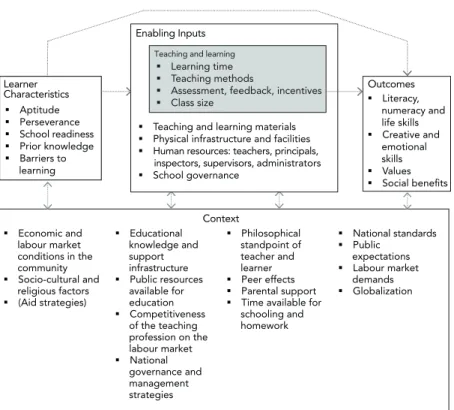
A second way that educational quality may be considered is through the use of input-output models, such as that shown in Figure 2.1, from UNESCO’s Global Monitoring Report on Quality. In this model, a number of key learner character-istics are taken into account, most particularly what a child has learned at home before arriving at school. The school provides a set of inputs that includes time, teaching methods, teacher feedback, learning materials and so forth. The outcomes of this process, in the learner, may be a set of cognitive skills learned (such as reading and writing), social attitudes and values, and more. This model points to the impor-tance of measuring a variety of outcomes, but leaves out which outcomes depend on which intermediate contextual variables, and how one might measure them.
By understanding the component processes, a path toward improvement begins to come into focus. Take one example—the role of a mother’s education on the academic success of her children. Many claim that maternal education is one of the most powerful determinants of children’s staying in school and learning achievement (Figure 2.2).11 Yet, how does a model of quality of education work
systematically? How does a mother actually transmit skills, attitudes, and values to her children, even if she herself is poorly educated? As discussed further in the following chapter, new research is beginning to answer such questions.
10. Adapted from Braun and Kanjee (2006), p. 5. In addition to quality, their framework also considered issues of access, equity, and efficiency.
Economic and labour market conditions in the community Socio-cultural and religious factors (Aid strategies) Educational knowledge and support infrastructure Public resources available for education Competitiveness of the teaching profession on the labour market National governance and management strategies Philosophical standpoint of teacher and learner Peer effects Parental support
Time available for schooling and homework National standards Public expectations Labour market demands Globalization Context Enabling Inputs
Teaching and learning
Outcomes Learner Characteristics Aptitude Perseverance School readiness Prior knowledge Barriers to learning Literacy, numeracy and life skills Creative and emotional skills Values Social benefits Learning time Teaching methods
Assessment, feedback, incentives
Class size
Teaching and learning materials
Physical infrastructure and facilities
Human resources: teachers, principals, inspectors, supervisors, administrators
School governance 0 20 40 60 80 Out-of-school children (%) Bolivia Lao PDR Niger
Mother’s ability to read sentence: Not at all With difficulty Easily
Source: Calculations based on the UNICEF MICS database.
FIGURE 2.1. Understanding education quality
FIGURE 2.2. Mother’s literacy and schooling status in the Niger, the Lao PDR, and Bolivia, 2000
Adapted from UNESCO, 2004, p. 36.
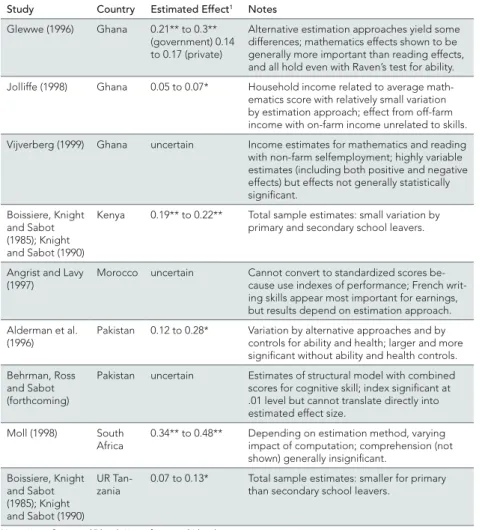
A third way to consider the promise of improved quality of education is to consider how learning achievement has been linked to economic development. Numerous studies have demonstrated how the returns on investment (ROI) measure of investments in schooling (measured by basic skills learning) can be applied in de-veloping countries (Table 2.1). International and national government agencies use this measure to rationalize increases in the quantity and quality of education.
Finally, the consequences of the improved quality of education may be seen clearly as a right to self-development.12 The presence of qualified teachers,
well-pre-pared curricula and textbooks, supportive parents, and engaged communities are all factors that can and do affect children. The desire to improve the quality of learning, and the overall quality of education, is not in doubt.13 What is less than clear is how
to come to agreement about how to determine empirically what quality is, and then to decide what implementation steps are needed to reinforce and expand quality. Improved measurement tools play an important part in this process.
The Importance of Measurement
The world of educational measurement intersects with a world of population varia-tion in ways that are often predictable, but also difficult to address. This is not only a matter of international comparability. Rather, variation in populations is endemic in each and every context where children are raised. Each household itself may also contain significant variation, especially if one considers how differently boys and girls may be treated in many cultures.
If measurement (including all tests and assessments) is so difficult, and can be challenged on so many grounds, how can it be implemented in so many countries and in so many ways? The answer is “with care.” There are many criti-cisms of measurement, but it may be the best way we have to address complex problems on a platform of knowledge that can be understood, and debated, by groups that may hold widely divergent ideas of what is best for children.
12. Sen, 1999
13. See the important GMR on quality (UNESCO, 2004) for a policy perspective. Nonetheless, it must be also noted that there may be decision makers who seem to care more about the numbers (quantitative results) just noticed this. than the more difficult to measure qualitative results. Similarly, it would not be surprising to find teachers, school leaders, and ministry officials who are complacent about the status quo. Moving beyond such complacency is, in large part, what the current efforts toward SQC approaches are trying to achieve.
Table 2.1. Impact of basic skills on income
Study Country Estimated Effect1 Notes
Glewwe (1996) Ghana 0.21** to 0.3** (government) 0.14 to 0.17 (private)
Alternative estimation approaches yield some differences; mathematics effects shown to be generally more important than reading effects, and all hold even with Raven’s test for ability. Jolliffe (1998) Ghana 0.05 to 0.07* Household income related to average math-ematics score with relatively small variation by estimation approach; effect from off-farm income with on-farm income unrelated to skills. Vijverberg (1999) Ghana uncertain Income estimates for mathematics and reading with non-farm selfemployment; highly variable estimates (including both positive and negative effects) but effects not generally statistically significant.
Boissiere, Knight and Sabot (1985); Knight and Sabot (1990)
Kenya 0.19** to 0.22** Total sample estimates: small variation by primary and secondary school leavers. Angrist and Lavy
(1997) Morocco uncertain Cannot convert to standardized scores be-cause use indexes of performance; French writ-ing skills appear most important for earnwrit-ings, but results depend on estimation approach. Alderman et al.
(1996) Pakistan 0.12 to 0.28* Variation by alternative approaches and by controls for ability and health; larger and more significant without ability and health controls. Behrman, Ross
and Sabot (forthcoming)
Pakistan uncertain Estimates of structural model with combined scores for cognitive skill; index significant at .01 level but cannot translate directly into estimated effect size.
Moll (1998) South
Africa 0.34** to 0.48** Depending on estimation method, varying impact of computation; comprehension (not shown) generally insignificant.
Boissiere, Knight and Sabot (1985); Knight and Sabot (1990)
UR
Tan-zania 0.07 to 0.13* Total sample estimates: smaller for primary than secondary school leavers.
Notes: *significant at .05 level; **significant at .01 level.
1. Estimates indicate proportional increase in wages from an increase of one standard deviation in measured test scores.
Source: Hanushek (2004) Adapted from UNESCO, 2004, p. 42.
Concerns about Assessment
To some, assessment is a fair and objective way to set and maintain standards, to spearhead reform at the levels of both policy and practice, and to establish a basis for meaningful accountability. To others, it is an instrument for maintaining the status quo, grossly unfair and educationally unproductive.14
Failure to address inequalities, stigmatization and discrimination linked to wealth, gender, ethnicity, language, location and disability is holding back progress to-wards Education for All.15
Assessment in education has never been uncontroversial, and it remains contro-versial today. Whenever an educational assessment is reported in the media, critics often challenge the results by claiming a contradictory bit of evidence, or that the assessment itself was flawed for a variety of technical reasons. Thus, when it was learned that French adults scored more poorly than adults in other European countries that participated in the International Adult Literacy Survey (IALS; see Chapter 8), French officials withdrew from the study, claiming technical flaws in the study itself. Similar stories can be told in nearly every country when educa-tional news is negative. Of course, what might be called “political defensiveness” is the other side of “policy sensitivity,” and simply shows that measurement can be an important source of change. Still, as in the quotation above, some see assessments not as a tool for change, but rather as reinforcement of the status quo.
Another sensitive issue concerning assessment is statistics. The science of statistics in assessment of human skills has a long and rich history. With respect to current efforts of education, numerous complex techniques have been developed that allow corrections or adjustments to be made for different types of populations, numbers of items on a test, determination of the significance of differences between groups, and so forth. But there is not a single science to the choice of statistical methodologies—debate is robust amongst specialists. It is important to keep in mind that while some methodologies have undergone rigorous prior testing (such as in international assessments), which other more small-scale assessments may only be beginning. Moreover, the science of the former is not necessarily better than the sci-ence of the later. The scientific rigor, and level of confidsci-ence among both the public and specialists, must be maintained irrespective of the type of assessment chosen.
14. Braun & Kanjee, 2006, p. 2. 15. UNESCO (2010), p. 2.
In the end, assessment is mainly what one makes of it. Assessments are only as good as their technical quality in relationship to the population under consideration (the main focus of this review). Assessments can sit in the dustbin, or they can be front-page headlines. Most often they are still used today by the few specialists who understand them best, and by those that found the resources to have them implemented in the first place. Thus, one of the main concerns about assessments is assuring their effective use, which includes helping to hold decision makers at many levels accountable for educational quality. Although no report on the technical aspects of learning assessments can assure the appropriate use of them, it is nonetheless incumbent on the designers of assessments to assist in their effec-tive application.
Finally, it is important to consider the issue of inequalities or inequities, as cited in the second quotation above. The 2010 Global Monitoring Report (GMR)
on Reaching the Marginalized makes clear that meeting the educational goals of the
world’s poorest populations poses serious challenges. There are political reasons for sure, but there are also technical reasons—and some that can be addressed by virtue of the kinds of assessments considered in this volume.
3.
How Learning Indicators
Can Make A Difference
Uses of Learning IndicatorsPossible uses for learning (and educational) indicators include the following:16
• Informing policy. In every country, ministries of education spend large portions of national budgets on education. Indicators are one important way that policy makers determine if those funds are well spent.
• Monitoring standards and creating new ones. Most countries have a set of edu-cational goals or targets embedded in curricular design. These are often based on, and monitored by, learning indicators. To the extent that national systems seek to change standards and curricula, indicators form an important basis for doing so. • Identifying correlates of learning. What are the causes and effects of learning
in the classroom? How well do certain groups (by gender, language, or regions) succeed in mastering the specified curriculum? Indicators are essential for deter-mining levels of achievements, and for understanding the relationship between key factors.
• Promoting accountability. What factors are accountable for educational change in a country, a community, a school, a teacher, a parent or a student? Many different actors are (separately or collectively) accountable for learning achievement.
• Increasing public awareness. How can parents and communities become more involved in supporting education? To the extent that indicators can be under-stood by the public, and disseminated by the media, learning measures are one way to establish outcomes in the minds of these potential consumers.17
• Informing political debate. Education is necessarily political. As with policy discussions and accountability, the presence of indicators and learning results allow for a more reasoned discussion of the empirical results of any intervention in education. Learning indicators can and do (when available) play a key role in such debates. They can also begin to identify who may be accountable for improving learning.
16. This list is substantially adapted from Greaney & Kellaghan, 1996. Of course, the actual use of indicators for mak-ing educational policy changes varies widely across the world (see Kellaghan, et al., 2009, Chapter 1; also Abadzi, personal communication.)
17. In fact, this dimension is often underestimated, especially in developing countries, where education has most often be a matter of state control. To the extent that education becomes more owned by parents and communities, it seems that the chances of improving education will increase.
Defining and Measuring Learning
How knowledge, skills and values are transmitted is as important a part of the cur-riculum as what is learned – because, in fact, the process is part of ‘what’ is learned.18
Many describe learning as the most essential enterprise of being human. Contemporary research has demonstrated that significant learning begins at birth (or before), and continues across the human lifespan. Since learning encompasses multiple diverse aspects, it has numerous disciplinary-based definitions. For ex-ample, psychologists have defined learning as any “measurable change in behavior,” while anthropologists define learning as enculturation whereby a child is socialized by others into the values and behaviors that are required by the culture.
In discussions of learning, test scores serve as a proxy for education qual-ity. The use of learning indicators can provide solid information on how well items in the curriculum are being understood as a process (per the quotation above), a formative measure on teaching and learning policies, and a marker for how well learners have done at the main exit points from the school system. This latter type of summative assessment may be criterion- or norm-referenced,19 and may be used
as a means of facilitating (and legitimizing) access to social and economic hierar-chies. In this way, tests may help to ensure that the intended curriculum is taught and learned, but they may bring detrimental effects, if they augment the pressure to succeed that leads to excessive attention to passing examinations.
Learning in and out of Schools
Types of Inputs
Other things being equal, the success of teaching and learning is likely to be strongly influenced by the resources made available to support the process and the direct ways in which these resources are managed. It is obvious that schools without teachers, textbooks or learning materials will not be able to do an effective job. In that sense, resources are important for education quality—although how and to what extent this is so has not yet been fully determined.20
18. Pigozzi, 2006, p. 45.
19. Criterion-referenced (or standards-based) assessments are those that allow scores to be judged against some level of expected result. Norm-referenced assessments are those that provide a level of skill that is matched against the learners relative position among peers taking the same test.
In the quotation above, resources are highlighted that emanate from the school system itself. Yet, countless studies in the social sciences show that much (or even most) of the statistical variance associated with school success or failure results from inputs that are outside of the school walls, even far outside.21 Naturally, as implied in the psychological
and anthropological definitions for learning mentioned at the outset of this chapter, there are a whole host of experiences that a child brings to school—experiences that in-volve not only learned facts about his or her life and community, but also attitudes and values, support structures that implicate language, cultural processes, and much more. For some children, these inputs are sometimes acknowledged when they finally arrive at the primary school door (such as language of instruction, if it matches what is spoken in the home). As more is learned about children’s lives at home, more is understood about a multitude of types of inputs, as well as mismatches between children and schools. This is not news. Ever since schools were invented as part of religious institutions over the centuries, the idea of schooling was to shape what children bring to school into some type of uniformity of knowledge with purpose. Since mass education and equity concerns were less an issue in those centuries, the known facts of frequent mismatch, resistance, and drop-out were not so important.
In today’s world, where the MDGs try to guarantee universal basic edu-cation, it is no longer possible to ignore the personal, social, and ethno-linguistic characteristics that children bring to the classroom. Further, there is a growing recognition that reaching the most difficult to reach (what are sometimes called “marginalized”) populations will require special attention and financing in order to reach the EFA goals.22 While there are many examples of these types of external
inputs to schooling, one oft-cited characteristic is the nature of the home literacy environment of the child. In Figure 3.1, home literacy environment was found to be strongly related to reading achievement for fourth grade students in a PIRLS23
international assessment, but, nonetheless, widely varied across countries.
21. Of course, there are many who have looked at the role of socio-economic status (SES) and in-school factors (such as textbooks, teacher training, management, and use of resources) for explanations of educational outcomes. See, for example, Heyneman & Loxley (1983) and a recent more review by Gamaron & Long (2006).
22. See the recent GMR report entitled Reaching the marginalized, UNESCO (2010). 23. Progress in International Reading Literacy Study.