Mills, Kathy Ann
&
Chandra, Vinesh
(2011)
Microblogging as a literacy practice for educational communities.
Journal of Adolescent and Adult Literacy,
55(1), pp. 35-45.
This file was downloaded from:
http://eprints.qut.edu.au/38997/
c
Copyright 2011 International Reading Association
Notice
:
Changes introduced as a result of publishing processes such as
copy-editing and formatting may not be reflected in this document. For a
definitive version of this work, please refer to the published source:
35
Mills, K. A., & Chandra, V. (2011). Microblogging as a Literacy Practice for Educational Communities. Journal of
Adolescent and Adult Literacy, 55(1), 35-45.
Microblogging as a Literacy Practice for Educational Communities
Kathy A. Mills, Vinesh Chandra
A new technology breaks down limitations of traditional print-based reading and writing and builds an enthusiastic community of learners.
Each time users log into their social networking accounts, they are invited to post a “status update” that answers a simple yet provocative question: “What are you doing?” (Twitter) or “What’s on your mind?” (Facebook). These questions highlight some of the features of literacies in a digital age—immediacy, community, interactivity, and transparency.
On our Twitter accounts we can publish links to the latest resources, conferences, papers, or websites for a network of “followers.” We can also use this popular Web 2.0 messaging service as a connection to breaking news as it streams across the Web. We can use our Facebook “wall” to publish details of our day-to-day minutiae, establishing an online identity for our ever-expanding, multitiered connections with relatives, friends, teachers, and other colleagues. These microblogging practices serve the purpose of maintaining solidarity with groups of people with whom we have an affinity.
Microblogging can play a powerful role in supporting the professional and personal growth of teachers in supportive online communities. However, concerns about online security have inhibited many educators from using popular microblogging platforms in their school or university classrooms. In our local state education department (Queensland, Australia), in-school student access to Facebook and Twitter is prohibited, though teacher access is permitted.
It is beyond the scope of this article to debate issues of censorship, access, and Internet safety in the context of
microblogging. Rather, we demonstrate how meaningful contexts for literacy practice can be created through secure and free microblogging platforms designed for educational communities. These specialist educator networks enable students and teachers to collaborate in closed online environments. Designed for teachers and students, these microblogging services often provide a host of other useful tools for teachers to manage classes, display calendars, or share and store files. They also allow educators to post frequently updated information to a public timeline and RSS (Really Simple Syndication) feed to publish frequently updated works.
Changing Conceptions of Literacy in New Times
This article draws from our work with undergraduate teachers in their third year of training to explore microblogging as a literacy learning resource in schools and universities. Literacy educators are increasingly aware of the need to harness authentic digital communication tools in educational settings, to extend but not replace conventional literacy practices. These new social practices have been described as “multi- literacies” (New London Group, 1996), the “new literacies” (Lankshear & Knobel, 2003b; Street, 2003), multimodal discourse (Kress, Jewitt, Ogborn, & Tsatsarelis, 2001), and multimodal literacy (Jewitt & Kress, 2003).
The New London Group (1996) coined the term “multiliteracies” to reconceptualize literacy for new times. One of the key arguments of multiliteracies is that literacy pedagogy needs to account for the broadened array of communication channels, media, and protocols, tied to the increased availability and convergence of communications technologies (e.g., the Internet
36
and television). They argued that exclusively print-based conceptions of reading and writing are no longer adequate todescribe the combination of sign systems in digital texts. Reducing the English curriculum to a narrow repertoire of conventional genres and writing skills discounts the reality of literacy practices in society today (Cope & Kalantzis, 2000).
The New Literacy Studies have similarly pointed to the changing nature of literacy practices across varied social contexts. Scholars within the New Literacy Studies have drawn attention to the innovative and productive potentials of literacy practices in digital environments that children use both in and out of school (e.g., Gee, 2005; Hull & Schultz, 2001; Lankshear & Knobel, 2003a; Nixon, 2003; Sefton-Green, 2007; Street, 2003.
Studies within the New Literacy Studies research have addressed specific online practices, including instant messaging (Jacobs, 2005; Lee, 2007; Lewis & Fabos, 2005), designing Web pages in anime (Japanese animation) fan sites (Chandler-Olcott & Mahar, 2003), using webquests and creating e-zines or electronic magazines (Courtland & Paddington, 2008), and writing online fan fictions (Black, 2009). Web 2.0 practices that have been the focus of studies include relay writing (Yi, 2008), blogging (Davies & Merchant, 2009), threaded discussion (Grisham & Wolsey, 2006), and wikis (Wheeler & Wheeler, 2009).
While there is a growing corpus of research in the New Literacy Studies that focuses on specific digital contexts of literacy practice (for a comprehensive review, see Mills, 2010a), microblogging in educational settings has not yet been widely addressed. Microblogging platforms designed for use by students and teachers in restricted online networks have only recently become available. For example, EDMODO—the service used in the research dis- cussed in this article—was released in 2009.
The new affordances of Web 2.0 tools—a group of technologies that include blogs, wikis, podcasts, RSS feeds, and microblogs—facilitate collaborative and socially connected online literacy practices in which users co-construct the
information space (Davies & Merchant, 2009). These online tools provide an infrastructure that supports collaborative digital media design, encouraging what Jenkins (2009) describes as a “participatory culture” of digital media production. Teachers are giving students the opportunity to draw on these out-of-school media literacies to enhance in-school literacy learning. These tools have also been effectively used for knowledge building and knowledge sharing in higher education (Chandra & Lloyd, 2008).
In educational settings, these shifts in Web-based social practices call for changes to print-based pedagogies for reading and writing to include authentic digital forms of communication used today. The increasing digitalization of print is here to stay, giving impetus for literacy educators to extend the limits of their existing practices to more closely reflect the way literacy is used in society.
What Is Microblogging?
Microblogging allows users to share information in very brief texts (e.g., 140-character “tweets” in Twitter) to “friends” or “followers” using multiple sources and tools, including websites, third-party applications, or mobile devices. Unlike traditional blogging, brevity is essential. Updates appear to friends and followers as a continuous newsfeed,
amalgamated with updates from other subscribers. Others can comment on the updates or reply directly to the message sender. Friends and followers, depending on the application used, can then comment on the updates or reply directly to the sender. Publicly accessible microblogging platforms include Twitter, Friend Feed, Jaiku, and Plurk, while the status updates
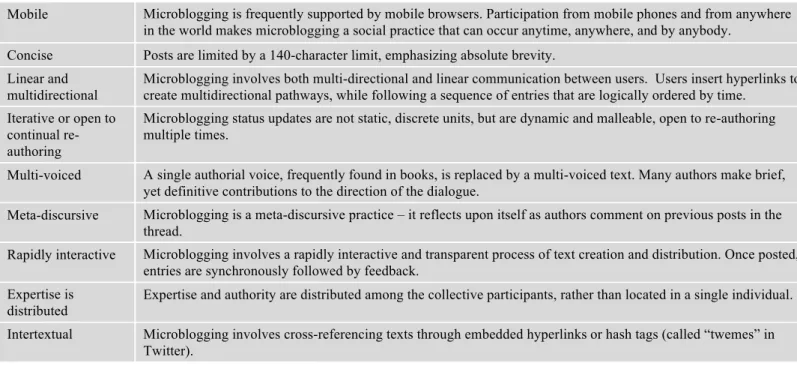
embedded within sites like Facebook, MySpace, and LinkedIn also support microblogging (DeVoe, 2009). A summary of the features of microblogging appears in Table 1
The small corpus of microblogging studies has pointed to the benefits of using platforms such as Twitter to enable mobile communication between students and course facilitators in remote regions (Al-Khalifa, 2008). Other studies have compared
37
microblogging responses to conventional journal writing, observing that students wrote about a topic more frequently over a more extended period of time when using microblogging, leading to deeper cognitive engagement with scientific topics and dialogue among the classroom community (Ebner & Maurer, 2008). Most recently, Ebner, Leinhardt, Rohs, and Meyer (2010) have explored the potentials of microblogging to support process-oriented learning through the rapid feedback from other students and teachers the technology affords, and the transfer of learning between formal and informal learning contexts. This emerging research has not investigated microblogging as a social and literacy practice.Research Description
Theoretically framed in the tradition of New Literacy Studies, this case study examined new uses of microblogging as an emergent literacy practice in an institution of higher education. Specifically, our research question asked: What are the potentials of microblogging for literacy learning in an educational community? We anticipated that meaningful contexts for literacy practice might be created through the use of this very recently developed technology. EDMODO, a secure and free microblogging platform designed for use in educational contexts, was selected as a flexible service to use in the study. Research Context and Participants
Microblogging activities were incorporated into the course work of a preservice teacher education program in the Faculty of Education of an Australian university. The 166 participating students were enrolled in a compulsory unit within the Information and Communication Technologies (ICT) curriculum strand in the third year of a Bachelor of Education (Primary) degree program. All participants had some prior experience with ICT. However, this was the only course in the Bachelor of Education program that specifically prepared them for using ICT in the classroom. The preservice teachers, male and female, would graduate at the end of a fourth year, qualified to teach in Australian primary schools (students aged 4.5 to 15 years). While the majority of the preservice teachers were aged 19 to 21 years, there was also a significant group of “mature” students who had not commenced their teaching degree immediately upon graduation from high school.
The course coordinator worked with two tutors to facilitate six tutorial groups. The facilitators had extensive experience in teaching ICT. However, all the facilitators had only recently become acquainted with educational microblogging platforms, given the advent of EDMODO only in 2009, and this was the first time that microblogging had been included in the ICT unit of study. All students were required to participate in the ICT unit as part of their course work, but no data were published about them unless they had provided voluntary, informed, written consent. Pseudonyms were used in the publication of the research. The consent was obtained after the students had completed the course, thereby avoiding possible implications of coercion.
The Microblogging Tasks
The two key aims of the microblogging component of the course were, first, to increase preservice teachers’ technical competence with a microblogging platform (EDMODO) through first-hand experience, and second, to give students the opportunity to investigate and reflect on the possible utility of microblogging for literacy learning.
Each facilitator conducted a workshop demonstrating how to set up an account and navigate the microblogging site. A podcast was also created and uploaded to the online support materials to introduce EDMODO to students who were unable to attend the workshop. Each week the students were given a tutorial and workshop, and a microblogging task was assigned as a component of a digital portfolio assessment.
EDMODO is a secure social network and microblogging platform specifically designed for teachers, students, and schools. Students created their own accounts using a unique group code. The microblogging activity was a relay-writing task using EDMODO in which students were to make short, successive contributions to a narrative constructed collaboratively by members of each tutorial group. The unit coordinator posted the first and last sentence of several contemporary versions of
38
traditional fairytales, including Cinderella and The Three Little Pigs. The students were given several weeks to contribute to the evolving narrative by relaying their story segments using no more than 140 characters. The students were asked to take on the role of primary school students as they created a class story, envisaging the potentials of microblogging for literacy learning. For example, one of the microblogging narratives began with the post:Once upon a time there were three little pigs. The pigs had grown up, and their mother gave them an emotionally charged farewell. She cautioned, “Do your best and don’t worry about the rest!”
The first entry to continue the story was:
The first pig, Jimbo, wanted to go overseas. He did not have any money, so he begged his mother to pay for his visa, new clothes, a suitcase and a mobile phone. His mother asked him to get a part-time job and pay for all this.
This tutorial group jointly constructed an imaginative story with numerous subplots. A consistent theme was the need for courage to pursue one’s dreams collaboratively, while demonstrating moral integrity.
After participating in the online collaborative writing task, students wrote a reflective blog entry to evaluate the potentials of microblogging in their future classroom. Unlike the collaborative story writing activity, the reflective blog was set up as a private class community journal, so that students in the tutorial group were unable to view one another’s comments. This was intended to encourage originality in reflections, and it enabled the facilitator to capture a greater diversity of responses from the students. Students were also asked to reflect on the following questions:
1. Where could this application be used? 2. How could this be integrated? 3. What would students learn?
4. Why should this application be used?
5. Which key learning theory could be addressed? Data Collection and Analysis
The case study data included the entries to the story thread from each tutorial group and the reflective blogs. Approximately 332 digital artifacts were collected, representing full participation by the students enrolled in the course. Data analysis involved systematically coding the key themes and findings in the two data sets. Examples drawn from raw data were selected for inclusion in this article when they served to illustrate the salient findings. The researchers also used concept maps (graphic organizers) to trace the characters, plots, and subplots of the microblogging stories.
Findings
Four recurring themes emerged as salient from the coding of the two data sets: 1. Microblogging blurs the distinction between authors and readers.
2. Microblogging transforms elements of the writing process. 3. Microblogging creates a supportive virtual community of learners. 4. Microblogging promotes self-initiated literacy practice.
Blurring the Distinction Between Authors and Readers
Once posted to the microblogging platform, entries are rapidly followed by feedback. Unlike writing a single-authored story, microblogging requires that multiple authors read, comprehend, and draw inferences from the contributions of others to maintain the internal consistency of the text. Unlike blogs that can often relate to a lead piece, microblogging threads have a 140-character limit that equalizes the contributions, so that no single contribution is more dominant than another.
With the exception of those who only read microblogging threads, this practice involves a rapidly interactive and transparent process of text creation and distribution. A number of students independently pointed to the potentials of microblogging for the complementary processes of reading and writing. For example, Justin wrote that microblogging:
39
…actively engages students with reading and writing through the “hook” of technology. Students are encouraged to read through all posts before submitting their own: requiring them to interpret and infer meaning from the information and continue the blog.The microblogging activity required its multiple authors to draw on metacognitive reading comprehension strategies, such as previewing a text to activate background knowledge, clarifying their understanding of the text as they read, and making inferences to draw conclusions about the possible directions of the unfinished text (Mills, 2008). Unlike authors of print-based texts, microbloggers are simultaneously readers and authors. Microblogging allows students who are physically remote from the classroom to occupy the same reading and writing space in rapidly interactive writing. For example, Karen commented:
After completing the workshop...I saw the value of using educational micro-blogging sites... The activity required us to contribute a short passage to a narrative, but in doing so, I engaged in a substantial amount of reading and planned my contribution so it would be cohesive and add depth to the story.
Microblogging facilitates proficient reading in a read–write environment. The unfinished nature of a microblogging thread necessitates that multiple users make predictions about the subsequent entries, requiring an internal consistency with the work of the previous authors. Facilitators found that using graphic organizers, such as a concept map of the plot and a sociogram of the characters, provided a helpful visual representation of the complex development of characters and events. Users revisited the site to make multiple posts, to blog their reflections on the activity, or to take on a passive role as a spectator. In this way, text processing occurred not only during microblogging, but long after the students had posted a response.
Transforming Elements of the Writing Process
Unlike conventional forms of print-based writing, which readers cannot modify, microblogging is characterized by rapid interactivity between authors and readers. There was a quality of transparency and immediacy among users as their writing was distributed to a peer audience within moments of its construction. The activity required engagement with existing content in the thread to further improve upon it. We observed that microblogging threads are not static, discrete units, but are dynamic and malleable, open to re-authoring multiple times. This evolutionary development of the written text led to a continual and iterative process as the narrative became repeatedly over-written with complex subplots and multilayered characters. As Rebecca commented, “This software also allows the students to grow and develop their own and each other’s work.”
In this respect, microblogging was found to be a meta-discursive practice, reflecting upon itself as each new reader-author added posts in the thread. This practice differed, for example, from a single-authored printed text, which does not invite or depend on the reflective contributions of its readers. A single authorial voice, frequently found in books, was replaced by a multivoiced text. This is a feature of microblogging for a range of purposes, and is not limited to relay-writing stories. For example, all the posts in a Twitter feed bring together multiple entries by different authors that relate to a similar theme or new event. There are invariably multiple authors who contribute to a thread or within an RSS feed of entries that comment on a related theme.
Unlike text messaging or online chat, students used full sentences, capitalization, and punctuation and writing was well edited before posting. Using random samples of the students’ contributions, the Flesch-Kincaid grade level of the writing had a mean of approximately 8.7 (that is, it is comfortably read by students of U.S. grades eight to nine). The limited length of both the reflective blog and microblog required students to write with absolute brevity and clarity. It is important to note that there were also elements of continuity between conventional literacies and microblogging practice, as Joanna described:
I will endeavour to use the micro-blogging activity in my classroom as it develops literacy skills in the following areas: comprehension, creative writing, expressive writing as well as basic language skills such as punctuation, grammar, spelling, sentence structure and f low.
Students concluded their story entries with conjunctions (“but,” “until”) and ellipses to indicate an unfinished thought, serving to cue peers to anticipate new events in the storyline. The posts were creative and entertaining, with descriptive vocabulary and varied sentence structures. For example, Chris posted:
40
Jimbo turned around and saw Lady Gaga...and squealed with fright! She looked at him with crazy eyes— the magical disco stick was bait to lure...Lady Gaga wanted to wear Jimbo as her next outrageous costume. She lunged for him....Weaving intertextual references to popular iconic figures from movies, songs, and the media, the students made
connections to their existing knowledge and experiences (e.g., taking exams), the world (e.g., Jenga games), and other texts (e.g., Gorilla King, Harry Potter, and the Chronicles of Narnia). Microblogging can also involve cross-referencing texts through embedded hyperlinks or hash tags (called “twemes” in Twitter). While the participants were not required to insert hash tags, some inserted hyperlinks for peers to access information about educational uses of microblogging.
A quality that was difficult to achieve in some microblogging threads was coherent organization or structure. This occurred when the first class of students attempted to upload their posts simultaneously. Students prepared their entries after reading the previous posts, but unless they refreshed the page, they did not respond to the most recent update. When constructing in-class threads, users must understand the immediacy of microblogging, which necessitates a system of turn taking. This problem was eliminated once the facilitators appreciated this feature and organized the students to refresh their browsers and respond in order.
A benefit of microblogging is that the complexity of the writing task, in terms of both structure and content, can be modified to suit a wide range of literacy abilities. Participation in microblogging was achievable for all pre-service teachers, who ranged in age from late teens to middle age and who were from ethnically di- verse backgrounds. As Karen commented:
I would integrate this program into my classroom because it caters to diversity and different learning styles and brings new life to traditional writing activities. It’s an inclusive learning tool.
Creating a Supportive Community of Learners
A consistent theme in the students’ evaluative blogging posts was the recognition of a supportive community of writers. Michael blogged:
I appreciate the collaborative approach to learning that this application provides—instant messaging and the ability for the class to be able to see their peers’ work contributes to a sense of classroom community.
Similarly, Sarah used the term “community of learners” to describe the potential to “use the ideas of my peers in extending and developing the storyline.” These comments draw attention to the increased collaboration in creating and sharing content afforded by online networks.
In traditional writing classrooms, there is a greater emphasis on individual authorship and the teacher as an authoritative source of knowledge. In contrast, there is an important discursive shift during microblogging. In our study, peers refocused the thread when there were inconsistencies in the plot. For example, in one tutorial group, Barbara censured the inclusion of unwholesome themes in the thread, such as stealing, gambling, and taking revenge, by the previous writers. Barbara wrote, “Meanwhile, Flatus, whose real name is Fredrick, decided to take his mother’s advice seriously (Considering this story is for Year 5 students).” Barbara’s post demonstrates a degree of censorship among the members of the learning community as she makes explicit the established norms. Like Barbara, Jack interrupted the discourse of the narrative to respond to Barbara’s reflective meta-discourse: “ I disagree. Personally I feel that if I was in year five, I’d so write about Flatus.... After all, where’s the fun in listening to mum. Boys do that in real life...”
This interaction illustrates a form of democratic practice within the learning community, as users voiced their differing perspectives. At the same time, the facilitator was responsible for ensuring that the responses were appropriate to the purpose and institutional social context. Facilitators ultimately had responsibility for monitoring the content of the thread, but there was a de-emphasis of the teacher’s authoritarian position as peers took a significant degree of responsibility for directing the discourse and owning the user-generated content.
Users were continually evaluating the quality and value of the posts, providing immediate written responses or reactions to the text. For example, one student provided a hash tag or hyperlink to web information about educational uses of
microblogging. Other writers commented about inconsistencies in the storyline when they occurred. Microblogging became a new learning discourse of dialogue between experts and novices, rather than fostering an imperative discourse of command
41
from teacher to student. Expertise and authority were clearly distributed among the collective participants, rather than located in a single author or individual.The students identified that the joint writing of an online text provided participants with the opportunity to “scaffold” one another’s contributions, applying an important principle of learning (Vygotsky, 1934/1962). Katrina reflected that
microblogging “allows students to feel individually supported by their teacher and also their peers in this educational experience.” This is confirmed by Ebner et al. (2010), who observed that thoughts can be developed and elaborated by others to co-construct texts in a supportive community. In microblogging, the difficulty of assessing individual contributions to the collaborative text can be overcome by the transparency of individual posts.
The pre-service teachers identified the unique supportive environment offered by online collaborative writing, particularly for students who experience difficulty composing written texts: “For those students who struggle with reading and writing microblogging is a way of allowing them to participate in these avenues without feeling pressured.” This comment draws attention to microblogging within “communities of practice” (Lave & Wenger, 1991). Whether microblogging in the classrooms or from home, students are bonded together through a common endeavor, involving multiple but integrated responses. Members of a microblogging community draw upon broad rather than narrow knowledge, which is distributed across various members and networked across different geographical sites such as educational institutions, libraries, Internet cafés, or home. The content of microblogging posts is not located in books or a single individual, but in the collective contributions of the community.
The co-creation and co-construction of texts and concepts is central to microblogging, unifying communities that are not constrained by rank. The logic of the co-construction of knowledge is a keystone both to the knowledge economy and the education that will support it (Kalantzis & Cope, 2008). Microblogging is a computer-mediated form of communication that is producing social practices and conceptions of communities of learning across time and space that differ from print-based models of writing in educational sites.
Promoting Self-Initiated Literacy Practices
There was 100% participation in the online microblogging activity, with high levels of interest expressed in the students’ reflective posts. Microblogging was tied to the demonstration of self-initiated literacy practice. Students reported that they voluntarily continued reading new entries for pleasure, even when they had completed their required contribution for course evaluation. This self-initiation of literacy practices was evident in the workshops when students discussed the activity: “I found it highly engaging, although I did my post in class time, I have logged on a few times to read the other stories,” remarked Teagan.
The students openly expressed enjoyment in jointly constructing a text, a recurring theme in the students’ evaluation of this technology. William wrote:
This application will definitely be considered within my future classroom, as it is a fun way for students to construct a piece of writing.... It allows students to freely explore their ideas in a seemingly “anonymous” environment without the heavy time constraints for
responding, as usually seen in a classroom
Furthermore, microblogging strengthened the connections between students’ out-of-school and in-school literacy practices, providing students with unrestrained “opportunities to post several comments whenever they wish to, at home or at school,” as Julia noted. Microblogging is a medium that enables learning connections through written dialogue that extends beyond the boundary of classroom walls (Holotescu & Grosneck, 2009).
Microblogging illustrates the ways in which the nature of in-school and out-of-school learning is changing (see Table 1). In the past, school learning was geographically, institutionally, and temporally defined. Microblogging is a ubiquitous practice that can be geographically and temporally unlimited: Users can contribute and receive feedback from peers and the teacher anywhere, at anytime. Nevertheless, there continues to be an authority-novice relationship between facilitator and students that places some boundaries around the content of the posts. Therefore, this form of learning remains specifically educational. Text Feature Description
42
Mobile Microblogging is frequently supported by mobile browsers. Participation from mobile phones and from anywherein the world makes microblogging a social practice that can occur anytime, anywhere, and by anybody. Concise Posts are limited by a 140-character limit, emphasizing absolute brevity.
Linear and
multidirectional Microblogging involves both multi-directional and linear communication between users. Users insert hyperlinks to create multidirectional pathways, while following a sequence of entries that are logically ordered by time. Iterative or open to
continual re-authoring
Microblogging status updates are not static, discrete units, but are dynamic and malleable, open to re-authoring multiple times.
Multi-voiced A single authorial voice, frequently found in books, is replaced by a multi-voiced text. Many authors make brief, yet definitive contributions to the direction of the dialogue.
Meta-discursive Microblogging is a meta-discursive practice – it reflects upon itself as authors comment on previous posts in the thread.
Rapidly interactive Microblogging involves a rapidly interactive and transparent process of text creation and distribution. Once posted, entries are synchronously followed by feedback.
Expertise is
distributed Expertise and authority are distributed among the collective participants, rather than located in a single individual. Intertextual Microblogging involves cross-referencing texts through embedded hyperlinks or hash tags (called “twemes” in
Twitter).
Table 1 Textual features of Microblogging Microblogging Meets the English Teacher
Teachers can begin by setting up a class microblogging account using a public platform or secure educational site that can be accessed only by teachers and students. Microblogging services that allow users to choose the level of openness of the social network, including private or closed settings for communication within the classroom or school, are the most suitable for educational contexts. For example, Shout ’em includes features to enable the teacher to limit access for sharing content to specified members within the educational community of users (DeVoe, 2009).
Setting up a microblogging user account was easy for students in this study, with a limited number of fields requiring the user to enter information. The facilitator chose a system that did not require student e-mail addresses, in order to maintain the anonymity of the users. The interface was user friendly, allowing the teacher to see the class list of participants on a profile page, with hyperlinks to each student’s entry. The site was not overloaded with graphics, which facilitated the fast upload of the webpages, and it was free of pop-ups and advertising.
In our study, students consistently noted that EDMODO afforded a secure online environment for collaborative writing. A female student wrote:
I quite enjoyed this micro-blogging activity because the site enables students to interact and share information with each other in a secure and safe environment. The teacher is in control of the website in relation to what students can join and who can view the information.
Similarly, Anita commented, “The web-based application also has the advantage of being a safe and secure network that protects student identities from risks associated with the World Wide Web.”
Irrespective of the platform chosen, students need to reflect critically on the social practice of microblogging. For example, when creating an account profile, the teacher can demonstrate how to consider issues of representing one’s identity, managing security settings, choosing what personal information to conceal, and choosing which microblogging service is best suited to the social purposes and intended audience (Williams, 2008).
Microblogging can be used as a platform for several simple teaching techniques. For example, when introducing new concepts or literature, English teachers can find out what students already know using a “Background Knowledge Probe.” Logged on to a microblogging account in which the students “follow” the teacher, students can post their responses
electronically via mobile phone, tablet, laptop, or desktop computer. Students can microblog their response to the open-ended question, “What do you know about ______?” The RSS feed can be displayed on a large screen for class discussion, providing a backchannel for the students and teacher to quickly identify shared starting points for discussion.
43
After a lesson, invite students to microblog about what they had trouble understanding, answering the question, “What is the muddiest point in this session?” This technique enables the teacher to identify which concepts need to be further consolidated through discussion. Students should be encouraged to be concise in their posts, using accurate and precise vocabulary.A variation of this activity is the “One-Minute Paper” in which students are directed to microblog their response to the question, “What was the most important thing that you learned today?” This reflective activity can be used to consolidate knowledge. These activities can be adapted as online conversations after class for students to clarify, evaluate, and integrate ideas and information, promoting active participation with lectures, discussion, homework assignments, novels, plays, or films (Angelo & Cross, 1993).
Another microblogging activity that makes the most of the 140-character limit is the “One Sentence Summary.” Students post a microblog summarizing the gist or main point of a lesson, a chapter in a novel, or an information text. Teachers can set up simple structures, such as challenging students to answer the question, “Who does what to whom, when, where, how, and why?” about a given book or topic (Angelo & Cross, 1993; Skiba, 2008). Such uses of microblogging allow students to rethink and revise their initial ideas using one another’s critical and immediate feedback. Students develop greater authority as literary critics, and they relinquish fears about producing and publishing polished work in academic settings by engaging in the fluid, transparent, and divergent spaces of online communication (Lankshear & Knobel, 2003b). Ella commented:
Microblogging platforms have a range of affordances in educational settings. Students are able to upload their assignments, interact with their teachers and other students online, and post blogs and upload videos on current activities taking place in the classroom. Teachers can also keep a record of student achievement by posting results for assignments and exams online and make them available to students through their profiles. This application allows students to participate in a virtual community in a secure and interactive environment.
Such uses of microblogging appropriate digitally mediated literacies of youth in the social ecology of the classroom in
ways that are meaningful and consistent with their uses in the real world.What Are You Doing?
Literacy in classrooms must now account for the growing repertoire of text forms and practices that are increasingly important in the digital communication environment. Microblogging accentuates the key features of the new communications environment. More rapidly interactive than blogging, microblogging uses real-time messages that can be received and replied to instantly, supported by mobile browsing from any geographical location. Unlike blogging, microblogging practice is established within open or closed social networks of “followers”—communities of people with shared interests.
Microblogging has become a key feature of social networking sites, offering something very different to previously available communication platforms. We have summarized some of the distinctive features of microblogging practice addressed in this study in Table 1.
As with learning in general, microblogging establishes an active social dynamic among the participants to create an open, fluid, and continuous dialogue, rather than one that is closed, static, and bound. The increased dialogue and rapid interactivity between multiple authors and readers is coupled with a need to acknowledge differing viewpoints. These distinctive features of microblogging highlight the dynamic and interactive social relations in workplaces and global communications
environments today (Mills, 2010b).
The increasing role of digital technologies for communication is one of the major reasons why theories of literacy and semiotics associated with the New Literacy Studies and multiliteracies are taking into account new textual practices. There is no imprecision in broadening conventional understandings of literacy learning to extend beyond print. Rather, it is a well-reasoned effort not to exclude literacy practices that are augmented and modified by digital formats. With the advent of secure and free microblogging platforms, students can now engage in immediate, spontaneous, hyperlinked, collaborative, and democratic arenas for knowing and communicating in a supportive learning community. In conclusion, in the words of Twitter, we ask, What are you doing?
44
References
Al-Khalifa, H. S. (2008). Twitter in academia: a case study from Saudi Arabia eLearn Magazine, 2008(9).
Angelo, T. A., & Cross, K. P. (1993). Classroom assessment techniques: A handbook for college teachers (2nd ed.). Sanfrancisco, CA: Jossey-Bass.
Black, A. (2009). Online fanfiction, global identities, and imagination. Research in the Teaching of English 43(4). Brown, A. (1994). The advancement of learning. Educational Researcher, 23(8), 4-12.
Bruns, A. (2010). Produsage: Towards a broader framework for user-led content creation. Kelvin Grove, Qld: Queenland University of Technology.
Chandler-Olcatt, K., & Mahar, D. (2003). "Tech-savviness" meets multiliteracies: Exploring adolescent girls' technology-mediated literacy practices. Reading Research Quarterly. , 38(3), 356-385.
Cobb, P., Confrey, J., diSessa, A., Lehrer, R., & Schauble, L. (2003). Design experiments in educational research. Educational Researcher, 32(1), 9-13.
Cope, B., & Kalantzis, M. (2000). Multiliteracies: Literacy learning and the design of social futures. South Yarra, VIC: Macmillan.
Courtland, M., & Paddington, D. (2008). Digital literacy in a grade eight classroom: An e-zine webquest. Language and Literacy: A Canadian E-Journal, 10(1).
Davies, J., & Merchant, G. (2009). Web 2.0 for schools: Learning and social participation. New York: Peter Lang. Devoe, K. M. (2009). Bursts of information: Microblogging. The Reference Librarian, 50(2), 212-214.
Ebner, M., Leinhardt, C., Rohs, M., & Meyer, I. (2010). Microblogs in Higher Education – A chance to facilitate informal and process-oriented learning? Computers and Education, 52, 92-100.
Ebner, M., & Maurer, H. (2008). Can Microblogs and Weblogs change traditional scientific writing? Paper presented at the E-Learn 2008, Las Vegas.
Gee, J. (2005). Why video games are good for your soul: Pleasure and Learning. Altona, VIC: Common Ground Publishing. Grisham, D. L., & Wolsey, T. D. (2006). Recentering the middle school classroom as a vibrant learning community: Students,
literacy and technology intersect. Journal of Adolescent & Adult Literacy, 49(8), 648-660.
Holotescu, C., & Grosneck, G. (2009). Using microblogging to deliver online courses. Case-study: Cirip.ro. Procedia Social and Behavioural Sciences, 1, 495-501.
Hull, G., & Schultz, K. (2001). Literacy learning out of school: A review of theory and research. Review of Educational Research, 71(4), 575-611.
Jacobs, G. E. (2004). Complicating contexts: Issues of methodology in researching the language and literacies of instant messaging. Reading Research Quarterly, 39(4), 394-406.
Jenkins, H., Ravi Purushotma, Weigel, M., Clinton, K., & Robison, A. J. (2009). Confronting the challenges of participatory culture: Media education for the 21st century: MIT Press.
Jewitt, C., & Kress, G. (2003). A multimodal approach to research in education. In S. Goodman, T. Lillis, J. Maybin & N. Mercer (Eds.), Language, Literacy and Education: A Reader (pp. 277-292). Staffordshire, England: The Open University.
Kress, G., Jewitt, C., Ogborn, J., & Tsatsarelis, C. (2001). Multimodal teaching and learning: The rhetorics of the science classroom. London: Continuum.
Lankshear, C., & Knobel, M. (2003a). Literacy, culture and technology. In G. Bull & M. Anstey (Eds.), The Literacy Lexicon (pp. 67-79). Frenchs Forest, NSW: Pearson Education Australia.
Lankshear, C., & Knobel, M. (2003b). New literacies: Changing knowledge and classroom learning. Philadelphia, PA: Open University Press.
Lee, C. (2007). Affordances and text-making practices in online instant messaging. Written Communication, 24(3), 223-249. Lewis, C., & Fabos, B. (2005). Instant messaging, literacies, and social identities. Reading Research Quarterly 40(4), 470–
501.
New London Group (1996). A pedagogy of multiliteracies: Designing social futures. Harvard Educational Review, 66(1), 60-92.
Nixon, H. (2003). New research literacies for contemporary research into literacy and new media. Reading Research Quarterly, 38(3), 407-413.
Sefton-Green, J. (2007). Literature review of informal learning with technology outside school. Bristol: United Kingdom. Skiba, D. J. (2008). Nursing education 2.0: Twitter and Tweets. Nursing education perspectives, 29(2), 110-112.
Street, B. (2003). What's "new" in the new literacy studies? Critical approaches to literacy in theory and practice. Current Issues in Comparative Education, 5(2), 77-91.
Vygotsky, L. (1962). Thought and language. Cambridge, Massachusetts: Massachusetts Institute of Technology.
West, K. C. (2008). Weblogs and literary response: Socially situated identities and hybrid social languages in English class blogs. Journal of Adolescent & Adult Literacy, 51(7), 588-598.
Wheeler, S., & Wheeler, D. (2009). Using wikis to promote quality learning in teacher training. Learning, Media and Technology, 34(1), 1-10.
Williams, B. T. (2008). “Tomorrow will not be like today”: Literacy and identity in a world of multiliteracies. Journal of Adolescent and Adult Literacy, 51(8), 682-686.