The University of Southern Mississippi The University of Southern Mississippi
The Aquila Digital Community
The Aquila Digital Community
Dissertations
Summer 8-2016
Instructor-Student Classroom Interactions: An Experimental Study
Instructor-Student Classroom Interactions: An Experimental Study
of Language, Sex-Differences, and Student Perceptions of
of Language, Sex-Differences, and Student Perceptions of
Instructors
Instructors
Carl Joseph BrownUniversity of Southern Mississippi
Follow this and additional works at: https://aquila.usm.edu/dissertations
Part of the Communication Commons, and the Other Education Commons
Recommended Citation Recommended Citation
Brown, Carl Joseph, "Instructor-Student Classroom Interactions: An Experimental Study of Language, Sex-Differences, and Student Perceptions of Instructors" (2016). Dissertations. 395.
https://aquila.usm.edu/dissertations/395
This Dissertation is brought to you for free and open access by The Aquila Digital Community. It has been accepted for inclusion in Dissertations by an authorized administrator of The Aquila Digital Community. For more
INSTRUCTOR-STUDENT CLASSROOM INTERACTIONS: AN EXPERIMENTAL STUDY OF LANGUAGE, SEX-DIFFERENCES, AND STUDENT
PERCEPTIONS OF INSTRUCTORS by
Carl Joseph Brown
A Dissertation
Submitted to the Graduate School and the Department of Communication Studies
at The University of Southern Mississippi in Partial Fulfillment of the Requirements for the Degree of Doctor of Philosophy Approved:
________________________________________________ Dr. Charles H. Tardy, Committee Chair
Professor, Communication Studies
________________________________________________ Dr. Wendy Atkins-Sayre, Committee Member
Associate Professor, Communication Studies
________________________________________________ Dr. Lawrence A. Hosman, Committee Member
Professor, Communication Studies
________________________________________________ Dr. Eura Jung, Committee Member
Associate Professor, Communication Studies
________________________________________________ Dr. Steven J. Venette, Committee Member
Associate Professor, Communication Studies
________________________________________________ Dr. Karen S. Coats
Dean of the Graduate School
COPYRIGHT BY
Carl Joseph Brown
2016
ABSTRACT
INSTRUCTOR-STUDENT CLASSROOM INTERACTIONS: AN EXPERIMENTAL STUDY OF LANGUAGE, SEX-DIFFERENCES, AND STUDENT
PERCEPTIONS OF INSTRUCTORS by Carl Joseph Brown
August 2016
Higher education instructors must establish meaningful relationships with
students in order to be effective. Student ratings of instructor dynamism, approachability, and credibility impact overall evaluations of instructors. Instructor use of strategic
language choices, such as slang use in the classroom, impacts these student evaluations. Here, the outcome of language choices’ impact on student evaluations is explored. To do so, both instructor and student sex main effects and interactions are tested. Last, specific methods, findings, as well as meaning and application are covered. Overall, instructor use of slang impacts student evaluations.
ACKNOWLEDGMENTS
Thank you to Dr. Charles Tardy and my doctoral committee for guiding this project. Your mentorship has been invaluable. Thank you to each and every member of my academic and professional support system for pushing me through this process.
DEDICATION
To my wife, Ashley, I say both thank you and I love you. Without your support over the past years, this dissertation would not be possible. I also thank and love my parents, Samuel and Barbara Brown. My entire life has been filled with support and encouragement because of you. Finally, this project is dedicated to my late Grandmother, Cora Viers. You taught me how to read, how to speak, and, most importantly, how to live. You are always with me. When I felt like giving up on this project, I heard your voice speak to me. You are everything.
TABLE OF CONTENTS
ABSTRACT ... ii
ACKNOWLEDGMENTS ... iii
DEDICATION ... iv
LIST OF TABLES ... viii
LIST OF ILLUSTRATIONS ... ix
CHAPTER I - INTRODUCTION ... 1
CHAPTER II – REVIEW OF THE LITERATURE... 7
Student Evaluations of Instructors ... 7
Dynamism ... 8
Approachability... 8
Credibility ... 9
Evaluations and Sex Differences ... 10
Instructors & Strategic Classroom Communication ... 12
Communication Accommodation Theory... 13
Accommodation ... 14
Convergence, Divergence, and Directionality ... 14
Motivations ... 15
Outcomes and Evaluations ... 17
Slang in the Classroom ... 23
Defining Slang ... 23
Mazer and Hunt... 26
Brown ... 29
Sex Differences in the Classroom ... 34
Male Instructors, Female Instructors, and Language ... 34
Sex, Language, and the Classroom ... 35
CHAPTER III - METHODOLOGY ... 40
Slang Elicitation Procedure... 40
Control Messages ... 41 Experimental Messages ... 43 Main Experiment ... 45 Variables ... 45 Independent variables ... 46 Dependent variables ... 46 Experiment ... 47
Instrument Reliability and Validity ... 48
Data Analysis ... 51
CHAPTER IV – RESULTS ... 53
CHAPTER V – DISCUSSION ... 61
Language Influences Evaluations of Interactions ... 61
Sex Differences, Language, and Evaluations ... 63
Theoretical Implications ... 64
Communication Accommodation Theory... 64
Language and Sex ... 65
Practical Implications and Applications ... 66
Limitations and Future Research ... 68
Conclusion ... 71
APPENDIX A – Slang Elicitation Survey ... 74
APPENDIX B – Control Passage and Survey ... 75
APPENDIX C – Experimental Message 1... 77
APPENDIX D – Experimental Message 2 ... 78
APPENDIX G – IRB Approval Letter... 81
LIST OF TABLES
Table 1 Slang Terms/Phrases, Definitions, Agreement Rate, and Use Frequencies ... 42 Table 2 Tukey Post Hoc Results by Message Type and Slang Inclusion Mean ... 44 Table 3 Varimax Rotation Loading Coefficients for Final Items. ... 51 Table 4 MANOVA Multivariate Output for Experiment with Pillai’s Trace Statistics. .. 54 Table 5 Tukey’s Post Hoc Results for Dynamism Means by Messages ... 55 Table 6 Tukey’s Post Hoc Results for Approachability Means by Messages ... 57 Table 7 Tukey’s Post Hoc Results for Credibility Means by Messages ... 58
LIST OF ILLUSTRATIONS
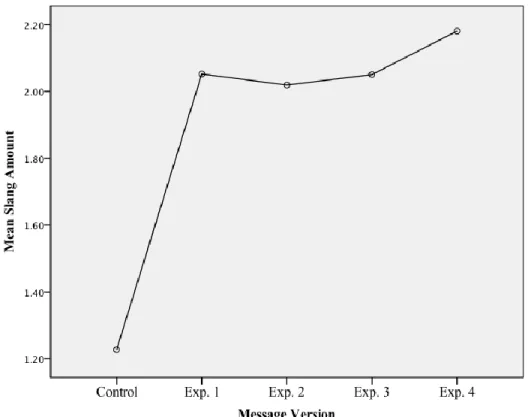
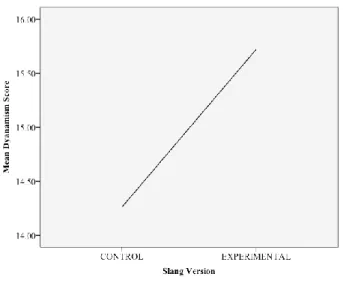
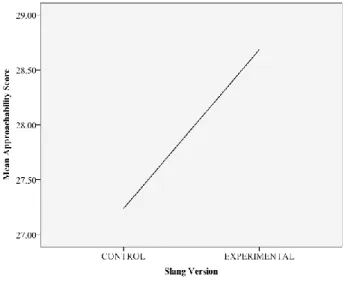
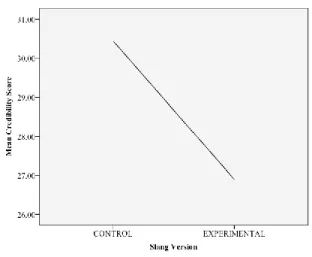
Figure 1. Means Plot for Message Version and Slang Inclusion ... 45 Figure 2. Mean Differences between Dynamism Ratings for Control and Slang Messages ... 55 Figure 3. Mean Differences between Approachability Ratings for Control and Slang Messages. ... 56 Figure 4. Mean Differences between Credibility Ratings for Control and Slang Messages ... 58
CHAPTER I - INTRODUCTION
Practitioners of higher education are charged with, at least, one critical task: preparing students for various aspects of their futures. Faculty at research-focused universities, liberal arts institutions, comprehensive programs, and community colleges take on the responsibilities of educating and mentoring the next generation of society. The emphasis that American culture places on education makes the ability of faculty members to create real and meaningful connections with students practically invaluable. However, a monetary amount can be calculated. In the short term, students pay in excess of $24,000 for four years of higher education (U.S. Department of Education, 2012). In the long term, having a higher education positively correlates with higher earning
potentials and negatively correlates with high levels of unemployment (U. S. Department of Labor, 2013). Moreover, individuals with higher educations have increased social status, influence, and even life expectancy (Villoutierx, 2013). However, the large number of students engaged in the higher education system can complicate the creation of meaningful interpersonal connections. In fact, thirty-one million 18 to 24 year olds were enrolled in colleges and universities across the nation in 2012 (U. S. Department of Education, 2013). These enrollment numbers are remarkable considering the fact that less than three million faculty members serviced this enormous number of students. Given the incredible responsibilities with which higher education faculty members are charged, it is important to know more about faculty-student interactions, how students evaluate these interactions, and how faculty can improve the quality of these interactions.
Classroom interactions between instructors and students are vital to the process of higher education (Hagenauer & Volet, 2014; Wallace, 2003). While instructors and
students interact in various settings, the focus of this research is classroom interactions— a virtually inescapable site of educational communication. Many instructors struggle to create meaningful classroom interactions and to encourage student participation
(Gooblar, 2015). However, the quality of classroom interactions between instructors and students act as predictors of classroom climate (Fassinger, 1995) and student success (Duffy, Warren, & Walsh, 2001). During these interactions, instructors often wish to appear dynamic (Basow, 2000), approachable, and credible (Bennett, 1982), in order to increase the likelihood of positive interactions with students. High levels of dynamism, associated with instructor enthusiasm (Wheeless, Witt, Maresh, Bryand, & Schrodt, 2011), energy, and excitement (Patrick, Hisley, Kempler, & College, 2000), positively correlate with increased student recall of class material (Stewart, 1989), as well as increased ratings of instructor effectiveness (Haleta, 1996). High levels of instructor approachability, associated with students feeling comfortable interacting with instructors, positively correlate with increased student participation (Sidelinger, 2010) and increased student ratings of quality classroom climates (Cox, Zhu, Cekic, Chavela, & London, 2010). High levels of instructor credibility, associated with trustworthiness and expertise (Infante, 1980), positively correlate with increased student motivation to learn (Finn et al., 2009) and student perceptions of instructor competence (Wheeless et al., 2011). These three areas of instructor evaluation are commonly used when evaluating instructor performance (Cox et al., 2010; Finn et al., 2009; Haleta, 1996).
One reason the areas of dynamism, approachability, and credibility are used for instructor evaluation is that they are positive indicators of effective instructor-student interactions (Cox et al., 2010). While no instructor purposefully wishes to negatively
impact students’ perceptions of any of these areas, some instructors intentionally behave in ways they hope will improve student perceptions and evaluations (Mazer & Hunt, 2008a). One behavior some instructors add to their classroom personas to achieve these goals is slang use during class lectures. Slang is defined as an ever changing set of words and phrases that are used to establish social identity or group cohesiveness, and are typically less socially prestigious than more standards language (Eble, 1996). Instructor use of slang in the classroom is not a rare phenomenon (Jannedy, Poletto, & Weldon, 1994). Some instructors use slang as a part of their natural or personal vernacular, while others use it strategically as a means to accomplish particular communication goals (Giles & Williams, 1992). Regardless of natural predilections, some instructors use slang in an attempt to enhance communication immediacy or to reduce the social distance between instructors and students (Gorham, 1988; Mazer & Hunt, 2008a, 2008b; Mottet &
Richmond, 1998). However, observations of instructor use of slang in the classroom have produced conflicting findings (Brown, 2013; Mazer & Hunt, 2008a, 2008b).
On one hand, Mazer and Hunt (2008a; 2008b) found that when instructors, at least male instructors in their mid-thirties, use slang in the classroom, students react positively. When slang was examined as a form of communication immediacy, students indicated that slang helped instructors relate to students and appear humorous, aided in the delivery of course material, and increased the comfort level of students in the
classroom (Mazer & Hunt, 2008a). On the other hand, Brown (2013) found that when the confederate instructor, in this case a woman in her mid-thirties, used slang, students responded in largely negative ways. For example, students stated that slang was “out of place,” and “unnatural” (p. 9). While some findings from Brown’s study aligned with the
previous studies (Mazer & Hunt, 2008a, 2008b), such as slang as attention grabbing, more findings did not. Even though Brown replicated Mazer and Hunt’s study closely with the exception of a female confederate, conflicting findings emerged. This seems to indicate that students evaluate male and female instructors’ use of slang differently. To explore this phenomenon further, this study measures and compares student perceptions of no- slang and slang-included messages. Additionally, this study includes evaluations of instructor slang use with sex-specific instructor conditions and sex-specific student conditions. Possible main effects and interactions of instructor sex and student sex on evaluations of instructors were examined.
Sex differences were selected as a focus of this examination, as opposed to other variables, for two reasons. First, past research (Mazer & Hunt, 2008a) suggests that sex differences should be explored as a possible cause of perceptions of slang use. While multiple variations instructor variables like ethnicity and age exist, all instructors are of one sex or the other. Second, other variables (e.g., ethnicity and age) were not included in order to avoid an overly complex study with methodological difficulties. While it is known that no distinct speech characteristics exist for male and female instructors (Krupnick, 1985), it is also known that female speakers have less linguistic latitude than male speakers (Burgoon, 1990; Burgoon, Birk, & Hall, 1991; Carli, 2001) and that male and female students evaluate male and female instructors differently (Grasha, 1994; Romano, 1994; Statham, Richardson, & Cook, 1991). Because of these conflicting findings, this study will answer both general and sex-specific questions about instructor use of slang. As a whole, this study assesses students’ perceptions and evaluations of instructor credibility, approachability, and dynamism based on both male and female
instructors’ use of slang in the classroom. This study strives to better understand how students evaluate instructor slang use as a form of convergent communication
accommodation (Giles, 1977). Understanding student evaluations of classroom communication produces explanations of and predictions about instructor slang use, specifically of and about student assessment of instructor ratings of dynamism, approachability, and credibility. Finally, student evaluations of instructor-student interactions involving slang are evaluated in order to look for sex-specific interactions between slang use and the sex of the instructor and student. This project provides instructors with an understanding of how students evaluate the use of slang, gives prescriptive advice on instructor use of slang in the classroom, and supplies an overall understanding of one approach to improving instructor-student classroom interactions.
To conclude, it is important to summarize and preview important information. This paper has briefly discussed and identified a rationale for this study. Moving forward, this dissertation will review findings of several studies that focus on applicable areas of interest. These areas will begin with student evaluations of instructors as a way of measuring instructor-student interactions, focusing on student perception of instructor dynamism, approachability, and credibility. The review will continue by discussing instructor use of strategic classroom communication. Here, Communication
Accommodation Theory (CAT) is reviewed as an explanatory addition to instructor use of strategic communication. Next, selected slang literature is reviewed. Slang is defined and findings from two similar but contradictory studies are reviewed and differences between male and female language use, specifically in the classroom, are covered. Later, a methodology for studying instructor use of slang in the classroom is covered and results
of the study are described in terms of parameters, slang elicitation and production, study variables, survey, procedure, and analysis. Finally, a discussion of the findings is
CHAPTER II – REVIEW OF THE LITERATURE
This review of literature will cover student evaluations of instructors, sex differences of these evaluations, instructor use of strategic classroom communication, slang in the classroom as a form of strategic communication, and sex differences in language use in the classroom. As stated above, classroom interactions between
instructors and students are vital to the process of higher education (Hagenauer & Volet, 2014; Wallace, 2003). One behavior some instructors might either strategically or naturally add to their classroom personas to improve evaluations of classroom interactions is slang use during class lectures (Mazer & Hunt, 2008a). Before understanding how slang impacts evaluations, student evaluations of instructors, in general, are discussed.
Student Evaluations of Instructors
Aside from in depth interviews (Kardia & Wright, 2004), it is difficult for researchers to accurately assess students’ perceptions of interactions with instructors. While immediate feedback in the classroom is common and useful, it is not easily quantifiable. This absence of empirical feedback makes it difficult for researchers and instructors alike to understand the linkage between instructor-student interactions, students’ evaluations of those interactions, and specific perceptions of instructors established above. One way in which students’ perceptions of instructors are shared and empirically measured is end of semester instructor evaluations (Basow & Silberg, 1987). In fact, student evaluations are an increasingly important part of assessing overall faculty performance (Laube, Massoni, Sprague, & Ferber, 2007). For instructors of either sex, student evaluations provide potentially useful information. Student evaluations serve as
looking-glasses which allow instructors to see themselves as their students do (Mead, 1934a/1967). While evaluations explore multiple and various areas of students’ perceptions of instructors’, three areas remain common to evaluations: dynamism, approachability, and credibility. Below, these three commonly used dimensions of evaluation (Cox et al., 2010; Finn et al., 2009; Haleta, 1996; Marsh, Fleiner, & Thomas, 1975; Norton, 1983; Perry, 1985), dynamism, approachability, and credibility, are reviewed.
Dynamism
Dynamic teaching styles are characterized by enthusiasm (Wheeless et al., 2011), high energy, and excitement (Patrick et al., 2000). The use of this teaching style
communicates to students that an instructor is engaged in the teaching-learning process and is willing to expend energy to facilitate that process (Andersen, Norton, &
Nussbaum, 1981; Rubin & Feezel, 1986). Additionally, a dynamic style captures the attention of students. Other benefits of instructor dynamism in the classroom include increased student affect toward the course, increased student affect toward the instructor, increased student satisfaction (Myers & Knox, 2000), and increased student recall of lecture content (Stewart, 1989). Dynamism is an exceptional predictor of an effective teacher across a variety of studies (Haleta, 1996; Norton, 1983; Perry, 1985).
Approachability
Instructor approachability is characterized by students feeling comfortable asking the instructor questions during class and instructor willingness to interact with students inside and outside of class (Cox et al., 2010). Student perceptions of what makes an instructor approachable include factors such as the teacher’s personality and lecture style
(Perrine, 1998). Students report that approachable instructors are associated with facilitating quality classroom climates. Quality classroom climates are associated with increased class participation (Fassinger, 1995; Sidelinger, 2010). Therefore, instructor approachability seems to have a positive relationship with student participation. For these reasons, evaluations of approachability are commonly included in student evaluations of instructors (Cox et al., 2010; Marsh et al., 1975).
Credibility
While early research in the area of credibility grouped credibility and dynamism together as a single factor (Berlo, Lemert, & Mertz, 1970; McCroskey, 1966), later scholarship suggested the two are separate and unique factors used to evaluate speakers (Bell & Daly, 1984; Infante, 1980). According to Infante (1980), credibility is
characterized by descriptors such as trustworthy and expertise. Benefits of increased credibility include positive perceptions of competence and trustworthiness (Wheeless et al., 2011). Additionally, high levels of credibility in the classroom are associated with an increase in student motivation to learn and overall positive outcomes of classroom
instruction (Finn et al., 2009).
While the findings discussed above represent instructors of both sexes, the following section of this review will take a closer look at student evaluations of
instructors from a sex-specific view. Specifically, the following review will identify areas in which students commonly evaluate male and female instructors differently. This section might provide insight into expectations for sex-specific predictions.
Evaluations and Sex Differences
This review above has justified the study of student evaluations of instructors. However, the review has been limited to sex-neutral findings. In other words, student evaluations of dynamism, approachability, and credibility have been described using both male and female research participants. Now, this paper will review research that contains contradictory findings. Some findings do not indicate sex-based differences in
evaluations. Others indicate male and female instructors are perceived differently by students and therefore have different interactions with them.
Overall, students consistently rate male and female instructors equally, with an infrequent and insignificant advantage present for men (Andersen & Miller, 1997; Basow, Condos, & Martin, 2013; Bavishi, Madera, & Hebl, 2010; Centra & Gaubatz, 2000; Chamberlin & Hickey, 2001; Feldman, 1992, 1993). This finding alone could support the idea that students see male and female instructors as equals in the classroom. However, this conclusion reflects overall ratings across multiple areas of evaluation. When individual areas of evaluation are examined, sex differences are seen.
A closer look at evaluations reveals that, on one hand, men receive higher dynamism ratings than women, while on the other hand, women receive higher approachability ratings than men (Caltabiano & Caltabiano, 2004; Fandt & Stevens, 1991; Feldman, 1993; Fischer-Clune, 2009; Sebastian & Bristow, 2008; Sidanius & Crane, 1989). It is important to note that differences in evaluations of male and female instructors’ dynamism and approachability, cited above, were significantly different, though the magnitudes of those differences were small. For example, Basow and Silberg (1987) found a statistically significant difference between male and female instructors’
dynamism ratings. Using a scale with an overall range of 5-25 where lower scores reflect more positive dynamism ratings, male instructors received a mean rating of 9.8 while female instructors received a mean rating of 11.4. While this was a significant difference, the study only produced an effect size of η2 = .03. In a separate study, Bennett (1982) found a statistically significant difference between male and female instructors’ approachability ratings. Female instructors received a mean rating of 1.0 while male instructors received a mean rating of -.34. Again, the difference was significant but only produced an effect size of β = .16.
To review, significant sex-based differences in these areas of evaluation suggest that male instructors may have real or perceived deficiencies regarding approachability, while female instructors may have real or perceived deficiencies regarding dynamism. While the differences between males and females noted above may not indicate an overall quality of an instructor, all teachers seek methods to improve their perceived deficiencies to become more effective instructors. Becoming more effective may produce more favorable evaluations that may, in turn, affect general and specific instructor
ratings.
While students generally evaluate male and female instructors equally on a macro, all-inclusive level, clear discrepancies exist on a micro level (Andersen, & Miller, 1997; Feldman, 1992, 1993; Sidanius & Crane, 1989). While sex differences should be
highlighted in order to understand which area(s) of communication instructors of each sex might seek to improve upon, all instructors likely wish to improve their classroom interactions. For this reason, it is important to review research that may provide strategies for altering student perceptions of instructors in more detail. In the section below,
research centered on interpersonal strategic communication behaviors is reviewed. This research provides linguistic and behavioral tools for instructors to use in an attempt to manage and improve students’ evaluations of instructor-student interactions.
Instructors & Strategic Classroom Communication
Instructors of both sexes may wish to appear dynamic, approachable, and credible in the classroom in order to increase the likelihood of positive interactions with and evaluations from students. Considering the sex-specific evaluation differences reviewed above, should focus on improving students’ perceptions of their dynamism, while male instructors should focus on improving their perceived approachability (Basow, 2000; Feldman, 1992, 1993; Sidanius & Crane, 1989). Clearly, no instructor wishes to
negatively impact students’ perceptions of any of these areas. Seminal research indicates that perceptions others have of a particular individual involve the reduction of perceived social distance between two interlocutors (Giles, Coupland, & Coupland, 1991) and increasing the perceived similarity between them (Byrne, 1971). The use of
accommodating language, as explained by Communication Accommodation Theory (CAT), can function to both reduce social distance and increase similarity. Using accommodative language allows individuals to influence perceptions that others form about them (Goffman, 1959; Hall, Johnson, Juzwik, Wortham, & Mosley, 2010). Below, CAT is reviewed followed by a subsequent discussion of one specific strategic
accommodation strategy instructors may use in the classroom to better connect with students.
Communication Accommodation Theory
The process of formulating CAT began in 1972 with the work of Giles, Taylor, and Bourhis. This research, along with subsequent work produced by Howard Giles (Giles, 1973, 1977), provided a foundation for CAT through the development of Speech Accommodation Theory (SAT). In its original form, SAT was primarily focused on explaining accent and bilingual shifts during intergroup encounters (Street & Giles, 1982). In part, SAT developed in reaction to the work of William Labov (Shepard, Giles, & LePoire, 2001). Labov’s 1966 work (2006) was designed to discover if changing the context of an interview would change the pronunciation styles that interviewees used in relation to the perceived prestige of the styles. While Giles regarded this work as valuable, he hypothesized that the pronunciation style used by Labov and his co-interviewer during the experiments affected the speech styles of interviewees more so than the interview’s context (Giles, 1973). Giles suggested this interpersonal influence led interviewees to converge toward the style of the interviewer and set out to explore the social psychological processes that impact speech diversity during intergroup interactions (Giles & Coupland, 1991). In addition to reacting to Labov’s work, Giles’ new theory was also informed by Byrne’s (1971) assumption that humans are socially attracted to similar others. This combination of assumptions led to the transformation of SAT to CAT by way of a revision of SAT’s propositions and the inclusion of impression management (Gallois, Ogay, & Giles, 2005). In this way, CAT connects the work of Labov and Byrne by characterizing speech accommodation, specifically convergence, as a means to similarity attraction. Today, CAT aims to predict and explain multiple and various interpersonal communication adjustments (Giles & Ogay, 2007). Below, components of
CAT that explain these interpersonal adjustments as well as extensions of CAT research are reviewed.
Accommodation. CAT refers to communication adjustments as accommodation. Humans use accommodation to increase or decrease the social distance between
themselves and others, to demonstrate solidarity with or separation from others, and/or to express attitudes about communication situations (Giles & Coupland, 1991; Giles et al., 1991; Giles & Ogay, 2007). When humans wish to reduce social distance between themselves and others, demonstrate solidarity, or communicate a positive attitude, they may use convergence behaviors. When wishing to increase social distance between themselves and others, demonstrate separation, or communicate a negative attitude, they may use divergence behaviors. Both convergence and divergence are seen operating in upward and downward directions.
Convergence, Divergence, and Directionality. Convergence refers to the accommodation strategy of adjusting communication behaviors in order to make them more similar to the communication behaviors of interlocutors (Coupland et al., 1988; Giles & Ogay, 2007). One, both, or all communication participants may perform
convergence behaviors. Convergence may take the form of adjusting speech style and/or rate, pauses, language, utterance length, facial expressions, and more. Convergence may be uni-modal (adjusting a single behavior) or multi-modal (adjusting multiple behaviors) (Giles & Coupland, 1991; Giles et al., 1987). CAT posits that speakers can converge toward either the actual communication style of others, or toward a style they perceive others to use or desire. Divergence refers to the accommodation strategy of adjusting communication behaviors in order to make them dissimilar to the communication
behaviors of interlocutors (Coupland et al., 1988; Giles & Ogay, 2007). Like
convergence, divergence can be uni-modal or multi-modal (Giles & Coupland, 1991; Giles et al., 1987). CAT states that communicators use divergence to separate themselves from other individuals. Both convergence and divergence can be seen taking either an upward or downward direction.
Directionality is concerned with shifts between communication styles considered more prestigious or less prestigious. Upward convergence, first discussed by Giles and Powesland in 1975 (as cited in Giles & Coupland, 1991), refers to shifting toward a prestigious variety of communication styles and behaviors. An example of this would be an interviewee using a standardized dialect when speaking at a job interview. Here, the interviewee may be converging toward the style of the interviewer, or attempting to speak as he or she perceives the interviewer to desire. Downward convergence refers to shifting toward a less prestigious pattern of communication styles and behaviors (Giles & Ogay, 2007). An example of this would be a parent trying to appear cool in the eyes of their children and using slang in hopes of achieving a particular goal. Conversely, upward divergence is typically used to demonstrate superiority to others, while downward divergence may be used to show inferiority or to identity with a less prestigious group. Downward convergence of instructors towards students is the focus of this study. While most individuals can identify a time when they have seen and/or used convergence or divergence as an accommodation strategy, understanding the motivations and outcomes of converge is key to CAT research and application.
Motivations. Convergence is motivated by multiple factors (Giles & Coupland, 1991; Giles et al., 1991). First, an individual’s need for integration or identification with
another person may motivate convergence. As mentioned above, Byrne (1971) notes that humans desire the approval of others. Moreover, humans want to be liked, respected, seen as socially attractive, and to gain social rewards. Byrne’s research suggests that appearing similar to others, or converging toward their communication style, is one way to appear attractive to them, which leads to gaining their approval and liking. The above example of a parent using slang when interacting with their child in hopes of appearing cool is an example of that parent being motivated in this way. Additionally, this approval and liking may increase the likelihood for future, positive interactions with the
communication partner (Shepard et al., 2001). Similar to the parent-child example, research indicates that instructors use this convergence technique in the classroom when interacting with students (Giles & Williams, 1992; Mazer & Hunt, 2008a, 2008b). This phenomenon, which is at the crux of this dissertation, will be explored later.
Second, convergence may be motivated by a desire to alter or strengthen a social or group identity (Giles & Coupland, 1991; Giles et al., 1991; Shepard, Giles, & LePoire, 2001). Similar to the motivation above that relates to individuals, social or group
motivations also hinge on being seen in a positive way. Here, motivation for convergence within a group is frequently seen as group members attempt to boost similarity with one another in hopes of distinguishing themselves from other groups. This display of in-group solidarity usually involves identifying a prototypical communication style for the group, followed by mass convergence toward that style by group members. Social Identity theorists refer to this as prototypical behavior or adherence to the prototype (Bourhis, 1989; Tajfel & Turner, 1979).
Third, convergence may be motivated by situational norms or expectations (Giles & Ogay, 2007). While the various locations and settings that humans visit in their lives rarely have explicitly posted communication norms, most understand that different expectations exist for different situations. This is not unlike Goffman’s (1959) notion that humans behave in accordance with social expectations. For example, Jones, Gallois, Barker, and Callan (1994) found that, in classroom settings, students are expected to demonstrate upward convergence toward the language and communication style used by the instructor. While this specific assumption will be analyzed and challenged later, the outcomes and evaluations generally associated with convergence behaviors are important to understand and are reviewed below.
Outcomes and Evaluations. There are several positive outcomes of
communication convergence. The first positive outcome of convergence is a positive evaluation of a speaker’s attractiveness, supportiveness, intelligibility, and interpersonal involvement (Giles et al., 1987). A second positive outcome of convergence is the reduction of uncertainty and interpersonal anxiety, as well as an increase in mutual understanding between communicators (Gudykunst, 1995). The increased sense of similarity created through convergence puts interlocutors at ease while communicating, and seems to increase the likelihood of reaching an agreement or consensus. The final positive outcome of convergence is compliance gaining (Buller, LePoire, Aune, & Eloy, 1992). Individuals are more likely to comply with requests of similar others than
dissimilar others. However, authority figures, police officers for example, must find a suitable level of convergence as to avoid a loss of authority when interacting with the public (Giles et al., 2005; Giles, Linz, Bonilla, & Gomez, 2012). These positive outcomes
associated with convergence are important to the application of CAT to instructors and classroom interactions. However, convergence may not always be appropriate or effective (Giles & Coupland, 1991). For this reason, it is important to next review the negative outcomes of convergence.
Convergence is typically positively evaluated by receivers and seen as a validation of the recipient’s own way of communicating (Bourhis, Giles, & Lambert, 1975), but negative outcomes of convergence are possible. First, convergence can sometimes be seen as stereotypical or condescending (Giles & Coupland, 1991). This is often seen when convergence is based on stereotypical expectations. For example, research shows that elderly adults often experience younger interlocutors using ‘baby-talk’ when addressing them (Coupland et al., 1988). Here, younger speakers may hold the stereotypical view that the elderly (seen as an all-encompassing group of people) are audibly impaired and cognitively delayed. This level of accommodation is known as overaccommodation and results when a “participant perceives a speaker to exceed the sociolinguistic behaviors deemed necessary for synchronized interaction” (Shepard et al., 2001, p. 38). Given the perceived condescension that results from interactions involving overaccommodation, it is not surprising that this level of convergence is negatively evaluated.
The second cost of convergence is a potential loss of personal or social identity (Giles & Coupland, 1991; Hogg, D’Agata & Abrams, 1989; Shepard et al., 2001). When individuals converge toward the communication behaviors of others, they lose a degree of authenticity. On a personal level, individuals may be seen as trying to be someone they are not. On a social or group level, individuals who converge toward behaviors not
aligned with the prototypical behaviors of their group may be seen as deviants (Hogg et al., 1989). Later, when CAT is applied to instructors, potential overaccommodation and loss of authenticity could negatively affect student evaluations of instructor convergence.
Since both positive and negative evaluations of convergence are seen, it is important to understand what factors may contribute to the production of each type of evaluation. First, the level of convergence used impacts the way in which convergence is received by others (Giles & Coupland, 1991; Giles & Ogay, 2007). Convergence is typically seen on two levels, partial and full, and should be viewed as a continuum. Partial convergence refers to adjusting one’s own communication behaviors to resemble the behaviors of a partner. Full convergence refers to adjusting one’s own communication behaviors to mimic the behaviors of a partner. Partial convergence is typically preferred to full convergence. The discrepancy-arousal link (Street & Giles, 1982) explains that no convergence results in no arousal of communication partners, partial convergence results in some arousal of communication partners and positive evaluations, and full
convergence, or over accommodation, results in an over arousal of communication partners and negative evaluations. However, levels of convergence, levels of arousal, and type of evaluation are dependent on the context of unique situations. For example, in some cases, an absence of convergence when it is expected may result in high levels of arousal and negative evaluations of the expectation-violating experience. Since finding an optimal level of convergence is important for receiver evaluations of speakers,
understanding how to arrive at that optimal level is important.
Finding an optimal level of convergence involves considering situational norms and expectations, as well as sociohistorical contexts (Giles & Coupland, 1991; Giles et
al., 1991; Giles & Ogay, 2007). Situational norms, as discussed above, differ from setting to setting and communicators should consider what is expected of them in various
situations before attempting to adjust their behaviors towards others. Sociohistorical contexts refer to, in part, established norms about intercultural encounters or encounters between individuals with different amounts of social power. For example, Americans in Paris should not expect Parisians to converge toward them and speak English. Similarly, college students may assume they are expected to converge toward their professors when composing an email, and avoid using ‘text-speak’ (Stephens, Houser, & Cowan, 2009). This assumption is challenged, in part, by later findings of this research.
In addition to level of convergence, a speaker’s intentions and level of consciousness often impact how convergence is evaluated. First, to increase the
likelihood of convergence being evaluated positively, receivers must perceive it as being motivated by positive intentions (Giles & Coupland, 1991). If convergence is perceived as motivated by negative intentions, it is very likely to be evaluated negatively. Positive intentions include a desire for understanding, closeness, and reduced uncertainty.
Negative intentions include being deceptive and seeking personal gain. Second, perceived unconscious convergence receives more positive evaluations than conscious or scripted convergence (Street & Giles, 1982). For example, President Obama was criticized for his deliberate use of colloquial language when speaking to the public (Sieczkowski, 2013, September 30). While this element of CAT and others are mainly studied in the context of intergroup contact, its validity is generalizable to other extensions of convergence. Next, instructor use of accommodative behavior and impacts on student perceptions is discussed.
Accommodation and Perceptions of Instructors
Applying CAT to instructor-student classroom interactions is appropriate for three reasons. First, intergroup communication takes place as students and instructors represent two different groups of individuals when they come together in the classroom. Second, future communication between instructors and students is typically guaranteed. This promise of future interactions is a motivator for accommodating behavior (Giles & Ogay, 2007). Finally, existing research has documented the existence of communication
convergence in the classroom (Mazer & Hunt, 2008a, 2008b; Jones et al., 1994). These reasons justify applying CAT to classroom interactions. Specifically, it is important to understand the effects of instructor convergence as they relate to students’ evaluations of instructors and instructor-student interactions.
This paper has shown that social interactions impact perceptions of individual speakers (Akkerman & Meijer, 2011; Cooley, 1902/1956; Mead, 1934a/1967; Rodgers & Scott, 2008). This paper has also reviewed research that indicates communication
accommodation influences the outcomes and evaluations of social interactions (Giles & Coupland, 1991; Giles et al., 1987; Gudykunst, 1995; Buller et al., 1992). In this way, communication accommodation may influence student perceptions of instructor use of slang. In the classroom setting, the use of accommodative language shapes students’ perceptions of the instructor. Additionally, speech markers, such as the use of convergence, communicate a speaker’s identity to others (Giles, Scherer, & Taylor, 1979). Speakers, or instructors, may use speech markers they believe will present themselves in the most favorable way during interactions with students. Taken as a
whole, instructors can use communication strategies to favorably manipulate students’ perceptions of them in the classroom.
Knowing that instructors can influence how students evaluate them through communication convergence is potentially useful. However, instructors must know or have an idea about students’ speech styles in order to make this adaptation successful. Pinpointing specific student speech styles may be impossible or difficult as they may vary by region, institution, or classroom. However, CAT research shows that
accommodative language may be used in response to the expected language of others (Hajek, Abrams, & Murachver, 2005). If accommodation is used in response to what the instructor expects the students’ linguistic styles to be, some level of familiarity with students by the instructor is required. If the instructor has an accurate understanding of students’ styles, their use of accommodation may have a positive outcome. If not, the outcome is more likely to be null or negative. If viewed negatively, students may see the use of accommodation as a cynical, condescending attempt to garner their favor (Giles & Coupland, 1991; Goffman, 1959). Instructors may have an accurate understanding of students’ language styles and still experience a negative outcome of convergence as students may see this linguistic adjustment as an encroachment on their established group, of which the instructor is not a part. As stated above, outcomes of convergence often depend on specific situations and contexts of interactions. Still, some instructors are willing to risk negative outcomes and use convergence strategies in an attempt to reduce the social distance between themselves and their students (Mazer & Hunt, 2008a, 2008b). This study includes a pilot study used to create an accurate expectation of students’
language and use of slang. The question that should be asked now is: does instructor use of slang in the classroom equate to an effective accommodative strategy?
Slang in the Classroom
As stated above, many instructors wish to decrease the social distance that exists between themselves and their students and increase classroom immediacy (Gorham, 1988; Mottet & Richmond, 1998). Immediacy can be defined as “communication behaviors that enhance closeness and…interaction with another” (Andersen, 1979, p. 544). Given these desires, some instructors use downward convergence by incorporating slang into their lectures (Drake, 1980; Eble, 1996; Mazer & Hunt, 2008a, 2008b).
Currently, very little research exists on students’ perceptions of instructor use of slang in the classroom (Mazer & Hunt, 2008a, 2008b). This lack of research seems to indicate that communication and education scholars understudy the area of instructor use of slang. Below, slang is clearly defined and expositions of two studies (Brown, 2013; Mazer & Hunt, 2008a) involving slang in the classroom are provided. These studies were selected for exposition due to both the similarities of their designs and the conflicts between their findings. To begin this discussion, slang must be defined.
Defining Slang
Renowned American linguist Connie Eble, in her comprehensive review of slang, Slang and Sociability (1996), defines slang as an ever changing set of words and phrases that are used to establish social identity or group cohesiveness, and are typically less socially prestigious than more standard language. Eble says that slang reveals more about a speaker’s attitude than does more formal language. She agrees with Drake that slang use functions to bolster in-group distinction and out-group alienation (Drake, 1980) Also,
Eble subscribes to Dumas and Lighter’s (1978) criteria for identifying slang by stating that words and/or phrases must meet at least two of the following criteria to be identified as slang. The four criteria are:
1. Its presence will markedly lower, at least for the moment, the dignity of formal or serious speech or writing.
2. Its use implies the user’s special familiarity either with the referent or with that less statusful or less responsible class of people who have such special familiarly and use the term.
3. It is a tabooed term in ordinary discourse with persons of higher social status or greater responsibility.
4. It is used in place of the well-known conventional synonym, especially in order (a) to protect the user from the discomfort caused by the conventional item or (b) to protect the user from the discomfort or annoyance of further elaboration.
Slang can be divided into two categories: positive and negative slang. The
delimitation between positive and negative slang is a creation of Mazer and Hunt (2008a, 2008b). This distinction was made in order to separate slang that is not seen as verbally aggressive (positive slang) from slang that is seen as verbally aggressive (negative slang). Positive slang refers to a subset of non-derogatory slang used to identify with a specific group of listeners (Mazer & Hunt, 2008a). In the context of this review, the specific group of listeners is college students. In other words, an instructor may use slang because he or she knows or assumes its use is common among students. Examples of positive slang include words such as cool or sweet. In contrast, negative slang, “refers to informal
language that may be perceived offensive by the listener…and would likely have a negative effect on…perceptions of the instructor” (Mazer & Hunt, 2008a, p. 22). Examples of negative slang include words such as jerk or shit. Positive slang was selected for this review and proposed study due to students’ negative evaluations of verbally aggressive instructors (Martin, Weber, & Burant, 1997).
While words like cool and sweet are common adjectives, the context of their use can result in the use of slang terms. For example, describing the weather as cool
(temperature)is not slang. However, describing an object or person, aside from body temperature, as cool qualifies as slang. In other words, saying, “Sam and Barbara are cool people,” is an example of positive slang. This use of the word cool meets Dumas and Lighter’s (1978) requirement that a slang term meet two of their four established criteria. In this case, using the word cool would lower the dignity of serious or formal speech writing, and it protects the user from further elaboration of what it means to say someone is cool.
It is important to understand the difference between slang and other forms of less formal language. First, slang is not jargon (Lighter, 1994). Jargon is technical language unique to a particular profession, interest, or skillset. Slang is “nontechnical vocabulary” (p.xi). For example, describing someone as left wing instead of liberal or progressive is jargon, not slang. Second, slang is not the use of a dialect in place of more standard language. A dialect is a regional or socioeconomic variety of a language. For example, calling a brown paper bag a poke in the Appalachian region is an example of dialect, not slang. Finally, slang is not argot or cant. Argot, or cant, refers to special vocabulary used by a secretive group (Crystal, 1995). For example, the use of pig Latin is an example of
argot, not slang. Slang is, however, often seen as a subset of figurative language,
especially when used as a metaphor (Sopory & Dillard, 2002). For example, saying “She is cool” is metaphoric.
As previously stated, instructor use of slang in the classroom is not a rare
phenomenon (Jannedy et al., 1994). Many individuals use slang as a part of their natural or personal vernacular, while others use it strategically as a means to accomplish
particular communication goals (Giles & Williams, 1992). That communication goal often takes the form of instructors wanting social approval from students, to be seen as affiliated with a particular group (students in this case), or to appear more competent, likable, or dynamic (Norton, 1983). This desire to be seen in a particular way often stems from the more basic desire to enhance communication immediacy or to reduce the social distance between instructors and students (Gorham, 1988; Mottet & Richmond, 1998). However, this goal stands in contrast to typical CAT research (Giles & Coupland, 1991; Giles et al., 1991; Jones et al., 1994) which assumes that students, who have low levels of power in the classroom, may use upward convergence toward the style of the professor who has high power in the classroom. This apparent contradiction is a focal point of this research. Research findings detailed below highlight this contradiction
Mazer and Hunt
Interested in understanding how classroom climate influences student motivation and affect toward the instructor and course, Mazer and Hunt (2008a) conducted a study assessing the effects of instructors’ use of slang in the classroom on students’ perceptions of instructor immediacy. The researchers assumed that instructor use of slang was a form
of downward convergence from instructor to students, and that slang use was likely to decrease the perceived social distance between instructor and student.
Participants in Mazer and Hunt’s (2008a) study were 126 students, 48 men and 78 women, enrolled in a basic communication course. The students’ ages ranged from 18 to 25; the mean age was 18. A video recording was made of a 36-year-old male instructor using positive slang during a four-minute classroom lecture. Participants were asked what they liked about the use of slang, what they did not like about the use of slang, and what suggestions they would offer the speaker in regard to his presentational style. Responses were sorted to identify themes.
Four themes emerged related to what students liked about the use of slang (Mazer & Hunt, 2008a). The first theme was labeled relate to students. Students indicated that the use of slang in the lecture was a clear attempt by the instructor to relate classroom material to a younger audience. One participant said that the use of slang made the lecture seem, “geared toward people my age” (p. 24). The second theme identified was labeled humor. Students felt as though the use of slang added humor to the lecture. One student stated that the inclusion of slang in the lecture was, “funny and attention grabbing” (p. 24). The third theme identified was labeled delivery of course material. Participants felt that slang use helped them stay focused on the lecture. One individual said that the use of slang “made me pay more attention” (p. 24). The final theme identified related to what students liked about the use of slang was labeled comfort level. Students felt comfortable listening to an instructor incorporate slang into a lecture with one participant stating that slang use, “made me feel on the same level as him” (p. 24).
In response to questions asking what participants disliked about the use of slang and what advice they would offer the speaker in regards to his presentation style, no clear themes emerged as participants overwhelmingly perceived the instructor’s use of slang positively (Mazer & Hunt, 2008a). However, some participants noted that the
presentation did not warrant the use of slang. Additionally, a few participants felt that slang use threatened the instructor’s credibility, while another stated that the instructor was trying too hard and was out of character. However, the small number of comments like these did not constitute themes.
The authors (Mazer & Hunt, 2008a) concluded the study indicates that instructors can use downward convergence to gain the social approval of their students.
Additionally, the use of positive slang seems to generally help instructors relate to students, appear humorous, aid the delivery of course material, and increase the comfort level of students in the classroom. However, the authors advise instructors to use slang cautiously and point out that some participants did not evaluate its use positively. Additionally, the authors conclude that more research is needed in order to better understand and predict students’ perceptions of instructor use of slang. Specifically, the authors point out instructor traits, including sex, which future researchers should examine as they may affect how students perceive instructor use of slang. Following this
recommendation, Brown (2013) completed a study designed to detect the effects of instructor sex on perceptions of instructor use of slang. This study’s findings, reviewed below, indicate instructor sex likely impacts students’ perceptions of slang use.
Brown
Already interested in CAT research, as well as his own classroom experiences with slang use, Brown (2013) designed a replication of Mazer and Hunt’s (2008a) study to assess differences in students’ perceptions of male and female instructor use of slang. Brown contacted Mazer and Hunt and asked for assistance replicating the study reviewed above. Mazer and Hunt provided Brown with the exact transcript used in the original study, as well as detailed information about how the study was conducted (e.g., video recording equipment, confederate positioning, reading a script from a teleprompter). Using this information, Brown (2013) followed the procedures of Mazer and Hunt (2008a) with two exceptions: he had fewer participants and used a 39-year-old female to record the lecture shown to participants.
Brown’s (2013) qualitative study examined 13 participants, five men and eight women, enrolled in an introductory communication course. This maintained the male to female ratio of the earlier study (Mazer & Hunt, 2008). Participants’ ages ranged from 18 to 27; the mean age was 20. Students viewed the video of the female instructor presenting a brief lecture and were asked to respond to the same questions used in the original research. Participant responses to these questions led to the emergence of three additional questions. Since Brown (2013) used fewer participants than Mazer and Hunt (2008a), he was able to ask participants to elaborate on their answers in some cases. The new
questions that emerged from this elaboration addressed participant perceptions of the acceptability of instructor use of slang, slang’s impact on instructor credibility, and possible changes in participant perceptions of slang use if the instructor in the video had
been a male of a similar age. Like the original research, responses were sorted to identify themes.
The results of this study (Brown, 2013) indicate that some themes aligned well with those found by Mazer and Hunt (2008a), some were contradictory, and others were new themes not found in the original research. First, two themes aligned well with the original study. Categories identified as slang as attention grabbing and instructor relating to students were common thematic labels between the two studies. Slang as attention grabbing was constituted by comments that indicated participants found the use of slang made focusing on the lecture an easier task to undertake. Exemplars of this theme included, “…it [slang] just jumps out and gets your attention” (p. 9). Instructor relating to students was constituted by comments that indicated participants viewed the instructor’s use of slang as a method of connecting with an audience of college students. Exemplars of this theme included, “…she uses it [slang] to kind of keep it on our age group’s level” (p. 9).
Second, at least one theme seemed to be in contrast to the original research. Participant responses produced a theme identified as slang was out of place and unnatural. Exemplars of this theme included, “…that was awkward,” and “…It [slang use] was kind of weird” (p. 9). This finding does not fit with the original research
findings that slang helps the delivery of course material and increases the comfort level of students in the classroom. While Mazer and Hunt (2008a) noted that some participants shared negative evaluations of instructor use of slang, the authors did not feel the quantity of these negative evaluations constituted a theme. However, Brown (2013) found that a
majority of participants voiced negative evaluations of slang use, criticizing it as unprofessional.
Finally, three themes not included in the original research emerged in the replication. These themes were a result of Brown’s ability to ask participants to elaborate on their responses. Slang as not affecting perceptions of instructor credibility, slang as more natural/acceptable from men than women, and instructor is too old to use slang were all new themes found in the replication using a female confederate. First, Brown explicitly asked participants if slang use affected their perceptions of the instructor’s credibility. Participant responses to this question indicate that the instructor’s title of professor established her credibility in a way that slang use would not threaten. However, a specific degree (e.g., Ph.D.) was not included in the demographic information. Second, participants were explicitly asked if slang used by the female confederate in the video would be perceived differently if a male had been featured in the recording. Students indicated that slang seems more natural when used by males than females. One
participant justified this perception by stating that females are held to a higher standard than males when in the classroom. Finally, Brown explicitly asked participants if they felt the instructor in the recording was too old to use slang. Responses indicated that students perceived the confederate as being too old to naturally use slang. At least one participant stated that women over 30 should not use slang in professional settings. While these additional themes were identified as a result of Brown’s use of questions not included in the original replicated research (Mazer & Hunt, 2008a), they suggest that students may perceive the use of slang in the classroom very differently depending on the sex and/or age of the instructor.
The comparison of themes from Brown’s (2013) work and Mazer and Hunt’s (2008a) work shows that some differences in student perceptions of instructor use of slang may be due to the sex of the instructor. Central to this claim is an apparent difference between levels of acceptability for slang use for men and women. A male instructor using slang was perceived as increasing the comfort level of students and aiding the delivery of course content. However, a female instructor using the same slang was perceived as unnatural and out of place. Additionally, Brown’s work produced findings that were not seen in Mazer and Hunt’s work. These findings include the idea that acceptable slang use may be dictated by the age of the user, as well as slang being more acceptable when used by a man than a woman. These latter findings were a result of Brown’s use of interviews. This style allowed for the emergence of new questions.
Conversely, Mazer and Hunt used a written question and answer data gathering style that prevented the addition of emergent questions. While differences in data gathering
techniques, as well as locational differences—Brown studied a southern university while Mazer and Hunt studied a Midwestern university—may explain some variation in
findings between the two studies, it is also possible that the variation is an effect of the confederates’ opposite sexes. In order to better understand sex differences in the classroom, sex-based instructor differences are reviewed below.
Given the research reviewed above, two of four hypotheses are proposed here. The first hypothesis involves the effect slang use may have on students’ perceptions of instructor dynamism. Dynamic instructional styles are, in part, characterized as being attention grabbing and engaging (Andersen et al., 1981; Rubin & Feezel, 1986). Similarly, instructor use of slang captures students’ attention (Brown, 2013; Mazer &
Hunt, 2008a). Even when students reported the use of slang as ineffective, they agreed that the instructor was putting forth an effort to connect and engage with them. As a result, the following hypothesis is formed:
H1: Instructors who use positive slang in the classroom will be perceived as more dynamic than instructors who do not use slang.
The second hypothesis involves the effect slang use may have on students’ perceptions of instructor approachability. Instructor approachability is characterized, in part, by students feeling comfortable asking the instructor questions in class (Cox et al., 2010). Additionally, students’ perceptions of instructor approachability are often formed as a result of the instructor’s lecture style (Perrine, 1998). Similarly, instructor use of slang is associated with positive student evaluations of instructor approachability (Brown, 2013; Mazer & Hunt, 2008a). In fact, students report a feeling of increased similarity to professors who incorporate slang into lectures (Brown, 2013; Mazer & Hunt, 2008a, 2008b). As a result, the following hypothesis is formed:
H2: Instructors who use positive slang in the classroom will be perceived as more approachable than instructors who do not use slang.
In addition to the preceding hypotheses, this research also aims to answer research questions for which insufficient data exists for the formation of hypotheses. The first research question deals with mixed findings that exist concerning slang use and instructor credibility. Credibility is characterized by terms such as trustworthy and expertise
(Infante, 1980), and is associated with competence (Wheeless et al., 2011). Mazer and Hunt (2008a) found that some participants viewed slang use as harmful to instructor credibility. However, these reports were few and not deemed significant. Also, Brown’s
(2013) participants reported that slang did not affect their perceptions of instructor credibility. Given that no prior research indicates slang use has a significant effect on students’ evaluations of instructor credibility, the following research question is formed:
RQ1: Are students’ perceptions of instructor credibility impacted by instructor use of slang?
Sex Differences in the Classroom
A variable that may influence students’ perceptions of instructor use of slang in the classroom is the instructor’s sex (Mazer & Hunt, 2008a; Brown, 2013). Male and female instructors often approach teaching differently (Laird, Garver, & Niskode, 2007). Not only do male and female instructors often take different approaches, but also students often evaluate male and female instructors differently (Krupnick, 1985). Taken together, it can be established that differences in instructor sex influence classroom interactions. The variable of instructor sex is important to study because of the nearly even distribution of male and female classroom instructors (U. S. Department of Education, 2013). This project is specifically concerned with students’ perceptions of linguistic behaviors of male and female instructors in the classroom. Therefore, this section will review general linguistic differences between males and females as well as slang and sex-based linguistic differences in the classroom.
Male Instructors, Female Instructors, and Language
Differences in prototypical language styles exist between men and women (Mulac, 2006). On one hand, males have a wide range of acceptable language styles and features that can be used without violating social expectations. On the other hand, women have more restricted socially accepted language options that can be used and still be
perceived as an effective communicator (Burgoon, 1990). This past research suggests that women have fewer linguistic options than do men. In her widely cited work Language and Woman’s Place (1973), Robin Lakoff notes that “women’s language” (p. 50) is largely free from informal and nonstandard elements while men’s language is not. Similarly, Haas (1979) and, much more recently, Romaine (2003) found that men use significantly more non-standard language forms than do women across a large range of socioeconomic levels. Cheris Kramarae (1981) explains this linguistic difference by stating, “Women are not as free or as able as men to say what they wish, when and where they wish…” due to being outside of the dominant, male group (p.1). In fact, Kramarae states that women who use informal language are perceived as being less attractive than women who use more formal language. One specific style of informal language that has traditionally been atypical for women to use is, while a dated finding, slang (Labov, 1966; Trudgill, 1972). Evaluations of slang use in classroom settings, as noted above, are largely understudied.
Sex, Language, and the Classroom
While it is unclear if women wish to use slang in the classroom, it is clear that women are linguistically restricted. What is also clear is that sex-specific language is dynamic and always changing (Kalbfleisch, 2010). Generally, research has found no distinct speech characteristics for male or female instructors (Krupnick, 1985). Also, no significant sex-based differences have been found in the amount of words male and female instructors use during a typical lecture. Krupnick notes that instructors of both sexes speak around 4,500 words per hour-long class meeting. However, differences have been noted in linguistic behaviors of male and female instructors. Male instructors report
being more comfortable speaking in the classroom than female instructors due to life experiences and expectations requiring males to publicly and/or professionally
communicate (Tannen, 1991). Additionally, females report higher overall communication apprehension levels than males (Jaasma, 1997). While, according to some research, possibly less comfortable speaking than men, female instructors’ behaviors are perceived as being more encouraging (Statham et al., 1991), more facilitating (Grasha, 1994), focused on networking (Romano, 1994), and making more adjustments during lectures (Tannen, 1991) than men. One such adjustment, as noted above, may be the strategic use of slang. However, limited research discussed above reminds us of the possibility of negative evaluations of women who use slang in the classroom (Brown, 2013). These contradictory findings between male and female instructors’ speaking styles and classroom comfort levels strengthen the rationale for this research project.
At this point, the final two hypotheses, both centered on the sex of the instructor, can be discussed. These specifically involve instructor sex differences and students’ perceptions of instructor use of slang. Existing research on students’ perceptions of instructor use of slang suggest that students evaluate slang use by male instructors more positively than slang use by female instructors (Brown, 2013; Mazer & Hunt, 2008a). This difference in evaluations can be explained by the understanding that women have more restricted socially accepted language options that can be used and still be perceived as an effective communicator than men (Burgoon, 1990). This means that a larger variety of acceptable language styles exist for men than women. Specifically, men are more likely (Romaine, 2003) and free (Lakoff, 1973; Kramarae, 1981) to use informal language than women. Since slang is a type of informal language (Lighter, 1994) that