The NaTioNal CharTer SChool reSourCe CeNTer iS fuNded by The u.S. deparTmeNT of
oCtoBer 2013
exeCutive summAry
the ArkAnsAs puBliC sChool resourCe Center, the Colorado League of Charter Schools, and the National Alliance for Public Charter Schools publish this report, entitled “An Analysis of the Charter School Facility Landscape in Arkansas,” detailing the status of charter school facilities in the state.
In Spring of 2013, the above organizations worked to collect evidence that would accurately portray both the degree to which Arkansas open enrollment charter school facilities1 were
sufficient2 and the average amount of operating funds spent on facilities. Collectively, the results
described in this report provide evidence that open enrollment charter school students in Arkansas do not have access to the same facilities and facilities-related special program amenities compared to traditional public school students in the state.
In order to ensure that the policy recommendations of this report are research-based and supported by reliable data, Cuningham Group Architecture, Inc.—a leader in educational facilities architecture—consulted on the project to provide a set of reasonable expectations for school facilities’ size and amenities (see Appendix B for detailed description). The Colorado League of Charter Schools (“the League”) is the pioneering organization behind the creation and development of the Charter School Facilities Survey. The League worked closely with the Arkansas Public School Resource Center to collect the data used to produce this report. A set of recommendations for ways in which Arkansas could address any facilities-related issues is provided by the National Alliance for Public Charter Schools.
Given the alignment of the Facilities Initiative and the goals and data needs of the U.S. Department of Education’s (ED) Charter Schools Program (CSP), ED procured additional state surveys, including Arkansas. The National Charter School Resource Center at American Institutes for Research (AIR) [1] has been subcontracting with the Colorado League of Charter Schools to collect the research and data on behalf of the U.S. Department of Education since October of 2011. To date, AIR has subcontracted for the data collection and research of charter school facilities in seven states: Arkansas, Idaho, Massachusetts, Michigan, New Jersey, Rhode Island, and South Carolina. This report is based on facilities survey and measurement data plus enrollment and operating revenue data collected for the 2012-2013 school year3. The results presented in this report are
The standards cited throughout this report were derived by averaging local standards5 and new
construction practices from several sources including published regional and national new school construction data found in the School Planning and Management’s Annual School Construction Reports for 2001 through 20126.
Key findings include:
1. Arkansas’s open enrollment charter schools spend per-pupil education and operating dollars on facilities, and do not have access to additional state and local facility funding. ■ The average Arkansas charter school spends $782 per pupil out of the school’s annual
operating budget on its facility, though this can vary depending on the charter’s facility arrangement. For example:
■ Charters renting from private entities pay an average of $864 per pupil (14 percent), annually.
■ Charter schools that own their facility pay an average of $680 per pupil (11 percent), annually.
■ Charter schools renting from another, non-district, governmental entity pay an average of $176 per pupil (three percent), annually.
4 Arkansas has one online school; it was not included in these survey results as standards for those facilities have not yet been explored.
5 Guidelines presented in the Commission for Arkansas Public School Academic Facilities and Transportation Rules Governing the Academic Facilities Partnership Program were also incorporated into the standards used in this study.
6 See School Planning and Management’s Annual School Construction Reports for the years 2001-2012 at (http://www.peterli.com/spm/resources/rptsspm.shtm).
2. Charter school facilities in Arkansas are smaller than prescribed standards.
■ 90 percent of Arkansas charter school facilities are at least 20 percent smaller than the
grade level standards.
■ 95 percent of Arkansas charter schools are on sites that are at least 20 percent smaller than
grade level standards.
■ Only 25 percent of charter school general education K-12 classrooms meet grade level
standards, with fewer than five percent of early childhood education and kindergarten classrooms meeting the grade level standards.
3. Few Arkansas public charter schools have access to underutilized or vacant district facilities.
■ 63 percent of respondents reported that there is an empty traditional public school (TPS)
building near the charter school.
■ Five charter schools with empty TPS buildings nearby reported that they have asked the
district for the use of that empty school facility.
■ To date, no charter schools have been granted access to an empty district owned building.
4. Many Arkansas charter schools lack full-preparatory kitchen facilities that qualify for participation in the National School Lunch Program.
■ Sixty-eight percent of Arkansas charter schools do not have a full-preparatory,
federally-compliant food kitchen; however,
■ Almost 70 percent of those have the capability of keeping food warm, typically food
provided by catering companies.
5. Physical education and recreational options are limited for Arkansas charter school students.
■ Over 60 percent of Arkansas charter schools do not have a gymnasium on campus.
■ Nearly 90 percent of Arkansas charter schools reported that their facility does not have a
tABle of Contents
Introduction ... 2
Key Findings ... 5
#1: Arkansas’s open enrollment charter schools spend per-pupil education and operating dollars on facilities, and do not have access to additional state and local facility funding. ... 5
#2: Charter school facilities in Arkansas are smaller than prescribed standards. ... 6
#3: Few Arkansas public charter schools have access to underutilized or vacant district facilities. ... 7
#4: Many Arkansas charter schools lack full-preparatory kitchen facilities that qualify for participation in the National School Lunch Program. ... 8
#5: Physical education and recreational options are limited for Arkansas charter school students. ... 8
Additional Evidence and Findings ... 9
Conclusions and Recommendations ... 12
Appendices: ... 15
Appendix A: Methodology ... 15
introduCtion
Charter School Facilities Initiative Background
In the summer of 2007, the Colorado League of Charter Schools (“the League”) launched its Facilities 2010 Task Force. The Task Force was established to identify prominent shortcomings in the charter school capital landscape and to develop a blueprint of public policy and private sector changes leading to a comprehensive, long-range system of sufficient public charter school facilities or facility funding sources that are accessible to charter schools. At the direction of the Task Force, the League developed a comprehensive Charter School Facilities Survey in partnership with a national leader in school facilities, Paul Hutton, AIA, of Cuningham Group Architecture, Inc., and local experts in school planning, Wayne Eckerling, Ph.D., and Allen Balczarek.
In April 2008, the first report outlining the results of the Colorado survey was published. As a result of that report, the League was able to successfully obtain more capital construction funds for charter schools, make legislative changes that required school districts to include district-authorized charter schools in bond election discussions, and provide for the inclusion of charter schools as eligible applicants in the Colorado Building Excellent Schools Today (BEST) program, a competitive grant program that provides funding to school districts and charter schools for capital construction projects.
Charter School Facilities Initiative Partnership
The National Alliance for Public Charter Schools (“the Alliance”), upon noting the success of the Colorado facilities initiative, partnered with the League to use the Colorado facilities survey model in other states to assess the charter facilities landscape across the country. In 2010-2011 the League worked with the charter support organizations (“CSO”) in Georgia, Indiana, and Texas to pilot the initiative across multiple states simultaneously. Following the success of this multi-state initiative, data collection began in late 2011 in New York and Tennessee in conjunction with the state CSOs. Given the alignment of the Facilities Initiative and the goals and data needs of the U.S. Department of Education’s (ED) Charter Schools Program (CSP), ED procured additional state surveys, including Arkansas, which began in the spring of 2013. The National Charter School Resource Center at American Institutes for Research (AIR) [1] has subcontracted for the data collection and research of charter school facilities in seven states: Arkansas, Idaho, Massachusetts, Michigan, New Jersey, Rhode Island, and South Carolina.
In 2013, the League worked in conjunction with the Arkansas Public School Resource Center (“Resource Center”) to collect and analyze the data used to produce this report. All charter schools in Arkansas were asked to complete the Charter School Facilities Survey and to allow a Resource Center representative to conduct an on-site measurement of the facility and educational spaces. The results presented in this report are based on data from all 19 of Arkansas’s brick and mortar charter school facilities7, which completed all or part of the comprehensive facility survey. While
financial data was collected from the one online Arkansas charter school, that data is not included in this report.
Charter Schools in Arkansas
Arkansas’s charter law was passed in 1999, and the first two charter schools opened in Arkansas in 2001. In the 2012-2013 school year, 17 open enrollment charter schools (including 19 campuses) and one online charter school, collectively serving almost 8,000 students (or 1.7 percent of Arkansas’s K-12 enrollment), operate throughout Arkansas. In 2012-13, 51 percent of Arkansas’s charter school students were eligible for free or reduced price meals, and 59 percent belonged to at least one ethnic minority group.
The Arkansas Department of Education is the primary authorizer of open enrollment charter schools in the state, with the Arkansas State Board of Education possessing a discretionary right of review. Arkansas school districts may also apply to the State Charter Authorizer to “convert” a school into a charter school. This type of charter school8, called a district conversion charter school, remains part of
a school district. As conversion charter schools continue to receive the same resources and supports from the school district, only the open enrollment charter schools were included in this study. Management organizations run 37 percent of the open enrollment charter schools in Arkansas. Forty-seven percent of Arkansas charter schools are located in urban areas, 47 percent are in suburban areas, and five percent are in rural areas.
7 The number of facilities differs from the number of charter schools, as some charter schools operate more than one facility.
Charter School Facilities in Arkansas
Arkansas open enrollment charter school operators regularly report in the Arkansas Public School Resource Center’s (“Resource Center”) needs surveys that facilities funding is the single largest challenge in starting and sustaining a public charter school. Charter schools spend a greater share of per-pupil state foundation funding (SFF) (i.e. education/operational dollars) to cover the costs of their facilities, whether paying on debt service, rent, or a mortgage. Traditional Arkansas public schools have access to additional state facility funding and local tax dollars in excess of the uniform tax rate, in addition to the per-pupil SFF. Because Arkansas charter schools receive no direct facilities funding, this results in a drop in the remaining per-pupil SFF available for educational expenses (e.g. purchase of curricular materials, paying educator salaries).
To get a sense of the amount charter schools are paying for facilities, the Resource Center
partnered with the League to participate in the Charter School Facilities Initiative (CSFI). Following the Colorado facility survey’s model, all Arkansas charter schools were asked to complete an extensive and thorough survey about their facilities (see Appendix A for a detailed description of the survey). The Resource Center led this data collection effort and provided supplemental data on school enrollment, student demographics, and funding. The survey and measurement data was collected during May and June, 2013.
The standards cited throughout this report were derived from published regional and national new school construction data found in the School Planning and Management’s Annual School Construction Reports for the years 2001-2012 (see http://www.peterli.com/spm/resources/rptsspm.shtm). Guidelines presented in the Commission for Arkansas Public School Academic Facilities and Transportation Rules Governing the Academic Facilities Partnership Program were also incorporated into the standards used in this study.
Judgment based on professional experience with charter and traditional public school design is also factored into these standards (see Appendix B). To ensure accuracy in data collection and interpretation, the League consulted with two industry experts: Paul Hutton, an architect and a leader in school facilities design and planning, and Wayne Eckerling, Ph.D., an expert on charter schools, facilities planning, research, and bond planning and implementation.
key findings
Key Finding #1: Arkansas’s open enrollment charter schools spend per-pupil
education and operating dollars on facilities, and do not have access to additional
state and local facility funding.
The 2012-2013 base-level per student state foundation funding (SFF) for all public schools in Arkansas, including charter schools, was $6,267. On average, Arkansas public charter schools spend $782 dollars per pupil, or 12.5 percent, from per-pupil SFF on facilities9. However, the
amounts being spent vary widely, depending on the type of entity that owns the facility: the school, a governmental entity other than a school district (e.g. city- or county-owned), or a private entity (e.g. non-profit organization, a for-profit organization).
• Charters renting from private entities (63 percent) pay an average of $864 per pupil (14 percent), annually.
• Charter schools that own their facility (10.5 percent) pay an average of $680 per pupil (11 percent), annually.
• Charter schools renting from another (non-district) governmental entity10 (10.5
percent) pay an average of $176 per pupil (3 percent), annually.
In addition to rent or mortgage payments, 79 percent of Arkansas charter schools have
undertaken a major capital project in the last five years (defined as projects over $20,000), for a total of over $32 million spent on renovations, major repairs, additions to existing facilities, new land or building purchases, or construction of a new facility, with an average of almost $2.2 million spent per school. Over one-third of those schools (38 percent) utilized per-pupil state foundation funding and reserve funds generated from state foundation funding to pay for these capital projects – for a total of $4.8 million (15 percent of all capital project funding).
Sixteen percent of Arkansas charter schools report that they are saving current per-pupil SFF operating revenue for future capital projects.
9 In this analysis, facilities costs do not include maintenance fees, utilities costs, or any other assessed fees by the districts, as those are paid by both traditional and charter public schools.
10 Non-district governmental entities could include facilities owned by a county or a city, or some other municipality. 0 3 6 9 12 15
School rents from a private entity School owns the facility
School rents from other gov. entity
School rents from other gov. entity School owns the facility School rents from a private entity 3% 11% 14% Figure 1
Percent of Per-Pupil Operating Budget Spent on Facilities by Facilities Arrangement
Note: Two facilities were not included in this analysis due to mixed ownership type.
#1: Arkansas’s open enrollment charter schools spend
per-pupil education and operating dollars on facilities, and do not
have access to additional state and local facility funding.
Key Finding #2: Charter school facilities in Arkansas are smaller
than prescribed standards.
Results from the survey found that Arkansas charter school buildings and classrooms are considerably smaller than the standards used for this study (see Appendix B).
• Almost 90 percent of Arkansas charter school facilities are at least 20 percent smaller than the
grade level standards.
• 95 percent of Arkansas charter schools are on sites that are at least 20 percent smaller than
grade level standards.
• Only 25 percent of charter school general education K-12 classrooms meet grade level
standards and fewer than five percent of early childhood education and kindergarten classrooms meet the grade level standards.
When total facility size is too small, charter schools are challenged to provide the same quality instructional spaces that are available to other public school students; such as a library, computer labs, or a space exclusively used for a gymnasium or lunch rooms.
Charter school facilities
in Arkansas are smaller
than prescribed
standards.
#2: Charter school facilities in Arkansas are smaller than
Key Finding #3: Few Arkansas public charter schools have access to underutilized
or vacant district facilities.
Charter schools are challenged to find suitable facilities when districts do not allow access to underutilized or vacant facilities and charter schools end up using funds from their per-pupil SFF operating revenues to pay for their capital needs (see Key Finding #1 for total amount spent within the past five years). These additional facility costs further dilute the per-pupil operating revenue charter schools have available for instruction.
• Sixty-three percent of respondents reported that there is an empty traditional public school
(TPS) building near the charter school.
• Five charter schools have approached their districts requesting the use of nearby vacant
TPS facilities.
• No charter schools were granted use of vacant TPS facilities, with half being told the district
had plans for future use or given no explanation at all.11
■ Similar results were experienced by charter schools seeking use of TPS district-controlled unused land or underutilized facilities (30 percent or more unused capacity) near their charter school facilities.
■ Sixty-eight percent of respondents either strongly disagreed or disagreed that “information
about unused or underutilized space is readily available.” Seventy-three percent strongly disagreed or disagreed that “the selection of schools that are given the opportunity to use underutilized space for co-location is fair and transparent.”
11 The other two schools that were denied the use of an empty or underutilized facility were told that the district “had plans for future use or possible use as a school.”
#3: Few Arkansas public charter schools have access to
underutilized or vacant district facilities.
Key Finding #4: Many Arkansas charter schools lack full-preparatory kitchen
facilities that qualify for participation in the National School Lunch Program.
Sixty-three percent of the typical Arkansas charter school’s students qualify for free and reduced price meals. Yet, a majority of Arkansas charter schools do not have a full-preparatory, federally-qualified food kitchen in which to prepare hot meals.• Sixty-eight percent of Arkansas charter schools do not have a full-preparatory,
federally-compliant food kitchen in which to prepare hot meals and that qualifies for federal free and reduced price meal reimbursement.
• Almost 70 percent of Arkansas charter schools have the capability of keeping food for
students warm. This is typically food purchased from outside vendors that has been prepared at another location, often at costs far in excess of the federally-subsidized rates. Charter schools must find a way to cover that extra cost. Sometimes this is done by fundraising, but often the excess cost comes out of per-pupil operating revenue.
Key Finding #5: Physical education and recreational options are limited for
Arkansas charter school students.
Although the majority of Arkansas charter schools have playgrounds for elementary students (86 percent), most Arkansas charter schools report that their facility does not have a gymnasium or a play/athletic field, nor access to one nearby. The lack of these amenities, often a “standard” in traditional public schools, limits the opportunity to participate in physical education and organized athletic activities for Arkansas charter school students.
• Over 60 percent of Arkansas charter schools do not have a gymnasium on campus.
• Of those schools that do have a gym, less than 30 percent of those gyms are dedicated gyms. The remaining schools have some kind of shared space (e.g., a gym/lunchroom combination).
• Nearly 90 percent of Arkansas charter schools reported that their facility does not have a play/
athletic field or access to one nearby.
#4: Many Arkansas charter schools lack full-preparatory
kitchen facilities that qualify for participation in the National
School Lunch Program.
#5: Physical education and recreational options are limited for
Arkansas charter school students.
AdditionAl evidenCe And findings
Specialized Instructional Spaces
Most instruction during the school day takes place in generic classrooms; however, specialized instructional spaces such as science labs, libraries, and music rooms are an important part of a comprehensive educational program. Arkansas charter schools have a limited number of these types of spaces, and, even when present, the spaces frequently do not meet the accepted standards12.
The standards cited throughout this report were derived from published regional and national new school construction data. However, judgment based on the professional experience with charter and public school design of the architecture firm that the League consults with is also factored into these standards (see Appendix B for more information).
• 53 percent of Arkansas charter schools have no dedicated library space or access to a
nearby library.
• 32 percent of Arkansas charter schools have no dedicated art room.
• 47 percent of Arkansas charter schools have no dedicated music room.
• 32 percent of Arkansas charter schools have neither a dedicated art room nor a dedicated
music room.
• 38 percent of Arkansas secondary charter schools have no dedicated gymnasium.
12 The standards cited throughout this report were derived from published regional and national new school construction data. Judgment based on professional experience with charter and public school design is also factored into these standards (see Appendix B).
School Environment
Recent studies conducted by Uline and Tschannen-Moran,13 Tanner,14 and Durán-Narucki15
demonstrate a link between the quality of the physical environment within a school facility and students’ educational outcomes. Facility characteristics that are believed to have an impact on student learning are: acoustics, windows, natural day light, thermal comfort, and indoor air quality. The facilities survey asked Arkansas charter school leaders to rate their schools on these aspects. Selected relevant findings follow:
• Building deterioration is one area that Arkansas charter administrators often report as a problem with their school site:
■ In the last three years, three Arkansas charter schools have been forced to close their doors for three or more days due to facilities-related issues (such as broken pipes, furnace repair, or air quality issues).
■ 47 percent of charter school leaders disagreed with the statement, “[t]he roof leaks rarely, if
ever.”
■ 58 percent also disagreed that “[t]he site does not exhibit regular drainage problems such
as standing water.”
■ 42 percent disagreed that “[t]he site is free of hazards like large cracks in the pavement or
sidewalks and uneven ground.”
• Almost 70 percent of Arkansas charter school administrators indicated the lack of operational
windows or insulated glass (thermal pane).
■ 74 percent disagreed with the statement that “[m]ost classrooms/instructional spaces have
enough natural day-lighting, sufficient to occasionally turn off electric lights.”
■ 37 percent disagreed that “[m]ost classrooms/instructional spaces have windows permitting
views of the outside.”
• Almost 60 percent of charter school administrators reported that noise from other classrooms
or corridors was a disruption to instruction inside the general classrooms.
• At least 30 percent of charter school administrators stated their school experienced air quality
• Over a third of charter school administrators disagreed with the statements that “[t]he
temperature in the classrooms is reasonably comfortable throughout the school year” and [t]he temperature throughout the building is reasonably comfortable throughout the school year.”
• 42 percent of Arkansas charter schools have facilities that require students to cross a street to
access one or more of the following: playgrounds, play/athletic field, gymnasium, or library.
• 42 percent of Arkansas charters are in facilities constructed prior to 1970, and 26 percent are
in facilities that have at least one temporary building.
Charter schools in Arkansas face a dual challenge as they look to the future; while there is high demand for charters to expand, there are not enough resources to support the expansion. The typical (median) Arkansas charter school had a wait list of 92 students. Statewide, student demand for charter school enrollment exceeds the supply with a total wait list of almost
8,000 students at the time survey data was collected. In addition, 74 percent of Arkansas charter schools reported plans to grow over the next five years, potentially adding up to 2,724 additional students across the state. However, 79 percent of those schools planning for growth indicated that their current facility does not have adequate space to accommodate the additional enrollment. Over half of those schools have a specific plan to construct or acquire adequate space for the desired enrollment in five years.
Therefore, additional financial requirements for construction and/or acquisition of additional space, along with the costs of maintaining aging facilities will just worsen the additional burden of facilities costs for Arkansas charter schools. Almost 90 percent of Arkansas charter schools would participate in the newly-created State Charter Schools Facilities Funding program, with the typical school indicating it would apply for $500,000.
ConClusions And reCommendAtions
Arkansas public charter schools currently serve about two percent of the state’s public school students, and are poised to serve an even larger percentage in the coming years. The Facilities Survey shows that 74 percent of Arkansas’s public charter schools plan to increase their enrollment over the next five years.
The provision of equitable facilities funding, including access to state facility grant and loan programs and better access to vacant school district buildings, would allow public charter schools to allocate more operational dollars toward core educational concerns and enhance their ability to provide a well-rounded educational experience for Arkansas’s public charter school students. Based on experiences in other states, there is no one simple way to resolve the facilities challenges that charter schools face. A report by the National Alliance for Public Charter Schools, A New Model Law for Supporting the Growth of High-Quality Public Charter Schools, provides a menu of eight solutions that Arkansas may consider adopting to help mitigate these challenges:
1. A per-pupil facilities allowance that annually reflects actual average district capital costs. 2. A state grant program for charter school facilities.
3. A state loan program for charter school facilities.
4. Equal access to tax-exempt bonding authorities or allowing charters to have their own bonding authority.
5. A mechanism to provide credit enhancement for charter schools.
6. Equal access to existing facilities funding programs available to traditional public schools. 7. Right of refusal to purchase or lease at or below fair market value a closed, unused, or
underused public school facility or property.
8. Prohibition of facility related requirements that are stricter than those applied to traditional public schools.
Not all of these solutions are equal in their importance. The most important solutions are those that provide revenue directly to public charter schools for their facilities expenses. Points #1, #2, and #6 above provide facility revenue options for Arkansas to consider. While not as critical as revenue, the other policy solutions listed above (#3, #4, #5, #7, and #8) may prove helpful to Arkansas charter
Arkansas currently provides little facilities support to public charter schools. According to the National Alliance for Public Charter Schools’ Measuring Up to the Model: A Ranking of State Charter School Laws (which analyzes and ranks each state public charter school law against the model law), Arkansas law only addresses three of the eight facilities components in the model law: • In 2013, the Arkansas legislature passed a law to create an Open Enrollment Public Charter
School Capital Grant Program. However, the state has not provided funding to this program. • New Arkansas law established the Open enrollment Charter School Facilities Loan Fund, which
allows open enrollment public charter schools to borrow money from the state for facilities purposes, including credit enhancement for financing academic facility projects. Unfortunately, this too is under threat of going unfunded.
• Beginning in 2007, Arkansas law gives open enrollment charter schools the first right of refusal to purchase or lease at fair market value a closed public school or unused portions of a public school located in a district from which it draws students. It also provides that a district may not require lease payments that exceed the fair market value of a property, and that a district is not required to lease to an open enrollment charter school if an offer higher than fair market value is offered by an entity other than the charter school through a competitive bid process.
Arkansas could better support the likely growth of its public charter school sector over the next few years by helping charters with their facilities challenges in the following ways:
• Provide direct funding to public charter schools for their facilities costs: One option
is to provide a per-pupil facilities allowance that annually reflects actual average district capital costs. For example, Tennessee provides a per-pupil facilities allotment to charter schools. The exact amount of the allotment varies by the district in which a charter school is located. Currently, the allotment is between approximately $215 and $315 per pupil. A second option is to fund an open enrollment public charter school capital grant program. For example, Indiana law established the charter school facilities assistance program to make grants and loans to public charter schools for the purpose of constructing, purchasing, renovating, maintaining, and paying first semester costs for new facilities projects, and reducing common school fund debt for public charter schools. Indiana provided $17 million to this program in 2011.
• Provide funding to the open enrollment public charter school facilities loan fund: Arkansas
law creates an open enrollment public charter school facilities loan fund. To date, this
program has not received any funding. Utah law provides a charter school revolving loan fund that provides loans to public charter schools for the costs of constructing, renovating, and purchasing public charter school facilities. This fund is capitalized at $6,000,000. Washington D.C. also has such a fund which is currently capitalized at over $30,000,000.
• Improve access to surplus district and other public space: Arkansas requires school districts to give charter schools the first right of refusal to purchase or lease vacant and unused buildings at a price not to exceed the fair market value of the property. This policy should be strengthened. Indiana law, for example, requires school districts to provide a list of buildings that are closed, unused, or unoccupied to the state department of education and make them available for lease or purchase to any charter school. If a charter school wishes to use a school building on the list, the school district must lease the building for $1 a year for a term at the charter school’s discretion or sell the building for $1.
The results of the 2013 Arkansas Charter School Facilities Study indicate that Arkansas charter schools face challenges in obtaining equitable access to facilities and facilities financing. By ensuring equitable access for all Arkansas public schools, charter schools could widen programming options, increase the quality of the educational experiences, and increase the number of available seats.
Appendix A
Methodology
Questionnaire Development
A critical first step to gathering the best possible set of objective data and information about charter school facilities and facility needs was to develop a comprehensive questionnaire. To accomplish this, the Colorado League of Charter Schools (“the League”) commissioned Cuningham Group Architecture, Inc. The firm’s principal architect, Paul Hutton, AIA, has designed a variety of schools and is known for his creative, cost-effective, and environmentally conscious facilities. Hutton has designed numerous new charter schools and charter school additions. Wayne Eckerling, Ph.D., a former assistant superintendent with the Denver Public Schools with responsibilities for supervision of charter schools, educational planning, and research, was also selected to assist in the design of the survey and analysis of the data. In addition to his public school facilities expertise, Dr. Eckerling has experience with general obligation bond planning and implementation.
The draft questionnaire was reviewed by the League’s facility task force, League staff, and others with expertise in school construction and educational policy. A draft questionnaire was then field tested with a small group of charter schools to ensure clarity and comprehensiveness of the items. Further revisions to the questionnaire were made based on the feedback from all participating Colorado schools and survey results. The revised base survey and state-specific questions were then administered in Georgia, Indiana and Texas. Extensive feedback was solicited from these states’ Charter Support Organizations and schools, resulting in further revisions to the Colorado League of Charter Schools’ base survey.
Topics addressed include the following:
• Demographic information including grades served, year of inception, and number of students on the waiting list.
• Future facility plans. • Shared use information.
• Facility information including year of construction and site size. • Facility ownership, financing, and annual payments.
• Facility and classroom size and information technology resources.
• Facility amenities such as gymnasiums, lunch rooms, libraries, and playgrounds. • Facility adequacy, condition, and maintainability.
• Facility funding.
The questionnaire includes more than 145 items with some requiring multiple responses.
Arkansas Survey Procedures
The League’s base questionnaire was revised to address Arkansas-specific issues through a collaborative effort of the Arkansas Public School Resource Center (“Resource Center”), the League, Mr. Hutton, and Dr. Eckerling. To ensure both timely and accurate responses, the Resource Center and their consultants assisted schools with completing the questionnaires. Submitted questionnaires were reviewed again for accuracy and completeness. Follow-up was done with the schools as necessary. While the completed questionnaires are the primary source of information for this study, information was procured by the Resource Center from the Arkansas Department of Education and was used to provide data on pupil membership, per-pupil funding and free and reduced price lunch eligibility.
Appendix B
School Facility Standards
This section provides information about the standards used in this report. The standards cited throughout this report were derived from published regional and national new school construction data found in the School Planning and Management’s Annual School Construction Reports for the years 2001-2012 (see http://www.peterli.com/spm/resources/rptsspm.shtm). Guidelines presented in the Commission for Arkansas Public School Academic Facilities and Transportation Rules Governing the Academic Facilities Partnership Program were also incorporated into the standards used in this study, forming a composite standard. Judgment based on professional experience with charter and public school design is also factored into the standards as are site, facility and classroom standards used in a number of states. The standards are intended to be neither excessively generous in allocating space nor unnecessarily limiting to charter school opportunities.
Gross square footage standards were based first on published regional and national new school
construction data and comparable local facility data for gross building square footage16. This data
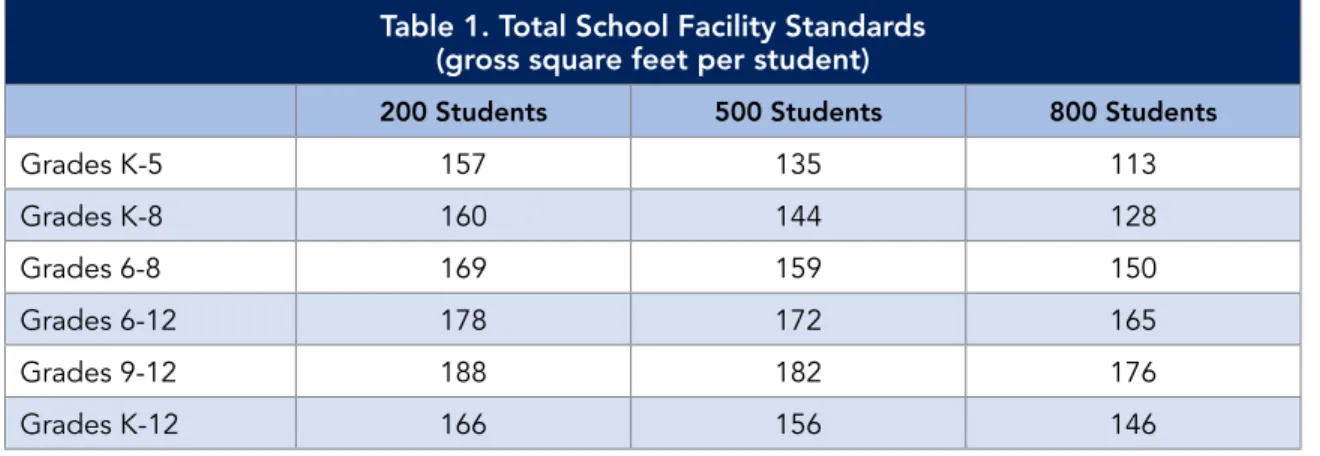
is typically based on enrollments that average between 600 and 1200 students. Since many charter schools may not reach these levels of enrollment even when their program capacity is realized and a few may even exceed these enrollments, the standards were extended to account for a much broader range of enrollments while at the same time taking into account minimum sizes necessary for a base level of educational adequacy. When available, standards were also compared to state and/or district standards to verify validity. Standards for schools with enrollments of 200, 500, and 800 students are shown in Table 1.
Table 1. Total School Facility Standards (gross square feet per student)
200 Students 500 Students 800 Students
Grades K-5 157 135 113 Grades K-8 160 144 128 Grades 6-8 169 159 150 Grades 6-12 178 172 165 Grades 9-12 188 182 176 Grades K-12 166 156 146
16 National and regional data were acquired from the School Planning & Management’s (2001-2012, individually) Annual School Contraction Reports. Local data was acquired through district building and planning reports.
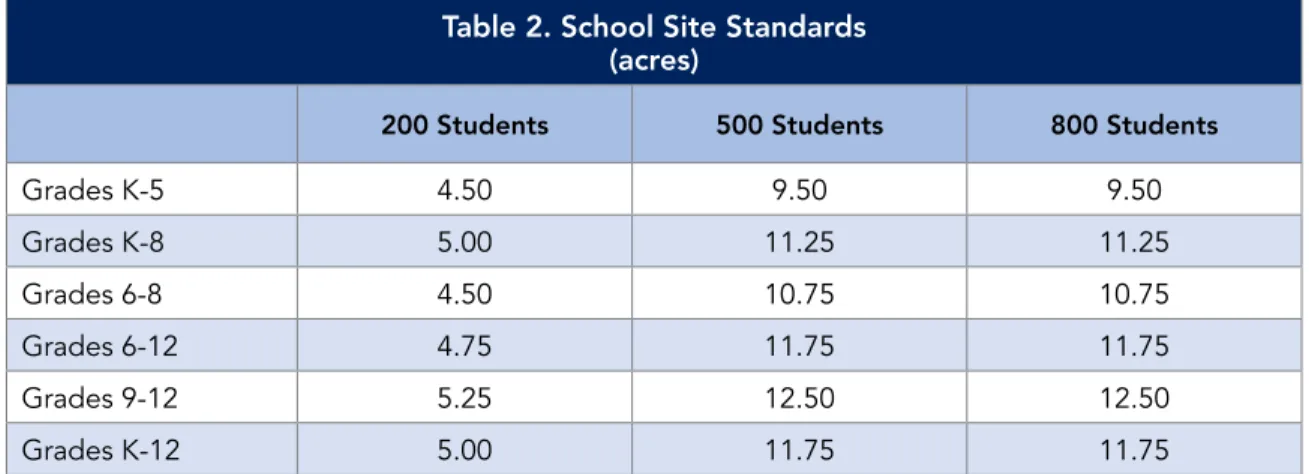
Site standards were derived from the gross square footage standards described above by taking into account the fairly consistent relationship between building and site size. Again, particularly for smaller enrollments, educational adequacy was also taken into account. Again, derived standards were then compared to those used in other states and districts, including a representative sample of urban, suburban, and rural school districts, to ensure their validity. Site size standards are shown in Table 2 for three different enrollment levels.
Table 2. School Site Standards (acres)
200 Students 500 Students 800 Students
Grades K-5 4.50 9.50 9.50 Grades K-8 5.00 11.25 11.25 Grades 6-8 4.50 10.75 10.75 Grades 6-12 4.75 11.75 11.75 Grades 9-12 5.25 12.50 12.50 Grades K-12 5.00 11.75 11.75
General classroom standards are shown in Table 3. These standards were derived from standards
used in other states and districts as well as best practice based on professional experience with charter and public school design. Adjustments were made for Montessori and Expeditionary Learning programs to reflect that larger classrooms are required to implement these educational programs.
Table 3. General Classroom Standards (square feet per student)
Grade K 46
Grades 1-5 33
Grades 6-8 30
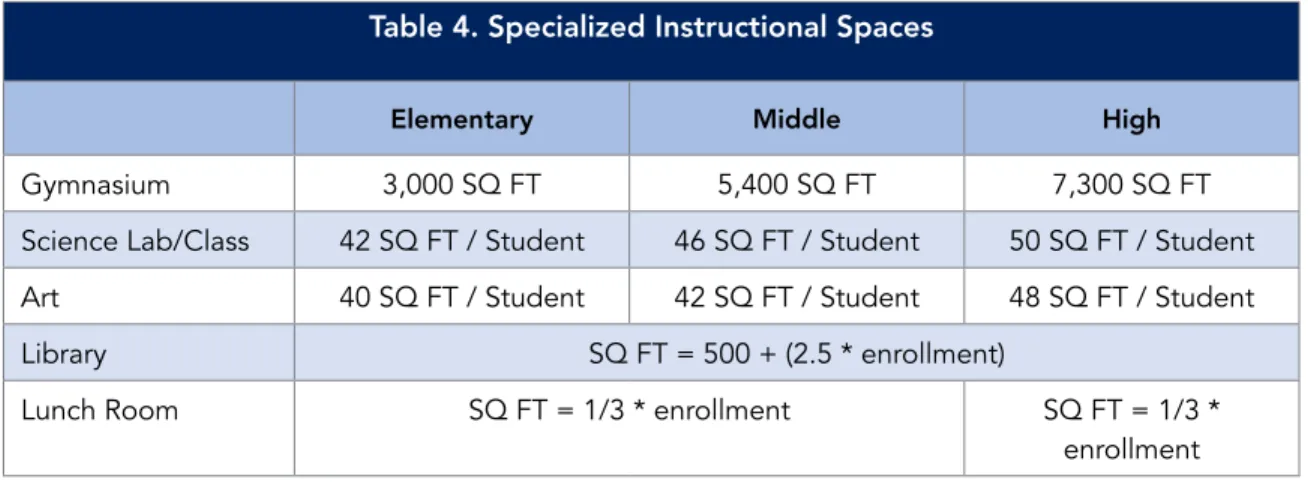
Standards for specialized instructional spaces like libraries, computer rooms, science labs, art rooms, music rooms, special education classrooms, gymnasiums, and lunch rooms also were
developed based on a review of state and district standards as well as best practices in school design. Many of the standards below are based on formulas to accommodate the potential for smaller or larger enrollments, as previously outlined, and then take into consideration educational adequacy. Some of these standards are shown below. Lunch room standards assume three lunch periods.
Table 4. Specialized Instructional Spaces
Elementary Middle High
Gymnasium 3,000 SQ FT 5,400 SQ FT 7,300 SQ FT
Science Lab/Class 42 SQ FT / Student 46 SQ FT / Student 50 SQ FT / Student Art 40 SQ FT / Student 42 SQ FT / Student 48 SQ FT / Student
Library SQ FT = 500 + (2.5 * enrollment)
Lunch Room SQ FT = 1/3 * enrollment SQ FT = 1/3 *