CEC Theses and Dissertations College of Engineering and Computing
2015
Service Quality and Perceived Value of Cloud
Computing-Based Service Encounters: Evaluation
of Instructor Perceived Service Quality in Higher
Education in Texas
Eges Egedigwe
Nova Southeastern University,[email protected]
This document is a product of extensive research conducted at the Nova Southeastern UniversityCollege of Engineering and Computing. For more information on research and degree programs at the NSU College of Engineering and Computing, please clickhere.
Follow this and additional works at:http://nsuworks.nova.edu/gscis_etd
Part of theDatabases and Information Systems Commons, and theEducation Commons
Share Feedback About This Item
This Dissertation is brought to you by the College of Engineering and Computing at NSUWorks. It has been accepted for inclusion in CEC Theses and Dissertations by an authorized administrator of NSUWorks. For more information, please [email protected].
NSUWorks Citation
Eges Egedigwe. 2015.Service Quality and Perceived Value of Cloud Computing-Based Service Encounters: Evaluation of Instructor Perceived Service Quality in Higher Education in Texas.Doctoral dissertation. Nova Southeastern University. Retrieved from NSUWorks, Graduate School of Computer and Information Sciences. (54)
Service Quality and Perceived Value of Cloud Computing-Based Service
Encounters: Evaluation of Instructor Perceived Service Quality in Higher
Education in Texas
by Eges Egedigwe
A dissertation submitted in partial fulfillment of the requirements for the degree of Doctor of Philosophy
in
Information Systems
Graduate School of Computer and Information Sciences Nova Southeastern University
An Abstract of a Dissertation Proposal paper Submitted to Nova Southeastern University in Partial Fulfillment of the Requirements for the Degree of Doctor of Philosophy
Service Quality and Perceived Value of Cloud Computing-Based Service
Encounters: Evaluation of Instructor Perceived Service Quality in Higher
Education in Texas
byEges Egedigwe May 2015
Cloud computing based technology is becoming increasingly popular as a way to deliver quality education to community colleges, universities and other organizations. At the same time, compared with other industries, colleges have been slow on implementing and sustaining cloud computing services on an institutional level because of budget constraints facing many large community colleges, in addition to other obstacles. Faced with this challenge, key stakeholders are increasingly realizing the need to focus on service quality as a measure to improve their competitive position in today's highly competitive environment. Considering the amount of study done with cloud computing in education, very little has been done in examining the needs and the satisfactions of the instructor customer. The purpose of this study was to examine the expectations and perceptions of instructors’ usage of cloud computing based technology on overall quality of service (QoS).
An extension and adaptation of the SERVQUAL model tailored to the higher education environment was introduced for this study. Using the established service quality
(SERVQUAL) dimensions (tangibles, reliability, responsiveness, assurance, and empathy), the study investigated the relationship between instructors’ views (perception and
expectation) and overall service quality received on their use of cloud computing based technology. A total of 301 online instructors at large Texas community colleges completed a Web-based survey containing previously validated and adapted items. The participants in this study completed four parts of the survey instruments that were used to measure service quality of academic cloud computing technology: Service Quality Expectations, Service Quality Perceptions, Perceived Service Quality and Demographic. The survey questions were answered using a seven-point Likert scale and the survey results were analyzed using
descriptive and inferential statistical methods.
The results indicated that the difference between instructors’ perception and expectation affected their perceived service quality of cloud computing based systems. The differences between the expectation and perception on all five SERVQUAL dimensions load to the instructors’ perceived service quality; gender but not age, income or education has significant effect on instructors’ overall perceived service quality. The results of the study create an awareness of instructors’ needs and offer useful feedback to college administrators and institutional planners in their efforts to improve service quality of educational technology initiative in higher education.
Acknowledgements
The support, guidance, and encouragement of many individuals were critical to the completion of this dissertation.
First, I am extremely grateful to my dissertation committee, Dr. Peixiang Liu, Dr. Yair Levy and Dr. Ling Wang, for their extraordinary support, encouragement and direction. I express my deepest appreciation to my dissertation chair and mentor, Dr. Liu, who provided
guidance, hope, and immediate kick when I needed it. Special thanks to Dr. Levy for his unwavering support, invaluable mentorship, and insightful ideas that shaped my dissertation. Also, I appreciate the encouragement and direction given by Dr. Wang. Without her timely feedback, this dissertation would not have been possible.
I am also grateful to my friends, who constantly reminded me to set aside time to write, edit, and then write some more. I appreciate the support and understanding provided by my colleagues at two year colleges that generously provided their thoughts and feedbacks on the survey.
Finally, I thank God Almighty for the opportunity and the ability that he granted me to complete this dissertation in lieu of the challenges and setbacks. I would like to thank my wife, for her unconditional love and ongoing support during the long nights and weekends; and my kids for their love in putting up with me while I strived to accomplish this goal. I sincerely thank my brothers and their families for their love, support, and their continuous faith in me to complete this task.
v
Table of Contents Abstract iii
List of Tables vii List of Figures viii Chapters
1. Introduction 1 Background 1 Problem Statement 6 Dissertation Goal 8
Research Questions and/or Hypotheses 10 Relevance and Significance 13
Barriers and Issues 17
Assumptions, Limitations and Delimitations 19 Definition of Terms 21
Summary 24
2. Review of the Literature 25 Introduction 25
Cloud Computing Background and History 25 Service Quality Measurement 29
Service Quality and Customer Perceived Service Quality (or Customer Satisfaction) 32
Measuring Service Quality in Information and Communication Technology 35 Dimensions of Quality in Higher Education 38
Measuring Service Quality in Higher Education 40 Summary 43
3. Methodology 45 Introduction 45 Research Design 45
Population and Sampling 47 Population 47
Sample 48 Instrument 49
Reliability and Validity of Survey Instrument 52 Data Collection Procedures 54
Specific Procedures Employed 54 Data Organization 60
Data Analysis Methods 60 Summary 65
vi Introduction 67
Descriptive Analysis 67
Discussion of Research Questions 70 Research Question One 70
Research Question Two 74 ANCOVA 76
Summary of Results 82
5. Conclusions, Implications, Recommendations, and Summary 84
Introduction 84
Discussion of Research Findings 84 Research Question One 84
Research Question Two 86
Recommendations and Implications 89 Limitations 91
Recommendations for Further Study 93 Conclusions 94
Appendices
A. Survey Instrument 113 B. IRB Approval Letter 119 C. Sample Gatekeeper Letter 121
D. Sample E-mail Request to Participate in Internet Survey 123 E. Reminder/Follow-Up E-mail 125
F. Adult Informed Consent 127
G. Retention, Storage and Destruction of Human Subjects Research Records 131 H. The SERVQUAL Dimensions and Items 133
I. IRB Approval Letter from Dallas County Community College District (DCCCD) 136 J. IRB Approval Letter from Houston College System (HCS) 138
K. IRB Approval Letter from Lone Star College System (LSC) 141 References 96
vii List of Tables
Tables
1. Analysis Plan of Hypothesis Testing 64
2. Frequencies and Percentages for Participant Demographics 68
3. Descriptive Statistics for Expected, Perceived, and Difference Scores 70 4. Parameter Estimates for PSQ CFA Model 72
5. Model Fit Statistics for Original and Modified Models 73
6. Results of ANCOVA for Perceived Service Quality by Gender when controlling for the difference between expectation and perception of reliability, assurance, tangibles, empathy, and responsiveness differences 77
7. Means and Standard Deviations for Perceived Service Quality by Gender 78
8. Results of ANCOVA for Perceived Service Quality by Age when controlling for the difference between expectation and perception of reliability, assurance, tangibles, empathy, and responsiveness differences 79
9. Means and Standard Deviations for Perceived Service Quality by Age 79
10. Results of ANCOVA for Perceived Service Quality by Income when controlling for the difference between expectation and perception of reliability, assurance, tangibles, empathy, and responsiveness differences 80
11. Means and Standard Deviations for Perceived Service Quality by Income 80
12. Results of ANCOVA for Perceived Service Quality by Education when controlling for the difference between expectation and perception of reliability, assurance, tangibles, empathy, and responsiveness differences 82
13. Means and Standard Deviations for Perceived Service Quality by Education 82 14. Hypotheses’ Testing Results 85
viii List of Figures Figures
1. Conceptualization of model to be tested 9 2. Measurement of Service Quality 31
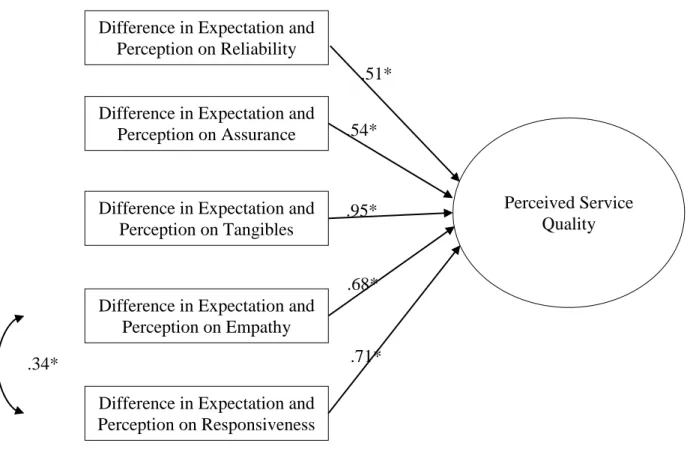
3. Empirical model being tested in MPlus and SPSS 62 4. SEM (CFA) Results for PSQ 74
Chapter 1
Introduction
Background
The explosive growth in computer usage by business, government, educational
institutions, combined with global collaboration provided by the Internet, and competition has brought a considerable increase towards computer usage along with the associated need to
maximize the use of available resources while minimizing costs. One area of growing interest for meeting these needs is the use of cloud computing to centralize computing and information management functions for large, often geographically dispersed organizations. Cloud computing is an approach where information technology services and capabilities are delivered to the customer or user via the Internet by a centralized provider (Robinson, 2009). Users only need to pay for the services they actually use (Kim, Kim, Lee, & Lee, 2009). It offers potential benefits related to reductions of server/storage infrastructure and delivery of services (Leavitt, 2009). The computing resources are held by the provider. These resources are accessible over the Internet via personal computers, laptops, smart phones, and other electronic devices. According to Kim et al. (2009), cloud computing provides access to programs, storage, processing, applications, and software development. This access is granted after an agreement is negotiated between the cloud computing provider and the recipient of services. With a commercial cloud computing provider, resources are normally available, for a set fee, based on usage. For the majority of cloud vendors that charge for cycles or time used, an accounting and billing procedure is needed, with
contractual terms agreed upon before service is granted. According to Kim et al. (2009) and Leavitt (2009), these approaches of having large scale computational resources available upon
demand to organizations and individuals that are connected to the Internet are not completely new.
As a concept, cloud computing is not entirely new (Robinson, 2009). There are various technologies that predate the coining of the term cloud computing including the time-sharing systems of the 1960s, the network computing and grid computing of the 1990s, and the utility computing of 2000s (Kim et al., 2009). Several studies (Kim et al., 2009; Leavitt, 2009)
described these technologies as follows: A time-sharing system, similar to a thin client, connects to a central server which houses commercial, multi-license applications designed for multiple simultaneous users. Grid computing in its most common form is a collection of computers connected (or clustered) together as a "grid" dedicated to performing a single task. This centralized server dispatches the computing jobs to available computing resources. Utility computing is the packaging of computing resources, such as computation, storage and services, as a metered service similar to a traditional public utility (such as electricity, water, natural gas, or telephone network). Both grid computing and utility computing have many features similar to those of cloud computing, with users sending jobs to a central server that arranges for these jobs to be run (Leavitt, 2009). By moving the applications and processing requirements from the user's desktop to a central server, time sharing clients allow deployment of inexpensive, low-powered terminals to user desktops (Robinson, 2009).
Some of the primary types of cloud computing services include infrastructure as a service, platform as a service, and software as a service (Leavitt, 2009; “National Institute,” 2011). Leavitt (2009) also included a general group called services, which consist of storage, middleware, collaboration, and databases provided via the Internet. The descriptions of these cloud services, as explained by Leavitt (2009), follow: Infrastructure as a Service, offers
storage/computer resources that developers and IT organizations can use to deliver business solutions. Platform as a Service, offers black-box services with which developers can build applications on top of the computer infrastructure. Finally, Software as a Service consists of complete turnkey computing applications, such as for enterprise resource management, available online.
These technologies and services, described above, together comprise the majority of the types of computing services available from cloud computing, ranging from hardware and software services, to entire computing environments. Cloud computing offers potential benefits related to reductions of server/storage infrastructure and delivery of services (Kim et al., 2009; Robinson, 2009). Cloud computing can be highly beneficial in educational settings. Among the possible benefits is the enhanced usefulness of the existing technology (Erenben, 2009). With its emphasis on the delivery of low-cost or free applications anywhere on the Internet, cloud
computing is a promising prospect for educational institutions faced with budget restrictions and mobile student population (Denton, 2012). The weak economy has accelerated a need to
maximize the use of available resources while minimizing costs for many large community colleges. And in times of fiscal challenge, fostering innovation becomes a critical strategic goal for the organization. Emerging technology, such as cloud computing, holds great promise for enhancing instruction and operations for large academic institution (Denton, 2012).
Compared with other industries, colleges have been slow on implementing and sustaining cloud services on an institutional level because of budget constraints facing many large
community colleges, in addition to other obstacles (Young, 2011). Many educational institutions do not have the wherewithal needed to sustain and reap the full benefits of cloud computing (Pocatilu, Alecu, & Vetrici, 2010). In some cases, you find a patchwork of a growing trend of
"rogue" technology on campuses. Professors are making their own decisions of using cloud computing even if campuses do not approve those (Young, 2011). This raises legal and security issues, and makes it more difficult for a college to provide central technical support. In other cases, some institutions that can afford it, host their own private clouds for faculty, staff and students. It is not unusual to find a combination of both in some campuses. Bateson (1995) argued that in the current economic climate, many colleges and universities are giving serious thoughts to the issue of getting good quality service.
Cloud computing based systems as educational tools offer the educators and learners access to well-structured and easily-updatable study materials, task-based activities, online resources, and tutorial support (Robinson, 2009). In spite of these benefits, however, educators and learners may be left frustrated or disappointed, because cloud computing based systems do not sufficiently address their needs or expectations. Most cloud computing based systems may have been developed mainly by software designers and developers with a high level of technical expertise, but without knowledge about educators’ (or learners’) needs (Nam & Smith-Jackson, 2007) and/or perceived service quality. As a result, difficulties may arise when technical
usability is overemphasized to the detriment of pedagogical aspects (Brinck, Gergle, & Wood, 2002). Although technical usability as defined by Brinck et al. (2002) may be important to minimize the cognitive load and helps to free more resources for the learning processing, but it does not necessarily measure the educational quality of cloud computing based systems in terms of educating and learning process. This means that existing cloud computing based systems still lack a number of important issues that need to be considered, therefore, a study to examine and understand these quality attributes will provide a means of measuring service quality. They are
also an effective and meaningful strategy to remaining productive (Kuo, Lu, Huang, & Wu, 2005).
According to Barak, Lipson, and Lerman (2006), in education, the application of computer technology in academic classroom can improve teaching when used appropriately. Accordingly, with the proliferation of cloud computing initiatives across campuses combined with the growing mobile student population, evaluation of such initiatives becomes the logical next step. The evaluation ultimately centers on the key stakeholders of high education – instructors, students, staff and administrators. For these initiatives to be implemented and sustained, the service quality they provide must be perceived as satisfactory. In other words, the level of satisfaction perceived by the customer (student or instructor) must be greater than the expected service (Parasuraman, Zeithaml, & Berry, 1985). Previous studies in higher education have focused mainly on educational service quality or educational information technology service quality as evaluated by students’ satisfaction (Hampton, 1993; Harvey & Knight, 1996). Rarely have they evaluated educational service quality of computer technology from the
perspectives of faculty or instructors. In that regard, the objective of this study focused on instructors’ perception regarding the Service quality provided by cloud computing based system in large community colleges in Texas as expected. SERVQUAL is a service quality
measurement model developed and refined by Parasuraman, Zeithaml, and Berry (1988, 1991a) for measuring service quality from a customer's perspective. This study builds on the
SERVQUAL model to analyze the significance of expectations and perceptions of instructors’ usage of cloud computing technology in community colleges. Further, the study analyzed the role of demographic variables of the instructors in evaluating the service quality and also established how factor analysis was used to identify number of factors underlying SERVQUAL
components (items). The study contributed to a better understanding of the implementation, management and sustainability of information technology (IT) based initiatives in education with a particular emphasis on cloud computing.
The following introductory sections of chapter 1 described the problem that was investigated and the dissertation goal that was achieved. The other sections of this chapter include the research questions and/or hypotheses, analysis of the relevance and significance, discussion of barriers and issues related to achieving the goal, assumptions, limitations and delimitations of the study, and the definition of terms. Finally, a summary is provided at the end of this chapter.
Problem Statement
The role of service quality in higher education (HE) has received increasing attention during the last few decades (Brochado, 2009). Higher education (HE) institutions should ensure that all services encounters are managed to enhance customer perceived quality (Brochado, 2009). While there is a consensus on the importance of service quality issues in higher education (HE), the identification of the different customers for these institutions and their corresponding needs is a challenge that those who aim to gain a better understanding of the quality issues with an impact on the customers’ experiences face. According to Maguad (2007), the future success of higher education institutions will increasingly depend on proper identification of their mission and the customers they serve.
A review of the literature reveals that previous studies in higher education have focused mainly on educational service quality or educational information technology service quality as evaluated by students’ satisfaction (Hampton, 1993; Harvey & Knight, 1996; Ong & Nankervis, 2012; Schwantz, 1996; Shekarchizadeh, Rasli, & Hon-Tat, 2011); on non-academic staff
perceptions of service quality delivered to students; and/or on both (Smith, Smith, & Clarke, 2007; Tan & Kek, 2004; Yeo, 2008; Yu, 2008). This is mainly based on the notion that students are the primary customers in higher education in the sense that they are beneficiaries with needs that should be satisfied (Harvey & Knight, 1996)). Rarely have they evaluated technologies directly via instructors’ satisfaction. This study was aimed to correct this imbalance. Further, no consistent framework in education for identifying the needs and expectations of
faculty-customers was evident. According to Massy, Wilger, and Colbeck (1994), the customer stands at the center of quality management and satisfying customer needs signifies the dominant goal. Higher education (HE) institutions must identify, listen to, and deliver value to all the parties they serve (Massy et al., 1994). Part of that value is determined by the quality of service
instructors receive and not just only the students and staff. Unless instructors understand, endorse and perceive a high quality from cloud computing as a means of software delivery, students will probably not understand the benefits from the system (Behrend, Johnson, London, & Wiebe, 2011).
According to Comesky, McCool, Byrnes, and Weber (1991; see also Maguad, 2007), customer service and satisfaction, when applied to higher education, must involve an
examination of the institution's knowledge of the customer and who that customer is. A study of instructor customers should identify their perception regarding the service quality provided by cloud computing based system as expected.
To summarize, while a great deal of research has been conducted on the importance of service quality measurement in educational institutions and information and communication technology sectors (Al-alak & Bekhet, 2011), less have focused on instructors’ perceived service quality on the introduction of new technology such as cloud computing. This study sets out to
address this through an investigation of the effect of service quality dimensions towards instructors’ perceived service quality under the perspective of SERVQUAL service quality model.
Dissertation Goal
The study was an empirical analysis of the expectations and perceptions of instructors’ usage of cloud computing based technology on overall quality of service (QoS). Using the established service quality (SERVQUAL) dimensions (tangibles, reliability, responsiveness, assurance, and empathy), the study investigated the relationship between instructors’ views (perception and expectation) and overall service quality received on their use of cloud computing based technology in large community colleges in the State of Texas. The study also analyzed the role of demographic variables of the instructors in evaluating the service quality and also
ascertained how factor analysis was used to identify number of factors underlying SERVQUAL component.
The outcome of this study may assist key stakeholders, such as instructors, administrators or information technology (IT) professionals of higher education to understand and evaluate the suitability of a particular technology, such as cloud computing, in terms of its ability to provide quality education service before implementing new technology or upgrading the current. The results of the improvement effort may certainly benefit the students as well. In addition, the current study may provide a better understanding of faculty needs and will help implement new programs so that purpose and missions of the higher education institutions can be served.
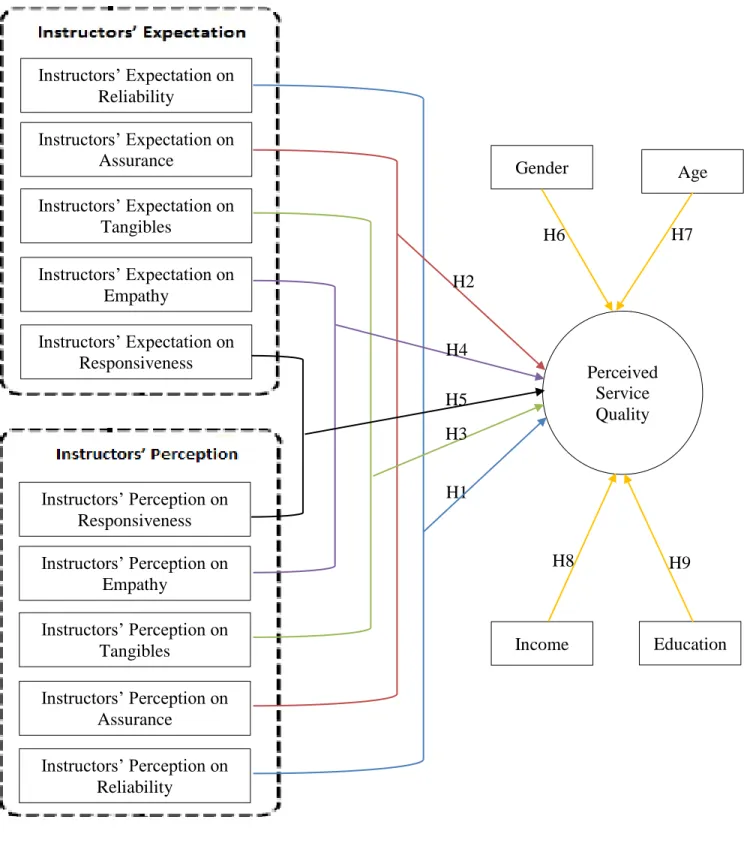
Instructors’ Expectation on Reliability Instructors’ Expectation on Assurance Instructors’ Expectation on Tangibles Instructors’ Expectation on Empathy Instructors’ Expectation on Responsiveness Instructors’ Perception on Responsiveness Instructors’ Perception on Empathy Instructors’ Perception on Tangibles Instructors’ Perception on Assurance Instructors’ Perception on Reliability Perceived Service Quality H1 H2 H3 H4 H5 Gender Age Income Education H7 H8 H6 H9
Figure 1. Conceptualization of model to be tested. Paths between expectation and perception represents the differences between these values.
Specifically, the study developed a standard instrument to measure instructors' service quality perception, which include, but not limited to, using the established SERVQUAL scale (Cronin & Taylor, 1992) that includes multiple measures of each of the five identified service quality dimensions (tangibles, reliability, responsiveness, assurance, and empathy). Another set of items were developed to measure the comparison of expected and perceived service with perceived service quality. Finally, items were designed to measure demographic variables influence on perceived service quality (or overall quality of service – QoS). The full conceptual model that was developed and tested is shown in Figure 1 above. The main objectives were: (a) to examine the relationship between the use of service quality dimensions (SERVQUAL - tangibles, reliability, responsiveness, assurance, and empathy), perception, expectation, and instructors’ perceived service quality on the use of cloud computing based technology; and (b) to examine the effect of demographic variables on the perceived service quality.
Research Question
Several research questions were used to guide this investigation. The primary research questions that were addressed in this study are as follows:
Research Question 1
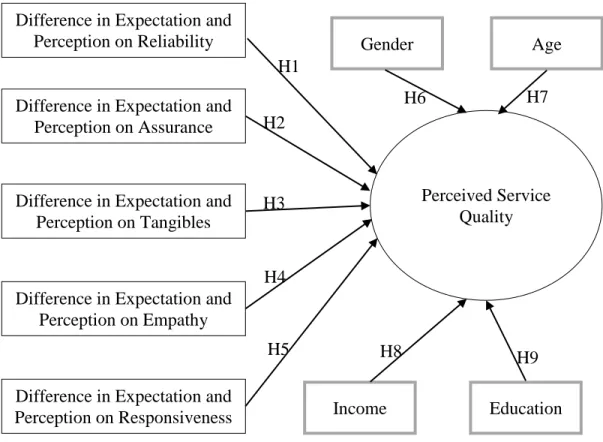
RQ1: Do the difference between instructors’ perception and expectation significantly affect their perceived service quality of cloud computing based systems?
H01: The difference between expectation and perception of reliability will not significantly load onto perceived service quality of cloud computing based systems.
Ha1: The difference between expectation and perception of reliability will significantly load onto perceived service quality of cloud computing based systems.
H02: The difference between expectation and perception of assurance will not significantly load onto perceived service quality of cloud computing based systems.
Ha2: The difference between expectation and perception of assurance will significantly load onto perceived service quality of cloud computing based systems.
H03: The difference between expectation and perception of tangibles will not significantly load onto perceived service quality of cloud computing based systems.
Ha3: The difference between expectation and perception of tangibles will significantly load onto perceived service quality of cloud computing based systems.
H04: The difference between expectation and perception of empathy will not significantly load onto perceived service quality of cloud computing based systems.
Ha4: The difference between expectation and perception of empathy will significantly load onto perceived service quality of cloud computing based systems.
H05: The difference between expectation and perception of responsiveness will not significantly load onto perceived service quality of cloud computing based systems.
Ha5: The difference between expectation and perception of responsiveness will significantly load onto perceived service quality of cloud computing based systems.
Research Question 2
RQ2a: Is there a difference in instructors’ perceived service quality by gender when controlling the difference between expectation and perception of reliability, assurance, tangibles, empathy, and responsiveness differences?
RQ2b: Is there a difference in instructors’ perceived service quality by age when controlling the difference between expectation and perception of reliability, assurance, tangibles, empathy, and responsiveness differences?
RQ2c: Is there a difference in instructors’ perceived service quality by income when controlling the difference between expectation and perception of reliability, assurance, tangibles, empathy, and responsiveness differences?
RQ2d: Is there a difference in instructors’ perceived service quality by level of education when controlling the difference between expectation and perception of reliability, assurance, tangibles, empathy, and responsiveness differences?
H06: Instructors’ perceived service quality will not differ by gender among instructors when controlling for the difference between expectation and perception of reliability, assurance, tangibles, empathy, and responsiveness differences.
Ha6: Instructors’ perceived service quality will differ by gender among instructors when controlling for the difference between expectation and perception of reliability, assurance, tangibles, empathy, and responsiveness differences.
H07: Instructors’ perceived service quality will not differ by age among instructors when controlling for the difference between expectation and perception of reliability, assurance, tangibles, empathy, and responsiveness differences.
Ha7: Instructors’ perceived service quality will differ by age among instructors when controlling for the difference between expectation and perception of reliability, assurance, tangibles,
empathy, and responsiveness differences.
H08: Instructors’ perceived service quality will not differ by income among instructors when controlling for the difference between expectation and perception of reliability, assurance, tangibles, empathy, and responsiveness differences.
Ha8: Instructors’ perceived service quality will differ by income among instructors when controlling for the difference between expectation and perception of reliability, assurance, tangibles, empathy, and responsiveness differences..
H09: Instructors’ perceived service quality will not differ by level of education among instructors when controlling for the difference between expectation and perception of reliability, assurance, tangibles, empathy, and responsiveness differences.
Ha9: Instructors’ perceived service quality will differ by level of education among instructors when controlling for the difference between expectation and perception of reliability, assurance, tangibles, empathy, and responsiveness differences.
The study measured user (instructor) perceived service quality with the level of cloud computing based technology service at large community colleges in Texas and pinpointed problem areas, if they exist. Service Quality, as a concept, is widely addressed in the business world and its use is slowly spreading to academic areas. The motivation for the study was to analyze the significance of expectations and perceptions of instructors’ usage of cloud computing based technology in community colleges.
Relevance and Significance
Focusing on the use of cloud computing based systems by instructors’ at large community colleges in Texas, the study examined the relationships between service quality, expected and perceived value, and instructors’ perceived service quality. Further, the study also examined the influence of demographic variables (such as age, gender, monthly income (MI) and highest qualification (HQ)) of the instructors on perceived service quality when instructors’ expectation plays a mediating role. It also ascertained how factor analysis can be used to identify
number of factors underlying SERVQUAL components (or items). At present, research that measure instructors’ satisfaction (or perceived service quality) with cloud computing technology in educational settings and the effect of demographic factors in evaluating perceived service quality is lacking. Not only organization needs empirical data to understand the level of customers’ (instructors’) satisfaction in any new technology but also the role of demographic variables in evaluating perceived service quality. This knowledge gap is where the present study wishes to contribute.
Large community colleges educate a rapidly growing number of students (Fisher, 2000), often with underfunded IT resources. IT administrators are always seeking ways to deliver IT while keeping budgets manageable, with cloud computing promising to be an effective tool towards this goal. Careful planning, which is one of the goals of the study, is needed to ensure that cloud computing investments do not go to waste. Unless the users (like instructors and students) of this technology (cloud computing) feel comfortable in its use, that the technology is an easy and reliable alternative, perceived a high level of quality in its use, they will not use it and hence the college will not be benefited. In information technology (IT) context, cloud computing based system value is perceived as positive when the degree of outcome exceeds user expectation via the service process (Woodruff, 1997). Thus, the cost of a cloud computing based system will be considered high if its performance does not live up to expectations or it does not fulfill the needs and service requirements of users.
Resource prioritization provides another reason for undertaking a research in cloud computing for large community colleges in Texas. Armbrust et al. (2010) noted that in a healthy economy, resources are readily available to foster technological innovation and allow a wide range of exploration; however, the current financial challenges require greater strategic planning
of resources to achieve the organization’s goals. The constraints of physical space, existing infrastructure, available staff, funding for purchases, and existing commitments will need to be taken into account in pursuit of any given technology initiative, such as cloud computing (Armbrust et al., 2009). Any new investment will require close examinations of many issues, including the way faculty, staff, and students use technology and its perceived value. Formal prioritization of initiatives at all levels will allow the application of resources to their best effect in alignment with organization goals. A formal process for development of cloud computing technology initiatives with clearly articulated levels of review and approval from the key stakeholders will provide initiatives, which is the greatest opportunity for success (Armbrust et al., 2010).
Another relevance of the study may provide additional insight on the role of the instructor in evaluating educational technology initiative. Interacting directly with students in an
educational context, instructors use cloud computing technology to attend to their students. When it comes to evaluating the usefulness of any new technology initiative, Maguad (2007) have argued that the direct experiences of the instructors are key measure because the instructors routinely interact with the students using the cloud computing based technology. The instructors are knowledgeable about these applications and familiar with their use. Thus, they are well placed to provide effective feedback to management in terms of their own experience with using the technologies and also how this cloud computing based technology has been experienced and received by their students. This feedback is crucial for upgrading cloud computing based
technology to improve the quality of the entire service. In fact, Robinson (2007) in a clinical research he conducted, made the point that if those who work directly with the customers of any organization are not actively involved in the selection of an information technology (IT), its
implementation is unlikely to be successful. Robinson (2007) also pointed out that it is important for other staff operating these technologies, who work alongside instructors, to have a clear understanding of the perceptions and expectations of instructors so that they too can feel confident they are providing a good service with positive outcomes for students. Therefore, the problem that the current study investigated focused on instructors’ perception regarding the service quality provided by cloud computing based system in large community colleges in Texas but not from the students’ perspectives. This mode of evaluation confirmed if cloud computing based technology in higher education is useful, accessible, controllable, and beneficial to both the instructor, students and the institution (Schumann, Keller, Wngenheim, & Holzmüller, 2007).
Further, the study was used to inform college IT planners about the possible risks and benefits of cloud computing based technologies before engaging in wide-scale implementation (Behrend et al., 2011). Thus, college-level cost analysis has to go hand-in-hand with
organizational ‘fit’ of the tool. That is, ‘cost-effectiveness’ and actual utilization of the tool have to be likely taken into account when judging the success of a project. According to Behrend et al. (2011), providing decision makers, both potential and current cloud computing adopters, with information to enable them to make informed decisions about current and future organizational computational resource needs is vital. Therefore, the goal of this research was valuable because it benefits large community colleges as they plan to or continue the implementation and support of cloud computing based technology. Both network and software engineers have struggled for years to rationalize the implementation process. The addition of the new cloud computing technology has further complicated this process. This study contributed to the body of knowledge and improves professional practice by an extension and adaptation of the SERVQUAL model tailored to the higher education environment.
To summarize, the study has both theoretical and practical contributions. With the proliferation of technology-based initiatives in education, studies examining the effect of service quality dimensions towards instructors’ perceived service quality of cloud computing based system complement existing attempts to evaluate overall quality of service in higher education. Specifically, evaluating the effectiveness of such IT-based initiatives in education provided insight regarding the factors behind the success or failure of such initiatives. Based on the findings of this study, we have identified factors of service quality in higher education that are considered vital from the instructors’ point of view in their use of cloud computing technology. Such insight can be used for diagnostic purposes for the planning and management for
technology-based initiatives in education. From a theoretical perspective, the research has added to the literature dealing with instructors’ satisfaction with cloud computing technology in
educational settings. The research also contributes to the general service quality literature by studying the theoretical validity and empirical applicability of the SERVQUAL model.
Barriers and Issues
The goal of the study was challenging because in higher education, the notion of referring to instructors (or even students) as customers is foreign to many academic institutions. Even the suggestion of the term can arouse many emotions, preconceptions, and misconceptions (Canic & McCarthy, 2000). Administrators and faculty alike are reluctant to call an instructor or anyone else a customer (Teeter & Lozier, 1993). They find the commercial flavor distracting and difficult to translate to education. Those that admit to have customers, usually refer to
businesses, government agencies, and the society at large as their customers (Maguad, 2007). That is not generally the case with students, which explains the reason that previous studies have
concentrated on service quality from the perspective of students. All too often this perspective is reinforced by administrative actions that tend to put the benefits of the institution before the needs of the faculty. Many educational institutions are very hesitant to consider themselves as customer-driven entities (Lewis & Smith, 1997), therefore, a study that measure service quality of academic cloud computing technology of large community colleges in the State of Texas from instructors' perspectives becomes a challenge too. Maguad (2007) have argued that the future success of colleges and universities will increasingly be determined by how they identify and satisfy their various customers.
Another challenge relates to the theoretical framework, which the study is based on. Although the SERVQUAL instrument is ubiquitously employed, it has received heavy criticism from both a theoretical and practical perspective. The issues questioned include the use of gap scores, the overlap among the five dimensions, poor predictive and convergent validity, the ambiguous definition of the “expectation” construct, and unstable dimensionality (Babakus & Boller 1992; Carman, 1990; Brown, Churchill, & Peter, 1993; Van Dyke, Kappelman, & Prybutok, 1999). By discarding the expectations portion in the SERVQUAL model, Cronin and Taylor (1992) justified the SERVPERF or performance only instrument in place of the gap measurement approach. In addition, they showed that the SERVPERF instrument empirically outperforms the SERVQUAL scale across several industries. As a result of these issues, the performance only measures are used and suggested by many scholars in various industries (Gilbert, Veloutsou, Goode, & Moutinho, 2004; Keillor, Hult, & Kandemir, 2004; Law, Hui, & Zhao, 2004; Parasuraman, Zeithaml, & Berry, 1994; Van Dyke et al., 1997). The above issues notwithstanding, SERVQUAL is still a reliable instrument that was created around 1985, and
over the years, it has been modified by the authors. Its final version, which includes five dimensions, has proven to measure user’s satisfaction.
One of the methods the study used for data collection is the administration of survey over the Internet and informing potential participants via e-mail. According to Creswell (2007), this data collection method is faced with the barrier of low or no responses. Campbell, Calvert, and Boswell (2003) noted that the biggest challenge the researcher faces is how to separate the survey (authentic e-mail) from spams/hoaxes. Spam, unsolicited junk e-mail offering dubious business deals, pornography, and other rip-offs, are nuisance that all the users of e-mail must face (Campbell et al., 2003). Another is hoaxes that further threaten the number of participants completing and/or responding to the survey. The potential for deleting and thrashing the email invitation received with a link to the online survey is very high (Yin, 2009). To overcome this barrier associated with e-mail, the participants were made aware of this through other means and they were also made aware of expected e-mail ‘subject’ along with the date. In addition, follow-ups were also sent to those that have not responded to the survey. This is definitely additional time in completing the survey. Despite early warnings, responses might still be low because of the difficulty stated above (Creswell, 2007).
As with all study or research, the findings of this study are tentative. It is important to note that the sample size, site and procedures for participant selection, while appropriate for the study, may not support generalization to a larger population.
Assumptions, Limitations and Delimitations
The assumptions underlying the study on service quality in higher education included the following:
- The instructors’ online survey (hosted over the Internet by SurveyMonkey) reflected participants’ perceptions regarding their experiences with cloud computing based technology in large community colleges.
- The instructors surveyed are representative of faculty members at the selected community colleges.
- Although customer service is an unusual element to consider in higher education, it is assumed that respondents are aware of customer service in other aspects of their lives, such as at departmental stores, restaurants, and hotels, and could apply those personal concepts to their experience in education. It is also assumed that faculty members are able to express their expectations and perceptions of service quality through answering a survey.
- The motivations driving the responses of the respondents are unknown.
This study will focus on a single level of analysis, namely instructor behavior. Successful analysis of the significance of expectations and perceptions of the usage of cloud computing technology in community colleges also depends on student beliefs and behaviors, professional staff, as well as those of the administration and IT staff. Therefore, the results of the analysis are applicable only to faculty at these institutions and may not be generalizable to other groups or institutions. The results are limited by the validity and reliability of the survey instrument and the timeframe in which the data was collected. The data for the study was collected using an online survey. Sample participants had the option to choose to participate, or not participate, in the survey.
The study was delimited based on the scope of the population for this study. The participants were randomly selected from a database of all instructors or faculty members of
large community colleges in the State of Texas. Only faculty members in community colleges that have implemented some form of cloud computing initiative were randomly selected to participate in the online survey.
Definition of Terms
To examine the nature of service quality, it is helpful to have a common understanding of terminology and usage. For purposes of this study, the following key terms based on definitions and usage within the literature and within this dissertation proposal are used:
Cloud computing - an approach where information technology services and capabilities are delivered to the customer or user via the Internet by a centralized provider (Robinson, 2009). Users only need to pay for the services they actually use (Kim et al., 2009). The National
Institute of Standards and Technology [NIST] (2011) also defines cloud computing as a model for enabling convenient, on-demand network access to a shared pool of configurable computing resources, such as networks, servers, storage, applications, and other information technology services and capabilities, that can be quickly provisioned and released with minimal management effort or service provider interaction (Mell & Grance, 2009).
Cloud computing based technology (or system) - includes information technology services and capabilities that are perceived as useful and accessible, which enable the users to provide beneficial services via technological interfaces (Robinson, 2009).
Grid computing - refers to a network of computers set up so that a job submitted to the network can be completed on any available network computer (Leavitt, 2009). Delic and Walker (2008) also defined grid computing as very large-scale collections of communication and
computation resources permitting new types of applications and bringing several benefits of economy-of-scale.
Infrastructure as a service (IaaS) - an arrangement that provides a full computer infrastructure via the Internet (Leavitt, 2009).
Platform as a service (PaaS) - a full or partial application development environment accessible online, with collaboration possible (Leavitt, 2009).
Software as a service (SaaS) - is a complete turnkey computing application available online (Leavitt, 2009).
Provider - an organization supplying cloud computing resources to outside users.
User - an organization or individual that uses cloud computing resources as a customer of a cloud computing provider.
Community college instructor – an academic staff (or educator) who works at a college or university. An instructor is sometimes referred to as a faculty member or Professor. Community college instructor directs his or her energies and labor toward providing academic support to students with multiple identities and responsibilities. The instructor participates in an
environment that underscores academic support, student services, effective instruction, and academic remediation (Levin, 2012).
Service - any activity offered to a customer that is consumed simultaneously as it is produced. It encompasses the process, delivery, and outcome of the activity (Parasuraman, Zeithaml, & Berry, 1990).
Customer Service - understanding the needs and expectations of the customer and responding to meet those needs and expectations (Chaffee, 2006; Johnston, 1993).
Expectation - the performance anticipated or expected by the consumer. They are formed by word-of-mouth, advertisements, and past experiences (Parasuraman et al., 1990). They form the reference point against which product or service performance is compared (Nolan & Swan, 1985).
Perception - the customer’s judgment about the service encounter – the actual service received (Parasuraman et al., 1990).
Customer satisfaction and dissatisfaction - Lin (2003) defined customer satisfaction as a result of a mental and emotional evaluation, where some comparison standard is compared to the actually perceived performance. If the perceived performance is less than expected, customers will be dissatisfied. On the other hand, if the perceived performance exceeds expectations, customer will be satisfied (Lin, 2003). In order words, met expectations result in customer satisfaction; unmet expectations result in customer dissatisfaction (Oliver, 1980).
Disconfirmation paradigm - the model that describes the customer’s comparison of expected performance to actual performance to determine met expectations (satisfaction) or unmet expectations (dissatisfaction) (Oliver, 1980).
Service quality or Perceived Service quality – Service quality is defined as the customer’s perception of the level of success or failure in meeting expectations (Lewis & Booms, 1983; Parasuraman et al., 1990). It is a measure of how well service level delivered matches customer expectations on a consistent basis (Webster, 1989, 1991). Perceived Service quality, similar to service quality, is a value judgment based on the gap between actual experiences and
expectations of the consumer. It is the result of the comparison of expectation with perception of service quality (Parasuraman et al., 1990).
SERVQUAL – a service quality measurement instrument developed and refined by Parasuraman et al. (1988, 1991a) for measuring service quality, on a 7-point Likert scale, from a customer's perspective. The instrument measures customers' expectations (the customer's
expectations for the type of service they expect they will receive from an excellent business entity) and customers' perceptions (how well they perceived the actual service received). The end result is a SERVQUAL difference score, customers' perceptions scores minus their expectations scores, item by item.
Summary
The above introductory chapter describes the proposed study, problem that was
investigated and the goal to be achieved. The other sections of this chapter include the research questions/hypotheses, analysis of the relevance and significance, barriers and issues,
assumptions, limitations and delimitations, and definition of terms.
Chapter 2 covers the literature review that establishes the rationale and framework for this investigation. A background and history of cloud computing, service quality measurement, and its perceived service quality relating to cloud computing are discussed. Next, Measuring Service Quality in Information and Communication Technology and in higher education is covered. Chapter 3 describes the research methodology - the methods used in the study, the survey instrument, the research design, and the procedures used to obtain the research data. Chapter 4 will present an analysis of the data and the results. Chapter 5 will contain a summary of the findings, conclusions, and recommendations from the study.
Chapter 2
Review of the Literature
Introduction
The literature review that follows establishes the rationale and framework for this
investigation. The overall purpose of this study was to expand on the concept of “service quality” in higher education, along with its associated implementation strategies and their influence on customer satisfaction. This chapter presents a review of the pertinent literatures that are related to the current study. The review begins with an overview of cloud computing background and history, follows with a discussion of literature specific to the subject of service quality
measurement, service quality and customer perceived service quality, measuring service quality in information and communication technology (ICT), dimensions of quality in higher education, and measuring service quality in higher education (HE). The evolution of service quality in higher education is explored, along with a discussion of methods to measure service quality.
Cloud Computing Background and History
While important cloud computing research was published by Chellappa in 1997 (Mei, Zhang, & Chan, 2008), implementation of cloud computing has been a fairly recent
phenomenon. This term began surfacing commonly in the literature around 2006 and refers to computing over the Internet (Aymerich, Fenu, & Surcis, 2008). By 2008, cloud computing was receiving extensive research interest that had surpassed grid computing, (defined as “very large-scale aggregates of communication and computation resources enabling new types of
amount of media interest received (Wang, Archer, & Zheng, 2006; Youseff, Butrico, & Da Silva, 2008). Many of the initial cloud providers were Web-based companies and start-up companies (Leavitt, 2009). As cloud computing demand expanded, the types of cloud providers extended to include public and community clouds (“National Institute,” 2011). Although the term cloud computing is relatively new, this technology had its basis in many other earlier computing methods.
A cloud computing entity contains parallel and distributed resources from a group of connected and virtual computers that are exhibited as one combined system (Buyya, Yeo, & Venugopal, 2008; Foster, Zhao, Raicu, & Lu, 2008). These systems are made available based on service-level agreements between the provider and the user (Buyya et al., 2008). The key
features of a cloud computing entity are massive scalability to meet user needs, the existence as an abstract entity to deliver multiple service levels to outside users, economy of scale, and dynamic configuration of services on demand, often by virtualization (Foster et al., 2008). Delic and Walker (2008) portrayed cloud computing to be the third wave of Internet advancement, following the Internet as the first wave and the Web as the second. From a different perspective, Hayes (2008) compared cloud computing to computing fifty or more years ago when service bureaus and time sharing systems gave users access to mainframe computers. These computing advances were fostered by earlier predecessor technologies. Some of the predecessor
technologies to cloud computing include Service-Oriented Architecture (SOA), distributed computing, virtualization, and grid computing (Sandhu et al., 2010).
Cloud computing has strong ties to pervasive computing, where multiple computing resources are available for use via the Internet (Su, Kuo, & Huang, 2008). It also had its roots in the search and retrieval systems that emerged in the 1990s (Aymerich et al., 2008). These search
and retrieval systems originally were based on cluster computing but eventually migrated to the geographically dispersed grid computing (Aymerich et al., 2008). Cloud computing can be considered a natural evolution from grid computing in its approach to providing computing resources to remote users.
Cloud computing based technology has taken colleges and universities by storm as university professors use this technology and its resources to enhance education (Fernando, 2008; Thomas & Qing, 2008). It has drastically changed technology access, use, and connection both inside and outside educational settings. Community colleges in Texas have begun to offer more distance learning courses in the hopes that with a greater flexibility to complete their coursework, more students will be able to enroll in online classes (Beyth-Marom, Chajut, Roccas, & Sagiv, 2003; Selim, 2007). This age of virtual simulation, real time interaction, and scalable and flexible resource use provides instructors and students the tools for creativity, innovation, and engagement (Dong, Zheng, Yang, Li, & Qiao, 2009; Srinivasa, Nageswara, & Kumari, 2009; Sultan, 2010). Cloud computing is an infrastructure that can bring a new value to a community college, as educational services can be delivered in a reliable and efficient way. It also provides a suitable environment for ubiquitous learning activities. As a result, efforts to introduce cloud computing in community colleges in Texas have been initiated over the last couple of years and are ongoing. Several different approaches of cloud computing based technology have been implemented in various community colleges in Texas.
Considering the existing IT infrastructure in a community college, the cloud computing paradigm has been implemented with various approaches. The colleges choose the deployment model appropriate for that educational institution. Depending on the type of ownership of physical resources and infrastructure available, you will find any of the following deployment
models of cloud computing in large community colleges in Texas: a private cloud, a public cloud, a hybrid cloud, and a community cloud. The characteristics of each deployment model from the standpoint of infrastructure are management, ownership and location - access rights to cloud resources (Mell & Grance, 2011). Researches and case studies pointed out the most common approaches, not only within community colleges or universities, but in the other fields of cloud computing solutions, are private and public cloud (Jin et al., 2010). Public clouds are owned and operated by third parties – the cloud service providers. Main advantage of a public cloud is that the educational institutions do not need to invest and house large IT infrastructures for educational and research purposes. A private cloud model enables educational institutions to have complete control of services, data security, applications and resources that are provided to their users. Depending on how technology is provided and used, these solutions implement one or more cloud computing service models (Costanzo, Assuncao, & Buyya, 2009): infrastructure as a service (IaaS), platform as a service (PaaS) and software as a service (SaaS). According to Despotović-Zrakić, Simić, Labus, Milić, and Jovanić (2013), the main aim of IaaS is to provide computing resources or storage as a service to users. For this service model, users install
operating system on the machines as well as their application software by themselves. PaaS model enables programming language execution environment for users. This model allows users to develop and deploy their own software solutions. SaaS model provides specific software that runs on a cloud computing infrastructure. The users of these services do not control or manage underlying infrastructure and application platform (Despotović-Zrakić et al., 2013). Although solutions found in the literature add new value to learning and enable numerous services and features, one of the challenges of using cloud computing in community colleges, which may not
have been fully explored, is evaluating educational service quality of this technology from the perspectives of the instructors.
Service Quality Measurement
According to Renganathan (2011), quality is a subjective concept that has no generally agreed definition for it. The word quality means different things to people according to the context. Garvin (1988) identified five perspectives on quality, namely: the transcendent view, the product-based approach, the User-based definitions, the manufacturing-based approach, and the value based definitions. In order to be able to manage the quality of any product or service, it must be measured. Without measurement, managers and stake holders cannot be sure whether product or service quality gaps exist (Lovelock, Wirtz, & Chatterjee, 2006). According to Lovelock et al. (2006), measurement is needed to determine whether goals for improvement are being met after changes have occurred.
In general it is difficult to measure and quantify service quality. The main purpose of measuring service quality is to ensure whether service is provided as per the expectations of the customers. There are several well-known tools for measuring service quality or customer satisfaction. The most eminent instrument in attempting to systematize the service quality is "The gap model" of service or SERVQUAL developed by Parasuraman et al. (1985). This conceptual framework was developed initially to measure customer perception of service quality for the financial service sectors but later extended to sectors such as hospitality,
telecommunications and healthcare. The SERVQUAL’s model, which was developed by
Parasuraman et al. (1988) used a survey to ask respondents for an indication of their expectations as well as their perceptions of service, and establishes the gap between the two. Other
important. SERVQUAL has been used in universities to assess satisfaction not only with teaching and learning, but with support services such as information technology (Smith et al., 2007). Authors have proposed several variations, including SERVPERF, optionally asking respondents to weight the importance of their answers, and HEdPERF – devised specifically for use in higher education by Firdaus (2006).
The service quality or SERVQUAL scale is a major instrument in the services marketing literature for assessing quality (Parasuraman et al., 1988, 1991a). According to Parasuraman et al. (1988, 1991a), this instrument has been widely used by both managers and academics (Babakus & Boller, 1992; Carman, 1990; Crompton & MacKay, 1989; Cronin & Taylor, 1992; Webster, 1989) to measure customer perceptions of service quality for a variety of services, which include, but not limited to financial companies, repair and maintenance companies, and long distance telephone companies. Grounded on Parasuraman et al. (1988)’s conceptualization of service quality, the original SERVQUAL instrument included two 22-item sections that intended to measure the (a) customer expectations for various aspects of service quality, and (b) customer perceptions of the service they actually received from the principal service organization (Parasuraman et al., 1988). The SERVQUAL instrument is based on the gap theory
(Parasuraman et al., 1985) and suggests that a consumer’s perception of service quality is a function of the difference between what is expected from a service encounter and the perception of the actual service encounter. Operationalized in Figure 2 below:
Figure 2. Measurement of service quality:
Service Quality (Q) = Perception (P) - Expectation (E).
The results of the initial published application of the SERVQUAL instrument by Parasuraman et al. (1988) indicated that five dimensions of service quality emerged across a variety of services. These dimensions are reliability, responsiveness, tangibles, assurance, and empathy (Carman, 1990; Crompton & MacKay, 1989; Parasuraman et al., 1985, 1988, 1991a). Reliability involves consistency of performance and dependability – that means that a firm performs the service right the first time and honors its promises; responsiveness is the willingness or readiness of employees to provide service – that is the timeliness of service; tangibles are the physical evidence of the service – such as physical facilities, appearance of personnel, or tools or equipment used to provide the service; assurance corresponds to the knowledge and courtesy of employees and their ability to inspire trust and confidence; and finally empathy which pertains to caring - individualized attention that a firm provides to its customers.
A study by O’Neill, Fitz, and Wright (2001) showed some benefits of using the SERVQUAL approach such as its ability to make a clear indication of how well the company performs to meet the customer’s requirement according to the customer’s perception. In addition,
Perception of Service Quality (P) (What Customers Perceive Service Provider Actually Offered) Expectation of Service Experience (E) (What Customers Believe the Service Provider Should Offer)
Service Quality (Q)
SERVQUAL also helps the company to priorities customer needs, wants and expectations based on customer’s opinion. Furthermore, SERVQUAL allows the organization to set the standards to meet the quality requirement issued by customers and other recipients of the services offered.
Service Quality and Customer Perceived Service Quality (or Customer Satisfaction) Review of the literature reveals a lack of consensus on the definition of satisfaction as a concept with the service, and therefore, there is no generally accepted measurement scale for customer satisfaction in higher education (Garcia-Aracil, 2009). Some scholars claimed that service quality is an outcome of the service encounter and that customer satisfaction is related to prior expectations and is conceptualized as a response to service quality in the form of
disconfirmation (Oliver, 1980). Many studies propose that customer satisfaction and service quality are separated and distinct constructs that share a number of similar qualities
(Parasuraman et al., 1994).
Models of satisfaction often focus on comparing customer expectations to the observed service delivered (Oliver, 1980; Morad, Rezaei, Alipour, & Salehi, 2011), which are referred to as the service quality gap (Parasuraman et al., 1994). Perceptions of service quality are built on previous expectations of what should be and will occur compared to the actual service delivery (Boulding, Kalra, Staelin, & Zeithaml, 1993). Indeed, empirical evidence has confirmed that the customers’ perceptions of service quality and customer satisfaction directly affect their intention to positively favor an organization.
A study by Harvey and Green (1993) indicated that quality in higher education is a complex and multilayered concept; therefore, a single accurate definition of quality is lacked. As a consequence, consensus concerning the best way to define and measure perceived service
quality in high education or anywhere else does not exist yet (Clewes, 2003). Every stakeholder in higher education, such as students, instructors, professional bodies, and governments has his/her/their own view of quality due to particular needs. According to Maguad (2007), despite efforts to substitute other words for the term customer in higher education, it appears that they cannot truly capture the true essence of the term. Maguad (2007) argued that every stakeholder in academia serves customers and is also a customer. Student may be regarded as the primary internal customers of the college or university. But besides students, higher education serves a broad range of other customers whose needs and expectations ought to be met or exceeded (Maguad, 2007). Based on the findings in the service quality literature, therefore, colleges and universities must fully understand their different customers and their corresponding needs. Customer satisfaction in higher education will be defined as the difference between what a customer expects to receive and his/her perceptions of actual delivery.
There are, however, conceptual issues in the services literature concerning the sequential order of the two constructs. While these authors (Cronin, Brady, & Hult, 2000; Farrell, Souchon, & Durden, 2001) viewed service quality as an precursor to perceived service quality, others, such as Parasuraman et al. (1988), Bitner (1990), and Al-alak (2009, 2006), considered customer perceived service quality (or satisfaction) as an antecedent to service quality. Farrell et al. (2001) gave a good overview of this contentious conceptual issue. The majority of recent researches consider service quality as an antecedent to customer satisfaction or perceived service quality (Yavas, Benkenstein, & Stuhldreier, 2004; Carrillat, Jaramillo, & Mulki, 2007; Zeithaml, Bitner, & Gremler, 2008). In particular, Zeithaml et al. (2008) pointed out that service quality and customer perceived service quality are fundamentally different concepts. They also pointed out that perceived service quality is a broader concept and in developing the framework of perceived