NBER WORKING PAPER SERIES
CHILD LABOR Eric V. Edmonds Working Paper 12926
http://www.nber.org/papers/w12926
NATIONAL BUREAU OF ECONOMIC RESEARCH 1050 Massachusetts Avenue
Cambridge, MA 02138 February 2007
Forthcoming in Handbook of Development Economics, Volume 4, John Strauss and T. Paul Schultz, eds. I appreciate the comments and helpful discussions with Kathleen Beegle, Debopam Bhattacharya, Patrick Emerson, Deborah Levison, Peter Orazem, Nina Pavcnik, Norbert Schady, T. Paul Schultz, Najib Shafiq, Furio Rosati, Ken Swinnerton, and participants at the Bellagio conference for the Handbook of Development Economics, Volume 4. I am grateful to John Bellows, Zakariah Lakel, Ariel Rodman, Smita Reddy, Salil Sharma, Maheshwor Shrestha, and Jiawen Ye for research assistance. The views expressed herein are those of the author(s) and do not necessarily reflect the views of the National Bureau of Economic Research.
© 2007 by Eric V. Edmonds. All rights reserved. Short sections of text, not to exceed two paragraphs, may be quoted without explicit permission provided that full credit, including © notice, is given to the source.
Child Labor Eric V. Edmonds
NBER Working Paper No. 12926 February 2007
JEL No. J13,J22,O15
ABSTRACT
In recent years, there has been an astonishing proliferation of empirical work on child labor. An Econlit search of keywords "child lab*r" reveals a total of 6 peer reviewed journal articles between 1980 and 1990, 65 between 1990 and 2000, and 143 in the first five years of the present decade. The purpose of this essay is to provide a detailed overview of the state of the recent empirical literature on why and how children work as well as the consequences of that work. Section 1 defines terms commonly used in the study of child time allocation and provides a descriptive overview of how children spend their time in low income countries today. Section 2 reviews the case for attention to the most common types of work in which children participate, focusing on that work's impact on schooling, health, as well as externalities associated with that work. Section 3 considers the literature on the determinants of child time allocation such as the influence of local labor markets, family interactions, the net return to schooling, and poverty. Section 5 discusses the limited evidence on different policy options aimed at influencing child labor. Section 6 concludes by emphasizing important research questions requiring additional research such as child and parental agency, the effectiveness of child labor policies, and the determinants of participation in the "worst forms" of child labor.
Eric V. Edmonds Department of Economics Dartmouth College 6106 Rockefeller Hall Hanover, NH 03755 and NBER [email protected]
Table of Contents
1. Introduction... 2
2. What is Child Labor? ... 6
2.1 Terminology... 7
Market and domestic work... 7
Child labor ... 8
Worst and hazardous forms of child labor ... 9
2.2 Sources of Data... 10
Available data ... 10
Limitations of household surveys and missing children ... 11
Idle children ... 13
2.3 Background on the Activities of Working Children... 14
Types of activities... 14
Occupation and industry of economically active children... 16
Gender differences ... 17
Urban –rural differences ... 18
Age patterns ... 19
Worst forms of child labor ... 20
Are worst forms different? ... 22
3. The Case for Attention to Working Children ... 22
3.1 Child Labor in International Policy... 22
3.2 Work and Schooling ... 23
Is schooling attendance lower for working children? ... 23
Is schooling achievement and attainment lower for working children?... 25
Is there a causal relationship between work and schooling achievement and attainment? . 26 Do changes in the price of schooling affect child labor supply?... 27
Modeling the joint determination of schooling and other time allocation decisions... 28
Are there future consequences of working?... 29
3.3 Work and Health... 30
Is the health status of working children worse? ... 30
Does child labor affect future adult health? ... 31
3.4 Child Labor Externalities and General Equilibrium Considerations ... 32
Do working children support their siblings? ... 32
Does child labor perpetuate across generations? ... 33
Does child labor promote high fertility? ... 34
Does child labor affect local labor markets? ... 35
4. Determinants of Child Time Allocation ... 37
4.1 Local Labor Markets and Child Labor ... 38
Production technology ... 38
4.2 Child Labor and the Family... 42
Who makes child labor decisions?... 42
Parental attitudes towards work and schooling ... 44
Child and Adult labor supply interactions... 46
Does parental co-residence influence child labor? ... 48
How does sibling composition affect child labor?... 49
4.3 Child Labor and the (Net) Return to Schooling... 52
Credit constraints and child labor ... 52
Does child labor respond to the return to schooling? ... 54
School costs and child labor ... 56
4.4 Child labor and Poverty ... 56
The link between child labor and living standards ... 56
The empirical evidence ... 57
Can the effect of rising incomes differ from that of declining poverty? ... 60
Economic shocks, credit constraints, poverty, and child labor ... 61
5. Policy ... 63
5.1 Child Labor Specific Programs ... 63
5.2 Restrictions and Prohibitions on Employment ... 65
5.3 Trade Sanctions and Labor Standards ... 67
5.4 Conditional Cash Transfers ... 68
6. Conclusion ... 69
Works Cited... 71 1. Introduction
Few issues in developing countries draw as much popular attention as does child labor. The purpose of this chapter is to provide a detailed overview of the state of the recent empirical literature on why and how children work as well as the consequences of that work. A less detailed overview of recent developments in the child labor literature can be found in Edmonds and Pavcnik (2005a), and an older review with a more theoretical focus is Basu (1999).
Child labor has received considerable attention in economics throughout the discipline's history. Early writings tended to focus on child labor solely through the lens of labor demand. Adam Smith emphasized the value of children in labor shortage societies as motives for fertility. Friedrich Engels wrote extensively on the conditions of working children in the early industrial revolution, and to Marx, child labor was created by the industrial revolution. In his view, machines replaced the need for muscle power, allowing children to do the work formerly performed by men. Though his views on labor supply are not transparent, inDas Kapitalhe seems to assume that parents and capitalists inevitably exploit all opportunities to employ children. Interestingly, one exception to this assumption that working parents will take all
opportunities to have children work is in Malthus. He argues that the prevalence of child labor in the late 18th century is evidence that families were unable to meet their most basic needs.
Modern writings on child labor are largely based on the human capital theory as developed by T.W. Schultz, Gary Becker, and others. In thinking through the determinants of investments in education, Schultz (1960) emphasized the importance of foregone earnings in human capital accumulation. Investors (parents, children) weigh the return on additional education investments against the costs such investments entail which includes the foregone economic contribution of children. Becker (1965) extended this argument to emphasize that non-wage uses of time are apt to be an equally important influence on the opportunity cost of child time in school. Rosenzweig and Evenson (1977) appear to be the first published study to apply this framework explicitly to analyze child labor in a developing country context.
In recent years, there has been an astonishing proliferation of empirical work on child labor. An Econlit search of keywords "child lab*r" reveals a total of 6 peer reviewed journal articles between 1980 and 1990, 65 between 1990 and 2000, and 143 in the first five years of the present decade. This rise in interest appears driven by three factors. First, child labor has drawn considerable policy and public attention over the last decade. This public interest seems to be motivated by a concern about child labor as a human rights issue and its implication for long-run growth and development through its interaction with education. The rise in interest in recent years may owe to rising trade and globalization more broadly. They have both raised awareness about the pervasiveness of child labor and elevated concerns among rich country residents about their role in its perpetuation. Second, concurrent with this rise in public interest is a booming theoretical literature on why children work. Prominent theoretical publications such as Basu and Van (1998, section 3.4 below) and Baland and Robinson (2000, section 4.3 below) have spurred a large battery of empirical research. Third, large-scale, nationally representative household surveys from developing countries have become increasingly available over the last fifteen years. This has both lowered the costs of working on child time allocation and increased the complexity of the types of questions that can be addressed empirically.
Any study of child labor must begin with a definition of what the researcher means by child labor. The next section surveys different definitions used in the existing literature and discusses some examples from a variety of countries about how children work. The types of activities popularly viewed as child labor are not usually the focus of empirical studies of child labor. Often, academic studies of child labor are better viewed as child time allocation studies, and it seems clear that research must consider as wide a scope of activities as data permits in order to understand the dynamics of child time allocation. Data sources and data problems such as children that are hard to observe with randomized surveys are also discussed.
Section 3 considers the case for attention to the types of work activities that are most common in low income countries. Historically, activists sought to move children out of work so that children could enjoy their childhood, and the Progressive Era's "sacralization" of childhood (to quote Zelizer 1985) persists in contemporary, anti-child labor resolutions such as the 1989 UN Convention on the Rights of the Child. Part of the reason for viewing working child work as a moral issue is that parents may make decisions for children about whether and how children work without fully internalizing the costs of such activities. Research on child labor tends to avoid moral arguments about how children should spend their time by focusing on quantifying the costs of working. Human capital theory generally post-dates the anti-child labor movements in developed economies, but most of the academic interest in child labor today is because of its consequences for human capital accumulation. Many studies examine whether specific types of
work or groupings of activities of common forms of work appear to affect education, physical and mental health, or nutritional status of working children. This begs the question of why focus on child labor as anything other than something to explain schooling or health changes. Several answers to this question are posited in the literature, and they are discussed in section 3.
Section 4 reviews the accumulating evidence on why children work. This literature is of academic interest in its own right for all the same reasons that adult labor supply is of interest to research. Moreover, studying the determinants of common forms of work also can be
informative about the case for attention to common activities. That is, how the common forms of work are affected by changes in the family's broader economic and social environment can reveal how family decision-makers view the most common forms of work in low income countries. Policies aimed to influence how and where children work can be useful for understanding by the causes and consequences of working, and section 5 discusses the minimal evidence that exists on how policies influence child labor supply. Section 6 concludes with a summary of the critical issues that have yet to be addressed in the literature.
A simple analytical model will be helpful to fix ideas in this chapter and can illustrate most of the basic points that have been emphasized in existing research on child labor. This model is presented in the remainder of this introduction. This model is meant to be heuristic. Cigno and Rosati (2005) present a more general child labor model that can incorporate most of the important recent theoretical contributions in the child labor literature.
Consider a household with one parent, one child, and two time periods: the child's youth when the parent decides how to allocate the child's time and the child's future (the parent has no future in this model). The parent's labor supply is inelastic and yields an exogenous incomeY. Parental preferences are over the family's current standard of living,S, and the child's future welfareVk. u S V
, k
is the utility representation of parental preferences. The child's time is allocated between educationE, leisure and playP, work outside of the householdM, and work inside of the householdH. Work inside the household can be in the production of goods or services that might be resold to the market (market work) or it can be in similar activities that are important for the family in converting purchased inputs into a standard of living (domestic work). E+P+M+H=1.The standard of living is produced by a linear homogenous production function and depends on purchased inputscand the input of child timeH, SF c H
,
. The child's future welfare depends on the positive, diminishing marginal product production function,
,
k
V R E P . Leisure and play is likely complementary to schooling in the production of child welfare, but such statements about cross-partial derivatives are not necessary for the present discussion. Importantly, time spent in education is not necessarily limited to time in the classroom. Also, beyond the opportunity costs of education inherent in the time constraint, schooling entails direct costs, e. Direct costs are assumed to be increasing in the time spent in education. Thus, direct schooling costs entaileEin foregone consumption today. Work outside of the household is freely available in the formal labor market and brings an exogenous wagew. This income combines with non-child incomeYto purchase inputs used in the production of the standard of living: c Y wM eE. In this setting, the parent's problem is:
, , , max , , , : 1, 0, 0, 0, 0 E P M Hu F Y wM eE H R E P subject to E P M H E P M H (eq. 1.1)This set-up emphasizes several points that will be raised in sections 2 and 3. First, the residual claimant on child time outside of work is not schooling, and there is a return to leisure that parents may value and could be important for the child’s future welfare. Second, if one is interested in child labor because of its impact on schooling, there is no theoretical reason to focus on work outside of the home alone. Consider a child that does not attend school. What are the possible explanations for this?
0 k u R u F E e V E S c (eq. 1.2)
The family's marginal utility from the foregone consumption caused by schooling costs plus the marginal utility of time is at least as large as the family's marginal utility that comes through improving child welfare from additional education. The marginal utility of time will depend on how the family values the contribution of play to child welfare, the marginal utility of the standard of living, and how time spent in the wage market and in household production affects the standard of living. There is no reason to presume that the wage contribution is more likely to dominate schooling than is the household production contribution. In fact, most children work at home rather than in the wage labor market. This implies that for most children the return to time in household production is at least as large as the value the family places on the child’s wage contribution. The idea that studies of child time allocation should consider as broad a definition of child work as the data permits is a main theme in section 2. Of course, there are many reasons to be interested in why children work beyond its implications for schooling. Section 3 reviews the literature on the short term and long term consequences of child work.
This setting also implies several key reasons why children work. First, poverty is a key influence on child labor supply. It influences the family's valuation of child time in household production and the formal labor market, and it may affect the production function for future child welfare. Some researchers have emphasized that the influence on child labor of exiting poverty may differ from the effects of additional income, and this will be discussed in section 4.
Second, the relative return to child time in schooling may be an important factor. The relative return depends in part on the returns to education as well as the returns to play, the return to child time in home production, the return to formal labor income, and the direct costs of schooling. Schooling improvements, labor demand factors including trade, technological change, and labor regulations all potentially affect child labor through these mechanisms. Similarly, living arrangements, fertility, and market imperfections in credit, land, or goods markets may all influence child labor through their impact on the relative return to child time.
Third, parental preferences play a key role in child time allocation decisions. In this set-up, preferences do not drive differences in the allocation of child time between the formal labor market and household production, but they affect the family's valuation of child time in work activities relative to non-work activities. For example, a child engages in wage work and does not attend school if:
k u R u F w e V E S c . (eq. 1.3)The marginal utility from the child's contribution to the production of the standard of living (through wage income and the lack of educational expenditure) is at least as large as the marginal utility from the return to education. To the extent that preferences are important, then questions of intrahousehold allocation such as how household decisions are made and who makes these decisions become important in understanding child labor supply.
With so many influences on child labor, what types of policies will be useful in reducing it? Section 5 concludes with a discussion of different policy options that have been used to influence the activities of children. There is very limited evidence to suggest that anything other than long-term poverty reduction and development is likely to substantially alter the child labor picture although some findings from conditional cash transfer programs are encouraging. However, it is important to note that the general lack of evidence reflects a lack of scientific research more than a failure of programs. Moreover, very little is known about why children participate in some of the worst forms of child labor, where human rights issues are most
relevant, and very little formal analysis has been done on the policies being pursued to help these most vulnerable children.
2. What is Child Labor?
Any discussion of child labor must begin with a precise description of what the term means. The phrase "child labor" conjures images of children chained into factories, sold as slaves, or forced into prostitution. Fortunately, while many children work in the developing world, few experience such atrocities. The International Labor Organization (ILO) is the international body charged with country child labor, and it estimates that in 2004 there are 218 million child laborers in the world (ILO 2006). Most of these working children labeled "child laborers" are helping their family at home, on the family farm, or in the family business.
Economics research on "child labor" tends to focus on these more commonplace activities, both because of their greater prevalence and the relative ease in collecting data on the typical types of activities children perform. There is controversy about whether the types of activities that children typically participate in are harmful or beneficial to children and others. That discussion is reviewed in section three.
The present section aims to describe the different definitions of child labor and child work that are prevalent in the literature and overview how children typically work in low income countries. It should be clear from the discussion in the introduction that if one is ultimately interested in influencing the allocation of child time to a particular activity such as some form of work or schooling then researchers need to consider as broad a set of activities as possible. Children do not typically participate in the formal wage labor market. When children do not participate in the formal wage labor market, the shadow value of child time ( in the analytical model) is determined by the child's involvement in chores, the family business, schooling, etc. Hence, focusing on a limited set of activities can bias a researcher's understanding of the dynamics of child time allocation. Of course, a broad focus on child time allocation overall inevitably means that a paper on "child labor" will consider types of work that are very different than the popular use of the term.
2.1 Terminology
Market and domestic work
In both research and policy discussions, there is extraordinary heterogeneity in how child labor is defined and in what words are used to describe the different categories of work in which children participate. The purpose of this subsection is to review how words are typically defined in the literature, but there is no consensus. There is currently work underway to define statistical standards and develop a fixed terminology (see Guarcello et al 2005) that is the basis for much of this section, but that work is still in its infancy. Both producers and consumers of research need to be careful to define exactly what is being studied in a particular research paper.
Table 1 presents a list of commonly used phrases to describe aspects of how children work. Activities are organized by whether the activity involves the direct production of economic goods and services that fall under the United Nations System of national Accounts (SNA). According to the SNA, "the production of economic goods and services includes all production and processing of primary products whether for the market, for barter, or for own consumption, the production of all other goods and services for the market and, in the case of households which produce such goods and services for the market, the corresponding production for own consumption" (ILO 2000 p1). The production of economic goods and services will include wage employment, self-employment, participation in agriculture, milling, handicrafts, construction as well as water and wood collection.
Aggregate statistics of child employment typically cover the economically active population. Economically active is defined as being involved in economic activity, and it includes wage workers, employers, own-account workers, members of producer cooperatives, unpaid family workers, apprentices, members of the armed forces, and the unemployed.
Economic work or market work is used similarly to economically active individuals, except the unemployed are excluded. Participants in market work are sometimes separated by whether their work is for the consumption of others (market oriented work) or their own family (non-market oriented work). One can imagine how this distinction is important in national accounts, but there is no clear reason why this distinction is important in studying child time allocation. Wage work is a subcategory of market oriented work, and many authors focus on studying wage employment alone. One unique challenge in classifying children engaged in market work outside of their own household is that children are not always paid directly in wages. They either receive pay in-kind (goods and services) or their labor is contracted for a fixed fee. Typically, these children are grouped with those paid in cash under "wage work", but some studies separate them, labeling them unpaid out of household market or economic work.
Child involvement in non-SNA activities is studied infrequently in child labor studies. A February 2005 review of empirical papers on child labor indexed in EconLit and published in peer reviewed economics journals since 1995 found that all but two considered wage work, half additionally considered other forms of market work such as work in the family farm or business, and 10 percent considered work that would fall outside the SNA definition of economic activity. The phrase non-economic work is sometimes used to denote participation in the provision of goods and services to family members or other members of the community that fall outside of the scope of the official definition of economic goods and services. This includes for example
community service work that helps build or maintain local schools. It also includes domestic chores such as caring for family members, cooking, cleaning, or shopping. The phrase
"housework" is sometimes in place of domestic chores or it is used to refer to domestic chores excluding shopping. Finally, "domestic work" is used in reference to non-economic work exclusive of community service and volunteer work.
The use of the word "economic" in the SNA is confusing as economists since the early 1960s have emphasized the activities that the SNA defines as non-economic as critical to the household's standard of living. Moreover, non-economic can be interpreted to imply that the associated activities are inelastic with respect to economic factors, an assumption that is not born out by the data. Many writers avoid using the phrases "economic" and "non-economic" work. Instead, they classify work into market work and domestic work. The remaining classification of work, community service and volunteer work, is rarely studied and poorly understood. There are two obvious problem with using this market and domestic work lexicon. First, market work and market oriented economic work are apt to be confused. Second, domestic work performed for compensation outside of the child's own household is considered a type of market work and is often referred to as domestic service or domestic work. The safest solution is for researchers to be explicit in how they are defining the activities under study.
Two commonly used terms to be avoided are child work and household work. Child work is typically used synonymously with market work. However, asserting that a child who works in substantive hours in the provision of services to their home is not working is difficult to justify. One could make the case for defining child work as covering both domestic and market work, but simply using the phrase "work" to refer to these activities together is apt to generate the least confusion given child work's common use as market work. Household work is often used as a synonym for domestic work. However, this is confusing, because market work most often occurs within the household.
Child labor
Researchers often avoid labeling any one activity as child labor. Official definitions of child labor vary. Some countries officially define child labor as wage work (e.g. Pakistan) or market work that is harmful to the future well-being of children (e.g. Vietnam). This later standard is based on the precedent of the International Labor Organization's (ILO) C138. C138 on the Minimum Age for Admission to Employment was passed in 1973 and has been signed by 135 countries to date. Signatories agree to pursue a national policy to abolish "child labor" and to increase the minimum age of employment to "a level consistent with the fullest physical and mental development of young persons" (C138, Article 1). Neither "child labor" nor
"employment" is defined in the convention, but the age appropriateness of various activities depends on consideration of their effects on the health and development of the young. In general, the minimum age of employment is the minimum age of completion of compulsory schooling or at least 15 years old, although 14 can be consistent with the convention in very poor countries. Light work that is deemed consistent with schooling attendance and unlikely to be harmful to health and development is consistent with the convention in children as young as 12.
For statistical purposes, defining whether an activity is harmful to a child's health or development is a challenge, because whether an activity is harmful depends on what the child
would be doing in the absence of work. The ILO's Statistical Information and Monitoring Program on Child Labor (SIMPOC) is the international body charged with tracking child labor around the world. Their definition of what exactly is "child labor" varies over time, in part because of controversy over what can be considered harmful. At the time of writing, a child laborer is defined by SIMPOC as an economically active child under 12 that works 1 or more hours per week, an economically active child 14 and under that works at least 14 hours per week or 1 or more hours per week in activities that are "hazardous by nature or circumstance," and a child 17 and under that works in an "unconditional worst form of child labor" (trafficked children, children in bondage or forced labor, armed conflict, prostitution, pornography, illicit activities, ILO 2002). The ILO (2006a) estimates that there were 218 million child laborers in the world in 2004 under this definition.
Some researchers that choose to define an activity status as child labor adopt this
SIMPOC definition, but others are also present in the literature. By far, the most common thing to do is to define children in wage work as child laborers. Others define child labor as market work. A few researchers also define child labor by adding in domestic work. Typically, an arbitrary cutoff in hours is employed in classifying some domestic workers as child laborers and others as not just as the SIMPOC definition arbitrarily classifies as 13 year old working 14 hours per week as a child laborer while the 13 year old working 13 hours per week is not. Given that "child labor" carries a particular connotation in the popular imagination, the safest course is likely for researchers to avoid labeling any one class of activities child labor.
"Light work" is sometimes used to refer to market work that is not deemed child labor. That is, market work which is for some reason viewed as unlikely to be harmful to health, development, and does not affect school attendance, participation in vocational training, or the child's ability to benefit from any instruction received. Of course, it is not obvious how would know whether work could be harmful in any of these senses without establishing the
counterfactual of what children would be doing absent this light work.
Worst and hazardous forms of child labor
While the general phrase "child labor" is poorly defined, some specific activities are labeled as a "hazardous form of child labor" or a "worst form of child labor". The minimum age convention, C138, places special emphasis on activities that "jeopardise the health, safety, or morals of young persons" (Article 3 - section 1) and defines 18 as the minimum age of
employment for activities that can be described as such. In 1999, C182 on the Worst Forms of Child Labor asks signatory countries to clarify what types of activities fall under this label and to develop specific plans for their eradication. C182 has proven less controversial than C138 on the minimum age of employment. To date, C182 has 151 signatories.
While it is up to the individual country to identify "worst forms" in their own country, Article 3 of C182 contains several guidelines for what types of activities are to be considered for persons under the age of 18. These include all forms of slavery and "practices similar to
slavery." This later clause is noted to include the sale and trafficking of children, debt bondage, serfdom, and forced or compulsory labor including for the purposes of armed conflict. Children in prostitution, pornography, the production or processing of drugs are also noted as being in "worst forms" of child labor. Article 3 (d) is the most ambiguous part of the convention as it
allows worst forms to include "work which, by its nature or the circumstances in which it is carried out, is likely to harm the health, safety, or morals of children." Article 4 of the convention is explicit that it is up to individual countries to define what types of work are
considered "worst forms" of child labor under this clause. Activities labeled "worst forms" under Article 3(d) of C182 are often labeled as "Hazardous forms of child labor." The companion recommendation document for C182, R190 Worst Forms of Child Labor Recommendation, suggests that these hazardous forms of child labor include:
"(a) work which exposes children to physical, psychological, or sexual abuse; (b) work underground, under water, at dangerous heights, or in confined spaces; (c) work with dangerous machinery, equipment and tools, or which involves the handling or transport of heavy loads; (d) work in an unhealthy environment which may, for example, expose children to hazardous substances, agents or processes, or to temperature, noise levels, or vibrations damaging to their health; (e) work under particularly difficult conditions such as work for long hours or during the night or work where the child is unreasonably confined to the premises or the employer." (R190, Section II.3.a-e).
It is worth noting that, unlike the more general child labor definitions discussed above, these hazardous forms of child labor are defined based on the characteristics of the work rather than relying on understanding what the child might do in the absence of work. Hence, the labeling of specific activity as a worst or hazardous form does not carry the same assumptions about the impact of that work as does the phrase child labor, and a specific country's policy definition of hazardous work or worst forms of child labor can guide researchers in the use of those terms. 2.2 Sources of Data
Available data
Sources of data on child labor are increasing almost daily, and with them, our
understanding of child labor should continue to increase accordingly. Unfortunately, it does not appear that much work is being done to validate the types of surveys and data collection methods that are being used extensively. Hence, there is considerable scope for work on how to measure the activities that children participate in.
Many early studies of child labor relied on cross-country data. Cross-country estimates of economic active populations come from the ILO's LABORSTA database although the most recent release (fifth edition) omits the 10-14 age group.1 These LABORSTA estimates of economically activity populations are generally believed to understate the extent of work, because data on work inside the household (even market work) are often not collected. Moreover, although the LABORSTA data are available over time, very few low-income countries have multiple data sources on child labor over time. Much of the intertemporal variation in child labor in the LABORSTA data must thus be driven by the imputations and
adjustments done for LABORSTA rather than independent observations on child labor. As a result, the LABORSTA data is not reliably useful for analyzing changes in child labor over time.
When the ILO's Statistical Information and Monitoring Program on Child Labor (SIMPOC) computes global estimates of the incidence of child labor, it does not rely on the LABORSTA data. Instead, it works wherever possible off available household surveys that facilitate a more complete picture of how children work and are free from LABORSTA's imputations. Understanding Children's Work (UCW) is a joint effort of the World Bank,
UNICEF, and the ILO to coordinate studies relevant to child labor, and they maintain a thorough listing of labor force, child labor, and multi-purpose household surveys with information useful for studying how and why children work. Many dedicated child labor surveys assisted by SIMPOC are freely available for download from their website, and there are a variety of multi-purpose household surveys that can be downloaded for research multi-purposes.2
This chapter draws extensively from UNICEF's Multiple Indicator Cluster Surveys (MICS) from 2000 and 2001.3 They include a child labor module which asks children 5-14 whether they work outside of their household in the last week and the last year as well as how many hours they worked outside the household in the last week. The surveys also collect hours in the last week for work in domestic chores and in the household business (separately). No information is available on industry of employment, type of employer, nor compensation. An appealing feature of the MICS data is that survey instruments are nearly identical in each country. That said, questions are likely to be interpreted in different ways based on local context.4
Limitations of household surveys and missing children
Several issues arise in using household survey data to examine child labor supply. First, there is the general question about who to ask about the child's labor supply. A great deal of attention has been directed by agencies such as SIMPOC and UCW towards what types of activities should be monitored, but it is difficult to find detailed analysis of how this information should be collected. It seems likely that measurement error in hours worked is a first order problem with this data while participation is perhaps less difficult to gauge.
Second, measurement of compensation is particularly complicated. Most children do not work for wages, so strong modeling assumptions are required even in detailed data to gauge their compensation. Moreover, it is not obvious that even in wage work any one respondent will be fully aware of the child's compensation. For example, a parent may be paid an amount that the
2At the time of writing: UCW's data archive can be found at http://www.ucw-project.org; SIMPOC's archives are http://www.ilo.org/public/english/standards/ipec/simpoc/microdata/index.htm; World Bank assisted multi-purpose household surveys are available from http://www.worldbank.org/lsms/. The most recent Indonesian family life survey contains rich detail on how children spend their time: http://www.rand.org/labor/FLS/IFLS/. Several of the Demographic and Health Surveys also contain information on child time allocation: http://www.measuredhs.com/. 3
http://www.childinfo.org/MICS2/MICSDataSet.htm
4
For example, 38 percent of children 5-14 in Niger answer that they work in unpaid work outside of their family. The average across all countries is 6 percent. It could be that this labor arrangement is much more frequent in Niger, or it may be that respondents are interpreting the question in a different way than are respondents in other countries.
child is not aware of for the child's services, but an employer may also compensate the child to reduce moral hazard problems.
Third, estimates of the incidence of any type of work will be sensitive to the recall period used. It is not unusual for children to work intermittently, and it is not obvious what the "right" recall period is for any analysis. For example, in agricultural communities, one often observes high participation rates in market work during harvest seasons but little other than domestic work at other times of year. Systematic evidence on the dynamics of child labor is extremely rare. Levison et al (2003) is an exception. Brazil's urban, monthly employment survey follows approximately 35,000 household for fourth months (the survey is set up as a rotating panel). Levison et al use this data to document the intermittent nature of market work participation in urban Brazil from 1982-1999. In their sample, they observe that the percent of children
employed in any given month is roughly half the number of children employed in at least one of the four months. Moreover, depending on the city, between 20 and 40 percent of children 10-14 experienced 2 or more employment transitions in a four month period. Hence, not only are child labor measures sensitive to the types of work considered, but they should also be assumed to be sensitive to the recall periods used to assess employment status. This raises particular problems for child labor measures based on the intensity of the child's work.
Fourth, some of the most vulnerable children may be impossible to capture with surveys. Either they do not reside in households or their situation is sufficiently rare that the probability that they are sampled in a randomized survey is effectively zero. Moreover, there is often little reason to assume that selection into these activities (relative to other more easily measured forms of work) is random. To get at these rare or hard to find groups of children, researchers often employ contaminated sampling procedures, but it is hard to draw inferences with this data when children outside of the activity are unobserved although this is an active avenue of research (for example: Edmonds 2006c).
There are two approaches that can be taken to gauge the problem of missing children. Both have severe limitations. First, enumerators can collect complete fertility histories and then account for all of the children. In general, this approach may be biased by errors of omission if children in particular circumstances are also omitted from fertility histories. Alternatively, this fertility history based approach may overstate the extent of missing children, because children that set up independent households or that are fostered in to other households should appear in those household rosters and would not be excluded from any analysis using representative data.
Table 2 presents an example of this approach. A subset of the MICS countries include fertility histories for women 15-49, and Table 2 lists the mean total births, number dead, and number absent for women in these countries in this age range that report having given birth in the last 15 years. Unfortunately, the data do not identify the timing or age of each birth child. It is impossible to decipher the extent to which differences in adult mobility rates are driving differences in number of absent children or how many of the absent children would be captured in other households in a study of children 10-14 (for example). In many countries, a negligible number of children are missing from the mother's household: less than a percent in Vietnam, Uzbekistan, Tajikstan, Azerbaijan, and Albania. However, nearly 20 percent of living births are absent in Sierra Leone and Swaziland. 15 percent are absent in Gambia and Guinea Bissau. Altogether, 10 percent or more of births are absent in 9 of 22 countries. It is impossible to tell
whether these missing children would be relevant for an analysis of child labor supply or schooling. It is also impossible to identify how many of these children would appear in other households in nationally representative randomized survey. However, there seems to be ample potential for a substantive problem in some settings.
The problem of missing children is most acute in panel data, because children that exit a panel household who would be captured in a representative survey are unlikely to reappear in other panel households. However, panel data permits a second approach to evaluate the scale of missing children. Many household panels collect information on individuals, including missing individuals over time. This data can be tabulated to gauge the scale of missing children for work. Extrapolating from this tabulation to representative data overstates the problem of missing children as many children that exit panel households would be captured in a survey of non-panel households, but it is an accurate reflection of the incidence of missing children in panel
households.
Table 3 contains counts of missing and recaptured children in two household level panel datasets from Nepal and Vietnam. A comparison of missing children in the two panels is illustrative, because the questionnaires regarding attrition are very similar, both datasets are World Bank assisted Living Standards Measurement Surveys (LSMS), and at the start of each panel, the two countries have similar living standards as measured by GDP per capita. The counts in Table 3 are only for recaptured household and are not relevant for assessing child attrition in households that are not in the panel for each country. In the Vietnam data, 93 percent of boys and girls are recaptured. Of the missing children, 7 percent of boys and 8 percent of girls are potentially missing from the Vietnam data because of work or schooling (this includes
children whose absence is not explained). This corresponds to less than a percent of the boys and girls that would be expected to appear in the second round of the panel in the Vietnamese data.
While out-migration for work or school is then unlikely to be a significant source of bias in the Vietnamese data (at least for recaptured households), it appears to be a much more
substantive issue in the Nepali data. 78 percent of boys and 75 percent of girls are recaptured in panel households in the Nepali panel. Of the missing, 44 percent of boys and 13 percent of girls are potentially missing for work or school. These missing children constitute 10 percent of the boys and 3 percent of the girls expected to be in the household for the second round of the panel. Hence, while the data from Vietnam suggest that missing children is unlikely to be a substantive problem in that data, there is considerably more scope for problems in the Nepali data. Specific country contexts must be considered in discussing biases owing to missing children.
Idle children
Most household surveys of children capture a large number of children that neither work nor attend school. For example, the 2000 Indian National Sample Survey classifies 13 percent of rural children 10-14 in India as neither working nor attending school. These children are
typically labeled "idle," and the exact interpretation of their status is controversial. Biggeri et al (2003) discusses the interpretation of idle status in household surveys from six different
countries. They argue that measurement error in activities (especially mismeasurement of domestic work), unemployment, and unobserved health issues are responsible for a significant
part of the "idleness" status. Measurement issues may be particularly important in cross-country comparisons as understandings of "work" may vary from country to country.
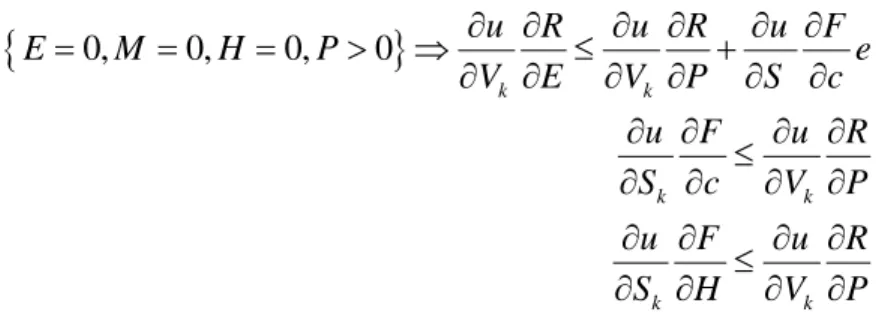
Idleness is not necessarily simply measurement error in work. Idleness can be fully rational in a time allocation model with schooling costs such as that of section 1. Equation 1.2 specifies that a child does not attend school when the marginal utility associated with the returns to education is less than the foregone utility caused by schooling costs and the shadow value of child time. When children also do not work (H=0, M=0), the shadow value of child time is simply the marginal utility associated with the return on leisure for the child's future welfare. Thus, idle status occurs when:
0, 0, 0, 0
k k k k k k u R u R u F E M H P e V E V P S c u F u R S c V P u F u R S H V P (eq. 2.1)That is, true idleness occurs when the marginal utility associated with additional leisure is at least as large as that of the contribution of the child's work to household welfare. Is this ever plausible unless the parents put substantive weight on child leisure? There is no empirical evidence to inform this question, but it could occur when there are not wage employment options open to children (M=0), and the shape of the home production function F(-) is such that the marginal product of child labor can become non-positive. This might occur if, for example with young children, there were some tasks children could do but then afterwards, they were more
destructive to output (perhaps distractive to adult labor) than helpful. Whether the prevalence of idle children reflects the economic reality of the country or problems in how we collect child time allocation data is not yet answered. Interestingly, Edmonds, Pavcnik, and Topalova (2007) find that the poverty elasticity of idleness in Indian data is greater than is the poverty elasticity of market or domestic work. Hence, even if idleness reflects measurement error, it might not be classical measurement error.
2.3 Background on the Activities of Working Children
Types of activities
Table 4 presents participation rates in various categories of activity for 34 countries included in UNICEF's MICS project. The questionnaires are nearly identical in all the countries in Table 4. The data present a unique opportunity to examine child labor across countries in as comparable a manner as possible (little can be done for cultural differences in the interpretation of the questions). Participation rates in schooling, market work, market work for wages, other market work outside of the household, market work inside the household, domestic work, any work, work without schooling, and no work and no schooling are reported in Table 4. Note that while there is considerable variation in schooling, schooling rates are surprisingly high. This reflects the structure of the questionnaire. It asks whether a child has attended school in the last year while the labor questions refer to the last week.
Several important properties of how children work are apparent in table 4. First, work outside of the household is the least prevalent work category in every country except Azerbaijan, Kenya, and Venezuela. In these three countries participation rates in market work inside and outside of the household are similar. Altogether, 8 percent of children in the MICS data work outside of their household, and only 2 percent work in paid work outside of the household. It is unclear what the 6 percent of children who work outside their house without pay are doing in the MICS data, but in other datasets, they are often observed working in labor exchanges on
neighboring farms, working in schools in exchange for materials or a reduction in fees, helping a relative with their work, etc.. Domestic work is the most prevalent type of work. Across
countries, 65 percent of children 5-14 report working in domestic work, compared to 23 percent in market work.
Second, the countries with the lowest school attendance rates have the highest incidence of "idle" children that neither work nor attend schooling. Work is not the residual claimant on child time outside of school. Moreover, work is not especially prevalent in these countries with high rates of idleness. They do not have the highest rates of work outside of the household or work in market work. This is consistent with the idea that no single indicator of activity will give a particularly complete idea of child time allocation, and research needs to take a comprehensive view of child time in order to understand how it is influenced.
Third, countries with the highest prevalence of work outside the household also have the highest prevalence of work inside the household. Sierra Leone has the highest rate of work outside the household, and the second highest rate of work inside the household. Niger is second with 43 percent of children working outside the household, while it has the fifth highest rate of market work inside the household. In section 4.1 below, we discuss the weak nature of the evidence linking child's market work status and employment opportunities outside of the household, and the high correlation between work inside and outside the household are
consistent with the idea that children are not working solely because wage labor market factors draw children away from their homes.
Fourth, participation in market work is highest in countries where domestic work is most prevalent. This positive correlation in participation rates for market and domestic work also appears in hours worked. However, the positive correlations between hours in various categories of work mask a more nuanced view - that participation in various activities is positively
correlated when children work a small number of hours in each activity (as is typical) but not with extreme hours. This is evident in Figure 1 which presents the joint distribution of hours worked in market and domestic work for all children 10-14 in the MICS data. Figure 1 is a contour map of the joint density of hours in market work and hours in domestic work for
children 10-14 in the pooled MICS data. Each contour on the map is a given density. Thus each point on a given contour is equally likely. Density is increasing in color intensity.
Several key points are evident in figure 1. First, at the peak of the density, children work more hours per week in domestic work than market work. Ignoring domestic work would frequently understate total hours worked by a child by a factor slightly greater than 2. Second, children working a large number of hours in market work are more likely than not to spend additional time in domestic work. This is evidence by the humps in the market work direction. No such humps are evident with hours in domestic work. Third, as hours per week in domestic
work increase, it becomes less likely to observe the child doing significant time in market work. This is evident in the increasing slope of contours as one heads up the domestic hours worked distribution.
The joint distribution of hours worked in Figure 1 illustrates the problem with "child labor" definitions that focus on market work alone, especially definitions based on the intensity of hours worked. For example, suppose a researcher decided to be concerned about children that worked more than 20 or more hours per week. If only work outside the household was
considered, this would be 8 percent of the MICS 10-14 sample. If market work inside the household is also included, 23 percent of children work more than 20 or more hours per week. When domestic work is also considered, 38 percent work 20 or more hours per week and 17 percent work 40 or more hours per week. Hence, ignoring domestic work may seriously understate estimates of total hours worked and thereby the incidence of child labor if hours worked is used to define it.
Occupation and industry of economically active children
In table 4, it is clear that most working children participate in domestic work. Among children engaged in market work, most of that work is inside the child's household. The industrial and occupational composition of employment in market work is not available in the MICS data. Comparable cross-country estimates of the industrial and occupational composition of child involvement in market work do not appear to exist. One possible source of this
information is that most SIMPOC child labor surveys use similar questionnaires, and they tend to collect information on occupation and industry. In this section, we tabulate available
information on industry and occupation for economically active children as reported in downloadable, English language SIMPOC reports.
Table 5 shows the industrial composition of economically active populations for
available countries.5 In almost every listed country, a majority of children economically active children are involved with agriculture, forestry, or fishing industries. The exceptions are the 5-17 populations of Costa Rica, Panama, and the Ukraine where these industries are still the largest employers of children. In most countries, the combination of hotel and restaurants and wholesale and retail trade are the next most important industrial sectors for economically active children. When they can be disaggregated, wholesale and retail trade tends to have a larger share of economically active children than does the hotel and restaurant sector. Manufacturing tends to be small relative to agriculture related and wholesale and retail trade sectors, but it employs a larger share of children than does mining or construction in every country in the table.
Interestingly, private households are large employers of economically active children in Kenya, Tanzania, and Zambia. Many of these children are child domestic workers, and the phenomena
5
Of the MICS countries from table 4, only Kenya and the Philippines also have child labor surveys. It is interesting to note, that MICS estimates of participation rates in market work differ from estimates of the economically active population in the SIMPOC surveys for these two countries. The difference in the Philippine data is small. 16 percent of children are involved in market work in the MICS data, 11 percent in the SIMPOC survey. However, the differences in the Kenyan data are large. 3 percent of Kenyan children 5-14 are involved in market work in the MICS surveys, but the SIMPOC surveys report an economic activity rate for this population of 15 percent. It is not clear why these estimates differ.
of child domestic workers in Africa and elsewhere is infrequently studied in detail within economics.
The comparability of industry classifications in the SIMPOC surveys across countries is not as complete as one would like. Nor are the classifications particularly detailed. The 2002/03 Bangladesh Child Labor Survey is unusual in the incredible detail it provides on the industrial classification of economically active children. Table 6 tabulates the 4 digit industrial distribution of the economically active populations of children 5-17 in Bangladesh. Only sectors with at least 0.5 percent of economically active children in either rural or urban areas are reported in Table 6. In examining the detailed industrial composition of employment in Bangladesh, it is important to remember that there is no reason to believe that Bangladesh is representative of other low-income countries. There are an estimate 7.5 million economically active children 5-17 in Bangladesh. This corresponds to 18 percent of children 5-17.
The useful information within the detailed classifications of Table 6 is about what children within the aggregate sectors are doing. Children involved in agriculture and related industries are involved in the growing of cereals, vegetables, poultry farming, and inland fishing. Cereal cultivation is the largest single sector with 39 percent of all economically active children directly involved. In the retail trade industries, groceries and general stores are the largest employer of children. In manufacturing, wooden furniture and fixtures stand out. For construction, site preparation is relatively more important.
The disaggregated occupational composition of economically active children can provide further insight into what children do. Information at the 3 digit level is available in the
Bangladesh child labor force survey, and these data are tabulated in Table 7. 46 percent of children 5-17 are farm crop workers. The next largest occupations are salesmen and shop assistants (7 percent), poultry farmers (5 percent), sales supervisors (4 percent), fisherman (3 percent), and non-motorized road vehicle drivers (3 percent).
Gender differences
Gender differences in activities can be considerable in some countries. Boys generally have higher participation rates in market work than girls and lower participation rates in domestic work. For example, in the MICS countries, girls are 18 percent more likely to be involved in domestic work and nearly 30 percent less likely to participate in paid market work. Estimates of gender differences tend to be extremely sensitive to what types of activities are considered in a study. Studies such as Assaad et al (2003) for Egypt, Levison and Moe (1998) for Peru, Levison, Moe, and Knaul (2001) for Mexico have documented the misleading picture that omitting domestic work can create for analysis of the determinants of child work.
In both market and domestic work, boys and girls often participate in different tasks. This is evident in the large gender differences in the industrial composition of economically active children in Bangladesh (table 6). Boys are involved in a wider variety of industries. Boys are more likely to be engaged in the growing of cereal crops. Girls are more involved in growing vegetables and poultry farming. 14 percent of economically active girls are in poultry and 16 percent in vegetables while less than 2 percent of economically active boys are in each industry. Children involved in textile and sewing handicrafts and private household services are almost
entirely female whereas boys are more involved in fishing, wooden furniture manufacture, construction site preparation, retail trade of grocery and general stores (as sales assistants and sales supervisors, table 7), and transport (non-motorized vehicles, table 7). We should not
extrapolate from Bangladesh to assume such distinct gender differences in other countries, but its example shows that these gender differences can be large.
Large gender differences in types of tasks can complicate researcher decisions about how to treat gender. Do differences in activities reflect a fundamental difference in how girl time allocation decisions will be made with respect to the household's economic environment? If so, this would suggest that boys and girls should be considered separately in research. Qualitative evidence from specific country contexts can help inform where girls should be considered separately from boys, but bifurcating data by gender seems a reasonable default position.
Substantive gender differences in tasks and determinants of work can be especially challenging for studies that rely on within household comparisons (household fixed effects) of children. Assume average birth spacing is two years, the probability an observed child is a girl is 0.5, and that gender draws are independent within parents. This implies that a household fixed effects study of working children 10-14 will rely on gender differences in activities and tasks for half its variation.
Urban –rural differences
The research challenges associated with gender also arise with urban-rural data. Children tend to work more and for longer hours in rural than urban areas. For example, Edmonds and Pavcnik (2005a) tabulate urban-rural differences in the MICS data used in Figure 1 and table 4. 31 percent of rural children 5-14 are engaged in market work in rural areas compared to 19 percent in urban areas. Domestic work also has a higher prevalence in rural areas although the difference is smaller (68 percent compared to 61 percent). 26 percent of children work 20 or more hours per week in rural areas compared to 14 percent in urban, and 9 percent work 40 or more hours in rural areas compared to 4 percent in urban.
If children only worked more intensely in rural areas, then researchers could pool urban and rural children in their analysis, but children also tend to work in different types of activities. For example, in the MICS countries, the prevalence of unpaid market work is nearly double in rural areas, and paid employment accounts for 50 percent larger share of all market work in urban areas. A careful look at the urban-rural differences in the detailed Bangladesh data is illustrative for why researcher's default assumption should be to treat urban and rural child labor decisions distinctly.
In general, employment is more concentrated in rural areas in Bangladesh. For boys, urban-rural differences in employment are similar to what one would expect with rural areas more weighted to agriculture. A majority of economically active boys in rural areas are farm crop workers (table 7) with most being involved in cereals (table 6). Salesman and shop
assistants, fisherman, and non-motorized vehicle drivers are the next most prevalent occupations among rural boys. In urban areas, boys are most active in sales. 27 percent of boys in urban areas are working as sales supervisors, salesmen, shop assistants, and street vendors (table 7). Much of this appears to be in retail grocery and general stores (table 6) as well as tea stalls.
However, farm crop workers in cereals, fisherman, and non-motorized vehicle operators are also prevalent in urban areas.
Urban-rural differences in occupation and industry of the economically active population in Bangladesh are more pronounced for girls. A majority of girls in rural areas are involved in cereals, vegetables, or poultry farming. While poultry is the second largest industry of
employment for urban girls, together these agricultural industries are less than a quarter of urban employment for girls (table 6). Spinners, weavers, knitters, etc. are unusual in rural areas, but 13 percent of economically active urban girls are in these occupations (table 7). Employment of girls in the manufacture of bidies or in private households is also much more prevalent in urban areas (table 6).
A difficulty in bifurcating data into urban and rural segments is that it presumes the two area types are segmented. In some contexts, there is no clear line either defining or separating urban and rural. In fact, there is an interesting literature that documents how household
specialization changes with proximity to major urban areas (Fafchamps and Shilpi 2004) and that this in turn affects schooling and both market and domestic work (Fafchamps and Wahba 2006). Thus, it is difficult to draw generalities with regards to how and whether urban and rural areas should be treated differently by empirical researchers. Moreover, the example of Bangladesh illustrates that the extent to which urban and rural activities are comparable may differ by gender as well (Amin, Quayes, and Rives 2006 also make this point in data from Bangladesh).
Age patterns
C138 established the idea that whether an activity is viewed negatively for a child depends on the child's age, and this has been codified into SIMPOC's definition of child labor. The idea behind this is that what may be appropriate for a 14 year old might not for a seven year old. This is logical, but implicit in this discussion is that 7 year olds tend do the same sorts of activities as a 14 year old. This does not appear to be the case in the limited available evidence.
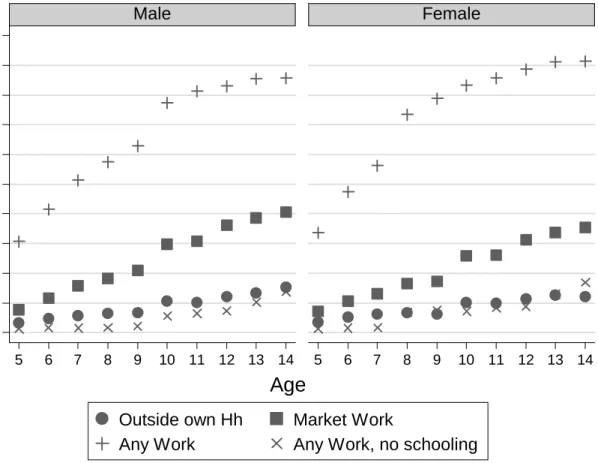
Figure 2 pools the MICS countries and plots participation rates in various activities separately by age and gender. The four pictured categories are market work outside of one's own household, market work, any work (the difference between any and market work is children who only work in domestic work), and any work without also attending school. Participation rates in each of these categories looks smooth in age for boys until age 10 when there is a sizeable increase in participation rates in market and domestic work and again for age 12. Girls appear to experience discrete jumps at age 8, 10, and 12. The increase at age 8 for girls appears to be most dramatic in domestic work whereas most of the increase at age 10 and 12 for girls is in market work. Overall "any work" patterns for girls look smooth at ages 10 and 12, suggesting that the increase in market work and 10 and 12 for girls complements the domestic work that began increased substantively starting around age 8.
Moreover, within market work, there are changes by age in the types of industries in which children are employed. This is evident in the SIMPOC data tabulated in Table 5. When available, the industrial composition of employment is also broken down by age. There are some interesting differences across age. For example, in Tanzania, the fraction of economically active children employed in private households is decreasing in age whereas the fraction in agriculture
and related industries is increasing in age. However, the opposite is true for Kenya. Declining shares in agriculture and related industries with age is also present in Ethiopia, Ghana, Namibia, and Nicaragua. But the age patterns are ambiguous in Zambia and the Philippines. Hence, while there is no clear age pattern across countries in the industrial composition of employment, there appear to be patterns within countries that highlight how important age can be in the analysis of child labor.
The evidence in figure 2 and table 5 implies that researchers should be as flexible as possible in how they treat age in their analysis. A full set of gender interacted age effects seems reasonable for regression work. This is especially true for market work although a gender
interacted polynomial in age may be suitable for some types of activities (such as participation in any work for girls above age 8 in the data used in figure 2).
A related issue concerns what ages researchers should consider. International
organizations interested in child labor typically focus on children 6-14 for most activities but the under 18 are often considered in particularly abhorrent situations such as prostitution. However, C182 is careful to allow each country to set appropriated ages for different types of work, and individual country policies regarding work and schooling are useful for researchers in deciding what ages to consider and how to group those ages. While work laws tend not to be enforced in most current developing countries (more on this later), they are useful at providing insight into country specific views on the ages at which work is a concern. Researchers have to be careful, however, not to let subjective policy statements about "harmful" work drive what types of ages they consider as whether work is harmful ultimately depends on understanding why a child participates in it.
Research needs to be particularly concerned about schooling ages, and grouping children based on the category of schooling they would normally attend for their age can be prudent (especially when drop out rates at schooling transitions are high). For example, observing a seven year old who worked without attending school in a country where schooling typically begins at age 8 might reflect something very different than if the child were at a country where schooling begins at 5. Likewise observing a thirteen year old out of school in a country where thirteen year olds are usually in primary school may imply something different than in a country where thirteen year olds are in secondary school. Moreover, in many settings, the elasticity of child time allocation to factors in the environment appears to be increasing in age at young ages, and explaining child time allocation at pre-school ages is a challenge. Hence, country specific attention to the appropriate age grouping of the data seems merited.
Worst forms of child labor
The ILO's SIMPOC estimates that a total of 8.4 million children are involved in child trafficking, in forced or bonded labor, are soldiers, are prostitutes or involved in pornography, or participate in illicit activities (ILO, 2002). 68 percent of these children are in bonded or forced labor. Since hazardous activities are defined at the country level, cross country evidence on their extent is not available. Country level estimates are also typically not available. However, in implementing C182, the ILO has been active in assisting countries in assessing the prevalence of worst and hazardous forms of child labor as well as in developing plans for the eradication of these activities. Nepal was one of the first countries to initiate one of these "Time Bound