2015
Integrating Writing in the Middle-Level
Mathematics Classroom: An Action Research
Study
Alyssa Beavers
Stephen F. Austin State University Brandon L. Fox
Stephen F Austin State University Jamaal Young
University of North Texas Elizabeth M. Bellows Appalachian State University Leah Kahn
Stephen F. Austin State University
Follow this and additional works at:http://scholarworks.sfasu.edu/mlet
Part of theCurriculum and Instruction Commons, and theJunior High, Intermediate, Middle School Education and Teaching Commons
Tell ushow this article helped you.
This Article is brought to you for free and open access by SFA ScholarWorks. It has been accepted for inclusion in MLET: The Journal of Middle Level Education in Texas by an authorized administrator of SFA ScholarWorks. For more information, please [email protected].
ScholarWorks Citation
Beavers, Alyssa; Fox, Brandon L.; Young, Jamaal; Bellows, Elizabeth M.; and Kahn, Leah (2015) "Integrating Writing in the Middle-Level Mathematics Classroom: An Action Research Study,"MLET: The Journal of Middle Level Education in Texas: Vol. 2: Iss. 1, Article 4.
Integrating Writing in the Middle-Level Mathematics Classroom: An Action Research Study In this action research project, our focus was on improving students’ written expressions and explanations in the middle-level mathematics classroom. Having taught math at various grade levels, we are interested in researching the effects of written content within the math curriculum. Typically, the writing process is taught in depth in language arts classrooms, but there is not much emphasis placed on writing in mathematics classrooms. Students should be taught essential writing techniques and how to properly express their thoughts and feelings mathematically. Today’s math classrooms require students not only to provide solutions to specific math problems but also to explain how they arrived at these solutions. However, it seems that far too often students struggle with justifying their explanations in a coherent and concise way. We decided to implement a writing portion during the lead author’s mathematics block in which her students were expected to express critical thinking skills, feelings, and mathematical responses in a written context.
The purpose of this action research was to examine and evaluate the effect writing has on students’ mathematical thinking processes and skills. For this, we looked specifically at the effects of students’ written justifications and reflections on student success with a variety of math problems throughout an 8-week period. We also focused attention on discourse that occurred during student interactions with peers to see if it led students to a deeper level of thinking and understanding and in return transferred to the written context. The specific research questions were What effect does writing in the mathematics classroom have on students’ conceptual
understanding? and What effect does writing in the mathematics classroom have on students’
For the remainder of this introductory section, we provide an overview of the action research intervention followed by a description of influential research and then close the section with a list of operational definitions. The next section of this manuscript is the literature review. Then comes the method section, which further describes the guiding processes of this action research project. Following the method section is a presentation of findings followed by a closing discussion.
Description of the Intervention
Over the course of eight weeks, students were presented with various writing assignments in mathematics. Students were provided with journal prompts that included open-ended
questions, mathematical investigations, and reflection statements. These prompts covered the specific mathematical concepts that were being facilitated during whole-group lessons. Students were given approximately 15-20 minutes to read the prompt, brainstorm ideas, reflect, and then write about the prompt. At the end of each week, the teacher collected students’ written journals and responded to any concerns.
Prior to the intervention, we believed this project would improve our math workshop routine in the following ways:
1. Students would feel a sense of positive accountability for completing their journal prompts, assessing their reflections, and gaining problem solving skills;
2. Students would further develop writing techniques for writing journal entries and for participating in teacher-modeled activities;
3. Students would participate in the “think-pair-share” method. They would gain
knowledge through communication with each other about the specific math concepts being facilitated;
4. Teachers would gain a greater understanding of students’ knowledge and attitudes about the subject matter being facilitated, which could guide lesson planning; and
5. Teachers would be able to diagnose areas of concern for specific students, which
would allow for quick teacher support.
The effects of this particular study were determined by individual interviews about math journaling and the math workshop in general. The teacher collected comparative interview feedback before and after the study to determine changes in students’ in interest and knowledge gained from before and to after the writing intervention. Additionally, students’ journals were collected at the end of each week and carefully examined by the researchers. The teacher would then review the journals against a teacher-created checklist. Each day, students were observed while participating in small groups, during think-pair-share exercises, during whole-group lessons, and during journal writing time.
Description of the Research
There is an excessive amount of literature that affirms the study of journaling in the mathematics classroom. This study is strongly linked to the ideals and principles of the constructivist theory of learning with a particular emphasis on sociocultural learning theory, pioneered by Lev Vygotsky (1986). Vygotsky’s work is based on the idea that children learn by connecting new knowledge to previously learned knowledge through the use of scaffolding. Vygotsky (1986) believed that “language is the outward expression of thinking, the way one makes meaning out of one’s thoughts” (p. 72). This goes hand in hand with the language experience approach to reading. Various sources have provided compelling information on the formation and management of math journals (Baxter, Olson, & Woodward, 2005) and the examination of utilizing journals within the math curriculum (Cooper, 2012). Advantages of
math journaling in the classroom are also noted in the research and investigation of the literature collected for the study (Countryman, 1992). We elaborate more about journaling in the
mathematics classroom in the Literature Review.
Operational Definitions
Below is a list of terms and definitions we used throughout the course of this study:
Conceptual understanding occurs when students are able to identify key ideas, draw inferences, and apply key ideas in an effective and accurate way (NCTM, 2000).
Math journaling is a personal record of occurrences, experiences, and reflections kept on a daily basis such as learning and articulating mathematics through writing (Countryman, 1992).
Problem solving is a mental process that involves investigating, discovering, analyzing, and solving problems (Schoenfeld, 1992).
Problem-based learning (PBL) is a student-centered instructional strategy in which students are engaged and collaboratively work together to solve problems and reflect upon their solutions and experiences (Wood, 2003).
Small groups comprise three to four students placed together to work collaboratively.
Literature Review
For the Literature Review, we begin with an argument that writing can be an outlet for students’ voices to be magnified and heard, especially those of students from historically marginalized spaces. We further the review of literature by providing an in-depth look at journaling in mathematics classrooms before providing an overview of observing and assessing journaling in mathematics classrooms.
Writing and Mathematics—An Opportunity to Embrace Voice
Integrating writing in mathematics classrooms “can provide opportunities for students to construct their own knowledge of mathematics” (Countryman, 1992, p. vi). Countryman released an influential publication in 1992, Writing to Learn Mathematics, that finally brought together many ideas related to constructing knowledge through writing in the mathematics classroom. Countryman (1992) suggested that when students write, they develop an awareness of what they know and don’t know, connect to prior knowledge, summarize their knowledge, provide insights to their understandings, raise new questions, critically reflect, and construct mathematics for themselves. The metacognitive benefits of writing in the mathematics classroom foster students’ ability to regulate, evaluate, and adapt their own mathematical thinking (Wilson & Clarke, 2004). Many students remain silent within the mathematics classroom because classroom discussions require instantaneous comprehension and response, while written communication allows students to embrace mathematics at their own pace.
Writing may be one strategy or process to allow teachers to embrace and respond to the voices of their students. Embracing voice and supporting students in the knowledge construction process has been a key tenet of culturally responsive and culturally specific pedagogies. Leonard (2008) defined the construct of culturally specific pedagogy as “intentional behavior by a teacher to use gestures, language, history, literature, and other cultural aspects of a particular race, ethnic, or gender group to engage students belonging to that group in authentic student-centered learning” (p. 9). Furthermore, strategies and processes that embrace the culture of students allow for the student to develop content-specific identities and encourage students to apply content knowledge in their daily lives (Leonard, 2008; Martin, 2000). In addition, written
Journaling in the Mathematics Classroom
Discourse in mathematics refers to the written and oral communication that occurs in the mathematics classroom. Yet, in many classrooms in the United States, writing is often taught remotely in the classroom of a language arts teacher. Math teachers rarely utilize writing as a form of instruction or practice within their curriculum (Benjamin, 2005; Countryman, 1992). The use of multiple representations is a cornerstone of effective mathematics instruction, thus
educators are encouraged to incorporate pictures, manipulatives, real-world situations, written symbols, and oral language into their mathematics instruction. Oral language is the most dominant form of mathematics discourse practiced within many mathematics classrooms, but issues of language interference may inhibit student understanding of mathematics. Students experience interference when language is borrowed from their everyday lives and used in a mathematics context (Kotsopoulos, 2007). A student’s use of words such as limit, if, cancel, and
table hinges upon her or his ability to negotiate the mathematical and everyday meanings of these words. Students must be taught essential writing techniques and how to accurately and appropriately express their knowledge and reasoning skills mathematically (Benjamin, 2005; Countryman, 1992; Leonard, 2008). These skills will help student avoid this type of interference by capitalizing on the metacognitive benefits of writing.
In modern mathematics classrooms, students are expected not only to provide answers to math problems but also to justify their solutions, how they approached them, and the strategies they used to solve them. Writing across the curriculum has become a hot-topic approach in many classrooms. Kenny (1990) noted that “writing across the curriculum is a synthesis of writing and learning—that we do more learning by doing more writing and that we become better writers by being better learners” (p. 17). Writing to learn mathematics is a term that is reserved for explicit
attempts to implement writing in the mathematics classroom with the aspiration of improving students’ knowledge and comprehension in mathematics. The National Council of Teachers of Mathematics (NCTM, 1991) recommended that classroom discussions be based on mathematical reasoning and evidence “in order for students to develop the ability to formulate problems, to explore, conjecture, and reason logically, to evaluate whether something makes sense” (p. 34).
Writing in the mathematics classroom may take place during a warm-up, whole-group lessons, small-group settings, at the end of a lesson, or to assess acquired knowledge learned from a specific concept taught. Students should be given the opportunity to observe and reflect on communication skills and participate in active learning situations (Leonard, 2008). According to Carter (2009), students should be explicit with mathematical discourse and be able to interpret other people’s mathematical logic, and the use of math journaling is an efficient way to meet both skills. In addition, Albert (2000) expressed that mathematics does not need to be taught with memorization and rigor, stating “students can apply their knowledge to specific tasks or
situations that involve active, constructive, and innovative practices, which can be manifested through writing” (p. 137). When students utilize math journals during the math workshop, they are not only conveying their conceptual understanding of the processes they used to solve a particular problem but are also making sense of their performance. Cooper (2012) went on to express that “through the process of writing, students learn how to express themselves more clearly and how to be more persuasive” (p. 81). Journaling in the mathematics classroom is intended to provide students with the tools necessary to accurately reflect, make meaningful connections to concepts, and evaluate their performance when solving or explaining particular mathematical situations (Leonard, 2008). With the related research that writing has produced,
writing has been considered an incentive to develop and improve more tactful and purposeful responses to mathematical expressions.
Incorporating a writing portion and implementing the utilization of math journaling within the mathematics curriculum are becoming more frequent practices in schools today (Benjamin, 2005). When discussing the math journal itself, Burns and Silbey (2001) noted, “it helps students stretch their thinking and make sense of problems that can sometimes leave them confused or frustrated” (p. 18). Although writing in the mathematics classroom has not been embraced by all educators, it does appear to be utilized more frequently than in the past. Many studies have acknowledged the positive affects math journaling can have on a student’s
achievement level (Leonard, 2008). In one specific study, Crocker (1992) was able to determine that writing to learn mathematics in the classroom appears to be successful in fostering
understanding and gratification of mathematics (p. 68). Burns (1998) conducted a study in which she was able to shift real-life problems into activities through the use of math journaling, giving students greater understanding of how mathematics will be used in their daily lives.
The implementation of math journaling ultimately depends upon the objectives,
inclinations, and particular age and needs of the students (Benjamin, 2005; Countryman, 1992). Simple writing activities that involve student-created glossaries, journal entries, graphic
organizers, and visual aids all benefit students’ ability to increase their understanding of word problems, vocabulary, and mathematical ideas (Blessman & Myszczak, 2001). In some classes, students utilize their math journals to complete all of their work, using them on a daily basis during whole-group lessons to keep notes and conduct problem-solving activities. Other classes may use math journals to perform and conduct entries at the end of a particular math lesson to express solutions and constructed knowledge or to include items they are unsure about or
questions they may have. Some teachers only allow their students to utilize their math journals for specific math activities or investigations, and some use them for corrections or simple reflection statements (Countryman, 1992).
Writing in the mathematics classroom can take many different forms. Baxter, Woodward, and Olson (2005) expressed that writing in the mathematics classroom can range from formal assessments, for which students’ goal is to present an edited entry in which a coherent and logical explanation is presented, to less structured, spontaneous journal entries in which students express their understanding of mathematical ideas. When journals are used for writing in the mathematics classroom, the students must think about what they have done and what is required to solve the specific math problem or activity. Journal entries can be open-ended questions, reflection statements, or mathematical investigations and can be used in small-group settings or during think-pair-share situations. Incorporating journals in the mathematics classroom can be impactful to both teachers and students when they are used with intent and objective
(Countryman, 1992).
Observing and Assessing Journaling in the Mathematics Classroom
Math journaling is an effective tool to gain understanding of students’ critical thinking and reasoning skills of mathematics concepts (Benjamin, 2005; Countryman, 1992; Fox & Larke, 2009; Leonard, 2008). Clarke, Waywood, and Stephens (1993) suggested that routine observation and monitoring of journals can inform teaching practices and present the support needed for discussion with individual students or with a whole group. They believe that the teacher’s role is critical in helping students take control of their own learning. Math journaling in the mathematics classroom should be assessed, observed, and evaluated (Benjamin, 2005). Assessment can take place in many forms, such as collecting students’ journals, recording
anecdotal notes while observing students writing, asking questions during small-group settings, or engaging in individual conferences (Benjamin, 2005; Countryman, 1992). Teachers, then, must have a foundation for evaluating students’ written responses so they can accurately utilize this information to reteach or alter their own lesson plans.
Along with this idea, Flores (2006) proposed that teachers must comprehend and understand the ways in which students justify their solutions so that they can appropriately and accurately build upon these justifications to help students develop their ability to use persuasive arguments in mathematics classrooms. Flores (2006) also stated it is imperative for students to develop approaches that reflect on the accuracy of a procedure they have performed. In addition, students must develop accountability for their math journals, embracing ownership of their writing and learning (Zemelman, Daniels, & Hyde, 2005). While the literature has suggested the importance of writing in the mathematics classroom, we wanted to determine the effect of writing on motivation in a specific middle-level classroom environment in Texas.
Method
The purpose of this research study was to identify the effect that writing has on students’ conceptual understanding of mathematics and on students’ motivation. This particular study utilizes an action research approach, which can be described as “a systematic inquiry conducted by teacher researchers, principals, school counselors, or other stakeholders in the
teaching/learning environment to gather information about how their particular schools operate, how they teach, and how well their students learn” (Mills, 2011, p. 5). When collecting data, the researchers utilized a mixed-methods approach to research design. While most of the data collected were qualitative, the researchers did analyze the quantity of responses to surveys. All data were collected within a span of 8 weeks.
Participants
This research study took place in an elementary school located in a large urban area in central Texas. The school’s population was approximately 978 students and included the following ethnic and/or racial representation: 12% Asian American, 21% African American, 26% European American, 35% Latino/Latina/Hispanic American, and 6% multiethnic. This elementary school recently received the distinctions of academic achievement in reading/ELA, academic achievement in mathematics, and top 25% student progress. About 52.5% of the students within the school population are labeled as “economically disadvantaged.” This action research study occurred in a fifth-grade classroom in which the primary investigator (PI) is the lead teacher. The research study consisted of a total of 38 fifth-grade students, 16 from the PI’s homeroom class and 22 from a colleague’s homeroom class. The PI facilitates math and science to both groups every day. To easily distinguish between classes, the researchers labeled the PI’s homeroom class as “Class Pi,” whereas the partner teacher’s class was labeled as “Class Tri.” All of the students were between the ages of 10 and 11 years old. Refer to Table 1 for the
Table 1
Demographic Information Across Race/Ethnicity and Gender
Class Pi Class Tri
Total Students 16 22 Race/Ethnicity European American 6 8 African American 4 5 Latino/Latina/Hispanic American 5 5 Asian American 0 3 Multiethnic groups 3 1 Gender Female 8 12 Male 8 10
Data Collection and Instruments
This action research study consisted of a mixed-methods research design in order to gather the appropriate data and answer the specific research question. Qualitative research was used to collect rich, descriptive data. Students completed questionnaires before and after the implementation of math journaling. Math journals were provided to each student during the first week of the intervention. Students were expected to complete journal prompts and/or problem-solving investigations before, during, and after lessons. When students received journal prompts, they were given quiet time to independently work and express their thoughts and explanations in the form of a journal entry. Problem-solving investigations required students to work together in collaborative groups to solve problems and to reflect upon their solutions and experiences. Math journals served as a place to record observations and notes, prove their solutions and strategies, and reflect upon their experiences in math class. The researchers also quantitatively compared
students’ responses to questionnaires facilitated before and after the implementation of math journaling. The first questionnaire was used to gain insight on students’ motivation and attitude levels about the math workshop. Students were given interview questions on paper and were encouraged to provide honest answers to each question (see Appendix A). A second
questionnaire was given to students before the study that included questions fitted to assess their motivation and attitude levels about the use of journaling in the mathematics classroom and was designed to compare the knowledge gained before and after the implementation of math journals (see Appendix B). The facilitator then examined the interview data for both Class Pi and Class Tri. After the interview data were collected, students in both Class Pi and Class Tri were provided with their own math journals.
Math journaling was implemented on a daily basis and occurred before, during, and after mathematical lessons as well as during problem-solving investigations. The journal prompts included the use of problem-solving investigations, open-ended questions, reflection statements, observations, and notes. Each journal prompt or investigation covered the necessary math skills that the students were expected to understand, know, and utilize per the Texas Essential
Knowledge and Skills (TEKS) for fifth-grade mathematics. The prompts and investigations changed according to the concepts being learned, based on previously learned material, and to address specific individual or group needs.
Students were given approximately 20 minutes to brainstorm, reflect, and complete their journal prompts each day. At the end of each week, the PI collected the journals and responded to any concerns, asked probing questions to gain a deeper understanding and expand the
efficiency of the intervention, and assessed students’ entries using a 1-to-4 grading scale rubric. At the beginning of each week, students were provided with time to read and reflect upon the
PI’s responses. The PI kept a conferring binder to record anecdotal records on students based on student motivation, interest, understanding, and focus during journal writing. This binder helped the teacher to examine the effectiveness of math journaling as well as attitudes of students. To assist students in following the appropriate expectations while utilizing their math journals during the math workshop, the PI posted a chart indicating specific expectations.
The researchers examined and analyzed students’ math journals over the course of 8 weeks to assess the effects of writing on students’ motivation in the mathematical classroom and on students’ conceptual understanding. The following areas were assessed and analyzed
thoroughly regarding the effectiveness of math journaling: student attitudes and interest in mathematics, efficiency in conceptual understanding and reasoning skills in math, depth and quality of explanations proven and shown, and academic discourse when collaboratively working with peers. To conclude the study, students were asked to complete the same questionnaires that were used in the beginning of the study. These questionnaires were used to compare the attitudes that students had toward the math workshop in the beginning and at the end of the intervention.
Outcomes
The guiding questions for this research study were What effect does writing in the
mathematics classroom have on students’ conceptual understanding? and What effect does
writing in the mathematics classroom have on students’ motivation toward mathematics?
According to the data observed and recorded throughout this action research project, the
application of math journaling may have a positive effect on student’s conceptual understanding and an increase in motivation toward mathematics. Students’ conceptual understanding and motivation toward mathematics both appeared to increase after a writing portion was incorporated into the mathematics curriculum.
Analysis of Student Motivation
Student motivation and attitude levels were evaluated and analyzed based on students’ responses to interview questions given before and after the implementation of math journaling. Table 2 displays students’ responses to interview questions (see Appendix A) pre- and post-intervention. Divisions were distinguished based on significant aspects of the math workshop. Group A and Group B were interviewed separately but were combined to better evaluate motivation and attitude levels across the grade level and classes.
Table 2
Class Pi and Class Tri Interview Questions 1–6 and Breakdown of Responses
N = 38 N = 38
Pre-Intervention Post-Intervention
1. Do you enjoy learning math?
Yes 29 34
No 5 2
Sometimes 4 2
2. What is your favorite thing to learn in
math? Problem solving 4 2 Multiplication 13 7 Division 11 7 Measurement 3 4 Other 7 18
3. What is your least favorite part about math class? Textbook/worksheet work 3 6 Homework 3 2 Tests 2 1 Writing in math 3 1 Nothing 3 4 Other 24 24
4. Do you enjoy hands-on activities during
math class?
Yes 36 37
No 2 1
Sometimes 0 0
5. Do you enjoy working in small groups while solving mathematical investigations?
Yes 27 21
No 7 5
Sometimes 4 7
6. Would you rather work by yourself during mathematical investigations?
Yes 9 9
No 23 26
Note. “Other” in the last division of Questions 2 and 3 demonstrates responses that involve math units and their components. “Nothing” in the fifth division of Question 3 refers to students generally responding, “I would not change anything.”
Table 3 (Group A) and Table 4 (Group B) include material regarding Question 7. This question was expected to evoke more subjective answers connected to students’ motivation and attitudes toward the math workshop. There were consistent themes across each class. Students seem to desire more hands-on activities, games, and group work, but less homework, worksheets, and tests.
Table 3
Class PiInterview Question 7 in Regard to Motivation and Attitude Levels Toward Math Class
7. If you could change one thing about math class, what would it be?
Pre-Intervention Themes
More games (especially computer games) Less homework
Simple examples (step by step)
Computation (adding, subtraction, division, multiplication)
Writing in our journals because it takes up a lot of time to do fun activities To always work in groups
Textbooks
Post-Intervention Themes
More games (especially computer games) Less homework
Paced examples Volume and area
More hands-on activities To always work in groups Longer classes
Table 4
Class Tri Interview Question 7 in Regard to Motivation and Attitude Levels Toward the Math
Workshop
7. If you could change one thing about math class, what would it be?
Pre-Intervention Themes
More games and fun activities; Less homework;
More group work; Less writing;
To always work in groups; Fewer worksheets;
Tests.
Post-Intervention Themes
More games and fun activities; Less homework;
More group work; Less writing;
To always work in groups; Fewer worksheets;
Tests.
The goals of the surveys before and after the implementation of math journaling were to gain more insight on motivation and attitude levels toward the mathematical workshop and to determine feelings about writing in general. The interviews expressed no significant information related to writing in the mathematics classroom; however, they showed a slight increase in enjoyment toward mathematics class as a whole. Many students also seemed to prefer to work in small groups than to work independently, and many students seemed to prefer one unit over another unit.
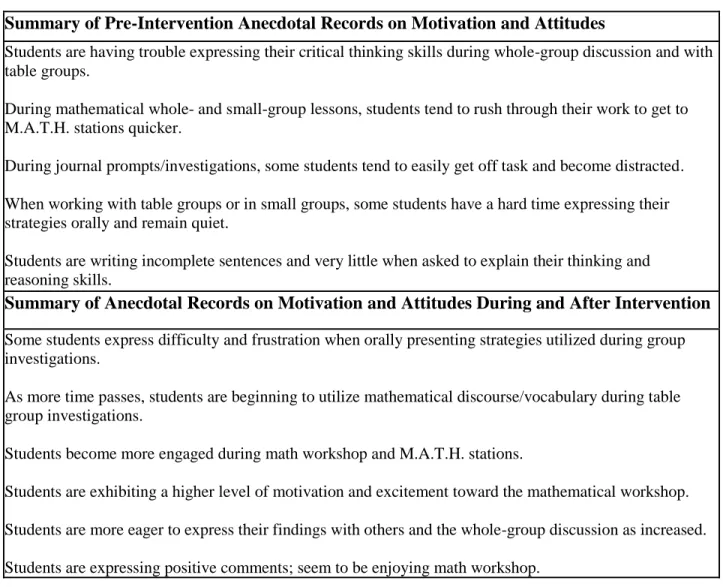
Anecdotal records taken during the math workshop analyzed students’ motivation and attitude levels and demonstrated the variations as a possible result of the implementation of math
math class in general, and anecdotal records elicit that there was a positive effect. The records are compiled in Figure 1.
Summary of Pre-Intervention Anecdotal Records on Motivation and Attitudes
Students are having trouble expressing their critical thinking skills during whole-group discussion and with table groups.
During mathematical whole- and small-group lessons, students tend to rush through their work to get to M.A.T.H. stations quicker.
During journal prompts/investigations, some students tend to easily get off task and become distracted. When working with table groups or in small groups, some students have a hard time expressing their strategies orally and remain quiet.
Students are writing incomplete sentences and very little when asked to explain their thinking and reasoning skills.
Summary of Anecdotal Records on Motivation and Attitudes During and After Intervention
Some students express difficulty and frustration when orally presenting strategies utilized during group investigations.
As more time passes, students are beginning to utilize mathematical discourse/vocabulary during table group investigations.
Students become more engaged during math workshop and M.A.T.H. stations.
Students are exhibiting a higher level of motivation and excitement toward the mathematical workshop. Students are more eager to express their findings with others and the whole-group discussion as increased. Students are expressing positive comments; seem to be enjoying math workshop.
Figure 1. Pre-intervention and post-intervention anecdotal records summary on motivation and attitudes toward math workshop. Anecdotal records/notes were taken throughout the course of this study. The notes included above are a compilation of the total notes collected.
Analysis of Student Learning
Motivation toward math journaling was evaluated and analyzed by students’ responses to a questionnaire given before and after the implementation of math journaling. Table 5 below displays students’ responses to the questionnaire (see Appendix B) pre- and post-intervention. Divisions were determined based on significant aspects of math journaling. Class Pi and Class
Tri were interviewed separately but were combined to better evaluate student motivation across the grade level and classes. This table includes Questions 1 through 6, which required students to choose which response related most to them.
Table 5
Class Pi and Class TriQuestionnaire Questions 1–6 and Breakdown of Responses in Regard to Conceptual Understanding and Motivation Toward Math Journaling
N N
Pre-Intervention Post-Intervention
1. I enjoy journal writing.
Strongly Agree 5 13
Agree 19 16
Disagree 6 4
Strongly Disagree 8 5
2. It is easy for me to express my thoughts and
feelings when writing.
Strongly Agree 9 11
Agree 18 19
Disagree 7 6
Strongly Disagree 5 2
3. Journal entries in which I express my
explanations and solutions to mathematical problems increase my knowledge and
understanding. Strong Agree 13 18 Agree 22 13 Disagree 3 4 Strongly Disagree 0 3 4. I feel comfortable expressing and
documenting my thoughts to my teacher
through journal writing.
Strongly Agree 10 14
Agree 15 15
Disagree 11 7
Strongly Disagree 2 2
5. Journal writing in math class helps me learn
and solve mathematical problems.
Strongly Agree 21 23
Agree 10 13
Disagree 6 1
Strongly Disagree 1 1
6. Writing in a journal helps me organize my
thoughts and explanation more clearly.
Strongly Agree 19 18
Agree 12 15
Disagree 6 4
Strongly Disagree 1 1
The primary goal of this questionnaire was to gain understanding of levels of motivation toward math journaling. The questionnaire expressed a positive increase in attitude toward writing. Question 1 expressed an increase of 21% in the number of students who strongly agreed with the statement, while there was an 8% decrease in the number of students who strongly disagreed. Question 2 presented an increase of 5% among students answering “strongly agree” and a decrease of 8% among students answering “strongly disagree.” Question 3 showed that the number of students who strongly agreed that they had acquired knowledge and understanding when expressing explanations and solutions increased by 13% and the number of students who strongly disagreed increased by 8%. Question 4 expressed a 10% increase in the number of students who strongly agreed that they felt comfortable expressing and documenting thoughts to the teacher through journal writing. Questions 5 and 6 expressed a positive effect in that
Question 5 demonstrated a 13% decrease in students who disagreed with the statement and an 8% increase in the number of students who agreed.
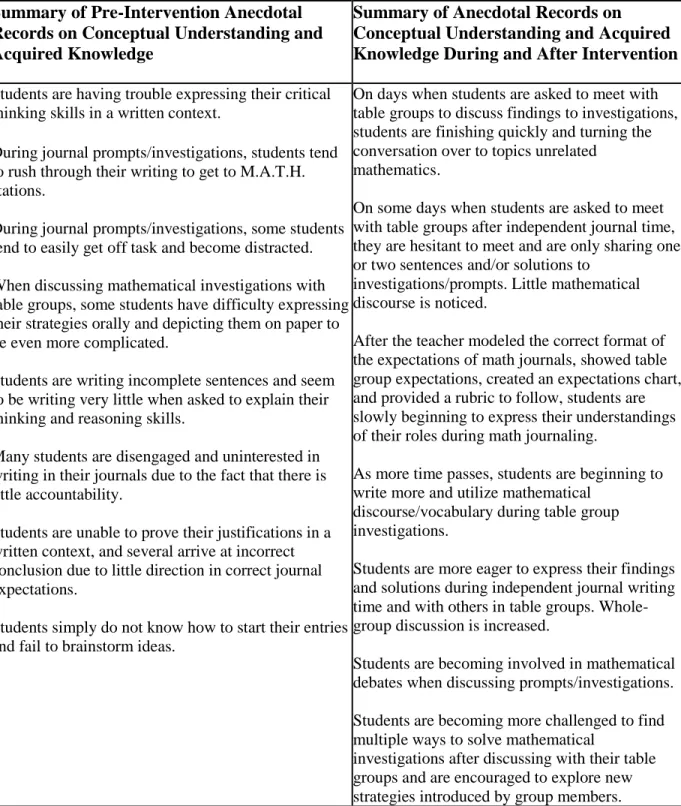
Anecdotal records taken during the math workshop analyzed students’ range of
Anecdotal records indicate that there was a positive effect of implementing writing in math. The records are compiled in Figure 2. Many comparisons can be viewed between student motivation and attitudes and between student conceptual understanding and knowledge acquired (see Figures 1 and 2). Therefore, the level of knowledge acquired and an increase in student conceptual understanding are byproducts of student motivation and attitudes toward the mathematical writing workshop.
Summary of Pre-Intervention Anecdotal Records on Conceptual Understanding and Acquired Knowledge
Summary of Anecdotal Records on Conceptual Understanding and Acquired Knowledge During and After Intervention
Students are having trouble expressing their critical thinking skills in a written context.
During journal prompts/investigations, students tend to rush through their writing to get to M.A.T.H. stations.
During journal prompts/investigations, some students tend to easily get off task and become distracted. When discussing mathematical investigations with table groups, some students have difficulty expressing their strategies orally and depicting them on paper to be even more complicated.
Students are writing incomplete sentences and seem to be writing very little when asked to explain their thinking and reasoning skills.
Many students are disengaged and uninterested in writing in their journals due to the fact that there is little accountability.
Students are unable to prove their justifications in a written context, and several arrive at incorrect conclusion due to little direction in correct journal expectations.
Students simply do not know how to start their entries and fail to brainstorm ideas.
On days when students are asked to meet with table groups to discuss findings to investigations, students are finishing quickly and turning the conversation over to topics unrelated
mathematics.
On some days when students are asked to meet with table groups after independent journal time, they are hesitant to meet and are only sharing one or two sentences and/or solutions to
investigations/prompts. Little mathematical discourse is noticed.
After the teacher modeled the correct format of the expectations of math journals, showed table group expectations, created an expectations chart, and provided a rubric to follow, students are slowly beginning to express their understandings of their roles during math journaling.
As more time passes, students are beginning to write more and utilize mathematical
discourse/vocabulary during table group investigations.
Students are more eager to express their findings and solutions during independent journal writing time and with others in table groups. Whole-group discussion is increased.
Students are becoming involved in mathematical debates when discussing prompts/investigations. Students are becoming more challenged to find multiple ways to solve mathematical
investigations after discussing with their table groups and are encouraged to explore new strategies introduced by group members.
Figure 2. Summary of pre-intervention and post-intervention anecdotal records on conceptual understanding, knowledge acquired, and motivation of math journaling. Anecdotal records/notes were taken throughout the course of this study. The notes included above are a summary of the total notes collected.
Conceptual understanding was evaluated and analyzed by observing students during the mathematical workshop and reviewing student journals. Students’ journals were evaluated and compared on the basis of both independent journal prompts and mathematical investigations with table groups. Figure 3 provides a summary of anecdotal records that examine and analyze
students’ journal entries and mathematical investigations pre- and post-interventions based on a rubric determined by the teacher.
Productivity of Strategies Used to Solve Problems During Mathematical Investigations
Pre-Intervention A variety of strategies were expressed and recognized; however, students were using the most recognized algorithms/strategies and using them repeatedly. There was little “thinking outside the box.” After several mathematical explorations as a whole group, students continued to use the same strategies that were most
comfortable and “easy” to them.
Post-Intervention Many students became experimental in that they were thinking outside the box. They used more strategies and even began to think of their own strategies to solve mathematical investigations. During whole- and small-group lessons, students became more comfortable expressing these strategies and admitted to trying others’ strategies.
Adequately and Appropriately Explains the Solution and Provides Support
Pre-Intervention Students used very little mathematical discourse to orally express and explain their solutions and/or strategies to solve mathematical investigations. Students were frequently able to explain their solutions, only to realize they needed assistance and begin to ask questions. After discussion and guidance, students were able to successfully comprehend the problem as it was explained.
Post-Intervention Students and table groups became very eager and excited to express their solutions and justification to others during whole- and small-group lessons. Students were fully able to orally express their solutions with appropriate mathematical discourse and little guidance. Journal writing stamina increased, students showed little frustration toward writing, and they became more engaged in their own writing.
Quality of Journal Entries and Comprehensibility Shown
Pre-Intervention Little work or writing was expressed before the implementation of math
journaling in the math workshop. Students expressed frustration with writing and with showing their level of work and strategies. The organization of their writing and their handwriting was difficult to understand without probing questions and further explanations from the students.
Post-Intervention Qualities of journal entries and mathematical investigations improved in organization and utilization of strategies, and students used more pictures and mathematical discourse as a means for justifying their solutions. Students were able to comprehensively analyze journal prompts and express their knowledge and skills.
Analyzing the Solutions and Justifications to a Mathematical Investigation
Pre-Intervention During whole- and small-group lessons, students exhibited a difficult time expressing their justification, and many errors were noticed. These errors were due to misinterpretation of the problem or question asked, confusion about the journal prompt, miscommunication, miscalculations, and failure to read the problem and/or journal prompt.
Post-Intervention After students met with table groups to discuss their findings and solutions, students became more efficient when evaluating their own work as well as the work of others. Mathematical errors decreased.
Figure 3. Analysis of journal entries and mathematical investigations using math journals. Student journals as a whole were evaluated and studied, and conclusions were created based on group progress as a result of the implementation.
An increase in conceptual understanding and motivation levels occurred between the pre- and post-intervention surveys. This assumption is easily recognized in the anecdotal records collected and the analysis and evaluation of students’ math journals. This increase in knowledge and motivation levels is directly related to the result of students working in math journals, evaluating and expressing their justifications and solutions to mathematical investigations and journal prompts.
Discussion
The purpose of this action research was to examine and evaluate the effect writing has on students’ mathematical conceptual skills as well as their level of motivation toward writing in
mathematics. During the study, we looked specifically at the effects on students’ written justifications and reflections on a variety of math problems and investigations throughout an 8-week time frame. We focused our initial attention on discourse that occurred during interactions with peers to see if it led students to a deeper level of thinking and understanding. Anecdotal records and observations were recorded throughout the study during math journaling and math workshop. Mathematical investigations and justifications were collected, reviewed, analyzed, and compared before, during, and after the study. Results were examined and critiqued through the comparison questionnaires, interview responses, and anecdotal records.
Summary of Findings
Math journaling during the mathematical workshop appeared to have a positive effect on student motivation as well as to increase conceptual understanding similarly to what has been suggested in the literature (Benjamin, 2005; Countryman, 1992; Leonard, 2008). Although math journaling and motivation levels seemed to provide a slight difference in student responses to the interview questions and the questionnaire questions, anecdotal records and comparisons of math journals suggest that the use of math journaling during the mathematical block has helped students to think more deeply about problems and investigations. Though students were not very receptive to writing and explaining solutions to mathematical investigations on a daily basis, they were willing to admit through the interview and questionnaire that math journaling helped them better understand mathematical concepts and organize their thoughts more clearly. The quality of student responses to journal prompts and mathematical investigations increased in regard to the efficiency of strategies utilized, accuracy of explanations and/or justifications, and evaluation of students’ solutions.
Implications for Student Learning
The results concluded that implementing math journaling in the mathematical workshop can increase students’ level of motivation and their conceptual understanding by allowing them to think about mathematical investigations and/or problems, engaging them in collaborative thinking and purposeful discourse with small groups, and providing them with an appropriate learning environment where they are accountable for their learning. When students are given the opportunity to express their knowledge and understanding in their math journals, they are more likely to submerge themselves within the problem, instead of merely “skimming the surface” (Benjamin, 2005; Countryman, 1992; Leonard, 2008). The students were able to better analyze and evaluate mathematical problems, as well as to formulate their own solutions to these
problems. Following this intervention, students no longer asked specific questions about certain math problems or investigations; instead, they conferred with their small groups on how to solve a particular problem. Journal writing has also provided students with an outlet to express
mathematically more on their own to construct a mathematical identity (Leonard, 2008). Also, journaling in the mathematics classroom assisted these particular students in explaining and justifying their ideas independently with limited guidance, organizing their thoughts more clearly, and transferring their justifications into a written context.
Math journals enable students to gain a better understanding of both academic discourse related to mathematics and the concepts centered on the mathematics curriculum (Benjamin, 2005; Countryman, 1992; Leonard, 2008). In addition, math journals help students comprehend the idea that math is all around them, not just a subject that must be acquired within a school setting (Leonard, 2008).
Implications for Teacher Practice
The implementation of math journaling can be introduced in any mathematical workshop. One educator may decide to implement math journaling in the same way as this study, while others may attempt a new strategy. When making the decision to implement math journals into the math workshop, we recommend that teachers first conduct interviews to determine students’ motivation levels, feelings toward the writing process, and attitudes toward the mathematical workshop in general. This will provide teachers with necessary information to help with the implementation of math journaling, as well as let students feel that their interests and attitudes are worthwhile. The educator should also be prepared for teaching the writing process, students not being able to fully express their justifications in words, and lack of motivation from some students. We believe that these topics will occur more often in situations involving the
implementation of math journaling. Educators must also provide time to accurately analyze student responses and provide efficient feedback throughout the study. Teachers must recognize that there always exists the possibility of cultural miscommunication and understanding, and they should work diligently to negotiate the process of cross-cultural and cross-generational understanding.
Limitations and Future Research
While we were able to collect a substantial amount of data from this research study, there were many limitations. The scope of this action research study was within one campus and concentrated on two classroom environments in Central Texas. We relied heavily on anecdotal records and simple student interviews. Our data-collection process was limited to only 8 weeks. A more comprehensive study may identify other evidence to support our assumptions. However, we do acknowledge the relevance and embrace the importance of action research.
Based on our research and the findings conducted within this study, we plan to continue implementing journaling in mathematics classrooms. We intend to implement various
approaches to writing and expressing mathematically as we move forward. In doing so, we hope to respond to the following questions: What is the impact of artistic expression on students’ conceptual understanding and motivation in the mathematics classroom? What are innovative approaches to writing to enhance the mathematical socialization and identity development of our students? What are the implications of embracing a community cultural wealth approach to the mathematics classroom? We believe that each of these questions provide pathways of possibility in mathematics research and teaching.
References
Albert, L. R. (2000). Outside-in inside-out: Seventh grade students’ mathematical thought processes. Educational Studies in Mathematics, 41(2), 109-141.
Baxter, J., Woodward, J., Olson, D., & Robyns, J. (2002). Blueprint for writing in middle school mathematics. Mathematics Teaching in the Middle School, 8(1), 52-56.
Baxter, J. A., Woodward, J., & Olson, D. (2005). Writing in mathematics: An alternative form of communication for academically low-achieving students. Learning Disabilities Research and Practice, 20(2), 119-135.
Benjamin, A. (2005). Writing in the content areas (2nd ed.). Larchmont, NY: Eye on Education Blesssman, J., & Myszczak, B. (2001). Mathematics vocabulary and its effect on student
comprehension. ERIC Document Reproduction Service No. ED 455 112, Arlington, VA.
Burns, M. (1998). Math in action. Link classroom projects to math practice. Instructor, 107(8), 69.
Burns, M., & Silbey, R. (2001). Math journals boost real learning, 110(7), 18-20.
Carter, S. (2009). Connecting mathematics and writing workshop: It's kinda like ice skating.
Reading Teacher, 62(7), 606-610.
Clarke, D, J., Waywood, A., & Stephens, M. (1993). Probing the structure of mathematical writing. Educational Studies in Mathematics, 25(3), 325-350.
Connolly, P. (1989). Writing and the ecology of learning. Writing to learn mathematics and science. 1-14.
Cooper, A. (2012). Today's technologies enhance writing in mathematics. Clearing House: A Journal of Educational Strategies, Issues and Ideas, 85(2), 80-85.
Countryman, J. (1992). Writing to learn mathematics: Strategies that work. Portsmouth, NH: Heinemann.
Flores, A. (2006). How do students know what they learn in middle school mathematics is true? School Science and Mathematics, 106(3), 124-132.
Fox, B & Larke, P.J. (2009). Culturally responsive teaching in middle school mathematics: One response to addressing passing rates on Texas assessment of knowledge and skills (TAKS) test. National Forum of Multicultural Issues Journal. 6(2), 38-49.
Garside, C. (1994). Building bridges to critical thinking: utilizing student journals in the college
classroom. Paper Presented at the Annual Meeting of the Speech Communication
Association. New Orleans, LA.
Kenny, E. A. (1990). A reply to questions from mathematics colleagues on writing across the curriculum. Using Writing to Teach Mathematics, 17-21.
Kotsopoulos, D. (2007). It’s like hearing a foreign language. Mathematics teacher, 101(4), 301- 305.
Leonard, J. (2008). Culturally specific pedagogy in the mathematics classroom: Strategies for teachers and students. New York, NY: Routledge.
Martin, D. B. (2000). Mathematics success and failure among African American youth: The roles of sociohistorical context, community forces, school influence, and individual agency. Mahweh, NJ: Lawrence Erlbaum.
Mills, G, E. (2011). Action research: A guide for the teacher researcher (5th ed.). Boston, MA: Pearson Education, Inc.
National Council of Teachers of Mathematics. (1991). Professional standards for teaching
National Council of Teachers of Mathematics. (2000). Principles and standards for school
mathematics. Reston, VA: National Council of Teachers of Mathematics.
Quinn, R. J., & Wilson, M. M. (1997). Writing in the mathematics classroom: Teacher beliefs and practices. Clearing House, 71(1), 14-20.
Schoenfeld, A. H. (1992). Learning to think mathematically: Problem solving, metacognition, and sense making in mathematics. In. D. Grouws (Ed.). Handbook for Research on
Mathematics Teaching and Learning (pp. 334-370). New York, NY: Macmillan.
Vygotsky, L. (1986; 1934). Thought and language. Cambridge, MA: The MIT Press.
Wilson, J., & Clarke, D. (2004). Towards the modelling of mathematical metacognition.
Mathematics Education Research Journal, 16(2), 25-48.
Wood, D. F. (2003). Problem based learning. BMJ : British Medical Journal, 326(7384), 328– 330.
Wood, T. (2001). Teaching differently: Creating opportunities for learning mathematics. Theory into Practice, 40(2), 110-117.
Zelmelman, S., Daniels, H., & Hyde, A. (2005). Best practice: Today’s standards for teaching
Appendix A Student Interview: Math Workshop
1. Do you enjoy learning math?
2. What is your favorite thing to learn in math? 3. What is your least favorite part about math class? 4. Do you enjoy hands-on activities during math class?
5. Do you enjoy working in small groups while solving mathematical investigations?
6. Would you rather work by yourself during mathematical investigations? 7. If you could change one thing about math class, what would it be? 8. What are your goals for math in fifth grade?
Appendix B Student Questionnaire: Math Journaling
1. I enjoy journal writing.
Strongly Disagree Disagree Agree Strongly Agree
2. It is easy for me to express my thoughts and feelings when writing.
Strongly Agree Agree Disagree Strongly Disagree
3. Journal entries in which I express my explanations and solutions to mathematical problems increase my knowledge and understanding.
Strongly Agree Agree Disagree Strongly Disagree
4. I feel comfortable expressing and documenting my thoughts to my teacher through
journal writing.
Strongly Agree Agree Disagree Strongly Disagree
5. Journal writing in math class helps me learn and solve mathematical problems.
Strongly Agree Agree Disagree Strongly Disagree
6. Writing in a journal helps me organize my thoughts and explanations more clearly.