Florida International University
FIU Digital Commons
FIU Electronic Theses and Dissertations
University Graduate School
3-10-2014
The Relationship between Selected Standardized
Test Scores and Performance in Advanced
Placement Math and Science Exams: Analyzing the
Differential Effectiveness of Scores for Course
Identification and Placement
Josue N. Urbina
Florida International University, [email protected]
Follow this and additional works at:
http://digitalcommons.fiu.edu/etd
Part of the
Curriculum and Instruction Commons
,
Educational Assessment, Evaluation, and
Research Commons
,
Gifted Education Commons
,
Science and Mathematics Education Commons
,
and the
Science and Technology Studies Commons
This work is brought to you for free and open access by the University Graduate School at FIU Digital Commons. It has been accepted for inclusion in FIU Electronic Theses and Dissertations by an authorized administrator of FIU Digital Commons. For more information, please [email protected].
Recommended Citation
Urbina, Josue N., "The Relationship between Selected Standardized Test Scores and Performance in Advanced Placement Math and Science Exams: Analyzing the Differential Effectiveness of Scores for Course Identification and Placement" (2014).FIU Electronic Theses and Dissertations.Paper 1208.
FLORIDA INTERNATIONAL UNIVERSITY Miami, Florida
THE RELATIONSHIP BETWEEN SELECTED STANDARDIZED TEST SCORES AND PERFORMANCE IN ADVANCED PLACEMENT MATH AND SCIENCE EXAMS: ANALYZING THE DIFFERENTIAL EFFECTIVENESS OF SCORES FOR COURSE
IDENTIFICATION AND PLACEMENT
A dissertation submitted in partial fulfillment of the Requirements for the degree of
DOCTOR OF EDUCATION in
CURRICULUM AND INSTRUCTION by
Josué N. Urbina
ii
To: Dean Delia C. Garcia College of Education
This dissertation, written by Josué N. Urbina, and entitled The Relationship between Selected Standardized Test Scores and Performance in Advanced Placement Math and Science Exams: Analyzing the Differential Effectiveness of Scores for Course Identification and Placement, having been approved in respect to style and intellectual content, is referred to you for judgment. We have read this dissertation and recommend that it be approved.
_______________________________________ Sneh Gulati _______________________________________ Hilary Landorf _______________________________________ Eric Brewe _______________________________________
George E. O’Brien, Major Professor Date of Defense: March 10, 2014
The dissertation of Josué N. Urbina is approved.
_______________________________________ Dean Delia C. Garcia College of Education ______________________________________ Dean Lakshmi N. Reddi University Graduate School
iii
© Copyright 2014 by Josué N. Urbina All rights reserved.
iv
DEDICATION
This dissertation study is dedicated to my Heavenly Father and my family. Thank you for being my source of inspiration, direction and strength.
v
ACKNOWLEDGMENTS
The journey towards completing this dissertation has been longer than anticipated; yet I have cherished every minute of it, because of the relationships it has helped me to establish. Words are not enough to express my deepest gratitude to all those individuals who have helped to make this dissertation possible.
To my dissertation chair, Dr. George E. O’Brien, thank you for your countless hours of mentorship, support and guidance. I am forever grateful. At a time where I was looking for leadership and advice, after losing my original dissertation chair, you did not hesitate to fill in and guide me. Your mentorship has continued over the years. At times it appeared harsh, at times encouraging- yet always beneficial, detailed and honest.
To the rest of the committee members: Dr. Sneh Gulati; Dr. Hilary Landorf; and Dr. Eric Brewe, thank you for sharing your expertise with your dependable feedback and valuable
corrections during this process. I also thank you for your availability, flexibility and patience. A special thanks to Dr. Gulati - who is the longest standing committee member in my dissertation. Thank you for your dependability and assistance. I still remember sitting in your Statistics class, before I had even conceptualized the idea for this manuscript. The clarity of your teaching and passion for the subject matter, planted a seed from which this writing germinated.
To the special consultants who have guided me along the way: Dr. Paulette Johnson, thank you for serving as a statistical consultant on a moment’s notice and validating from the onset the possibility of this research. Dr. Isadore Newman, I am assured that this work would never have been possible, had it not been for your availability during various dissertation boot camp sessions and even on weekends! Thank you for sharing your brilliant knowledge and proficiency in research design and statistical methodology. Dr. Linda Bliss, I still remember sitting in your Qualitative Research class before this study was underway. Never did I imagine that our paths would cross again in this quantitatively-driven study. Thank you for your prompt and
precision-vi
driven feedback. You have shown me the same level of professionalism as a reviewer as you did in the classroom.
To individuals that were part of my professional support system in Seminole County, thank you for your availability to listen: Dr. Connie Collins; Dr. Mickey Reynolds; and Mrs. Demetria Hayes-Faison, three phenomenal high school principals. Thank you for your leadership and encouragement. A special thanks to Mrs. Hayes-Faison: I still remember how willingly you were to review my work and provide advice- all during an educator’s workshop! Dr. Kim Dahl and Dr. Cindy Dawson, thank you for sharing your reassuring words- they really helped to fuel me forward. Brad Barsalou, an incredible AP teacher, I value your reviews, advice and friendship.
To my family, thank you for all of your sacrifice and your steadfast love. My beautiful wife Ivette, thank you for comforting me on my sleepless nights and for showing me your sacrificial love regularly - You are my treasure. To my three children, Jasmin, Isaac and Joel, perhaps you are too young now to know the great source of inspiration you have served, thank you for your hugs, kisses and massages while I was writing. To my mother, Edith, your hard work ethic and loving ways are a true inspiration to my life. To my brother, Nestor, thank you for your
reassurance and driving me across the State, on several occasions, to see this work complete. To my sister, Carmen, thank you for your attention to detail and willingness to patiently listen and assist me as needed. I have enjoyed your company in this labor. To my brother-in-law, Johnny, and my brothers-in-life, Mike and Miguel, thank you for faith in me to see this finished work. To my mother-in-law, Hildelisa, thank you for your love and sacrifices that ensured that I had more time to write. A special thanks to my cousin, Cindy, you will never know how much your knowledge and willingness to assist me has meant to me. To Carlos, my stand-in father, thank you for not allowing me to quit when things seemed most bleak and hopeless. To all of those individuals that appear to have been left out, yet have played an important role in the completion of this dissertation, I have not forgotten you- Thank you.
vii
ABSTRACT OF THE DISSERTATION
THE RELATIONSHIP BETWEEN SELECTED STANDARDIZED TEST SCORES AND PERFORMANCE IN ADVANCED PLACEMENT MATH AND SCIENCE EXAMS: ANALYZING THE DIFFERENTIAL EFFECTIVENESS OF SCORES FOR COURSE
IDENTIFICATION AND PLACEMENT by
Josué N. Urbina
Florida International University, 2014 Miami, Florida
Professor George E. O’Brien, Major Professor
There is a national need to increase the STEM-related workforce. Among factors leading towards STEM careers include the number of advanced high school mathematics and science courses students complete. Florida’s enrollment patterns in STEM-related Advanced Placement (AP) courses, however, reveal that only a small percentage of students enroll into these classes. Therefore, screening tools are needed to find more students for these courses, who are
academically ready, yet have not been identified.
The purpose of this study was to investigate the extent to which scores from a national standardized test, Preliminary Scholastic Assessment Test/ National Merit Qualifying Test (PSAT/NMSQT), in conjunction with and compared to a state-mandated standardized test, Florida Comprehensive Assessment Test (FCAT), are related to selected AP exam performance in Seminole County Public Schools. An ex post facto correlational study was conducted using 6,189 student records from the 2010 - 2012 academic years.
viii
Multiple regression analyses using simultaneous Full Model testing showed differential moderate to strong relationships between scores in eight of the nine AP courses (i.e., Biology, Environmental Science, Chemistry, Physics B, Physics C Electrical, Physics C Mechanical, Statistics, Calculus AB and BC) examined. For example, the significant unique contribution to overall variance in AP scores was a linear combination of PSAT Math (M), Critical Reading (CR) and FCAT Reading (R) for Biology and Environmental Science. Moderate relationships for Chemistry included a linear combination of PSAT M, W (Writing) and FCAT M; a combination of FCAT M and PSAT M was most significantly associated with Calculus AB performance.
These findings have implications for both research and practice. FCAT scores, in conjunction with PSAT scores, can potentially be used for specific STEM-related AP courses, as part of a systematic approach towards AP course identification and placement. For courses with moderate to strong relationships, validation studies and development of expectancy tables, which estimate the probability of successful performance on these AP exams, are recommended. Also, findings established a need to examine other related research issues including, but not limited to, extensive longitudinal studies and analyses of other available or prospective standardized test scores.
ix
TABLE OF CONTENTS
CHAPTER PAGE
I. INTRODUCTION ... 1
General Statement of the Problem ... 4
Rationale for the Study ... 5
The PSAT/NMSQT as a selected standardized test for AP course Identification and Placement ... 7
The FCAT as a supplemental standardized test for AP course Identification and Placement ... 10
Purpose of the Study ... 11
Statement of the Problem ... 11
Research Questions ... 12
Definitions ... 13
II. REVIEW OF THE LITERATURE ... 15
Historical Perspective ... 15
History of the Advanced Placement Program15 Implications of Historical Changes in AP Course Placement Procedures ... 18
History of the Florida Comprehensive Assessment Test (FCAT) ... 20
AP Course Selection Procedures ... 22
AP Course Selection Decisions in Public Schools ... 22
AP Math and Science Course Selection Procedures ... 22
Demographic Representation in AP Courses ... 24
Using PSAT/NMSQT to Identify Potential AP Students ... 26
Relationship Studies between State-Mandated Exams and College Readiness Tests ... 30
Summary of Literature Review ... 31
III. METHODOLOGY ... 33
Research Hypotheses ... 34
Sample ... 35
Demographics of the Sample ... 35
Collection of Data ... 37
Treatment of Data ... 38
Statistical Analysis ... 39
Significance Testing and Power Analysis ... 41
Delimitations of the Study ... 42
IV. ANALYSES AND RESULTS ... 43
Evaluation of Assumptions for Multiple Regression Analyses ... 43
Evaluation of Sample Size ... 43
Evaluation of Outliers ... 44
Evaluation of Multicollinearity ... 44
Evaluation of Normality ... 46
Evaluation of Linearity ... 46
x
Model Testing for Each STEM-Related AP Course ... 48
Hypothesis Testing for AP Biology ... 48
Hypothesis Testing for AP Environmental Science ... 51
Hypothesis Testing for AP Chemistry ... 54
Hypothesis Testing for AP Physics B ... 58
Hypothesis Testing for AP Physics C- Mechanical ... 61
Hypothesis Testing for AP Physics C- Electrical ... 65
Hypothesis Testing for AP Statistics ... 68
Hypothesis Testing for AP Calculus AB ... 71
Hypothesis Testing for AP Calculus BC ... 75
Overall Summary of Results ... 78
V. DISCUSSION AND RECOMMENDATIONS ... 80
Discussion of the Findings ... 81
Findings for AP Biology ... 82
Findings for AP Environmental Science ... 83
Findings for AP Chemistry ... 83
Findings for AP Physics B ... 84
Findings for AP Physics C- Mechanical ... 85
Findings for AP Physics C- Electrical ... 85
Findings for AP Statistics ... 86
Findings for AP Calculus AB ... 86
Findings for AP Calculus BC ... 87
Overall Findings... 87
Findings for Research Question 1 ... 87
Findings for Research Question 2 ... 89
Findings for Research Question 3 ... 90
Recommendations for Future Research and Practice ... 91
Research Recommendations ... 91
Practice Recommendations ... 95
Limitations of the Findings ... 96
Conclusion ... 97
REFERENCES ... 99
APPENDICES ... 106
xi
LIST OF TABLES
TABLE PAGE 1. Student Attrition en route to Success with AP Courses & Exams ... 3 2. Exam Participation and Performance in Florida
Public Schools 2009 – 2010 by AP Subject ... 4 3. Exam Participation and Performance in Florida
Public Schools 2010 – 2011 by AP Subject ... 5 4. PSAT/NMSQT 10th grade participation in Florida
Public Schools 2000 - 2009 ... 9 5. Participation and Performance Florida districts with
high number of AP test takers in 2010 ... 37 6. Summary table highlighting significant relationships
with AP exam scores (Biology) ... 51 7 Summary table highlighting significant relationships
with AP exam scores (Environmental Science). ... 54 8. Summary table highlighting significant relationships
with AP exam scores (Chemistry) ... 57 9. Summary table highlighting significant relationships
with AP exam scores (Physics B) ... 61 10. Summary table highlighting significant relationships
with AP exam scores (Physics C: Mechanical) ... 64 11. Summary table highlighting significant relationships
with AP exam scores (Physics C: Electrical) ... 67 12. Summary table highlighting significant relationships
with AP exam scores (Statistics) ... 71 13. Summary table highlighting significant relationships
with AP exam scores (Calculus AB) ... 74 14. Summary table highlighting significant relationships
xii
15. Relationship of AP Scores to PSAT/NMSQT and
FCAT scores for Biology 2010 - 2011 ... 107 16. Relationship of AP Scores to PSAT/NMSQT and
FCAT scores for Biology 2011 - 2012 ... 108 17. Relationship of AP Scores to PSAT/NMSQT scores
for Biology 2010-2011 ... 109 18. Relationship of AP Scores to PSAT/NMSQT scores
for Biology 2011-2012 ... 109 19. Relationship of AP Scores to FCAT scores
for Biology 2010-2011 ... 110 20. Relationship of AP Scores to FCAT scores
for Biology 2011-2012 ... 110 21. Relationship of AP Scores to PSAT/NMSQT and
FCAT scores for Environmental Science 2010-2011 ... 111 22. Relationship of AP Scores to PSAT/NMSQT and
FCAT scores for Environmental Science 2011-2012 ... 112 23. Relationship of AP Scores to PSAT/NMSQT scores
for Environmental Science 2010-2011 ... 113 24. Relationship of AP Scores to PSAT/NMSQT scores
for Environmental Science 2011-2012 ... 113 25. Relationship of AP Scores to FCAT scores
for Environmental Science 2010-2011 ... 114 26. Relationship of AP Scores to FCAT scores
for Environmental Science 2011-2012 ... 114 27. Relationship of AP Scores to PSAT/NMSQT and
FCAT scores for Chemistry 2010-2011 ... 115 28. Relationship of AP Scores to PSAT/NMSQT and
FCAT scores for Chemistry 2011-2012 ... 116 29. Relationship of AP Scores to PSAT/NMSQT scores
for Chemistry 2010-2011 ... 117 30. Relationship of AP Scores to PSAT/NMSQT scores
xiii
31. Relationship of AP Scores to FCAT scores
for Chemistry 2010-2011 ... 118 32. Relationship of AP Scores to FCAT scores
for Chemistry 2011-2012 ... 118 33. Relationship of AP Scores to PSAT/NMSQT and
FCAT scores for Physics B 2010-2011 ... 119 34. Relationship of AP Scores to PSAT/NMSQT and
FCAT scores for Physics B 2011-2012 ... 120 35. Relationship of AP Scores to PSAT/NMSQT scores
for Physics B 2010-2011 ... 121 36. Relationship of AP Scores to PSAT/NMSQT scores
for Physics B 2011-2012 ... 121 37. Relationship of AP Scores to FCAT scores
for Physics B 2010-2011 ... 122 38. Relationship of AP Scores to FCAT scores
for Physics B 2011-2012 ... 122 39. Relationship of AP Scores to PSAT/NMSQT and
FCAT scores for Physics C Mechanical 2010-2011 ... 123 40. Relationship of AP Scores to PSAT/NMSQT and
FCAT scores for Physics C Mechanical 2011-2012 ... 124 41. Relationship of AP Scores to PSAT/NMSQT scores
for Physics C Mechanical 2010-2011 ... 125 42. Relationship of AP Scores to PSAT/NMSQT scores
for Physics C Mechanical 2011-2012 ... 125 43. Relationship of AP Scores to FCAT scores
for Physics C Mechanical 2010-2011 ... 126 44. Relationship of AP Scores to FCAT scores
for Physics C Mechanical 2011-2012 ... 126 45. Relationship of AP Scores to PSAT/NMSQT and
FCAT scores for Physics C Electrical 2010-2011 ... 127 46. Relationship of AP Scores to PSAT/NMSQT and
xiv
47. Relationship of AP Scores to PSAT/NMSQT scores
for Physics C Electrical 2010-2011 ... 129 48. Relationship of AP Scores to PSAT/NMSQT scores
for Physics C Electrical 2011-2012 ... 129 49. Relationship of AP Scores to FCAT scores
for Physics C Electrical 2010-2011 ... 130 50. Relationship of AP Scores to FCAT scores
for Physics C Electrical 2011-2012 ... 130 51. Relationship of AP Scores to PSAT/NMSQT and
FCAT scores for Statistics 2010-2011 ... 131 52. Relationship of AP Scores to PSAT/NMSQT and
FCAT scores for Statistics 2011-2012 ... 132 53. Relationship of AP Scores to PSAT/NMSQT scores
for Statistics 2010-2011 ... 133 54. Relationship of AP Scores to PSAT/NMSQT scores
for Statistics 2011-2012 ... 133 55. Relationship of AP Scores to FCAT scores
for Statistics 2010 - 2011 ... 134 56. Relationship of AP Scores to FCAT scores
for Statistics 2011-2012 ... 134 57. Advanced Placement Scores Relationship to PSAT/NMSQT and
FCAT scores for Calculus AB 2010-2011 ... 135 58. Advanced Placement Scores Relationship to PSAT/NMSQT and
FCAT scores for Calculus AB 2011-2012 ... 136 59. Relationship of AP Scores to PSAT/NMSQT scores
for Calculus AB 2010-2011 ... 137 60. Relationship of AP Scores to PSAT/NMSQT scores
for Calculus AB 2011-2012 ... 137 61. Relationship of AP Scores to FCAT scores
for Calculus AB 2010-2011 ... 138 62. Relationship of AP Scores to FCAT scores
xv
63. Advanced Placement Scores Relationship to PSAT/NMSQT and
FCAT scores for Calculus BC 2010-2011 ... 139 64. Advanced Placement Scores Relationship to PSAT/NMSQT and
FCAT scores for Calculus BC 2011-2012 ... 140 65. Relationship of AP Scores to PSAT/NMSQT scores
for Calculus BC 2010-2011 ... 141 66. Relationship of AP Scores to PSAT/NMSQT scores
for Calculus BC 2011-2012 ... 141 67. Relationship of AP Scores to FCAT scores
for Calculus BC 2010-2011 ... 142 68. Relationship of AP Scores to FCAT scores
1
CHAPTER I INTRODUCTIONThe scientific future of the United States is in part entrusted to its educational system. It is this system that can serve as a resource to produce the nation’s science, technology,
engineering and mathematics (STEM) workforce. The vitality of the workforce is largely derived from the steady stream of scientists and the innovations that they produce (The National
Academies, 2005). This workforce is important as the country is challenged with an increasingly interconnected and complex world, economic uncertainties and rapid development of
technological advances (Babco, 2002; The National Academies, 2014).
One of the major factors, in determining entry into STEM careers, is the number of advanced mathematics and science courses taken in high school (George, Neale, Van Horne & Malcom, 2001; Mattern, Shaw & Ewing, 2011). In a study concerning whether students who take AP math and AP science exams were more likely to major in STEM-related disciplines than students who did not take those courses, researchers established that correlations existed. These researchers found that students who took AP Calculus AB or BC exams were more likely to earn degrees in physical science and engineering concentrations than their non-AP student
counterparts (Tai, Liu, Almarode, & Fan, 2010). Likewise, students who took an exam in AP Biology, Chemistry or Physics were more likely to earn degrees in life science concentrations than students who did not take an AP exam in those sciences (Tai, Liu, Almarode, & Fan, 2010). Researchers and policy makers therefore advocate efforts to increase the availability of rigorous courses such as AP science and math courses, as these courses provide the building blocks for the STEM workforce (Babco, 2002; The National Academies, 2010). More specifically, persistent proposed action plans highlight the importance of the high school component of the pipeline as
2
expressed by the following statements written in Rising above the Gathering Storm and Rising above the Gathering Storm, Revisited: Rapidly Approaching a Category 5:
Action A-3: Enlarge the pipeline by increasing the number of students who take AP and IB science and mathematics courses. The competitiveness of US knowledge industries will be purchased largely in the K–12 classroom: We must invest in our students’ mathematics and science education. A new generation of bright, well-trained scientists and engineers will transform our future only if we begin in the 6th grade to significantly enlarge the pipeline and prepare students to engage in advanced coursework in mathematics and science. (The National Academies, 2005, p. 4)
Action A-3: Enlarge the pipeline of students who are prepared to enter college and graduate with a degree in science, engineering, or mathematics by increasing the number of students who pass AP and IB science and mathematics courses. (The National Academies, 2010, p. 28)
The AP program is seen by many as a high-quality, rigorous and academically challenging option available to students in preparation for post-secondary education (Bleske-Rechek, Lubinski, & Benbow, 2004; Burton, Whitman, Yepes-Bara, Cline, & Kim, 2002; Dougherty, Mellor, & Jian, 2006; The National Academies, 2010; National Research Council [NRC], 2002; Klopfenstein, 2003). These courses allow students to earn college credit during high school by attainment of a qualifying score on the corresponding AP exam. Furthermore, Ndura, Robison and Ochs (2003) explained that only half of all students who enroll at 4-year institutions actually complete their degree. A suggested explanation was that most students are not well prepared for the rigors of higher education. A proposed solution has been to identify more students to take Advanced Placement courses in high school (Ndura et al., 2003). However, according to the following table (Table 1) national statistics collected show that many students never reach the opportunity to take at least one AP exam before graduation.
3
Table 1
Student Attrition en route to Success with AP Courses & Exams
_______________________________________________________________________ Out of 100 entering kindergarten # of students that Milestone
<68 Are aware of college readiness requirements by 8th grade
30 Are academically prepared for Common Barriers the next step on a path leading to AP by 8th grade
25 Take PSAT (grades 9-11)
20 Achieve a PSAT/NMSQT score
that indicates a 50% likelihood of success on AP
15 Enrolled in 1 or more AP
courses (grades 10-12) before graduation
12 Take at least 1 AP exam before Graduation
11 Score 3 or higher on at least 1 AP exam by graduation
*Note: Modified version of table as reported by The Broad Foundation (2009) using analysis of data from The College Board, Annual Report to the Nation; National Center for Education Statistics (NCES); Long Beach Unified School District (LBUSD); The Broad Prize.
According to the Broad Foundation (2009) only a small percentage of students in the K – 12 classrooms will eventually take advantage of the accelerated AP curriculum. More
specifically, Table 1 emphasizes that for every 100 kindergarteners entering school, only 15 will enroll in one or more AP courses before graduation. Included among the many barriers is a lack of student and parental awareness, students not taking standardized tests that indicate readiness, as well as capable students not being identified.
In response to similar statistics offered in Table 1, there have been dramatic increases in federal and state funding for AP course offerings (NRC, 2002; Klopfeinstein, 2003; Holstead, Spradlin, McGillivray & Burroughs, 2010). Reported statistics during 1997 through 2006 show that the number of AP examinees increased nationally by 142 % (Educational Testing Service [ETS], 2008). Similarly, an increase of 125% was reported from 1999 (685, 981students) to
4
2008 (1,546,020 students) by the National Center for Educational Statistics (2010). AP is consequently considered one of the fastest growing high school programs in America (Farkas Duffett Research Group [FDR], 2009).
At the state level, Florida Department of Education (FLDOE) has outlined a plan known as the Next Generation PreK-20 wherein there is a continued effort to increase student
participation in AP courses (FLDOE, 2011b). In 2011, Florida was highlighted as the number one state in America for percentage of seniors taking an AP exam with 43.5 % of students (65,741) taking at least one assessment before graduation as compared to the national average of 28.3 %. In that same year Florida was third in the nation for the total number of AP exams taken by students at 231,632 (College Board, 2011; FLDOE, 2011).
General Statement of the Problem
At a glance, enrollment into AP courses is increasing in Florida and therefore the identification of students for course placement is not problematic. However, a closer look at Florida’s AP enrollment data reveals a genuine problem with respect to America's STEM workforce needs, as shown in Table 2 and 3.
Table 2
Exam Participation and Performance in Florida Public Schools 2009 – 2010 by AP Subject _____________________________________________________________________________ AP Subject Total Enrolled % of Total Score Score Score Score Score % 3 or Population of 1 of 2 of 3 of 4 of 5 above _____________________________________________________________________________ Biology 8,845 4% 54% 16% 12% 9% 8% 29% Chemistry 5,284 3% 47% 17% 18% 12% 6% 36% Env. Sci. 9,532 4% 46% 19% 15% 15% 5% 35% Physics B 3,803 2% 38% 20% 22% 12% 8% 42% Physics C (E & M) 418 <1% 25% 22% 13% 22% 8% 43% Physics C (Mechan.) 965 <1% 25% 21% 20% 10% 16% 46% Statistics 9,235 3% 38% 22% 20% 14% 10% 44% Calculus AB 11,297 4% 44% 11% 17% 13% 14% 44%
Note. Table developed by using publicly available archived yearly data by the College Board for the state of Florida and by Florida Department of Education Accountability, Research and Measurement (2009 – 2010).
5
Table 3
Exam Participation and Performance in Florida Public Schools 2010 – 2011 by AP Subject _____________________________________________________________________________ AP Subject Total Enrolled % of Total Score Score Score Score Score % 3 or Population of 1 of 2 of 3 of 4 of 5 above _____________________________________________________________________________ Biology 9,253 3% 52% 15% 13% 12% 9% 34% Chemistry 6,286 2% 48% 17% 17% 11% 6% 34% Env. Sci. 13,175 4% 36% 27% 14% 18% 5% 37% Physics B 4,152 1% 35% 19% 23% 14% 9% 46% Physics C (E & M) 539 <1% 37% 19% 13% 14% 17% 44% Physics C (Mechan.) 1,063 <1% 23% 20% 22% 18% 17% 57% Statistics 4,449 4% 41% 19% 21% 13% 6% 40% Calculus AB 12,060 4% 42% 11% 17% 14% 16% 47%
Note. Table developed by using publicly available archived yearly data by the College Board for the state of Florida and by Florida Department of Education Accountability, Research and Measurement (2010 – 2011).
As exemplified by both tables, only a small percentage of students in Florida Public Schools enroll in STEM-related AP math and science courses. Furthermore, only a limited number of students perform well enough (score of 3 or higher) to be recommended for college credit. For example, students participating in the AP math and science programs represented approximately 19% of Florida’s total public school system population between 2009 and 2011. Similar statistics highlighted in A Report to the Nation 2011, show that only 14.8 % of Florida’s graduating class, in 2010 - 2011, enrolled in at least one AP science course before completing high school (College Board, 2011). Therefore, finding screening tools to help identify more of Florida’s students who are academically ready to enroll in AP mathematics and science courses will help to widen the narrow STEM pipeline.
Rationale for the Study
Individuals who advocate for dramatically increasing the AP mathematics and science participation rate must be aware of possible unintended consequences. Klopfenstein (2003)
6
warned that educators must appreciate the demands of the AP program so that students are not haphazardly placed into these classes. A special concern has been raised about properly identifying students who are ready to take a college level course in high school (Farkas Duffett Research Group [FDR], 2009). According to Wagner (2001) these courses are taught at a college level; therefore, they inherently require more effort on the part of the student and the teacher than traditional high school courses. Hence, expanding access needs also to be moderated with adequate advisement of students. In an independent survey by the Thomas B. Fordham Institute, researchers reported that about 60% of participating AP teachers voiced that too many students overestimate their abilities and were inappropriately placed. Furthermore, a committee gathered to consider the future of the Advanced Placement Program, stated that broadening access to AP, while maintaining the quality of the AP program could create competing forces between
participation and performance (College Board, 2001).
In a traditional college or university in the United States, schools have specific
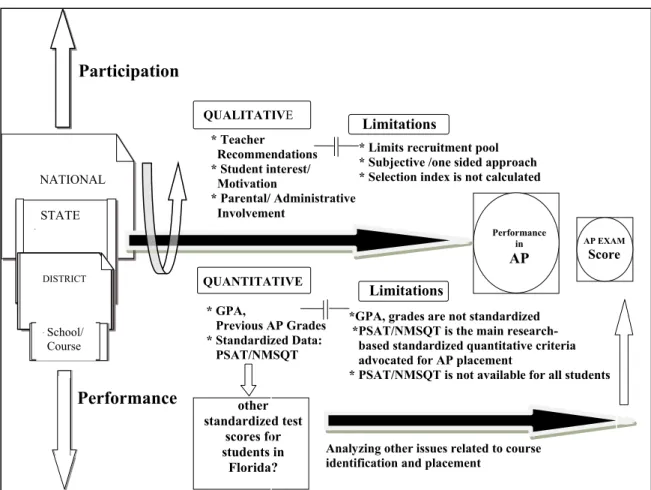
quantitative and qualitative records that they review as they make placement and/or acceptance decisions. For example, aside from reviewing letters of recommendation, many universities also look at standardized tests. These standardized examination scores and percentile rank are the two factors calculated in order to construct a selection index. This selection index is one of the main criteria used to make college admission decisions, especially in public universities (Tam & Sukhatme, 2004). Typically, colleges in the United States accept either the American College Test (ACT) or the Scholastic Assessment Test (SAT) as part of the admission process. However, although an AP course is intended to be equivalent of a university level course, there is no selection index calculated or prescribed criteria in advising students towards AP placement.
In contrast, being overly cautious in selecting students, also poses a challenge for
educators. Such is the case when dealing with students of various ethnicities, low-income, and/or females subgroups that have been historically underrepresented in AP programs at the national,
7
state and local level (Burton et al., 2002; Ndura, Robinson, & Ochs, 2003; Lee, 2001). Whiting and Ford (2009) reported that, acting as gatekeepers; teachers and counselors often under refer these students for screening into the AP program. Yet, for many underrepresented Hispanic and African-American low-income students, exposure to such AP courses may be the best, if not the only opportunity to participate in rigorous, college-level high school curricula (ETS, 2008). Having the opportunity to gain college or university credit, moreover, may help students economically, but especially low income students. Such opportunity aids to minimize the escalating college costs as the fee to take the AP exam is often subsidized for minority and low income students. In the case that it is not subsidized, it is still substantially less than paying for college credits. Underrepresented ethnicities and women that are already enrolled in the public school system, furthermore, provide an untapped homegrown reservoir of talent (Blickenstaff, 2005; George et al., 2001). In essence, properly identifying and allocating students based on an accurate assessment is important for future outcomes of all students. Therefore, learners with the talent and capabilities who are accurately placed will be able to use the school system as a roadway for social and economic mobility (Oakes and Gution, 1995; Hallinan, 1994).
The PSAT/NMSQT as a Selected Standardized Test for AP Identification and Placement
In an attempt to find ways to identify students for AP course placement, a few
dissertations have studied the relationships between AP science scores and various quantitative measures such as SAT mathematics, SAT verbal, SAT combined scores, Preliminary Scholastic Assessment Test/ National Merit Qualifying Test (PSAT/NMSQT), PSAT Math, PSAT Reading, PSAT Writing, attendance, grade point average, class rank, grade level, grade point average and count of prior science courses (Camera, Ewing & Millsap, 2006; Camara & Millsap, 1997, 1998; Sheperd, 1997; Wagner, 2001). Sheperd (1997) found that a multiple regression analysis showed that the best combination of predictors in performance in AP Biology to be SAT verbal score, SAT mathematics score and attendance for a sample taken from a Virginia public school system.
8
Wagner (2001) identified scores from standardized exams from the PSAT Math and PSAT Writing to have the strongest correlations with performance in AP Chemistry, for both the sample taken from the South Carolina public school students and for a sample taken from a school belonging to a National Consortium for Specialized Secondary Schools of Math, Science and Technology.
Currently, for educators looking to quantitatively identify more students for their AP program, researchers advocate using the PSAT/NMSQT scores (Camera et al, 2006; Camara & Millsap, 1997, 1998; Wagner, 2001). Researchers found strong relationships (as high as r = .732,
p < .05) reported by Camara and Millsap (2006) between the PSAT/NMSQT scores and AP examination scores. The College Board, overseer of the AP program, has in turn developed a web-based program that is readily available to educators called AP Potential. This is an online tool that generates a roster of students predicted to perform with a qualifying score of 3 or better on the AP exam (College Board, 2009).
There is a practical challenge, however, for educators in relying only on PSAT/NMSQT scores as a standardized criterion for identification of potential AP students. An example is that for certain AP subjects offered as early as ninth grade, these scores are not likely to be available since the majority of students do not take these tests until October of their sophomore year (Camera et al., 2006; Camara & Millsap, 1997, 1998; Palin, 2001). Scores received from the 10th grade administration, henceforth, will only be beneficial for 11th grade and 12th grade
identification and placement. Table 4 highlights the percentage of PSAT/NMSQT test takers over a 10 year span:
9
Table 4
PSAT/NMSQT 10th grade participation in Florida Public Schools 2000 - 2009
______________________________________________________________________________
Academic Year Total Enrolled Test Takers Percentage of Test Takers ______________________________________________________________________________ 2000 170,436 77,807 45.7 2001 173,071 87,939 50.8 2002 184,244 101,047 54.8 2003 191,353 116,237 60.7 2004 201,400 135,442 67.3 2005 211,446 141,683 67.0 2006 210,533 142,235 67.6 2007 209,867 140,150 66.8 2008 207,127 138,347 66.8 2009 199,206 129,902 65.2
Note. Participation 2000 – 2009. Modified using PSAT/PLAN report, FLDOE (2008a) and archived yearly data by the state of Florida Department of Education Accountability, Research and Measurement (publicly available by FLDOE website).
As the Table 4 shows, in fall 2008, 66.8% of the 10th graders in Florida public schools took the PSAT/NMSQT. This is approximately the same percentage of students taking the exam since 2004 as highlighted in Table 4. In 2009 this percentage represented 69,304 sophomores for whom PSAT/NMSQT scores were not available and henceforth for whom the AP potential tool would not apply. Likewise participating districts also vary; the PSAT was the predominant test for only 32 of the 67 county school districts in Florida (FLDOE, 2008a). Many districts, therefore, did not have any students taking the PSAT and would not be able to use this standardized test for student advisement. Furthermore, as indicated earlier, AP courses are available to students as early as the ninth grade. For example, 10.5% of the students took an AP Biology exam, AP Environmental 4%, AP Chemistry 6% before their junior year in high school (College Board, 2011). Hence, finding other standardized test scores that can be utilized when the PSAT/NMSQT scores are not available or to supplement these scores, henceforth, would have practical benefits for educators attempting to use a quantitative data-driven approach in
10
The FCAT as a Supplemental Standardized Test for AP Identification and Placement
Paralleling AP expansion of the last decade, standardized statewide assessment has taken root in the American public school system. The federal No Child Left Behind Act of 2001 requires states to measure the performance of all students in all public schools on an annual basis. In Florida, the Florida Comprehensive Assessment Test (FCAT) was developed to assess students on various measures of readiness as a response to this Act (FLDOE, 2007). The FCAT evaluates student thinking skills at various levels by categorizing question items from Low to High
Complexity. In the Low Complexity category, the test items require students to demonstrate simple skills or abilities such as locating details in a text, graph, or chart. On the other end, the FCAT high-complexity items require students to think in a more abstract and elaborate manner. For instance, FCAT Mathematics skills include, but are not limited to, solving a non-routine problem, providing mathematical justifications, formulating original problems and mathematical models for complex situations, analyzing or producing deductive arguments. FCAT scores, reflective of the student’s mastery of this cognitive complexity, are reported as Scale Scores (SS), Developmental Scale Scores (DSS) and Achievement Level Scores (FLDOE, 2005).
A conceptual alignment was reported to exist between skills assessed by the PSAT/NMSQT and the state standards assessed by the FCAT (College Board, 2010). The College Board established that every Skill Category and Description of Skill is also assessed by the FCAT as described in the Next Generation Sunshine State Standards (NGSSS). For example, PSAT/NMSQT Math skills such as solving problems using algebraic equations and symbols to represent relationships, patterns and functions were also addressed by state standard by
MA.192.A.2.3. Likewise, PSAT/NMSQT English Language skills such as reasoning and inference to understand assumptions, suggestions and implications when reading passages and drawing informed conclusions that require students to determine the main idea in higher level text were also gaged by state standards LA.910.1.7.3 (College Board, 2010).
11
Several studies suggest that a relationship may exist between state tests and other standardized tests. Wilson (2004) examined the Texas Assessment of Knowledge and Skills (TAKS), and its relationship with PSAT/NMSQT in order to provide initial data for school districts in Texas. That researcher found a moderate linear relationship between TAKS and PSAT (r = .511, p < .001). However, he pointed out, more research is needed in the manner in which state assessments and other standardized assessments relate (Wilson, 2004). In a dissertation Beard (2007) used predictive discriminant analysis to study the link between the PSAT/NMSQT and FCAT and found that FCAT pass or failure can be predicted with an accuracy as high as 83.4%. In Miami Dade County Public Schools (MDCPS), Froman, Brown and Tirado (2008) examined the correlation between FCAT and AP scores in that district. Researchers established strong positive relationships as high as (r = .60, p < .05) between both assessments.
Purpose of the Study
Educators advocating for increased enrollment in AP mathematics and science are challenged to adequately place students into these courses. The purpose of this study was to investigate the extent to which a national standardized test, PSAT/NMSQT, in conjunction with and compared to, a state-mandated standardized test, FCAT, can be used to identify potential AP students who may not have otherwise been identified by other measures. The study analyzed the correlations between scores on the PSAT/NMSQT in conjunction with the FCAT scores as they related to performance on the AP science and math examinations for the 2010 – 2011 and 2011 - 2012 academic school years in Seminole County Public Schools (SCPS). The study was intended to serve as a baseline investigation in Florida.
Statement of the Problem
This study examined the extent to which scores from a national standardized test, PSAT/NMSQT, in conjunction with and compared to, state-mandated standardized test scores,
12
FCAT, were related to AP Performance as measured by AP Scores in Math and Science courses in Seminole County Public Schools. Various Multiple Regression Analyses (MRA) using subset scores from both standardized tests were conducted in order to compare the degree to which these standardized scores are related to AP exam performance in the following STEM-related courses: (a) Biology (b) Chemistry (c) Environmental Science (d) Physics B (e) Physics C- Electricity and Magnetism (f) Physics C-Mechanics (g) Statistics (h) Calculus AB (i) Calculus BC. The primary aim was to investigate the combined correlations that are associated with the selected
standardized test scores and corresponding AP exam performance in STEM-related AP
disciplines. A secondary aim was to investigate the amount of variance in the outcome variable, AP exam performance, which is accounted for by the individual predictors, PSAT/NMSQT and FCAT sub-scores. The PSAT/NMSQT sub category scores are reported as follows: (a)
Mathematics (PSAT-M) (b) Critical Reading (PSAT-CR) (c) Writing (PSAT-W). The FCAT scores are reported as follows: (a) Mathematics (FCAT-M) b) Reading (FCAT-R) (c) Writing (FCAT-W).
Research Questions
Question 1. (a) To what extent were the combined selected standardized test scores, PSAT/NMSQT (Math, Critical Reading and Writing scores) and FCAT (Math, Reading and Writing scores), related to performance on each of the selected AP math and science exams in Seminole County Public Schools for students during the 2010 – 2011 and 2011 - 2012 academic school years? (b) What is the extent of unique variance that each selected standardized test sub-scores (PSAT-M, PSAT-R, PSAT-V, FCAT-M, FCAT-R, FCAT-W) accounts for in the relationship?
Question 2. (a) To what extent were PSAT/NMSQT scores alone related to AP exam
performance for students with at least one reported AP math and science score during 2010 – 2011 and 2011 - 2012 academic school years in Seminole County Public Schools for selected
13
STEM-related subjects? (b) What is the extent of unique variance that each selected standardized test sub-scores (PSAT-M, PSAT- CR, PSAT-V), accounts for in the relationship?
Question 3. (a) To what extent were FCAT scores alone related to AP exam performance for students with at least one reported AP math and science score during 2010 – 2011 and 2011 - 2012 academic school years in Seminole County Public Schools for selected STEM-related subjects? (b) What is the extent of unique variance that each selected standardized test sub-scores (FCAT-M, FCAT-R, FCAT-W) accounts for in the relationship?
Definitions
The following terms are defined as follows for this study:
Achievement. Related to score received on the AP exam as defined by the College Board; a qualifying grade for college or university credit is 3 or higher on the AP exam.
Achievement Levels. Related to FCAT scores and expressed in five categories. Each category represents the success students demonstrate with content assessed on the FCAT SSS.
AP Course. Designed to be the equivalent of a one or two-semester college course, based on AP Score recommendations ranging from 1 - 5 on the AP exam, some high school students may be granted college credit. Each post-secondary institution has its own AP credit policy regarding their particular interpretation of an AP score recommendation.
AP Student. A particular student that enrolled and completed an AP course exam.
AP Exam. A standardized test given to students in May, towards the end of each academic school year. The test consists of two sections, a section of multiple choice questions and a portion with four free-response questions. The AP exam aims to measure the students’ ability to acquire the conceptual framework, factual knowledge, mathematical skills, reading comprehension, and analytical skills necessary in the specific discipline of study (College Board, 2011).
14
AP Exam Score. Each AP Exam is scored using a 5-point scale: 5- Extremely well qualified; 4- Well qualified; 3- Qualified; 2- Possibly qualified; 1- No recommendation
Developmental Scale Score (DSS). A type of scale score used to determine a student’s annual progress from grade to grade. The FCAT Reading DSS range from 86 to 3008. The FCAT Math DSS ranged from 375 to 2605 (FLDOE, 2009).
FCAT. Florida Comprehensive Assessment Test administered to students in Grades 3 -10, which assess mastery over the Sunshine State Standards (FLDOE, 2009).
FCAT/SSS. The FCAT Sunshine State Standards is criterion-referenced to the SSS benchmarks in reading, mathematics, science and writing (FLDOE, 2009).
PSAT/NMSQT. Preliminary Scholastic Aptitude Test/National Merit Scholarship
Qualifying Test published by the College Board. It measures critical reading skills, math problem-solving skills and writing skills.
15
CHAPTER IIREVIEW OF THE LITERATURE Historical Perspective
Thomas Kuhn (1996) reminds us of the importance of history and the development of new theoretical thought. Kuhn reveals that there is no theoretical foundation developed without a historical progress. Instead he highlights that, “That is why a new theory, however special its range of application, is seldom or never just an increment to what is already known. Its assimilation requires the reconstruction of prior theory and the re-evaluation of prior fact, an intrinsically revolutionary process that is seldom completed by a single man and never overnight” (p.7). In light of this view, the historical continuum of the Advanced Placement Program and Florida Comprehensive Assessment Test will be highlighted in order to gain a theoretical perspective wherein the social implications between standardized testing and the AP program intertwine.
History of the Advanced Placement Program.
Origins (1950 – 1990).In 1951, The Ford Foundation Fund for the Advancement of Education sponsored two equivalent investigations that lead to the establishment of Advanced Placement: General Education in School and College and the Kenyon Plan. In both cases the conclusion was similar, secondary schools and colleges must work together to avoid replication in course work and instead allow an elite number of motivated students to work at the height of their capabilities and advance as quickly as possible. In accordance, this set in action a partnership between secondary and higher education institutions in the development of curricula and standards for the creation of advanced placement courses in high schools (DiYanni, 2008).
The first decade of advanced academics, Rothschild (1999) explained, began in May 1951, as an assembly of educational specialists from three elite prep schools; Andover, Exeter, and Lawrenceville, and three prominent colleges; Harvard, Princeton, and Yale, gathered to
16
discuss the best use of the last two years of high school and the first two years of college. A committee published a final report, General Education in School and College, through Harvard University Press in 1952. Rothschild (1999) then explained that, in fact, the term ‘advanced placement’ appeared for the first time on page 118 of that report. Diyanni (2008) explained that the report urged schools and colleges to work together as part of a continuous process to raise the standards in the educational system. The overall impact of the report concluded that, schools should encourage more independent study. This report hence helped to advance a seven-year program with an outline for advanced placement. Program standards would be evaluated through examinations of the students that would enable participating colleges to accept or reject students based on these scores (Rothschild, 1999).
Diyanni (2008) explained that simultaneously, a committee of representatives from 12 colleges and 12 secondary schools was formulating the Kenyon Plan. The Committee, with assistance from the Fund for the Advancement of Education, then followed the recommendations of both studies and enlisted leaders from various disciplines from the areas of higher education. These professors accepted the challenge of creating high school course descriptions and
assessments for colleges to find sufficient rigor to employ as a standard for granting credit. In1952, they launched a pilot program involving several schools that had introduced advanced courses in eleven initial subjects, from Biology to Spanish Language. In the mid-1950s, the pilot program was underway in 27 schools and had been proven successful (Rothschild, 1999).
By 1961, the program began receiving resources and support from various commissioners of states while an increased number of colleges began granting college credit for successful AP exam grades. Furthermore, many more high schools began adopting the courses (Diyanni, 2008). However, all was not well, as Rothschild (1999) explained, “Education was not immune to the social and political shocks of the late 1960s” (p.185). Instead, only 14 percent of nation’s high school students challenged themselves with the rigorous AP curriculum. Rothschild explained
17
that the low representation in the AP program could possibly be explained by the cultural trends of the late sixties. Even though the democratic viewpoint in this era called for the enhancement of education for the many, rather than an elitist education for the few, the program resisted the cultural opposition, and remained a program for the privileged (Diyanni, 2008).
In the mid-eighties after a report, A Nation at Risk, the trend of the sixties changed. This report deplored the state American education and in turn fueled and ignited a greater enrollment pattern into AP courses. The eighties included the spread to urban schools with traditionally underrepresented minorities. Students in the eighties hence reacted differently by accepting the academic advantages of the program, unlike the sixties, whose enrollment pattern demonstrated social exclusivity (Rothschild, 1999).
Present (1990 – 2013). In the most recent decades, the AP program has continued to increase in enrollment. By 1990, the College Board began expanding on the goals of the AP program by introducing Pre-AP programs, including AP Vertical Teams and Building Success workshops for teachers (Diyanni, 2008). More recently, A Report to the Nation 2007 highlighted that students representing 16,000 secondary public schools took AP exams. Additionally,
although most of these students were from schools in the United States, 878 of these schools were located outside of the U.S. (College Board, 2008). Therefore the AP program has expanded from its inception to now include great international appeal (Viadero, 2006; Sadler, P. M., Sonnert, G., Tai, R. H., & Klopfenstein, K, 2010). Rothschild (1999) explained, as the numbers of students challenging themselves with the rigors of the AP program increases, the answer to the question of who can be considered an AP student changes. Wherein in its early history AP students were more likely to come from homes of highly educated parents such as judges, professors, surgeons, etc., by 1998 the typical AP student could not easily be distinguished. Still, in a Report of the Commission on the Future of the Advanced Placement Program the commission’s top
18
underserved populations, while continuing to maintain AP’s high quality” (p.7). Additionally, the authors noted that future trend has shifted to expand to students who are willing to accept the program's rigor (College Board, 2001). Moreover, the College Board committed themselves to ensure that AP courses would be accessible to underserved racial, ethnic, and socio- economic groups in urban and rural areas. (College Board, 2001; Viadero, 2006; Sadler, Sonnert, Tai, & Klopfenstein, 2010).
Implications of Historical change in AP Course Placement Criteria. Early on in the AP program’s history several researchers criticized the impact of a tracking guided program, such as AP placement, on the social implications that it may have. Alexander, Cook and McDill (1978) wrote that a membership to a college track enhanced the probability of entering college therefore it was a sorting mechanism that occurred at the high school level that paralleled the sorting of society in the near future. Other arguments of the tracking system included the notion that suggested that these sorting channels limited the resources by providing the most to the ones that need it the least (Rosenbaum, 1975). In addition he also stated that students in non-college tracks were denied access to teachers, counselors, resources, and information which would broaden their interests and challenge their abilities. Furthermore, they are discouraged from competition and association with more advantaged students and are usually not required to strive towards excellence in academics (Rosenbaum, 1975). In summary the authors’ conclusion was that differential tracking in secondary education propagates social and economic inequalities, by widening the previously existing differences in ability (Alexander et al., 1978; Rosenbaum, 1975).
To compound the problem even further, according to Spade and Vanfossen (1997), the tracking seems to actually originate as early as kindergarten, and selection factors range widely. This same argument was also made evident in an article written Merrilee K. Finley (1984), where the author discussed the fact that tracking contributed to the reproduction of the social order of
19
the next generation. Tracking was referred to as a mechanism of sorting, selecting, and socialization. In addition, researchers indicated that the small differences in student’s
achievement, derived primarily from differences in social-class background become accentuated over time through a perpetual process of organizational selection (Spade et al., 1997). Hallinan (1996) claimed that research on the effects on tracking on student achievement was consistent. Positive effects are shown for high-tracked students; negative effects are shown for low-tracked students, and negligible effects for regular track.
According to Oakes and Gution (1995), from a human capitalist perspective in education, tracking schools serves a primary function to prepare students for a productive workplace. Because the labor force is differentiated, schools offered an extensive amount of learning opportunities within various tracks as students are being prepared for different levels of the workforce. Therefore, students may increase their human capital potential of knowledge and skills, which will establish how much return they can attain in terms of income and social status as adults. This human capital theory recognizes that not all academic tracks have the same rate of return. However, it asserts that the competition for various options is an open contest based on merit. On the other hand, Oakes and Guiton (1995) also points out a competing structural theory of how tracking takes place. “Rather than competing in a wide-open competition for slots in particular curricula, then, students follow rather narrow curriculum paths that are established quite early in their school careers by factors not limited to their ability to benefit from a particular path” (p. 6).
According to Oakes and Gution (1995), the theoretical framework from which schools operate probably lies somewhere in the middle between these two; Oakes and Gution (1995) state that “Schools do not simply offer a wide range of offerings from which students and their parents choose. But neither do they simply match students to curricular and occupational opportunities in ways likely to reproduce their current social and economic status” (p. 7). In any case, properly
20
identifying and allocating students based on an accurate assessment of relevant abilities and interest may be important to future outcomes for the student. These researchers highlighted that students that have the talent and capabilities and are accurately placed will be able to use the school system as roadway for social and economic mobility (Oakes and Gution, 1995; Hallinan, 1996; Spade and Vanfossen, 1997).
Analyzing available assessment data and the extent to which it adequately informs educators towards AP placement in mathematics and science therefore have long term implications for students in Seminole County Public Schools. It is therefore pertinent to understand the historical continuum from which the current statewide assessment program available for educators in SCPS was developed.
History of the Florida Comprehensive Assessment Test
Origins (1971 – 1990). Intertwining with the AP program, a statewide assessment program has also experienced a marked expansion. The Accountability Act of 1971, Section 229.57, established a uniform statewide educational objective for grade level and subject area that includes reading, mathematics, and writing. Furthermore, it intended to assess student progress and the degree to which students have achieved the educational objectives (FLDOE, 2007). The FCAT is the latest initiative in Florida’s statewide accountability system.
The first statewide assessment, called the State Student Assessment Tests (SSAT) was given in reading, writing, and math in Grades 2 and 4. In 1974, the Educational Accountability Act was amended to require the assessment of all students in reading, mathematics and in writing by 1976. By that year, the Florida Legislature expanded the Educational Accountability Act to require assessments in Grades 3, 5, 8 and 11. The Grade 11 graduation test was the State Student Assessment Test, Part II (SSAT-II) but was renamed in 1984 to the High School Competency Test (HSCT). A Grade 10 assessment was later added known as the Grade Ten Assessment Test (GTAT). All these tests were then replaced by FCAT and FCAT 2.0 (FLDOE, 2010; 2011c).
21
Present (1990 – 2013). The School and Accountability Act of 1991 called for major modifications for Florida’s public educational system. A decade later Goal 3 in the Blueprint 2000, published bythe Florida Commission on Education Reform and Accountability,
highlighted a goal for improving student performance in reading, writing, mathematics, and thinking skills. The standards from Blueprint 2000 were reinforced by the Florida
Comprehensive Assessment Design [FCAD] (FLDOE, 2010). The FCAD proposed a formal development of a new statewide assessment system as part of the goal to increase student achievement. This assessment system later was named the Florida Comprehensive Assessment Test (FCAT). The FCAT was later followed by the adoption of the Sunshine State Standards (SSS) that were guided by a set of learning expectations for seven content areas and in four separate grade clusters (PreK – 2, 3 – 5, 6 – 8, 9 -12). The benchmarks of the SSS are the foundation of the FCAT and representative of the skills and knowledge deemed essential for Florida students (FLDOE, 2010). Currently, there are several statewide uses of the FCAT. At the student level, FCAT scores are being used for promotion and graduation requirement.
Furthermore, scores are used for develop progress monitoring plans for students. Additionally, at the school level, FCAT scores are being used to assess Adequate Yearly Progress (AYP) of each school. Moreover, under the Florida A-Plus plan, every public school in Florida are assigned yearly school grades, A through F, based on the proportion of its students passing the FCAT (Statewide Uses of the FCAT, 2010). In light of these uses, it is clear that the FCAT, like AP, has also become an integral part of Florida’s public school system. A central question in this
dissertation it the extent to which, FCAT scores, can be utilized as a supplement to using the PSAT/NMSQT scores for identification of potential AP science and mathematics students.
22
AP Course Selection Procedures AP Course Selection Decisions in Public Schools
Recent studies have highlighted that the course selection process in high school varied by institution. Burton, Yepes-Para, Cline and Kim (2002) conducted a study that, among other variables, looked at the role that teachers played in the student selection process. The researchers focused their study on approximately 400 schools with the most underrepresented minorities who were enrolled in AP Calculus AB in 1998. A similar invitation was done for another 400 schools with a high ratio of minority enrollment in AP literature therefore there was some overlap among schools. Teachers in these schools were identified as effective or non-effective depending on their student’s results on the AP exam as compared to multiple regression equations based on PSAT that predicted how successful these students should be. A school questionnaire was also devised for school principals in which they were asked to comment on state policies and practices for their AP program. The researcher also focused on policies and practices for assigning teachers to teach AP classes. A separate teacher questionnaire was given in order to get the teacher’s perspectives. The researcher found that teachers played a vital role in the recruitment process of students into the AP classes. The following research highlights the most researched and available tools available to teachers for identification of potential AP students.
AP Math and Science Course Selection Procedures
In 1997 Spade, Columba and Vanfossen studied how tracking and course selection procedures occurred in mathematics and science. The purpose of their study was to examine both the types of courses offered to assess the number of options available to students, as well as how students are placed in classes, by studying the course-placement decisions and the criteria used to make those decisions in “excellent” and “average” schools across social-class communities.
The method they used for the study was first categorizing six schools in New York State based on performance of students on a norm-referenced exam as either average or excellent. A
23
further system of classification organized each school based on social economic status of the community derived from an approximation of the social class of the school. To choose the schools, data were obtained from the New York State Department of Education, as well as the U.S. Census. These schools were matched based on the average income of families in the school district and the type of community they were in. The six schools were categorized as Working-average, Working-excellent, Middle-Working-average, Middle-excellent, Affluent–Working-average, and Affluent-excellent. Once categorized, the enrollment pattern and course offerings were quantitatively organized. Afterwards, interviews with each department head of the six schools were conducted to gain an insight.
The researchers found that the number of advanced courses offered in both math and science increased with the social class of the school. Furthermore, excellent schools, regardless of social class offered more advanced courses in their area of excellence. Lowest social class districts and average schools were less successful in getting students to enroll in advanced math and sciences. Interviews suggested that there was a climate of high performance expectations in excellent schools, regardless of social class. Analyses of procedures associated with course placement suggested that both scores on standardized tests and teachers’ recommendations were used differently across schools in different social class communities. Average schools had a relaxed approach regarding recruitment policies and more emphasis was placed on students’ and parents’ choice. Excellent schools had a more systematic and active approach to recruitment that involved teachers, counselors, parents, etc. All staff in these schools considered their role to be a critical factor in course-placement decisions. The authors believed that course taking was the most powerful factor affecting student’s achievement that is under school control. The researchers suggested that although schools can do very little regarding the social class of the school, they can indeed impact the course enrollment pattern and course offerings through the student selection process (Spade et al., 1997).
24
Demographic Representation in AP Courses
Ndura, Robinson and Ochs (2003) examined students’ ethnic background on their enrollment in AP classes during high school. Through questionnaires developed by the authors, the researchers examined AP course data in a mid-sized school district in the western United States. The surveys were mailed through interoffice correspondence to the teachers in the school district in the fall of 2002 during the first week of class. The teachers returned the completed surveys to the District Science Coordinator. The data obtained were from eight of 10 high schools in a diverse district with an approximate student population of 58,000. In general, the district served a lower middle to upper class socioeconomic status. Hispanic students made up the majority ethnic minority. Six other ethnic minorities were classified as “other” for the purpose of this study. The AP students who were surveyed ranged from 14 to 18 years of age. All students in AP courses offered by the district were surveyed and had an approximate return rate of 50%. In this particular district, students were neither encouraged nor discouraged to challenge
themselves through the AP program.
The researchers found that with the exception of Asian and Pacific Islanders, minority students were severely underrepresented in AP programs (Ndura et al., 2003). In the study minority students enrolled in AP classes comprised 17.5% of the student body. However, minority students in this district comprised approximately 30% of the total school enrollment. Furthermore, researchers also looked at who in the schools had the biggest influence on taking AP classes. The data indicated that parents and teachers had the largest influence, followed by friends and then counselors. In the survey the number one response for choosing an AP course was to obtain a challenging course that would allow them to be surrounded by “smart people” (p. 27). The researchers also highlighted a positive relationship between parents’ academic
background and income with the students’ enrollment in such programs. According to the researchers, although the recent federal aid that aims to provide equity by allowing more AP