44
5
Strengthening Research and Capacity
Building in Computer Science
Peter Wagacha, Katherine Getao and Bernard Manderick
This chapter discusses strengthening of research and capacity-building in Computer Science at the School of Computing and Informatics, University of Nairobi over the last few years. Research is one of the school’s primary missions. The vision of the School is to be a leading centre of excellence in research, research and development (R&D) and advanced education in Computer Science. We further elaborate on some significant changes and experiences that this department has gone through in its development. To harness synergies within individual members of staff, the school formulated research groups. These research groups have been responsible for research in their own areas, curricula development, and student research, project supervision and direction. As a way to foster growth, the school has been in strategic academic and research collaboration with development partners from various parts of the world. Links with researchers from different parts of the world have also been established. To harness synergies, specific areas of research are being pursued.
Introduction
The School of Computing and Informatics (SCI) is the department of the University of Nairobi charged with teaching and research in Computer Science. Since its inception (formerly as the Institute of Computer Science) in 1977, it has established itself as a regional leader in computer science and informatics with regard to teaching, research and consultancy. Its main areas are Information Systems, Distributed Systems and Artificial Intelligence.
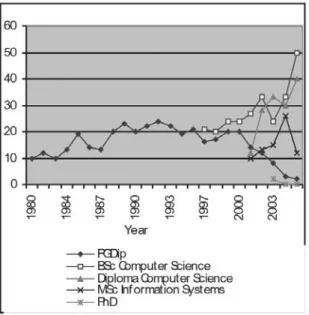
It has several approved programmes, some of which are very competitive: Diploma in Computer Science, BSc Computer Science, Postgraduate Diploma in Information Systems, Postgraduate Diploma in Computer, MSc in Computer Science, MSc in Information Systems, MSc in Applied Computing and PhD. See Figure 1 for graduands.
The current mission of the school includes (SCI2003a,SCI2005):
Research: This is the primary activity of the school, upon which the success and quality of all other activities hinge. The School aims at instituting a dynamic programme of aggressive research in its core areas of competence: information systems, distributed systems and artificial intelligence, in line with national and regional priorities. This is to be achieved through the harnessing of local, national and regional resources and skills.
Figure 5.1: Graduands 1980-2005 in various programmes (2005 figures are projected)
Teaching and Learning: To produce high-quality, well-rounded graduates who are productive, innovative, work effectively with academic and industrial partners and capable of lifelong learning. The school’s courses will be developed and delivered to a high standard of educational and technological competence.
Consultancy: To engage productively with the public and private sectors to solve problems of national or organisational economic importance in order to foster progress in computer science.
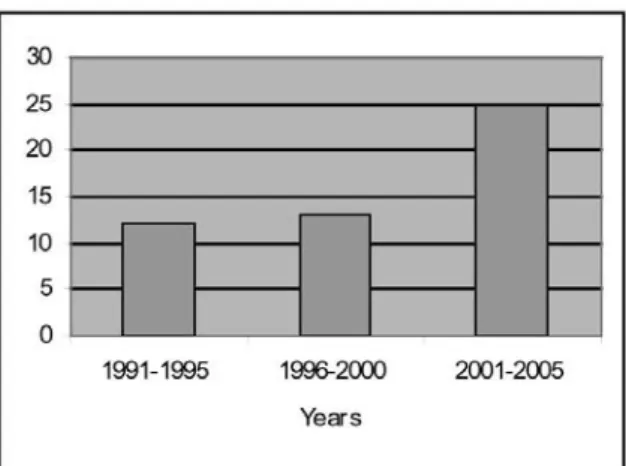
Active research is the cornerstone of any academic department and is closely related to capacity-building (UoN2005). For several years the school’s research output and interest amongst staff was been fairly low, (compare Figure 5.2 and 5.3). In 2003, the school instituted a process to address this problem. The main goal was to strengthen research.
This paper describes the process that the school has taken towards achieving this goal. Some of the challenges are enumerated in the sections below.
This paper is organised as follows: First, in section 2, we give an overview of the strengths, weaknesses, opportunities and threats (SWOT) that SCI identified during a strategic planning process. On the basis of the SWOT analysis, SCI developed a strategic plan for research. This plan has subsequently been used as a road map for current research activities and capacity-building. Sections 3 and 4 discuss the research and development (R&D), and consultancy and extension activities respectively. These are part of the school’s mission. Academic research and capacity-building are discussed in section 5. Finally we provide a conclusion in section 6.
The SWOT Analysis
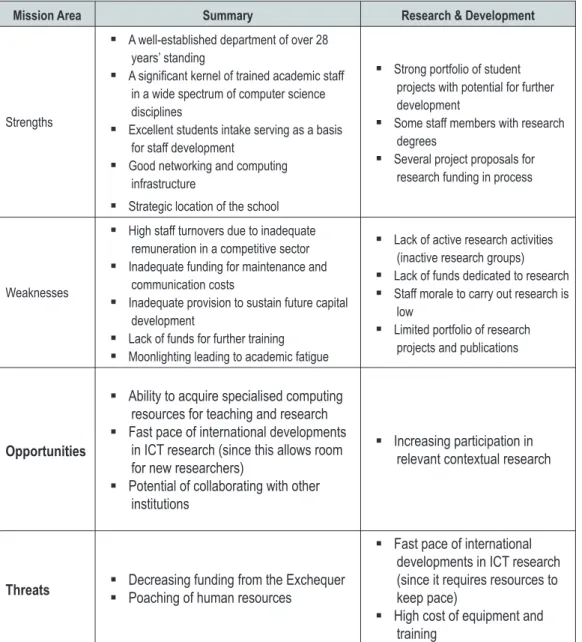
By carrying out a strengths, weaknesses, opportunities and threats (SWOT) analysis the school was able to uniquely evaluate and re-define itself. This is illustrated in Table 5.1. This culminated into the SCI Strategic Research Plan document (SCI2003b).
Below we highlight a few of the issues brought to the fore. Some of the strengths were: a significant group of trained academic staff in a wide spectrum of computer science disciplines, and a good quality student intake that could serve as the basis for research activity and staff development. Some of the weaknesses were high staff turnover due to poor university remuneration in a market with a healthy demand for ICT skills, lack of adequate research funds, and staff exhaustion due to moonlighting (extensive participation in other academic or non-related areas outside the university). Some of the opportunities were: research opportunities in the contextual application of rapidly developing ICTs, and a pool of human resource (academic staff) that can engage in research activities. One major threat that was highlighted was the poaching of staff in an environment where there are a rapidly growing number of learning institutions combined with a scarce pool of appropriately qualified human resources.
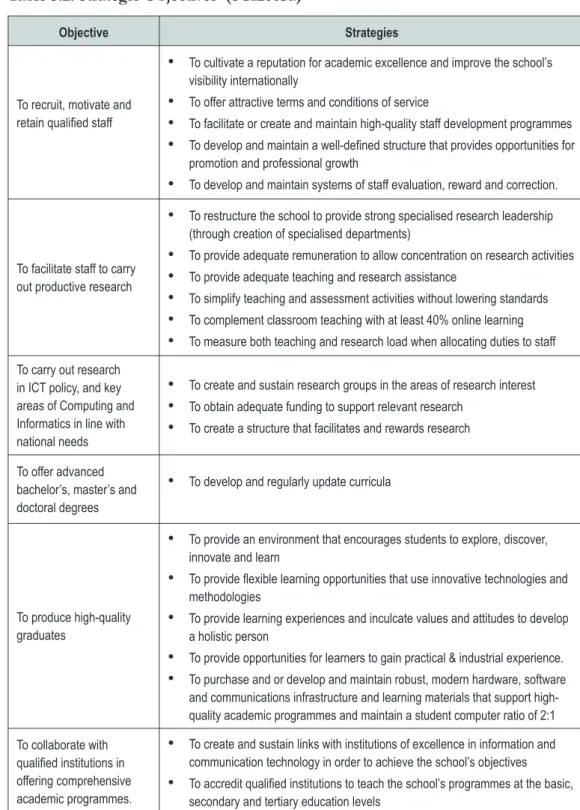
To address these important issues some strategic objectives were developed (see Table 5.2). These objectives include motivation of staff through better terms and the provision of high-quality staff training opportunities; facilitation of staff to carry out productive research; and to collaborate with qualified institutions in offering comprehensive academic programmes.
Research and Development Activities
The School of Computing and Informatics has an extensive portfolio of research and development activities in diverse areas such as Mobile Communications, Electronic Learning, Management Information Systems, Web-based applications and Hardware projects. For example, the development of an e-learning software platform, WeduSoft1, which was designed and developed in-house. Several university departments in East and Central Africa are actively producing electronic courses using WeduSoft.
The school is currently preparing an extensive demonstration and database of these projects that have been developed by staff and students over the years with the hope of attracting opportunities for commercial development. The school is in conversation with a number of interested parties from industry as well as actively participating in the Chiromo Science Park Project to be based at the University of Nairobi.
Consultancy and Extension Activities
The School of Computing and Informatics takes its role as a leading Computer Science Department in the region seriously. Members of staff serve as external examiners to regional universities in South Africa, Zimbabwe and Uganda as well as nearly all local public and private universities.
The school participates in local initiatives such as the development of an Information and Communication Technology policy, and a variety of conferences and symposia. In
recent years the school has worked hard in selling itself to industry and government in an advisory capacity. As a department, the school has the highest concentration of computer science expertise in the country, by the virtual of the number of PhDs, P.hD students and master’s degree holders. SCI is currently assisting the Ministry of Lands, the Ministry of Health, Kenya Bureau of Standards, Kenya Revenue Authority and the Commission for Higher Education, among others.
Table 5.1: Research and Research & Development SWOT Analysis (SCI2003a)
Mission Area Summary Research & Development
Strengths
§ A well-established department of over 28 years’ standing
§ A significant kernel of trained academic staff in a wide spectrum of computer science disciplines
§ Excellent students intake serving as a basis for staff development
§ Good networking and computing infrastructure
§ Strategic location of the school
§ Strong portfolio of student projects with potential for further development
§ Some staff members with research degrees
§ Several project proposals for research funding in process
Weaknesses
§ High staff turnovers due to inadequate remuneration in a competitive sector § Inadequate funding for maintenance and
communication costs
§ Inadequate provision to sustain future capital development
§ Lack of funds for further training § Moonlighting leading to academic fatigue
§ Lack of active research activities (inactive research groups) § Lack of funds dedicated to research § Staff morale to carry out research is
low
§ Limited portfolio of research projects and publications
Opportunities
§ Ability to acquire specialised computing resources for teaching and research § Fast pace of international developments
in ICT research (since this allows room for new researchers)
§ Potential of collaborating with other institutions
§ Increasing participation in relevant contextual research
Threats § § Decreasing funding from the ExchequerPoaching of human resources
§ Fast pace of international developments in ICT research (since it requires resources to keep pace)
§ High cost of equipment and training
Research and Capacity-Building
The school realises that research is the pillar of academic work. The School of Computing and Informatics is the first Computer Science department in Kenya to train
computer scientists to the level of PhD by research. The world over, research activities are closely linked to capacity-building. These are both discussed below.
Research Activities
Research at the School of Computing and Informatics is guided by the Research Strategic Plan 2003-2007 (SCI2003b). This plan was developed in line with the overall school’s Strategic Plan (SCI2003a). This research strategic plan describes the mission, vision, SWOT analysis and research strategic objectives defined by the school (see section 2).
All researchers in the school are currently organised into three research groups, namely:
1. Artificial Intelligence Research Group (AI); 2. Distributed Systems Research Group (DS); 3. Information Systems Research Group (IS).
These research groups were created through a broad clustering of computer science disciplines, with research leadership in mind. Each group also has an action plan that describes the specific activities of that group which may include seminars, preparation of technical reports, specific research projects and so on.
Currently, some of the research activities within these three groups includes: • Grid computing: This involves the use of intelligent agents, scheduling,
issues of quality of service etc. (AI & DS groups)
• Natural language processing (NLP): Research in Swahili and other local Kenyan languages, development of text-to-speech systems etc. (AI group) • ICT policy and e-governance, e-strategies (IS group)
• Geographical Information Systems (GIS): Modelling and decision support (IS group)
• Electronic learning technologies (IS group) • Electronic learner modelling (AI & IS group)
• ICT for development and technology forecasting (IS group) • Mobile phone telephony (AI & DS group)
Table 5.2: Strategic Objectives (SCI2003a)
Objective Strategies
To recruit, motivate and retain qualified staff
• To cultivate a reputation for academic excellence and improve the school’s visibility internationally
• To offer attractive terms and conditions of service
• To facilitate or create and maintain high-quality staff development programmes • To develop and maintain a well-defined structure that provides opportunities for
promotion and professional growth
• To develop and maintain systems of staff evaluation, reward and correction.
To facilitate staff to carry out productive research
• To restructure the school to provide strong specialised research leadership (through creation of specialised departments)
• To provide adequate remuneration to allow concentration on research activities • To provide adequate teaching and research assistance
• To simplify teaching and assessment activities without lowering standards • To complement classroom teaching with at least 40% online learning • To measure both teaching and research load when allocating duties to staff To carry out research
in ICT policy, and key areas of Computing and Informatics in line with national needs
• To create and sustain research groups in the areas of research interest • To obtain adequate funding to support relevant research
• To create a structure that facilitates and rewards research To offer advanced
bachelor’s, master’s and doctoral degrees
• To develop and regularly update curricula
To produce high-quality graduates
• To provide an environment that encourages students to explore, discover, innovate and learn
• To provide flexible learning opportunities that use innovative technologies and methodologies
• To provide learning experiences and inculcate values and attitudes to develop a holistic person
• To provide opportunities for learners to gain practical & industrial experience. • To purchase and or develop and maintain robust, modern hardware, software
and communications infrastructure and learning materials that support high-quality academic programmes and maintain a student computer ratio of 2:1 To collaborate with
qualified institutions in offering comprehensive academic programmes.
• To create and sustain links with institutions of excellence in information and communication technology in order to achieve the school’s objectives • To accredit qualified institutions to teach the school’s programmes at the basic,
To be a model in the application of ICT in the implementation of our research, teaching and learning, management and extension roles
• To acquire, initiate or develop management information systems to support the major teaching and learning, research and management functions of the school
• To regularly evaluate and update information and communication technology hardware, links and software
• To use e-learning as a major delivery method for teaching and learning To facilitate the formulation
of productive and relevant national and regional policy for ICT
• To engage in ICT policy research and development
• To disseminate ICT policy through a series of technical reports, workshops, seminars and other fora
To create an infrastructure for developing ICT products, in collaboration with relevant partners, that address regional needs
• To utilize the Master of Science in Applied Computing Science to fund and develop novel and relevant ICT products
• To create and sustain links with partners in order to develop ICT products that address regional needs
To facilitate professional networking in ICT (including its interface with other disciplines)
• To encourage staff to represent ICT interests in all relevant national and regional fora
• To disseminate ICT knowledge through a series of technical reports, workshops, seminars and other fora
• To build strong links with industry through networking and collaboration To strengthen consultancy
and other income generation activities
• To carry out training for specified target groups at various levels of expertise • To undertake contracted research and consultancy
• To carry out research and development leading to marketable products To extend our reach into all
areas of national ICT need • To develop technological products that bridge our national digital divide • Telemedicine (AI group)
• Application of ICT in organisational change management (IS group)
The school actively nurtures links with internationally renowned researchers and institutions. Some of these researchers include: Prof. Barry Levine from the University of San Francisco; Prof. Thierry Duval from the University of Rennes in France; Prof. Laurence Duval from INRIA research institute in France; Prof. Luc Steels of the Free University of Brussels; Dr Gerald Kotonya from the University of Lancaster; Prof. Peter Flach from the University of Bristol, U.K.; Dr Guy DePauw from the University of Antwerp, among many others. These links have played a key role in building international research networks.
Short courses conducted and visits by these renowned scholars have been invaluable in developing interest and capacity in research among staff and students at the school.
Capacity-Building
Staff development is a key strategy of the School of Computing and Informatics. At the moment, all staff are recruited with a master’s degree in a Computer Science-related discipline and three years’ teaching experience in higher education. Staff are expected to prepare a PhD proposal and commence on doctoral research. A PhD degree is a mandatory requirement for senior academic appointments. This has proved a very challenging requirement for the Computer Science discipline since there is strong competition from industry for these professionals.
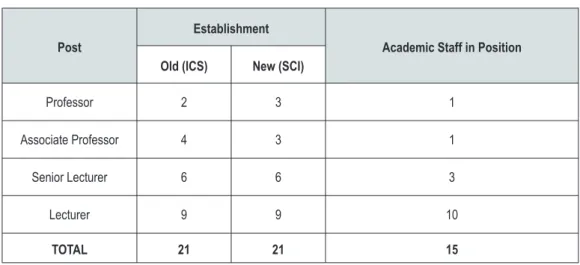
The current staff stautus is depicted in Table 5.3. It should be noted that most staff are in the lecturer grade. Five out of the fifteen members of staff are on leave from the school. There are few women members of staff, their number currently standing at 20%.
There are two avenues for developing staff at SCI. Most staff have sought scholarships to pursue their doctoral studies outside Kenya. However, this has proved difficult as the number of scholarships has shrunk as the competition for the few scholarships become much stiffer. In addition potential applicants often find it difficult to leave their families for three or four years, and very few scholarships fund families. It is more common nowadays for staff to follow sandwich programmes that involve collaborating with an institution in the developed world to manage a degree in both environments. The school’s plan envisioned the development of adequate capacity to manage the PhD programme locally at lower cost. This is also meant to enable the school to sustain its programmes.
Both sandwich and local programmes have their own challenges. These include availability of adequate concentrated research airtime, in an environment that may require them to continue supporting their departments in terms of teaching and other related duties.
Table 5.3: Staff status SCI (71% of establishment filled; 52% on the ground 20% of staff are women)
Post
Establishment
Academic Staff in Position Old (ICS) New (SCI)
Professor 2 3 1
Associate Professor 4 3 1
Senior Lecturer 6 6 3
Lecturer 9 9 10
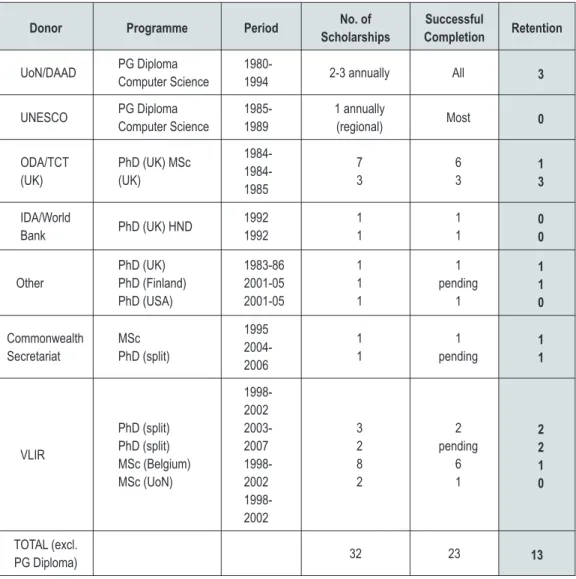
Table 5.4: Capacity-building at SCI (SCI2005)
Donor Programme Period ScholarshipsNo. of CompletionSuccessful Retention UoN/DAAD PG Diploma Computer Science 1980-1994 2-3 annually All 3 UNESCO PG Diploma Computer Science 1985-1989 1 annually (regional) Most 0 ODA/TCT
(UK) PhD (UK) MSc (UK)
1984-1985 7 3 63 13 IDA/World Bank PhD (UK) HND 19921992 11 11 00
Other PhD (UK)PhD (Finland) PhD (USA) 1983-86 2001-05 2001-05 1 1 1 1 pending 1 1 1 0 Commonwealth Secretariat MSc PhD (split) 1995 2004-2006 1 1 pending1 11 VLIR PhD (split) PhD (split) MSc (Belgium) MSc (UoN) 1998-2002 2003-2007 1998-2002 1998-2002 3 2 8 2 2 pending 6 1 2 2 1 0 TOTAL (excl. PG Diploma) 32 23 13
At the moment the school has three staff members with PhD that were pursued overseas, and two staff members who have recently acquired their PhD through sandwich programmes. Currently, two members of staff are pursuing their PhD abroad, two others have recently enrolled on sandwich PhD programmes, and another two have enrolled on local PhD programmes. SCI believes that it now has more than adequate teaching and supervision capacity for its PhD programme. Two recently recruited tutorial fellows are enrolled in our MSc programme on staff development.
Staff recruitment, development and retention have been a big challenge. For example, of the seven PhD candidates who have been trained through international scholarships between 1985 and 2000 only one is still at the school (see Table 5.4). Note that retention of staff was very low in the period when PhD graduates returned to an institution which had no Research Strategic Plan, where little active research was taking place. Since most of these graduates were returning from active research centres, the
lack of research combined with poor pay packages was highly demotivating. This led to serious problems with staff retention. With the revival of research activities, it has been possible to create a more motivating environment for PhD graduates. It is also expected that recent improvements in terms of service for academic staff will have a positive impact on recruitment and retention.
The fast pace at which technology evolves makes it paramount for SCI to continuously evaluate and upgrade its infrastructure. Both students and staff require better tools, better access, better labs etc. This is an expensive exercise and remains a big challenge owing to its financial requirements. In the recent past the school has been able to fund these from the little departmental funds and through partnerships with collaborating research institutions in the developed world such as The Flemish Inter-University Council (VLIR), which for the duration 2003-2007 will provide support to the tune of Euro 334,000.
The government’s support to public universities has over the years reduced, constrained by demands in other sectors of the economy. This in turn has led to reduction in funding from the university. Research funding is, and remains, a big challenge.
The school’s Strategic Plan was presented to the University Council and approved for implementation. It included a comprehensive budget for infrastructure, human resources and operations to be funded through university development budgets, increased productivity through the school’s income-generating activities and development partners (e.g. VLIR). This strategy is already on course. Resources are in the process of being provided such as: recruitment of highly qualified technical staff to support research activities; extension of laboratories through building works and acceptance of paid study leave and lighter duties for staff pursuing PhD studies. Part of this support is funded through the university’s income-generating “development” budget as well as the Kenya government treasury allocation for staff salaries.
6. Conclusion
The research vision of the school is to be the premier research and research and development school in the areas of artificial intelligence, distributed systems, and information systems. The school has already met, or is poised to soon meet, many of its strategic research objectives such as increased research activity as indicated by the number of peer reviewed publications and human capacity-building at PhD level. (See Table 5.3 and Figures 5.2 and 5.3.) It is now very evident that a culture of research activity and excellence is being institutionalised.
Figure 5.2. Number of peer reviewed publications over the last 5 years (figure for 2005 is projected)
Figure 5.3. A comparison on the number of peer reviewed publications over the last 15 years
One of the motivations of research in computer science is the numerous opportunities that continuously present themselves for research due to the nature of this discipline and the related technologies. For instance, research into local African languages, GIS modelling, grid computing and mobile telephony all have the potential to impact many facets of life in Africa, as well as other parts of the world. Moreover, in a domain such as Natural Language Processing which is particular to the African situation African researchers can make valuable contributions that can be recognised.
Another source of motivation is the fact that generally for computer science research, investment is fairly low compared to other disciplines such as medical science, biotechnology, high energy physics and many others.
Finally, vibrant research motivates staff and makes them proud members of the global community of researchers. This assists the school in retaining high-quality staff who would otherwise drift into the private sector. Research raises the profile of the department and improves the quality of teaching and therefore makes the department more attractive to potential students.
The successful implementation of the SCI research strategic plan has made research groups more vibrant than before. Most of the research activity that is ongoing can be attributed to the current PhD and MSc students and academic staff. The research culture has been fostered through workshops and lunch-hour seminars given by staff, students and visitors to the school. Student research projects are designed by the research groups with the aim of encouraging both undergraduate and postgraduate students to engage in more challenging, research-oriented projects. One way that SCI is able to achieve its objective of strengthening research and research excellence is through collaboration with local and international researchers, and other quality institutions. We have fostered closer ties with regional universities such as Makerere and Dar-es-Salaam universities by actively participating in regional workshops. We have a two-pronged South-South (regional) and North-South (international) strategy for research excellence. Publications have been achieved at both levels. This has been made possible through links developed and nurtured over the years and the school’s increased international visibility.
Recently, researchers at the Massachusetts Institute of Technology (MIT) have approached the school for collaborative research in mobile phone data mining. Also, we and researchers from the University of Antwerp are in the process of writing a research proposal on developing tools for our local languages.
The school is commited to continuously evaluating its research and capacity dvelopment, a means of checking its progress. However, there remain many serious challenges such as staff retention, sources of research funding, continuous improvement in infrastructure and thus sustainability of active research.
We acknowledge the fact that these gains have been made through the school’s wisdom in, firstly, self-evaluation through SWOT analysis, and thereafter developing and implementing a strategic plan.
References
[SCI2003a] School of Computing & Informatics, Strategic Plan, 2003
[SCI2003b] School of Computing & Informatics, Strategic Research Plan, July 2003 [SCI2005] School of Computing & Informatics, Strategic Research Plan, 2005 [UoN2005] University of Nairobi Strategic Plan, June 2005