This is the author’s version of a work that was submitted/accepted for pub-lication in the following source:
Alderman, Lyn&Melanie, Larissa (2013)
Kaleidoscope : Reframing learning and teaching evaluation through a shared stakeholder lens. In
Australasian Higher Education Evaluation Forum (AHEEF) 2013, 28-30 October 2013, Launceston, TAS.
This file was downloaded from: http://eprints.qut.edu.au/64658/
c
Copyright 2013 The Author(s)
Notice: Changes introduced as a result of publishing processes such as copy-editing and formatting may not be reflected in this document. For a definitive version of this work, please refer to the published source:
Kaleidoscope: Reframing learning and teaching evaluation through a shared stakeholder lens. Lyn Alderman, Manager, Academic Quality and Standards, Learning and Teaching Unit
Queensland University of Technology, [email protected] Larissa Melanie, Project Manager, Learning and Teaching Unit,
Queensland University of Technology, [email protected]
Abstract
Sector wide interest in Reframe: QUT’s Evaluation Framework continues with a number of institutions requesting finer details as QUT embeds the new approach to evaluation across the university in 2013. This interest, both nationally and internationally has warranted QUT’s collegial response to draw upon its experiences from developing Reframe into distilling and offering Kaleidoscope backto the sector. The word Reframe is a relevant reference for QUT’s specific re-evaluation, reframing and adoption of a new approach to evaluation; whereas Kaleidoscope reflects the unique lens through which any other institution will need to view their own cultural specificity and local context through an extensive user-led stakeholder engagement approach when introducing new approaches to learning and teaching evaluation. Kaleidoscope’s objectives are for QUT to develop its research-based stakeholder approach to distil the successful experience exhibited in the Reframe Project into a transferable set of guidelines for use by other tertiary institutions across the sector. These guidelines will assist others to design, develop, and deploy, their own culturally specific widespread organisational change informed by stakeholder engagement and organisational buy-in. It is intended that these guidelines will promote, support and enable other tertiary institutions to embark on their own evaluation projects and maximise impact. Kaleidoscope offers an institutional case study of widespread organisational change underpinned by Reframe’s (i) evidence-based
methodology; (ii) research including published environmental scan, literature review
(Alderman, et al., 2012), development of a conceptual model (Alderman, et al., in press 2013), project management principles (Alderman & Melanie, 2012) and national conference peer reviews; and (iii) year-long strategic project with national outreach to collaboratively engage the development of a draft set of National Guidelines. Kaleidoscope’s aims are to inform Higher Education evaluation policy development through national stakeholder engagement, the finalisation of proposed National Guidelines. In correlation with the conference paper, the authors will present a Draft Guidelines and Framework ready for external peer review by evaluation practitioners from the Higher Education sector, as part of Kaleidoscope’s
dissemination strategy (Hinton & Gannaway, 2011) applying illuminative evaluation theory (Parlett & Hamilton, 1976), through conference workshops and ongoing discussions (Shapiro, et al., 1983; Jacobs, 2000). The initial National Guidelines will be distilled from the Reframe: QUT’s Evaluation Framework’s Policy, Protocols, and incorporated Business Rules. It is intended that the outcomes of Kaleidoscope are owned by and reflect sectoral engagement, including iterative evaluation through multiple avenues of dissemination and collaboration including the Higher Education sector. The dissemination strategy with the inclusion of Illuminative Evaluation methodology provides an inclusive opportunity for other institutions and stakeholders across the Higher Education sector to give voice through the information-gathering component of evaluating the draft Guidelines, providing a comprehensive
understanding of the complex realities experienced across the Higher Education sector, and thereby ‘illuminating’ both the shared and unique lenses and contexts. This process will enable any final guidelines developed to have broader applicability, greater acceptance,
enhanced sustainability and additional relevance benefiting the Higher Education sector, and the adoption and adaption by any single institution for their local contexts.
Key words
Higher Education; pedagogy; organisational change; quality.
Introduction
Within the Australian Higher Education sector, institutions are required to evaluate teaching, units and courses to assure the quality of the student learning experience; however, with hardly any regulatory parameters guiding institutions, and with disparate practices, there are few opportunities to benchmark across institutions or the sector (Alderman, Towers & Bannah, 2012). In 2011, when QUT was faced with the prospect of completely reviewing its survey evaluation system, the project team conducted an environmental scan and a purposeful literature review leading to the discovery of evidence supporting the case for a broader
approach to evaluation. This article will provide a case study of QUT’s experience in the discovery, design and delivery stages of the project life cycle and then outline the National Guidelines that were distilled from this experience. This work builds directly from previous Australian Learning and Teaching Council (ALTC) projects (Chalmers, 2010; Hinton, et al., 2011; Barrie, Ginns & Symons, 2008) and Queensland University of Technology’s Reframe Project, the aim of Kaleidoscope is to synthesise and disseminate a set of National Guidelines supporting a stakeholder approach to sustainable, cultural change in Higher Education or more broadly large organisations. Illuminative Evaluation offered an innovative research opportunity to model a stakeholder approach at a national level (Parlett & Hamilton, 1972, 1976; Hinton, et al., 2011).
In recent times, Higher Education institutions have paid increasing attention to the views of students to obtain feedback on their experience of learning and teaching through internal surveys. A commonly recurring caution in the national and international literature on student feedback surveys relates to the use made of them and the role of supplementary methods of evaluating learning and teaching. Seminal researchers such as Abrami, Rosenfeld & Dedic (2007), Theall & Feldman (2003) and Marsh (2007), all agree that student feedback surveys should comprise just one element of more comprehensive systems that aim to deliver fair and equitable evaluation and facilitate professional and faculty development. Likewise, Harvey (2011) endorsed student feedback as one of the most powerful tools in the ongoing
improvement of Higher Education but stresses that it is just one tool and should never be used as the only source of evidence. Addressing all concerns would require stakeholder
engagement. Within a sub-project of ALTC’s Teaching Quality Indicators Project, the authors, Barrie, Ginns & Symons (2008, p.2), agreed that while Australian surveys had a degree of face validity in their ongoing use, most lacked an explicit theoretical basis or published psychometric data. They summed up the situation with the observation that, ‘to a large extent, these [surveys] have remained idiosyncratic institutional practices, developed within
universities and operating independently of any national system and usually without reference to each other’.Tucker (2013) continues this discourse on the importance of making good use of evaluation in Higher Education to inform and improve the quality of the student experience. The Reframe project research outcomes confirmed the need for institutions to develop an overarching framework for evaluation in which a valid, reliable, multidimensional and useful student feedback survey constitutes just one part (Alderman, Towers & Bannah, 2012; Alderman, et al., in press).
QUT’s new approach to evaluation
Reframe:QUT’s Evaluation Framework empowers user-led input and collaboration, further enhances the relevance of cultural and local needs, and restores agency back to stakeholders (Alderman, et al., in press). Through the project Reframe, QUT developed a multidimensional evaluation framework in response to stakeholder criticism of a pre-existing fixed process, single survey approach. It followed an evidence based, practice-led process and applied a discovery, development and delivery approach to the project life cycle.
QUT’s ReframeProject found, through a thorough review of the literature, that Higher Education institutions have more recently paid increasing attention to the views of students, their largest stakeholder group. To obtain feedback from students on their experience of learning and teaching, universities in many parts of the world routinely conduct internal surveys. This scholarly activity also uncovered that national and international research in the field and reports on practices in other Australian universities as a means of providing QUT with a sound base from which to consider a revised approach. Findings demonstrated that while student feedback was valued and used by all Australian universities, survey practices were idiosyncratic (Alderman, Towers & Bannah, 2012). In the majority of cases,
questionnaires analysis of the evaluation literature unveiled that evaluation practices in the Higher Education sector have been criticised for having: (i) unclear purpose and principles; (ii) ignoring the complexity and changing nature of learning and teaching and the environments in which they occur; (iii) relying almost exclusively on student ratings of teachers working in classroom settings; (iv) lacking reliability and validity; using data for inappropriate purposes; and (v) focusing on accountability and marketing rather than the improvement of learning and teaching. These messages echoed similar criticism received from stakeholders at QUT which ultimately led to the ‘reframing’ of the approach to the evaluation of learning and teaching. This activity formed the basis of developing a conceptual framework identifying key dimensions of evaluation that were compared with other conceptualisations and models of evaluation identified in the literature, to determine its validity and suitability for supporting QUT’s plans for the future (Alderman, et al., in press). The case for a broader approach was articulated by other eminent researchers and practitioners. For example, Prosser, et al. (2003), cautions against over-reliance on any one set of survey results, instead suggesting that greater reliability was achieved when student survey data are used in conjunction with information from other sources and robust links are established between the data and the institution’s overall quality management system. Similarly, Berk (2005) positions the use of the student evaluation survey as just one of twelve potential strategies for measuring the effectiveness of teachers. While acknowledging that student surveys are a necessary source of evidence for both formative and summative decisions, he stresses they are not sufficient for the latter. Berk suggests that augmenting student ratings with other sources of data can serve to broaden and deepen the evidence base used to evaluate courses and assess the quality of teaching.
The case for a broader approach to evaluation at QUT is already supported by the university’s general policy settings (Queensland University of Technology, 2011a, 2011b) particularly those relating to evaluating teaching quality; course quality assurance; evaluation of units, teaching and student experience; and high quality teaching. QUT has always supported multiple lines of evidence in evaluation conceptually and has now developed a suite of evaluation tools to enact this (Alderman & Melanie, 2012a). It was also consistent with the university’s risk-based practice in relation to course quality assurance, which takes multiple datasets into account and consists of an ongoing, cyclical process of monitoring, review,
benchmarking and improvement (Towers, et al., 2011). The Reframe Project research outcomes confirmed the need for institutions to develop an overarching framework for evaluation in which a valid, reliable, multidimensional and useful student feedback survey constitutes just one part. Given external expectations and internal requirements to collect feedback from students on their experience of learning and teaching, the pursuit of sound evaluation practices will continue to be of interest at local, national and international levels. This consolidated the base on which QUT developed an overarching framework for
evaluation of learning and teaching, in which feedback from the student survey comprises just one part, and in this case, provides usable and useful data reports and easy access to empower targeted evaluation strategies.
It was clear from the above analysis that (i) students are widely regarded as important stakeholders in universities; (ii) surveys of their experience are established components of evaluation systems; and (iii) feedback from them has the potential to contribute to
improvement in the quality of learning and teaching. While the research undertaken as part of the Reframe Project shows that some surveys were valid, reliable, multidimensional and useful for formative and summative purposes, it also revealed that many are poorly conceived and designed; and generate data sets that cannot be validated, are used for inappropriate purposes, are not communicated to the students, or are ignored by those who could benefit from action resulting from the feedback. Although many of the findings have theoretical and practical relevance for the redevelopment of elements of internal feedback surveys, overall, they confirm the need for institutions to (i) develop systems that are tailored for specific purposes; (ii) develop with input from stakeholders; (iii) foster staff and student engagement with the process; (iv) facilitate continuous improvement; and (v) contribute to a more diverse but holistic approach to evaluation of learning and teaching (Alderman, et al., in press). In 2013, QUT embedded a multidimensional evaluation framework to further deliver QUT’s learning and teaching evaluation policy, and provide quality assurance evidence to fulfil external accreditation requirements. ‘Reframe: QUT’s Evaluation Framework’ was developed through the acknowledged collaborative efforts led by QUT’s Learning and Teaching Unit, with relevant reporting and technology departments, user-led stakeholder engagement and contributions with students, staff, institution executive and external groups.
Reframe actively sought academic peer review through formal and informal structures As QUT receives ongoing interest and requests from national and international universities on accessing Reframe: QUT's Evaluation Framework, the project team have capitalised on opportunities as they occur and deliberately engage with external reference points. These external reference points have included: (i) peer reviewed journal articles (Alderman, Towers & Bannah, 2012; Alderman & Melanie, 2012b; Alderman, et al., in press; Alderman & Bennett, in press); (ii) a keynote invitational address at an Australian university (Vaughan, Alderman & Phan, 2013); (iii) professional development day for a Higher Education society (Alderman, 2012); (iv) national and international conference papers (Alderman & Melanie, 2013a; Alderman & Melanie, 2013c; Alderman, 2012a; Alderman, 2012b); (v) national workshop presentations (Alderman & Melanie, 2012c; Alderman & Melanie 2013b); and (vi) through to accepting national and international invitations to present on Reframe (Carroll, 2011; Wallace, 2011; Beaton-Wells, 2012; Kanthamanon, 2012; Salonda, 2012; Bandara, 2013; Driver, 2013; Smiegel, 2013, Thomas, 2013). The process of actively seeking academic peer review through formal and informal structures provides a multidimensional evaluation throughout the project lifecycle.
It became evident through the Reframe findings that QUT’s experience was broadly
applicable to other institutions which may be contemplating change in relation to evaluation of learning and teaching. Implementation of a multidimensional evaluation framework provides a richer source of formative and summative feedback, understanding and current information to stakeholders, useful in a variety of contexts. QUT’s Reframe Project empowers user-led input and collaboration, further enhancing the relevance of cultural and local needs, and divulges agency back to stakeholders.
The distillation from Reframe to Kaleidoscope
Kaleidoscope represents the transference of QUT's knowledge and experience in developing an evaluation framework into a coordinated package to facilitate and guide those Higher Education providers to inspire and enable discovery, design and delivery through stakeholder engagement when delivering their own widespread organisational change.
A kaleidoscope is an optical instrument in which pieces of coloured glass in a rotating tube are shown by reflection in continually changing symmetrical forms. Alternatively, a
kaleidoscope is defined as a pattern of things or events which is complex and constantly changing (Macquarie Essential Dictionary, 2000). It could be said the contemporary Australian Higher Education sector exhibits complex and constantly changing elements. Kaleidoscope as a project embraces both definitions. In response to criticism from
stakeholders about the inordinate number of acronyms that populate the Higher Education sector and building on the successful reception of the name and definition associated with Reframe, the authors have deliberately selected a meaningful single word Kaleidoscope as the short form for the full range of activities. Where Reframe reflects QUT’s cultural perspective on evaluation in learning and teaching, Kaleidoscope attempts to reflect the cultural
differences that influence an institution’s view of the Higher Education sector and evaluation in particular.
QUT was well aware that simply copying the elements and steps within Reframe would not necessarily allow another institution to be successful in a similar endeavour. It is not as simple as that. Rather it is the distillation of the type of approach for sustainable, cultural change that is the transferable and valuable contribution that QUT can take more broadly across the sector. Previous use of Illuminative Evaluation in the sector was successfully applied to evaluate an innovative education program, where this approach facilitated the exploration of
transferability and the ability to adopt to specific conditions on a variety of sites (Shapiro, Secor and Butchart, 1983). This transferability is also supported in Illuminative Evaluation through the broad responsibility of the outcomes being dispersed to stakeholders through their participation (Jacobs, 2000). In other words the outcomes of Kaleidoscope are owned by and reflect the sectoral engagement. As Kaleidoscope is primarily an innovative research
dissemination project that builds on research and good practice, Illuminative Evaluation is directly supportive of teasing out both intended and unintended consequences of innovative educational programs.
Kaleidoscope offers the Higher Education sector an opportunity to extend and build on current evaluation approaches systems and processes and build capacity through facilitation of institutional cultural change through stakeholder engagement that is sensitive to their own cultural nuances (Alderman & Melanie, 2013b). The dissemination strategy, with the
inclusion of Illuminative Evaluation methodology, provides an opportunity for other institutions and stakeholders across the Higher Education sector to give voice through the information-gathering component of evaluating the National Guidelines, providing a comprehensive understanding of the complex realities experienced across the Higher
Education sector, and thereby ‘illuminating’ both the shared and unique lenses and contexts (Alderman & Melanie, 2012b, 2013b; Alderman, 2012, 2013) . This process enables any final guidelines to have broader applicability, greater acceptance, enhanced sustainability and additional relevance benefiting the Higher Education sector, and the adoption and adaption by any single institution for their local contexts. The dissemination strategy of Kaleidoscope is deliberate in targeting the most relevant stakeholders to test and ‘illuminate’ the National Guidelines, for the purpose of developing a National Guidelines proposal back to the Higher Education sector (Alderman & Melanie, 2013a).
QUT’s lessons learned
Lesson 1: The executive support of a project is critical to its successful outcomes.
QUT’s executive was strongly committed to ensure that the new evaluation framework would have significant sustainable, cultural impact on evaluation of learning and teaching at QUT. The institution-wide level of investment through Reframe was a three to five year body of work with approximately twomillion dollars of in-kind salaries, resourcing and funding that will impact approximately forty-six thousand students and over four thousand staff.
Lesson 2: Recognise the need to go about widespread organisational change in a systematic, collaborative manner.
These guidelines will assist institutions to discover, design, and deliver, their own culturally specific widespread organisational change, with stakeholder engagement and institutional buy-in informing successful strategic organisational cultural change. It is intended that these guidelines will promote, support and enable other Higher Education Providers to embark on their own projects for widespread organisation change using a stakeholder approach. Lesson 3: A stakeholder approach it is imperative to meet stakeholder’s needs not to constrain or manage them.
This innovative approach gives: (i) agency back to academic staff and students engaged with evaluation and feedback; (ii) agency back to universities to acknowledge and value their individually specific cultural differences when approaching organisational change; (iii) acknowledges that natural evaluation approaches occur within learning and teaching environments; (iv) raises the profile of multiple evaluation techniques, with institutional value; and (v) complements central evaluation and systems data.
Lesson 4: Deliberately build on the work of others.
The Reframe project applied Illuminative Evaluation as the research method and built on existing work including the 2009 ALTC Project ‘A Review of Dissemination Strategies used by Projects Funded by the ALTC Grants Scheme’ (Hinton, et al, 2011) and the 2010 ALTC led ‘Teaching Qualities Indictors Project’ (Chalmers, 2010), including the publication ‘Students surveys on Teaching and Learning’ (Barrie, Ginns & Symons, 2008). Building on these earlier projects, Reframe’s investigation of current practice and analysis of the
theoretical and practice-led literature from the field of evaluation, strongly emphasised the need to build evaluation instruments, processes and systems that are culturally sensitive to institutional nuances.
Lesson 5: Design and develop the product which reflects the literature and the stakeholder’s needs.
Kaleidoscope’s key features include: (i) multidimensional approach to evaluation data sources and collection; (ii) overarching framework with different elements; (iii) each element meets the needs of one or more stakeholders; and (iv) stakeholder engagement, collaboration and dissemination strategies inform outcomes.
Kaleidoscope’s Conceptual Model
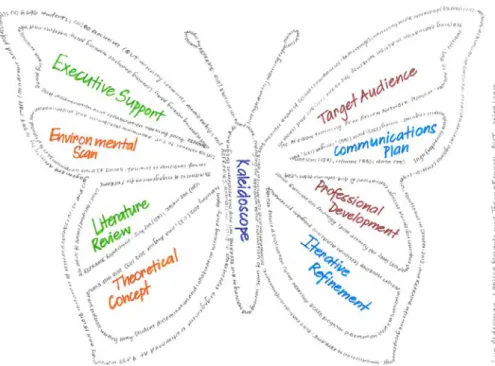
As shown in Figure 1 below, the conceptual model for Kaleidoscope is the shape of a butterfly. The discovery phase of the project lifecycle is the left wing which includes
executive support, environmental scan, literature review and theoretical concept as significant activities. The design phase, including production, is the main body of the butterfly with Kaleidoscope representing the local cultural specificity of the institution undertaking widespread organisational change. Delivery is the final phase and this is represented by the right wing of the butterfly which includes target audience, communications plan, professional development and iterative refinement as significant activities.
Figure 1 National Guidelines to Reframe Learning and Teaching Evaluation
The butterfly was selected to represent the life cycle of a project to emphasise that the three core phases are all required for the project, or the butterfly, to actually fly.
Conclusion
In conclusion, QUT offer the National Guidelines to Reframe Learning and Teaching Evaluation in a spirit of openness, collegiality and leadership towards the Australian Higher Education Sector. There are opportunities for transferability through Kaleidoscope to assist other institutions to engage in widespread organisational change that is sensitive to the cultural specificity of their own institution. These National Guidelines will continue to
develop through the engagement and stakeholder feedback at the AHEEF conference through this paper and an associated workshop. Ultimately, the National Guidelines to Reframe Learning and Teaching Evaluation will be available for public use through QUT’s ePrints portal.
Acknowledgement
The authors would like to acknowledge the contribution of Joanna Bennett in drawing the Kaleidoscope conceptual model by hand.
Bibliographic note Lyn Alderman
Ms Lyn Alderman’s portfolios within Queensland University of Technology include course quality assurance and evaluation of courses, units, teaching and student experience. With fourteen years Higher Education experience, Lyn strategically leads the Kaleidoscope initiative and was instrumental in the successful design, development and deployment of QUT’s Reframe Project. Ms Alderman continues to provide substantial leadership within evaluation of learning and teaching with increasing acknowledgement and recognition from leaders and peers across the sector. Tertiary qualifications, professional memberships, editor of the Evaluation Journal of Australasia, scholarly writing and evidence based investigations are firmly embedded within Lyn’s work.
Larissa Melanie
Ms Larissa Melanie is the Project Manager for the Learning and Teaching Unit at Queensland University of Technology. Her role as Project Manager for Reframe provided the insight to recognise the Kaleidoscope opportunity to provide a continuation of expertise and knowledge into the dissemination of QUT’s Evaluation Framework to the sector. With qualifications in project management and Master of Research Management and Commercialisation, current memberships with the Australian Evaluation Society (AES), Australian Institute Project Management (AIPM), Australasian Research Management Society (ARMS), Larissa is currently the project manager of two national Aboriginal and Torres Strait Islander federally funded Higher Education projects.
References
Abrami, P.C., Rosenfeld, S. & Dedic, H., 2007, ‘The dimensionality of student ratings of instruction: an update on what we know, do not know, and need to do’, in Perry, R.P. & Smart, J.C. (Eds.), The Scholarship of Teaching and Learning in Higher Education: An evidence-based approach (Dordrecht, Springer).
Alderman, L. & Bennett, J. (in press). An ethnographic study of Heads of School as agents for change in reframing learning and teaching evaluation. Brisbane: Queensland University of Technology.
Alderman, L. & McGrath, H. (2013). Reframe’s Communication and Dissemination Plan 2013. Brisbane: Queensland University of Technology.
Alderman, L. & Melanie, L. (2012a). Reframe at a glance. Brisbane: Queensland University of Technology.
Alderman, L. & Melanie, L. (2012b). REFRAME: a new approach to evaluation in Higher Education. Studies in Learning, Evaluation, Innovation and Development, 9(1), pp. 33-41.
Alderman, L. & Melanie, L. (2012c, Oct 8-10).How to meet stakeholders’ expectations, not management them? Workshop presented at the Australasian Higher Education Evaluation Forum (AHEEF). Rockhampton: Central Queensland University.
Alderman, L. & Melanie, L. (2013a). Kaleidoscope: National guidelines to reframe learning and teaching evaluation. Brisbane: Queensland University of Technology.
Alderman, L. & Melanie, L. (2013b). Kaleidoscope: Illuminating learning and teaching evaluation for a shared stakeholder lens. Workshop presented at the Australasian Higher Education Evaluation Forum (AHEEF). Launceston: University of Tasmania.
Alderman, L. & Melanie, L. (2013c, Sep 2-6). Kaleidoscope: Shaping A Better Future Through A Stakeholder Approach To Widespread Organisational Change. AES 2013 International Conference. Brisbane: Australasian Evaluation Society.
Alderman, L. (2012a, Dec 3-4). Cross-institutional Strategic Sharing and Planning Day: National presentation on Reframe: QUT’s Evaluation Framework. Hobart: University of Tasmania and Curtin University.
Alderman, L. (2012b, Sep 28). Reframe: QUT’s new approach to evaluation. Queensland and Northern NSW Development Day. Brisbane: Higher Education Research and Development Society Inc.
Alderman, L., Phan, L.H. & Bennett. (2013). Reframe’s Professional Development Workshops. Brisbane: Queensland University of Technology.
Alderman, L., Towers, S., & Bannah, S. (2012) Student feedback systems in Higher Education: a focused literature review and environmental scan.Quality in Higher Education, 18(3), pp. 261-280.
Alderman, L., Towers, S., Bannah, S., & Phan, L. H. (in press). Reframe evaluation of learning and teaching: An approach to change.Evaluation Journal of Australasia. Bandara, D. C. (2013, Sep 16). Sri Lankan Ministry of Higher Education: International presentation on Reframe: QUT’s Evaluation Framework. Brisbane: Queensland University of Technology.
Barrie, S., Ginns, P., & Symons, R. (2008, p.2). Student surveys on teaching and learning: Final report. Sydney: Australian Learning and Teaching Council (ALTC).
Berk, R. A. (2005). Survey of 12 strategies to measure teaching effectiveness. International Journal of Teaching and Learning in Higher Education, 17(1), 48-62.
Carroll, J. (2011, Sep). Oxford Brookes University: International presentation on Reframe: QUT’s Evaluation Framework. Brisbane: Queensland University of Technology.
Chalmers, D. (2010). Rewarding and recognising quality teaching in Higher Education through systemic implementation of indicators and metrics on teaching and teacher effectiveness. Australian Learning and Teaching Council (ALTC).
Driver, J. (2013, Jul 29). Simon Fraser University: International presentation on Reframe: QUT’s Evaluation Framework. Brisbane: Queensland University of Technology.
Harvey, L., 2011, ‘The nexus of feedback and improvement’, in Nair, C.S. & Mertova, P. (Eds.), Student Feedback: The cornerstone to an effective quality assurance system in Higher Education (Oxford, Chandos).
Hinton, T., Gannaway, D., Berry, B., & Moore, K. (2011). A Review of the Dissemination Strategies used by Projects Funded by the ALTC Grants Scheme. Brisbane: The University of Queensland.
Jacobs, C. (2000). The Evaluation of Educational Innovation. Evaluation. Vol. 6, No. 3, 261-280. London: SAGE Publications.
Kanthamanon, P. (2012, Sep 7). King Mongkut’s University of Technology, Thailand:
International presentation on Reframe: QUT’s Evaluation Framework. Brisbane: Queensland University of Technology.
Macquarie essential dictionary. (2000). Sydney: The Macquarie Library Pty. Ltd.p.433. Marchment, M. (2013). Newsletter Notes. Australian Association for Institutional Research Electronic Newsletter.
Marsh, H.W., 2007, ‘Students’ evaluations of university teaching: dimensionality, reliability, validity, potential biases and usefulness’, in Perry, R.P. & Smart, J.C. (Eds.), The Scholarship of Teaching and Learning in Higher Education: An evidence based approach (Dordrecht, Springer).
Parlett, M., & Hamilton, D. (1972). Evaluation as Illumination: A new approach to the study of innovative programs. London: Edinburgh University, Centre for Research in the
Educational Sciences.
Parlett, M., & Hamilton, D. (1976). Evaluation as illumination. In D. Tawney (Ed.),
Curriculum Evaluation Today: Trends and implications. Great Britain: Macmillan Education. Prosser, M., Ramsden, P., Trigwell, K., & Martin, E. (2003). Dissonance in experience of teaching and its relation to the quality of student learning. Studies in Higher Education, 28(1), 38-48. 14
Queensland University of Technology (QUT), 2011a, 2011 Performance Model. Accessed 29 Aug 2011, http://www.ltu.qut.edu.au/curriculum/coursequalit/cycle/icr/model.jsp.
Queensland University of Technology. (2011a). A/2.4 QUT Quality Framework. Retrieved 6 Mar, 2012, from http://www.mopp.qut.edu.au/A/A_02_04.jsp 16 Queensland University of Technology. (2011a). Annual report 2010. Available from
http://cms.qut.edu.au/_data/assets/pdf_file/0017/72053/annual-report-2010-20110915.pdf. Queensland University of Technology. (2013). Evaluation Protocols Version 6.0. Brisbane: Learning and Teaching Unit.
Salonda, L. (2012, Nov 22). PNG Divine Word University: International presentation on Reframe: QUT’s Evaluation Framework. Brisbane: Queensland University of Technology. Shapiro, J. P., Secor, C, & Butchart, A. (1983). Illuminative Evaluation: Assessment of the Transportability of a Management Training Program for Women in Higher Education. Educational Evaluation and Policy Analysis.Vol. 5, No. 4, 465-471.
Smiegel, H. (2013, Apr 16). Flinders University: National presentation on Reframe: QUT’s Evaluation Framework. Brisbane: Queensland University of Technology.
Tertiary Education Quality and Standards Agency, (2012). Report of an Audit of QUT, April 2012. Tertiary Education Quality and Standards Agency, (2012b).
Theall, M. & Feldman, K.A., 2007, ‘Commentary and update on Feldman’s (1997)
“Identifying exemplary teachers and teaching: evidence from student ratings”’, in Perry, R.P. & Smart, J.C. (Eds.), The Scholarship of Teaching and Learning in Higher Education: An evidence-based approach (Dordrecht, Springer).
Thomas, A. (2013, Apr 4). Southbank Institute of Technology – National presentation on Reframe: QUT’s Evaluation Framework. Brisbane: Queensland University of Technology. Towers, S., Alderman, L., Nielsen, S. & McLean, V., 2010, A risk-based approach to course quality assurance. Paper presented at the Australian Quality Forum 2010, Gold Coast, 30 Jun-2 Jul.
Tucker, B. M. (2013) Student evaluation to improve the student learning experience: an Australian university case study, Educational Research and Evaluation: An International Journal on Theory and Practice, 19:7, 615-627
Vaughan, S., Alderman, L. & Phan, L. H. (2013, Jun 4). Reframe: QUT’s Evaluation Framework.CMBE & CPMS Teaching and Learning Colloquium: The Open classroom – A led education sampler. Canberra: Australian National University.
Vaughan, S., Towers, S. & Alderman, L. (2012, Jun 5). Reframe: QUT’s Evaluation Framework – presentation to TEQSA university regulator. Teleconference: Queensland University of Technology.
Wallace, M. (2011, Apr 20). University of Wollongong: National presentation on Reframe: QUT’s Evaluation Framework. Brisbane: Queensland University of Technology.