0
Analysis of
e-commerce sites
using the 7C
Framework, by
developing a software
tool
Chih-Hsiang Yang
Unitec Institute of Technology Carrington Rd, Mt Albert, Auckland, New ZealandMaster of Computing 2016 Department of Computing Primary Supervisor: Dr. Xiaosong Li Secondary Supervisor: Dr. Hira Sathu
1|Page
Analysis of e-commerce sites using the 7C Framework, by
developing a software tool
Abstract
Businesses are moving rapidly to leverage the internet to market and sell their products through virtual stores or websites. The success of an enterprise is directly linked to e-commerce quality, and for businesses to remain competitive, evaluation of their e-commerce quality is important.
The primary research question:
• Whey evaluation is important?
Sub Research Questions:
• Why 7Cs have been used?
• Will automatic evaluation using a tool work reliably and accurately?
The objective of this paper is to develop an automated framework to evaluate the quality of a number of e-commerce solutions systematically through use of a tool, and to determine the value of such an approach.
The 7C Framework was used as the reference for the study because of its unbiased approach in emphasising the communication channels between the business and consumer in delivering the core value proposition. This approach was combined with web data mining, where an application was developed to extract elements from the HTML in web pages by accessing their hyperlinks. By mapping the elements within the 7C Framework against those extracted from a web page, a consistent approach was determined that can be replicated to analyse websites. Using this data, an analysis was done, covering as many elements within the 7C Framework as possible. Scores were assigned to each of the user-facing elements of the 7C Framework based on what the application detected, and the final score for each e-commerce solution was the sum of scores for each element.
2|Page Our analysis was performed by running the application on a selection of B2C and C2C sites of varying scale and user base, such as Amazon, eBay, TradeMe and Walmart, where it was found that that larger sites such as eBay scored higher and sites that were limited to a smaller demographic such as TradeMe appeared to score lower. No website performed poorly overall, which was to be expected, as all e-commerce sites used are established and are considered successful within their own target demographics.
Overall, we can conclude that our approach generates results that are representative of e-commerce success and further work should be undertaken to utilise the merits of the approach investigated more fully in this effort.
3|Page
Acknowledgement
Firstly, I would like to thank my supervisor Dr. Xiaosong Li and Dr. Hira Sathu. Their great support and valuable feedback have helped me during the thesis writing. I have gained great research skills and experience from them. They not only assist me with their knowledge, but also guided me through the whole process of the Master study.
I would also like to thank Helga Arlington. She helped me check grammar and content edit for my thesis.
Finally, I would like to thank my family for their love and support. Without them I would have never had the courage to accomplished so much.
4|Page
Attestation of Authorship
I here by declare that this submission is my own work and that, to the best of my knowledge and belief, it contains no material previously published or written by another person nor material which to a substantial extent has been submitted for the award of any other qualification in a degree or diploma of a university or other institute of higher learning.
Chih-Hsiang Yang
0
Table of Contents
1 Introduction ... 3 1.1 Background ... 3 1.2 Problem definition ... 6 1.3 Research questions ... 7 2 Literature review ... 8 2.1 What is e-commerce? ... 8 2.2 The 7C Framework ... 92.3 Extending the 7C Framework ... 12
2.4 Evaluation of Web User Interfaces and e-commerce solutions ... 13
2.5 Internet-related technologies and systems to extract information ... 15
2.6 Software solutions to evaluate web user interfaces ... 17
3 Research methods ... 19
3.1 Research design ... 19
3.1.1 Qualitative analysis ... 19
3.1.2 Quantitative analysis ... 19
3.2 Software design ... 20
3.3 High level software design ... 21
3.4 Development timeline ... 22
4 Application in evaluating user interfaces ... 27
4.1 Context ... 28 4.2 Content ... 30 4.3 Connection ... 30 4.4 Commerce ... 31 4.5 Community ... 32 4.6 Communication ... 33 4.7 Customisation ... 33 5 Measurements ... 34
6 Experiment and analysis (case study: comparison between e-commerce sites) ... 38
7 Research limitations ... 42
8 Conclusions ... 45
1|Page 8.2 Further work ... 46 9 References ... 48 10 Appendix 1: Processed data from e-commerce websites ... 53
2|Page
List of Tables
Table 1: Meanings/Examples of the 7Cs ... 11
Table 2: UA 2.0 Retrieved Elements ... 27
Table 3: Table of applicable elements ... 28
Table 4: Mapping between UA and Context Specific Elements ... 29
Table 5: Mapping between 7C Framework and extracted data using UA 2.0 ... 35
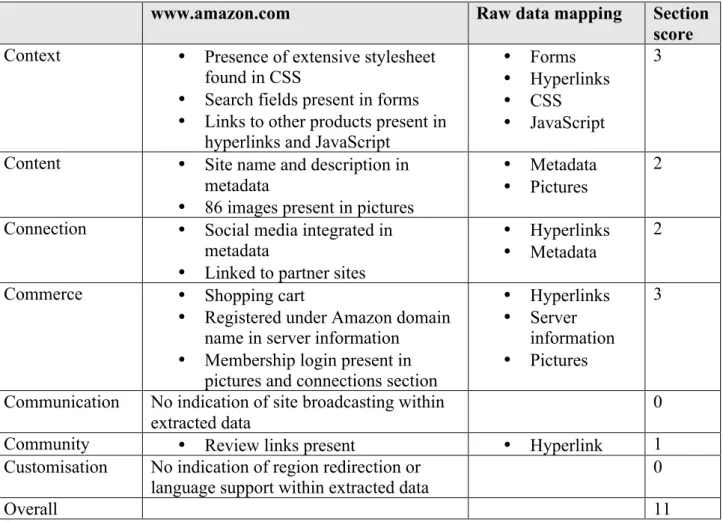
Table 6: Amazon data extracted by UA 2.0 ... 37
Table 7: Table of sites of interest ... 38
Table 8: Results of UA 2.0 Multi-website automated analysis ... 41
List of Figures
Figure 1: UA Application High Level Architecture ... 22Figure 2: UA 1.0 ... 23
Figure 3: UA 1.5 ... 24
3|Page
1
Introduction
1.1
Background
The internet has evolved from its humble beginnings as a DARPA- (Defense Advanced Research Projects Agency) sponsored project (an agency of the U.S Department of Defense, used primarily by scientists and researchers) to what is now known as the “World Wide Web” or the internet. The internet is used by billions of individuals globally for numerous daily tasks and applications, for recreation, research and business. The internet is composed of innumerable websites, all accessible through a reference field of text called the “Uniform Resource Locator” or hyperlink, and accessing a website simply involves typing the hyperlink into a web browser.
The World Wide Web has evolved, especially over the past decade, and has gone through many changes in design, such as those made possible by the use of JavaScript and Flash in webpages, and in the services the internet can now provide (i.e. commerce, social networking, etc.). Such is the evolution of the internet that more and more businesses can leverage the technology available easily and establish online ‘shops’. Online business can be conceptualised as e-commerce, and due to the nature and convenience of online shopping as a very common example of e-commerce, the practice has become the standard for companies aiming to gain an advantage in today’s highly competitive market. E-commerce is now a key point of interaction between businesses across various sectors and their clients and stakeholders [1].
The advancement of technology and the internet in the 21st Century has paved the way for the rapid expansion and adoption of e-commerce solutions for businesses. The remarkable convenience of tablet computers, smart phones and mobile internet has made e-commerce more lucrative than ever as accessing millions of services can be achieved with just a few swipes at the user’s convenience. A survey by Coleman Parkes Research in 2013 indicated that almost two out of three companies forecast e-commerce to be between 21% and 40% of their business and that companies are prioritising e-commerce adoption over physical presence [2].
The scale of e-commerce as a virtual marketplace is enormous because of its defining characteristics of being available at all times and readily accessible. If this is in contrast with traditional brick and mortar stores, which have limited opening hours and less convenience, as well as greater overhead costs – thus e-commerce solutions have very clear advantages. The
4|Page extent of commerce growth can be seen in the case of the Alibaba Group, a Chinese e-commerce company that provides consumer-to-consumer, consumer and business-to-business sales services using web applications [3]. This company was publicly listed in 2014, raising $US25 billion and making it the largest ever, global initial public offering and showing the scale of just how large e-commerce companies can become [4]. Other e-commerce companies such as Amazon and eBay are also dominant in the online retailing market through strong customer relationships made through exploiting their digital assets.
A more effective e-commerce solution attracts more users and is critical in the success of business done through electronic means. There are several important factors to consider when designing an e-commerce solution for a business, which include the quality of content, suitability, aesthetics and language. However, a tool to evaluate e-commerce solutions would be of great potential benefit to businesses.
Businesses already offer the service of evaluating web sites and improving them, and many corporations handle their own web applications. User analytics are popular – technology giant Google has created a tool which tracks usage statistics of online behaviour in a website and feeds it back to stakeholders [5]. The objective of this research is to provide a method of evaluation that leans more towards the theory of e-commerce and to develop a tool that streamlines this evaluation. This presents a different view of e-commerce solutions and offers another method in bridging the gap between e-commerce site users and business owners. Our tool should be able to obtain website user interface information, such as colour schemes and animations, in a consistent format, which can then be evaluated easily against a reference model known as the 7C Framework. As conceptualised by Rayport [1], the 7C Framework is a reference framework used as a means of encapsulating the individual elements of the design of a web page [6]. As indicated by Lee and Benbasat [2], “the 7C framework is chosen as the reference for comparison, because it emphasizes the specific role of interface elements as a communication channel between retailers and their customers”. In other words, the 7Cs are the interface components through which retailers communicate with their customers to deliver the core value proposition the company wants to convey [7] and serve as an effective and unbiased method of measuring how each individual user-facing element is conveyed.
5|Page When comparing a system such as the 7C Framework, with its defined analysis criteria, to existing methods of evaluating e-commerce websites, the results may not be comparable. The 7C Framework requires human interaction to map the observed features in a web page to the corresponding responsible element within the 7C Framework. This is subject to bias, as it requires human interaction and decision-making. In order to remove this element of human bias, a consistent approach is required for e-commerce website evaluation.
What attracts customers to e-commerce websites is determined largely by the quality of the website. This consists of elements including the appearance, content quality, ease of use, site performance and interactivity. Quality is what differentiates e-commerce solutions in the online marketplace and methods of evaluating this naturally exist already. Businesses follow the general principle where “the customer is always right” and user analytics tools such as Google Analytics are used to determine how users interact with the site. Decisions regarding improving e-commerce website quality can be made based on these. Comparing this approach with the 7C Framework, the main difference lies in the method of obtaining data, and this changes the scope of its use.
6|Page
1.2
Problem definition
Despite the expansive scope of e-commerce and the impact it has on people’s daily lives, research on user interface analysis is quite varied as multiple streams of research have adopted different approaches towards assessing the performance of user interfaces. Currently, user analytics appear to be the current trend with Google Analytics being one of the more powerful tools in analysing user behaviour [8].
E-commerce website quality determines the success of the business e-commerce venture. Thus, to establish the quality of e-commerce websites, it is necessary to utilise a model that adopts a qualitative, systematic and repeatable approach to e-commerce websites. The model chosen for this research is the 7C Framework [9].
The problem statement of this research is to determine the value in an approach where a reference framework such as the 7C Framework is used to evaluate e-commerce website quality automatically, using an application or tool. In making this evaluation, a web URL data mining method was used to extract the raw data, which was then analysed using the 7C Framework. The automation of e-commerce websites analysis requires both qualitative and quantitative methods of analysing data. This has been one of the core challenges for this research. Such a tool would allow a user to obtain a top-level view of an e-commerce website and rank it against other e-commerce websites, irrespective of the target demographic or the site’s success, and to draw conclusions based on this.
When evaluating websites, data extraction begins from the home page and then propagates to the linked pages. Evidence of this approach is provided by Lynch and Horton – their results show that home page views are significantly higher than views of the rest of the website [10] and thus give the confidence that performing analysis on the homepage of a website alone gives sufficient coverage of the quality of the site. Many tools exist that extract web page properties by simply passing through the hyperlink of the web page. These properties include visual elements including layout and colour schemes, as well as web site metadata and web server location.
7|Page
1.3
Research questions
Despite the ease of being able to obtain detailed web information about individual web pages, our research indicates that there is no evidence in literature of a software tool designed for the purpose of website interface evaluation using the 7C Framework as a reference model. There has been previous work done developing frameworks and models to evaluate e-commerce websites against a series of set criteria on different platforms. It is important therefore, that a tool is developed to evaluate websites in bulk against the 7C Framework, to broaden the scope of user interface analysis and to assess the validity of using software solutions with a higher degree of automation to evaluate e-commerce websites against the 7C Framework.
The objective of this research is the investigation and development of an approach that can evaluate e-commerce websites using a reference framework. To achieve this, an independent software application that enables the user of the application to automate the analysis of the effectiveness of a user interface was developed. The approach works by first, using a software application to extract the data relevant to a webpage, and then analysing the extracted data by comparing it with the elements of the 7C Framework. The intention of this is to determine the validity and overall effectiveness of using a web data mining approach to analyse a user interface and therefore determine the strengths and weaknesses of such an approach and improvements that could be made. Ideally, use of this software solution should offer the means for businesses, researchers and consultants to draw valid comparisons and conclusions about e-commerce solutions in key areas such as website presentation, navigation, features and security.
8|Page
2
Literature review
2.1
What is e-commerce?
Electronic commerce or e-commerce is a term that conceptualises commerce or trading using the internet. The simple convenience of having access to a large number of both physical and non-physical resources by using a computer has changed current human life from a fundamental standpoint, along with the form of how businesses are managed and accessed. The presence and existence of virtual marketplaces that have no physical form but which allow customers to purchase a variety of goods, services and even information from their location of convenience is an incredible leap from traditional stores.
Rayport [1] defines e-commerce as “technology-mediated exchanges between parties (individuals, organisations or both) as well as the electronically based intra- or inter-organisational activities that facilitate such exchanges” [6]. From a fundamental standpoint, the degree to which users interact with each other and to businesses has changed. Purchasing and trading can happen at any time, price comparisons can be made with ease and there are automated services to handle simple user queries.
Bill Gates has described e-commerce as “frictionless” or “friction free capitalism” [3] – meaning that e-commerce has excellent economic properties for a ‘perfectly competitive’ industry. The trait of being “frictionless” means that e-commerce satisfies the following three assumptions:
• Search costs – consumers can effortlessly, and at no cost, find the cheapest price no matter
how many sellers operate in the market
• Repeated interaction – sellers cannot react to price changes made by competitors;
assuming a “one-off” interaction
• Products are completely identical and price is the only factor in determining consumer
behaviour – disregarding brand loyalty, quality of service, product differentiation and mass customisation
9|Page The four main classifications of e-commerce are Business (B2B), Business-to-Consumer (B2C), Business-to-Consumer-to-Business and Business-to-Consumer to Business-to-Consumer (C2C) and categorise the major party-to-party interactions [6].
• B2B transactions involve multiple businesses such as wholesaling of goods between
manufacturer and store
• B2C transactions are the most common and such transactions are generally an online sale
of a good or service from a business to a customer
• C2B describes the sales or transfer of goods or services from end users to businesses • C2C describe an internet-driven community of users who trade with each other
These classifications of e-commerce, although different in some ways, all must happen using some form of communication. The current standard of communication between parties, especially in a B2C and C2C scenario, happens through an electronic customer interface which allows communication between interested parties in a consistent manner.
2.2
The 7C Framework
Before introducing the 7C Framework, it is important to clarify what a customer interface is and what part it plays in our e-commerce analysis. With regard to the interaction between humans and computers known as HCI, “human-computer discipline [is] concerned with the design, evaluation and implementation of interactive computing systems for human use and with the study of major phenomena surrounding them [11].” User interfaces for e-commerce web sites – also known as “customer interfaces” – represent the store’s theme and level of appeal to the users of the web store [12].
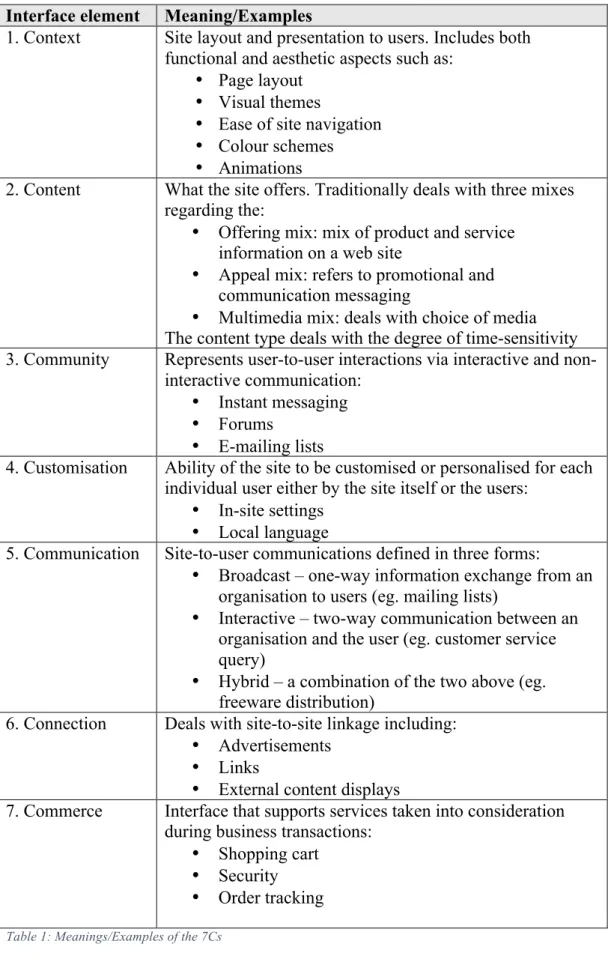
The 7C framework includes seven elements, each representing a component of the interface [12]:
• Context – website design
• Content – information on the website
• Community – communication between users
• Customisation – extent to which the site can be customised • Communication – site to user communication
10|Page
• Connection – relationship between this and other sites • Commerce – e-commerce functionality
The 7C Framework looks specifically at customer interface elements – what the user sees – and it was for this reason that it was chosen as the reference model for our e-commerce analysis. In this sense, the interface elements encapsulated by the 7Cs represent the method through which businesses communicate with customers to deliver the core value proposition each company wishes to convey [12]. A more detailed look at the 7Cs can be seen in Table 1 where each interface element has been mapped to its meaning, and practical examples of scenarios are provided. Previous research on e-commerce evaluation will be discussed in later sections.
11|Page Interface element Meaning/Examples
1. Context Site layout and presentation to users. Includes both functional and aesthetic aspects such as:
• Page layout • Visual themes
• Ease of site navigation • Colour schemes • Animations
2. Content What the site offers. Traditionally deals with three mixes regarding the:
• Offering mix: mix of product and service
information on a web site
• Appeal mix: refers to promotional and
communication messaging
• Multimedia mix: deals with choice of media
The content type deals with the degree of time-sensitivity 3. Community Represents user-to-user interactions via interactive and
non-interactive communication:
• Instant messaging • Forums
• E-mailing lists
4. Customisation Ability of the site to be customised or personalised for each individual user either by the site itself or the users:
• In-site settings • Local language
5. Communication Site-to-user communications defined in three forms:
• Broadcast – one-way information exchange from an
organisation to users (eg. mailing lists)
• Interactive – two-way communication between an
organisation and the user (eg. customer service query)
• Hybrid – a combination of the two above (eg.
freeware distribution)
6. Connection Deals with site-to-site linkage including:
• Advertisements • Links
• External content displays
7. Commerce Interface that supports services taken into consideration during business transactions:
• Shopping cart • Security • Order tracking Table 1: Meanings/Examples of the 7Cs
12|Page
2.3
Extending the 7C Framework
The way users interact with web applications has been changing dramatically over the past decade, as a result of advances in web development. A number of authors have noted that there are many issues not covered by the 7C Framework, which has not kept up with the recent developments. Numerous attempts have been made to extend the 7C Framework by other researchers, in order to gain greater insight into evaluating and improving e-commerce solutions. In summary, it can be said that modern web applications offer the means to “empower individual users with relatively low technological sophistication in using the Web to manifest their creativity, engage in social interaction, contribute their expertise, share content, collectively build new tools, disseminate information and propaganda, and assimilate collective bargaining power” [13].
Models such as the 8C Framework [14] extend the 7C Framework to add ‘Collaboration’ as the eighth ‘C’ or element of a user-facing interface. The concept of collaboration is a characteristic of the current state of web applications where users have a much greater influence over the content and direction of specific web applications such as Wikipedia. Social media websites such as Twitter and Instagram utilise user collaboration and sharing effectively to create the content on the website.
Although it can be argued that the concept of collaboration between users also can be classed as a form of community within the original 7C Framework, Yang et al. identified that the key difference between the two is that “collaboration is task-specific while the community element defines a set of communication methods and is not related to a specific task or goal” [14]. Despite this difference, however, we believe that collaboration is a branch of community despite possessing the key characteristic of being task-driven. For the purposes of our study where the user interface is less applicable in the customer-to-customer sense, the aforementioned element of collaboration is minimal.
Aside from the 8C Framework, which uses collaboration as the eighth ‘C’, there have been numerous other 7C and 8C frameworks. Hamilton and Gunesh [15] for instance, define a framework including an eighth ‘C’ of ‘characterisation’ in order to account for modern web applications’ ability to adapt and modify themselves, creating an impression that the website is tailored to the customer. Such adaptability can be classified under the customisation elements for modern web applications [14].
13|Page Benefits of the 7C Framework has been found in the evaluation and design of marketing resources and web advertisement. Triki and Abidi [16] indicate that “e-advertisement was considered as a promising constituent of the economic activity enticed by the big potentialities offered by the advertisement on the Internet”. They state that the advancement of the internet and related technologies provides organisations with the resources to conduct marketing tasks in an economical and efficient manner. To evaluate the effectiveness of web sites, Triki and Abidi utilise Rayport and Jaworski’s 7C Framework when evaluating the ergonomics of business web sites [16].
The 7C Framework has also been extended to act as a point of reference for analysis of mobile interfaces. The key issues that the 7C Framework misses when dealing with mobile interfaces are grouped under ‘mobile settings’ and ‘mobile device constraints’. Mobile settings represents the environment unique to mobile technology, where mobile users can perform their tasks at any time, location or context [17]. Mobile device constraints encapsulates the inferior performance of mobile devices due to their smaller screens, less convenient input capabilities and lower system processing power and memory compared to their desktop counterparts.
2.4
Evaluation of Web User Interfaces and e-commerce solutions
The first formal approach to the evaluation of e-commerce web sites was developed by Boyd Collins in 1995. He founded the ‘Infofilter’ project, a model for librarians to evaluate the quality of information found on the internet [18]. Six criteria made up the model: content, authority, organisation, searchability, graphic design and innovative use. Much has changed since then and the rapid growth of web technology rendered the model obsolete within two years of its being created. However, internet search engines reveal numerous web sites claiming to provide web site evaluation criteria and most of these use the Collins criteria as a basis.
Graphical user interfaces exist within most web applications to eliminate the complexity in human-computer interaction. Pressman [4] defines interface analysis as a part of the development process, and focuses on a key set of rules for designing user interfaces. A set of questions provide a summary for users, and four elements are defined: users who will use the system, tasks that the user must perform, content within the interface and the work environment where the user will conduct these tasks. Pressman heavily relies on user input as the primary source of analysis of the design process.
14|Page Another branch of research employs WebQual as a tool to assess the quality of web sites by looking at three main areas – site usability, information quality, and service interaction quality – to provide a balanced perspective in assessing e-commerce offerings. The tool takes the form of a questionnaire of twenty-two questions to be answered by customers. WebQual has been refined over the years by many parties to make the questions more concise while improving on the coverage of the questionnaire in the three key fields of usability, information quality and service interaction. In WebQual 4.0, Barnes and Vidgen applied the application to three websites, Amazon, BOL and Internet BookShop, in order to determine the mean scores across a sample of 376 students and staff of a university. Despite the bias of using a sample from a specific target demographic, the aim of the experiment was to obtain relevant information from users who have had experience in using web user interfaces to purchase goods online [20].
Research with the intention of evaluating e-commerce elements within a web page is not a new area. Methods of assessing e-commerce sites have been considered previously by Boyd, who adopted the GQIM model in order to measure customer satisfaction. The high-level framework identifies the business requirements, goals and various other elements used to help achieve the key goals. This is done using a comprehensive set of questions of key stakeholders’ effort, and relies heavily on user interaction [21].
Hung and McQueen chose to instead construct a tool specifically for the evaluation of e-commerce web sites from a first-time-buyer’s viewpoint, by choosing criteria based on several theoretical models from business transaction, web user satisfaction and web evaluation literature. This instrument uses these concepts to find what gives user satisfaction. The questionnaire is not unlike that of WebQual 4.0 in that each question accepts a score as an answer, elaborating a binary response to ascertain if the elements in question are detected [22].
Delong and Maclean’s (D&M) model is regarded as a major breakthrough in the field of information systems [5]. The D&M model can be interpreted as: “Systems quality and information quality singularly and jointly affect both user and user satisfaction. Additionally, the amount of use can affect the degree of user satisfaction positively or negatively” and of course the opposite is also true [23]. The model itself works by providing a framework for improving each individual element of system quality and information quality, to therefore improve individual and organisational impact. Molla and Licker extend the D&M model by creating an independent
15|Page variable which is used as a proxy for assessing e-commerce success. This variable is called customer e-commerce satisfaction (CES) as a means of incorporating user satisfaction into the evaluation of website evaluation [5].
McLean and Blackie performed research for consumers on seven facets of e-commerce from a socially constructed approach to a knowledge management perspective [25]. The seven facets include communications, sales, marketing, links to related sites, company information, online communities and links to customer reviews. The study reviews how customers value the seven facets of e-commerce in order to build a profile of interest in any particular category for business or customers that are of interest or indifference [26]. This seven facets approach is not unlike the 7C Framework where there is significant overlap of elements and is a variant of research in developing a framework to determine e-commerce success.
In more recent work, Jakob Nielson discusses website site usability, effective naming conventions and effective content. This work reflects trends in observing current problems with e-commerce websites and improving their usability for the current demographic of internet users. Elements considered include outdated navigation menus [27], poorly described links [28] and website content legibility [29].
2.5
Internet-related technologies and systems to extract information
The following is to explain the prevalent technologies and systems to retrieve data from hyperlinks features and information, and methods of automating the retrieval. First, two popular technologies for the retrieval of hyperlink features and information will be considered. One is the internet browser. It is the most common and popular application used to retrieve the information and features of hyperlinks. Typical examples include Microsoft IE, Apple Safari, and Firefox. Once users input or click one hyperlink connecting with a specific piece of information, the features of that hyperlink are retrieved and analysed in order to access the information and such features and information will be automatically saved in the user’s computer [6].
Web pages are traditionally written in hypertext markup language (HTML); a language that can be ‘rendered’ by a web browser to look like the web sites we have become accustomed to seeing. HTML handles everything we see when loading a webpage including the page formatting, colours and images. The current standard for web pages is use of a so-called ‘cascading stylesheet’ to
16|Page handle the formatting and colour schemes within the webpage, while HTML is still used to process the content within the web page.
Another important part of the technology of the web is the domain name service (DNS) server. Its role is to map the hostname of a URL on behalf of the domain name service. The DNS is a hierarchical name distribution system for computers, services and resources that are connected in a private network or the internet. When these entities have queries for names, DNS will resolve such queries into Internet Protocol (IP) addresses in order to locate computers, services, and devices. DNS is an essential component to ensure the functioning of the internet. In large networks, many DNS servers can collaborate to provide the mapping between host names and IP addresses [7]. WHOIS is another query and response protocol used for querying databases that stores the registered user or assignees of an internet resource, such as a domain name, and IP address block, or an autonomous system and delivers results in a readable format to the users of the website, or in other words, delivers information about the website to users [8].
As mentioned, typical web browsers retrieve web pages from the web servers and ‘render’ them (convert the HTML code into the visual web page). Web browsers can also allow advanced options where viewers can see the raw source code and associated objects and certificates. In practice, this is merely a huge file written in HTML and it can be retrieved for each web page and broken down into its subsequent components by section. The HTML file is comprised of a few key sections which form the core functionality of the website and which are known as JavaScript, CSS and hyperlinks – which are responsible for website responsiveness, formatting and links respectively. Components which utilise features that include these elements are coded in a specific manner which allow them to be distinguished by the browser.
In addition to these common technologies that are popular with internet users, there are specific feature-rich URL applications being developed for specific purposes [6]. Security is a large component within e-commerce, where parties use fake websites or ‘adware’ to obtain customer credit card details or personal information. The online learning approach to detecting malicious websites examined by Ma, J., Saul, L. K., Savage, S., & Voelker, G. M. is an example of such a specialised application [8]. This approach uses lexical and host-based features or features related to the physical locations of URLs to detect whether websites are malicious. The result shows that this approach is especially suitable for online algorithms or strategies because the features
17|Page typifying malicious URLs are employed in a continuously changing way. The online learning approach works well to detect malicious websites because it is a real-time system used to gather URL features dynamically by referring to a real-time source of the labelled URLs from a large provider of web mails.
A more simplistic approach to detecting malicious websites is to view factors including ownership details, location, popularity and other online sources related to reviews, threat, ‘phishing’ and others. An example of this is nikeshoe.co.nz, which received a low trust rating on ScamAdvisor.co.nz, a website security evaluator. Key factors leading to the low level of trust included tests of the components of the retrieved server information, which revealed that multiple similarly-named websites were hosted on the same server, and that the registered email addresses were free ones. ScamAdvisor also found that the location of the server was in Lithuania despite the owner being from the United States, which is another indicator of fake or illegitimate websites [30].
2.6
Software solutions to evaluate web user interfaces
The vast majority of tools that evaluate an e-commerce web site’s effectiveness do so by using user analytics as the preferred method. A simple search brings up a range of web analytics tools focussing on different elements of web interaction including user clicks, traffic volumes and the effectiveness of moving between different content types. Arguably the most proficient tools on the market now to analyse e-commerce web applications and customer behaviour are Google Analytics and Google Website Optimiser, which are free tools that conduct web analysis as described. Google Analytics works by analysing key user metrics including website visitor traffic, the virtual route customers take to get to the web page and how customers interact with the customer interface [8]. As these tools monitor user behaviour, it is important to note that the scope of user analytics differs from evaluating a web interface using a reference model.
Other methods of analytics compare performance across websites using a tool installed within the user’s web browser. An example of this is Alexa, which takes information from web browser toolbars or extensions and calculates a rank for a website based from the data gathered, and displays it in an ‘Alexa browser extension’ [31]. The key metric or statistic for this is that it notes the number of site visitors per unit of time, and the website rank is based upon this. The value for
18|Page companies and potential investors is in understanding visitor count of competitors relative to each other [32].
Web extraction tools that extract data from multiple websites in a single iteration are fairly common. These applications all work in similar ways by providing an easy-to-use user interface to extract specific files and elements from a URL with other functionality such as automating rules-based tasks, amongst other features. To varying extents, these tools would be capable of performing e-commerce evaluation on websites and likely already do so, but they are unlikely to perform well against a strict framework and are therefore likely to be extremely limited in scope when attempting to evaluate against a reference model such as the 7C Framework.
Web site accessibility checking has also become increasingly common with a number of free tools appearing across the internet. Tools including Accessibility Valet, AChecker and OCAWA which process URLs and evaluate the corresponding website or domain against a set of accessibility guidelines such as Web Content Accessiblity Guidelines (WCAG) [9] and section 508 standards [10], both of which are standards for web accessibility. As far as data analysis is concerned, the application of extracting and analysing web properties from a web page is not an uncommon task and web content data mining tools are commonplace within the internet.
19|Page
3
Research methods
3.1
Research design
Most e-commerce website data gathering is done using quantitative approaches where large amounts of user data is gathered to draw conclusions. Examples of this include user behaviour or user surveys, where large amounts of user data is sampled, quantified and compared against what is expected. No method of analysis is free from some degree of bias and quantitative methods seek to reduce this as much as possible.
The purpose of automation of e-commerce website analysis is to perform both qualitative and quantitative analysis. This offers a better view into how a website can be improved when compared with other websites and can help in reducing the bias in website analysis. It is expected as part of our analysis that more successful e-commerce solutions or e-commerce solutions larger in scale and revenue would score higher.
3.1.1 Qualitative analysis
A qualitative approach to analysing e-commerce sites involves a less elegant method of manually producing detailed reports about a web page. Subsequent attempts to improve a webpage after data has been gathered is generally done in this way, where the elements within the web page are critically analysed and re-evaluated. However, different professionals can provide widely different advice depending upon personal opinion.
In this experiment, we are using the 7C Framework to analyse websites qualitatively, using the criteria set in the Framework itself. A web URL will be passed through our application and elements of the URL will be extracted then mapped to the applicable customer-facing element of the 7C Framework. This will be done by detecting certain keywords pertaining to various features of e-commerce websites.
3.1.2 Quantitative analysis
Traditional quantitative analysis samples user actions or opinions about a single site. The method proposed for this work sought to gather a greater variety of data from various sources to create a generalised ranking of websites. The data gathered from each site was kept consistent, and scope was limited in order to keep the conclusions relevant.
20|Page Quantitative analysis was used in this experiment to compare information between multiple sources of data or different e-commerce websites. In order to have enough data to compare, we wanted to have a large number of web sites (at least ten) of varying demographic target customer base. These would be used to determine the difference in quality in respect of the success and target audience of an e-commerce web site. For this experiment, twelve websites were chosen, based on factors including internet rankings of popular e-commerce web-sites and e-commerce websites with a known target demographic. Raw data files for all twelve websites were created, and the raw data from each was analysed without looking at the actual site. Based on certain keywords used commonly in websites, the results were mapped to the relevant elements in the 7C Framework.
3.2
Software design
A specific tool to automate the evaluation and analysis of e-commerce web user interfaces was not found in our literature search. The tools found primarily were surveys [20] or alternative frameworks born from consulting and web analysis such as GQIM [21]. This lack of tools became our motivation for developing our own application to extract data from web pages directly and to analyse such data quantitatively instead of imposing human bias before having extracted the data. Ideally, in order to design the best tool for the automation of e-commerce user interface evaluation, we would need to design an application that could emulate human analysis during the evaluation. The approach we adopted instead was to use a software tool to determine details about a web user interface through raw data extracted, in contrast with the approach of obtaining a user sample to evaluate a web user interface visually. Our application adopts a traditional web data mining approach by using knowledge of web architecture to extract details about a website by inputting the URL to the website.
The approach that we took to designing our tool to perform e-commerce analysis was a quantitative method based on data-mining, using hyperlinks as the input. We wished to extract the following key areas of data from the web URL:
• Related information to the URL (hostname, path, tokens, query, fragment, HOWIS info, IP
address, etc.)
21|Page
• Security and website demographic information (hostname, path tokens, query, fragment,
WHOIS info, IP address, etc.)
However, unlike the online learning approach of Ma et al [35], the proposed system will focus on the WHOIS information and the possibility of extracting other features from a hyperlink, such as keywords in a webpage, or some features related to the use of JavaScript. These features would be likely to be useful for any classification of the web pages. Ideally, there would be a general way, independent of classification, to measure the effectiveness of a feature in representing the information on a web page. For instance, when dealing with text documents, a ‘bag-of-words’ model which is used in image recognition by treating image features as words [36], is a fairly good representation of the kind of content on the page. If word order were also included in the model, it would come much closer to representing all the information encoded in the document. However, web pages are multi-dimensional concepts that layer semantic and visual annotation on top of the already rich semantics of text. This makes it much harder to verify the features theoretically. For example, all ‘phishing’ websites are likely to hide themselves in order to avoid being detected easily and identified by users [37]. As for the WHOIS info, it is valuable to identify the owner and/or operator of a website. If a person is identified as the operator and/or owner of a phishing website, other websites run or owned by him or her are doubtful. Such information is helpful to decide security questions where websites are phishing, since operators of such sites usually operate them in bulk [38].
The ability to detect JavaScript is important, as JavaScript serves in current web applications as the primary means for users to view additional content on a web page without completely reloading it. JavaScript is an ‘object scripting language’, which is used in web pages in conjunction with HTML and is typically used to create dynamic content and therefore highly responsive interfaces. Web applications such as AJAX (Asynchronous JavaScript and XML) and JQuery are web technologies based on JavaScript, and which can be used for a variety of formatting and interface responsiveness features [39].Any form of animation, site interactivity or dynamic web content is handled by JavaScript, specifically, the ‘look and feel’ of the web page.
3.3
High level software design
The aim of this research is to develop an approach utilising the 7C Framework and a software tool to extract data to be evaluated against the 7C Framework. The tool extracts data from the HTML
22|Page within web pages using their hyperlinks or URLs. Within this research, the tool is called URL Analyser (UA)
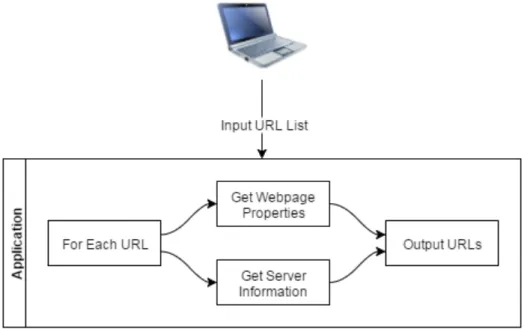
UA is a Java-based application with the core functionality of retrieving website and server information from a URL or hyperlink. The application opens a window where the user selects the input file containing the web page links and the output directory for the results. Once the input and outputs are configured, the application can be run to retrieve webpage information and server information for any individual web page. The standard use case diagram and high-level workflow diagram behind our application can be seen below in Figure 1.
Figure 1: UA Application High Level Architecture
3.4
Development timeline
An overview of the development process is useful, so that the requirements and the knowledge needed to develop similar software are outlined. Our application was developed in the popular programming language known as Java, which is the foundation for virtually every type of web application and which acts as the global standard for developing web content, applications and software, amongst other things [40]. The program we have written is capable of being run on any computer with Java installed, and can be easily modified at the code level by other developers, businesses or individuals who want to adapt the tool for their own problems or to further develop the functionalities.
23|Page The features noted in Section 3.1 were built using an iterative development process where each new feature was added to subsequent versions of the application.
24|Page
25|Page
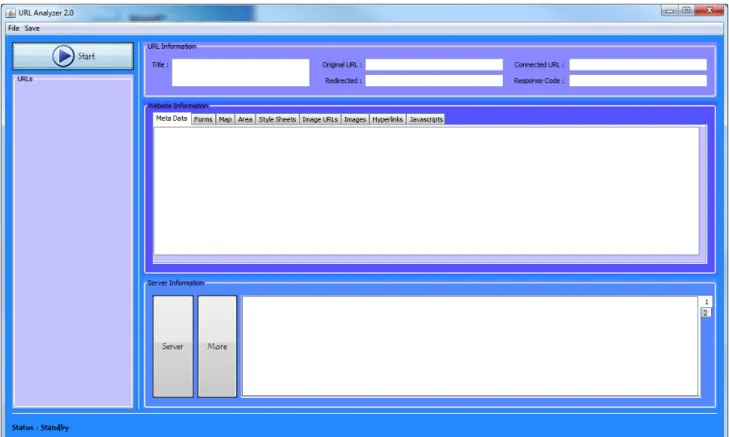
Figure 4: UA 2.0
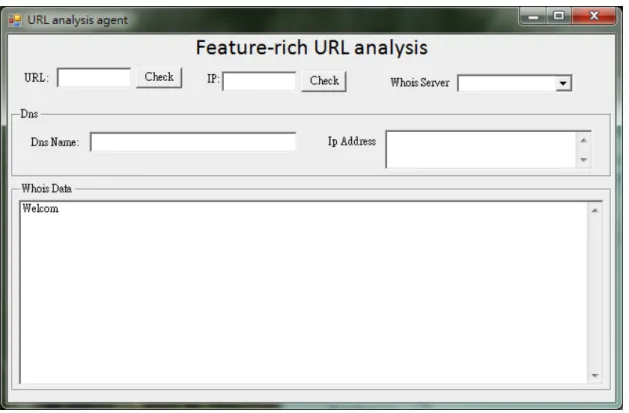
Version 1.0 of the application simply retrieved URL features from different service providers and after studying the threads from the National Vulnerability Database, applied those to the application to analyse any malicious codes. Security analysis was dealt with by the primary build for two reasons: online security is an important component of e-commerce transactions and is relevant to the 7Cs of e-commerce as a component of the ‘commerce’ element. This version successfully retrieves WHOIS information from different servers.
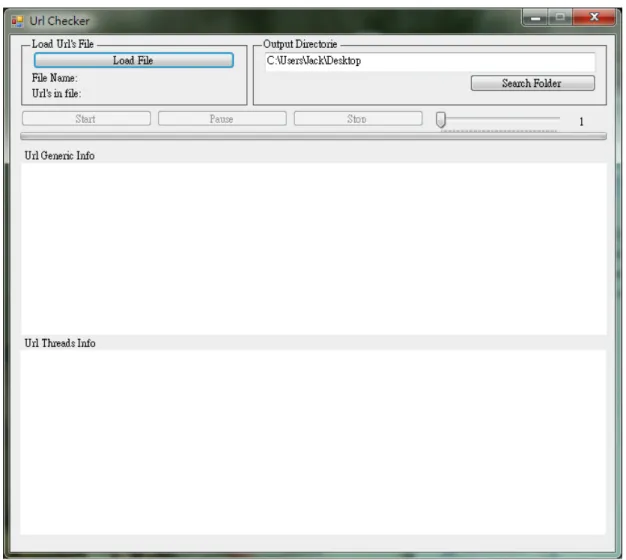
Version 1.5 built on the concept of automation by allowing users to import data files consisting of multiple URLs as the input for the application, and it output the retrieved information to multiple output files in a specified directory. It applied a method not unlike that of existing service provider sites (e.g. webstatsdomain.com, statmyweb.com) to extract information about that URL. UA Version 1.5 was significantly more stable than Version 1 and offered greater functionality, because larger amounts of functional information was extracted from the URL provided, and that could be used to perform high level analysis on individual web pages.
Finally, Version 2.0 improves greatly on earlier versions by adding much needed functionality to the application. As with previous versions, UA takes the input as a text file containing the URLs
26|Page to be processed, and saves the output in the location of choice. The output is separated into sections within the Java window of our application and allows an easy method of viewing the relevant information for each webpage. This is done by detecting the tags specific to each section listed and the information returned can be broken down into the previously mentioned areas of website information and server information, and which can be seen in Table 2.
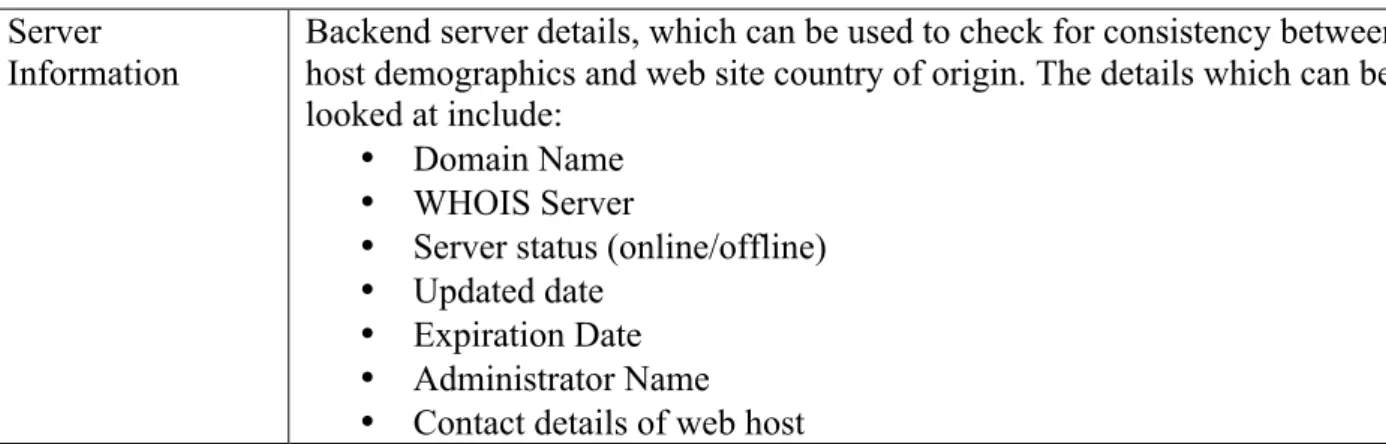
Information Values
Details
Meta Data Data that describes other data on the page. For example:
• HTML information (i.e. page code, links, page logo image) • Basic site description
Title Page Title
CSS Cascading Style Sheets, determine:
• Page Layout/Structure/Format (i.e. header/footer/section positioning) • Colour schemes and themes (i.e. predefined colour schemes used)
Forms Forms on the web page, can be seen as input boxes eg.:
• Search Bars • Login box
Maps/Area HTML feature that defines a client-side image-map. Can be seen as images with clickable areas and can be used for:
• Banners • Advertising
• Dynamic and interactive links
JavaScript High level, dynamic, untyped and interpreted programming language. JavaScript within web pages is most commonly used to add client-side behaviours. Examples are:
• Loading new page content without reloading entire page • Animation of page elements
• Validating user input (security)
• Interactive content including games and video • Transmitting user information/behaviour
URL (Hyperlinks) Full links to all content being displayed on the webpage including:
• Pictures • Stylesheets
• Links to advertised content and other websites
Pictures Full links only to content which includes pictures in the current webpage. This includes:
• Pictures
• Links to advertised content and other websites
Original URL Input hyperlink
Connected URL Hyperlink where the connection is established Redirected URL Hyperlink resulting from any redirections Response Code Checks if site has loaded correctly
27|Page Server
Information
Backend server details, which can be used to check for consistency between host demographics and web site country of origin. The details which can be looked at include:
• Domain Name • WHOIS Server
• Server status (online/offline) • Updated date
• Expiration Date • Administrator Name • Contact details of web host Table 2: UA 2.0 Retrieved Elements
The output for each specified website is stored in a text file in a specified destination in local storage. These text files contain the information listed in table 2 and are constructed in a format where there is a defined structure between sections. Our research and investigation has revealed that there is little in literature to support the statement that research could be undertaken to determine a method to automate the analysis of e-commerce web sites by using an application. Evaluation instruments such as that developed by Hung and McQueen [22] and WebQual 4.0 [20], do look at e-commerce quality approaches and develop solution and tooling methodologies which incorporate concepts not unlike those within the 7Cs. In particular, these give greater weighting to lower level concepts within the 7C Framework, with the key concepts being usability, quality of information and site security. This assists in validating our approach and model for e-commerce validation.
4
Application in evaluating user interfaces
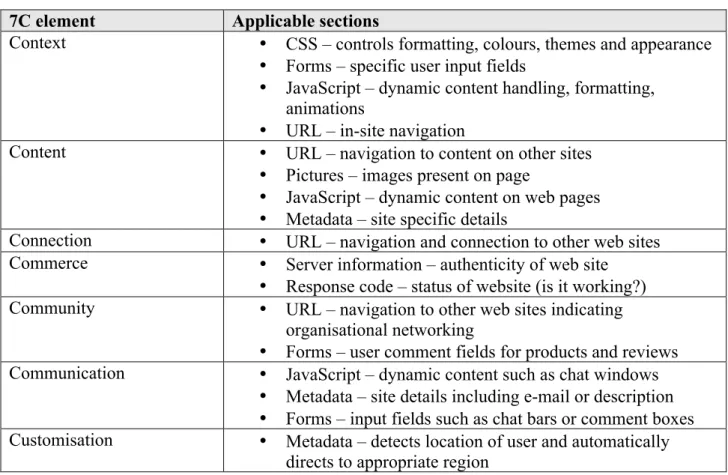
The 7C Framework has quite a broad scope within the context of e-commerce and covers many of the elements relating to user interfaces. Incorporating the 7C Framework into our research, the functional aim for the application developed within this research is to retrieve as much information as possible from a single URL. Table 3 below describes the elements that can be retrieved and mapped to specific elements of the 7C Framework.
Our application can detect external content from other sites, pages and advertisement scripts using hyperlinks (eg. links to other pages) and image links through the URLs and pictures sections. An
28|Page analysis of site-to-site linkage is important when considering methods of listing products from other organisations in which potential users may be interested.
7C element Applicable sections
Context • CSS – controls formatting, colours, themes and appearance
• Forms – specific user input fields
• JavaScript – dynamic content handling, formatting,
animations
• URL – in-site navigation
Content • URL – navigation to content on other sites
• Pictures – images present on page
• JavaScript – dynamic content on web pages • Metadata – site specific details
Connection • URL – navigation and connection to other web sites Commerce • Server information – authenticity of web site
• Response code – status of website (is it working?)
Community • URL – navigation to other web sites indicating organisational networking
• Forms – user comment fields for products and reviews
Communication • JavaScript – dynamic content such as chat windows
• Metadata – site details including e-mail or description • Forms – input fields such as chat bars or comment boxes
Customisation • Metadata – detects location of user and automatically directs to appropriate region
Table 3: Table of applicable elements
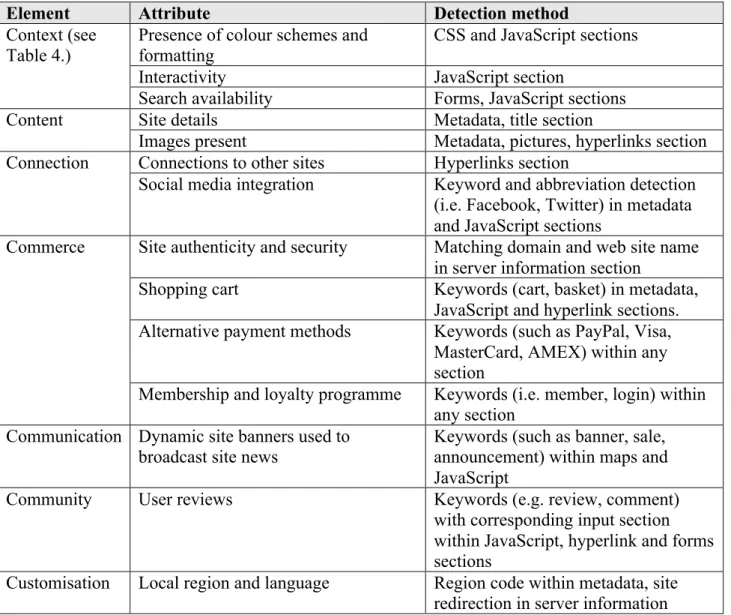
We will cover some specific elements which can be evaluated with the most breadth or detail by our application and describe methods of leveraging the retrieved data in order to draw comparisons and conclusions between different e-commerce web sites that reflect upon the performance of UA. Because of the nature of the research, we will also attempt to map the 7C Framework to previous research work.
This section describes the elements of the 7C Framework not covered in sufficient detail by UA 2.0 and the reasons why these shortcomings are significant. It will also cover other drawbacks of UA 2.0 when comparing the results obtained and drawing conclusions from them.
4.1
Context
‘Context’ within the 7C Framework covers the visual appearance and functionality of the website. Previous research that developed frameworks for assessing e-commerce websites shows clearly that user satisfaction is strongly correlated with elements such as usability, interactivity and visual
29|Page appearance of the website. Barnes and Vidgen categorise this in the ‘usability’ category in WebQual 4.0, where a survey was conducted with a random sample of users in respect of the aesthetic and functional perspective of a web user interface. This included factors such as ease of use, site appearance, appropriateness of design and overall experience [20]. Hung and McQueen also regard context-related aspects an important part of evaluating how well an e-commerce site performs with regard to making specified information easy to find. Critical areas of feedback within their evaluation instrument are the presence of context related ‘ease-of-use’ and the level of interactivity of the web page [22].
Amongst the elements within the 7C Framework, UA covers the context of a web page with the greatest amount of depth. The main reason for this is that functional and aesthetic elements within a webpage can be detected quite easily by CSS (Cascading Style Sheets), JavaScript and links to other webpages. Aesthetic elements within the web page including colour schema, themes, formatting and appearance are governed by the CSS of a web page. These are controlled in specific fields and can be detected by parsing specific labels. These labels are subject to change, however, as CSS have a variety of implementations. This implies that in the future, these elements will be tracked by UA as an entity within the CSS and JavaScript to a lesser extent. Functional elements such as page layout and to a lesser extent, site mapping, can be detected by URLs and CSS.
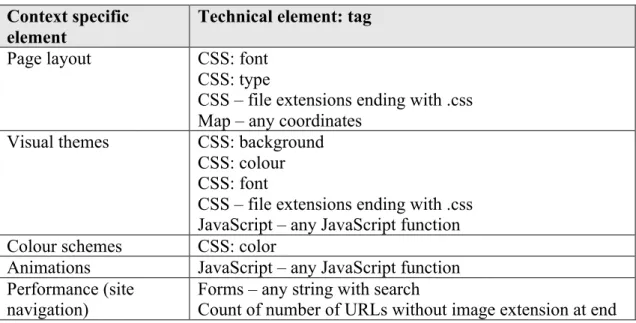
A table of the more specific mapping between elements is shown here: Context specific
element
Technical element: tag
Page layout CSS: font
CSS: type
CSS – file extensions ending with .css Map – any coordinates
Visual themes CSS: background CSS: colour CSS: font
CSS – file extensions ending with .css JavaScript – any JavaScript function Colour schemes CSS: color
Animations JavaScript – any JavaScript function Performance (site
navigation)
Forms – any string with search
Count of number of URLs without image extension at end
30|Page
4.2
Content
Popular streams of research place content analysis as an integral part of web user analysis, where users tend to rate a website more highly if the quality of the content is high. WebQual puts these ratings in the Information section of their questionnaire and asks a series of questions analysing the information quality pertaining to why the user visited the site. They found from the customers surveyed that the most important aspect of a webpage to them is the accuracy of information, with information-related aspects being scored quite highly in general [20]. However, there is no method within literature of assessing information quality automatically without user input, as the perceived quality of the information is dependent on the person accessing it.
As has been shown, analysing content within a webpage is not an easy task and ‘easy’ methods of doing so do not provide the depth required to draw any meaningful conclusions. Like reading a book, the contents of which can only be evaluated once read by a user, evaluating the content within a web page by manually sifting through the information retrieved is tedious and much more difficult after being processed than by viewing the webpage.
The 7C Framework treats content in a webpage as three ‘mixes’: offering mix, appeal mix and multimedia mix [14]. Examples of these in an e-commerce sales site would include the products/services on offer, the featured items and the videos, respectively. As observed, evaluations of these are subjective, and the extent to which UA 2.0 can evaluate content in a web page is by returning the links to images and extracting the number of images returned manually. Content is also present as text within the JavaScript and Metadata sections to a lesser degree. Evaluating the content can be done in a shallow manner by detecting the site details within the site metadata and images present.
4.3
Connection
Research on web page connection is plentiful and makes up an important part of a many organisations’ business models. The vast majority of advertisements and site-to-site linkage is composed primarily of hyperlinks inside a JavaScript, evidenced by the dynamic advertisements seen on many webpages. UA 2.0 is able to retrieve this dynamic information through its ability to detect JavaScript. Our application can detect external content from other sites, pages and advertisement scripts using hyperlinks (i.e. links to other pages) and image URLs using the URLs
31|Page and pictures sections. An analysis of site-to-site linkage is important when considering methods of listing products from other organisations in which users may be interested.
A specific category of site-to-site linkage is social media integration. In order to promote their products and services, many websites allow users to share using a built-in hyperlink that authenticates the user through social media and creates an announcement in the social media channel. Examples of such social media channels include Facebook, Twitter and Google where there is a huge user base and integration allows for efficient word-of-mouth promotion of products.
4.4
Commerce
An interesting point to note within the e-commerce environment is that from our literature search, we have noted that e-commerce possesses the trait of being ‘frictionless’ – users can easily find the lowest possible price for the same product across many sellers. Assuming that all of the products are the same, firms are forced to operate efficiently in producing at a profit-maximising level of production with the least input [41].
The commerce elements within the 7C Framework are the business services, including security, shopping cart, order tracking, shipping speed and product quality assurance. In this sense, the commerce element captures the concept of site usability [20], which measures the ease and intuitiveness of allowing users to achieve their aim without any difficulties. In a more practical sense, successful interaction with the commerce element allows users to continue their shopping after closing the window, being able to pay for their goods without fear of theft and to receive their goods in good condition after a reasonable wait. Because by its nature e-commerce means that shopping is done online instead of at a physical store, these services make up a large part of determining end-user satisfaction and are a common target for sites seeking business advantage. Retaining users is another aspect of the commerce element. Most e-commerce web sites have a membership and loyalty programme for frequent users and purchasers. Rewards offered include further discounts, free shipping and new release information. These rewards are difficult to analyse as they form part of the business model for businesses. A basic check for membership and user login is easily achievable though, as related keywords are generally always included as part of the code and can be detected easily.
32|Page Security within e-commerce is a large area of research for most businesses attempting to ensure the safety of their customers. Practices including theft and fraud are prevalent in e-commerce and since technology is not fool proof, methods exist of extracting important details including personal or credit card details from online transactions. Popular e-commerce websites are required to be secure against such attacks and are generally safe in handling transactions. UA 2.0 retrieves details about the host of websites which can be used to detect fraud and to check where user information is being transferred. This allows UA 2.0 to detect fraud within websites.
4.5
Community
Community within web sites relates to methods of communication between users, and the transparency in how they talk to each other. There are many modes of user-to-user communication within an e-commerce web site, including comments, feedback and product reviews. A strong community within an online forum is a powerful tool in e-commerce and many business models focus on attracting customers and users to create their own online communities. The presence of a community can be detected automatically by analysing the channels of communication between users (such as forums, message boards, instant messaging tools). UA 2.0 can potentially detect these by analysing the JavaScript and forms present within a webpage and from this, detect user input forms such as those in forums and chat windows; interactive interfaces which allows users to communicate with each other.
Within the scope of current e-commerce sites, users have the ability to post reviews either as anonymous users or under a personal account. WebQual analyses this briefly in one question where it asks whether the site conveys a sense of community, and results from user evaluation of the importance of such a question rank this element as of the lowest importance of all the questions evaluated [20]. It is also important to note that Barnes and Vidgen conducted this survey with Webqual in 2002 and much has changed since then with the introduction of social media, and web sites where the content is constructed by the users [12].
Collaboration and community in the e-commerce context can take many forms. Strictly within the e-commerce sense, an online community could be made up of reviews of products, as is the case with e-commerce powerhouses such as Amazon. A powerful e-commerce solution allows methods of easy feedback from all users of the goods or services sold, and rewards users for detailed reviews. These reviews accumulate for products and gradually can serve to define a
33|Page product. Examples of this in practice can be found within Amazon’s implementation. Customers who have bought a product are sent friendly reminders to evaluate and review it and to give a score out of five. Top reviews are displayed at the top of the reviews section and an average score for most products is displayed.
4.6
Communication
Communication between website and user happens through mailing lists and ‘site broadcasting’. Examples of site broadcasting can be seen as announcements or large banners within websites, which have the effect of ‘jumping out’ at users who visit the site. Such means of site-to-user communication can also be viewed as using dynamic formatting with the Context element - they are implemented by JavaScript. Site broadcasting to users can be seen when the organisation behind the website have an announcement to make and is an effective and useful method of providing updated Content to users. This can be observed in the HTML by viewing an automatic scan of the site.
Although communication within the traditional 7C Framework looks at site-to-user communication, modern web applications rely heavily on user feedback in order to improve the web experience for customers. In current e-commerce applications, communication from users can happen through forms or text boxes in a webpage rendered primarily by JavaScript. This system stores user responses and sends them to the interested and relevant parties of the website. Forms like these can be used as as feedback forms, contact forms and comments.
4.7
Customisation
The ability for a website to be customised or personalised for individuals has grown as web technology has advanced. Prior to Web 2.0 applications, customisation of a website was limited mainly to regions and language – whereas now, users can alter the settings to control the way the content displays.
Research in the analysis of customisation exists within literature but not in great depth. WebQual 4.0 asks users to rate the website in the sense of user personalisation as one of their evaluation criteria. Results from the survey, however, reveal that factor as having a relatively low importance compared to other factors present within the context and content elements of the user interface, namely the functional aspects of the website and the quality of information [20].