Introduction
In the course of wear processes caused by friction of tribological system elements some structural changes in superficial layers of co-working bodies arise, modifying their physical properties. The problem of resistance to abrasive wear is of great importance in technique and, therefore, novel methods are searched in order to reduce tribological wear [12]. In the last years it was found [6, 12] that temperature is a very important fac-tor for friction processes in a tribological system and a significant increase of wear resistance can be reached when a constant, well-chosen temperature is provided in the friction zone. The reduction of wear is accom-panied by transfer of the material between surfaces of rubbing bodies and stabilization of coefficient of friction [15]. This phenomenon seems to be very important for decrease of friction losses in tribological systems, al-though it is not well understood up to now. Mössbauer investigations of the surface layer of rubbing elements and friction products can be helpful for identification of processes that occur in the course of friction as well as comparison of the results obtained under optimal, (i.e. reducing the wear) and non-optimal conditions.
Experimental methods
Samples of C45 steel of chemical composition Fe+C/0.5/ Mn/0.67/Si/0.21/Ni/0.08/ Cr/0.15/ were chosen for inves-tigations. The specimen were normalized or previously
Structure of friction products
and the surface of tribological system
elements
Katarzyna Brzózka, Wojciech Żurowski, Bogumił Górka
K. Brzózka, B. Górka
Technical University of Radom, Faculty of Mechanical Engineering, Department of Physics,
54 Krasickiego Str., 26-600 Radom, Poland, Tel.: +48 48 361 7846, Fax: +48 48 361 7075,
E-mail: [email protected], [email protected] W. Żurowski
Technical University of Radom, Faculty of Mechanical Engineering, Institute of Machines Building,
54 Krasickiego Str., 26-600 Radom, Poland Received: 11 June 2012
Accepted: 14 September 2012
Abstract. The goal of the paper is to identify characteristic features of the surfaces of rubbing bodies and friction products, which come into being when friction processes are realized under optimal conditions, regarding wear resistance. Mössbauer investigations carried out both in scattering and transmission arrangement have evidenced, between others, differences in oxides content and their phase composition, depending on the temperature of tribological system in the course of fric-tion test. It has been found that the wear products obtained at the optimal temperature are composed of the much smaller particles than those produced at lower or at higher temperature.
subjected to various heat treatment – they were hard-ened and tempered at temperatures: 200oC, 350oC or 600oC (Table 1). In order to determine the optimal temperature values, corresponding to reduced abrasive wear, tribological measurements were performed under conditions of oxidation wear. For friction tests, a special apparatus, enabling stabilization of the temperature in the friction zone, was designed and employed [14]. The investigated specimens, in form of fixed sliders, were co-worked with a counter-sample made of 145Cr6 steel (of chemical composition: Fe+C/1.4/Mn/0.59/ Si/0.28/Ni/0.08/Cr/1.6/V/0.17/), being a rotating ring. The temperature was stabilized by a cooling system supplied by a Julabo Cryo-Compact CF-40 circulator. Friction resistances were stabilized by means of clean-ing elements to make the friction coefficient constant. It was maintained at 0.4 during the test. In this case, a Polish patent was used: PL 171768 B1 of 1997: Method of friction resistances regulation.
Phase composition of steel surfaces was investigated using conversion electron Mössbauer spectroscopy (CEMS) based on the 57Fe isotope. A 57Co/Rh source of gamma radiation was used. A single-wire flow coun-ter supplied by a He+4%CH4 mixture was employed in order to detect electrons emitted from a specimen surface owing to de-excitation of 57Fe nuclei previously excited by gamma radiation of energy about 14.4 keV. The energy of gamma photons was modified – owing to the Doppler effect – by velocity of the radiation source moving in constant acceleration mode. Mössbauer spec-tra were collected both before and after a frictional test. For selected specimen, the tests were carried out under optimal as well as non-optimal conditions. Friction products in the form of powder were examined by the use of a transmission Mössbauer spectrometer working in a vertical arrangement. In this case, a proportional counter was applied as a detector.
Numerical analysis of Mössbauer spectra was car-ried out by means of specialized NORMOS program, utilizing conventional least square procedure with ad-ditional smoothing terms. It enables identification of iron compounds, particularly secondary iron-oxygen phases.
Results
Optimal temperature values, corresponding to maximal resistance to abrasive wear, deriving from friction tests [13], are shown in the last column in Table 1.
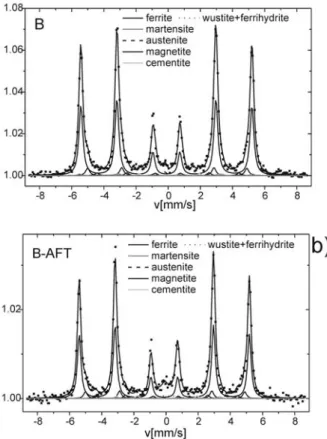
Mössbauer spectra collected for individual sam-ples before and after the friction tests are visible in Figs. 1–4. They have a shape typical of crystalline mate-rials, composed of sharp maxima – single lines or lines
coupled to doublets (two lines) or sextets (six lines). In all the spectra a slightly asymmetric sextet dominates, attributed to ferrite. Asymmetry of the sextet is caused by alloying elements, which occupy both interstitial and site positions in the vicinity of 57Fe atoms in the crystal-line lattice and thus modify the hyperfine interactions parameters of the spectra components, i.e. hyperfine magnetic field (HMF), quadrupole splitting and isomer shift. Therefore, in the numerical analysis of the spectra, the asymmetric sextet characteristic of ferrite was fitted by three or four subspectra, corresponding to several in-equivalent positions of iron in the crystalline lattice of the steel.
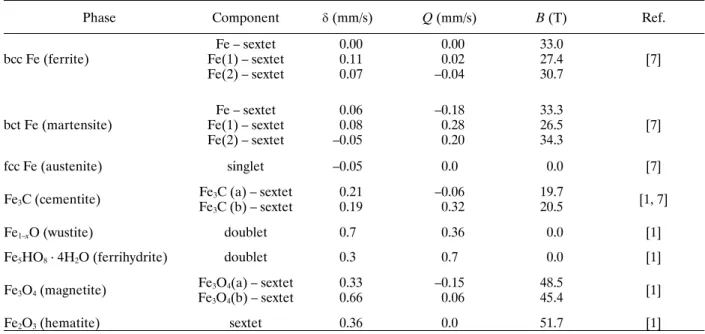
Beside ferrite, the following components contribut-ing to the spectra were taken into account in the fittcontribut-ing procedure: martensite (the alloy with tetragonal crystal-line lattice), cementite – Fe3C, austenite – γ-Fe as well as oxide phases: wustite – FexO, ferrihydrite – Fe5HO8.4H2O, magnetite – Fe3O4 and hematite – Fe2O3. The literature data of the hyperfine interactions parameters (hyperfine magnetic field – B, quadrupole splitting – Q and isomer shift – δ) of the phases, assumed as initial parameters in the fitting procedure of Mössbauer spectra, are collected in Table 2 [1, 7]. The two last oxides bring contribution
Table 1. Attributes of investigated steels and topt – optimal temperature corresponding to maximal wear resistance, derived
from friction tests [13]
Sample Material Conditions of heat treatment Hardness topt (oC)
Specimen
A Steel C45 normalized 18 HRC –5
B Steel C45 hardened and tempered at 200oC 52 HRC –10
C Steel C45 hardened and tempered at 350oC 38 HRC –20
D Steel C45 hardened and tempered at 600oC 19 HRC +5
Counter-specimen Steel 145Cr6 hardened 63 HRC
Fig. 1. CEMS spectra collected for sample A: before friction test (a) and after friction test (b).
to the spectra in the form of rather well resolved sextets which are characterized by large values of hyperfine magnetic field. The other phases give subspectra which overlap mutually. Particularly, the sextets characteristic
of ferrite and martensite are poorly separable; the same refers to the subspectra attributed to austenite, wustite and ferrihydrite, especially when the phases bring small contribution. This is why the percentage of individual phases, derived from Mössbauer spectra, has consider-able uncertainty.
The values of relative content of subspectra attrib-uted to different phases, derived from CEMS spectra, collected for particular specimens of steel are presented in Table 3. Assuming that the Debye-Waller factor of all the phases has a similar value, we can identify the results with the distribution of iron atoms over the phases. Taking into account different ratio of iron atoms to other ones in oxides compared to ferrite together with martensite we can estimate that real volume relative content of oxides in the investigated materials is about twice larger than the results presented in Table 3.
From Table 3 it may be noted that iron in ferrite and martensite makes in total 84÷95% all iron atoms in the surface of steels and the value decreases slightly after friction tests. Moreover, a small rise of iron contribu-tion in martensite and also in oxides (especially wustite) is observed after tests and the latter composes up to 10% all iron atoms; the maximal value corresponds to the normalized C45 steel. In all samples the relative contribution of cementite is less than 4%.
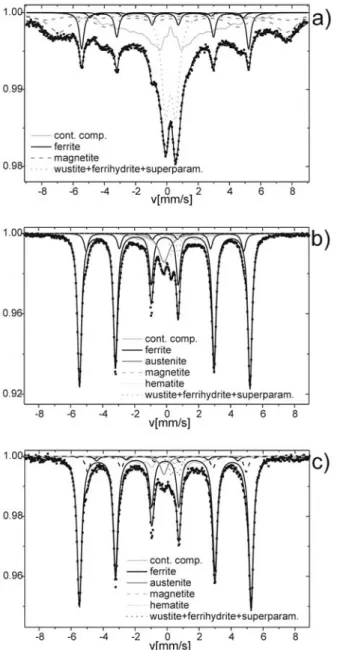
Mössbauer transmission spectra of friction products produced in the course of friction tests carried out for sample A at different temperatures are shown in Fig. 5. It may be seenthat the shape of Mössbauer spectrum collected for the powders obtained at optimal tempera-ture (regarding wear resistance) ta = topt= –5oC is quite different than those related to the temperature dis-tinctly higher or lower than the optimal one (tb = –20oC, tc = 15oC). The significant part of the spectrum
consti-Fig. 2. CEMS spectra collected for sample B: before friction test (a) and after friction test (b).
Fig. 4. CEMS spectra collected for sample D: before friction test (a) and after friction test (b).
Fig. 3. CEMS spectra collected for sample C: before friction test (a) and after friction test (b).
tutes a smeared component with broad spectral lines that has been fitted by a continuous distribution of hyperfine interactions parameters. We attribute the component to ultra-fine powder particles. They are characterized by large intensity of strain, a large number of defects and a considerable contribution of surface regions in comparison to the volume ones. Possibly, some of them have superferromagnetic (or superparamagnetic) prop-erties and contribute to the smeared component (or the central part) of the spectrum. One cannot also exclude arising of amorphous regions that bring a contribu-tion to the “continuous” subspectrum. As is shown in Table 4, the smeared component (excluding a high-field part attributed to magnetite and hematite) constitutes about 27% of the spectrum in Fig. 5a – for friction products obtained at optimal temperature – and only 5–7% in the cases of powders produced in the course
of friction test realized at non-optimal temperature. Moreover, much more oxides arise in friction products obtained under optimal conditions, especially Fe3O4 (about 40%), Fe1–xO and Fe5HO8.4H2O (about 21%), while only several percent of these phases as well as traces of Fe2O3 have been found in the spectra of pow-ders produced at non-optimal temperature. Vestigial amount of austenite has been also stated.
Summary and discussion
It was found that as a result of friction under optimal conditions the content of martensite slightly increases on the surface of the specimen. Similarly, a small rise of percentage in the oxides Fe3O4 and Fe1–xO is observed.
According to the recognized mechanism of oxidational
Table 2. Hyperfine interaction parameters (hyperfine magnetic field – B, quadrupole splitting – Q and isomer shift – δ) of iron phases, assumed as initial parameters in the fitting procedure of Mössbauer spectra
Phase Component δ (mm/s) Q (mm/s) B (T) Ref.
bcc Fe (ferrite) Fe – sextet Fe(1) – sextet Fe(2) – sextet 0.00 0.11 0.07 0.00 0.02 –0.04 33.0 27.4 30.7 [7] bct Fe (martensite) Fe – sextet Fe(1) – sextet Fe(2) – sextet 0.06 0.08 –0.05 –0.18 0.28 0.20 33.3 26.5 34.3 [7] fcc Fe (austenite) singlet –0.05 0.0 0.0 [7] Fe3C (cementite) Fe3C (a) – sextet Fe3C (b) – sextet 0.21 0.19 –0.06 0.32 19.7 20.5 [1, 7] Fe1–xO (wustite) doublet 0.7 0.36 0.0 [1] Fe5HO8 .4H2O (ferrihydrite) doublet 0.3 0.7 0.0 [1] Fe3O4 (magnetite) Fe3O4(a) – sextet Fe3O4(b) – sextet 0.33 0.66 –0.15 0.06 48.5 45.4 [1] Fe2O3 (hematite) sextet 0.36 0.0 51.7 [1]
Table 3. Distribution of iron over different phases, derived from CEMS spectra collected for particular specimens of steel (the last column – non-identified phases)
Sample Distribution of iron over different phases (%)
bcc-Fe + bct-Fe fcc-Fe Fe3C Fe3O4 Fe1–xO/Fe5HO8. 4H2O Others
A 91.7 + 2.3 = 94.0 0.0 2.9 0.4 0.6 2.1 A-AFT* 76.6 + 7.1 = 83.7 0.1 0.1 2.9 7.8 5.4 B 92.2 + 2.1 = 94.3 0.0 2.1 0.0 0.0 3.6 B-AFT 93.3 + 0.5 = 93.8 0.3 2.9 0.0 2.5 1.5 C 91.2 + 0.6 = 91.8 0.0 4.3 0.5 1.0 2.4 C-AFT 89.2 + 1.7 = 90.9 0.1 2.3 0.0 3.1 3.6 D 90.9 + 0.8 = 91.7 0.1 3.6 0.0 0.9 3.7 D-AFT 89.5 + 1.2 = 90.7 0.2 3.8 0.7 1.5 3.1
*AFT – after friction test.
Table 4. Distribution of iron over different phases, derived from TMS spectra collected for friction products obtained for sample A (normalized C45 steel) as a result of friction test carried out at different temperatures
Temperature (oC)
Distribution of iron over different phases (%)
bcc-Fe + bct-Fe fcc-Fe Fe3C Fe3O4 Fe1–xO/Fe5HO8 . 4H2O Others Smeared compounds
–5 (optimal) 11.9(±5%) 0 0 39.5 21.4(±10%) 0 27.2(±10%)
–20 81.1 + 0.5 = 81.6(±2%) 8.4(±50%) 0 0.2 3.1(±50%) 1.2 Fe2O3 5.5
wear, all three types of iron oxides should occur on the specimen surface. Presented findings show that only slight amount of hematite appears in the regime of friction at the temperature that assures enhanced resistance to wear. Similar mechanisms of oxide genera-tion in various regimes of fricgenera-tion have been described in several papers [2–5, 8–11].
Transmission Mössbauer spectroscopy investigations of pulverous products of friction, arising at optimal temperature, have shown that they are composed of the ultra-fine particles, much smaller than the wear products obtained at other temperatures. The relative content of individual oxides and their global percentage has been also changed in dependence on the friction test temperature. It has been stated that after friction test realized at optimal temperature the oxides percentage
is about 60%, while the content of magnetite is about twice larger than the relative fraction of other oxides. In friction products obtained at non-optimal tempera-ture the oxides content is much smaller and is equal to about 5%. Traces of hematite and vestigial amount of austenite have been also found.
Summing up, the outcomes of Mössbauer investiga-tions enabled analysis of friction effects in the studied systems and evidenced that the character of wear pro-cesses accompanying the friction under wear minimiz-ing conditions is clearly different from those occurrminimiz-ing under non-optimal conditions.
References
Fajardo M, Pérez Alcázar GA, Aguilar Y (1998) Oxida-1.
tion study by Mössbauer and optic microscopy of steels from boiler tubes used in sugar industry. Hyperfine Interact 113:435–442
Garbar II (2002) Gradation of oxidational wear of metals. 2.
Tribol Int 35:749–755
Hu ZS, Dong JX, Chen GX (1998) Study on antiwear 3.
and reducing friction additive of nanometer ferric oxide. Tribol Int 31:355–360
Jiaren Jiang, Stott FH, Stack MM (1998) The role of tri-4.
boparticulates in dry sliding wear. Tribol Int 31:245–256 Quinn TFJ (1998) Oxidational wear modeling. Part III. 5.
The effects of speed and elevated temperatures. Wear 216:262–275
Sadowski J, Żurowski W (1992) Verschleißbeständig-6.
keit von Metallen, Tribologie+Schmierungstechnik 3:152–158
Sang Joon Choi, Soon-Ju Kwon, Seong-Hun Choo, 7.
Sunghak Lee (1999) Phase analysis of surface layers irra-diated with high-energy electron beam using Mössbauer spectroscopy. Mat Sci Eng A 265:208–216
So H (1995) The mechanism of oxidational wear. Wear 8.
184:161–167
So H, Yu DS, Chuang CY (2002) Formation and wear 9.
mechanism of tribooxides and the regime of oxidational wear of steel. Wear 253:1004–1015
Sullivan J, Quinn TFJ, Rowson DM (1980) Develop-10.
ments in the oxidational theory of mild wear. Tribol Int 12:153–158
Umeda A, Sugimura J, Yamamoto Y (1998) Character-11.
ization of wear particles and their relations with sliding conditions. Wear 216:220–228
Żurowski W (2008) Wear resistance maximization of 12.
frictional interface circuits. In: De Vaal P (ed) Tribology. SAIT, Pretoria, pp 491–497
Żurowski W (2010) Physical aspects of maximization of 13.
wear resistance of tribological systems elements. Seria: Monografie no. 152. Wydawnictwo Politechniki Radom-skiej, Radom (in Polish)
Żurowski W (2011) Tribological research of friction 14.
couples under conditions of increased wear resistance. In: De Vaal P (ed) Tribology. SAIT, Pretoria, pp 148–157 Żurowski W (2012) Structural factors contributing 15.
to increased wear resistance of steel friction couples. Eksploatacja i Niezawodność – Maintenance and Reli-ability 14:18–23
Fig. 5. Mössbauer spectra of friction products obtained at the temperature: ta = topt = –5oC (a), tb = –20oC (b), tc = 15oC (c).