OPTIMIZATION OF RESOURCE ALLOCATION AND
LEVELING USING GENETIC ALGORITHMS
Assist. Prof.: Dr. Sawsan Rasheed Mohammed Ameer Ahmed Abdul Ameer
University of Baghdad University of Baghdad
College of Engineering College of Engineering
Department of Civil Engineering Department of Civil Engineering
ABSTRACT
Resource allocation and leveling are of the top challenges in project management, due to the complexity of projects. This research aims to develop an optimization model for resource smoothing, so that.
The proposed model is formulated using C++ program for resource smoothing. The project management software MS-Projects is adopted hereto perform resource leveling to facilitate achieving the optimal solution.
The proposed model utilizes a system that depends on Genetic Algorithms (GAs) procedure built in C++ program to find the optimum solution.
This research reach concludes that it is possible to smooth resources using Genetic Algorithms program and compares then with MS-Project when the GA results are better than MS-Project.
Three case studies have been applied in this research and the application results come identical with research objectives, to form the conclusion.
Then comes the recommendations regarding adopting and using the research results in construction planning and project management. Further suggestions related to the research subject are proposed for future works.
ﺔﺻﻼﺨﻟا ﻊﻳرﺎﺸﻤﻟاﺪﻴﻘﻌﺗﺐﺒﺴﺑعوﺮﺸﻤﻟاةراداﻲﻓتﺎﻳﺪﺤﺘﻟاﺮﺜآاﻦﻣﻲهدراﻮﻤﻟاﺔﻳﻮﺴﺗوﻦﻴﻴﻌﺗنا . دراﻮﻤﻟا ﺔﻳﻮﺴﺘﻟ ﻞﺜﻣا جذﻮﻤﻧ ءﺎﻨﺑ ﻰﻟا ﺚﺤﺒﻟا اﺬه فﺪﻬﻳ . ﺞﻣﺎﻧﺮﺑ ماﺪﺨﺘﺳﺎﺑ حﺮﺘﻘﻤﻟاجذﻮﻤﻨﻟا ءﺎﻨﺑ ﻢﺗ ﺪﻘﻟ C++ دراﻮﻤﻟا ﺔﻳﻮﺴﺘﻟ ﻊﻳرﺎﺸﻤﻟاةرادﻻﺞﻣﺎﻧﺮﺑدﺎﻤﺘﻋاﻢﺗﺎﻤآو (MS-Project) ﻞﺜﻣﻻاﻞﺤﻟاﻰﻟالﻮﺻﻮﻟاﻞﻴﻬﺴﺘﻟدراﻮﻤﻟاﺔﻳﻮﺴﺗءاﺮﺟﻻ . جذﻮﻤﻨﻟاﺪﻤﺘﻌﻳ ﺞﻣﺎﻧﺮﺑماﺪﺨﺘﺳﺎﺑﻩؤﺎﻨﺑﻢﺗﺚﻴﺣﺔﻴﻨﻴﺠﻟاتﺎﻴﻣراﻮﺨﻟابﻮﻠﺳاﻰﻠﻋحﺮﺘﻘﻤﻟا (C++) ﻞﺜﻣﻻاﻞﺤﻟاﻦﻋﺚﺤﺒﻠﻟ . ﺞﻣﺎﻧﺮﺑ ﻊﻣ ﺎﻬﺘﻧرﺎﻘﻣو ﺔﻴﻨﻴﺠﻟا تﺎﻴﻣزراﻮﺨﻟا ماﺪﺨﺘﺳﺎﺑ دراﻮﻤﻟا ﺔﻳﻮﺴﺗ ﺔﻴﻧﺎﻜﻣا ﻰﻟا ﺚﺤﺒﻟا ﻞﺻﻮﺗ MS-Project نا ﺪﺟو ﺪﻘﻟو ﺞﺋﺎﺘﻧﻦﻣﻞﻀﻓاﺔﻴﻨﻴﺠﻟاتﺎﻴﻣزراﻮﺨﻟا ﺞﺋﺎﺘﻧ MS-Project ﻖﻴﺒﻄﺘﻟاﺞﺋﺎﺘﻧﺖﻧﺎآوﺖﺳرد تﻻﺎﺣ ثﻼﺛﻰﻠﻋﺚﺤﺒﻟاﺞﺋﺎﺘﻧ ﺖﻘﺒﻃو ﺚﺤﺒﻟا ﻪﻴﻟافﺪه ﺎﻤﻟ ﺔﻘﺑﺎﻄﻣ . ﻲﻨﺒﺗ نﺎﺸﺑ تﺎﺣﺮﺘﻘﻤﻟاو تﺎﻴﺻﻮﺘﻟا ﻦﻣدﺪﻋ ﺖﻌﺿو ﺎﻤآ تﺎﺟﺎﺘﻨﺘﺳﻻا ﻦﻣدﺪﻋ ﻰﻟا ﻞﺻﻮﺘﻟا ﻢﺗو ﻴﻄﺨﺘﻟاﻞﻘﺣﻲﻓﺚﺤﺒﻟاﺞﺋﺎﺘﻧ ﺚﺤﺒﻟاعﻮﺿﻮﻤﺑﺔﻠﺻتاذﺔﻘﺣﻻثﻮﺤﺒﻟتﺎﺣﺮﺘﻘﻤﻟاﻦﻣدﺪﻋﺖﻌﺿوﺎﻤآﻊﻳرﺎﺸﻤﻟاةراداوﻂ .
INTRODUCTION
Resource allocation and leveling have been dealt with as two distinct subproblems solved mainly using heuristic procedures that cannot guarantee optimum solutions. In this research, improvements are proposed to resource smoothing and leveling heuristics, and the Genetic Algorithms (GAs) technique is used to search for near-optimum solution.
In dealing with project resources, two main types of techniques have been used: resource allocation and resource leveling. Resource allocation (sometimes referred to as Constrained-Resource Scheduling) attempts to schedule the project tasks so that a limited number of resources can be efficiently utilized while keeping the unavoidable extension of the project to a minimum. Resource leveling (often referred to as resource smoothing), on the other hand, attempts to reduce the sharp variations among the peaks and valleys in the resource demand histogram while maintaining the original project duration [Mselhi 1993].
Genetic Algorithms (GAs) are search procedures that combine an artificial survival of the fittest strategy with genetic operators abstracted from nature [Michell 1998]. GAs are optimization search procedures inspired by the biological system improved fitness through evolution. GAs employ a random yet directed search for locating the globally optimal solution. [Goldberq 1989]
SCHEDULING DEFINITION & OBJECTIVES
Scheduling deals with time order in which project activities are to take place, and also the manpower, material machinery and money (the 4m’s) required at every stage of production that should be shown in the scheduling. [Senupta 1995]
Schedule development means determining the start and finish dates for project activities. If the start and finish dates are not realistic,
schedule. The schedule development process must be iterated (along with processes that provide inputs, especially duration estimating and cost estimating) prior to the determination of the project schedule. [Project Management Institute 1996]
The basic objectives of the scheduling process are as follows:[Callahan 1992]
a. To find out how long the total project duration is. Timely completion of the project is particularly important when fails to complete within the time required by contract that carries a financial penalty or liquidated damages;
b. evaluating the early and late times at which activities start and finish.
c. Identifying the group of critical activities so that special care is taken to make sure they are not delayed; d. since the construction environment is
always exposed to constraints and changes, it is important to be able to evaluate the implications of changes in start and/or finish times of activities on the overall project duration;
e. the follow up execution of the project; f. to monitor the usage of Resources; g. to Expect the stoppage in the
execution and reasons behind;
h. to prepare the financial requirements and cost control of work; and
to control the sub-contractors work and their interference.
SCHEDULING TECHNIQUES
There are many types of schedules which can be used for many construction project. The choice of which type of planning to be used depends on the characteristics of each project.
Several tools and techniques assist in the planning development process.
- Gantt Chart (Bar Chart) - Network Analysis
- Program Evaluation and Review Technique PERT
OPTIMIZATION SCHEDULING METHODS (MODELS)
Modeling can be defined as the process of producing a model; model is a representation of the construction and working of some system of interest. [Maria 1997]
Modeling is one of the most powerful tools that have ever been employed in various research disciplines. Often it’s the typical way and some times the only way to conduct experiments on a wide range of systems of various types.
- Linear Programming Model - Simulation Model
- Monte Carlo Simulation
- Genetic Algorithms Techniques RESOURCE SMOOTHING
Resource smoothing attempts to reduce peak requirements and smooth out period-to-period fluctuations in resource assignment without changing project duration. The objective of resource leveling procedures is to schedule project activities so that the project duration does not exceed a specific limit and the variation in the projects demand for a resource from one time period to another is held to a minimum. [Harris 1990]
The project managers' objective to hire the minimum number of resources, to reduce resource fluctuation and to ensure better utilization of resources. Typical situations include full utilization of a rented piece of equipment that needs to be returned early, also reducing the number of skilled workers who need to be hired for the job. Project managers have desired resource profiles that they try to get their resource profiles to match.
A well-known heuristic algorithm is the minimum moment algorithm that assumes limited project duration and unlimited resources [Hiyassat 2001]. The objective in this algorithm is to minimize daily fluctuations in resource use while keeping the total project duration unchanged. As a proxy to this objective the Algorithm minimizes the moment of the resource histogram around the horizontal axis. [Harris 1978]
The moment MX is calculated by summing the daily moments as follows: [Haider 1999]
Mx = ∑ [1*Resource Demandi)*1/2Resource Demand1]
Mx = 1/2 ∑ (Resource Demandi)2 (1) Where n is the working day number of the projects finish date. Equation – to be a minimum becomes:
Mx = ∑ (Resource Demandi)2 (2)
GENETIC ALGORITHMS DESCRIPTION
Genetic Algorithms are search algorithms based on the mechanics of natural selection and natural genetics. They combine survival of the fittest among string structures with a structured yet randomized information exchange to form a search algorithm with some of the innovative flair of human search. In every generation, a new set of artificial creatures (strings) is created using bits and pieces of the fittest of the old; an occasional new part is tried for good measure. While randomized, genetic algorithms are no simple random walk. They efficiently exploit historical information to speculate on new search points with expected improved performance.
The central theme of research on genetic algorithms has been robustness, the balance between efficiency and efficacy necessary for survival in many different environments. The implications of robustness for artificial systems are manifold. If artificial systems can be made more robust, costly redesigns can be reduced or eliminated. If the higher levels of adaptation can be achieved, existing systems can perform their functions longer and better. Designers of artificial systems – both Software and hardware, whether Engineering Systems, Computer systems, or Business systems – can only marvel at the robustness, the efficiency, and the flexibility of biological systems. Features for self-repair, self-guidance, and reproduction are the rule in Biological systems, whereas they barely exist in most sophisticated artificial systems.
Genetic Algorithms are now finding more widespread application in Business, Scientific, and Engineering circles. The reasons behind the growing numbers of applications are clear. These algorithms are computationally simple yet powerful in their improvement. Furthermore, they are not
fundamentally limited by restrictive assumptions about the search space (assumptions concerning continuity, existence of derivatives, unimodality, and other matters).[Baker 1985]
THE WORK OF GAS
GAs work with a family of solutions, known as the "current population" from which the "next generation" of solutions is obtained, better solutions from one generation to the next are progressively obtained [Harmanani 2001]. GAs procedure begins by generating an initial collection (referred to as population) of random solutions that are encoded in the form of strings called Chromosomes.
Each individual Chromosome represents one solution that is better or worse than others in the population. The fitness of each solution is determined by evaluating its performance with respect to an objective function. To stimulated the natural survival of the fittest process, best Chromosomes (potential solutions) exchange information to produce offspring that are evaluated and can replace less fir members in the population.
Usually, this solutions replace unfit solutions), until criterion is met (e.g. one solution becomes satisfactory). At the end of the process, the member of the population with the best performance becomes the optimum solution [Tarek 1999]. Figure (1) illustrates the basic cycle of genetic algorithm operations.
STEPS OF GENETIC ALGORITHM SYSTEM
The following points illustrate the principle work of genetic algorithm:
Encoding the Application of GA
GAs require a representation scheme to encode feasible solutions to the Optimization problem. Each Chromosome represents one member, i.e., one solution, which is better or worse than other members in a population.
A Chromosome represents a sequence of genes that require Optimization.
There are two basic chromosome formats in GAs,
a. Binary Coding. b. Ordinary Coding.
New Population Initial
Mutation Selection
Crossove
Generating an Initial Population of Chromosomes
The process of genetic algorithms starts with a randomly created first generation of population. Every individual in a generation represents one solution and consists of one Chromosome with a number of genes. [Haider 1999]
Deciding the Chromosome Evolution Criterion (Objective Function)
The performance of the strings is often called fitness, and the fitness of each string (Chromosome) in the population is evaluated with respect to an Objective Function.
Selection
A pair of parent Chromosome from the current population is selected. Each of the
two parent Chromosomes is randomly selected in a manner such that its probability of being selected is proportional to its relative merit.
Crossover
Crossover is the process of combing the chromosomes of two potentially good solutions to form two offsprings [Kevin 2003]. Crossover is performed by randomly selecting two members from the Population and exchanging their chromosomal information.
Figure (3) illustrates that two Chromosomes (parents 1 and 2) are randomly selected and broken at a random point (at gen 5), and after the exchange at genetic material two new Chromosomes (Offspring 1 and 2) are generated.
3
10
22
14
5
9
4
1 2 3 4 5 6 PY
X
Gene position
Gene Value
Legend:
Mutation
Mutation is a rare process that resembles the process of a sudden generation of an odd offspring that turns out to be a genius. This can be done by randomly selecting one Chromosome from the population and then randomly changing some of its information. The benefit of the mutation process is that it can break any stagnation in the evolutionary process and avoid sub optimal solutions. Figure (4) displays some forms of mutation [Goldberg 1989]. In this figure characters have mutation operation.
1 1 0 0 1 1 0 1 0 1 1 0 0 1 1 1 1 0 1 A B D A C E G B D A N E 4 5 1 8 11 1 7 3 4 20 1 8 2 1 7 3
Figure 4 Some Examples of Mutation in GA [Goldberg 1989]
PARAMETERS OF GAS
To implement GAs, its Parameters must be set having: [Michell 1998]
a. Population Size: is the number of population to be generated randomly. Population size is an important factor that affects the solution and processing time it takes. Large Population size (in the order of hundreds) increases the likelihood of obtaining a Global Optimum solution, however, it substantially increases processing time.
b. Chromosome Length: A solution is represented as a linear string called a Chromosome whose length varies with each application.
c. Crossover Probability (Pc): A rate to perform Crossover between any pairs of two selected Chromosomes (strings). Pc is real number from 0 to 1 and the mostly used of Crossover probability are from 0.3 to 0.95. [Tarek 2000]
d. Mutation Probability (Pm): A rate to randomly alter one or more genes of a selected string (Pm) is real number
A1 A2 A3 A4 A5 A6 A7 A8 A9 A10 B1 B2 B3 B4 B5 B6 B7 B8 B9 B10 A1 A2 A3 A4 A5 B6 B7 B8 B9 B10 B1 B2 B3 B4 B5 A6 A7 A8 A9 A10 Parent 1 Parent 2 Offspring 1 Offspring 2
e. from 0 to 0.1 and the mostly used values of mutation probability are from 0.001 to 0.1. [Tarek 2000] Stopping Criteria: There are two types of stopping criteria included in GAs. The first one is in state of meaning the value of objective function, and the second is the number of Offspring generations. The two types above can be used as a termination criterion for the GA process. [Tarek 1999]
BENEFITS OF GAS IN CONSTRUCTION
GAs are particularly suited for Optimization problems in Construction Scheduling because:
a. They do not experience combinatorial explosion: [Que 2002] GAs perform well on problems whose complexity increases exponentially with the number of input Parameters. Such problems are called NP-Complete. The Resource Leveling problem could be defined as a (NP-Complete) problem. That is computational time which grows exponentially as the size of the problem increases. [Son 1999] b. They are Robust: GA has the feature
of robustness because of its ability to evaluate many possible solutions simultaneously and use the Chromosome fitness to direct the search.
COMPUTER IMPLEMENTATION
GAs procedure can be implemented on a Visual C++ Program.
C++ is more faster than any Programming languages to reach the Optimal solution because it is deeply treat with computer and upon of this feature it is object oriented.
Always C++ depends on specifying the object to get a specific class (or specific character) then create other target (object) from that specific character which have the same characters of that class. Each class should have some functions, each of it do special work depend on that variables. [De Jon 1980]
The objective of our program of C++ is getting the minimum of MX, are equal ∑R2 whereas R is the resource of each activity. The target of that is getting specific project.
The aim of this project is to get knowledge the optimum resources to get the minimum
∑R2 for each project and the early start of each activity which only has TF.
This work does not happen by isolated the activity from the other one because the activities is interfusion, therefore ∑R2 is cumulative.
Any programmer sees this idea thought to move the first activity and calculate ∑R2 and then the second activity, this way is correct and it is long. But in the event of using Genetic Algorithm we will adapt this concept and make the movement which depend on correct programming grammars used in our program which is called cumulative test procedure and relation movement.
The Activities Features are as Follows: a. Each activity has duration.
b. Each activity has early start that is important.
c. Each activity has total float that is more important. Then we will make the permutation and calculate the fitness function (∑R2).
d. It’s noted there are critical activities without movement and uncompatible with the permutation because of the total float is equal zero.
Every time in our project we are keep generated the offsprings to get the best cumulative resources of each day of project duration. The visual C++ program illustrates the optimum solution.
APPLICABILITY OF GENETIC ALGORITHMS TO RESOURCE LEVELING
The minimum resource moment algorithm was improved using both Mx and My resource moments. The moment Mx (Moment of the resource histogram about the x-axis) represents the resource fluctuation and the moment My (Moment of the resource histogram about y-axis) represents the resource utilization. The minimum value of these two combined moments serves as a good indicator of efficiently utilized resources where fluctuations from period to another are avoided. The random activity priorities and the combined moments
approach form the basis of the optimization process. [Tarek 1999]
The detailed GA Procedure is outlined in Figure (5)
PROPOSED RESOURCE SMOOTHING SYSTEM
The proposed model comprises two main sections: processing project data in MS and optimizing resource leveling using genetic algorithms program.
Figure (6) illustrates process chart diagram of the proposed model.
MINIMIZING RESOURCE MOMENTS The minimizing resource moments objective represents the optimization of the resource smoothing procedure. Which involves the process of optimally minimizing
resource fluctuations and resource utilization moments. This process is executed under unlimited resources Figure (7) illustrates process chart of resource smoothing.
The optimization parameters associated with this process are outlined as follows:
a. Objective function which will minimize the fluctuation and/or utilization moments;
b. optimization variables which consist of activity TF values, which range accepts integers between zero and the maximum TF value obtained from Microsoft project before applying resource smoothing;
c. optimization constraints which state that the project duration should be equal to the project deadline.
d. START
User input of evaluation criteria (wts) for project duration & moments), population size, & No. of offspring
Initialize Scheduling Software
Save Initial Project Duration and moment
Generate population of random chromosome; each chromosome has a value for the priority
of each project task
For each chromosome in the population: Input its data to the software Get project Duration & moments; & Calculate the Chromosome's fitness
Evaluate the relative merit of each Chromosome in the population and
determine the worst Chromosome
Pick 2 Chromosomes at random with probability of being picked proportional
to their relative merits
Perform Crossover or mutation to generatean Offspring
Determine the fitness of the Offspring chromosome, as in step 5
Is Offspring better than the worst Chromosome
in the population? END
Is this the last Offspring
Discard the Offspring
Replace the worst chromosome with the
Offspring END
Is this the last Offspring Yes No 10 9 8 7 6 5 4 3 2 1
Figure 5 Genetic Algorithm Procedure [Tarek 1999] yes Yes No No 13 14 12 11
Start MS project
Input resources information manually
Labour sheet Equipment sheet Materials sheet
Performing Time Schedule sheet
Performing Resources allocation Histogram of limited time
Performing Resources smoothing Histogram
Setting up genetic algorithms program (visual stiduo C++ but in time schedule sheet and resources information sheet
Performing activities ES, Project Duration and resources smoothing sheet
Input activities information get from MS project manually in GA program
Performing resources smoothing of limited time
Compare result with Mx to the two histogram
Time schedule sheet from Ms project
Bar chart scheduling computation screen - Project duration - Activity duration - Activity resource - Activity ES - Activity TF Resource planning screen
Setting up optimization program C++
Selecting objective function
- Minimum fluctuation moment
- Minimum utilization moment or
- Minimum total moment
Defining optimization options
- Population size
- Stopping conditions
Defining constraints
- Project duration dead line
- Critical activities
Running the optimization process
Evaluating each possible solution with respect to fluctuation and/or utilization
moment and constraints
Selecting the best possible solution Performing activities with their ES, TF, and
Cumulative resource on unit time
Figure 7 Optimization Process Chart of the Resource smoothing [researcher]
OPENING AND USING C++
when C++ screen appears follows these steps: 1. File
2. Open
3. Write the file name contains the code 4. Press F7
5. Press Yes 6. Press Ctrl+F5
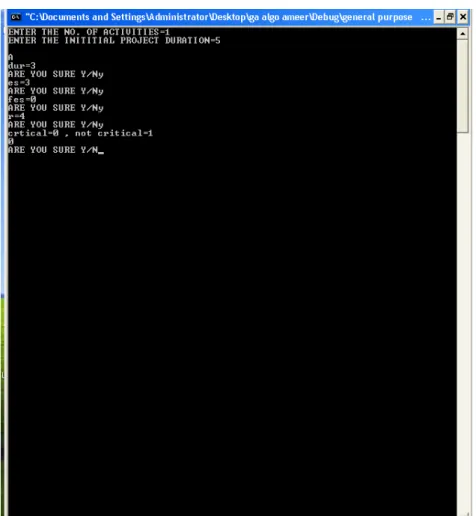
After the above steps GA input screen which we will input the number of activity, duration of project, for each activity input we will input:
a. Duration b. Early start (ES) c. Total Float (TF) d. Resources (R) e. Is it critical or not
f. When Click Enter the GAs is operate and give us Resource of each day and the minimum of (Mx)
These steps illustrate in Figure (8) that input the data of one activity
MODEL APPLICATION
Case Study1 of 7 Activity (Description and Data)
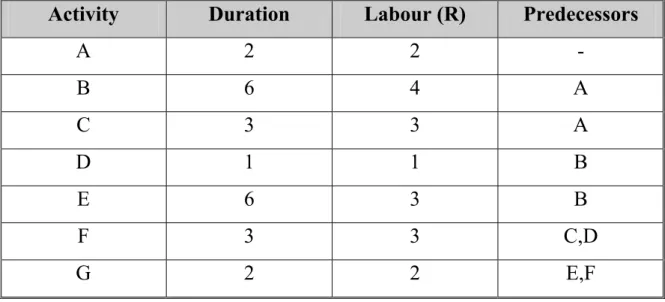
A summary of the case study data is demonstrated in Table (1) Table 1 Case Study Data of 7 activity
Activity
Duration
Labour (R)
Predecessors
A 2 2 -
B 6 4 A
C 3 3 A
D 1 1 B
E 6 3 B
F 3 3 C,D
G 2 2 E,F
From MS Project we get figure (9) and (10) show a hypothetical case study of 7 activities in the form of activity on node (AON)
network and a bar chart representation respectively.
Figure 10 Bar Chart of 7 Activity Project
A
B
C
E
D
F
G
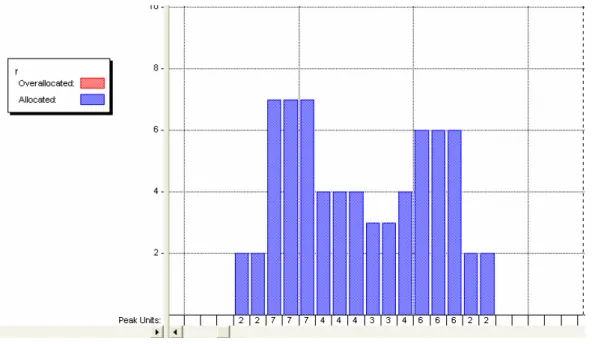
Figure (11) illustrate the Resource Histogram before Smoothing where Mx = 353
Figure (12) illustrate resource Histogram after Smoothing in MS Project where Mx = 353
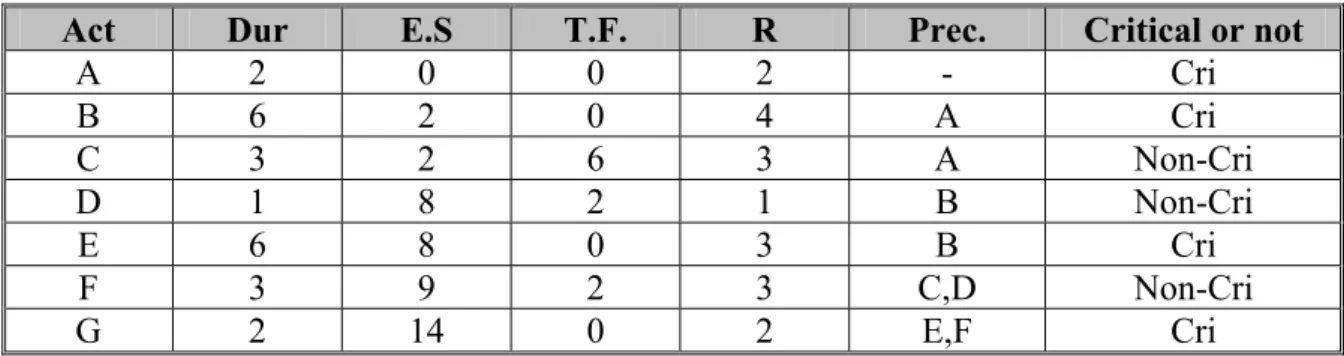
Table (2) show the information needed to GA Resource Smoothing System which get it from MS Project before Smoothing and Table (3) show the information after Smoothing.
Figure 11 Resource Histogram Before Smoothing
Table 2 Activity Information Before Smoothing
Act Dur E.S T.F. R Prec. Critical or not
A 2 0 0 2 - Cri B 6 2 0 4 A Cri C 3 2 6 3 A Non-Cri D 1 8 2 1 B Non-Cri E 6 8 0 3 B Cri F 3 9 2 3 C,D Non-Cri G 2 14 0 2 E,F Cri
Table 3Activity Information After Smoothing in MS-Project
Act Dur E.S T.F. R Prec. Critical or not
A 2 0 0 2 - Cri B 6 2 0 4 A Cri C 3 2 6 3 A Non-Cri D 1 10 0 1 B+2day[FS] Cri E 6 8 0 3 B Cri F 3 11 0 3 C,D Cri G 2 14 0 2 E,F Cri
It is noted that MS-Project after smoothing make the activity D,F is critical and the Total Float = 0 while the moment of resources (Mx) is not changed and equal (Mx = 353). Performing Optimization Process
This application is perform to compare the proposed model results with manual solution of the case study. Optimization options are set as follow:
- Population size: After initial experimentation with different population size (chromosomes) = No. of duration of any project.
- Crossover rate = No. of total float of each non-critical activity.
- Stopping condition: as GA gives results that show no further improvements.
Performing Resource Smoothing
This application demonstrates the proposed model ability to optimize the process of resource smoothing to compare the results with MS-project program and manual results.
The optimization parameters associated are as follows:
- Objective function: minimizes fluctuation moment (Mx).
- Change TF, ES to non-critical activities.
- Constraints:
Project duration = deadline duration (16)
ES = early start to critical activity. The results of resource smoothing in GA are illustrated in table (4)
Table 4 Activity Information of Resource Smoothing in GA
Act Dur E.S T.F. R Prec. Critical or not
A 2 0 0 2 - Cri B 6 2 0 4 A Cri C 3 8 0 3 A,B Cri D 1 8 2 1 B Non-Cri E 6 8 0 3 B Cri F 3 11 0 3 C,D Cri G 2 14 0 2 E,F Cri
And the bar chart after smoothing in GA as shown in Figure (13)
We conclude from the above that the MS project made the activity D,F is critical where Mx = 353 but GA is made the activity C,F is critical and activity D is still non-critical where Mx = 341 and it is less than the calculated Mx from MS project and equal mx from manual solution and the Histogram
because its small project where the Mx from GA equal Mx from manual solution.
It’s noted No. of peak and No. of changes = 2 and highest peak = 7 from Ms results while No. of changes and No. of peak = 1 from GA results
Figure 13 Bar Chart of 7 Activity After Smoothing in GA
Figure (14) show resource smoothing histogram from GA results where Mx = 341
Figure (15) show the GA output screen from C++
Figure 14 Resource Histogram After Smoothing From GA Results
CONCLUSIONS
Through the research work, there are groups of conclusions that can be summarized by the following points:
1. Through the literature review, the researcher found that :
a- There are no researches or studies accomplished in Iraq deal with the subject of Resource Leveling in spite of the importance of this part of Management.
b- GA can be utilized in the other areas of Project Management such as Productivity, Value Engineering, Scheduling…etc.
2. Through the development of Resource Smoothing Model using GA, the following points are concluded:
a- GA have demonstrated to be a promising tool for use in the initial stages of Construction Projects. b- The scheduling model has the
capability to obtain optimum solution for performing resource smoothing. Genetic algorithms program searches for the optimum set of activities methods of constructions that minimize the moment of resources (MX). The purpose model can perform resource leveling is better than the Microsoft project program (MS-project). We also find that the calculated moment of resources (MX) of proposed model (C++) is less than the results of (MS-project) and given better smoothing. Resource smoothing can be applied with the proposed model to obtain results identical (improved further) to that obtained from adopting Microsoft project software.
RECOMMENDATIONS
1. Despite the good performance of GA in this work and in many situations in civil engineering, it suffer from a number of
help with it development, the fact that success in finding a good solution is usually achieved by optimize project plan during planning stage.
2.For the future work, it is suggested to transfer the information automatically (to perform Resource Smoothing).
It is suggested to adopt the research findings in the application field throughout using the model in the planning and managing of construction project in Iraqi construction industry.
REFERENCES
Baker, J.E. (1985). Adaptive Selection Methods for Genetic Algorithms. Proceedings of an International Conference on Genetic Algorithms and Their Applications, 101-111.
Callahan, M. T., Enbush. D.G.Q. and Rowings, J. E., 1992, "Construction Project Scheduling", McGraw-Hill, Inc.
De Jon, K.A. (1980b). “A Genetic-Based Global Function Optimization Technique” Pittsburgh: University of Pittsburgh. Department of Computer Science.
GOLDberq, D. E., 1989, "Genetic Algorithms in search optimization and Machine Learning", Addision Wesley Publishing Co.
Haider, A., Naoum, S., Howes, R and Tah, J., 1999, "Genetic Algorithms Application and Testing for Equipment Selection", ASCE Journal of Construction Engineering and Management, vol. 125, No.1.
Harmanani, H., Zouein, P., Hajar, A., 2000, "An Evolutionary Site Layout" , ASCE, Journal of Construction Engineering and Management, vol. 128, No.6.
Harris, R. B., 1990, "Packing Method for Resource Leveling (PACK)", Journal of Construction Engineering and Management,
Harris, R. B., 1978, "Precedence and Arrow Networking Techniques Press, London, England.
Hiyassat, A. M., 2001, "Applying Modified Minimum Moment Method to Multiple Resource Leveling", ASCE, Journal of Construction Engineering and Management, vol. 127, No. 3.
Kevin, P. and Tarek, H., 2003, "Genetic Optimization for Dynamic project Control", ASCE journal of Construction Engineering and Management, vol. 129, No.4.
Leu, S. and Yang, C. H.,1999, "GA-Based Multicriteria in Optimal Model for Construction Scheduling", ASCE, Journal of Construction Engineering and Management, vol. 125, No. 6.
Maria, A., 1997 "Introduction to Modeling and Simulation" Proceedings of the 1997 Winter Simulation Conference, Atlanta, Georgia, USA.
Michell,M.,1998,"An Introduction to Genetic Algorithms", MIT press, London, England. Moselhi, A., and Lorterapong, P. (1993). “Least Impact Algorithm for Resource Allocation.” ” Can. J. Civ. Engrg., CSCE, 20(2).
Project Management Institute, 1996, " A guide to the Project Management Body of Knowledge" USA.
Que, B. C., 2002, "Incorporating Practicability into Genetic Algorithms-Based Time-Cost Optimization", Journal of Construction Engineering and Management. Senupta, B. and Guha, H.,1995, "Construction Management and Planning", Tata Mc Gra-Hill.
Son, J. and Skibuiewski, M. J., 1999, "Multi Heuristic Approach for Resource Leveling Problem in Construction Engineering and Management", Journal of Construction
Engineering and Management ASCE, vol. 125, No. 1.
Tarek, H, 1999 "Optimization of Construction Time-Cost Trade off Analysis Using Genetic Algorithms", Canadian Journal of Civil Engineer, Vol. 26.
Tarek, H. 1999 "Optimization of Resource Allocation and Leveling Using Genetic Algorithms", ASCE, Journal of Construction Engineering and Management, Vol. 125, No. 3.
Tarek, S. A., 2000, "conjugation and Controlled Mutations New Operatos in Genetic Algorithms", Ph. D. Thesis, Computer Science and Information System, University of Technology.
![Figure 1 Basic Cycle of GA Operations [Tarek 1999]](https://thumb-us.123doks.com/thumbv2/123dok_us/9779322.2861919/4.892.171.680.723.949/figure-basic-cycle-ga-operations-tarek.webp)
![Figure 2 Chromosome Structure [Lue 1999]](https://thumb-us.123doks.com/thumbv2/123dok_us/9779322.2861919/5.892.166.660.114.400/figure-chromosome-structure-lue.webp)
![Figure 4 Some Examples of Mutation in GA [Goldberg 1989]](https://thumb-us.123doks.com/thumbv2/123dok_us/9779322.2861919/6.892.103.779.141.483/figure-examples-mutation-ga-goldberg.webp)
![Figure 5 Genetic Algorithm Procedure [Tarek 1999]](https://thumb-us.123doks.com/thumbv2/123dok_us/9779322.2861919/9.892.80.786.75.1046/figure-genetic-algorithm-procedure-tarek.webp)
![Figure 6 Process Chart Diagram of the Proposed Model [researcher]](https://thumb-us.123doks.com/thumbv2/123dok_us/9779322.2861919/10.892.167.598.180.1121/figure-process-chart-diagram-proposed-model-researcher.webp)
![Figure 7 Optimization Process Chart of the Resource smoothing [researcher]](https://thumb-us.123doks.com/thumbv2/123dok_us/9779322.2861919/11.892.115.767.71.1025/figure-optimization-process-chart-resource-smoothing-researcher.webp)