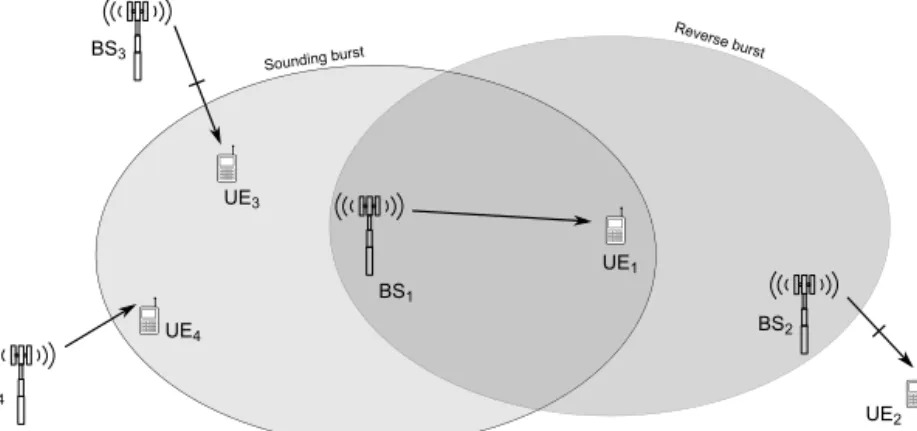
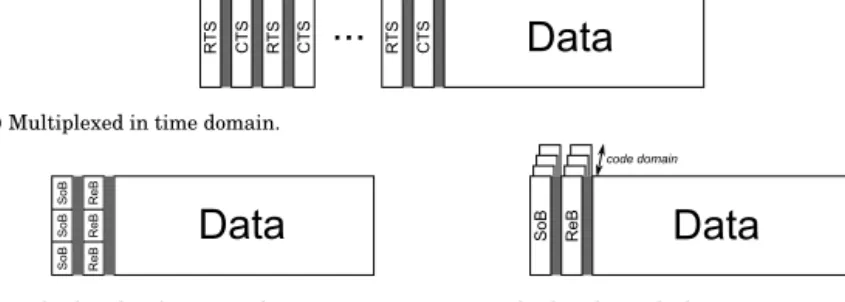
Cellular wireless networks have become a commodity. We use our cellular devices every day to connect to others, to conduct business, for entertainment. Strong demand for wireless access has made corresponding parts of radio spectrum very valuable. Consequently, network operators and their suppliers are constantly being pressured for its efficient use. Unlike the first and second generation cellular networks, current generations do not therefore separate geographical sites in frequency. This universal frequency reuse, combined with continuously increasing spatial density of the transmitters, leads to challenging interference levels in the network.
It is important to study wireless
communications because it has become an irreplaceable part of our everyday life and because the technology did not yet reach its imaginable potential. In our personal opinion, this limit is transfer of human thoughts with comparable latency as within our own brains.
A alt o-D D 1 4 2 /2 01 6
9HSTF
MG*agj
cch+
ISBN 978-952-60-6922-7 (printed) ISBN 978-952-60-6923-4 (pdf) ISSN-L 1799-4934 ISSN 1799-4934 (printed) ISSN 1799-4942 (pdf) Aalto UniversitySchool of Electrical Engineering
Department of Signal Processing and Acoustics www.aalto.fi BUSINESS + ECONOMY ART + DESIGN + ARCHITECTURE SCIENCE + TECHNOLOGY CROSSOVER DOCTORAL DISSERTATIONS M ich al Č ier ny Co ntr ib uti on s to A na lys is a nd M itig ati on of C oc ha nn el I nte rfe re nc e in C ell ula r W ire les s N etw or ks A alt o U n ive rs ity
Department of Signal Processing and Acoustics
Contributions to Analysis
and Mitigation of
Cochannel Interference in
Cellular Wireless Networks
Michal Čierny
DOCTORAL DISSERTATIONS
Aalto University publication series
DOCTORAL DISSERTATIONS 142/2016
Contributions to Analysis and
Mitigation of Cochannel Interference
in Cellular Wireless Networks
Michal Čierny
A doctoral dissertation completed for the degree of Doctor of Science (Technology) to be defended, with the permission of the Aalto University School of Electrical Engineering, at a public examination held at the lecture hall S1 of the school on 19 August 2016 at 12 o'clock noon.
Supervising professor
Prof. Risto Wichman
Preliminary examiners
Prof. Harpreet Dhillon, Virginia Tech, USA Dr. Gűnther Auer, Ericsson, Sweden
Opponent
Prof. Chintha Tellambura, University of Alberta, Canada
Aalto University publication series
DOCTORAL DISSERTATIONS 142/2016 © Michal Čierny ISBN 978-952-60-6922-7 (printed) ISBN 978-952-60-6923-4 (pdf) ISSN-L 1799-4934 ISSN 1799-4934 (printed) ISSN 1799-4942 (pdf) http://urn.fi/URN:ISBN:978-952-60-6923-4 Unigrafia Oy Helsinki 2016
Abstract
Aalto University, P.O. Box 11000, FI-00076 Aalto www.aalto.fi
Author
Michal Čierny
Name of the doctoral dissertation
Contributions to Analysis and Mitigation of Cochannel Interference in Cellular Wireless Networks
Publisher School of Electrical Engineering
Unit Department of Signal Processing and Acoustics
Series Aalto University publication series DOCTORAL DISSERTATIONS 142/2016
Field of research Signal Processing for Communications
Manuscript submitted 25 April 2015 Date of the defence 19 August 2016 Permission to publish granted (date) 21 April 2016 Language English Monograph Article dissertation Essay dissertation Abstract
Cellular wireless networks have become a commodity. We use our cellular devices every day to connect to others, to conduct business, for entertainment. Strong demand for wireless access has made corresponding parts of radio spectrum very valuable. Consequently, network operators and their suppliers are constantly being pressured for its efficient use. Unlike the first and second generation cellular networks, current generations do not therefore separate geographical sites in frequency. This universal frequency reuse, combined with continuously increasing spatial density of the transmitters, leads to challenging interference levels in the network.
This dissertation collects several contributions to analysis and mitigation of interference in cellular wireless networks. The contributions are categorized and set in the context of prior art based on key characteristics, then they are treated one by one.
The first contribution encompasses dynamic signaling that measures instantaneous interference situations and allows only for such transmissions that do not harm each other excessively. A novel forward signaling approach is introduced as an alternative to traditional reverse signaling. Forward signaling allows the interference management decisions to be done at the receiver, where there is more relevant information available.
The second contribution analyzes cross-link interference in heterogeneous networks. Cross-link interference is interference between downCross-link and upCross-link transmissions that can appear in time-division duplex (TDD) networks. It is shown that uplink reception of small cells can be disturbed considerably by macrocell downlink transmissions. We proposes an intuitive solution to the problem based on power control. Users in small cells have generally enough power headroom as the distance to the small base station is often short.
The third contribution provides an extensive analysis of a specific interference managment method that the Long-Term Evolution (LTE) applies in cochannel heterogeneous deployments. We analyze this so-called time muting using a modern stochastic geometry approach and show that performance of the method strongly depends on residual interference in the muted sections of time.
The fourth and last contribution analyzes the impact of interference rank, i.e., number of spatial streams at the interferer, on a beamformed or spatially block coded transmission. It is shown that when the interferer chooses to transmit multiple spatial streams, spreading the power in spatial domain has potential to decrease probability of outage at neighbor receiver, especially if the neighbor transmission uses beamforming.
Keywords interference management, cellular, wireless
ISBN (printed) 978-952-60-6922-7 ISBN (pdf) 978-952-60-6923-4
Preface
This thesis is a culmination of research work that was done under super-vision of Prof. Risto Wichman from Department of Signal Processing and Acoustics, which belongs to Aalto University’s School of Electrical Engi-neering. I (who in other parts of the thesis is represented bywe) would like to express my foremost gratitude to Risto for giving me the chance, freedom and support during this endeavor.
I would like the thank the pre-examiners, Prof. Harpreet Dhillon and Dr. Gunther Auer, for their time and effort spent while evaluating this thesis. Both have provided high quality expert opinions, acknowledged contributions of my work and did not hesitate to point out shortcomings where it was needed. I would also like to thank Prof. Chintha Tellambura for accepting to be an opponent when I defend this thesis. It will be an honor to be examined by a world class expert of his rank.
I did the accompanied research during 2009-2014 and continued writing this thesis until 2015. In the beginning I worked full time on a TEKES project under the wings of Nokia Research Center (NRC, currently Nokia Technologies). In 2010 I was accepted to prestigious Graduate School in Electronics, Telecommunications and Automation (a.k.a. GETA). Later on I joined a cooperation project called Wireless Innovation between Fin-land and US (a.k.a. WiFiUS) and decreased my activities at NRC to part time. Additionally, my work was supported by HPY Foundation and Nokia Foundation. I humbly thank each one of these institutions.
Many colleagues deserve gratitude for guiding my work and ultimately for shaping my research skills. At NRC it was Dr. Klaus Hugl, Prof. Olav Tirkkonen, Dr. Carl Wijting and most importantly Dr. Cássio Ribeiro, who had to deal with me the most and who is my inspiration in the ability of seeing the bigger picture of research problems. During the WiFiUS project I was guided by Prof. Zhi Ding and Prof. Jyri Hämäläinen. Prof.
Preface
Ding also hosted my visit at the University of California, Davis, where we had weekly discussions and where he unknowingly showed me what really makes a university stand out.
I would like to also acknowledge my other coauthors Dr. Pekka Jänis, Haining Wang and Prof. Xin Liu. I had a lot of nice colleagues at Aalto University, with whom I have sadly not had a chance to cooperate much, Pekka being an exception. On the other hand, we had some great time together, among others with Karol Schober, Pramod Mathecken, Jaakko Ojaniemi, Jayaprakash Rajasekharan, Dr. Taneli Riihonen, Eric Halbach, Vincent Boerjan and others. Separate thanks go to our department sec-retaries Mirja Lemetyinen and Heidi Koponen and the GETA coordinator Marja Leppäharju.
Extra humble thanks go to Prof. Risto Wichman, Dr. Cássio Ribeiro and Prof. Zhi Ding for providing me with recommendation letters and to my current boss Kaisu Iisakkila for reading them, giving me a chance and setting up a warm welcome at a new workplace. From my new colleagues I would like to thank Timo Lunttila and Dr. Kari Hooli; it is a pleasure to work with such dedicated and open-minded experts.
As I here and there return to my home country, a couple of good friends are always ready to meet me: Jakub Gécz, Adam Klimek, Marek Jurík and others, thank you. Here in Finland, I must not forget the Niinikangas family for helping me to assimilate in this dark corner of Earth. Eternal gratitude goes towards my family; mom, dad, sister and brother, thank you for everything and I am sorry I am so bad at keeping in touch. Finally, ultimate thanks to Silja, for understanding me and preventing me from becoming a robot.
Helsinki, July 3, 2016,
Contents
Preface 1 Contents 3 List of Publications 5 Author’s Contribution 7 List of Abbreviations 11 List of Symbols 15 1. Introduction 192. Interference and its management 25
2.1 Classification of interference . . . 25
2.2 Modeling of cochannel interference . . . 28
2.3 Classification of interference management . . . 29
2.3.1 What? . . . 29
2.3.2 Where? . . . 30
2.3.3 How fast? . . . 31
2.3.4 How verbose? . . . 31
2.3.5 How intrusive? . . . 32
2.4 Examples of interference management methods . . . 32
3. Dynamic on/off interference management 35 3.1 Competing on/off techniques . . . 37
3.1.1 The concept of busy burst . . . 37
3.1.2 Cochannel interference avoidance MAC . . . 39
3.2 SINR prediction and reverse reporting . . . 40
Contents
3.2.2 Sounding/silencing protocol . . . 48
3.2.3 Discussion . . . 49
4. Management of cross link interference 51 4.1 Motivation and description . . . 51
4.2 Survey of solutions . . . 53
4.3 Power control in heterogeneous cross link cases . . . 54
5. Semi-static on/off interference management 57 5.1 About almost blank subframes . . . 57
5.2 Stochastic geometry background . . . 60
5.3 How many are needed? . . . 63
5.3.1 System model . . . 64
5.3.2 Distance to serving base station . . . 65
5.3.3 Interference, SINR and success probability . . . 66
5.3.4 Average rate . . . 69
5.3.5 Results . . . 70
5.4 Time synchronization issues . . . 72
5.4.1 Problem formulation and analysis . . . 73
5.4.2 Results . . . 75
6. Controlling interference rank 77 6.1 Problem description and system model . . . 77
6.2 Analysis of beamforming . . . 79
6.3 Analysis of OSTBC . . . 81
6.4 Results and discussion . . . 83
7. Conclusions 85
References 91
Errata 103
List of Publications
This thesis consists of an overview and of the following publications which are referred to in the text by their Roman numerals.
IM. ˇCierny, P. Jänis, R. Wichman, C. Ribeiro. Exclusion Regions via Handshaking Protocol for Inter-Cell Interference Management. In45th
Annual Conference on Information Sciences and Systems, CISS 2011,
Baltimore, MD, March 2011.
IIM. ˇCierny, C. Ribeiro, R. Wichman, O. Tirkkonen. SINR Prediction Versus Reverse Reporting for Soft Reuse and Interference Management.
In11th European Wireless Conference, EW 2011, Vienna, Austria, April
2011.
IIIM. ˇCierny, C. Ribeiro, R. Wichman, O. Tirkkonen. Inter-Cell Interfer-ence Management in OFDMA TDD Downlink Using Sounding/Silencing Protocol. InIEEE 22nd International Symposium on Personal, Indoor
and Mobile Radio Communications, PIMRC 2011, Toronto, ON, pp.
839-843, September 2011.
IV M. ˇCierny, R. Wichman, J. Hämäläinen, C. Ribeiro, Z. Ding, X. Liu. On TDD Cross-Tier In-Band Interference Mitigation: A Practical Example.
In7th International ICST Conference on Cognitive Radio Oriented
Wire-less Networks and Communications, CROWNCOM 2012, Stockholm,
Swe-den, June 2012.
List of Publications
Almost Blank Subframes in Heterogeneous Cellular Networks. IEEE
Transactions on Wireless Communications, vol. 12, no. 10, pp.
5061-5073, September 2013.
VI M. ˇCierny, R. Wichman, Z. Ding. Impact of Base Station Time Syn-chronization Mismatch on Almost Blank Subframes. IEEE
Communi-cations Letters, vol. 17, no. 11, pp. 2092-2095, October 2013.
VIIM. ˇCierny, Z. Ding, R. Wichman. Higher Rank Interference Effect on Weak Beamforming or OSTBC Terminals. IEEE Transactions on
Author’s Contribution
Publication I: “Exclusion Regions via Handshaking Protocol for Inter-Cell Interference Management”
In Publication I we introduce the idea of using RTS and CTS control bursts in a fixed frame structure for the purpose of dynamic interference management. Power of the received bursts is compared to a threshold; transmission proceeds if the power does not exceed the threshold. An exception to the rule is proposed so that bursts do not cross-block trans-missions. We study the concept in a small scale by mathematical analysis and in a larger scale by numerical simulations.
The present author designed the concept, performed the analysis and wrote major part of the article. Pekka Jänis authored the simulation framework that was adapted for the analysis and helped with editing of the article. Risto Wichman and Cássio Ribeiro guided the work and helped with editing of the article.
Publication II: “SINR Prediction Versus Reverse Reporting for Soft Reuse and Interference Management”
In Publication II we separated the signaling approach from Publication I into forward part and reverse part and in the forward part we introduced relative thresholding instead of absolute thresholding, thus making way to SINR prediction. We then performed elaborate indoor simulations that showed that SINR prediction achieves comparable fairness and higher spectral efficiency than reverse signaling approach.
The present author designed the concept, performed the evaluation and wrote major part of the article. Cássio Ribeiro, Risto Wichman and Olav
Author’s Contribution
Tirkkonen guided the work and helped with editing of the article.
Publication III: “Inter-Cell Interference Management in OFDMA TDD Downlink Using Sounding/Silencing Protocol”
In Publication III we augmented the concept of SINR prediction in or-der to address especially strong interference scenarios. After a receiver predicts SINR, it is given an option to silence selected interferers, thus improving its SINR during data transmission. We evaluated the concept using numerical simulations and showed it has good potential to reduce outage of users that would normally suffer from bad location.
The present author defined minor details of the concept, performed the evaluation and wrote major part of the article. Cássio Ribeiro and Olav Tirkkonen designed the concept, guided the work and helped with editing of the article. Risto Wichman guided the work and helped with editing of the article.
Publication IV: “On TDD Cross-Tier In-Band Interference Mitigation: A Practical Example”
In Publication IV we studied cross-link interference in a heterogeneous scenario with macro cells and small cells. Small cell uplink reception was found to be vulnerable to interference from macrocell downlink. We proposed to increase transmission power of small cell users, which have sufficient power budget thanks to small distances (i.e., low default trans-mission powers) between them and small cell base stations. We presented a closed form solution for a small scenario with known channel conditions and a heuristic practical solution that could be adapted in a real network. The present author designed the concept, performed the evaluation and wrote major part of the article. Risto Wichman, Jyri Hämäläinen, Cássio Ribeiro, Zhi Ding and Xin Liu guided the work and helped with editing of the article.
Author’s Contribution
Publication V: “On Number of Almost Blank Subframes in Heterogeneous Cellular Networks”
In Publication V we studied time domain enhanced inter-cell interference coordination, a 3GPP LTE concept of blanking part of subframes in a ra-dio frame to manage interference in heterogeneous networks. We used stochastic geometry framework and adapted it to calculate outage proba-bility of users that are in vicinity of dominant interferers. We then used the result to calculate how many blank subframes are needed and how does the requirement change with different system parameters.
The present author performed the analysis and wrote major part of the article. Haining Wang, Risto Wichman, Zhi Ding and Carl Wijting guided the work and helped with editing of the article. In addition, an anonymous reviewer contributed to small part of the analysis.
Publication VI: “Impact of Base Station Time Synchronization Mismatch on Almost Blank Subframes”
In Publication VI we studied the effect of time synchronization error on viability of time domain enhanced inter-cell interference coordination. We adapted the analysis framework from Publication V and evaluated the effect of time mismatch on LTE’s control channel located in the beginning of a subframe. The results showed that timing requirements defined for TDD are sufficient also for FDD network that uses TDM eICIC.
The present author performed the analysis and wrote major part of the article. Risto Wichman and Zhi Ding guided the work and helped with editing of the article.
Publication VII: “Higher Rank Interference Effect on Weak Beamforming or OSTBC Terminals”
In Publication VII we study SINR distribution and outage probability of beamforming and space-time block coding, with a special focus on the rank of interferers’ transmissions. We show that forcing the interferer to transmit higher rank MIMO signal has potential to decrease probability of outage of vulnerable receivers.
The present author performed the analysis and wrote major part of the article. Zhi Ding and Risto Wichman guided the work and helped with
Author’s Contribution
List of Abbreviations
3GPP third generation partnership project ABSF almost blank subframe
AMC adaptive modulation and coding AWGN additive white Gaussian noise
BS base station
CCDF complementary cumulative distribution function
CDF cumulative distribution function CDMA code-division multiple access
CIA-MAC cochannel interference avoidance MAC CoMP coordinated multipoint
CRE cell range expansion
CRS cell specific reference symbols CSG closed subscriber group
CTS clear to send
DECT digital enhanced cordless communications
DI dominant interferer
DL downlink
fBS femto base station
FDD frequency-division duplexing
fUE femto user equipment
iBS interfering base station IC interference cancellation ICI intercell interference INR interference to noise ratio IRC interference rejection combining LAA licensed-assisted access
List of Abbreviations
LTE Long-Term Evolution
MAC medium access control
mBS macro base station
MBSFN multicast broadcast single frequency network
MCS modulation and coding scheme MIMO multiple input multiple output
MRC maximum ratio combining
MTI maximum tolerable interference
mUE macro user equipment
NSF normal subframe
OFDM orthogonal frequency-division multiplex OFDMA orthogonal frequency-division multiple
access
OSTBC orthogonal space-time block coding
pBS pico base station
PDCCH physical downlink control channel PDF probability density function PDSCH physical downlink shared channel
PHY physical layer
PMF probability mass function
PPP Poisson point process
pUE pico user equipment
QoS quality of service
ReB reverse burst
RF radio frequency
RSRP reference signal received power
RTS request to send
RV random variable
S/S sounding/silencing
sBS serving base station
SINR signal to interference plus noise ratio smBS small cell base station
smUE small cell user equipment SNR signal to noise ratio
SoB sounding burst
List of Abbreviations
TD-SCDMA Time-division Synchronous Code Division Multiple Access
TDD time-division duplexing
TDM eICIC time domain enhanced inter-cell interference coordination TTI transmission time interval
UE user equipment
UL uplink
UWB ultra wideband
List of Symbols
2F1 hypergeometric function
Ca rate of a victim UE in an ABSF Ci spectral efficiency ofi-th link CM macro link capacity
cM number of bits per subcarrier
CM,min minimum required macro link capacity Cn rate of a victim UE in a NSF
Cv outage rate of a victim UE d0 sBS data symbol
Fc CDF of channel gain
Frm CDF of distance to the closest mBS frm PDF of distance to the closest mBS
fγ PDF of SINR
Fτ CDF of timing mismatch gmn element ofHi
Gm,np,q Meijer G-function
H0 fast fading channel matrix from sBS
h(i)
eq equivalent channel vector ofi-th sBS Hi fast fading channel matrix fromi-th iBS
hk channel gain threshold for transmission of k-th base station
hmn element ofH0
Id interference from DIs Im interference from mBSs Ip interference from pBSs J Jain’s fairness index k1 pBS association coefficient k2 DI-defining coefficient
List of Symbols
n noise vector
Na number of ABSFs in a radio frame Nd number of dominant interferers Nl number of links
NL(i) number of transmission layers ati-th iBS
NR number of receive antennas Nr number of resource blocks
NReB number of detected ReBs that that are stronger thanλReB
Ns number of subframes in a radio frame NSC number of subcarriers
NSC,min required number of successfully decoded subcarriers
NSC,ρ number of successfully decoded subcarriers
NSoB number of detected SoBs NT number of transmit antennas NUE number of UEs
NUE,v number of victim UEs
P probability
pCM,
min probability of reaching minimum capacity requirement
pdata insistence probability for data transmission
pγ,M PDF ofγM
Pm mBS transmission power pm fraction of critical mBSs Pp pBS transmission power pReB insistence probability for ReB
transmission
Ps smUE transmission power
ps success probability at a victim pUE Ps,max maximum smUE (subcarrier)
transmission power
Ps,opt optimal smUE (subcarrier) transmission power
List of Symbols
pρ probability of successful subcarrier decoding
r received sample vector
R0 average received power from sBS rd distance to closest DI
Ri average received power fromi-th iBS ˜
ri received sample vector fromi-th iBS
rm distance to closest mBS
RMM long term channel gain on mBS-mUE link
rp distance to closest pBS
RSM long term channel gain on smUE-mUE
link
SMM fast fading on mBS-mUE link
SSM fast fading on smUE-mUE link
tcp cyclic prefix length
tfft OFDM symbol length (without cyclic prefix)
Tk number of victim receivers fork-th base
station
w0 precoding vector of sBS
wi precoding vector ofi-th iBS
wm element of precoding vector X† Hermitian transpose ofX x complex conjugate ofx XF Frobenius norm ofX
x(m) variablexat time instancem
αm path loss exponent on mBS-UE link αp path loss exponent on pBS-UE link
Γ Gamma function
γ SINR
γ0 SINR threshold
γa SINR in an ABSF
γi SINR ofi-th link
γM subcarrier SINR at the mUE
Δ multiplicative coefficient of mismatched interference
η Rayleigh fading distribution rate Θm mBS Poisson point process
List of Symbols
Θp pBS Poisson point process ΘUE UE Poisson point process κ association bias
λm intensity of mBS PPP λmax dominant eigenvalue λp intensity of pBS PPP λReB power threshold for ReB λSoB power threshold for SoB λUE intensity of UE PPP
μm mBS load
μp pBS load
ρdB subcarrier SINR threshold in decibels ρr residual interference fraction
σ2
n noise power
τi timing mismatch ofi-th BS τw timing mismatch of the serving BS Υ multiplicative coefficient of all
interference
φI
d subterm containing DI interference φIm subterm containing mBS interference φIp subterm containing pBS interference Ωa round robin fraction in an ABSF Ωn round robin fraction in a NSF
1. Introduction
If you happen to read this text, you most likely belong to one of three groups of people. You may be a family member or a friend of the author looking for another part of the thesis beyond the preface that you could understand. To you we thank greatly for you interest and encourage you to look no further and rather spend your time on a more joyful activity. The remainder of this book is very technical and not at all enjoyable for those that are not close to the matter. This matter is the field ofwireless
communications[56,132], a field of study that is partly science and partly
technology. The second group of probable readers are (ex)colleagues of the author and “random” visitors at his public examination. These readers are very welcome to read on and evaluate how relevant is the author’s contribution, or ponder on the importance of theory versus practice and analyzing a problem versus finding a solution. We hope the text will not bore you to exhaustion. Finally the last and most important readers are our reviewers and genuinely interested researchers or engineers. To you we apologize for the rattle, it is merely an attempt to set a lighter tone. All the readers who are not discouraged to read on, please note that through-out the textwerefers sometimes to the author himself and other times to author and his coauthors, most likely in relation to a specific part of the work.
It is important to study wireless communications because it has become an irreplaceable part of our everyday life and because the technology did not yet reach its imaginable potential. In our personal opinion, this limit is transfer of human thoughts with comparable latency as within our own brains [139]. But let us not get carried away. We use wireless commu-nications in different ways. All systems were originally analog and some of them, for example radio and TV broadcast, still survive, although they are being replaced. The modern systems are digital, meaning that
electro-Introduction
magnetic waves are modulated with symbols encoding a stream of zeros and ones. Beside broadcast systems, typical examples of wireless commu-nication systems are point-to-point connections used to overcome certain distance or obstacle. These include (among others) satellite communi-cation systems and microwave relays. Furthermore, by combining two or more wireless devices we build wireless networks. Depending on the transmission power and other design or regulation limitations, these net-works then serve different ranges. Personal area netnet-works such as Blue-tooth work within short distances in the range of 10s of meters. Local area networks (LANs) such as wireless LAN (WLAN) reach intermediate distances maybe in the range of 100s of meters. Wide area networks such as cellular networks or trunked systems can serve larger areas.
This book focuses on cellular systems, or more specifically on interfer-ence management in the radio access part of cellular systems. The focus is motivated by prevalent academic and business interest in next genera-tion systems, especially third generagenera-tion partnership project (3GPP) LTE-Advanced, an upgrade of Long-Term Evolution (LTE). From four major topical chapters present in this book two present ideas that can be used in other systems as well, while the other two are applicable solely to cel-lular systems. We will now list the four topics that this thesis deals with and try to pinpoint what is our specific contribution. The topics are listed in chronological manner.
•Dynamic forward and reverse signaling for spatial separation of
interfer-ence (topic 1). Our very first topic was initiated by a question whether
cellular local area network should draw inspiration from WLAN and consider using random access mechanism instead of centralized radio resource management. The author as a young (and maybe a bit naive) researcher applied request to send (RTS)/clear to send (CTS) mechanism in orthogonal frequency-division multiple access (OFDMA) and find that while it does not help system performance, by applying smart thresh-olds on these bursts one can increase user fairness. We designed chan-nel reservation protocols based on dynamic signaling and prediction of interference level or signal to interference plus noise ratio (SINR). We evaluated these using simulation studies and showed that forward sig-naling approach fares better than traditional reverse sigsig-naling. Our findings were published in Publication I, Publication II and Publication III. Later on we wanted to prove some of the findings also analytically,
Introduction
but lack of time prevented us from continuing the work.
•Power control for TDD interference reduction (topic 2):Our second topic
was related to 3GPP study item on dynamic time-division duplexing (TDD) operation [2]. We studied uplink-downlink interference in het-erogeneous deployment with macrocells and femtocells. We identified that uplink reception in one layer is vulnerable to downlink interfer-ence from the other layer and proposed to solve the problem by means of power control, as femtocells transmissions happen over small distances and there is room for power optimization. In Publication IV we pre-sented an analysis and a simulation study related to this topic.
•Time domain enhanced inter-cell interference coordination (topic 3):This
topic, although still 3GPP related, was our first venture into “hard” an-alytic approaches that is prevalent in the top journals of our field. The work is related to almost blank subframes that are designed to tackle problematic downlink interference scenarios in heterogeneous deploy-ments. In Publication V we analyzed how many subframes in a radio frame need to be blanked to fulfill certain requirements, while in Pub-lication VI we looked at the impact of base station timing errors on the concept. In both cases we used stochastic geometry framework, a math-ematical toolbox that got very popular recently in the context of wireless network analysis. Additionally, we co-authored [140] that looked at the problem from a local (not network-wide) perspective.
•Impact of interference rank on beamforming and OSTBC (topic 4): The
last topic considers the effect of spatial multiplexing on other transmis-sions, especially on receivers in bad conditions. The topic was proposed by one of our mentors, although it was not completely crystallized in the beginning. The question was in the lines of “see what there is to study about higher rank transmissions and femtocells”. In the end we found that interference rank has not been studied comprehensively and were able to put together a study that glues existing pieces together and introduces a couple of novelties. Our main finding was that when an interferer transmits multiple spatial streams the power is spread in space and it is thus less likely to cause outage at a nearby receiver. We presented the findings in Publication VII.
Introduction
At the first sight one could claim that our four topics are not exactly cohe-sive. While there is no hidden connection between them and no ultimate conclusion showing what is the best interference management technique ever, they all fall under the umbrella of interference management in cel-lular wireless networks. Although there is no profound reason why a uni-versal solution could not exist, the researcher has to apply his skills where the demand1is.
After few years of doing research we can see two common dilemmas that influence the choice of a problem to work on and the way the work will be executed. First comes the dilemma of analyzing a problem versus look-ing for a solution. Strictly speaklook-ing, the dilemma should not exist; good solution should be based on proper analysis, hence the two should not be treated separately. In our fast moving world, it may however happen that commercial interest requires a solution to be found quickly; the research problem may be somewhat close to previously solved problems and a well tailored existing solution may just be the right thing. From our own works we would say the first two topics are about finding a solution, topic 1 for low user fairness and topic 2 for TDD interference. The third topic has a lot of analysis and a small bit of solution, while the fourth topic is a more balanced one but still contains more analysis.
The other dilemma is theory versus practice. Although this can mean many things, in our line of research practice is represented by evaluating ideas through simulation campaigns, while theoretical approach relies on rigorous mathematical analysis. The two approaches can serve different purposes. Rigorous analysis leads to an undeniable proof and cannot be obscured by programming bugs, but it requires considerable effort. At the same time, scale and complexity of the analyzed problem cannot be too high. Simulation campaign does not suffer from this limitation, but increasing number of system features and parameters may make it more difficult to draw good conclusions. Again, neither this dilemma has to actually appear; a good way to make use of both approaches is to draw “large scale” insights from an analysis and then use this insights to limit the scale of required simulation campaign. Our first topic used simulation campaign approach, because it originated from industrial environment where mathematical analysis is not as prevalent. The second topic was probably in between the two approaches. The third and the fourth topic rely on mathematical analysis. Stochastic geometry, the framework that
Introduction
we used in the third topic, is a nice example of analytical approach making its way into larger problems.
The structure of our thesis is as follows. In Chapter 2 we discuss inter-ference and its management on a general level. Chapters 3-6 then contain topics 1-4, just as we introduced them above. Finally, in Chapter 7 we at-tempt to draw our conclusions and discuss what is left for the future.
2. Interference and its management
The centerpiece of this thesis is interference in wireless systems. This chapter is dedicated to interference and its management. While we do at-tempt to keep the discussion as general as possible, the reader will surely notice a bias towards cellular systems [56, Chapter 15], [132, Chapter 4]. This bias is not a result of personal preference, but rather of profes-sional orientation. Well designed wireless networks areinterference lim-ited, meaning that their capacity is limited by interference rather than noise. If this was not the case, it would be possible to increase the spectral efficiency by lowering the frequency reuse or by increasing the load [10]. Interference management is therefore of paramount importance. During a search for good interference management solutions it is rather hard to refer to optimality, as optimal solutions are known only for simplistic setups, see for example [56, Chapter 14], [132, Chapter 6]. From informa-tion theory it is known when interference management is not needed [48]: when the interference power is sufficiently low, the optimal approach is to treat interference as noise. When the power is not so low, interference management is needed. Information theory suggests to use multi-user detection [137], but complexity issues often prevent multi-user detection from being feasible.
In the following sections we will discuss what types of interference there are, how can one specific interference type be modeled, what characteris-tics define an interference management technique and then give reference to some existing techniques.
2.1 Classification of interference
Interference in wireless network may surely be classified from many points of view. There would be certain level of satisfaction in creating an own
Interference and its management
elaborate classification, especially because there are not that many avail-able. We would however like to avoid that in fear that our creation may never get enough deserved appreciation (pun intended). Let us therefore take an existing classification that is good enough and try adding a com-ment here and there. One such good starting point is the creation of our earlier colleague in [70, Section 2.4]. We note here that because this exer-cise could be described as playing with terms that are well known within the field, we will refrain from searching for references that describe each type of interference. Who used which term first is not really relevant -unlike for example who proposed certain solution.
The first important classification categorizes interference intocochannel
interferenceandadjacent channel interference. Cochannel interference, as
the name suggests, come from wireless nodes that operate on the same channel as our node of interest. In this context,channelmeans acarrier, i.e., a part of licensed or unlicensed frequency spectrum that a certain wireless system occupies. In other context, channel could be a finer unit, for example part of a carrier that the system decided to assign to a subset of its nodes. Adjacent channel interference originates from a node or a sys-tem operating in an adjacent channel and typically leaks to our channel of interest as a result of radio frequency (RF) imperfections, most likely filtering.
Both cochannel and adjacent channel interference may come from a completely different wireless system, although in co-channel case this is possible only in unlicensed frequency bands. Unlicensed bands allow ac-cess to all users that abide by regulations, in contrast to licensed bands where only the owner of the corresponding license is allowed to operate. In [70] the interference from different wireless systems is denoted
coex-istence interference. Coexistence interference is not typical for cellular
systems as those operate in licensed bands (that are not adjacent to un-licensed) bands. This may however change as 3GPP licensed-assisted ac-cess (LAA) will start getting deployed in the 5GHz ISM band [4].
The center-point of our focus lays in cochannel interference as it is the most critical interference in broadband cellular networks. It is sometimes denoted asother cell interference or intercell interference (ICI), because its source is another cell of the same operator (as long as we are in li-censed band). Intercell interference can be further divided into three sub-categories:
Interference and its management
•Cell edge interferenceis the most general type of ICI arising at the
bor-der of cells where distance to a neighbour base station (BS) is compara-ble to distance to the serving BS. This is closely related to the concept of frequency reuse further explained in Section 2.4. Cell edge interference is relevant for both uplink (UL) and downlink (DL). It is expected to get worse as the density of network deployment is increasing.
•Cross-link interference,also calleduplink-downlink interference, is ICI
that arises in TDD networks that allow neighbour cells to have opposite link direction, i.e., one performing uplink and the other downlink, in the same time instance. This leads to BS-to-BS interference and user equip-ment (UE)-to-UE interference, the former being especially challenging in case of line-of-sight channel between the base stations.
•Heterogeneous network interferencearises when a cellular operator
de-ploys multiple tiers of cells with overlapping coverage, most commonly small cells (picocells, femtocells) as an underlay to the macro tier. This is an attractive way of increasing network capacity in a busy area (hot spot). However, cochannel deployment of overlapping cells by definition leads to challenging interference scenarios.
Another interference category according to [70] isself interference. This interference originates from the same transmitter as the signal of inter-est and largely depends on the chosen physical layer transmission tech-nique. A classical example of self interference isintersymbol interference
caused by channel spread, badly designed modulation waveform or im-perfect time synchronization. In orthogonal frequency-division multiplex (OFDM), intercarrier interference arises among subcarriers in presence of oscillator imperfections or Doppler effect. When using multi-antenna transmission techniques, interstream interference may arise if different spatial streams are not orthogonal among each other. In full duplex wire-less systems [42], self interference refers to leakage from transmitter to receiver in the same device.
Lastly, there ismultiple access interference, which arises when multiple transmitters transmit to a single receiver at the same time. This happens on a common basis in the cellular uplink, even though it is often designed to assign orthogonal (time/frequency/code) resources to users. For exam-ple, spreading codes in code-division multiple access (CDMA) are not
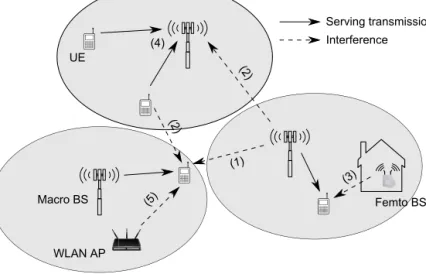
per-Interference and its management WLAN AP Macro BS Femto BS UE Serving transmission Interference (1) (2) (3) (4) (5) (2)
Figure 2.1.Illustrations of interference types in cellular network: (1) represents the most common cell edge interference; (2) represents cross-link interference that may appear in TDD networks; (3) represents heterogeneous interference usually associated with co-channel deployment of femtocells or picocells; (4) represents multiple access interference and (5) represents coexistence inter-ference that may be possible in unlicensed bands in the future.
fectly orthogonal and with frequency selective channel this imperfection gets only amplified. In OFDMA users are assigned different subcarriers, but RF imperfections cause power leaks in the same manner as with ad-jacent channel interference.
This concludes the classification of interference. Some of the interfer-ence types are illustrated in Figure 2.1. Throughout our research activ-ities that have lead to this thesis, the focus has always been on ICI. We focused on all three subcategories of ICI, although not all of them received the same amount of attention. More on that in Chapters 3-6.
2.2 Modeling of cochannel interference
Between realizing that there is a problem (interference) and trying to en-gineer a solution (an interference management technique) it may be use-ful to abstract the problem as much as possible, so that the search for a solution becomes more tractable. Sometimes it is not needed; if a re-searcher (or a company) has enough computational power, he can model the wireless network and interference inside it explicitly. Other times, when we want to prove things with scientific rigour, we need to find a simpler model.
Interference and its management
Statistics of interference depends on three basic things [58]. Firstly, there is the distribution of transmitter locations. By taking into account only active transmitters, this distribution can account not only the spa-tial dimension, but also the temporal dimension of traffic distribution. Secondly, there is the spatial region or area where the transmitters are located. Thirdly, there is the propagation characteristics of the wireless medium. All these result in a rather complicated random process that is sometimes modeled as a shot noise process [27, 135]. A thorough work on interference modeling by a lifelong expert can be found in [96, 97]. Cur-rently, a widely accepted approach is based on an assumption that location of the interferers follows a spatial Poisson distribution [58]. We use this approach in Chapter 5. In Chapters 3, 4 and 6 we model the interference explicitly.
2.3 Classification of interference management
Now that we classified types of interference in wireless network, let us try to classify methods for their management or mitigation. Before look-ing at specific interference management techniques we try to go one level of abstraction higher by listing and describing characteristics that are im-portant for every existing and future technique.
While the goal of every interference management technique should be to increase capacity of a link or a network, not every technique may in practice fit a particular purpose. For example, a system that has latency constraints due to quality of service (QoS) requirements may not be able to use a technique that relies on large amount of signaling or adapts slowly to changes. A good categorization of interference management techniques may thus help when choosing the right technique for the right purpose.
We are not aware of any prior art related to this exercise. Disclaimer: our list may not be exhaustive and sometimes the entries are not com-pletely independent.
2.3.1 What?
We call the first characteristic amethod. It is probably the most impor-tant characteristic that defines what does a technique control in order to manage interference. In a broader scope we could ask what layer does the technique reside on: is it physical layer (PHY) or is it medium access
Interference and its management
control (MAC)? Techniques residing on the physical layer may control for example:
•transmission power, as lower transmission power leads to less interfer-ence to other receivers;
•modulation and/or coding scheme, as robust transmission format is more resilient to interference;
•multi-antenna technique, as beamforming focuses the transmitted power (i.e., interference) in one direction while other techniques may not; •transmission rank, as spatial multiplexing is more susceptible to
inter-ference than single-stream transmission.
Using receiver algorithms resilient to interference, such as interference rejection combining (IRC), may also be considered a PHY interference management technique.
On the MAC layer the techniques usually put restrictions on how links use available radio resources. For example, a link may be restricted to access certain resources that are being used in a neighbor link. In other words, MAC layer may schedule links so that they are separated in time, frequency, code or spatial domain. Separating the transmissions is a cor-nerstone of interference management, or one could rather say interference avoidance.
2.3.2 Where?
The second characteristic we callcontrol, as in point of control, i.e. defin-ing where the interference management decisions are done. In this con-text we mainly distinguish between a centralized approach and a
dis-tributedapproach. A centralized technique performs interference
man-agement decisions at a central location with aggregated control over mul-tiple links (mulmul-tiple cells in a cellular networks), whereas distributed technique performs decisions locally. There is a clear trade-off between the two options. While centralized techniques may achieve better perfor-mance, the central controller needs to be provided inputs and distribute its decisions; hence demanding more signaling. At the same time, search for optimality will likely lead to complex algorithms with higher demands on computational power. Distributed approaches rarely achieve optimal-ity but are obviously less demanding on the architecture.
Interference and its management
Another possible distinction incontrolis whether the interference man-agement decisions are made at the transmitter or at the receiver. This choice should be considered especially for distributed algorithms. In prin-ciple, receiver has more information available to perform good decisions, as it may “see” (i.e., measure) interference directly. On the other hand, if decisions are made at the receiver, they must be conveyed to the trans-mitter, which (again) raises demands on signaling.
2.3.3 How fast?
The third characteristic istime scaleand it defines how fast does an inter-ference management technique operate. We can divide most of existing techniques into three groups:
•Astaticapproach sets up all interference management related settings
only once, most likely when the network is deployed. This approach may be demanding on network planning, but does not require changes in the network protocols. A serious disadvantage is not being able to adapt interference management to changing user distribution or traffic pattern.
•Semi-staticinterference management technique can adapt its settings
to current needs, but can do so only in longer time scale related to higher layer signaling. In 3GPP LTE this approximately means a time scale in 100s of milliseconds. Such approach is able to react to user mobility, but not for example to instantaneous changes in the traffic pattern.
•Adynamicapproach makes interference management decisions
instan-taneously based on current conditions. Its biggest advantage over pre-vious two is the ability to follow even fast channel condition or traffic pattern changes. On the other hand, it may lead to larger (often over the air) signaling overhead.
2.3.4 How verbose?
Our fourth characteristic issignaling. Signaling approaches may differ quantitatively by the amount of generated overhead, and qualitatively by choice of interface and effect on network architecture. For practical
Interference and its management
purposes it is desirable to use existing interfaces or signaling channels and keep the overhead at minimum.
2.3.5 How intrusive?
The fourth and last characteristic iscompatibilityand it simply defines whether an interference management technique can be deployed in an ex-isting network without harming users that do not support the technique. For example, in 3GPP LTE it is common that legacy (Release 8) UEs do not support features of later releases, but it should always be ensured that deployment of a new feature does not harm performance of legacy UEs.
2.4 Examples of interference management methods
Now it is time to introduce existing interference management techniques, because they serve as a starting point for any progress. From the different types of interference that we listed in Section 2.1 we will only discuss techniques that deal with ICI as ICI is the only one addressed in our published research.
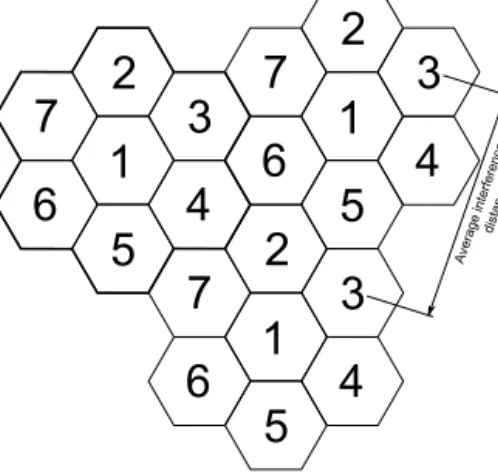
The traditional approach in cellular networks, i.e., the mother of all in-terference management techniques, is so calledfixed frequency reuse[8]. Frequency reuseN, whereN is a positive integer, means that the avail-able bandwidth is divided intoN chunks. Each cell is then assigned a chunk in a way that maximizes distance between cells that operate on the same frequency, thus minimizing ICI. The approach is illustrated in Figure 2.2. An inherent weakness of frequency reuse higher than 1 is its negative effect on system capacity. For that reason, 3rd and 4th gener-ation systems are designed around frequency reuse 1. Reuse 1 however increases the amount of interference in the system and stimulates search for better interference management techniques.
When it comes to cell edge interference, we refer the reader to [49, Sec-tions 2.6, 2.7], [70, Section 4.1], [22, Section 2.3], or for example [10, 20]. Most of the existing approaches either adapt itself to the interference, for example by means of adaptive modulation and coding (AMC) and/or interference cancellation (IC), or then separate interfering transmissions in time, frequency or space (via various multi-antenna techniques) in a way that is not as limiting as the fixed frequency reuse. We would like to avoid repeating work that has already been published in aforementioned
Interference and its management
1
2
3
4
5
6
7
1
2
3
4
5
6
7
1
2
3
4
5
6
7
Average interference distanceFigure 2.2.Depiction of the traditional frequency reuse with factor 7. Hexagons repre-sent cells, numbers reprerepre-sent frequency channels. During network planning the channel pattern is defined in a way that maximizes the distance between base stations that occupy the same channel.
references, therefore we do not dig into details of the different techniques here. Instead, we collect the appropriate techniques from [70, Table 4.1] into Table 2.1 and attempt to categorize them based on the characteristics from Section 2.3. From our own works, Chapter 3 and partly Chapter 6 contribute to the topic on cell edge interference mitigation.
There is not much existing work on cross-link interference management techniques. What there is we describe in Chapter 4 as it is related to one of our own published works.
Heterogeneous network interference management has recently been an active area of research and there are quite some contributions to choose from. For an overview of the basic principles, see for example [90]. In ad-dition to adaptation and separation approaches from the general cell edge interference management landscape, power control has been considered a viable approach. Power control is commonly used in cellular uplink, but not as much for interference management as for avoiding the near-far problem [56] in multiple access. Chapter 5 discusses deeply one time separation technique that gained significance in 3GPP LTE. The multi-antenna approach presented in Chapter 6 can also be used to manage heterogeneous network interference.
Interference and its management T ec hnique References Method Control T ime scale Signaling Compatibility F ixed freq. reuse [8] Full cell freq. separation Network planning , does not apply Static No signaling No issue F ractional freq. reuse , soft freq. reuse [83, 102] P artial cell freq. separation, power control Centralized Static , possibly semi-static P ossible BS-to-BS bac khaul signaling No issue AMC (link adaptation), hybrid-ARQ [25, 112] Adapting transm. format to interf . Distributed (BS level) Dynamic Reference symbols , PHY ACK/NACK Exists already Interf . cancellation [9] Pure signal processing (PHY) No control Dynamic Reference symbols Implementation specific , no issue Network assisted interf . cancellation [3] PHY with signaling assistance Distributed (BS level) Dynamic Interf . transm. format indication Additional signaling , no issue Beamforming [10], for illustr . [19] Spatial separation of interf . Distributed (BS level) Dynamic Reference symbols Different transm. mode Network MIMO (a.k.a. CoMP) [69, 84, 114, 136] UL: spatial diversity + IC , DL: coord. spatial separation of interf . UL: distributed, DL: centralized Dynamic Bac khaul signaling , in DL also additional reference symbols Different transm. mode Interf . alignment [24] J oint encoding of interfering links Centralized Dynamic Extensive bac khaul signaling and reference symbols Different transm. mode Channel sensing (CSMA, cogn. radio), RTS/CTS [28, 82], Chapter 3 Time separation of interf . Distributed (link level) Dynamic RTS/CTS: O T A control signaling Not compatible , major impact Receiver beaconing [66, 72], Chapter 3 Time separation of interf . Distributed (link level) Dynamic , possibly semi-static O T A control signaling Not compatible , major impact T able 2.1. Characteristics of existing or proposed interference management tec hniques that target cell edge interference . The characteristics are evaluated from perspective of deployment in cellular network. Certain control and signaling requirements could be relaxed for the price of optimality . O T A stands for over the air .
3. Dynamic on/off interference
management
One of the simplest things one can do to protect an active receiver from interference is to not allow any other transmission on the same resource (time, frequency, etc.) to exist. Or, if we cannot forbid all other transmis-sions, we should at least forbid those that are close to the active receiver.
Themethodof such interference management approach is separation of
interfering transmissions. One may also consider it a binary power con-trol approach; at a given time/frequency/space instance a transmitter ei-ther transmits with full power, or not at all. Two important questions arise here. Firstly, still part of the method, how does one define what distance to the active receiver is dangerous? And secondly, moving to
sig-naling, how does the interferer learn that it may disturb another
trans-mission?
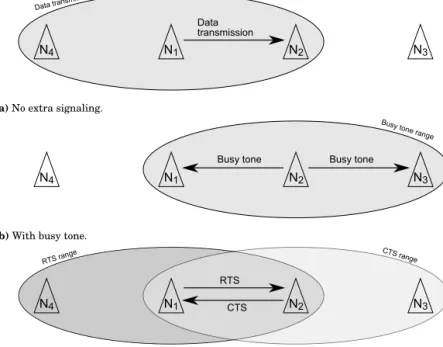
The idea of silencing an interferer in the vicinity of active receiver dates quite some time back. For example, the original concepts of busy tone [130] and RTS/CTS handshake [79] perform this technique implicitly. In the busy tone concept the active receiver transmits a busy tone signal in a separate control band during the whole time of reception. If a potential interferer detects the presence of busy tone, it realizes there is an active receiver and postpones its own transmission. The RTS/CTS handshake has the transmitter send an RTS burst and the receiver reply with a CTS burst before the data transfer commences. Another transmitter in the neighborhood may detect these bursts and refrain itself from interfering. Busy tone and RTS/CTS handshake have been proposed to tackle the so called hidden terminal problem, as explained in Figure 3.1. These con-cepts in principle define an exclusion region (or exclusion zone) around the active receiver. Exclusion region is a geographical area where all other transmissions are suppressed. Exclusion region has for the first time been mentioned within ultra wideband (UWB) networks [113]. It has been
fur-Dynamic on/off interference management
N1 N2 N3
N4
Data transmission Data transmission range
(a)No extra signaling.
N1 N2 N3
N4
Busy tone
Busy tone range
Busy tone
(b)With busy tone. RTS range N1 N2 N3 N4 RTS CTS range CTS (c)With RTS/CTS handshake.
Figure 3.1.Hidden terminal and exposed terminal problems. NodeN1communicates with nodeN2. In (a) there is no extra signaling and potential interfererN3, a so called hidden terminal, has no way of detecting the data transmission and deferring itself from disturbing it. In (b) a busy tone, present during the whole data transmission, informsN3thatN2should not be disturbed. In (c) an RTS and a CTS bursts inform bothN3andN4that they should avoid transmitting. NodeN4, a so called exposed terminal, is however not located close toN2and could thus transmit to another receiver without harmingN2.
ther studied in connection with multi-hop wireless networks [133], [134], CDMA ad hoc networks [64], indoor wireless networks [23] and two-tier femtocell networks [27].
When the work towards this thesis started it was built on an idea to use RTS/CTS handshake to do a more flexible interference management. There are two potential areas of improvement. Firstly, if a potential in-terferer detects an RTS or a CTS burst it may not automatically mean that its transmission would endanger the active receiver. From an SINR perspective, the active receiver may have a strong own link and may thus be able to withstand certain amount of interference. Secondly, while the role of CTS bursts to silence potential interferers is clear, the role of RTS bursts could be expanded. Looking at Figure 3.1(c), nodeN4learns from the RTS burst thatN1 is going to attempt a transmission, which means thatN4should refrain from accepting transmission (i.e., being a receiver) from another source.
Pub-Dynamic on/off interference management
lication II and Publication III. We have developed a concept that chal-lenges the approach of receiver announcements (busy tone, CTS, etc.) by using forward signaling, thus giving the decision responsibility to the ac-tive receiver. The concept has distributedcontroland dynamictime scale.
Compatibilityis not straightforward due to the signaling requirements.
In the following sections we will first look at competing state-of-the-art techniques based on similar principles and then present our own findings.
3.1 Competing on/off techniques
We identified two concepts that are comparable to our approach that will be presented in Section 3.2. Both of them have an on/offmethod, decen-tralizedcontroland dynamictime scale.
3.1.1 The concept of busy burst
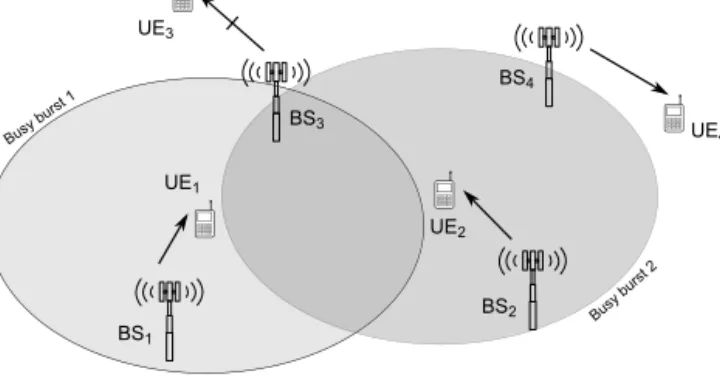
Busy burst [49] is a mature interference management concept developed under the leadership of professor Harald Haas. It is targeted at OFDMA-TDD cellular systems and could be simply described as a time and fre-quency multiplexed busy tone broadcast after a successful data trans-mission and before a next data transtrans-mission. Busy burst is transmitted for every resource block separately (in an OFDMA manner). It exploits the channel reciprocity of TDD: a potential interferer may measure the received power of a busy burst and estimate how much harm would its transmission cause to the active receiver. The network is time synchro-nized so that all active receivers transmit their busy bursts at the same time instances. A potential interferer measures the aggregate busy burst power, compares it to a predefined threshold and if it the threshold is ex-ceeded the interferer refrains from transmitting.
The principle of busy burst is illustrated in Figure 3.2. The most impor-tant assumptions and principles are summarized in the following list: •Busy bursts are time and frequency multiplexed with the data in the
manner of OFDMA. As a consequence they do not need a separate con-trol band but require TDD.
•Busy bursts are evaluated for every resource block separately. They are placed after a successful data transmission in case the same resource
Dynamic on/off interference management BS1 Busy burst 1 BS2 BS3 BS4 UE1 UE2 UE3 UE4 Busy burst 2
Figure 3.2.Functionality of busy burst illustrated on a single radio resource. NodesBS1 andBS2 are active transmitters, thereforeUE1 andUE2transmit a busy burst. NodesBS3andBS4are potential interferers. NodeBS3detects large busy burst power and refrains from transmission toUE3. NodeBS4detects only low busy burst power and is free to transmit toUE4.
block is going to be used again in the following time instance. As a con-sequence, certain level of persistence is required within the scheduler. •Because of the persistence requirement, it matters who accesses a given
resource at first.
•A transmitter that wants to access the medium first measures the busy burst power and compares it to a system wide threshold. If the threshold is exceeded, transmission on given resource is not allowed.
•The value of the threshold is important. Strict threshold reduces in-terference levels in the system and increases fairness, liberal threshold increases spatial reuse.
Busy burst has amassed a considerable publication record. It was for the first time mentioned in [106] and subsequently expanded to OFDMA in [61]. To resolve the problem of the first access, [54] proposed to have the probability of initial access to be1/Q, whereQis the number of cells that are close enough to interfere each other. A contention free alterna-tive based on resource partitioning has been proposed in [13]. In [107] one may find an analytical delay throughput analysis of a single-carrier system using busy bursts. A good value of the busy burst threshold has initially been searched using simulations. To alleviate that [118] derives an optimal value for a small network with two links and proposes an-other heuristic value for a general network. In [117] the authors
approxi-Dynamic on/off interference management
mate distribution of the interference when using busy burst. The concept has been further enhanced to include power control [138] and to support beamforming [50], coordinated multipoint (CoMP) [51] and even optical wireless networks [52].
3.1.2 Cochannel interference avoidance MAC
Cochannel interference avoidance MAC (CIA-MAC) [95] is another inter-ference management technique that shares similarities with the approach that we will introduce in Section 3.2. While its impact on the physical layer is smaller than that of busy burst, it requires a certain level of in-formation exchange among base stations. That may be the reason why CIA-MAC did not receive as much attention as the concept of busy burst. CIA-MAC focuses on cellular downlink transmissions. A downlink re-ceiver, a UE, identifies dominant interfering base stations in the vicinity. A dominant interferer is such that its potential transmission would harm reception at the given UE beyond repair. The UE then reports the iden-tities of the dominant interferers to its associated base station. Base sta-tions subsequently exchange information so that eachk-th base station learns how many UEsTkit may cause danger to. Whenever thek-th base
station considers a transmission in a certain resource block, it only places the transmission if the channel gain on given resource block exceeds a threshold hk=Fc−1 Tk 1 +Tk , (3.1)
whereFc−1(·)represents an inverse function ofFc(·), a cumulative distri-bution function (CDF) of the channel power gain. Following such thresh-old leads to a probability of channel access to be
pk= 1
Tk+ 1
. (3.2)
Randomness provided by (3.2) ensures that the k-th base station will not harm the victim UEs in the neighborhood every time it accesses the medium. Formulas (3.1) and (3.2) are not heuristic, but derived to achieve proportional fairness from the work on random access networks [94]. CIA-MAC has another important threshold: a so called trigger, an interference-to-carrier-ratio threshold that identifies the dominant interferers. An op-timal value is not provided, but some thoughts on its setting are present in the original work [95]. We summarize the steps of CIA-MAC in a form of a flowchart in Figure 3.3.