E
NERGY
E
FFICIENT
C
ORE
N
ETWORKS WITH
C
LOUDS
Leonard Nonde
Submitted in accordance with the requirements for the degree of
Doctor of Philosophy
The University of Leeds
School of Electronic and Electrical Engineering September 2016
The candidate confirms that the work submitted is his own, except where work which has formed part of jointly-authored publications has been included. The contribution of the candidate and the other authors to this work has been explicitly indicated below. The candidate confirms that appropriate credit has been given within the thesis where reference has been made to the work of others.
Chapter 4 and Chapter 5 are based on the work from:
Leonard Nonde, T.E.H. El-Gorashi, and J.M.H. Elmirghani, "Energy Efficient Virtual Network Embedding for Cloud Networks", IEEE/OSA Journal of Lightwave Technology, 2015. 33(9): p. 1828-1849
This paper has been published jointly with my PhD supervisor Prof. Jaafar Elmirghani and my co-supervisor Dr Taisir Elgorashi
Chapter 6 is based on the work from:
Leonard Nonde, T.E.H. El-Gorashi, and J.M.H. Elmirghani, "Green Virtual Network Embedding in Optical OFDM Cloud Networks," in 16th IEEE Conference on Transparent Optical Networks ( ICTON), 2014.
This paper has been published jointly with my PhD supervisor Prof. Jaafar Elmirghani and my co-supervisor Dr Taisir Elgorashi
Chapter 7 is based on the work from:
Jaafar M. H. Elmirghani, T. Klein, K. Hinton, A. Q. Lawey, L. Nonde, T.E.H. El-Gorashi, M. O. I. Musa, X. Dong "GreenTouch GreenMeter Core Network Energy efficiency Improvements ", to be submitted to IEEE/OSA Journal of Lightwave Technology, 2016.
This paper will be published jointly with my PhD supervisor Prof. Jaafar Elmirghani, my co-supervisor Dr Taisir Elgorashi, Thierry Klein from Bell Labs, Kerry Hinton from University of Melbourne, Ahmed Lawey and Mohamed Musa from University of Leeds and Xiaowen Dong from Huawei Shannon Labs.
Chapter 8 is based on the work from:
Leonard Nonde, T.E.H. El-Gorashi, and J.M.H. Elmirghani, "Cloud Virtual Network Embedding: Profit, Power and Acceptance," in proc. IEEE Global Comminications Conference (GLOBECOM ), 2015.
This paper has been published jointly with my PhD supervisor Prof. Jaafar Elmirghani and my co-supervisor Dr Taisir Elgorashi
Chapter 9 is based on the work from:
Leonard Nonde, T.E.H. El-Gorashi, and J.M.H. Elmirghani, "Virtual Network Embedding Employing Renewable Energy
Sources," Accepted in proc. IEEE Global Comminications Conference (GLOBECOM ), 2016.
This paper has been published jointly with my PhD supervisor Prof. Jaafar Elmirghani and my co-supervisor Dr Taisir Elgorashi.
This copy has been supplied on the understanding that it is copyright material and that no quotation from the thesis may be published without proper acknowledgement.
Theresa and Michael Nonde, this PhD thesis is dedicated to you.
i
Acknowledgments
First and foremost I would like to give thanks and praise to the almighty God for my life and all the abundant gifts that He has bestowed on me. I wish to acknowledge my supervisor, Professor Jaafar Elmirghani for his astute leadership, guidance and patience throughout my entire PhD journey. His timely advice and constant encouragement is much appreciated.
I would also like to acknowledge my co-supervisor Dr. Taisir Elgorashi for her guidance during my PhD.
I am also highly indebted to the Commonwealth Scholarship Commission for fully funding my PhD studies in Leeds. Many thanks to them.
I wish to thank my spouse Mwansa Changufu Nonde and my children Chengelo and Neema-Christina, for their love and sacrifice during some very challenging times; they always gave me assurance. Thank you Mwansa for letting me pursue my dreams. Love you so much.
I wish to thank my colleagues in the Communication Systems and Networks group in the School of Electronic and Electrical Engineering. I enjoyed working with them and I thank them for the company and fruitful discussions.
ii A big thank you to my family back home in Zambia. My late parents Theresa and Michael Nonde for making everything I have achieved in life possible. My uncle, Bishop Aaron Chisha for being a parent to me throughout my life and to my brothers George, Richard and Michael for your inspiration. To my sister Lillian for being like a mother to me.
iii
Abstract
The popularity of cloud based applications stemming from the high volume of connected mobile devices has led to a huge increase in Internet traffic. In order to enable easy access to cloud applications, infrastructure providers have invested in geographically distributed databases and servers. However, intelligent and energy efficient high capacity transport networks with near ubiquitous connectivity are needed to adequately and sustainably serve these requirements. In this thesis, network virtualisation has been identified as a potential networking paradigm that can contribute to network agility and energy efficiency improvements in core networks with clouds.
The work first introduces a new virtual network embedding core network architecture with clouds and a compute and bandwidth resource provisioning mechanism aimed at reducing power consumption in core networks and data centres. Further, quality of service measures in compute and bandwidth resource provisioning such as delay and customer location have been investigated and their impact on energy efficiency established. Data centre location optimisation for energy efficiency in virtual network embedding infrastructure has been investigated by developing a MILP model that selects optimal data centre locations in the core network. The work also introduces an optical OFDM based physical layer in virtual network embedding to optimise power consumption and optical spectrum
iv utilization. In addition, virtual network embedding schemes aimed at profit maximization for cloud infrastructure providers as well greenhouse gas emission reduction in cloud infrastructure networks have been investigated. GreenTouch, a consortium of industrial and academic experts on energy efficiency in ICTs, has adopted the work in this thesis as one of the measures of improving energy efficiency in core networks.
v
Table of Contents
ACKNOWLEDGMENTS ... I ABSTRACT ... III TABLE OF CONTENTS ... V LIST OF FIGURES ... XILIST OF TABLES ... XVIII
GLOSSARY OF TERMS ... XX 1 CHAPTER 1: INTRODUCTION ... 1 1.1 RESEARCH OBJECTIVES ... 5 1.2 ORIGINAL CONTRIBUTIONS ... 6 1.3 RELATED PUBLICATIONS ... 8 1.4 THESIS ORGANISATION ... 9
2 CHAPTER 2: OPTICAL NETWORKS AND ENERGY EFFICIENCY ... 12
2.1 INTRODUCTION ... 12
2.2 OPTICAL NETWORKS ... 13
2.2.1 SONET/SDH Networks ... 13
2.2.2 WDM Networks ... 14
2.2.3 IP Over WDM Networks ... 17
vi
2.3.1 Introduction ... 21
2.3.2 Energy Efficient Approaches in Core Networks ... 23
2.4 SUMMARY ... 45
3 CHAPTER 3: NETWORK VIRTUALISATION AND VIRTUAL NETWORK EMBEDDING ... 46
3.1 INTRODUCTION ... 46
3.2 NETWORK VIRTUALISATION ... 47
3.3 VIRTUAL NETWORK EMBEDDING ... 52
3.3.1 Revenue Maximization ... 53
3.3.2 Network Resilience and Survivability ... 55
3.3.3 Energy Efficiency ... 56
3.4 SUMMARY ... 58
4 CHAPTER 4: ENERGY EFFICIENT VIRTUAL NETWORK EMBEDDING ... 60
4.1 INTRODUCTION ... 60
4.2 VIRTUAL NETWORK EMBEDDING IN IP OVER WDMNETWORK ARCHITECTURE ... 62
4.3 MILPMODEL FOR ENERGY EFFICIENT VIRTUAL NETWORK EMBEDDING ... 63
4.4 THE REAL-TIME ENERGY OPTIMISED VIRTUAL NETWORK EMBEDDING (REOVINE)HEURISTIC ... 75
4.5 PERFORMANCE EVALUATION OF THE EEVNEMODEL AND THE REOVINEHEURISTIC ... 80
vii
4.5.1 CostVNE Model ... 81
4.5.2 VNE-EA Model ... 83
4.5.3 Embedding of VNRs of Uniform Load Distribution ... 83
4.5.4 LAN Power Consumption Consideration inside the Data Centre ... 89
4.5.5 EEVNE Model and REOViNE Heuristic Performance Considering Different Physical Topologies ... 93
4.5.6 Embedding of VNRs of Non Uniform Load Distribution ... 96
4.6 ENERGY EFFICIENT VIRTUAL NETWORK EMBEDDING WITH ENERGY EFFICIENT DATA CENTRES ... 101
4.7 SUMMARY ... 106
5 CHAPTER 5: ENERGY EFFICIENT VIRTUAL NETWORK EMBEDDING WITH LOCATION AND DELAY CONSTRAINTS ... 108
5.1 INTRODUCTION ... 108
5.2 MATHEMATICAL MODEL FOR ENERGY EFFICIENT VIRTUAL NETWORK EMBEDDING WITH LOCATION AND DELAY CONSTRAINTS ... 110
5.2.1 Model Results and Analysis for Energy Efficient Virtual Network Embedding with Location and Delay Constraints ... 112
5.3 MATHEMATICAL MODEL FOR ENERGY EFFICIENT VIRTUAL NETWORK EMBEDDING WITH DATA CENTRE LOCATION OPTIMISATION ... 118
5.3.1 Model Results and Analysis for Energy Efficient Virtual Network Embedding with Data Centre Location Optimisation ... 122
viii 6 CHAPTER 6: GREEN VIRTUAL NETWORK EMBEDDING IN
OPTICAL OFDM CLOUD NETWORKS ... 134
6.1 INTRODUCTION ... 134
6.2 IP OVER OPTICAL-OFDMNETWORK ARCHITECTURE AND OPERATION ... 135
6.3 MILPMODEL FOR VNE IN O-OFDMCLOUD NETWORKS ... 138
6.4 MILPMODEL RESULTS AND ANALYSIS ... 142
6.5 SUMMARY ... 149
7 CHAPTER 7: CONTRIBUTIONS TO GREENTOUCH GREENMETER RESEARCH STUDY ... 151
7.1 INTRODUCTION ... 151
7.2 ROUTER PORTS POWER CALCULATIONS AND NETWORK EQUIPMENT POWER CONSUMPTION IMPROVEMENTS ... 153
7.2.1 Calculation of Router Port Power Consumption ... 154
7.3 NETWORK VIRTUALISATION CONTRIBUTION TO GREENMETER STUDY ... 162
7.4 SUMMARY ... 166
8 CHAPTER 8: PROFITABLE AND ENERGY EFFICIENT VIRTUAL NETWORK EMBEDDING OVER CORE NETWORKS WITH CLOUDS ... 168
8.1 INTRODUCTION ... 168
8.2 CONSIDERED CLOUD NETWORK ARCHITECTURE AND OPERATION ... 169
8.3 MATHEMATICAL MODELS FOR PROFIT MAXIMISED VNE ... 171
8.4 PERFORMANCE EVALUATION OF PROFIT MAXIMISED VNE ... 175
ix
8.6 PROFIT MAXIMISED AND POWER MINIMISED MODEL WITH
CAPACITATED LINK AND DATA CENTRE RESOURCES ... 188
8.7 SUMMARY ... 191
9 CHAPTER 9: GREEN AND ELECTRICITY COST MINIMISED VIRTUAL NETWORK EMBEDDING OVER CORE NETWORKS WITH CLOUDS ... 193
9.1 INTRODUCTION ... 193
9.2 NETWORK ARCHITECTURE AND OPERATION ... 195
9.3 MILPMODEL FOR GREEN VIRTUAL NETWORK EMBEDDING ... 196
9.3.1 GVNE Performance and Evaluation ... 199
9.4 GVNE WITH DATA CENTRE SELECTION AND ELECTRICITY COST OPTIMISATION ... 210
9.4.1 MILP Model for GVNE with Data Centre Selection and Electricity Cost Optimisation ... 211
9.4.2 Electricity Cost Green VNE MILP Model Results and Analysis ... 214
9.5 GVNE-DC AND ECOSTGVNEMODELS SCALABILITY AND PERFORMANCE TRADE-OFFS ... 220
9.5.1 Scalability of the Models ... 222
9.5.2 Computational Complexity ... 223
9.5.3 Performance Trade-Offs Considerations ... 223
9.6 SUMMARY ... 225
10 CHAPTER 10: SUMMARY OF CONTRIBUTIONS AND FUTURE WORK ... 227
x
10.1 SUMMARY OF CONTRIBUTIONS ... 227
10.2 FUTURE DIRECTIONS ... 233
10.2.1 Software Defined Networking Implementation of Proposed
Algorithms ... 233
10.2.2 Virtual Network Embedding in Multi Operator Networks ... 234 REFERENCES ... 236
xi
List of Figures
Figure 2-1: SDH/SONET Traffic Aggregation ... 14
Figure 2-2: IP Over WDM with SDH/SONET as the Interfacing Layer ... 15
Figure 2-3: IP over WDM Network ... 18
Figure 2-4: IP over WDM Overlay Model ... 18
Figure 2-5: Converged IP over WDM Network - Peer Model ... 20
Figure 2-6: IP over WDM Core Network Architecture ... 20
Figure 2-7: Global Mobile Data Traffic Forecast By Region [22] ... 22
Figure 2-8: Fractional Energy Consumption of an Electronic High End IP Router [47] ... 36
Figure 2-9: Flow Manager [48] ... 38
Figure 3-1: Server and Network Virtualisation [65] ... 47
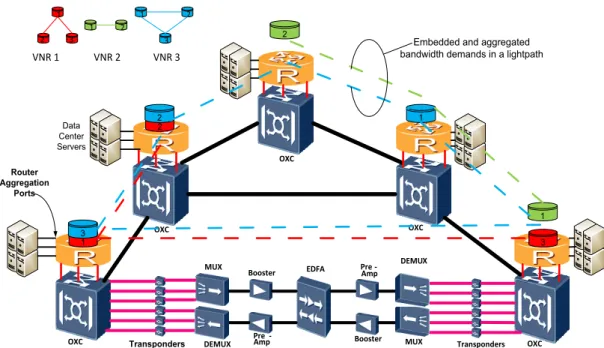
Figure 4-1: Architecture of Virtual Network Embedding In IP over WDM Network with Data Centres ... 62
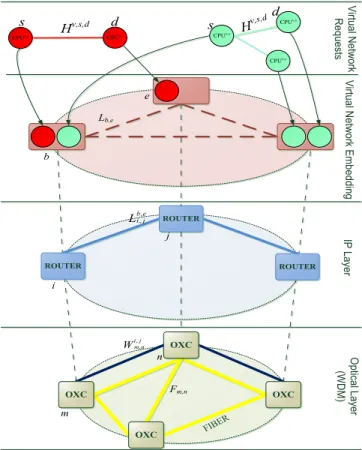
Figure 4-2: Illustration of VNE across Multiple Layers in IP/WDM ... 64
xii
Figure 4-4: REOViNE Heuristic Flow Chart ... 78
Figure 4-5: Grouping of Nodes of a VNR ... 79
Figure 4-6: The NSFNET Network with Data Centres ... 82
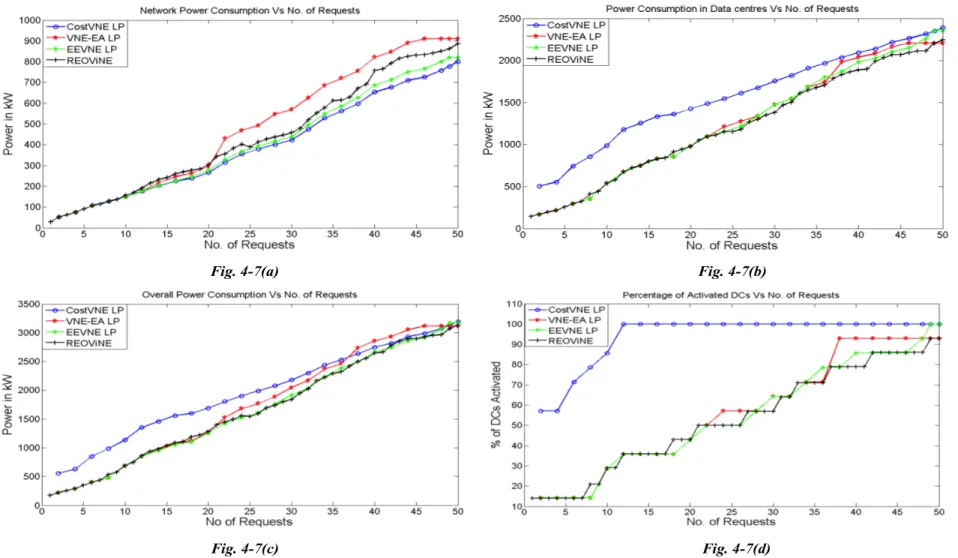
Figure 4-7: (a) Network Power Consumption of the Different Approaches, (b) DCs Power Consumption of the Different Approaches, (c) Overall Power Consumption of the Different Approaches, (d) Data Centre Activation of the Different Approaches ... 85
Figure 4-8: Number of Accepted Requests ... 88
Figure 4-9: Cloud Data Centre Architecture ... 89
Figure 4-10: Power Consumption in DC due to Servers and the LAN ... 92
Figure 4-11: Network Power Consumption in the Core and the DC LAN ... 93
Figure 4-12: REOViNE and EEVNE Model Overall Power Consumption in Different Networks ... 94
Figure 4-13: (a) Power Consumption under a Load of High Bandwidth and High CPU Demands (Load 1), (b) Power Consumption under a Load of High Bandwidth and Low CPU Demands (Load 2), (c) Power Consumption under a Load of Low Bandwidth and Low CPU Demands (Load 3), (d) Power Consumption under a Load of Low Bandwidth and High CPU Demands (Load 4) ... 97
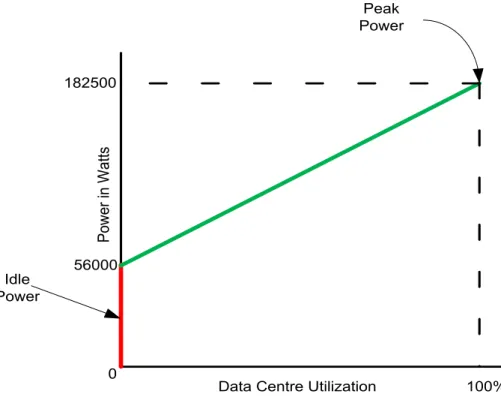
xiii Figure 4-14: Number of Accepted Requests at Various Loads. The Loads refer to those in Table 4-3 ... 100 Figure 4-15: Energy Efficient Data Centre Servers Power Profile ... 102 Figure 4-16: (a) Network Power Consumption under the EE Data Centre Power Profile, (b) Data Centre Servers Power Consumption under EE Data Centre Servers Power Profile, (c) Overall Power Consumption under EE Data Centre Servers Power Profile, (d) Data Centre Activation under EE Data Centre Power Profile ... 103 Figure 5-1: NSFNET Network with Population Heat Map ... 113 Figure 5-2: (a) Network Power Consumption at various values ofα, (b) Data Centre Power Consumption at various values of α, (c) Overall Power Consumption at various values of α ... 116 Figure 5-3: The Network Power Consumption of a Single Data Centre Scenario at Different Locations under Non-Bypass and Bypass Approaches ... 124 Figure 5-4: The Network Power Consumption of a 5 Data Centre Scenario under Non-Bypass and Bypass Approaches at α=5 ... 125 Figure 5-5: The Normalized Size of 5 Data Centres in Optimal Locations at
α=5 ... 127 Figure 5-6: The Network Power Consumption of a Data Centre Scenario under Non-Bypass and Bypass Approaches at alpha=1 ... 129
xiv Figure 5-7: The Normalized Size of 5 Data Centres in Optimal Locations at
alpha=1 ... 129
Figure 6-1: Spectrum Utilization of O-OFDM and WDM ... 136
Figure 6-2: O-OFDM Transponder Cubic Power Profile ... 145
Figure 6-3: Optical Layer Power Consumption for all the Considered Models ... 146
Figure 6-4: Network Power Consumption ... 147
Figure 6-5: Network Spectral Efficiency ... 148
Figure 7-1: Cisco CRS High Level Logical Architecture [117] ... 155
Figure 7-2: Port Power Consumption Curve ... 159
Figure 7-3: AT&T Network Topology used for the Combined MILP Model ... 163
Figure 7-4: Traffic Strands For Distributed Cloud for Content Delivery and Network Virtualisation ... 163
Figure 7-5: Power Consumption of a 2010 Core Network ... 165
Figure 7-6: Power Consumption of a GreenTouch 2020 Core Network ... 165
Figure 8-1: Virtual Network Embedding Cloud Infrastructure ... 170
xv Figure 8-3: 2020 Average Business Internet 24 Hour Traffic Distribution [113] ... 177 Figure 8-4: (a) Profit and Acceptance Performance of the Profit Maximised Model, (b) Profit and Power Consumption Performance of the Profit Maximised Model ... 179 Figure 8-5: Network Power Consumption of the Power Minimised and Profit Maximised Models ... 181 Figure 8-6: Device Network Power Consumption Comparison ... 182 Figure 8-7: Profit and Power Consumption at Various Acceptance Thresholds ... 182 Figure 8-8: POEM Algorithm ... 185 Figure 8-9: Cloud Data Centre Selection Procedure ... 186 Figure 8-10: Profit Performance of the Profit Maximised Model and the POEM Heuristic ... 187 Figure 8-11: Profit Performance of the Profit Maximised Model and the POEM Heuristic ... 187 Figure 8-12: Network Power Consumption of the Power Minimised and Profit Maximised Models in a Capacitated Network. ... 190
xvi Figure 8-13: Device Network Power Consumption Comparison in
Capacitated Network ... 190
Figure 9-1: Considered Green Virtual Network Embedding Architecture ... 195
Figure 9-2: NSFNET Network with Popularity and Solar Capacity Information ... 199
Figure 9-3: Total Solar and Non-Renewable Power Consumption ... 204
Figure 9-4: Non-Renewable and Solar Power Consumption in (a) Data Centres, (b) Networking Components ... 205
Figure 9-5: Embedded Cores Distribution in Data Centres, (a) Supplied Only by Non-Renewable Energy Sources (Reference Case), (b)GVNE Supplied by Both Renewable and Solar Energy Sources, (c) Non-Renewable Energy Powered Cores Under GVNE (d) Solar Energy Powered Cores under GVNE ... 208
Figure 9-6: Non-Renewable Power Consumption Performance for Various Approaches ... 215
Figure 9-7: Energy Cost Performance for Various Approaches ... 217
Figure 9-8: Data Centre Selection Frequency for Various Approaches ... 220
xvii Figure 9-10: Computation Times for ECostGVNE Model in Various Topologies ... 223 Figure 10-1: SDN three Tier Architecture [140] ... 233
xviii
List of Tables
Table 4-1: Evaluation Scenario Parameters ... 82 Table 4-2: Performance of REOViNE and EEVNE in Different Networks ... 95 Table 4-3: Load Distributions ... 96 Table 5-1: Load Distribution of Virtual Network Requests ... 113 Table 6-1: Load Distribution ... 144 Table 6-2: Power Consumption of Network Devices ... 145 Table 7-1: Cisco CRS Chassis ... 157 Table 7-2: Cisco CRS Line Cards ... 158 Table 7-3: Port Power Consumption at Different Line Rates ... 159 Table 7-4: Power Consumption Values ... 161 Table 8-1: Evaluation Parameters ... 178 Table 9-1: Solar Power Availability in Different Cities. SR: Sunrise, SS: Sunset Recorded in Individual Cities in June [38], [134] ... 201 Table 9-2: Parameter Values For the GVNE Model ... 203 Table 9-3: Commercial Electricity Prices in US Cities ... 214
xix Table 9-4: Savings in Different Topologies ... 222
xx
Glossary of Terms
ADM Add and Drop Multiplexer ALR Adaptive Link Rate
API Application Programming Interface ATM Asynchronous Transfer Mode
BAU Business as Usual
BPSK Binary Phase Shift Keying
BV-OXC Bandwidth Variable Optical Cross Connect BVT Bandwidth Variable Transponder
CAPEX Capital Expenditure CLI Command Line Interface
CMOS Complementary Metal-Oxide Semiconductor CostVNE Cost Virtual Network Embedding
CostVNE-LD
Cost Virtual Network Embedding with Location and Delay
CPU Central Processing Unit DSP Digital Signal Processing
DVFS Dynamic Voltage and Frequency Scaling DXC Digital Cross Connect
xxi
Embedding
ECostVNE Electricity Cost Virtual Network Embedding EDFA Erbium Doped Fibre Amplifier
EE Energy Efficient
EEVNE Energy Efficient Virtual Network Embedding EEVNE-LD Energy Efficient Virtual Network with
Location and Delay
EIA Energy Information Administration
EU European Union
FEC Forward Error Correction Gbps Gigabit per second
GCA Green Cloud Architecture GHG Greenhouse Gas
GHz Giga Hertz
GMPLS Generalized Multiprotocol Label Switching
GT GreenTouch
GVNE Green Virtual Network Embedding
GVNE-DC Green Virtual Network Embedding with Data Centre Optimisation
IaaS Infrastructure as a Service
ICT Information and Communications Technology InP Infrastructure Provider
xxii
IP Internet Protocol
IPTV Internet Protocol Television ISI Inter-symbol Interference
ITU International Telecommunications Union LAN Local Area Network
MILP Mixed Integer Linear Programming MLR Mixed Line Rate
MSC Modular Services Card NaaS Network as a Service
NGN Next Generation Networks NIC Network Interface Card
NSFNET National Science Foundation Network OADM Optical Add and Drop Multiplexer OEO Optical to Electrical to Optical
OFDM Orthogonal Frequency Division Multiplexing OLA Optical Line Amplifier
OLT Optical Line Terminal
ONOS Open Network Operating System
O-OFDM Optical Orthogonal Frequency Division Multiplexing
OOK On-Off Keying
xxiii
OSC Optical Supervisory Channel OSNR Optical Signal to Noise Ratio OSPF Open Shortest Path First OTN Optical Transport Network OXC Optical Cross Connect
PLIM Physical Layer Interface Module POEM Profit Optimised Energy Minimised PUE Power Usage Effectiveness
PV Photovoltaics
QAM Quadrature Amplitude Modulation QoS Quality of Service
QPSK Quadrature Phase Shift Keying RAM Random Access Memory
REOViNE Real-time Energy Optimised Virtual Network Embedding
ROADM Re-configurable Optical Add and Drop Multiplexer
SDH Synchronous Digital Hierarchy SDN Software Defined Networking SLA Service Level Agreement SLR Single Line Rate
xxiv
SONET Synchronous Optical Network SP Service Provider
SR Short Reach
TCP Transmission Control Protocol TDM Time Division Multiplexing TDS Time Driven Switching
TF Time Frame
ToR Top of the Rack
USNET United States Network VLAN Virtual Local Area Network
VN Virtual Network
VNE Virtual Network Embedding
VNE-EA Virtual Network Embedding Energy Aware VNR Virtual Network Request
VPN Virtual Private Network VSB Vestigial Sideband
W Watt
WDM Wavelength Division Multiplexing WR Wavelength Router
1
1
Chapter 1: Introduction
The Cisco Visual Networking Index of 2016 reports that more than half a billion mobile devices and connections were added in the year 2015 and mobile data traffic grew by 74% in 2015 reaching 3.7 exabytes per month. This amount is expected to grow almost tenfold to 30 exabytes per month by the year 2020. With such a huge amount of traffic being generated, intelligent transport networks with near ubiquitous connectivity are needed. Aside from the capacity problem, the other heavy price to be paid by this rapid growth is the rising energy requirement of these systems.
Applications on all these devices and others need access to geographically distributed databases and servers using public and private clouds requiring flexible traffic management, energy efficiency and bandwidth on demand capabilities. The high capacity transport network architectures of today will therefore need to evolve in order to adequately meet these requirements. The energy use by ICT equipment and services represented about 8% of electrical power in the EU, and about 2% of carbon emissions
2 in 2008 [1]. Estimates indicate that in the long term, if current trends continue, companies operating data centres will spend more money per year on energy than on equipment [2]. On a world wide scale, based on the 2009 data, ICT consumes about 9% of the world’s total electricity output [3].
Most of the energy resources available for use today come from hydrocarbons. In the US for example, 82% of all the primary energy consumption is derived from hydrocarbons [4]. It is however a well-known fact that this type of energy resource is not renewable and it is expected to be used up in a not too distant future and it is also an energy source that is responsible for the release of large amounts of greenhouse gas (GHG) emissions that are very harmful to the environment. Considering this fact as well as the increase in the cost of energy, it is necessary in both academia and industry to focus on energy-efficient paradigms that ultimately lead to a reduction in the amount of energy consumed in ICT networks.
Recently, there have been significant research efforts aimed at reducing energy consumption in ICT networks. Gupta et al [5], introduced the concept of “greening the internet” as a means of reducing the amount of energy consumed in ICT networks. There have also been various efforts from researches on reducing power consumption in data centres. The research carried out in [6] focuses on reducing power consumption inside the data centre by use of low power processors in servers, use of efficient power supplies, use of blade servers and server virtualisation. A group
3 known as the Green Grid [7] was founded to increase energy efficiency inside data centres.
Energy efficiency in core networks has also received a lot of attention. Bandwidth intensive applications such as IPTV call for increased capacity in core network infrastructure, which leads to an increase in power consumption. In [8], the authors have examined the energy efficient design of IP over WDM networks by implementing lightpath bypass in the optical layer. The goal is to enhance energy efficiency of core network nodes which are usually in few locations but handle intensive amounts of traffic because of traffic aggregation which mainly comes from co-located high capacity data centres and metro networks.
In this thesis, network virtualisation has been identified as a potential networking paradigm that can contribute to energy efficiency improvements in core networks. A networking environment is considered to support network virtualisation if its infrastructure services have been decoupled from the physical assets on which the services operate. Core networks connect geographically distributed public and private cloud data centres. In [9], the authors have stated that the success of future cloud networks where clients are expected to be able to specify the data rate and processing requirements for hosted applications and services will greatly depend on network virtualisation. Software Defined Networking has been identified as the enabler of network virtualisation [10]. Software Defined Networking (SDN) has brought about many possibilities in service
4 provisioning in cloud networks. The fact that it is now possible to program a network on the fly as well as dictate how it behaves under different conditions provides opportunities for optimisation of the physical resources that make up the network. A centralized control plane that is isolated from the data plane allows custom designed algorithms to dynamically route application specific flows or wavelengths in a network in order to fulfil a specific goal. As an example, an algorithm, which automatically uses minimum hop routing for a live video stream at a particular time of the day and then tears it down when circumstances change could be implemented in the controller. In the absence of SDN, this process would have to be statically implemented and resources assigned even when they may not be used all the time.
Network virtualisation has been proposed as an enabler for energy savings by means of resource consolidation [11] - [15]. In all these proposals, the models and/or algorithms do not address the link embedding problem as a multi-layer problem spanning from the virtualisation layer through the IP layer and all the way to the optical layer. Except for the authors in [14], the others do not consider the power consumption of network ports/links as being related to the actual traffic passing through them. In contrast, in this study, a very detailed and accurate approach towards energy efficient virtual network embedding is developed. Granular power consumption of various network elements that form the network engine in backbone networks as well as the power consumption in data centres is considered.
5 Mixed Integer Linear Programming models and real-time heuristics have been developed to model the problems with the goals of reducing the power consumption in core networks and data centres, improve the profitability of infrastructure providers and to mitigate the release of greenhouse gas emissions into the environment.
1.1
Research Objectives
All the research so far that has considered the use of resource consolidation in network virtualisation as a means of reducing energy consumption in networks has not specifically considered the practical implementation of virtual network embedding across all the multiple layers in core networks. It is important to note that virtualisation is done for many reasons such as sharing the infrastructure dynamically. The hypothesis in this thesis is that virtualisation can improve energy efficiency in core networks with clouds. In this research therefore, the fundamental objectives are as follows:
1. Propose an energy efficient virtual network embedding approach in IP over WDM networks with data centres to reduce the overall power consumption in both the core network and in data centres. In addition, explore the effects of considering both non-energy efficient data centres and energy efficient data centres on the proposed design. 2. Investigate the energy efficiency benefits of data centre location
6 impact on the power consumption of considering quality of service measures such as delay and client location.
3. Investigate the energy and spectral efficiency gains of virtual network embedding brought about by the use Optical OFDM as an underlying physical layer technology in core networks with data centres.
4. Propose a virtual network embedding solution in core networks with data centres that jointly maximises the profit for infrastructure providers and minimises the power consumption while keeping the acceptance ratio of requests at acceptable levels.
5. Propose a hybrid power virtual network embedding architecture in core networks with data centres employing renewable energy sources and then develop a MILP model that optimises the use of non-renewable power to reduce the overall greenhouse gas emissions of infrastructure providers and the overall electricity cost in a geographically price discriminated environment.
1.2
Original Contributions
1. A novel virtual network embedding model has been developed based on mixed integer linear programming (MILP) in an IP over WDM network with data centres. The model incorporates the optical layer in the link embedding stage. A real-time energy optimised virtual
7 network embedding (REOViNE) algorithm has been developed as a real time implementation of the proposed MILP model.
2. Development of virtual network embedding MILP formulations that incorporate data centre location optimisation for energy consumption minimisation and taking delay and customer location requirements into consideration.
3. A MILP model has been proposed for optimising power consumption and optical spectrum utilization in virtual network embedding infrastructures that uses optical OFDM as the underlying physical layer.
4. Novel realistic router port power consumption estimates have been produced and the GreenTouch Consortium has used these results in the GreenMeter study. The work on energy efficient virtualisation was also adopted by the GreenTouch Consortium as one of the solutions for energy minimisation in core networks. The GreenMeter study has been awarded the Edison Prize for 2016. The work on energy efficient virtual network embedding has been awarded the University of Leeds 2015 Carter Prize for the Best Published paper. 5. A virtual network embedding approach that jointly maximises the
profit and minimises the power consumption of an infrastructure provider in core networks with clouds has been developed. The approach also guarantees acceptable request rejection ratios to
8 minimise customer churn. The profit optimised and energy minimised heuristic algorithm ensures real time implementation.
6. An approach to virtual network embedding in core networks with clouds that jointly reduces the overall greenhouse gas emissions and the OPEX accrued from electricity costs of an infrastructure provider has been developed.
1.3
Related Publications
The work in this thesis resulted in the following journals and conference papers:
1. Leonard Nonde, T.E.H. El-Gorashi, and J.M.H. Elmirghani, "Energy Efficient Virtual Network Embedding for Cloud Networks", IEEE/OSA Journal of Lightwave Technology, 2015. 33(9): p. 1828-1849
2. Jaafar M. H. Elmirghani, T. Klein, K. Hinton, A. Q. Lawey, L. Nonde, T.E.H. El-Gorashi, M. O. I. Musa, X. Dong "GreenTouch GreenMeter Core Network Energy efficiency Improvements ", to be submitted to IEEE/OSA Journal of Lightwave Technology, 2016. 3. Leonard Nonde, T.E.H. El-Gorashi, and J.M.H. Elmirghani, "Cloud
Virtual Network Embedding: Profit, Power and Acceptance," in proc. IEEE Global Comminications Conference (GLOBECOM), San Diego CA. 2015.
9 4. Leonard Nonde, T.E.H. El-Gorashi, and J.M.H. Elmirghani, "Virtual Network Embedding Employing Renewable Energy Sources," Accepted in IEEE Global Comminications Conference (GLOBECOM), 2016.
5. Leonard Nonde, T.E.H. El-Gorashi, and J.M.H. Elmirghani, "Green Virtual Network Embedding in Optical OFDM Cloud Networks," in 16th IEEE Conference on Transparent Optical Networks (ICTON), Graz, Austria. 2014.
6. “GreenTouch Final Results from Green Meter Research Study: Reducing the Net Power Consumption in Communication Networks by upto 98% by 2020,” A GreenTouch White Paper, Version 2.0, August 15, 2015.
1.4
Thesis Organisation
This thesis is organised as follows: Chapter 2 reviews Optical Networks and the various energy efficient approaches that have been introduced in Information and Communication Technology (ICT) networks. Most of the attention has been given to energy efficient approaches in core networks so as to enable a clear understanding of the proposed designs in the subsequent chapters.
Chapter 3 is a detailed review of network virtualisation and virtual network embedding. Network virtualisation has been defined in this
10 chapter and its use has been contextualised. Virtual network embedding is also introduced and its link to network virtualisation explained. Various approaches to virtual network embedding have also been described.
Chapter 4 introduces the novel network architecture and mixed integer linear programming (MILP) model for energy efficient virtual network embedding (EEVNE) in IP over WDM networks with data centres. The MILP model and real-time heuristic to represent the EEVNE approach for clouds in IP over WDM networks are developed. The model is tested with two different power consumption profiles for servers in data centers to determine the energy efficiency; an energy inefficient power profile and an energy efficient power profile.
Chapter 5 investigates the introduction of delay and client location constraints to the energy efficient virtual network embedding problem. It also investigates the power consumption benefits of data centre location optimisation in virtual network embedding infrastructures.
Chapter 6 investigates the spectral and power consumption benefits of introducing optical OFDM as the underlying physical layer in virtual network embedding infrastructures.
Chapter 7 is a study on the development of port power consumption values for core network routers at various lines rates. The study uses the modular design of the Cisco CRS chassis to estimate more accurately the power consumption of router ports, which have been used in later chapters.
11 The chapter also details the contributions that have been made to the GreenTouch GreenMeter study for energy efficiency improvements in core networks.
Chapter 8 is an investigation into the virtual network embedding design that jointly maximises profits for infrastructure providers and minimises the power consumption in the network. The design is such that request rejection is minimised to acceptable levels that do not encourage customer churn. A profit optimised and energy minimised (POEM) heuristic algorithm is developed for real time implementation.
Chapter 9 investigates virtual network embedding design in core networks with clouds that are connected to hybrid power sources. The virtual network embedding goal is to reduce the amount of greenhouse gas emissions of infrastructure providers while at the same time minimizing the OPEX due to electricity costs in the network.
The thesis is finally concluded in Chapter 10 where the major contributions of this work are presented and the future directions are discussed.
12
2
Chapter 2: Optical Networks and
Energy Efficiency
2.1
Introduction
In this chapter, a review of optical networks and energy efficiency is presented. Optical networks have played a very crucial role in the development of the Internet ecosystem without which, there would be serious capacity limitations in service provisioning of Internet based applications. Detailed descriptions of generations of optical network designs and how they have interfaced with IP systems are presented. The chapter also makes an important review of the efforts that have so far been made to improve energy efficiency in Information and Communications Technology (ICT) systems over the years.
13
2.2
Optical Networks
2.2.1 SONET/SDH Networks
In the first generation of optical networks, optical fibres were mainly used to provide high capacity transmission for point to point links as they offered very low bit error rates. The switching functions and all the necessary control functions were all done by electronic components. The technology associated with the first generation of optical networks is Synchronous Digital Hierarchy (SDH) or Synchronous Optical Network (SONET) [16] the latter being the term used in North America and the former in Europe.
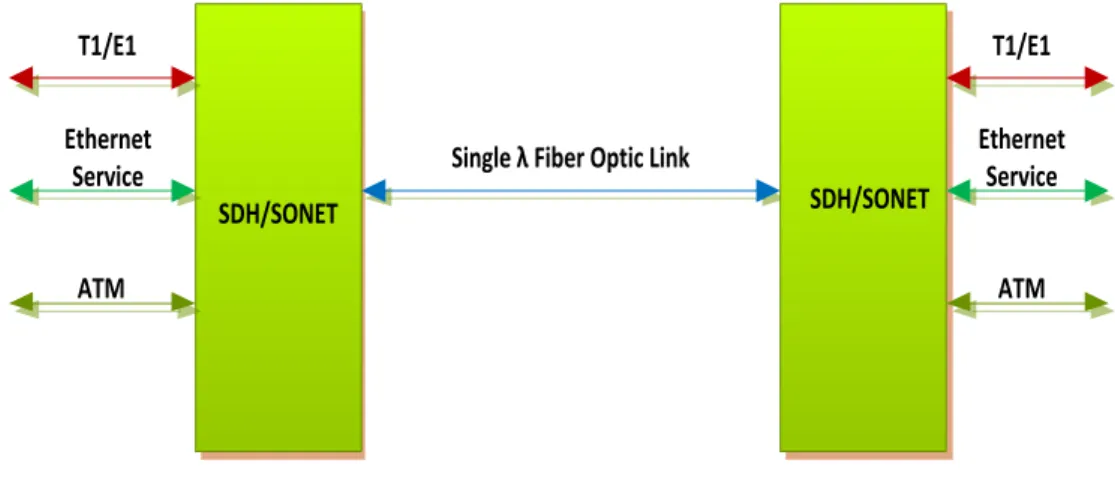
SDH/SONET technology offered an optical transport layer on which other technologies would ride. Time Division Multiplexing (TDM) is used to aggregate IP traffic with several other types of traffic for transport over SDH/SONET as shown in Fig. 2-1. A single wavelength is used to optically transport multiplexed SDH/SONET services over optical fibre links.
14 SDH/SONET T1/E1 Ethernet Service ATM
Single λ Fiber Optic Link
SDH/SONET
T1/E1
Ethernet Service
ATM
Figure 2-1: SDH/SONET Traffic Aggregation
Currently, SDH/SONET networks can support link transmission rates of tens of gigabits per second. The STM-64/OC-192 un-channelised system has transmission rates of 10 Gbps. Most of the traffic that is now carried by most networks is IP traffic, as a result, the present day SDH/SONET networks are mostly carrying IP over SDH/SONET traffic.
2.2.2 WDM Networks
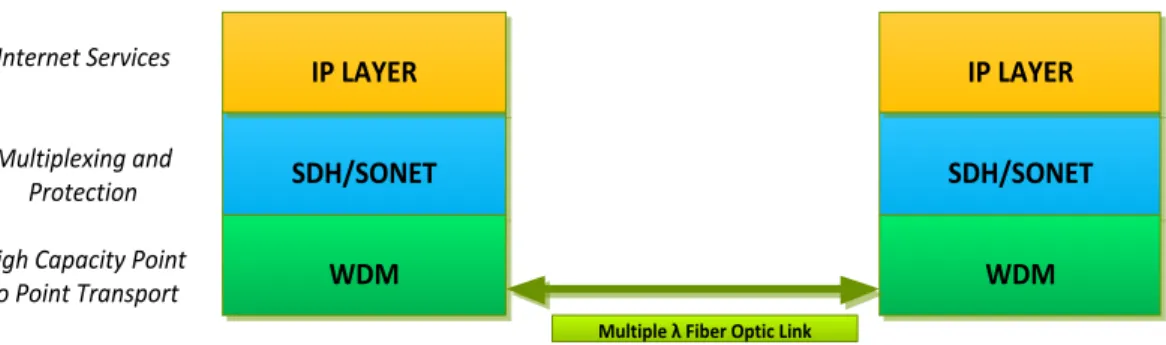
As the Internet transport infrastructure grows rapidly towards a model of high speed routers connected by highly intelligent optical networks and widely geographically spaced data centres, SDH/SONET technologies have failed to fully meet the bandwidth requirements. The only present day technology that can effectively meet this demand for bandwidth is Wavelength Division Multiplexing (WDM). In the early years, WDM was a point to point deployment with SDH/SONET used as a standard layer for interfacing to the higher layers of the protocol stack [17]. Fig. 2-2
15 illustrates the interactions of WDM and IP with SDH/SONET as an interfacing layer. SDH/SONET IP LAYER WDM SDH/SONET IP LAYER WDM Internet Services Multiplexing and Protection High Capacity Point
to Point Transport
Multiple λ Fiber Optic Link
Figure 2-2: IP Over WDM with SDH/SONET as the Interfacing Layer WDM networks provide circuit switched end to end optical channels or lightpaths between network nodes and their users. A lightpath is simply an optical channel or wavelength between two network nodes traversing through multiple nodes in the network. Intermediate nodes may switch and convert wavelengths. These networks are also referred to as wavelength-routing networks [18].
The major network components in the WDM network architecture are Optical Line Terminals (OLTs), Optical Add/Drop Multiplexers (OADMs), Optical Cross Connects (OXCs) and Optical Line Amplifiers (OLAs) [18]. These components work together to form a network that is protocol independent (Transparent Network) capable of carrying high capacity traffic. OLTs multiplex several wavelengths into a single fibre and de-multiplex a WDM signal into individual wavelengths. OADMs are used for grooming at stations where fractional wavelength traffic is added or
16 dropped from the WDM network. OXCs perform large scale routing of wavelengths in high capacity meshed networks.
Signals that come from the client equipment, such as IP Routers, cannot be readily presented and routed over the WDM network. OLTs therefore transponders, which adapt signals presented to them into a form that can be used in the WDM network. This is done by optical to electrical to optical (OEO) conversion within these devices. An interface between the client equipment and the long distance transponder is used and is often referred to as a short reach (SR) interface. In some cases, the transponder also adds overheads for purposes of network management and forward error correction (FEC). The outgoing signals of different wavelengths from the transponder are then multiplexed and transmitted over a single fibre. OLTs also terminate an optical supervisory channel (OSC) carried on a separate wavelength which is used for performance monitoring and other management and control functions.
The signal in the optical fibre undergoes attenuation as it travels from one node to the other. This is mainly due to absorption and scattering of photons by the glass along the length of the optical fibre [18]. Therefore, optical line amplifiers are used in between nodes at periodic intervals typically every 80km to 120km. Erbium Doped Fibre Amplifiers (EDFAs) are used as line amplifiers. EDFAs are capable of amplifying signals at many wavelengths simultaneously.
17 OADMs as mentioned earlier perform traffic grooming in WDM networks. These devices can have a static configuration or they could be implemented in a reconfigurable manner. Reconfigurable Optical Add and Drop Multiplexers (ROADMs) are very desirable in WDM networks. This is because they allow wavelengths to be dropped and added as and when they are required as opposed to having a fixed add/drop plan during equipment deployment, which can only be changed with interruptions to service. In today’s ROADM architectures, there is transparent interconnectivity among nodes, flexible add/drop configurations and support for multiple service rates, including 2.5Gbps, 10Gbps and 40Gbps [19].
Optical cross connects are used to handle wavelength switching and routing in large meshed topologies where huge numbers of wavelengths are used. These devices are capable of providing lightpaths in large WDM networks in a fully automated manner. OXCs also perform wavelength conversion in addition to multiplexing and grooming.
2.2.3 IP Over WDM Networks
In today’s world, almost all forms of end user communications make use of the ubiquitous TCP/IP protocol. This coupled with the high bandwidth capabilities of WDM networks makes IP over WDM the ideal choice for high capacity transport supporting today’s Internet services. Fig 2-3 shows the interaction of the IP and Optical layers in an IP over WDM network.
18 IP over WDM can be implemented in two different ways; the Overlay Model and the Peer Model [20]
IP LAYER
WDM
IP LAYER
WDM
Internet Services High Capacity Transport with Protection, Control Multiplexing and Grooming
Capabilities
Multiple λ Fiber Optic Link Figure 2-3: IP over WDM Network 2.2.3.1 Overlay Model
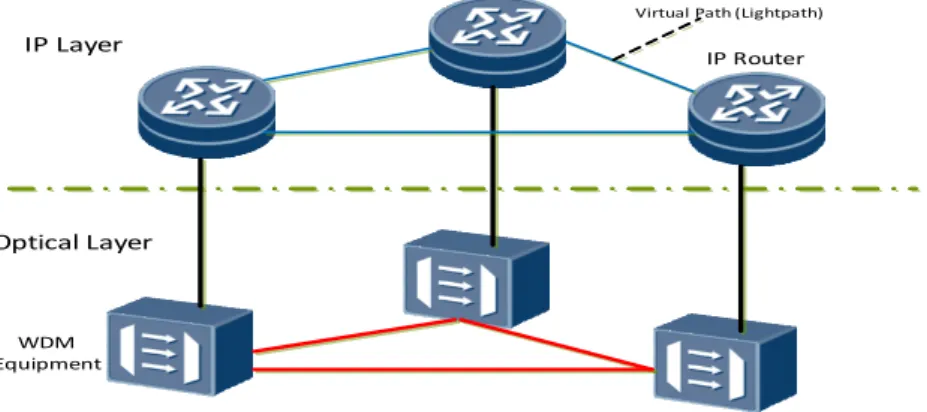
As shown in Fig. 2-4, in the overlay model, the optical transport network (OTN) is completely opaque to the IP network and as a result, two separate control planes exist. One control plane operates within the optical network and the other control plane between the core optical network and the IP Routers.
Figure 2-4: IP over WDM Overlay Model
IP Layer
Virtual Path (Lightpath)
IP Router
Optical Layer
WDM Equipment
19 This model also has two separate routing protocols; IP routing in the IP layer and wavelength routing in the optical layer. In the IP layer, routes are determined from the IP addresses by the IP routing protocol. In the optical layer, the lightpath could be statically provisioned or maybe dynamically determined. In the dynamic overlay model, lightpaths are dynamically established by the wavelength routers (WR). In this model, the OXC (WR) must have the ability to do neighbour discovery, obtain link state updates, do route computations and path establishment, traffic engineering and bandwidth provisioning. The Multiprotocol Label Switching (MPLS) protocol with modifications has been identified as the suitable control plane for optical switching [21].
2.2.3.2 Peer Model
In the peer model (Fig. 2.5), only one control plane exists. This means that both IP routing and wavelength routing are performed by the same control plane. Cisco has pioneered most of this work to meet the demand for converged packet infrastructure moving towards what they term the IP NGN-based architecture [5]. A modified generalised multiprotocol label switching (GMPLS) protocol has been adopted for the unified control plane.
20 Converged IP Over WDM OXC-LSR OXC-LSR OXC-LSR Edge LSR
Figure 2-5: Converged IP over WDM Network - Peer Model
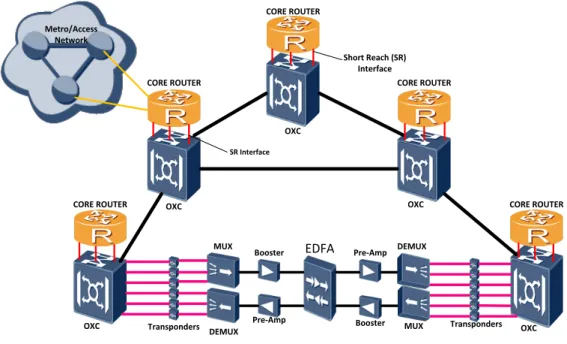
Metro/Access Network
CORE ROUTER
CORE ROUTER
CORE ROUTER
CORE ROUTER CORE ROUTER
OXC OXC OXC OXC OXC Transponders Transponders EDFA MUX DEMUX Booster Pre-Amp Booster Pre-Amp DEMUX MUX Short Reach (SR) Interface SR Interface
Figure 2-6: IP over WDM Core Network Architecture
Fig. 2.6 shows the IP over WDM network architecture with all the layers and components described earlier included.
21
2.3
Energy Efficient Approaches in ICT Networks
2.3.1 Introduction
There has never been a sector that has seen so much rapid growth in this generation as the Information and Communications Technology (ICT) sector. The Cisco Visual Networking Index of 2016 [22] reports that more than half a billion mobile devices and connections were added in the year 2015 and mobile data traffic grew by 74% in 2015 reaching 3.7 exabytes per month. This amount is expected to grow almost tenfold to 30 exabytes per month by the year 2020 as shown in Fig. 2-7. Applications on all these devices and others will need to access geographically distributed databases and servers using public and private clouds requiring flexible traffic management and bandwidth on demand capabilities. The high capacity network transport architectures of today will therefore need to evolve in order to adequately meet these requirements. This growth has put so much pressure on service providers to increase their Capital Expenditure (CAPEX) to meet the demand for the required high capacity equipment. The other price that has been paid by this growth is that ICT equipment is now consuming more and more energy and contributing an annual volume of greenhouse gas emissions just as much as the airline industry. [23]
22 Figure 2-7: Global Mobile Data Traffic Forecast By Region [22]
This therefore calls for both academia and industry to come up with ways of minimising energy consumption in ICTs and in turn reduce the overall carbon footprint contribution from the ICT Industry. Earlier research work has examined energy efficiency in the ICT industry from different layers of the Internet ecosystem. The Internet ecosystem can be divided into three major network domains: The Core Network, Metro Network and Access Network. This study is however restricted only to the Core Network.
The term core network refers to the backbone network infrastructure in telecommunication networks that interconnects major cities, countries and even continents. These networks are usually topologically meshed to ensure survivability. Since core networks are high capacity networks, their
5 10 15 20 25 30 35 ASIA PACIFIC NORTH AMERICA WESTERN EUROPE
CENTRAL AND EASTERN EUROPE MIDDLE EAST AND AFRICA LATIN AMERICA
2015
2016
2017
2019
2019
2020
53% CAGR 2015-2020
EXABYTES PER MONTH
23 physical infrastructure is mainly supported by optical technologies discussed earlier. Several optical network architectures exist in core networks and these include; IP over SONET/SDH, IP over SONET/SDH over WDM and IP over WDM. These architectures have all been reviewed in the earlier sections and it can be seen that they are all multi-layered structures. This therefore entails that any meaningful efforts to bring about energy efficiency in core networks should include both the IP and optical transport layers as well as the data centres.
2.3.2 Energy Efficient Approaches in Core Networks
Recent research efforts have adopted several approaches to reducing energy consumption in core networks. These approaches can be divided into five categories: (i) Selective On-Off switching (ii) Improved Network Architectures (iii) Improved Routing Protocols and (iv) Improved Hardware Design.
2.3.2.1 Selective On-Off Switching
One of the approaches to saving energy in Core Networks is to selectively switch off the nodes in the network which are not carrying traffic during low traffic periods while still maintaining the important nodes in the network to support the remaining traffic. This entails that a core network node, which in this case could be an optical node or an electronic router, is switched off when it is completely idle and not carrying any traffic or when
24 it is carrying traffic below a certain threshold which could be routed to other nodes in the network.
One of the pioneering papers using this approach [5] discusses the impact on network protocols of saving energy by putting network interfaces and other router and switch components to sleep. Current Internet protocols would need some changes to achieve the objective of lowering the energy consumption by putting network interfaces and some other components to sleep when the equipment is idle.
The Authors in [24] consider the possibility of switching off routers and links in a wide area network under connectivity and quality of service (QoS) constraints. A physical topology comprising routers and links of known capacities is considered. There is also knowledge of the average traffic between the source and destination pairs in the network, the maximum supported link utilisation and the power utilisation of links and nodes. A problem of finding a set of routers and links that must be powered on so that the total power consumption is minimised is formulated. Since the problem is a capacitated multi-commodity flow problem, and thus NP-Complete, heuristics have been proposed to solve the problem. The results show that it is possible to reduce the percentage of powered nodes and links in the network as well as guaranteeing the quality of service at a given resource utilisation threshold. The problem with this approach is that it is not practical to switch off an entire node in a backbone network and expect it to recover instantly when required. The
25 approach also needs a separate control plane with links that would ensure that a node gets the knowledge of the status of the network even when it is asleep. The authors in [25] have proposed a technique that would help mitigate the control challenges of selective on-off switching. The work investigated the reduction of energy consumption in networked computers that operate in a clustered environment. Using traffic characterisation of university computers, it was shown that there is significant idle time that can be exploited for power management and subsequently energy consumption reduction. A proxying Ethernet adapter that handles routine network tasks for a desktop computer when it is in a low-power sleep mode was introduced. Such an addition to the hardware considered by the authors in [24] would resolve the control problem.
The other issue with the approach by the authors in [24] is that a real network with a real traffic profile has not been considered and as such the model may yield different results in a real network. This concern is addressed in [26] where a real IP backbone network and a real traffic profile have been considered. In this case however, protection nodes whose capacity is not required to transport off-peak traffic are selectively turned off. The results show that energy savings of more than 23% per year could be achieved through this approach, though at the expense of system reliability. Since only protection nodes have been considered, there is no need for the proxying adapter solution for the control plane as the active nodes can easily wake up the idle protection nodes provided that the
26 master active node itself does not fail first. The authors of [27] have also adopted a similar strategy except it has been applied in WDM networks and an enhancement to the manner in which the nodes are put to sleep has been made. A sleep mode operation of optical devices (Amplifiers and Optical Switches) that are installed for protection purposes only has been proposed. The sleep mode definition in this case is a low-power, inactive state in which devices can be suddenly waken up upon occurrence of a triggering event. An energy-efficient network planning problem for resilient WDM networks where optical devices can be configured in sleep mode was proposed and results of an Integer Linear Programming (ILP) model show savings of up to 25% in overall power consumption.
Since most traffic profiles are not constant throughout the day, some researchers have explored the opportunities of saving energy during low traffic periods. The authors in [28] evaluated the potential energy savings in IP over WDM Networks that could be achieved by switching off router line cards in low traffic demand periods. The authors propose dynamically adapting the network topology and the number of active components to the traffic patterns as a means of reducing energy consumption in IP over WDM backbone networks. An estimate and comparison of potential energy savings of three different approaches; Fixed Upper Fixed Lower, Dynamic Upper Fixed Lower, and Dynamic Upper Dynamic Lower is investigated. Line cards are put in idle state through routing reconfiguration at the IP and/or WDM layer. The results indicate that re-routing demands in the IP
27 layer (Using the Dynamic Upper Fixed Lower Approach) and subsequently switching off line cards that become redundant as a result, contributes the most to the energy savings. The authors also conclude that vendors should endeavour to design line cards that have in built fast on and off switching functionalities. The authors of [29] have also adopted this method of shutting down line cards in off-peak traffic periods but the approach has been extended further to include switching off the router chassis as well. When equipment is being shut-down or turned on, traffic interruptions may occur since new routes are needed. To mitigate this scenario, the authors in [30] have introduced a novel approach which focuses on the minimisation of the amount of re-configurations so that potential traffic interruptions can be minimised.
The approaches considered so far could be categorised as switch-off schemes aimed at reducing the energy consumption of already existing networks by switching off IP ports, links and even nodes during low traffic periods. Caria et al. [31] addresses the fact that, although it has been shown that these schemes can notably reduce the network’s energy consumption, they are prone to instabilities in the IP routing service and decreased resilience due to reduced connectivity, and they may induce monitoring reconfigurations. In order to address these challenges, a switch-on scheme in an IP over WDM network has been proposed, where the network is designed so that the essential IP connectivity is maintained during low traffic periods while dynamic circuits are switched on in the
28 optical layer to boost network capacity during periods of high traffic demand.
2.3.2.2 Energy Efficient Network Architectures
The architectural design of the core network is another area that can be exploited to bring about energy efficiency in ICT networks. This is usually done through the incorporation of energy efficiency at the network design stage.
As a way of saving energy, some researchers have proposed the use of mixed line rates (MLR) in core networks. In [32] the authors evaluate the energy efficiency of an MLR network. A transparent optical network with no wavelength conversion and different reach for different line rates is considered. Considering the fact that currently there are vendors on the market who have manufactured line cards carrying 100Gbps on a single wavelength [33] and even as high as 400Gbps as seen on Cisco’s CRS-X core router [34], the authors’ proposal of mixed line rate networks is feasible. In this case, as opposed to a network providing a single line rate (SLR) of 2.5Gbps or 10Gbps or 40Gbps or 100Gbps as the demands for bandwidth grow, multiple line rates could be offered by the same network. The results from the work shows that MLR networks consume much lower energy than SLR networks.
The advent of bandwidth intensive user applications such as high definition IPTV has significantly increased the energy consumption in
29 backbone networks and is expected to continue increasing because of the high popularity of such applications. The authors in [8] have proposed energy minimisation of the IP over WDM backbone network as an important research problem. An investigation to reduce energy consumption in IP over WDM networks by applying lightpath bypass in the optical layer has been proposed. The study is based on the goal of reducing the number of required IP router ports as a way of increasing energy efficiency. Based on the lightpath bypass concept, a mixed integer linear programming optimisation model and two simple but efficient heuristics to minimise energy consumption have been developed. This has been achieved by considering all the physical layer issues concerning power consumption of all the components in both the IP and optical layers of the IP over WDM network. The results show that the energy-minimised IP over WDM design with lightpath bypass can significantly reduce energy consumption compared to the non-bypass design with energy savings ranging from 25% to 45%. It was also shown that energy consumption in IP over WDM networks follows an approximately linear relationship with the network traffic demand and that the lightpath bypass strategy can equalise the geographic distribution of power consumption which is important for some situations that are subject to maximal electricity supply at a network node location. IP routers were found to be the major consumers of power in IP over WDM networks accounting for over 90% of the total power consumed. The authors assumed a linear and proportional relationship between the traffic in the network and the power consumption
30 of the router ports. This may not necessarily be the case however as the use of 8 ports on a 10 port line card could consume just as much power as using all the 10 ports.
The authors in [35] have developed further the bypass model introduced by the authors in [8] to incorporate router line cards instead of only considering router ports. This is because in reality, router ports are organised by line cards or modules. In most cases, if not all for the case of the 40Gbps ports on the CISCO CRS1 Router [36], the addition or subtraction of a router port means the addition or removal of a line card. It was established that for modularized router ports, the strategy of optical bypass can significantly outperform the strategy of non-bypass in terms of energy consumption.
Increased network and equipment efficiency may lead to increased consumption of ICT services in accordance with the Khazzoom-Brooks postulate [37] and thus still increase the carbon footprint contribution. Therefore, researchers have investigated network architectures that incorporate the use of renewable energy sources by means of taking ICT infrastructure to renewable energy source sites [38]. In a bid to reduce the CO2 emissions from IP over WDM networks, the authors in [39] have proposed an approach for energy minimisation in IP over WDM networks employing renewable energy sources. A linear programming model and heuristic for energy minimisation in the network when renewable energy is used has been proposed for improving renewable energy utilisation. The
31 results show that compared with routing in the electronic layer, routing in the optical layer coupled with renewable energy sources significantly reduces CO2 emissions in the IP over WDM network by 47% to 52%. It was also shown that the nodes at the centre of the network have more impact than other nodes if they used renewable energy sources. Further investigations of additional energy savings resulting from the use of adaptive link rate (ALR) techniques under different load dependent energy profiles achieved even higher energy savings.
There has been significant research on energy consumption in data centres. This research has however mainly focussed on how to minimise energy inside the data centre by looking at cooling and other environmental concerns inside the data centres [40, 41]. However, the authors in [42] have investigated the power consumption associated with transporting data between data centres and end users. Based on the developed linear programming models and simulations, the results show that the selection of optimal locations of data centres in an IP over WDM network leads to a reduction in the network’s power consumption. The authors also investigated replication of content with varying popularity to minimise power consumption. They have also addressed the question of whether to locate data centres next to renewable energy sources or to transfer renewable energy to data centres in a given network topology considering the power losses of 15% per 1000km of power transmission lines. The results from the work have shown that by identifying the optimum data
32 centre locations, combining the multi-hop bypass heuristic with renewable energy and employing the content replication scheme, power consumption savings of up to 73% can be achieved.
The authors in [43] investigate the power savings obtained by optimising the physical topology of an IP over WDM network. A mixed integer linear programming model is developed to optimise the physical topology of IP over WDM networks with the objective of minimizing the total network power consumption. An investigation of the physical topology optimisation under a symmetric full-mesh connectivity traffic matrix and an asymmetric traffic demand where data centres create a hot node scenario in the network is carried out. Simulation results show that the full-mesh and star topologies result in significant power savings of 95% and 92% respectively. Upon inclusion of renewable energy sources in the design, it was shown that optimising the physical topology increases the utilization of renewable energy sources. The authors in [44] have also evaluated at the role of network topology in energy efficient architectural designs of IP over WDM Networks. A large set of randomly-generated topologies, characterised by different values of the network connectivity index is considered. The connectivity index is defined as the measure of the average number of links per node within the network. A study is then carried out on how the connectivity index influences energy consumption of different IP over WDM network architectures. The different architectures are named; Basic, Transparent and Opaque IP Over WDM. A quantification of how the
![Figure 2-9: Flow Manager [49]](https://thumb-us.123doks.com/thumbv2/123dok_us/10132358.2914173/67.892.186.778.490.823/figure-flow-manager.webp)