RICE UNIVERSITY
Compiling dynamic languages via statically t y p e d functional languages ^ by
Rajarshi Bandyopadhyay
A THESIS SUBMITTED
IN PARTIAL FULFILLMENT OF THE REQUIREMENTS FOR THE DEGREE
Doctor of Philosophy
APPROVED, THESIS COMMITTEE:
UkW IcvU.
Walid Taha, Chair
Assistant Professor of Computer Science
'iJ a
k.eith Cooper
Professor of Computer Science
Robert Cartwright (J Professor of Computer Science
Vivek Sarkar
Professor of Computer Science
Marcia K. O'Malley
Assistant Professor of Mechanical Engineering
H O U S T O N , T E X A S M A R C H 2009
UMI Number: 3362128
INFORMATION TO USERS
The quality of this reproduction is dependent upon the quality of the copy submitted. Broken or indistinct print, colored or poor quality illustrations and photographs, print bleed-through, substandard margins, and improper alignment can adversely affect reproduction.
In the unlikely event that the author did not send a complete manuscript and there are missing pages, these will be noted. Also, if unauthorized copyright material had to be removed, a note will indicate the deletion.
®
UMI
UMI Microform 3362128 Copyright 2009 by ProQuest LLC
All rights reserved. This microform edition is protected against unauthorized copying under Title 17, United States Code.
ProQuest LLC
789 East Eisenhower Parkway P.O. Box 1346
ABSTRACT
Compiling dynamic languages via statically typed functional languages
by
Rajarshi Bandyopadhyay
Dynamic languages enable rapid prototyping, but are generally not viewed as providing the best performance. As a result, software developers generally build a prototype in a dynamic language and then rewrite the application in C or Fortran for high performance. This costly rewriting step can be avoided by improving the performance of dynamic languages. Dynamic languages are usually interpreted for easier implementation. The traditional approach to improve their performance is to build an optimizing compiler. However, building a compiler from scratch is much more time-consuming than implementing an interpreter. Our thesis is that we can build effective compilers for dynamic languages by translating them into statically typed functional languages which have good compilers and automatic memory man-agement. In particular, we believe that modern statically typed languages provide
precise control over data representations, and come with runtime systems that have competitive performance.
To investigate the viability of this approach, we have built a compiler for the dynamic language Python by translating it into the statically typed functional lan-guage OCaml. An interesting practical advantage of using modern statically typed functional languages is that they use Hindley-Milner type systems, which means that there is no need for the translation to construct type terms.
We compare the performance of our implementation, Monty, with that of CPython, the reference Python implementation, and with Jython, a Java implementation of Python, using a suite of 370 benchmarks. Our experiments show that some programs compiled using our approach run up to 4.6 times faster than CPython. However, due to a number of engineering reasons, some programs also run significantly slower than CPython. We pinpoint the specific causes of performance degradation and as-sess the potential for removing these causes in future work. Our implementation is significantly faster than Jython, up to a factor of 100 in some cases.
A by product of our research is a proposal for an improved array copying imple-mentation in OCaml.
Acknowledgments
I take this opportunity to express my deep gratitude to my thesis advisor, Dr. Walid Taha, for his constant guidance and enthusiastic support. Without his encour-agement and involvement, this dissertation would not be possible.
My research would not have reached this stage without the contributions of my colleagues in Dr. Taha's research group at Rice. Jun Inoue implemented the Python module system in OCaml. Yilong Yao and Hisham Abi Ammar collected and built the test and benchmark suite, isolating many subtle bugs along the way. Dustin Bachrach collected tests and crafted the testing script. Pete Hokanson built his own suite of intricate test cases and coded some of the basic C functions in the foreign function interface. Gregory Malecha added exception handling to the foreign function interface. In addition, Cherif Salama and Angela Zhu fixed bugs and added missing functionality to the code. Edwin Westbrook added several improvements to the garbage collection mechanism in the foreign function interface, along with some optimizations to the runtime. Ronald Garcia suggested several optimizations and cleaned up the C code in the foreign function interface.
The OCaml developers and users on the OCaml mailing list were some of my most effective resources. Xavier Leroy, the chief developer of OCaml, clarified some of the internals of OCaml's garbage collector while I was building the the foreign function interface. Thomas Fischbacher, Jon Harrop and Richard Jones explained many of the intricacies of OCaml in their responses to my questions.
I received invaluable preliminary feedback for my research at my talk at Google in January 2007. Chris Monson invited Dr. Taha and me. Guido van Rossum, the creator of Python, clarified many of the subtleties of the language. Rami Bitar and Russel Whittaker provided valuable suggestions.
I would like to thank the Department of Computer Science and all of its adminis-trative staff for the support I have received as I have contended with a repetitive stress injury for the last year. Dr. Stacy Ware at Student Health Services and Jean Ashmore at Student Disability Services provided invaluable assistance. The programming for my research would not be complete without Aramis Martinez, who not only typed for me, but also brought his systematic approach and spreadsheet wizardry to the entire development, debugging and benchmarking process. Kirsten Jones typed and proof-read large swaths of this document and in particular, brought her meticulousness to bear on the presentation of the tables and figures.
I am also ever grateful to the late Prof Ken Kennedy, who expressed faith in me by persuading me to finish graduate school, and was a constant source of inspiration. Dr. Devika Subrarhanian supervised my Master's thesis. Dr. Keith Cooper always encouraged me in his unique ways. Dr. Robert Cartwright, Dr. Vivek Sarkar and Dr. Marcia O'Malley gave their time to serve on my thesis committee.
My life at Rice has been enriched in endless ways by the innumerable people that I have been fortunate to meet. Unfortunately, it is impossible to try to name them all here, but I would like to acknowledge all the wonderful contributions they have made.
Dr. Adria Baker from the Office of International Students and Scholars has provided invaluable help with immigration issues. I have been blessed with a multitude of wonderful friends over the years: Anirban Mahdal, Naureen Shahid, Ivy Ghose, Koji Otsuka, Mili Shah, Fernando Gonzalez del Cueto, Leila Issa, Rhonda Ragsdale, Ala Alazzeh, Vica Papp, Christina Burrows and countless others. A very special thanks goes to my partner, Kirsten Jones, for her unflagging patience, support and excellent culinary skills.
My parents taught me that knowledge is the most important and valuable posses-sion to have; the values they instilled have made me who I am. No words can convey how thankful I am for that. This thesis is dedicated to them.
Contents
1 Introduction 1 1.1 Approach 2 1.2 Related work 4 1.3 The Monty Compiler 5
1.4 Contributions and summary of results 10
2 Python: A dynamic language 13 2.1 An example illustrating important Python features 13
2.2 Objects 15 2.3 Dictionaries 15 2.4 Inheritance . 16 2.5 Mixed static-dynamic scoping 17
2.6 Function parameter passing • • • 18
2.7 Control flow mechanisms 19 2.8 Dynamic code execution 20
2.9 Other features . 21 2.10 Memory management in CPython 22
3 OCaml: A statically typed language 23
3.1 Algebraic datatypes . 23 3.2 Pattern matching 25 3.3 Memory management 26 3.4 Functions . . . 27 3.5 Control constructs 27 3.6 Imperative features 28 3.7 Other features and tools 29 4 Representing Python objects in OCaml 30
4.1 Representing Python objects in CPython 30
4.2 The type object in CPython 33 4.3 Representing Python objects in OCaml 35
5 Supporting CPython libraries: Memory management and the
for-eign function interface (FFI) 43 5.1 Python's interface to C 45 5.2 OCaml's interface to C . . . 48 5.3 Passing immutable and mutable objects in the FFI 52
5.4 Monty FFI: Memory management and exceptions . . 57
5.5 Limitations of the FFI 61 6 Translating P y t h o n into OCaml 64
6.1 Building a correct translation 64
6.2 The translation 69 6.3 Type-checking the generated code 78
6.4 Compilation time for generated OCaml programs 79
6.5 Testing methodology 80 6.6 Unimplemented features and known bugs 82
7 Building an optimizing translation 85
7.1 Profiling tools 85 7.2 Improving memory allocation and use 86
7.3 Common-case optimizations . 89 7.4 Implementing modules natively in OCaml . . 91
7.5 Replacing exceptions with option types 93
7.6 Using a method cache 96 7.7 Reducing printing costs . . . 100
7.8 Using compile-time information 102 7.9 Byproduct: A contribution to the OCaml code base 107
8 Performance results 113 8.1 Experimental setup 114 8.2 Benchmark suite 115 8.3 Speedup compared to CPython 117
8.4 Speedup compared to Jython 119 8.5 Performance bottlenecks 121 8.6 Speedups and code size 128 8.7 Compile time and code size 129 8.8 Impact of code size on translation and compilation times 131
8.9 Impact of OCaml compiler options 133 8.10 Impact of Monty optimizations 137 8.11 Object allocation in OCaml vs. Python . . 141
8.12 Array allocation in OCaml vs. Python 143 8.13 Effect of removing function stack management 145
9 Practical lessons that we learned about our approach 147
9.1 Achieving completeness 148 9.2 Improving performance 153
10 Conclusions a n d F u t u r e work 156 10.1 Recap . . . . . . . . . 156 10.2 Future work . . . . . 158 A How t o learn O C a m l 173 B T i m i n g d a t a 175 C P e r f o r m a n c e bottlenecks in t h e g e n e r a t e d O C a m l code 182
List of Figures
1.1 Left: the standard CPython interpreter. Right: the compilation
strat-egy of our implementation, Monty . 6 1.2 The main components of the Monty implementation, including the
translator, runtime and foreign function interface. . 8 2.1 A simple Python example illustrating dynamic typing and object
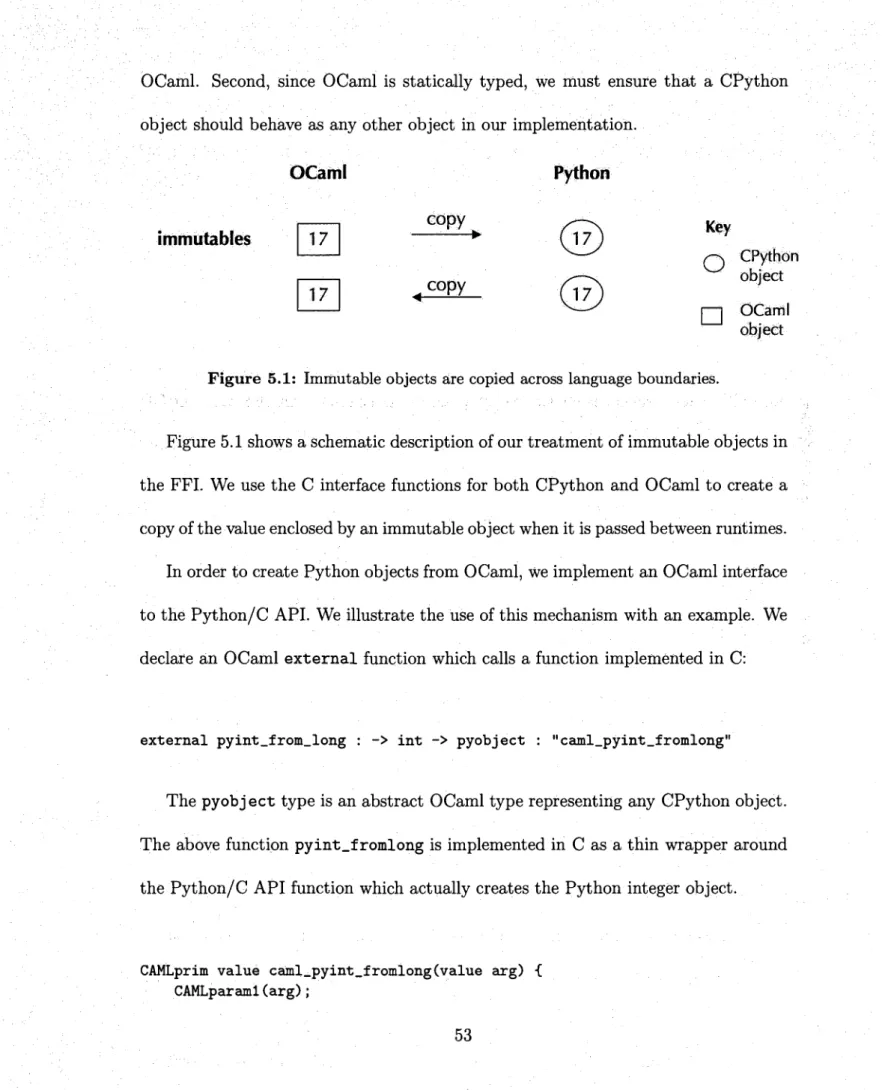
ori-ented features 14 5.1 Immutable objects are copied across language boundaries 53
5.2 Mutable objects are passed as references enclosed by wrappers 55 5.3 Every wrapped OCaml object has a weak pointer to its CPython wrapper. 59
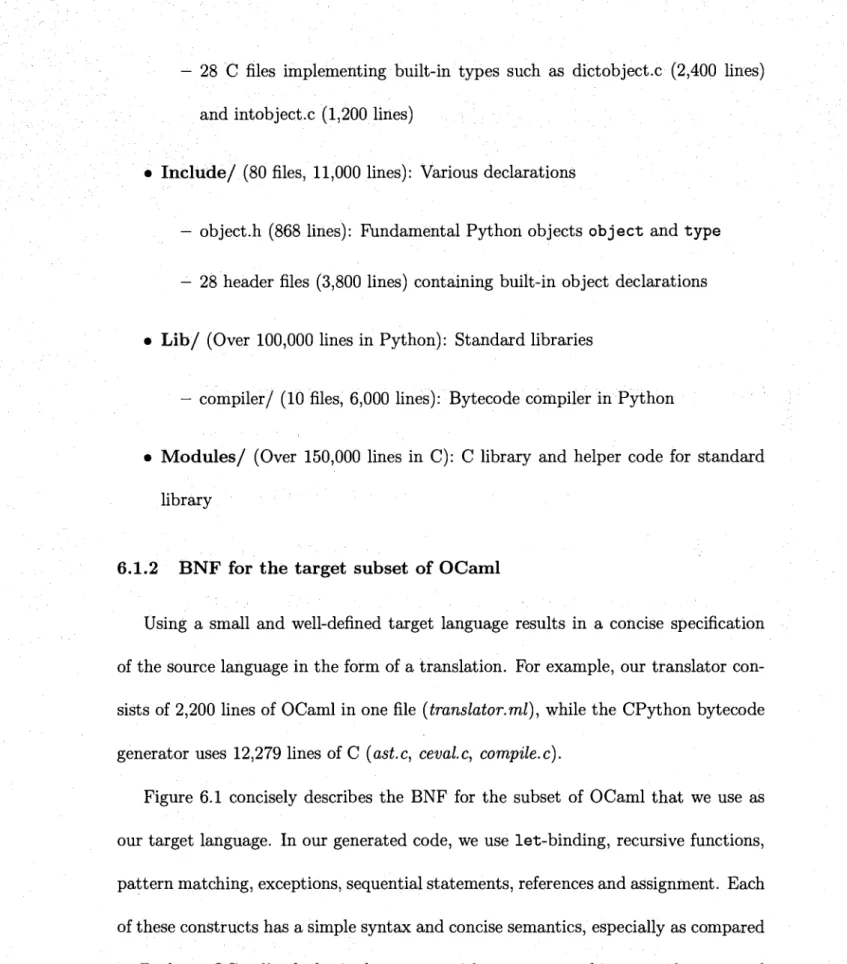
6.1 BNF for generated OCaml code 67 6.2 Using the CPython parser via the FFI for parsing input Python source. 68
6.3 Architecture of our implementation with approximate code sizes (in
lines) 69 8.1 Benchmark sizes, sorted by increasing Python word count 116
8.2 Relative benchmark speedups of Monty compared to CPython (higher
is better) . 118 8.3 Jython performance on our suite is much slower than both CPython
and Monty: (a) shows Jython speedup compared to CPython, (b)
shows speedup in Monty over Jython 120 8.4 Speedups are evenly distributed across Python source size . 128
8.5 Generated OCaml word count vs Python word count 129 8.6 OCaml compilation time is much higher than translation time 131
8.7 Translation time increases with Python code size 132 8.8 Compile time increases with source code size 133 8.9 The - i n l i n e N option has a slight impact on execution time, but
com-pilation time increases with larger values of N for large programs such
as our aggregates 134 8.10 Using the - i n l i n e parameter for our benchmark suite, the relative
change in compile time before and after inlining is evenly distributed
around 1 for smaller programs such as those in our benchmark suite. 135 8.11 The -ccopt -0<N> option has a no impact on execution or compilation
time 136 8.12 Specializing binary numeric operations, comparisons and storing string
8.13 OCaml allocates individual objects more efficiently than CPython: (a) shows the time taken to allocate linked lists of objects and (b) shows
the relative speedup in OCaml. . . . . . . . . 143 8.14 CPython allocates large arrays of objects more efficiently than OCaml:
(a) shows the time taken to allocate arrays of objects, (b) shows the
relative speedup in OCaml. 144 8.15 The relative speedup improvement after removing stack management
code is highest for recursive functions. The improvement is distributed
List of Tables
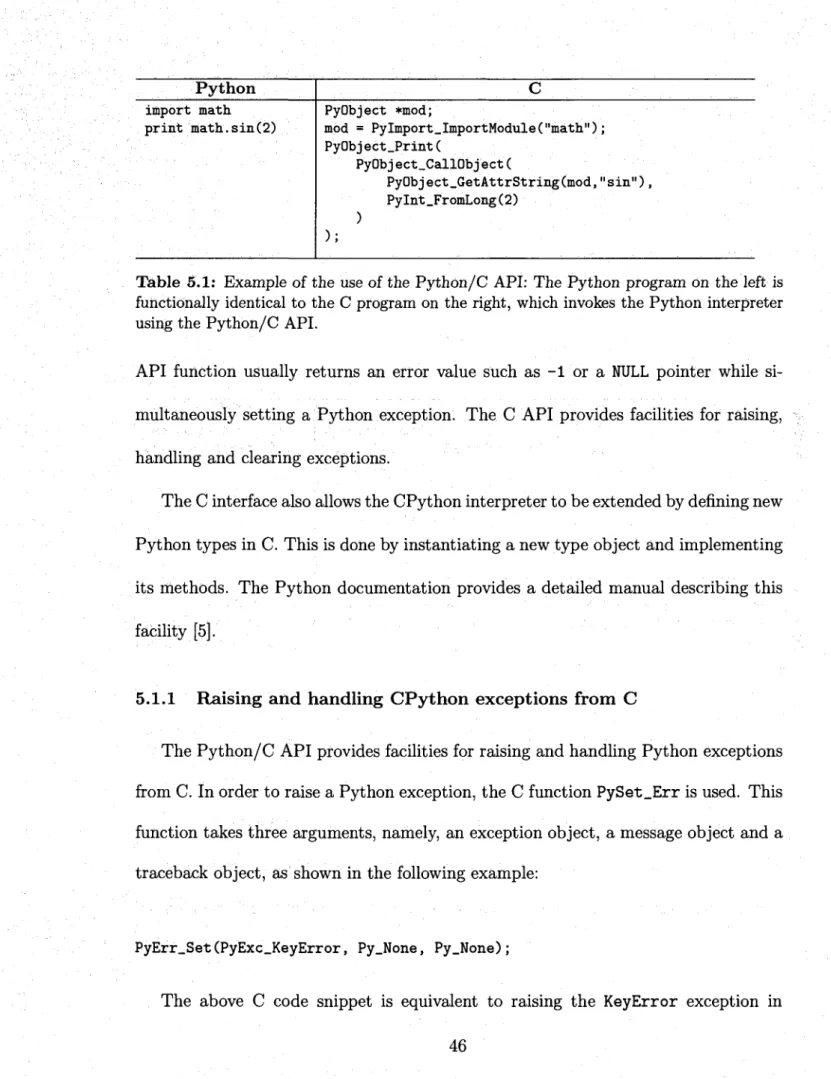
5.1 Example of the use of the Python/C API: The Python program on the left is functionally identical to the C program on the right, which
invokes the Python interpreter using the Python/C API. . . . 46 6.1 Breakdown of test suite results, with some reasons for failure of test
cases. 81 6.2 Test failures due to implementation-specific issues 82
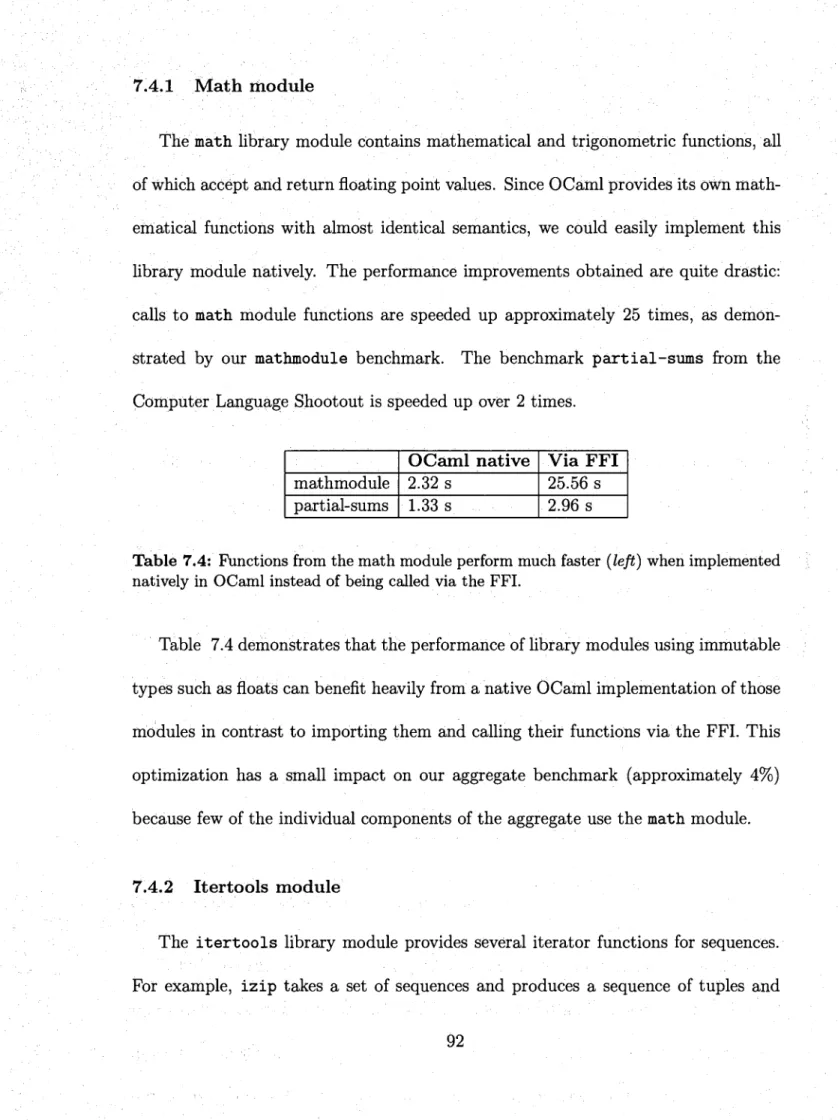
7.1 Performance of recursive functions with and without stack management. 87 7.2 Numeric binary and comparison operations are highly sped up by
common-case optimizations 90 7.3 Storing string hash values results in faster execution times (right). . . 91
7.4 Functions from the math module perform much faster (left) when
im-plemented natively in OCaml instead of being called via the FFI. . . 92 7.5 Functions from the itertools module perform faster when implemented
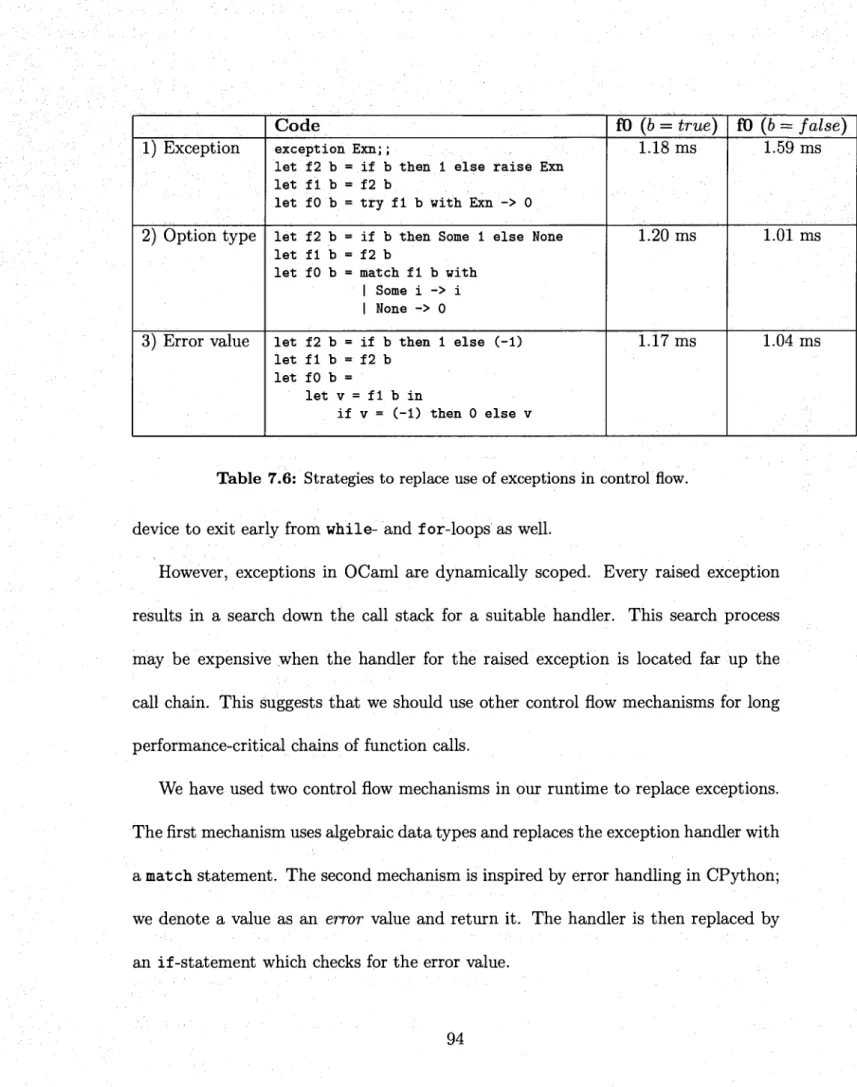
natively in OCaml (left) instead of being called via the FFI. 93 7.6 Strategies to replace use of exceptions in control flow. 94 7.7 For built-in methods, a method cache makes little or no difference in
performance 98 7.8 A method cache can improve performance by 20-30% for user-defined
classes 99 7.9 List printing is faster using a global buffer pool for storing string
rep-resentations of lists. 101 7.10 Recognizing the if-compare pattern during compilation reduces
exe-cution time. 103 7.11 The g e t - a n d - c a l l pattern optimization improves performance by
re-ducing boxing-unboxing operations 105 7.12 Computing lengths of lists and dictionaries at compile time reduces
execution time 106 10.1 Some large Python applications that we would like to support in the
Chapter 1
Introduction
Dynamic languages such as Python [22], R [32] and MATLAB [37] are employed extensively in scientific programming due to their ease of use, large feature set and standard libraries. These languages are often interpreted to quickly implement all of their features. As a result, programmers often build prototypes of high-performance applications in a dynamic language, then rewrite ('harden') the application in lan-guages like C, C + + and Fortran to obtain faster execution times. Lanlan-guages such as C, C + + and Fortran usually offer faster performance than dynamic languages for two reasons. First, they are closer to machine language (lower-level), providing a pro-grammer with finer control over program behavior. Second, they are statically typed, providing a compiler with a large amount of information about data representation even before execution. We believe that these features make it possible to express more efficient programs in statically typed languages than is possible in dynamically typed languages. To explore this hypothesis, this thesis studies the effect of automatic translation from a dynamic language to a statically typed language.
by the translational approach, it is easy to see that when profitable, this approach can be used to build compilers as follows: the language developer first establishes a semantically correct translation, then she refines this translation gradually to achieve better performance. As such, one of the goals of this work is to characterize the tradeoffs that arise as clearly as we can, so that the potential gains from this approach can be estimated before such a translation is developed.
1.1 Approach
In this research, we are interested in a new method for building compilers for dynamic languages: translating them into a statically typed functional language. Our thesis is that this translational methodology has the potential for being an effective approach to compiling dynamic languages. We investigate the tradeoffs involved in our approach concretely by building a compiler for a large subset of the dynamic language Python that works by translating it into the statically typed functional language OCaml.
The key insights underlying our approach are that functional languages such as OCaml have several features that make them suitable target languages for a dynamic language compiler:
1. Functional languages have well-established memory management runtimes. Mem-ory allocation and memMem-ory management have significant overhead in the exe-cution of dynamic language programs. It is now widely understood that well
designed and well tuned automatic memory management systems can be far superior to both explicit memory management and simplistic memory man-agement schemes. For example, recent work at IBM by Bacon's group [25] has shown that automatic memory management can be superior not only in terms of performance, but also in terms of predictability. This makes auto-matic memory management more suitable for real-time systems than explicit memory management.
2. Statically typed functional languages such as GCaml implement algebraic data
types [38] efficiently. In particular, these languages use fairly minimal
imple-mentations of type products and sums.
3. As a result of several decades of research, effective compilers for functional languages exist for most major platforms. In particular, OCaml has a well-supported open-source compiler that can generate efficient native code for most common platforms.
4. OCaml is an implicitly typed language based on Hindley-Milner type inference [36]. The compiler developer using it as an intermediate language need not generate type annotations, greatly simplifying the translation process.
Thus, using a statically typed functional language such as OCaml as an inter-mediate language for a compiler enables programmers to effectively leverage a vast existing infrastructure to build high-performance compilers for dynamic languages.
2 Related work
In this section we review relevant work to the thesis in the area of compiling namic languages.
• Jython is a Java implementation of Python [21]. It translates Python programs internally to Java classes with the primary goal of seamless interoperability with the Java development infrastructure. It is frequently used in web-based appli-cations to connect Python and Java tools. Unlike Jython, our implementation primarily aims to achieve high performance (Section 8.4).
• IronPython is a Python implementation for Microsoft's .NET infrastructure [20]. It compiles Python to Microsoft's Dynamic Language Runtime, a common typed intermediate language framework, after which a program can be compiled to .NET based executable code. The idea of translating a dynamic language to a typed intermediate language is similar to our work, however, we use OCaml, a full-fledged implicitly typed language as our intermediate target language.
• Psyco [39] uses a just-in-time specialization approach to speed up Python pro-grams. This approach works very well for the few programs which can be easily type-specialized, but shows a large overhead for other programs. In contrast, our approach relies on generating an optimized translation at compile time.
• The RCC project [33] at Rice University is building a compiler for R by trans-lating it to C and using a C compiler for faster performance. This compilation
technique has some similarities to ours, but with some important differences: 1) Unlike OCaml, C is a weakly typed language with explicit type declarations. 2) OCaml has an automatic memory management system, in contrast to explicit memory management by a C programmer. We expect that comparing the re-sults of RCC (as they become available) with those of our implementation will provide important insights into dynamic language compilation techniques.
In addition, many of the techniques and optimizations used in this work have originated with compilers for earlier object oriented languages, such as Smalltalk 80 [30], Self [42] and Cecil [28]. For example, Smalltalk 80 uses method caching (Section 7.6), Self implements method specialization and value caching (Section 7.3), while Cecil implements dynamic inheritance similar to Python (Section 7.6.2).
1.3 The Monty Compiler
To test our theory that translating dynamic languages to a statically typed func-tional language can lead to an effective compiler, we have implemented Monty, a compiler for Python, by translating it into OCaml. In this section, we describe the outline of our implementation and some of the challenges we encountered in the pro-cess.
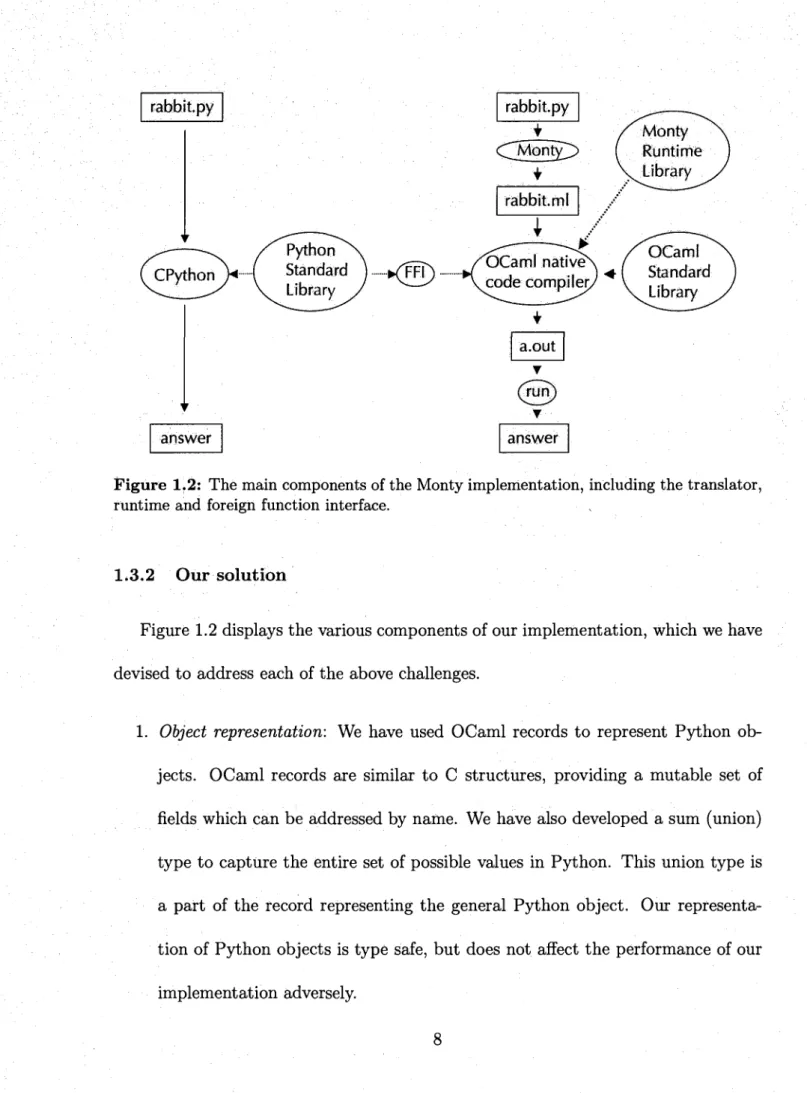
rabbitpy rabbitml OCaml native" code eompilep i a.out T T answer
Figure 1.1: Left: the standard CPython interpreter. Right: the compilation strategy of our implementation, Monty.
1.3.1 Overview and challenges
Figure 1.1 shows the high-level architecture of the standard Python interpreter, CPython, as compared to our implementation, Monty. The CPython interpreter accepts Python source code and directly produces a result. The Monty compiler translates the Python source to OCaml source and links it with a runtime to generate a native code executable.
While building an implementation for a large, highly-featured language like Python, we encounter several important software engineering challenges:
1. How do we represent Python objects in OCaml? Python is a dynamically typed language. A Python object at runtime can represent a wide variety of values:
rabbitpy
CPython
* answer
from simple ones such as integers to complex ones such as classes. An object representation in Python must be flexible enough to handle this entire range.
2. How do We support Python built-in objects and methods? Python has an ex-tensive set of built-in types and methods. Many of its methods are capable of handling multiple types of values using ad hoc overloading semantics. Python also has about forty built-in exceptions which are thrown under different con-ditions.
3. How do we support the extensive Python standard library? Python has a large standard library suite with over a hundred modules, written in a mix of Python and C. Any non-trivial Python program uses functions from this library at runtime.
4. How do we translate Python source code? Python has a quirky grammar im-plemented in its own parser implementation. Python source code has no type declarations and has several syntactic features which cannot be trivially mapped to statically typed languages.
5. How do we verify and maintain correctness? Python's open-source development model results in a plethora of syntactic and runtime features. The Python distribution comes with extensive documentation, but it is not necessarily up-to-date with the latest implementation. The source code of Python is itself the most reliable documentation of the language.
Figure 1.2: The main components of the Monty implementation, including the translator, runtime and foreign function interface. ,
1.3.2 Our solution
Figure 1.2 displays the various components of our implementation, which we have devised to address each of the above challenges.
1. Object representation: We have used OCaml records to represent Python ob-jects. OCaml records are similar to C structures, providing a mutable set of fields which can be addressed by name. We have also developed a sum (union) type to capture the entire set of possible values in Python. This union type is a part of the record representing the general Python object. Our representa-tion of Python objects is type safe, but does not affect the performance of our implementation adversely.
2. Built-in types and methods: We have implemented a runtime system in OCaml, containing our implementation of all of Python's built-in types and their pre-defined methods.
3. Standard Library: We have built a foreign function interface (FFI) in C between Python and OCaml, using the C interfaces provided by Python and OCaml. However, we have found that while the FFI lets us conveniently support most Python libraries, there is a large performance tradeoff. Natively implemented library modules perform much faster than those called via the FFI, but are more time-consuming to implement.
4. Source-to-source translation: In order to translate Python source code, we have used Python's built-in parser via the FFI to generate a string-based representa-tion of the source code for further processing in OCaml. We have made effective use of OCaml constructs such as sum types, recursive functions, exceptions, as well its imperative features such as references, sequential statements and loops to build a source-to-source translator from Python to OCaml.
5. Correctness: In order to evaluate and maintain correctness of our implementa-tion, we used a test-driven programming methodology consisting of (1)
accep-tance testing for individual features and (2) regression testing to ensure that
newly added features do not break existing ones. Our test suite of 425 files Was developed and collected by several undergraduate students. Several bugs in our implementation were identified by the undergraduates and fixed by the
developers.
1.4 Contributions and summary of results
In this section, we present the results of of our experiment in implementing our translational approach. We first present the status of the translation in terms of completeness, and then briefly discuss the results of a comparative performance eval-uation. Our performance results characterize some of the tradeoffs involved in our approach. Finally, we summarize the salient technical contributions of our work.
1.4.1. Completeness
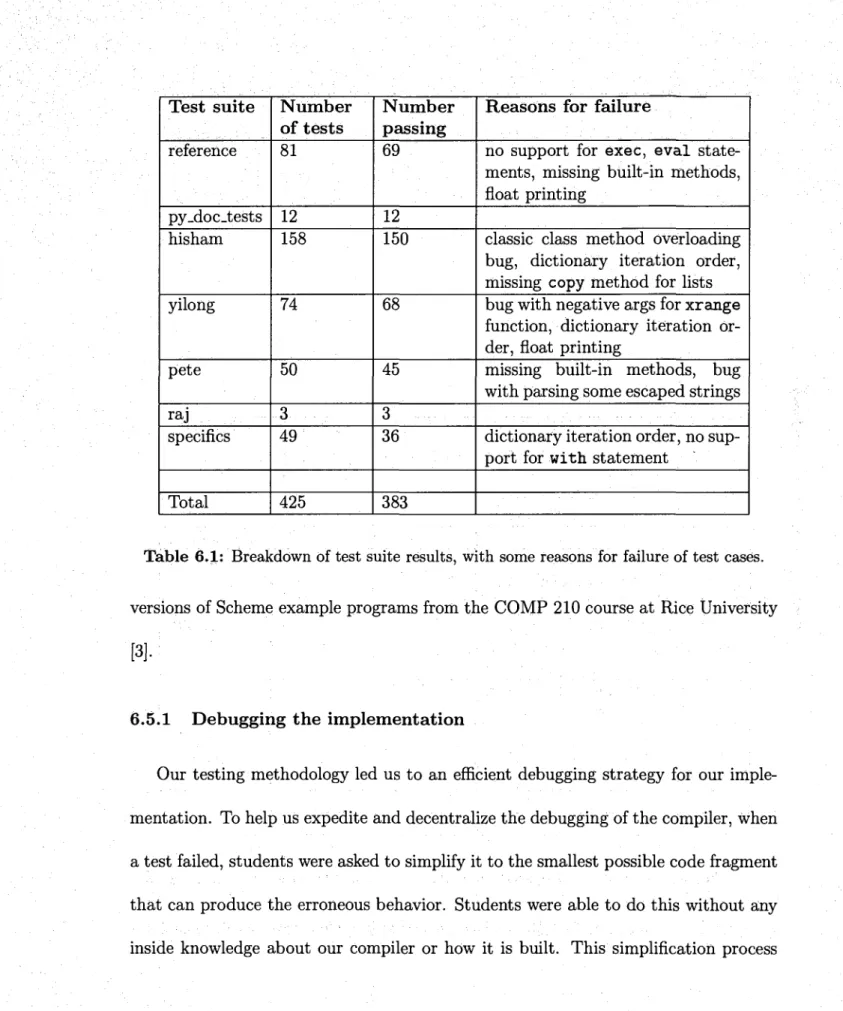
At the time of writing this thesis, Monty passed 383 out of the 425 cases that were used to test it. Approximately one-third of test case failures are due to implementation-specific differences between CPython and the OCaml compiler, whereas the remaining are due to bugs and missing features in our implementation. We do not yet support features such as dynamic code evaluation (exec and eval statements), context man-agers (with statement) and threads (Section 6.6.2).
1.4.2 Comparative performance
We evaluate the performance of our implementation, Monty, by comparing it against two other Python implementations:
performance evaluation. We implemented several optimizations to improve per-formance (Chapter 7). As a result of these strategies, our compiler currently provides a speedup over CPython for about 75 percent of our benchmark suite, that is, 278 of 370 benchmarks (Section 8.3). We have profiled each of the 92 benchmarks which run slower than CPython and identified specific areas of per-formance loss. The FFI, printing methods, stack management and large object array allocation are some of the common causes of slowdown (Appendix C).
• Jython: On average, the latest version of Jython (2.5 beta) runs approximately 10 times slower than Monty and approximately 5 times slower than CPython. However, some programs run approximately 100 times faster in Monty compared to Jython. Jython runs slightly faster than Monty on 7 benchmarks. In these cases, Jython implements a library natively in Java, whereas Monty invokes the CPython version of the library using the FFI (Section 8.4).
1.4.3 Technical contributions
The technical contributions of this thesis may be summarized as follows:
• To our knowledge, this is the first work that uses a Hindley-Milner typed lan-guage, OCaml, as a Typed Intermediate Language for a compiler [40]. The type inference system in OCaml removes the burden of generating explicit type annotations from the compiler developer (Chapter 3).
repre-sentation of Python objects which does not impede the performance of our implementation (Section 4.3).
• We have built a foreign function interface that is compatible with the current version of Python, enabling OCaml users to access functions from the Python interpreter and standard library (Chapter 5).
• We have obtained a concise expression of Python semantics in the form of a translation to a small and well-defined subset of the target language, OCaml (Section 6.1).
• Our work has shown how to translate Python into efficient OCaml code (Section 6.2). We believe that many of our optimization strategies could be used for implementing other dynamic languages (Chapter 7).
• We developed an improved version of the array copying function in the OCaml Standard Library while optimizing our implementation. Our version runs ap-proximately 3 times faster than the OCaml library version. Our code is under review for inclusion in the next release of OCaml (Section 7.9).
Chapter 2
Python: A dynamic language
Python is an open-source, object oriented dynamic language [22]. The standard implementation of Python, CPython, is written in C. This implementation provides Python users with several built-in types, each supporting many useful methods. In addition, much of Python's popularity derives from its extensive standard library and its ability to interface with existing libraries via its C API.
2.1 An example illustrating important P y t h o n features
The simple Python program in Figure 2.1 illustrates some basic Python features. An instance of the class BankAccount is initialized using the specially named con-structor i n i t . The deposit and withdraw methods of this instance are called with arguments of different types, an integer and a float. The p r i n t statement inter-nally calls another special method, r e p r , which returns a string representation of the instance.
This small Python example illustrates many of the important features of Python: class declaration, instance creation, function declaration with keyword arguments,
c l a s s BankAccount(object): #defines a new c l a s s (type) i n h e r i t i n g #from base type "object"
def i n i t ( s e l f , i n i t _ b a l a n c e = 0 ) : # c o n s t r u c t o r invoked f o r hew i n s t a n c e s s e l f . b a l a n c e = i n i t _ b a l a n c e # i n i t _ b a l a n c e has d e f a u l t value of 0 def d e p o s i t ( s e l f . a m o u n t ) : s e l f . b a l a n c e += amount def withdraw(self,amount): s e l f . b a l a n c e -= amount def __repr ( s e l f ) : # s t r i n g r e p r e s e n t a t i o n r e t u r n "Balance i s : " + s t r ( s e l f . b a l a n c e )
my_account = BankAccount(15) # c r e a t e s i n s t a n c e with balance 15 # c o n s t r u c t o r with init_balance=15 my_account.deposit(10)
my_account.withdraw(5.50)
p r i n t my_account.balance # p r i n t s "Balance i s : 19.50"
F i g u r e 2 . 1 : A simple Python example illustrating dynamic typing and object oriented features.
method calls, arithmetic operations and string concatenation. Python also specifies many special method names for classes, such as r e p r for generating a string rep-resentation and i n i t for initializing a new instance. The + operator is overloaded to handle different numeric type arguments (such as integers and floats) correctly at runtime. These features and others which we describe in this chapter make Python a dynamic, object oriented language.
2.2 Objects
All Python values are represented by a universal type called object. The behavior of any object is determined by the methods stored in it's type, which itself is an object. Python's several built-in types include integers, floats, strings and lists. Python programmers can create their own types by defining classes, which are syntactically similar to classes in other object oriented languages like C + + and Java. However, an important difference between Python and C + + / J a v a is that Python classes make ho attempt to hide information. All the information in a class instance is accessible externally. There is no notion of p r i v a t e or p r o t e c t e d variables in Python.
2.3 Dictionaries
Dictionaries, mutable mappings from objects to objects, are a critical data struc-ture in Python. Type objects store their methods in dictionaries. The methods of a Python class are mutable at runtime since they are stored in dictionaries. Instances of user-defined classes use dictionaries to store local data.
All Python objects may be used as dictionary keys, except for mutable types such as lists and dictionaries themselves. CPython implements dictionaries using a hash table data structure. Both equality and hashing are defined in Python as methods implemented by objects. For example, the expression ol = = o2 is syntactic sugar for ol eg_(o2). Every hashable object must provide a —hash— method: hash : obj —>
returns True must have the same hash value *.
A common use case for dictionaries is to store method names for a type. In these cases, the key is an object containing a string value. CPython takes advantage of this common case by internally using two distinct dictionary implementations: a general object-to-object mapping and a more specific to-object mapping. The string-to-object mapping is used by default to store methods for type objects. Specializing for the common case provides performance benefits for CPython, but necessitates extra book-keeping to maintain dual implementations.
2.4 Inheritance
Python supports multiple inheritance. For any class, the base class hierarchy can be an arbitrary graph. However, Python semantics follows a specific order of method lookup, defined by the C3 Method resolution algorithm [26], which was originally created for the Dylan language [4]. In C + + and Java, inheritance is statically deter-mined. In Python, however, inheritance is determined by runtime method lookups. For simple programs with single inheritance, the search algorithm for a given method m in an object is fairly straightforward; search the dictionary of the type of the object, and then in its base class and so forth. However, if multiple inheritance is involved, the method m may have different implementations in different base classes,
1Personal communication by Guido van Rossum, the lead developer of Python at a Google talk on January 22, 2007. This is an example of a language feature that is very hard to glean from documentation and code, and had to be communicated to us by the developers of the language.
each of which may be reachable by a different path. The method resolution algorithm disambiguates this process by ensuring that for every class, a unique priority is as-signed to each of its base classes and the methods are looked up in that order. We recommend the original C3 paper for details of this algorithm [26].
2.5 Mixed static-dynamic scoping
A Python program can define three possible scopes: Module scope, Class scope and Function scope. Variables defined in the module and function scopes are lexically scoped, but a class variable is only available via the dictionary of the class. This results in an unusual mix of static and dynamic scoping rules.
x = 5 class C(object): x = 10 def foo(self): return x c - . C O
print c.fooO # prints "5" print c.x # prints "10"
In the above example, the p r i n t statement in the function f oo prints the value of x in the outermost scope instead of the lexically enclosing scope of the class C. These scoping rules lead to more involved book-keeping in the translation process in order to keep track of variable scoping.
2.6 Function parameter passing
Python allows user-defined functions with complex argument definition and pro-cessing semantics. Python functions can be nested. Functions themselves are objects, like any other Python value. Python functions support several kinds of parameter passing:
• Positional parameters have no default value, but are sequentially assigned values from the arguments of a function call.
e Keyword or named parameters have a default value.
• The list (*arg) parameter allows a variable number of positional arguments to be packed into the list arg.
• The map (**arg) parameter allows a variable number of named arguments to be packed into the dictionary arg.
def iun(xJy,z=8,*argl,**arg2):
print x , y , z , a r g l , a r g 2 # 2 5 4 (5, 66) {'a': 1, ' b ' : 2} fun(2,5,4,5,66,a=l,b=2)
In this example, the function fun is called with both positional and keyword ar-guments. The first two positional arguments are assigned to the formal parameters x and y respectively, while the third argument is assigned to the keyword parameter z. The remaining positional arguments are absorbed in the *argl formal parameter.
Similarly, the excess keyword arguments a and b are inserted into a dictionary rep-resented by the **arg2 parameter. This example illustrates that Python's argument processing makes its function call semantics quite complex.
2.7 Control flow mechanisms
Python provides several mechanisms for control flow:
1. Conditionals a n d loops: Python supports the standard imperative control flow constructs: i f - e l s i f - e l s e , while and for loops. As in C, loops in Python support the break and continue statements for non-local control flow.
2. Exceptions: Python supports exception raising and handling. The r a i s e statement allows an exception to be raised, and the t r y - e x c e p t syntax is used to implement handlers. Python defines 30 built-in exceptions. Exceptions in Python are objects like any other Python value. For example, the following function update_count updates a dictionary d which maintains a count of each word occurring in a document.
def update_count(d,word):
t r y : # if word e x i s t s , increment count d[word] = d[word] + 1
with KeyError: # if new word, add i t d[word] = 1
3. G e n e r a t o r s : Python supports an imperative form of streams called generators. A generator looks like a function, except for the presence of one or more y i e l d
statements in its body. A generator responds to an invocation of its next method by yielding a value and preserving its state. This preserved state is used to resume execution and yield the next value on subsequent invocations of next.
def pow2(N): #defines a g e n e r a t o r function i = 0 while i < N: y i e l d 2~i i += 1 # p r i n t t h e f i r s t 10 powers of 2 g = pow2(10) # c r e a t e a g e n e r a t o r i n s t a n c e p r i n t g . n e x t 0 #1 p r i n t g . n e x t O #2
For example, the generator function pow2 creates a specific generator instance g on invocation. This instance has a built-in next method which returns the value of the subsequent y i e l d statement.
2.8 Dynamic code execution
Python allows any string to be executed as code using the exec and eval con-structs. The exec construct supports arbitrary Python code, while eval can only evaluate a single expression. This code can be executed in an environment speci-fied by local and global dictionaries. This feature, when used, makes it difficult for compilers to analyze programs.
2.9 Other features
Python has several other features that are popular in scripting languages and must be supported by any Python implementation. Much of Python's popularity derives from its extensive standard library suite. The Python Standard Library contains over 100 modules, ranging from mathematical functions (math) to mail and web applications (smtpd, cgi). As shown below, a function in a Python standard library module is used by first making the module available in the current namespace using the import statement.
import math
print math.sin(2)
In this example, we compute the sine of a number using the s i n function of the math library module. Modules can be dynamically loaded into Python at any point in the program, even if the name of the module is known only at runtime.
Python provides a high-level C API that allows data (object) manipulation and method invocation from a C program. In addition to calling functions in the Python runtime, the interpreter can be easily extended by defining new Python types in C. These C interface facilities make it simple to connect Python to existing code and libraries.
2.10 Memory management in C P y t h o n
CPython's memory management is based on a reference counting [34] garbage collector. Each CPython object contains an integer count representing the number of references to it. When this reference count falls to zero, the object becomes inac-cessible and can be marked for deallocation. There are two main advantages to this reference counting scheme. First, objects can be immediately reclaimed in an incre-mental fashion without long pauses for garbage collection cycles. Second, reference counting is one of the easiest garbage collection schemes to implement.
However, a significant disadvantage of a naive reference count scheme is the in-ability to reclaim objects that are part of reference cycles. Because an object in a reference cycle directly or indirectly refers to itself, its reference count is always greater than zero. CPython resolves this problem by periodically calling a cyclic garbage collector (available via the gc library module) which identifies and collects reference cycles.
Chapter 3
OCaml: A statically typed language
OCaml (Objective Categorical Abstract Machine Language) is a statically typed open source programming language developed mainly at INRIA, Prance, but with contributors around the world [17]. OCaml is fundamentally a functional language with some imperative and object oriented features. Since we use only the functional and imperative features of OCaml, we focus on those features in this chapter.
3.1 Algebraic d a t a types
OCaml provides an implementation of algebraic data types [38], which can be defined by the following BNF:
T := B\T + T\T*T\T-*t\ref'T
The symbol B represents base or ground types such as booleans, integers, floats and strings. Sum types of the form T\ + T2 represent disjoint (tagged) union types. Such a type can take a value in one of two forms: either a tagged value Left v\ carrying a value v\ of type Ti, or a tagged value Right v% carrying a value vi of type T2. In practice, OCaml allows the user-defined tag names and sums can introduce
several tags simultaneously. Product types of the form T\ *T2 are pairs, and can have values of the form (^1,^2) where value v\ is of type T\ and v<i is of type T2. A type of the form Ti —>• T2 is a function which accepts a value vi of type Ti and returns a value V2 of type T2- The ref T type represents a mutable reference to a value of type
T.
There are two commonly used product types in OCaml: tuples and records. A tuple is declared with the * syntax used as follows:
type mytuple = (int * s t r i n g * (float -> i n t ) )
In the above example, the tuple mytuple has three components in the order specified by the type declaration: an integer, a string and a function which accepts a float and returns an integer.
OCaml records are tuples with named elements, similar to C structures. This construct is useful when specific elements of a collection have to be conveniently accessed. For example, the elements of mytuple in the previous example can be placed in a record as follows:
type myrecord = { x: int; y: string; z: (float •-> int) }
In the above example, the record type myrecord has the same three components as mytuple, but they are now individually named as x, y and z.
; Unlike C, OCaml does not support unchecked coercion subtyping for records, that is, one OCaml record cannot be cast to another. Moreover, in OCaml, two different record types cannot have a field with the same name.
OCaml also allows recursive type definitions, enabling easy construction of data structures such as lists and hash tables. OCaml also allows parameters in type def-initions for creating polymorphic types. For example, a basic polymorphic list type can be easily defined in OCaml as follows:
type 'a l i s t = Nil I Cons of 'a * ('a l i s t )
This list type defines a polymorphic list of elements, each represented by the type parameter 'a. The Nil tag represents the empty list, while the Cons tag recursively extends an existing list using a tuple consisting of a head and a tail.
OCaml is a statically typed language with Hindley-Milner type inference. Type declarations are implicit: the programmer need not declare types. Explicit type annotations are allowed only as hints to the compiler.
In our work, we use OCaml's algebraic data types, chiefly records and union types, to devise a representation for Python objects in OCaml. Using a sum type enables us to represent all possible Python values using one type (Section 4.3).
3.2 P a t t e r n matching
An important feature of OCaml that we use extensively is pattern matching with the match statement. The match statement in OCaml is similar to the switch
state-ment in C. Patterns in OCaml allow the match statestate-ment to select an action based on the structure of a value. For example, in order to determine the length of the list type defined earlier, we can define a recursive function.
l e t rec l i s t l e n 1 = match 1 with
I Nil -> 0
I Cons (hd.tl) -> 1 + l i s t l e n ( t l )
The function l i s t l e n uses a match statement to iterate over the list, using pattern matching on the tags Nil and Cons to determine the return value.
Pattern matching enables us to implement dynamic typing: we examine the tag of the value enclosed by a Python object at runtime and determine the action based on the tag.
3.3 Memory management
OCaml provides automatic memory management with garbage collection. The OCaml garbage collector uses a hybrid generational incremental algorithm [34]. It maintains two heaps: a young or minor heap, and an old or major heap. Objects in the minor heap are collected far more frequently than those in the major heap. Objects are first allocated in the minor heap and then moved to the major heap after they have survived a minimum number of collections. The OCaml Book [27] offers a detailed description of the OCaml garbage collector as well as an excellent summary of related algorithms.
3.4 Functions
OCaml enables the user to define recursive functions with an arbitrary number of arguments. The OCaml language specification leaves the argument evaluation order unspecified. However, in the standard OCaml implementation, arguments are evaluated from right to left [23], unlike imperative style languages such as Python or C.
Functions in OCaml are first class values, which means that they can be supplied as arguments to other functions, or returned by other functions. We use this fea-ture and recursion extensively to implement generator functions in Python using a continuation-passing style (CPS) approach (Section 6.2).
3.5 Control constructs
OCaml provides exception raising and handling constructs. An exception may be raised by the r a i s e statement. Exception handlers are implemented using the t r y - w i t h statement. A raised exception in a try-block may be caught by the with statement, which provides handlers to perform specific actions based on the value of the exception. In OCaml, all exceptions are first class values belonging to a type called exn. This is an extensible sum type: it can be extended by declaring new con-structors. Exceptions are dynamically scoped: a raised exception propagates through the program stack from callee to caller until it finds the first handler to catch it. If an uncaught exception reaches the bottom of the stack, it stops program execution
with an error. In practice, exceptions can also be used as a control flow mechanism. We use exceptions in OCaml to implement Python exceptions. In addition, we find OCaml exceptions to be a convenient technique to implement non-local control flow constructs in Python such as break or continue statements in loops.
3.6 Imperative features
OCaml provides several features traditionally associated with imperative lan-guages. These include references which can be used to store values of a particular type and can be modified by assignment. OCaml also allows statements in a block to be executed as a sequence. The result of the last statement in the sequence determines the type of a block.
OCaml defines the i f - t h e n - e l s e control flow construct, along with more im-perative style constructs such as for and while loops. Unlike loops in imim-perative style languages like C or Python, OCaml loops do not support non-local control flow constructs such as break or continue.
The imperative features of OCaml enable us to implement the imperative fea-tures of Python. We use sequential statements to implement Python code blocks. References allow us to implement Python assignments.
3.7 Other features and tools
OCaml's standard library supplies many useful data structures such as lists, arrays and hash tables. The library also contains a large set of string manipulation functions and an implementation of arbitrary-precision arithmetic. In our implementation, we use many OCaml libraries: the Hashtbl library for custom hash tables as the basis for our dictionary implementation, arrays to represent lists and tuples, string functions for the source-to-source translator and so on.
OCaml provides a powerful C interface mechanism to call functions implemented in C and for C code to call functions back into the OCaml runtime. This is extremely useful in building foreign function interfaces to other languages, as we have used in our interface between Python and OCaml.
The standard OCaml distribution comes bundled with some useful tools for lan-guage developers: ocamllex and ocamlyacc. These programs provide lexing and parsing facilities similar to the Unix utilities lex and yacc respectively. OCaml also supports profiling using the ocamlprof tool and by generating executables which can be profiled using the gprof profiler.
Chapter 4
Representing P y t h o n objects in OCaml
In this chapter, we discuss the representation of Python objects. We first re-view the existing CPython object representation using C structures. C allows unsafe structural subtyping; structures can be cast to one another. In our view, this leads to potentially type-unsafe programs. We present an object representation using OCaml records and sum types. Our representation is both type-safe and does not prevent our implementation from being sigificantly faster than CPython.
The definition of the type object in Python presents a challenge when developing an appropriate OCaml representation for Python objects . An instance of a type object contains methods implementing a Python type or class. The definition of this object in CPython is unusually complex relative to other CPython objects. We devote a section in this chapter in order to explain our type object representation.
4.1 Representing P y t h o n objects in C P y t h o n
Every element in the domain of Python values is called an object. Based on their internal representation, Python objects can behave as numbers, strings, lists,
functions and other values. A special category of Python objects is type, whose main purpose is to contain methods designated for use by other objects. Two properties hold true for Python: (1) every object has a type and (2) every type is an object. Any particular Python object carries data specific to itself, while its type object contains behavior (methods) for all instances of that type.
4.1.1 PyObject: A C structure for Python objects
CPython uses C structures to represent Python objects. The most abstract object is denoted by a structure called PyObject which contains the minimal information needed by an object. Every Python object has some bookkeeping information for memory management and a pointer to its type object:
s t r u c t PyObject {
PyObject_HEAD / * GC info */ PyTypeObject *ob_type;
}
The PyObject.HEAD macro expands into some fields internally used by Python's garbage collector, while the ob_type field is a pointer to the type of the instance. The PyObject structure serves as a template for all CPython objects. For example, the object representing an integer has a slightly larger C structure:
struct PylntObject {
PyObject.HEAD / * GC info */ PyTypeObject *ob_type;
long i n t i v a l ; /* integer value */
The PylntObject structure is a subtype of PyObject with an extra field i v a l containing the data distinguishing each Python integer object. The ob_type field for any Python integer object, such as the integer 1 below, points to an object called PylntType, which in turn is a specific instance of PyTypeObject. The PylntType structure encodes all the methods and properties describing a Python integer:
<• . •
PyObject_HEAD / * GC info */ ob_type = fePylntType;
i v a l = 1; }
4.1.2 The use of unsafe structural subtyping in CPython
Because C supports casting between s t r u c t types, all Python objects can be coerced to each other via the abstract structure PyObject. This technique is useful for implementing a dynamic language in which a function can receive different kinds of Python objects as valid arguments.
Using coercion for records in this manner has several advantages. First, it saves memory by ensuring that every record type has exactly the data that it needs to carry. Second, this data can be accessed rapidly using field lookup. However, coercion reduces type safety. If there is a mismatch of types at runtime, a program can attempt to access memory illegally. Another disadvantage of using coercion indiscriminately is that it can create a profusion of record types in the source code.
4.2 The type object in C P y t h o n
Surprisingly, the largest and most complex subtype of PyObject in CPython is PyTypeObj ect, which is used to denote type objects describing the behavior of each type or class. The PyTypeObj ect structure contains a dictionary t p _ d i c t . In theory, the dictionary is sufficient to carry all the methods defined by this type. However, in addition to being accessible via the dictionary, several commonly used methods are also defined as fields of the C structure itself, making this structure large and complex. This design is used primarily for performance reasons; accessing the field of a structure is much faster than a dictionary lookup.
The type object structure has several fields representing the most commonly used methods for Python objects. This includes hashing (tp_hash), string representa-tion ( t p _ s t r and tp_repr) and iterarepresenta-tion ( t p _ i t e r ) . In addirepresenta-tion there are special-ized method suites for implementing numeric behavior (tp_as_number), sequence behavior (tp_as_sequence) and map behavior (tp_as_mapping). Other fields, as de-scribed in the code below, implement behavior for attribute access ( t p _ g e t a t t r o and t p _ s e t a t t r o ) , instance creation (tp_new and t p _ i n i t ) and comparison (tp_compare and tp_richcompare):
struct PyTypeObject {
PyTypeObject *ob_type; char *tp_name;
PyObject *tp_dict;
/* GC and book-keeping fields */ /* name of this type */
/* dictionary */
/* Methods to implement standard operations */ destructor tp_dealloc; getattrfunc tp_getattro; setattrfunc tp_setattro; cmpfunc tp_compare; richcmpfunc tp_richcompare; /* destructor */ /* retrieving attributes */ /* setting attributes */ /*. 3-way comparison */ /* rich comparison */
/* Method suites for standard classes */
PyNumberMethods *tp_as_number; PySequenceMethods *tp_as_sequence; PyMappingMethods *tp_as_mapping;
/* numeric methods */ '/* sequence methods */
/* map (dictionary) methods */
/* More standard operations (here for binary compatibility) */
hashfunc tp_hash; ternaryfunc tp_call; reprfunc tp_str; reprfunc tp_repr; getiterfunc tp_iter; iterhextfunc tp_iternext; /* hash function */
/* calling object as function */ /* string representation */
/* concise string representation */ /* iterator creation */
/* iterator traversal */
/* Methods, subclassing and instantiation */
struct PyMethodDef *tp_methods; /* method list */
struct PyMemberDef *tp_members; /* data attribute list */ struct PyGetSetDef *tp_getset; /* custom attributes */
newfunc tp_new; initproc tp_init; PyObject *tp_bases; PyObject *tp_mro; PyObject *tp_subclasses; /* instance creation */ /* instance initialization */
/* list of base classes */ /* method resolution order */ /* list of subclasses */
4.3 Representing P y t h o n objects in OCaml
We use OCaml records in our implementation to represent Python objects because they offer several of the same benefits offered by C structures: named elements and fast access. Unlike C, OCaml records cannot be cast to one another. Moreover, in OCaml, two different record types cannot have a field with the same name. These restrictions imply that we must define exactly one record type in OCaml to represent all Python objects.
We define a single record type obj containing the basic fields that are shared by most Python types. Python stipulates that every object be assigned a unique identifier. In CPython, the memory address of an object is used as its identity. In OCaml, the address of a value is not constant due to garbage collection. Hence we generate our own unique integer identifiers and store them in each object as a field. In addition, the obj record contains a reference to the type of an object, the size (for sequences and strings) and some other fields as shown below:
type obj = -C ob_idx mutable ob_type mutable ob_value i s b u i l t i n mutable ob_size mutable props mutable weak_wrapper } i n t ; (* object i d e n t i t y *) o b j ; (* type o b j e c t *)
raw; (* Python value representation *) bool
i n t ; (* l e n g t h of sequences *) tp_record o p t i o n ; (* only for type o b j e c t s *) pyobject; (* used by t h e FFI *)
The object identifier is stored in the field (ob_idx), while the ob_type field con-tains the type of the object. The ob_size field stores the size of container objects
such as lists and dictionaries. A boolean field i s b u i l t i n identifies whether an object is an instance of a built-in type, enabling runtime optimizations relying on type-based specialization. For example, we can invoke specialized numeric methods for built-in numeric types such as integers. This kind of specialization is the biggest source of performance gain in our implementation (Section 8.10).
The weak_wrapper field of the object is used by our Python-OCaml foreign function interface (FFI). When an instance of obj is passed to CPython, a wrap-per is created in CPython to make the instance simulate CPython behavior. The weak_wrapper field points to this CPython wrapper and is used to optimize memory management, as described in Section 5.4.
The ob_value field represents the actual Python value, specified by a type named raw. An important challenge for us was to represent the entire range of Python values using this one OCaml type. We use an OCaml sum type (tagged union) to express Python values, as described in the following subsection.
4.3.1 Representing Python values using an OCaml sum type
OCaml's support for algebraic data types allows us to easily represent the entire value domain of Python using a universal value type called raw, implemented as a tagged union type in OCaml as shown below:
type raw =
I Type (* type object *)
I Object (* general catch-all object *) I None_raw (* the Python 'None' object *)
Int of int
Loiiglnt of Big_int.big_int (* unlimited size ints *) Float of float
String of (string * int) Bool of bool
Complex of Complex.t Char of char
Aseq of obj array (* list and tuple *) Diet of diet (* dictionary *)
Seqlter of iter_record (* sequence iterator *) Bfunc of (string * bfunc) (* built-in function *) Ufunc of (string * (obj -> obj -> obj) (* user-defined function *)
* func_record)
I Method of meth_record (* methods *)
I C l a s s i c C l a s s of ( s t r i n g * (obj l i s t ) (* c l a s s i c c l a s s *) * d i e t * (obj option) * s t r i n g )
I NewClass of (obj option * s t r i n g ) (* new-style c l a s s *) I C l a s s i c l n s t a n c e of d i c t * o b j
I Newlnstance
I Property of property_record (* p r o p e r t i e s / t r a i t s *) I Module of s t r i n g * d i e t * (obj option) (* e x t e r n a l module *) I Frame of frame_record (* s t a c k frame *) I E x t e r n a l of pyobject (* CPython o b j e c t s *) I F i l e of pyobject (* F i l e o b j e c t s , * ) I PyException of pyobject (* Exception o b j e c t s *)
The raw type is a union of several tagged types. These tags include miliary constructors such as Type for type values, None_raw for the Python value None and a catch-all constructor Object for instances of user-defined classes. In addition, the record shows several other tagged types for specific Python built-in objects.
As shown above, this union type definition is quite large, and raises the question as to whether all of these tagged types are necessary. Our answer is that that all these types are not necessary for achieving correct semantics; the type of an object can be identified by examining its type field (ob_type) and it's data can be stored in a dictionary. We use these tags to exploit OCaml's fast pattern matching for identifying
the kind of value contained by an object and to access instance data. For example, unboxing an integer object o to extract its value is can be easily carried out as follows:
match o.ob_value with I Int i -> ...
I ...
Using a dictionary to extract the value i contained by the integer object would require an extra hash computation, resulting in performance loss.
4.3.2 Representing Python type objects in OCaml
The props field in the obj record definition is used only in type objects. It is occupied by a record of type t p . r e c o r d , which contains all the methods (over 50) that are unique to type objects. For each type object, one copy of this record is instantiated. For other kinds of objects, the tp_record field is set to None, a null value. Breaking up the record definition ensures that only type objects allocate a large amount of memory to store basic information such as the name of the type
(tp_name), the dictionary (tp_dict) and type-specific methods.
type tp_record = { tp_name mutable tp_dict mutable tp_bases mutable tp_base mutable tp_mro string;
diet ; (* type dictionary *) obj list; (* base classes *)
obj option; (* primary base class *) obj list; (* method resolution order *)
(* Sets of functions for standard protocols *)
mutable seq_prot : sequence_protocol; (* sequence methods *)
mutable map_prot : map_protocol; (* map/dictionary methods *) (* Iterators *)
mutable t p _ i t e r : unaryfunc o p t i o n ; mutable t p _ i t e r h e x t : unaryfunc o p t i o n ;
C* Comparison methods: r i c h and 3-way comparison *) mutable tp_richcmp : (obj -> obj -> i n t -> obj) o p t i o n ; mutable tp_compare : (obj -> obj -> i n t ) o p t i o n ;
(* Other Standard methods *) mutable tp_bool
mutable tp_hash mutable t p _ c a l l mutable tp_new mutable t p _ i n i t
obj -> bool; (* t r u t h value *) (obj -> i n t ) o p t i o n ; (* hash f u n c t i o n *) t e r n a r y f u n c ; (* c a l l a b l e o b j e c t s *) t e r n a r y f u n c ; (* new i n s t a n c e c r e a t i o n *) t e r n a r y f u n c ; •''(* i n s t a n c e i n i t i a l i z a t i o n *) mutable t p _ r e p r : obj -> s t r i n g ; mutable t p _ s t r : (obj -> s t r i n g ) o p t i o n ; mutable t p _ g e t a t t r o : obj -> obj -> o b j ;
mutable t p _ s e t a t t r o : obj -> obj -> obj -> u n i t ; >••"
The tp_record type contains several fields corresponding to the PyType_Object structure in C used to define type objects, including a dictionary ( t p _ d i c t ) , hash function (tp_hash), string representation ( t p _ s t r and t p _ r e p r ) , iteration ( t p _ i t e r ) , attribute access ( t p _ g e t a t t r o and t p _ s e t a t t r o ) , instance creation (tp_new and t p _ i n i t ) and comparison (tp_compare and tp_richcmp).
The tp_record type actually represents the value of a type object. As such, it should be part of the raw union type defining Python values, changing the Type miliary constructor to Type of tp_record, a non-nullary constructor. This redesign step is planned as part of future improvements to our runtime environment.
4.3.3 Creating new Python objects
As a concrete example, we show how we combine the various types described earlier in this section to represent a real Python object. An instance of obj record representing the Python string " h e l l o " is shown below:
let _string_hello = { ob_idx = 500; ob_type = t y p e s t r i n g _ o b j ; ob.value = S t r i n g ( " h e l l o " , 14287294); i s b u i l t i n = t r u e ; ob_size = 5 ; props = None; weak_wrappper = null_wrapper; }
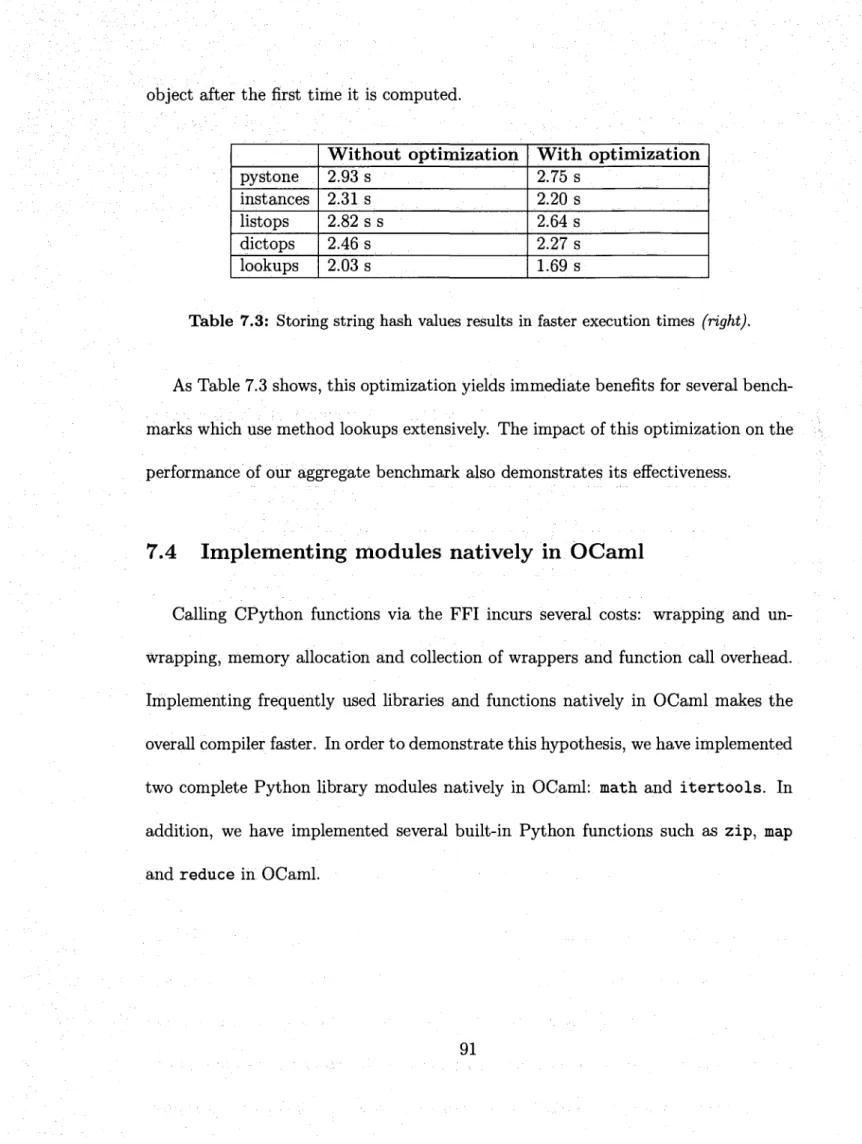
The object identity 500 is generated by a function next i d : unit -> i n t which simply increments a counter. The value of this string object is a tuple containing the string "hello" and its hash value 14287294. Because string hashing is an expensive and frequent operation, we store the hash value of a string object as soon as it is created. The ob_size field contains the length of the string. The props field is None because this is not a type object.
In order to instantiate new objects, our runtime defines several functions, each targeted to a specific object type. For example, the most general function for creating a string object is a function which takes a string constant and computes its length and hash value.
(* unique integer id *) (* string type object *)
let pystring_new s =
let len = String.length s in let hval = Hashtbl.hash s in
•'•'• { • . ' • • ' . ' . . • ob_idx = n e x t i d O ; ob_type = t y p e s t r i n g _ o b j ; ob_value•'= S t r i n g ( " h e l l o " , h v a l ) ; ob_size = l e n ; props = None; weak_wrappper = null_wrapper; }
In practice, we use several variations of this function, accepting additional argu-ments such as the length and the hash value. This takes advantage of the fact that for string constants, the hash and length can be pre-computed at compile time.
4.3.4 Note on using OCaml's object oriented features
We initally attempted to represent Python objects in OCaml using OCaml's object oriented features such as classes, methods and inheritance. However, OCaml's classes and objects are static while Python's are dynamic, resulting in a mismatch between the two kinds of objects. As such, it is not clear that using OCaml objects offers a clear advantage in implementing Python's object oriented features.
In addition to potentially gaining a natural mapping from OCaml classes to Python objects, we expected to use OCaml object oriented features to obtain a form of safe structural typing and subtyping (via inheritance). However, OCaml requires that all object data be accessed only through explicitly defined methods. These method calls are slower than the direct data access provided by fields in records, leading to potential performance loss at runtime.
For these reasons, we opted to use OCaml records in lieu of OCaml's object oriented features, despite the lack of structural subtyping in records. While this may seem like a severe restriction, it does ensure that our representation is type safe. Furthermore, as we will show in the rest of this dissertation, this type safe representation itself does not prevent our implementation from being significantly faster than the CPython implemention.
Chapter 5
Supporting C P y t h o n libraries: Memory
management and t h e foreign function interface
(FFI)
In order to study the translation from Python to OCaml and the associated per-formance tradeoffs, a practical concern must be addressed: A significant part of the Python language is comprised of libraries that are implemented either in C or in Python. While, in principle, it is possible to rewrite all these libraries in OCaml, there are pragmatic reasons to avoid this approach. First, some of these libraries are fine tuned for performance, and it may simply be more profitable to reuse them even when an alternative strategy is used to compile the main program. Second, the effort needed to map such programs into OCaml would be considerable. As a result, for the purposes of this work we simply ensure that the results of compilation can be integrated with such libraries.
In order to achieve this integration in our implementation, we have built an FFI between the OCaml runtime and the CPython interpreter. This approach allows us