Supply Chain Capabilities, Risks, and Resilience
IXavier Brusseta, Christoph Tellerb
aUniversité de Toulouse, Toulouse Business School, Toulouse, France bSurrey Business School, University of Surrey, Guildford, UK
Abstract
Supply chain resilience is an operational capability that enables a disrupted or broken supply chain to reconstruct itself and be stronger than before. This paper examines resilience using the dynamic capabilities approach, grounded in the Resource-Based View of firms. The purpose of this research is to provide insights for achieving resilience by mapping the relationships between the practices, resources, and processes over which a manager has control. A survey of 171 managers is used to test a conceptual model that proposes relationship between supply chain capabilities and resilience as well as the moderating role of supply chain risks. Variance-based structural equation modeling reveals that only tighter integration between echelons and increasing flexibility lead to added resilience. The perception of supplier risk helps motivate the supply chain manager to enhance integration capabilities and thus achieve higher resilience. Furthermore, the perception of external risks to a supply chain actually reduces the effort of deploying external capabilities to obtain resilience. Overall, the findings strongly support the view that resources, routines, and capabilities provide different results in terms of resilience depending upon supply chain risk factors.
Keywords: Resilience, Supply Chain, dynamic capability, survey
1. Introduction
Supply chain risk management remains a key managerial challenge that affects the performance of organizations (Altay and Ramirez, 2010). Char-acteristics such as tighter collaboration, increased complexity, reduced inventory levels, and ever-wider geographic dispersion have created greater vulnerabilities (Bode et al., 2011). Supply chain management literature is now beginning to explore
IThis paper has been written using material collected
during the “Baromètre Supply Chain” project led by CapGemini Consulting and in association with the École Centrale de Paris and SupplyChainMagazine.fr. We grace-fully acknowledge their support.
Email addresses: [email protected] (Xavier Brusset),[email protected](Christoph Teller)
how best to build resilience in supply chains, with increasing attention especially toward value chain fragmentation and geographical extension (Gulati
et al., 2000). All economic disruptions, whether
natural or man-made, carry unforeseen threats to the performance and profitability of supply net-works (Hindle, 2008; The Economist,2009).
In sociology and ecology, resilience characterizes an organization or a social body that is able to rebuild itself after having been substantially af-fected by an exogenous attack (Berkes et al.,2003). One example from the United States is that of Walmart’s operations before and after the pas-sage of hurricane Sandy in 2012 (Creighton et al.,
2014). Resilience, as defined by Brandon-Jones
et al. (2014), page 55, and Christopher and Peck
return to normal operating performance, within an acceptable period of time, after being disturbed”.
Given the literature and interest in resilience, it is surprising that the management practices required to achieve it are approached from so many different managerial viewpoints (e.g., operations, strategy, information systems, marketing, human resources) as exemplified in Li et al. (2008, 2009). In this paper, we consider the supply chain managers as the central decision-makers and organizers of the management processes within the supply chain. As such,they organize, deploy and control all the nec-essary investments, assets, resources, routines, pro-cesses, and systems to achieve the strategic goal of enabling the supply chain to be resilient. Grounded in the Resource-Based View (RBV) (Wernerfelt,
1984), the dynamic capabilities theoretical frame-work introduced inTeece and Pisano(1994) yields powerful results which can be brought to bear in the present setting. Teece(2007) defines a dynamic capability as the ability to dynamically integrate, build, and reconfigure lower-order competences to achieve congruence with changing business environ-ments.
We apply this framework here to answer the fol-lowing questions: (1) Given the risks being faced, what practices does a supply chain manager deploy to obtain such resilience? (2) How do environmen-tal factors related to supply chains influence the ef-fectiveness of these practices? With this dual focus, our research contributes to theory as well as prac-tice by increasing understanding of how to enhance resilience and providing insights to determine the supply chain capabilities required to achieve greater resilience.
We next present a review of the literature and the theoretical underpinning of our paper, from which we derive a conceptual model. Next, we elaborate on the study’s methodology, analytical approach, and the results of our empirical study. The con-cluding sections discuss the theoretical and
prac-tical implications of the findings, highlight limita-tions, and outline directions for future research.
2. Theoretical background and conceptual model
The dynamic capabilities approach has gained wide acceptance as a tool to explain performance across competing firms (Barreto,2010;Teece et al.,
1997). According to this perspective, superior per-formance stems from two types of organizational capability, namely, dynamic capability and opera-tional capability (Cepeda and Vera, 2007; Helfat
and Peteraf,2003).
The literature has formulated the basic difference between dynamic capability and operational capa-bility (Teece,2007; Winter, 2003). Dynamic capa-bilities are a learned pattern of collective activity and strategic routines through which an organiza-tion can generate and modify operating practices to achieve a new resource configuration and achieve and sustain a competitive advantage (Teece et al.,
1997; Teece, 2007). Barreto (2010) recommends
that research should focus on the factors that may help (or hinder) firms to achieve the potential rep-resented by their dynamic capabilities. It is impor-tant to recognise that the value of dynamic capabil-ities is context dependent (Wilden et al.,2013) and not a set recipe or formula for general effectiveness. Organizational response to environmental turbu-lence is faster as well as more effective (Chmielewski
and Paladino,2007) so ultimately enhances
perfor-mance. Attaining competitive advantages requires efficient and effective sharing and deployment of re-sources between partnering organizations and sup-ply chain partners (Rajaguru and Matanda,2013). By contrast,Winter(2003) argues that an oper-ational capability provides the means by which a firm functions or operates to make a living in the present. Dynamic capabilities are considered to be of a higher order than operational capabilities, as
their role is to contribute to the firm’s higher rel-ative performance over time (Drnevich and
Kriau-ciunas, 2011). An operational capability refers to
a firm’s ability to execute and coordinate the vari-ous tasks required to perform operational activities, such as distribution logistics and operations plan-ning, which are processes and routines rooted in knowledge (Cepeda and Vera,2007). This capabil-ity refers to a high-level routine or a collection of routines (named organizational routines or compe-tences in Teece et al., 1997) that can be used to respond to unforeseen events affecting the ability of a supply chain to perform (Barreto,2010;
Eisen-hardt and Martin, 2000). For example, given the
increasing importance of timely and cost-effective product delivery, supply chain resilience is consid-ered a critical capability to maintain the continuity of operations. Resilience as an operational capabil-ity requires both internal processes as well as those relative to the information flow, coordination, and collaboration with upstream and downstream part-ners.
To build and operate a resilient supply chain, it is helpful to have an in-depth understanding of the lower-order capabilities (or micro-foundations, as described in Teece, 2007) that are required.
Managerial systems, procedures and processes that undergird each class of capability define what
Teece (2007) call organizational routines or
com-petences and what Barreto (2010) sees as a re-quirement for supply chain operations. Henceforth named here lower-order capabilities, they are dis-tinct from the capability itself (Teece,2007). These lower-order capabilities along the supply chain con-stitute the practices among the different chain members using which the supply chain is able to absorb or recover from disturbances, and still main-tain its ability to deliver value to final customers
(Bhamra et al.,2011).
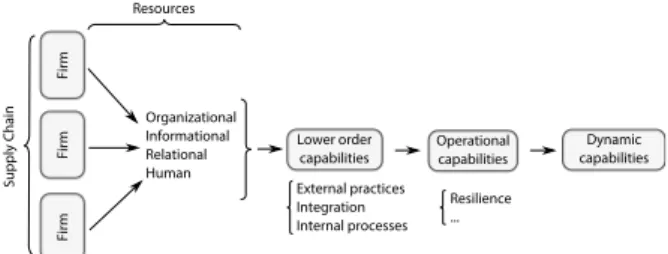
The dynamic capabilities approach makes it pos-sible to characterize the operational capabilities
Organizational Informational Relational Human Operational capabilities Dynamic capabilities Lower.order capabilities Resources Firm Firm Firm Supply.Chain Resilience ... External.practices Integration Internal.processes
Figure 1: Theoretical model of the Resource-Based-View of a supply chain
that supply chain managers wish to enhance as well as the routines, procedures, and processes they ap-ply at their firms and across their supap-ply chains (see
Figure 1). We now switch focus to the relationship
between those lower-order capabilities and the op-erational capabilities that characterize resilience.
2.1. Resilience in supply chains
An important aspect for all supply chain man-agers is the capacity of their supply chain to with-stand upheavals, disruptions and unforeseen events (e.g., Brandon-Jones et al., 2014; Bhamra et al.,
2011). A supply chain that is still able to perform and deliver products and services under such cir-cumstances is characterized as resilient (Blackhurst
et al., 2011). This capacity is defined in Fiksel
(2006) and in Pettit et al. (2010) as “the capac-ity for an enterprise to survive, adapt, and grow in the face of turbulent change”. Resilience has broader implications than supply chain risk control. Since supply chains have increased in both length and complexity (Blackhurst et al., 2005), natural catastrophes, wars, strikes and economic upheavals severely impact performance (Chopra and Sodhi,
2004; Wagner and Bode, 2008). Hendricks (2005)
states that it is critical for firms to enhance the siliency (sic) in their supply chains and call for re-search into specific tactics that help firms develop such capabilities.
Studies are concerned with the ability of the sup-ply chain to return to its original state of opera-tion after being disturbed (Pettit et al.,2010).
To-day’s supply chains are more prone to disruptions caused by natural and man-made events (Wagner
and Bode, 2008). Hence, the ability to recover
quickly has become a topic of concern for practi-tioners and academics.
Having described resilience as an operational pability, we now characterize the lower-order ca-pabilities available to the supply chain manager, which, when deployed across all members of the supply chain, should generate this capability. We then stipulate the corresponding hypotheses.
2.2. Lower-order capabilities and hypothesis devel-opment
We define lower-order capabilities as the set of physical, financial, human, technological, and orga-nizational resources (Grant, 1991) coordinated by organizational routines (Nelson and Winter, 1982) and deployed in an organization and across organi-zations.
The literature provides abundant descriptions of the practical managerial routines and processes de-ployed by a large number of supply chain managers. For the purpose of this study, we centered our at-tention on the organizational, informational, and human resources across organizations. Even though the relevant literature often does not mention the RBV, the resources mentioned clearly belong to the class of lower-order capabilities that we iden-tified above. For example, a fully deployed second-generation material requirements planning (MRP II) system is composed mostly of procedures, infor-mation systems, and skilled operators, as well as tangible assets (computers, servers and wide area networks). This MRP has to be connected to other firms in the supply chain to exchange forecasts, de-livery schedules, and other planning requirements
(Akkermans et al., 2003). This lower-order
capa-bility, when combined with other similar practices, will contribute to a higher-order operational capa-bility (Su and Yang, 2010). The practices that we
consider as having influence on operational capabil-ities can be grouped as external, integration, and flexibility capabilities, which are described below.
External capabilities: These are the practices that in sum represent Efficient Customer Response policies (Skjoett-Larsen et al., 2003). Partners have to collaborate through systems such as Vendor Managed Inventory (VMI) and Collaborative, Plan-ning, Forecasting, and Replenishment (CPFR) with retailers to enhance close cooperation among au-tonomous organizations engaged in joint efforts to effectively meet end-customer needs (Faisal et al.,
2007).
The flow of accurate and real-time information in the supply chain is considered by many to be as important as the flow of goods. Information sharing can also provide flexibility and improve the responsiveness of the supply chain (Gosain et al.,
2005;Agarwal et al.,2006). The information shared
may include: end-customer demand, sales fore-casts, order status, inventory levels, capacity avail-ability, lead times, and quality. Sharing informa-tion can improve transparency, avoid lost sales, speed up payment cycles, create trust, avoid over-production, and reduce inventories (for reviews, see
Bhamra et al., 2011; Sahin and Robinson, 2002).
Current inter-organizational information systems (IOIS) facilitate the sharing of real-time informa-tion in the supply chain and allow organizainforma-tions to be more effectively coordinated throughout the network. These systems are named Advanced ning and Scheduling (APS), Collaborative Plan-ning, Forecasting and Replenishment (CPFR), and Efficient Customer Response. IOIS also have impli-cations for the way that supply chains are designed and managed. One important example is the use of vendor managed inventory (VMI) systems where an upstream supplier is able to react directly to the inventory and demand information from a down-stream customer by adjusting the quantity and tim-ing of deliveries (Kotzab,1999). These practices
en-able a supply chain to be reconfigured when faced with unexpected and disrupting events. As char-acterized in Faisal et al. (2006) and Faisal et al.
(2007), supply chains are affected by “information risks”.
Hendricks (2005) empirically documents how
glitches in supply chains affect operating perfor-mance, naming sources of glitches that run the gamut from parts shortages to reorganizational de-lays and information technology (IT) problems.
Klibi et al. (2010) specifies how resilience in
sup-ply chains should be assessed in view of the disrup-tions being faced. The soludisrup-tions they propose to enhance resilience require tighter integration of sup-pliers and distribution networks as well as building redundancy and flexibility. Mandal (2012) specifi-cally identifies IT (an important component of ex-ternal capabilities) as one of the sources for in-creased resilience in a supply chain. The resilience provided protects the supply chain against the va-garies of the market. Our first hypothesis is the following.
Hypothesis 1. There is a positive relationship be-tween the implementation rate of external capabil-ities (ξ1) and the level of resilience (η1) in supply
chains.
Integration capabilities: Supply chain integra-tion has been defined “as the degree to which a manufacturer strategically collaborates with its supply chain partners and collaboratively manages intra- and inter-organization processes. The goal is to achieve effective and efficient flows of products and services, information, money and decisions, to provide maximum value to the customer at low cost and high speed” (Naylor et al.,1999; Frohlich
and Westbrook, 2001; Flynn et al., 2010). Even
though the integration of manufacturers and clients has been studied in the context of China through the prism of power relationship commitment theory
(Zhao et al., 2008), other literature such as Pagell
(2004); Lin et al. (2006); Faisal et al. (2007);
Ra-jaguru and Matanda(2013) view this capability as
consisting of IT systems and practices that employ both information systems and the corresponding managerial practices and routines to enhance inter-organizational integration and coordination. Such integration of IT with supply chain processes en-hances collaboration in the chain through continu-ous adjustments to the product lineup and invento-ries as well as sharing forecasts, sales data and in-ventory levels (Qrunfleh and Tarafdar,2013, for an appreciation of the impact of Information Systems on supply chain performance). Collaborative plat-forms provide the possibility of exchanging informa-tion in real time (Boyson et al., 2003). The tech-nologies that enable goods to be tracked and traced provide greater control over operations within the chain as well as timely notification and access to detailed information when events occur. This also contributes to suppliers’ integration, thus increas-ing efficiency (Danese and Romano, 2011), espe-cially as service levels can be monitored (
García-Dastugue and Lambert,2003).
Integration provides the capability to reduce the costs and risks of coordination and of transactions by providing managers an opportunity to under-stand the focal areas that need attention. Hence, they can minimize risks to real-time and free flow of information (Faisal et al.,2007). Mandal (2012) identified the dimensions or antecedents that IT professionals perceive as important for achieving re-silience in the Indian context.
Hypothesis 2. There is a positive relationship be-tween the implementation rate of integration capa-bilities (ξ2) and the level of resilience(η1) in supply
chains.
Flexibility capability: This last set of practices increases the responsiveness of a supply chain to stimuli from end-consumers. It refers to the abil-ity to evaluate and take needs into account quickly
(Charles et al.,2011). The forecasting and planning
re-sulting in enhancement of the supply chain’s reac-tive capabilities by enabling it to predict final de-mand changes and adapt to them both in upstream and downstream operations (Olhager, 2013). Such practices, jointly named Sales and Operations Plan-ning (S&Op), provide a vital link between lean manufacturing operations within the supply chain and responsive distribution and differentiation op-erations (Sauvage,2003;Faisal et al.,2006).
These practices hold important promise in en-abling risk prevention and recovery (Lavastre et al.,
2012). By enabling better control of inventories and production schedules, planning and forecasting systems reduce the risks from both upstream and downstream events (Stadtler, 2005). These plan-ning systems have long-, medium-, and short-term horizons and include master planning, requirements planning, and demand and distribution planning. Evidence of the use of such systems and routines to protect the supply chain has been found by
Fleis-chmann and Meyr(2003) and Stadtler and Kilger
(2005). This leads us to our third hypothesis:
Hypothesis 3. There is a positive relationship be-tween the implementation rate of flexibility capabil-ities (ξ3) and the level of resilience (η1) in supply
chains.
Moderating Effects of Supply Chain Risks Us-ing the classification presented in the risk litera-ture review by Heckman et al. (2015), we analyze the risk sources that might affect the supply chain manager’s effort to increase the resilience of a sup-ply chain depending on whether the risk source lies within or beyond the supply chain boundaries
(Wagner and Bode, 2008; Waters, 2007). Internal
risks stem from suppliers and customers. They are referred to as internal to reflect that they should be within the control of the supply chain manager. External risks are outside her or his control.
External Supply Chain Risks: Chopra and Sodhi
(2004) highlight the importance of understanding the nature and effectiveness of supply chain risks
to be able to set up or strengthen the firm’s ca-pabilities to more effectively manage those risks and thus become more resilient. In terms of risks outside a firm’s supply chain, Walters(2006) illus-trates the significant impact of external risks—such as economic, social, and political risks for supply chains—on the performance and qualities of a sup-ply chain. We contend that macro-economic, so-cial, and political risks will counteract the efforts deployed by the supply chain manager to increase the resilience of the whole chain. Such external risks can negatively affect how lower order capabilities will develop resilience (Bode et al.,2011;Altay and
Ramirez,2010).
Internal Supply Chain Risks: Supply chains represent vertical inter-organizational networks of firms that are closely linked to their up-stream and down-stream supply chain partners (Carvalho et al.,
2012). As such, suppliers as well as customers have an impact on establishing supply chain (manage-ment) capabilities (e.g., Teller et al., 2016) as well as on resilience. Hwang et al.(2013) highlight the importance of supplier impact on risks affecting the capabilities of firms, for example, through a lack of reliability, lead times, or delivery problems. Tang
(2006) and Chopra et al. (2007) explicitly argue that suppliers represent a source of risks to firms within a supply chain. Walters (2006) provides comparable arguments of customers posing poten-tial risks to their up-stream supply chain partners, for example, if the customer goes into administra-tion, generates variable demand, or has ordering problems. Consequently, risks related to suppliers and customers, that is, risks outside the firm but inside the supply chain affecthow firms will be able to garner all the benefits from increasing their lower order capabilities to develop resilience.
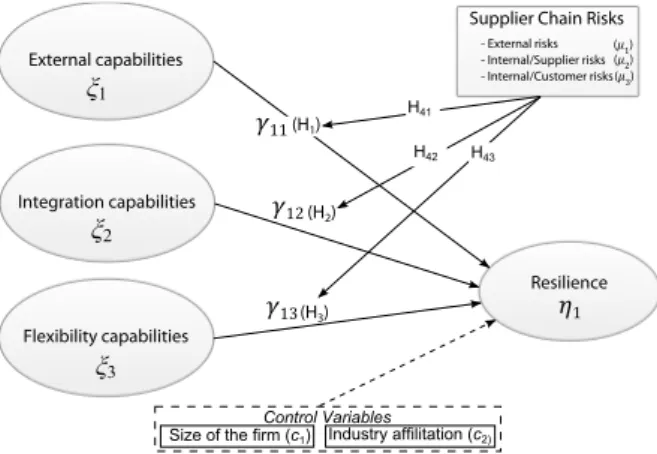
To conclude, we propose that supply chain risks related to both external factors and those related to up-stream and down-stream supply chain partners affect the relationship between supply chain
capa-External-capabilities Integration-capabilities Flexibility-capabilities ξ3 ξ2 ξ1 Resilience (H2) �1 (H1) �11 �12 (H3) �13 Control Variables
Size of the firm (c1) Industry affilitation (c2)
Supplier-Chain-Risks (�1) --External-risks --Internal/Supplier-risks --Internal/Customer-risks (�2) (�3) H43 H42 H41
Figure 2: Conceptual model.
bilities and resilience. We thus propose the final hypothesis H4 as follows:
Hypothesis 4. Supply chain risks (external risks (µ1), supplier risks (µ2), and customer risks (µ3))
affect the positive relationship between the imple-mentation rate of (external (ξ1, H41), integration
(ξ2,H42), and flexibility (ξ3,H43)) capabilities and
the level of resilience (η1) in supply chains. Our conceptual model comprises all four hy-potheses, as depicted in Figure 2. Based on the dynamic capabilities approach, our model proposes the effects of capabilities on the resilience of a sup-ply chain as well as risk factors that influence those effects.
We now turn to the empirical test of our concep-tual model.
3. Methodology 3.1. Research design
The design involves a survey among supply chain managers, using a single respondent in each orga-nization as the analysis unit. We considered these managers as key informants (e.g., Campell, 1955) since – due to their role within their organizations – they have the most expertise and access to infor-mation on their organizations’ capabilities, supply chains, and environments.
Our research views the organization as “embed-ded in a network of relationships that impact its performance” (Saraf et al., 2007), p. 327. We recognize that a multiple-respondent survey design would have been preferable, but chose a single-respondent design to improve acceptable response rate (Saraf et al.,2007), as suggested byTang and Tang (2010) for studying inter-organizational phe-nomena. Even though the study has limited ex-planatory powers owing to the subjective nature of the data gathered, the use of subjective data is com-mon in this type of research and considered accept-able (Chan et al.,1997). We opted for a web-based survey approach (Grant et al.,2005) due to the tar-get population size, the number of questions, and the cost involved in contacting respondents. An-swers were anonymized to allay respondent identi-fication problems.
The population of supply chain managers was ap-proached through an electronic mailing campaign to the 8,000 French tested e-mail addresses of a Supply Chain newsletter. The subscribers are opt-in readers with an opt-interest opt-in general supply-chaopt-in management news. Even though 366 replies were recorded, only 171 were valid for statistical analy-sis, a response rate of 2.1% of the identified popula-tion and 47% of the sample usable (Yu and Cooper,
1983). This response rate is comparable to other re-search within the field of supply chain management (e.g., Van der Vaart and Van Donk,2008;Wagner,
2010).
Several economic sectors are represented by the sample, thus increasing the results’ generality.The usable subset included firms operating in the fol-lowing sectors: food and beverage (17.5%), retail (25.7%), and general manufacturing (24.0%). The sample reflects a dominant proportion of small to medium sized firms; 67.3% have less than 1,250 em-ployees.
3.2. Common method bias
Since there was a single informant per organiza-tion, the potential for common method bias (CMB) was assessed. There is no single best method avail-able to test CMB (Podsakoff et al.,2012). Further-more, the choice of method is a subject of intense debate, as is the question of whether CMB can af-fect data (for a critical discussion see Richardson
et al.,2009). We applied theHarman(1967)
single-factor test of CMB (Podsakoff and Organ, 1986;
Podsakoff et al., 2003), which revealed twelve
dis-tinct factors with eigenvalues above or near one that cumulatively explained 87.6% of total variance. Ac-cording to this test, if common method bias exists, one of the following should be observed: (1) a single factor will emerge from a factor analysis of all sur-vey items (Podsakoff and Organ, 1986); or (2) one general factor will emerge that accounts for most of the common variance existing in the data. The first factor explained 24.32% of the variance, which was not the majority of total variance and thus consid-ered to be low enough.
3.3. Non-response bias
Because significant numbers of the targeted pop-ulation failed to respond, we checked for possible non-response bias using a “time-trend extrapolation test” in which “late” versus “early” respondents are compared along key study variables (first suggested
byOppenheim,1966). The assumption behind this
test is that“late” respondents are very similar to non-respondents, since their responses would not have been recorded without follow-up efforts (
Arm-strong and Overton, 1977). The t-tests conducted
showed no significant differences between “early” and “late” respondents along any of the key study variables.
3.4. Measurement
Capabilities and Resilience: The four theoretical constructs of our conceptual model—excluding the
moderating and control variables—constitute latent variables requiring indirect measurement (see
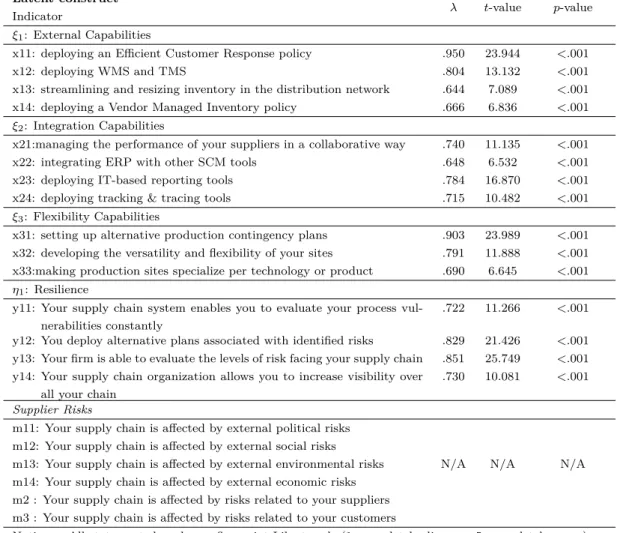
Ta-ble 3). We sifted through the nine references in
lit-erature that deal with resilience or one of the lower-order capabilities using empirical surveys (
Lavas-tre et al.,2012;Mandal,2012;Qrunfleh and
Taraf-dar, 2013, 2014; Richey et al., 2012; Kern et al.,
2012; Moon et al., 2012; Hoffmann et al., 2013),
and the survey presented in Wilden et al.(2013), which uses dynamic capabilities as second order constructs. The focus in each of these surveys is different from ours: often the supply chain manager is not considered to be the decision maker—given the questions or items, the respondent could be a production manager, a chief executive officer, or an IT chief information officer; or he or she responds to strategic or policy statements such as “we select the best quality supplier”. Actual and practical usage of managerial tools and resources are not contem-plated. In fact, there is a decided absence of scales based upon the set of physical, financial, human, technological, and organizational resources (Grant,
1991), coordinated by organizational routines (
Nel-son and Winter, 1982), and deployed in an
organi-zation and across organiorgani-zations. Consequently, we determined that our study required a grounding in actual usage of such sets by supply chain managers in their daily work inside their organizations as well as in the relationships with suppliers and distribu-tors or customers.
So, following Churchill (1979), we started with the domain specification of each construct and col-lected the relevant measurement items in the liter-ature. However, rather than blindly applying pre-viously utilized measurement items, we used them as a starting point, and revised them based on the feedback from five experts in the supply chain tice at CapGemini Consulting France. These prac-titioners were aware of the scope and purpose of our study and thus were able to provide precise feedback on the measurement items. Using their
feedback we were able to tailor each measurement item to most accurately measure the underlying construct. As such, we employed a grounded ap-proach to make the items as accurate as possible, given our study context. This approach to develop the final items provides for a very high level of face and content validity, while increasing the practical relevance and applicability of the research. After re-ceiving the feedback, we had to accommodate spe-cific changes in the constructs, which the experts had criticized as being too complicated and having limited face validity. The measures for supply chain resilience were thus deductively and inductively de-veloped with the help of practitioners.
A draft version of the survey questionnaire was pre-tested among experts and journalists from sup-plychainmagazine.fr. As a result of this pretest, some inconsistencies and unclear formulations were addressed. Given the numerous definitions of re-silience available in the literature and the preva-lent confusion in the minds of practitioners (Kidd,
2000), it was expected that a particularly wide cross-section would emerge. A broad consensus was achieved through a general discussion in which each participant described the effect of each practice on the overall supply chain and how this effect could be achieved and measured. In a subsequent pre-test, the questionnaire was presented to five supply chain managers, whose remarks were then incorpo-rated. When questioned about capabilities, the re-spondents were asked to rate their agreement, with a response range from totally disagree (rated 1) to fully agree (rated 5). For each capability, managers were asked to specify if it was “not applicable to their particular case” (rated 1), “under considera-tion” (rated 2), partly deployed (3), fully deployed but still only partially used (4), to fully deployed and in use (rated 5). The result is a list of 9 af-firmations about capabilities found in their supply chains. A final updated list was drawn up that captures both the comments about clarity and
sim-plicity as well as system- or process-related remarks about their capabilities. The list of all measurement items underlying the constructs of our conceptual model can be found in the appendix.
We consider all constructs in our model to be of a reflective nature. We base this decision on the notions of Jarvis et al. (2003): The direction of causality goes from the latent construct towards the indicators for all of our constructs. This is of particular importance for our dependent construct Resilience (η1), givenLee and Cadogan (2013) cri-tique on treating formative constructs as being de-pendent.
Supply Chain Risks: To measure the three sup-ply chain risk variables we followed the notions of
Walters(2006) andHeckman et al.(2015), who
dis-tinguish between risk that is external to the sup-ply chain, including political, social, environmen-tal and economic risks, and risk that is internal to the supply chain, which is related to suppliers and customers (see Table 3). Our questionnaire asks respondents to indicate the degree to which their supply chain is affected by the various dimensions of supply chain risk and thus treat these responses as manifest variables.
3.5. Control variables
We consider two control variable that potentially influence the proposed effects in our conceptual model: company size (c1, operationalised by the number of employees) and industry affiliation (c2). The inclusion of the first control is supported by dis-cussion on the different roles and practices of SCM in large as opposed to small organisations, and thus the notion that the size of a company affects the advantages gained from SCM (Arend and Wisner,
2005).
In terms of the second control Harland (1996) identified that the position of a company in a sup-ply chain (= industry affiliation) affects the man-agement of supply chains. Given the distribution of
industry affiliation in our samples we use a dichoto-mous scale to measure our control variable, that is, the companies –represented by our respondents– are either affiliated to the manufacturing, retail or any other industry.
4. Analyses
4.1. Variance-Based Structural Equation Modeling
This study uses variance-based structural equa-tion modeling (VBSEM) (two main references are
Wold, 1982, 1985), a technique for component-based structural estimation modeling. Variance-based SEM has distinctive features compared to covariance-based SEM (SEM-ML). VBSEM has less restrictive assumptions on characteristics such as measurement scales, sample size, and distribu-tional assumptions (Chin,1998b;Tenenhaus et al.,
2005). Chin and Newsted(1999) observe that
VB-SEM is generally better suited to studies in which the objective is prediction, or the phenomenon un-der study is new or changing. Instead of relying on overall goodness-of-fit tests, variance-based SEM tests the strength and direction of individual paths by statistical significance (Calantone et al., 1998). The sample size requirement for VBSEM is ten times the larger value of the following: (a) the block with the largest number of indicators, or (b) the de-pendent latent variable with the largest number of independent variables impacting it (Chin, 1998b).
Tenenhaus et al.(2005), in a more theory-oriented
paper that complements the work ofChin(1998b), compares both SEM-ML and VBSEM. Even though it is recognized that these methods give different results, for our purpose, VBSEM is more suitable given that the theory is still in development. Max-imum Likelihood modeling techniques are better suited once confirmatory studies have been made
(Lee et al., 2006). VBSEM allows for more
ex-ploratory investigations into the links between cer-tain enablers and the traits of supply chains due to
its less rigorous requirement of restrictive assump-tions.
4.2. Evaluation of the measurement and structural model
To systematically evaluate our VBSEM results, we first investigated the measurement model and subsequently the structural model (Hair et al.,
2014). Allt-values of the factor loadings are highly significant at p < 0.001 (see Table 3). Further, all loadings exceed the suggested size of 0.70 ( Hul-land,1999). The internal consistency is also satis-factory for all factors (Cronbach’s (α >0.70), and for all factors the composite reliability (ρ) meets the requirement of being above 0.70 (Fornell and
Larcker, 1981). The degree of convergent validity
proved to be acceptable, with the average variances extracted (AVE) higher than 0.50 (Bagozzi and Yi,
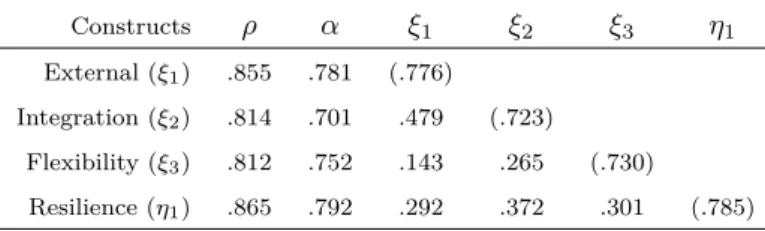
1988). With regard to the constructs’ discriminant validity, the AVE is larger than the highest of the squared inter-correlations with the other factors in the measurement models (see Table 1). Addition-ally, all factor loadings on the assigned factor are higher than cross-loadings on the non-assigned
fac-tors Chin (1998a). To conclude, all constructs in
the model show sufficient validity.
Table 1: Convergent validity, composite reliability and dis-criminant validity measures for capabilities
Constructs ρ α ξ1 ξ2 ξ3 η1
External (ξ1) .855 .781 (.776) Integration (ξ2) .814 .701 .479 (.723)
Flexibility (ξ3) .812 .752 .143 .265 (.730)
Resilience (η1) .865 .792 .292 .372 .301 (.785) Average variance extracted values (AVE) shown on the diagonal; Squared correlation matrix for constructs below the diagonal;
α, Cronbach’s alpha;ρ, composite reliability;
Structural model: Unlike covariance-based SEM, its variance-based counterpart does not offer com-parable global fit measures (e.g., Henseler and
calculating goodness-of-fit measures as proposed by
Tenenhaus et al.(2005);Hair et al.(2014) suggest
investigating the coefficient of determination (r2 -value) and the significance of the structural path coefficient to use as primary evaluation criteria for the structural model. Our estimation shows anr2 -value of .221 which represents a satisfactory -value. Furthermore, two out of three structural paths are significant and as such, represent medium-size ef-fects according toCohen(1988).
4.3. Model robustness test
Next, we evaluate the impact of our two control variables (c1, c2) on the main associations in our model (see Figure 2), following the procedure ap-plied by Robson et al. (2008). The direct impact ofc1 andc2 operationalized by three dummy vari-ables (for the manufacturing, retailing and other industries) on the dependent constructξ2are all in-significant (t-values1.965) and very weak. When comparing the structural associations as proposed in our hypotheses by including or excluding the con-trol variables in the model, we see that the coef-ficients change insignificantly on the third decimal place and the significance of the associations do not change.
These results suggest that the two control vari-ables do not confound the proposed relationships in our conceptual model. Moreover, we can conclude that the structural associations are independent of the industry affiliation and company size. Since the two control variables lack explanatory power, we trimmed our model and excluded them from the following analysis.
5. Results
5.1. Structural effects
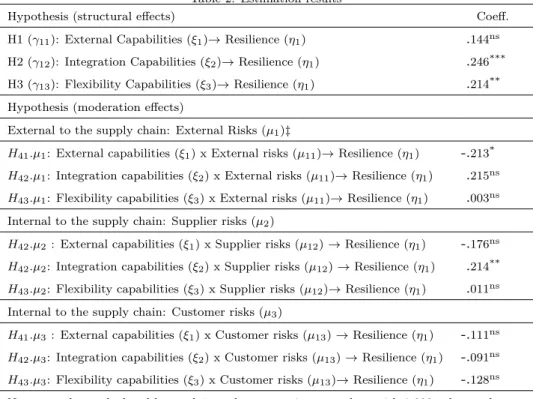
The estimation results in Table 2 show that the effect of external capabilities on resilience is insignificant on a 5% level (γ11, .144;p > .05). We therefore cannot support the first hypothesis.
Nevertheless, the other two capability constructs, that is, integration and flexibility, impact resilience significantly (γ12, .246;γ13, .214;p, < .01). Conse-quently, hypotheses H2 and H3 are supported.
5.2. Moderating effects
To test the proposed moderating effects we ap-plied the product indicator approach, as suggested by, among others,Busemeyer and Jones(1983) and
Kenny and Judd (1984). This means that for each
moderating effect a product term is calculated us-ing the indicators of a predictus-ing variable (in our case, one of the three capability constructs, ξ1, ξ2 or ξ3) and the moderator variables (µ1, µ2 or µ3)
(Henseler and Chin, 2010). This term is then
in-cluded as a (latent) interaction term and as such represents the moderating effects (see hypothesis H4) in the conceptual model. The impact of the interaction term on resilience (η1) measures the sig-nificance and the size of the moderating effects.
Henseler and Chin (2010) recommend the
prod-uct indicator approach for models such as that pro-posed in this paper, specifically, models where the purpose of the estimation is to (1) explain impacts, (2) describe interaction effects, and (3) focus on the prediction of endogenous constructs. Furthermore, the product indicator approach is regarded as su-perior to the frequently used multi-group analysis when the moderating variable is of a continuous na-ture. Multi-group analysis, and thus the test for in-variance between coefficients, is most appropriate in the case of dichotomous moderating variables and experimental designs (Bagozzi et al.,1991).
In terms of external risks (µ1) the results show only a negative significant moderating effect (−.213;p < .05) on the association between Ex-ternal Capabilities on Resilience (γ11). Thus, an increasing economic risk leads to a weaker impact of external capabilities on resilience. In terms of supplier risk (µ2), we found a significant moder-ating effect (.214, p < .01) on the relationship be-tween Integration Capabilities and Resilience. This
Table 2: Estimation results
Hypothesis (structural effects) Coeff.
H1 (γ11): External Capabilities (ξ1)→Resilience (η1) .144ns
H2 (γ12): Integration Capabilities (ξ2)→Resilience (η1) .246***
H3 (γ13): Flexibility Capabilities (ξ3)→Resilience (η1) .214**
Hypothesis (moderation effects)
External to the supply chain: External Risks (µ1)‡
H41.µ1: External capabilities (ξ1) x External risks (µ11)→Resilience (η1) -.213*
H42.µ1: Integration capabilities (ξ2) x External risks (µ11)→Resilience (η1) .215ns
H43.µ1: Flexibility capabilities (ξ3) x External risks (µ11)→Resilience (η1) .003ns Internal to the supply chain: Supplier risks (µ2)
H42.µ2: External capabilities (ξ1) x Supplier risks (µ12)→Resilience (η1) -.176ns
H42.µ2: Integration capabilities (ξ2) x Supplier risks (µ12)→Resilience (η1) .214**
H43.µ2: Flexibility capabilities (ξ3) x Supplier risks (µ12)→Resilience (η1) .011ns Internal to the supply chain: Customer risks (µ3)
H41.µ3: External capabilities (ξ1) x Customer risks (µ13)→Resilience (η1) -.111ns
H42.µ3: Integration capabilities (ξ2) x Customer risks (µ13)→Resilience (η1) -.091ns
H43.µ3: Flexibility capabilities (ξ3) x Customer risks (µ13)→Resilience (η1) -.128ns Notes: t-values calculated by applying a bootstrapping procedure with 1,000 sub-samples (Chin,1998b); ns, non-significant;*,p < .05;**,p < .01;***,p < .001;‡, derived measurement that combines the rating results related to social, political, economic, and environmental risks, through the calculation of mean values; caefficients of determination,r2
means that the effect becomes stronger as the sup-plier risk increases. Customer Risk turned out to have no moderating impact (p > .05) on any of the structural effects. We can conclude that Ex-ternal and Supplier Risk represent significant mod-erators as they affect at least one structural path in the model. Consequently H41 and H42 can be supported.
6. Discussion and concluding remarks
In this paper we provide insights into the lower-order capabilities that help a supply chain to achieve resilience. We provide a research frame-work that builds upon earlier literature about re-silience in supply chains. Within a dynamic capa-bility setting grounded in the Resource-Based View, we describe how lower-order capabilities developed using cross-functional and inter-organizational rou-tines can provide a supply chain with higher-order operational capabilities.
Through our research we substantiate the theory-driven conceptual model of supply chain resilience, which is regarded as a major source of competi-tive advantage (Chang and Grimm,2006;Li et al.,
2008;Wisner,2003). Starting from theoretical
defi-nitions of resilience in supply chains, we have oper-ationalized them with supply chain managers, trait by trait. A conceptual model, embedded in the dynamic capability approach, was developed and tested using data from French supply chain man-agers. In summarizing the contributions of this pa-per, we distinguish between implications for theory and for practice.
Implications for theory
First, we conclude that in the view of supply chain managers, resilience is not easily enhanced, even though it is a highly desirable trait (Bhamra et al.,
2011). In answer to the first question we asked in the Introduction, only integration and flexibil-ity capabilities positively affect the resilience level of a supply chain. These findings resonate with
those revealed through theBlackhurst et al.(2011) case study research. There, three major categories of factors were deemed to enhance resilience: hu-man capital resources, organizational and inter-organizational capital resources, and physical cap-ital resources. Of these, organizational resources were said to include defined communication net-works, contingency plans, and supplier relationship management.
Second, we found that our results deviate from findings in the literature. As regards the results re-ported from the empirical investigation in Mandal
(2012), the link between external capabilities and resilience cannot be corroborated, while the link be-tween the supply chain infrastructure and integra-tion and resilience is only partially validated. This may be due to the fact that the sample selection in
Mandal(2012) is composed of IT professionals and
not supply chain managers. We are unable to con-firm the notions of Klibi et al.(2010) and see that the Efficient Customer Response type of external collaboration practices —as exemplified by Vendor Managed Inventories and Warehouse Management Systems— to streamline inventories across echelons have no impact on resilience.
Third, we selectively found moderating effects of supply chain risks on the relationships between ca-pabilities and the resilience of a supply chain. More specifically, the question we asked in the Introduc-tion was: How do environmental factors related to supply chains influence the effectiveness of these practices? The answer we provide here supports the notions developed in Walters (2006) in terms of risks external to the supply chain as well as risks internal to the supply chain related to suppliers. In-terestingly, we find that customer risks do not play a significant role in affecting the proposed relation-ships in our model.
The size of the focal firm as a proxy for the ex-tension of the supply chain has no influence on its resilience, even though it should be a facilitating
factor in the implementation of lower-order capa-bilities. This seems surprising for, as recognized in
Waters(2007) several times, larger firms have more
sophisticated tools and should thus be better placed to address market as well as environmental risks.
By applying the dynamic capabilities approach as a theoretical underpinning of our research, we have highlighted the link between specific lower-order capabilities and a supply chain’s operational capability, namely, resilience. Additional research is required along three directions: (a) how to en-hance specific supply chain capabilities; (b) how to combine those operational capabilities and how best to add learning capabilities that can be made dy-namic; and (c) how to link such operational capa-bilities for the competitive advantage of a supply chain.
Implications for practice
In this paper, contrary to most papers dealing with the subject of resilience, we have positioned our-selves from the point of view of supply chain man-agers to understand how the actions, decisions, and practices they apply, the routines they set up, the collaborative and coordination effort and resources that they build upon contribute to the resilience of the supply chain to which their firm belongs.
Our results indicate that only some practices and asset and human deployments will provide an in-creased measure of this quality. Managers who combine and enhance both integration and flexibil-ity capabilities will observe a level of resilience in their supply chain. This means that they must not only use information technology tools and routines to integrate their internal organization (through their ERP) but also use other supply chain man-agement software to integrate their suppliers, cus-tomers, distributors, and logistics service providers. These efforts enhance collaboration by sharing fore-casts and sales data and allowing continuous inven-tory adjustments. In conjunction with logistics ser-vice providers, using track and trace technologies
for goods provides advanced tip-offs about events and glitches that affect service levels and quality. It is a notable result that the supply chains affected by high supplier risk concomitantly deploy these in-tegration practices and resources.
Our results show that External Capabilities do not influence resilience. When we delve into the tools, practices, and routines involved, the follow-ing interpretation can be suggested: Supply chain managers do not have ample experience in apply-ing efficient customer response policies, deployapply-ing both warehouse and transport management sys-tems, streamlining inventories, as well as deploying vendor managed inventories. Hence the resilience effects have yet to be observed. The implemen-tation of the routines and processes of Integration Capabilities, which involve the deployment of sup-ply chain management software connected to the ERP—managing supplier performance, using busi-ness intelligence software to generate reports pro-viding insights into the working of the supply chain as well as tracking goods—are all somewhat re-cent and require additional managerial capacities and training to be deployed effectively. Such prac-tices may have not yet been mastered by all supply chains. This view is reinforced by the result that the influence of integration capabilities on resilience is higher when supplier risk is higher. That is, when a supply chain is subject to significant internal risks, the best line of conduct is to foster increased inte-gration of the chain links so as to enhance its overall resilience.
Flexibility capabilities enhance resilience: Re-silience can be augmented through the combina-tion of alternative produccombina-tion and site plans, as well as by making plans more flexible and versa-tile. The pertinence of the deployment of these re-sources and routines increases with the incidence of external risks faced by the supply chain, such as raw material price hikes, political upheavals, or reg-ulatory changes. Flexibility functions in several
di-mensions. The first dimension is the ability to meet new demands in terms of product type or quanti-ties. The second is the ability to reconfigure the supply chain (upstream and downstream) by flex-ibly deciding whether to make or buy, to change locations, or to implement site specialization, while keeping tabs on a pool of suppliers. Unavoidably, such abilities in a supply chain go hand in hand with the supply chain manager’s increased ability to detect and measure risks. A supply chain man-ager should deploy processes to identify and mon-itor risks and potential areas of trouble as a com-plement to the practices discussed above.
When controlling for the impact of the size of the firm, we found that the size of the focal firm is not an impediment to resilience, as even small busi-nesses with limited resources can achieve the same level of resilience as larger firms. Neither could we distinguish an effect due to the economic sector. By extension, the focal firm can occupy any position in the supply chain (from manufacturer to retailer) without this position affecting its ability to enhance resilience.
7. Limitations and future research agenda
As with all research, this study has some limita-tions. The respondents to our survey were French managers, which results in a bias towards a West-ern European supply chain context. Future stud-ies could be conducted in other country settings. Furthermore, we do not differentiate between dif-ferent industries and supply chain stages (except as control variables), the study of which might yield additional insights. We applied a single-informant approach and thus rely exclusively on the perspec-tive of supply chain managers. Using experts from other parts of the organization, such as marketing or finance, could complement our findings.
Our conceptual model only considers one mod-erator: supply chain risks. Further analyses of our data should include other moderators, such as firm
or supply chain characteristics, to identify particu-lar capability-resilience relationships.
Our approach is quantitative in nature. Qual-itative interviews or focus group discussions with managers would help to understand better why ex-ternal capabilities do not affect resilience whereas the other capabilities do.
Finally, further research is needed about the role of managerial expertise in building upon informa-tion technology as the means to embed managerial processes both within and across organizations so enhancing resilience. Information technology would need to be separated into more nuanced categories involving lower-order practices and routines (such as ERP, MRP II, collaborative platforms, tracking & tracing) or higher-order structures, such as in-formation aggregation systems for business intelli-gence. In this way, researchers could better evalu-ate the potential impact of each set of practices on supply chain resilience.
Table 3: External indicators and loading factors
Latent construct
λ t-value p-value Indicator
ξ1: External Capabilities
x11: deploying an Efficient Customer Response policy .950 23.944 <.001
x12: deploying WMS and TMS .804 13.132 <.001
x13: streamlining and resizing inventory in the distribution network .644 7.089 <.001
x14: deploying a Vendor Managed Inventory policy .666 6.836 <.001
ξ2: Integration Capabilities
x21:managing the performance of your suppliers in a collaborative way .740 11.135 <.001
x22: integrating ERP with other SCM tools .648 6.532 <.001
x23: deploying IT-based reporting tools .784 16.870 <.001
x24: deploying tracking & tracing tools .715 10.482 <.001
ξ3: Flexibility Capabilities
x31: setting up alternative production contingency plans .903 23.989 <.001 x32: developing the versatility and flexibility of your sites .791 11.888 <.001 x33:making production sites specialize per technology or product .690 6.645 <.001
η1: Resilience
y11: Your supply chain system enables you to evaluate your process vul-nerabilities constantly
.722 11.266 <.001 y12: You deploy alternative plans associated with identified risks .829 21.426 <.001 y13: Your firm is able to evaluate the levels of risk facing your supply chain .851 25.749 <.001 y14: Your supply chain organization allows you to increase visibility over
all your chain
.730 10.081 <.001
Supplier Risks
m11: Your supply chain is affected by external political risks m12: Your supply chain is affected by external social risks
m13: Your supply chain is affected by external environmental risks N/A N/A N/A m14: Your supply chain is affected by external economic risks
m2 : Your supply chain is affected by risks related to your suppliers m3 : Your supply chain is affected by risks related to your customers
Agarwal, A., Shankar, R., Tiwari, M. K., 2006. Modeling the metrics of lean, agile and leagile supply chain: an ANP-based approach. European Journal of Operational Research 173, 211–225. 4
Akkermans, H., Bogerd, P., Yücesan, E., van Wassenhove, L. N., 2003. The impact of ERP on supply chain manage-ment: exploratory findings from a European Delphi study. European Journal of Operational Research 146, 284–301. 4
Altay, N., Ramirez, A., 2010. Impact of disasters on firms in different sectors: Implications for supply chains. Journal of Supply Chain Management 46 (4), 59–80. 1,6 Arend, R., Wisner, J. D., May 2005. Small business and
sup-ply chain management: is there a fit? Journal of Business Venturing 20 (3), 403–436.9
Armstrong, S. J., Overton, T. S., 1977. Estimating non-response bias in mail surveys. Journal of Marketing 14, 396–402.8
Bagozzi, R. P., Yi, Y., 1988. On the evaluation of structural equation models. Academy of Marketing Science 16 (1), 74–94. 10
Bagozzi, R. P., Yi, Y., Singh, S., June 1991. On the use of structural equation models in experimental designs: Two extensions. International Journal of Research in Market-ing 8 (2), 125–140.11
Barreto, I., 2010. Dynamic capabilities: a review of past re-search and an agenda for the future. Journal of Operations Management 36 (1), 256–280. 2,3
Berkes, F., Colding, J., Folke, C., 2003. Navigating social-ecological systems; Building resilience for complexity and change. Cambridge University Press.1
Bhamra, R., Dan, S., Burnard, K., September 2011. Re-silience: the concept, a literature review and future di-rections. International Journal of Production Research 49 (18), 5375–5393.3,4,13
Blackhurst, J., Craighead, C., Elkins, D., Handfield, R., 2005. An empirically derived agenda of critical research is-sues for managing supply-chain disruptions. International Journal of Production Research 43 (19), 4067–81. 3 Blackhurst, J., Dunn, K., Craighead, C., 2011. An
empiri-cally derived framework of global supply resiliency. Jour-nal of Business Logistics 32 (4), 374–391.3,13
Bode, C., Wagner, S. M., Petersen, K. J., Ellram, L. M., 2011. Understanding responses to supply chain disrup-tions: Insights from information processing and resource dependence perspectives. Academy of Management Jour-nal 54 (4), 833–856.1,6
Boyson, S., Corsi, T., Verbraeck, A., 2003. The e-supply chain portal: a core business model. Transportation Re-search Part E 39, 175–192.5
Brandon-Jones, E., Squire, B., Autry, C. W., Petersen, K. J., 2014. A contingent resource-based perspective of supply
chain resilience and robustness. Journal of Supply Chain Management 50 (3), 55–73. 1,3
Busemeyer, J. R., Jones, L. E., May 1983. Analysis of multi-plicative combination rules when the causal variables are measured with error. Psychological Bulletin 93 (3), 549– 562. 11
Calantone, R. J., Graham, J. L., Mintu-Wimsatt, A., 1998. Problem-solving approach in an international context: an-tecedents and outcome. International Journal of Research in Marketing 15 (1), 19–35. 10
Campell, D. T., 1955. The informant in quantitative re-search. American Journal of Sociology 60 (4), 339–342. 7
Carvalho, H., Barroso, A. P., Machado, V. H., Azevedo, S., Cruz-Machado, V., 2012. Supply chain redesign for re-silience using simulation. Computers & Industrial Engi-neering 62, 329–341. 6
Cepeda, G., Vera, D., 2007. Dynamic capabilities and opera-tional capabilities: a knowledge management perspective. Journal of Business Research 60, 426–437. 2,3
Chan, Y. E., Huff, S. L., Copeland, D. G., 1997. Business strategic orientation, information systems strategic ori-entation, and strategic alignment. Information Systems Research 8 (2), 125–150. 7
Chang, L., Grimm, C. M., 2006. The application of empirical strategic management research to supply chain manage-ment. Production and Operations Management 27, 1–56. 13
Charles, A., Lauras, M., Wassenhove, L. V., 2011. A model to define and assess the agility of supply chains: build-ing on humanitarian experience. International Journal of Physical Distribution & Logistics Management 40 (8/9), 722–741. 5
Chin, W. W., 1998a. Issues and opinions on structural equa-tions modeling. MIS Quarterly 22 (1), 1–10. 10
Chin, W. W., 1998b. The partial least squares approach for structural equation modeling. Laurence Erlbaum Asso-ciates, London. 10,12
Chin, W. W., Newsted, R., 1999. Statistical Strategies for Small Sample Research. Sage Publications, Ch. Structural equation modeling analysis with small samples using par-tial least squares, pp. 307–341. 10
Chmielewski, D. A., Paladino, A., 2007. Driving a resource orientation: reviewing the role of resource and capability characteristics. Management Decision 45, 462–483. 2 Chopra, S., Reinhardt, G., Mohan, U., 2007. The importance
of decoupling recurrent and disruption risks in a supply chain. Naval Research Logistics 54 (5), 544–555. 6 Chopra, S., Sodhi, M., 2004. Managing risk to avoid
supply-chain breakdown. MIT Sloan Management Review 46 (1), 53–61. 3,6
sup-ply chain. International Journal of Logistics Management 15 (2), 1–13.1
Churchill, G. A., 1979. A paradigm for developing better measures of marketing constructs. Journal of Marketing Research 16 (1), 64–73.8
Cohen, J., 1988. Statistical power analysis for the behavioral sciences, 2nd Edition. L. Erlbaum Associates.
URLhttps://books.google.fr/books?id=Tl0N2lRAO9oC
11
Creighton, D. P., Walker, A. C., Mundt, G., 2014. Contin-gency contracting in support of CONUS disasters: a case study of the 1994 northridge earthquake, 2005 hurricane katrina and 2012 hurricane sandy. Ph.D. thesis, Calhoun Naval Postgraduate School, Monterey, California, USA. URLhttp://hdl.handle.net/10945/426031
Danese, P., Romano, P., 2011. Supply chain integration and efficiency performance : a study on interaction between customer and supplier integration. Supply Chain Mange-ment: an International Journal 16 (4), 220–230.5 Drnevich, P. L., Kriauciunas, A. P., 2011. Clarifying the
con-ditions and limits of the contributions of ordinary and dy-namic capabilities to relative firm performance. Strategic Management Journal 32, 254–279.3
Eisenhardt, K. M., Martin, J. A., 2000. Dynamic capabil-ities: what are they? Strategic Management Journal 21 (10-11), 1105–1121.3
Faisal, M. N., Banwet, D. K., Shankar, R., 2006. Mapping supply chains on risk and customer sensitivity dimensions. Industrial Management & Data Systems 106 (6), 878–895. 5,6
Faisal, M. N., Banwet, D. K., Shankar, R., 2007. Information risks management in supply chains: an assessment and mitigation framework. Journal of Enterprise Information Management 6, 677–699.4,5
Fiksel, J., 2006. Sustainability and resilience: towards a sys-tems approach. Sustainability: Science, Practice & Policy 2 (2), 1–8. 3
Fleischmann, B., Meyr, H., 2003. Supply chain management: Design, coordination and operation. Handbooks in Opera-tions Research and Management Science. Springer, Berlin, Ch. Planning hierarchy, modeling and advanced planning systems, pp. 455–523.6
Flynn, B., Huo, B., Zhao, X., 2010. The impact of supply chain integration on performance: a contingency and con-figuration approach. Journal of Operations Management 28, 58–71.5
Fornell, C., Larcker, D. F., 1981. Evaluating structural equa-tion models with unobservable variables and measurement error. Journal of Marketing Research 18 (1), 39–50.10 Frohlich, M., Westbrook, R., 2001. Arcs of integration: an
international study of supply chain strategies. Journal of Operations Management 19, 185–200. 5
García-Dastugue, S. J., Lambert, S. J., 2003. Internet-enabled coordination in the supply chain. Industrial Mar-keting Management 32 (3), 251–264.5
Gosain, S., Malhotra, A., El Sawy, O. A., 2005. Coordinat-ing for flexibility in e-business supply chains. Journal of Management Information Systems 21, 7–45. 4
Grant, D. B., Teller, C., Teller, W., 2005. Hidden opportuni-ties and benefits in using web-based business-to-business surveys. International Journal of Market Research 47 (6), 641. 7
Grant, R. M., 1991. The resource-based theory of compet-itive advantage: implications for strategy formulation. California Management Review 33 (3), 114–135. 4,8 Gulati, R., Nohria, N., Zaheer, A., 2000. Strategic networks,
special issue. Strategic Management Journal 21 (3), 203– 217. 1
Hair, J. F., Ringle, C. M., Mena, J. A., 2012. An assess-ment of the use of partial least squares structural equation modeling in marketing research. Journal of the Academy of Marketing Science 40 (3), 414–433. 10
Hair, J. F., Sarstedt, M., Hopkins, L., Kuppelwieser, V. G., 2014. Partial least squares structural equation modeling (PLS-SEM) an emerging tool in business research. Euro-pean Business Review 36 (2), 106–121. 10,11
Harland, C., December 1996. Supply network strategies the case of health supplies. European Journal of Purchasing & Supply Management 2 (4), 183–192. 9
Harman, H. H., 1967. Modern factor analysis. University of Chicago Press, Chicago, IL, USA. 8
Heckman, I., Comes, T., Nickel, S., 2015. A critical review on supply chain risk – definition, measure and modeling. Omega 52 (119-132). 6,9
Helfat, C. E., Peteraf, M. A., 2003. The dynamic resource-based view: capability lifecycles. Strategic Management Journal 24 (10), 997–1010. 2
Hendricks, K., 2005. Association between supply chain glitches and operating performance. Management Science 51 (5), 695–711. 3,5
Henseler, J., Chin, W. W., 2010. A comparison of approaches for the analysis of interaction effects between latent vari-ables using partial least squares path modeling. Structural Equation Modeling: A Multidisciplinary Journal 17 (1), 82–109. 11
Henseler, J., Sarstedt, M., 2013. Goodness-of-Fit indices for Partial Least Squares path modeling. Computational Statistics 28, 565–580. 10
Hindle, T., 2008. Guide to Management Ideas and Gurus. The Economist, Ch. Suply chain management, pp. 177– 178. 1
Hoffmann, P., Schiele, H., Krabbendam, K., 2013. Uncer-tainty, supply risk management and their impact on per-formance. Journal of Purchasing & Supply Management
19, 199–211. 8
Hulland, J., 1999. Use of partial least squares (PLS) in strategic management research: a review of four recent studies. Strategic Management Journal 20, 195–204.10 Hwang, W., Bakshi, N., DeMiguel, V., May 2013. Inducing
reliable supply: Simple versus simplistic contracts. Working Paper.
URL http://faculty.london.edu/nbakshi/ HBD-2013-07-05.pdf6
Jarvis, C. B., Mackenzie, S. B., Podsakoff, P. M., Mick, D. G., Bearden, W. O., 2003. A critical review of con-struct indicators and measurement model misspecification in marketing and consumer research. Journal of Consumer Research 30 (2), 199–218. 9
Kenny, D. A., Judd, C. M., July 1984. Estimating the non-linear and interactive effects of latent variables. Psycho-logical Bulletin 96 (1), 201–210.11
Kern, D., Moser, R., Hartmann, E., Moder, M., 2012. Sup-ply risk management: model development and empirical analysis. International Journal of Physical Distribution & Logistics Management 42 (1), 60–82. 8
Kidd, P., 2000. Two definitions of agility.
URL http://www.cheshirehenbury.com/agility/ two-definitions-of-agility.html9
Klibi, W., Martel, A., Guitouni, A., 2010. The design of robust value-creating supply chain networks: a critical review. European Journal of Operational Research 203, 283–293.5,13
Kotzab, H., 1999. Improving supply chain performance by Efficient Customer Response: a critical comparison of ex-isting ECR approaches. Journal of Business & Industrial Marketing 14 (5/6), 364–377.4
Lavastre, O., Gunasekaran, A., Spalanzani, A., March 2012. Supply chain risk management in French companies. De-cision Support Systems 52 (4), 828–838.6,8
Lee, K. H., Yang, G., Graham, J. L., 2006. Tension and trust in international business negotiations: American ex-ecutives negotiating with Chinese exex-ecutives. Journal of International Business Studies 37 (5), 623–641. 10 Lee, N., Cadogan, J. W., 2013. Problems with formative
and higher-order reflective variables. Journal of Business Research 66 (2), 242–247. 9
Li, X., Goldsby, T. J., Holsapple, C. W., 2008. A uni-fied model of supply chain agility: the work design per-spective. International Journal of Logistics Management 19 (3), 408–435.2,13
Li, X., Goldsby, T. J., Holsapple, C. W., 2009. Supply chain agility: scale development. International Journal of Logis-tics Management 20 (3), 408–424.2
Lin, C. T., Chiu, H., Chu, P. Y., 2006. Agility index in the supply chain. International Journal of Production Eco-nomics 100, 285–299. 5
Mandal, S., 2012. An empirical investigation into supply chain resilience. IUP Journal of Supply Chain Manage-ment 9 (4), 46–61. 5,8,13
Moon, K. K.-L., Yi, C. Y., Ngai, E. W. T., 2012. An instru-ment for measuring supply chain flexibility for the textile and clothing companies. European Journal of Operational Research 222, 191–203. 8
Naylor, J. B., Naim, M., Berry, D., 1999. Leagility: integrat-ing the lean and agile manufacturintegrat-ing in the total supply chain. International Journal of Production Economics 62, 107–118. 5
Nelson, R. R., Winter, S. G., 1982. An Evolutionary Theory of Economic Change. Belknap Press of Harvard Univer-sity, Cambridge, MA, USA. 4,8
Olhager, J., 2013. Evolution of operations planning and control: from production to supply chains. International Journal of Production Research 51 (23-24), 6836–6843. 6 Oppenheim, A. N., 1966. Questionnaire Design and Attitude
Measurement. Basic books, NY, NY, USA. 8
Pagell, M., 2004. Understanding the factors that enable and inhibit the integration of operations, purchasing and lo-gistics. Journal of Operations Management 22, 459–487. 5
Pettit, T., Fiksel, J., Croxton, K., 2010. Ensuring supply chain resilience: development of a conceptual framework. Journal of Business Logistics 31 (1), 1–21. 3
Podsakoff, P., MacKenzie, S. B., Lee, J. Y., Podsakoff, N. P., 2003. Common method bias in behavioral research: a crit-ical review of the literature and recommended remedies. Journal of Applied Psychology 88 (5), 879–903. 8 Podsakoff, P., MacKenzie, S. B., Podsakoff, N. P., 2012.
Sources of method bias in social science research and rec-ommendations on how to control it. Annual Review of Psychology 63 (1), 539–569. 8
Podsakoff, P., Organ, D. W., 1986. Self-reports of organiza-tional research: problems and prospects. Journal of Man-agement 12 (4), 531–544. 8
Qrunfleh, S., Tarafdar, M., 2013. Lean and agile supply chain strategies and supply chain responsiveness: the role of strategic supplier partnership and postponement. Sup-ply Chain Management: An International Journal 18 (6), 571–582. 5,8
Qrunfleh, S., Tarafdar, M., 2014. Supply chain information systems strategy: impacts on supply chain performance and firm performance. International Journal of Produc-tion Economics 147, 340–350. 8
Rajaguru, R., Matanda, M. J., May 2013. Effects of inter-organizational compatibility on supply chain capabilities: exploring the mediating role of inter-organizational infor-mation systems (IOIS) integration. Industrial Marketing Management 42 (4), 620–632. 2,5