An Intraday Examination of the Role of Priors in the Price
Discovery Process
Baback Roodbar
Submission for the degree of
Doctor of Philosophy
in
Economics
Department of Economics
Newcastle University Business School
Newcastle University
I
Abstract
The informational efficiency of financial markets is the most debated topic of financial economics. Asset price formation in the absence of new market relevant information is described as a puzzle unresolved by standard economic theory. This thesis asks if this puzzle is simply a case of missing information. If there is market relevant information in existence, which has been identified by market agents, but not discerned by economists.
Traders/Investors have prior expectations for the outcome of future market relevant information events (subsequently termed ‘priors´). Such priors relate to the scope, scale, timing and probability of an upcoming information event. These priors play a significant role in the price formation process upon the arrival of the expected information event.
Priors are updated frequently by individual investors concurrently with information flows which may change the individuals’ expectation of the upcoming high scope information event. Such changes to priors alter the fundamental valuation of a given asset and can be considered completely in line with rational expectation hypotheses. The subtle changes to the priors of a few market agents alone is not enough to result in a large-scale price formation process. However, an information event sufficiently absorbed by a large number of market agents, which results in an alteration to prior’s en masse, will significantly alter the weighted average valuation of a given asset sufficiently that a large-scale price formation process should be observable.
This research identifies a database of market relevant information, in the form of market rumours, broadcast by market agents and commentators. This information by nature is not published or archived by the incumbent and regulated financial information sources such as Reuters and Bloomberg, thus potentially missed by research economists.
Empirical results of this thesis show that at intraday observations of market price, large scale and persistent volatility events are observable at the time of rumour broadcast. The instantaneous increase in volatility during the first minute of rumour arrival is up to 211%, while the cumulative increase in volatility over a 60-minute window is as much as 2614%. Such large-scale volatility events had previously been attributed to ‘noise’ or private information flows.
Further findings show that large excess returns in the run-up to central bank announcements can be attributed to market rumours dispersion. Such pre-announcement excess returns had been observed in the past but unexplained in the literature. Results show that trading on the pre-announcement rumour for 10 days per year can generate almost 100% greater return than holding the market portfolio on all other days of the year.
The thesis also documents the existence of a new price formation process undocumented in the literature. Empirical results identify the existence of large excess returns in the day following European Central Bank (ECB) announcements but only when the day is a Friday. This is termed ‘the ECB conditional Friday effect’.
III
Acknowledgements
Firstly, I would like to thank my Mum and Dad. Without you, I would not be in this privileged position. Your love, kindness, generosity and support in every aspect of my life is unwavering and unlimited. I am a very lucky man to have been gifted two such wonderful people to guide and accompany me through all of life’s joys and provide endless help in overcoming the hurdles. The completion of this PhD would not have been possible without everything that you are.
I would also like to thank my Wife, Deeya, without whom this PhD would have been more difficult and certainly a more lonely process. I am blessed to have met you during this process and traversed the ups and downs of it with you.
A huge and boundless thanks to my supervisors, Hugh Metcalf and Fabrizio Casalin, without whom this PhD would certainly not have been possible. Hugh, you are an absolute inspiration and a hero of my professional life. The countless number of cheerful hours spent generating ideas, solving puzzles and drinking gallons of coffee (and wine) while determining the best path for this PhD have been priceless. The times when you’ve restore my spirit and picked me up from my lows have been equally invaluable. I’ve learnt lessons from you that I will appreciate for the rest of my career and life. Fabrizio, you are among the most kind and patient people I have met during my professional life. Thank you for all the hours spent patiently explaining the vital technical knowledge required for this PhD. Suffice to say that your guidance has not only been imperative for the completion of this PhD but also for the development of copious skills I will carry forward in my academic career.
I would like to express my gratitude to the economics department, specifically Mich Tvede, for the abundant support through open doors and open minds.
My thanks to Peter and Norah Lomas for the financial support their scholarship provided during this research. Your contribution to the research process is appreciated and significant.
Finally yet importantly, I would like to thank all those who have provided me with much happiness through their friendship. A special thanks to Markus, Peter and Carlos for the laughs and good times we have shared during this process.
IV
V
Table of Contents
Abstract ... I Acknowledgements ... III Table of Contents ... V List of Tables ... VII List of Figures ... VIII
Chapter 1. Introduction... 1
Chapter 2. Trade the Rumour... 9
2.1 Chapter Introduction... 9
2.2 Rumour and Price Formation: A Paradigm... 15
2.3 Data Description... 19
2.3.1 Euro-US Dollar Exchange Rate Data... 19
2.3.2 Intraday Patterns of the Euro-USD Series... 20
2.3.3 Information Event Data... 23
2.4 Methodology... 26
2.5 Empirical Findings... 32
2.5.1 Preliminary Analysis... 32
2.5.2 Intraday Periodicity... 33
2.5.3 Volatility Response Structure... 36
2.5.4 Public Information Announcement Effect... 39
2.5.5 ECB Rumour Arrival Effect... 43
2.6 Conclusion... 48
Appendix A... 50
Appendix A1 List of ECB sources stories quoted on Twitter... 50
Appendix A2 Results of Monte Carlo robustness checks... 52
Chapter 3. Buy the Rumour, Sell Before the Fact... 55
3.1 Chapter Introduction... 55
3.2 Pre-Announcement Price Formation... 58
3.3 Rumour Driven Price Formation... 60
3.4 European Central Bank Policy and Meetings... 62
3.5 Data Description... 64
3.5.1 DAX Stock Index Data... 64
3.5.2 Euro-US Dollar Exchange Rate Data... 66
3.5.3 European Central Bank Data... 69
3.5.4 Rumour Data... 71
3.6 Methodology... 73
3.7 Empirical Findings... 76
3.7.1 The Pre-ECB Announcement Stock Market Rumour Driven Drift... 76
3.7.2 The Pre-ECB Announcement Currency Market Rumour Drift... 84
3.7.3 Buy the Rumour, Sell Before the Announcement... 94
3.8 Conclusion... 99
VI
Appendix B1 Full list of timestamped ECB rumours... 101
Appendix B2 DAX 1300 -1300 OLS estimation and specification test results... 108
Appendix B3 DAX close -1300 OLS estimation and specification test results... 109
Appendix B4 DAX open - close OLS estimation and specification test results... 109
Chapter 4. The ECB Conditional Friday Effect... 110
4.1 Chapter Introduction... 110
4.2 Day-of-the-Week-Effects... 112
4.3 Data Description... 115
4.4 Methodology... 119
4.5 Empirical Findings... 122
4.5.1 The post-ECB Trading Window... 122
4.5.2 The Conditional Friday Effect... 128
4.5.3 Trading the Conditional Friday Effect... 135
4.6 Explanations for the ECB conditional Friday Effect... 139
4.6.1 Public Information Announcements... 139
4.6.2 Friday Afternoon Order Flow... 139
4.6.3 Risk Weighted Weekend Liquidation... 140
4.7 Conclusion... 142
Appendix C... 144
Appendix C1 EUR/USD 2300 OLS estimation... 144
Appendix C2 ECB Friday Macroeconomic Data... 145
Appendix C3 Bootstrapped Beta and Standard Error Distribution... 146
Chapter 5. Thesis Conclusion... 150
VII
List of Tables
Table 2.1 Descriptive statistics for EUR/USD exchange rate returns... 20
Table 2.2 Scheduled public information arrival... 24
Table 2.3 Largest absolute 1-minute returns for EUR/USD spot exchange rate... 33
Table 2.4 Coefficient estimates for FFF regression... 34
Table 2.5 Public information arrival effects on the volatility of 1-minute EUR/USD... 40
Table 2.6 Rumours effects on the volatility of 1-minute EUR/USD... 44
Table 2.7 Rumours effects on the volatility of 1-minute EUR/USD (decay structure)... 46
Table 3.1 Descriptive statistics for full intraday sample (DAX)... 64
Table 3.2 Descriptive statistics for the cumulative excess returns (%) on the DAX... 65
Table 3.3 Descriptive statistics for full intraday sample (EUR/USD)... 66
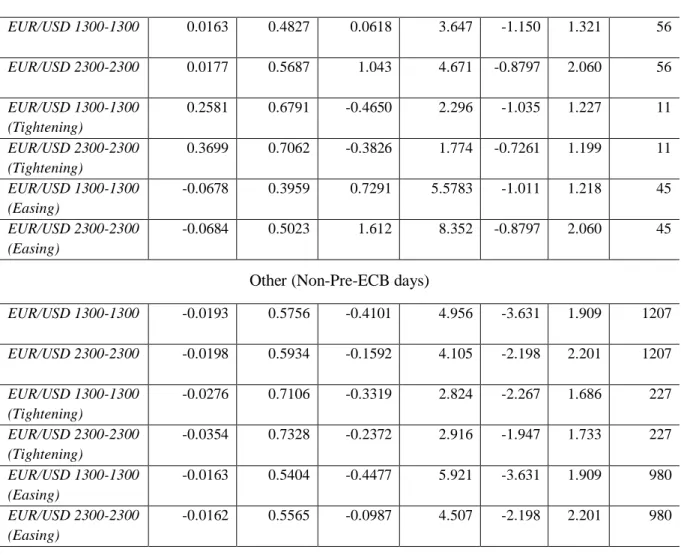
Table 3.4 Descriptive statistics for the cumulative excess returns (%) on the EUR/USD. 68 Table 3.5 Dates and outcomes of the European Central Bank’s scheduled meetings... 69
Table 3.6 Rumours pertaining to forthcoming ECB Governing Council policy... 72
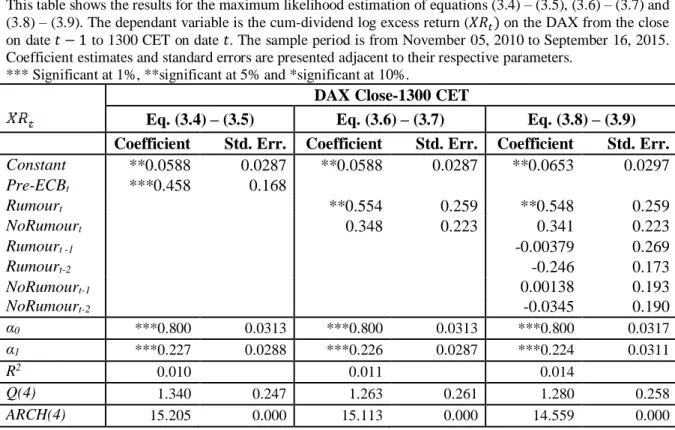
Table 3.7 ML ARCH estimation of equations, DAX (3.1), (3.2) and (3.3)... 79
Table 3.8 ML ARCH estimation of equations, DAX (3.1), (3.2) and (3.3)... 81
Table 3.9 ML ARCH estimation of equations, DAX (3.1), (3.2) and (3.3)... 83
Table 3.10 OLS estimation of equations, EUR/USD (3.1), (3.2) and (3.3)... 90
Table 3.11 ML ARCH estimation of equations, EUR/USD (3.1), (3.2) and (3.3)... 92
Table 3.12 Analysis of Rumour trading rule (DAX)... 95
Table 3.13 Analysis of Rumour trading rule (EUR/USD)... 97
Table 4.1 Descriptive statistics for cumulative returns (%) on EUR/USD... 116
Table 4.2 OLS and ML estimation of equations (4.1) - (4.6) for Full Sample... 129
Table 4.3 OLS and ML estimation of equations (4.1) - (4.6) for Tightening Sample... 131
Table 4.4 OLS and ML estimation of equations (4.1) - (4.6) for Easing Sample... 133
VIII
List of Figures
Figure 2.1 Theoretical price discovery diagrams... 15
Figure 2.2 EUR/USD average raw and absolute 1-minute returns... 20
Figure 2.3 Five day correlogram for absolute EUR/USD returns... 21
Figure 2.4 Bayesian and Akaike information criterion for FFF regression... 27
Figure 2.5 Return and estimated volatility for daily observations of EUR/USD... 28
Figure 2.6 Fourier fit for alternative specifications for orders of expansion... 30
Figure 2.7 Estimated volatility decay structures following Macro news arrival.... 41
Figure 2.8 Estimated volatility decay structure following Rumour arrival... 47
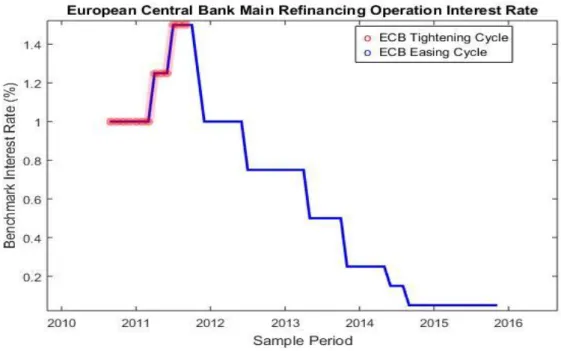
Figure 3.1 ECB benchmark interest rates... 67
Figure 3.2 Cumulative returns on the DAX... 77
Figure 3.3 Cumulative returns on the EUR/USD full sample... 85
Figure 3.4 Cumulative returns on the EUR/USD tightening cycle... 86
Figure 3.5 Cumulative returns on the EUR/USD easing cycle... 88
Figure 4.1 Cumulative returns on the EUR/USD Thursday/Friday window... 123
Figure 4.2 Cumulative returns on the EUR/USD Thursday/Friday window... 124
Figure 4.3 Cumulative returns on the EUR/USD Full Friday window... 125
1
Chapter 1. Introduction
Economic theory dictates that financial market prices should remain at equilibrium unless new market fundamental information becomes available. This new information may become available to the public or be privately acquired by an individual or a small group of market agents. The information may be scheduled, that is, the time of its release is known by the public but its content/scale of information is unknown prior to its arrival. The information may also be unscheduled, that is, the arrival and the content, scale and scope of the information is unknown ex-ante.
The magnitude of the correction toward the new equilibrium occurring as a result of an information event should be directly related to the amount by which the new information changes the fundamental valuation of the market traded asset. Fundamental valuation may change due to the scope (e.g. central bank policy announcement), the content (e.g. interest rate policy), the scale (e.g. deviation from current interest rates), and the probability content (e.g. forward guidance) of the information event. Further, the magnitude of price deviation from equilibrium also depends on the degree to which new information deviates from expectations (e.g. deviation from analyst forecasts).
The complete and instantaneous incorporation of new market relevant information into market price is considered to be an efficient price formation process. Further, the deviation of market price from equilibrium without the detection of new fundamental information is considered to be an inefficient price formation process. This economic principle is formalised as the Efficient Market Hypothesis by Fama (1965).
It is the observation of large deviations of market prices from equilibrium in the absence of new information that lead the strongest critiques of the notion of informationally efficient financial markets. It is the central focus of this thesis to investigate market price deviations from equilibrium occurring in absence of new market information, such price formation processes are often deemed ‘puzzles’ of financial economics. The central question posed in commencement of this research is whether such price formation processes occur independently and are therefore ‘puzzles’, or, does an information set exist which is detected by market agents but not yet identified by academics? Further, is such an information set sufficiently influential to alter the fundamental valuation of market traded assets? As a result, can a price formation process be detected upon the arrival of new information of this kind?
2
Eugene Fama’s (1965) Efficient Market Hypothesis (EMH) is among the most empirically analysed theories of economics. In its most strict form, Fama’s hypothesis contends that for a financial market to be considered efficient, available information, private or public about the past, present or future must be priced. A more relaxed version of his hypothesis (Fama (1991)) contends that a market can be considered ‘semi-strong’ efficient if all known public information is priced. The least strict form of the EMH considers a market to be ‘weakly’ efficient as long as current prices reflects all information priced in the past. The large-scale interest in testing this hypothesis is unsurprising given that an efficient financial market is one of the cornerstones of a functioning market driven economy. Inefficiencies in the financial markets of such economies can be catastrophic, as evident during the recent financial crisis which had led to a prolonged period of economic decline, followed by stagnation in most major developed economies. The financial crisis, after all, at its most fundamental level, can be considered a result of informational inefficiency in financial markets.
The informational efficiency of financial markets has proponents and opponents in abundant measures. Empirical examination of financial market price during times of new public and private information arrival is abundant. Results of such analysis predominantly show support for the EMH, with evidence pointing to weak form efficiency (lack of autocorrelation persistence and profitability for technical traders, Jensen (1978)), semi-strong form efficiency (new public information is immediately priced, Andersen and Bollerslev (1997)) and strong form efficiency (private information is priced as evidenced by order flow, Li et al. (2009)). Proponents point to excessive price variation, both in the first and second moment, in the absence of new fundamental information as evidence of informational inefficiency in the financial markets. Price formation processes such as the January Effect (Rozeff and Kinney (1976)), Monday Effect (Kamara (1997)), asset price bubbles (Shiller (2003)), over and under reaction to new public information (De Bondt and Thaler (1985)) and the price to earnings ratio effect (Fama and French (1995)) are considered as repudiations to the notion that financial markets are informationally efficient.
More recently policymakers and academics have turned their attention to financial market ‘functionality’ (see ECB (2012)) and O’Hara (2003)). Financial market functionality is fundamentally dependent upon a complete price discovery process and sufficient liquidity provisions. Liquidity provision is defined as a market agent’s ability to buy and sell assets without, individually, having a large impact on price (Hasbrouk (2009)). A complete price discovery process is defined as the integration of new public and private information,
3
instantaneously, in price (O’Hara (2003)). Therefore, for a market to be considered functional, it should also be informationally efficient under the strictest definition of the EMH.
According to this definition of financial market functionality, the abundant price formation puzzles identified by proponents of the EMH would suggest that a large number of financial markets may be defined as dysfunctional. Such price formation puzzles, are solved incrementally with wider access to market relevant public and private information databases and the availability of intraday and ultra-high frequency observations of market price.
Alternative trading windows such as intraday price observations and overnight trading periods have been examined to show that increasing amounts of excess price variability can be attributed to new public information arrival (Andersen and Bollerslev (1997)). The nature of new public information, in terms of scale, relevance and surprise has also been tested to account for increasing amounts of excess price variability (Faust et al. 2007)). The structure of public information arrival has also been examined. For instance, unscheduled monetary policy announcements have been shown to have a significantly greater impact on price than scheduled announcements (Kuttner (2001)). A large number of financial markets have been examined, at various frequencies of price observation during heterogeneous public information events, to unravel the structure of the instantaneous and cumulative price response (see among others, Andersen et al. (2003)).
Proponents of efficient markets lend support from the existence of private market relevant information to explain the remaining unexplained price formation processes. Recently, the existence of price formation resulting from private information, has been documented by using order flows (see among others O’Hara (2003), Evans and Lyons (2002) and Li et al. (2009)). Such periods of private information driven order flow have been characterised as increasing the inherent informational risk in the market, thus leading to excess return premiums required to compensate market participants. A risk premium driven price formation process seems plausible and this price discovery process has gained traction in the recent literature. However, questions have been posed as to whether private information flows can completely explain the existence of large scale return and volatility events. After all, the value of private information to market agents is maximised if they trade incrementally on such information and do not shock the market with orders capable of causing large scale price formation events (Cespa and Foucault (2013)).
Progressively, price formation puzzles, investigated with more sophisticated datasets and methodologies are converging to the definition of a complete price discovery processes.
4
However, significant large scale price formation processes exist in the financial markets that cannot as yet be fully explained by the arrival of new fundamental information detected by academics (Andersen et al. (2007), Groß-Klußmann and Hautsch (2011)).
This thesis contributes toward the price discovery literature by providing further support to the idea that informationally driven price formation processes are recurrent and a key feature of financial markets. The fundamental assertion of this thesis leans on the notion that market agents have priors (Fleming and Remolona (1999)). Traders/Investors form prior expectations for given outcomes of future market relevant information events (subsequently termed ‘priors´). Such priors relate to the scope, scale, timing and probability of an upcoming information event. These priors play a significant role in the price formation process upon the arrival of the expected information event. A realised information event which significantly deviates from the weighted average expectation (e.g. analyst forecasts) is shown to have a greater impact on market price than one which is largely in line with the weighted average/consensus expectation (see among others, Kuttner (2001), Faust et al. (2007)). Similarly, the price impact is of greater magnitude if the realised information event is of fundamental scope. An example of this would be scheduled central bank policy announcements (Andersen et al. (2007)).
Priors are updated frequently by individual investors concurrently with information flows which may change the individuals’ expectation of the upcoming high scope information event. Such changes to priors may alter the fundamental valuation of a given asset and can be considered completely in line with rational expectations hypotheses. The subtle changes to the
priors of a few market agents alone is not enough to result in a large-scale price formation process. However, an information event sufficiently absorbed by a large number of market agents, which results in an alteration to prior’s en masse, will significantly alter the weighted average/consensus valuation of a given asset sufficiently so that a large-scale price formation process should be observable.
This thesis posits that such expectation altering information events occur frequently and when such information is pertaining to large scope macroeconomic news events, the price impact could be large scale. The impact could be of such scale that the resulting price formation process may be deemed a puzzle, if the expectation altering information events go undetected.
The assertion in this thesis is that a Bayesian updating process of traders’ prior expectations is taking place in the pre-announcement period, prior to large scope macroeconomic news events. Such updating is posited to be as a result of new information, perhaps public, which has been
5
detected by market agents but not by academics. The information is therefor, not private but also not public in the regulatory sense. That is, it is not published and/or archived by mandated outlets such as Bloomberg or Reuters. Should the content of such information change the weighted average expectation of market agents, about the scale, probability or timing about the forthcoming large scope central bank announcement, then pre-announcement price formation process should be observable.
This thesis identifies a dataset of prior altering information events and shows empirically that contemporaneous and persistent large-scale intraday price volatility is dependent on the arrival of such information events at intraday observations of price. Further, this dataset is employed to solve an existing price formation puzzle identified by Lucca and Moench (2015). The central bank pre-announcement positive drift in returns previously identified as a pre-announcement risk premium can be explained with the existence of prior updating information events. This research also identifies a unique, central bank announcement conditional day-of-the-week effect. This price formation process could be considered a pricing puzzle however, applying the central hypothesis of this thesis to this price formation process allows for an intuitive explanation based on the notion of expectations updating.
The remainder of the thesis presents the central theoretical hypothesis, along with empirical evidence in support.
Chapter 2 investigates a new source of market relevant informational flow that is discerned by market agents but not yet identified by academics. The advent of social networks has enabled the identification of ‘market rumours’ and this has rarely been the subject of discussion within the price discovery literature, as until the introduction of Twitter and similar financial micro-blogging sources, these elements whilst known to market participants were not available as a database for investigators. It is this largely neglected category of information which is of most interest to this study. These rumours are essentially chatter, broadcast by market agents and commentators on the microblogging website Twitter.com. The information is therefore public and archived, timestamped and fully observable to both academics and market agents.
I suggest that rumours about expected future market events, circulating publicly, are prior
altering information events. Rumours by nature are difficult to pinpoint in time and rational expectations theory would suggest rumour information to be of little fundamental importance to the pricing of assets. It is therefore understandable that this type of information has been overlooked in the past. However, it is fair to posit that if rumours sufficiently alter the perceptions held by market participants of a given future market event, they become fundamental to the pricing mechanism. Rumours of forthcoming European Central Bank (ECB)
6
actions, dubbed ‘ECB sources’, which are broadcasted regularly by ‘in the know’ market commentators are observed. All such broadcasts are timestamped to within one-minute accuracy which alleviates the difficulty of pinpointing the arrival of a rumour in time. Moreover, the unique nature of Twitter as a broadcasting mechanism is that, commentators are not subject to stringent financial regulatory body mandates and in-house substantiation filtration systems. This fundamentally differentiates Twitter from incumbent financial news broadcasters, such as Bloomberg and Reuters, which have in the past been the source of new timestamped market information for studies testing the asset price impact of new information (see, among others Li et al. (2015)).
The arrival of 63 ‘ECB sources’ rumours broadcast on Twitter is pinpointed, to within one-minute accuracy, during a 420-day sample period of one-one-minute frequency spot Euro-US dollar exchange rates. I show, using Anderson and Bollerslev’s (1998) Flexible Fourier form regression, that there is a significant increase in the volatility of exchange rate returns following the arrival of 25 out of 63 ‘ECB sources’ rumours. The empirical results suggest that in the foreign exchange markets, market participants actively seek rumour information pertaining to market relevant ECB announcements. The consideration of such actionable information in the price formation process makes it possible to explain a greater proportion of asset price volatility. In Chapter 3, I explore the potential effect of rumours on financial market price formation in the central bank pre-announcement period. Results show that stock market excess returns are significantly large and positive in the 24-hour trading period immediately before scheduled monetary policy announcements. These excess returns are particularly observable in recent years, between 2011 and 2015, during which the European Central Bank (ECB) has exercised policy measures considered to be accommodative. This finding is in line with observations of a similar pattern in pre-announcement price formation found by Lucca and Moench (2015) for trading windows prior scheduled FOMC (Federal Open Market Committee). However, given the findings of the previous chapter I ask: Is the central bank pre-announcement anticipatory effect simply as a result of new public information flows which have previously gone undetected?
I expand the data set from Chapter 2 to six years of observations for ‘ECB sources’ stories broadcast on Twitter and corresponding stock and currency intraday return observations. Employing the same model as Lucca and Moench (2015), pre-ECB return windows are isolated and tested for excess returns above other non-pre-ECB trading periods. Empirical results show that average excess returns earned on the stock market index, in the 24-hour trading window immediately prior the 55 ECB Governing Council’s scheduled policy announcements are
7
statistically significant and substantially higher than all other days. The implication is that the pre-announcement drift is also observable in European markets pre-ECB windows. This contrasts with Lucca and Moench (2015) findings that show the pre-announcement drift is only observable for scheduled FOMC announcements, with no specific pattern occurring for other central banks. I conjecture that this is simply due to the sample period under scrutiny. Their sample period concludes in 2011, whereas the sample period here is from November 2010 through November 2015. It is fair to suggest that the major changes in the ECB’s balance sheet, policy mandate and expansion of policy tools from 2011 onwards may be, in part, the reason behind their divergence in results.
Importantly, further empirical results show that the pre-announcement drift is rumour conditional and less puzzling than previously assumed. This result is in line with the most compelling case put forward by Lucca and Moench (2015) for explain the ‘drift’. In fact, they suggest that investors could be subject to more complex information flows than those detected in standard theory. In this chapter, I assert that such information flows include the arrival of new publicly available information in rumour form pertaining to forthcoming policy actions. These rumours have the standard theoretical effect of an ensuing risk adjusted price formation process
In Chapter 4, I explore the currency market price formation process in the central bank post-announcement period. Findings show that the immediate EUR/USD exchange rate response to European Central Bank (ECB) schedule policy announcements is in line with the standard economic theory formalised through the Efficient Market Hypothesis (see Fama (1970)). The Euro area currency experiences large negative excess returns in the immediate (5-minute) period following Central Bank Monetary Policy announcements which are deemed to be mostly accommodative throughout the sample period under scrutiny. This finding is unsurprising, given that it is simply the anticipated financial market response to new and relevant, public information.
The main finding of this Chapter, however, is in stark contrast to that professed by standard asset pricing theories. I document large, significant negative excess returns on the EUR/USD spot exchange rate on the day following scheduled ECB policy decision announcements. This pricing anomaly only takes place on Friday trading days which follow scheduled ECB announcements taking place on Thursdays. When the day-of-the-week following an ECB announcement falls on a Thursday then no pricing anomaly can be observed. I define this ECB Friday pricing anomaly as the ‘ECB conditional Friday effect’. Overall, these findings present a price formation anomaly which is conditional on a prevailing scheduled ECB policy decision
8
announcement and that the trading day following the announcement must fall on a Friday. Several explanations are explored for this conditional price formation process.
The initial intuition is that such a uniform post-ECB negative drift must be a result of new public information arrival. However, findings in this chapter show that scheduled public information events observed on days following scheduled ECB announcements, are heterogeneous in macroeconomic data type and report both Euro negative and positive information. Thus, I conclude that the intuitive reasoning based on standard asset pricing theory cannot be used to explain the ECB conditional Friday price formation process.
Due credence is also given to a second argument; that this ECB conditional Friday effect is one linked to findings presented in market microstructure literature. This literature finds that Friday afternoons in multiple markets experience higher levels order flows, volume and short selling (see among others, Ralando et al. (2012)). In this context, the hypothesis could be that large-scale profit taking and closing of positions occurring after a larger impact public information event are the determinants of the ECB conditional Friday effect. The magnitude of the average excess negative return on the EUR/USD following scheduled announcements is over 20 basis points. Therefore, this argument is also dismissed given that post-ECB scheduled announcement immediate market reaction is likely to be short positions in the EUR/USD, the covering of which would result in an opposite directional Friday price effect than that observed in the empirical results.
The most intuitively persuasive reason for the ECB conditional Friday effect is simply a risk-weighted liquidation of long positions in the Euro prior to Friday market close. The intuition being that traders, cautious of weekend news relating to an already dovish ECB during a predominantly policy easing cycle, would not be willing to stay long the currency over the weekend following ECB announcements. Further, ECB Governing Council members, who are mandated to a quiet period prior to scheduled announcements, tend to make frequent comments and clarification to the world press during the days following ECB meetings. Following predominantly dovish ECB announcements in the sample, such comments may be deemed by traders to be likely to have a Euro negative impact on post-weekend market open. Therefore, a conclusion can be drawn that traders, long the currency on post-ECB Fridays, are likely to make a risk-weighted decision to cut their positions. And, traders short the currency, are likely to make the risk-weighted decision to remain short. This conclusion comes with a caveat; that the strength of this argument is very much linked to the intuition underpinning rational risk-weighted investor/trader behaviour. Thus, the ECB conditional Friday effect is, in part, still a pricing puzzle worthy of further investigation. Chapter 5 concludes this thesis.
9
Chapter 2. Trade the Rumour
2.1 Introduction
The excess volatility puzzle is one of the foremost unanswered questions in financial economics. The Efficient Market Hypothesis in all its guises has offered theoretical and empirical backing to the notion that security prices vary as a result of new information arrival. A large number of studies, however, have shown that such flows of market relevant information cannot fully explain the large volatility observed in financial markets. Many scholars, however, argue that such excess of volatility can be explained by the existence of private information (see, among others, French and Roll 1989). A competing explanation comes from behavioural finance, and it is based on the idea of irrational investors as a solution to the ‘excess volatility puzzle’. The existence of excess volatility, within this school of thought, is ascribed to the existence of noise, technical and speculative investors (see, among others, De Long at al. 1990). Both of these competing paradigms struggle to offer tangible evidence of the determinants of excess of volatility. ‘Noise’ and private information are, in fact, particularly difficult to pinpoint in time, source, scale and scope.
In this chapter, I define a tangible alternative source of excess financial market volatility, a part of the puzzle previously unaccounted for by economists but discerned by market participants. More specifically, I pinpoint the source, timing, scale and scope of sixty-three financial market rumours relating to upcoming European Central Bank (ECB) policy actions and announcements. I assert that such rumours are neither private in scope nor noise in relevance. I define financial market rumours as actionable information, broadcast on Twitter, by multiple market commentators. I suggest this is information to be considered for trade execution, given a probabilistic change in market participant’s expectations of future ECB policy decisions, thus leading to a change in market consensus.
As long as enough number of market participants discerns a particular rumour as having a high enough probability to occur, then a period of market volatility should be observable. The empirical findings of this chapter show that out of 63 ECB rumours under scrutiny, 25 result in a significant and positive impact on foreign exchange volatility. The instantaneous increase in volatility during the first minute of rumour arrival is up to 211%, whereas the cumulative increase in volatility over a 60-minute window is as much as 2614%.
The Efficient Market Hypothesis (EMH) suggests that financial asset prices reflect all information relevant to the value of a given traded security. In its strongest form, the EMH
10
dictates that relevant information, regardless of whether it is in the public domain, or held privately, will be reflected in market price. Given this assertion, asset price fluctuations should reflect the arrival of new information about relevant market events that have already occurred or are expected to occur in the future. This notion has resulted in a large body of research testing the informational efficiency of financial markets. A large number of studies have investigated the market impact of the arrival of macroeconomic news (Andersen et al. 2000, Cutler et al. 1989, Menkhoff 2010, Berry and Howe 1994, Andersen and Bollerslev 1997, Cai et al. 2001, Chang and Taylor 2003, Bauwens et al. 2005, etc.). One strand of this literature focuses on the directional change in asset prices following news arrival, while the remainder measure asset price volatility following news arrival (Li et al. 2015). The latter is of greater relevance to this study. At lower frequency daily observations,French and Roll (1986), Barclay et al. (1990) and Ito et al. (1998), find that a relatively small amount of daily asset price volatility can be attributed to the arrival of new public information. They all conjecture the existence of private information among ‘informed market agents’, as the reason behind the remaining unexplained asset price volatility. However, any evidence of the existence of such private information is ambiguous, as opposed to being pinpointed in time with a given source.
The availability of higher frequency intraday data has yielded more insightful results.Andersen et al. (2000), Cutler et al. (1989), Menkhoff (2010), Andersen and Bollerslev (1997), Cai et al. (2001) and Chang and Taylor (2003), all find that a larger proportion of price variability can be attributed to the arrival of new information. There remains a consensus, however, that volatility attributable to the arrival of new public information is low when compared to that of their respective samples. Andersen and Bollerslev (1997), in particular, discover a distinct periodic intraday volatility pattern where the magnitude of return variability is consistently correlated with variations in market activity. They suggest, in line with French and Roll (1986), that the greater variability in returns during periods of heightened market activity is evidence of price adjustments due to the existence of private information.1 More recently, scholars have increasingly focussed on studying the formation of price prior the arrival of new information. Bauwens et al. (2005), Andersen et al. (2007), and Groß-Klußmann and Hautsch (2011) have found heightened levels of volatility in stock, bond and currency markets prior to the arrival of new scheduled and unscheduled public information. Bauwens et al. (2005), draw upon these findings to give further empirical support to the notion that private information triggers price
1
Periodic volatility patterns during periods of heightened market activity can also occur as a result of market microstructure factors such as systematic periods of increased order flows (Groß-Klußmann and Hautsch 2011).
11
adjustments prior to market information becoming public. Despite this growing body of literature, questions remain over the plausibility of the notion that a sizable majority of excess price variation occurs due to private information arrival. After all, by nature, private information is likely to filter relatively slowly into price and not to produce large price deviations - as suggested by price discovery authors (see, among others, Andersen and Bollerslev 1997 and Bawuens et al. 2005). While it is fair to acknowledge the existence of private information and a resultant price formation process, the idea that private information is the main - or one of the main determinants - of financial market volatility, is not entirely plausible.
The literature testing the informational efficiency of financial markets has traditionally divided new information into four broad categories. The first consists of the arrival of new scheduled public information named structured information. Information of this type becomes available in the market at a pre-specified time. New structured public information is generally about market events that have occurred in the past. An example of this type of information would be macroeconomic data released by a government body.
The second is the arrival of new unscheduled information named unstructured information. This type of information does not have a pre-specified arrival time, and it is generally about market relevant events that have already occurred. An example of this type of information would be the announcement of a profit warning.
The third type consists of privately held information, which is assumed to circulate among a small group of ‘in the know’ market agents. Information of this type is generally about a market relevant event due to take place in the future or which has already taken place, but of which the public are unaware. An example of this type of information would be insider knowledge of an upcoming takeover.
The fourth type consists of market rumours. The financial market impact of this type of information has been explored to a lesser extent. This is in part due to the ambiguous nature of rumours and difficulty in acquiring timestamped historical datasets of rumour arrival. Pound and Zeckhauser (1990) were among the first to consider the price effect of market relevant rumours by considering takeover stories published in financial newspapers. They found that speculative stories of potential mergers and acquisitions published in the Wall Street Journal result in significant changes in the ‘price trends' for the acquired firm's equity, during the pre-acquisition windows. Similar findings of rumour conditional equity price variation have been presented by Zivney et al. (1996), Gao and Oler (2012) and Chou et al. (2015). More recently, Ahern and Sosyura (2015) carry out more in-depth analysis of similar rumours published in the
12
mainstream financial U.S. press. They find stock prices of rumoured takeover targets are rumour conditional and that such price movements are unconditional of the accuracy of the reported rumour. There is, therefore, substantial empirical evidence pointing to a rumour conditional stock price effect.
The above literature finds evidence that rumours pertaining to firm-specific factors - such as takeovers, earnings reports, hiring and firing – have a role in the price formation process. This finding is in part supportive of the findings in this chapter. At an elementary level, they all show that rumours, irrespective of realised accuracy have a market price impact. However, the findings presented in the literature fail to show the real-time price formation effect of rumours. This is usually due to rumour datasets not containing timestamps to a high enough frequency. Moreover, the rumours studied are all pertaining to firm-specific factors and it would be valid to suggest that the role of firm-specific rumours is limited given that they amount to idiosyncratic noise in the wider market context, which based on fundamental financial theory, can be diversified away in any long run return window.
There is very limited research into the systematic influence of rumours on macro-markets. Oberlechner and Hocking (2004) show - using questionnaire and interview data - that traders implement currency market transactions based on informal communications with ‘in the know’ journalists and sources. The intuition is that market relevant rumours carry an informational risk premium. Their intuition and survey findings are in line with the empirical results of this chapter; however, in the absence of an empirical sample of timestamped market relevant rumours, it is difficult to identify any associated real-time price discovery process. Kosfeld (2005) builds on Banerjee’s (1993) theoretical model to show that if the diffusion of a rumour is wide enough, through word of mouth, then such rumours can cause a significant ‘price run-up’. The model builds on the assumption that rumours transmit more effectively in networks that are small and local rather than large and global. I would argue that this theoretical model can be expanded to include a more global outreach for a given rumour since the existence of social media outlets has been shown to lead to rapid rumour diffusion (Nekovee et al. (2007)). The rapid global transmission combined with the macroeconomic information content of ECB Twitter rumours would suggest that systematic risk factors are at play – so that during rumour diffusion the market should command risk premia.
In this chapter, I focus on a new source of systematic informational flows that is relevant to macro-markets. The advent of social networks has enabled the identification of ‘market rumours’ and this has rarely been the subject of discussion within the price discovery literature.
13
In fact, up until the introduction of Twitter and similar financial micro-blogging sources, such rumours whilst known to market participants were not available as a database to investigators. It is this largely neglected category of information, which is of most interest to this study.2 Results show that real-time price discovery in the foreign exchange markets are associated with the real-time arrival of ECB relevant rumours. This finding provides fundamental evidence that market relevant rumours - conveying a potential change to future expectations of systematic risk factors - carry risk premium in macro-markets. This previously undetected price formation process incrementally increases the proportion of excess volatility that can be explained. I suggest that rumours about expected future market events, circulating publicly, are information of this type. Rumours by nature are difficult to pinpoint in time and rational expectations theory would suggest rumour information to be of little fundamental importance to the pricing of assets. It is therefore understandable that this type of information has remained overlooked in the past. I argue, however, that if rumours sufficiently alter the perceptions held by market participants of a given future market event, they become fundamental to the pricing mechanism. This assertion will be discussed in greater depth in section 2.2. A domain is available where market relevant rumours can be pinpointed in time by using Twitter. The social networking platform, Twitter, is a medium through which market commentators and participants exchange opinions and information about market relevant events. I identify rumours of forthcoming ECB actions, dubbed ‘ECB sources', which are broadcasted regularly by ‘in the know' market commentators. All such broadcasts are timestamped to within one-minute accuracy, which alleviates the difficulty of pinpointing the arrival of a rumour in time. Moreover, the unique nature of Twitter as a broadcasting mechanism is that commentators are not subject to stringent financial regulatory body mandates and in-house substantiation filtration systems. This fundamentally differentiates Twitter from incumbent financial news broadcasters such as Bloomberg and Reuters, which have in the past been the source of new timestamped market information for studies testing the asset price impact of new information (see, among others Li et al. 2015).
I pinpoint the arrival of 63 ‘ECB sources’ rumours broadcast on Twitter, to within one-minute accuracy, during a 420-day sample period of one-minute frequency spot Euro-US dollar exchange rates. Using Andersen and Bollerslev’s (1997b) Flexible Fourier form regression, I show that there is a significant increase in the volatility of exchange rate returns following the
2Given the above discussion, the statement by Andersen and Bollerslev (1998): “If private information is at least in part ruled out, supporters
of the Efficient Market Hypothesis must concede the existence of fundamental market information detected by market actors but not by economists” still remains relevant today.
14
arrival of 25 out of 63 ‘ECB sources’ rumours. Empirical results suggest that in the foreign exchange markets, market participants actively seek rumour information pertaining to market relevant ECB announcements. The consideration of such actionable information in the price formation process makes it possible to explain a greater proportion of asset price volatility. The remainder of the chapter is structured as follows. Section 2.2 defines the theoretical framework that provides the rationale for market rumours to be a source of information fundamental to the process of price formation in efficient markets. Section 2.3 provides details of market and information data. Section 2.4 assesses the robustness of the methodological approach I adopt by means of Monte Carlo simulation. Section 2.5 discusses the empirical results, while section 2.6 concludes the chapter.
15
2.2 Rumours and Price Formation: A Paradigm
In this study, I show empirically that rumours play a significant role in the price formation process. The question remains, however, if market rumours can be considered information events fundamental to the efficiency of financial markets. Are market rumours a type of information fundamental to the calculation of asset price? Do market agents change their calculations of asset prices based on new rumours? Can the market, therefore, be considered efficient if prices re-adjust at the time of new rumour information arrival?
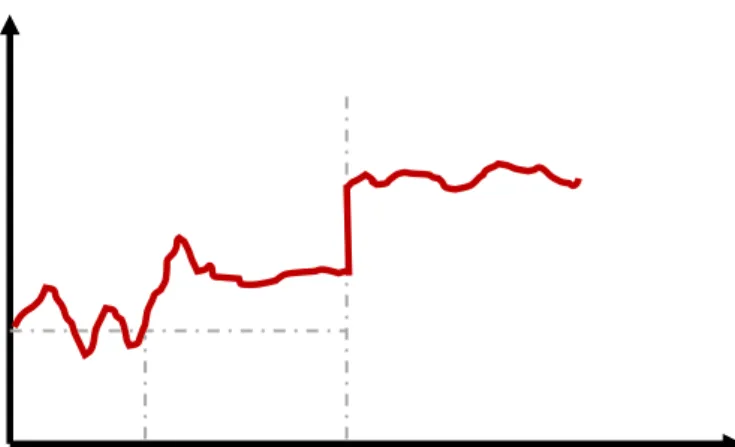
I answer these questions in the context of strong form EMH, which asserts that an efficient financial market will price all available relevant information, public and private, about market events that have already occurred or are expected to occur in the future. Market rumours by nature are information events predominantly indicating the size, scope, timing and probability of future market events. The arrival of a market rumour could plausibly change the nature of investor forecasts of future events. Depending on the quality of the source of a given rumour, market agents may reasonably alter the probability they attach to the possible outcomes of a specific future event. It is therefore perfectly reasonable for investors to alter their pricing of an asset based on the reliability and timing of a given rumour. The second question remains over the motivation for market agents to change their market positions based on a rumour contingent alteration to their forecast. To answer this question, I refer to Figure 2.1, which provides simple illustrations of price formation leading up to a future event E. Figure 2.1a illustrates a semi-strong efficient market, where market agents react only to public information at the time of event E.
Figure 2.1a
Price
Time E
16
The size, scope and probability of this event become known only at time E, and the profits generated by the price adjustment would only be earned by those reacting immediately. The price formation process illustrated in Figure1a is purely theoretical and not observable in financial markets.
A price formation process with increasing investor price forecast accuracy and private information diffusion is illustrated in Figure1b. Price variation is observed in this scenario up to event E.
Figure 2.1b
The timing, size, scope and probability of a future event in a strong form efficient market is partly known and priced by ‘in the know’ market agents. Market agents with the best forecasts or private information prior to event E will profit most. This simple illustration is converging to the reality of financial market price formation.
Figure 2.1c Price Time E Price Time E R
17
In reality, however, Figure 2.1c is more representative of pre-event price formation. Price formation is a dynamic process where forecasts alter frequently due to continuous market information flows. The timing, size, scope and probability of upcoming event E changes based on heterogeneous forecasts and beliefs. Cumulative market participant forecasts form a market consensus, which at any given time determines price.
If the arrival of a rumour R (Figure1c)sufficiently changes the forecasts of a large enough group of market agents to a new homogenous forecast, then a resultant volatility event may be expected. Given that market agents attach a certain probability to the rumour being true they stand to profit by taking action based on the change to their forecasts. The profit may be contemporaneous at time R or based on a time advantage over market agents who react at time
E. With the obvious profit motive of market agents in mind, it is perfectly rational for market agents to change their position based on the probability they attach to the rumour being true.
Such a probabilistic calculation is simply a risk-weighted trading decision, one that would be deemed rational in an efficient market.
To demonstrate this, I define It as a vector of all variables determining the exchange rate of a given currency pair prior to an event E. The outcome of such an event could alter the composition, magnitude and probability attached to any given element of vector It. I would, however, expect It to remain fixed between t=0 and t=E, without the arrival of unscheduled market relevant information. This vector includes the known quantities of exchange rate determinants such as, the rate of inflation, trade balances, interest rate differential, as well as information about central bank announcements/actions, which determine investor’s expectations about the future values of said variables. Further, I denote 𝐼̂𝑡 as a vector containing the consensus estimates of all market participants of each element of It between t=0 and t=E. Equilibrium foreign exchange rate at any time 𝑡 ∈ [0; 𝐸] can be written as 𝐹𝑋𝑡= ∅(𝐼𝑡, 𝐼̂𝑡). I can obtain the approximate change in the foreign exchange rate within this time window (t=0
to t=E) by linearizing ∅ and time differencing the result, so that:
∆𝐹𝑋𝑡 ≅ ∅1′∆𝐼
𝑡+ ∅2′∆𝐼̂𝑡
where ∆ is the difference operator between 𝑡 = 0 𝑡𝑜 𝑡 = 𝐸, and ∅1′ =𝜕𝐼𝜕∅
𝑡 and ∅2
′ = 𝜕∅ 𝜕𝐼̂𝑡. By supposition, none of the foreign exchange rate determinants can change during the window, thus ∆𝐼 = 0 and ∆𝐹𝑋 = ∅2′∆𝐼̂𝑡. Any marginal effect on the exchange rate is given by an element of the vector ∅2′, as a result of a change to an element of the market consensus vector 𝐼̂. Changes to market consensus without material changes to vector I, detectable as excess volatility,can be deemed a repricing of risk by the market, due to either undetected information events or noise.
18
I assert that a rumour event R, can be seen as an undetected information event. Provided that R
delivers information about the probability, scale, scope or timing of upcoming event E, and that it sufficiently alters market consensus elements of vector 𝐼̂, a marginal effect on the exchange rate should be observable following the arrival of the rumour at t=R. The magnitude of such a change should be proportional to ∅2′∆𝐼̂𝑡 as a result of the arrival of R. In section 2.5.5, I show that this marginal effect is observable in terms of significant periods of exchange rate volatility following the arrival of ECB rumour information events.
19
2.3 Data description
2.3.1 Euro-US dollar exchange rate data
The Euro-US dollar currency market is the largest in the world by number of transactions per day. It opens 2200 GMT Sunday and is subject to a 24-hour trading day until 2200 GMT Friday. Pre-market (weekend) trading is available through some exchanges, however trading volume is relatively illiquid when compared to standard non-weekend trading (Chaboud et al. 2014). The markets opening hours overlap geographic trading days in Tokyo, Sydney, Frankfurt, London and New York; the most active financial centres. This 24-hour trading day allows the investigation of price formation during the full weekly information cycle.
I source EUR-USD exchange rate data from Bloomberg professional services. I have chosen to utilise 1-minute interval exchange rate data to accommodate the investigation of post-rumour price formation in greater detail. The data supplied consists of exchange rate quotes for a period spanning from September 29, 2013 to May 08, 2015 (84 weeks, 420 days), totalling in 604,800 observations. Quote data is available for weekend trading hours (2200 GMT Friday to 2200 GMT Sunday) however, I choose to omit these observations due to reasons given above. Further, I omit half trading days and major holidays during which trading is considerably less active. These omissions result in a final minute-by-minute data sample of 596,160 observations. There is a total of 414 trading days, individually made up of 1440 1-minute intraday returns. I define intraday returns (Rt,n) in terms of trading day t=1,2,...,414 and minute interval n=1,2,…,1440. Where price is defined as Pt,n, minute by minute returns are calculated as follows:
𝑅𝑡,𝑛 = log(𝑃𝑡,𝑛) − log (𝑃𝑡,𝑛−1)
The collection of daily EUR-USD data is also required for inclusion in the baseline Flexible Fourier form regression to account for the highly persistent volatility factor as observed by Andersen and Bollerslev (1997b). The inferred daily volatility in daily frequency observations of spot EUR-USD exchange rates, as determined by EGARCH estimates, controls for the observable highly persistent volatility in exchange rate. A detailed discussion of this procedure will be outlined in section 2.4. I source this daily data, spanning from January 2012 to June 2015 for a total of 910 observations, via Bloomberg professional services. Daily data (Rt) is then filtered to omit related observations removed from the intraday sample (898 observations). Descriptive statistics for both daily and intraday frequency samples are presented in Table 2.1.
20
Table 2.1
Descriptive statistics for full sample daily and intraday minute-by-minute EUR-USD exchange rate returns. Mean Median St. Dev. Skew Kurtosis Min Max Observations
Rt -4.55x10⁻⁴ -1.45 x10⁻⁴ 0.0052 -0.138 2.84 -0.021 0.024 898
Rt,n -2.64x10⁻⁷ 0 1.43x10⁻⁴ 0.235 192.47 -0.0088 0.0094 596,160
2.3.2 Intraday patterns of the Euro-USD series
It is clear from Table 2.1 that with a skewness of 0.235 and kurtosis of 192.47 the EUR-USD minute-by-minute raw returns are not normally distributed across the sample. This is consistent with previous studies by Chaboud et al. (2014) and Andersen and Bollerslev (1997b), who make use of intraday currency 1-minute and 5-minute data respectively. Furthermore, it can be observed that when sample returns are averaged for the trading day, there are distinguishable increases in return variability during specific times of the trading day. This greater variability is somewhat apparent, although centred around zero, for raw returns but is profoundly clear for absolute returns. This unique feature of intraday data was initially identified by Andersen and
Figure 2.2
(a) EUR-USD intraday 1-minute average (one trading day) raw returns R.,n.(b) EUR-USD intraday 1-minute
21
Bollerslev (1997a) and has been consistently observed by a number of other scholars (see, e.g., Bauwens et al. 2005, Dominguez 2003, and Chaboud et al. 2014). Figure 2.3 illustrates the average interval raw and absolute returns across the trading day.
Figure 2.3
Ten day correlogram for absolute EUR-USD returns | Rt,n |.
The regular intraday pattern observed for absolute returns suggests persistent spikes in volatility at regular times for the trading day across the sample. These spikes in price variability coincide with prominent geographical financial centres opening and their respective scheduled public information releases of macroeconomic data and Central Bank news. This chapter defines the trading day as commencing 2200 GMT when the average absolute 1-minute returns are low relative to the trading day. There are small periodic increases in absolute returns as Asian financial centres begin their respective trading days. There is a notable rise to a higher level of 0.011% for the Frankfurt opening, and a further rise to 0.016% for the start of the London trading day. There are further spikes in absolute returns at 0900 GMT (660th interval) and 1000 GMT (720th interval) which represent regular macroeconomic data releases. The most distinguishing feature of the daily pattern is that of the 930th trading interval at which points absolute returns spike to 0.046%. This represents East coast US financial centres opening and the release of scheduled macroeconomic data such as the US employment report. Further distinguishable spikes represent a second scheduled macroeconomic data point, US stock markets closing and times during which the Federal Open Market Committee (FOMC) releases information.
The intraday pattern in absolute returns discussed above has been reported to result in a persistent U-shaped autocorrelation effect throughout the sample (see, e.g., Andersen and Bollerslev 1998, and Bauwens et al. 2005). I report similar findings in Figure 2.3, which depicts
22
the 10-day correlogram for absolute returns. Standard volatility models developed for analysis of lower frequency daily, weekly and monthly data, by design, are not appropriate given the persistent autocorrelation in observations (Payne 1996). This is the principal reason I offer for selecting the methodology outlined in section 2.4.
23
2.3.3 Information event data
There are two sources of financial market information for this chapter; Bloomberg professional services and Twitter. Information events sourced via the former facilitate the inclusion of times during which scheduled and unscheduled public information arrives. For scheduled events, a unity value is included as a dummy variable for the event window commencing at the minute the information is released via Bloomberg. The inclusion of said event windows allow for the testing of the papers’ main hypothesis while controlling for any volatility jumps attributable to scheduled public information events. From Bloomberg professional services, I collect timestamped data for 20 categories of scheduled public information releases, totalling in 429 events of this type for the period September 29, 2013 to May 08, 2015. Further, 250,000 unscheduled public information arrivals (news headlines) are collected via Bloomberg for the same period. The times of such news headlines are cross-referenced with the sample of timestamped rumour information. Any rumour observations which either repeat such Bloomberg information arrivals or occur concurrently are eliminated from the sample.3
Details of public information data is provided in Table 2.2. For the purpose of this chapter, I collate scheduled public information in twenty categories, FOMC rate decisions, ECB rate decisions, FOMC meeting minutes release, speeches given by prominent ECB and FOMC Committee members, US employment reports, Category 1 economic data (US GDP, US CPI, US ISM manufacturing data, US consumer confidence, German ZEW economic confidence data, German IFO economic confidence data and Eurozone CPI) and Category 2 economic data (US retail sales data, US Durable Goods, US Manufacturing PMI, German Employment Report, European PMI manufacturing, German Industrial Production and German Factory Orders). A relevance indicator provided by Bloomberg determines the constituent economic data events included in the latter two categories.4 In further research there is scope to include additional control variables, particularly those relating to the microstructure of the EUR/USD market. Preliminary analysis of the EUR-USD market shows that of the largest 25 absolute returns for the sample, 10 occur concurrently within the arrival of news associated with the ECB (see Table 2.3). It is therefore appropriate, that I focus on highly relevant market rumours relating to forthcoming ECB actions or changes in remit. Such highly relevant market rumours are appropriate examples of actionable information discerned by market actors but not yet
3The inclusion of further control variables such as sentiment indicator could potentially augment this research. However, for simplicity and
to avoid possible endogeneity problems, I have chosen to exclude such indicators.
4It is worth noting that for Eastern Standard Time (New York) the change to daylight savings time occurs sooner and ends later than in Western
Europe. This can cause some disparity when observing US related information events. I control for these disparate periods when constructing public information dummy variables.
24
investigated by economists. Rumours of this type are quoted as ‘ECB sources’ stories. These rumours are regularly reported by ‘in the know’ financial market commentators via Twitter. ECB sources stories are particularly prevalent within a one-week window of the ECB’s Governing Council meeting that takes place on a monthly basis. I can gauge the popularity of the ECB sources story by the number of times the quoted rumour is repeated. It is relatively simple to search Twitter archives for the phrase ‘ECB sources’. I select ECB rumour events where the quoted story is repeated by more than 50 ‘in the know’ financial market commentators. I then perform an advanced search for the full quoted story i.e. “ECB Sources:
ECB is working on a discussion chapter to execute government bond buying. 3 different options”, and pinpoint the time of the first broadcast of the quote. In total, I collect times for the first broadcast of 63 ECB rumour events. Some ‘sources’ stories gain so much traction among financial commentators that they are then reported via Bloomberg professional services. Details of the 63 ‘ECB sources’ events are given in Appendix A1.
The applied threshold of 50 repeats of a given rumour is determined arbitrarily, but nonetheless is reasonable method of preventing the selection of stale rumours and those which are largely
Table 2.2
Scheduled public information arrival for period September 29, 2013 to May 08, 2015.
Announcement Regular Time
(GMT)
Bloomberg
Relevance Indicator
Number of Observations
FOMC Rate Decision 1900/1800 97.6 13
ECB Rate Decision 1245 97.7 18
FOMC Minutes 1930/1830 97.6 12
ECB Speakers Various N/A 46
FOMC Speakers Various N/A 52
US Employment Report 1330 99.2 20
US CPI (Cat 1) 1330/1230 94.4 19
US GDP (Cat 1) 1330/1230 96.8 19
US ISM (Cat 1) 1500/1400 96.0 19
German ZEW (Cat 1) 1000 98.3 19
German IFO (Cat 1) 0900 96.6 19
Eurozone CPI YoY (Cat 1) 1000 95.3 19
US Consumer Confidence (Cat1) 1330/1230 95.2 19
US Durable Goods (Cat 2) 1330/1230 92.1 19
US Retail Sales (Cat 2) 1330/1230 91.3 19
US Manufacturing PMI (Cat 2) 1445/1345 90.0 19
German Employment Report (Cat 2) 0855 90.0 19
Eurozone Manufacturing PMI (Cat 2) 0800 to 0900 90.0 19 German Industrial Production (Cat 2) 0700/1100 93.2 20