UNIVERSITY OF KWAZULU-NATAL
EXPLORING INCLUSIVE PRACTICES IN THE INTERMEDIATE PHASE MATHEMATICS CLASSROOM AT UMLAZI DISTRICT
BY
NOSIPHO MSOMI
STUDENT NUMBER: 217078616
THESIS SUBMITTED IN PARTIAL FULFILMENT OF THE REQUIREMENTS FOR THE DEGREE OF MASTER OF EDUCATION (EDUCATIONAL PSYCHOLOGY)
DISCIPLINE OF EDUCATIONAL PSYCHOLOGY SCHOOL OF EDUCATION STUDIES
SUPERVISOR: DR. VISVARANIE LINDA JAIRAM
ii
DECLARATION
I, Nosipho Msomi, declare, that this study represents original work by the author and has not been submitted in any form to any other institution. All the sources that I have used or quoted have been indicated and acknowledged by means of complete references.
_____________________________ ______________________________
Nosipho Msomi Date
iii
ABSTRACT
The study sought to explore inclusive practices in intermediate phase mathematics classrooms in Umlazi District, KwaZulu-Natal, South Africa. This study sought to explore the experiences of mathematics educators in the intermediate phase, the challenges they face in the implementation of inclusive education, and the types of support and assistance they need. The South African government has implemented numerous changes in education since the 1994 democratic elections, and adopted a policy of inclusive education in 2001. Inclusive education requires educators to ensure that their classrooms and teaching strategies accommodate all learners, regardless of their diversity, in order for all learners to succeed. This study finds that educators have been tasked with the responsibility of implementing the inclusive education policy, and have been faced with diverse challenges that have stalled the successful implementation of inclusive education. Educators need support, guidance and resources to overcome these challenges. The lack of support educators currently receive raises grave concerns regarding the quality of education in South Africa, as does the poor scholastic achievement of learners in mathematics.
The aim of this study was to explore inclusive education practices in the intermediate phase mathematics classroom from the perspective of the educators. An interpretivist research philosophy was therefore used to investigate these perspectives, grounded in a social constructivist world view underpinned by the work of Lev Vygotsky. A qualitative research approach was used to construct the investigative interpretivist framework. A case study strategy was used, and qualitative data from eight mathematics teachers in the intermediate phase was generated through scheduled interviews and questionnaires. The data was analysed using thematic analysis that adhered to Braun and Clarke’s (2006) six steps.
The findings of this study highlighted the need for appropriate educator training at tertiary level; on-going professional development of existing educators; provision of basic teaching resources, and specific resources for mathematics; the recognition of overcrowding, and a reduction of class sizes; the recognition that language barriers contribute enormously to conceptual gaps in mathematics, and the provision of additional resources to address this; and the need for parents to play an active and responsible role in their children‘s education.
iv
ACKNOWLEDGEMENTS
First and foremost, I give praise to almighty God for giving me the strength to complete my study and for sending the dearest people my way to assist me. Completing a Master’s degree part time requires a lot of hard work and dedication.
I would like to express my deep gratitude to my supervisor, Dr Visvaranie Jairam, for her expert guidance, enthusiastic encouragement, immediate feedback and useful critiques of this research. I would also like to thank her for her advice and assistance in keeping my progress on schedule. Her motivation, kind heart and wise words always made me want to soldier on and perform at my best. Thank you very much. You are truly an inspiration to me.
My mother and father continued to assist and guide me in furthering my studies as they know that education is the best money can buy. I am proud to have them in my life. I hope I have made them proud.
To my sisters, Simangele, Snobby, Londekile and Zinhle, for the kind words and support during my late nights working hard: thank you. I trust this achievement will motivate them to do their best and that they will look up to me as a role model who always strives for more.
My dear niece, Anathi, and my nephews, Andile, Mphumeleli and Makwande: thank you for your support on this journey of completing my degree. Your motivation to further my studies has really pushed me thus far.
v
DEDICATION
I dedicate this thesis to my parents, my two late brothers and my niece, for nurturing in me affections and love, and their constant dedicated partnership for success in my life.
vi
LIST OF TABLES
TABLE OF CONTENTS
DECLARATION ... ii ABSTRACT ... iii ACKNOWLEDGEMENTS... iv DEDICATION... v LIST OF TABLES... xi
LIST OF FIGURES ... xii
LIST OF ABBREVIATIONS ... xiii
CHAPTER 1 ... 1
INTRODUCTION TO THE STUDY... 1
1.1 INTRODUCTION... 1
1.2 FOCUS OF THE STUDY ... 1
1.3 RATIONALE OF THE STUDY ... 2
1.4 THE RESEARCH PROBLEM ... 4
1.5 AIM OF THE STUDY ... 4
1.6 OBJECTIVES OF THE STUDY ... 4
1.7 RESEARCH QUESTIONS ... 5
1.8 THEORETICAL AND CONCEPTUAL FRAMEWORK ... 5
1.8.1 Inclusion ... 5 1.8.2 Constructivist theory... 6 1.9 RESEARCH PARADIGM... 7 1.10 RESEARCH DESIGN ... 7 1.10.1 Research strategy ... 7 1.10.2 Research setting ... 7 1.10.3 Sampling strategy ... 8 1.11 DATA Generation ... 8 1.12 DATA ANALYSIS ... 9
1.13 METHODS TO ENSURE TRUSTWORTHINESS ... 9
1.14 LIMITATIONS OF THE STUDY ... 9
1.15 ETHICAL CONSIDERATIONS ... 10
1.16 OUTLINE OF CHAPTERS ... 10
vii
CHAPTER 2 ... 12
LITERATURE REVIEW ... 12
2.1 INTRODUCTION... 12
2.2 DEFINING INCLUSIVE EDUCATION ... 12
2.3 INCLUSIVE EDUCATION IN THE GLOBAL CONTEXT ... 14
2.3.1 The Salamanca Statement ... 14
2.3.2 The international community ... 15
2.4 INCLUSIVE EDUCATION IN THE SOUTH AFRICAN CONTEXT ... 16
2.4.1 South African policy framework for inclusive education ... 16
2.4.2 The intermediate phase in the South African inclusive education environment ... 17
2.4.3 The state of mathematics teaching and learning in the South African inclusive education environment ... 18
2.4.3.1 Annual National Assessment mathematics statistics for 2012–2014 ... 18
2.4.3.2 Mathematics tasks in home language instead of first additional language (FAL) ... 20
2.5 IMPLEMENTING INCLUSIVE EDUCATION ... 20
2.6 MATHEMATICS IN THE INCLUSIVE ENVIRONMENT ... 22
2.6.1 The nature of mathematics ... 22
2.6.2 Mathematics content areas in the intermediate phase ... 23
2.6.3 Mathematics anxiety ... 24
2.6.4 Ensuring inclusivity in mathematics ... 25
2.6.5 Assessment practices ... 27
2.6.6 Curriculum differentiation ... 27
2.7 AN OVERVIEW OF CONSTRUCTIVIST THEORY ... 28
2.8 CONCLUSION ... 30
CHAPTER 3 ... 31
RESEARCH DESIGN AND METHODOLOGY ... 31
3.1 INTRODUCTION... 31 3.2 RESEARCH OBJECTIVES ... 32 3.3 RESEARCH PARADIGM... 32 3.3.1 Research philosophy ... 33 3.3.2 Research approach ... 33 3.3.3 Research purpose ... 35 3.4 RESEARCH DESIGN ... 35
viii 3.4.1 Research strategy ... 36 3.4.2 Research setting ... 37 3.4.3 Sampling ... 37 3.4.3.1 Population ... 38 3.4.3.2 Sampling strategy ... 38 3.4.3.3 Sample ... 38 3.4.4 Data collection ... 39 3.4.4.1 Research instruments ... 40
3.4.4.2 Data collection procedure ... 40
3.5 DATA ANALYSIS ... 41
3.5.1 Step 1: Become familiar with the data ... 41
3.5.2 Step 2: Generate initial codes ... 42
3.5.3 Step 3: Search for themes ... 42
3.5.4 Step 4: Review potential themes ... 43
3.5.5 Step 5: Define themes ... 43
3.5.6 Step 6: Writing-up / producing the report ... 44
3.6 METHODS USED TO ENSURE TRUSTWORTHINESS ... 44
3.6.1 Credibility ... 44
3.6.2 Transferability ... 45
3.6.3 Dependability... 45
3.6.4 Conformability ... 45
3.6.5 Authenticity ... 46
3.7 LIMITATIONS OF THE STUDY ... 46
3.8 ETHICAL ISSUES ... 46
3.8.1 Informed consent ... 47
3.8.2 Right to privacy ... 47
3.8.3 Protection from harm ... 48
3.8.4 Involvement of the researcher ... 48
3.9 CONCLUSION ... 48
CHAPTER 4 ... 50
DATA PRESENTATION AND ANALYSIS ... 50
4.1 INTRODUCTION... 50
ix
4.3 OVERVIEW OF RESEARCH THEMES ... 51
4.4 FINDINGS AND ANALYSIS ... 53
Phase ... 53
4.4.2 Theme 1: Lack of training and skills development ... 56
4.4.2.1 Lack of on-going training ... 56
4.4.2.2 No clear policy at participants’ disposal... 57
4.4.2.3 Work readiness programmes through monitoring and coaching ... 58
4.4.3 Theme 2: Barriers experienced by teachers in the application of the inclusive education policy ... 59
4.4.3.1 Language barrier ... 60
4.4.3.2 Application of a differentiated approach ... 63
4.4.3.3 Poor learner counting skills and conceptual difficulties ... 65
4.4.4 Theme 3: Teachers’ prejudices and discrimination ... 67
4.4.4.1 Implementation of inclusive education policy ... 67
4.4.4.2 Difficulty teaching mathematics ... 69
4.4.4.3 Few learners can learn mathematics ... 71
4.4.4.4 Resources are a challenge when teaching mathematics ... 71
4.4.5 Theme 4: Effects of large class sizes in an inclusive environment ... 73
4.4.5.1 Lack of space and lack of resources ... 73
4.4.5.2 Differentiated teaching is a challenge ... 74
4.4.5.3 Excessive marking and delayed feedback to learners ... 76
4.4.5.4 Discipline in large classes ... 77
4.4.6 Theme 5: Lack of parental involvement in the inclusive classroom and community ... 78
4.4.6.1 Supervision of homework is an uphill battle ... 78
4.4.6.2 Attendance at curriculum meetings ... 80
4.4.6.3 Parent-teacher interviews ... 80
4.4.6.4 Parents misunderstand their role or are indifferent to it ... 80
4.5 CONCLUSION ... 82
CHAPTER 5 ... 83
DISCUSSION, RECOMMENDATIONS AND CONCLUSIONS ... 83
5.1 INTRODUCTION... 83
5.2 SUMMARY OF THE RESEARCH PROCESS ... 83
x
5.2.2 Research paradigm and design ... 84
5.2.3 Data generation and data analysis ... 84
5.3 SUMMARY OF INCLUSIVE PRACTICES IN THE INTERMEDIATE PHASE MATHEMATICS CLASSROOM ... 85
5.3.1 Theme 1: Lack of training and skills development ... 85
5.3.2 Theme 2: Barriers experienced by teachers in the application of the inclusive education policy ... 86
5.3.2.1 The language barrier ... 86
5.3.2.2 Application of a differentiated approach ... 87
5.3.2.3 Poor learner counting skills and conceptual difficulties ... 88
5.3.3 Theme 3: Teachers’ prejudices and discrimination ... 88
5.3.4 Theme 4: Effects of large class sizes in an inclusive environment ... 89
5.3.5 Theme 5: Lack of parental involvement in the inclusive classroom and community ... 90
5.4 SUMMARY OF RECOMMENDATIONS FOR THE EDUCATION COMMUNITY91 5.5 RECOMMENDATIONS FOR FURTHER RESEARCH ... 92
5.6 LIMITATIONS OF THE STUDY ... 93
5.7 CONCLUSION OF THE STUDY ... 93
REFERENCES ... 95
APPENDICES ... 109
APPENDIX A: PERMISSION LETTER ... 109
APPENDIX B: ETHICS CLEARANCE CERTIFICATE ... 110
APPENDIX C: GATEKEEPER PERMISSION LETTER ... 111
APPENDIX D: INFORMED CONSENT LETTER ... 113
APPENDIX E: LETTER OF REQUEST FOR TEACHERS’ PARTICIPATION ... 115
APPENDIX F: INTERVIEW SCHEDULE ... 117
APPENDIX G: QUESTIONNAIRE ... 118
_________________________________________________________________________ APPENDIX H: EDITOR’S CERTFICATE ... 120
xi
LIST OF TABLES
Table 2.1: Average mathematics scores in Annual National Assessment for 2012–2014 ... 19
Table 2.2: Percentage of learners obtaining at least 50% in mathematics ... 19
Table 2.3: Content areas for Grade 4, Grade 5 and Grade 6 ... 23
Table 3.1: Profile of participants ... 38
Table 4.1: Overview of Research Themes ... 51
Table 4.2: Example of a vocabulary journal ... 62
Table 5.1: Recommendations for the successful implementation of inclusive education in The intermediate phase mathematics classroom... 90
xii
LIST OF FIGURES
Figure 2.1: Five components of mathematics proficiency ……….23
xiii
LIST OF ABBREVIATIONS
ANA Annual National Assessment
CAPS Curriculum Assessment Policy Statement DBE Department of Basic Education
DoE Department of Education
EU European Union
FAL First Additional Language GET General Education and Training
HL Home Language
IDEA Individuals with Disabilities Education Act JPTD Junior Primary Teachers‘ Diploma
KZN KwaZulu-Natal
LoLT Language of Learning and Teaching LSEN Learners with Special Educational Needs NCTM National Council of Teachers of Mathematics RDP Reconstruction and Development Programme RSA Republic of South Africa
SEN Special Educational Needs
SGB School Governing Body
SPTD Senior Primary Teachers‘ Diploma
TIMSS Trends in International Mathematics and Science Study
UNESCO United Nations Educational, Scientific and Cultural Organisation UNCRPD United Nations Convention on the Rights of Persons with Disabilities ZPD Zone of Proximal Development
1
CHAPTER 1
INTRODUCTION TO THE STUDY
1.1 INTRODUCTION
Education — the act or process of educating or being educated — is a basic human right. This is proclaimed in the United Nations Educational, Scientific and Cultural
Organisation’s (UNESCO) Universal Declaration of Human Rights, and has been reaffirmed by the World Declaration for All (UNESCO, 1994a). However, humans are extremely diverse in their abilities and approaches, and only an inclusive education policy can fairly and productively ensure that educational practices productively include such diversity. According to UNESCO (1994b), inclusive education is both a process and an approach to education. As a process it requires the modification of curriculum content, structure, language, and background in order to include all learners (UNESCO, 2002). The mathematics curriculum has been identified as one of the major challenges in developing and implementing inclusive educational practices (UNESCO, 2003, p. 16). There are several curriculum-based and practice-based factors that limit learners ‘inclusion in the intermediate phase mathematics classroom, such as curriculum content, assessment practices, teaching styles, and the learners ‘abilities and backgrounds (Department of Basic Education (DBE), 2011, p. 4). Inclusive practices in the intermediate phase mathematics classroom involve differentiating instructions by identifying the various learners ‘strengths, needs and interests, and adapting the lessons to match those.
1.2 FOCUS OF THE STUDY
The fundamental aim of inclusive education is the provision of the human right to education to all learners, regardless of their diverse abilities and backgrounds, and the preparation and training of all learners for 21st-century globalised society (UNESCO-IBE, 2014; European Agency, 2015). South Africa is a rapidly growing country whose economic development
2
largely depends on its citizens acquiring skills and knowledge through competent teaching. South Africa is also in pursuit of a policy of inclusive education. Inclusive education, in a nutshell, considers how to alter the education system by eradicating the barriers that prevent learners from participating fully in education, in order for knowledge and skills to be accessible to all learners. Marishane, Marishane and Mahlo (2015) state that one important way to ensure children’s right to education is for teachers as duty bearers to guarantee that the curriculum is not only accessible to all learners but also inclusive of all learners. Empirical research studies that have been done in the past, point to the fact that teaching and learning is less effective if the educators’ knowledge of good assessment is inadequate or lacking (Vandeyar & Killen, 2003 in Kakoma, 2016).
1.3 RATIONALE OF THE STUDY
Teaching mathematics in the foundation and intermediate phase has been the researcher ‘s first choice for 23 years. The school at which the researcher is currently teaching is situated in a township and lacks certain basic and necessary resources. As educators we are compelled to devise our own teaching strategies to enable the learners to comprehend mathematics. I have been part of the many changes in the South African context that have had an impact on education in schools. My personal interest in the process of transforming an education system that still bears the marks of the social and political inequalities of the past, is embedded in a desire to stimulate meaningful change in South African society. For this to occur it is pivotal to understand the broader socio-political perspective within which schooling and learning occurs. It has therefore become of paramount importance to me to assess inclusive education practices in the intermediate phase mathematics classroom, in order for all learners to be adequately served by the education system.
Mathematics has been my favourite subject since the Foundation Phase, where I excelled at it. Due to a high failure rate in mathematics, our school created a special class between Standard 2 (Grade 4) and Standard 3 (Grade 5) called the ―Graduation‖ class. If learners made satisfactory progress in this class, they were promoted to Standard 3 during the course of the year. Those who made slow progress were promoted to Standard 3 at the end of the
3
year. This method of sorting and streaming learners is in stark contrast to today ‘s dominant educational philosophies and approaches, both in South Africa and globally, which focus strongly on inclusive education. In South Africa the inclusive approach to education is defined and expressed in Education White Paper 6: Special Needs Education: Building an inclusive education and training system (Department of Education (DoE) 2001), which outlines what an inclusive education and training system is, and how the South African government intends to develop such a system. It provides a framework for establishing an inclusive education system, details a funding strategy, and lists the key steps to be taken. It states that mainstream education’s priorities should include multi-level classroom instruction so that teachers can prepare main lessons with variations that are responsive to individual learners ‘needs (DoE, 2001, p. 19).
The researcher has also chosen this study because of a personal professional interest in the inclusive intermediate phase mathematics classroom, which coincides with a national interest in mathematics teaching. I strongly believe that learners need a strong foundation in mathematics in order to achieve good results in their final matriculation exams. However, I am perturbed by the state of mathematics education in South Africa, the poor results of which are evident in the Trends in International Mathematics and Science Study (1995, 1999, 2003), International Competition and Assessment for Schools (2006), Human Sciences Research Council (2008) and Southern and Eastern Africa Consortium for Monitoring Education Quality (1999) assessment tests, described in detail by Sheinuk (2010). The poor performance by South African learners in all areas of mathematics indicates that there is a nationwide crisis in mathematics achievement. Yet a central precondition for national economic success, as argued by Hlalele (2012), is that the citizens of a country be numerically literate, and be able to understand and apply mathematics, as it is an indispensable aspect of the logic of our daily lives. Hlalele cites the fact that in 2011, one in six Grade 12 learners who wrote the final mathematics exam scored less than 10% for the exam (City Press, 2012). There has also been a massive decline in the number of learners enrolling for mathematics in recent years. Problems with maths start in the intermediate phase, and by the time learners reach matric that gap is insurmountable.
4
1.4 THE RESEARCH PROBLEM
The researcher embarked on this research study for professional and personal reasons. The researcher is a qualified educator, with a keen and vested interest in improving the conditions of educators and learners at schools. The central problem that the researcher has encountered is that learners are not doing well in mathematics in the intermediate phase, and are struggling with basic operations and computation. The researcher’s direct observations and experience are supported by Raoano (2016, p. 7), who states that
Learners at school are unable to break complicated descriptions into small parts, to understand those parts and to see the relationship between them. Learners are not familiar with the skill of interrogating a word problem for understanding. Lacking this skill leads the learners to be unable to translate the word problem into mathematics expression.
Consequently, mathematics has a high failure rate. This is also observed by Marishane et al. (2015), who state that the quality of mathematics teaching in South African schools is amongst the worst in the world. An additional concern is educators ‘general lack of formal training in special education. This training would equip them with the necessary materials and resources to be the drivers of change in promoting and sustaining inclusive education (Mayaba, 2008).
1.5 AIM OF THE STUDY
The primary aim of this study was to qualitatively assess inclusive education practices in the intermediate phase mathematics classroom.
1.6 OBJECTIVES OF THE STUDY The objectives of the study were as follows:
5
• To explore the educators ‘perceptions and practices of inclusive education in the intermediate phase mathematics classroom.
• To understand Mathematics teachers’ adherence to what is stated as inclusivity in their teaching.
• To provide recommendations on how inclusive education practices can be improved in the intermediate phase mathematics classroom.
1.7 RESEARCH QUESTIONS
The study was guided by the following research questions:
• What are educators’ perceptions of inclusive education and what their practices in the intermediate phase mathematics classroom are?
• Are Mathematics teachers adhering to what is stated as inclusivity in their teaching?
• How does inclusive education need to be improved in the intermediate phase mathematics classroom?
1.8 THEORETICAL AND CONCEPTUAL FRAMEWORK
The theoretical framework provides the foundation for conducting research to explore a particular problem. Henning, Van Rensburg and Smit (2004) and Mahlo (2011) state that a study ‘s theoretical framework situates the study within the discipline in which the researcher is working, and is comprised of a combination of formal theories to elucidate the various aspects of the field of research in question (Maja, 2015).
CONCEPTUAL FRAMEWORK 1.8.1 Inclusion
Inclusion is a key concept in this study. The term ―inclusion‖, in the context of education, refers to the policy of accepting learners with special needs into the mainstream school
6
context, and ensuring that they adapt successfully. Inclusion has become the global norm for education in the 21st century, and the concept of inclusive education is widely accepted as the best means of allowing every child to be equally valued and involved in the system of education, regardless of their difference in terms of disability, sex, religion, ethnicity, or anything else (Mitiku, Alemu & Mengsitu, 2014). The purpose of conducting this research was to assess educators’ perceptions and practices of inclusive education in the intermediate phase mathematics classroom. The motivation for conducting the research is both professional and personal, as the researcher is a qualified educator and is therefore well placed to observe the conditions of educators and learners at schools. As a practising educator, the researcher is also well placed to formulate recommendations that can assist with strengthening inclusive education.
THEORETICAL FRAMEWORK 1.8.2 Constructivist theory
In this study, constructivist theory formed the basis for assessing inclusive education practices in the intermediate phase mathematics classroom. Hein (1999) in Kussumua (2007, p. 14) defines constructivism as ―a theory based on observation and the scientific study of how people learn‖ and further states that ―people construct their own understanding and knowledge of the world through experiencing things and reflecting on those experiences‖. Airasian and Walsh (1997) in Jensen (1998) also points out that ―Constructivism is not a unitary viewpoint‖, but is based on the fundamental principle that people create knowledge from the interaction between their existing knowledge or beliefs and the new ideas, information, or situations they encounter.
Most constructivists also agree on the need to foster interactions between learners’ existing knowledge and new knowledge and experiences. In this way, learners construct their own knowledge or meaningful ideas by linking the newly received information to their existing knowledge and experience (Haruthaithanasan, 2010). According to the constructivist approach, learners are encouraged to direct and control their own learning, and educators play the role of facilitators, rather than performance evaluators. Creative approaches to
7
education that increase learners’ knowledge, strengthen their capabilities and improve their attitudes are critical for personal development, for fostering a sense of personal fulfilment and inclusion, and for ultimately ensuring their constructive role as usefully employed members of society in the future (European Commission, 2004 p.3).
1.9 RESEARCH PARADIGM
The aim of this study was to explore inclusive education practices in the intermediate phase mathematics classroom from the perspective of the educators. An interpretivist research philosophy was therefore used to investigate these perspectives, grounded in a social constructivist world view underpinned by the work of Lev Vygotsky (Woolfolk, 2007). A qualitative research approach was used to construct the investigative interpretivist framework. The detailed reasons for selecting this particular philosophy and approach are provided in section 3.3.
1.10 RESEARCH DESIGN 1.10.1 Research strategy
This study adopted a case study strategy, as described by Saunders, Lewis and Thornhill (2007, p.140). A case study strategy was chosen because it is suited to the qualitative investigation of a specific situation (in this case the experiences of intermediate phase mathematics educators in an inclusive environment) in its real-life context. A detailed discussion of the characteristics and merits of a case study approach can be found in section 3.4.1.
1.10.2 Research setting
The study was conducted at three primary schools located in KwaMakhutha, township area under Umbumbulu tribal authority in Durban, KwaZulu-Natal, South Africa. The schools
8
are in Mafa ward, 30 kilometres south of Durban. One school is quintile 3 and two schools are quintile 3. The total learner enrolment is between 300 and 1020 among the three schools. There are no libraries and laboratories in these schools, only library corners for extra reading and creative writing. The area has one municipality library that cannot accommodate all the library users especially young learners. The area has an estimated population of 24 336, consisting largely of Zulu-speaking black people. Crime and unemployment is high, and the school is surrounded by RDP (Reconstruction and Development Programme) houses. Most of the learners receive child support grants and are from poor socio-economic backgrounds. Most parents are illiterate and unable to assist in school work and homework.
1.10.3 Sampling strategy
Intermediate phase primary school teachers who are teaching mathematics in the Mafa cluster that falls under Umbumbulu circuit, in KwaZulu-Natal, were the target population for this research study. Convenience sampling was used to select educators who teach mathematics in the intermediate phase from Grade 4 to Grade 6, at three primary schools. These educators had three or more years of experience teaching mathematics in the intermediate phase. Section 3.4.3 contains a more detailed discussion of the sampling strategy and process used in this study.
1.11 Data Generation
Data was generated using one-on-one structured interviews with the selected sample of participants (see Appendix F for the interview schedule) and questionnaires, which contained primarily open-ended, qualitative questions (see Appendix G for the questionnaire). The interviews were audio taped (with the permission of the participants), transcribed, and coded for thematic analysis. These data collection procedure is discussed in more detail in section 3.4.4.
9
1.12 DATA ANALYSIS
The researcher used thematic analysis to analyse the qualitative data. Thematic analysis is a method for identifying, analysing and reporting patterns or themes within data (Mayaba, 2008). Braun and Clarke‘s (2006) method of thematic analysis was used, and this method involves six steps:
1. Becoming familiar with the data 2. Generating initial codes
3. Searching for themes 4. Reviewing potential themes 5. Defining themes
6. Writing up the themes.
These steps are described in detail in section 3.5.
1.13 METHODS TO ENSURE TRUSTWORTHINESS
Trustworthiness of data, according to Guba and Lincoln (1994), is a question of whether data can be considered credible, transferable, dependable, conformable and authentic. The researcher went to great efforts to select the participants carefully and gather and record the data accurately. The researcher was careful to understand and question her own assumptions, experiences and feelings when interpreting the data, in order to avoid bias, and ensured that the participants had an opportunity to check the validity of the thematic analysis. A detailed discussion of how the researcher gave attention to the five elements of trustworthiness is found in section 3.6.
1.14 LIMITATIONS OF THE STUDY
10
District, KwaZulu-Natal, South Africa. The sample was restricted to only intermediate phase educators who teach mathematics within Mafa cluster of Umbumbulu circuit. The findings cannot therefore be generalised, as they apply to a limited sample group and a very specific social, political, economic and cultural context.
1.15 ETHICAL CONSIDERATIONS
In accordance with Welman, Kruger and Mitchell‘s (2005) guidelines, the researcher ensured that informed consent was obtained from the participants, that their privacy was maintained, that they were protected from harm, and that no manipulative or unethical tactics were used to elicit information from them. These measures are discussed in detail in section 3.8.
1.16 OUTLINE OF CHAPTERS
Chapter 1 has discussed the focus of the study, the rationale for the study and the research problem. The aim of the study, the objectives and the research questions were presented, and the theoretical framework, research paradigm and research design outlined. The data collection and data analysis procedures were discussed, as well as the limitations of the study and the ethical considerations taken into account.
Chapter 2 discusses literature relevant to inclusive education, the intermediate phase in the inclusive environment, inclusive practices within this phase and within the mathematics classroom, assessment practices within the inclusive classroom, and general issues related to the implementation of inclusive education in the global and the South African context. In addition, it provides an overview of constructivist theory, which forms the theoretical approach to this study and underpins the data analysis
Chapter 3 discusses the methods that were used to collect data for analysis. It deals firstly with the overall research paradigm that informed the approach to data collection and
11
analysis (the research philosophy, approach and purpose), and then describes the overall research design (the research strategy employed, the research setting, the sampling procedure and the data collection procedure). The data analysis is then described, as well as the methods used to ensure trustworthiness in the data, the limitations of the study, and the ethical considerations that were taken into account
Chapter 4 presents and analyses the data collected using thematic analysis, and interprets it using constructivist theory.
Chapter 5 presents a summary of the research process, and a summary of the findings on the inclusive practices in the intermediate phase mathematics classroom, in accordance with the main themes that emerged from this study. A summary of the overall recommendations for the education community is then presented. Recommendations for further research are discussed, after which the limitations of this study are addressed, and a final overall conclusion is presented.
1.17 CONCLUSION
This chapter has provided a background to the study, and has discussed the focus of the study, the rationale for the study and the research problem. The aim of the study, the objectives and the research questions have also been presented, and the theoretical framework, research paradigm and research design outlined. The data collection and data analysis procedures have been discussed, as well as the limitations of the study and the ethical considerations taken into account. The following chapter discusses literature relevant to inclusive education, the intermediate phase in the inclusive environment, inclusive practices within this phase and within the mathematics classroom, assessment practices within the inclusive classroom, and general issues related to the implementation of inclusive education in the global and the South African context. In addition, it provides an overview of constructivist theory, which underpins the data analysis of this study.
12
CHAPTER 2
LITERATURE REVIEW
2.1 INTRODUCTIONThis chapter discusses literature relevant to inclusive education, the intermediate phase in the inclusive environment, inclusive practices within this phase and within the mathematics classroom, assessment practices within the inclusive classroom, and general issues related to the implementation of inclusive education in the global and the South African context. In addition, it provides an overview of constructivist theory, which forms the theoretical approach to this study and underpins the data analysis.
2.2 DEFINING INCLUSIVE EDUCATION
Going together is the beginning, keeping together is progress, and working together is success (Henry Ford, 1976).
A clear understanding of inclusive education on the part of educators, learners and administrators is a vital part of its successful implementation in the classroom. Lalvani (2014) notes that the necessary support required by educators may be linked to the manner in which they conceptualise inclusive education (Lalvani, 2014), and Mohanty and Nanda (2017) state that in order to achieve successful inclusion in their classrooms, educators need a very clear understanding of inclusive education policies and practices, in order to access the necessary skills and resources to implement appropriate inclusive strategies.
Various definitions of inclusive education focus on its intention to make education fairly and equally accessible to all learners, regardless of their diversity. Fredrickson and Cline (2009, p. 71) in Madihlaba (2013, p. 8) define inclusive education as ―a procedure by which a school attempts to answer to all pupils as individuals by reconsidering and
13
reconstructing its curricula organization, provision and allocating resources to improve equal opportunity‖. This view is supported by Khan (2017), who takes the definition a step further and focuses on equal participation and inclusion within the classroom, describing inclusive education as the process of responding to the diversity of children through enhancing participation in classrooms and reducing exclusion from education. Moscardini (2014) reinforces this approach, emphasising that all learners should learn together in the same place without being grouped, labelled or excluded. In this study, inclusive education refers to the practices that teachers utilise to accommodate learners who are battling academically in mathematics.
Inclusive education is defined as a collaborative approach to teaching based on the idea that all children can learn together, and that participation in learning requires responses to individual differences among learners that do not depend on ability labelling or grouping, or the withdrawal of the learner for additional classroom support.
Mo (2014) concurs that inclusive education is about making equal educational opportunities accessible to all students, irrespective of their biological, physiological, cultural and social conditions. Mahlo (2011, p. 16) supports the accommodation of the full diversity of learners, defining inclusive education as ―a learning environment that promotes the full personal, academic and professional development of all learners irrespective of race, class, gender, disability, religion, culture, sexual preference, learning styles and language.‖ Mohanty and Nanda (2017) state that the concept of inclusive education needs to be understood in the way that allows students with special needs to be placed and receive instruction in mainstream classes and to be taught by mainstream teachers. Mohanty and Nanda (2017) reinforce the other definitions by emphasising that every child has unique characteristics, interests, abilities and learning needs, and that educational programmes need to consider the wide diversity of these characteristics and needs.
Mittler (2005) emphasises that inclusion is not simply about placing learners with special needs in mainstream schools, but it is about changing schools to make them more responsive to the needs of all learners. Inclusive education is about helping all educators to accept responsibility for the effective learning of all learners in their school, and about
14
preparing educators to teach those learners who are currently excluded from their schools but may be brought into an inclusive classroom (Mittler, 2005).
Ntombela (2011) describes how educators are ―change agents‖ whose roles are crucial in the inclusive education environment (Ntombela, 2011). Mathibe (2007) recommends that educators’ skills should be strengthened through programmes that equip them with the necessary attitudes, knowledge, values and skills to confidently and effectively implement inclusive education in their classrooms.
2.3 INCLUSIVE EDUCATION IN THE GLOBAL CONTEXT 2.3.1 The Salamanca Statement
The single biggest international commitment to inclusive education to date has been the
Salamanca Statement and Framework for Action on Special Needs Education, signed at the World Conference on Special Needs Education: Access and Quality in Salamanca, Spain in June 1994 by over 300 international delegates that represented 92 governments and 25 international organisations.
It is commonly known as the Salamanca Statement and is framed by a rights-based perspective on education that expresses a strong commitment to reaffirming the right to education of every individual, as enshrined in the 1948 Universal Declaration of Human Rights, and renewing the pledge made by the world community at the 1990 World Conference on Education for All to ensure that right for all regardless of individual differences (UNESCO, 1994b, p. vii).
The signatory countries and individuals to the Salamanca Statement supported the following beliefs about education (UNESCO, 1994b, p. vii):
• Every child has a fundamental right to education, and must be given the opportunity to achieve and maintain an acceptable level of learning.
15
• Education systems should be designed and educational programmes implemented to take into account the wide diversity of these characteristics and needs.
• Those with special educational needs must have access to regular schools which should accommodate them within a child-centred pedagogy capable of meeting these needs.
• Regular schools with this inclusive orientation are the most effective means of combating discriminatory attitudes, creating welcoming communities, building an inclusive society and achieving education for all; moreover, they provide an effective education to the majority of children and improve the efficiency and ultimately the cost-effectiveness of the entire education system.
The Salamanca Statement has been very influential in encouraging governments to adopt inclusive policies, and to reform their education systems to accommodate a much greater range of learner diversity. However, it does not describe specific practical recommendations for how educators can achieve inclusive classrooms in practice.
2.3.2 The international community
Inclusive education practices generally have a great deal of support in developed countries. Evans and Lunt (2005, p. 41) describe how inclusion has become ―a buzz-word in social and educational policy in the UK and the European Union, and also in the USA and further afield‖. Evans and Lunt (2005) note that politicians in these countries are increasingly emphasising a commitment to inclusion and social justice, and outline how all the EU countries and the USA now have legislation and strong policy frameworks in place that promote or mandate inclusive educational practices. Developed countries seem to have the advantage of generally resource-rich education systems that allow a relatively effective implementation of inclusive education policies.
16
Developing countries, however, seem to be struggling with both policy and implementation (Srivastava, de Boer & Pijl, 2013). In their survey on the implementation of inclusive education in developing countries over ten years, Srivastava, de Boer and Pijl (2013) found that only 16 developing countries (out of 140 in the survey) had any research projects at all on the inclusion of students with disabilities, and that these projects were often small scale and confined to a small area like a school or a city. They see this as a worrying sign that inclusive education is not seen as a serious priority in developing countries, noting that ―although a number of developing countries signed the recent United Nations Convention on the Rights of Persons with Disabilities (UNCRPD) (2006), students with disabilities are not always taken care of in education policies‖ (Srivastava et al., 2006, p. 11). They note too that ―in most developing countries, regular schools have large classes with few teachers. Consequently, many teachers hesitate to work with students with disabilities, finding it an additional workload‖ (Srivastava et al., 2006, p. 11). Their review also showed that teachers receive very little support and attention in developing countries, and that parents’ involvement with their children‘s schooling is generally extremely limited. Fernando, Yasmin, Minto and Khan (2010) argue that inaccessible school infrastructure, limited learning materials, limited capacity of teachers, poverty, disability, conflicts and lack of supporting policy frameworks are the major causes of exclusion from the mainstream education system.
2.4 INCLUSIVE EDUCATION IN THE SOUTH AFRICAN CONTEXT 2.4.1 South African policy framework for inclusive education
South Africa is a country of great social and economic inequality, and the South African education system in particular still bears the marks of the social and political inequalities of the past, many of which have continued into the present. Section 29 of the South African Constitution grants everyone the right to basic education, and the Bill of Rights enshrines the rights of all South Africans to human dignity, equality and freedom (Muringi, 2015). In the South African context, therefore, inclusive education is crucially necessary for the full
17
range of learners‘ needs to be met, in order to deliver their right to basic education, and to redress inequalities (DoE, 2001).
The framework for an inclusive education system is laid out in Education White Paper 6: Special Needs Education: Building an Inclusive Education and Training Systems (DoE, 2001), and the intention of this policy is to support all learners, teachers and the system, so that the full range of learning needs can be met. Implementing this policy, however, requires a significant shift in mind-set on the part of all stakeholders, who need to recognise that all children, youth and adults have the potential to learn, given the necessary support. It also requires the creation of systems for identifying and accommodating the diverse range of learning needs. However, as will be discussed and shown later in this chapter, and in the findings in Chapter 4, the inadequate implementation of inclusive education policies in South Africa has resulted in a breakdown of learning in the inclusive intermediate phase mathematics classroom.
The Guidelines for responding to learner diversity in the classroom through the Curriculum and Assessment Policy Statement (DoE, 2011) is intended to provide practical guidance to school managers and educators for planning and teaching to meet the needs of a diverse range of learners. This document incorporates the Curriculum and Assessment Policy Statement (CAPS) and forms part of the CAPS orientation programme for educators and education officials. Curriculum differentiation, which Boliver (2011) refers to as
―education shaped differently for different learners‖, is fundamental to the implementation of inclusive education in the intermediate phase mathematics classroom. This is because most learners are excluded due to a one-size-fits-all approach to following and teaching the curriculum.
2.4.2 The intermediate phase in the South African inclusive education environment The intermediate phase falls between the foundation and senior phases, and consists of three grades — Grade 4, Grade 5, and Grade 6. It is an important transitional phase between the foundation and senior phase (Mahlo, 2011). In the intermediate phase, learners between the
18
ages of 10 and 14 are catered for, and they are taught seven subjects: their Home Language (HL), their First Additional Language (FAL), mathematics, life skills, social sciences, natural sciences and technology (DBE, 2011). In the foundation phase, they were taught only four subjects. Learners are also taught by multiple educators, compared with two educators in the foundation phase.
Learners also start using English as the language of learning and teaching (LoLT) in these grades. The new content subjects are taught in English by different teachers, unlike in the foundation phase, where learners are taught by a single teacher in their home language. Many learners therefore begin to experience a sense of exclusion in the classroom, based on the barrier to learning created by the LoLT being their FAL, after being taught in their home language for three years. This language barrier is experienced in conjunction with an increase in the volume and complexity of the syllabus.
2.4.3 The state of mathematics teaching and learning in the South African inclusive education environment
2.4.3.1 Annual National Assessment mathematics statistics for 2012–2014
The Annual National Assessment (ANA) in South Africa is a testing programme that requires all schools in the country to conduct the same grade-specific language and mathematics tests for Grades 1 to 6 and Grade 9 (Pennington & Richards, 2016). The ANA was introduced in 2011 as a means of assessing learning in language and mathematics. Van der Berg (2015, p. 28) states that although ―problems related to the calibration and inter temporal and inter-grade comparability of ANA test scores limit their usefulness for measuring learning gains […] relative performance in these tests provides meaningful information on the evolution of learning gaps between children‖. Table 2.3 indicates the very low average mathematics scores for the intermediate phase (Grades 4–6), and paints a clear picture of the difficulties faced by learners in the intermediate phase mathematics
19
classroom. In Grade 6 there has been a large increase in the percentage of learners achieving acceptable levels in mathematics over the period; however, the overall achievement level is still too low, and the overall goal of the DoE (60%) has not been achieved.
Table 2.1: Average mathematics scores in Annual National Assessment for 2012–2014
2012 2013 2014
Grade 4 37% 37% 37%
Grade 5 30% 33% 37%
Grade 6 27% 39% 43%
(Source: Department of Basic Education, 2014, p 8)
The urgency of the situation becomes even clearer when one focuses on the percentage of learners who achieve at least 50% in mathematics in the ANA, shown in Table 1.2 below. Results are only available for Grades 3, 6 and 9, and the appallingly low statistics for Grade 9 in particular indicate the overall failure of the system of teaching and learning in mathematics classrooms in South Africa. It is clear that learners are encountering gaps in their knowledge and are falling behind during the earlier grades, and by the time they reach Grade 9, the problem of understanding mathematics has become insurmountable.
Table 2.2: Percentage of learners obtaining at least 50% in mathematics
% learners obtaining 50% in Mathematics
2012 2013 2014
Grade 3 36% 59% 65%
Grade 6 11% 27% 35%
20
(Source: Department of Basic Education, 2014, p. 9)
Learner results in the intermediate phase in general show wide-ranging deficiencies in basic knowledge, and learners’ achievement deteriorates sharply over the course of the intermediate phase and into the senior phase. In order to improve learning of mathematics knowledge and skills, and to identify and address specific deficiencies revealed by the assessment results, educators must have full mastery of the mathematics content area as well as a thorough understanding of the specialised nature of the subject (Moloi & Kanjee, 2018).
2.4.3.2 Mathematics tasks in home language instead of first additional language (FAL) In the 2015 TIMMS (Trends in International Mathematics and Science Study), South Africa came second to last in both sets of results (Grade 4 and Grade 8) (Mullis, Martins,
Foy & Hooper, 2016). Research suggests that the learners’ home languages are a resource in the teaching and learning of mathematics, and teaching mathematics using both their home language and the LoLT (if it differs from their home language) can improve learner results. Howie (2004) argues strongly that improvement in their English language proficiency will improve the mathematics performance of African learners. Significantly, TIMSS (2011) indicates that learners in Japan generally show high achievement levels, and learners‘ LoLT in Japan and their home language are one and the same.
2.5 IMPLEMENTING INCLUSIVE EDUCATION
Prior to the 1994 general democratic elections, the system of education in South Africa used to be a dual system comprising mainstream education and special education. Kisanji (1999) describes how the special education component introduced several educational problems. The perception was created that learners who required special education had something
21
wrong with them, and needed a curriculum that was different from that of their peers because they had difficulty in completing the standard school curriculum. Furthermore, the assessment procedures had the effect of labelling and categorising learners, with a resulting negative effect on the learners‘ self-esteem, and on teacher and parent expectations of them. Carrim (2002) explains how this dual education system resulted in many learners being excluded from mainstream education, and how the majority of these were black learners. Learners were therefore not only being segregated on the basis of learning disability, but also on the basis of race.
Since the 1994 Salamanca Statement the South African government has promulgated various Acts and policies that promote the inclusion of learners with special needs in education: Education White Paper No.1 (1995); the South African Schools Act (1996); and Education White Paper No.6 (2001). In 1997, the National Commission on Special Needs Education and Training (NCSNET) and the National Committee for Education Support Services (NCESS) were set up to investigate and make recommendations on special needs and support services in education and training in South Africa (Engelbrecht, Green, Naicker & Engelbrecht, 1999).
The success or failure of executing inclusive educational policy and practice is dependent upon what the classroom educator believes about such initiatives (Monsen, Ewing & Kwoka, 2014). However, Polat (2011) explains that ―teachers need a robust personal commitment towards inclusive practice for this intervention to be successful‖. However, South African educators do not have an adequate or detailed understanding of what inclusive education is (Ntuli & Traore, 2013). Many educators believe that integrating learners with special needs allows these learners to learn a lot from the mainstream learners, while teaching the learners without disabilities how to relate to those with special needs (Ntuli & Traore, 2013).
But most importantly, formal support structures for educators are not as effective as those proposed by policy and by the educational authorities (Nel, Krog, Mohangi, Muller & Stephens, 2016). Many educators lack the necessary skills to implement inclusive education practices due to inadequate knowledge, inadequate practical resources, and inadequate
22
support from principals and school authorities. It is therefore vital that principals be prepared for the implementation of inclusive education.
2.6 MATHEMATICS IN THE INCLUSIVE ENVIRONMENT
“Everybody is a genius. But if you judge a fish by its ability to climb a tree, it will live its whole life believing it is stupid” (Albert Einstein, 1999).
2.6.1 The nature of mathematics
The DBE‘s 2011 Grades 10–12 CAPS mathematic document (DBE, 2011, p. 8) describes mathematics as
a language that makes use of symbols and notations to describe numerical, geometrical, geometric and graphical relationships. A human activity involves observing, representing and investigating patterns and qualitative relationships in physical and social phenomena and between mathematical objects themselves. Mathematics helps the developmental process that enhances logical and critical thinking, accuracy and problem-solving that will contribute in decision making. Naude and Meier (2014) describe mathematics as the story of how we organise our everyday lives to make sense of what is going on around us. It explains the actions the people around us and translates our thoughts to the people around us (Naude & Meier, 2014).
According to Bowie and Reed (2016) teachers need a deep, connected and flexible understanding of the mathematical content that they are expected to teach. The intermediate phase (Grades 4-6) mathematics includes the basic operations covered in the foundation phase (Grades 1-3) and forms a critically important phase in which the majority of learners in South Africa move from learning in their home language to using English as the main LoLT (Bowie & Reed, 2016). In these grades they are also expected to move from proficiency in arithmetic, based on counting, to proficiency in using more sophisticated
23
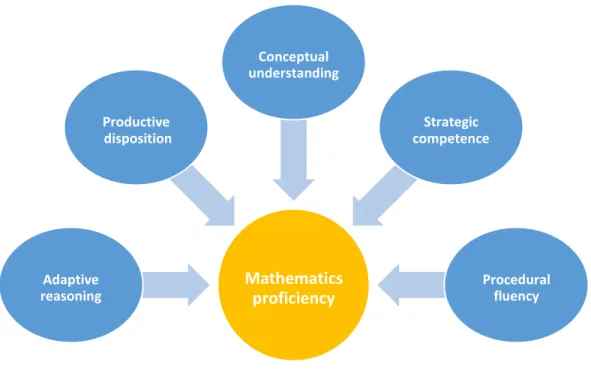
mathematical tools (Bowie & Reed, 2016). Figure 2.1 shows Bowie and Reed‘s (2016) five components of mathematics proficiency.
Figure 2.1: Five components of mathematics proficiency Source: (Bowie & Reed, 2016)
2.6.2 Mathematics content areas in the intermediate phase Mathematics content areas in the intermediate phase are as follows: Table 2.3: Content areas for Grade 4, Grade 5 and Grade 6
Content areas Grade 4 Grade 5 Grade 6
Numbers, Operations & Relationship 50% 50% 50%
Patterns, Functions and Algebra 10% 10% 10%
Space & Shape (Geometry) 15% 15% 15%
Measurement 15% 15% 15% Data Handling 10% 10% 10% Mathematics proficiency Adaptive reasoning Productive disposition Conceptual understanding Strategic competence Procedural fluency
24
100% 100% 100%
Source: (DBE, 2011) 2.6.3 Mathematics anxiety
Mathematics anxiety is defined as ―feelings of tension and anxiety that interfere with the manipulation of numbers and solving mathematical problems in a wide variety of ordinary life and academic situations‖ (Richardson & Suinn, 1972, p.551, in Haciomeroglu, 2017). Haciomeroglu (2017, p. 59) observes that ―mathematics can be a rich context through facilitating connections to real life examples but for those who are not mathematically inclined, encouraging these connections may be overwhelming‖. Furthermore, ―although learners often begin their schooling with a positive attitude towards mathematics, mathematical experiences gained in school play a detrimental role in learners’ anxiety and attitude towards mathematics‖ (Haciomeroglu, 2017). Learners often experience anxiety when mathematics is associated with assessment and problem solving. Such an anxious and negative attitude towards mathematics has negative implications for learners’ academic performance in school.
According to the National Council for Teachers of Mathematics (NCTM) (2014), educators should do the following to counteract mathematics anxiety in their learners:
• Establish mathematics goals to focus learning.
• Implement tasks that promote reasoning and problem solving.
• Use and connect mathematical representation.
• Facilitate meaningful mathematical discourse.
• Pose purposeful questions.
• Build procedural fluency from conceptual understanding.
• Support productive struggle in learning mathematics.
25
2.6.4 Ensuring inclusivity in mathematics
Naude and Meier (2014) argue that the classroom must be a place where learners will trust that it is safe to express their feelings. Language must be used to create a classroom environment where learners and teachers respect each other. Learners must first believe that they are valued before they can value others and learn from them. Furthermore, in most South African schools the LoLT in the intermediate phase is English, creating a communication barrier between learners and educators who do not share the same linguistic background and who have little knowledge of the language communities from which the other comes (Naude & Meier, 2014).
Most importantly the best way for learners to learn in the inclusive mathematics classroom is for educators to organise and plan appropriate experiences so that learners will be able to individually construct mathematical meaning, regardless of their diversity. Educators should plan their lessons for learners with barriers to learning with the same dedication that they plan lessons to challenge stronger learners. Learners should also work collaboratively with other learners to solve mathematical problems, guided by open-ended questions set by the educator. Mathematical activities must be learner-centred rather than teacher-centred. Teachers should prioritise a classroom environment in which learning is accessible to all learners (Bond & Chernoff, 2015).
Inclusion in mathematics requires an educator to alter the learning plan of each individual learner to maximize the likelihood they can participate in classroom activities according to their own ability (Sharma & Nuttal, 2016). Ollerton (2009) further affirms that inclusivity can be ensured by using outdoor games when teaching mathematics. Recreational, out-of classroom activities can be used as learning context which learners could relate to and use and apply within their mathematics lessons. Engaging mathematics for all learners includes using the playground, dance, fashion and architecture as context for learning mathematics (Ollerton, 2009). Inclusive education in mathematics is possible when teaching, using resources the learners are familiar with. Learners need to take an active role to develop their mathematical thinking skills through engaging with rich mathematical tasks. It also reveals
26
that reduction of textbook activities can promote inclusion in mathematics because they will do activities within their context.
Tan (2017) argues from personal experience that promoting inclusive mathematics education has mostly met with staunch resistance on the part of the educators. Pinel (2017) recommends that teaching geometry (mathematics) in inclusive education should be done by using visually rich, tactile media to move together from simple beginnings to build a firm trust-based relationship with the learners, who are themselves empowered to arrive at a cleaner and deeper understanding of their own outcomes.
Angelova (2014) agrees to a novel way of teaching mathematics also in an inclusive education classroom setting as she proposes a system of exercise which focuses on targeted building of combinatorial competences in students. This provides opportunities which are anchored in a structured learning content and the appropriate set of problems with their methodological developments for build-up and deepening of logical knowledge to students in primary school age.
Globally and nationally, departments of education have implemented inclusive education in schools as one of the policies in ensuring quality education for all. However, the success of the implementation was completely dependent on the educator. An educator is always considered the key person in the implantation of inclusive Education (De Boer, Pijil & Minnaert, 2011). De Boer et al. (2011) attest that inadequate training and support offered to educators has resulted in the failure of inclusive education. Therefore, with continuous support and capacity building workshops, educators would be better equipped to face the challenges presented by inclusive education. Ultimately the educator plays a pivotal role, with support and liaising with other stakeholders within the school environment. De Boer et al. (2011) is of the opinion that educators thus face the greatest liability and responsibility for implementing inclusive education, since the educator is the one who has direct contact with the learners.
27
• Focusing on learner’s ideas and valuing their contribution in order to minimise misconceptions.
• Describing mathematics concepts using the simple language and example from their own context.
• Helping learners to create their own mathematical identity and their own ways of solving mathematical problems.
• Sharing the authority of mathematics and setting tasks that promote reasoning and problem solving. Rote learning should be minimised at all cost.
2.6.5 Assessment practices
Shohamy (2014) cited by Pennington and Richards (2016) defines assessment as any procedure or activity that is used to measure the attitude, skills and knowledge of learners in schools. This is supported by Hanna and Dettmer (2014), who state that assessment is a process of gathering data used by instructors about their teaching and learning in their learners. This will assist in the evaluation of learners’ performance. According to Roos (2018), assessment in the mathematics classroom can be a concept with broad boundaries. This means it can be done in different ways, for example through tests, through documentation such as written individual action plans, or through communication between the teacher and the learner during day-to-day work. Assessment is an activity that has strong connections between learning and teaching (Roos, 2018).
2.6.6 Curriculum differentiation
Differentiation refers to education shaped differently for different students (Bottge, Cohen & Choi, 2018). The goal with differentiation is to fit the education to all learners, and since the students are different, the education needs to be different. Another term used in relation to differentiation in mathematics is ability grouping. When using ability grouping, learner's ability in mathematics is assessed and the learners are divided into different ability groups.
28
2.7 AN OVERVIEW OF CONSTRUCTIVIST THEORY
In this study, constructivist theory was employed to assess inclusive education practices in the intermediate phase mathematics classroom. This theory was suggested by the Russian psychologist, Lev Vygotsky, who advocated the learning theory that maintained that our specific mental structures and processes can be traced back to our interactions with others (Woolfolk, 2007). The rationale for choosing this theory was that Vygotsky constructivist approach resonates strongly with inclusive practices in general, and with mathematics teaching in particular.
Walqui (2006, p. 160) sums up the core ideas of Vygotsky’s learning theory as follows:
• Learning precedes development.
• Language is the main vehicle (tool) of thought.
• Mediation is central to learning.
• Social interaction is the basis of learning and development. Learning is a process of apprenticeship and internalisation in which skills and knowledge are transformed from the social into the cognitive plane.
• The Zone of Proximal Development (ZPD) is the primary activity space in which learning occurs.
Constructivist theory underlines how context contributes towards learning and development. The LoLT, the learning environment, and the social environment are therefore seen as critical elements in successful teaching and learning. Kussumua (2007, p.14) defines constructivism in the following way: ―Constructivism is a theory based on observation and the scientific study of how people learn and further states that people construct their own understanding and knowledge of the world through experiencing things and reflecting on those experiences‖.
Constructivists argue that teachers cannot impart knowledge to learners, and that learners learn only through engaging in activities that promote discovery. Stiff (2001) points out that a constructivist approach requires learners to be actively involved in their knowledge and be free to use their own strategies to learn. Learners construct their knowledge best when it