Methods to improve recruitment to
randomised controlled trials: Cochrane
systematic review and meta-analysis
Shaun Treweek,1Pauline Lockhart,1Marie Pitkethly,2Jonathan A Cook,3 Monica Kjeldstrøm,4Marit Johansen,5Taina K Taskila,6Frank M Sullivan,1 Sue Wilson,6Catherine Jackson,7Ritu Jones,8Elizabeth D Mitchell9
To cite:Treweek S, Lockhart P, Pitkethly M,et al. Methods to improve recruitment to randomised controlled trials: Cochrane systematic review and meta-analysis.BMJ Open2013;3: e002360. doi:10.1136/ bmjopen-2012-002360
▸ Prepublication history and additional material for this paper are available online. To view these files please visit the journal online (http://dx.doi.org/10.1136/ bmjopen-2012-002360).
Received 16 November 2012 Revised 7 January 2013 Accepted 8 January 2013
This final article is available for use under the terms of the Creative Commons Attribution Non-Commercial 2.0 Licence; see
http://bmjopen.bmj.com
For numbered affiliations see end of article.
Correspondence to Dr Shaun Treweek; [email protected]
This review is an abridged version of a Cochrane Review previously published in the Cochrane Database of Systematic Reviews 2010, Issue 4, Art. No.: MR000013 DOI: 10.1002/14651858.MR000013.pub5 (see www.thecochranelibrary.com for information). Cochrane Reviews are regularly updated as new evidence emerges and in response to feedback, and Cochrane Database of Systematic Reviews should be consulted for the most recent version of the review.
ABSTRACT
Objective:To identify interventions designed to improve recruitment to randomised controlled trials, and to quantify their effect on trial participation.
Design:Systematic review.
Data sources:The Cochrane Methodology Review Group Specialised Register in the Cochrane Library, MEDLINE, EMBASE, ERIC, Science Citation Index, Social Sciences Citation Index, C2-SPECTR, the National Research Register and PubMed. Most searches were undertaken up to 2010; no language restrictions were applied.
Study selection:Randomised and quasi-randomised controlled trials, including those recruiting to
hypothetical studies. Studies on retention strategies, examining ways to increase questionnaire response or evaluating the use of incentives for clinicians were excluded. The study population included any potential trial participant (eg, patient, clinician and member of the public), or individual or group of individuals responsible for trial recruitment (eg, clinicians, researchers and recruitment sites). Two authors independently screened identified studies for eligibility.
Results:45 trials with over 43 000 participants were included. Some interventions were effective in increasing recruitment: telephone reminders to non-respondents (risk ratio (RR) 1.66, 95% CI 1.03 to 2.46; two studies, 1058 participants), use of opt-out rather than opt-in procedures for contacting potential participants (RR 1.39, 95% CI 1.06 to 1.84; one study, 152 participants) and open designs where participants know which treatment they are receiving in the trial (RR 1.22, 95% CI 1.09 to 1.36; two studies, 4833 participants). However, the effect of many other strategies is less clear, including the use of video to provide trial information and interventions aimed at recruiters.
Conclusions:There are promising strategies for increasing recruitment to trials, but some methods,
such as open-trial designs and opt-out strategies, must be considered carefully as their use may also present methodological or ethical challenges. Questions remain as to the applicability of results originating from hypothetical trials, including those relating to the use of monetary incentives, and there is a clear knowledge gap with regard to effective strategies aimed at recruiters.
ARTICLE SUMMARY
Article focus
▪ Despite representing the gold standard in
evalu-ating the effectiveness and safety of healthcare interventions, many randomised controlled trials do not meet their recruitment targets.
▪ Poor recruitment can lead to extended study
dur-ation, greater resource usage and findings that are not as statistically precise as intended; in the worst case, a trial may be stopped.
▪ A systematic review was carried out to identify
methods used to improve recruitment to rando-mised controlled trials, and to quantify their effects on participation.
Key messages
▪ There are promising strategies for increasing
recruitment to trials, most notably telephone reminders, open-trial designs, opt-out strategies and financial incentives.
▪ Many trials of recruitment methods involve
hypo-thetical trials, and the applicability of their results to the real world is still unknown.
▪ There is a clear knowledge gap with regard to
effect-ive strategies aimed at those recruiting to trials.
Strengths and limitations of this study
▪ This Cochrane review utilised a comprehensive
search and appraisal strategy, thereby ensuring that all relevant evidence was included.
▪ Many of the included studies were small,
increasing the likelihood of their being under-powered, and resulting in CIs that included the possibility of substantial benefit.
▪ The interventions evaluated by included studies
varied greatly, making it difficult to pool data for met-analysis.
INTRODUCTION
Randomised controlled trials represent the gold stand-ard in evaluating the effectiveness and safety of health-care interventions, primarily because they help guard against selection bias.1 Nonetheless, the recruitment of clinicians and patients to these studies can be extremely difficult.2While there are several possible consequences of poor recruitment, perhaps the most crucial is the potential for a trial to be underpowered.3 In such cir-cumstances, clinically relevant differences may be reported as statistically non-significant, increasing the chance that an effective intervention will either be aban-doned before its true value is established, or at the very least, delayed as further trials or meta-analyses are con-ducted. Similarly, while poor recruitment can be addressed by extending the length of a trial, this too can create delay in the roll-out of a potentially effective inter-vention, while increasing the cost and workload of the trial itself.
Several investigations of recruitment have attempted to quantify the extent of the problem, and while esti-mates differ, it is clear that many trials do not meet their recruitment targets.2 4–6Of those that do, many achieve them only after extending the length of the trial. A recent cohort study of 114 multicentre trials, supported by two of the UK’s largest research funding bodies (the Medical Research Council and the Health Technology Assessment Programme), found that less than a third achieved their original target (n=38; 31%), and more than half had to be extended (n=65; 53%).2In a similar study of 41 trials in the US National Institute of Health inventory, only 14 (34%) met or exceeded their planned recruitment, while a quarter (n=10; 24%) failed to recruit more than half.4 In many cases, trials may have to close prematurely due to recruitment problems.6
While trialists have used many interventions to improve recruitment, it has been difficult to predict the effect of these. The purpose of this review was to quan-tify the effects of specific methods used to improve recruitment of participants to randomised controlled trials, and where possible, to consider the effect of study setting on recruitment. Although there have been three previous systematic reviews on strategies to enhance recruitment to research, two do not include the most recent literature,7 8 while the third considers the com-bined effects of interventions across four strategic areas rather than the individual effects of specific interven-tions.9 Our synthesis builds on and updates an earlier Cochrane review;8the protocol and full review are avail-able from the Cochrane Library.10
METHODS
Criteria for inclusion Study types and participant
We included randomised and quasi-randomised con-trolled trials, including those recruiting to hypothetical studies, that is, where potential participants are asked if
they would take part in a trial if it was run, but where no trial exists. Studies examining ways to increase question-naire response rates, evaluating the use of incentives or disincentives to increase clinicians’ recruitment of patients or studying strategies to improve retention were excluded as these are addressed by other Cochrane Methodology Reviews (CMR).11–13The study population included any potential trial participant (eg, patient, clin-ician and member of the public), or an individual or a group of individuals responsible for recruiting trial parti-cipants (eg, clinicians, researchers and recruitment sites).
Types of intervention
A recruitment intervention was defined as any method implemented to improve the number of participants recruited to a randomised controlled trial, whether this was directed at potential participants, at those respon-sible for recruiting participants or at trial design or co-ordination. Interventions used in any study setting were included.
Outcome measure
The outcome of interest was the proportion of eligible individuals or centres recruited.
Identification of studies
We searched the CMR Group Specialised Register 2010, Issue 2, part of The Cochrane Library (http://www. thecochranelibrary.com), ERIC (Educational Resources Information Centre), CSA (1966 to April 2010), Science Citation Index and Social Sciences Citation Index, ISI Web of Science (1975 to April 2010), National Research Register (online) (2007, Issue 3), The Campbell Collaboration Social, Psychological, Education and Criminological Trials Registry (C2-SPECTR) (up to April 2008), MEDLINE, Ovid (1950 to March week 5 2010) and EMBASE, Ovid (1980 to 2010 week 14). The UK Cochrane Centre previously ran a series of searches in MEDLINE (in 2000) and EMBASE (in 2004) to identify reports of methodological studies, with the resulting cita-tions being subsequently entered into CMR. To increase the efficiency of our searches, we therefore restricted our searches of MEDLINE and EMBASE to records entered from 2001 and 2005, respectively. We searched PubMed to retrieve ‘related articles’ for 27 studies included in the previous version of this review. No lan-guage restrictions were imposed. A sample search is given in appendix 1; the complete strategy is available online from the Cochrane Library.10
Selection of studies
Titles and abstracts of identified studies were independ-ently screened for eligibility by two reviewers. Full text versions of papers not excluded at this stage were obtained for detailed review. Potentially relevant studies were then independently assessed by two reviewers to determine if they met the inclusion criteria. Differences
of opinion were discussed until a consensus was reached; the opinion of a third reviewer was sought when necessary.
Data extraction and assessment of bias
Data extraction of included studies was carried out inde-pendently by two reviewers (ST with EM, PL or MP) using a pro-forma specifically designed for the purpose. Data were extracted on trial design, study setting, partici-pants, inclusion and exclusion criteria, interventions and outcomes evaluated and results. In addition, data on the method of randomisation, allocation conceal-ment (adequate, clear and inadequate), blinding (full, partial and none), adequacy (objective, unclear and subjective) and reporting of outcome measures and level of follow-up were collected to allow the risk of bias in each study to be determined.14 This was independ-ently assessed by the same two reviewers, and sum-marised in line with Cochrane guidance (A, low risk; B, moderate risk and C, high risk).15 Studies at a high risk of bias were not excluded, but results were interpreted in light of this.
Data synthesis
Data were processed in accordance with the Cochrane handbook.15 Trials were grouped according to the type of intervention evaluated (eg, monetary incentives, alter-native forms of consent, etc), with intervention group-ings based on similarities in form and content. Where available, binary data were combined as risk ratios (RR) and the associated 95% CIs generated. Cluster rando-mised controlled trials were included only where there were sufficient data to allow analyses that adjusted for clustering. In such a case, an odds ratio (OR) was used as the summary effect in the meta-analysis, with the pooled result subsequently being converted to an RR using the average comparator group risk.
Heterogeneity was explored using the χ2test, and the degree of heterogeneity observed (ie, the percentage of
variation across studies due to heterogeneity rather than to chance) was quantified with the I2 statistic. Where there was substantial heterogeneity, we informally investi-gated possible explanations and summarised data using a random-effects analysis if appropriate. Subgroup ana-lyses were planned to explore key factors considered to be potential causes of heterogeneity, namely (1) trial design (randomised vs quasi-randomised); (2) conceal-ment of allocation (adequate vs inadequate or unclear); (3) study setting ( primary vs secondary care; healthcare vs non-healthcare); (4) study design (open vs blinded; placebo vs none); (5) target group (clinicians, patients and researchers) and (6) recruitment to hypothetical versus real trials. However, there were too few studies evaluating the same or similar interventions to allow these analyses to be conducted. Similarly, it was not pos-sible to explore publication bias.
RESULTS
Description of studies Search results
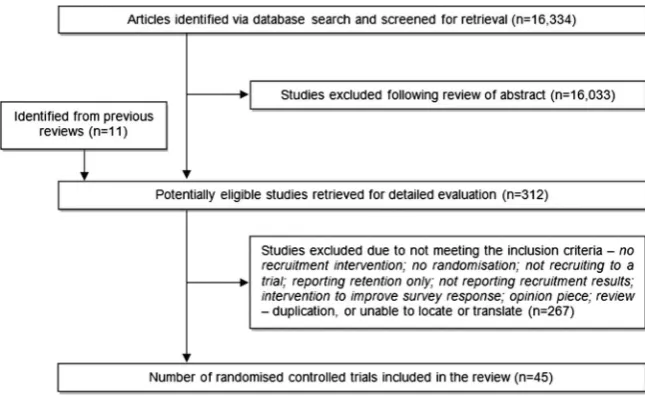
The search strategy identified 16 334 articles, of which 301 appeared to meet the inclusion criteria and were subject to detailed review (figure 1). We retrieved the full text of an additional 10 papers identified from the reference lists of previous reviews, and one article pub-lished out with the search period but which appeared relevant, giving a total of 312 potentially eligible studies. Forty-five papers, targeting more than 43 000 individuals, were included in thefinal analysis. Nineteen studies eval-uated recruitment to hypothetical trials (table 1).
Study characteristics
[image:3.595.229.552.551.749.2]Almost half of the studies were carried out in North America (n=21; 47%), with the remainder located in Europe (n=18; 40%) and Australia (n=5; 11%). One study involved centres in 19 countries worldwide. Studies were comparatively small in size, involving between 6 and 2561 participants (mean 493; median 79). It was
Figure 1 Flow of studies into the review.
Table 1 Summary of included studies
Authors
(country) RCT design Setting Intervention(s) Comparator Participants
Recruited to intervention(s)
Recruited to comparator
Risk of
bias* Comments†
Avenellet al
(UK)16
Parallel group Secondary care
Open trial design comparing vitamin D, with calcium, with vitamin D and calcium, with no tablets
Conventional trial comparing vitamin D, with calcium, with vitamin D and calcium, with placebo
Patients aged≥70 attending a fracture clinic or orthopaedic ward
134/180 (74.4%) 233/358 (65.1%) A Between-group difference was statistically significant (OR 1.56; 95% CI 1.05 to 2.33)
Bentley and Thacker (USA)17
Factorial University (multicentre, n=5)
A:Info on a high-risk trial for a drug not yet tested on humans, pays $1800
Not applicable Pharmacy
students
Unclear Not applicable C Assessed willingness to take part in hypothetical studies by risk and reward; did not differentiate recruitment rates between groups (270 participants); between-group differences were statistically significant for both risk level (p<0.0005) and level of payment (p=0.015)
B:Info on a high-risk trial for a drug not yet tested on humans, pays $800
Unclear
C:Info on a high-risk trial for a drug not yet tested on humans, pays $350
Unclear
D:Info on a medium-risk study for a generic drug already on the market, pays $1800
Unclear
E:Info on a medium-risk study for a generic drug already on the market, pays $800
Unclear
F:Info on a medium-risk study for a generic drug already on the market, pays $350
Unclear
G:Info on a low-risk study measuring the salivary levels of stress hormones, pays $1800
Unclear
H:Info on a low-risk study measuring the salivary levels of stress hormones, pays $800
Unclear
I:Info on a low-risk study measuring the salivary levels of stress hormones, pays $350
Unclear
Cooperet al
(UK)18
Parallel group Secondary care
Partially randomised patient preference design allocating to medical management or transcervical resection of the endometrium or preferred option
Conventional RCT design allocating to medical
management or transcervical resection of the endometrium
First time attendees at a gynaecological clinic
90/135 (96.3%) 97/138 (70.3%) A No information on statistical significance given
Coyneet al
(USA)19
Cluster Secondary
care (multicentre, n=44)
Easy-to-read consent statements (altered text style, layout, font size, vocabulary; reading level 7th–8th grade)
Standard consent statements
Patients eligible for participation in a cancer treatment trial
75/89 (84.3%) 68/137 (49.6%) C Involved consent statements for three cancer treatment trials (one lung, two breast cancer); actual accrual to the parent studies was not significantly different (p=0.32)
T
re
w
eek
S,
Lockhart
P
,
Pitk
ethly
M,
et
al
.
BMJ
Open
2013;
3
:e002360.
doi:10.1136/
bmjopen-20
12-002360
Impr
o
v
ing
recruitment
to
RC
Ts
group.bmj.com
on August 6, 2013 - Published by
bmjopen.bmj.com
(country) RCT design Setting Intervention(s) Comparator Participants intervention(s) comparator bias* Comments†
DiGuiseppiet al
(USA)20
Parallel group Health Maintenance Organisation (HMO) (multicentre)
Telephone administered questionnaire on hazardous drinking and willingness to participate in lifestyle intervention
Face-to-face administered questionnaire on hazardous drinking and willingness to participate in lifestyle intervention
Patients aged≥18 attending the HMO with an acute injury
64/99 (64.6%) 190/370 (51.4%) C Considered different methods of screening, which included willingness to participate in a hypothetical trial; the telephone group was somewhat more often associated with willingness to participate (OR 1.49; 95% CI 0.97 to 2.30)
Duet al(USA)21 Parallel group Secondary
care
18 min educational video giving an overview of clinical trials and the importance of cancer clinical research to society
Standard care (ie, normal first visit to the oncologist)
Patients aged 21– 80 attending a multidisciplinary lung clinic at a cancer centre
11/63 (17.5%) to therapeutic trials; 16/63 (25.4%) to all trials
7/63 (11.1%) to therapeutic trials; 10/63 (15.9%) to all trials
B Considered recruitment to a range of cancer trials categorised into
‘therapeutic’, and
‘therapeutic and non-therapeutic’; between-group difference was not statistically significant for therapeutic trials (p=0.308) or for all trials (p=0.187) Duet al(USA)22 Parallel group Secondary
care
18 min educational video giving an overview of clinical trials and the importance of cancer clinical research to society
Standard care (ie, normal visit to the oncologist)
Women aged 21– 80 attending a breast cancer clinic at a cancer centre
10/98 (10.4%) 6/98 (6.1%) C Between-group difference was not statistically significant (p=0.277)
Elliset al
(Australia)23
Parallel group Secondary care
Information booklet explaining trials, how treatment is selected in an RCT, discussion of treatment options, advantages and disadvantages of participation, where to get more info plus usual discussion about treatment options from the clinician, inc. RCTs if appropriate (no standardisation of what is discussed)
Usual discussion about treatment options from the clinician, inc RCTs if appropriate (no standardisation of what is discussed)
Women undergoing definitive surgery for early stage breast cancer at a cancer institute
12/30 (40.0%) at follow-up
14/30 (46.7%) at follow-up
C Studied willingness to participate in a hypothetical trial; between-group difference was statistically significant (p=0.05)
Fordet al(USA)24 Parallel group Community
(multicentre, n=2)
A:Enhanced recruitment letter, phone screening by an African American interviewer, baseline questionnaire by mail, reminder calls/mailings for baseline info and consent
Standard recruitment letter, phone screening by an African American/ Caucasian interviewer, baseline questionnaire by mail, reminder calls/ mailings for return of baseline info and consent
African American men aged 55–74, eligible for a prostate, lung and colorectal cancer screening trial
78/3079 (2.5%) 95/3297 (2.9%) B Between-group difference was statistically significant (p<0.01)
B:Enhanced recruitment letter, phone screening by an African American interviewer, baseline questionnaire by phone, reminder calls/mailings for consent form
87/3075 (2.8%)
Continued
P
,
Pitk
ethly
M,
et
al
.
BMJ
Open
2013;
3
:e002360.
doi:10.1136/
bmjopen-20
12-002360
Impr
o
v
in
g
recruitment
to
RCTs
group.bmj.com
on August 6, 2013 - Published by
bmjopen.bmj.com
[image:5.595.58.740.63.539.2]Table 1 Continued
Authors
(country) RCT design Setting Intervention(s) Comparator Participants
Recruited to intervention(s) Recruited to comparator Risk of
bias* Comments†
C:Enhanced recruitment letter, phone screening by an African American interviewer, reminder for project session held at church, baseline questionnaire at church session
116/2949 (3.9%)
Fowellet al(UK)25 Clustered cross-over
Secondary care (multicentre, n=2)
Cluster randomisation Zelen’s design (only those randomised to intervention arm asked for consent)
Cancer inpatients receiving palliative care and starting on a syringe driver
6/24 (25%) 0/29 (0%) C Considered the effect of trial design on potential recruitment rate; aimed to explore the feasibility of the two designs for studies of dying patients;
between-group difference was statistically significant (p=0.02)
Freeet al(UK)26 Parallel group Community
(multicentre, n=2)
A: A letter containing study and consent information, and a £5 note
Normal trial procedures (letter and patient information sheet)
Members of the public who are aged≥16, are daily smokers and willing to quit in the next month
13/246 (5.3%) 1/245 (0.4%) A Evaluated interventions in separate trials;
between-groups differences were statistically significant for both the financial incentive (OR 4.9; 95% CI 2.0 to 7.7) and text messages (OR 4.2; 95% CI 2.2 to 6.1)
B: Four text messages over 1 week containing quotes from existing participants
Normal trial procedures (letter and patient information sheet)
17/405 (4.2%) 0/406 (0%)
Freeret al(UK)27 Parallel group Tertiary
neonatal intensive care unit
A: Five page US version of a study information leaflet (inc. more detail on study process, risks, benefits and patient rights) plus standard verbal explanation
US version of an information leaflet without verbal explanation
Parents of immature infant(s) admitted to the NICU but not requiring intensive care
5/9 (56%) 3/9 (33%) B Considered the impact of
information on parents’ understanding of a research study and the validity of their consent to participation in a hypothetical trial; no information on statistical significance given
B: Less detailed single sheet UK version of a study information leaflet plus standard verbal explanation
UK version of an information leaflet without verbal explanation
5/9 (56%) 4/10 (40%)
Furemanet al
(USA)28
Parallel group Existing trial (university based)
Enhanced video on an HIV vaccine trial plus a 1 h pamphlet
presentation (5 min pre-test, 26 min of video, 10 min to review pamphlet, RA initiated Q&A session, post-test questionnaire, survey at 1 month
Standard half hour pamphlet-only presentation (5 min pre-test, 10 min to review a trial info pamphlet, RA initiated Q&A session, post-test questionnaire, survey at 1 month
Participants in the Risk Assessment Project (injection drug users)
1.84 (post-test 1); 1.69 (post-test 2)
1.70 (post-test 1); 1.50 (post-test 2)
C Studied recruitment to a hypothetical trial (targeted 98 individuals for intervention, 88 for comparator); results provided as mean willingness scores; between-group difference was not statistically significant (p>0.1) Grahamet al
(USA)29
Parallel group Health Maintenance Organisation (multicentre)
A: Electronic questionnaire on hazardous drinking and willingness to participate in lifestyle intervention
Standard
self-complete paper questionnaire
Patients aged≥18 attending the HMO with an acute injury
69/151 (45.7%) 76/141 (53.9%) C Considered different methods of screening, which included willingness to participate in a hypothetical 42/78 (53.8%) T re w eek S, Lockhart P , Pitk ethly M, et al . BMJ Open 2013; 3 :e002360. doi:10.1136/ bmjopen-20 12-002360 Impr o v ing recruitment to RC Ts group.bmj.com
on August 6, 2013 - Published by
bmjopen.bmj.com
trial; between-group difference was statistically significant (p=0.001)
B: Oral questionnaire read aloud to patients in the clinic, potential answers printed on cards and patients asked to point Halpernet al
(USA)30
Within-subject design
Secondary care
A: Variation in trial information on (1) the percentage of previous patients experiencing an adverse effect from the study drug (10%, 20%, 30%) and (2) payment participants would receive ($100, $1000, $2000)
Not applicable Patients with mild to moderate hypertension attending an outpatient clinic
Unclear Not applicable C Assessed willingness to take part in hypothetical studies by risk and reward; did not provide recruitment rates (126 participants); there was a statistically significant increase in willingness to participate as risk of adverse effects reduced (p<0.001), payment level rose (p<0.001), and the risk of being assigned to placebo decreased (p=0.02)
B: Variation in trial information on (1) the percentage of patients who would be assigned to placebo (10%, 30%, 50%) and (2) the payment level (payment in range typically offered to participants in phase 3 trials of antihypertensive drugs)
Unclear
Harriset al(UK)31 Factorial Community A: Personal recruitment letter and
info plus telephone reminder (up to four) plus questionnaire on physical activity
Not applicable Households of older people aged
≥65, able to walk outside and registered with one GP practice
69/140 (49.3%) Not applicable A Between-group difference was statistically significant for telephone reminders (OR 1.5; 95% CI 1.0 to 2.3), but not for the inclusion of a questionnaire (OR 0.9; 95% CI 0.6 to 1.3)
B: Personal recruitment letter and info plus telephone reminder (up to four)
65/140 (46.4%)
C: Personal recruitment letter and info plus questionnaire on physical activity
47/140 (33.6%)
D: Personal recruitment letter and info only
59/140 (42.1%)
Hemminkiet al
(Estonia)32
Parallel group Local clinics (multicentre)
Non-blinded allocation comparing active HRT treatment with no treatment
Traditional blinded allocation comparing active HRT treatment with placebo
Postmenopausal women aged 50– 64
1027/2159 (47.6%)
796/2136 (37.3%)
A Between-group difference was statistically significant (p<0.001)
Hutchisonet al
(UK)33
Parallel group Secondary care
Video giving generic and
site-specific trial info with a focus on randomisation, pictures of patients receiving care and a voiceover discussing uncertainty plus standard practice
Standard practice of clinician from tumour site team discussing trial and administering trial specific info sheet and consent form; at next visit patient sees a clinician from the same team to decide on treatment and whether it will be part of a trial
Patients with colorectal, breast or lung cancer, and eligible for a cancer treatment trial
62/86 (72.1%) 66/87 (75.9%) A Considered recruitment to a range of cancer trials; between-group difference was not statistically significant (p=0.661)
P
,
Pitk
ethly
M,
et
al
.
BMJ
Open
2013;
3
:e002360.
doi:10.1136/
bmjopen-20
12-002360
7
Impr
o
v
in
g
recruitment
to
RCTs
group.bmj.com
on August 6, 2013 - Published by
bmjopen.bmj.com
[image:7.595.51.727.57.551.2]Table 1 Continued
Authors
(country) RCT design Setting Intervention(s) Comparator Participants
Recruited to intervention(s) Recruited to comparator Risk of
bias* Comments†
Iveset al(UK)34 Parallel group Secondary
care
Standard trial information plus booklet entitled,“Clinical Trials in HIV and AIDS: Information for people who are thinking about joining a trial”
Standard trial information (information sheet specific to proposed trial plus discussion with trial doctor and research nurse)
Patients attending an HIV hospital clinic
15/23 (65.2%) 11/27 (40.7%) C Considered recruitment of patients eligible for participation in eight trials being carried out at the participating institution; no information on statistical significance given Jesteet al
(USA)35
Parallel group Secondary care
Multimedia consent with DVD presenting key information from consent form, including
simultaneous narrative explanation; researcher also present to answer questions
Routine consent procedure plus 10 min control DVD giving general information about research; researcher also present to answer questions Outpatients aged >40 with schizophrenia, and healthy comparison subjects 41/62 (66.1%) patients with schizophrenia; 23/31 (74.2%) healthy comparisons 44/66 (67.2%) patients with schizophrenia; 22/29 (75.9%) healthy comparisons
B Studied agreement to participate in a hypothetical trial; between-group differences were not statistically significant (no p value provided)
Karunaratneet al
(Australia)36
Parallel group Secondary care
Computer-based, interactive presentation of study information inc. diagrams, video clips, hyperlinks, quiz pages
Conventional paper-based study information
Patients aged 18– 70 attending an outpatient diabetic clinic
23/30 (76.7%) 17/30 (56.7%) C Considered participant understanding of consent materials, including interest in participating in a hypothetical trial; between-group difference was statistically significant (p=0.01)
Kendricket al
(UK)37
Parallel group Primary care (multicentre)
Mailed invitation to participate in an injury prevention trial, including a home safety questionnaire
Mailed invitation to participate excluding home safety questionnaire Families with children aged<5 years, living in deprived areas
217/1203 (18.0%) 157/1190 (13.2%)
A Between-group difference was statistically significant (p=0.001)
Kerret al(UK)38 Parallel group Further
education colleges (multicentre, n=5)
A: Leaflet describing a trial of two treatments for arthritis, where A and B are described as standard treatments
Not applicable Students aged
≥18 enrolled on further education/ leisure courses
24/29 (82.8%) Not applicable C Studied willingness to participate in a hypothetical trial; did not provide recruitment rates (130 participants); between-group difference was statistically significant (p<0.001), with those who had a preference for a standard treatment— available outside of the trial
—less willing to participate than those with no preference
B: Leaflet describing a trial of two treatments for arthritis, where A is described as new treatment and B as standard treatment
10/17 (58.8%)
C: Leaflet describing a trial of two treatments for arthritis, where B is described as new treatment and A as standard treatment
13/16 (81.3%)
D: Leaflet describing a trial of two treatments for back pain, where A and B are described as standard treatments
26/31 (83.9%)
E: Leaflet describing a trial of two treatments for back pain, where A is described as new treatment and B as standard treatment
10/15 (66.7%) T re w eek S, Lockhart P , Pitk ethly M, et al . BMJ Open 2013; 3 :e002360. doi:10.1136/ bmjopen-20 12-002360 Impr o v ing recruitment to RC Ts group.bmj.com
on August 6, 2013 - Published by
bmjopen.bmj.com
F: Leaflet describing a trial of two treatments for back pain, where B is described as new treatment and A as standard treatment
10/16 (62.5%)
Kimmicket al
(USA)39 Cluster Secondary care and academic institutions (multicentre, n=126)
Educational intervention of standard info plus an educational
symposium, geriatric oncology educational materials, monthly mailings and emails for 1 year, lists of available protocols for use on patient charts, case discussion seminar
Standard information of periodic
notification of all existing CALGB (Cancer and Leukaemia Group B) trials by the CALGB Central Office, and CALGB web site access
Practitioners and researchers from CALGB institutions
36% in year 1; 31% in year 2
32% in year 1; 31% in year 2
C Considered recruitment of older people to existing CALGB treatment trials for a range of cancers;
between-group difference was not statistically significant at year 1 (p=0.35) or at year 2 (p=0.83)
Larkeyet al
(USA)40
Parallel group Existing trial sites (multicentre, n=2)
A: Hispanic lay advocates; attended 6 h long training sessions, five quarterly meetings and received brochures with interest cards to distribute to other women
Anglo women controls, received quarterly‘phone calls and brochures with interest cards to distribute to other women
Participants in the Women’s Health Initiative trial
13/31 referrals (41.9%)
2/19 referrals (10.5%)
B Determined whether Hispanic women already enrolled in a study and trained as lay advocates would refer/enrol more participants than untrained Hispanic women and Anglo controls; between-group difference was statistically significant (p<0.01)
B: Hispanic women controls, received quarterly‘phone calls and brochures with interest cards to distribute to other women
0/3 referrals (0.0%)
Liénardet al
(France)41
Cluster Secondary
care (multicentre, n=135)
Site visits including an initiation visit to review trial protocol, inclusion/ exclusion criteria, safety, randomisation, etc plus ongoing review visits
No site visits (unless requested)
Centres recruiting to an RCT for breast cancer
302 271 A No denominator data
provided; between-group difference was not statistically significant (no p value provided)
Litchfieldet al
(UK)42
Cluster Primary care
(multicentre, n=28)
Internet-based collection of trial data
Paper-based collection of trial data
28 participating GP practices
45/52 (86.5%) 28/28 (100%) B Considered efficiency and ease of use of internet versus conventional paper-based data capture, and looked at recruitment incidentally; between-group difference was statistically significant (p=0.04) Llewellyn-Thomas
et al(Canada)43
Parallel group Secondary care
A: Booklet with negatively framed intervention about treatment side-effects and survival
Booklet with neutrally framed intervention about treatment side-effects and survival Colorectal cancer patients attending cancer hospital outpatients
20/30 (66.7%) 23/30 (76.7%) B Determined the impact of probabilistic info on entry to a hypothetical trial; between-group difference was not statistically significant (p>0.40)
B: Booklet with positively framed intervention about treatment side-effects and survival
18/30 (60.0%)
Llewellyn-Thomas
et al(Canada)44
Parallel group Secondary care
Searchable computerised info on imaginary trial, including purpose, description of treatment arm and randomisation, possible benefits, side-effects, patients’rights
Tape-recorded info on imaginary trial, including purpose, description of treatment arm and
Patients attending the outpatient department of a cancer hospital
31/50 (62.0%) 21/50 (42.0%) B Studied recruitment to a hypothetical trial; between-group difference was statistically significant (p<0.05, unadjusted) P , Pitk ethly M, et al . BMJ Open 2013; 3 :e002360. doi:10.1136/ bmjopen-20 12-002360 9 Impr o v in g recruitment to RCTs group.bmj.com
on August 6, 2013 - Published by
bmjopen.bmj.com
[image:9.595.49.737.57.547.2]Table 1 Continued
Authors
(country) RCT design Setting Intervention(s) Comparator Participants
Recruited to intervention(s)
Recruited to comparator
Risk of
bias* Comments†
randomisation, possible benefits, side-effects, patients’ rights
Mandelblattet al
(USA)45
Parallel group Community (multicentre,
n=3)
5–10 min educational counselling session about the trial delivered by non-physician study staff (inc benefits and risk of participation and need for minority participation) plus an informational brochure
Informational brochure only
Spanish speaking women who were eligible for a trial on women at high risk of breast cancer
178/232 (76.7%) general intent;118/232 (50.9%) if mild side-effects mentioned;108/ 232 (46.6%) if uterine cancer mentioned
147/218 (67.4%) general intent;118/218 (54.1%) if mild side-effects mentioned;97/ 218 (44.5%) if uterine cancer mentioned
C Results relate to intention to participate (‘might, probably or definitely would’); between-group difference was statistically significant for general intention to participate (p=0.03)
Milleret al(USA)46 Parallel group Secondary care, primary care and community
Eligibility screening and recruitment by a senior investigator
Eligibility screening and recruitment by a Research Assistant
Patients aged 18–75, eligible for participation in two chronic depression treatment trials
28/162 (17.3%) 22/185 (11.9%) C Considered the relationship between interviewer experience and positive predictive value and cost of telephone screening, and looked at recruitment incidentally; between-group difference was not statistically significant (p=0.30)
Monaghanet al
(Worldwide)47
Cluster Existing trial sites (multi-centre, n=167)
Additional communication—usual plus frequent emails, regular personalised mail-outs of league tables/graphs of performance against other sites, certificates of achievement for recruitment/other study items (1/month)
Usual communication (provided via the regional centre) plus occasional direct communications from the
co-ordinating centre in the form of generic newsletters, emails and faxes
Clinical sites in 19 countries recruiting to a diabetes and vascular disease treatment trial
37.5 (27.0–51.5) 37.0 (21.0–54.5) A Result provided as median number of participants recruited; between-group difference was not statistically significant (p=0.68)
Myleset al
(Australia)48
Parallel group Secondary care
A: Prerandomised to experimental drug and asked to provide consent; if no consent, standard treatment given
Standard randomisation method (equal chance of either drug)
Inpatients aged
≥18, scheduled for elective surgery
90/169 (53.3%) 84/151 (55.6%) B Considered recruitment to a hypothetical trial;
between-group difference was not statistically significant (p=0.66)
B: Prerandomised to standard drug and asked to provide consent; if no consent, experimental treatment given
79/149 (53.0%)
C: Told that physician thinks experimental drug superior, if consent given, has 70% chance of receiving this; if no consent, standard treatment given
91/150 (60.7%)
T
re
w
eek
S,
Lockhart
P
,
Pitk
ethly
M,
et
al
.
BMJ
Open
2013;
3
:e002360.
doi:10.1136/
bmjopen-20
12-002360
Impr
o
v
ing
recruitment
to
RC
Ts
group.bmj.com
on August 6, 2013 - Published by
bmjopen.bmj.com
†
D: Allowed to increase or decrease chance of receiving experimental drug if consent given, and if no preference, 50% chance of receiving it; if no consent, standard treatment given
85/150 (56.7%)
Nystuen and Hagen (Norway)49
Parallel group Community (multicentre,
n=6)
Written invitation to participate in a community-based trial followed by a
‘phone reminder if no response within 2 weeks; guide used for discussion
Written invitation to participate in a community-based trial followed by no reminder if no response within 2 weeks
Sick-listed employees attending a participating social security office
31/256 (12.1%) 11/242 (4.5%) A Between-group difference was statistically significant (p=0.003)
Perroneet al
(Italy)50
Parallel group Community A: randomised consent to new treatment; if no consent given standard treatment
On consent to participate, standard or new treatment assigned at random; if no consent, given standard treatment
Members of the general public aged 16–80, attending a scientific exhibition
997/1151 (86.6%) 836/985 (84.9%) C Studied recruitment to a hypothetical trial; between-group difference was significant for both the single (p=0.08) and double consent scenarios (p<0.0001)
B: randomised consent to standard treatment; if no consent given new treatment
246/474 (51.9%)
C:if consents to participate, standard or new treatment assigned at random; if no consent, can choose standard or new treatment
482/607 (79.4%)
Pighillset al
(UK)51
Parallel group Primary care (multicentre)
A: Newspaper article about the trial included with recruitment materials
Usual recruitment materials only
Men and women aged≥70 who had at least one fall in the previous 12 months
73/2243 (3.3%) 71/2245 (3.2%) B Evaluated interventions in separate trials;
between-group differences were not statistically significant (p=0.80; p=0.62)
B: Inclusion of a more‘upbeat’ newspaper article about the trial
Inclusion of the
Intervention A
newspaper article
57/1374 (4.1%) 54/1371 (3.9%)
Simel and Feussner (USA)52
Parallel group Secondary care
Consent form including a statement that the new treatment may work twice as fast as usual treatment
Consent form including a statement that the new treatment may work half as fast as usual treatment
Patients attending an ambulatory care clinic
35/52 (67.3) 20/48 (41.7%) B Considered recruitment to a hypothetical trial;
between-group difference was statistically significant (p<0.01)
Simeset al
(Australia)53
Parallel group Secondary care
Individual approach to consent— patients given info about aims, expected results, potential toxicities of treatment; details of treatment left to discretion of consultant; patients given opportunity to ask questions, verbal consent obtained
Total disclosure approach—patients fully informed about all trial aspects by consultant: patients given opportunity to ask questions, also given a consent form outlining the info; this was kept overnight and written consent obtained next day
Patients attending an oncology unit
27/29 (93.1%) 23/28 (82.1%) A Considered recruitment of patients eligible for 16 trials being carried out at the participating institution; between-group difference was statistically significant (p=0.01)
Continued
P
,
Pitk
ethly
M,
et
al
.
BMJ
Open
2013;
3
:e002360.
doi:10.1136/
bmjopen-20
12-002360
11
Impr
o
v
in
g
recruitment
to
RCTs
group.bmj.com
on August 6, 2013 - Published by
bmjopen.bmj.com
[image:11.595.50.733.55.537.2]Authors
(country) RCT design Setting Intervention(s) Comparator Participants
Recruited to intervention(s)
Recruited to comparator
Risk of
bias* Comments†
Treschanet al
(Austria)54
Parallel group Secondary
care
A: Info on study of wound healing said to have no risk but involving additional procedures described as provoking considerable pain and discomfort
Info on study of wound healing described as posing essentially no risk and producing no significant pain
Patients aged 19– 80, and scheduled for minor surgery with general anaesthesia
18/51 (35%) 30/47 (64%) B Studied willingness to
participate in a hypothetical trial, although patients were not aware of this until after the decision to take part; between-group difference was statistically significant (p<0.001)
B: Info on study of wound healing said to have no pain but involving additional procedures described as inducing risk of injury
13/50 (26%)
Trevenaet al
(Australia)55
Sequential start
Primary care Opt-out recruitment; letter from doctor advising that practice taking part in screening trial; would be contacted unless practice advised to withhold contact details
Opt-in recruitment; letter from doctor advising that practice taking part in screening trial; would only be contacted if contact details returned
Patients aged 50– 74 eligible for a colorectal cancer screening trial
40/60 (66.7%) 44/92 (47.8%) A Compared the effect of opt-in requirements in new privacy laws with an opt-out approach that was previously permissible; no information on statistical significance given
Wadlandet al
(USA)56
Parallel group Primary care Consent form read out to potential participants by study co-ordinator
Consent form read by potential participants
Current smokers aged≥18
27/51 (53%) 25/53 (47%) C Smoking cessation study
carried out in two practices, with the intervention evaluated in one; between-group differences were not statistically significant (no p value provided)
Weinfurtet al
(USA)57
Parallel group Secondary care
A: Consent documents containing a disclosure indicating that the clinic received per capita payments covering the costs of the research (including investigator’s salary)
Consent documents containing no financial disclosure
Patients of a cardiovascular outpatient clinic aged≥18, and diagnosed with coronary artery disease
3.51 (SD 1.30) 3.50 (SD 1.29) C Studied willingness to participate in a hypothetical trial; did not provide recruitment rates (470 participants); results provided as mean willingness scores; between-group difference was statistically significant (p=0.02); patients in the equity group were also less willing to participate than those in the per capita (p=0.01) and no disclosure groups (p=0.03)
B: Consent documents containing a disclosure describing an investment by the investigator in the company sponsoring the research (‘equity’)
3.20 (SD 1.32)
Weinfurtet al
(USA)58
Parallel group Community A: Info inc a general disclosure that the investigator may gain financially from the study plus a statement that ethics committee does not think this affects patient safety or study quality
Not applicable Aged≥18 with asthma or diabetes and a member of a panel of adults who agreed to be contacted about research opportunities
3.28 (SD 0.04) Not applicable C Studied willingness to participate in a hypothetical trial; did not provide recruitment rates (3623 participants); results provided as mean willingness scores; between-group difference
B: Info inc a disclosure that the drug company pays running costs to the investigator plus a statement that
3.46 (SD 0.04)
12
T
re
w
eek
S,
Lockhart
P
,
Pitk
ethly
M,
et
al
.
BMJ
Open
2013;
3
:e002360.
doi:10.1136/
bmjopen-20
12-002360
Impr
o
v
ing
recruitment
to
RC
Ts
group.bmj.com
on August 6, 2013 - Published by
bmjopen.bmj.com
[image:12.595.54.736.47.546.2]Table 1 Continued
Authors
(country) RCT design Setting Intervention(s) Comparator Participants
Recruited to intervention(s)
Recruited to comparator
Risk of
bias* Comments†
was statistically significant (p<0.001)
ethics committee does not think this affects safety or quality
C: Info inc a disclosure that the drug company pays monies out with the study to the investigator plus a statement that ethics committee does not think this affects safety or quality
3.22 (SD 0.04)
D: Info inc a disclosure that the investigator has an investment in the drug company plus a statement that ethics committee does not think this affects safety or quality
3.16 (SD 0.04)
E: Info inc a disclosure that the investigator’s institution has an investment in the drug company plus a statement that ethics committee does not think this affects safety or quality
3.28 (SD 0.04)
Weltonet al
(UK)59
Parallel group Primary care (multicentre,
n=10)
Verbal info about a trial of HRT, comparing oestrogen only, with combined oestrogen and progestogen, with placebo
Verbal info about a trial of HRT, comparing oestrogen only with combined oestrogen and progestogen
Women aged 45– 64 who had not had a hysterectomy
65/218 (29.8%) 85/218 (39.0%) C Considered willingness to take part in a hypothetical trial; between-group difference was not statistically significant (p=0.06)
Westonet al
(Canada)60
Parallel group Secondary care (multicentre)
Written study information followed by viewing of Term Prelabour Rupture of the Membranes (Term PROM) video
Written study information only
Women attending for antenatal visits
26/42 (61.9%) initially; 23/41 (56.1%) at 2– 4 weeks
17/48 (35.4%) initially; 17/44 (38.6%) at 2– 4 weeks
B Between-group difference was statistically significant (p=0.01)
*Risk of bias: A, low; B, moderate; C, high.
†Includes difference in outcomes as reported by the authors. RCT, randomised controlled trial.
P
,
Pitk
ethly
M,
et
al
.
BMJ
Open
2013;
3
:e002360.
doi:10.1136/
bmjopen-20
12-002360
13
Impr
o
v
in
g
recruitment
to
RCTs
group.bmj.com
on August 6, 2013 - Published by
bmjopen.bmj.com
not possible to determine actual participant numbers for two studies aimed at recruiters. In a further six studies evaluating recruitment to hypothetical trials, the number willing to participate was unclear, or was reported as a mean score. In more than half of the studies, participants were recruited from secondary care (n=23), or from secondary care in combination with another setting (n=2). Trials based in the community (n=8) or in primary care (n=6) were also common (table 1).
Risk of bias within studies
All of the studies were described by their authors as being either randomised (n=41) or quasi-randomised (n=4), but more than a third failed to provide details of the method used to achieve this. Similarly, while alloca-tion concealment was adequate in half of the studies, details were poorly reported in many others. This was also true in relation to the procedures used to blind par-ticipants, which was often missing or not fully reported. All studies provided details on the outcome measures used, many of which were subjective (eg, willingness or intention to consent). When considered across the domains, 12 studies had a low risk of bias, 13 had mod-erate risk and 20 had a high risk (table 1).
Effects of interventions on recruitment
The 45 included studies evaluated 46 interventions across six main categories: trial design, obtaining consent, approach to participants, financial incentives, training for recruiters and trial co-ordination (table 2). As might be expected, the majority of studies were aimed directly at trial participants (n=40), with few studies targeting those responsible for recruitment. Although some of the categories incorporate several studies, we considered the majority of interventions to be sufficiently different to make pooling them inappro-priate. Where reported data did not allow for calculation of an estimate of effect based on our outcome measure, the results from the paper have been presented. Effects of the interventions studied are presented intable 3and
figures 2–7; only those figures relating to pooled esti-mates have been presented.
Trial design
Six studies (5675 participants; one study also recruited 28 general practices) considered the effect of trial design changes on recruitment.
Two trials16 32compared an open design (where parti-cipants know what treatment they are receiving) with a blinded, placebo-controlled design, and found that an open design improved trial recruitment (RR 1.22, 95% CI 1.09 to 1.36; figure 2). A study investigating the impact of a placebo group on women’s willingness to participate in a hypothetical hormone replacement trial59 suggests that the number likely to take part may be less when a non-active comparator is included (RR 0.76, 95% CI 0.59 to 0.99). A trial of menorrhagia
management compared conventional randomisation with a patient preference design, where those with a preference for a specific treatment receive it, while the remainder are randomised.18 Although this made little or no difference to the number who agreed to be recruited to the trial, women were more likely to partici-pate in the study overall (96% vs 70%).
In a crossover trial for palliative care, cluster random-isation was compared with consenting individuals after randomisation if they were assigned to experimental treatment (Zelen design).25Only two sites with few parti-cipants were included (6/24 recruited in the cluster arm vs 0/29 in the Zelen arm; p=0.02). The final study involved 28 general practices in a trial of two delivery methods for insulin, and compared internet-based data capture with paper-based collection, reporting higher recruitment with the paper-based method (45/52 vs 28/28; p=0.04).42
Obtaining consent
Five studies (4468 participants) considered modifi ca-tions either to the consent process (including timing) or to the format of the consent form.
Consent process
In a trial on decision aids for colorectal cancer screen-ing,55 the use of opt-out ( potential participants were contacted unless they withdrew their details) was found to improve recruitment when compared with an opt-in approach to contact (RR 1.39, 95% CI 1.06 to 1.84). Two studies recruiting to hypothetical trials (one on a new drug and one on anaesthesia) evaluated various combinations of prerandomisation and consent.48 50 Both evaluated consenting specifically for the experi-mental or standard treatment, but there was consider-able heterogeneity for the latter (I2=93%), and under a random-effects model, neither form of consent may lead to any difference in recruitment (figure 3). Three other variants of consent were also considered: (1) consent allowing those refusing participation to choose between the treatments,50(2) consent to a 70% chance of receiv-ing the experimental treatment because the clinician believes it is better48 and (3) consent to a participant-modified chance of receiving the experimental treat-ment (60%, 70% and 80%).48 All three appear to have had little effect on recruitment compared with usual consent.
Consent format
Two trials dealt with how the consent form was pre-sented to potential participants. Researchers in a smoking cessation trial56 compared the effect of the consent form being read aloud by the researcher with it being read by participants, while a cluster trial recruiting to oncology studies evaluated an easy-to-read version of the consent form.19 Neither study found that the inter-vention improved recruitment.
Approach to participants
Twenty-eight studies (31 910 participants) evaluated the effect of modifying trial information or the way it was delivered.
Delivery of trial information
Nine studies considered various ways of providing poten-tial participants with information about the trial. Studies
[image:15.595.50.552.68.609.2]using video or other audiovisual materials had mixed results. A study evaluating the effect of providing a 10 min video alongside written information in a trial of pregnant women with prelabour rupture of membranes60 found that this most likely improved will-ingness to participate compared with written informa-tion alone (RR 1.75, 95% CI 1.11 to 2.74). There were three studies presenting audiovisual overviews of clinical
Table 2 Recruitment intervention and effect on participation
Recruitment interventionReference ID Increases Decreases Little impact Inconclusive
Trial design
Open design16 32
†
Placebo*59 W_
Patient preference design18 W_ Zelen design†25 W_
Internet-based data capture†42 W_ Obtaining consent
Process—opt-out approach55 W_
Process—consent to experimental treatment*48 50
†
Process—consent to standard treatment*48 50†
Process—refuser chooses treatment option*50 W_ Process—physician modified chance of experimental*48 W_ Process—participant modified chance of experimental*48 W_ Form—researcher read aloud56 W_ Form—altered readability level†19 W_ Approach to participantsDelivery—video presentation*†28 35
†
Delivery—video presentation plus written information60 W_Delivery—audiovisual overview of trials21 22 33
†
Delivery—interactive computer presentation*36 44
†
Delivery—verbal education session45 W_Supplementing info—booklet on clinical trials*23 34
†
Supplementing info—study-relevant questionnaire31 37†
Supplementing info—newspaper article51 W_ Framing—treatment as faster*52 W_Framing—treatment as new*38 W_ Framing—emphasis on pain or risk*54 W_
Framing—positively or negatively*43 W_ Content—more detailed info (inc. total disclosure)*27 53
†
Content—financial disclosure of investigator interest*†57 58†
Telephone reminders31 49
†
SMS messages26 W_Eligibility screening—face-to-face*24 29
†
Eligibility screening—telephone*20 W_Eligibility screening—electronic self-complete*29 W_ Screening personnel46 W_ Financial incentives
Cash incentive with invitation26 W_ Paid participation*†17 30
†
Level of trial risk*†17 30
†
Training for recruitersTraining lay advocates†40 W_
Education sessions†39 W_ Trial co-ordination
On-site visits†41 W_ Additional communication†47 W_
†
, Multiple studies;W_, single study. *Includes recruitment to hypothetical trial(s).†Includes result reported by study authors only (effect size not calculated).
Table 3 Effects of interventions to improve recruitment
InterventionReference ID
Participants recruited Risk ratio (95% CI)
Absolute difference (%)*
Heterogeneity Risk of bias† (studies) Intervention Comparator χ2 p Value I2(%)
Trial design
Open vs blind design16 32 1161/2339 1029/2494 1.22 (1.09 to 1.36) 9 2.74 0.10 64 A│A (2)
Active comparator vs placebo59‡ 65/218 85/218 0.76 (0.59 to 0.99) −9 – – – C (1) Patient preference vs conventional
RCT18
90/135 97/138 0.95 (0.81 to 1.11) −4 – – – A (1)
Obtaining consent
Consent processOpt-out vs opt-in55 40/60 44/92 1.39 (1.06 to 1.84) 19 – – – A (1)
Consent to experimental vs usual48‡,50‡
1087/1320 920/1136 1.01 (0.98 to 1.05) 1 0.42 0.51 0 B│C (2)
Consent to standard vs usual48‡,50‡ 325/623 920/1136 0.76 (0.49 to 1.17) −19 14.74 <0.001 93 B│C (2)
Refusers choose treatment vs usual50‡
482/607 836/985 0.94 (0.89 to 0.98) −5 – – – C (1)
Physician modified consent vs usual48‡
91/150 84/151 1.09 (0.90 to 1.32) 5 – – – B (1)
Participant modified consent vs usual48‡
85/150 84/151 1.02 (0.83 to 1.24) 1 – – – B (1)
Consent formResearcher read vs
participant read56
27/51 25/53 1.12 (0.76 to 1.65) 6 – – – C (1)
Approach to participants
Delivery of informationFull video presentation+Q&A vs standard info +brief video+Q&A35‡
64/93 66/95 0.99 (0.82 to 1.20) −1 – – – B (1)
Video presentation+written information vs written only60
26/42 17/48 1.75 (1.11 to 2.74) 26 – – – B (1)
Audiovisual information on trials vs standard21 22 33
88/247 82/248 1.20 (0.75 to 1.91) 7 4.00 0.14 50 B│C│A (3)
Interactive computer presentation vs paper-based information36‡
23/30 17/30 1.35 (0.93 to 1.96) 20 – – – C (1)
Interactive computer presentation vs audio-taped information44‡
31/50 21/50 1.48 (1.00 to 2.18) 20 – – – B (1)
Verbal educational session +information brochure vs brochure only45
178/232 147/218 1.14 (1.01 to 1.28) 9 – – – C (1)
Supplementing informationBooklet on
trials+standard information vs standard information only23‡,34
27/53 25/57 1.18 (0.64 to 2.18) 8 2.38 0.12 58 C│C (2)
Study questionnaire with invitation vs invitation only31 37
333/1483 281/1470 1.14 (0.77 to 1.64)§ 3 4.41 0.04 77 A│A (2)
Continued
T
re
w
eek
S,
Lockhart
P
,
Pitk
ethly
M,
et
al
.
BMJ
Open
2013;
3
:e002360.
doi:10.1136/
bmjopen-20
12-002360
Impr
o
v
ing
recruitment
to
RC
Ts
group.bmj.com
on August 6, 2013 - Published by
bmjopen.bmj.com
InterventionReference ID
Risk ratio (95% CI)
Absolute difference (%)*
Risk of bias† (studies) Intervention Comparator χ2 p Value I2(%)
Newspaper article+study information vs study information only51
73/2243 71/2245 1.03 (0.75 to 1.42) 0 – – – B (1)
Favourable article+information vs standard article+information51
57/1374 54/1371 1.05 (0.73 to 1.52) 0 – – – B (1)
Framing and contentTreatment
described as working‘twice as fast’vs ‘half as fast’52‡
35/52 20/48 1.62 (1.10 to 2.37) 26 – – – B (1)
Trial of treatment described as new vs treatment described as
standard38‡
43/64 50/60 0.81 (0.66 to 0.99) −16 – – – C (1)
Information emphasising pain involved vs standard information54‡
18/51 30/47 0.55 (0.36 to 0.85) −29 – – – B (1)
Information emphasising risk involved vs standard information54‡
13/50 30/47 0.41 (0.24 to 0.68) −38 – – – B (1)
Negative framing vs neutral framing of side-effects/survival43‡
20/30 23/30 0.87 (0.63 to 1.20) −10 – – – B (1)
Positive framing vs neutral framing of side-effects/survival43‡
18/30 23/30 0.78 (0.55 to 1.11) −17 – – – B (1)
Total information disclosure vs standard disclosure53
27/29 23/28 1.13 (0.93 to 1.38) 11 – – – A (1)
Less detailed information on risk and benefits vs more detailed
information27‡
4/10 3/9 1.20 (0.36 to 3.97) 7 – – – B (1)
Information leaflet+verbal explanation vs information leaflet only27‡
10/18 7/19 1.51 (0.73 to 3.10) 19 – – – B (1)
Telephone contactTelephone reminder
vs no reminder31 49
165/536 117/522 1.66 (1.03 to 2.46)§ 15 2.44 0.12 59 A│A (2)
SMS messages (inc quotes) vs no SMS messages26
17/405 0/406 35.09 (2.12 to 581.48) 4 – – – A (1)
Eligibility screeningEnhanced recruitment (inc African American interviewer) vs standard24
78/3079 95/3297 0.88 (0.65 to 1.18) 0 – – – B (1)
Enhanced recruitment+baseline data by telephone vs standard24
87/3075 95/3297 0.98 (0.74 to 1.31) 0 – – – B (1)
Enhanced recruitment+baseline data face-to-face vs standard24
116/2949 95/3297 1.37 (1.05 to 1.78) 1 – – – B (1)
Researcher-administered screening questionnaire vs standard paper based29‡
42/78 76/141 1.00 (0.77 to 1.29) 0 – – – C (1)
P
,
Pitk
ethly
M,
et
al
.
BMJ
Open
2013;
3
:e002360.
doi:10.1136/
bmjopen-20
12-002360
17
Impr
o
v
in
g
recruitment
to
RCTs
group.bmj.com
on August 6, 2013 - Published by
bmjopen.bmj.com
[image:17.595.62.742.69.545.2]trials (including risks and benefits, randomisation and value to society) for a range of cancer studies (figure
4),21 22 33one using interactive computer information in
a hypothetical trial on managing complications after heart attack36 and another using video plus a pamphlet for a hypothetical HIV vaccine trial,28 but all found little or no difference in recruitment.
Interactive computer presentation compared with audio-taped presentation in a hypothetical cancer trial44 slightly improved recruitment (RR 1.48, CI 95% 1.00 to 2.18), while showing a multimedia presentation of key trial infor-mation while a research assistant was available to answer questions, appears to have had little impact compared with just the research assistant in a hypothetical drug trial for schizophrenia.35Finally, a study using a brief verbal educa-tion session for Spanish-speaking women eligible for a trial on high breast cancer risk45 found slightly improved recruitment compared with print materials alone (RR 1.14, 95% CI 1.01 to 1.28).
Supplementing trial information
Five studies considered the effect of supplementing usual trial information with additional materials. Two studies evaluated the inclusion of a booklet on clinical trials, one in a hypothetical breast cancer trial,23 the other in a real trial for HIV patients,34 while two trials on physical activity31 and injury prevention37 included study-relevant questionnaires with the invitation letters to potential participants. All four interventions made little or no difference to recruitment (figures 5 and6). In the final study, the authors investigated the effect of including a newspaper article publicising the trial.51 This led to little or no difference in recruitment, even when the article was replaced with one that was more favourable to the trial.
Framing and content of trial information
Eight studies evaluated modifications to the way study information was presented, seven of them for hypothet-ical trials. The only study to evaluate an intervention for a real trial compared total disclosure of information relevant to a cancer trial with a more limited individual approach, where the level of detail was at the clinician’s discretion.53 This found that providing more informa-tion led to little or no difference in recruitment. Similarly, a study comparing a more detailed informa-tion leaflet with a less detailed one in a hypothetical cancer trial also found that this made little or no difference.27
A consent form describing a new medication that ‘may work twice as fast as usual treatment’ most likely increased recruitment compared with one describing it as working ‘half as fast’ (RR 1.62, 95% CI 1.10 to 2.37),52 while describing treatment as‘new’ rather than ‘standard’ may have slightly decreased recruitment (RR 0.81, 95% CI 0.66 to 0.99).38 Similarly, emphasising the pain or risk involved in a trial most likely decreased recruitment (RR 0.55, 95% CI 0.36 to 0.85 and RR 0.41,
T able 3 C ontinued Interv ention R e fer ence ID P articipants recruited Risk ra tio (95% CI) Absolute differ ence (%)* Heter ogene ity Risk of bias † (s tudies) Interv ention C ompa ra tor χ 2 p V alue I 2 (%) Electr onic scr eening ques tionnair e vs s tandard paper based 29 ‡ 69/151 76/141 0.85 (0.67 to 1.07) − 8 –– – C (1) T elephone scr eening vs fa ce-to-fa ce scr eening 20 ‡ 64/99 190/370 1.26 (1.06 to 1.50) 13 –– – C (1) Eligibility scr eening by senior inv es tiga tor vs scr eening by res ear ch as sis tant 46 28/162 22/185 1.45 (0.87 to 2.44) 5 –– – C (1) Financial incentiv es Cas h incen tiv e+s tudy informa tion vs informa tion only 26 13/246 1/245 12.95 (1.71 to 98.21) 5 –– – A (1) ‡ R ecr uitment to a hypoth etical trial. *Absol ute diffe rence bet w een the interv ention and compa ra to r gr oups (for m ultis tudy interv entions , th is w as calcula ted using th e risk ra tio and a v er age com par a tor gr oup risk) . † Risk of bias : A , lo w; B, mo der a te; C, high . §Anal y sed as an OR and conv erted to a risk ra tio using th e a v er age comp ar a tor gr oup risk.
[image:18.595.70.262.56.744.2]