Procedia Computer Science 65 ( 2015 ) 358 – 367
1877-0509 © 2015 The Authors. Published by Elsevier B.V. This is an open access article under the CC BY-NC-ND license (http://creativecommons.org/licenses/by-nc-nd/4.0/).
Peer-review under responsibility of Universal Society for Applied Research doi: 10.1016/j.procs.2015.09.097
ScienceDirect
Available online at www.sciencedirect.com
International Conference on Communication, Management and Information Technology
(ICCMIT 2015)
A New Framework for E Academic Advising
Amin Y. Noaman
a, Fekry Fouad Ahmed
bFaculty Of Computing Science & Information Technology, Deanship of Admission and Registration
King Abdul Aziz University, Jeddah , Kingdom of Saudi Arabia
Abstract
In order to provide a comprehensive advising solution student visibility and accessibility to available advising appointments is essential. Making student access to advisors simple and convenient is facilitated by the University Academic Advising System. Student Ac a d e mi c Ad v i s i n g is an important and always time-consuming effort in academic life. Online technologies are moving advising out of academic offices onto an integrated part of the university student information system, where students gain anytime, anywhere access to advisers and tools to help them succeed. This paper shows the King Abdul Aziz attempts to solve a technology-based problem by developing and evaluating a new framework for the E Academic Advising (Online Advisor) that helps advisors and students make better use of the present university student information system with full consideration of the importance of Face-to-Face Contact between Faculty and Students. As an E framework, the paper also shows how to integrate a new module of Academic Advising technically into the running student information system. The paper focus on the real and completed integration of the E Advising system into the running Student Information System
© 2015 The Authors. Published by Elsevier B.V.
Peer-review under responsibility of Universal Society for Applied Research.
Keywords: E Academic Advising, Online Academic Advising, Academic Advising, Web Usability, Online Advisor
1. INTRODUCTION
The importance of interactive Advising is to create an electronic environment actively working within advising system, and convert from traditional paper-based Academic Advising into a real system interactive Advising that aims to enrich the advising process with discussions, opinions and experiences within rules and regulations © 2015 The Authors. Published by Elsevier B.V. This is an open access article under the CC BY-NC-ND license
(http://creativecommons.org/licenses/by-nc-nd/4.0/).
governing the whole advising process.[1] The elements of advising process will not be completed unless the
advising process became more independent from time and place, same time the higher education total solution will not be completed unless Academic Advising became an integrated part of the total solution. The seamless process of electronic advising as a part in the higher education total solution is the curative of most of the problems that students face.
Academic Advising practice in King Abdul Aziz University (KAU) started early by a trained professional staff aiding students in opening days of registration for Admission / Registration and courses selection. KAU realized that the Academic Advising is now facing a fourth era due the societal changes emerging from the globalization process and the contemporary pressures of Globalization arising out of new communications, Information Technology (IT) and scientific progress have a tremendous bearing on designing of effective Academic Advising new concept and
methodology.[2]
This new era, “Academic Advising as a global initiative,” has been defined by the refocus of NACADA as an
organization seeking to expand the field because of internationalization and by the even further expansion of higher education due to globalization.
The new approach of KAU for Academic Advising during the globalized era of Academic Advising is the Online Advising or E Academic Advising that helps advisors and students make better use of an already present university
student information system. [3]
In a couple of years, through an extensive plan, currently KAU Academic Advising provides students with the opportunity to build a relationship with their advisor. The students get assistance in planning their educational career in learning the skills needed for academic success, and in learning how to access the variety of resources and services available to them on a smart online application. The result of that out of the total number of students
admitted every year; only 7% come to the university camp, otherwise all services already done electronically.
Academic Advising as a collaborative educational process whereby students and their advisors are partners in meeting the essential learning outcomes, ensuring student academic success, and outlining the steps for achievement
of the students’ personal, academic, and career goals. The Student Learning Outcomes for the online Academic
Advising Experience given by KAU can be summarized as follows :
• Students can demonstrate the ability to make effective decisions concerning their degree and career goals.
• Students develop an educational plan for successfully achieving their goals and select courses each semester to progress toward fulfilling that educational plan.
• Students utilize the resources and services on campus to assist them in achieving their academic, personal, and career goals.
• Students make use of referrals to campus resources as needed.
• Students will be able to accurately read and effectively utilize a degree audit in their educational planning. The development of the information technology has influenced all different kinds of science and provided new techniques that become the core and an essential part of the educational process in communication and information transfer. However, the existence of e-services platforms and interactive software in King Abdul Aziz University make the interactive advising more realistic to be a part of this e service environment.
In this paper the importance of Academic Advising through technological dimension and the possibility of finding an interactive electronic advising platform to facilitate the process of counseling and development on the technological level by using modern communications such as the Internet and smart phones [4].
To explain the method of e Academic Advising or paperless advising and how it is different from the former the traditional or paper-based model in KAU colleges and offices. University College at KAU advises all incoming freshmen and select transfer students, using a specific paper forms. The new E Academic Advising at KAU is not to make existing paper-based forms digital by scanning them. However, it is complete interactive information
system. An online-integrated information system for E Academic Advising is a web-based application that provides inputs and outputs information support to admin/users in order to update their academic information on time. Replacing the traditional Academic Advising as one-stop, searchable source of academic policies and procedures to help students locate what they need to plan and manage successful educational experiences. The interactive system also supports academic advisers, faculty and staff members as they advise undergraduates and highlights opportunities for professional development and collaboration.
The deanship of admission and registration in KAU have improved the way to work with students, through a team of academic colleagues staff identified important academic tools and resources maintained across the system and
surveyed stakeholders to assess their search habits and preferences. “The team then developed the portal to be an
accessible, easy-to-navigate site with multiple ways to find the resources students and advisers most often use.” 2. Academic Advising
2.1 Standards
Of significance to the profession of Academic Advising are the Standards and Guidelines for Academic Advising that have been developed by the Council for the Advancement of Standards in Higher Education (CAS) and endorsed by the National Academic Advising Association (NACADA). These Standards and Guidelines are available at the NACADA web site. The Standards and their accompanying Guidelines cover thirteen areas from
Mission to Assessment. The current Standards and Guidelines were last updated in 2006 [5].
2.2 Models
A variety of approaches exists to Academic Advising, each of which is informed by the goals of the advisor-student interaction. Three principle models of advising include developmental advising, prescriptive advising, and intrusive advising.
i. Developmental Advising
Developmental advising was first introduced by Crook son in 1972.[6] This approach is focused on
helping students explore and define academic, career and life goals and pathways, and develop problem-solving and decision-making skills through collaborative and process-oriented advising. Fostering a relationship between the advisor and student is critical to this model, which is based
primarily on adult development theory and student development theory.[6] Although many studies have shown that students generally prefer this approach.[7][8] it can require a greater commitment of
time and resources compared to other advising models.[9]
ii. Prescriptive Advising
The prescriptive or traditional advising model is focused primarily on providing students with information directly related to their academic program and progress, such as academic policies, major/program requirements and course selection.[9] Prescriptive advising is normally initiated by the student as the goal of this approach is to address immediate questions to facilitate the student’s
progress through their academic program, rather than play a role in helping the student form long-term goals beyond their academic pursuits. This type of advising is sometimes equated to a doctor-patient
relationship model.[6]
iii. Intrusive Advising
Glennon first introduced a model for intrusive advising [6](also known as high involvement or proactive advising) in 1975[10]. A defining feature of this approach is that contact is initiated by the advisor rather than the student.[9] Generally, contact with students is initiated at critical periods throughout a student’s academic career, such as during a student’s first year of study, before they must
declare a major, or as they approach graduation. Additionally, particular cohorts of students may be targeted such as academically at-risk students (e.g. students on probation), or high-achieving students. In practice intrusive advising has been shown to have a positive impact on student retention and degree
attainment rates,[11] and research indicates that students prefer this approach to advising over strictly prescriptive advising.[9] However, it is important to note that some students may find this approach
2.3 NACADA and Technology in Academic Advising
The Global Community for Academic Advising (NACADA) has identified the need to educate advisors on how to effectively implement technology into their practice. The NACADA Technology in Advising Commission continues
to thrive to support new initiatives and tap into the advising needs for the profession. During the 2009 NACADA
Winter Institute, the first hands-on, interactive NACADA Technology Seminar [17] introduced participants to a
conversation about technology in advising. NACADA continues to support online webinars to share expertise and resources throughout the United States, and across the globe.
Overall, a renewed emphasis for collaborative, online engagement in the higher education community is evolving to develop new forms of interaction and assessment. Participants will learn and share examples of online advising delivery being utilized in the advising practice. Session facilitators will share their experience advising with social networks, IM, web conferencing, podcasts, slide casting, and other online resources. The growing use of social media and online tools, combined with collective intelligence and mass involvement, is gradually but deeply
changing the practice of learning[10]. Electronic technologies can create a change in pedagogy for students, staff
and faculty connected to the advising process. Advising units need to think about online advising development that includes increased participation, self-paced learning design, and continual assessment and feedback.
2.4 Face-to-Face Advising
Academic Advising is shown to be more successful when advisors hold face-to-face appointments with their advisees. Particularly with topics like future classes, and careers.[12] Face-to-face interactions make advising more
meaningful for the students.[13] Additionally, students place more importance on the supportive and caring nature
of their relationship with their advisor than on the particular approach to advising.[8] KAU E Academic Advising
still support the face-face-to face model. In the college the students can meet their advisors for a specific academic problems.
Participation in Academic Advising has been shown to increase student satisfaction and mitigate students’ feelings of isolation or disconnection from the institution as a whole,[14] both of which according to Tinto (as cited in Gravel, 2012 [15]) are linked to with increased university student retention and graduation rates, and reduced
attrition and withdrawal rates. This effect has been documented for both traditional ‘on-campus’ institution [16] and institutions which offer courses and/or entire programs through online/virtual formats.[15][17]
3. KAU ACADEMIC ADVISING
3.1 KAU Traditional Academic Advising practice
Academic Advising practice in King Abdul Aziz University (KAU) started early by a trained professional staff aiding students in opening days of registration for Admission / Registration and courses selection. Professional advisors housed in various Colleges academic staff the university conduct the current practice of Academic Advising at KAU. The Colleges academic staff in their colleges advise fresh students with declared majors whereas the Deanship of Admission and Registration (DAR employee's staff) advise all students who have not declared a major, including fresh students. Each college has its own advising academic staff which advises its majors that are sophomores or above. DAR employee's staff acts as advisors representing each college and advises all level of undergraduates with declared majors, including Fresh students, who wish to seek academic advisement at the KAU. The current (KAU) student information system is a part of the university system one that provides DAR employees
staff administrators with information about each student’s academic standing, future planning, and graduation requirements. The system enables users, with proper authorization, to view a student’s transcript and enter grades
for student assignments and exams. It provides information about all courses taken by a student and the courses that still need to be met for that student to finish his/her degree. However, KAU system and in its current implementation runs short from delivering a solution to the “last mile” problem. Some of the system’s output is
difficult to read, not web enabled, and is rarely used by its stakeholders due to its user unfriendliness. This is especially true for advising purposes.
3.2 Identifying Problems
In a traditional Academic Advising practice, students have complained that advisers have a tendency to
respond to students’ issues by referring students to widely available handouts rather than offering
actual advice or direction. Advisers ought to be more knowledgeable than the student himself
regarding procedural issues is.[18]
ii. Perceived Indifference
A related complaint is that advisers tend to recommend courses based on their own interests or preferences rather than trying to understand the perspective of the student. This is perhaps one of the most fundamental issues plaguing the current Academic Advising practice. Also, DAR employees staff as a task force of the Academic Advising in KAU undertook activities to address the concerns about the colleges academic advisors staff and noted other problems as follow:
Students inability to see an their colleges academic advisors when most needed;
Students receiving course advice by their college's academic advisors that later turns out to be wrong; Students receiving conflicting advice from two or more different college's academic advisors
3.3 KAU E Academic Advising and Student Information System Integration.
Academic Advising is a developmental process, which assists students in the clarification of their life / career goals and in the development of educational plans for realization of these goals.
It is a decision-making process by which students realize their maximum educational potential by communication and information exchanges with an advisor; it is ongoing, multi-faceted, and the responsibility of both student and advisor.
The advisor serves as a facilitator of communication, a coordinator of learning experiences through course and career planning and academic progress review, and an agent of referral to other campus agencies as necessary. Academic support services pertain to students at all levels and to faculty and are consistent with the institution’s
mission, enhance the educational experience, and contribute to the achievement of teaching and learning outcomes. The learning environment affects student and faculty success. An institution provides appropriate academic support services to strengthen academic programs and ensure the success of students and faculty in meeting the goals of the educational programs.
There is a common misconception in the university software application confirms that getting a state of the art application is the end. On the contrary, having the application in not the end, where the ultimate objective is the user satisfaction. Obviously, this is the situation of software application system in higher education. The ultimate user satisfaction always depends on the higher education functionalities availability in the software application.
The Academic Advising as a part of the university application within the real functional requirements describes
what higher education application system should do, as shown in table (1) successful E Academic Advising is an
integrated part of the university application.
Functionality Seq Functionality Seq Internal massaging 16 Institution profile 1 Alumni management 17 Staff profile 2 Hostel management 18 Student profile 3 Transportation management 19
Feedback mechanism module
4 Stuff attendance 20 curriculum 5 Semesters Calendar 21 Performance analysis 6 Library management 22 Attendance 7 Accounting 23 Score card 8 Fees management 24 Online examination 9 Academic Advising 25 Online assignment 10 Ad hock reporting 26 Admission 11 Asset Management 27 Payroll 12
Job / requirements analysis
28
Time table
Table (1) Academy main functionality
As with almost everything else, system integration begins with planning. Because system integration is the logical consequence of systems engineering and other activities, the integration plan of KAU E Academic Advising is
usually a composite of those portions of other plans, which pertain to it, as shown in Figure (1).
While it may sound like the final assembly of the parts of a system, successful system integration involves almost
every aspect of the university application as shown in Table (1) the actual integration, where the system comes
together, many of the results of successful integration, and several of the activities that are required for successful
integration. Out of approximately 30 functions are included in the proper student information system, the Academic
Advising exist.
(Figure 1) Academic Advising , part of integrated academy system
E Academic Advising as a subsystem is an end-to-end functional thread through the whole university information system that satisfies a set of system-level requirements for capabilities and performance. A subsystem corresponds to a subset of the overall system physical implementation.
4. KAU New Framework for E Academic Advising
4.1 Integration of the new Academic Advising system
KAU to achieve transformation of its administrative practices and process in order to ensure that all members of its Integrated KAU community benefit from reduced barriers, increased options for service delivery, advancement toward the goals of access and excellence, and redeployment of the savings achieved as a result of transformation to serve the core mission of scholarship and education.
The transformation of Academic Advising –as a main module- will be pursued in a manner, which creates benefits Labor market demand
29
Event management
14
Education / labor market observatory
30
Notice board
for the entire KAU system while supporting individual of the University/Colleges as they maintain their unique identities and pursue their unique academic missions.
One of KAU’s strategic administrative/academic goals is to realize the maximum value of KAU’s resources for the benefit of KAU’s students, faculty, and other academic / admin staff.
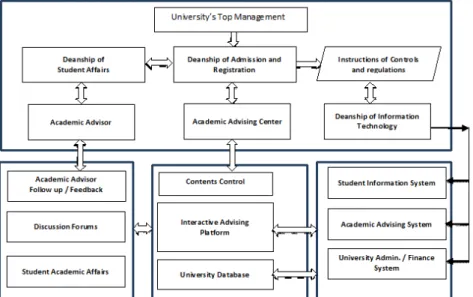
This diagram shown in (figure 2) explain the interactive Electronic Academic Advising and responsibilities that fall
on different bodies to facilitate and use of the whole university information system .
This KAU new framework of academic guidance shows that the student bears most of the responsibility that parallels the responsibility of the institution and the deanship and academic advisor in the research, communication and access to information that will benefit the student during his academic and social development.
To implement this framework in practice, increasing the functions of the institution to facilitate the provision of information and improve the mechanisms of Academic Advising and the transition from paper-based or semi computerized counseling and guidance to the a real interactive and find electronic systems extension like Academic Advising systems. Features, classification, and components guide systems. Where availability of this system provides infrastructure platform to deliver the content of counseling and administration. It provides a set of software tools that perform a variety of tasks related to the management and guidance over the network performance management.
To achieve also a very practical set of guidance; in terms of content and updates; twinning of management systems with electronic content management systems is indicative, as is the case in the management of educational content for electronic platforms. Where the aims of this administration to ensure the application of the standards, controls and mechanisms for academic guidance.
Figure 1. Shows a systematic process based on a close student-advisor relationship intended to aid
Students in achieving educational, career, and personal goals through the utilization of the full range of university Student Information System resources as well as the E Academic Advising. It both stimulates and supports the students in their quest for an enriched quality of educational life Developmental advising relationships focus on identifying and accomplishing academic goals, acquiring skills and attitudes that promote intellectual and personal growth, and sharing concerns for each other and for the academic community.
(Figure 2) New framework for the KAU Academic Advising
The electronic Academic Advising is a process of communication between the Deanship of Admission and Registration (DAR) and student/advisor relationship to keep this constant communication, even in the absence of one of them, which increases the efficiency of Academic Advising. In addition, academic guidance is not subject to time and place, which keeps the Advisor, and the student informed of the latest developments related to them. There
are many positives to use academic advising which can be summarized as follows:
i. Continuous communication between the mentor (may be the academic advisor or the center of the academic advising) and the student through the Academic Advising platform liberation from the constraints of time and space.
ii. Knowledge of the news related to the student and the mentor periodically
iii. The existence of a clear picture of the student through electronic information available about him in the unique database that includes all academic data of the student , making it easier to guide decision-making for the student , mainly in the choice of specialization courses and registration.
iv. Cancel the psychological barrier between the mentor and the student to stand on the social and psychological problems faced by the student through the platform that includes social networking directly or through correspondence
v. Easy connectivity between department’s students, college, and counselors to exchange information and
conduct motivational programs and initiatives at the department and college level.
vi. Students benefit from the experiences of each other through access to information available onsite.
4.2 Academic Advising system platforms and content management:
The new framework of E Academic Advising system platform has its own advantages; those features can be summarized in general as follows:
i. Ease of installation of the system and dealing with the vocabulary and followed. ii. Provide an interactive environment and different tasks oriented to both dean and student iii. Ability to develop and provide appropriate updated knowledge and technical requirements. iv. Containment of supportive activity units such as forums, sources, and instructions. v. System’s ability to deal with a wide range of tools for electronic guidance and multimedia.
vi. Easy file uploading and interdependence with the help of software that works with Internet networks. vii. Presence of predefined templates ready for use and a variety of forms scientifically and logical knowledge. viii. Provide infrastructure software to display models of electronic guidance within several different models.
In addition, the indicative content management systems represent a multi-user environment through which education developers create, store and re- use, management and delivery of digital content indicative of central server for the advising process.
These systems allow users such as developers, counselors and experts to create content or download content indicative heuristic preset. These systems manage the organization of content.
One cannot say that academic guide programs partial forms are not available. It may be available as part of other systems, such as e-learning systems with the observation that these regimes dealing with the relationship between professor and student, and collected in a particular course of study. It can also be part of the Systems Admission to enable the mentor and student to have knowledge of information that will help in the process of guidance, but all of these programs lacks integration and suffer from a lack of tools to help and logical software that will help in the decision making which return guidance process to the traditional concept in the end. Therefore , the presence of guidance platforms with certain specifications and independent that indicates the guidance and guided academic elements of inputs and outputs become an urgent to institutions , especially emerging ones to expedite the installation of such platforms , to activate and use it to become practical with guidance variety, high availability of time for fun and efficient and effort and reduce errors that may reflect negatively on the lives of student academic and professional future .
5. Results and Future Action 5.1 Summary
Can summarize the results of the paper, including the following:
i. The need for all elements of the Academic Advising to improve education outcomes because of their relationship are to help a student during his educational journey within the university.
ii. Work on the use of technological evolution in telecommunications and information technology in transit to the concept of guided -mail address and deal with the extension of electronic platforms to facilitate access to the information necessary.
iii.The universities emerging in scientific faculties must have Academic Advising among the urgent priorities since the beginning and work on activating the role of Deanships in employing the supplement Academic Advising.
iv. It is not limited to Academic Advising between academic advisor and the student, but the work that is practical guidance to strengthen initiatives that stimulate students to positive competition among them. The new framework of the Online Advisor has several parts that can be improved further in functionality and application. This can only be through extensive use by students and academic advisors. The real measure of success is the extent to which it will be adopted on campus. Measures have to be taken to secure that the Online Advisor delivers what it is designed to do. It has to support the face-to-face meeting between advisor and student and not replace it except for optional prescriptive functions. It has to provide advisors more time to focus on student development and contribute in making better planning and scheduling. Finally, the Online Advisor is as good as the
“freshness” of its information. Therefore, it is critical that all information is updated promptly to secure higher adoption on campus.
5.2 Results 2013 vs 2014 KAU students' participation
Academic levels at KAU student's participation as follows:
CLASS HOURS TOWARD GRADUATION 2013
%
2014
%
Freshman less than 30 hours 10 40
Sophomore 30 - 59 hours 3 20
Junior 60 - 89 hours 8 30
Senior 90 credit hours and above 17 45
It is clear that the percentage of using and participating in the Academic Advising increased comparing 2013 vs 2014 on all classes and levels of students.
5.3 Future work:
Must be to achieve the goals referred to in this paper to achieve the following:
i. Find and use the platforms of Academic Advising up to be guided by an interactive work on the development and the involvement of workers and students to deal with.
ii. Create and develop initiatives that will enhance the student's confidence and find an interactive relationship
between his surroundings and the university’s surrounding.
iii. Create a participatory mechanism clear and smooth between the elements of the academic advising system from senior management and then Deans assistance and specialized colleges and section leader in the interest of the student.
References
1. J.E. Brindley, C. Walti & O. Zawacki-Richter (Eds.) Studien und Berichte der Arbeitsstelle
Fernstudienforschung der Carl von Ossietzky Universität Oldenburg 2004,Volume 9.
2. Academic Advising in a Globalized Postmodern Era.National Academic Advising Association. NACADA ..
3. Deirdre Goggin Cork Institute of Technology, CIT Extended Campus, Cork, Ireland Empowering students through mentoring, learning and reflective portfolios Enhancement and Innovation in Higher Education
conference 11 - 13 June 2013.
4. Gordon, Virginia N.; Habley, Wesley R.; Grites, Thomas J., eds. (2008-09-12). Academic Advising: A Comprehensive Handbook (2 ed.). Jossey-Bass. ISBN 0470371706.
5. Harrison, E. (2004). "Faculty Perceptions of Academic Advising: "I Don't Get No Respect."". Nursing Education Perspectives 30 (4): 229–233. doi:10.1043/1536-5026-030.004.0229.
6. White, E.R. (2006). "Using CAS Standards for Self-Assessment and Improvement". NACADA Clearinghouse of
Academic Advising Resources. National Academic Advising Association. Retrieved 2012-05-15.
7. Crookston, B.B. (2009). "A Developmental View of Academic Advising as Teaching". NACADA Journal 29 (1): 78–82. doi:10.12930/0271-9517-29.1.78.
8. Broadbridge, A (1996). "Academic Advising--traditional or developmental approaches?". British Journal Of
Guidance & Counselling 24 (1): 97–111. doi:10.1080/03069889608253711.
9. Mottarella, K.E.; Fritzsche, B.A.,; Cerabino, K.C. (2004). "What do Students Want in Advising? A Policy
Capturing Study". NACADA Journal 24 (1/2): 48–61. doi:10.12930/0271-9517-24.1-2.48.
10.Jeschke, M.; Johnson, K.E.,; Williams, J.R. (2001). "A Comparison of Intrusive and Prescriptive Advising of
Psychology Majors at an Urban Comprehensive University.". NACADA Journal 21 (1/2): 46–58. doi:10.12930/0271-9517-21.1-2.46.
11.Schwebel, D.C.; Walburn, N.C.; Jacobsen, S.H.; Jerrolds, K.L.; Klyce, K. (2008). "Efficacy of Intrusively
Advising First-Year Students via Frequent Reminders for Advising Appointments.". NACADA Journal 28 (2): 28–32. doi:10.12930/0271-9517-28.2.28.
12.Vander Schee, B.A. (2007). "Adding Insight to Intrusive Advising and Its Effectiveness with Students on Probation.". NACADA Journal 27 (2): 50–59. doi:10.12930/0271-9517-27.2.50.
13.Halgin, R.P.; Halgin, L.F. (1984). "An advising system for a large psychology department.". Teaching of Psychology 11 (2): 67–70. doi:10.1207/s15328023top1102_1.
14.Johnson, E.J.; Morgan, B.L. (2005). "Advice on Advising: Improving a comprehensive university's program".
Teaching of Psychology 32 (1): 15–18. doi:10.1207/s15328023top3201_3.
15.Fowler, P.R.; Boylan, H.R. (2010). "Increasing student success and retention: A multidimensional approach". Journal of Developmental Education 34 (2): 2–10.
16.Gravel, C.A. (2012). "Student-Advisor Interaction in Undergraduate Online Degree Programs: A Factor in
Student Retention.". NACADA Journal 32 (2): 56–67. doi:10.12930/0271-9517-32.2.56.
17.Drake, J.K. (2011). "The role of Academic Advising in student retention and persistence.". About Campus 16 (3): 8–12. doi:10.1002/abc.20062.
18.Nolan, K. (2013). "Online advising pilot at community college of vermont". Journal Of Asynchronous Learning Networks 17 (1): 47–51.