This is the author’s version of a work that was submitted/accepted for
pub-lication in the following source:
Wei, Fuguo
,
Barros, Alistair
, &
Ouyang, Chun
(2015)
Discovering behavioural interfaces for overloaded web services. In
2015 IEEE World Congress of Services (SERVICES)
, IEEE, New York City,
NY, pp. 286-293.
This file was downloaded from:
http://eprints.qut.edu.au/91739/
c
Copyright 2015 IEEE
Notice:
Changes introduced as a result of publishing processes such as
copy-editing and formatting may not be reflected in this document. For a
definitive version of this work, please refer to the published source:
Discovering Behavioural Interfaces for
Overloaded Web Services
Fuguo Wei, Chun Ouyang, Alistair Barros
Information Systems SchoolQueensland University of Technology Brisbane, Australia
Email:{f.wei, c.ouyang, alistair.barros}@qut.edu.au Abstract—The growth of APIs and Web services on the
Internet, especially through larger enterprise systems increasingly being leveraged for Cloud and software-as-a-service opportuni-ties, poses challenges to improving the efficiency of integration with these services. Interfaces of enterprise systems are typically larger, more complex and overloaded, with single operation having multiple data entities and parameter sets, supporting varying requests, and reflecting versioning across different system releases, compared to fine-grained operations of contemporary interfaces. We propose a technique to support the refactoring of service interfaces by deriving business entities and their relationships. In this paper, we focus on the behavioural aspects of service interfaces, aiming to discover the sequential dependencies of operations (otherwise known as protocol extraction) based on the entities and relationships derived. Specifically, we propose heuristics according to these relationships, and in turn, deriving permissible orders in which operations are invoked. As a result of this, service operations can be refactored on business entity CRUD lines, with explicit behavioural protocols as part of an interface definition. This supports flexible service discovery, composition and integration. A prototypical implementation and analysis of existing Web services, including those of commercial logistic systems (Fedex), are used to validate the algorithms proposed through the paper.
Keywords—web service, business entity, service interface syn-thesis, service behavioural interface derivation.
I. INTRODUCTION
Conventional service adaptation [1] relies on expert insight of service providers to gain an understanding of service inter-faces so that they can be integrated, composed and accessed with external applications [2]. Through insights into the inter-faces of the applications intended to interoperate, adapters can be built to support mediation across heterogeneous data types of operations (structural aspects) and the permissible orders in which operations are invoked (behavioural aspects). With the growth of interfaces on the Internet, especially for larger, enter-prise systems from SAP, Oracle, FedEx and the like, classical adaptation and other mechanisms for achieving service integra-tion are time-consuming and costly, due to the size, complexity and overloading of enterprise systems interfaces. For example, FedEx Web services have more than 1000 parameters in some of their operations, while SAP enterprise services have up to 400 parameters. The availability of behavioural interfaces is not guaranteed in practice [3]. Even if it is, behavioural interfaces, as structural ones, present ambiguities because of This work is sponsored by Smart Service CRC Australia and in part by ARC Discovery Grant DP140103788.
their overloading nature, resulting in different variants that may lead to differences in service interactions, and all of which are optional and determined through run-time as to which choice of interactions is required. Therefore, service users cannot easily determine which particular part of the behavioural protocol applies for interacting with a service.
This paper contributes to a complementary strategy to conventional service adaptation, whereby knowledge of service interfaces can be unilaterally analysed by service consumers in support of self-learning and self-adaptation with external services. Specifically, we have extended upon previous efforts to analyse interfaces for data type elicitation and data depen-dencies by automatically analysing service interfaces [4], [5]. These are useful for identifying the focal artefacts of applica-tions, namely the business entities, which forms the basis for the creation of a simplified and fine-grained interface layer, allowing access (create, read, update and delete) operations against individual business entities [6]. Through [7], we have proposed refined insights into the discovery of business entities and their relationships, and shown how these can be used to refactor fine-grained, arteface-centric operations, validated using several existing Web services including those of SAP and FedEx applications. This paper extends service interface analysis for behavioural aspects, proposing how sequential dependencies of operations can be discovered and used to gen-erate behavioural protocols in service interfaces. The protocols are derived from an understanding of different relationships between business entities. As an example, if the analysis of an operation elicits two business entities, one of which exclusively contains the other (e.g. a line item is exclusively contained in a purchase order), the creation of a line item should be synchronized with the creation of the purchase order. This implies a triggering dependence between the corresponding operations: purchase order creation and line item creation. In all, we consider 3 types of relationships across business entities and propose heuristics for triggering dependencies: exclusive containment, inclusive containment (mandatory and optional) and association. These, in turn, result in different business entity operation invocation dependencies, providing indispensable knowledge for generating behavioural aspects of service interfaces.
The remainder of this paper is structured as follows. Sect. II reviews state of the art and this is followed by the elaboration on the key algorithms of the behavioural interface derivation mechanism and the development of detailed insights into its most novel features in Sect. III. Sect. IV evaluates the
mechanism by experimenting the implemented prototype with a variety of services and reveals some open issues. Finally, Sect. V concludes the paper and outlines the future work.
II. RELATEDWORK
Various techniques have been proposed over recent years to address challenges of generating service behavioural inter-faces. These approaches include static code analysis, semantic ontologies, interaction log mining, and service composition.
Static analysis involves analysing codes of web applica-tions. For example, Lucca et al. [8] proposed a two-phase analysis approach, where source codes (such as HTML tags and PHP programs) and execution of web applications are analysed and observed. However, this proposal relies on the availability of source codes and it also requires a significant amount of human intervention. In addition, the approach is limited to recovering high-level design documentation such as sequence diagrams.
Semantic ontologies have been utilised to annotate service interfaces. As an example of this utilisation, Falk et al. [9] adapted automata learning to the problem of service interaction analysis. This proposal usefully combines automated analy-sis with semantic ontologies in that it requires semantically annotated interface descriptions showing preconditions and effects as the prerequisite to learn interaction protocols. Also, there are web service Semantics standards such as WSDL-S
1, which are meant to incorporate ontologies into services so
that behavioural interfaces can be derived with ease. However, they have not been commonly practised, because they impose a considerable amount of development work on service providers and the maintenance of semantic ontologies requires significant lead times and adoption.
Complementary to semantic techniques, log mining algo-rithms [3] have been proposed for discovering service proto-cols (i.e., behavioural interfaces according to our terminology). The mining technique incurs overheads for aggregating logs and can suffer from lack of logs or even missing information in them.
Service composition have been investigated intensively, and the common problem being addressed is in this area is “how to automatically generate a new target service protocol by reusing some existing ones” [10]. However, this technique assumes that the behavioural interfaces of individual services involved in a composition are available.
Another proposal by Bertolino et al. [4] synthesises ser-vice behavioural interfaces based on type elicitation and data dependencies between service operations’ input and output parameters. We extend the analysis to derive the central artefact - business entities and their relationships, namely exclusive containment, inclusive containment and association in order to transform service operations into CRUD of business en-tities. Ultimately, ordering constraints are developed among these operations based on the relationships between entities. Kumaran et al. [5] proposed an approach to transform a process activity based process model to an information-centric one, where life cycles of business entities are incorporated into business process models. This research has demonstrated the importance of modelling a process using information entities (a
1http://www.w3.org/Submission/WSDL-S/
similar notion to the business entity in our study). This research also proposed a relation between information entities called domination, which has been adapted in our study to support the derivation of relationships between business entities.
III. BEHAVIOURALINTERFACEDERIVATION A. Overview of the Approach
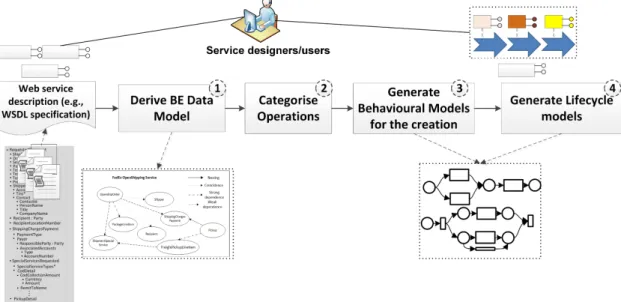
We propose a four-step approach for deriving service behavioural interface, which is illustrated in Fig. 1. Given a service specification such as a WSDL file, the first step is to identify business entities and to create business entity-based data models capturing service structural interface. This can be achieved by iterating the operations involved in the service and examining all the complex input and output parameters of individual operations. The details of generating such a data model for service syntactical interface can be found in our previous work [7]. The resulting data model is then utilised in the following three steps, which are the primary focus of this paper. In the second step, the operations provided by a service are analysed and grouped into several categories based upon what exactly each operation does to business entities, namely creating, reading, updating, deleting, and associating. Then, the behavioural model for creating a business entity is generated according to a number of rules that are derived based on three types of relationships (i.e., exclusive containment, inclusive containment, and association) among business entities. This model is the key output of the behavioural interface derivation mechanism. Finally, the notion of state is incorporated into business entities, and a model that reflects a business entity’s life cycle is generated. The resulting behavioural models can be utilised by service designers and users to guide service design and ease the comprehension of services.
B. Business Entities and Relations
Structural input and output interfaces of operations on a service are mapped to a business entity based service data model. Fig. 2 presents an example of such a model, where four business entities (there could be more in a real example) are mapped from the complex parameters in the input interface of operation 1 (op1) on the services. For example,p1is mapped
to business entity A, and the parameters under p1 are then
mapped as attributes of the business entity. Each business entity has a key, which is identified through one of the nested param-eters. For instance,p2is mapped as the key ofA. Becausep4
is nested inp1, it implies that its corresponding business entity
(i.e., B) has a relationship with p1’s corresponding business
entity (i.e., A). Specifically, three types of relationships are derived in this study, namely Exclusive Containment, Inclusive Containment, and Association.
Domination, adapted from [5], if two business entitieseand
e0 are derived from two parameterspandp0,edominatese0 if
and only if in the context of a service (1) for every operation that uses p0 as an input parameter,pis also used as an input parameter, (2) for every operation that uses p0 as an output parameter, pis also used as an output parameter, and (3)pis used by at least one operation (as its input or output parameter) that does not usep0.
Exclusive Containment,e0 is exclusively contained ineiff
Fig. 1: Overview of the approach.
Fig. 2: A generic business entity based data model.
set of pairs that represent exclusive containment between two business entities.
Inclusive Containment, the relationship between e ande0
is inclusive containment iff e0 dominates e. ϕ captures the set of pairs that represent inclusive containment between two business entities. Ife0is a compulsory part ofe(this is inferred by the relation between the corresponding parameters), it is called Strong Inclusive Containment, otherwise it is a Weak inclusive containment.
Association, e0 is associated with e if there exists an operation op such that e0 is the primary entity involved in
op and the key of e is one of input parameters of op. op is called Association Operation. An association operation for e
and e0 is denoted as opasso
ee0 . ψ captures the set of pairs that represent association between two business entities.
C. Behavioural Interface Derivation Rules
Business Entity Behavioural Model, A business entity based behavioural model (behavioural modelfor short)P is a Petri net(Q,T,F).T is a set of transitions that specify ser-vice operations,Q a set of places that specify the pre- and post-conditions of service operations, andF ⊆(Q×T∪T×Q) a set of flow relations that connect a (pre-)condition to an operation or an operation to a (post-)condition.
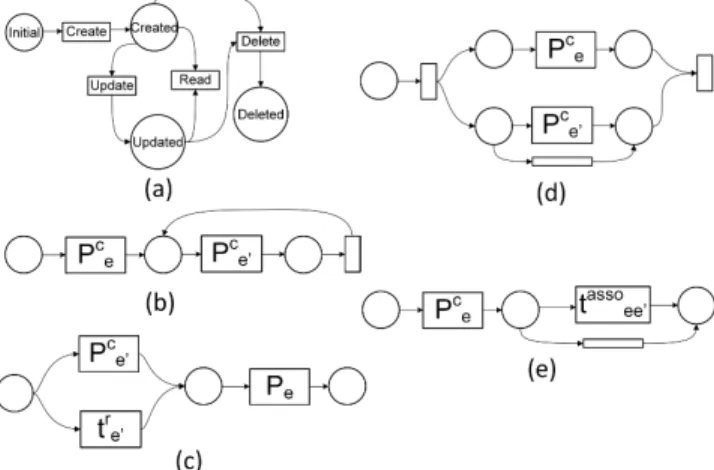
We consider that for every business entity e there are four generic types of operations: Create, Read, Update, and Delete(CRUD). They are used to create, retrieve, update, and delete an instance of e respectively, thus changing the states of business entities. Fig. 3 (a) depicts a typical life cycle of a business entity capturing the state transitions upon carrying out these four types of operations.
The different relations between business entities determine the order of performing the possible types of operations to a business entity. In addition to the CRUD operations (which always apply to one business entity, kind of unary operations), we also consider a so-called Association operation (which apply to two business entities, kind of binary operation). The following rules specify how to derive the occurring order of operations from the business entity relations.
Rule 1An instance of business entityecan only be read, updated, or deleted if the instance is created, meaning there is a temporal sequence between e’s Create operation and its Update, Read, and Delete operations as shown in Fig. 3 (a). Retrieval and deletion of an entity are also permitted when it is in the state of “Updated”.
Rule 2 If business entity e0 is exclusively contained in business entity e, an instance of e0 cannot be created unless an e is instantiated. In Fig. 3 (b), Pc
e and Pec0 represent the behavioural models for creating an instance of e and e0
respectively. According to the rule, Pc
e0 takes place after Pec. For example, in Fedex open shipping service, PackageLineItem is exclusively contained in OpenshipOrder and this means an
OpenshipOrder has to be created before its PackageLineItem is instantiated.
Rule 3When the relationship between eand e0 is strong inclusive containment, an instance of e0 is required when
creating an instance of e. This instance can be either created or read if it exists thereby the instance of e0 can be supplied as part of the input parameters when instantiatinge. This rule is depicted by Fig. 3 (c), wherePc
e0 represents the behavioural model for creating an instance ofe0, andtre0 denotes transition for retrieving an instance of e0. For example, in FedEx open shipping service, the relationship between OpenshipOrder and Shipper is strong inclusive containment, so a shipper has to be created or read so that the creation of OpenshipOrder can be carried out. When the relationship between these two entities is weak inclusive containment, there is no specific order between
e’s and e0’s creation and it is not compulsory to create an instance ofe0 when instantiatinge (Fig. 3 (d)).
Rule 4 When a business entity e0 is associated with e, to form such relationship behaviourally, it is required to attach an instance of e0 to e after the instance of e is created. The attachment is achieved by invoking the association operation
tasso
ee0 , but the formation of this association is not a compulsory step of creating an instance of e (Fig. 3 (e)). For example, in Amazon Simple Storage Service (i.e., S3), SetBucketAc-cessControlPolicy is the association operation that associates a control policy with a bucket, so it is called after a bucket is instantiated to form the association between Bucket and AccessControlPolicy.
Fig. 3: A graphical representation of the rules. D. Service Operation Categorisation
Operations provided by a service can be categorised into five groups: Create, Read, Update, Delete, and Association. Below we define the mapping rules for such categorisation.
Create If the invocation of an operation requires some input parameters which are attributes of e and returns a reference to e (i.e., key(e)), the operation is for creating an instance of e. In other words, an operation that is designed to create an instance ofeusually requires its users to pass values of some parameters which are attributes of e. For instance, to create a shipment order, it requires to know details of the shipment order such as shipping date, shipper, and recipient. As a result, the operation should return a reference (e.g., shipmentNumber) of the shipment order created.
ReadIf the invocation of an operation requires a value for
key(e)and it returns the values of parameters that are attributes of e, the operation is for reading an instance of e.
Update If the invocation of an operation requires values for key(e)and other parameters which are attributes ofe, the operation is for updating an instance of e.
Delete If the invocation of an operation requires a value for key(e) and returns nothing related to e but just a status, the operation is for deleting an instance of e.
Association Operation Given e0 is associated with e, if the invocation of an operation requires values for some input parameters which are attributes of e0 and the reference to another business entitye, and it returns a value of the reference toe0 (i.e.,key(e0)), the operation attaches an instance ofe0 to an instance of eand forms the association relationship.
An algorithm, which invokes each operation that manip-ulates a business entity e, analyses the input and output parameters according to the aforementioned rules to categorise operations has been developed, but due to space limit, this paper will not discuss the details. The resulting operations of this algorithm will be utilised in behavioural model derivation algorithms in the following sections.
E. Behavioural Interface Derivation
Based on the rules in Section III-C, we can derive be-havioural models for an entity’s creation and its life cy-cle on both abstract and executable (i.e., actual) level. An abstract model is generated in strict compliance with the rules considering only operation types regardless whether an operation can be found. For instance, in FedEx open shipping service, the relationship between OpenshipOrder and Shipper is strong inclusive containment, meaning a shipper should be instantiated before an openshipOrder is created, but the operation for creating an instance of shipper is not provided by FedEx in reality. A abstract model generates the template according to Rule 3 in Section III-C anyway despite the fact thatPc
shipper is not available. That is to say, an abstract model
presents an impeccable behavioural interface for a service, meaning it defines a template, which depicts the ordering constraints that a service should follow. Therefore, this type of model can be utilised as a guidance for service designers when designing services. An executable model, by contrast, considers the availability of an operation and it generates a node only when the corresponding operation can be found. Therefore, the creation of shipper is skipped in generating the executable model for OpenshipOrder’s creation. In other words, an executable model can be utilised by service users to comprehend how to invoke the operations provided by a service. The behavioural derivation mechanism supports the generation of both abstract and executable models, but this paper focuses on the latter only.
Given a business entity e and the data model of the service that e resides in, we derive a behavioural model
Pec, which reveals the invocation sequence constraints among
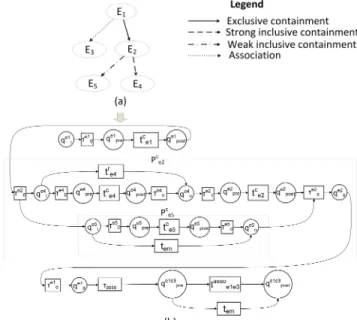
the operations provided by the service. Algorithm 1 presents how such a model is generated and Fig. 4 demonstrates the algorithm. Fig. 4 (a) shows anE1focused data model and Fig.
4 (b) presents the corresponding behavioural model generated by the algorithm.
Algorithm 1 GENERATECREATEBEMODEL
Input: a business entity data model (E, ω, φ, ψ), a business entitye(where e∈E)
1: /∗ Initialise the business entity behavioural model Pc e ∗/
2: Pec :=(Qe,Te,Fe)
3: Qe:={qei} /∗ qie is the input (start) place ofPec ∗/
4: Te:={τ0e} /∗ τ0e is the first silent transition in Pec ∗/
5: Fe:={(qie, τ0e)}
6: /∗ First step - process strong inclusive containment ∗/
7: foreache0 ∈ϕ(e, e0)∧λE(e, e0) =true do
8: Pec0 :=GENERATECREATEBEMODEL(E, ω, φ, ψ, e0) 9: Pec :=(Qe∪Qe0,Te∪Te0,Fe∪Fe0) 10: tr e0 :=CONVERTTOTRANSITION(opr(e0)) 11: Te:=Te∪ {ter0} ∪ {τ e 1} 12: Fe:=Fe∪ {(qe 0 i ,ter0),(ter0, qe 0 o),(τ0e, qe 0 i ),(qe 0 o, τ1e)} 13: end for
14: /∗ Second step - process the creation∗/
15: Qe:=Qe∪ {qpree } ∪ {qposte } 16: if{τe 1} ∈T then 17: Fe:=Fe∪ {(τ1e, qpree )} 18: else 19: Fe:=Fe∪ {(τ0e, qpree )} 20: end if 21: tec:=CONVERTTOTRANSITION(opc(e)) 22: iftec=⊥then 23: return nil 24: end if 25: Te:=Te∪ {tec} ∪ {τoe} 26: Fe:=Fe∪ {(qepre,tec),(tec, qposte )}
27: /∗ Third step - process exclusive containment ∗/
28: ifω(e, e0)6=∅ then 29: foreache0 ∈ω(e, e0)do 30: Pec0 :=GENERATECREATEBEMODEL(E, ω, φ, ψ, e0) 31: REMOVETHEFIRSTPLACE(Pc e0) 32: REMOVETHEFIRSTFLOW(Pec0) 33: Pc e :=(Qe∪Qe0,Te∪Te0,Fe∪Fe0) 34: Fe:=Fe∪ {(qepost, τe 0 0 ),(qe 0 o, τoe)} 35: end for 36: else 37: Fe:=Fe∪ {qepost, τoe)} 38: end if
39: /∗ Fourth step - process weak inclusive containment ∗/
40: foreache0 ∈ϕ(e, e0)∧λE(e, e0) =false do
41: Pc e0 :=GENERATECREATEBEMODEL(E, ω, φ, ψ, e0) 42: Pec :=(Qe∪Qe0,Te∪Te0,Fe∪Fe0) 43: tem:=CREATANEMPTYTRANSITION() 44: Te:=Te∪ {tem} 45: Fe:=Fe∪ {(qe 0 i ,tem),(tem, qe 0 o),(τ0e, qe 0 i ),(qe 0 o, τoe)} 46: end for
47: Qe:=Qe∪ {qoe}/∗qeois the output (end) place ofPec ∗/
48: Fe:=Fe∪ {(τoe, qoe)} /∗ τoe is the output transition∗/
49: /∗ Fifth step - process association ∗/
50: foreache0 ∈ψ(e, e0)do
51: teeasso0 :=CONVERTTOTRANSITION(opasso(ee0)) 52: tem:=CREATEANEMPTYTRANSITION() 53: Te:=Te∪ {teeasso0 } ∪ {tem} ∪ {τasso}
54: Qe:=Qe∪ {qee 0 pre} ∪ {q ee0 post} 55: Fe:=Fe∪ {(qoe, τasso),(τasso, qee 0 pre),(qee 0 pre,teeasso0 )} 56: Fe:=Fe∪ {(teeasso0 ,{qee 0 post),(qee 0 pre,tem),(tem, qee 0 post)} 57: end for 58: return Pec
Fig. 4: An abstract demonstration for Algorithm 1.
Algorithm 2 GENERATEENTITYLIFECYCLE
Input: a business entity data model (E, ξE, ω, φ, ψ), a
busi-ness entitye(where e∈E) 1: Pcycle:= (Q,T,F)
2: /∗ Step 1 - the behavioural model for creating ∗/
3: Pc e :=GENERATECREATEBEMODEL(E, ξE, ω, φ, ψ, e) 4: ifPec6=⊥then 5: return nil 6: end if 7: Pcycle:=(Q∪Q e,T∪Te,F∪Fe) 8: T :=T∪ {τcre} 9: F :=F∪ {(qoe, τcre) 10: /∗ Step 2 - update∗/ 11: teu :=CONVERTTOTRANSITION(opu(e)) 12: iftu e 6=⊥then 13: T :=T∪ {tu e} ∪ {τupe } 14: Q :=Q∪ {qpreU pe } ∪ {qpostU pe } 15: F :=F∪ {(τe cr, qpreU pe ),(qepreU p,teu)} 16: F :=F∪ {(tu e, qpostU pe ),(qpostU p, τupe )} 17: end if 18: /∗ Step 3 - read∗/ 19: ter :=CONVERTTOTRANSITION(opr(e)) 20: iftr e 6=⊥then 21: T :=T∪ {ter} 22: Q :=Q∪ {qe preRd} ∪ {qpostRde } 23: F :=F∪ {(τcre, qpreRde ),(τ e up, qpreRd)} 24: F :=F∪ {(qpreRde ,ter),(ter, qepostRd)} 25: end if 26: /∗ Step 4 - delete∗/ 27: td e :=CONVERTTOTRANSITION(opd(e)) 28: ifted 6=⊥then 29: T :=T∪ {td e} 30: Q :=Q∪ {qpreDle ∪ {qpostDl} 31: F :=F∪ {(τe cr, qpreDle ),(τupe , qpreDl)} 32: F :=F∪ {(qe preDl,ted),(ted, qpostDle )} 33: end if 34: return Pcycle
Specifically, Algorithm 1 consists of five main steps. The first (from line 6 to line 13) involves iterating every business entitye0that has strong inclusive containment relationship with
e and constructing a behavioural modelPc
e0 for e0. According to Rule 3 in Section III-C, an instance of e0 should be either created or read before creating an instance ofe. That is to say, the first step of Algorithm 1 is to construct a behavioural model for each e0 withPc
e0 andtre0 as shown in Fig. 3 (c). As each
e0 may further contain other business entities, the algorithm is recursive, soPc
e0 may consist of a number of Petri net models. At the end of the first step, the generated Pc
e0 is connected and merged with Pc
e before moving on to the next step. In
Fig. 4 (a), as no entities have strong inclusive containment relationship with E1, the first step is skipped forE1, but E4
has strong inclusive containment relationship with E2, so the
corresponding nodes (e.g., tce4 and tre4) are generated before
tc
e2. The second step (from line 14 to line 26) constructs a Petri
net model with a transitiontce, which represents the operation
that creates an instance of e, and its pre-condition and post-condition. As this algorithm generates executable models, it exits iftc
eis not found in the service. At the end of the second
step, the generated net is connected to Pc
e as its second part.
In Fig. 4 (b), this net consists of qpree1 , tce1, and qepost1 . The third step (from line 27 to line 38) iterates each e0 that is exclusively contained in eand generates a behavioural model
Pec0 for e0. Similarly, the creation ofPec0 is a recursive process and eachPc
e0 is merged intoPecin the end according to Rule 2 in Section III-C, which is thatPc
e0 can only be called afterPec. As the first placeqie0 and the first arc(qie0, τ0e0)are redundant,
they are removed before thePc
e0 is merged with Pec. In Fig. 4 (b), the third step processesE2, as it is exclusively contained
in E1. As the relationship between both E5 and E4 and
E2 is weak inclusive containment, the algorithm recursively
processes these two entities and the output is the Petri net model Pc
e2 (as the dotted rectangle indicates in Fig. 4 (b)). In
step four (from line 40 to line 48), each e0 that has weak inclusive containment relationship with e is checked and a
Pec0 is generated. According to Rule 3 in Section III-C, Pec0 can be skipped, so an empty transition (i.e., tem) is created
and incorporated into the Pc
e0. Similarly to step 1 and step 3, Pc
e0 is merged into and connected to Pec as its third part. In Fig. 4, as the relationship between E5 and E2 is weak
inclusive containment, the corresponding behavioural model
Pc
e5 is generated and linked to Pec2. Finally (from line 49 to
line 57), entities that are associated witheare iterated and their nets are generated. This step converts the association operation that attachese0andeto a transitiontassoee0 and links it to the end ofPc
e. In Fig. 4, asE3is associated withE1, the corresponding
nodes (e.g., τasso and tassoe1e3) are generated and connected to
qe1
o .
F. Deriving Business Entity Life Cycle
Having categorised an entity’s CRUD, based on Rule 1 in Section III-C, The life cycle model for an entity can be derived. Algorithm 2 presents a four-step approach, depicting how such a model is generated. The first retrieves the behavioural model for entitye’s creation by invoking Algorithm 1 and merges the resulting model into Pcycle as the first part of e’s life cycle
model, as an instance of eshould be created before reading, updating, and deleting it. If the behavioural model for entity
e’s creation is not formed, the whole process terminates. A
new silent transition (i.e., τe
cr) links to Pec’s end place qeo
and it will be connected with e’s update, read, and deletion nodes in the following steps. The second step processes e’s update. Specifically, it retrieves opu(e), converts it to the
corresponding transition, and then connects it to its pre and post conditions (i.e., places). Another silent transition τe
up is
introduced in this step and it will be connected toe’s read and deleting nodes in the following steps. The third and the fourth steps deal with the transitions that read and delete an instance of e. Corresponding nodes are generated and they are linked toτe
cr andτupe according to Rule 1 in Section III-C.
IV. IMPLEMENTATION ANDVALIDATION
To validate the service behavioural interface derivation mechanism, we have developed a Java based prototype, Service Integration Accelerator, which implements the algorithms pre-sented in the previous section and outputs behavioural models in Petri net graphs by utilising Graphviz2 and the standard
PNML format using a Java based PNML Framework3. This
section presents the details of the experiments we conducted and evaluates the mechanism using their results. All experi-ments were performed on a laptop with Intel Core i7-3520M CPU 2.90 GHz 4 and 8 GB of memory, running on Ubuntu 14.04 LTS and OpenJDK 1.7 (with standard allocation of memory).
Hypotheses Three hypotheses are defined to assess the effectiveness of the mechanism. The first is competence -we presume it can produce abstract behavioural models for every business entity according to the rules in Section III-C and executable behavioural models based on the operations provided by a service. Another criterion to be examined is performance - the time taken to derive behavioural models for each business entity should be within one second.
ObjectsEleven popular services (shown in Table I) drawn from xmethods.net4, Amazon.com, and FedEx were chosen as the experiment objects. These samples are from three cate-gories: Internet Services (IS), i.e., services from the Internet, Software-as-a-Service (SaaS), and Enterprise Services (ES) and the complexity of these services increases from IS to ES. Services in the IS category are highlighted in light grey (i.e, the first two services); Services in the SaaS category are dark gray (i.e., the three Amazon services); Services in the ES category are in dim gray (i.e., the six FedEx services).
Validation Process We applied the Service Integration Accelerator to the interfaces of the aforementioned 11 services, which cover 115 operations and 621 business entities. Based on the business entity data models generated [7], we run the behavioural interface derivation mechanism to produce the results and then analyse them to assess if they support the hypotheses.
Results Table I presents the detailed statistics of the generated behavioural models for the 11 services. Specifically, it reports the following details: (1) the number of operations each service provides, (2) the number of business entities, executable behavioural models for entity creation and life cycle generated, (3) The time taken (in milliseconds) for
2http://www.graphviz.org/ 3http://pnml.lip6.fr/
generating these models (with and without PNML output) for each service. The behavioural models for entity creation and life cycle are detailed with number of places, transitions, and flows (i.e., P/T/F in Table I).
TABLE I: Behavioural interface derivation results.
Ser
vices
Operations Entities Executable
Models/P/T/F life cycle models/P/T/F Elapsed time Elapsed time with PNML Find People5 3 2 0 0 0 0 MailBox Validator6 1 2 0 0 0 0 Amazon S37 16 17 3/12/9/18 3/22/17/36 166 38051 Amazon Advertising8 9 19 2/12/9/19 2/20/16/36 105 25382 Amazon Mechanical9 44 97 9/36/27/54 9/60/48/104 552 115595 FedEx Ship10 5 168 2/8/6/12 2/12/10/20 165 26210 FedEx Pickup10 3 76 1/4/3/6 1/8/6/13 68 12758 FedEx Return10 1 4 1/4/3/6 1/4/3/6 61 12635 FedEx Close10 6 22 4/20/17/36 4/20/16/34 206 51254 Open Shipping10 22 208 4/20/15/31 4/40/32/74 295 52305 Address Vali-dation10 1 6 1/4/3/6 1/4/3/6 48 12815
According to the results, Internet services usually do not involve ordering constraints, because they often have only a few operations with a handful of parameters and these opera-tions are loosely coupled. For example, the Find People service has only two operations: “findAddress(city, backlinkWebsite)” and “findPeople(exactAddress, backlinkWebsite)”. No business entities have been identified based on these operations, and they can be invoked independently of one another. Therefore, Internet service users will not benefit significantly from the behavioural model derivation mechanism.
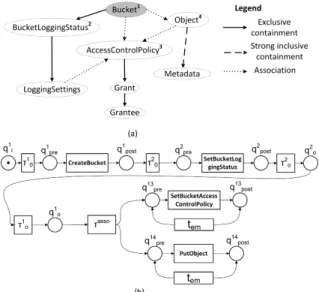
As for services in the SaaS category, their interfaces present intermediate complexity. The number of operations provided in the three Amazon web services ranges from 9 to 44. Based on the data model generated and the operations provided by these services, we derived 3, 2 and 9 executable behavioural models for the creation of business entities involved in Amazon S3, Advertising, Mechanical services respectively, and the same number of life cycle models for these entities. Taking S3 as an example, Fig. 5 (a) presents a business entity data model with a focus on Bucket. The generated executable behavioural model for Bucket’s creation is shown in Fig. 5 (b). In this model, the transition: “CreateBucket” has been identified as the one that creates an instance of Bucket. As it can be seen, Buck-etLoggingStatus is exclusively contained in Bucket, meaning an instance of this entity has to be instantiated after creating
5http://www.findpeoplefree.co.uk/findpeoplefree.asmx?wsdl 6http://ws2.fraudlabs.com/mailboxvalidator.asmx?wsdl 7http://s3.amazonaws.com/doc/2006-03-01/AmazonS3.wsdl 8http://webservices.amazon.com/AWSECommerceService/ AWSECommerceService.wsdl 9http://mechanicalturk.amazonaws.com/AWSMechanicalTurk/2013-11-15/ AWSMechanicalTurkRequester.wsdl 10http://www.fedex.com/us/web-services/
an instance of Bucket. “SetBucketLoggingStatus” has been identified as the transition that creates an instance of Bucket-LoggingStatus, so this operation is called after “CreateBucket” as shown in Fig. 5 (b). In addition, both AccessControlPolicy and Object are associated with Bucket, meaning the attachment of these two entities to Bucket can only take place after an instance of Bucket is created. “SetBucketAccessControlPolicy” and “PutObject” have been identified as the associate opera-tions for AccessControlPolicy and Object respectively, so they can be invoked after Pc
bucket to form the association.
Fig. 5: The derived behavioural model for Bucket’s creation.
Fig. 6: The executable behavioural model for OpenshipOrder’s life cycle.
they usually involve numerous business entities and operations, so it is significant to derive behavioural models for them. The statistics for the six FedEx services in Table 1 show the number of behavioural models generated. For instance, by analysing the 22 operations provided by FedEx Open Shipping service, we derived 4 executable behavioural models for the creation of the business entities involved in the service. Due to space limit, this paper only presents the one for OpenshipOrder. Fig. 6 (a) depicts a fraction of the OpenshipOrder focused data model and its life cycle model is presented in Fig. 6 (b). As PackageLineItem is exclusively contained in Open-shipOrder, its creation (“addPackagesToOpenShipment”) oc-curs after OpenshipOrder’s (“createOpenShipment”). There are also other entities such as Shipper, ShippingChargesPayment, Label, and SpecialService that have either exclusive contain-ment or strongly/weak inclusive containcontain-ment relationships with OpenshipOrder, but no corresponding executable nodes were generated due to the fact that no operations are provided for the creation of these business entities. However, all these nodes were reflected in the abstract behavioural models derived. As the FedEx Open Shipping service provides operations for creating, reading, updating, deleting the core business entities involved (i.e., OpenshipOrder and PackageLineItem), the mechanism was able to categorise them correctly and generate the life cycle model for them (as shown in Fig. 6 (b)) according to Rule 1 in Section III-C.
The time taken to generate these models are listed in the last two columns in Table I. The elapsed time meets the performance requirement, which is within one second per entity, but producing pnml files for behavioural models takes a large amount of time, with almost 2 minutes for the Amazon Mechanical service at worst. This is because the external PNML library involves intensive IO operations. As the output of pnml is an optional setting in the mechanism, the performance of the core part of the mechanism is not compromised.
Discussion The experiments have demonstrated the effec-tiveness of the mechanism, but we have found several issues at the same time. The first is that the mechanism misses some operations occasionally, especially when it comes to the cate-gorisation of operations. For example, both “PutObjectInline” and “PutObjectInline” should be identified as the association operations, only the later was rendered due to the assumption we made that only one association operation exists. Similarly, in FedEx open shipping service, the operation “confirmOpen-Shipment” is to confirm the creation of an OpenshipOrder, so it should be invoked at the end of OpenshipOrder creation. However, this operation was missed in the models generated. To address the problem, operations for one category should not be limited to one and a set should be used to keep all operations that fall in the same category. These operations should also be reflected in the behavioural models. Another problem is that the current categorisation algorithm only invokes operations with the minimum set of parameters, and this can sometimes cause inaccuracy and incompleteness. To counter this problem, more invocations with other alternative sets of parameters should be tried and the responses should then be analysed.
V. CONCLUSION ANDOUTLOOK
This paper presented a service behavioural interface deriva-tion mechanism, which generates service behavioural inter-faces based on the core artefact reflected in services - business
entities and the relationships between them. We validated the mechanism using a variety of services ranging from internet services to enterprise services. The study has demonstrated that the business entity based interface derivation technique is an effective solution to deriving behavioural models for entity’s creation and life cycle both on abstract and executable level. The resulting models of the mechanism can be utilised in a service integration scenario, where behavioural interfaces of services are unknown, and it can also provide a guidance to service designers. Future work includes the improvement of the operation categorisation and analysis of the models generated. As for the former, we will allow more than one operations to fall in one category and adopt a Monta Carlo statistic approach to search for other valid service invocations so that a complete input and output parameter analysis can be carried out. For the later, Petri net deadlock detection and reachability analysis techniques will be utilised to optimise the models.
REFERENCES
[1] R. Mateescu, P. Poizat, and G. Salaun, “Adaptation of service proto-cols using process algebra and on-the-fly reduction techniques,”IEEE Transactions on Software Engineering, vol. 38, no. 4, pp. 755–777, 2012.
[2] G. Decker, A. Barros, F. Kraft, and N. Lohmann, “Non-desynchronizable service choreographies,” inService-Oriented Comput-ing ICSOC 2008, ser. Lecture Notes in Computer Science, A. Bouguet-taya, I. Krueger, and T. Margaria, Eds. Springer Berlin Heidelberg, 2008, vol. 5364, pp. 331–346.
[3] H. Motahari-Nezhad, R. Saint-Paul, B. Benatallah, and F. Casati, “Protocol discovery from imperfect service interaction logs,” inIEEE 23rd International Conference on Data Engineering, 2007, pp. 1405– 1409.
[4] A. Bertolino, P. Inverardi, P. Pelliccione, and M. Tivoli, “Automatic synthesis of behavior protocols for composable web-services,” in Proceedings of the the 7th joint meeting of the European software engineering conference, ser. ESEC/FSE ’09. New York, NY, USA: ACM, 2009, pp. 141–150.
[5] S. Kumaran, R. Liu, and F. Wu, “On the duality of information-centric and activity-information-centric models of business processes,” inAdvanced Information Systems Engineering, ser. Lecture Notes in Computer Science, Z. Bellahsne and M. Lonard, Eds. Springer Berlin Heidelberg, 2008, vol. 5074, pp. 32–47.
[6] A. Barros, K. Duddy, M. Lawley, Z. Milosevic, K. Raymond, and A. Wood, “Processes, roles, and events: Uml concepts for enterprise architecture,” in łUML 2000 The Unified Modeling Language, ser. Lecture Notes in Computer Science, A. Evans, S. Kent, and B. Selic, Eds. Springer Berlin Heidelberg, 2000, vol. 1939, pp. 62–77. [7] F. Wei, A. Barros, and C. Ouyang, “Deriving artefact-centric interfaces
for overloaded web services,” in Proceedings of 27th International Conference on Advanced Information Systems Engineering, ser. Lecture Notes in Computer Science. Springer International Publishing, 2015, forthcoming.
[8] G. A. Di Lucca, A. R. Fasolino, and P. Tramontana, “Reverse engi-neering web applications: the ware approach,” J. Softw. Maint. Evol., vol. 16, no. 1-2, pp. 71–101, Jan. 2004.
[9] F. Howar, B. Jonsson, M. Merten, B. Steffen, and S. Cassel, “On handling data in automata learning,” in Leveraging Applications of Formal Methods, Verification, and Validation, ser. Lecture Notes in Computer Science, T. Margaria and B. Steffen, Eds. Springer Berlin Heidelberg, 2010, vol. 6416, pp. 221–235.
[10] R. Ragab Hassen, L. Nourine, and F. Toumani, “Protocol-based web ser-vice composition,” inProceedings of the 6th International Conference on Service-Oriented Computing, ser. ICSOC ’08. Berlin, Heidelberg: Springer-Verlag, 2008, pp. 38–53.