Air Force Institute of Technology Air Force Institute of Technology
AFIT Scholar
AFIT Scholar
Theses and Dissertations Student Graduate Works
3-2003
Deception Detection in a Computer-Mediated Environment:
Deception Detection in a Computer-Mediated Environment:
Gender, Trust, and Training Issues
Gender, Trust, and Training Issues
Monica A. Dziubinski
Follow this and additional works at: https://scholar.afit.edu/etd
Part of the Gender, Race, Sexuality, and Ethnicity in Communication Commons, and the Training and Development Commons
Recommended Citation Recommended Citation
Dziubinski, Monica A., "Deception Detection in a Computer-Mediated Environment: Gender, Trust, and Training Issues" (2003). Theses and Dissertations. 4255.
https://scholar.afit.edu/etd/4255
DECEPTION DETECTION IN A COMPUTER-MEDIATED ENVIRONMENT: GENDER, TRUST, AND TRAINING ISSUES
THESIS
Monica A. Dziubinski, Second Lieutenant, USAF AFIT/GIR/ENV/03-03
DEPARTMENT OF THE AIR FORCE
AIR UNIVERSITY
AIR FORCE INSTITUTE OF TECHNOLOGY
Wright-Patterson Air Force Base, OhioThe views expressed in this thesis are those of the author and do not reflect the official policy or position of the United States Air Force, Department of Defense, or the U.S. Government.
AFIT/GIR/ENV/03-03
DECEPTION DETECTION IN A COMPUTER-MEDIATED ENVIRONMENT: GENDER, TRUST, AND TRAINING ISSUES
THESIS
Presented to the Faculty
Department of Systems and Engineering Management Graduate School of Engineering and Management
Air Force Institute of Technology Air University
Air Education and Training Command In Partial Fulfillment of the Requirements for the
Degree of Master of Science in Information Resource Management
Monica A. Dziubinski, BA Second Lieutenant, USAF
March 2003
AFIT/GIR/ENV/03-03
DECEPTION DETECTION IN A COMPUTER-MEDIATED ENVIRONMENT: GENDER, TRUST, AND TRAINING ISSUES
Monica A. Dziubinski, BA Second Lieutenant, USAF
Acknowledgements
First, I want to thank my family and friends for their support and interest in my educational endeavor. I would also like to express my sincere appreciation to Lieutenant Colonel David Biros, Dr. Joey George, and Dr. Michael Morris, my committee, for providing me the encouragement and the instruction necessary to complete this thesis; it has truly been a learning experience and a great capstone to a challenging Master’s program. I also owe great appreciation to individuals that, although not members of my committee, supported my thesis effort immensely, Major Danny Holt, Dr. Dan Reynolds and Kent Marett.
In addition, I want to thank the members of the deception detection research group for their help in gathering research and stimulating ideas. In particular, I owe my appreciation to the rest of the team on the Keesler experiment. Thank you very much to all who have contributed to this effort.
Table of Contents
Page
Acknowledgements... iv
List of Figures ... vii
List of Tables ... viii
Abstract... ix I. Introduction ... 1 Overview... 1 Problem Statement ... 2 Background Information ... 6 Research Focus ... 9
Contribution to Theory and Practice... 11
Summary ... 12
II. Literature Review... 14
Introduction... 14 Deception Literature... 14 Nonverbal Behavior ... 16 Deceptive Strategies... 18 Verbal Behavior ... 21 Detection ... 23
Adapted Model of Deceptive Communication ... 28
Characteristics of the Medium ... 30
Motivation to Detect ... 33
Trust ... 34
Gender... 37
Training... 39
Presentation of Conceptual Model... 43
Deception Detection Accuracy ... 44
Characteristics of the Medium ... 45
Gender... 46 Trust ... 47 Training... 49 Summary ... 50 III. Methodology... 51 Overview... 51 Research Methodology ... 51
Page
Relevant Population ... 53
Trust Measurement... 55
Data Collection Method ... 57
Pilot Study... 58
Permission to Conduct the Experiment... 60
Experiment Execution... 60
Knowledge Tests... 61
Judgment Accuracy Tests ... 61
Training and Feedback... 64
Survey ... 67
Summary ... 68
IV. Data Analysis... 69
Overview... 69
Description of Participants... 69
Analysis of Medium Characteristics ... 70
Analysis of Gender Differences... 73
Analysis of Trust Levels ... 74
Analysis of Training Differences... 75
Summary ... 77
V. Conclusions and Recommendations ... 78
Overview... 78
Discussion ... 78
Limitations ... 81
Implications for Practice ... 83
Academic Implications and Suggestions ... 84
Conclusion ... 85 Appendix A... 86 Appendix B ... 87 Appendix C ... 89 Appendix D... 95 Bibliography ... 97 Vita... 110
List of Figures
Figure Page George and Carlson’s Adapted Model of Deceptive Communication (simplified) ... 28
Media Richness Hierarchy... 31 Proposed Model ... 44
List of Tables
Table Page
Research Design... 52
Demographics of Sample... 55
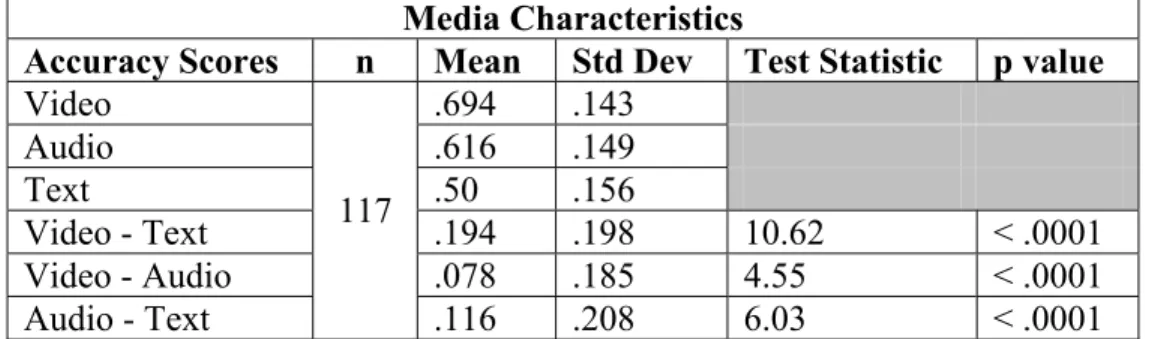
Hypothesis 1a, 1b, and 1c Analysis ... 72
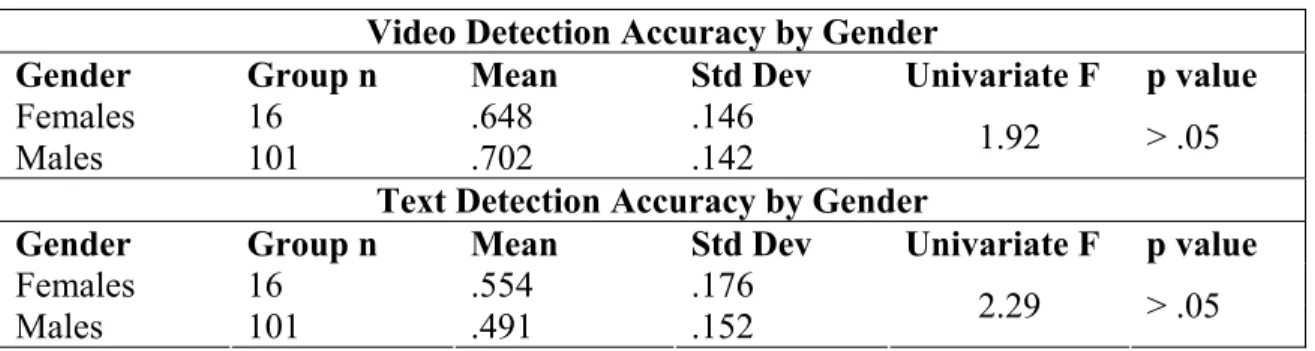
Hypothesis 2a and 2b Analysis... 74
Hypothesis 3 Analysis... 75
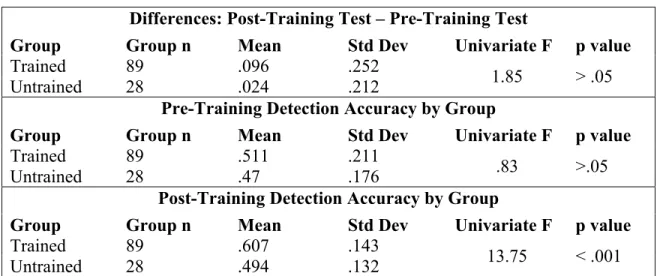
Hypothesis 4 Analysis... 77
AFIT/GIR/ENV/03-03
Abstract
The Department of Defense is increasingly relying on computer-mediated
communications to conduct business. This reliance introduces an amplified vulnerability to strategic information manipulation, or deception. This research draws on
communication and deception literature to develop a conceptual model proposing
relationships between deception detection abilities in a computer-mediated environment, gender, trust, and training. An experiment was conducted with 119 communications personnel to test the proposed hypotheses. No relationship between gender or trust and deception detection accuracy was found. Partial support was found showing that training improves deception detection accuracy. The most significant finding was that
individuals’ deception detection abilities deteriorate in lean media environments. The results showed significant differences in deception detection abilities across media types; indicating lower accuracy rates in the lean media environments (i.e. audio and text). This suggests that deception detection is more difficult when the deceptive message is
presented in a lean medium, such as a text only online chat, than when delivered in richer medium. Future research should be conducted to further explore this finding.
DECEPTION DETECTION IN A COMPUTER-MEDIATED ENVIRONMENT: GENDER, TRUST, AND TRAINING ISSUES
I. Introduction
"Oh what a tangled web we weave, when first we practice to deceive!" Sir Walter Scott
Overview
Deception is a prevalent practice in everyday interactions. It is estimated that twenty five percent of all communications contain deception or perceived deception (DePaulo et al., 1996; Buller and Burgoon, 1996b; Turner et al., 1975). In addition, research has shown humans can only accurately detect about half of the deception they encounter (Miller and Stiff, 1993; Vrij, 2000; Zuckerman et al., 1981). The
pervasiveness of deception is a threat to the Department of Defense’s information and decision-making superiority. Compounding this problem is the increasing use of
information technology (IT) for communication, data storage, and information gathering (Biros, 1998; Biros et al., 2002; Research Consortium, 2001). Currently, little research exists investigating deception and its detection over electronic media. However, the available research suggests it will be more difficult to detect deception in a computer-mediated environment (Biros, 1998; Biros et al., 2002; George and Carlson, 1999a; George and Carlson, 1999b; Research Consortium, 2001). Continuing research in this area could advance the United States Air Force’s effort to gain information and decision making superiority.
This thesis effort is focused on adding the Air Force’s effort to gain information and decision making superiority, by exploring receivers’ possible information processing biases pertaining to deception detection, and their ability to be trained to detect deception. This chapter will provide an introduction to the topic of the deception detection. The following chapter will review the relevant literature, and propose hypotheses and a conceptual model to be tested. Chapter Three will outline the methodology for testing the proposed model, and Chapter Four will present the results of the experiment
conducted. Finally, Chapter Five will present the discussion and implications of the findings.
Problem Statement
The use of IT has become prevalent in today’s society, and its popularity only continues to grow (Mohan, 1995). The growing prevalence of IT has transformed society socially, economically, and politically (Sheridan, 2000). For many, computers have become a piece of everyday personal and organizational life. Information systems are used to store, process, and share critical information from bank account transactions to classified meeting proceedings. Much of the communication that was once conducted face-to-face is now taking place through electronic means, such as video conferencing, electronic mail, shared databases, and computer conferencing (Biros, 1998; Dennis and Kinney, 1999; George and Carlson, 1999a; Wachter, 1999).
The proliferation of computer-mediated communication (CMC) has had many effects on society. The use of various electronic means of communication has offered
numerous advantages to both organizations and individuals. Computer-mediated
communication offers the ability to quickly relay messages and information across large geographical gaps, and the means to immediately filter and store that information for rapid retrieval at a later time (George and Carlson, 1999b). Another advantage of IT in general, recognized by both Joint Vision 2020 and the Air Force Information Operations (IO) doctrine, is the dramatically reduced time between information collection and information availability (AFDD 2-5, 1998; Joint Vision 2020, 2000). Because of the numerous advantages and the increased availability of IT, organizations have come to rely on technology applications for critical functions. In the military, for example, Joint Vision 2020 (2000) identifies information processing abilities and communication networks as the core of every military activity, and a key enabler to victory.
In the recent military confrontation in Afghanistan, Operation Enduring Freedom, CMC has become the primary means of communication. The United States Central Command (CENTCOM) has taken advantage of available technologies to establish a network containing critical intelligence information, and provide a secure means of communication (Ackerman, 2002). The system allows for immediate communication between the different levels in the chain of command, via online chat. The system is capable of numerous tasks including displaying maps which show troop positioning, collecting and processing inputs from unmanned aerial vehicles and ground based personnel, and rapidly broadcasting alerts and information to all levels in the chain of command (Ackerman, 2002; Associated Press, 2002). This example illustrates that military decision makers are continually developing a reliance and dependence on information systems to gather and disseminate critical and sensitive information.
This reliance on and increased use of IT, CMC in particular, increases
organizations’ vulnerability to strategically altered information or messages (Biros, 1998; Biros et al., 2002; George and Carlson, 1999a; George and Carlson, 1999b; Research Consortium, 2001; Zmud, 1990). The Air Force IO doctrine admits the reliance on information systems is the “Achilles’ heel” of America. In addition, the doctrine notes that adversaries including terrorists, criminals, hackers, and unfriendly countries are using the electronic environment to accomplish their malicious goals (AFDD 2-5, 1998). One method adversaries can use to accomplish malicious goals via electronic media involves altering, deleting, or inserting false information in the electronic messages or storage systems in order to present deceptive data to the decision maker. Buller and Burgoon define deception as “a message knowingly transmitted by a sender to foster a false belief or conclusion by the receiver” (Buller and Burgoon, 1996:205).
Deception within information systems can take many forms. A few typical examples of deception in a computer-mediated environment include intruders masquerading as legitimate users on a system and coders generating counterfeit electronic mail. Imagine the damage that could be experienced if deception were implanted in the aforementioned information system being used in Operation Enduring Freedom. Consider this fictitious scenario illustrating the damage that could be imposed on the Air Force through this type of threat. Suppose an adversary masquerading as a senior ranking official issued orders to carry out an attack that would actually result in leading the troops into a trap. Even posing as lower ranking ground personnel, the adversary could transmit the location of a friendly target to a weapons platform for input
into precision-guided munitions. This fictitious example shows the life-threatening errors that can result from the introduction of deceptive information in a military system.
Decision makers often rely on databases, other electronic information storage devices, and computer-mediated communications to gather critical information in the decision making process, thus increasing their vulnerability to strategic information manipulation (Biros, 1998; Zmud 1990). The United States Military defines military deception as an offensive and defensive operation that circulates misleading information causing adversary decision makers to act in accordance with the sender’s objectives (JP 3-13, 1998). A high-priority goal of the Air Force outlined in the IO doctrine is
counterdeception, which is to ensure that friendly decision makers are aware of the military deception presented by adversaries and that they respond accordingly (AFDD 2-5, 1998). However, it is difficult to perform counterdeception if the deceptive
information is not identified as such. Currently available automated protection mechanisms cannot easily identify deception in electronic media. Therefore, system administrators, users, and individual decision makers are often relied on to judge the veracity of information (Biros, 1998; Biros et al., 2002; George and Carlson, 1999; Research Consortium, 2001). For this reason, it is vital to understand humans’ ability to detect deception over electronic media. However, this is a very new concern and little literature exists on the topic.
Background Information
The issue of deception in warfare is not a new concern. In 500 BC, Sun Tzu noted “All warfare is based on deception” (Clavell, 1983:11). The Joint Doctrine for Information Operations identifies the increasing use of information technologies to support the military as a “double edge sword” in that they have developed both the opportunity to exploit adversaries in new ways, and new areas that the warfighter must protect (JP 13-3, 1998). In essence, the increase in IT has formed a new battlespace for the military referred to as the infosphere. Within the infosphere, both offensive and defensive measures are taken to take advantage of and protect information systems (AFDD 2-5, 1998; Joint Vision 2020, 2000).
Deception and concerns about detecting deception fall into the area of information operations known as information warfare. Information warfare is defined by the Air Force as the information operations defending friendly information and information systems or attacking enemy information or information systems (AFDD 2-5, 1998). Although the definition concentrates on information and information systems, an important aspect of information warfare is that the ultimate targets of the operations are the human decision makers (Joint Vision 2020, 2000). Military deception is categorized under both defensive and offensive information warfare operations. However, the detection of deception, which is of interest to this research, is a process necessary to perform counterdeception, a defensive counterinformation (DCI) activity. The Air Force doctrine identifies DCI activities as the most imperative information warfare priority (AFDD 2-5, 1998). Regardless of this, the challenge of detecting deception in the dynamic information environment is only briefly addressed in the doctrine. Developing
an understanding of human ability to detect deception in a computer-mediated
environment should also be a high priority for the Air Force. It is impossible to defend the decision making process from introduced deception if deception is not detected.
Deception is also a subject of interest in the academic environment. Researchers from diverse disciplines have been exploring various aspects of deception for decades (Kalbfleisch, 1994; Research Consortium, 2001). Deception research has concentrated on such areas as defining deception (Buller and Burgoon, 1994a; Ekman, 1985), identifying reliable cues to deception (Zuckerman and Driver, 1985; Zuckerman et al., 1981), exploring deceptive behaviors within relationships (McCornack and Parks, 1986; McCornack and Levine, 1990), examining individual ability to detect deception (Ekman, and O’Sullivan, 1991; Kalbfleisch, 1994; Vrij, 2000), and training effects on deception detection ability (deTurck et al., 1990; deTurck, 1991). Still, little research exists that examines deception in a computer-mediated environment. This gap in research has recently been identified and is being addressed by academics (Biros, 1998; Biros et al., 2002; George and Carlson, 1999a; George and Carlson, 1999b; Research Consortium, 2001).
Realizing that deception within a computer-mediated environment is an
immediate and growing problem to the military, a group of experienced researchers from many disciplines gathered to work on a project investigating various aspects of deception within information systems. This project, Detecting Deception in the Military
Infosphere: Improving and Integrating, is sponsored by the Air Force Office of Scientific Research (AFOSR). The project is now in its second year and is working towards six objectives that will further the Air Force’s efforts to obtain information and decision
making superiority. The six objectives as outlined in the annual performance report to AFOSR are as follows:
1) Integrate numerous academic theories to create a unified model of deception detection. 2) Identify through experimental research reliable cues of deceit received under various communication modes, and information-processing biases and heuristics that may inhibit the receiver from appropriately detecting deception.
3) Document lessons learned to further the understanding of deception detection. 4) Create a training curriculum for deception detection.
5) Develop automated aids to assist individuals in deception detection.
6) Test the integrated training program and the automated tools in a military environment (Research Consortium, 2002).
During the first year of the project, the research team has taken great strides toward the above six objectives. They have conducted many experiments that are furthering their knowledge of deceptive behavior; the newly gained knowledge will be utilized to develop training programs and automated tools for deception detection. One example, called the mock theft experiment, is designed to help the Air Force understand deceptive behaviors in a formal interview situation. The experiment involves
interrogating participants (some honest and some deceptive) over various types of media (face-to-face, audio, and synchronous chat) (Research Consortium, 2002).
The information gathered, in the numerous studies conducted by the group, is being used to develop training curriculum, training software, and automated detection tools. The training curriculum is being created based on academic theory developed over several decades of deception studies, the new information garnered from this project, and
other current research. The training covers particular cues to help individuals recognize deception. The training lectures, examples of deceptive scenarios with accompanying expert analysis, and other learning features are being incorporated into a prototype of a training software system called Agent99. Agent99 is a virtual classroom designed to teach individuals how to detect deception in a variety of settings (Research Consortium, 2002). Although this progress is impressive, there are still many aspects of deception detection in a computer-mediated environment that need to be explored in order to meet the six listed objectives.
Research Focus
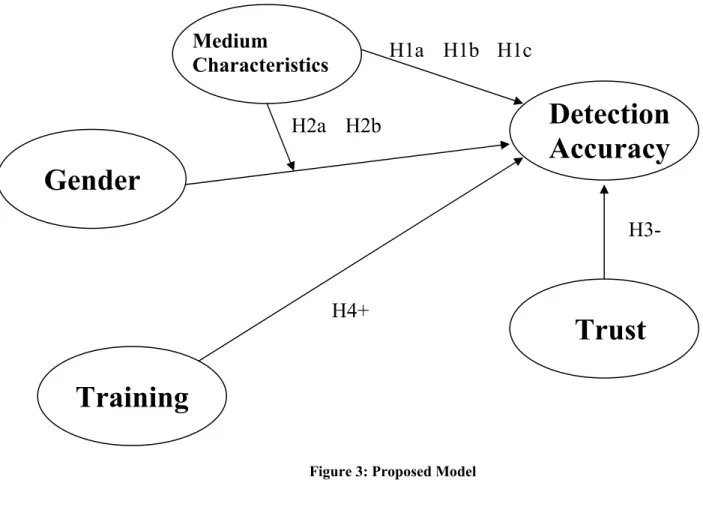
This thesis effort will be adding to the effort of the AFOSR project, Detecting Deception in the Military Infosphere: Improving and Integrating, described above. In particular, this study will further the objectives of identifying information processing biases in receivers, creating a training curriculum for deception detection, and testing that training curriculum in a military environment. In order to add to the knowledge about information processing biases, this study will examine if the media characteristics, the receiver’s gender, or the receiver’s disposition to trust has an influence on deception detection accuracy.
Electronic media provides communication messages with less available cues (Daft and Lengel, 1986), and individuals rely on cues to detect deception (Buller and Burgoon, 1996b); therefore it may be harder to detect deception communicated with electronic media (George and Carlson, 1996b). This research will investigate the role
media characteristics play in deception detection ability. Specifically, are individuals more accurate at deception detection in a media rich environment? Past research has suggested that females are better at detecting deception, due to their ability to interpret nonverbal cues (deTurck, 1991). Does this gender difference exist in a computer-mediated environment where many nonverbal cues are not available to the receiver? Also, this research will investigate the role of the receiver’s trust level in deception detection ability. If a person is generally trusting, will they be less accurate at detecting deception?
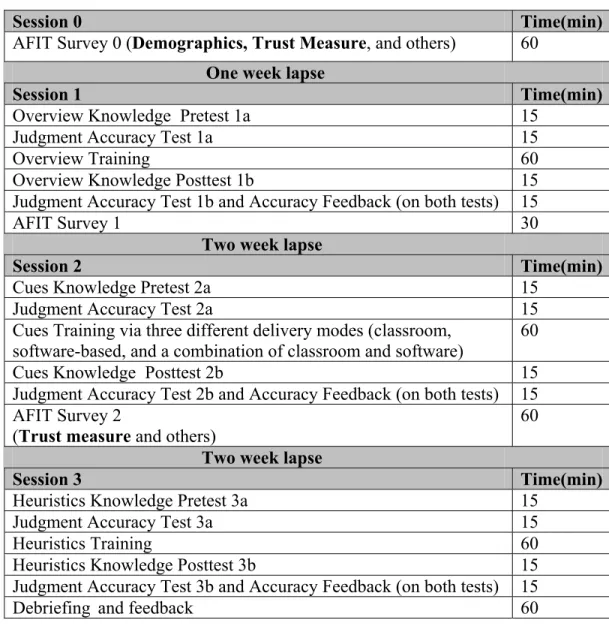
In the effort to create a training curriculum for deception detection, the research experiment will test the effectiveness of the current training curriculum developed by the research team delivered via three different formats: traditional classroom lecture,
software based training via the Agent99 virtual classroom, and a combination of lecture and Agent99 training. Does training improve deception detection accuracy? Answering the above research questions will further the understanding of deception detection capabilities, and help the research team meet the objectives of identifying information processing biases and developing and testing training curriculum. The specific research questions for this study are listed below.
1) How do the communication medium characteristics affect the ability to detect deception?
2) How does gender influence deception detection accuracy?
3) Do gender effects vary depending on the communication medium characteristics? 4) How does one’s disposition to trust affect deception detection accuracy?
Contribution to Theory and Practice
Exploring these areas of deception detection may also add to theoretical knowledge that will help fulfill the objective of creating a unified model of deception detection. Understanding more about receivers’ possible information processing biases and ability to be trained to detect deception will help the research team identify areas that should be further investigated or possibly ruled out as insignificant. In addition, this experiment could provide empirical support for constructs already included in or being considered for the model.
Whether or not the research effort helps the research team meet the first objective, it will still offer a considerable contribution to theory and practice. Very few studies have examined possible gender differences in deception detection abilities and, in
particular, deception detection in a computer-mediated environment. Exploring this area will help academics better understand an inadequately explored issue in deception detection. Furthermore, knowing if a gender difference exists will allow for training programs to be designed with this difference in mind. If individuals have different natural abilities, they will benefit from varied training programs. Understanding any gender differences that are present will help organizations vulnerable to deception to take these differences into consideration when choosing personnel for particular jobs. The study of the relationship between trust and deception detection accuracy will also add to both theory and practice in a similar manner.
Increased understanding and knowledge of deception detection abilities will not only add to academic knowledge and aid the Air Force in its effort for information superiority, but it can also benefit civilian organizations. Civilian organizations are vulnerable to numerous types of deception (Biros, 1998; George and Carlson, 1999a; George and Carlson, 1999b). One example of deception in a civilian organization is the practice of altering resumes in order to obtain a desired job. An experiment currently being conducted, as part of the AFOSR project, involves analyzing the manipulation of resumes by participants. This experiment will allow the team to identify strategies deceivers may use to present deceptive information (Research Consortium, 2002). This garnered knowledge will help civilian organizations better understand resume
manipulation and possibly identify ways to recognize false claims.
Computer-mediated deception recently upset many customers of an online payment service, PayPal. Deceptive coders generated counterfeit e-mails soliciting PayPal customers for their account information (Cox, 2002). PayPal lost credibility, and possibly customers, due to this incident. This example delineates the fact that computer-mediated deception is not only a military concern, but also a problem for civilian
organizations.
Summary
This chapter discussed the growing prevalence of IT and computer-mediated communication and pointed out how these technologies increase vulnerabilities to information manipulation. Additionally, the need to explore deception and the ability to
detect it in a computer-mediated environment was stated, and the particular research focus of this thesis effort was delineated. The following chapter will review the literature on deception, deception detection, communication medium characteristics, gender
differences, trust, and deception detection training. Specific hypotheses concerning the relationship between deception detection accuracy, gender, communication medium, trust, and training will be proposed. Chapter Three will outline the methodology for conducting the research, including characteristics of the population, an explanation of the experiment, and the data collection techniques. Chapter Four will provide the results of the experiment and data collection. Finally, Chapter Five will present the discussion of the findings, limitations of the research, implications of the results, and suggestions for further study.
II. Literature Review Introduction
This chapter reviews literature relevant to the study of deception detection in a computer-mediated environment, and presents and defines the constructs of a proposed deception detection model. First, deception literature from the communications field is reviewed. Then, other applicable areas of literature, including computer-mediated communication, trust, gender, and training, are reviewed. Finally, a theoretical model and related hypotheses for the current research effort are presented.
Deception Literature
To begin understanding deception detection in a computer-mediated environment, an examination of existing human-to-human deception research is beneficial. As
mentioned in the previous chapter, extensive research examining deceptive
communication exists. Deception research relevant to the current research effort includes the prominent deception theories, Interpersonal Deception Theory (Buller and Burgoon, 1996b) and Information Manipulation Theory (McCornack, 1992), the believed
nonverbal and verbal indicators of deception (Buller and Burgoon, 1994a; Burgoon et al., 1995; DePaulo, 1992; Zuckerman and Driver, 1985), and the ability of individuals to detect deception (DePaulo et al., 1985; Comedena, 1982; McCornack and Parks, 1986).
Early research attempted to investigate various aspects of deception using an experiment that required participants to lie about their feelings while viewing unpleasant slides (Brandt et al., 1980; Ekman and Friesen, 1974; Miller et al., 1983). These
experiments requested that the participants attempt to convincingly report they were in a content emotional state while viewing horribly graphic pictures of burn victims (Miller et al., 1983). Although this research offered enlightening findings about many areas of deception, deception experts have argued this is not an adequate research design because it does not take place in the same environment as the majority of deceptive
communication (Buller and Burgoon, 1996b).
Buller and Burgoon argue that this impersonal research design does not generalize well to real-world situations; they point out that deception typically occurs in, and
therefore should be studied in, an interactive context (Buller and Burgoon, 1996b; Buller and Burgoon, 1994a; Burgoon and Buller, 1994). As a result of this and several other research conclusions, the authors proposed Interpersonal Deception Theory (ibid). Interpersonal Deception Theory (IDT) provides a theoretical framework for predicting and explaining the dynamics of deception during human-to-human interaction (Burgoon et al., 1995). IDT focuses on deception in the context of a communication exchange; the theory is based on the key assumption that communication is comprised of goal-oriented strategic and nonstrategic behaviors (Buller and Burgoon, 1996b). IDT posits that successful deception requires the conscientious management of both strategic and
nonstrategic behaviors during communication in order to deliver a believable message to the receiver. On the other hand, successful deception detection requires the receiver to
recognize the sender’s effort or failure to manage the content of the message (Buller and Burgoon, 1994a).
Nonverbal Behavior
The “nonstrategic” behaviors that Buller and Burgoon (1996b) refer to are the inadvertent and possibly unconscious actions of the sender such as body movements, pitch changes, nonfluencies, or facial expressions. These behaviors are often identified as the nonverbal indicators of deception (DePaulo, 1992; Zuckerman et al., 1981).
Nonverbal behaviors are the messages in a communication exchange other than the actual words, consisting of both visual and paralinguistic (or vocal) cues (Miller and Stiff, 1993). Deception research has extensively explored the area of nonverbal behavior and its relationship to deception (Burgoon et al., 1996). Ekman and Friesen proposed that regardless of the sender’s effort to strategically manage information, nonverbal behavior has a tendency to unintentionally occur, or “leak,” during deception (Ekman and Friesen, 1974; Ekman, 1985). This proposition is commonly accepted as a fact among deception researchers; thus, the inadvertent occurrence of nonverbal behavior is frequently referred to as leakage. The abundance of research in this area has led to the discovery of several reliable nonverbal indicators of deception.
While there has been substantial research completed on nonverbal behavior cues to deception, many of the studies’ findings are contradictory (Vrji, 1998). Zuckerman and colleagues attempted to identify reliable cues by compiling the literature that examined the correlates of deception (Zuckerman et al., 1981; Zuckerman and Driver,
1985). Zuckerman and Driver (1985) completed a meta-analysis in which they identified nine nonverbal cues to deception. The visual cues the authors identified include
increased pupil dilatation, increased blinking, increased adaptors, decreased facial segmentation, and increased body segmentation. Adaptors are activities in which the sender is moving his or her hand while touching their body, such as scratching (deTurck and Miller, 1985). Zuckerman and Driver (1985) also identified that deceptive messages contain the following paralinguistic cues: shorter response length, higher speech pitch, increased speech errors, and hesitations. While these nonverbal behaviors have been identified as reliable indicators of deception, researchers have proposed that different cues are present depending on the situational variables (Miller et al., 1983; Vrij and Mann, 2001).
The situational variables of the deceivers’ level of arousal, amount of motivation, and amount of planning could possibly alter the nonverbal cues present. Leakage of various nonverbal cues may fluctuate depending on the senders’ level of arousal. Deceivers are thought to experience arousal as a result of feelings of guilt, fear, or
excitement related to deceiving the receiver (Vrij and Mann, 2001). Arousal is associated with the nonverbal cues of pitch increase, increased adaptor gestures, and increased body segmentation (Frank and Ekman, 1997). In addition, arousal is also associated with various physiological deceptive cues; detection aids such as the polygraph are designed to measure these cues (Porter and Yuille, 1995). However, the current research effort is concerned with human detection of deception, and the physiological cues are often not detectable via human observation alone (ibid). A theory similar to the arousal theory states that deceivers will give off varying cues depending on their level of motivation for
success (DePaulo et al., 1988; Burgoon and Floyd, 2000). However, whether high motivation of the deceiver prompts increased control of nonverbal cues, or the increased leakage of nonverbal cues due to heightened arousal, remains a subject of debate
(Burgoon and Floyd, 2000). Furthermore, the increase in the amount of planning time available to the deceiver has been proposed as a variable that decreases the availability of nonverbal cues (Miller et al., 1983). Zuckerman and Driver (1985) found that the
deceivers who were given more planning time were able to decrease their response latencies and increase their speech rates, thus removing the availability of two vocal deception cues. Given that nonverbal cues are sometimes hard to measure (i.e., voice pitch or pupil dilation), and that the cues vary depending on the situation, it is beneficial to explore the verbal cues related to deception.
Deceptive Strategies
One way to identify the verbal indicators present in deceptive messages is to determine how deceivers present deceptive messages as opposed to truthful messages. In other words, how do senders strategically present the information in order to deceive the receivers? Researchers agree that deceivers alter or manipulate verbal content across various dimensions when creating a deceptive message (Buller and Burgoon, 1996a; Burgoon et al., 1996; McCornack, 1992). Regardless of the agreement that deceptive messages vary in systematically identifiable ways, theories explaining these systematic message variations contradict each other. Two widely discussed theories that attempt to identify dimensions of information manipulation are McCornack’s (1992) Information
Manipulation Theory (IMT) and Burgoon and colleagues’ (1996) Information Management Theory.
Information Manipulation Theory (McCornack, 1992) is built on Grice’s (1989) Cooperative Principle of communication and conversational maxims. The principle focus of IMT is that deceptive messages are derived by violating the conversational maxims through concealed manipulation of verbal content (McCornack, 1992). The conversational maxims, which when violated can be considered an attempt at deceptive communication, are quantity, quality, manner, and relation (ibid). The first maxim of quantity considers the amount of sensitive information the sender reveals; a deceptive message may contain too much information or exclude critical information. The maxim of quality refers to the veracity or truthfulness of the message. Deceptive communication lacks quality, in that deceptive messages contain distorted or entirely fabricated
information. The maxim of relation represents the relevance of information communicated in a message; a deceiving sender will possibly insert irrelevant information into the exchange in order to divert the conversation topic. Finally, the maxim of manner refers to the sender’s clarity when presenting information. An ambiguous message violates the maxim of manner, and possibly contains deceptive information. IMT proposes that a violation of one or more of the four conversational maxims occurs during deception. Because IMT is based on linguistic properties of deceptive messages, the theory aids in the identification of verbal cues and also helps identify deceptive messages that are presented as text only (Biros, 1998).
Burgoon and colleagues (1996) introduced Information Management Theory as another method to analyze the verbal behavior of deceptive messages. The authors refer
to Information Management Theory as a theory that expands on the maxims proposed in IMT based on the principles of IDT (Buller and Burgoon, 1996). Burgoon and
colleagues suggest that verbal content is strategically managed along five dimensions, as opposed to the four maxims of IMT, during deceptive communication. These dimensions include informational and conversational completeness, actual and apparent veridicality, semantic and syntactic relevance/directness, semantic and syntactic clarity, and
personalization (Burgoon et al., 1996). Information and conversational completeness refer to the amount of information revealed in a communication exchange, similar to the maxim of quantity. The next dimension of veridicality is the amount of truthfulness in the message, which is comparable to the IMT maxim of quality; however, Information Management Theory includes both actual deception and perceived deception. The dimension of relevance, analogous to the IMT maxim of relation, refers to the content directness and grammatical relevance of the message. Clarity, the fourth dimension of Information Management Theory, is equivalent to the IMT maxim of manner, which refers to the amount of equivocation or ambiguity in a statement. Burgoon and
colleagues (1996) consider both semantic and syntactic clarity to be of importance and interest in potentially deceptive messages. The last Information Management Theory dimension, personalization, does not relate to any of the IMT maxims. Personalization is the amount of immediacy the sender portrays in the message, or the extent to which ownership of the statement is accepted (Burgoon et al., 1996). In general, Information Management Theory suggests that deceivers will attempt to strategically manage verbal content by creating incomplete, dishonest, indirect, ambiguous, and impersonal messages (Buller and Burgoon, 1994b).
Although these theories diverge in some aspects, the summary of IMT and Information Management Theory provided above delineates the corresponding ideas presented within the two theories. Both of these theories concentrate on the linguistic content of communicated messages, and hence, will be helpful in identifying verbal characteristics of deception (Burgoon et al., 1996; McCornack, 1992). Considering the majority of research has concentrated on the nonverbal correlates of deception, this new focus on verbal content will undoubtedly broaden the understanding of deception.
Verbal Behavior
As acknowledged by researchers, the literature and knowledge about verbal correlates to deception is deficient (Burgoon et al., 1996; McCornack, 1992; Miller and Stiff, 1993). Verbal, or linguistic, indicators are present in the actual words and content of a communication exchange (Miller and Stiff, 1993). Given the lack of research on verbal correlates of deception, these cues are even less agreed on than the nonverbal cues discussed above. Zuckerman and Driver (1985) attempted to identify reliable verbal correlates of deception through a meta-analysis of deception literature.
In addition to nine nonverbal cues, Zuckerman and Driver (1985) identified four reliable verbal cues to deception. Zuckerman and Driver (1985) suggest that deceptive communication will contain more negative statements, irrelevant information, and leveling, while portraying less immediacy. A less immediate statement is one in which the sender attempts to distance or disassociate himself or herself from the deception through such tactics as speaking in the passive voice and past tense (Kuiken, 1981).
Leveling is usually associated with overgeneralizations, such as every, always, never, and everyone (Buller and Burgoon, 1996b). Another proposed verbal indicator of deception is fewer specific references; a deceiver will use more group references and avoid using first person pronouns (Cody et al., 1984; DePaulo et al., 1985; Stiff and Miller, 1986). Verbal indicators, like nonverbal indicators, are subject to situational variables. The situational variables of the deceivers’ level of arousal, amount of motivation, and amount of planning could affect both nonverbal and verbal indicators of deception. Another situational variable that could change the verbal content of the message is the subject matter being discussed (Miller and Stiff, 1993). For example, depending on the question being asked, the answer may call for less immediate replies or more group references; even if the reply is truthful it may contain cues of deception, and result in perceived deception (DePaulo et al., 1985).
Although there are less agreed upon reliable verbal correlates of deception, these indicators are more generalizable across media than the nonverbal correlates. In less interactive contexts, such as a computer-mediated environment, receivers have limited access to nonverbal cues (Buller and Burgoon, 1996b; George and Carlson, 1999b). If the medium is text only, the receiver only has access to verbal cues and some of the paralinguistic cues. The paralinguistic cues that could be seen in a text only situation include shorter response length, increased speech errors, and, in synchronous text communication, increased hesitations (George and Carlson, 1999b). Realizing the usefulness of verbal cues, academics have recently increased investigations in this previously research-deficient subject (Burgoon et al., 1996, Miller and Stiff, 1993).
Although the above nonverbal and verbal behaviors are considered reliable correlates of deception, deception researchers stress that no common or universal behavioral cue set exists to identify deception across all individuals; therefore, receivers must concurrently consider all the indicators in the context of the communication
exchange (DeTurck and Miller, 1990; Zuckerman and Driver, 1985). A reliable indicator of deception, which does not fit in either the verbal or nonverbal category, is discrepancy (Zuckerman and Driver, 1985). DePaulo argues that inconsistency between an
individual’s nonverbal behavior and the concurrent linguistic message is the most reliable indicator of deception (DePaulo, 1992). However, receivers often fail to depend on reliable cues, such as discrepancy or increased adaptors; rather, novices and specialists alike often base deception judgments on unreliable behaviors, such as shifty eyes and fidgeting (DePaulo et al., 1985; Vrij, 1998). The erroneous belief that these behaviors are associated with deception is a factor in the poor deception detection ability of individuals (ibid).
Detection
Of highest interest to this research endeavor is the ability for individuals to detect the difference between deceptive and truthful messages, or the detection accuracy of individuals. Miller and Stiff (1993) argue that communications researchers should measure both the ability to detect deception and truth, because increasing knowledge of ability to recognize truth will add to the understanding of deception. Although some researchers (Miller and Stiff, 1993) differentiate between deception detection accuracy
and detection accuracy, for the purpose of this study these terms are synonymous. Regardless of the accumulated knowledge concerning deception, deception detection accuracy still only averages near 50 percent (DePaulo et al., 1985). These poor detection rates may be a result of reliance on undependable behaviors, as mentioned above;
however, researchers have offered numerous other explanations of deception detection performance.
Another hindrance to accurate deception detection is the inability of receivers to observe cues due to the practice of communicating via leaner media (Buller and Burgoon, 1996b; George and Carlson, 1999b). Communication via an information system removes the receivers’ ability to examine all of the senders’ behaviors (Buller and Burgoon, 1996b). Text-based communications, such as electronic mails or online chat sessions, restrict access to visual cues and allow the receiver to analyze only the linguistic and some paralinguistic cues (Rice, 1993). A richer CMC, video conferencing, allows access to the majority of the cues; however, research suggests that using this communication medium will nevertheless inhibit receivers’ ability to detect deception due to masking or distortion of cues in low quality video (Horn, 2001; Horn, 2002). Overall, the
characteristics of the communication medium can reduce the number of observable cues available to the receiver, thus hindering detection abilities (Horn, 2001; George and Carlson, 1999a; George and Carlson, 1999b).
However, past research suggests that the lack of cues may actually increase detection accuracy (Maier and Thurber, 1968). The research of Maier and Thurber suggested that individuals exposed only to audio or written communications were better able to identify deception than the participants of an interactive interview. The
researchers attributed this finding to the fact that the receivers’ were distracted by the senders’ nonverbal cues, and concluded that the visual cues limited the receivers’ processing ability (Maier and Thurber, 1968). However, the researchers never formally tested the hypothesis, and when the hypothesis was tested, by other researchers, it received no empirical support (Miller and Stiff, 1993).
More recently, researchers have suggested the richness level of CMC is not a permanent property; rather, it can vary depending on the knowledge base of the
participants and the social context surrounding the communication (Carlson and Zmud, 1999; Markus, 1994; Ngwenyama and Lee, 1997; Schmitz and Fulk, 1991). Carlson and Zmud (1999) point out that users build knowledge bases about the communication media, the conversation topic, the organizational context, and the other participants. These experiences allow the receiver to extract rich information from even a message delivered in a text only format (Carlson and Zmud, 1999). Thus, an individual experienced in these domains may be able to better utilize available cues to successfully detect deception in a computer-mediated environment (George and Carlson, 1999b).
Another explanation for poor deception detection ability is the highly
individualistic nature of deception; people differ in the cues they leak during deception and the same people may leak different cues, depending on the situational factors surrounding the deceit (Miller et al., 1986; Vrij and Graham, 1997). Considering the highly idiosyncratic nature of deception, the knowledge about a particular individual’s behavior during deception is most likely more valuable than the general indicators of deception offered by Zuckerman and Driver (1985). Zuckerman and colleagues (1984) investigated this idea, and found that exposure to baseline information about the sender’s
idiosyncrasies increased the receivers’ detection accuracy when judging the veracity of that particular sender.
This line of reasoning led to the hypothesis that people involved in a relationship would be capable of more accurately detecting deception from their partners than
strangers (Comedena, 1982; Knapp, 1984). However, studies examining detection accuracy between relational partners did not support this hypothesis (Comedena, 1982; McCornack and Parks, 1986; Miller and Stiff, 1993). McCornack and Parks (1986) suggested that this lack of ability might be due to an individual’s tendency to presume the other member of the relationship is being honest. The researchers labeled this
predisposition the “truth bias” (McCornack and Parks, 1986:380). The existence of a truth bias diminishes the receivers’ motivation to detect deception; therefore, they will put less effort in discerning truthful behavior from deceptive behavior. Although findings from initial tests of the truth bias hypothesis questioned its validity, it has been empirically supported, and generalized to include strangers (Levine and McCornack, 1992; Stiff et al., 1992). The truth bias concept has become a widely accepted concept among deception researchers, and is often cited as a factor that negatively influences detection capabilities (Buller and Burgoon, 1996b; DePaulo et al., 1985; Levine and McCornack, 1992; Stiff et al., 1992).
A factor closely related to the truth bias construct is an individual’s level of trust; a high level of trust in the communication partner is correlated with a lower motivation to detect deception and an increased truth bias (Levine and McCornack, 1992; McCornack and Levine, 1990). Research in this area has been conducted mostly with relational partners (couples and friends), given that people within a relationship have an
opportunity to build trust (Levine and McCornack, 1992; McCornack and Levine, 1990; Stiff et al., 1992). However, Biros (1998) explored how humans’ trust level in computer systems related to deception detection accuracy, and hence truth bias. Although the study did not support the truth bias construct, it contributed to the understanding of user truth bias toward computer systems (Biros, 1998). Overall, research has demonstrated an individual with a high level of relational trust is more likely to presume honesty when discerning the veracity of a message.
Another factor that may influence detection accuracy is the receivers’ level of suspicion. Unsuspicious receivers are not motivated to scrutinize communication content for deception, and alternatively rely on the truth bias to judge veracity (McCornack and Parks, 1986). Suspicion has been described as a pertinent requirement for successful deception detection (DePaulo et al., 1980). When receivers have their suspicion level aroused, their motivation to carefully analyze communication content for deceptive content increases, therefore decreasing their reliance on the truth bias (Levine and
McCornack, 1992; Millar and Millar, 1998). Although aroused suspicion counteracts the dependence on the truth bias, it does not necessarily increase detection accuracy
(Burgoon et al., 1994; Toris and DePaulo, 1985). Under conditions of aroused suspicion, individuals often assume truthful messages contain deception, resulting in a false alarm (Levine and McCornack, 1991; Toris and DePaulo, 1985). Levine and McCornack (1991) identified this tendency to presume deception as the lie bias. In conclusion, although aroused suspicion provides an increased motivation to detect deception, it may cause detection accuracy to decrease given the reliance on the lie bias.
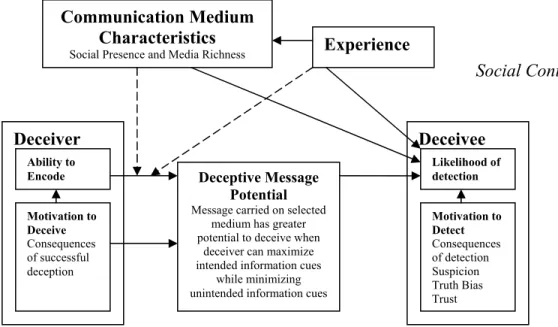
Although this set of factors is not comprehensive, the issues discussed are fundamental to the understanding of deception and deception detection ability. Collectively, the research presented highlights that deception takes place in varied interactive social contexts, which include a sender, a receiver, and the message being communicated. Miller and Stiff (1993) provided a conceptual model that encompasses many of the factors involved in a deceptive transaction. George and Carlson (1999b) modified this model to address more recent concerns of deception research including communication medium characteristics and experience level. George and Carlson’s (1999b) adapted model of deceptive communication is presented below in Figure 1, and discussed further in the following section.
Figure 1: George and Carlson’s Adapted Model of Deceptive Communication (simplified)
Adapted Model of Deceptive Communication
George and Carlson’s model is adapted from Miller and Stiff’s (1993) model of deceptive communication (George and Carlson, 1999b). The model presented above
Social Context Deceivee Likelihood of detection Motivation to Detect Consequences of detection Suspicion Truth Bias Trust Experience Deceiver Ability to Encode Motivation to Deceive Consequences of successful deception Deceptive Message Potential Message carried on selected
medium has greater potential to deceive when
deceiver can maximize intended information cues
while minimizing unintended information cues
Communication Medium Characteristics
delineates the complexity of deceptive exchanges. Following is a brief description of the model. The exchange begins with the deceivers, or senders, taking into consideration their motivations to deceive, using their ability to encode information to transmit the potentially deceptive message. The deceptive message potential is based on the ratio of intended versus unintended information conveyed in the message. George and Carlson posit that the relationship between deceiver and deceptive message potential is moderated by the communication medium characteristics and the experience level of the
participants. The deceivees’, or receivers’, likelihood of successful deception detection is dependent on their motivation to detect deception, their utilization of available cues, the delivery mode of the message, and the experience level of the individuals involved in the communication. The whole deceptive communication process takes place in a distinct social context. George and Carlson’s model shows deceptive communication as a
transaction, offering a view that includes the encoding and the decoding of the potentially deceptive message.
However, the current research effort is only concerned with the right side of the model, the receivers’ decoding abilities. Of particular interest are the constructs of trust, as a hindrance of motivation to detect deception; communication medium characteristics, as a factor in deception detection accuracy; and the receivers’ likelihood of detection success. These areas will be explored in depth in the following sections. Although the other constructs are important, they are beyond the scope of this study.
Characteristics of the Medium
Communication media vary in their capability to overcome situational
communication constraints and transmit social, symbolic, and nonverbal cues (Short et al., 1976; Daft and Lengel, 1986; Rice, 1992). Currently, the widely accepted theories for explaining the differing characteristics of communication media are Social Presence Theory and Media Richness Theory. Both of these theories suggest classifications of media based on the medium’s ability to represent various types of information. These theories were initially developed without consideration for electronic media such as video conferencing, online chat, or electronic mail, but academics later expanded the theories to accommodate these innovative media types (Daft et al., 1987; Rice, 1993). Social
Presence Theory and Media Richness Theory discriminate media based on different dimensions, and provide different continuums on which to rank media based on these dimensions (Short et al., 1976; Daft and Lengel, 1986).
Short and colleagues (1976) define social presence as the degree that a medium is able to convey the perception of the conversational participants’ physical presence. Social Presence Theory differentiates media based on the levels of immediacy and intimacy that it can portray (Short et al., 1976). Social Presence Theory asserts that media differ in their ability to: reveal social roles, support human interactivity, and convey nonverbal cues, such as facial expressions, body language, and tone of voice (Olaniran, 1995). Using these dimensions Short and colleagues presented a continuum on which the social presence of media could be ranked. Face-to-face communication is considered the most socially present media, given that it provides for the highest
media are considered less socially present as follows, in descending order: television, multispeaker audio, telephone, and business letter (ibid).
Media Richness Theory, previously called Information Richness Theory, is similar to Social Presence Theory; both theories differentiate media based on the amount of information they can effectively convey to the participants (Carlson and Davis, 1998; George and Carlson, 1999b). Media richness is based on the premise that different media have different capacities for transmitting comprehensible data (Daft et al., 1987). Daft and Lengel (1986) propose that media are differentiated based on their capabilities to provide feedback, communicate cues, present personalized messages, and support the use of varied language. Like Social Presence Theory, Media Richness Theory ranks face-to-face communication at the top of the continuum, as the richest media. The rest of the continuum, however, slightly diverges from the social presence scale. The rank order of media in terms of richness is face-to-face interaction, telephone conversation, electronic mail exchanges, personal written text, formal written text, and formal numeric text (Lengel and Daft, 1988). Figure 2 represents the media richness hierarchy as presented by Lengel and Daft (1988).
Media Richness Hierarchy
Highest Physical Presence (face-to-face)
Interactive Media (telephone, electronic media)
Personal Static Media (memos, letters, tailored computer reports)
Media Richness
Lowest Impersonal Static Media (flyers, bulletins, generalized computer reports) Figure 2: Media Richness Hierarchy
Media Richness Theory proposes it is the goal of organizations to process information in a format that reduces uncertainty and equivocality; therefore, managers will more likely use rich media for equivocal tasks in an effort to reduce ambiguity (Daft and Lengel, 1986; Daft et al., 1987). Similarly, Social Presence Theory suggests that to achieve desired results, mangers should match the need for social presence with the medium used to communicate (Short et al., 1976). Due to the similarities of social presence and media richness theories, academics are beginning to informally merge the two theories. The recent literature commonly addresses only one of the two theories, or refers to media richness/social presence when discussing the characteristics of media (Carlson and Davis, 1998; Rice, 1992; Straub and Karahanna, 1998). Given the interrelatedness of these theories, a common assumption is that a medium high in richness is also high in social presence (ibid); this assumption will be employed throughout the remainder of this thesis.
Although Media Richness Theory was originally developed to explain the use of different media within organizations (Daft and Lengel, 1986), researchers immediately began applying the theory to explain mangers’ media selection (Trevino et al., 1987). Later, researchers also began using Social Presence Theory to describe media choice rationale (Straub and Karahanna, 1998). Much of the empirical research supporting Media Richness Theory tests the theory’s ability to predict management selection of media rather than media use (Daft et al., 1987; Russ et al., 1990; Trevino et al., 1990; Trevino et al., 1987).
The usefulness of media richness and social presence theories as a tool for media selection has been debated by academics (Carlson and Davis, 1998; Carlson and Zmud, 1999; Markus, 1994; Ngwenyama and Lee, 1997; Schmitz and Fulk, 1991). The arguments against Media Richness Theory argue that media characteristics are not objective definitive characteristics, but rather dynamic and individualistic depending on the situational and social context of the communication (Carlson and Zmud, 1999;
Markus, 1994). However, the current study is not investigating media selection, but rather medium characteristics. Given that media richness and social presence theories
effectively categorize media as related to the amount of cues available in various types of media, these theories are appropriate for use in this research effort.
Motivation to Detect
George and Carlson’s adapted model of deceptive communication lists suspicion, truth bias, and trust as a part of the receivers’ motivation to detect deception (George and Carlson, 1999b). These concepts are all discussed above in relation to detection
accuracy; however, truth bias and trust warrant further discussion. Of particular interest to this research effort is how truth bias and trust are linked. The premise of truth bias is that trust acts as a “biasing agent that detrimentally influences accuracy” (Levine and McCornack, 1992:144). An individual that has developed a truth bias will experience a lack of motivation to analyze messages for cues to deception (Levine and McCornack, 1992; Stiff et al., 1992).
Truth bias has been conceptualized behaviorally (McCornack and Parks, 1986) and cognitively (Stiff et al., 1992; Miller and Stiff, 1993). McCornack and Parks (1986) measured truth bias by the number of times a participant judged their partner as honest. Other researchers viewed this method as inadequate, and chose to instead view truth bias as a cognitive heuristic (Stiff et al., 1992; Miller and Stiff, 1993). These researches operationalized truth bias with a short questionnaire, which asked the participant questions about their trust towards their partner (Levine and McCornack, 1992; Stiff et al., 1992). Stiff and colleagues (1992) argued that this is a more appropriate measure of a bias than the behavioral approach used by McCornack and Parks (1986). Although it has not been adequately explored, it is possible that an individual’s basic trusting nature may also act as a biasing agent that negatively affects accuracy. The following section will review the trust literature related to this suggestion.
Trust
Trust is an imperative concept both for effective social interactions and
technology use (Johnson-George and Swap, 1982; Muir 1987). Trust is considered vital in relationships along a wide range of intimacy levels, from the relationship between an employee and an employer to a romantic relationship (Whitener et al., 1998). In addition, recent literature has suggested trust is also a key factor for effective performance in a virtual environment (Muhlfelder et al., 1999). Trust is an immensely complex concept; comparing results of trust research across studies and fields is problematical due to the numerous contradictory definitions and measurements of trust (Barber, 1983).
The definitions of trust vary greatly in breadth, yet tend to be narrowly defined within research endeavors (Kee and Knox, 1970; McKnight and Chervany, 2002). Trust has been defined as: a behavior (Zand, 1972), a general expectancy (Rotter, 1980; Rotter, 1967; Wrightsman, 1991), a belief or set of beliefs (Barber, 1983; Rotter, 1967), a
situational variable (Johnson-George and Swap, 1982), and an interpersonal variable (Rempel, Holmes and Zanna, 1985). McKnight and Chervany (2002) performed an in-depth review of the trust literature across numerous disciplines. They concluded that the current confusion surrounding trust research needed to be resolved. In an effort to meet this objective, the authors developed a classification system for the different types of trust and a model conceptualizing how the different types of trust interrelate (McKnight and Chervany, 2002).
McKnight and Chervany’s literature review identified three major trust types, impersonal/structural, dispositional, and personal/interpersonal, which they use as
classification categories. McKnight and Chervany’s impersonal/structural category refers to trust based on social or institutional structures rather than personal aspects. The
category of dispositional trust refers to an individual’s basic sense of trust across various situations. Personal trust is the trust one individual sends to another, while interpersonal trust is the trust exchanged between two or more people. All of the categories are situation dependent except dispositional trust (McKnight and Chervany, 2002).
Given that communicating in a computer-mediated environment involves both the interaction with people and systems, trust within CMC could be categorized as
personal/interpersonal or impersonal/structural. In addition, it could be argued that an individual’s general disposition to trust is also an important concept in a
computer-mediated environment; considering, that by definition this type of trust is consistent across various situations and people (McKnight and Chervany, 2002). For the purpose of this study the most generalizable category of trust, dispositional trust, will be considered.
The concept of dispositional trust was originally developed by Rotter (1967, 1971) and has been expanded on greatly by other academics (Couch and Jones, 1997; Erikson, 1968; Wrightsman, 1974; Wrightsman, 1991; Zand, 1972). The definition offered by Rotter suggested trust is the generalized expectancy that the agreement of an individual or group can be relied upon (Rotter, 1967; Rotter, 1971). This conceptual view of trust has also been referred to by many different names such as: basic trust, global trust, trust in human nature, generalized trust, and trusting nature (Couch and Jones, 1997; Erikson, 1968; Wrightsman, 1974; Wrightsman, 1991). Rotter (1967) originally referred to this type of trust as interpersonal trust; however, as the concept evolved theorists considered the description too broad to be limited to interpersonal trust (McKnight and Chervany, 2002; Wrightsman, 1991). In order to emphasize the
constructs’ generalizability, and to conform to McKnight and Chervany’s (2002)
proposed trust classification, this type of trust will be referred to as dispositional trust, or simply trust, throughout this study.
An individual’s dispositional trust cannot be related to one particular event or to one person. Rather, it is derived from a collection of experiences and generalized to all situations (Rotter, 1967, Stack, 1978). A key distinction between dispositional trust and other types of trust is the idea that this level of trust is constant across diverse situations and individuals. In fact, this concept is the foundation of McKnight and Chervany’s definition of dispositional trust, which refers to a “consistent tendency to trust across a
broad spectrum of situations and persons” (McKnight and Chervany, 2002: 37). The suggestion that dispositional trust is consistent regardless of situational circumstances is aligned with the proposition that dispositional trust is a personality characteristic or trait (Couch and Jones, 1997).
In addition to the factors that George and Carlson (1999b) present in their adapted model of deceptive communication, there may be other factors that influence the
receivers’ ability to detect deception. In particular, the possibility of adding the constructs of gender and training will also be explored in the sections below.
Gender
Past research has demonstrated that broad communication differences between men and women exist, in that they have different communication norms and expectations (Borisoff and Merrill, 1992; Meyers et al., 1997). Sex differences have been
demonstrated in the areas of connection, cooperation, competition, and conflict (Borisoff and Merrill, 1992; Hawkins and Power, 1999; Meyers et al., 1997). In addition, gender differences have been explored specifically in relation to computer-mediated situations and deception detection.
Studies have examined gender differences in many computer-related topics such as: computer anxiety (Qureshi and Hoppel, 1995), computer skills (Harrison and Rainer, 1992), and factors influencing computer usage (Allen and Griffeth, 1997; Gefen and Straub, 1997; Venkatesh et al., 2000). Research has also examined gender differences in the areas of perceptions of media richness, social presence, and CMC (DeGreef and
Ijsselsteijn, 2000; Dennis and Kinney, 1999; Gefen and Straub, 1997; Savicki and Kelly, 2000).
In relation to social presence and media richness, the gender difference findings are somewhat contradictory. Dennis and Kinney (1999) concluded from their studies in Media Richness Theory that females’ decision quality was more negatively affected by the use of lean media than males. The authors’ hypothesize that this difference is due to females’ higher sensitivity to nonverbal communication (Dennis and Kinney, 1999). The authors claim women send and interrupt messages more clearly using nonverbal cues; the lack of cues may be more detrimental to female performance because of their reliance on nonverbal cues for communication (Briton and Hall, 1995; Dennis and Kinney, 1999). However, in a recent social presence research academics concluded that women
consistently perceive lean media (such as electronic mail) higher in social presence than males (Gefen and Straub, 1997; Greef and Ijsselsteijn, 2000). These results seem conflicting; Greef and Ijsselsteijn (2000) suggest this may be the product of a response bias in the social presence studies.
Gender differences have also been explored within deception studies (Blanck et al., 1981; Cody and O’Hair, 1983; deTurck, 1991; and McCornack and Parks, 1987). The deception research does not reach a consensus as to the relationship of gender and deception. This may be due to the various angles the researchers choose to relate gender and deception. For example, Cody and O’Hair (1983) examined how the correlates of deception differed between the genders. Zuckerman and colleagues (1981), who were also investigating sex differences in relation to deceptive cues, concentrated on which gender was better at reporting nonverbal cues. The studies of Blanck and colleagues