Metaphor detection for German Poetry
Ines Reinig Computational Linguistics Heidelberg University [email protected] Ines Rehbein Leibniz ScienceCampus IDS Mannheim/Heidelberg UniversityAbstract
This paper presents first steps towards metaphor detection in German poetry, in particular in expressionist poems. We cre-ate a dataset with adjective-noun pairs ex-tracted from expressionist poems, manually annotated for metaphoricity. We discuss the annotation process and present mod-els and experiments for metaphor detection where we investigate the impact of context and the domain dependence of the models. 1 Introduction
Metaphors are commonly used to conceptualise all aspects of our social and intellectual lives, thus helping us to make sense of the world around us (Lakoff, 1987, p.6). Therefore, many studies in NLP have addressed the task of metaphor detec-tion for English and other languages, focussing on everyday language use. But metaphors are also an important stylistic device in literary texts, and recently more and more interest in computational methods for metaphor detection comes from the newly emerging area of Computational Humanities (Kesarwani et al., 2017; Tanasescu et al., 2018).
Our work is situated in the context of Compu-tational Literary Studies. We are interested in the use of metaphors as stilistic devices in poetry, in particular in expressionist poems. Expressionism is an art movement originating in Germany at the beginning of the 20th century. In contrast to ear-lier periods such as Naturalism, expessionist artists focussed on describing the world not according to its physical properties but from a subjective and highly emotional perspective.
“Dem Dichter geht es also nicht um eine Darstellung der empirischen Wirklichkeit, son-dern darum, wie er sie, nur er sie sieht und wie er m¨ochte, daß sie auch von anderen gesehen werde. Er erarbeitet deshalb eine Metapher, die f¨ahig ist, seine Gestimmtheit auszusprechen und
eine gleiche Gestimmtheit hervorzurufen: eine Art magische Formel.”1 (Dietz, 1959, p.56) For illustration, consider the following adjective-noun pairs fromGrodek, a well-known expression-ist war poem by Georg Trakl. InGrodek, Trakl creates a nightmarish atmosphere by means of colour symbolism, imagery, personification and neologisms, making extensive use of metaphors to express his inner view of reality (example 1).
(1) a. rotes Gew¨olk(red clouds)
b. schwarze Verwesung(black decay) c. zerbrochene M¨under(broken mouths) d. wilde Klage(wild lament)
e. schweigender Hain(silent forest) f. mondne K¨uhle(lunar coolness) To be able to do large-scale investigations of metaphors in expressionist poems and to compare the use of metaphors in different literary genres or in the writings of individual authors, we need to be able to automatically detect metaphors in literary text with high precision and recall. This work presents first steps towards this goal. Our contributions can be summarised as follows:
• We create a new corpus with adjective-noun (A-N) pairs from expressionist poems, anno-tated for metaphoricity.
• We develop a classifier for automatically pre-dicting A-N metaphors in literary texts. • We investigate the domain dependence of our
model by creating a second dataset for Ger-man A-N metaphors, based on the translation of the English A-N dataset of (Tsvetkov et al., 2014), extracted from web corpora.
1Engl. translation: “The poet is not interested in a
repre-sentation of empirical reality, but only in his subjective view of reality, and how he wants it to be seen by others. He there-fore develops a metaphor that is capable of expressing his mood and evoking the same mood in others: a kind of magic formula.”
DistributedunderaCCBY-NC-SA4.0license.
Originally published in: Preliminary proceedings of the 15th Conference on Natural Language Processing (KONVENS 2019), October 9 – 11, 2019 at Friedrich-Alexander-Universität Erlangen-Nürnberg. - München [u.a.]: German Society for Computational Linguistics & Language
The paper is structured as follows. We first re-view related work on metaphor detection for En-glish and German (§2). Then we describe the cre-ation of the two datasets (§3) and present our ex-periments on metaphor detection for German (§4 and§5). We evaluate and discuss our results and outline avenues for future work (§6).
2 Related Work
Extensive research on metaphor detection has been conducted for English. Early approaches rely on lexical resources such as hyponym relations in WordNet and word co-occurrence information (Krish nakumaran and Zhu, 2007). Others have used abstractness ratings for individual words as features (Turney et al., 2011; Tsvetkov et al., 2014). Turney et al. (2011) show that abstractness scores extracted from a word’s context is an effective indi-cator of its metaphoricity. The system in Tsvetkov et al. (2014), which achieves an F-score of 85% on detecting English adjective-noun metaphors, uses imageability scores in addition to abstractness, in combination with WordNet supersenses and word embeddings.
Shutova et al. (2013) create a statistical model that does not depend on lexical knowledge from external knowledge bases but relies on weakly su-pervised distributional clustering. The more recent work in Rei et al. (2017) also identifies metaphors without the need for handcrafted features: a su-pervised similarity network uses the semantic in-formation encoded in word embeddings to detect metaphorical relations. Their system is on a par with the work of Tsvetkov et al. (2014).
Only few studies have investigated metaphor de-tection for German, due to the lack of freely avail-able annotated resources.2 K¨oper and Schulte im Walde (2016a) develop a classifier for the identi-fication of metaphorical uses of German particle verbs. Among other features, they use affective ratings for German lemmas (K¨oper and Schulte im Walde, 2016a) which we also employ in this work. K¨oper and Schulte im Walde (2017) model word senses for particle verbs and evaluate their model on metaphor detection, among other tasks. 3 Data & Annotation
In the paper, we focus on metaphorical adjective-noun (A-N) pairs and conduct experiments on two
2The Hamburg Metaphor DB Project (L¨onneker-Rodman, 2008) created a resource for French and (some) German metaphors. Unfortunately, the data is not publicly available.
datasets: i) one new dataset with A-N metaphors from German expressionist poems (POEMS) and ii) a second dataset based on a translation of the English A-N data of Tsvetkov et al. (2014) (TSV). 3.1 Annotating Metaphors in Poetry
For the first dataset, we extract A-N pairs from expressionist poems and annotate these pairs for metaphoricity. The process of creating and anno-tating the POEMSdataset is described below.
Dataset creation The poems have been collected
from Project Gutenberg3, Deutsches Textarchiv4 and from various poetry websites. We extract the raw text and predict lemmas and POS tags using the TreeTagger (Schmid, 1994; Schmid, 1995). Then we extract lemma pairs that consist of an adjective followed by a noun.
In addition, we extract context for each A-N pair. Since the use of punctuation in poems does not always follow standard German grammar and sentence length in poetic texts can strongly vary in length, we choose to extract context information based on a fixed token window. For each A-N pair, we extract at most 10 tokens on the left and at most 10 tokens on the right. This approach generates context that varies only minimally in length.
We also limit the number of context strings extracted for each A-N pair to avoid that high-frequency A-N pairs are overrepresented in our data. For POEMS, we limit the number of context strings per pair to 20 in the training set and 10 in the test set. For the out-of-domain TSVdataset, we use a limit of 129 in the training set and 47 for the test set. These numbers were determined empir-ically such that i) no pair is overrepresented and ii) the original distributions between metaphorical and literal instances in the data is maintained.
Annotation procedure In the next step, we
an-notate each A-N pair with one of three labels ( lit-eral,metaphorical,ambiguous). The annotators do not see to the instance’s context but assign the label ambiguousfor instances where context is necessary to disambiguate between literal and metaphorical uses. We found that most of the A-N pairs were unambiguous, making this procedure suitable for annotation and, at the same time, speeding up the annotation process by a large margin.
3https://gutenberg.spiegel.de 4http://www.deutschestextarchiv.de/
Example (2) shows an ambiguous instance from our corpus where the adjectiveheiß(hot) can refer to high temperatures in a literal sense or, metaphor-ically, to a subject of interest (hot topic). In such ambiguous cases, human annotators are usually able to determine the intended sense based on con-text. This was done in a second pass over the data where we presented the annotators with context for the ambiguous instances.
(2) heißes Feld(hot field)
Different approaches have been proposed for metaphor annotation. One of them is the Metaphor Identification Procedure (MIP) (Pragglejaz Group, 2007) which first establishes the contextual mean-ing of a lexical unit, then determines whether a more basic (concrete, precise, older or more related to bodily action) meaning exists. It then marks the unit as metaphorical if the contextual mean-ing contrasts with the basic meanmean-ing while bemean-ing understandable in comparison with it.
A similar approach by Shutova (2017) uses the same definition of basic meaning but extends the annotation procedure by additionally identify-ing source and target domains. Shutova (2017) also highlights problems with the concept of ba-sic meaning, i.e. the degree of conventionality of metaphors and the partially unsystematic inclusions of word senses in dictionaries make the use of dic-tionaries problematic for the identification of basic meanings. We encountered the same difficulties in the early stages of annotation when trying to use a dictionary as a reference. In consequence, we choose not to rely on dictionaries during the annotation process but instead extended our guide-lines with a categorisation of adjectives and their interpretation (see A.2 in Appendix).
Do Dinh et al. (2018) address the problem of conventionalised metaphors by augmenting an Eng-lish metaphor corpus with scores for metaphor nov-elty. They compare different approaches for an-notation and show that best-worst scaling5, while being more time-consuming, yields the highest IAA. Their annotations, however, assume that the metaphors have already been identified.
Our annotation procedure follows previous work by marking A-N pairs as metaphorical if a more basic meaning of the adjective can be found. For example, indurstiges Kind(thirsty child), the ad-jective’s meaning used to describe the noun can
5In best-worst scaling, annotators select the most novel and the most conventionalised from a set of four metaphors.
be considered as basic. In contrast, the adjective’s meaning indurstige Flamme(thirsty flame) is con-sidered to be different from the basic meaning.
The annotation is performed in several batches by two annotators. After each batch, the annotators discuss difficulties and annotation disagreements to discover grey areas not yet covered in the annota-tion guidelines, which were continuously improved during the annotation process.
While Tsvetkov et al. (2014) did not use con-text information in their experiments, we wanted to test the hypothesis that the context is useful for automatically distinguishing metaphors from literal senses. Therefore, after labeling each instance as eithermetaphorical, literalorambiguous, annota-tors performed an additional annotation step and further annotated ambiguous A-N pairs as either metaphorical or literal by referring to their con-text. However, both annotators reported that they found this second step difficult because the con-text often did not provide enough information for disambiguation. Consider the following example:
(3) Er schleudert die m¨achtigen [...] Kurven umher in der Welt, sie kehren zu ihm zur¨uck, wie demdunklen Krieger, der den Bumerang schnellt.
In the example above,dunkler Krieger(dark war-rior) was labeled as ambiguous in the first round of annotation sincedunkel(dark) could refer to colour (e.g. of the warrior’s equipment or skin colour) in a literal sense, or to a gloomy or scary appearance in a metaphorical sense. Such ambiguities are charac-teristic for expressionist poems and again illustrate the use of metaphors as “a magic formula” (Dietz, 1959) to evoke certain emotions in readers.
As only 49 instances had been annotated as am-biguous, we decided to discard all ambiguous A-N pairs from the POEMS corpus, keeping only metaphorical and literal instances. All experiments described in section 5 are conducted on this two-class dataset.6
3.2 IAA and Error Analysis
We measured inter-annotator agreement (IAA) for the different batches during annotation. On aver-age, we observe an IAA of 0.62 (Fleiss’κ) and a percentage agreement of 84,9%.
A particular challenge for annotation are adjec-tives of measurement. Take, for example, hohe Kosten(high costs) orein langer Tag(a long day) 6We make all annotated data publicly available in form of lists (see https://github.com/ireinig/ metaphor-german-poetry/tree/master/data).
where it is not clear whether the adjective’s basic sense should only refer to physical objects with spatial extensions (length, width, depth, heigth) or also capture other measures such as monetary val-ues or the length of time. During annotation, we discussed these disagreements and extended the guidelines accordingly. For example, in the case ofgroß(big/large), we decided to mark instances as literal when the adjective refers to a quantifiable or classifiable attribute, such as size, surface or intensity, and label all other uses as metaphorically. While most disagreements concern adjectives of measurement, we did not observe an annota-tion bias in terms of one annotator choosing a particular class particularly more often than the other. The probability of choosing the literal class varies between 70-80% for both annotators across all batches.
3.3 Translating an English Metaphor Dataset To investigate the domain dependence of our metaphor detection model, we create a second metaphor corpus based on the English dataset of Tsvetkov et al. (2014). The dataset was created manually using collections of metaphors from the web (training set) and sentences from the TenTen Web corpus (test set). The domains in this dataset range from economics to politics and sports, and are thus crucially different from our POEMScorpus.
We automatically translated the English A-N pairs to German using DeepL7. The set of trans-lated instances was then cleaned up by removing i) instances that are not A-N pairs (e.g. English A-N pairs translated to German N-N compounds) and ii) duplicate instances, resulting from the translation of two distinct English instances to the same Ger-man expression (e.g.little chanceandslim chance were both translated togeringe Chance).
We then lemmatise the translated A-N pairs us-ing the TreeTagger and extract context for each A-N pair from the sDeWaC German Web corpus (Faaß and Eckart, 2013). Table 1 shows the size of the dataset for the original English data (Tsvetkov et al., 2014) and for the translated TSVdataset. 4 Experimental Setup
Training/test split We divide the data into
train-ing and test sets by putttrain-ing all A-N pairs that ap-peared at least twice in the corpus in the training set while instances occuring only once constitute the
7https://www.deepl.com/en/translator
Lang Set Total metaphorical literal POEMSdataset DE Training 578 100 478 DE Test 378 98 280 TSVdataset EN train 1768 884 884 EN test 200 100 100 DE train 1149 546 603 DE test 142 65 77
Table 1: Number of A-N pairs in the German POEMSand the English and German TSVdatasets. test set.8 This ensures that none of the test instances have been seen during training. Table 1 illustrates the class imbalance in this dataset: approximately 17% (train) and 26% (test) of the instances are metaphorical while the majority class accounts for 83% and 74% of the data.
4.1 Features
In our experiments, we use the following features that have been shown to be beneficial for metaphor detection in the literature.
Word embeddings are dense vector
representa-tions that capture syntactic and semantic properties of words (Turian et al., 2010). Previous work has used embeddings for metaphor detection and re-ported high scores for baseline models that rely only on word embeddings as features (Tsvetkov et al., 2014; Bulat et al., 2017; Rei et al., 2017; Shutova et al., 2016).
For each A-N pair, we extract embeddings for the adjective and for the noun from the 100-dimensional SkipGram embeddings of Reimers et al. (2014).9 We average both vectors and obtain one 100-dimensional compositional embedding vector for each A-N pair.
Supersenses Our next feature uses the GermaNet
(Hamp and Feldweg, 1997) supersense taxonomy for adjectives and nouns where word senses (and the associated lemma forms) are sorted into seman-tic fields (e.g.Menge(set),Gesellschaft(society) orKoerperfunktion(bodily functions)).10
8All parameter tuning was done in a cross-validation setup on the training set.
9The embeddings are available from https://www. informatik.tu-darmstadt.de/ukp/research_ 6/ukp_in_challenges/germeval_2014.
10For the list of supersenses, please refer to http: //www.sfs.uni-tuebingen.de/GermaNet/ germanet_structure.shtml#Tops
Following Tsvetkov et al. (2014), we construct feature vectors by calculating the degrees of mem-bership for noun and adjective supersenses. Ger-maNet contains 16 distinct semantic fields for ad-jectives and 23 for nouns. We extract supersense features for each A-N pair as follows. For a given word, we count the number of synsetssit belongs to. Then, for each semantic field f, we count the number of synsetssf from the setsthat are related
to f. Finally, for each f, we compute the resulting value by divingsf bys. We thus obtain vectors
of length 16 for adjectives and vectors of length 23 for nouns. The resulting 39-dimensional vector representation is a concatenation of both vectors.
Affective ratings Tsvetkov et al. (2014) and
Tur-ney et al. (2011) show that abstractness and im-ageability scores are useful features for metaphor detection. We use ratings for abstractness, image-ability, arousal and valence published by K¨oper and Schulte im Walde (2016b). The dataset contains ratings for 351,617 German lemmas, in a range of 0 to 10. According to K¨oper and Schulte im Walde (2016b),abstractnesscharacterises anything that cannot be perceived using our senses, as opposed to concreteness;imageability refers to words for which one can easily form a mental image;arousal refers to the intensity of the emotion linked to a word and valence describes whether positive or negative emotions are linked to the word.
We extract affective ratings for each adjective and each noun, resulting in an 8-dimensional vec-tor representation. Words for which no rating is available are assigned the default value of 5.0. 5 Experiments
We investigate the following three hypotheses: H1 Supersenses, word embeddings and affective
ratings are useful features for A-N metaphor detection in German poetry.
H2 Context features extracted from the A-N pair’s surrounding text can further improve classifi-cation accuracy for metaphor detection. H3 Metaphors are not domain-dependent but a
general cognitive phenomenon, thus supple-mentary out-of-domain training data can im-prove results for metaphor detection in poetry.
Setup We train two SVM models on our datasets,
POEMSand TSV. For model selection, we perform the following three steps:
1. Algorithm selection and hyperparameter tuning 2. Feature selection for A-N pairs
3. Feature selection for context features
Model and feature selection was done separately for the POEMSand TSVdatasets. We refer to the models trained on each dataset as POEMSand TSV. 5.1 Model Selection
Following previous work (Turney et al., 2011; Tsvetkov et al., 2014; Bulat et al., 2017), we exper-iment with three ML algorithms, i) a Random For-est classifier (Breiman, 2001), ii) a Support Vector Machine (SVM) (Joachims, 1998) and iii) logis-tic regression (Le Cessie and Van Houwelingen, 1992).11 Based on 10-fold cross-validation on the training set, we select the SVM as the best perform-ing model for the POEMSand TSVdatasets. We will use this model in all further experiments.
5.2 Class Imbalance in thePOEMSData
As shown in Table 1, the POEMSdataset is highly imbalanced, with far more instances for the non-metaphorical class. A common problem when train-ing classifiers on imbalanced data is the classifier’s bias towards the majority class. Several techniques have been proposed to tackle this problem (Chawla, 2010). One example are resampling techniques where, in the case ofoversampling, the minority class is increased by randomly adding duplicates from this class to the training set.Undersampling, on the other hand, reduces the number of instances from the majority class in order to obtain a more balanced distribution, at the cost of decreasing the size of the training data.
Another solution iscost-sensitive learningwhere the model is punished harder when misclassifying instances from the minority class while prediction errors on the majority class do not lead to high costs. We determine the best suited approach to deal with class imbalance using 10-fold cross-validation on the POEMStraining set. We select a cost-sensitive SVM12with a Radial Basis Function (RBF) kernel for the POEMSmodel. We use this cost-sensitive model in all further experiments.
11We use the Scikit-learn toolkit (Pedregosa et al., 2011) implementations for all models.
12In Scikit-learn, this algorithm can be made cost-sensitive by adapting the parameterclass weight, which controls the weights attributed to each class.
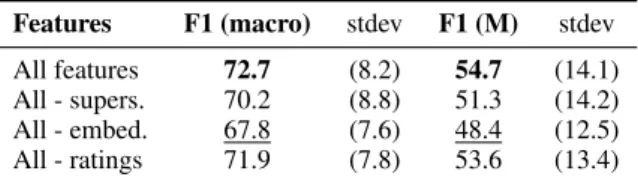
Features F1 (macro) stdev F1 (M) stdev All features 72.7 (8.2) 54.7 (14.1) All - supers. 70.2 (8.8) 51.3 (14.2) All - embed. 67.8 (7.6) 48.4 (12.5) All - ratings 71.9 (7.8) 53.6 (13.4) Table 2: Feature ablation on the POEMS data (Macro F1 and F1(M): F1 for the minority class; stdev: standard deviation for cross-validation). 5.3 Feature Selection
We perform feature selection for POEMSand TSV using feature ablation with 10-fold cross-validation on the respective training sets. We conduct these experiments to test our first hypothesis.
By dropping one feature at a time, we can de-termine the feature’s importance by measuring the decrease in performance in terms of F1-score. Ta-ble 2 shows 10-fold cross-validation results for POEMS. The highest F1-score is bolded while the lowest is underlined. Removing word embeddings results in the highest loss in performance, showing their usefulness for metaphor detection. Since we obtain highest performance when using all features, we conclude that all feature types contribute rele-vant information and keep them for the next set of experiments.
We conduct the same experiment on the TSV data. As for the POEMS, best results are obtained when using all features. Results for the balanced TSV dataset, however, are much higher with an F1-score of 82.8% (10-fold cross-validation on the training set).
We also compare the impact of different em-beddings types. For POEMS, we obtain best re-sults for the SkipGram embeddings (Reimers et al., 2014) while for TSV, 100-dimensional Fast-Text embeddings (Bojanowski et al., 2017) trained on the SDeWac corpus (Faaß and Eckart, 2013) give slightly higher results. We use FastText for all subsequent experiments on the TSVdataset. 5.4 Context Features
Turney et al. (2011) state the hypothesis that ”the degree of abstractness of the context in which a given word appears is predictive of whether the word is used in a metaphorical or literal sense”. They support their claim with experiments showing that i) the abstractness of an adjective’s noun, seen as context, can be used to predict the adjective’s metaphoricity and ii) averaged abstractness ratings of a verb’s context, excluding the verb itself, can
be used to predict the verb’s metaphoricity. In all experiments, the authors report classification performances significantly higher than the majority class baselines and systems from related work.
While Turney et al. (2011) use only the noun modified by the adjective as context, we extend their hypothesis and test whether using features extracted from the A-N pairs’ surrounding context can further improve classification accuracy (H2). In addition to affective ratings, we also extract su-persenses and word embeddings from the context and add these new features to the feature vectors.
Context feature extraction We extract features
for word embeddings, supersenses and affective rat-ings from a context window of size 20 for each A-N pair and concatenate the additional feature repre-sentations with the feature vectors for the A-N pairs. Similar to Turney et al. (2011)’s experiments on verbs, we do not extract features for every word in the context but limit feature extraction to adjectives, nouns and verbs. The final context representation is the average over all individual context features for a specific A-N pair.
We use the same word embedding types that gave us best results in the previous experiments. In other words, we use Reimers et al. (2014)’s word embeddings for POEMSand FastText word embed-dings trained on SDeWac for the TSVdata.
Context feature selection We now compare the
setting without context, using only features ex-tracted for the A-N pairs, to models that are also trained on context features. Again, we perform an ablation study to measure each context feature’s importance, doing 5-fold cross-validation on the training set. The results for POEMS in Table 3 show a slight increase in overall F1-score; however, the improvement on the minority class is subtle and the high standard deviations for the different folds shows that the results are not robust. Since re-moving context supersenses from the set of context features lowers the performance, we test another setting in which we add only context supersense features to the feature set. This setting corresponds to the last row in Table 3. Since the cross-validation results suggest that context supersenses might in-clude relevant information for the metaphor detec-tion model, we add them to the feature vector.
We run the same experiment for TSV. For this model, we achieve highest F1-scores without addi-tional context features. This means that we found no evidence to support hypothesis H2 that
con-Cont. features F1 (macro) stdev F1 (M) stdev None 73.8 6.2 54.3 10.9 All 74.0 4.4 54.2 8.2 All - supers. 72.9 4.3 52.3 8.0 All - embed. 74.4 3.4 55.0 6.3 All - ratings 73.5 4.9 53.1 9.2 Only supers. 74.5 3.5 55.3 6.3 Table 3: POEMScontext feature selection (in addi-tion to features extracted from A-N pairs)
text features can provide useful information for metaphor detection for A-N pairs.
This is in contrast to Turney et al. (2011) who did report positive results for employing context features for metaphor detection. There are, how-ever, some crucial differences between their and our setup. For adjectives, Turney et al. (2011) used only the adjectives’ nominal heads as context but did not include additional context features extracted from the local context of the A-N pair. Thus, their experiments only show improvements for using context for verbal metaphors where they do extract abstractness features for all nouns, adjectives and verbs in a sentence.
As a result, we do not know whether the use of additional context features might only be rele-vant for verbs where we would add information for verbal arguments that might be useful for dis-ambiguation. For adjectives, we already include their syntactic heads in our setup and the surround-ing context might not be as relevant as for verbal metaphors.
It might also be possible that our setup for ex-tracting context information from a fixed-size win-dow around the target A-N pair is suboptimal and that a different approach might be more successful. We leave this to future work.
Results on the test sets All experiments reported
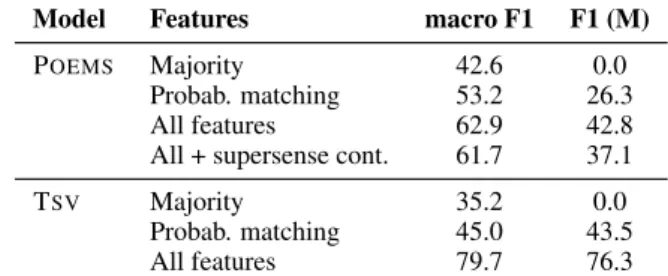
above were run in a cross-validation setup on the training sets and served to determine the best model and feature combinations for each dataset. We now report results on the test sets for the selected mod-els and compare them to two baselines (Table 4). Themajoritybaseline simulates a rule-based sys-tem that always predicts the majority class (i.e. lit-eral) whileprobability matchingcorresponds to a classifier that makes random predictions according to the training set class distribution. For POEMS, we also report the performance using supersense context features in addition to the features extracted from A-N pairs (All features + cont.).
Model Features macro F1 F1 (M)
POEMS Majority 42.6 0.0
Probab. matching 53.2 26.3
All features 62.9 42.8
All + supersense cont. 61.7 37.1
TSV Majority 35.2 0.0
Probab. matching 45.0 43.5
All features 79.7 76.3
Table 4: Baselines and test set results for POEMS and TSV. All features corresponds to the best model from the previous experiments.
For the POEMS, the features we investigate pro-duce a model that substantially outperforms both baselines and seems to be able to distinguish be-tween metaphorical and literal uses of adjectives. The improvements over the baselines, however, are not statistically significant. In addition, the supersense context features selected using cross-validation on the training set do not generalise to new data. We speculate that this might be related to the dataset’s class imbalance in addition to its relatively small size. Thus, increasing the size of the dataset is highly recommendable and should be the next step for future work.
For the balanced TSVdataset, results for the se-lected model (last row of Table 4) are much higher with an average F1 of 79.7% and an F1 for the metaphorical class of 76.3%. Here, results are also significantly better than both baselines.13
5.5 Domain impact
In our last experiment, we test the usefulness of out-of-domain training data for metaphor detection in German poetry (H3).
The datasets used for POEMS and for TSV present several differences: the former is unbal-anced, as opposed to the latter, and of smaller size. Moreover, both datasets originate from different domains, namely i) poetry and ii) a range of differ-ent genres from the web. To test our hypothesis that out-of-domain data can be used to improve results for metaphor detection in poetry, we conduct the following experiment.
We merge the training sets from the TSVand PO -EMSdatasets and shuffle the resulting dataset with a fixed random state for reproducibility. We obtain a training set consisting of 624 metaphorical and 1,047 literal instances, which form a total of 1,617 training instances; we denote this new training set 13Using McNemar’s test, both p-values are below 0.000001.
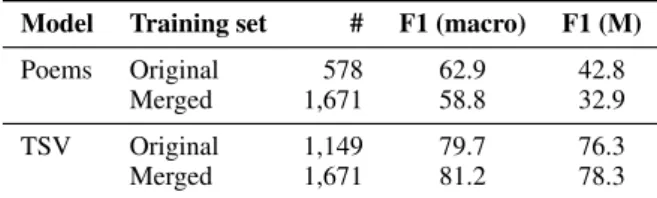
Model Training set # F1 (macro) F1 (M) Poems Original 578 62.9 42.8
Merged 1,671 58.8 32.9
TSV Original 1,149 79.7 76.3
Merged 1,671 81.2 78.3
Table 5: Test set results of POEMSand TSVusing
mergedin comparison to original training sets asmerged. We then train the best models selected for POEMSand TSVon themergedtraining set and test the models on the original two test sets.
Table 5 shows results for the models trained on themergedtraining set; results using the original training sets are repeated for comparison. Adding out-of-domain training data to the POEMSdid not improve results, meaning that we cannot confirm H3(repeated below).
H3: Metaphors are not domain-dependent but a general cognitive phenomenon, thus supple-mentary out-of-domain training data can im-prove results for metaphor detection in poetry. The performance for the TSVdata, however, did increase when adding the additional training data from the poetry corpus. At first glance, this is somewhat surprising as adding the TSVdata to the poems results in a more balanced training set. This, however, might not be the best idea when the dis-tribution in the test set is highly imbalanced. As a result, the classifier might have lost crucial infor-mation about the class distribution, which might explain the decrease in results.
To test whether this loss of information is respon-sible for the results, we run another experiment where we downsample both data sets so that both training and test sets have the same size and class distribution (table 6). Then we retrain and test our models on the resized datasets.14 Table 7 shows the same trend as before: training on POEMSdoes not decrease results for TSVwhile training on TSV yields substantially lower results for the POEMS.
14We report averaged results over 10 trials of sampling with replacement.
train (M/L) test (M/L) POEMS(orig) 100/478 98/280 TSV(orig) 546/603 65/77 DOWN-SAMPLED 100/217 65/77 Table 6: Train size and distribution ofMetaphorical /Literal instances in the datasets.
Model Train-Test Prec. Rec. F1 stdev Poems Poems-Poems 63.4 62.2 61.9 3.8
Poems-TSV 75.0 65.9 64.1 2.0 TSV TSV-TSV 75.1 65.2 63.0 2.3 TSV-Poems 59.5 52.9 44.3 3.6 Table 7: Cross-domain results for downsampled datasets (averaged over 10 runs).
These results should be taken with a grain of salt as the datasets are very small. In future work, we would like to validate our findings on larger data.
For now, we cannot confirm that the difference in class distribution in the training and test sets is the underlying reason for our negative results re-garding H3. We thus have to assume that the use of metaphors in expressionist poetry is crucially dif-ferent from the one in every-day life, as described by Dietz (1959).
6 Conclusions & Outlook
In the paper, we presented first steps towards metaphor detection in German literature, in par-ticular, in expressionist poetry. We created two datasets with adjective-noun pairs, manually an-notated for metaphoricity, and evaluated models for metaphor detection for German. Our results show that features that have been used for other lan-guages work well for German, too, and that word embeddings in particular are valuable features. We tested whether additional context information can improve classification accuracy, with negative re-sults. We also explored the domain-dependence for metaphor detection by adding supplementary out-of-domain training data. Here, the results were mixed and require future investigation.
One important finding of our work is that results for metaphor detection are highly dependent on the class distribution in the dataset, and that balanced corpora give overly optimistic and thus misleading results.
For future work, the most important step is to increase the size of the datasets and to add anno-tations for other metaphors types, such as verbal metaphors. Metaphor annotation is a challenging task where agreement between annotators is often low. As has been noted before (Shutova, 2017; Gibbs, 1984), metaphoricity can be seen as a con-tinuum. Thus, it might be recommendable to an-notate metaphors on a scale instead of categorising them into binary classes. This would allow annota-tors to capture shades of gray and give them more flexibility while avoiding arbitrary decisions.
Acknowledgments
This research has been partly conducted within the Leibniz Science Campus “Empirical Linguistics and Computational Modeling”, funded by the Leib-niz Association under grant no. SAS-2015-IDS-LWC and by the Ministry of Science, Research, and Art (MWK) of the state of Baden-W¨urttem-berg.
References
Piotr Bojanowski, Edouard Grave, Armand Joulin, and Tomas Mikolov. 2017. Enriching Word Vectors with Subword Information. Transactions of the As-sociation for Computational Linguistics, 5:135–146. Leo Breiman. 2001. Random forests. Machine
learn-ing, 45(1):5–32.
Luana Bulat, Stephen Clark, and Ekaterina Shutova. 2017. Modelling metaphor with attribute-based se-mantics. InProceedings of the 15th Conference of the European Chapter of the Association for Com-putational Linguistics: Volume 2, Short Papers, vol-ume 2, pages 523–528.
Nitesh V. Chawla. 2010. Data mining for imbalanced datasets: An overview. InData Mining and Knowl-edge Discovery Handbook, 2nd ed., pages 875–886. Ludwig Dietz. 1959. Die lyrische Form Georg Trakls.
Salzburg. Otto M¨uller.
Erik-Lˆan Do Dinh, Hannah Wieland, and Iryna Gurevych. 2018. Weeding out conventionalized metaphors: A corpus of novel metaphor annotations. In Proceedings of the 2018 Conference on Empiri-cal Methods in Natural Language Processing, pages 1412–1424.
Gertrud Faaß and Kerstin Eckart. 2013. SdeWaC – A Corpus of Parsable Sentences from the Web. In Lan-guage processing and knowledge in the Web, pages 61–68. Springer.
Raymond W. Jr. Gibbs. 1984. Literal Meaning and Psychological Theory. Cognitive science, 8(3):275– 304.
Birgit Hamp and Helmut Feldweg. 1997. GermaNet – a Lexical-Semantic Net for German. Automatic in-formation extraction and building of lexical seman-tic resources for NLP applications.
Thorsten Joachims. 1998. Text categorization with Support Vector Machines: Learning with many rel-evant features. InEuropean conference on machine learning, pages 137–142. Springer.
Vaibhav Kesarwani, Diana Inkpen, Stan Szpakowicz, and Chris Tanasescu. 2017. Metaphor detection in a poetry corpus. InThe Joint SIGHUM Workshop on
Computational Linguistics for Cultural Heritage, So-cial Sciences, Humanities and Literature, LaTeCH 2017, pages 1–9.
Maximilian K¨oper and Sabine Schulte im Walde. 2016a. Automatic semantic classification of german preposition types: Comparing hard and soft cluster-ing approaches across features. InThe 54th Annual Meeting of the Association for Computational Lin-guistics, ACL 2016.
Maximilian K¨oper and Sabine Schulte im Walde. 2016b. Automatically Generated Affective Norms of Abstractness, Arousal, Imageability and Valence for 350 000 German Lemmas. InLREC.
Maximilian K¨oper and Sabine Schulte im Walde. 2017. Applying Multi-Sense Embeddings for Ger-man Verbs to Determine SeGer-mantic Relatedness and to Detect Non-Literal Language. InProceedings of the 15th Conference of the European Chapter of the Association for Computational Linguistics: Volume 2, Short Papers, volume 2, pages 535–542.
Saisuresh Krishnakumaran and Xiaojin Zhu. 2007. Hunting elusive metaphors using lexical resources. InWorkshop on Computational Approaches to Figu-rative Language, pages 13–20.
George Lakoff. 1987. Women, Fire, and Dangerous Things. Chicago University Press.
Saskia Le Cessie and Johannes C. Van Houwelingen. 1992. Ridge Estimators in Logistic Regression.
Journal of the Royal Statistical Society: Series C (Applied Statistics), 41(1):191–201.
Birte L¨onneker-Rodman. 2008. The hamburg metaphor database project: issues in resource creation. Language Resources and Evaluation, 42(3):293–318.
Fabian Pedregosa, Ga¨el Varoquaux, Alexandre Gram-fort, Vincent Michel, Bertrand Thirion, Olivier Grisel, Mathieu Blondel, Peter Prettenhofer, Ron Weiss, Vincent Dubourg, et al. 2011. Scikit-learn: Machine learning in Python. Journal of machine learning research, 12(Oct):2825–2830.
Pragglejaz Group. 2007. MIP: A Method for Iden-tifying Metaphorically Used Words in Discourse.
Metaphor and Symbol, 22(1):1–39.
Marek Rei, Luana Bulat, Douwe Kiela, and Ekaterina Shutova. 2017. Grasping the finer point: A su-pervised similarity network for metaphor detection. In The 2017 Conference on Empirical Methods in Natural Language Processing, EMNLP 2017, pages 1537–1546.
Nils Reimers, Judith Eckle-Kohler, Carsten Schnober, Jungi Kim, and Iryna Gurevych. 2014. GermEval-2014: Nested Named Entity Recognition with Neu-ral Networks. In Gertrud Faaß and Josef Rup-penhofer, editors, Workshop Proceedings of the 12th Edition of the KONVENS Conference, pages
117–120, Hildesheim, October. Universit¨atsverlag Hildesheim.
Helmut Schmid. 1994. Probabilistic Part-Of-Speech Tagging Using Decision Trees. InProceedings of International Conference on New Methods in Lan-guage Processing, 1994.
Helmut Schmid. 1995. Improvements in Part-Of-Speech Tagging with an application to German.
EAL SIGDAT work-shop, 1995.
Ekaterina Shutova, Simone Teufel, and Anna Korho-nen. 2013. Statistical metaphor processing. Compu-tational Linguistics, 39(2):301–353.
Ekaterina Shutova, Douwe Kiela, and Jean Maillard. 2016. Black Holes and White Rabbits: Metaphor Identification with Visual Features. InProceedings of the 2016 Conference of the North American Chap-ter of the Association for Computational Linguistics: Human Language Technologies, pages 160–170. Ekaterina Shutova. 2017. Annotation of Linguistic and
Conceptual Metaphor. In Handbook of Linguistic Annotation, pages 1073–1100. Springer.
Chris Tanasescu, Vaibhav Kesarwani, and Diana Inkpen. 2018. Metaphor detection by deep learning and the place of poetic metaphor in digital human-ities. In The 31st International Florida Artificial Intelligence Research Society Conference, FLAIRS 2018, pages 122–127.
Yulia Tsvetkov, Leonid Boytsov, Anatole Gershman, Eric Nyberg, and Chris Dyer. 2014. Metaphor de-tection with cross-lingual model transfer. In The 52nd Annual Meeting of the Association for Compu-tational Linguistics, ACL 2014, pages 248–258. Joseph Turian, Lev Ratinov, and Yoshua Bengio. 2010.
Word representations: A simple and general method for semi-supervised learning. InProceedings of the 48th Annual Meeting of the Association for Com-putational Linguistics, ACL ’10, pages 384–394, Stroudsburg, PA, USA. Association for Computa-tional Linguistics.
Peter D. Turney, Yair Neuman, Dan Assaf, and Yohai Cohen. 2011. Literal and metaphorical sense iden-tification through concrete and abstract context. In
The 2011 Conference on Empirical Methods in Natu-ral Language Processing, EMNLP 2011, pages 680– 690.
A.1 List of authors for thePOEMSdataset
The following table lists the authors of the poems included in the POEMScorpus, with the number of poems for each author.
Author # poems Author # poems
Gottfried Benn 10 Johannes R. Becher 6
Julius Maria Becker 24 Frieda Bettingen 22
Ernst Blass 68 Paul Boldt 8
Theodor D¨aubler 62 Gerrit Engelke 66
Max Herrmann-Neisse 12 Georg Heym 87
Jakob van Hoddis 8 Oskar Kanehl 4
Georg Kulka 28 Else Lasker-Schueler 151
Heinrich Lersch 47 Alfred Lichtenstein 123
Oskar Loerke 45 Ernst Wilhelm Lotz 19
Ludwig Rubiner 21 Gustav Sack 65
Daniel Schiebeler 4 Ernst Stadler 116
August Stramm 71 Ernst Toller 5
Georg Trakl 91 Franz Werfel 35
Alfred Wolfenstein 2
Authors of poems in the dataset POEMS A.2 Categorisation for adjectives and annotation criteria
Category Instances in training set Literal ex. Metaphorical ex. Ambiguous ex. Criteria Temperature heiß, kalt, k¨uhl, lau, schw ¨ul, eisig, mild, vereist, w arm heiße Stirn heiße Tr ¨ane, heißes Auge heißes Feld Literal meanings: temperature property of an object (‘T eller’), body part (‘Hand’) or a substance (‘W ind’). Metaphorical: unusual uses of such adjecti ves are those describing a noun that w ould not commonly ha ve a temperature attrib ute (lik e an eye or a tear). Color blau, braun, bunt, gelb, ver gilbt, grau, gr ¨un, pur -pur ,rosig, rot, schw arz, weiß blauer Abend, blaue Nacht, blaues Licht blaue Seele, braune Stille, roter Duft blauer Tag Literal: the noun refers to an object that can ha ve the property of a color . Abstract nouns such as ‘soul’ or concepts that cannot be touched such as ‘odor’ are metaphorical cases. In dif ficult cases such as ‘night’, ‘day’, ‘e vening’, the noun does not refer to a ph ysical object but since it can ha ve the attrib ute of a color ,it is considered literal. Material golden, kristallen, sil-bern, steinern, seiden goldenes Auge, goldene Stufe, goldenes Bildnis, goldener W ald, goldene Luft, goldene W olk e, seidener Strumpf, silberne Hand steinerne Geduld goldener Tag Literal: when the noun refers to a ph ysical object such as an item. Dif-ficulties occurred for the adjecti ve ‘golden’; the decision w as made to exclude an y sense that does not refer to the material gold or its tint/color from literal tags. Metaphorical: abstract concepts (idea, feeling). ‘gold-ener Tag’ can mean that the sk y is tinted in a golden color (literal) or a day (time indication) w as excellent in a certain w ay (metaphorical); thus the pair is ambiguous. Te xture, sub-stance blank, dicht, dornig, dumpf, hart, kahl, rostig, tr ¨ub, weich, zart, fest blank es Ge wehr , blank er Himmel, dichte W iese, hartes Lager hartes Licht, harte Luft weicher W eg Literal pairs contain an adjecti ve describing a ph ysical object’ s te xture or substance: items, surf aces, body parts or certain locations (‘W iese’). Y et light cannot ha ve a hard te xture, for example, thus the corresponding pair is metaphorical. Shape, vol-ume, weight dick, d¨unn, d¨urr , eng, rund, schmal, spitz, ge w ¨olbt, gezackt, hohl, leicht, of fen, schwer , tief, weit d¨unnes Licht, d¨unner Nebel, d¨urres Rohr , tiefe W unde schweres Lid, schwerer Schlaf, d¨urre Straße -Literal pairs contain an adjecti ve describing a ph ysical object’ s shape, volume and weight. Ho we ver ,‘d ¨unn’ can concretely describe the narro w shape of a ray of light and is tagged as literal. ‘schweres Lid’ describes a person’ s eyelid with the tendenc y to close; thus the adj ecti ve is used in a metaphorical w ay . Size, length, height groß, klein, lang, kurz, hoch, nieder großer Himmel, große Not, kleines Lied, kleine Stimme, langer Tag, lange Stunde großes Leben, große Nacht, großer Tag, hohe Lust hohes Gut, hohe Nacht Literal: quanti fiable or classifiable attrib ute (‘groß’: of high size, surf ace or intensity ,‘hoch’: placed high in space or high in quantity or intensity , ‘lang’, ‘kurz’, ‘klein’: an object’ s length or an ev ent’ s duration). An y other sense is metaphorical. Age, time alt, erst, fr ¨uh, jung, letzt, neu, reif, ewig altes Haus, alter Gott, erster Men-sch, neuer Mensch, fr ¨uhes Gedicht, ewige Nacht alter Tag, junger Fr ¨uhling, junge Kraft, ewiger Raum -Objects and living beings can be described as old or young/ne w . A distinction is made between ‘ne w’ and ‘young’ since the second one is reserv ed to living beings (thus ‘junger Fr ¨uhling’ is metaphorical). In the case of ‘e wiger Raum’, the adjecti ve’ s sense is modified to describe a surf ace or extension in space, thus the pair is metaphorical. Light dunk el, d¨uster , finster , gl ¨uhend, hell, schim-mernd, strahlend dunkler Baum, dunkles W asser , helle Nacht dunkle Frage, dunkle Stimme, finsterer Zorn, gl ¨uhendes Blut dunkler W ald, dunkler W eg, d¨usteres Bild, fin-steres W asser , gl ¨uhende Erde Adjecti ves such as ‘dunk el’, ‘d ¨uster’ and ‘finster’ refer to a lo w light conte xt in the literal sense. An y pair that mak es use of the second sense (uncann y, sinister) is tagged as metaphorical. This cate gory pres ents a high amount of ambiguous cases since both senses are often possible and conte xt w ould be necessary to determine the adjecti ve’ s sense. Annotation criteria for dif ferent adjecti ve cate gories