
Gestural Control of Music
Marcelo M. Wanderley
IRCAM - Centre Pompidou
1, Pl. Igor Stravinsky
75004 - Paris - France
[email protected]
Abstract
Digital musical instruments do not depend on physical constraints faced by their acoustic counterparts, such as characteristics of tubes, membranes, strings, etc. This fact permits a huge diversity of possi-bilities regarding sound production, but on the other hand strategies to design and perform these new instruments need to be devised in order to provide the same level of control subtlety available in acous-tic instruments. In this paper I review various topics related to gestural control of music using digital musical instruments and identify possible trends in this domain.
1
Introduction
The evolution of computer music has brought to light a plethora of sound synthesis methods avail-able in general and inexpensive computer plat-forms, allowing a large community direct access to real-time computer-generated sound.
Both signal and physical models have already been considered as sufficiently mature to be used in con-cert situations, although much research continues to be carried on in the subject, constantly bring-ing innovative solutions and developments [9] [90] [65].
On the other hand, input device technology that captures different human movements can also be viewed as in an advanced stage [64] [8], consid-ering both non-contact movements and manipula-tion1. Specifically regarding manipulation, tactile
and force feedback devices for both non-musical2
and musical contexts have already been proposed [13]3.
Therefore, the question of how to design and perform new computer-based musical instruments
Current address: Faculty of Music - McGill University, 555, Sherbrooke Street West, Montreal, Quebec - H3A 1E3 Canada
1With the exception of extreme conditions, such as
3-dimensional whole-body acquisition in large spaces
2For a survey on haptic devices, check the Haptics
Commu-nity Web page at: http://haptic.mech.mwu.edu/
3Even so, many users still use the traditional piano-like
key-board as the main input device for musical interaction. This sit-uation seems to be equivalent to the ubiquitous role played by the mouse and keyboard in traditional human-computer inter-action (HCI).
– consisting of gesturally controlled, real time computer-generated sound – need to be considered in order to obtain similar levels of control subtlety as those available in acoustic instruments.
This topic amounts to a branch of knowledge known as human-computer interaction (HCI)4. In
this context, various questions come to mind, such as:
Which are the specific constraints that exist in the musical context with respect to general human-computer interaction?
Given the various contexts related to interac-tion in sound generating systems, what are the similarities and differences within these con-texts (interactive installations, digital musical instrument manipulation, dance-music inter-faces)?
How to design systems for these various mu-sical contexts? Which system characteristics are common and which are context specific?
1.1
Human-Computer
Interaction
and Music
Gestural control of computer generated sound can be seen as a highly specialized branch of human-computer interaction (HCI) involving the
simul-taneous control of multiple parameters, timing,
4For general information on human-computer interaction,
the reader is directed to general textbooks, such as [26] or to the ACM SIGCHI webpage at: http://www.acm.org/sigchi/
rhythm, and user training [63]. According to A.
Hunt and R. Kirk [40]:
In stark contrast to the commonly accepted choice-based nature of many computer interfaces are the control in-terfaces for musical instruments and ve-hicles, where the human operator is to-tally in charge of the action. Many pa-rameters are controlled simultaneously and the human operator has an overall view of what the system is doing. Feed-back is gained not by on-screen prompts, but by experiencing the moment-by-moment effect of each action with the whole body.
Hunt and Kirk consider various attributes as char-acteristics of a real-time multiparametric control systems [40, pg. 232]. Some of these are:
There is no fixed ordering to the human-computer dialogue.
There is no single permitted set of options (e.g. choices from a menu) but rather a series of continuous controls.
There is an instant response to the user’s movements.
The control mechanism is a physical and multi-parametric device which must be learned by the user until the actions become automatic.
Further practice develops increased control intimacy and thus competence of operation. The human operator, once familiar with the system, is free to perform other cognitive ac-tivities whilst operating the system (e.g. talk-ing while drivtalk-ing a car).
1.1.1 Interaction Context
Taking into account the specificities described above, let me consider the various existing con-texts5in computer music6.
These different contexts are the result of the evolu-tion electronic technology allowing, for instance, a same input device to be used in different situations, e.g. to generate sounds (notes) or to control the temporal evolution of a set of pre-recorded notes. If traditionally these two contexts corresponded to two separate roles in music – those of the per-former and the conductor, respectively – today not only the differences between different traditional 5Sometimes called metaphors for musical control [106]. 6A detailed analysis of different interaction contexts has
been proposed in [102], taking into account two points of view: system design (engineering) and semantical (human-computer interaction).
roles have been minimized, but new contexts de-rived from metaphors created in human-computer interaction are now available in music.
One of these metaphors is drag and drop, that has been used in [106] with a graphical drawing tablet as the input device, a sort of gesturally controlled sequencer, whereas in [81] and in [104] the same tablet was used in the sense of a more traditional instrument.
Therefore, the same term interaction in a musical
context may mean [102]:
instrument manipulation (performer-instrument interaction) in the context of real-time sound synthesis control.
device manipulation in the context of
score-level control, e.g. a conductor’s baton used
for indicating the rhythm to a previously de-fined computer generated sequence [52] [4] [49]. Wessel and Wright use the term dipping to designate this context [106].
other interaction contexts related to
tradi-tional HCI interaction styles, such as drag and drop, scrubbing [106] or navigation [92].
device manipulation in the context of
post-production activities, for instance in the case
of gestural control of digital audio effects7or
sound spatialisation.
interaction in the context of interactive
mul-timedia installations (where one person or
many people’s actions are sensed in or-der to provide input values for an au-dio/visual/haptic system).
But also, to a different extent:
interaction in the context of dance (dance/music interfaces) [16] [1].
computer games, i.e., manipulation of a com-puter game input device [23].
although in these two last cases the generation of sound is not necessarily the primary goal of the interaction.
1.1.2 Music as Supervisory Control
Another way to consider the different contexts in music is to relate them to supervisory control the-ory. For instance, Sheridan [82] makes a parallel to supervisory control theory, where the notions of 7Several papers on the control of digital
au-dio effects are available from the DAFx site, at:
zeroth, first and second order control correspond to
different musical control levels, i.e., biomechanics (performer gestures and feedback), putting notes
together, and composing and conducting the syn-chronization of musicians.
2
Gestural Control of Sound
Synthesis
I will now focus on the the main interest of this pa-per and analyze the situation of pa-performer-digital musical instrument interaction8. The focus of this
work can be summarized as expert interaction by
means of the use of input devices to control real-time sound synthesis software.
The suggested strategy to approach this subject consists in dividing the subject of gestural control of sound synthesis in four parts [100]:
Definition and typologies of gesture
Gesture acquisition and input device design
Mapping of gestural variables to synthesis variables
Synthesis algorithms
The goal is to show that all four parts are equally important to the design of new digital musical in-struments. This has been developed in detail in [98].
Due to space constraints, I will focus here on item 2, gesture acquisition and input device de-sign. Item 1 has been studied in collaboration with Claude Cadoz in [15] and item 3 in collaboration with Andy Hunt and Ross Kirk in [41]. Synthesis algorithms have been explored in various articles and textbooks, including [9], [73] and also in the perspective of real-time control in [19].
3
Digital Musical Instruments
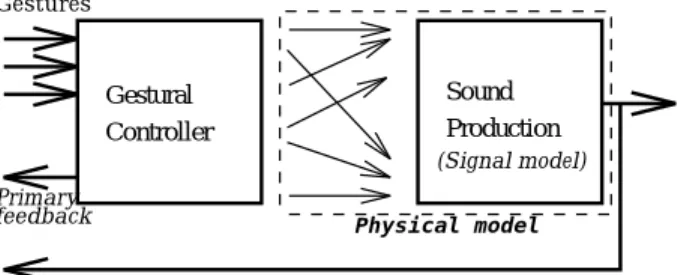
In this work, the term digital musical instrument (DMI)9 is used to represent an instrument that
8Due to space constraints, other important and interesting
modalities of human-computer interaction in music will not be studied here. An electronic publication (CDROM), Trends in
Gestural Control of Music, co-edited by the author and by M.
Battier [99], may present useful guidelines for the study of other modalities not discussed here.
9The term digital musical instrument [3] will be used
in-stead of virtual musical instrument - VMI[58] due to the various meanings of VMI, such as for example in the software package
Modalys, where a software-defined instrument is called a
vir-tual instrument, without necessarily the use of an input device. This is also the common usage of the term in the field of physi-cal modeling [90]. On the other hand, various authors consider
contains a separate gestural interface (or gestu-ral controller unit) from a sound generation unit. Both units are independent and related by mapping strategies [35] [57] [77] [80]. This is shown in fig-ure 1.
The term gestural controller10can be defined here
as the input part of the DMI, where physical inter-action with the player takes place. Conversely, the sound generation unit can be seen as the synthe-sis algorithm and its controls. The mapping layer refers to the liaison strategies between the outputs of the gestural controller and the input controls of the synthesis algorithm11.
This separation is impossible in the case of tradi-tional acoustic instruments, where the gestural in-terface is also part of the sound production unit. If one considers, for instance, a clarinet, the reed, keys, holes, etc. are at the same time both the ges-tural interface (where the performer interacts with the instrument) and the elements responsible for the sound production. The idea of a DMI is analo-gous to ”splitting” the clarinet in a way where one could separate these two functions (gestural inter-face and sound generator) and use them indepen-dently.
Clearly, this separation of the DMI into two inde-pendent units is potentially capable of extrapolat-ing the functionalities of a conventional musical instrument, the latter tied to physical constraints. On the other hand, basic characteristics of existing instruments may be lost and/or difficult to repro-duce, such as tactile/force feedback.
3.1
Gesture and Feedback
In order to devise strategies concerning the de-sign of new digital musical instruments for ges-tural control of sound synthesis, it is essential to analyze the characteristics of actions produced by expert instrumentalists during performance. These actions are commonly referred to as gestures in the musical domain. In order to avoid discussing all nuances of the meaning of gesture, let me ini-tially consider performer gestures as performer
ac-tions produced by the instrumentalist during per-formance. A detailed discussion is presented in
[15]12.
a VMI as both the synthesis algorithm and the input device [57] [25] [36], although in this case the digital musical instrument is eventually much more real or tangible and less virtual.
10The term gestural controller is use here meaning input de-vice for musical control.
11Details of each module of figure 1 will be considered in the
rest of this document.
12I will use the term performer gesture throughout this
doc-ument meaning both actions such as prehension and manipula-tion, and non-contact movements.
Primary Gestures INPUT Gestural Controller Sound Production feedback (Signal model) Secondary feedback MAPPING Physical model
Figure 1: A Digital Musical Instrument representation.
3.1.1 Performer Gestures
Instrumentalists simultaneously execute various types of gestures during performance. Some of them are necessary for the production of sound [12], others may not be clearly related to sound production [24] [101], but are nevertheless present in most highly-skilled instrumentalists’ perfor-mances.
One can approach the study of gestures by either analyzing the possible functions of a gesture dur-ing performance [70] or by analyzdur-ing the physical properties of the gestures taking place [18]. By identifying gestural characteristics – functional, in a specific context, or physiological – one can ulti-mately gain insight into the design of gestural ac-quisition systems.
Regarding both approaches, it is also important to be aware of the existing feedback available to the performer, be it visual, auditory or tactile-kinesthetic. Feedback can also be considered de-pending on its characteristics, as:
Primary/secondary [94], where primary feed-back encompasses visual, auditory (clarinet key noise, for instance) and tactile-kinesthetic feedback, and secondary feedback relates to the sound produced by the instrument. Passive/active [8], where passive feedback
re-lates to feedback provided through physical characteristics of the system (a switch noise, for instance) and active feedback is the one produced by the system in response to a cer-tain user action (sound produced by the in-strument).
Tactile-kinesthetic, or tactual [7] feedback is com-posed by the tactile and proprioceptive senses [76].
3.2
Gestural Acquisition
Once the gesture characteristics have been ana-lyzed, it is essential to devise an acquisition
sys-tem that will capture these characteristics for fur-ther use in the interactive system.
In the case of performer - acoustic instrument in-teraction, this acquisition may be performed in three ways:
Direct acquisition, where one or various sen-sors are used to monitor performer’s actions. The signals from these sensors present iso-lated basic physical features of a gesture: pressure, linear or angular displacement, and acceleration, for instance. A different sen-sor is usually needed to capture each physical variable of the gesture.
Indirect acquisition, where gestures are iso-lated from the structural properties of the sound produced by the instrument [2] [45] [69] [27] [62]. Signal processing techniques can then be used in order to derive per-former’s actions by the analysis of the fun-damental frequency of the sound, its spectral envelope, its power distribution, etc.
Physiological signal acquisition, the analysis of physiological signals, such as EMG [46] [66]. Commercial systems have been devel-oped based on the analysis of muscle tension and used in musical contexts [86] [6] [87] [50] [107]. Although capturing the essence of the movement, this technique is hard to master since it may be difficult to separate the meaningful parts of the signal obtained from physiological measurement.
Direct acquisition has the advantage of simplicity when compared to indirect acquisition, due to the mutual influence of different parameters present in the resulting sound (i.e. instrument acoustics, room effect and performer actions). Nevertheless, due to the independence of the variables captured, direct acquisition techniques may underestimate the interdependency of the various variables ob-tained.
3.2.1 Direct Acquisition
Direct acquisition is performed by the use of dif-ferent sensors to capture performer actions. De-pending on the type of sensors and on the combi-nation of different technologies in various systems, different movements may be tracked.
Citing B. Bongers, a well-known alternate con-troller designer [8]:
Sensors are the sense organs of a ma-chine. Sensors convert physical energy (from the outside world) into electric-ity (into the machine world). There are sensors available for all known physical quantities, including the ones humans use and often with a greater range. For instance, ultrasound frequencies (typi-cally 40 kHz used for motion tracking) or light waves in the infrared frequency range.
3.2.2 Sensor Characteristics and Musical Ap-plications
Some authors consider that most important sen-sor characteristics are: sensitivity, stability and
peatability [84]. Other important characteristic
re-lates to the linearity and selectivity of the sensor’s output, it’s sensitivity to ambient conditions, etc. P. Garrett considers six descriptive parameters ap-plicable to sensors as [33]: accuracy, error,
preci-sion, resolution, span, and range.
In general instrumentation circuits, sensors typi-cally need to be both precise and accurate, and present a reasonable resolution. In the musical domain, it is often stressed that the choice of a transducer technology matching a specific musical characteristic relates to human performance and perception: for instance, mapping of the output of a sensor that is precise but not very accurate to a variable controlling loudness may be satisfactory, but if it is used to control pitch, its innacuracy will probably be more noticeable.
Various texts describe different sensors and trans-ducer technologies for general and musical appli-cations, such as [33] and [34] [8] [29], respectively. The reader is directed to these texts for further in-formation.
3.2.3 Analog to MIDI Conversion
For the case of gesture acquisition with the use of different sensors, the signals obtained at the sen-sors outputs are usually available in an analog for-mat, basically in the form of voltage or current sig-nals. In order to be able to use these signals as
computer inputs, they need to be sampled and con-verted in a suitable format, usually MIDI (Musi-cal Instrument Digital Interface) [43] or more ad-vanced protocols [30].
Various analog-to-MIDI converters have been pro-posed and are widely available commercially. The first examples have been developed already in the eighties [97] [85].
3.2.4 Comparison of Analog-to-MIDI inter-faces
Concerning the various discussions on the advan-tages and drawbacks of the MIDI protocol and its use [56], strictly speaking, nothing forces some-one to use MIDI or prevents the use of faster or different protocols. It is interesting to notice that many existing systems have used communication protocols other than MIDI in order to avoid speed and resolution limitations. One such system is the TGR (transducteur gestuel r´ectroactif, from ACROE [14].
I compare here six commonly available models of sensor-to-MIDI interfaces in order to provide the reader an idea of their differences13. Their basic
characteristics are seen in table 1.
One can notice that interface characteristics may differ to a significant amount, but most models present comparable figures. As already pointed out, the limiting factor regarding speed and reso-lution is basically the specifications of the MIDI protocol, not the electronics involved in the design.
3.2.5 Indirect Acquisition
As opposed to direct acquisition, indirect
acquisi-tion provides informaacquisi-tion about performer acacquisi-tions
from the evolution of structural properties of the sound being produced by an instrument. In this case, the only sensor is a microphone, i.e., a sen-sor measuring pressure or gradient of pressure. Due to the complexity of the information avail-able in the instrument’s sound captured by a micro-phone, different real-time signal processing tech-niques are used in order to distinguish the effect of a performer’s action from environmental features, such as the influence of the acoustical properties of the room.
Generically, one could identify basic sound param-eters to be extracted in real-time. P. Depalle, cites four parameters [100]:
13I have developed an extended comparison of nine
commer-cially available models, including technical characteristics and general features, based on information provided from manufac-turers and/or owner manuals/manufacturer’s web pages. This comparison is available from the Gesture Research in Music home-page at http://www.ircam.fr/gesture
Interface ADB I/O AtoMIC Pro Digitizer (I-Cube) MIDIBox Midicreator Sensorlab Manufacturer BeeHive Ircam Infusion Systems NOTAM York Elect. Centre STEIM
Platform Macintosh Any Any Any Any Any
Max. SR [Hz] <90 1000 200/225 (12/8 bits) Approx. 400 120 250
Analog IN 4 32 32 8 8 32, 2x3 Usound
Digital IN 4/6/8 8 - 16 8 8x16 key
Input Res. 8 bits 10/ 8 bits 12/ 8 bits 8 bits 8 bits 8/14bits Usound
Outputs max 8 8 + 4 MIDI 8 switch + MIDI 6 + MIDI MIDI MIDI
Size(HWD)[mm] 29x122x65 38x165x225 34x121x94 20x100x100(PCB) 41x227x166 35x200x100
Table 1: Comparison of 6 Analog-to-MIDI commercial interfaces.
Short-time energy, related to the dynamic profile of the signal, indicates the dynamic level of the sound but also possible differ-ences of the instrument position related to the microphone.
Fundamental frequency, related to the sound’s melodic profile, gives information about fingering, for instance.
Spectral envelope, representing the distribu-tion of sound partial amplitudes, may give formation about the resonating body of the in-strument.
Amplitudes, frequencies and phases of sound
partials, that can alone provide much of the
information obtained by the previous param-eters.
Obviously, in order to perform the analysis of the above or other parameters during indirect acquisi-tion, it is important to consider the correct sam-pling of the signal. According to the Nyquist the-orem, this frequency needs to be at least twice as big as the maximum frequency of the signal to be sampled.
Although one could reasonably consider that fre-quencies of performer actions can be limited to few hertz, fast actions can potentially present higher frequencies. A sampling frequency value typically proposed for gestural acquisition is 200 Hz [51]. Some systems may use higher values, from 300 to 1kHz [14]). Recently, researchers considered the ideal sampling frequency to be around 4 kHz [31] [30]. As a general figure, one can consider 1 kHz as sufficient for most applications.
Several works on indirect acquisition systems have already been presented. They include both brid systems (using also sensors), such as the
hy-percello [47] and pure indirect systems, such as
the analysis of clarinet performances [69] [27] and guitar [62].
3.3
Gestural Controllers
Once one or several sensors are assembled as part of a unique device, this device is called an input device or a gestural controller14.
As cited above, the gestural controller is the part of the DMI where physical interaction takes place.
Physical interaction here means the actions of
the performer, be they body movements, empty-handed gestures or object manipulation, and the perception by the performer of the instrument’s status and response by means of tactile-kinesthetic, visual and auditory senses.
Due to the large range of human actions to be cap-tured by the controller15 and depending on the in-teraction context where it will be used (cf. section 1.1.1), its design may vary from case to case. In or-der to analyze the various possibilities, we propose a three-tier classification of existing controller de-signs as [100] [8]:
Instrument-like controllers, where the input device design tends to reproduce each fea-ture of an existing (acoustic) instrument in detail. Many examples can be cited, such as electronic keyboards, guitars, saxophones, marimbas, and so on.
A sub-division of this class of gestural con-trollers would be that of Instrument-inspired
controllers, that although largely inspired by
existing instrument’s design, are conceived for another use [88]. One example is the
Su-perPolm violin, developed by S. Goto, A.
Ter-rier, and P. Pierrot [67] [36], where the input device is loosely based on a violin shape, but is used as a general device for the control of granular synthesis.
Augmented Instruments, also called Hybrid
Controllers, are instruments augmented by
14Called input device in traditional human-computer
interac-tion.
15According to A. Mulder, a virtual musical instrument (here
called digital musical instrument) is ideally capable of
captur-ing any gesture from the universe of all possible human move-ments and use them to produce any audible sound [57].
the addition of extra sensors [5] [47]. Com-mercial augmented instruments included the Yamaha Disklavier, used in for instance in pieces by J.-C. Risset [72] [71]. Other exam-ples include the flute [68] [109] and the trum-pet [22] [42] [91], but any existing acoustic instrument may be instrumented to different degrees by the additions of sensors.
Alternate controllers, whose design does not follow an established instrument’s one. Some examples include the Hands [97], graphic drawing tablets [81], etc. For instance, a ges-tural controller using the shape of the oral cavity has been proposed in [61].
For instrument-like controllers, although repre-senting a simplified (first-order) model of the acoustic instrument, many of the gestural skills developed by the performer on the acoustic in-strument can be readily applied to the controller. Conversely, for a non-expert performer, these con-trollers present roughly the same constraints as those of an acoustic instrument16, technical
diffi-culties inherent to the former may have to be over-come by the non-expert performer.
Alternate controllers, on the other hand, allow the use of other gesture vocabularies than those of acoustic instrument manipulation, these being re-stricted only by the technology choices in the con-troller design, thus allowing non-expert performers the use of these devices. Even so, performers still have to develop specific skills for mastering these new gestural vocabularies [97].
4
An Analysis of Existing Input
Devices
A reasonable number of input devices have been proposed to perform real-time control of mu-sic [74] [64], most of them resulting from com-poser’s/player’s idiosyncratic approaches to per-sonal artistic needs. These interfaces, although often revolutionary in concept, have mostly re-mained specific to the needs of their inventors. Four examples of gestural controllers are shown in figures 2 and 3.
The advantages and drawbacks of each controller type depends mostly on the user goals and back-ground, but unfortunately systematic means of evaluating gestural controllers are not commonly available.
16This fact can be modified by the use of different mapping
strategies, as shown in [77].
From an engineering point of view, it is important to propose means to compare existing designs17in
order to evaluate their strong and weak points and eventually come up with guidelines for the design of new input devices.
Some authors consider that new devices, designed according to ergonomical and cognitive principles, could eventually become general tools for musical control [95] [58] [89] [59]18.
4.1
Design Rationale:
Engineering
versus Idiosyncratic approaches
The use of pure engineering/ergonomical ap-proaches can be challenged by the comparison with the evolution of input device design in human-computer interaction. In fact, researcher W. Buxton [11] considers HCI and ergonomics as
failed sciences. He argues that although a
sub-stantial volume of literature on input device evalu-ation/design in these two areas has already been proposed, current available devices have benefit little from all this knowledge and therefore major innovations are not often proposed.
The problem with both points of view –
engineer-ing versus idiosyncratic – seems to be their
appli-cation context. Although one can always question the engineering approach by stressing the role of creativity against scientific design [21], the propo-sition of scientific methodologies is also a key factor for the evaluation of existing gestural con-trollers.
Conversely, engineering methodologies, shall not prevent the use of creativity in design, although this can be a side effect of structured design ratio-nales. But without a common basis for evaluation, the differentiation between input devices and sim-ple gadgets turns out to be hazardous.
As stated before, the design of a new input device for musical performance is generally directed to-wards the fulfillment of specific and sometimes id-iosyncratic musical goals, but is always based on an engineering corpus of knowledge. This tech-nical background allows the choice of transducer technologies and circuit designs that implement the interface needed to perform the initial musical goals19.
17A similar situation occurs in others areas, such as haptic
devices [37].
18On the other hand, other authors claim that effort
demand-ing and hard-to-play instruments are the only ones that provide expressive possibilities to a performer [78] [79] [96].
19A description of several input device designs is proposed
in [8], where Bongers review his work at STEIM, the Institute of Sonology (Den Haag) and in the Royal Academy of Arts in Amsterdam. Other good reviews of different controllers has been presented by J. Paradiso in [64] and by Y. Nagashima in his home page at http://nagasm.org
Figure 2: Left: Joseph Butch Rovan holding a wx7, an instrument-like (saxophone) controller by Yamaha. Right: Suguru Goto and the SuperPolm, an instrument-inspired controller (violin).
Figure 3: Left: Marc Battier manipulating the Pacom, by Starkier and Prevot. Right: Jean-Philippe Viollet using the WACOM graphic tablet. Both devices are considered as alternate controllers.
Therefore, although the final development goals are musical and consequently any criticism of these goals turns into a question related to aesthet-ical preferences, their design is based on engineer-ing principles that can, and need, to be evaluated and compared. This evaluation is essential, for in-stance, in the selection of existing input devices for performing different tasks [81], but it can also be useful in the identification of promising new op-portunities for the design of novel input devices [17].
4.2
Gestural Controller Design
It may also be useful to propose guidelines for the design of new input devices based on knowledge from related fields, such as experimental psychol-ogy, physiology and human-computer interaction [63].
Taking the example of the research in human-computer interaction, many studies have been car-ried out on the design and evaluation of input de-vices for general (non-expert) interaction. The most important goal in these studies is the im-provement of accuracy and/or time response for a certain task, following the relationship, known as the Fitts’ law [48].
Also, standard methodologies for tests have been proposed and generally consist of pointing and/or
dragging tasks, where the size and distance be-tween target squares are used as tests parameters. In 1994, R. Vertegaal and collaborators have pre-sented a methodology, derived from standard HCI tests, that addressed the comparison of input de-vices in a timbre navigation task [92] [94]. Al-though pioneering in the field, the methodology used consisted of a pure selection (pointing and acquisition) task, i.e., the context of the test was a navigation in a four parameter timbral space [93], not a traditional musical context in the sense of in-strumental performance.
In 1996, Vertegaal et al. [95] [89] proposed an at-tempt to systematically relate an hypothetical mu-sical function (dynamic – absolute or relative – or static) to a specific sensor technology and to the feedback available with this technology. This means that certain sensor technologies may outper-form others for a specific musical function. The interest of this work is that it allows a designer to select a sensor technology based on the proposed relationships, thus reducing the need for idiosyn-cratic solutions. An evaluation of this methodol-ogy is presented in [104].
Another attempt to address the evaluation of well-known HCI methodologies and their possible adaptation to the musical domain was presented in [63]. Although one cannot expect to use
method-ologies from other fields directly into the musical domain, at least the analysis of similar develop-ments in better established fields may help finding directions suitable for the case of computer music.
5
Mapping of Gestural
Vari-ables to Synthesis Inputs
Once gesture variables are available either from in-dependent sensors or as a result of signal process-ing techniques in the case of indirect acquisition, one then needs to relate these output variables to the available synthesis input variables.
Depending on the sound synthesis method to be used, the number and characteristics of these input variables may vary. For signal model methods, one may have a) amplitudes, frequencies and phases of sinusoidal sound partials for additive synthesis; b) an excitation frequency plus each formant’s cen-ter frequency, bandwidth, amplitude and skew for formant synthesis; c) carrier and modulation coef-ficients (c:m ratio) for frequency modulation (FM) synthesis, etc.
It is clear that the relationship between the gestural variables and the synthesis inputs available is far from obvious. How does one relate a gesture to a c:m ratio?
For the case of physical models, the available vari-ables are usually the input parameters of an instru-ment, such as blow pressure, bow velocity, etc. In a sense, the mapping of gestures to the synthesis inputs is more evident, since the relation of these inputs to the algorithm already encompasses the multiple dependencies based on the physics of the particular instrument.
5.1
Systematic Study of Mapping
The systematic study of mapping is an area that is still underdeveloped. Only a few works have been proposed that analyze the influence of map-ping on digital musical instrument performance or suggested ways to define mappings to relate con-troller variables to synthesis inputs. Examples of works include: [10], [44], [28], [108], [20], [55], [77], [60], [103], [39], [32], [40], [54], and [19]. A detailed review of the existing literature on map-ping was presented in [15], and in [98]. Discus-sions have also been carried on on the role of map-ping in computer music in the Working Group on Interactive Systems and Instrument Design in Mu-sic, at ICMA and EMF20, where a complete
bibli-ography on the subject is available, as well as sug-gestions on basic readings and links to existing re-search.
20http://www.notam.uio.no/icma/interactivesystems/wg.html
5.2
Mapping Strategies
Although simple one-to-one or direct mappings are by far the most commonly used, other mapping
strategies can be used.
For instance, we have shown that for the same ges-tural controller and synthesis algorithm, the choice of mapping strategy may be the determinant factor concerning the expressivity of the instrument [77]. The main idea was to challenge the main directions in digital musical instrument design, i.e. input de-vice design and research on different synthesis al-gorithms, and focus on the importance of different mappings using off-the-shelf controllers and stan-dard synthesis algorithms.
Different mapping strategies were applied to the simulation of traditional acoustic single reed in-struments using the controller, based on the ac-tual functioning of the single reed. The three ba-sic strategies were suggested: one,
one-to-many and one-to-many-to-one, and were used in order to
propose different mappings, from a simple one-to-one to complex mappings simulating the physical behavior of the clarinet’s reed. This is shown in figure 4.
We could show, from the experience of single reed instrument performers that tried the system that the use of different mappings did influence the ex-pressivity obtained during the playing, without any modifications in either the input device or the syn-thesis algorithm.
5.3
Mapping for General Musical
Per-formance
The example above applying different mapping strategies to the simulation of instrumental perfor-mance has derived from the actual physical behav-ior of the acoustic instrument. But in the case of an alternate digital musical instrument, the possi-ble mapping strategies to be applied are far from obvious, since no model of the mappings strategies to be used is available. Even so, it can be demon-strated that complex mappings may influence user performance for the manipulation of general input devices in a musical context.
An interesting work by A. Hunt and R. Kirk [38] [39] [40] presented a study on the influence over time of the choice of mapping strategy on subject performance in real-time musical control tasks. User performance was measured over a pe-riod of several weeks and showed that complex mapping strategies used with the multi-parametric instrument allowed better performance than sim-pler mappings for complex tasks (various parame-ters changing simultaneously) and also that perfor-mance with complex mapping strategies improved
breath breath breath lip pressure lip pressure lip pressure fingering fingering fingering dynamics (Y) dynamics (Y) dynamics (Y) loudness vibrato (X, relative) vibrato (X, relative) vibrato (X, relative) fundamental frequency (X, absolute) fundamental frequency fundamental frequency (X, absolute) (X, absolute) loudness loudness WX7
Figure 4: Examples of different mapping strategies for the simulation of instrumental performance [77].
over time.
5.4
A Model of Mapping as two
Inde-pendent Layers
Mapping can be implemented as a single layer [10] [20]. In this case, a change of either the gestural controller or synthesis algorithm would mean the definition of a different mapping.
One proposition to overcome this situation is the definition of mapping as two independent layers: a mapping of control variables to intermediate
pa-rameters and a mapping of intermediate parame-ters to synthesis variables [103].
This means that the use of different gestural con-trollers would necessitate the use of different map-pings in the first layer, but the second layer, be-tween intermediate parameters and synthesis pa-rameters, would remain unchanged. Conversely, changing the synthesis method involves the adap-tation of the second layer, considering that the same abstract parameters can be used, but does not interfere with the first layer, therefore being trans-parent to the performer.
The definition of those intermediate parameters or an intermediate abstract parameter layer can be based on perceptual variables such as timbre, loud-ness and pitch, but can be based on other percep-tual characteristics of sounds [105] [53] [32] or have no relationship to perception, being then arbi-trarily chosen by the composer or performer [103].
6
Developments in Sound
Syn-thesis Methods
On the other extreme of current trends regarding the digital musical instruments, various develop-ments on sound synthesis methods have been pro-posed, among them methods for both physical and signal models.
Physical models are specially useful for a realis-tic simulation of a given acousrealis-tic instrument and today models of various instruments exist [83] and are commercially available. Disadvantages of physical models include the lack of analysis meth-ods, difficulties regarding the continuous morph-ing between different models and most of all the complexity regarding the real-time performance using these models, that correspond to the difficul-ties encountered with the real acoustic instrument. Signal models, specifically additive synthesis [75], present the advantage of having well-developed analysis tools that allow the extraction of param-eters corresponding to a given sound. Therefore, the morphing of parameters from different sounds can lead to continuous transformations between different instruments. Although not necessarily re-producing the full behavior of the original instru-ment, the flexibility allowed by signal models may be interesting for the prototyping of control strate-gies since the mapping is left to the instrument de-signer.
7
Conclusions
This paper has critically commented on various topics related to real-time, gesturally controlled computer-generated sound.
I have discussed the specificities of the interac-tion between a human and a computer in various musical contexts. These contexts represent differ-ent interaction metaphors for music/sound control and cannot be underestimated since they define the level of interaction with the computer.
I have then focused on the specific case of real-time gestural control of sound synthesis, and pre-sented and discussed the various constituent parts of a digital musical instrument.
I have claimed that a balanced analysis of these constituent parts is an essential step towards the design of new instruments, although current devel-opments many times tend to focus either on the de-sign of new gestural controllers or on the proposi-tion of different synthesis algorithms.
8
Suggestions of Future
Re-search Directions
Finally, I present suggestions of topics for future research directions that I believe can eventually lead to new directions on the design and perfor-mance of digital musical instruments.
Concerning gestural acquisition, the use of in-direct acquisition through the analysis of the sound produced by acoustic instruments may help the design of new gestural controllers. Although various works have been proposed in this direction, a general overview showing the current state of the research in this area was missing and was presented in [98]. It can serve as a basis for future developments in the field.
The development of evaluation techniques for multiparametric expert user tasks is a difficult problem that may improve our knowledge of the actual motor behavior of performers in these circumstances. The definition of tasks taking into account different musical contexts may also help the comparison of existing de-vices and suggest design methodologies for the developments of new digital musical in-struments.
The study of mapping strategies is, in my opinion, quite underdeveloped. We have been pioneers in showing the isolated effect of mapping on digital musical instrumental de-sign and another important work recently car-ried out at the University of York has pushed
further our knowledge about general multi-parametric control situations and the influ-ence of mapping on performance. From these studies there seems to exist a huge unexplored potential on the definition of mapping strate-gies for different contexts.
Acknowledgements
This work is a result of a PhD thesis recently completed at IRCAM - Centre Pompidou, in Paris, thanks to fund-ing through a doctoral grant from CNPq, Brazil. Thanks to my advisors Philippe Depalle and Xavier Rodet, and to Marc Battier, Claude Cadoz, Shlomo Dub-nov, Andy Hunt, Fabrice Isart, Ross Kirk, Nicola Orio, Joseph Butch Rovan, Norbert Schnell, Marie-H´el`ene Serra, Hugues Vinet, and Jean-Philippe Viollet, for var-ious discussions, ideas, and comments throughout my stay at IRCAM.
This paper contains material already published by the author and collaborators. These are dully referenced throughout the text.
References
[1] C. Bahn, T. Hahn, and D. Trueman. Physicality and Feedback: A Focus on the Body in the Performance of Electronic Music. In Proc. of the 2001 International
Computer Music Conference. San Francisco, Calif.: In-ternational Computer Music Association, 2001.
[2] N. Bailey, A. Purvis, I. W. Bowler, and P. D. Manning. Applications of the Phase Vocoder in the Control of Real-Time Electronic Musical Instruments. Interface, 22:259–275, 1993.
[3] M. Battier. Les Musiques Electroacoustiques et l’environnement informatique. PhD thesis, University
of Paris X - Nanterre, 1981.
[4] R. Boie, M. V. Mathews, and A. Schloss. The Radio Drum as a Synthesizer Controller. In Proc. of the 1989
International Computer Music Conference. San Fran-cisco, Calif.: International Computer Music Associa-tion, pages 42–45, 1989.
[5] B. Bongers. The use of Active Tactile and Force Feed-back in Timbre Controlling Electronic Instruments. In
Proc. of the 1994 International Computer Music Con-ference. San Francisco, Calif.: International Computer Music Association, pages 171–174, 1994.
[6] B. Bongers. An Interview with Sensorband. Computer
Music J., 22(1):13–24, 1998.
[7] B. Bongers. Tactual Display of Sound Properties in Electronic Musical Instruments. Displays, 18:129–133, 1998.
[8] B. Bongers. Trends in Gestural Control of Music, chap-ter Physical Inchap-terfaces in the Electronic Arts. Inchap-teraction Theory and Interfacing Techniques for Real-time Perfor-mance. Ircam - Centre Pompidou, 2000.
[9] G. Borin, G. dePoli, and A. Sarti. Musical Signal
Pro-cessing, chapter Musical Signal Synthesis, pages 5–30.
Swets and Zeitlinger, 1997.
[10] I. Bowler, A. Purvis, P. Manning, and N. Bailey. On Mapping N Articulation onto M Synthesiser-Control Pa-rameters. In Proc. of the 1990 International Computer
Music Conference. San Francisco, Calif.: International Computer Music Association, pages 181–184, 1990.
[11] W. Buxton. Trends in Gestural Control of Music, chapter Round Table. Ircam - Centre Pompidou, 2000. [12] C. Cadoz. Instrumental Gesture and Musical
Composi-tion. In Proc. of the 1988 International Computer Music
Conference. San Francisco, Calif.: International Com-puter Music Association, pages 1–12, 1988.
[13] C. Cadoz, L. Lisowski, and J. L. Florens. A Modu-lar Feedback Keyboard Design. Computer Music J.,
14(2):47–56, 1990.
[14] C. Cadoz and C. Ramstein. Capture, Repr´eesentation and ”Composition” of the Instrumental Gesture. In Proc.
of the 1990 International Computer Music Conference. San Francisco, Calif.: International Computer Music Association, pages 53–56, 1990.
[15] C. Cadoz and M. M. Wanderley. Trends in Gestural
Control of Music, chapter Gesture-Music. Ircam -
Cen-tre Pompidou, 2000.
[16] A. Camurri. Interactive Dance/Music Systems. In Proc.
of the 1995 International Computer Music Conference. San Francisco, Calif.: International Computer Music Association, pages 245–252, 1995.
[17] S. Card, J. Mackinlay, and G. Robertson. A Morpho-logical Analysis of the Design Space of Input Devices.
ACM Transactions on Information Systems, 9(2):99–
122, 1991.
[18] I. Choi. Cognitive Engineering of Gestural Primitives for Multi-Modal Interaction in a Virtual Environment. In
Proc. IEEE International Conference on Systems, Man and Cybernetics (SMC’98), pages 1101–1106, 1998.
[19] I. Choi. Trends in Gestural Control of Music, chapter Gestural Primitives and the Context for Computational Processing in an Interactive Performance System. Ircam - Centre Pompidou, 2000.
[20] I. Choi, R. Bargar, and C. Goudeseune. A Manifold in-terface for a high dimensional control space. In Proc.
of the 1995 International Computer Music Conference. San Francisco, Calif.: International Computer Music Association, pages 385–392, 1995.
[21] P. Cook. Principles for Designing Computer Music Con-trollers. In Proc. of the NIME Workshop, CHI 2001, 2001.
[22] P. Cook, D. Morril, and J.-O. Smith. A MIDI Control and Performance System for Brass Instruments. In Proc.
of the 1993 International Computer Music Conference. San Francisco, Calif.: International Computer Music Association, pages 130–133, 1993.
[23] A. de Ritis. Senses of Interaction: What does Interac-tivity in Music mean anyway? Focus on the Computer Game Industry. In Proc. of the Society for Artificial
In-telligence and the Simulation of Behavior Conference,
London, 2001.
[24] F. Delalande. La gestique de Gould. In Glenn Gould
Pluriel, pages 85–111. Louise Courteau, ´editrice, inc.,
1988.
[25] P. Depalle, S. Tassart, and M. M. Wanderley. Instru-ments Virtuels. R´esonance, (12):5–8, Sept. 1997. [26] A. J. Dix, J. Finlay, G. Abowd, and R. Beale.
Human-Computer Interaction. Prentice Hall, second edition, 1998.
[27] E. B. Egozy. Deriving Musical Control Features from a Real-Time Timbre Analysis of the Clarinet. Master’s thesis, Massachusetts Institut of Technology, 1995.
[28] S. Fels. Glove Talk II: Mapping Hand Gestures to Speech Using Neural Networks. PhD thesis, University
of Toronto, 1994.
[29] E. Flety. Trends in Gestural Control of Music, chapter 3D Gesture Acquisition Using Ultrasonic Sensors. Ir-cam - Centre Pompidou, 2000.
[30] A. Freed, R. Avizienis, T. Suzuki, and D. Wessel. Scal-able Connectivity Processor for Computer Music Per-formance Systems. In Proc. of the 2000 International
Computer Music Conference. San Francisco, Calif.: In-ternational Computer Music Association, 2000.
[31] A. Freed and D. Wessel. Communication of Musical Gesture using the AES/EBU Digital Audio Standard. In
Proc. of the 1998 International Computer Music Con-ference. San Francisco, Calif.: International Computer Music Association, pages 220–223, 1998.
[32] G. Garnett and C. Gouseseune. Performance Factors in Control of High-Dimensional Spaces. In Proc. of the
1999 International Computer Music Conference. San Francisco, Calif.: International Computer Music Asso-ciation, pages 268–271, 1999.
[33] P. H. Garrett. Advanced Instrumentation and Computer
I/O Design. Real-time System Computer Interface Engi-neering. IEEE Press, 1994.
[34] N. Gershenfeld and J. Paradiso. Musical Applications of Electric Field Sensing. Computer Music J., 21(2):69–89, 1997.
[35] S. Gibet. Codage, Repr´esentation et Traitement du Geste
Instrumental. PhD thesis, Institut National Polytech-nique de Grenoble, 1987.
[36] S. Goto. The Aesthetics and Technological Aspects of Virtual Musical Instruments: The Case of the Super-Polm MIDI Violin. Leonardo Music Journal, 9:115– 120, 1999.
[37] V. Hayward and O. R. Astley. Robotics Research: The 7th International Symposium, chapter
Perfor-mance Measures for Haptic Interfaces, pages 195–207. Springer Verlag, 1996.
[38] A. Hunt. Radical User Interfaces for Real-time Musical
Control. PhD thesis, University of York, 1999.
[39] A. Hunt and R. Kirk. Radical User Interfaces for Real-Time Control. In Euromicro 99 Conference, Milan, 1999.
[40] A. Hunt and R. Kirk. Trends in Gestural Control of
Music, chapter Mapping Strategies for Musical
Perfor-mance. Ircam - Centre Pompidou, 2000.
[41] A. Hunt, M. M. Wanderley, and R. Kirk. Towards a Model of Mapping Strategies for Instrumental Perfor-mance. In Proc. of the 2000 International Computer
Music Conference. San Francisco, Calif.: International Computer Music Association, pages 209–212, 2000.
[42] J. Impett. A Meta-Trumpet(er). In Proc. of the 1994
International Computer Music Conference. San Fran-cisco, Calif.: International Computer Music Associa-tion, pages 147–150, 1994.
[43] International MIDI Association. MIDI Musical Instru-ment Digital Interface Specification 1.0. North Holly-wood: International MIDI Association, 1983.
[44] M. Lee and D. Wessel. Connectionist Models for Real-Time Control of Synthesis and Compositional Algo-rithms. In Proc. of the 1992 International Computer
Music Conference. San Francisco, Calif.: International Computer Music Association, pages 277–280, 1992.
[45] C. Lippe. A Composition for Clarinet and Real-Time Signal Processing: Using Max on the IRCAM Signal Processing Workstation. In 10th Italian Colloquium on
Computer Music, pages 428–432, 1993.
[46] H. Lusted and B. Knapp. Controlling Computer with Neural Signals. Scientific American, pages 58–63, 1996. [47] T. Machover. Hyperinstruments - A Progress Report 1987 - 1991. Technical report, Massachusetts Institut of Technology, 1992.
[48] I. S. MacKenzie and W. Buxton. Extending Fitts’ Law to Two Dimensional Tasks. In Proc. Conf. on Human
Fac-tors in Computing Systems (CHI’92), pages 219–226,
1992.
[49] T. Marrin and J. Paradiso. The Digital Baton: A Ver-satile Performance Instrument. In Proc. of the 1997
International Computer Music Conference. San Fran-cisco, Calif.: International Computer Music Associa-tion, pages 313–316, 1997.
[50] T. Marrin-Nakra. Trends in Gestural Control of Music, chapter Searching for Meaning in Gestural Data: Inter-pretive Feature Extraction and Signal Processing for Af-fective and Expressive Content. Ircam - Centre Pompi-dou, 2000.
[51] M. V. Mathews and G. Bennett. Real-time synthesizer control. Technical report, IRCAM, 1978. Repport 5/78. [52] M. V. Mathews and F. R. Moore. GROOVE - A Program to Compose, Store and Edit Functions of Time.
Commu-nications of the ACM, 13(12):715–721, December 1970.
[53] E. M´etois. Musical Sound Information - Musical Gestures and Embedding Systems. PhD thesis, Mas-sachusetts Institut of Technology, 1996.
[54] P. Modler. Trends in Gestural Control of Music, chapter Neural Networks for Mapping Gestures to Sound Syn-thesis. Ircam - Centre Pompidou, 2000.
[55] P. Modler and I. Zannos. Emotional Aspects of Ges-ture Recognition by a Neural Network, using Dedicated Input Devices. In Proc. KANSEI - The Technology of
Emotion Workshop, 1997.
[56] F. R. Moore. The Disfunctions of MIDI. In Proc. of the
1987 International Computer Music Conference. San Francisco, Calif.: International Computer Music Asso-ciation, pages 256–262, 1987.
[57] A. Mulder. Virtual Musical Instruments: Accessing the Sound Synthesis Universe as a Performer. In
Proced-dings of the First Brazilian Symposium on Computer Music, 1994.
[58] A. Mulder. Design of Gestural Constraints Using
Vir-tual Musical Instruments. PhD thesis, School of
Kinesi-ology, Simon Fraser University, Canada, 1998. [59] A. Mulder. Trends in Gestural Control of Music, chapter
Towards a Choice of Gestural Constraints for Instrumen-tal Performers. Ircam - Centre Pompidou, 2000. [60] A. Mulder, S. Fels, and K. Mase. Empty-handed Gesture
Analysis in Max/FTS. In Proc. KANSEI - The
Technol-ogy of Emotion Workshop, 1997.
[61] N. Orio. A Gesture Interface Controlled by the Oral Cavity. In Proc. of the 1997 International Computer
Music Conference. San Francisco, Calif.: International Computer Music Association, pages 141–144, 1997.
[62] N. Orio. The Timbre Space of the Classical Guitar and its Relationship with the Plucking Techniques. In Proc.
of the 1999 International Computer Music Conference. San Francisco, Calif.: International Computer Music Association, pages 391–394, 1999.
[63] N. Orio, N. Schnell, and M. M. Wanderley. Input De-vices for Musical Expression: Borrowing Tools from HCI. In Workshop on New Interfaces for Musical
Ex-pression - ACM CHI01, 2001.
[64] J. Paradiso. New Ways to Play: Electronic Music Inter-faces. IEEE Spectrum, 34(12):18–30, 1997.
[65] G. Peeters and X. Rodet. Non-Stationary Analy-sis/Synthesis using Spectrum Peak Shape Distortion, Phase and Reassignement. In Proceedings of the
In-ternational Congress on Signal Processing Applications Technology - ICSPAT, 1999.
[66] R. Picard. Affective Computing. MIT Press, 1997. [67] P. Pierrot and A. Terrier. Le violon midi. Technical
report, IRCAM, 1997.
[68] D. Pousset. La Flute-MIDI, l’histoire et quelques appli-cations. M´emoire de Maˆitrise, 1992. Universit´e Paris-Sorbonne.
[69] M. Puckette and C. Lippe. Getting the Acoustic Parame-ters from a Live Performance. In 3rd International
Con-ference for Music Perception and Cognition, pages 328–
333, 1994.
[70] C. Ramstein. Analyse, Repr´esentation et Traitement du
Geste Instrumental. PhD thesis, Institut National
Poly-technique de Grenoble, December 1991.
[71] J. C. Risset. ´Evolution des outils de cr´eation sonore. In
Interfaces Homme-Machine et Cr´eation Musicale, pages
17–36. Hermes Science Publishing, 1999.
[72] J. C. Risset and S. Van Duyne. Real-Time Performance Interaction with a Computer-Controlled Acoustic Piano.
Computer Music J., 20(1):62–75, 1996.
[73] C. Roads. Computer Music Tutorial. MIT Press, 1996. [74] C. Roads. Computer Music Tutorial, chapter Musical
Input Devices, pages 617–658. The MIT Press, 1996. [75] X. Rodet and P. Depalle. A New Additive Synthesis
Method using Inverse Fourier Transform and Spectral Envelopes. In Proc. of the 1992 International Computer
Music Conference. San Francisco, Calif.: International Computer Music Association, pages 410–411, 1992.
[76] J. P. Roll. Trait´e de Psychologie Exp´erimentale, chapter Sensibilit´es cutan´ees et musculaires. Presses Universi-taires de France, 1994.
[77] J. Rovan, M. M. Wanderley, S. Dubnov, and P. Depalle. Instrumental Gestural Mapping Strategies as Expressiv-ity Determinants in Computer Music Performance. In
Proceedings of the Kansei - The Technology of Emotion Workshop, Genova - Italy, Oct. 1997.
[78] J. Ryan. Some Remarks on Musical Instrument De-sign at STEIM. Contemporary Music Review, 6(1):3– 17, 1991.
[79] J. Ryan. Effort and Expression. In Proc. of the 1992
International Computer Music Conference. San Fran-cisco, Calif.: International Computer Music Associa-tion, pages 414–416, 1992.
[80] S. Sapir. Interactive Digital Audio Environments: Ges-ture as a Musical Parameter. In Proc. COST-G6
Confer-ence on Digital Audio Effects (DAFx’00), pages 25–30,
2000.
[81] S. Serafin, R. Dudas, M. M. Wanderley, and X. Rodet. Gestural Control of a Real-Time Physical Model of a Bowed String Instrument. In Proc. of the 1999
International Computer Music Conference. San Fran-cisco, Calif.: International Computer Music Associa-tion, pages 375–378, 1999.
[82] T. Sheridan. Musings on Music Making and Listening: Supervisory Control and Virtual Reality. In Human
Su-pervision and Control in Engineering and Music Work-shop, September 2001. Kassel, Germany.
[83] J. O. Smith. Musical Signal Processing, chapter Acous-tic Modeling using Digital Waveguides, pages 221–263. Swets & Zeitlingler, Lisse, The Netherlands, 1997. [84] R. L. Smith. The Electrical Engineering Handbook,
chapter Sensors. CRC Press, 1993.
[85] M. Starkier and P. Prevot. Real-Time Gestural Control. In Proc. of the 1986 International Computer Music
Con-ference. San Francisco, Calif.: International Computer Music Association, pages 423–426, 1986.
[86] A. Tanaka. Musical Technical Issues in Using Inter-active Instrument Technology with Applications to the BioMuse. In Proc. of the 1993 International Computer
Music Conference. San Francisco, Calif.: International Computer Music Association, pages 124–126, 1993.
[87] A. Tanaka. Trends in Gestural Control of Music, chapter Musical Performance Practice on Sensor-based Instru-ments. Ircam - Centre Pompidou, 2000.
[88] D. Trueman and P. Cook. BoSSA: The Deconstructed Violin Reconstructed. In Proc. of the 1999 International
Computer Music Conference. San Francisco, Calif.: In-ternational Computer Music Association, 1999.
[89] T. Ungvary and R. Vertegaal. Trends in Gestural Control
of Music, chapter Cognition and Physicality in Musical
Cyberinstruments. Ircam - Centre Georges Pompidou, 2000.
[90] V. V¨alim¨aki and T. Takala. Virtual Musical Instruments -natural sound using physical models. Organised Sound, 1(2):75–86, 1996.
[91] C. Vergez. Trompette et trompettiste: un syst`eme
dy-namique non lineaire analys´e, modelis´e et simul´e dans un contexte musical. PhD thesis, Ircam - Universit´e Paris
VI, 2000.
[92] R. Vertegaal. An Evaluation of Input Devices for Tim-bre Space Navigation. Master’s thesis, Department of Computing - University of Bradford, 1994.
[93] R. Vertegaal and E. Bonis. ISEE: An Intuitive Sound Editing Environment. Computer Music J., 18(2):12–29, 1994.
[94] R. Vertegaal and B. Eaglestone. Comparison of Input Devices in an ISEE Direct Timbre Manipulation Task.
Interacting with Computers, 8(1):13–30, 1996.
[95] R. Vertegaal, T. Ungvary, and M. Kieslinger. Towards a Musician’s Cockpit: Transducer, Feedback and Musical Function. In Proc. of the 1996 International Computer
Music Conference. San Francisco, Calif.: International Computer Music Association, pages 308–311, 1996.
[96] M. Waisvisz. Trends in Gestural Control of Music, chap-ter Round Table. Ircam - Centre Pompidou, 2000. [97] M. Waiswisz. The Hands, a Set of Remote
MIDI-Controllers. In Proc. of the 1985 International
Com-puter Music Conference. San Francisco, Calif.: Inter-national Computer Music Association, pages 313–318,
1985.
[98] M. M. Wanderley. Performer-Instrument Interaction: Applications to Gestural Control of Sound Synthesis.
PhD thesis, Universit´e Pierre et Marie Curie - Paris VI, 2001.
[99] M. M. Wanderley and M. Battier, editors. Trends in
Ges-tural Control of Music. Ircam - Centre Pompidou, 2000.
[100] M. M. Wanderley and P. Depalle. Interfaces
Homme-Machine et Cr´eation Musicale, chapter Contr ˆole Gestuel
de la Synth`ese Sonore, pages 145–163. Hermes Science Publications, 1999.
[101] M. M. Wanderley, P. Depalle, and O. Warusfel. Im-proving Instrumental Sound Synthesis by Modeling the Effects of Performer Gesture. In Proc. of the 1999
International Computer Music Conference. San Fran-cisco, Calif.: International Computer Music Associa-tion, pages 418–421, 1999.
[102] M. M. Wanderley, N. Orio, and N. Schnell. Towards an Analysis of Interaction in Sound Generating Systems. In
Proc. of the International Symposium on Electronic Arts - ISEA2000, Paris - France, 2000.
[103] M. M. Wanderley, N. Schnell, and J. Rovan. Escher -Modeling and Performing ”Composed Instruments” in Real-time. In Proc. IEEE International Conference on
Systems, Man and Cybernetics (SMC’98), 1998.
[104] M. M. Wanderley, J. P. Viollet, F. Isart, and X. Rodet. On the Choice of Transducer Technologies for Specific Mu-sical Functions. In Proc. of the 2000 International
Com-puter Music Conference. San Francisco, Calif.: Inter-national Computer Music Association, pages 244–247,
2000.
[105] D. Wessel. Timbre Space as a Musical Control Structure.
Computer Music Journal, 3(2):45–52, 1979.
[106] D. Wessel and M. Wright. Problems and Prospects for Intimate Musical Control of Computers. In New
Inter-faces for Musical Expression - NIME Workshop, 2001.
[107] A. Willier and C. Marque. Juggling Gesture Analysis for Music Control. In IV Gesture Workshop, 2001. London, England.
[108] T. Winkler. Making Motion Musical: Gestural Map-ping Strategies for Interactive Computer Music. In Proc.
of the 1995 International Computer Music Conference. San Francisco, Calif.: International Computer Music Association, pages 261–264, 1995.
[109] S. Ystad. Sound Modeling using a Combination of
Phys-ical and Signal Models. PhD thesis, Universit´e


![Figure 4: Examples of different mapping strategies for the simulation of instrumental performance [77].](https://thumb-us.123doks.com/thumbv2/123dok_us/10594943.2946688/10.918.266.541.83.424/figure-examples-different-mapping-strategies-simulation-instrumental-performance.webp)
