By:
Eric Kyere, PhD,
Indiana University School of Social Work, IUPUI [email protected]
James Huguley, Ed,D.
University of Pittsburgh School of Social Work [email protected]
___________________________________________________________________ This is the author's manuscript of the article published in final edited form as:
Introduction
There is a well-documented racialized terrain in K-12 education, whereby regardless of demonstrated ability or educational history African American youth tend to be disproportionately exposed to teachers with fewer qualifications, schools with fewer resources, higher rates of disciplinary actions, overrepresentation in lower-level courses, and experience discrimination and negative intellectual stereotypes (Author, 2011; Abulkadiroglu, Angrist, & Pathak, 2014; Fisher, Wallace, & Fenton, 2000; Kelly, 2009; McKown & Weinstein, 2008). These disparate experiences undermine biopsychosocial adjustment and subsequently, the academic success of African American youth (Brody et al., 2006; Huynh & Fuligni, 2010).
In response, to having to navigate these racialized contexts, African American parents employ race-based parenting practices (Racial-ethnic socialization) to shape youth’s racial identity beliefs—the subjective meaning ascribed to race-ethnicity in one’s conceptualization of the self (Hughes et al, 2006; Sellers et al., 1998). These racial-ethnic identity beliefs are in turn expected to help ensure the optimal psychological, emotional, and physical health of African American youth in racially adverse contexts (Hughes et al., 2006; Spencer, 1999). Although distinct conceptually, racial-ethnic socialization (RES) and racial-ethnic identity (REI) are inseparable and mutually related in practice (Hughes et al., 2016). However, analytically the extant research has typically treated them completely separately when considering culturally relevant protective factors in the development of African American children and youth (Jones & Neblett, 2016). Additionally, explorations of the subdomains of RES and REI have generally focused on the independent effects of their various subconstructs, although emerging evidence suggests these various subdimensions work together to influence children’s developmental
current research substantially undermine the field’s ability to understand the nuances involved in how racial-ethnic socialization and identity interact to affect the educational outcomes of African American youth. Consequently, the field’s ability to inform best practices on racial-ethnic
socialization to support African American youth development is severely limited, particularly in the context of social work practice (Teasely, 2004).
In response, the current study aims to generate knowledge to address this dearth in social work literature related to RES, REI, and Black child’s development by using path analysis to examine how prominent racial-ethnic socialization and racial-ethnic identity subdomains
simultaneously interact over time to influence youth’s academic performance. In the process, we also asses the degree to which subconstructs of RES have distinct effects on youth’s performance independent of racial identity mediations. Below, we first review the extant literature on the links between racial-ethnic socialization, and racial-ethnic identity and academic performance among Black youth. Next, we present a review of the relationship between REI and academic
performance, with particular attention to the limited studies where racial-ethnic identity has analytically been included as a mediator for RES effects. We then present the research methodology, followed by our findings and discussion.
Background
Racial-Ethnic Socialization, Identity, and Academic Performance
Racial-ethnic Socialization and Identity. AS noted above, racial ethnic socialization approaches are commonly employed by African American parents to instill pro-achievement identity formations and resilience in the face of racialized social and institutional experiences. Many studies have explored this relationship between RES and REI, and there is substantial
support for the notion that various domains of RES individually and differentially influence the subdomains of REI (French & Coleman, 2013; Neblett et al., 2009; Smalls et al., 2007). For example, French and Coleman (2013) investigated the association between four dimensions of parents’ race related messages to children—cultural socialization, preparation for bias,
egalitarian, and promotion of mistrust— and four dimensions of racial identity beliefs— humanist, assimilationist, oppressed, and nationalist. Using a sample of 89 African American college students, they observed that 1) higher cultural socialization was associated with lower humanist ideology; 2) higher cultural socialization was associated with higher sense of belonging and collective efficacy. And 3) higher egalitarian socialization was associated with higher
humanist ideology, but lower nationalist ideology. Murry, Berkel, Brody, Miller, and Chen (2009) observed that youth who received messages related to pride in African Americans family and racial heritage were associated with positive private regard. Similarly, Hughes et al. (2009) observed that racial heritage was positively and significantly associated with a sense of
connectedness to, and positive evaluation about their ethnic group among Black sixth graders. In Tang et al. (2015), youth who received frequent messages that reinforced pride in their
racial/cultural heritage in combination with strategies for dealing with potential incident of discriminations were more likely to view race as important to them (racial centrality).
Racial-ethnic Socialization and academic performance. A number of studies have established direct positive links between racial-ethnic socialization and academic performance, including across both global and subdomain conceptualizations (Bowman & Howard, 1985; Friend, Hunter & Fletcher, 2011; Neblett et al., 2009; Wang & Huguley, 2012). Specifically, Friend, Hunter and Fletcher (2011) and Bowman and Howard (1985), found that preparation for
effects among Black males for racial ethnic socialization practices emphasizing self-worth. Few studies however have simultaneously estimated the effects of multiple subdomains of racial-ethnic socialization subdomains on performance and among those that do, findings are mixed across these delineated constructs. Brown et al. (2009) for example found that African American heritage and pride in cultural values were associated with students’ grades independent of
background factors and other RES variables for males specifically, although the effects were in different directions. Cultural values were positively associated with performance, while heritage was independently negatively associated with grades. Similarly, Neblett et al. (2006) observed that independent of each other, while indirect racial socialization messages (e.g. attending cultural event, buying black toys etc.) were positively associated with GPA, explicit racial pride messages were associated with lower grades. Finally, Cough (2002) found that racial
environments in the home were positively related to higher test scores, while parents’ explicit pride messages were unrelated to achievement outcomes. Across studies then, there is emerging evidence that subconstructs of RES seem differentially related when their independent effects are examined simultaneously, although currently these findings need further corroboration and specification.
Racial Identity and Academic Performance
While monolithic demographic indicators are most often used to capture race and ethnicity in research, racial-ethnic identity scholarship has documented wide variation in people’s self-perceptions of racial-ethnic identity meaning, and as such have created measures that capture both the relevance and substance of what racial identity holds for African Americans. Sellers et al. (1998) identified and psychometrically validated three prominent subdimensions of racial identity: (1) centrality—or the level of importance an individual ascribes to their racial group membership;
2) regard—one’s own (private) or one’s perceived sense of society’s (public) feelings toward one’s own racial group; and 3) racial ideology—the meaning one attributes to one’s racial group membership. Racial ideology is further delineated into four distinct orientations: 1) a nationalist philosophy, which prioritizes connectedness and a commitment to collective efforts with others of the same race; 2) an oppressed minority philosophy, which stresses the shared oppression experiences by multiple people of color groups in the United States; 3) an assimilationist philosophy, which emphasize on the need for African Americans to fully adopt the mainstream Eurocentric culture; and (4) a humanist philosophy, which stress on the common humanity of all human beings (Sellers, 1998, p.27-28).
This multidimensionality suggests that African American racial identity development potentially entails experimentation with the multiple aspects of their racial-ethnic group membership (Hughes et al., 2016). Scholars have noted that in a race conscious society such as the United States where Black may be stereotyped as criminal and intellectually inferior, positive racial identity development is a process that seeks to change and replace the negative narratives with positive ones by excelling academically (Smalls et al., 2007; Spencer, 1999; Perry et al, 2003; Worrell et al., 2006). According to this perspective, Blacks who recognize the value of education as a tool for liberation, racial uplift, and appreciation of historical legacy are likely to perform better in school settings (Byrd & Chavous, 2012). Conceivably, it can be argued that to the degree that youth are exposed to racial-ethnic socialization practices that help them to perceive and internalize Blacks in a positive light, they may hold stronger orientations toward achievement, which in turn may support academic success.
Despite these strong theoretical underpinnings, research linking African American youth’s racial-ethnic identity to actual academic performance has produced somewhat mixed
findings. Although several studies contended that stronger racial identity fosters higher
academic achievement (Altschul, Oyserman & Bybee 2006; Byrd & Chavous, 2011; Gordon et al., 2009; Sellers, Chavous & Cook, 1998; Smith et al., 2009; Wong, Eccles & Sameroff , 2003), others have found that more intense racial-ethnic identities pose a risk to higher achievement among Black youth (Cokley & Chapman, 2008; Harper & Tucker, 2006; Irving & Hudley, 2008). Theoretically, these negative findings generally are attributed to issues around private and public regard beliefs, whereby the combination of low public regard—i.e. strong awareness and internalization of the negative stereotypes in larger society—and a simultaneous strong personal identification (centrality) with said group can in tandem present risks for one's self-esteem which in turn undermine academic performance (Hughes et al., 2015; Jones, 2000; Patterson, 2015; Steel, 1997). This racial identity-risk perspective contends that to protect the self-esteem, individuals are perversely incentivized to disengage from a domain such as school, where the stigmatized status of the group is particularly salient (Cokley, 2002; Osborne, 1997; see also Fordham & Ogbu, 1986; Ogbu 2004). With disengagement from the academic domain, affected youth are less likely to value the norms and behaviors that are required and consistent with educational engagement, which in turn diminish achievement for the group. To date however, few studies have tested the viability of sequential processes whereby racial-ethnic identity subconstructs contribute positively or negatively to academic outcomes.
Moreover, largely absent from studies of the relationship between racial-ethnic socialization and academic performance is empirical attention to the role of identity as a
mediator. Given the established links between RES and REI, and as well as both RES, REI and academic performance, it is possible that REI mediates the links between RES and academic success (Hughes et al, 2006), although few studies actually test this system of relationships.
Several studies have investigated the mediation role of REI in the relationship between RES and other developmental outcomes more broadly, and have found significant racial identity
mediations in the effects of racial-ethnic socialization on self-esteem, academic persistence and prosocial behaviors (Davis et al., 2017; Murry et al., 2009; Murry, Berkel, Simons, Simons, & Gibbons, 2014). Currently no studies examine similar sequential associations as they predict actual academic performance, and as such research that estimates the interrelated processes between racial-ethnic socialization, racial-ethnic identity, and academic performance will shed much needed light on the development processes by which racial-ethnic parenting practices and racial-ethnic identity domains interact to influence academic performance among African American youth.
Accordingly, the current study aims to generate knowledge on these interrelationships with the purpose of informing the social work field, particularly in the school and family support contexts, about culturally tailored processes that can be leveraged to advance high academic achievement of African American youth. We hypothesized based on the extant literature that: (1) the subconstructs of RES will have an independent effect on African American youth academic performance controlling for the mediation effects of the racial identity domains and (2) the subconstructs of RES will uniquely be associated with the various domains of the racial identity constructs, which would in turn predict academic performance controlling for each other
simultaneously. See Figure 1 for the hypothesized relationships. Methods
Participants came from the Maryland Adolescent Development in Context Study (MADICS, 1991-1998), a majority African American longitudinal study of adolescent and caregiver dyads designed to investigate the influence of contexts on youth, and to examine successful pathways through adolescence into young adulthood. The current study investigated only Black participants (n =904) who make up make up 61% of the total sample size (N= 1,482). Data were collected through face to face and self-administered interviews. Data from Wave 3 which were collected in the summer following 8th grade when youth were transitioning into 9th
grade (mean age was 14.5), and Wave 4, which corresponds to the summer following 11th grade
(mean age was 17.4) were used in this study. Data from Wave 3 on racial socialization and covariates were used to predict outcomes in wave 4, including racial identity and academic achievement.
Measures
Racial/Cultural Heritage. Racial/cultural heritage was assessed using a composite score of four items that asked parents the frequency with which they communicate, and engage youth in conversations and activities that instill in them pride and importance of their race (alpha=.72). Sample questions include: 1) how often do you participate in community activities with people of your racial background?; 2) how often does (CHILD) study the traditions of or about being (his/her) race?. Responses were coded on a 5-point scale ranging from 1=almost never to 5 = almost always.
Preparation for Bias. Preparation for bias was measured using a composite score of 7 items that captured parents’ endorsements of specific strategies conveyed to their child in the face of discrimination (alpha=.87). The overarching predictor question was: “How often do you suggest to your 8th grader that good ways to deal with racial discrimination he or she may face are:.”
Example responses include do better than everyone else in school and have faith in God. The items were scored on a 5-point scale assessing how often they engage in each specific strategy, ranging from 1 = almost never to 5 = daily.
Racial Centrality: Racial centrality was captured by a composite of three items that captured the extent to which youth view their race to be central or important to their overall development (alpha=.75). Examples include: 1) How important is your racial or ethnic background to the daily life of your family? and 2) How important is it for you to know about your racial or ethnic background? Responses were coded in a four-point scale that ranges from 1= not at all to 4 = very important.
Private Regard; Youth’s positive or negative feelings toward their own racial group was captured by a composite score of seven items that assess youth’s evaluation of their Black race membership (alpha=.77). Sample questions include: 1) I am happy that I am Black and 2) I feel good about other Black people. Participants indicated the extent to which each statement was true on a five-point scale ranging from 1= strongly disagree to 5 = strongly agree.
Racial Belonging: Youth’s sense of racial belonging was assessed using a composite of four items asking youth how true statements were that pertained to their feelings of inclusion in the Black racial group (alpha=.75). Examples include: 1) I have a close community of friends because of my race/ethnicity; and 2) People of my race/ethnicity are very supportive of each other. Responses were coded on a five-point scale that ranges from 1 = not all true of me 5 = extremely true of me.
Covariates
Academic performance was indicated by students’ grade point average (GPA) at Wave 3 (rising 9th grade summer) and Wave 4 (11th grade). Wave 3 GPA, which was taken from school
record data, was used as a control variable for prior performance. GPA at Wave 4 was obtained through students’ self-report and was used as outcome variable. Both indicators are measured on a standard 4.0 GPA scale.
Family Income was assessed by the primary caregiver’s self-reported income taken in a Wave 1 question that asked “From all sources of income, tell me your total family income before taxes?” Responses were coded on a 21-anchor range scale of $5,000 increments, beginning with “Under $5,000” and ending with “More than $100,000.”
Parent/Caregiver Education Level was also assessed via a self-reported item from the primary caregiver, which was taken from a face-to-face survey question that asked “What is the highest grade of school you have completed?” The responses were then coded along a 22-point scale beginning with first grade school to post-secondary degree completion.
Analytic Strategy
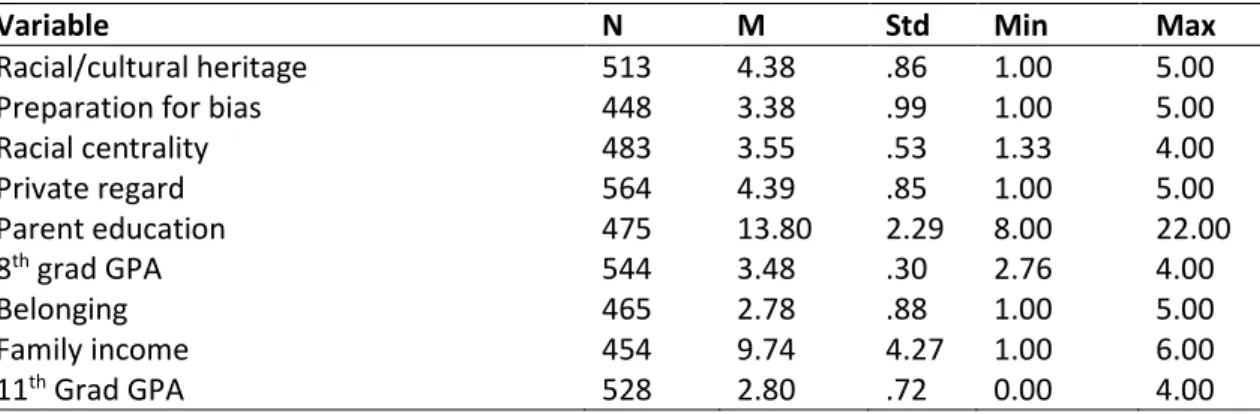
Descriptive statistics and correlations were first examined for racial-ethnic socialization, racial identity, and students’ performance (see Table 1). Following, the research questions were examined using path analysis, including identification of significant direct pathways as well as effects decomposition analyses to estimate the indirect effects between parameters in path model. Individual pathways were considered significant if regression coefficients were significant at the .05 critical alpha-level. Overall model fit was assessed using model chi-square, root mean square error of approximation (RMSEA), the comparative fit index (CFI), and the Tucker Lewis index (TLI). Model fit indices were used to make any theoretically tenable model adjustments. Missing data were addressed using multiple imputation.
Correlations reveal significant associations among the study’s variables of interest in uncontrolled conditions. Racial/cultural heritage socialization was positively and significantly related to two identity constructs: youth private regard (r =. 10, p<.0001), racial centrality (r =.23, p<.0001). However, it was negatively related to 11th grade academic performance (r = -.07, p<.01).
Preparation for bias was positively and significantly related to one identity construct: youth’s racial belonging (r =.11, p<.0001). Yet it was negatively related to private regard (r = -.12, p<.0001), and to 11th grade GPA (r = -.08, p<.01). Furthermore, private regard was positively and significantly
related to youth’s racial belonging (r = .21, p<.0001), racial centrality (r = .18, p<.0001), and 11th
grade GPA (r = .08, p<.01). Additionally, youth’s racial belonging was significantly and positively related to racial centrality (r = .20, p<.0001). Racial centrality was significantly and negatively related to 11th grade GPA (r = -.11, p<.0001). Regarding the RES subconstructs, preparation for
bias was positively, but marginally related to racial/cultural heritage socialization messages (r = .05, p =.06).
Model Fit
Inspection of the path analysis for the original proposed model indicated a poor fit, χ2 (12,
N = 1,361) =219.87, p <.0000, CFI = .536, TLI = -.005, RMSEA (90% CI) = .113 (1.00, .126). Information from the modification indices suggested that unaccounted for interrelations between racial identity subdimensions was causing the model to account for too little variance in the underlying structure. Accordingly, theoretically tenable direct paths were added from racial belonging to racial centrality, and from both racial belonging and racial centrality to private regard (Sellers et al., 1998; Worrell et al., 2006). In addition, direct paths from the covariates (parent education, family income, and youth’s past performance) were added to the racial identity
person-in-environment, these paths accounted for distal factors that likely affect racial ethnic identity above and beyond tangible racial ethnic socialization processes. These additional path inclusions improved the fitness of the model to acceptable levels (χ2 (4, N = 1,361) =6.36, p =.174,
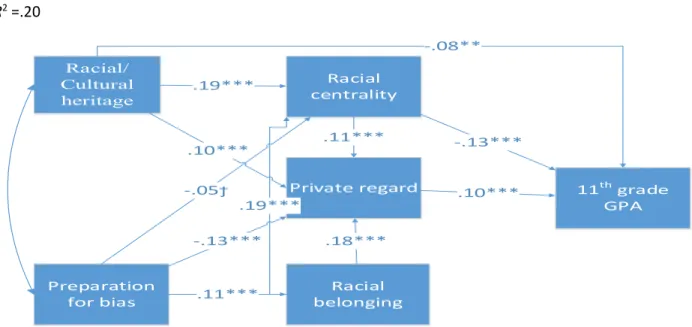
CFI = .99, TLI = .96, RMSEA (90% CI) = 0.02 (0.00, .050), (see Figure 2). The overall model accounted for 20% (R2 = .20) of the variability in African American youth academic performance.
Direct and Indirect Effects
As can be seen in Figure 2, the path analysis revealed that independent of the effects of preparation for bias, sociodemographic characteristics, and other identity mediators, parents racial/cultural socialization practices positively and significantly predict racial centrality (β = .19, p<.0001), as well as youth’s positive private regard for the Black racial group (β = .10, p<.0001). In addition, under these control conditions parents’ preparation for bias messages are independently and positively predictive of youth’s sense of racial belonging (β = .11, p<.0001), but negatively associated with private regard (β = -.13, p<.0001), and trending toward a negative association with racial centrality (β = -.05, p = .08). In terms of how the various dimensions of the racial-ethnic identity work together, the findings suggest that private regard is positively predicted by racial centrality (β = .11, p<.0001) and racial belonging (β = .18, p<.0001). Racial belonging also predicts racial centrality (β = .19, p<.0001) making it particularly influential among identity subdomains. With respect to students’ performance, the findings show that private regard and racial centrality significantly predicted performance in GPA (β = .10, p<.0001, and β = -.13, p<.0001 respectively), while racial belonging does not independent of other identity constructs. Similarly, results also suggest that independent of racial identity mediations, and sociodemographic factors, racial/cultural socialization directly but negatively predicts student’s
GPA over time (β = -.08, p<.004), while preparation for bias has no direct effect independent of identity mediations.
Discussion
Although racial-ethnic socialization and racial ethnic identity interlink to influence youth’s developmental outcomes (Hughes et al., 2016), the extant research has tended to investigate these constructs and their effect on youth’s outcomes separately (Jones & Neblett, 2016). We therefore used path analysis to investigate the interrelationships between RES, REI, and academic performance in one model to ascertain whether when considered simultaneously they have direct and/or mediated effect associations with the academic performance of African American youth. Based on previous findings, we hypothesized that the subconstructs of RES (racial/cultural and preparation for bias socialization) would have effects on academic performance that were both direct and independent of racial ethnic identity, as well as effects that were mediated by REI domains. This hypothesis was partially supported. As can be observed in Figure 2, when controlling for REI mediations, family background, youth’s previous performance, racial/cultural socialization was significantly but negatively linked to students’ performance two years later, while preparation for bias had no direct effect independent of covariates and mediations. These findings suggest that the direct effects of racial-ethnic socialization that are not associated with identity mediations may negatively impact academic performance among the participants investigated, and conversely that the positive benefits of RES are likely operationalized by way of its positive effects on key racial ethnic-identity subconstructs. On the surface these direct effect findings contradict previous research suggesting positive and significant link between academic performance and both preparation for bias (Bowman & Howard, 1985), and racial/cultural heritage
mediation effects of REI, they may best considered in comparison to the full sum of direct and indirect effects captured in this study, mediation pathways as captured in this study. In this vein, their findings are consistent with those described here, and it is likely that that racial-ethnic identity does in fact serve as the main conduit by which RES influences African American youth’s performance in education.
Our second and third aims were to examine whether when considered simultaneously, RES subconstructs independently relate to the various racial identity domains, and whether the identity subdimensions themselves in turn uniquely predict African American youth’s academic performance. Based on the extant research, we hypothesized that the subconstructs of RES will be positively and uniquely associated with the various subdomains of racial-ethnic identity, and that the racial-ethnic identity domains would in turn individually positively predict academic performance when controlling for each other and for sociodemographic background. The results partially support these above hypotheses. First, RES subconstructs do distinctively predict REI dimensions, but in some unexpected ways. As seen in Figure 2, as expected racial/cultural socialization positively and significantly predicts private regard and racial centrality independent of preparation for bias and key covariates. However, while preparation for bias does positively and significantly predicted racial belonging, it was negatively linked to private regard and racial centrality independent of racial/cultural socialization effects and the interrelationships between identity subdomains. These findings suggest that parents’ efforts to communicate and expose youth to racial history, heritage and cultural practices lead Black youth to have a positive evaluation of themselves and view their race to be relevant to their self-concept, while those related to preparation for bias, when independent of this cultural heritage socialization and identity
processes, may lead youth to view themselves less valuable, and their race as less relevant to who they are.
Decomposition analyses also suggest that preparation for bias indirectly predicts racial centrality and private regard positively through racial belonging, which racial/cultural socialization did not independent of preparation for bias. Given that belonging is subsequently a positive predictor of a positive private regard, these results are consistent with previous findings in suggesting that both racial/cultural heritage and preparation for bias play a role in the development of a healthy racial-ethnic identity in African American youth (Hughes et al., 2006; Stevenson, 1995). In investigating the independent effects of these racial-ethnic identity dimensions on student performance, while the results suggest that private regard is positively predictive of performance, racial centrality negatively predicts performance independent of the other racial identity dimensions, RES subconstructs, and covariates. Meanwhile, racial belonging had no direct positive link with performance independently. Given the distinct effects of racial centrality and racial belonging on private regard in predicting performance (See Figure 2), it can be argued that an integrated racial-ethnic identity that is established around not only strong identity importance beliefs, but also simultaneous positive view of Black racial group where youth view themselves as part, holds the greatest promise for higher academic performance. These findings support the proposition that racial-ethnic socialization, racial-ethnic identity and their various components are highly interconnected, mutually reinforcing, and inseparable as it pertains to promoting high academic achievement (Hughes et al., 2016).
Limitations
practices may differ from parents’ self-reported practices in ways that have implications for achievement outcomes. Future studies should certainly examine similar models from youths’ perspectives. In addition, because the data here are from parent reports they are generally specific to racial-ethnic socialization in the family context. It is likely however that African American youth are exposed to and affected by racial-ethnic socializing experiences that hold significance for racial-ethnic identity development outside of the family context (e.g. peers, school, media, community contexts, etc.) (Harper, 2013). Future work should seek to examine the simultaneous effects of racial-ethnic socialization stimuli from multiple sources. In addition, while the model here examines the independent, sequential effects of socialization and identity constructs on achievement, it is likely that statistical interaction effects between subconstructs also play a role in how these subdimensions predict achievement outcomes. While it was beyond the scope of this current study to explore the array of possible interaction effects in such a model, future efforts should compare models with both direct sequential effect and theoretically
grounded interaction effects to further refine our understanding of these complex processes. Lastly, given the narrow geographic scope of these data, the findings here may not generalize to all current settings of development for African American youth in the United States. Future studies should examine these issues across geographies and in nationally representative samples to assess the degree to which these experiences are similar across the various ecological contexts in which African American youth develop.
Implication for Social Work Research and Practice
Despite the above limitations, the findings of the current study have important implications for social work research and practice. For social work researchers, the findings suggest that positive REI development entails raced-based socialization content, structures, and processes
(Schachter & Rich, 2011). Therefore, social work researchers need to investigate the ways by which racial identity contents are generated and transmitted. Furthermore, Black youth seem to be actively involved in co-constructing and enacting the constructed self at any given time to adapt to the contextual demands that surround them (Nasir, 2011; Spencer, 1999). Social work research is needed to understand the processes by which REI structures are configured, reconfigured, and maintained to influence African American youth psychosocial adjustments and functioning across different domains of life including education. Therefore, social work researchers need to investigate the ways by which racial identity contents are generated and transmitted. Furthermore, Black youth seem to be actively involved in co-constructing and enacting the constructed self at any given time to adapt to the contextual demands that surround them (Nasir, 2011; Spencer, 1999). Social work research is needed to understand the processes by which REI structures are configured, reconfigured, and maintained to influence African American youth psychosocial adjustments and functioning across different domains of life including education.
In terms of practice, the findings indicate that social workers can help to create contexts that foster higher academic performance among African American youth if they utilize and advocate for racial-ethnic socialization approaches, and the subsequent positive racial-ethnic identity development in their engagement with educators, families and youth themselves. More specifically, practitioners can advocate for the incorporation of racial heritage discussion and strategies for responding to discrimination in school curriculum, after school programs and behavior intervention plans with youth. Additionally, social workers working with African American youth can draw on racial-ethnic socialization and subsequent positive racial identity to engage youth and their families in a therapeutic relationship for improved well-being
(Boyd-Conclusion
The findings reveal that race-based practices that highlight the racial/cultural heritage of African Americans in tandem with those that alert youth to potential discrimination and
strategies to respond, may potentially influence youth’s racial-ethnic identity domains, and that these racial-ethnic identity domains in turn shape one another in a complex way, leading to an integrated racial self that positively predicts GPA. Per the standards for cultural competence for competent social work practice with minority populations (NASW, 2015), social workers will increase competency to advance educational justice with Black youth by developing and applying knowledge and skills related to the positive racial-ethnic identity development, its content, and process in African American families.
References
Abulkadiroglu, A., Angrist, J., & Pathak, P. (2014). The elite Illusion: Achievement effects at Boston and New York exam schools. Econometrica, 82(1), 137–196.
Acock, A. C. (2013). Discovering structural equation modeling using Stata. Stata Press books. College Station, TX.
Altschul, I., Oyserman, D., & Bybee, D. (2006). Racial-ethnic identity in mid-adolescence: Content and change as predictors of academic achievement. Child Development, 77(5), 1155–1169.
Bowman, P. J., & Howard, C. (1985). Race-related socialization, motivation, and academic achievement: a study of black youths in three-generation families. Journal of the American Academy of Child Psychiatry, 24(2), 134–141.
Boyd-Franklin, N. (2003). Black families in therapy: Understanding the African American experience. The Guilford Press. New York.
Brody, G. H., Chen, Y. F., Murry, V. M., Simons, R. L., Ge, X., Gibbons, F. X., … Cutrona, C. E. (2006). Perceived discrimination and the adjustment of African American youths: A five-year longitudinal analysis with contextual moderation effects. Child Development, 77, 1170–1189.
Brown, T. L., Linver, M. R., Evans, M., & Degennaro, D. (2009). African-American parents’ racial and ethnic socialization and adolescent academic grades: Teasing out the role of gender. Journal of Youth and Adolescence, 38(2), 214–227.
Byrd, C., & Chavous, T. (2012). The congruence between African American students’ racial identity beliefs and their academic climates: implications for academic motivation and achievement. In Sulivan, J. & Esmail, A. (Ed.) African American Racial Identity: An Interdisciplinary Exploration of the Racial and Cultural Dimensions of the Black Experience, 345-369.
Byrd, C. M., & Chavous, T. (2011). Racial identity, school racial climate, and school intrinsic motivation among African American youth: The importance of person-context congruence. Journal of Research on Adolescence, 21(4), 849–860.
Cokley, K. O., & Chapman, C. (2008). The roles of ethnic identity, anti-white attitudes, and academic self-concept in African American student achievement. Social Psychology
of Education, 11(4), 349-365.
Davis, B. L., Smith-Bynum, M. A., Saleem, F. T., Francois, T., & Lambert, S. F. (2017). Racial socialization, private regard, and behavior problems in African American youth: global self-esteem as a mediator. Journal of child and family studies, 26(3), 709-720.
Ewert, S., Sykes, B. L., & Pettit, B. (2014). The degree of disadvantage: Incarceration and inequality in education. The ANNALS of the American Academy of Political and Social Science, 651(1), 24–43.
Fisher, C. B., Wallace, S. a., & Fenton, R. E. (2000). Discrimination distress during adolescence. Journal of Youth and Adolescence, 29(6), 679–695.
French, S. E., & Coleman, B. R. (2013). The relation between parental racial socialization and African Americans’ racial ideologies. Journal of Black Psychology, 39(4), 396-410. Friend, C. A., Hunter, A. G., & Fletcher, A. C. (2011). Parental racial socialization and the
academic achievement of African American children: A cultural-ecological approach. Fordham, S., & Ogbu, J. U. (1986). Black students’ school success: Coping with the “burden of
‘acting white.’” The Urban Review, 18(3), 176–206. Journal of African American Studies, 15(1), 40–57.
Gaddis, S. M., & Lauen, D. L. (2014). School accountability and the black-white test score gap. Social Science Research, 44, 15–31.
Harper, S. R. (2013). Am I my brother’s teacher? Black undergraduates, racial socialization, and peer pedagogies in predominantly white postsecondary contexts. Review of Research in Education, 37(1), 183–211.
Harper, B. E., & Tuckman, B. W. (2006). Racial identity beliefs and academic achievement: Does being black hold students back? Social Psychology of Education, 9(4), 381–403.
Hughes, D. L., Watford, J. A., & Del Toro, J. (2016). Chapter one-A transactional/ecological perspective on ethnic–racial Identity, socialization, and discrimination. Advances in Child Development and Behavior, 51, 1-41.
Hughes, D., Rodriguez, J., Smith, E. P., Johnson, D. J., Stevenson, H. C., & Spicer, P. (2006). Parents’ ethnic-racial socialization practices: a review of research and directions for future study. Developmental Psychology, 42(5), 747–770.
Hughes, D., Witherspoon, D., Rivas-Drake, D., & West-Bey, N. (2009). Received ethnic-racial socialization messages and youth's academic and behavioral outcomes: examining the mediating role of ethnic identity and self-esteem. Cultural Diversity & Ethnic Minority Psychology, 15(2), 112–124.
Hughes, M., Kiecolt, K. J., Keith, V. M., & Demo, D. H. (2015). Racial identity and well-being among African Americans. Social Psychology Quarterly, 78(1), 25–48.
Huynh, V. W., & Fuligni, A. J. (2010). Discrimination hurts: The academic, psychological, and physical well-being of adolescents. Journal of Research on Adolescence, 20(4), 916–941. Irving, M. A., & Hudley, C. (2008). Cultural identification and academic achievement among
Jones, C. (2000). Levels of racism: a theoretic framework and a gardener’s tale. American Journal of Public Health. 90(8), 1212.
Jones, S. C., & Neblett, E. W. (2016). Racial–ethnic protective factors and mechanisms in
psychosocial prevention and intervention programs for Black youth. Clinical child and family psychology review, 19(2), 134-161.
Kelly, S. (2009). The black-white gap in mathematics course taking. Sociology of Education, 82(1), 47-69.
McKown, C., & Weinstein, R. S. (2008). Teacher expectations, classroom context, and the achievement gap. Journal of School Psychology, 46(3), 235–261.
Miller, D. B. (1999). Racial socialization and racial identity: can they promote resiliency for African American adolescents? Adolescence, 34(135), 493–501.
Murry, V. M., Berkel, C., Brody, G. H., Miller, S. J., & Chen, Y.-F. (2009). Linking parental socialization to interpersonal protective processes, academic self-presentation, and expectations among rural African American youth. Cultural Diversity & Ethnic Minority Psychology, 15(1), 1–10.
Murry, V. M., Berkel, C., Simons, R. L., Simons, L. G., & Gibbons, F. X. (2014). A twelve‐year longitudinal analysis of positive youth development among rural African American males. Journal of Research on Adolescence, 24(3), 512-525.
National Association of Social Workers (2015). Standard and indicators for cultural competence in social work practice. NASW. Washington D.C
Nasir, N. I. (2011). Racialized identities: Race and achievement among African American youth. Stanford University Press. CA
Neblett, E. W. (2006). African American adolescents’ discrimination experiences and academic achievement: Racial socialization as a cultural compensatory and protective factor. Journal of Black Psychology, 32(2), 199-218.
Neblett, E. W., Chavous, T. M., Nguyên, H. X., & Sellers, R. M. (2009). “Say it loud-I’m Black and I'm proud”: Parents’ messages about race, racial discrimination, and academic achievement in African American boys. The Journal of Negro Education, 78(3), 246–363. Nicolas, G., Helms, J. E., Jernigan, M. M., Sass, T., Skrzypek, A., & DeSilva, A. M. (2008). A conceptual framework for understanding the strengths of Black youths. Journal of Black Psychology, 34(3), 261–280.
Patterson, O. (2015). The Cultural Matrix: Understanding Black Youth. Harvard University Press. MA.
Perry, T., Steele, C., & Hilliard, A. G. (2003). Young, gifted, and Black: Promoting high achievement among African-American students. Beacon Press: Boston, MA.
Sellers, R. M., Smith, M. a, Shelton, J. N., Rowley, S. a, & Chavous, T. M. (1998). Multidimensional model of racial identity: a reconceptualization of African American racial identity. Personality and Social Psychology Review : An Official Journal of the Society for Personality and Social Psychology, Inc, 2(1), 18–39.
Schachter, E. P., & Rich, Y. (2011). Identity education: A conceptual framework for educational researchers and practitioners. Educational Psychologist, 46(4), 222-238.
Smalls, C., White, R., Chavous, T., & Sellers, R. (2007). Racial ideological beliefs and racial discrimination experiences as predictors of academic engagement among African American adolescents. Journal of Black Psychology, 33(3), 299-330.
Smith, C. O., Levine, D. W., Smith, E. P., Dumas, J., & Prinz, R. J. (2009). A developmental perspective of the relationship of racial–ethnic identity to self-construct, achievement, and behavior in African American children. Cultural Diversity and Ethnic Minority
Psychology, 15(2), 145.
Spencer, M. B. (1999). Social and cultural influences on school adjustment: The application of an identity-focused cultural ecological perspective. Educational Psychologist, 34(1), 43–57. Spencer, M. B., Noll, E., Stoltzfus, J., & Harpalani, V. (2001). Identity and school adjustment:
revisiting the “acting White” assumption. Educational Psychologist, 36(1), 21–30.
Steele, C. M. (1997). A threat in the air. How stereotypes shape intellectual identity and performance. The American Psychologist, 52(6), 613–629.
Stevenson, H. C. (1995). Relationship of adolescent perceptions of racial socialization to racial identity. Journal of Black Psychology, 21(1), 49–70.
Tang, S., McLoyd, V. C., & Hallman, S. K. (2016). Racial socialization, racial identity, and academic attitudes among African American adolescents: Examining the moderating influence of parent–adolescent communication. Journal of youth and adolescence, 45(6), 1141-1155
Teasley, M. (2004). School social workers and urban education reform with African American children and youth: Realities, advocacy, and strategies for change. School Community Journal, 14(2), 19–38.
Umaña-Taylor, A. J., Quintana, S. M., Lee, R. M., Cross, W. E., Rivas-Drake, D., Schwartz, S. J., Seaton, E. (2014). Ethnic and racial identity during adolescence and into young adulthood: an integrated conceptualization. Child Development, 85(1), 21–39.
Wang, M.-T., & Huguley, J. P. (2012). Parental racial socialization as a moderator of the effects of racial discrimination on educational success among African American adolescents. Child Development, 83(5), 1716–31.
Wong, C. A., Eccles, J. S., & Sameroff, A. (2003). The influence of ethnic discrimination and ethnic identification on African American adolescents’ school and socioemotional adjustment. Journal of Personality, 71(6), 1197–1232.
Worrell, F. C. (2006). Generalizing nigrescence profiles: Cluster analyses of cross racial identity scale (CRIS) scores in three independent samples. The Counseling Psychologist, 34(4), 519–547.
Table 1: Descriptive Statistics
Variable N M Std Min Max
Racial/cultural heritage 513 4.38 .86 1.00 5.00
Preparation for bias 448 3.38 .99 1.00 5.00
Racial centrality 483 3.55 .53 1.33 4.00 Private regard 564 4.39 .85 1.00 5.00 Parent education 475 13.80 2.29 8.00 22.00 8th grad GPA 544 3.48 .30 2.76 4.00 Belonging 465 2.78 .88 1.00 5.00 Family income 454 9.74 4.27 1.00 6.00 11th Grad GPA 528 2.80 .72 0.00 4.00
Figure 1: Hypothesized Model Racial/Cultural Heritage Socialization Preparation for Bias Racial Centrality Private Regard Racial Sense of Belonging 11th Grade GPA
Figure 2: Path Model displaying the mechanism by which by which racial socialization, racial identity, and youth’s performance are linked
χ2 (4) =6 .37, p=.173. CFI =.99, TLI = .96 RMSEA = 0.02 (CI= .000, .050) R2 =.20 Racial/ Cultural heritage Preparation for bias Private regard Racial centrality Racial belonging -.13*** 11th grade GPA .10*** .11*** .19*** .11*** .18*** .10*** -.13*** .19*** -.08** -.05ϯ