* Jacob Davidsen, Department of Communication and Psychology, Aalborg University Email: [email protected]
Pernille Viktoria Kathja Andersen, Department of Communication and Psychology, Aalborg University Email: [email protected]
Ellen Christiansen, Department of Communication and Psychology, Aalborg University Email: [email protected]
Problem-based Learning in a Box: Lessons learned from an Educational Design Experiment
Jacob Davidsen, Pernille Viktoria Kathja Andersen and Ellen Christiansen *
ABSTRACT
In this study, we present an educational design experiment seeking to promote interaction and knowledge sharing in groups and to establish a sense of community among students during a semester at Aalborg University, Denmark. The experiment is materialised as a tangible artefact in the form of a colourful box with materials and texts. Some of the materials are oriented towards supporting the collaborative activities taking place in the group, while others are intended to support individual groups in displaying a visual identity and the public historical trajectory of their problem-based learning process to other groups or peers. The lessons learned from the experiment highlight that educational designs are difficult to implement in practice if it is not mandatory for the students, teachers and supervisors to take part. Furthermore, we imagined the box as a toolbox to support process-related aspects of problem-based learning, such as collaborative interaction, problem formulation and the collaborative learning process itself, whereas the students requested specific ‘how to’ materials for certain project activities – focusing more on the semester product and the outcome of problem-based learning.
INTRODUCTION
At Aalborg University (AAU) in Denmark, the overall philosophy and pedagogy is based on problem-based learning (PBL) (Holgaard, Ryberg, Stegeager, Stentoft, & Thomassen, 2014; Kolmos, Fink, & Krogh, 2004). In the literature, PBL is highlighted as a pedagogical model supporting students in obtaining transversal competencies such as collaboration, communication, critical thinking and problem-solving skills (Du, Emmersen, Toft, & Sun, 2013; Guerra, Ulseth, Jonhson, & Kolmos, 2017). To teach students about PBL on a theoretical, methodological and practical level, there is a
mandatory introductory course in the first semester in most educational programmes at AAU. Across the different educational programmes, this course is designed to meet the demands of the individual scientific discipline, while still adhering to the overall principles of AAU-PBL (Askehave, Linnemann Prehn, Pedersen, & Thorsø Pedersen, 2016). These principles are:
● The problem as the starting point
● Project organisation creates the framework of PBL ● Courses support the project work
● Cooperation is a driving force in problem-based project work ● The problem-based project work of the groups must be exemplary ● The students are responsible for their own learning achievements
In many ways, this introductory course is supposed to give students the necessary competencies and skills to study on the basis of the PBL principles, while also setting the stage for the continuous development of this way of studying throughout their education. Although many of the new students already have experience with collaboration and project work from their previous educational training, the AAU-PBL way of studying is different and the students have to learn how to learn this way. A key difference is that the students will be familiar with short-term projects in which the teacher designs a problem, whereas the students at AAU have to work together independently for 3–4 months on identifying, addressing and solving a problem while supported by a supervisor.
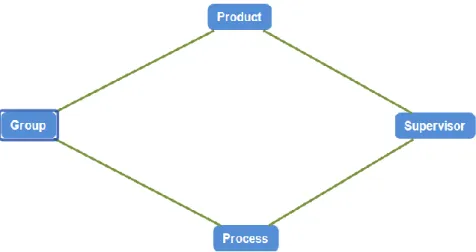
Besides the introductory course on PBL, the students are supervised by a teacher/researcher in their semester project. As illustrated in Figure 1, PBL supervision should be directed towards both the product (the text or design) and the process (e.g. how to manage collaboration, address and identify problems, etc.) (Dahl, 2008).
In this case, we focus on PBL in the educational programme of Communication and Digital Media (CDM). This programme admits 100 new students every year, who will have to learn how to learn in the AAU-PBL way. The overall learning objective of the PBL course is to introduce new students to the core principles of PBL, as well as to scaffold students in how to integrate these principles into their own study practices. Through a seven-week course programme in 2017, the students were introduced to the following PBL-related themes: ‘study technique: reading’, ‘project group collaboration’, ‘planning and process’, ‘problems and problem formulations’, ‘study technique: academic writing’, ‘information seeking’ and ‘PBL and IT’. Each week, a new theme was unfolded through a combination of 1) a lecture introducing the theme, 2) a workshop integrating the theme into group discussions, 3) written reflection papers reporting group discussions and 4) oral feedback sessions with teachers and other students reflecting on a written paper. Halfway through the course, a PBL box was handed out to the groups (see in detail below). In addition, the groups had to participate in two seminars with other groups and different supervisors, first presenting and discussing their problem formulation and then their strategy for conducting a literature search. In terms of supervision in the semester project on the CDM programme, the supervisor is expected to deal with both product- and process-related issues. As it, the attention of both students and supervisors is primarily directed towards the product being embodied as a text, backgrounding the process-related aspects of supervision in many cases. With our design experiment, we also wanted to support the students and supervisors in focusing more on the process-related aspects of PBL.
THE DESIGN EXPERIMENT
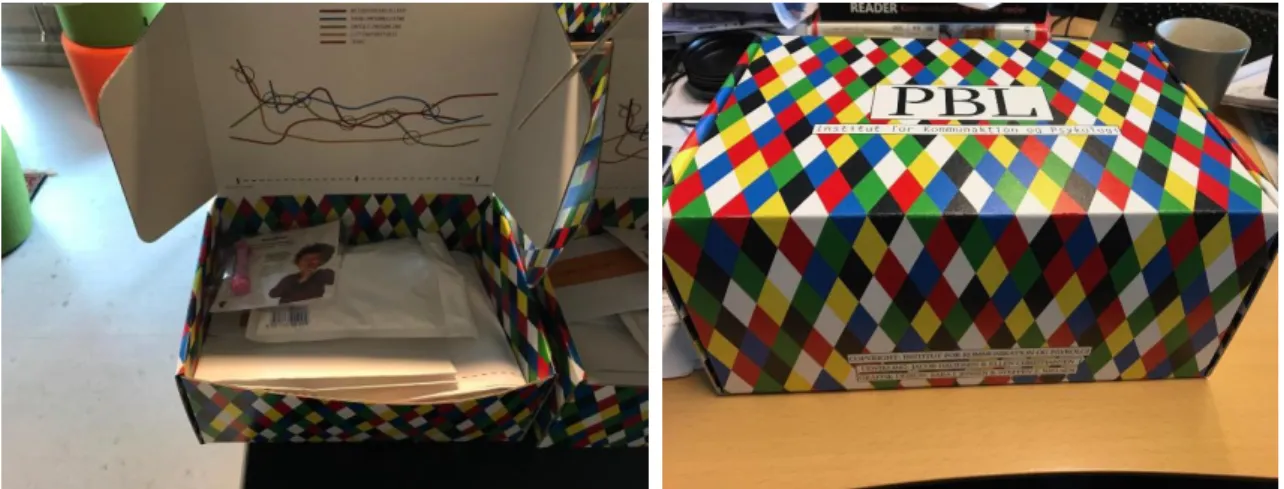
The design experiment was based on pedagogical experiments carried out in recent years in which teachers from the CDM programme have tried different designs for teaching PBL. Davidsen and Ryberg (2016) have explored how digital media (Google+) can support interaction and knowledge sharing and can establish a sense of community among students. One of the primary ideas of the design experiment was to make the work of the individual student group publicly available to the entire semester class – for inspiration and criticism. With these experiences in mind, we wanted to explore ways of supporting interaction, knowledge sharing and a sense of community in physical space by introducing a PBL box. In the year 2017, the Department of Communication and Psychology (approximately 100 students and 20 student groups) moved to a remodelled facility. We were given the opportunity to design a new learning space and explore the affordances of a PBL box (Figure 2). Basically, we wanted to support the students in developing a PBL way of studying and by making the product and process of their project more visible to fellow students and their respective supervisors.
Our goal in this experiment was to explore how to support the students in attending to process-related aspects of PBL with a box full of materials. Our hope was that this would eventually lead to a shared practice and a higher level of reflection on how to manage and adopt PBL practices. In essence, we wanted to support a transition from individual to collective forms of externalising knowledge, both within the individual groups and between the groups in the semester, and to cultivate hybrid practices rather than solely digital or analogue.
As the case format of the journal offers a limited number of characters, we only present some of the theoretical assumptions guiding us in designing the box as a materialisation of the pedagogical support material we wanted to introduce. Lefebvre (2011) has formulated the interwoven relationship between knowing, expression, material and the senses, which indicate that learning and development are not only a matter of learning to master words but also a matter of exploring and using materials to stimulate expression and reflection at some point: ‘[T]here can be no thought, no reflection, without language, and no language without a material underpinning – without the senses, without mouths and ears, without the disturbance of masses of air, without voices and the emission of articulated signs’ (Lefebvre, 2011, p. 402, highlighted by author). Furthermore, the idea was for the box and materials to serve as a boundary object in the sense described by Star and Griesemer (1989): ‘plastic enough to adapt to local needs and constraints of the several parties employing them, yet robust enough to maintain a common identity across sites’ (p. 393). In order to serve as a boundary object, the box and materials were designed as a conspicuous ‘thing’ intended to stimulate interaction and knowledge sharing within and outside the group, and to establish a sense of community among the groups, with each group having its own box.
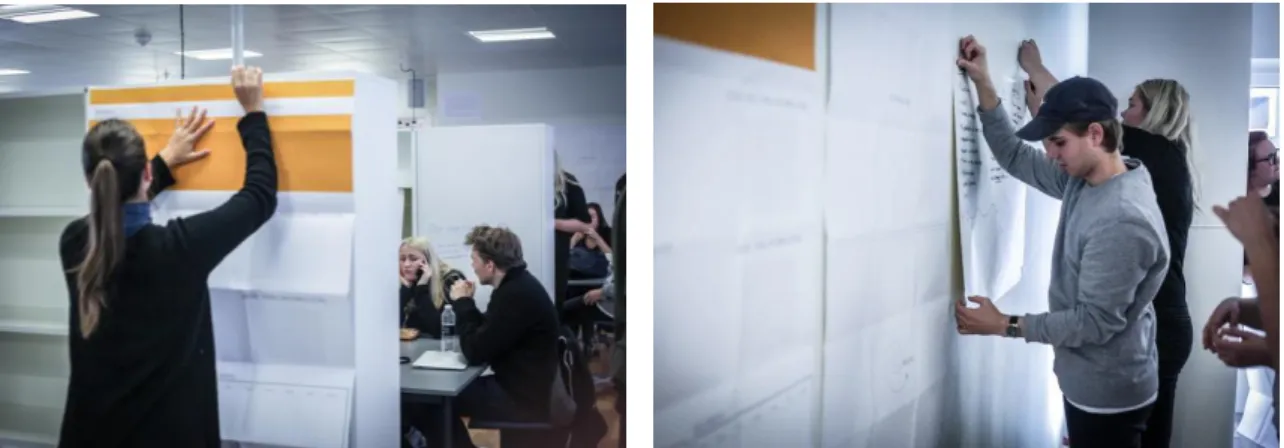
The boxes were handed out to the students after they had formed their groups for the first-semester project (approximately one month into the first-semester); at the same time, the groups were expected to find their place in the physical learning environment. Our initial idea was that the box and the materials would not be introduced witha step-by-step guide for the students, because we wanted to see how the students used and adopted the box and materials in their practice on their own. In other words, we did not want to impose a specific way of using the box on the students; rather, we wanted to see how the students used the box independently. Initially, the students started unpacking the contents of the box and many groups decorated their learning space with the materials (Figure 3).
UNWRAPPING THE PBL BOX1
Creating a visual identity and public trajectory for the PBL group process
As the first-semester students had been allocated dedicated group learning spaces for their group work, we wanted to support them in making their work, ideas and frustrations public to the rest of the class. Thus, we designed two A0 posters:
1Download the materials in the supplementary files (in Danish). Figure 3. Students decorating their room with materials from the box
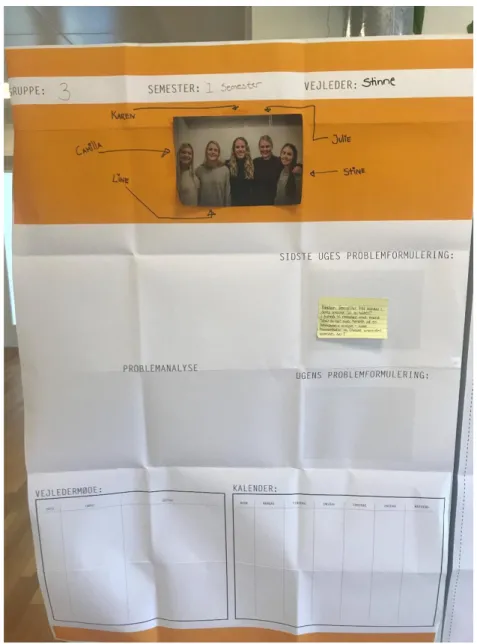
Figure 4. Poster 1 from group 3
With the first poster, we wanted to create a visible group identity, with the students adding photos of the individual group members in the orange field and identifying their group number, semester and supervisor. Furthermore, to indicate the importance of nurturing and cultivating re-formulations of the problem, we added three fields: ‘Problem analysis’, ‘Last week’s problem statement’ and ‘This week’s problem statement’. Our idea was to support the students in developing a history of their work with the problem, which could be discussed continually with their supervisor and included in their final project report. In the final section of the poster, we added calendars to illustrate the importance of planning the process and keeping track of the outcomes of the meetings with the supervisor.
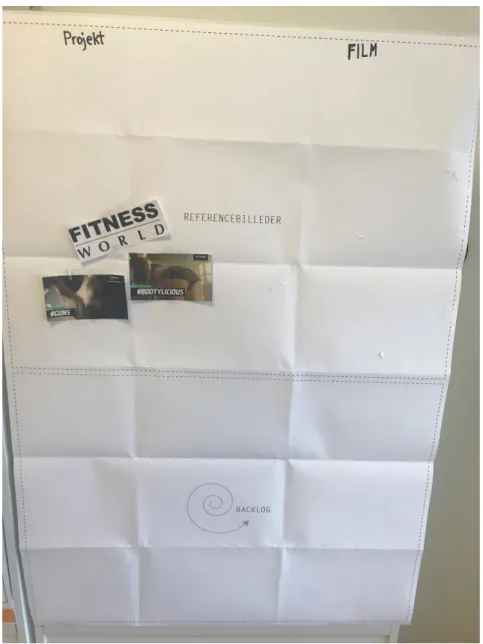
Figure 5. Poster 2 by group 3
The second poster was more like a blank canvas for the students to pin up their references and ideas, such as photos of books, products, models, etc. Basically, we wanted the students to add all relevant content to the canvas to support their collective memory, but also to showcase their process to their supervisor and fellow students. Finally, we added a section called ‘backlog’, which was intended to allow the students to revisit their earlier ideas or writings at a later point in their project, simply to keep track of things. This was inspired by SCRUM (Schwaber & Beedle, 2002), which is used as an established method for conducting work processes in software development projects.
Supporting collaborative processes
To support some of the various PBL activities and phases, we designed 12 cue cards describing ways of dealing with different aspects of PBL:
● Problem analysis
● Learning goals as points of orientation ● Feedback – how?
● How to get ideas ● Academic writing
● We are lost – what to do? ● Evaluating a group meeting ● Matching expectations ● Project management ● Types of supervision ● Roles in the project group ● Collaboration
The cards can be divided into three themes: ‘how to’ instructions, relevant information and reflection. The idea of giving the students a series of cards was to promote support at the right point in time instead of presenting the resources in PowerPoints or textbooks. In addition, we added an hourglass and six Lego™ figures, the latter to support the students in trying out different roles (e.g. Belbin’s [2010] team roles) and the former to make visible to the group the division between social time and project time. Finally, we included a print of the official PBL folder describing the principles of AAU-PBL.
Diagram of a project
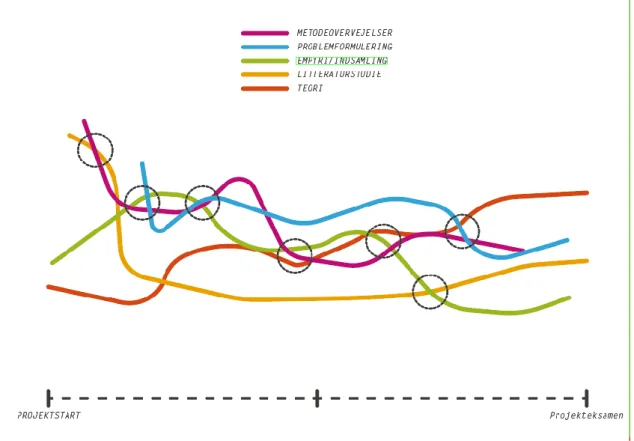
To illustrate the chaotic and non-linear nature of a PBL project, we designed a diagram (a spaghetti model) of a project period showing the different lines/trajectories (Ingold, 2015) in a project (e.g. method, problem formulation, data, literature and theory). This way of illustrating a project further resembles the nature of SCRUM (Schwaber & Beedle, 2002), instead of the more linear ways of illustrating a project (e.g. a step-by-step-guide).
Figure 6. The spahetti model
LESSONS LEARNED: STUDENTS’ USE OF THE PBL BOX
To follow up on the use and adaptation of the box and materials, we observed and interviewed five out of 20 student groups throughout the semester; subsequently, we also invited all of the students to a workshop with the purpose of evaluating the box. Eight students out of 95 volunteered to participate in the workshop, which was video recorded for documentation purposes. During our informal visits throughout the semester, we observed that many of the student groups did not use the box or materials to support their work; for example, their posters were not filled out and the box was placed on a shelf in the group space. For this presentation of outcomes, we have divided our observations from the workshops into five themes: practicalities; further introduction needed; no obligations, no use; analogue vs. digital practices; and other resources. We suggest that these themes must be addressed and dealt with in future implementations of the PBL box and its pedagogical content.
Practicalities
Some of the first things to notice with regard to the use of the box and materials are some practical obstacles: the posters would not stick to the wall and the students did not have
any pencils to write text on the posters. Consequently, most of the student groups ended up never filling out any of the information on the posters. They would have liked post-its and pencils above anything else in the box.
Further introduction needed
The students reported that, at first, they were happy about the box and thought it would become a useful resource in their project work. They explained, however, that they forgot about the box and materials a couple of days after they had received it. Some of the students said it was too overwhelming and that they did not know how to use the materials. They would have liked a more systematic introduction to the materials to make better use of them. On the other hand, some of the students described the materials as too pedagogical; for example, they did not need an hourglass as a symbol of social and academic time.
No obligations, no use
None of the student groups talked with their supervisor about the contents of the box, nor did they use the posters to make visible the progress and process of their project to the other groups. This is actually not surprising; we have witnessed a close relationship between students’ engagement in ‘must do’ and ‘can do’ assignments in our previous work (Davidsen & Ryberg, 2016).
Analogue vs. digital practices
In the workshops, the students also reported that they transferred some of the analogue materials to digital platforms; for example, the backlog, the calendar and the problem statement were re-mediated into Google Docs. Thus, they used tools and resources other than those provided in material form in the box, while in fact appreciating the ideas of the pedagogical tools.
Other resources
Interestingly, the students would have liked other materials to have been included in the box – they suggested more recipe-like materials, such as how to perform a structured search in the university library databases, how to reference correctly, a template for a group contracts, etc. As one of the participants said, ‘These would be tools for the real project work’ (student 1, group 2). It seems that the students were looking for tools to support very specific activities in their project work, whereas our original idea was to support students’ collaborative reflexive practices by introducing materials into their practices of learning and doing PBL. Hence, there appears to be a tension between our
view of the process-related aspects of PBL and the students’ view; whereas we strived to support reflection on the PBL process, the students wanted 1–1 descriptions of tasks related to their project work.
FUTURE DEVELOPMENTS
In this final section, we reflect on what could be done in a new design experiment based on the lessons learned from the present one:
Better linking between course activities and the PBL box
Instead of giving the groups all the materials at the beginning, we might introduce the different materials piecemeal as part of the introduction to the 7 PBL-related themes (see p. 3) of our teaching throughout the semester. This could provide a better connection between the course activities, the contents in the box and the specific challenges the students face at the right point in time. It may also help to overcome the ‘must do’ and ‘can do’ problem of students’ engagement.
Better support for students’ development of PBL process skills
We have realised that the toolbox in itself does not support the students in developing PBL process skills. In addition, we have learned that the students prefer supervision on their product (text), and that they do not necessarily feel a need to discuss process-related issues with their supervisor. In relation to this, it seems that the supervisor plays an important role in ‘legitimating’ or downplaying the importance of different PBL-related issues.
In any future experiment, it may be worth considering ‘investment’ in process-related supervision, in combination with the traditional product supervision. It could be of pedagogical interest to train a group of supervisors in facilitating PBL processes among students. This could involve integrating the content of the PBL box into supervision activities.
Better alignment between pedagogical beliefs and students’ practice
As we have shown, it seems that our pedagogical beliefs about relevant materials are not aligned with the students’ practice and current understanding of PBL. To strengthen the idea of enhancing interaction, knowledge sharing and community building in the physical space, more research is needed. This would need to include research into the specificities of first-semester students’ preferences and ways of working. For instance, we have reported how the students themselves transferred analogue materials onto digital platforms, and in relation to this we
need additional insights into the different preferences and needs regarding digital and analogue support for the PBL process.
From this design experiment, we have learned that it takes more than a box and materials to change the behaviour and attitude of first-year students and get them focusing on their PBL process. We would need to integrate pedagogical activities into the introduction of the box and work closer with the supervisors to align our activities and efforts. The fact that students seek product supervision first is understandable, but it just emphasises the importance of giving the PBL process supervision another form. Thus, our experiences have led us to consider materials and activities that can mediate both product and process supervision from students’ and supervisors’ perspectives. Furthermore, it is clear that future projects need to include activities that involve the supervisors. These could align the pedagogical ideas of the box and materials with the practice of the individual supervisor.
FINAL COMMENTS
During the project, we were met with enthusiastic comments from university colleagues and study councillors – they were all thrilled about the box and some wanted copies. While we appreciate all the positive feedback, we want to offer a critical voice based on our experiences: it takes more than a box to introduce and vitalise PBL among first-year students (and supervisors); this is an observation that calls for discussion of PBL, learning, tools and pedagogy among teachers and supervisors. In short, this experiment has taught us that there is no quick fix (analogue or digital) for changing learning in Higher Education and we hope that this case can act as a catalyst for further discussion about future directions in teaching PBL at AAU.
Funding
The project was funded by the Department of Communication and Psychology and the study board for Communication and Digital Media.
References
Askehave, I., Linnemann Prehn, H., Pedersen, J., & Thorsø Pedersen, M. (Eds.). (2016). PBL - Problem Based Learning. Aalborg universitet Rektorsekretariatet.
Retrieved from http://www.pbl.aau.dk/digitalAssets/269/269243_148025_pbl-aalborg-model_uk.pdf
Belbin, R. M. (2010). Management teams: why they succeed or fail. Amsterdam; Oxford: Butterworth-Heinemann. Retrieved from
http://public.eblib.com/choice/publicfullrecord.aspx?p=535052
Dahl, P. N. ard. (2008). Studenter-afstemt vejledning og kommunikation. In L. Krogh, J. B. Olsen, & P. Rasmussen (Eds.), Projektpædagogik (pp. 89–106). Aalborg Universitetsforlag.
Davidsen, J., & Ryberg, T. (2016). Samhørighed, interaktion og vidensdeling blandt studerende - Erfaringer fra et ikt-pædagogisk udviklingsprojekt. Dansk Universitetspaedagogisk Tidsskrift, 21, 57–71.
Du, X., Emmersen, J., Toft, E., & Sun, B. (2013). PBL and critical thinking disposition in Chinese medical students – A randomized cross-sectional study. Journal of Problem Based Learning in Higher Education, 1(1), 72–83.
https://doi.org/10.5278/ojs.jpblhe.v1i1.275
Guerra, A., Ulseth, R., Jonhson, B., & Kolmos, A. (2017). Engineering grand
challenges and the attributes of the global engineer: a literature review. In J. C. Quadrado, J. Bernardino, & J. Rocha (Eds.), Proceedings of the 45th SEFI Annual Conference 2017 (pp. 1222–1235). SEFI: European Association for Engineering Education.
Holgaard, J. E., Ryberg, T., Stegeager, N., Stentoft, D., & Thomassen, A. O. (2014).
PBL: Problembaseret læring og projektarbejde ved de videregående uddannelser. Frederiksberg: Samfundslitteratur.
Ingold, T. (2015). The life of lines. Milton Park, Abingdon, Oxon ; New York, NY:
Routledge.
Kolmos, A., Fink, F. K., & Krogh, L. (2004). The Aalborg model: problem-based and project-organized learning. In Kolmos, Anette : Fink, Flemming K.: Krogh, Lone (eds.) (Ed.), The Aalborg model : progress, diversity and challenges (pp. 9–18). Denmark: Aalborg Universitetsforlag.
Lefebvre, H. (2011). The production of space. (D. Nicholson-Smith, Trans.) (Nachdr.). Malden, Mass.: Blackwell.
Ryberg, T., & Davidsen, J. (2017). Establishing a Sense of Community, Interaction, and Knowledge Exchange Among Students. In D. Kergel, B. Heidkamp, P.
Kjærsdam Telléus, T. Rachwal, & S. Nowakowski (Eds.), The Digital Turn in Higher Education (pp. 143–160). Germany: Springer.
Schwaber, K., & Beedle, M. (2002). Agile software development with Scrum (Vol. 1). Prentice Hall Upper Saddle River.
Star, S. L., & Griesemer, J. R. (1989). Institutional Ecology, `Translations’ and Boundary Objects: Amateurs and Professionals in Berkeley’s Museum of Vertebrate Zoology, 1907-39. Social Studies of Science, 19(3), 387–420.