College of Science and Health Theses and
Dissertations College of Science and Health
Spring 6-12-2017
Simulation and Curriculum Integration: Does Simulation Improve
Simulation and Curriculum Integration: Does Simulation Improve
Clinical Competence
Clinical Competence
Tamara M. PooleDePaul University, [email protected]
Follow this and additional works at: https://via.library.depaul.edu/csh_etd Part of the Nursing Commons
Recommended Citation Recommended Citation
Poole, Tamara M., "Simulation and Curriculum Integration: Does Simulation Improve Clinical Competence" (2017). College of Science and Health Theses and Dissertations. 212.
https://via.library.depaul.edu/csh_etd/212
This Dissertation is brought to you for free and open access by the College of Science and Health at Via Sapientiae. It has been accepted for inclusion in College of Science and Health Theses and Dissertations by an authorized
Simulation and Curriculum Integration: Does Simulation Improve Clinical Competence
A Graduate Research Project
Presented in
Partial Fulfillment of the
Requirements for the Degree of
Doctor of Nursing Practice
June, 2017
BY
Tamara Poole
School of Nursing
College of Science and Health
DePaul University
Table of Contents
Abstract---6
Introduction---7
Background and Significance---7
Problem Statement---9 Purpose---10 Research Questions---10 Conceptual Definitions---10 Operational Definitions---12 Review of Literature---12
Overview of Simulation in Nursing Education---17
Knowledge Acquisition and Retention---18
Skills Acquisition and Retention---19
Critical Thinking---19
Clinical Judgment---20
Student Perceptions---20
Curriculum Integration---21
High-Fidelity Simulation Interventions---21
Measures Used for Learning Outcomes---22
Theoretical Framework---24
Method---28
Design---28
Recruitment---28
Inclusion/Exclusion Criteria---29
Random Assignment---29
Setting---30
High-Fidelity Simulation Intervention---30
Case Scenarios---31 Measurements---32 Data Collection---34 Traditional Instruction---38 Simulation Instruction---38 Video Recording---40 Data Analysis---40
Ethics and Human Subjects Protection---40
Pilot---41 Results---41 Discussion---49 Limitations---56 Conclusion---58 Future Implications---58 Acknowledgements---59 References---60
Appendix B: Oral Recruitment Script---136
Appendix C: Scenario- Preoperative Care of the Patient Scheduled for a Cholecystectomy----137
Appendix D: Scenario- Small Bowel Obstruction---139
Appendix E: Scenario: Postoperative Ileus---141
Appendix F: Demographic Data Sheet---143
Appendix G: Knowledge Quiz---144
Appendix H: Lasater Clinical Judgment Rubric---147
Appendix I: Creighton Competency Evaluation Instrument---151
Appendix J: Student Version of Scenarios---152
Appendix K: Simulation Orientation Checklist---154
Appendix L: Sample Schedule of Learning Activities---155
Appendix M: Prebrief Guides---158
Appendix N: Debrief Guide All Scenarios---162
Tables and Figures Table 1. Summary of Evaluative Scoring---16
Figure 1. Competence Model---26
Figure 2. Study Activities---35
Table 2. Characteristics of Study Participants---43
Table 3. Comparison of Mean Knowledge Scores Between Groups Over Time---44
Table 4. Comparison of Mean Skills Scores Between Groups Over Time---45
Table 5. Comparison of Mean Critical Thinking Scores Between Groups Over Time---46
Table 6. Comparison of Mean Clinical Judgment Scores Between Groups Over
Time---47
Table 7. Factor Analysis Kuder-Richardson (KR-20)---48
Abstract
Background: While simulation is a widely used pedagogy in nursing education, there is
inconsistent evidence regarding its effectiveness in demonstrating positive learning outcomes.
Therefore, further research is needed to establish the effectiveness of simulation in developing
clinical competence, and the incorporation of this pedagogy into nursing curricula. Purpose: To
explore how the integration of high-fidelity simulation into nursing curricula influences learning
outcomes. More specifically, to examine differences in clinical competence as measured by the
outcomes: knowledge, skills, critical thinking, and clinical judgment in nursing fundamental
students taught using high-fidelity simulation versus traditional instructional methods. Design: A
two-group time series experimental design was used to evaluate the impact of traditional or high
fidelity simulation instructional methods on improving clinical competence at three time points.
Findings: The results reveal significant improvements in knowledge, skills, and clinical
judgment over time. However, instructional method did not have a significant effect on these
learning outcomes. There was a significant interaction between time and instructional method on
improving critical thinking, as both groups demonstrated significant improvements from pre to
post intervention. The traditional group showed a significant decline in critical thinking ability 3
weeks post intervention, while the simulation group remained unchanged. Conclusions: The
findings of this study support the inclusion of high-fidelity simulation into nursing curricula to
facilitate improvements in clinical competence. This study provides evidence that high-fidelity
simulation is a better approach than traditional instruction in developing critical thinking, and is
Chapter 1. Introduction
Background and Significance
New graduate nurses are entering the workforce at a rapid rate and obtaining positions in
high acuity settings. Effective time management, the ability to multi-task, and providing care for
patients with more complex needs are among many obstacles that novice nurses must overcome
to transition into their new role. Unfortunately, only 30% of new graduate nurses have achieved
clinical judgment skills consistent with the expectations of an entry-level nurse (Del Bueno,
2005). This finding regarding new graduate clinical judgment is reinforced by a recent study of
hospital administrator perceptions of new graduate nurse competence that revealed that only 10
percent were considered to be adequately prepared for the role (Berkow, Virkstis, Stewart, &
Conway, 2008). Therefore, it is imperative that nursing programs reevaluate their curricula to
ensure that the development of clinical competence is facilitated through various teaching
modalities.
The National league for Nursing (NLN) has expressed the need for education reform to
meet current healthcare demands. In their 2003 position statement, the NLN appealed to nurse
educators to review and restructure nursing curricula to incorporate new technology and
innovative teaching strategies in order to facilitate learning (National League for Nursing, 2003).
Moreover, all nursing faculty were asked to develop and conduct research on the most effective
innovative teaching strategies that maximized students’ ability to learn clinical practice and
successfully manage higher acuity patients (National League for Nursing, 2003). Consequently,
simulation has emerged as the ideal innovative pedagogical approach to remedy the lack of
Simulation provides an opportunity to standardize a patient encounter so that all students
receive similar learning experiences (Medley & Horne, 2005). Moreover, students have the
ability to apply decision-making and critical-thinking skills to patient scenarios in a controlled
environment without compromising patient care (Gates, Parr, & Hughen, 2012). Ultimately,
simulation offers an opportunity to improve student-learning outcomes by facilitating the
integration of theoretical knowledge and skills (Thompson & Bonnel, 2008).
The use of simulation in nursing education has grown exponentially over the past decade.
The initial catalyst to this transition was the endorsement of simulation by the National Council
State Boards of Nursing (NCSBN). In their 2005 position statement, the NCSBN indicated that
pre-licensure nursing programs could use innovative teaching strategies such as simulation in
addition to clinical experience (National Council State Boards of Nursing, 2005).
Simulation is now the emerging teaching strategy to support clinical education in
programs with rapidly increasing admission rates. Over the past decade, nursing programs have
seen a significant increase in student enrollment. A recent survey conducted by the American
Association of Colleges of Nursing found that enrollment in BSN and RN to BSN completion
programs from the 2013 to 2014 academic year demonstrated a 4.2% and 10.4% increase,
respectively (American Association of Colleges of Nursing, 2015). This rise in the number of
nursing students has contributed to the challenge of obtaining adequate clinical placements, thus
forcing schools to turn to simulation.
Finding qualified faculty to teach in the clinical setting has presented yet another issue in
nursing education. The American Association of Colleges of Nursing (American Association of
Colleges of Nursing, 2015) revealed that two-thirds of nursing schools cited having an
prospective students. Another study indicated that 65.9% of institution vacancies were for
faculty that would have both clinical and lecture responsibilities (Li, Stauffer, & Fang, 2016).
The combined effects of deficiencies in faculty pools, expanding program enrollment,
and pressure from the NLN and NCSBN to provide innovative instruction, have required nursing
schools to shift their focus toward using simulation as a teaching strategy. Consequently the
literature has focused on the best methods of curricular integration, and determining if simulation
is a reasonable substitute for clinical to improve learning outcomes. Data presented in a recent
NCSBN survey reflected that 55% of nursing programs use simulation in five or more courses
within the curriculum (Hayden, 2010). Current recommendations support the replacement of up
to 50% of clinical time with simulation (Hayden, Smiley, Alexander, Kardong-Edgren, &
Jeffries, 2014).
Problem Statement
While the use of simulation in nursing education is a growing trend to improve clinical
related knowledge and skills among nursing students, research provides inconsistent objective
evidence that simulation is an effective pedagogy. Historically, much of the literature has
focused on student and/ or faculty perceptions of simulation effectiveness. This gap in the
literature makes it clear that further research must be dedicated toward determining the actual
learning outcomes of simulation, and how to effectively integrate simulation into nursing
Purpose of the Project
The purpose of the current study was to: 1) explore how the integration of high-fidelity
simulation using course and program objectives in a nursing fundamentals course influences
student learning outcomes, and 2) examine the differences in clinical competence as measured by
knowledge acquisition, skills acquisition, critical thinking, and clinical judgment between
student learners taught using high-fidelity simulation and those that received the traditional
instructional method.
Research Questions
This study addressed the following research questions:
1. Is there a difference in knowledge acquisition between student learners that are taught using high-fidelity simulation and those that receive the traditional instructional method?
2. Is there a difference in skills acquisition between student learners that are taught using high-fidelity simulation and those that receive the traditional instructional method?
3. Is there a difference in critical thinking ability between student learners that are taught using high-fidelity simulation and those that receive the traditional instructional method?
4. Is there a difference in clinical judgment between student learners that are taught using high-fidelity simulation and those that receive the traditional instructional method?
Conceptual Definitions
In order to have a thorough understanding of clinical competence as it applies to
simulation, it is imperative to define the term and its constituents.
Clinical competence is defined as “the acquisition of relevant knowledge, the development of
psychomotor skills, and the ability to apply the knowledge and skills appropriately in a given context” (Decker, Sportsman, Puetz, & Billings, 2008, p. 75). It contains four main components: knowledge acquisition, skill acquisition, critical thinking, and clinical judgment.
o Knowledge Acquisition is defined as “the knowledge that one acquires through both informal and formal processes, and serves as the basis of attitude formation and decision making about health topics” (Warren, Mendlinger, Corso, & Greenberg, 2012, p. 69).
o Skill Acquisition is described as “a gradual transition from rigid adherence to rules, to an intuitive mode of reasoning that relies heavily on deep tacit understanding” (Adolfo, 2010, p.3).
o Critical Thinking is outlined as the “process of actively and skillfully conceptualizing, applying, analyzing, synthesizing and/or evaluating information gathered from, or generated by, observation, experience, reflection, reasoning or communication, as a guide to belief and action” (National Council State Boards of Nursing, 2005, p.2).
o Clinical judgment is described as
The art of making a series of decisions to determine whether to take action based on various types of knowledge. The individual recognizes changes and salient aspects in a clinical situation, interprets their meaning, responds appropriately, and reflects on the effectiveness of the intervention (Meakim et al., 2013, p. S6).
Student learning outcomes are defined as “measurable results of the participants’ progress toward meeting a set of objectives” (Meakim et al., 2013, p.S7). The student learning outcomes measured in this study are changes in knowledge acquisition, skills acquisition, critical thinking, and clinical judgment.
High fidelity simulation is defined as “experiences using full scale computerized patient simulators, virtual reality or standardized patient that are extremely realistic and provide a high level of
interactivity and realism for the learner” (Meakim et al., 2013, p.S6).
Traditional instructional method incorporates the use of lecture, video, and instructor demonstration of skills, to facilitate the development of knowledge, skills, critical thinking, and clinical judgment.
Operational Definitions
For the purposes of this study the conceptual terms were operationally defined.
Student learning outcomes will be measured by changes in knowledge acquisition as measured by pre-and post-test performance, skills acquisition and critical thinking as
measured by Creighton Competency Evaluation Instrument, and clinical judgment as
measured by the Lasater Clinical Judgment Rubric
Clinical competence is measured by demonstrating improvements in all four student learning outcomes: knowledge acquisition, skills acquisition, critical thinking, and
clinical judgment as measured above.
Chapter 2. Review of Literature
An extensive review of the literature was conducted to identify relevant studies that
examined the integration of high-fidelity simulation into nursing curricula. Additionally, the
literature search examined articles related to the effectiveness of this teaching modality on
clinical competence, as evaluated by the outcomes: knowledge acquisition and retention, skills
acquisition and retention, critical thinking, and clinical judgment. All retrieved articles were
evaluated using the criteria presented in the researcher developed scoring key.
The scoring key consisted of a twenty-five-point scale, to establish relevance related to
initial research questions. Each article was evaluated on nine categories: article focus, sample
demographics, stage in program, sample size, randomization, evaluation method of learning
outcomes, interobserver reliability, internal consistency of evaluation tool, and content validity.
Articles with a score of ten or less were excluded, as they lacked critical elements in their
The Article Focus category aimed to ensure that the focus of the study was on curriculum
integration and the evaluation of high fidelity simulation. Articles would receive two points if
curriculum integration was addressed and high fidelity simulation evaluated; one point if
curriculum integration was not addressed and high fidelity simulation evaluated. Articles were
automatically excluded if the focus was on any of the following: exclusively on curriculum
integration of simulation, simulation design, development or analysis of an evaluation tool,
evaluation of prebriefing or debriefing, evaluation of standardized patients/actors, evaluation of
medium, low fidelity or virtual simulation, or the evaluation of multiple combinations of
simulation fidelity.
To ensure the sample reflected prelicensure nursing students enrolled in a baccalaureate
program, the Sample Demographics category was developed. Articles received two points if the
sample was comprised of entry level to practice students not enrolled in an associate’s degree
program; one point if the sample contained entry level students enrolled in a generalist master’s program, or if the program was not specified. Articles were automatically excluded if the sample
consisted of: associate degree nursing students, licensed health professionals, advanced practice
nursing students, or students enrolled in programs outside of the nursing discipline.
The Stage in Program category was designed to establish a sample of students enrolled in
fundamental nursing courses. Moreover, students at earlier program stages have less influence of
clinical and other simulation exposure influencing learning outcomes. Articles achieved three
points if the sample consisted of freshman through junior students, or students enrolled in a
fundamentals or a medical surgical course; two points if the sample consisted of senior students
of students enrolled in a nonclinical course, students at different points in a program, or if the
course was not specified.
The sample size category was established to ensure generalizability of outcomes. Articles
received a score of five points for a sample size great than 100 participants; four points for
75-100 participants; three points for 50-74 participants; two points for 25-49 participants; and one
point if there were less than twenty-five participants. There were no automatic exclusion criteria
for this category.
In order to eliminate sampling bias and strengthen external validity the Randomization
category was developed. Articles received two points if random sampling was used, and one
point if convenience sampling was used. There were no automatic exclusion criteria for this
category.
The Evaluation Method category was designed to establish the best evidence supporting
the learning outcomes of utilizing high fidelity simulation as pedagogy. Articles achieved three
points if three or more objective evaluation methods were used (i.e., pre-test, post-test, GPA,
clinical performance, course grade, checklists, judgment rubric); two points if two objective
evaluation methods were used; one point if only one objective evaluation method was used.
Articles were automatically excluded if the only objective evaluation used was: self-confidence,
perceived confidence, Simulation Evaluation Tool, or Self-efficacy Survey.
To establish consistency of observation the Interobserver Reliability category was
created. Articles were assigned three points for interobserver reliability coefficient > .90; two
points for interobserver reliability coefficient .70-.90; 1 point for interobserver reliability
The development of the Internal Consistency Reliability category was used to determine
the consistency of an evaluation tool. Articles were given a score of three points for Cronbach’s alpha, or Spearman Brown Coefficient > .90; two points for Cronbach’s alpha, or Spearman Brown Coefficient .70-.90; one point for Cronbach’s alpha or Spearman Brown Coefficient < .70
or a mention of established internal consistency without supporting data; zero points if internal
consistency was left unmentioned.
The Content Validity category was established to determine if items within the simulation
or evaluation tools were related to learning objectives and outcomes. Articles received two points
if content validity was addressed, and one point if validity was not addressed. There was no
exclusion criterion for this category.
The validation of the scoring key was guided by nursing professionals. Their feedback
assisted with the allocation of points to each category. Moreover, they assisted in clarifying
exclusion criteria to ascertain articles that were specifically pertinent to the stated research
questions.
A single multi-database search was conducted within CINAHL Complete, PsycINFO,
and Health Source: Nursing/Academic Edition. The terms used in the search were: manikins or
“models, anatomic”, or mannequins or “high fidelity” or “simulation lab” or “sim lab” and curric* and nursing. The following limiters were applied: published date between 2000 and
2016, and peer reviewed. This publication date range was selected because the adoption of high
fidelity simulation in nursing education began around this time. Special limiters applied to each
database were: English language to CINAHL and PsycINFO, as Health Source Nursing
Academic Edition did not specifically allow for language selection. One hundred seventy-two
the automatic exclusion criteria of a scoring key.Of the initial 172 articles, 30 articles were
selected for further review using the scoring key, resulting in the inclusion of nine articles.
As a result of the low yield of inclusion articles in the multi-database search, an
additional search was conducted using ProQuest Nursing and Allied Health Source. The
keywords entered into the database were: manikins or “models, anatomic”, or mannequins or
“high fidelity” or “simulation lab” or “sim lab” and curric* and nursing. Nine hundred seventy-six articles were initially retrieved, with a final yield of 948 articles, correcting for duplicates.
The related abstracts were reviewed using the automatic exclusion criteria of the scoring key. A
total of twenty-two articles were further evaluated using the scoring key, resulting in the
inclusion of an additional seven articles.
Final analysis of collected articles using the scoring key revealed a total score range of
ten to seventeen out of a possible twenty-five points. Of the sixteen articles evaluated using the
scoring key, fifteen articles satisfied the minimum score requirement. The scores for each article
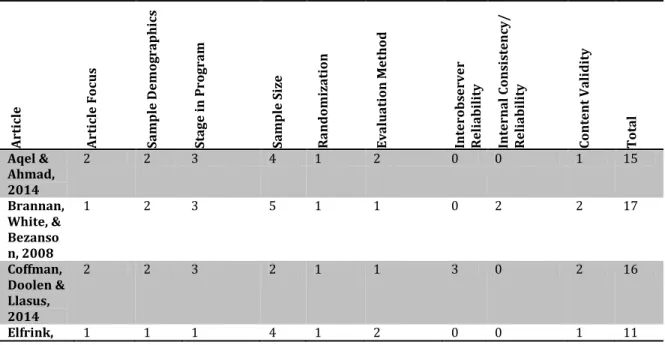
included in the literature review are summarized in Table 1.
Table 1. Summary of Evaluative Scoring
Ar ti cl e Ar ti cl e Fo cus Samp le De m og raph ics St age in P ro gr am Samp le Si ze R an d om izat io n Evaluat io n M etho d In ter ob ser ve r R eli ab ili ty In ter n al Co n si st enc y/ R eli ab ili ty Co n tent V al id it y To tal Aqel & Ahmad, 2014 2 2 3 4 1 2 0 0 1 15 Brannan, White, & Bezanso n, 2008 1 2 3 5 1 1 0 2 2 17 Coffman, Doolen & Llasus, 2014 2 2 3 2 1 1 3 0 2 16 Elfrink, 1 1 1 4 1 2 0 0 1 11
Kirkpatri ck, Nininger, & Schubert, 2010 Gates, Parr, & Hughen, 2012 1 2 3 5 1 2 0 0 1 15 Grady, et al., 2008 1 1 3 2 1 2 3 3 1 17 Harris, 2011 1 2 2 3 1 2 0 0 1 12 Hart, et al., 2014 2 2 2 2 1 2 0 0 1 12 Hooper, Shaw, & Zamzam, 2015 2 2 2 5 1 2 0 0 1 15 Liaw et al., 2010 1 2 1 3 1 1 0 0 2 11 Schlairet & Pollock, 2010 2 2 3 3 1 2 0 1 1 15 Shinnick & Woo, 2013 1 2 3 5 1 3 0 1 2 18 Simonelli & Paskausk y, 2012 2 2 2 5 1 3 0 0 0 15 Smith & Barry, 2011 2 2 2 2 1 1 0 0 1 11 Wood & Toronto, 2012 1 2 1 4 1 1 0 3 1 14
Selected studies were initially categorized based on the learning outcomes of knowledge
acquisition and retention, skills acquisition and retention, critical thinking, clinical judgment, and
overall competence. Further organization of articles was based on whether or not integration of
simulation was explored. Study findings were organized to determine the effect of high-fidelity
simulation on the stated learning outcomes.
Overview of Simulation in Nursing Education
Simulation has been used as both a supplemental teaching strategy, and in lieu of
selected has traditionally been determined by the objectives of the simulation scenario. Low
fidelity simulators utilize task trainers to teach psychomotor skills (Nehring & Lashley, 2010).
Instructors use moderate fidelity simulators to provide instruction on basic human biological
actions, such pulses, and breathing (Nehring & Lashley, 2010). High fidelity simulators allow for
the programming of specific health conditions and responses to nursing interventions (Nehring &
Lashley, 2010). A recent survey conducted by the National College State Boards of Nursing
revealed that 87% of prelicensure nursing programs utilized some form of medium to
high-fidelity simulation, most often as part of a foundational nursing course (Hayden, 2010)
Moreover, faculty reported that simulation was often used to teach clinical decision-making and
psychomotor skills (Hayden, 2010). With the consistent increase in use of simulation in nursing
programs, simulation educators are currently focused on effective integration of simulation into
nursing curricula. More specifically, these instructors are reviewing the influence of the amount
and fidelity of simulations on student learning outcomes.
Knowledge Acquisition and Retention
Researcher is ongoing regarding the impact of simulation on the learning outcomes of
knowledge acquisition and retention. The literature has measured these outcomes by comparing
simulation fidelity, such as the use of high vs. low-fidelity simulation (Aqel &Ahmad, 2014).
Moreover, studies have paralleled knowledge acquisition between high-fidelity simulation and
traditional teaching methods, such as lecture and clinical (Brannon, White, & Bezanson, 2008;
Schlairet & Pollock, 2010). The results have been mixed, as Brannon, White, and Bezanson
(2008) found that simulation participants demonstrated a superior performance in post-test
knowledge when compared to traditional teaching. However, Schlairet and Pollock (2010) found
Skills Acquisition and Retention
The research regarding the effects of simulation on acquiring and retaining skills
generally compares outcomes using various simulation fidelities. Analogous to knowledge
acquisition, skills outcomes are most often compared between high and low-fidelity simulation
(Aqel & Ahmad, 2014; Grady et al., 2008). Grady et al. (2008) reported higher skills
performance in participants that received high-fidelity simulation in comparison to low-fidelity.
More recent studies have concentrated on the timespan skills are retained when using
high-fidelity simulation (Aqel & Ahmad, 2014; Hart et al., 2014).The findings of these studies
provided mixed evidence on the use of simulation improving skills retention. Aqel and Ahmad
(2014) found that initially both the high fidelity and low fidelity simulation groups demonstrated
improved skills, however both groups demonstrated a decline in retention after three months.
Conversely, Hart et al. (2014) found that simulation participants showed improvements in their
skills over time.
Critical Thinking
The literature has not evaluated critical thinking directly in the context of simulation
scenarios. Instead, students’ critical thinking skills are often evaluated indirectly by standardized multiple-choice examinations taken in the classroom, such as the Health Sciences Reasoning,
California Critical Thinking Disposition Inventory, and RN Nursing Care of Children Content
Mastery Tests (Harris, 2011; Shinnick &Woo, 2013; Wood & Toronto, 2012). Studies generally
compare the influence of high-fidelity simulation vs. traditional teaching methods on enhancing
critical thinking (Harris, 2011; Wood & Toronto, 2012). Research findings for this learning
domain also provide mixed evidence. Harris (2011) found that participants in the simulation
instruction. However, Wood and Toronto (2012) found no significant difference between
simulation and traditional instructional groups on critical thinking. Research is currently shifting
towards identifying predictors of critical thinking (Shinnick & Woo, 2013). Suspected covariates
that influence critical thinking, such as age, previous simulation experience, learning style,
self-efficacy, and baseline knowledge have been evaluated to determine their effectiveness in
predicting critical thinking ability. Shinnick and Woo (2013) found that only age, baseline
knowledge, and self-efficacy accurately predict critical thinking.
Clinical Judgment
The effects of high-fidelity simulation on the development of clinical judgment have been
explored both in the context of simulation as well as performance in the clinical setting.
Measurement of clinical judgment within the scenario is often done using researcher-developed
checklists (Liaw et al., 2010). One such example of this evaluation method was the use of a
checklist to evaluate clinical judgment over the course of two scenarios. Liaw et al. (2011) found
significantly higher clinical judgment in the simulation group when compared with traditional
instruction. Other studies have attributed attention to the how clinical judgment translates from
high-fidelity simulation scenarios into the clinical setting (Harris, 2011). Harris (2011) found that
participants in a simulation orientation demonstrated significantly higher clinical judgment in the
clinical setting in comparison to the traditional instruction group.
Student Perceptions
Learner perceptions of simulation in reference to student satisfaction and perceived
self-confidence, has consistently been explored in the literature. Much of the literature focuses on the
evaluation of students’ self-confidence and satisfaction as positive outcomes of high-fidelity simulation (Brannon, White, & Bezanson, 2008; Smith & Barry, 2011). Brannon, White, and
Bezanson (2008) found that confidence was not significantly higher for participants that received
high-fidelity simulation in comparison to those that were exposed to traditional teaching
methods. Conversely, Smith and Barry (2011) high levels of satisfaction and self-confidence in
participants exposed to high-fidelity simulation. Current research is focused on determining if a
correlation exists between design characteristics, such as fidelity, simulation objectives, and
problem-solving within the scenario and self-confidence (Smith & Barry, 2011).
Curriculum Integration
Curriculum integration of high fidelity simulation is a relatively newer focus in the
literature. The appropriate sequence and dosing of simulation as identified in the research is still
in its infancy. Some studies observe outcomes based on strategically integrated high- fidelity
simulation throughout a course (Hart et al., 2014). Other literature is focused on demonstrating
that designing scenarios to match course content can improve learning outcomes (Coffman,
Doolen, & Llasus, 2015). More research on the integration of simulation into nursing courses
across the curriculum should be forthcoming as nursing programs continue to adopt and expand
their simulation programs.
High-Fidelity Simulation Interventions
All fifteen research articles involved the evaluation of high-fidelity simulation as an
intervention. Six studies used high-fidelity simulation in various frequencies ranging from one to
six scenarios as the primary intervention (Elfrink, Kirkpatrick, Nininger, & Schubert, 2010;
Gates, Parr, & Hughen, 2012; Hooper, Shaw, & Zamzam, 2015; Smith & Barry, 2011; Shinnick
& Woo, 2012; Simonelli & Paskausky, 2012). Five studies compared the use of high-fidelity
simulation with traditional teaching strategies, such as lecture, problem-based learning, and
Pollock, 2010; Wood & Toronto, 2012). However, the interventions varied in terms of delivery
and length of exposure. Two studies involved a comparison of high and low fidelity simulation
(Aqel & Ahmad, 2014; Grady et al., 2008). Two studies evaluated high fidelity simulation as
part of a curricular integration intervention (Coffman,et al., 2015; Hart et al., 2014).
Measures Used for Learning Outcomes
Knowledge acquisition and retention were commonly evaluated using researcher
developed NCLEX style multiple-choice exams (Aqel & Ahmad, 2014; Elfrink, Kirkpatrick,
Nininger, & Schubert, 2010; Gates, Parr, & Hughen, 2012; Hooper, Shaw, & Zamzam, 2015;
Smith & Barry, 2011; Simonelli & Paskausky, 2012). Reliability for many of the tests is
unknown, however two studies established reliability coefficients ≥ .74 in measuring tools (Brannon, White, & Bezanson, 2008; Schlairet & Pollock, 2010). One study utilized a
standardized Assessment Technologies Institute Care of Children Content Mastery Test (Harris,
2011).
Skills acquisition was often evaluated alongside knowledge using the same measure. A
performance rubric with established interobserver reliability of 100% was used in one study
(Coffman et al., 2015). Clinical performance grade was used in another study (Simonelli &
Paskausky, 2012). Independent evaluation of skills acquisition was done using checklists (Aqel
& Ahmad, 2014). One study established reliability in checklists as a measure with reliability
coefficient ≥ .84 (Grady et al., 2008).
Critical thinking was measured using various instruments. One study utilized the
established reliable measure Health Science Reasoning Test (HSRT) (Shinnick & Woo, 2013).
The HSRT is a 33 item multiple-choice exam with scores above twenty-four indicating very
in another study to evaluate how critical thinking translated from simulation into the clinical
setting (Harris, 2011). The California Critical Thinking Disposition Inventory was used in one
study, with established reliability of Cronbach’s alpha = .91 (Wood & Toronto, 2012). This tool
evaluates a learner’s critical thinking skills in seven domains: “truth-seeking, open-mindedness,
analyticity, systematicity, critical thinking, self-confidence, inquisitiveness, and judiciousness or
maturity of judgment” (Wood & Toronto, 2012, p.350).
Performance analogous to clinical judgment was measured using a variety of
instrumentation. The lowest level of measurement used was the checklist (Liaw et al., 2010). The
modified Emergency Response Performance (ERPT) and Patient Outcome Tools were used in
one study (Hart et al., 2014). The ERPT is a two-part instrument consisting twelve-item section
that evaluates the completion of basic life support interventions, and a timeline of intervention
initiation (Hart et al., 2014). The Patient Outcome Tool measured the elapsed time to implement
cardiopulmonary resuscitation (Hart et al., 2014).
Students’ perceptions were often measured in reference to self-confidence, satisfaction, and efficacy of the simulation. One study utilized the Student Satisfaction and Self-Confidence
in Learning Scale and the Simulation Design Scale (Smith & Barry, 2011). The National League
of Nursing (NLN) developed both instruments (Smith & Barry, 2011). The Self-Confidence in
Learning Scale and the Simulation Design Scale uses a 5-point Likert Scale to evaluate perceived
confidence and satisfaction of participants (Smith & Barry, 2011). The Simulation Design Scale
asks for participant perceptions on the inclusion of simulation design characteristics: “objectives, support, problem-solving, feedback, and fidelity” (Smith & Barry, 2011, p.302). A final study
used the 34-item Confidence Level Tool graded on a Likert scale, which consisted of four
Curriculum integration of high fidelity simulation was only measured directly by one
research study. Coffman et al. (2015) used two researcher-developed questionnaires to gain
insight into faculty and student perceptions regarding curricular integration of simulation.
Additionally, a performance rubric was used to measure learning outcomes as cited by the
simulation program objectives (Coffman et al., 2015). Smith and Barry (2011) used the NLN
Simulation Design Scale to determine student perceptions of how objectives were met. Hart et al.
(2014) focused on measuring learning outcomes with the Emergency Response Performance and
Patient Outcome Performance tool to demonstrate curriculum integration of high fidelity
simulation. Hooper, Shaw, and Zamzam (2015) measured curriculum integration of large
simulations by measuring knowledge as an outcome with a quiz.
In summary, the evidence provided in this extensive review provides substantial support
that high fidelity simulation yields positive learning outcomes in nursing education (see
Appendix A). Moreover, it presents creative ways to integrate simulation into nursing curricula
as a supportive pedagogy to enhance knowledge, skills, critical thinking, and clinical judgment
as components of clinical competence. Further research efforts must focus on establishing
reliable learning outcome measures for high fidelity simulation, and identifying the appropriate
amount and sequence of simulation in nursing curricula.
Theoretical Framework
The theoretical framework for this study was developed from the work of Kolb and
Mezirow. Kolb’s experiential learning theory declares that knowledge is acquired by
transforming experience. The four stages of the learning cycle include: concrete experience,
reflective observation, abstract conceptualization, and active experimentation (Sternberg &
experience (Sternberg & Zhang, 2001). The learner then reflects and assimilates components of
the experience during the reflective observation stage to form abstract concepts (Sternberg &
Zhang, 2001). These abstract concepts guide behavior in the active experimentation stage
(Sternberg & Zhang, 2001).
The transformative learning theory asserts that the foundation of learning consists of
two-part meaning structures, or frames of reference (Mezirow, 1994). The first component of
meaning structures is a meaning perspective, or “broad sets of predispositions resulting from psychocultural assumptions which determine the horizons of our expectations” (Mezirow, 1994, p.223). Meaning schemes make up the other element of meaning structures. Mezirow (1994)
describes meaning schemes as “the constellation of concept, belief, judgment, and feeling which shape a particular interpretation” (p.223). Mezirow (1994) argues that learners are resistant to learning new information that is inconsistent with their meaning structures. When a new
experience challenges the current meaning structure, learning occurs by expanding or developing
a new meaning scheme, or transforming an existing meaning scheme or perspective (Mezirow,
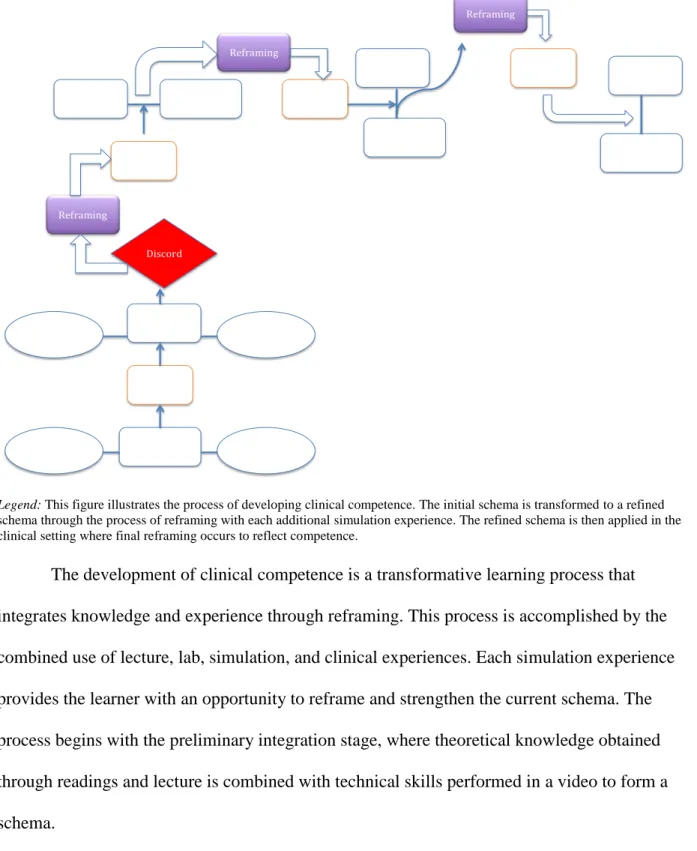
Figure 1. Competence Model
Legend: This figure illustrates the process of developing clinical competence. The initial schema is transformed to a refined schema through the process of reframing with each additional simulation experience. The refined schema is then applied in the clinical setting where final reframing occurs to reflect competence.
The development of clinical competence is a transformative learning process that
integrates knowledge and experience through reframing. This process is accomplished by the
combined use of lecture, lab, simulation, and clinical experiences. Each simulation experience
provides the learner with an opportunity to reframe and strengthen the current schema. The
process begins with the preliminary integration stage, where theoretical knowledge obtained
through readings and lecture is combined with technical skills performed in a video to form a
schema.
Schema
Preliminary Integration Theoretical
Knowledge TechnicalSkill
Simulation Critical
Thinking JudgmentClinical
Discord Reframing
Revised Schema
Simulation PerformanceOrganized
Reframing Revised Schema Simulation Reframing Refined Performance Clinical Competence Revised Schema
During the first simulation experience, the learner is presented with tasks and new
information that cause discord in the current schema. The challenge to perceived theoretical
knowledge acquired or the ability to complete skills with a basic level of clinical judgment and
critical thinking may be the source of the internal conflict. This causes the learner to revise the
current schema through critical reflection and the incorporation of newly acquired information
during the debriefing component of the simulation. This process is referred to as reframing. Once
the revised schema is formed, the learner is ready to proceed to the next phase.
The presentation of a repeated simulation will occur during the organized performance
stage. The case scenario will introduce a similar level of critical thinking and clinical judgment,
thus challenging the revised schema. Ideally, the learner’s performance at this stage should
demonstrate improvement through repeated exposure to the same simulation experience. The
learner will further reframe the schema to incorporate information related to knowledge, skills,
critical-thinking, and clinical judgment during the debriefing process.
The resulting schema is used during the refined performance stage. During this phase, the
learner is presented with a more complex simulation case. The scenario will involve synthesizing
knowledge and skills, and applying them appropriately to complete interventions using enhanced
critical thinking and clinical judgment. The learner should respond more efficiently to the events
that occur in the simulation case. This is the final opportunity for the learner to reframe the
schema prior to a clinical experience.
The learner will then take the refined schema into the clinical setting. This will provide
an opportunity to apply all knowledge and behaviors associated with the schema on an assigned
challenges that simulation cannot always replicate. At the completion of the stage the schema
will be polished and reflect competence.
Chapter 3. Methods
Research Design
A two-group time series experimental design was used to evaluate the impact of high
fidelity simulation on improving clinical competence. This design was selected for the benefit of
tracking the effect of the intervention over time. The independent variables were instructional
method (i.e., traditional lab versus high fidelity simulation) and time (pre intervention, post
intervention, and three weeks post intervention). The dependent variables in this study were:
knowledge, skills, critical thinking, and clinical judgment.
Sample
A convenience sample of first-year students enrolled in the winter 2017 quarter course
offering of NSG 301: Introduction to the Art & Science of Nursing on the Lincoln Park Campus
of DePaul University’s second-degree generalist masters of Science in nursing program were recruited for this study. As part of the requirements for this course students must complete six
4-hour lab sessions during the first 6 weeks of the course. Therefore, students were divided into 1
of 6 lab groups based on the lab section they self-enrolled. The intervention group consisted of
participants from 3 clinical groups, while the control group consisted of participants from the 3
other clinical groups.
Participant Recruitment
A total of 31 participants were recruited on the first day of class for the quarter. The
principal investigator presented the study during an information session held at the end of lecture
Appendix B). The principal investigator then left the room, and a research collaborator answered
final questions and collected consent forms from study participants.
Inclusion/ Exclusion Criteria
To be eligible for participation in the study participants had to be 18 years or older and
first-year nursing students enrolled in the winter 2017 quarter offering of NSG 301: Introduction
to the Art & Science of Nursing course on the Lincoln Park campus of DePaul University. All
participants enrolled in the course were recruited regardless of gender, racial, or ethnic status.
As this was a single site study, students that were 18 years or older and first- year nursing
students enrolled in the winter 2017 quarter offering of NSG 301: Introduction to the Art &
Science of Nursing course on the Rosalind Franklin campus of DePaul University’s School of Nursing Program were excluded. All other nursing students that were not currently enrolled in
NSG 301 on either campus were also excluded from participation in this study. Additionally, participants that were not fluent or literate in English were excluded.
Random Assignment
Each lab section of participants was randomly assigned to the control or intervention
groups using the RANDBETWEEN function in excel. There were three lab sections assigned to
the control group: 1L3, 1L4, 1L5, and three lab sections assigned to the intervention group: 1L1,
1L2, and 1L6. The DePaul University School of Nursing MENP program provided a letter of
support for random assignment of lab sections to the control or intervention group.
A research collaborator assigned each participant a unique identification number using
the RAND function in excel. The unique identification numbers were emailed to participants
instructed that this number was to be used on all data collection forms utilized throughout the
study.
Setting
This study was conducted in the DePaul University Interprofessional Simulation Lab.
The lab consisted of a four-room simulation bay, with a centralized room for prebriefing,
debriefing, and skills activities to take place. The medical-surgical room that was utilized in this
study was a replica of a traditional single-patient hospital room. Emergency equipment,
oxygenation, and suction devices were readily available, in addition to a bedside table. All
simulation activities were conducted using the Laerdal Sim Man 3G manikin.
High-Fidelity Simulation Intervention
Scenario Development. Three high fidelity simulation scenarios were developed by
modifying existing evidence-based scenarios to reflect a foundational perspective of caring for a
medical–surgical patient in an acute care setting. All scenarios required the participants to
perform a head-to-toe physical assessment, administer a medication via the intramuscular route,
and insert a nasogastric tube. The simulation cases were designed to match the following course
objectives of the Nursing Fundamentals Course:
1. Demonstrate use of nursing science and the nursing process in the performance and
documentation of clinical skills and preventions that are safe, effective, and relevant
to patient care.
2. Demonstrate personal accountability, critical thinking and integration of the art of
nursing in the performance of nursing skills within a beginning model of professional
3. Demonstrate the use of nursing knowledge specific to the care of older adults in
acute, intermediate, and skilled care settings.
4. Contrast therapeutic and social communication, and demonstrate beginning
therapeutic communication skills.
The scenarios also met one of DePaul University’s Master’s of Entry into Nursing Practice program objectives: Contribute to excellence in patient care and advances in nursing knowledge
across the lifespan through advanced health assessment, evidence-based professional practice,
systematic inquiry, planned innovation, and dissemination of information to consumer and
professional audiences (DePaul University, 2001).
Case Scenarios
Baseline and repeat scenario. The simulation case used for the baseline and repeated
scenario involved preoperative nursing interventions for a patient scheduled to have a
cholecystectomy. The patient was a 67-year-old male that presented with abdominal pain,
nausea, and vomiting as result of cholelithiasis and cholecystitis (see Appendix C). Participants
were required to perform a physical assessment on the patient, and note abnormal findings.
Participants then needed to communicate with the healthcare provider regarding the conflict
between the medication orders and the patient’s allergies. Once orders are clarified, participants
administered an intramuscular medication, and inserted a nasogastric tube.
Intervention group instructional scenario. The instructional simulation case for the
intervention group consisted of participants providing care to a patient with a small bowel
obstruction. The patient was a 61-year-old male admitted with a periumbilical pain, nausea, and
diarrhea over the previous 3 days (see Appendix D). The patient was admitted during change of
for orders. The scenario similarly required the administration of an intramuscular medication,
and insertion of a nasogastric tube.
Advanced level scenario for both groups. The final case that both the control and
intervention groups completed was providing care for a patient with a postoperative ileus. The
patient was a 72-year-old female that was two days status-post an uncomplicated laparoscopic
cholecystectomy (see Appendix E). The patient was complaining of abdominal fullness and pain,
along with nausea and vomiting. Participants needed to complete a physical assessment and
notify the provider of abnormal findings. Upon verification of provider orders, participants
administered intramuscular medication and inserted a nasogastric tube.
Measurements
A demographic data sheet was used to identify potential variance between the control and
intervention groups. The demographic data sheet was a paper and pencil form that consisted of
fill in the blank questions. The questions ascertained the following data: age, gender, grade point
average, and prior healthcare experience (see Appendix F).
Knowledge acquisition and retention were evaluated using a fifteen item multiple-choice
paper and pencil quiz developed by the principal investigator (see Appendix G). The quiz was
reflective of content presented during the online lecturette, skills video, and simulation
experience. There were three sections of the quiz that corresponded to content related to the three
skills included in each scenario: Head-to-toe assessment, medication administration, and
nasogastric tubes. Each section contained five questions. The quiz was circulated to the principal
investigator’s research committee to verify content validity. To establish test-retest reliability of
simulation, and again after the simulation on the day of pilot testing. The question and answer
order were randomized for all versions of the quiz to prevent recall bias.
Clinical judgment was measured using the Lasater Clinical Judgment Rubric with
permission. This tool was developed using the framework of Tanner’s Clinical Judgment Model,
which outlines the stages of clinical judgment development (Lasater, 2007) (see Appendix H).
The four phases of clinical judgment included in this rubric were: noticing, interpreting,
responding, and reflecting. Noticing involves observation, recognition of deviations, and
information seeking dimensions. The interpreting phase encompasses the dimensions of
prioritization and interpretation of data. Responding incorporates the dimensions of confident
mannerisms, communication, intervention planning, and skillfulness. The final phase of
reflecting includes the dimensions of self-evaluation and improvement plan. All dimensions are
scored as exemplary, accomplished, developing, or beginning according to established criteria.
The maximum score that could be achieved in this rubric is 44, which indicated exemplary in all
dimensions (Lasater, 2007). Internal consistency for this tool is high with Cronbach’s alpha = .974 (Adamson & Kardong-Edgren, 2012). To establish interobserver reliability for the Lasater
Clinical Judgment Rubric, the scenarios were recorded and scored by the principal investigator
and research collaborator on the day of pilot testing.
Critical thinking, skills acquisition and retention were measured by the use of the
Creighton Competency Evaluation Instrument (C-CEI) with permission (Hayden, Keegan,
Kardong-Edgren, & Smiley, 2014) (see Appendix I). The C-CEI had a total of 4 categories:
assessment, communication, clinical judgment, and patient safety. This tool was revised by the
National College State Boards of Nursing from the original version of the Creighton Simulation
incorporate Quality and Safety Education in Nursing (QSEN) language along with amendments
to the AACN Essentials (Hayden, Keegan, Kardong-Edgren, & Smiley, 2014). Modifications to
the C-SEI included changes in terminology of two broad categories contained within the tool:
critical thinking and specific skills. Critical thinking was renamed clinical judgment to reflect the
summation of experiences that build critical thinking, problem solving, and clinical reasoning
skills (Hayden et al., 2014). Patient Safety is the title used to replace the Specific Skills category.
One additional evaluation subcategory was added to each of these two sections. The interrater
reliability for the C-CEI is 79.4%, with Cronbach’s alpha greater than .90 to reflect high internal
consistency (Hayden et al., 2014). To establish interobserver reliability for this evaluation tool,
the scenarios were recorded and scored by the principal investigator and research collaborator on
the day of pilot testing.
Data Collection Procedure
The control and intervention groups were required to prepare for the baseline scenario
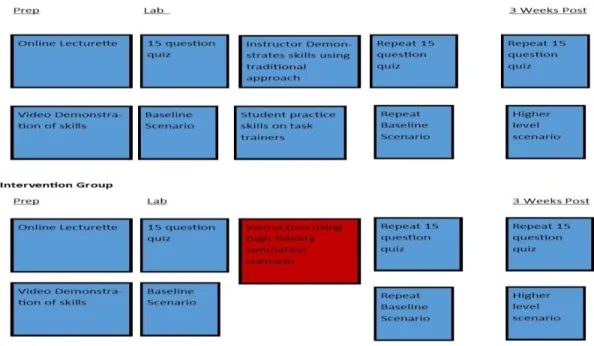
Figure 2. Study Activities
Legend: This figure illustrates the learning activities that the control group (traditional instruction) and the intervention group (simulation instruction) will participate in as part of the study.
The preparatory assignments were developed by the study’s principal investigator, and consisted
of watching an online lecturette and video demonstration of the required skills. Both assignments
were uploaded into the university online learning management system. Additionally, a brief
version of scenarios with objectives was uploaded for the students to review (see Appendix J).
The lecturette was a PowerPoint presentation with a voiceover that reviewed the following:
1. A bedside head-to-toe physical assessment with normal and abnormal findings
2. Medication administration verifying the five rights
3. Questioning medication orders
4. Uses for a nasogastric tube
5. Insertion of a nasogastric tube
7. SBAR Communication
8. GI illnesses (i.e., small bowel obstruction, cholecystitis)
The video provided visual instruction on how to complete the necessary skills to perform
successfully during the simulation. The skills demonstrated by the principal investigator in the
video were performed using a Laerdal 3G manikin. The following skills were reviewed:
1. Bedside head-to-toe physical assessment
2. Medication administration verifying the 5 rights
3. Insertion of a nasogastric tube
4. Verification of nasogastric tube placement
5. SBAR Communication
In addition to completing the required preparatory work, participants received an orientation
to the simulation lab during their scheduled lab of the first week of the quarter. The principal
investigator utilized a structured orientation checklist to ensure consistency among each group
(see Appendix K). The entire lab group of study participants was brought into the simulation
room at once. The room was set up to mimic the visual structure that was used for all simulations
in this study. Participants were oriented to the location of the oxygen and suction wall supply,
emergency equipment, medications, and nasogastric tube supplies. Participants also received
instruction on how to operate the wall suction. The manikin was turned on so that the principal
investigator could provide instruction on the location for auscultating heart, lung, and bowel,
sounds, palpating peripheral pulses, and the correct placement of the blood pressure cuff and
thermometer. Participants were also shown the location of the patient’s ID band. Finally
participants received 10 minutes to ask questions and practice with the manikin and equipment in
During the second week of the course, the principal investigator and research collaborator
conducted all lab and simulation activities for the six lab groups to maintain internal consistency.
Participants in each lab group were randomly divided into two sub-lab groups by having each
participant draw a card that stated “group 1” or “group 2.” These groups remained the same for
the duration of the study. The use of small groups ensured that participants would have the
ability to actively participate in each scenario. There was a staggered schedule of activities so
that each sub-lab group was allotted the same time to complete learning activities (see Appendix
L).
Both control and intervention groups began the lab by completing a paper and pencil
demographic data sheet. Participants placed the completed form in an envelope labeled with the
lab section (1L__) and sub-lab group (1 or 2). Once all data sheets were collected, the
fifteen-item multiple-choice knowledge quiz was administered. Participants were given fifteen minutes
to complete the quiz. Once completed, participants placed the quiz in the designated envelope.
The answers to the questions were not provided to the students at the conclusion of the quiz.
Upon completion of the quiz, subjects participated in a 5-minute prebriefing using a
standardized guide developed by the principal investigator of this study (see Appendix M). The
prebriefing began with a review of the patient’s medical history. Participants were informed of
which component of patient care would be occurring at the start of the scenario. All objectives
for the simulation were also discussed. Participants were then informed that there are no assigned
roles for the scenario. The time to complete the scenario was the final component of the
prebriefing. Participants were instructed that the scenario would end after 25 minutes, regardless
Participants then moved into the simulation bay to complete the baseline scenario.
Debriefing occurred immediately following the scenario using a standardized debriefing guide
that utilizes the Gather, Analyze, and Summarize (GAS) approach (see Appendix N). This
method of debriefing was selected because it facilitates the development of clinical reasoning
through reflective thinking. Moreover, it permitted facilitators to standardize the debriefing guide
by developing reflective questions that compare the student learners’ actual performance with expected actions to achieve scenario objectives. The debriefing period was limited to 25 minutes.
Following a brief 5-minute break after the debriefing, students completed either the
traditional or simulation instruction method of practicing skills. Participants in the control group
had 1 hour to complete learning activities, whereas intervention group participants had 55
minutes to compete the intervention simulation activities.
Traditional Instruction
This teaching method consisted of the principal investigator or research collaborator
providing an in-person review of each skill. A demonstration of the head to toe physical
assessment and nasogastric tube insertion was provided on a static manikin. Time was allotted
for each student to practice these skills individually. The five rights of medication administration
were also discussed, while demonstrating the process of withdrawing medication from a vial and
reviewing injection sites on the manikin. Participants had an opportunity to aspirate medication
from a vial and inject it into an injection pad.
Simulation Instruction
Participants practiced the essential skills of physical assessment, safe medication
administration, and insertion of a nasogastric tube as part of the simulation experience.
twenty-five minutes for debriefing. The standardized debriefing guide using the Gather, Analyze, and
Summarize (GAS) method will be used to debrief this scenario. This provided an opportunity for
the principal investigator and research collaborator to guide participants in self-reflection on
performance and correct any deviations from the standard of practice in providing nursing care.
Upon the completion of their designated learning activities, participants repeated the
fifteen-item multiple choice paper and pencil quiz. The quiz questions and order of answers were
rearranged. Participants placed the completed quizzes in an envelope labeled with the lab section
(1L__) and sub-lab group (1 or 2). Participants were then prebriefed for the repeated baseline
scenario using the same guide. At the conclusion of the prebriefing, participants completed the
scenario and debriefing. All testing and scenario activities remained consistant with the time
frame of baseline data collection.
Three weeks after the initial scenario, participants returned for a final quiz and simulation
case. The administered paper and pencil quiz was the same as the pre and post quiz, with a new
question and answer order. Participants placed the completed quizzes in an envelope labeled with
the lab section (1L__) and sub-lab group (1 or 2). Participants remained in the same groups they
were in previously to complete the final scenario. The last scenario was more complex, requiring
a higher level of critical thinking and incorporation of the same skills as all previous scenarios.
Students were prebriefed using the standardized guide before proceeding through the scenario.
The GAS method was used again to debrief students following the scenario. Once the final group
had been debriefed the principal investigator provided the answer key with rationales for the quiz
questions by email. All times for simulation activities remained consistent with baseline data
Video Recording
To remain consistent with the facilitation standards of the DePaul University
Interprofessional Simulation lab, participant performance in all scenarios were recorded using
the Sim Capture platform.The Sim Capture platform was used to allow for password protected
access and storage of recordings.Only the principal investigator and research collaborator had
access to the video recordings. Each recorded scenario was filed with the label “Lab section
(1L___), sub-lab group (1 or 2), and participant numbers” All recordings were retained until the
study had been completed, at which point they were be deleted from the Sim Capture platform.
Data Analysis
Data were analyzed using Statistical Package for the Social Sciences (SPSS) 24.
Descriptive statistics were used to evaluate the demographic data of the study sample. Data were
assessed for normative distribution. A mixed factorial analysis of variance was conducted to test
the effects of instructional method and time on the four learning outcomes: knowledge, skills,
critical thinking, and clinical judgment. Post hoc comparisons of means for the main effect of
time and simple effects of significant interactions were performed using Bonferroni adjustment.
Ethics and Human Subjects Protection
The study protocol was reviewed and approved by the DePaul University Institutional
Review Board. All participants provided informed consent prior to the start of the study.
There was concern that participants may report feeling anxious providing patient care in
the simulation lab while being video recorded. Video recordings of participant performance were
therefore only the principal investigator and research collaborator had access. Recordings were
deleted once the study was complete.
Pilot Testing
Pilot testing of each scenario occurred prior to the implementation of this study. Eleven
participants from the previous cohorts enrolled in NSG 301: The Art & Science of Nursing I
were recruited to participate in the pilot testing of the three scenarios. Participants were given
access to watch the lecturette one week prior to the day of pilot testing. All participants signed a
consent form to be video recorded. Four students were randomly assigned to one of the three
cases used in this study, with one scenario only having three participants. Participants began the
day by taking the 15-item multiple-choice paper and pencil quiz. Participants were not given the
answers upon completion of the quiz. Following the quiz, the principal investigator facilitated a
scripted prebriefing prior to beginning the scenario. At the conclusion of the scenario, the
participants took the quiz a second time with the questions and answers reordered to prevent
recall bias. Once the final quiz was collected the principal investigator reviewed the answers to
the quiz. The principal investigator then debriefed the students using the structured debriefing
guide that followed the Gather, Analyze, and Summarize approach.
Results
Reliability Analysis
Evaluation of interobserver reliability was done for the Creighton Competency
Evaluation Instrument (C-CEI) and the Lasater Clinical Judgment Rubric (LCJR) during pilot
reliability. The coefficient alpha for these tools were 1 and .89 for the C-CEI and LCJR,
respectively.
Reliability of evaluation tools was also done during pilot testing, with the exception of
the knowledge test. The reliability analysis of the knowledge test was omitted as a result of the
small sample used for pilot testing. The coefficient alpha for the critical thinking and skills
domains of the C-CEI was .56, The LCJR had a coefficient alpha of .86.
Sample Characteristics
A total of 31 participants initially enrolled in the study. Only 30 participants completed
all three points of data collection. Based on the inclusion and exclusion criteria for the study one
participant’s data was excluded from analysis.
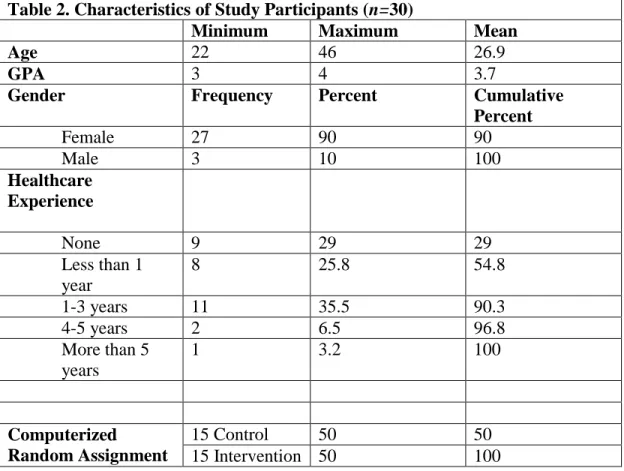
The majority of participants were female (90%). The age range for participants was
between 22 and 46 years (M =26.9). Additionally, participants reported an average GPA of 3.7.
Approximately 71% of participants reported having some previous healthcare experience (see