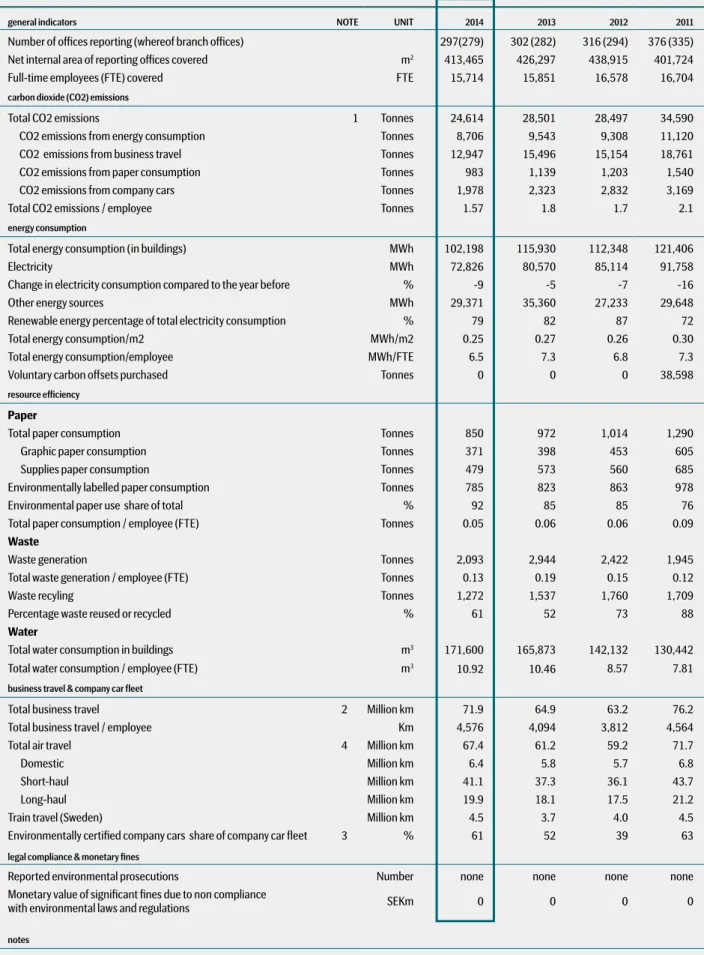
2014
How we create value for people,
the business and the environment
Sustainable Perspectives
This is SEB Front cover
CEO statement 1
Our role and approach
SEB’s role in society 2–3
Global outlook, challenges and opportunities 4–5
Stakeholder dialogues 6–7 Material issues 8–9 A sustainable business strategy 10–11
Objectives and performance 12–13
Integrating sustainability into business 14–15
Driving the agenda 16–17
Responsible business
Responsible selling and marketing 18–20
Tackling financial crime 21
Responsible investments 22–25
Sustainable finance 26–29
Project financing, examples 30
Environment
Reducing our environmental footprint 31
People and community
Valuing our people 32–35
Investing in communities 36–38
Access to financial services 39
Governance of corporate sustainability 40–41
About this report 42
GRI Index 43–47
Key Performance Indicators 49–55
Auditor’s report 56
People and
Community
Know
ledge and economic contribution
Environment
Et
hi
cs
Ethics
Eth
ics
Kn owle dge and econ conom ic con trib utionBusiness
To be the trusted partner for customers with
aspirations
SEB’s approach to sustainability
focuses on three areas. Through our
work, we aim to create mutual value to
our stakeholders and contribute to
sustainable development.
Our corporate objectives
To be the leading Nordic corporate bank and to be the top
universal bank in Sweden and the Baltic region.
Our strategic priorities
• Long-term customer relationships
• Growth within areas of strength
• Resilience and flexibility
Our mission
To help people and businesses thrive by providing quality
advice and financial resources.
Our vision
To be the trusted partner for
customers with aspirations.
Merchant Banking
Commercial and investment banking
services to large corporate and
institu-tional clients in 20 countries, mainly in
the Nordic region and Germany.
Retail Banking
Banking and advisory services to private
individuals and small and medium-sized
corporate customers in Sweden as
well as card operations in the Nordic
countries.
Wealth Management
Asset management, including mutual
funds, and private banking services to
institutional clients and high net worth
individuals in the Nordic countries.
Life
Life insurance services for private
individuals and corporate customers,
mainly in Sweden, Denmark and the
Baltic countries.
Baltic
Banking and advisory services to
private individuals and small and
medium-sized corporate customers in
Estonia, Latvia and Lithuania.
seb is a relationship
bank strongly committed to deliver customer value. We believe
in building on our heritage of entrepreneurship, international outlook and long-term
perspective. SEB’s offerings and services are provided through five divisions.
•
Merchant Banking 9,088 (8,171)•
Retail Banking 6,622 (5,743)•
Wealth Management 2,258 (1,610)•
Life•
Baltic•
OtherSME CUSTOMERS
In all, SEB serves approximately
400,000 small and medium-sized
companies in Sweden and the Baltic
countries. Of these some 246,000
are home bank customers.
CORPORATES &
INSTITUTIONS
SEB’s corporate customers in the
Nordic region are among the largest in
their respective industries. In Germany
they range from large mid- corporates
to large multinationals. The
institution-al clients operate both in the Nordic
countries and internationally.
PRIVATE INDIVIDUALS
SEB has approximately 4 million
pri-vate individuals among its customers
in Sweden and the Baltic countries.
Of these some 1,3 million are home
bank customers. In addition, SEB
has around 27,000 private banking
customers in and outside Sweden.
246,000
home bank customers
3,000
large corporations
and institutions
1.3
million home bank customers
SEK
23,348 m
OPERATING PROFIT PER DIVISION
SEK m
2,066 (1,892) 1,445 (1,280) 1,869 (–569)
W
e are experiencing extra-ordinary times. Growth is subdued. Inflation is at very low levels. Interest rates are at histo-ric low levels and even negative, while years of central bank liquidity support has boosted asset prices. In addition, in 2014 we saw heighte-ned geopolitical risks following the distressing events in Ukraine and in the Middle East. The discussions on how to tackle global issues such as increased social challenges and climate change intensified. An environment like this poses even larger demands on corporates to take a long-term perspective and conduct their business in a sustainable way. We strive to do so in SEB.IN PARTNERSHIP
WITH OUR CUSTOMERS
Founded close to 160 years ago in the service of entrepreneurs and enterprise, SEB has a deeply rooted ambition to work in active and close partnership with our customers. The best way we can fulfil our role as lubricant for the overall economy is by building deep customer relationships on the basis of a sound and robust financial position. At the same time, we need to cater to the needs of all
our stakeholders. Therefore, we have taken a clear stance to fully integrate sustainability into our core business. Our sustainability work is based on international co-operation. We are committed to global initiatives as for example the UN Global Compact, the Principles for Responsible Invest-ments and the Equator Principles. Our core values and internal guideli-nes such as Code of Busiguideli-ness Conduct mirror these principles.
DEEPER UNDERSTANDING
AMONG EMPLOYEES
We have taken major steps in our work on sustainability over the past five years. Closing the books on 2014, it is clear that this groundwork has yielded results. Our employees have a much deeper understanding of what sustainability means for us as a bank and how each and every one can make an impact. We see this in our yearly employee survey, Insight.
Our Group wide position sta-tements and sector policies have proven valuable tools in dialogues with our corporate customers and have been tightened, with an incre-ased focus on human rights issues. Back in 2008, we were pioneers in developing green bonds and have since then been the most active bank
in the world in terms of assisting companies and organisations issu-ing green bonds. The total market more than tripled just last year and has now reached USD 55bn issued globally. We launched our second microfinance fund for institutional clients, investments that are used to fund microloans to individuals in developing countries. In our role as owner and member of corporate no-mination committees, we nominated more female directors than in any previous year.
OUR INTEGRATION CONTINUES
Clearly, we have advanced during the past year, moving from sustainability seen as something “additional”, now being critical for our future success. This is a journey that never ends. We will continuously work to integrate sustainability aspects into everything we do. We will strengthen dialogues with our customers and other sta-keholders, enhance knowledge and engagement, actively using our role in society to be a positive force for sustainable development.
Stockholm, March, 2015
Annika Falkengren
President and Chief Executive Officer
CREATING VALUE FOR
ALL STAKEHOLDERS
seb is a bank with a clear aim
to take an active role and contribute to the overall
development of society. We strive to meet our stakeholders’ expectations
in a responsible way to create value for all of them. We do this
by integrating sustainability into our core business.
Financial markets are at the core of creating economic and social value in a modern society. The key role of banks as financial
en-gines is carried out in three main areas:
Financial intermediation
Banks provide solutions for those with money to invest and for those in need of borrowing and act as safe and efficient
intermediaries between them.
Payments
Banks provide domestic and international payment services, which are the basis for all
economic activity.
Risk management
Banks assume risk and assist customers with financial risk management.
As all these areas are essential to society, banks are an integral part of the economy.
SEB’S ROLE
IN SOCIETY
Corporate, institutional and public sector customers
Financial
intermediation Payments Risk management
• Access to financial markets • Access to capital • Advice • Financing • Asset management • Cash management • Cards • Giro • Transfers • Trade finance • Foreign exchange • Digital and mobile banking • Advice • Tools to manage credit, equity, interest and currency risk • Custody • Liquidity management
Examples:
Financial intermediation
Payments
Risk management
ECONOMIC AND
FINANCIAL NEEDS
Society at large
Financial
intermediation Payments Risk management
• Facilitation of investments • Operation of financial markets (money, capital, currency) and clearing • Facilitation of access to capital • Access to financial markets • Domestic payment systems • International payment systems • Complementary health and pension insurance • Economic forecasts • Anti-money laundering • Economic and specialist knowledge Private individuals Financial
intermediation Payments Risk management
• Consumer loans • Accessible savings • Mortgage financing • Access to financial markets • Bank accounts • Cards • Currencies • Payments • Giro • Internet and mobile banking • Health insurance • Life insurance • Pension • Long-term savings • Advice
Examples:
Examples:
VALUE DISTRIBUTION
(SEK 39bn)
Financial intermediation
Payments
Risk management
Financial intermediation
Payments
Risk management
Financial intermediation
Payments
Risk management
SEB CREATES ECONOMIC VALUE
Like all banks, SEB supports the economy and overall society by providing financial services to private individuals, corporate, institutional and public sector, customers and to society at large. These activities also benefit the Bank’s other stakeholders:
share-holders, the public sector, employees and suppliers.
SEK 10,382m
SEK 9,350m SEK 11,189m
GLOBAL OUTLOOK,
CHALLENGES AND
OPPORTUNITIES
as a bank
we have a central role to play in sustainable development. We have
direct as well as indirect impacts on the communities where we operate. As global
trends change, we need to continuously develop our operations in order to meet our
GLOBAL ECONOMY
Even though the world economy shows signs of stabili-sation and we are seeing increased activity among our Nordic and German corporate customers, the recovery has been sluggish. The macro-economic situation has a major impact on our customers’ levels of activity and thus on our business. Record-low and even negative interest rates have resulted in the cost of money never being as low as today. In spite of stimulatory efforts, the economic development remains uncertain.
GREAT BUSINESS
POSSIBILITIES
These four trends provide challenges as well as great business opportunities. Companies must act long-term and be good citizens. The strain on natural resources means that companies which are lean, resource-saving and productive have an edge. Those who can tap the talent resources of minorities and excluded groups on the labour market will not only help reduce unemployment, but also gain access to new skills that will be necessary in the future global economy. Banks that integrate social and environmental aspects into their financing and investment activities will strengthen their risk management and be better business partners for their customers.
Simultaneously, the digital development creates opportunities to improve services and accessibility. Moreover, the banking sector as a whole can invest in developing common technology platforms, customer-oriented infra-structure and modern functionality.
Those banks which credibly show that they strive to build a sustainable business strategy will have a head start in creating new long-term business opportunities.
SOCIAL CHALLENGES
At a global level, rising incomes have led to a growing middle class and a reduced share of the very poor. However, we also see deepening income inequality, risking the creation of a big class of people outside the mainstream of society. Unemployment, particularly among youth, is a severe challenge.
In many countries populations are aging rapidly. More resources need to be poured into health care and pensions systems. Private individuals need to take a greater respon-sibility for their financial security. Public finances will be tested. An inflow of young immigrants can alleviate the problems – but that necessitates successful measures to integrate the new citizens into the national labour and housing markets.
DEMANDS ON BANKS
ARE CHANGING
Regulatory authorities have taken a more over-arching and in-depth approach to strengthen stability in the financial markets as well as in every individual financial institution. Concurrently, measures have been adopted for improved functionality and infrastructure in the financial markets as well as enhanced consumer protection.
The rapid digital development leads to raised customer expectations on accessibility, efficiency and speed while their demand for qualified advice increases. Safety and security are crucial. New business models are being de-veloped, particularly in the market for payment services, leading to competitive pressure on traditional banking.
CLIMATE CHANGE AND
RESOURCE STRAINS
The recent reports of IPCC clearly demonstrate the dangers of the present trajectory of green-house gas emissions. The oceans are at present buffering some of the effects, but the risks of extreme weather, sea level rise and desertifi-cation – to name but a few – are rising. Poor countries with insufficient infrastructure and institutions are likely to suffer most.
As the global population grows, and as incomes rise, production will soar – as will the demands for natural resources. In some areas strains are clearly visible. A rising portion of the global population lacks fresh water. Pollution is rising rapidly in the megacities of the emer-ging economies. Farmland and wetlands are increasingly scarce. Consequently, there is a need to economize scarce natural resources and produce and consume in a way which creates a minimum of waste. This presupposes large investments and rapid technological change.
1
3
4
=
2
1 6 000 more than 4 million Sh areh old ers
Suppliers & business partners Co mm unit ies 2 70 0 00 13 000 in so me 20 c ount rie s Emplo yees C usto mers Med ia Go
vernment & regulators C om pe tito rs C ivil soc iety o rganis
ations Consumer ad vocate
grou ps active engagement with seb’s stakeholders is a cornerstone
in our efforts to understand their expectations and concerns. Listening and learning from our stakeholders provide us with essential insights, enabling us to respond and address the issues they raise.
We use a range of mechanisms for engagement as well as for gathering and monitoring of feedback across our business. The backbone consists of ongoing and specific surveys, complemented by deeper engagement dialogues. In addition, we participate in industry forums as well as international and national sustainability forums to discuss emerging challenges and trends.
SEB’s internal Corporate Sustainability Summit, held in November 2014, enabled us to engage with many employees around sustainability, to learn about priorities and generate ideas for improved processes and products.
STAKEHOLDER
PRIMARY ENGAGEMENT CHANNELS
MAIN ISSUES RAISED DURING 2014
Customers Tracking and analysis of customer insight surveys, focus groups, feedback and complaints received via our customer advisors and relations-hip managers, telephone banks, online, and local branch teams. Internal customer insight web portal hosting surveys such as Prospera, Needs-cope, SEB Brand Tracking, Reputation Index, SKI (Swe), Finansbarometern (Swe).
• Long-term customer relations • Proactivity
• Customer recognition
• Customer service across all meeting points • Accessibility of e-services
• Ethics
• Transparency and openness
Employees Annual employee survey, open internal chats with executive management, town hall meetings, value dialogues, SEB Way transformations and weekly continuous development whiteboard meetings, leadership development program-mes, everyday learning tools, Workers Councils meetings; annual health and safety reviews.
• Development/career opportunities • Organisation and culture • Leadership
• Transparency and openness • Health/work life balance • Working with sustainability • Remuneration
• Work methods and IT systems Shareholders,
investors and analysts
Surveys such as Bloomberg, RobecoSAM, Vigeo, Sustainalytics, Oekom and Imug. Road-shows, in-vestor meetings, briefings, engagement dialogues, questions received prior to and during AGM’s and in connection with result presentations.
• Financial resilience
• Sustainable growth and return • Sustainability performance • Human capital
• Transparency Government and
regulators
Economic and policy trend analysis, industry forums and meetings.
• Regulation • Consumer debt levels Suppliers and
business partners
Questionnaires and individual meetings, supplier screening process. • Strategic partnerships • Accountability Communities, civil society organisations, consumer advocate groups, media
Research – general public, local community engagements, round table discussions, regular meetings with NGO’s, mentoring, volunteering, CS forums, research papers, media coverage.
• Job-creation
• Ethical behaviour, transparency • Human rights and nuclear weapons • Sustainable performance • Local community support • Profitability versus customer value
WE ENGAGE WITH
STAKEHOLDERS
VIEWS AND EXPECTATIONS
MARIE
BAUM-GARTS
Head of Corporate Responsibility, Tele2 (supplier and customer)What are the strengths of SEB’s sustainability work?
SEB started out as an early bird in conducting high level stakeholder dialogues and reporting them to the Executive team. That gave a good position early on while others were still trying to figure out the concept. Another strength is the honest ambi-tion and commitment to further inte-grate sustainability into investments and operations, I think that will serve them well when navigating in a world of constant transformation.
What can we do better?
Speed up and dare more! That goes for all multinationals in general, us included. We, as companies, have a common responsibility in integrating corporate responsibility into our core business processes. This being specifically important for investors in making the right (sustainable) choices.
ŽYMANTAS
MORKVĖNAS
Direktor, Baltic Environmental Forum (NGO)What are the strengths of SEB’s sustainability work?
SEB’s most significant contribution for making our environment cleaner and well balanced co-existent with nature is streaming its financial
recourses, promoting more sus tain-able and “greener” business. To create more favourable condi-tions for the sustainable business and raising awareness among their clients how they can improve environ mental performance could lead to most influential change. It would be important if SEB would fix this course in its environmental business strategy and start taking real steps forward.
What can we do better?
As part of the environmental strategy, the bank could further improve by measuring its environ-mental performance on the annual basis making it as a standard annual procedure. Moreover, it is important to continue informing bank’s staff as well as their clients about the concreate achievements and new goals set for the coming years.
JUSSI
PENTTILÄ
Vice President Finance, Outotec, (customer)What are the strengths of SEB’s sustainability work?
Outotec’s mission is “Sustainable use of Earth’s natural resources” and Outotec intends to incorporate sustainability into all aspects of its operations. From our perspective we
highly appreciate that SEB’s position statements and sector policies are committed to topics like freshwater, mining and metals which are also in the core of Outotec’s business.
What can we do better?
We just encourage SEB to conti-nue the good work. Sustainabi-lity targets can be reached most efficiently when financial markets and industries continue to integrate cooperation with each other.
what do our stakeholders think
of how we perform our sustainability work?
Their views and expectations are critical for our continuous development and ability
to create long-term value. Below, representatives from four stakeholder
perspectives state their opinions.
MATS
ANDERSSON
Chief Executive Officer, AP4 (investor)What are the strengths of SEB’s sustainability work?
No company can be successful in the long run unless corporate sustaina-bility issues are high on its agenda. That is why it has become increasing-ly important for a long-term investor such as the Fourth Swedish National Pension Fund to follow sustainabi-lity efforts of the companies it has invested in, such as SEB. SEB’s
sus-tainability report is in many respects a model. There are clear, decomposed goals that can be measured, and as the saying goes: what gets measured gets managed. It is also evident that corporate sustainability is a focal point for SEB’s CEO and executive management, which is a prerequisite for the issue to gain priority throug-hout the organisation.
What can we do better?
An area for further improvement would be to even more clearly connect corporate sustainability strategy to the bank’s lending and financing services.
what is most
important?
why and for whom?
identify the issues
our process to
manage them?
how do we
IDENTIFYING THE
MATERIAL ISSUES
seb’s process for identifying
the most material issues is based on an on-going engagement with our stakehol-ders in combination with our own assessment of issues that are of strategic importance for business. The main engagement channels with key stakeholder groups, as well as the main issues raised, are described on page 6.The essential input gained from stakeholders is complemented by desk research on emerging societal, economic, environmental and business trends impacting our business. Issues identified are evaluated from both a stakeholder and a business perspective and how they in-fluence SEB’s ability to create and sustain value on a three to five year perspective. This input informs our strategic approach and guides our focus for reporting.
For material Aspects and Boundaries in accordance with Global Reporting initiative G4, please see p 43 – 47 (GRI Index).
During the year, we have further developed the materiality process established in 2013. In order to facilitate both internal and external understanding of our material issues, we have grouped identified issues. Detailed explanation of these issues can be found at our website www.sebgroup.com/sustainability.
Although many issues remain material over time, we have identified a few issues that have become more impor-tant during the year. In 2013, the carbon bubble was seen as an emerging issue which required monitoring. Develop-ments in 2014 clearly illustrate that this is an important issue that we will need to continue to respond to. We do this through our work with integrating ESG in financing and investments.
Digitisation has also become even more important. Al-together, our latest assessment has confirmed that SEB to a large extent has been prioritising the most important issues.
materiality is about identifying the issues
that are of most concern to our
stakeholders as well as to our own business. They influence stakeholders’ perception
of our performance and impact our ability to create and sustain value. SEB has an
established process to identify these issues and to prioritise them.
THE ISSUES THAT
MATTER MOST
this chart presents
an assessment and rating of issues identified as important,
to SEB as well as to our stakeholders. A majority of these issues were ranked as highly
relevant for both stakeholders and business, such as customer loyalty (1),
financial strength (2) and digitisation (4). Issues like SEB’s direct
environmental impact (H) and financial inclusion (I) were seen as
less important to all stakeholders as well as for SEB’s business.
Im
po
rt
an
ce
to
S
EB
’s
s
ta
keh
ol
ders
Importance to SEB’s business
M ed ium H ig h High
Medium Very high
IMPORTANT FOR MULTIPLE
STAKEHOLDER GROUPS
1. Customer loyalty and experience 2. Financial strength and resilience 3. Responsible selling and consumer advice 4. Digitisation
5. Business ethics and culture 6. Risk management 7. Talent management 8. Employee engagement
9. Integrating ESG in financing and investments 10. Capacity for innovation
11. Data protection
IMPORTANT FOR SOME
STAKEHOLDER GROUPS
A. Sustainability profiled products and services B Resource efficiency in society
C. Supporting entrepreneurship D. Tax transparency and public affairs etc E. Responsible sourcing
F. Working conditions
G. Engaging in local communities H. Direct environmental impact I. Financial inclusion Ve ry h ig h 1+2 A B 3 C E 6 F 9 G H I 10 11 7 8 5 4 D
The vertical axis shows the degree of importance to stakeholders, the horizontal axis shows SEB’s assessment of how important the areas are to the business strategy and operations.
seb’s strategic focus remains.
Long-term customer relationships built
upon a strong financial position form the foundation for sustainable profitability.
This creates value for our customers, shareholders, employees,
suppliers – and therefore for society as a whole.
LONG-TERM FOCUS
AND RELATIONSHIPS
seb was founded
in the service of enterprise nearly 160 years ago and has always played an active part in the development of the societies and markets in which it operates. By assisting customers with financing, secure payments and wealth management, SEB promotes econo-mic development and international trade, contributes to financial security and creates value.In its ambition to be the leading Nordic bank for cor-porates and financial institutions and the top universal bank in Sweden and the Baltic countries, SEB has adop-ted a strategy based on three pillars: long-term customer relationships, resilience and flexibility, and growth in areas of strength.
At SEB we offer not only high-quality products and ser-vices – we also build long-term relationships by sharing our expertise and know-how with our customers. We safeguard our customers’ financial strength by providing a customised, holistic offering.
Our financial strength –stability, resilience and flexibility – is crucial for maintaining the long-term trust amongst our stakeholders. With this trust and our role in society comes a responsibility for how we conduct our business including how we manage ethical, social and environmental aspects. Together they form the foundation for achieving our goals for customer satisfac-tion, employee engagement and profitability, and create shareholder value.
•
Salaries, pensions andbenefits to 16,000 employees
•
Dividends to 270,000shareholders
•
Taxes and fees•
Business partnersand suppliers (13,000)
SEB contributes to society (examples 2014)
We support trade • 853 million payments
• 782 million card
transac-tions We finance business
activity • Corporate and property ma-nagement lending
SEK 712bn We manage
custo-mers’ securities and investments
• Assets under management
SEK 1,708 bn and assets un-der custody SEK 6,763bn We provide secure
forms of savings • SEK 246bn of deposits from private individuals
We support local
communities • SEK 17m to entrepre-neurship and innovation
• SEK 7m to education and know-how • SEK 16m to children and youth • SEK 29m to sports and culture
SEB CONTRIBUTION: EXAMPLES
SEB’S VALUE DISTRIBUTION (SEK m)
Rewarding relationships
The Relationship Bank in
our part of the world
9,300 5,96 7 6,03 4 11,821 10 ,286 7,152 8, 71 9 11,330 9,350 7, 84 7 10 ,382 11,18 9 10, 000 6,500 3,83 9 11 ,7 62
Rewarding relationships are at the core of what we are. We strive to build partnerships based on insight and trust, supporting our customers long-term.
People and
Community
Know
ledge and economic contribution
Environment
Et
hi
cs
Ethics
Eth
ics
Kn owle dge and econ omic contribution Knowledg
e and e conom ic con trib ution
Responsible
Business
To be the trusted partner for customers with
aspirations
we are convinced
that a business that encompasses a sustainable perspective is more successful long-term. This entails acting responsibly, being increasingly transparent and making sustainability a natural part of how we con-duct our business. Our role as a bank and financial institu-tion provides the framework from which we aim to create mutual value and contribute to sustainable progress.SEB’s sustainability strategy targets three areas – Responsible Business, People and Community and Environment. A key aspect of our sustainability work en-tails our continued commitment to global initiatives such as the UN Global Compact, the UN supported Principles for Responsible Investments, UN’s Guiding Principles on Business and Human Rights, the UN Environment Programme Finance Initiative, the OECD Guidelines for Multinational Enterprises and the Equator Principles.
DEFINING THE NEXT STEP
We believe that we have made good progress in
integrating sustainability throughout our business and are now in the process of defining the next step. SEB’s internal conference, Corporate Sustainability Summit, which was held in November 2014, provided substantial input on key focus areas going forward. This complements essential information derived from our regular assessment of issues that matter. We plan to decide on SEB’s forthcoming sustainability plan during the first half of 2015, thereby linking this work closely with SEB’s overall business planning, all aimed to secure a sustainable business going forward.
EIGHT BUSINESS PRIORITIES – OUR AMBITIONS
OUR STRATEGY
SEB’s sustainability strategy is
focused on eight business priorities
within three areas of responsibility. By
focus ing our efforts on these priorities
we can contribute to better banking
governance and protection of the
environment, while enhancing our
social contribution.
Responsible selling and marketing
Top customer loyalty. Facilita-ting customers’ own control and under-standing of their financial situation. Ensure quality advice based on long term needs.
Tackling financial crime Strengthen processes for a flex-ible approach to meet changing threats, focusing on security and safety for employees, customers and assets.
Responsible investments Ensure that we perform our ownership role responsibly, promoting good business ethics and governance. To be the leading Nordic asset manager within responsible investments.
Sustainable finance Increasing dialogues on important sustainability issues with customers, using internal policies and international guidelines as key tools. In all business decisions consider environmen-tal, social and governance aspects. Increa-se share of positive impact financing.
Valuing our people
Top number of employees enga-ged and proud to recommend SEB as an inclusive and sound workplace with scope for individual development. Increased diversity at all levels.
Access to financial services Improve accessibility of our banking services, using new technology and innovation. Sharing our expertise to customers and the broader community. Make it easier for customers to interact with the bank on their own choice and regardless of physical ability.
Investing in communities As a corporate citizen we engage for future generations. Sustai-ning and developing long-term partnerships with people and organisations, together building a society we all want to be in.
Reducing our footprint Continue managing our direct environmental impact. Be re-source effective, reduce energy consump-tion and CO2 emissions. Increase focus on sustainability aspects in relations with suppliers and other business partners.
Responsible selling
and marketing
Tackling financial crime
Responsible investments
Sustainable finance
Valuing our people
Access to financial services
Investing in communities
Reducing our footprint
• Further improve customer satisfaction.
• Further focus on the custo-mers’ entire economy and needs.
• Building on long-term rela-tionship with all customers and continue the strategic focus on entrepreneurship.
• Transaction monitoring: More sophisticated risk grading of transactions.
• Increased communication on active ownership activities and impact analysis • Create overarching
respon-sible investment framework for all asset classes. • Continue to develop and
refi-ne ESG investment products for all distribution channels.
• Enhanced focus on sustaina-bility in strategy discussions. • Develop and roll-out
roundtable discussions on corporate sustainability. • Review of existing sector
policies.
• Additional focus on EP III training linked to project- related corporate loans.
• Further improve employee en-gagement, e.g. through value dialogues and activities from diversity initiatives.
• Aligning work environment to OHSAS 18001, international occupational health and safety management systems (Swe). • Implementing the global
leadership programme Art of Execution.
• Develop and enhance the digital and mobile offering for private and corporate customers. • Further focus on
multi-chan-nel banking (based on sound advisory) making it easier for all customers to interact with the bank.
• Deepen employee social engage-ment as a tool for health support. • Further develop engagement in
local communities towards youth. • Strengthen internal awareness
of entrepreneurship and of our community investments.
• Assessment of our largest suppliers (covering 80% of spend) from a sustainability perspective.
• Continue CO2 reduction towards target of –45% by 2015.
• Reduce electricity usage with 2.5% per year on average
STATUS
• Customer experience st-rengthened, reflected in the SKI-index (Swedish Quality Index). Among the major banks on the private market in Sweden, SEB increased the most and the number 2 position was confirmed. On the corporate side SEB in-creased more than industry average.
• Launch of new holistic and simplified savings offering and customer offering tar-geting young entrepreneurs.
• Strengthened internal collaboration.
• Additional resources with IT-security competence. • Implementation of
additio-nal transaction limits, crea-ting a stop loss for fraud. • Ability to stop payments to
known mule accounts.
• External blog activity started. Acknowledged as one of the owners that managed to no-minate the highest number of women to boards in listed companies.
• Responsible investment framework covering all asset classes launched.
• Launch SEB Microfinance Fund, II and Domestica II (real estate fund).
• The sector policy for arms and defence clarified and sharpened.
• Implementation of the new Equator Principles (EP III). • CS part of ongoing dialogue
with most medium and large corporate clients.
• Targeted training of client executives in the Baltic banks.
• Energy related loan portfolio includes 27% renewable energy, and less than 2% of coal.
• Improved Employee Engage-ment index 75 (70) as a result from several engagement activities across SEB. • Alignment of OHSAS 18001
accomplished. Certification yet to be done.
• Art of Execution implemented globally. Three programmes accomplished during 2014, covering 75 leaders.
• All digital customer interfaces were updated with the aim to enhance customer experience and user friendliness.
• In 2014, 96 per cent of Swedish retail customer interactions took place in a digital and mobile environment.
• Access to financial information has improved and errands that were to be carried out in a branch office is now possible in other channels.
• Mentor is part of health program. Feel good by doing good. • Support for children and young
adults widened in 2014, reaching 10,000 members of the future generation.
• Increased communication of community investments.
• 176 of our largest suppliers, covering 60% of our spend, assessed.
• Direct CO2 emissions reduced by about 42% since 2008. • Reduction in electricity use
comparing 2014 vs 2013 by 10%.
• Travel distance increased com-paring 2014 vs 2013 by 11%.
• Further enhance customer experience and satisfaction in all segments.
• Secure relevant and holistic advisory based on the customer’s whole economy and needs.
• Taking further steps in supporting entrepreneurs and engaging in local com-munities.
• Review and update of SEB’s Code of Business Conduct.
• Launch of new e-learning tools to increase awareness of Know-Your-Customer process and risks of money laundering.
• Launch of documentary film on fraud and money laundering cases. • Explore how Big Data can
be used for early fraud detection.
• Continued ESG integration in portfolio management. • Enhance communication to
support customers around responsible investments. • Further development of ESG
focused products, such as green bond fund.
• Continue to grow green product range.
• Increase share of renewable energy financing.
• Enhanced trainings on sus-tainability throughout SEB. • Continued focus on
dia-logues with clients around sustainability, to use this as a tool for better understan-ding of client needs.
• Further improve Employee Engagement (+1) through different initiatives encouraging dialogue and collaboration cross organisation.
• Certification of OHSAS 18001, international occupational health and safety management systems.
• Implementation of develop-ment program for potential leaders; Green House. • Increased gender balance at
senior managerial level.
• Further improvements and more accessibility for the customers’ entire economy in all digital and mobile interfaces.
• Further steps in improving custo-mer value through the multi- channel concept with the aim to further enhance accessibility and simplicity for the customer.
• Strengthen impact measures. • Further improve governance and
enhance knowledge about our commitments.
• Further steps into supporting en-trepreneurs in local communities.
• Continue to assess our largest suppliers to cover 70% of our spend.
• Continue CO2 reduction towards target of –45% by 2015. • Reduce electricity usage with
5% per year on average. • Increase our renewable
electricity consumption to over 90% of total electricity consumption.
• Reduce CO2 emissions from company cars by 10% vs. 2014. • Reduce paper consumption by
10% vs. 2014.
PE
R
FO
R
M
A
N
C
E 2
014
O
BJ
EC
TI
V
ES
2
014
O
BJ
EC
TI
V
ES
2
015
Responsible selling
and marketing
Tackling financial crime
Responsible investments
Sustainable finance
Valuing our people
Access to financial services
Investing in communities
Reducing our footprint
• Further improve customer satisfaction.
• Further focus on the custo-mers’ entire economy and needs.
• Building on long-term rela-tionship with all customers and continue the strategic focus on entrepreneurship.
• Transaction monitoring: More sophisticated risk grading of transactions.
• Increased communication on active ownership activities and impact analysis • Create overarching
respon-sible investment framework for all asset classes. • Continue to develop and
refi-ne ESG investment products for all distribution channels.
• Enhanced focus on sustaina-bility in strategy discussions. • Develop and roll-out
roundtable discussions on corporate sustainability. • Review of existing sector
policies.
• Additional focus on EP III training linked to project- related corporate loans.
• Further improve employee en-gagement, e.g. through value dialogues and activities from diversity initiatives.
• Aligning work environment to OHSAS 18001, international occupational health and safety management systems (Swe). • Implementing the global
leadership programme Art of Execution.
• Develop and enhance the digital and mobile offering for private and corporate customers. • Further focus on
multi-chan-nel banking (based on sound advisory) making it easier for all customers to interact with the bank.
• Deepen employee social engage-ment as a tool for health support. • Further develop engagement in
local communities towards youth. • Strengthen internal awareness
of entrepreneurship and of our community investments.
• Assessment of our largest suppliers (covering 80% of spend) from a sustainability perspective.
• Continue CO2 reduction towards target of –45% by 2015.
• Reduce electricity usage with 2.5% per year on average
STATUS
• Customer experience st-rengthened, reflected in the SKI-index (Swedish Quality Index). Among the major banks on the private market in Sweden, SEB increased the most and the number 2 position was confirmed. On the corporate side SEB in-creased more than industry average.
• Launch of new holistic and simplified savings offering and customer offering tar-geting young entrepreneurs.
• Strengthened internal collaboration.
• Additional resources with IT-security competence. • Implementation of
additio-nal transaction limits, crea-ting a stop loss for fraud. • Ability to stop payments to
known mule accounts.
• External blog activity started. Acknowledged as one of the owners that managed to no-minate the highest number of women to boards in listed companies.
• Responsible investment framework covering all asset classes launched.
• Launch SEB Microfinance Fund, II and Domestica II (real estate fund).
• The sector policy for arms and defence clarified and sharpened.
• Implementation of the new Equator Principles (EP III). • CS part of ongoing dialogue
with most medium and large corporate clients.
• Targeted training of client executives in the Baltic banks.
• Energy related loan portfolio includes 27% renewable energy, and less than 2% of coal.
• Improved Employee Engage-ment index 75 (70) as a result from several engagement activities across SEB. • Alignment of OHSAS 18001
accomplished. Certification yet to be done.
• Art of Execution implemented globally. Three programmes accomplished during 2014, covering 75 leaders.
• All digital customer interfaces were updated with the aim to enhance customer experience and user friendliness.
• In 2014, 96 per cent of Swedish retail customer interactions took place in a digital and mobile environment.
• Access to financial information has improved and errands that were to be carried out in a branch office is now possible in other channels.
• Mentor is part of health program. Feel good by doing good. • Support for children and young
adults widened in 2014, reaching 10,000 members of the future generation.
• Increased communication of community investments.
• 176 of our largest suppliers, covering 60% of our spend, assessed.
• Direct CO2 emissions reduced by about 42% since 2008. • Reduction in electricity use
comparing 2014 vs 2013 by 10%.
• Travel distance increased com-paring 2014 vs 2013 by 11%.
• Further enhance customer experience and satisfaction in all segments.
• Secure relevant and holistic advisory based on the customer’s whole economy and needs.
• Taking further steps in supporting entrepreneurs and engaging in local com-munities.
• Review and update of SEB’s Code of Business Conduct.
• Launch of new e-learning tools to increase awareness of Know-Your-Customer process and risks of money laundering.
• Launch of documentary film on fraud and money laundering cases. • Explore how Big Data can
be used for early fraud detection.
• Continued ESG integration in portfolio management. • Enhance communication to
support customers around responsible investments. • Further development of ESG
focused products, such as green bond fund.
• Continue to grow green product range.
• Increase share of renewable energy financing.
• Enhanced trainings on sus-tainability throughout SEB. • Continued focus on
dia-logues with clients around sustainability, to use this as a tool for better understan-ding of client needs.
• Further improve Employee Engagement (+1) through different initiatives encouraging dialogue and collaboration cross organisation.
• Certification of OHSAS 18001, international occupational health and safety management systems.
• Implementation of develop-ment program for potential leaders; Green House. • Increased gender balance at
senior managerial level.
• Further improvements and more accessibility for the customers’ entire economy in all digital and mobile interfaces.
• Further steps in improving custo-mer value through the multi- channel concept with the aim to further enhance accessibility and simplicity for the customer.
• Strengthen impact measures. • Further improve governance and
enhance knowledge about our commitments.
• Further steps into supporting en-trepreneurs in local communities.
• Continue to assess our largest suppliers to cover 70% of our spend.
• Continue CO2 reduction towards target of –45% by 2015. • Reduce electricity usage with
5% per year on average. • Increase our renewable
electricity consumption to over 90% of total electricity consumption.
• Reduce CO2 emissions from company cars by 10% vs. 2014. • Reduce paper consumption by
INTEGRATING SUSTAINABILITY
INTO BUSINESS
seb believes in
taking an active part and contributing to the development of society.
We are convinced that the best way to do this is by integrating sustainability into our
core business, in our daily way of working throughout the organisation. Over the past
years, we have made progress within all areas but still have challenges to overcome.
CHRISTOFFER
MALMER
Head of Wealth Management What are your main sustaina-bility achievements in 2014? Through active ownership we work to increase the number of women on boards of com-panies we invest in. In 2014 we managed to nominate more female directors than in any previous year. We also continued to increase our range of sustainability related products. This now comprises equities, fixed income, real estate, private equity, hedge funds and microfinance, which makes us unique among the Swedish banks. Within our fixed income funds, we also opt for green bonds wherever investment guidelines, liquidity and per-formance objectives permit. What main sustainability rela-ted challenges do you have? Our clients increasingly de-mand more from us in terms of sustainability products and stewardship. Sustainability has no precise definition and is to some extent a moving target. SEB’s ambition is to be at the forefront. We want to support our customers in their ambitions to make sustainable investments. This includes enhanced communi-cation about our offering and how we work with sustaina-bility in our fund range.
MATS
TORSTENDAHL
Head of the Retail Banking What are your main sustaina-bility achievements in 2014? Most of our customer interac-tions take place or start in a digital or mobile environment. During the year we have taken further steps in developing all our channels with the aim to improve the customers’ access to financial informa-tion and advisory. Simplicity, accessibility and advisory are key for our customers and by providing them with core competence and user friendly solutions we help them in managing their own finances. Customer interactions in mobile or digital environments reduce the need for traveling but also, by using secure digi-tal signatures, the use of paper documentation declines. What main sustainability rela-ted challenges do you have? We have noticed a surging demand for green customer offerings primarily related to savings. This is something we will continue to develop in all customer segments. We will also strengthen the advisory around private savings and further promote a sound amortisation culture for all our private customers. It is important for the customers’ long-term financial resilience and crucial from a sustainabi-lity perspective.JOACHIM
ALPEN
Co-head of Merchant Banking What are your main sustaina-bility achievements in 2014? The development of green bonds has been impressi-ve with USD 55bn issued globally, more than tripled compared to 2013. SEB remains the world leader and 2014 has been a year when we expanded globally. We have also intensified our work, more staff than ever before participated in discussions on our sector policies and posi-tion statements to clarify what we consider best practice. These are important in our strategic dialogue with our clients, as well as a corner stone for decisions made in Merchant Banking’s business committee.
What main sustainability challenges do you have? As a bank we have indirect impact on how our clients invest. The main driver for us is to deepen the relationships with our clients and to ensure that our employees always in-clude the responsible business aspects into decisions. What new products can we find to meet our clients’ needs? How can we strengthen our support even more? We are proud to be the speaking partner and faci-litator for both institutions and corporates who strive to make more sustainable investments.
CECILIA
WIDEBÄCK WEST
Head of Corporate Sustainability What are SEB’s main sustaina-bility achievements in 2014? Our Corporate Sustainability Summit, held in November 2014 with 300 participants, clearly showed that the whole of SEB now is on board on the sustainability journey. People are involved and engaged and realise that sustainability is for real and a critical factor for future business success. Besides valuable inspiration from external speakers, the most important contribution was the exchange of ideas and the lively discussions around important sustainability topics. I am convinced that many of the ideas genera-ted will be realised going forward.What main sustainability chal-lenges does SEB have? We need to build on the mo-mentum created and further enhance knowledge and understanding of the many important sustainability issues. We need to strengthen our processes as well as our communication. There is a great need to further promote climate friendly and resource efficient solutions. Partne-ring with clients and other stakeholders, on how we best use our resources towards sustainable development.
MARTIN
JOHANSSON
Head of Business Support What are your main sustaina-bility achievements in 2014? In 2014, we have taken further steps to integrate sustainabi-lity issues in the operations. 176 company groups have responded to sustainability issues in the newly developed screening process. Internally, digitisation and reducing traditional paper mailings to customers has given the continued positive effect of 25 tonnes less paper consumption annually and more satisfied customers. Overall, SEB has reduced the number of letters with 2.5 million letters in 2014. The commitment among employees increases to help young people to prepare for the world of work (collaboration with Mentor) and to help stu-dents achieve their dreams in the school competition Dream Challenge.What main sustainability challenges do you have? We will continue to engage more employees to support young students in our com-munity. Our colleagues value the possibility to participate in the activities, to feel pride and to contribute with their know-ledge. Our sustainabi-lity goals push us to use new technology and increase the number of digital meetings to reduce travel and reduce carbon emissions.
VIVEKA
HIRDMAN-RYRBERG
Chair of the Corporate Sustaina-bility CommitteeWhat are SEB’s main sustaina-bility achievements in 2014? For several years we have step-by-step worked to inte-grate sustainability aspects into the business and to make it a core capability. We have thoroughly elaborated our position statements and sector policies, increased awareness among employees all across SEB and reviewed several business processes. Thus, we have made a solid
ground work. In 2014, we saw that this work paid off in various external acknow-ledgements. Internally, among our people, we also see true engagement and a willingness to contribute to making SEB a sustainable value creator in society. What main sustainability challenges does SEB have? We see increasing demands on us of how we handle our
indirect impact, how we promote sustainability and sustainable businesses. This is also an opportunity for us, for example by being a dri-ving force as we have been in developing green bonds. We also see that our stakeholders have higher expectations on us, that we should promote transparency, simplicity and speed – not least in a more digitised world.
DAVID
TEARE
Head of the Baltic division What are your main sustaina-bility achievements in 2014? It feels great to have such motivated and engaged employees in the Baltics. In 2014, we boosted awareness and general understanding of what sustainability means to us. Internalising sustai-nability is an important step towards making it a natural part of our daily activities to better serve customers. Running a series of internal sessions with an exercise fo-cused on individual sustaina-bility journeys has been key to achieving this. Furthermore, many employees have shown great initiative within their teams and business areas. What main sustainability challenges do you have? Better understanding of client needs is always a top priority. We continuously strive to act on this understanding by providing new and improved services for our customers. This is a challenge as the ban-king environment is changing so rapidly; our clients are also becoming more demanding, which is a great impetus for us to deliver even higher quality! Looking forward, we seek to leverage employee engagement to generate the most modern and innovative solutions for our clients.
PETER
DAHLGREN
Head of the Life division What are your main sustaina-bility achievements in 2014? The final size of the pension increasingly depends on the yield individuals manage to get by making own invest-ment choices both in the public pension, in occupa-tional pension schemes and in private savings. Conse-quently, the need for clarity and information about our services grows. By organising “Occupational Pension Days” in 2014, for all SEB employ-ees, we took one important step to create awareness of pensions in general and of the occupational pension plan (BTP) in particular. We will bring this concept further and offer our large corporate customers this as a service in addition to their occupational pension plans.What main sustainability challenges do you have? The increasing interest for sustainable pension savings enhances the need for peda-gogical and clear communica-tion to customers. Furthermo-re, also our investments and fund offering are externally reviewed and ranked from a sustainability perspective. We need to address how to be more transparent about our processes and offerings.
JOHAN
ANDERSSON
Chief Risk OfficerWhat are SEB’s main sustaina-bility achievements in 2014? We have now reached a good deal of maturity throug-hout the Bank in applying our CS framework in the day-to-day business process, often discussing sustainabi-lity aspects and sometimes declining business entirely due to this. Furthermore, the sector policy for the arms and defence industry has been clarified and tightened, there is increased focus on human rights issues with exporting companies and the sustainability perspective has been strengthened in the New Product Approval Process. What main sustainability challenges does SEB have? With the risk of sounding very traditional, one of a bank’s primary contributions to a sustainable society is responsible credit granting, meaning not lending more than the customers have the capacity to repay. In the pre-sent extreme low interest rate environment, many clients may be tempted to borrow more than is good for them. The cornerstones of banking; responsible lending decisions and responsible financial ad-visory, therefore remain more important than ever.
DRIVING THE AGENDA
TOOLS AND TRAINING SUPPORT INTEGRATION OF
SUSTAINABILITY INTO THE BALTIC BUSINESS
As a leading financial services firm SEB seeks to be a stable and trusted partner for our clients as well as for our part-ners and employees. Integrating sustainability into our processes is key to enhance trust and competence. Seeking to increase awareness of sustainability within the Baltic banks we have both empowered and engaged a high number of employees through the exercise “My CS Jour-ney”. This tool helps employees to understand what they have done in the past, what they are doing now, and what they hope to achieve in the future, related to sustainability. At the start of 2014 the bank ran a series of training sessions for client executives. An integral part of this
training programme was a session on sustainability. During this occasion executives learnt about the bank’s approach to sustainability, as well as case studies linked to the sector policies and position statements (read more on page 26). This forms the basis of a solid understanding for client executives when developing customer relations. This has also increased competence and allows us to build trust by sharing our values with clients.
The New Product Approval Process was strengthened in 2014 with a series of training sessions and workshops for employees involved. Awareness and understanding of CS has increased. Additionally, employees now have a framework with which to assess CS risks and opportuni-ties when preparing to review new or adjusted services.
SWEDISH BANKERS’ ASSOCIATION
This network aims to contribute to a sound and efficient regulatory framework that facilitates for banks to help cre-ate economic wealth for customers and society. The Associ-ation drives important issues and highlights the effects of regulations on the Swedish financial market and the Swedish economy. Discussions are held with decision-ma-kers in Sweden in parliament, the government, the Natio-nal Bank and the FSA and other authorities. SEB’s CEO Annika Falkengren is the chairman of the Executive Board since 2014.
The regulators have continued to focus on the function, efficiency and stability of the financial markets. SEB is monitoring regulatory developments closely, at the global, European and local levels via Swedish Bankers’ Associa-tion, the Swedish Securities Dealers Association and other similar domestic and international associations. SEB is in frequent contact with the regulators and responds, via industry organisations, to a great number of consultations.
FINANCIAL COOPERATION FOR CHILDREN
Swedish Financial Coalition Against Commercial Sexual Exploitation of Children is a cooperation where Swedish banks and financial institutions, IT- and telecom compa-nies interact with ECPAT (End Child Prostitution and Traf-ficking), the Swedish Police, the Swedish Financial Super-visory Authority and the Swedish Departments of Justice and Finance. The purpose is to prevent and obstruct pay-ments for documented sexual abuse of children through the Swedish financial system.
seb actively engages
in collaboration forums connected to our business. We are
involved in general and sector specific groups, as well as in cross-sector contexts, in all
home markets. SEB is not allied to any political parties. We do not provide financial
support to any political parties, nor do we make any other type of political donation.
AMONG OUR INTERNATIONAL COMMITMENTS
SEB has representatives in various inter-national finance forums. Lena Anders-son, a trade finance specialist within Merchant Banking, is a representative in for example the International
Cham-ber of Commerce (ICC) in Paris and
The Institute of International Banking Law & Practice (IIBLP), based in Washington DC.
Cristina Rooth, a lawyer within SEB’s Merchant Banking division, is the lone representative from the Nordic region on the Legal Committee at the ICC, an ‘under committee’ within the Banking Commission, the largest out of 13 refe-rence groups within the ICC and particularly known as a rule-making body in trade finance.
Eszter Wijkman, Senior Advisor and Client Executive, Merchant Banking, represents SEB in The Bankers
Associa-tion for Finance and Trade, BAFT. The
association serves as the leading forum for bringing the financial community and its suppliers together to collaborate on shaping market practices, influencing regulation and legislation through global advocacy. It develops and adapts new and existing instruments that facilitate the settlements of products and service offerings for clients, providing education and training and contributing to the safety and soundness of the global financial system.
HIGHLIGHTS FROM
CS SUMMIT 2014
a sustainability conference
gathered some 300 employees from all SEB with the purpose of focusing on the next steps in SEB’s sustainability work. The conference ho-sted guest speakers like Ronnie Leten, CEO of Atlas Copco, Johan Kuylenstierna, Executive Director at Stockholm Environment Institute and Tom Beckman, Creative Director at Prime. Some 20 workshops were held, aiming to share knowledge and identify concrete actions for creating value for all SEB’s stakeholders.The participants agreed that SEB’s most important accomplishments to date have been the invention of green bonds in 2009, the bank’s position statements and sector policies in matters of ownership and credit granting, the launch of a microfinance fund, support for young and aspiring entrepreneurs, and establishing a clear structure for sustainability work.
CONCRETE IDEAS TO TAKE FURTHER
Going forward, the most important issues identified were to continue earning external trust, increase transparency, and to integrate sustainability even further into the business activi-ties. A series of concrete ideas was also discussed which will be taken further.
Speaking at the conference, Viveka Hirdman- Ryrberg, Head of Group Communications and Chair of SEB’s Corporate Sustainability Committee, said: “We began by setting a strategy for our sustainability work. We have now taken the next step where sustainability is integrated in the Bank’s overall strategy. Most important is how we run our core business, how we lend, invest, and how we identify opportunities and manage risks in a long-term sustainable manner.”
»SUSTAINABILITY IS NOT A
PROJECT, BUT AN INTEGRAL
PART OF THE BANK’S STRATEGY.
LONG-TERM PERSPECTIVE AND
SUSTAINABILITY ARE TWO SIDES
OF THE SAME COIN.«
Annika Falkengren, President & CEO
Some 20 workshops were held at SEB’s CorporateSustainability Summit 2014. From the left: Peter Urban, Wealth Management, Lars Millberg, Merchant Banking and Heidi Urbach, Retail Banking.
Annika Falkengren, CEO SEB, with guest speaker Ronnie Leten, CEO Atlas Copco.
WHAT’S THE ISSUE?
Relationships and trust are the foundation of everything we do as bank. Our customers entrust us not only their money but also their aspirations and their plans for the
future. In a society with a high rate of change, where uncertainty and complexity increases, there is a growing need to feel secure and confident, not least for the finances.
It is our job to share our knowledge, provide responsible advice, tools and opportunities
for our customers to make wise choices.