Does an antenatal educational programme
decrease adverse pregnancy outcomes among
obese pregnant women? A feasibility study in
Kurdistan Region of Iraq
Aveen F. Haji Mam
A Thesis submitted in partial fulfilment of the requirements of the
degree of Doctor of Philosophy
The school of Nursing and Midwifery/ De Montfort
University U.K
ABSTRACT
Maternal obesity is associated with a wide range of health risks for the mother and new- born (Poston et al, 2011). Investigations and research about the incidence of obesity during pregnancy and its outcomes has not previously been investigated in the Kurdistan region of Iraq. The aim of this study was to explore the appropriateness of an educational programme for obese women and its influence on pregnancy outcomes with a view to undertaking a larger randomised controlled trial and obese women‘s perceived benefits of the programme. Ethical approval to conduct the study was obtained from De Montfort University Research Ethics Committee and local health care and education provider institutions.
293 pregnant women agreed to take part in the study from three health centres in a large city in the Kurdistan region of Iraq. Obese women (BMI 30 or above) were randomised to one of two groups; 96 women agreed to take part in an antenatal education programme (intervention group), 98 did not take part in the intervention (control group) and 99 women were of normal weight (BMI 18.5-24.99) and did not take part in any education programme (baseline group). Quantitative and qualitative data was collected
The key findings showed that there was no statistically significant difference among the groups regarding; pregnancy induced hypertension (PIH), gestational age at onset of labour (GA), labour outcomes and neonatal outcomes. In relation to Gestational Diabetes Mellitus GDM, findings indicated that the prevalence of GDM was reduced among those obese women who received the educational programme compared to the control and baseline groups. In addition, obese women (intervention) had gained lower weight gain than women in control group but it was not statistically significant. . However, the
common themes which emerged in qualitative arm related to; antenatal educational strategies; problems of transferring an educational programme from one country to another, the socio-cultural context of health education programmes, weight management, and medicalization of birth in Kurdistan region.
This research found that the antenatal education programme appeared to make only a small difference to pregnancy outcomes. One factor which may have affected the results of this study was the diminishing attendance rate among women who were part of the education programme; less than 10% of women attending all six sessions and the majority of women attending 2-3 sessions. The reasons for the diminishing attendance are discussed in the thesis and highlight the importance of developing future maternity health education programmes that are culturally appropriate to the society they are part of; taking account of the perceived role of pregnant women in that culture, the style and format of health education and the place of the health professional in that society. A larger RCT comparing intervention group of obese pregnant women with non-intervention group is feasible, acceptable and recommended. However, prior to progressing to a large scale study, a thorough planning stage is necessary which considers cultural practices and educational strategies. The understandings gained from this research will be transferable to other research within similar settings.
DEDICATIONS
To my husband “Sedeeq” I will never forget your effort
My kids Loona and Mustafa
My Mum and Dad
My Brothers and Sisters
All my family in law for taking care of my kids
TABLE OF CONTENTS
ABSTRACT ... 2
DEDICATIONS ... 4
TABLE OF CONTENTS ... 5
ACKNOWLEDGEMENT ... 9
ATTENDING CONFERENCES AND SEMINARS (2012-2016)... 12
AUTHOR DECLARATION ... 8 LIST OF TABLES ... 9 LIST OF FIGURES ... 9 LIST OF DIAGRAMS ... 9 LIST OF APPENDICES ... 10 LIST OF ABBREVIATIONS ... 18
CHAPTER ONE: INTRODUCTION ... 1
1.1 General Introduction ... 1
1.2 Justifications for undertaking this study: ... 4
1.3 Personal motivation for undertaking this thesis ... 6
1.4 Study area ... 7
1.4.1 Kurdistan; geographic and demographic features ... 8
1.4.2 Kurds history ... 9
1.4.3 Kurdish language ... 9
1.4.4 Kurdish religion ... 10
1.4.5 Kurdish clothes ... 10
1.4.6 Kurdish culture and family structure ... 11
1.4.7 Kurdish culture and Marriage ... 13
1.4.8 Women position in Kurdish Society and honour of Family ... 16
1.4.9 Kurdish Women political changes ... 17
1.4.10 Socio-demographic characteristic in Kurdistan ... 18
1.4.11 Health sector in Kurdistan region of Iraq ... 20
1.4.12 Pregnant women within Kurdish society ... 24
1.4.13 Obesity and Kurdish society ... 25
1.5 Obesity as a concept ... 26
1.5.1 Classifications of obesity and its measurement ... 27
1.5.3 Inequalities and Obesity ... 33
1.5.4. Stigma and obesity ... 35
1.5.5 Health effect of obesity ... 37
1.5.6 Strategies for tackling obesity ... 39
1.5.7 Obesity and women’s health ... 40
1.6 Obesity and pregnancy ... 42
1.6.1 Maternal Obesity and Maternal Outcomes ... 45
1.6.2 Maternal obesity and labour outcomes ... 49
1.6.3. Maternal obesity and neonatal outcomes ... 50
1.6.4 Body Mass index and gestational weight gain ... 54
1.6.5 Weight gain for obese pregnant women... 56
1.6.6 Effect of body image on pregnancy weight gain ... 57
1.7 Health education and health outcomes ... 58
1.8 Research Problem, Aim, Questions ... 61
1.9 A brief description of the presentation of the thesis ... 63
1.10 Summary of chapter one ... 64
CHAPTER TWO: LITERATURE REVIEW ... 66
2.1 Introduction ... 66
2.2 Search strategy ... 66
2.2.1 Introduction ... 66
2.2.2 Process of literature search, and inclusion and exclusion criteria ... 67
2.2.3 Outcomes of literature reviews ... 70
2.3 Exploring literature around antenatal education, maternal obesity and pregnancy outcomes. ... 73
2.3.1 Effect of interventions on maternal outcomes ... 73
2.3.2 Effect of intervention on neonatal outcomes ... 79
2.4 Summary ... 82
CHAPTER THREE: METHOD AND METHODOLOGY ... 83
3.1 Introduction ... 83
3.2 Part one ... 83
3.2.1 Research Aims ... 83
3.2.2 Research Objectives ... 84
3.2.3 Measured outcomes and anticipated outcomes ... 84
3.2.4 Research questions ... 85
3.3 Part two ... 86
3.3.1 Research Methodology... 86
3.3.2 Setting of the study ... 105
3.3.3 Population, inclusion and exclusion criteria ... 106
3.3.4 Sampling, Sample size and randomization process ... 107
3.4 Part three; Antenatal educational programme development ... 109
3.4.1 Introduction ... 109
3.4.2 Adult learning theories ... 110
3.4.3Content of Health Education within Maternity Care ... 113
3.4.4Selecting educational theories: Base of Health Education ... 116
3.4.5 Motivation ... 122
3.4.6 Teaching strategies in maternity services ... 129
3.4.7 Benefits of antenatal classes... 132
3.4.8 The educational programme of this study ... 136
3.5 Part four ... 141
3.5.1 Data collection methods ... 141
3.5.2Data collection process ... 154
3.5.3 Researcher role during research process ... 160
3.5.4 Data analysis process ... 162
3.6 Part five: Ethical considerations... 172
3.6.1 Consent: ... 172
3.6.2 Educational sessions and focus group at primary health centre ... 173
3.6.4 Confidentiality and anonymity. ... 174
3.6.5 Benefit/ Risk Ratio ... 174
3.6.6 Data storage ... 175
3.7 Summary of the chapter ... 176
CHAPTER FOUR: RESULTS ... 177
Introduction ... 177
4.1 Part One: Quantitative results ... 177
4.1.1 Testing for Normality ... 179
4.1.2 Testing Randomization ... 179
4.1.3 Socio-demographic information of women of the study sample: ... 180
4.1.4 Attendances rate among women to educational sessions and their relationship to the pregnancy outcome. ... 182
4.1.7 Testing study hypothesis ... 190
4.1.8 The relationship between women attendance rate to the educational programme and their pregnancy outcomes ... 192
4.2 Part Two: Qualitative results. Evaluation of the educational programme and exploration of women’s experiences regarding the programme ... 193
4.2.1 Introduction ... 193
4.2.2 Section one; Analysis of self-evaluated questionnaire to the educational programme and pregnancy outcome ... 194
4.2.3 Section two; Qualitative result ... 196
4.3 Linking the quantitative and qualitative approach ... 225
4.4 Summary for chapter ... 226
CHAPTER FIVE DISCUSSION ... 227
5.1 Introduction of the chapter ... 227
5.2 Revisiting the aims of the current study ... 227
5.3 Pregnancy outcomes and educational programme ... 229
5.3.1 Positive pregnancy outcomes ... Error! Bookmark not defined. 5.3.2 Negative pregnancy outcomes ... Error! Bookmark not defined. 5.4 Educational strategies, trials and pitfalls for transferring an antenatal educational programme from one country to another. ... Error! Bookmark not defined. 5.5 Socio-cultural context ... Error! Bookmark not defined. 5.6 Weight management... 266
5.7 Medicalization of Birth ... 271
5.8 SUMMARY ... 275
5.9 Limitations and Strength of study ... 276
5.10 Recommendations for further research ... 279
5.11 Contributions to Knowledge ... 282
5.12 conclusions ... 285
5.13 Summary of the chapter ... 287
REFERENCES ... 287
ACKNOWLEDGEMENT
I would like to thank ALLAH for the power he gave me to complete this thesis and for sending me such supportive people to guide me and help me throughout this research. Without the guidance of these people, this research would not have been finished.
First, I would like to convey my thanks and gratitude to my supervisors Dr. Tina Harris, Professor Mark Johnson, Ms Rowena Doughty for their constant support, advice and encouragement throughout my PhD. Special thanks to my first supervisor Dr. Tina Harris whose guidance, advice and encouragements (both academic and non-academic) were particularly useful during my difficult times. I also thank my second Supervisor Professor Mark for giving me direction and support, for his insights and invaluable advice which have helped me to reach this milestone. I believe that without my supervisors I would have had no clear direction to my research and would not have been able to complete this study. Many thanks to Ms Rowena Doughty for your assistance and direction in the literature review of this thesis.
My thanks go to my local advisor Professor Badiaa Mohamed Najib; head of maternity department at Hawler Medical University in Kurdistan, for her continuous support and help with this research particularly with my data collection process.
I would like to express the deepest appreciation to every participant in the study and the focus groups who shared their information, stories and feedback. Without them, this thesis would not have been possible. I owe my deepest gratitude to all the Health care providers at certain health care centres in Kurdistan region of Iraq, too many to mention. My sincere thanks to all of them.
I gratefully acknowledge Mr Peter Norrie for his help and advice during my statistical analysis. I would like to express my thanks to Christina Weis for her help and personal support during my study period. My thanks go as well to Hajara Alfa for her assistance in English during my study. I must also mention Melanie Petch who helped me while I was writing this thesis. Many thanks to John Fowler for his assistance in organizing the whole thesis. Many thanks to the postgraduate office staff. I am grateful for the opportunity to have been part of the Reproduction Research Group within De Montfort University and for the experiences and knowledge that was shared.
I would like to express my gratitude to my whole family, for their belief in me. To my parents, thanks for your encouragement and moral support of my endeavour and your pride in celebrating my accomplishments; without you, I would not be the person I am today. To my sister and brother in law, thank you for your support and love. My heartfelt thanks also go to my children; Loona and Mustafa who suffered a lot in those times when we had to be apart. Finally, my endless thanks to my husband, who constantly supported me to accomplish my study successfully. And to all people who helped me directly or indirectly to complete this study.
ATTENDING CONFERENCES AND SEMINARS (2012-2016)
1. Aveen, F. Hajimam, Rowena Doughty, Mark Johnson and Tina Harris (2015) YOUR GENETICS LOAD THE GUN``YOUR LIFESTYLE PULLS THE
2. TRIGGER.‖ Educational Programmes for Obese Pregnancy Women in Kurdistan Region in Iraq. Poster Presentation ‗Research Degree Students ‘Poster Competition and Research Open Day‘. De Montfort University, Leicester.
3. Aveen, F. Hajimam, Rowena Doughty, Mark Johnson and Tina Harris (2015). Influence of an educational programme on pregnancy outcomes among obese pregnant women in Kurdistan region of Iraq. Oral Presentation. Postgraduate Conference. De Montfort University, Leicester.
4. Aveen, F. Hajimam, Rowena Doughty, Mark Johnson and Tina Harris (2015) YOUR GENETICS LOAD THE GUN``YOUR LIFESTYLE PULLS THE TRIGGER.‖ Poster Presentation. Postgraduate Conference. De Montfort University, Leicester.
5. Aveen, F. Hajimam, Rowena Doughty, Mark Johnson and Tina Harris (2015). Pregnancy outcomes among obese pregnant women. Presentation at Reproduction Research Group Meeting. De Montfort University, Leicester. 6. Aveen, F. Hajimam, Rowena Doughty, Mark Johnson and Tina Harris (2015),
Effect of an educational programme on pregnancy outcomes among obese pregnant women in Kurdistan region, poster presentation, life beyond PhD‘`
7. Aveen, F. Hajimam, Rowena Doughty, Mark Johnson and Tina Harris (2015), Educational programme and pregnancy outcomes among obese pregnant women in Kurdistan region of Iraq, oral presentation, ―life beyond PhD‖ Cumberland Lodge, London.
8. Aveen, F. Hajimam, Rowena Doughty, Mark Johnson and Tina Harris (2015) Effect of an educational programme on pregnancy outcomes among obese pregnant women in Kurdistan region of Iraq, oral presentation, ``EMUA conference, university of Lincoln.
Publications
Kazhan Ibrahim, Badiaa N. Mohamad, and Aveen, F. Hajimam (2012), Health problems of women aged 45-65 years who accompany clients in Maternity Teaching Hospital, Erbil city, Iraq.1st World Congress on Healthy aging 2012`` Evolution, Holistic aging in an age of change``, Kuala Lumpur convention centre, Malaysia.19th-22nd March 2012.
Sharing findings in a TV programme
Aveen F. Hajimam., (2016) Weight gain during pregnancy and effect of excessive weight on pregnancy outcomes among Kurdish women. Bayani Bash Kurdistan (Kurdistan TV), Miran, (19 august 2016)
AUTHOR DECLARATION
This thesis is the result of my own work. This work has not previously been submitted wholly or in part for any academic award or qualification other than that for which it is now submitted.
Aveen Haji Mam 2018
LIST OF TABLES
1.1 Educational level among 12-29 years old in Kurdistan 2014-2015 19
1.2 Percentage of poverty in Kurdistan region 20
1.3 Recommended weight gain during pregnancy according to IOM 54
2.1 Databases used in the Literature Review 68
2.2 Search terms 68
3.1 Motivation theory applied to the educational programme 126
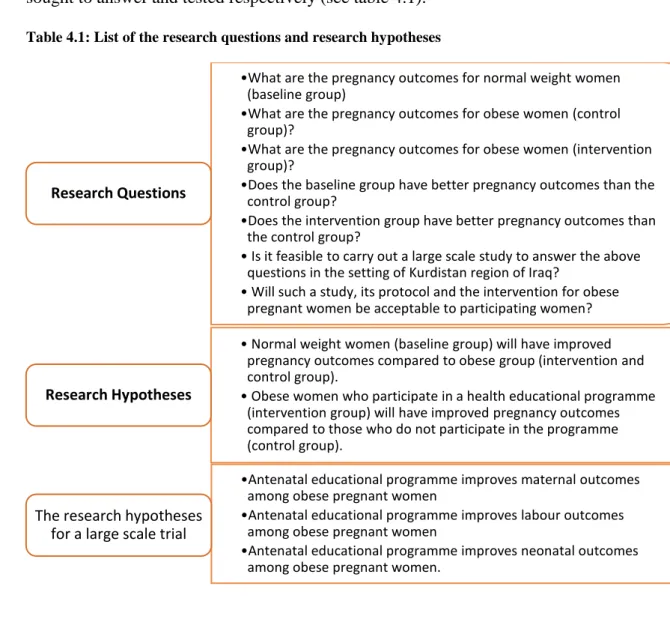
4.1 List of the research questions and research hypotheses 177
4.2 Assumptions of normality 178
4.3 Sociodemographic information of women of the study sample 179 4.4 Attendance rate among women in the intervention group of the study 182 4.5 Number of sessions which were attended by women 182
4.6 Pregnancy outcomes among study groups 184
4.7Pearson Correlation coefficient between women attendance rate to the educational programme and pregnancy outcome.
191
4.8 Mean and SD of women’s self- evaluation to the programme and pregnancy outcomes
194 4.9 Themes and sub themes of the experiences of women who participated in the
focus group and telephone interviews
200
LIST OF FIGURES
2.1 Literature search method 70
4.1 Frequencies of sessions attended by women 184
LIST OF DIAGRAMS
3.1 Framework research 87
3.2 The Multi method mixed method design of the study 105
3.3 Recruitment of the groups of the study 156
3.4 Data collection process and women eligibility to the study 158
4.1 Women attending sixth session (postnatal union) and focus group
discussions
LIST OF APPENDICES
-I- Poster
………...Error!
Bookmark not defined.48
1.2 Health facilities in Erbil governorate ... Error! Bookmark not defined.
1.2 Health facilities in Erbil governorate ... Error! Bookmark not defined.
1.3 Apgar score ... Error! Bookmark not defined.
2.1 Guidelines for critiquing research study Adapted from Coughlan et al (2007) . Error! Bookmark not defined.
2.2 Data extraction format ... Error! Bookmark not defined.
2.3 Included studies ... Error! Bookmark not defined.
3.1 Educational programme ... Error! Bookmark not defined.
3.2 Post amd post Study questionnaire ... 415
3.3 Likert Type Scale ... 416
3.4 Topic guide and invitation... 417
3.5Ethical approvals De Montfort University ... 419
3.6 Ethical approval Hawler Medical University ... 425
3.8 Information sheets for obese women and normal weight women... 426
3.9 Consent form for obese, control and baseline groups ... 433
3.10 Focus group transcripts ... 439
4.1 Codes of qualitative data………...………...…452 4.2- Characteristics of focus groups ... Error! Bookmark not defined.61
GLOSSARY OF TERMS USED IN THE THESIS
Alternative hypothesis (H1): is the hypothesis used in hypothesis testing that is
contrary to the null hypothesis. It is usually taken to be that the observations are the result of a real effect (with some amount of chance variation superposed).
Apgar score: A number arrived at birth by scoring the heart rate, respiratory effort,
muscle tone, skin colour and response to stimuli. Each of these objective signs can receive 0, 1 or 2 points. A perfect Apgar score of 10 means an infant is in the best possible condition. An infant with an Apgar score of 0-7 requires assessment and initiation of resuscitation.
Body Mass Index (BMI): The body weight of an individual in kilograms divided by their height in meters squared. A BMI below 18.5 is categorized as underweight, a BMI of 18.5-24.9 as normal/healthy weight, a BMI of 25-29.9 as overweight and a BMI of 30 and above is obese
Caesarean Section: Surgical incision into the abdominal and uterine wall to achieve delivery of the baby
Deep vein Thrombosis: A condition in which a blood clot form in the muscle of the leg, usually in the calf
Dystocia: Failure of labour to progress or obstructed labour, when, even though the uterus is contracting normally, the baby does not exit the pelvis during childbirth due to being physically blocked.
Fetal distress: Commonly used to describe fetal hypoxia (low oxygen levels in the fetus),
the concern with fetal hypoxia is it may result in fetal damage or death if not reversed or if the foetus is not promptly delivered
Gestational Age: Is a measure of pregnancy or age of a fetus or new-born in weeks,
measured from the first day of the woman`s last menstrual cycle to the date of birth of baby.
Gestational Diabetes Mellitus: Is defined as glucose intolerance that was not present or recognized prior to pregnancy.
Intrauterine growth retardation: The growth of the fetus is abnormally slow, or there is no growth. Intrauterine growth restriction is associated with increased risk of Medical illness and death in the new-born. Intrauterine growth restriction is also referred to as intrauterine growth retardation
Macrosomia: Defined as birth of baby with weight greater than 4000g.
Multipara: A woman who has had two or more pregnancies resulting in a viable baby
or stillbirth
Nominal data: is one that has two or more categories, but there is no intrinsic ordering to the categories. For example, gender is a categorical variable having two categories (male and female) and there is no intrinsic ordering to the categories.
Normal weight women: Women with BMI between 18.5-24.9 kg/m2 during pregnancy
Null hypothesis (H0): Is the hypothesis that there is no significant difference between
specified populations, any observed difference being due to sampling or experimental error.
Obese women: Women with BMI more or equal to 30kg/m2 during pregnancy
Ordinal data: is a statistical data type consisting of numerical scores that exist on an
ordinal scale, i.e. an arbitrary numerical scale where the exact numerical quantity of a particular value has no significance beyond its ability to establish a ranking over a set
Parity: The classification of women according to the number of times they have given
birth to a baby of more than 24 weeks` gestation
Pre- eclampsia: Is new hypertension presenting after 20 weeks with significant proteinuria.
Pregnancy: the period between 37 weeks and 38 weeks, six days of gestation is
considered "early term." Thirty-nine weeks to 40 weeks, six days is considered "full term"; between 41 weeks 0 days and 41 weeks, six days is "late term"; and 42 weeks and beyond is considered "postterm.Pregnancy induced hypertension: Can be defined as a condition where a woman`s blood pressure is 140/90 mm Hg or greater, after 20 weeks of pregnancy depending on measuring it in two different occasions which 4-6 hours a part
Preterm birth: Delivery of a live born infant before 37 weeks gestation.
Parity: this is defined as the number of times that a woman has given birth to a fetus
with a gestational age of 24 weeks or more, regardless of whether the child was born alive or was stillborn.
Singleton pregnancy: A pregnancy with only one fetus
Stillbirth: Delivery of a fetus showing no signs of life at 24 or more completed weeks of
gestation
Twin pregnancy: A pregnancy in which two embryos develop in the uterus at the same
LIST OF ABBREVIATIONS
Abbreviations Stand for
% Percentage
BMI Body Mass Index
CEMACH Confidential Enquiries into Maternal and Child Health
CMACE Centre for Maternal and Child Enquiries
CS Caesarean Section
CT Computed Tomography
CVI Cerebral Vascular Disease
DVT Deep Vein Thrombosis
F Frequency
FGM Female Genital Mutilation
GBV Gender-based violence
GDM Gestational Diabetes Mellitus
GMU Growth Monitoring Unit
GP General Practitioners
GWG Gestational Weight Gain
HCPs Health Care Practitioners
HS Highly Significant
ICU Intensive Care Unit
IHD Ischemic Heart Disease
IOL Induction of labor
IOM Institute of Medicine
LBW Low Birth Weight
LGA Large for Gestational Age
LMP Last Menstrual Period
Max Maximum
MCHC Maternal and Child Health Centre
MIN Minimum
MOH Ministry of Health
MRI Magnetic Resonance Imaging
N Number
NA Not available
NHS National Health Services
NICE National Institute for Health and Care Excellence
NICU Neonatal intensive Care Unit
NOO National Obesity Observatory
NS Not Significant
NTDs Neonatal Neural Tube Defect
P value Probability value
PHC Primary health Centre
PIH Pregnancy Induced Hypertension
PPH Post- partum Hemorrhage
QUAL Qualitative
QUAN Quantitative
RCOG Royal College of Obstetrics and Gynecology
RCT Randomized Controlled Trial
S Significant
SAT Subcutaneous Adipose Tissues (SAT)
SD Standard Deviation
SES Socio-Economic Status
SLT Social Learning Theory
SPSS Statistical Package for the Social Sciences
UK United Kingdome
UIS UNSECO Institute for Statistics
UNFPA United Nations Population Fund
UNICEF United Nations Children's Fund
USA United States of America
VAT Visceral Adipose Tissues
Vs. Versus
WC Waist Circumference
WHO World Health Organization
CHAPTER ONE: INTRODUCTION
1.1 General Introduction
Obesity is defined as an excessive and abnormal body fat accumulation with a body mass index of ≥ 30 kg/m2 (WHO, 2013; NOO, 2009). It has been recognised as a significant and global public health challenge (Herington et al, 2014; Heslehurst et al., 2011;
Caballero, 2007). Globally, the rate of obesity has increased steadily in both developed and emerging countries over the past several decades with little signs of slowing down. According to Nguyen and Lau (2012, p 327), over 1.5 billion people worldwide are overweight or obese and over 40 million children under the age of 5 are overweight. In the United Kingdom for example, two thirds of adults and one third of children were considered either obese or overweight in 2008, with an estimation of 9/10 adults and 2/3 children being obese or overweight by 2050 (Aylott et al., 2008).
Evidence shows that obesity during pregnancy has become a major public health problem in both developed and developing countries (Nascimento et al., 2011; NOO, 2009;
Caballero, 2007). The World Health Organisation (WHO) reported that the prevalence of obesity (BMI ≥30) amongst women during childbearing, ranges from 1.8 to 25.3% (Natalia and Dimitrios, 2010; WHO, 2006). An example can be drawn from the study of Kanagalingam et al. (2005) which reported an increase in the prevalence of obesity in pregnancies in England. Also, Morgan et al. (2014) stated that one in five women in England are categorised as obese during pregnancy. In addition, the NHS (2016) published recent statistics in UK indicating that 20% of the pregnant women who registered their first trimester were obese (Body Mass Index of 30 or above). While statistics are available in developed countries such as the UK, there is a significant lack
of data in emerging countries such as the Kurdistan region of Iraq. However, one study carried out in Baghdad in 2007 illustrated that 25% of non-pregnant women aged18 and above, were obese (Al-Tawil et al., 2007).
Obesity in the reproductive period is linked to a wide range of adverse outcomes for both mother and baby such as gestational diabetes mellitus (GDM) (Cordero et al., 2014; Moses et al., 2014), pregnancy induced hypertension (PIH) and pre-eclampsia (Bisson et al., 2014; Dodd et al., 2014; Scott- Pillai et al., 2013), the need for induction of labour IOL (Guelinckx et al., 2010), preterm birth (Althuizen et al., 2013; Phelan et al., 2011), Caesarean section (CS) (Hui et al., 2014; Ruiz et al., 2013), macrosomia ( Cordero et al., 2014; Moses et al., 2014; Hui et al., 2014; Murtezani et al., 2014; Scott- Pillai et al., 2013) and admission of new-born to Neonatal Intensive Care Unit (NICU) (Vinter et al., 2011). Obesity during pregnancy has been identified as the most frequently occurring risk factor in maternity care (Nagle et al., 2011). It is crucial for women to be aware of the risk of maternal and foetal complications associated with obesity. Such awareness can be achieved by providing concrete and standardised health education prior to the pregnancy (CMACE/RCOG, 2010), for instance, this is implemented in the UK health system. Currently, there is inadequate evidence indicating how such adverse events can be minimised through specific interventions for women who are obese during pregnancy (Campbell et al., 2011, Heslehurst et al., 2011). Some research studies suggest that lifestyle changes, diet plans and physical activity programmes should be recommended as they show substantial effect in reducing the risk associated with obesity such as gestational diabetes, pre-eclampsia and low birth weight (Harrison et al., 2011, Moholdt et al., 2011).
Unlike developed nations where substantial data has been collected on obesity and its adverse effect during pregnancy, there is very limited data available in the Kurdistan region of Iraq. Mirkhan et al. (2012) found that 29% of women were obese during pregnancy in a health centre in Erbil, the capital city of Kurdistan region of Iraq (Mirkhan et al., 2012). More so, neonatal death rate recorded by World Bank (2015) for Iraq was reported to be 18.4 deaths for every 1000 births, with obesity during pregnancy being one of the leading risk factors, suggesting that the mother`s lifestyle is a significant factor for a survival of the baby (Vinter et al., 2011; Leddy et al., 2008).
Factors resulting in adverse pregnancy outcomes are well-documented in the academic literature on pregnancy and obesity, and a review of possible interventions showed that educational interventions on diet and exercise decreased negative pregnancy outcomes (Knight and Foster, 2017). Interventions studied in the literature will be discussed in detail in subsequent sections.
This PhD-project is a feasibility study that serves as a pilot for the implementation of an educational programme to improve pregnancy outcomes among obese pregnant women in the Kurdistan region of Iraq. This study is to evaluate an educational programme. Kurdistan is a patriarchal society where women are still viewed as their father`s or husband`s properties (Mustafa, 2014; Hardi, 2005), thus they are consumed by their role as care takers to their immediate and extended family. Women in this region are mostly house wives and experience cultural, socioeconomic and family oppression which can put them at risk of unhealthy behaviour during pregnancy, especially those who are less educated. Therefore, there is a need to pilot an interventional education programme which informs women about a healthy lifestyle during pregnancy to assess its feasibility in improving pregnancy outcomes.
1.2 Justifications for undertaking this study:
In 2011, UNICEF reported that maternal mortality in Iraq was 51: 100,000 and the Kurdistan region was included in this rating (UNICEF, 2013). In addition, WHO also reported that the maternal mortality rate in Iraq fell by 29%, from 89 women in 1990 to 63 in 2010 which was suggested to be the direct effect of improvement in the quality of health services provided to mothers, thus decreasing the rate of maternal mortality. The 29% decrease in mortality rate is a head start and may be improved via educational intervention, as recommended by World Bank (2015) and WHO (2013). Maternal and neonatal deaths could be reduced by delivering an early effective intervention during pregnancy (Ray 2004 cited in Lassi et al., 2010). A review conducted by Lassi et al., (2010) suggested the use of community-based intervention packages to reduce both maternal and neonatal morbidity and mortality. This was supported by the study of Mehta et al., (2011), who also suggested the use of targeted interventions to improve pregnancy outcomes (Mehta et al., 2011).
A body of evidence proposed that health education provided to mothers either in their home, primary health centres or hospitals has a significant impact on maternal and neonatal outcomes such as birth weight, pregnancy induced hypertension and gestational diabetes (Vinter et al., 2011; Quinlivan et al., 2011; Thaver et al., 2009). Hence, they should be provided with information and support about appropriate diet and exercise (Furber and McGowan, 2011; Nitert et al., 2011). Furthermore, a guideline by the National Institute for Health and Clinical Excellence (NICE, 2010) recommended the adoption of a balanced and healthy diet instead of dieting during pregnancy to prevent excessive weight gain during pregnancy (Tanentsapf et al., 2011; NICE, 2010). Various research reported the lack of a clear pathway to sensitively raise the issue and offer
appropriate support as factors that serve as barriers to tackling obesity during pregnancy (Oteng-Ntim et al., 2012; Campbell et al., 2011; Bell et al., 2007). One example is the randomised control trial study conducted on obese pregnant women at antenatal clinics in the United Kingdom (Thangaratinam et al., 2012). This study involved two groups of behavioural intervention and standard antenatal care and aimed to assess gestational diabetes and large-for-gestational-age infants. However, no differences were reported between the study groups. Thus, prevention of gestational diabetes and reduction in the incidence of large-for-gestational-age infants will require designed strategies involving other factors than diet and physical activity (Thangaratinam et al., 2012). Furthermore, a systemic review conducted by Muktabhant et al. (2015) concluded that excessive weight gain during pregnancy could be reduced through diet and physical exercise intervention. Campbell et al. (2009) argue that the evidence on the effectiveness of weight intervention programmes in pregnancy is inconsistent and inconclusive. Meanwhile, the LiP study conducted by Vinter et al. (2011) reported that obstetric outcomes between intervention group and control group was statistically insignificant. However, lifestyle intervention led to a higher adherence to the recommended gestational weight gain by the Institute of Medicine. Another significant observational finding was that the average birth weight was 150g higher in the intervention group than in the control group. This was attributed to the effect of physical exercise and activities on placental development (Vinter et al., 2011). This study surpassed that of Thangaratinam et al. (2011) due to the inclusion of an educational package involving personal coaching and dietary guidance in the lifestyle intervention.
Although, Nitert et al. (2011) stated that there is limited evidence regarding the design of effective intervention programmes (effective nutritional and physical activity) and best
practices for managing obese pregnant women, some recommendations include promoting regular exercise and healthy diet in future education programmes (Saskatchewan Preventive Institute, 2010). The findings of Vinter et al. (2011) suggested that including educational strategies as intervention factors could make a difference, and if findings are not statistically significant, observations between study groups should be critically analysed.
In the Kurdistan region, where the researcher originates and has experience of working as a clinical instructor at a maternal health centre in the region for last ten years, she found that the idea of a health education programme for obese pregnant women is a new concept and needs to be explored, designed and developed. Introducing an education programme which aims to control excess weight gain and raise awareness of the risks obese women encounter, could allow women to self-monitor and self-refer to health care services appropriately. An education programme could be integrated with the current health care provision in the region to enhance all women`s health status during pregnancy, especially those who are obese. In conclusion, the need for community and individual lifestyle intervention studies for weight management among obese pregnant women, were recommended by several studies (Muktabhant et al., 2015; Vinter et al., 2011; Smith et al., 2008; Krishnamoorthy et al., 2006).
1.3 Personal motivation for undertaking this thesis
In 2005, I became a clinical instructor in a Maternity Teaching Hospital and a number of health centres in Erbil (a city in the Kurdistan region of Iraq). I taught nursing undergraduate students in care provision in the delivery room and the antenatal care unit. As a clinical instructor in delivery rooms, and antenatal health care centre, I realised that there was an insufficient focus on health education. I observed that pregnant women used
health centres as a place to acquire treatment and immunisation, rather than receiving health education about their conditions and needs.
During my master’s degree (2008-2010), I had the opportunity to deliver some educational sessions about minor discomfort and nutrition during pregnancy, discussing the relevance of education and women's health. This opportunity gave birth to a dream of educating women on health and its impact on pregnancy. At the end of that study, I realised that women in Kurdistan have little or no knowledge about health education. Most women in this region acquire knowledge from their relatives and friends, most of which is inaccurate. In 2011, I was awarded a grant from the Kurdistan Regional Government in Iraq to undertake a doctorate study to focus on creating an intervention programme for pregnant women. Overall, I wished to acquire relevant knowledge in this field to use it in promoting health quality in my country. To achieve this, I reviewed published literature on the topic of health education for pregnant women and its outcomes and deduced from the literature that educational programmes may have a positive effect on the pregnancy experience and outcomes of pregnant women. I also attended several antenatal educational sessions for obese pregnant women which were run by midwives at the Leicester Royal Infirmary Hospital in UK in order to observe, learn and find a way to merge the knowledge I acquired into the Kurdish culture.
1.4 Study area
This section introduces some of the characteristics of the Kurdistan region of Iraq, focusing on its geography, demography, language, religion and political issues. It also provides an overview of the culture and social context and health services in which the study was conducted.
1.4.1 Kurdistan; geographic and demographic features
The intention of this section is to present contextual information on an overview of Kurdistan, geographic features, the population, Kurdish language, and religion. It will provide the reader with an understanding of Kurdish family structure, culture, marriage, and socio-demographic characteristics. Finally, a description of the health system and health facilities available in the region will be provided.
Iraqi Kurdistan, also named South Kurdistan, is a region located in the North of Iraq, bordering Turkey in the North, Iran in the East, Syria in the West and Iraq in the South (see Fig. 1). Erbil (also called Hawler) is the capital of Iraqi Kurdistan. The region is autonomous and governed by the Kurdistan regional government. The population of Kurdistan is approximately 5.2 million. It presently consists of four governorates (Erbil, Sulamaniya, Dohuk and Halabja). The population of Erbil at present is 1.9 million and according to statistical data provided by the directorate of the Erbil Census and Data Analysis, there are slightly more males than females in the province; Erbil’s population has grown by 2.9 percent annually (Erbil Governorate, 2012).
1.4.2 Kurds history
The term Kurd is defined by Asatrian (2009) as an ethnonym, a term traditionally applied to an ethnic conglomeration whose various parts reside in the bordering areas of several Eastern countries (Asatrian, 2009). Until the First World War, most of the Kurdistan area was governed by the Osmania people, and according to the treaty of 1920, the Kurdistan area was granted autonomous status. However, Turkey did not respect this treaty. The treaty of Lausanne further divided the Kurdish area in 1923, where a decision by both Britain and France endowed Northern Kurdistan to Turkey, the Southern part remaining with Iraq and Syria, and the western part belonging to Iran (Mustafa, 2014).
Presently, most Kurds live in Turkey, Iraq, Iran, and Syria with an approximate population of 8 million, 5 million, 6 million and 4 million, respectively. They also live in European countries, the USA and Israel (Asatrian, 2009 p.2). Therefore, Kurdish people are recognised as the only nationals in the Middle East without a country.
The history of the Kurdish people revolves around invasion and war due to the richness in its natural resources such as the vegetation, beautiful scenery, mineral resources, and most importantly crude oil. For this reason, Kurdish people have witnessed war in different forms; some of the effects are still part of their life. For example, the impact of the Halabja chemical attack left women with challenges during pregnancy and congenital abnormalities among new-borns (Fatehi, 2012).
1.4.3 Kurdish language
Kurdish is regarded as one of the Indo-European languages in the Iranian family of languages, similar to Persian (Iranian language). Kurdish has also borrowed many Arabic words (Mustafa, 2014; Zaken, 2007). There are two Kurdish dialects, Kurmanji and Sorani, each with sub dialectics. The former is used by the Kurdistan of Turkey and Syria
and the latter by Kurdish people in Iraq and Iran (Asatrian, 2009 p.2). However, the Kurdish language employs different rules of language structure than other Indo-European languages, where the tenses are a product of verbs conjugated by endings indicating such tense. The people are mostly bilingual or multilingual, speaking the language of their respective nation of origin, such as Arabic, Turkish or Persian as a second language alongside their first language (Kurdish). Traditionally, Kurds did not use surnames, but nowadays most use a tribal title or their geographical location as a modern surname (Saarinen, 2013). An example could be drawn from the people residing in Barzan, a part of Iraqi Kurdistan which is the place of origin of the current president (Massoud Barzani) (Mustafa, 2014)
1.4.4 Kurdish religion
Kurds are followers of numerous religions and faiths, such as Islam, Ahl-I Haqq (Yarsan), Yazidism and Christianity. Nowadays, most Kurds are Sunni Muslim, belonging to the Shafi School. There are also Kurds who are Shia Muslim, being the minority. At first, the Kurds resisted the Islamic invasion during the seventh century AD. They gave in after the Islamic victory near the modern-day Iraqi city of Sulamaniya in AD 643. Yazidism is a small religion that combines aspects of Islam, Judaism, and Christianity (Asatrian, 2009). In general, the Kurds are moderate and religiously tolerant. For example, fasting, which belongs to Islam, connects the Kurds, but the length varies according to the religious conviction (Saarinen, 2013, p 3).
1.4.5 Kurdish clothes
Clothes used by Kurdish women are mostly loose. Kurdish women are not veiled except during parts of the marriage ceremony where they completely cover their elbows and
knees. However, they are not allowed to wear revealing clothes, even without a headscarf. Not abiding by this requirement is considered an issue of family honour (Mustafa, 2014). Traditionally, Kurdish women wear colourful skirts and blouses. Men wear baggy colourful trousers with a plain fully sleeves shirt, which are tied at the elbow. Bright-coloured vests and sashes (often red) are worn over the shirt. A man can wear a silk blue turban on his head, and often complete his costume with a dagger worn at the waist. Kurdish men usually shave their heads and wear long moustaches and women wear bright, colourful and heavily embroidered clothing. The traditional Kurdish shoe, the
klash, is a soft crocheted mocassin with a flexible sole (Hassanpour, 2001).The use of traditional attires is becoming rare among Kurds. Kurds generally dress like the people of the countries where they live. In Iran, women must wear a cloth covering their hair and body. In Turkey, on the other hand, the government has banned women from covering their hair in universities and public jobs; they are required to wear more Western-style clothing. In Iraq, men wear woollen coats and vests, checkered head-scarves, and baggy trousers. Women wear Muslim-style dress, often with baggy trousers underneath (John and Morris, 1992).
1.4.6 Kurdish culture and family structure
The basic principle of Kurdish culture is hospitality. The Kurds are a very welcoming and friendly people. They embrace both genders mixing and gathering during traditional celebrations such as engagements, marriages, religious festivals and Newroz (Kurdish new year celebrated every 21st March of the year), in contrast with Arab culture, where men and women are separated especially during meals (Muhamad, 2013). Kurds have respect for each other and the young ones start taking up responsibilities such as small chores at an early age (Hardi, 2005). It is customary to highly value the decision of the
elder and in a situation where there is no qualified male to take the role of a leader, an elderly woman will take up the role. This also happens in Indian culture (Ewars, 1997). Historically, Kurds are tribal individuals and tribal traditions continue to affect their daily experiences, as well as nontribal Kurds, who live in both rural and urban areas. According to tribal ideology, there are different family ties where families are closer to their first cousins than the second cousins. When conflict breaks out, they unite to face the opposing group. However, families and their first cousins can unite against their second cousins and distant relatives. And when there is conflict between a family and first cousins, nobody nor any other group interferes. Kurdish kinship happens in two ways: through blood or through marriage, which is also seen in Arab culture (Mustafa, 2014). A Kurdish family can be regarded as an extended family which includes many generations under an umbrella and there is a strong relationship between family members (Saarinen, 2013). Children learn how to respect their elders at home and they are expected to be obedient and submissive. Traditionally, they do not contest the decisions of their parents. A strong relationship between sisters and brothers can be noticed, even after marriage.
Every birth in a Kurdish family is recognised with joy and breastfeeding continues until the baby is two years old. In rural households, mothers do not discipline their children in the presence of their in-laws. Boys are circumcised between the ages of six and ten. Kurds select a family from their neighbours who will comfort the young boy during his circumcision, with the hope that the two families will have a lifelong relationship. As regards female circumcision, in 2010, WADI published a study on Female Genital Mutilation (FGM) in the Kurdish region of Iraq, which found that 72.2% of women and girls were circumcised. In 2016, UNICEF report mentioned Iraq as one of the 30
countries practising FGM. The practice of FGM was shown to be high in Kurdish region of Iraq with a percentage of 51%-80% (UNICEF, 2016).
1.4.7 Kurdish culture and Marriage
Traditionally, women were treated as property and marriage was used as means of business, using women as collateral, security, bond, or pledge (Mustafa, 2014; Hassanpour, 2001). In the past, women in Kurdish society did not have land of their own so marriage was the only way for them to be supported and as such were completely dependent on marriage. A woman begets respect and is treated as an adult by the community after marriage and her social, economic and sexual potential transfers from her family to her husband’s family, a common practise in most Pakistani culture (Ali et al, 2011). Sex in the Kurdish traditional view is not allowed before marriage and a couple cannot live together before marriage. Furthermore, most marriages are pre-arranged mostly by the tribal head, even before the birth of the child, particularly among people living in rural areas (Begikhani et al., 2010). Individuals are also forbidden to marry non-Kurds or someone outside of their tribe (Saarinen, 2013). In some cases, marriage can be postponed for girls due to a shortage of labour in the family. Generally, Kurdish women marry at a young age (before the age of 20 years), based on a belief that they will become settled and the family honour protected. A 2011 survey, conducted by Al Alak et al. (2012) in the Kurdistan region, showed that around 10% of women between the age of 15-19 years are married, although, this percentile did not cover non-registered marriages, which occur frequently in this region. There are different types of marriages within Kurdish culture, the majority have arranged marriages. First of all, when women are kidnapped or unmarried girls taken by force (planned in advance between families), which is a common practise in this culture, the kidnapper will have to give his sister or
cousin to the kidnapped girl’s family in order to recover from social and economic damage which mostly has to do with the family honour. Secondly, marriage exchange is also a very common traditional practice among Kurds. For example, the head of a family gives his daughter to another family head. Another instance is the circle marriage, where family A give their daughters to family B and family B have to give their daughters to family C, and finally family C have to complete the circle to give their daughters to family A. Alternatively, sisters can be exchanged in the circle marriage. These forms of marriage have nothing to do with religion, but form part of the culture where women are use as unemotional objects of transaction. These forms of marriage can be seen among Australian Aborigines and American Subarctic peoples (Evans, 2015). Thirdly, a divorced or widowed woman does not have another option but to marry a married man as a second or third wife. In this case, the husbands are mostly wealthy men, as it is expensive to raise more than one family. In addition, men in this region are not allowed to raise someone else`s children, so most widows remain unmarried or marry the brother of their deceased husband as his first, second, third or fourth wife so as to take care of the children and property. As for a widowed man, he can marry his wife's younger sister in order to guarantee the wellbeing of children and ensure that the inheritance of land stay within the family. Lastly, infertile women usually face ridicule and in most cases are divorced or their husbands marry more wives, because large families are very important for Kurds. However, for infertile men, the women have to stay with him for their entire life. These events highlight certain aspects of Kurdish family traditions. Nowadays, the Kurdish people can choose their partner, but arranged marriage is still common practise in rural areas (Saarinen, 2013; Begikhani et al., 2010). All the above-mentioned forms of
marriage are also reported as common practise in most Islamic communities such as Pakistan and Arabic speaker’s communities (Mustafa, 2014).
Regarding marriage patterns, the groom has to pay an amount of money to the bride`s father. This system is called next in Kurdish, meaning “bride price”. The money is given to the bride`s family for jewellery, the wedding ceremony, a rifle, a revolver, household goods, electronic equipment, and hoofed animals. Sometimes, the bride`s family uses the bride price to get brides for their sons. In addition, the groom has to cover the expenditure of renovating the bride and groom living room/quarters or building a new home. The “bride price” varies according to the groom`s family socioeconomic status and who the groom is marrying. For example, the sum paid is larger if the groom is an old widower or the girl is a second or third wife.
A couple in love cannot marry each other unless their families agree. As a result, some girls, especially in urban areas, threaten their parents that they will elope with their lover. However, eloping and kidnapping may have far more serious consequences. It may result in inter-lineage and intertribal feuds, since it is believed that the woman's honour is stained; she is no longer considered a virgin, and cannot be returned to her family (Mustafa, 2014; Hardi, 2005).
In Kurd tradition, blood feuds are intertribal affairs. When a Kurd is murdered by someone from another tribe, not only does the lineage of the dead man, but the whole tribe comes together for an extra-juridical form of punishment, usually provoking countermeasures that lead to escalated tribal warfare. Settlement between the tribes can be a lengthy process and is pursued until an agreement is reached about the payment of
bezh, blood money, to the relatives of the victim. Blood feuds are more widespread in the Kurdistan region of Turkey than in other parts of Kurdistan, and such incidents decrease as the power of tribal leaders decline (Ahmetbeyzade, 2000).
1.4.8 Women position in Kurdish Society and honour of Family
Kurdish women are still used to resolve conflict between two tribes. The most important role of women within this society is to look after children, undertake household chores, always stay at home and always has to be accompanied by immediate relatives when running errands or attending events. In some homes, women are expected to eat after men, and their sitting quarter is separated from that of the men (Salim, 2003). Many women`s noses were cut by their family as a punishment for mingling or associating with other men (who are not their relatives). In addition, the murder of a female family member typically happens when a woman is accused of having a sexual relationship with a man other than her husband. There have also been cases of women being killed simply for falling in love, and this phenomenon still occurs even among the present Kurdish diaspora. In Kurdistan, mobile phones and the internet have widened the opportunity for social interaction between young men and women, beyond the censorious eyes of male relatives. But the government’s best achievement was to amend the law that previously either let off perpetrators of honour killings, or handed down light sentences. The new law, which was approved in 2008, regards honour killing as murder though implementing the law remains a challenge due to a lack of law enforcement in the region. Sometimes a woman gets killed and no one is arrested to account for it (Neurink, 2014). Pakhshan Zangana, the leader of a new council that aim to improve the lives of women, announced by the government on 25th November (2012), states that honour killing is a cultural issue
that cannot be solved overnight and will only be resolved when the people`s understanding of the concept of honour changes (Neurink, 2014).
1.4.9 Kurdish Women political changes
The politics and economy of both Iraq and the Kurdistan Region have affected a number of changes in both the status of Kurdish women and the demands made of them over the last 50 years. From the 1970s, as the economic stability of Iraq improved, so did the role and position of women, especially in the Kurdistan region due to rural-urban migration to seek employment.
The country`s industrial sector developed in urban areas and urbanisation and lifestyle changes occurred as a result. Urbanisation had a key impact on the current status of women in Kurdish society, providing them with jobs in various industrial sectors such as knitting, sewing, chicken farming, hospitals, education and governmental organisations. Therefore, leading to changes and abolishment of some cultural norms, such as travelling alone without the company of immediate relatives (Mustafa, 2014).
Unfortunately, the political situation during the 1980s, during the war between Iraq and Iran, saw a change in women’s status. Kurdish (as well as Iraqi) women were asked by the Iraqi government to bear children and extra money was given to those families who produced more children. Family planning was prohibited. These issues led to most women leaving employment and staying at home. Moreover, most of the organisations where they were previously employed were closed resulting in loss of jobs. Futhermore, during this period, the government interrogated some women due to the connection between their male relatives and the people of the mountains. In the 1990s, when the economic sector of the Kurdistan region was performing poorly, most women started to
The traditional view and role of women in the Kurdish society was taken into consideration during the process of designing the intervention programme for this project.
1.4.10 Socio-demographic characteristic in Kurdistan
It is believed that education is one of the cornerstones for raising the status of an individual in his or her society (Boyden and Ryder, 1996). Data released by the UIS, showed a steady rise in literacy rates for adults and youth worldwide. Although the data indicates that young women (aged between15-24) are making the strongest gains, they are still behind young men. In 2011, 87% of young women had basic literacy skills, while the percentile reported for men was 92% (UNESCO Institute for Statistic, 2015). Overall, data provided showed that more than half of countries have youth literacy rates of 95% or higher. The literacy level is high in the Kurdistan region of Iraq but there is inequality between male and female, particularly with respect to access to education. A survey conducted by Sindi (2013) on the literacy rates in Kurdistan showed that 94.1% of male and 84.9% of female can read and write. In addition, the rate of illiteracy for children aged 12 or above is greater than 26.3%, Erbil 26.6%, Dohuk 30.7% and Sulamaniya 23.4%, with urban areas having better literacy rates compared to rural communities (23.8% and 38.4%).
According to Al Alak et al., (2012), the level of literacy among females increased from 64% in 2006 to 78% in 2011 (Al Alak et al., 2012). In 2000, a comprehensive survey done by the Kurdistan Ministry of Education with the help of an international organisation, which aimed to estimate the level of literacy, showed that out of 34% who were found to be illiterate, 60% of them were female (UNESCO, 2015). So women in Kurdistan are still struggling for equal access to education and equal status with men (Neurink, 2014). Inequality in education for women is also seen in neighbouring Arab
countries; Manasra (2003), highlighted that families preferred to educate their sons in areas of sciences such as medicine and engineering rather than their daughters, who were directed to study arts and social sciences (Manasra, 2003). The Kurdistan Ministry of education has attempted to decrease the level of illiteracy, by providing facilities to educate 340,000 people in the population. There are many reasons behind the level of illiteracy among Kurds and especially among women. Schools are not widely available and girls are often needed at home for household duties (Kurdistan Board of Investment, 2009). In addition, there are cultural views on women being indoors to protect family honour. Consequently, families do not send daughters and sisters to schools far away from home (Sindi, 2013). Educating women in this region is important to tackling this inequality; women need to be educated to have knowledge to improve their health. Table (1.1) Educational level among 12-29 years old in Kurdistan 2014 - 2015 (Sindi, 2013)
Area Illit er a te R ea d a nd w rit e P ri m a ry Int er me di a te Se co nda ry In sti tu te B Sc a nd A b ove Region 12.6 17.1 31.9 22.2 9.9 3.1 3.1 Erbil 14.2 15.2 29.7 23.9 10.1 2.8 4.2 Dohuk 17.8 16.3 31.7 18.3 9.2 3.6 3.2 Sulamaniya 7.7 19.3 33.8 23.4 10.4 3.1 2.2 According to Al Alak et al., (2012), in Kurdistan, the average study years in school is 7.8 years which is similar to Iraq. Erbil, Sulamaniya, and Dohuk having an estimate of 8 years, 8 years, and 7.8 years and 7.7 years, respectively. Also, the report from Ministry of Planning showed that, in the academic year 2014-2015 (Mop, 2015) 5,950 schools available in Kurdistan region were enrolled with 115547 teachers and 1,555,042 students. The rate of registration of students at primary schools was around 95.5% better than other
years old, while 90% of students were between 12-17 years old when they start to attend secondary school.
Sindi (2013) reported the statistics on poverty for Kurdistan and its neighbouring regions. In Kurdistan region, poverty was reported to decrease from 4.7% in 2007 to 3.5% in 2012, whereas, in Erbil the rate reported is 3.6%, 2% in Sulamaniya while around 5.8 % in Dohuk (see the following table) (Sindi, 2013).
Table (1.2) Percentage of poverty in Kurdistan region
Region Erbil Dohuk Sulamaniya Iraq
% poverty 3.5 3.6 5.8 2.0 18.9
Own house 74.1 75.4 71.0 74.2 70.9
Own car 49.8 55.4 51.6 44.9 31.7
1.4.11 Health sector in Kurdistan region of Iraq
Health care is provided by the ministry of health (MOH) in Kurdistan. This free service is responsible for rendering good quality care and ensuring the availability of health care to the Kurdish people. Historically, the formal health care system in Iraq began in the 1920s, but the Ministry of Health (MoH) in Iraq was established in 1952 and its organisational structure was formalised in 1959. This organisational structure has changed little since its establishment (WHO, 2004). The health care system in Iraq adopts a hospital-oriented and capital-intensive model that requires large-scale imports of medicines and medical equipment (Anthony et al., 2014; Alwan, 2004). In the 1970s and early 1980s, Iraq witnessed spectacular social and economic development leading to the development of an efficient health system that was considered one of the best in the Middle Eastern region. This period was associated with improvements in several critical health outcomes (Alwan, 2008; Al Shorbaji, 2006). “However, the capacity and
economic sanctions leading to a serious decline in indicators of population health outcome to levels comparable to some of the least developed countries” (Ali and Shah, 2000, p56). With its establishment in the early 1990s, the MoH of Iraqi Kurdistan Regional Government adopted the basic organisational structure and system of the Iraqi MoH. In the public sector, the health services are provided through a network of primary health care (PHC) centres and hospitals where services are provided at very low cost to all people with equal access for all. However, this led to overuse of health services and overcrowding of health facilities with some adverse effects (Alwan, 2004; Kreisel, 2001). The significant devastation of the health system in Kurdistan region of Iraq by the events of the last few decades together with latest demographic, political and economic evolutions, have made the necessity for adopting a new health care system increasingly recognised (Al Shorbaji, 2006). The health system needs to go through a process of continuous change and improvement in order to be able to cope with different changes in the health and population environments and to appropriately respond to different challenges and needs (Figueras and Saltman, 1998). (See appendix 1.1 & 1.2 Demographic statistics of Kurdistan region, health facilities in Erbil governorate and primary health care centres).
Health services in Iraq, particularly in Kurdistan, have faced persistent problems because of recurrent war and internal conflicts over the past two decades. Primary health care centres are continuously confronted with insufficient supplies, shortage in health care workers and lack of supporting services.
Iraq, including Kurdistan, is regarded as having the second highest fertility rate in the Arab world. The average fertility rate in the Kurdistan region is about 3.1 children per family. Sulamaniya has the smallest fertility rate at approximately 2.3 while Dohuk has
the greatest (3.9) (Whitcomb, 2014). There are 38 per 1000 teenage pregnancies among women in Kurdistan region, compared to the rest of Iraq, where 90 teenage pregnancies occur per 1000 births (Al Alak et al., 2012). 92% of women delivered their babies under the attendance of qualified nurses. In comparison to neighbouring countries, this is better than Egypt (79%) but less than Turkey’s (95%). In regards to family planning, 64% of women used family planning in 2011, which was better than Egypt and Turkey, also beating countries in western Asia, standing at 56% in 2010. Also the rate of children immunised in 2006 was about 47%, and that increased to about 64% in 2011. 7% of children from Kurdistan region were underweight when compared to other parts of Iraq which have a 5% underweight (Al Alak et al., 2012). A Survey conducted by UNICEF with the help of Kurdistan region statistics office (2011) reported that mortality rate in Kurdistan region was 32% of children under 5 years old, while in Iraq was 38% in 2011. In Iraq including Kurdistan region, mortality rate of new-borns is 27 per 1000 from 1990s, but the recent data estimate around 18 per 1000 in first 28 days of their life (Al Alak et al., 2012). That means 85% of children die within the first 28 days of their life, implying that Iraq including Kurdistan is still among those countries where the maternal and neonatal mortality is high. So offering women health education during pregnancy could be an important factor in helping to reduce this rate (Al Alak et al., 2012).
Health services, including maternal health services, have faced constant problems after wars and internal conflicts in the last decades. According to the UNFPA (2014), Iraq is included among 68 countries that have 97% of maternal deaths worldwide. This is related to inadequate birth practices, lack of emergency obstetric care and high prevalence of anaemia among pregnant women. In 2006, 60% of women delivered their babies at hospital but this number reached 76% in 2011 (UNCEF, 2011).
Most women in this region are mostly uneducated and unemployed, thus have poor economic status and experience more gender-based violence (GBV). Therefore, women are underrepresented in the higher levels of public sector and government, and participate in small numbers in the labour force (Salim, 2003). Women’s situation needs reforming and enhancing by educating women and informing them about their needs and health, especially during pregnancy. This can be achieved by providing antenatal care facilities and robust relevant information and services at this stage of their lives. Generally, antenatal care can be defined as care that is routinely offered to all pregnant women equally at primary care level from screening to the delivery of the baby (NHS, 2014). At this stage, pregnant women will receive support and information regarding issues relating to pregnancy, delivery and parenthood (Shabila et al., 2010). In addition, it is beneficial for early diagnoses of high-risk pregnancies and offering periodic assessment (NHS, 2014).
The strategies for antenatal care have improved over the last two decades in this region. Most care providers inform and sensitise pregnant women on various issues such as nutrition, signs of high risk pregnancy and its complications, immunisation during pregnancy, care of new-born, as well as family planning. The provision of antenatal care is relatively high in Erbil city with 84% of women receiving antenatal care at least once during pregnancy (DOH, 2012). Around 40% of women have four visits and about 80% of them sought antenatal care for the first time during first and second trimester (Al Alak et al., 2012). The problem in this region is not related to the number of visits, but the quality of services provided for pregnant women. There is no room for antenatal classes. Women use health centres for registering their pregnancies, immunisation, sometime taking blood pressure for those with history of hypertension and seeing physician for
referral to clinics for further investigation (urine and blood test). This is an opportunity for health care providers (HCPs), with the help of the health director to identify women at risk and provide information regarding health promotion.
As stated before, antenatal care has positively contributed to pregnancy outcomes. In this region research around pregnancy outcomes and their associated topics has not been done scientifically. Therefore, at the end of this study the researcher discusses the status of antenatal care and the issues around health education to participating women in this region.
1.4.12 Pregnant women within Kurdish society
Generally, in Kurdish society pregnancy is considered as a normal process and socially defined as a time to make the family bigger. The new baby is regarded as very important because it will play a vital role in providing support to the family in the future. In the Kurdish community, pregnant women continue with their normal household chores such as cleaning, cooking, and looking after their children and avoid work involving heavy lifting.
In the Kurdish social context, from the researcher`s experience as a woman from this region, big sized pregnant women, alternatively obese pregnant women, are recognised as “good mothers” who will have nice and healthy babies. Whereas lean and skinny pregnant women will have unhealthy small babies, which are traditionally called ‘cat`s babies’. Therefore, there is pressure on pregnant women to have more food than they necessarily need; the principle of “eating for two”. The inability of pregnant women to over-eat results in heavy scolding from family members. In addition, in this society, women are made to believe that obese mothers are more likely to have the ability to