The Comparative Effect, Page 1
The Comparative Effect on Business Creativity When Web
based Collaborative Learning vs. Traditional Lecturing Instruction
Kevin K.W. Cheng Kaohsiung Hospitality College ABSTRACT
The relative effectiveness of web-based collaborative learning instruction and traditional lecturing instruction were compared for business administration students in a technical school to determine the effects of business creativity on accounting courses. A pretest-posttest control group quasi-experimental design involving two classes was used. The experimental group students (n=54) received the cooperative learning instruction, and the control group students (n=55) received the traditional lecturing instruction. The “Business Creativity Scale (BCS)”, was used as the research instrument. A statistical analysis suggested students taught using the
web-based collaborative learning instruction scored significantly higher than students in the traditional lecturing group for business creativity. The research results showed web-based collaborative learning heightened the students’ business creativity, and web-based collaborative learning could serve as a suitable and worthwhile reference that schoolteachers could apply to their teaching instruction.
The Comparative Effect, Page 2
INTRODUCTION
In this fast-changing world, the prevalence of the Internet is increasing at rapid speed. Knowledge transmission is fast and boundless, and large economic benefits have been indirectly produced. Almost every nation in the world is well-prepared for this global trend (Zhao, 2001). Besides, the emergence of the Internet has intensified global competition, making business environments constantly vary. To retain business competitiveness, enterprises around the world are making efforts to create a human-based, knowledge-centered, and continuously innovative business structure, to cope with the challenges of the new era (Liu, Lai, Wang, & Chang, 2001). Therefore, appropriately applying the Internet to our education system is an important topic. Over the last few decades, talents cultivated under today’s educational system have made a great contribution to worldwide economic development. However, students have long been affected by the exams and enrollment systems, so inspiration or creativity have been overlooked (Ma, 2002). Thus, they have almost become “studying machines”. Under this adverse situation, how
creativity-deficient workers are able to retain their predecessors’ outstanding performance in this era of knowledge economy is worrying. As a result, heightening student’s creativity, to let them gain proper professional training, and preserve flexibility and creativity will be a trend in the current education reforms.
Huang & Lin (2000) pointed out teacher’s instructions can be delivered through 3 methods, including collaborative learning, competitive learning, and individual learning. In the past, teachers mainly used competitive learning and individual learning. Thus, students
prioritized their personal goals and viewed classmates as academic enemies. Interaction and mutual trust between peers was deficient, and the effectiveness of learning did not significantly improve. Fortunately, collaborative learning refers to joint construction of knowledge by a group of people having a joint commitment to a shared goal (Sharan, 1980; Bouton & Garth, 1983). Many studies have empirically proven collaborative learning can strengthen the effectiveness of learning (Sharan & Shachar, 1988; Roth & Roychoudhury, 1993; Johnson, Johnson, & Smith, 1995). Further, due to the advancement of computers and Internet technologies, more and more research supported the internet is a perfect medium to perform collaborative learning (Levin & Cohen, 1985; Davits, 1988; Bump, 1990; Din, 1991; Comeaux & Nixon, 2000; Rovai, 2001). That’s why this paper applied web-based collaborative learning to a technical school.
Accounting is one of the important core courses in business studies, so this study selects accounting as the research topic. Therefore, “creativity” examined by most of the previous studies will be replaced by “business creativity” to be the focus of this study. In business creativity, most of the existing studies focus on developing university education and seldom touch on technical school education. Then, this study focuses on technical school education to
The Comparative Effect, Page 3 develop a web-based collaborative learning model for technical school education. This model will be used to verify the effectiveness of teaching and understand whether students are well prepared with business creativity for future careers. This is the main motivation of this study.
LITERATURE REVIEW
i. Collaborative Learning
Piaget (1959) pointed out human’s cognitive development is determined by
environmental manipulation and active participation. He strongly proposed group work provides more cognitive benefits than individual work (Golbeck & Sinagra, 2000; Druyan, 2001). Nattiv (1994) pointed out collaborative learning is a teaching method which allows students to be "inter-dependent” in learning, working, and role-playing when they deal with a shared goal to accomplish their tasks. Slavin (1995) mentioned collaborative learning makes every learner exchange information and responsible for their learning in the activity that is carefully planned and designed, so they can further interact with other learners in the group and be motivated to promote their learning. It can be discovered that collaborative learning is a systematic and structured teaching strategy, which can improve the drawback of conventional competitive learning and individual learning methods where developing cooperative and social skills is usually neglected.
Collaborative learning has been rapidly developed since 1970s. According to the theory of collaborative learning, various teaching strategies have been developed. The major strategies include Student’s Team Achievement Division (STAD), Learning Together (L.T.),
Teams-Games-Tournament (TGT), and Group Investigation (G-I). Among these methods, STAD is mostly adopted. STAD was developed by Slavin in 1979. As the content, criteria, and appraisal methods are similar to those of conventional teaching methods, it can be easily implemented and extensively applied. The implementation effectiveness is also significant. Therefore, this method is also adopted in this study.
ii. Web-based collaborative learning
In recent years, because of the advancement of computers and Internet technologies, the virtual environment constructed on the Internet has allowed implementing collaborative learning to be no longer confined to traditional classrooms, making the application of technology
integrated instructions an unavoidable tendency. Through the abundance, flexibility, interactivity, and boundlessness of the Internet, the conventional linear and progressive learning method can be subverted. Students can only learn at their pace but also cross the boundaries of time and space to take part in group discussions (Chen, Mo, & Cheng, 2006). Thus, many scholars have
The Comparative Effect, Page 4 advocated the computer network as an ideal medium for performing collaborative learning (Levin & Cohen, 1985; Davits, 1988; Bump, 1990; Din, 1991; Comeaux & Nixon, 2000; Rovai, 2001). Web-based collaborative learning was innovated as a result. Tomlinson & Henderson (1995) pointed out when two or more than two learners use different computers under the support of an application system to perform information sharing and achieve the goal of
collaborative learning, this learning process can be considered collaborative learning. Web-based collaborative learning has become a hot topic in the learning area and a tendency in instructional design (Strijbos, Kirschner, & Martens, 2004; Weinberger & Fischer, 2005). It has been
empirically proved web-based collaborative learning can heighten the effectiveness of student’s learning (Koschmann, 1996; Wilson, 1996; Dillenbourg, 1999).
iii. Business Creativity
“Business Creativity” originated from Center for Creativity and Innovation Studies, National Cheng Chi University (http://www.ccis.nccu.edu.tw/CCIS%20Epaper/list, 2005). In early years, when cultivating creativity was mentioned, the focus was usually placed on
creativity in the industrial area. Cultivating creativity in the business area has been relatively less substantial and easily neglected. In fact, industrial activities and business activities coexist in human society. Thus, neither industrial creativity nor business creativity can be ignored in researching creativity. In a survey conducted by the National Youth Commission (2005), it was discovered a successful entrepreneurship requires not only creativity but also business
knowledge and core expertise. The survey further revealed most people considered marketing and financial management the most essential disciplines of knowledge for starting a business. It can be clearly seen cultivating “business creativity” is essential for students to enter occupational careers.
In 2001, Ministry of Education started to proactively develop teaching materials and methodologies for creativity education, in an attempt to improve Taiwanese student’s creativity. As well as the White Paper on Creativity Education, several related projects were also proposed, such as the teacher’s training program on creativity and creativity design, action research on creativity teachers, and research on creativity in students. However, in the aspect of business creativity, only developing higher education is stressed currently. In technical education, due to promoting an integrated curriculum, connecting vocational curriculum to the follow-up college curriculum has become a focus issue for scholars and teachers in the education field (Chen, Cheng, & Lai, 2006; Chen, Lai & Cheng, 2006). “Business Creativity” referred to in this study is mainly defined according to the categorization of Creativity Teaching Resource Center as
The Comparative Effect, Page 5
METHODOLOGY
i. Research Design
A pretest-posttest, control-group quasi-experimental design was conducted in the two classrooms. The participants in both the experimental (web-based collaborative learning instruction) and the comparison (traditional lecturing instruction) groups were pretested
immediately before the 10-week treatment. During the experimental period, each group received an equivalent amount of instructional time and was provided with the same textbook and similar materials. Besides, the teacher was also required to adopt relevant teaching resources introduced in both groups.
Because the purpose of this study was to examine whether web-based collaborative learning did or did not enhance the students’ business creativity. The participants in both the experimental and comparison groups were post-tested at the end following the experimental period.
The research design is shown in figure 1:
ii. Partici pants The particip ants in this researc h include d 109 Year 1 technical school students who attended two accounting classes in Taiwan. These students were typical of first-year students, with a mean age of 18 years. The same accounting teacher taught the two classes at this school. The basic information of the participants is shown in Table 1.
Table 1 Basic information of the participants
Experimental class Control class
Number of students 54 55
Grade Year 1 Year 1
Gender proportion 45 girls 9 boys
40 girls 15 boys Experimental group Q1 X Q2 Q1、Q3:(pre-test)
Q2、Q4:(post-test)
X:the experiment treatment ( lasted for 10-weeks) Control group
Q3 Q4
The Comparative Effect, Page 6 iii. Instructional Methods
The web-based collaborative learning was developed and used in this research according to the following five-stage methodology proposed by Slavin (1995) and Tomlinson & Henderson (1995), a method that included the following characteristics:
1. Class presentation:
According to the course’s learning objectives, the teacher lectured to the whole class or led them into discussion to let all the students grasp the important content and concepts of the course. 2. Grouping on the internet:
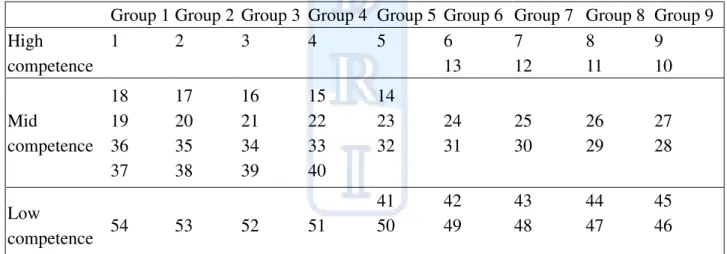
The teacher divided the students into different teams, based on their distinct qualities on the self-built internet. The terms “distinct qualities” means the students were divided according to their race, sex, learning achievements, etc (Slavin, 1995). In this experiment, the teacher placed the students into different teams according to their previous semester’s grades in an accounting course. According to the grades, the students were divided into “high competence”, “mid competence” and “low competence” groups, taking up proportions of 25%, 50%, and 25% respectively. Based on the ranking of students, the students were assigned to the groups, as shown in Table 2.
Table 2. The grouping of students in the experimental group
Group 1 Group 2 Group 3 Group 4 Group 5 Group 6 Group 7 Group 8 Group 9 High competence 1 2 3 4 5 6 13 7 12 8 11 9 10 Mid competence 18 19 36 37 17 20 35 38 16 21 34 39 15 22 33 40 14 23 32 24 31 25 30 26 29 27 28 Low competence 54 53 52 51 41 50 42 49 43 48 44 47 45 46 After the teacher lectured to the whole class and presented the teaching material, all the team members discussed, compared, and corrected the answers to the assignment (a cooperative learning sheet was used) on the internet, so they all could master the content of the unit. During the process of team learning, all team members should endeavor to help all other members and spare no efforts, so the whole team can be successful.
The Comparative Effect, Page 7 3. Quizzes:
After team learning, all the students were asked to take a quiz. The quiz was done individually, and help from team members was not allowed. Each student was responsible for his or her own learning.
4. Individual improvement:
Each student’s average score for previous quizzes served as the basic score. The score of the current quiz minus the basic score turned out to be the index of learning progress. All team members had to study hard to get a better accumulated score, which functioned as their greatest contribution to the whole team; that accumulated score of the team was calculated by adding the average of the total “accumulated scores” of all the team members.
5. Team recognition:
When the team’s score exceeded the agreed standard, members got rewards and public praise. As well as the public praise for the group, those who had made great progress were also rewarded and praised individually.
The traditional lecturing instruction for this research highlighted lectures given by the teacher, use of textbooks and other materials, and clear explanations of important content and concepts to students in the traditional classroom. In addition, class discussions between students and the teacher and among students after the course unit were incorporated into the teaching format. The key feature of this instruction was to provide students with clear instruction and explanations. iv. Basic information of the researchers and instructor
The participants in this experiment included researchers, an instructor, and research assistants. The tasks undertaken by each participant are explained in Table 3. The experimental group and control group were instructed by the same person, a female, 36 years old, having 12 years of experience in teaching accounting.
Table 3 Tasks undertaken by each participant in this research Participant Tasks undertaken
Researchers
1.Designing and planning of the experimental course 2.Designing and planning of the research
3.Responsible for preparation of facilities or materials required for the experimental teaching
4.Recording the teaching of the control group Instructor 1.Responsible for the teaching of the course
The Comparative Effect, Page 8 2.Participating in the designing and planning of the course
3.Regularly reporting teaching progress and review to the researcher v. Instrument
1. Webpage materials
In the experimental teaching, the appropriateness of materials is the most important feature. Therefore, the researcher invited six experts to evaluate the teaching materials and the designed activities according to 16 appraisal indicators in 3 constructs, including “content and structure of materials”, “design of interactions between the teacher and students”, and
“instructional design” (Chen, 2002). According to the opinions provided by each expert, the materials and the activities were properly adjusted and adapted to form the teaching plan for this research.
BUSINESS CREATIVITY SCALE
In this study, the “Business Creativity Scale” developed by Chen, Cheng & Lai (2006) was employed to evaluate the business creativity of the research participants.
(1) Compilation process
To measure the “business creativity” of students in the business administration cluster, document analysis, in-depth interview, focus group interview, and content analysis were applied to compile a “business creativity pretest scale”. This pretest scale included 52 question items for participants to answer according to their level of agreement. Likert’s 5-point scale was used. For each question, five choices were available, including 1-strongly disagree, 2-disagree, 3-fair, 4-agree, and 5-strongly agree. Lower points signaled more disagreement, while higher points pointed to more agreement. After the pretest scale was compiled, three experts in creativity were invited to review the scale. Based on the suggestions provided, the scale was modified to obtain expert validity. 160 copies of the pilot-test were distributed, and 147 copies were collected. The collected questionnaires were screened immediately to sort out those with incomplete or
consistent answers. At last, 122 valid responses were obtained, and the valid response rate was 76.25%. The result revealed the validity and reliability of the “Business Creativity Scale” were acceptable.
(2) Implementing the test and item selection
Based on the total number of students in business-related departments (commercial management, international trade, accounting, and data processing) of vocational schools released by Department of Statistics, Ministry of Education in 2005, random sampling was conducted on
The Comparative Effect, Page 9 students in equal proportions for gender, department, grade, and school attributes. 1420
questionnaires were distributed to students in 16 schools in Nov, 2006. In the first step, the researcher contacted the teachers of the surveyed class and explained the process of the survey on the phone. Later, formal questionnaires were mailed to the teachers with notes attached. The teachers were asked to select a class period to conduct the survey. 1303 questionnaires were returned. 1052 questionnaires were valid, making the valid response rate 74.08%. After valid responses were obtained, an item analysis was performed to select proper question items. The analysis showed all the 52 items were suitable.
In addition, through principle component analysis of factor analysis, factors with an eigenvalue larger than 1 and items with a factor loading larger than .5 were selected. Factor analysis was conducted four times. 26 items were deleted. Finally, five factors including
“intelligence”, “environment”, “motivation”, “characteristic”, and “attitude” were extracted, and the accumulated variance explained was 56.43%. Therefore, the validity of the scale was
constructed.
3. Reliability Analysis
The analysis result revealed the Cronbach’s α of each subscale ranged from .66 to.88, and the entire scale was .90, suggesting the entire scale was highly reliable. By this time, the formal “Business Creativity Scale” was formed.
RESULTS
i Pretest results between two groups
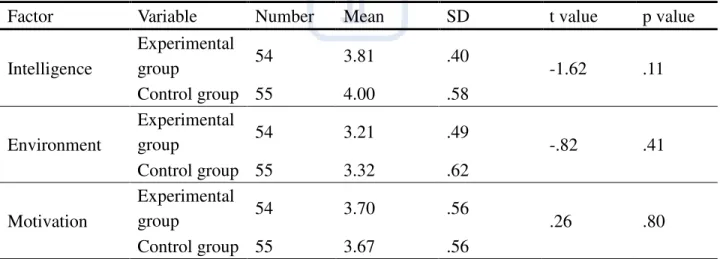
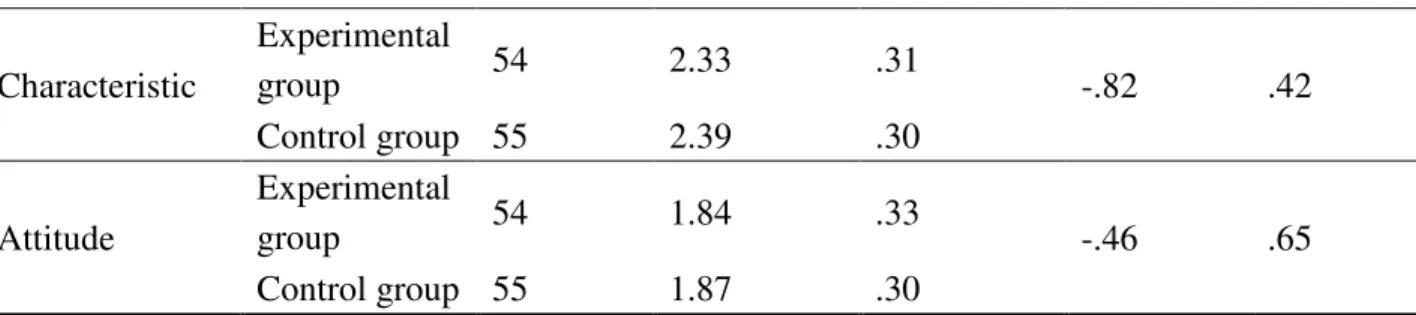
The independent sample t-test was conducted on the pretest results to ascertain whether there were significant differences in business creativity between the two groups, as shown in Table 4. Table 4 Pretest results between two groups
Factor Variable Number Mean SD t value p value
Intelligence Experimental group 54 3.81 .40 -1.62 .11 Control group 55 4.00 .58 Environment Experimental group 54 3.21 .49 -.82 .41 Control group 55 3.32 .62 Motivation Experimental group 54 3.70 .56 .26 .80 Control group 55 3.67 .56
The Comparative Effect, Page 10 Characteristic Experimental group 54 2.33 .31 -.82 .42 Control group 55 2.39 .30 Attitude Experimental group 54 1.84 .33 -.46 .65 Control group 55 1.87 .30
As shown above, for the five factors of intelligence, environment, motivation, characteristic, and attitude, no significant difference was observed between the two groups before the experience. Thus, it could be inferred before the experiment, there was no significant difference in the aspect of business creativity between the two groups.
ii. Posttest results between two groups
The independent sample t-test was conducted on the posttest results to understand whether there were significant differences in business creativity between the two groups, as shown in Table 5.
Table 5 Posttest results between two groups
Factor Variable Number Mean SD t value p value
Intelligence Experimental group 52 4.42 .66 2.78* .007 Control group 53 4 .63 Environment Experimental group 52 3.65 .58 2.91* .004 Control group 53 3.22 .65 Motivation Experimental group 52 4.00 .67 2.00* .049 Control group 53 3.66 .72 Characteristic Experimental group 52 2.59 .41 2.77* .007 Control group 53 2.33 .37 Attitude Experimental group 52 1.96 .35 1.25 .216 Control group 53 1.86 .33 Note: * p < .05
The Comparative Effect, Page 11 From Table 5, the results revealed after the posttest, significant differences existed
between the two groups in the constructs of intelligence, environment, motivation, and characteristics.
iii. Pretest and posttest results of the experimental group
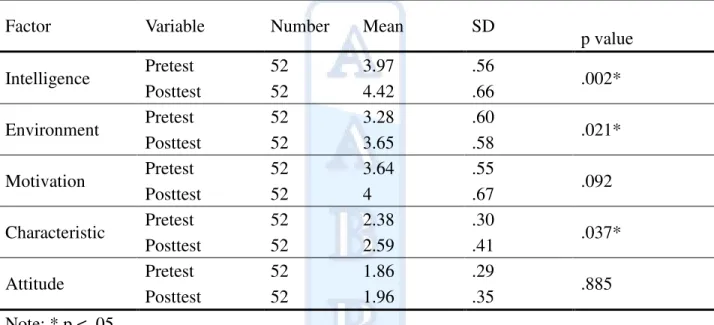
The paired sample t-test was conducted on the pretest and posttest results of the experimental group to verify the growth of the group in business creativity. With missing values excluded, 35 subjects were selected for the paired sample t-test. The result is shown in Table 6.
Table 6 Pretest and posttest results of the experimental group
Factor Variable Number Mean SD
p value Intelligence Pretest 52 3.97 .56 .002* Posttest 52 4.42 .66 Environment Pretest 52 3.28 .60 .021* Posttest 52 3.65 .58 Motivation Pretest 52 3.64 .55 .092 Posttest 52 4 .67 Characteristic Pretest 52 2.38 .30 .037* Posttest 52 2.59 .41 Attitude Pretest 52 1.86 .29 .885 Posttest 52 1.96 .35 Note: * p < .05
As shown above, after the experimental teaching, the experimental group presented significant growth in three aspects of business creativity, including intelligence, environment, and characteristics.
iv. Pretest and posttest results of the control group
The paired sample t-test was conducted on the pretest and posttest results of the control group to verify the growth of the group in business creativity. With missing values excluded, 35 subjects were selected for the paired sample t-test. The result is shown in Table 7.
Table 7 Pretest and posttest results of the control group
Factor Variable Number Mean SD p value
The Comparative Effect, Page 12
Factor Variable Number Mean SD p value
Posttest 53 4.00 .63 Environment Pretest 53 3.23 .51 .26 Posttest 53 3.22 .65 Motivation Pretest 53 3.68 .57 .21 Posttest 53 3.66 .72 Characteristic Pretest 53 2.35 .31 .12 Posttest 53 2.33 .37 Attitude Pretest 53 1.85 .31 .23 Posttest 53 1.86 .33
As shown above, the control group treated with the traditional lecturing instruction presented no significant growth in all the factors of business creativity, including intelligence, environment, motivation, characteristic, and attitude. It can be inferred if teachers’ teaching styles are similar and there is no significant difference in student’s quality, the traditional teaching method for accounting curriculum in general technical schools is unable to effectively strengthen student’s business creativity.
CONCLUSIONS AND SUGGESTIONS
In this study, the pretest-posttest nonequivalent quasi-experiment design was adopted, and students in a technical school in Taiwan were selected as search subjects. Using the class as the unit, two classes in the Accounting Department in this school were selected. One of the classes was assigned as the experimental group and treated with the “web-based collaborative learning method”. The other class was designated as the control group, and instruction by the traditional lecturing method was adopted. And the concurrent teacher taught these two classes. The experiment period lasted 10 weeks, with 2 hours of instructions in each week. Students in each group received 20 hours of instructions. Based on the research findings, conclusions are summarized as follows.
Students in the experimental group significantly outperformed those in the control group in the constructs of intelligence, environment, motivation, characteristics, and attitude
respectively after the web-based collaborative learning method was implemented. Besides, students in the experimental group presented significantly better performance in the constructs of intelligence, environment, motivation, characteristics, and attitude respectively in the posttest than in the pretest, after the web-based collaborative learning method was carried out.
The Comparative Effect, Page 13 It can be discovered after the experiment, no matter in the comparison between the
posttest results of the both groups or the comparison between the pretest and posttest results of the experimental group, there was no significant growth in “attitude”. Through an interview with the teacher and students, it was found this was probably because the experiment period was not long enough for students to change their learning attitude. Besides, the pretest and posttest results of the experimental group revealed the growth in motivation was also not significant. Through practical observation of the researcher, it was found current technical school students are under heavy pressure for entrance exams and heavy academic loads. Under the effect of
institutionalized teaching and school environment, student’s thinking gradually becomes rigid and they can only play passive roles in creative thinking activities. The research results were consistent with the opinion of various scholars (Ma, 2002, Wu, 2002). In addition, the results suggest the considerable research and professional practice about the theory of web-based collaborative learning developed in the West may be useful for understanding student group dynamics in Asia as well. Most importantly of all, the results of this present study support the conclusion that web-based collaborative learning does lead to significantly more positive business creativity.
In this study, a quasi-experiment was conducted on only some students in the business department of a technical school in Taiwan, so the experimental results might not be used to explain students in other departments. Moreover, in the experimental school, girls significantly outnumbered boys and we were unable to determine whether gender would lead to any error. Thus, it was assumed the boys and girls would present equal effectiveness of learning. This was the main constraint of this study.
REFERENCES
Bouton, C., & Garth, R. Y. (1983). Learning in groups: New directions in teaching and learning. San Francisco, CA: Jossey-Bass.
Bump, J. (1990). Radical changes in class discussion using networked computers. Computers and the Humanities, 24, 49-65.
Center for Creativity and Innovation Studies, National Cheng Chi University (2005). Nov 24, 2005. URL: http://www.ccis.nccu.edu.tw/CCIS%20Epaper/list.
Chen, Y. F., & Cheng, K. W. (2005). Application of Computer-Mediated Teaching to Management. Business Education Quarterly, 96, 47-53.
Chen, Y. F., Cheng, K. W., & Lai, M. C. (2006). Research of Business Creativity Teaching Strategies and Evaluation Model for Students in the Business Administrations of Vocational High School. Taipei: National Science Council, Executive Yuan.
The Comparative Effect, Page 14 Chen, Y. F., Lai, M. C., & Cheng, K. W. (Oct 2006). A Study of the Content of Business
Creativity. A thesis published in the academic conference “Creative Education and Innovative Teaching” held by Center for Teacher Education, Kun Shan University of Technology (p 6-21~6-40), Tainan.
Chen, Y. F., Mo, H. E., & Cheng, K. W. (2006). The Power of the “Interactive” Learning Disk in Learning: Is Student Learning Enhanced? International Journal of Technology and Engineering Education, 3(2), 25-30.
Cheng, K. W. & Chen, Y. F. (2007). Effects of cooperative learning in a college course on student attitudes toward accounting: A quasi-experimental study. International Journal of
Management, 24(3), XX-XX. (In press)
Comeaux, P., & Nixon, M. A. (2000). Collaborative learning in an Internet graduate course: A case study analysis. Internet Technologies, Applicants & Issues, 2(4), 34-43.
Davits, D. (1988). Computer-supported co-operative learning systems: Interactive group
technologies and open learning . Programmed Learning and Educational Technology, 25, 205-215.
Dillenbourg, P. (1999). Introduction: What do you mean by "collaborative learning"? In P. Dillenbourg (ed.), Collaborative learning: Cognitive and computational approaches (pp. 1-19). Oxford: Pergamon.
Din, A. H. (1991). Computer-supported collaborative writing: The workplace and the writing classroom. Journal of Business and Technical Communication, 5, 123-150.
Druyan, S. (2001). A comparison of four types of cognitive conflict and their effect on cognitive development. International Journal of Behavioural Development, 3, 226-236.
Golbeck, S. L., & Sinagra, K. (2000). Effects of gender and collaboration on college students’ performance on a Piagetian spatial task. Journal of Experimental Education, 69(1), 22-31. Huang, C. J. & Lin, P. H. (2000). Collaborative Learning. Taipei; Wunan
Johnson, D. W., Johnson, R. T., & Smith, K. A. (1995). Cooperative learning and individual student achievement in secondary schools. In Pedersen, J. E., & Digby, A. D. (Eds.), Secondary schools and cooperative learning: Theories, models, and strategies (pp. 3-54). New York, NY: Garland Publishing.
Koschmann, T. (1996). CSCL: Theory and Practice of an emerging paradigm. Mahwah, NJ: LEA.
Levin, J. A., & Cohen, M. (1985). The world as an international laboratory: Electronic networks for science instruction and problem solving. Journal of Computers in Mathematics and Science Teaching, 4, 33-34.
Light, J. (1990). The Harvard assessment seminars. Cambridge, MA: Harvard University. Liu, R. J., Lai, M. H., Wang, W. Y., Chang, S. W. (2002). Cultivation and Training for Teachers
The Comparative Effect, Page 15 of Creativity and Creative Design Education—Business Studies—Report of Production and Manufacturing Team. Ministry of Education Advisory Office, Jun 2001.
Ma, C. C. (2002). A Report of the Current Promotion of Creative Education in Domestic
Colleges and Universities. Ministry of Education Advisory Office. Date of data retrieval: 2006/10/7. URL: http://www.edu.tw/consultant/
National Youth Commission, Executive Yuan (2005). Disclosure of the Trend of Female Entrepreneurship in 2005. Nov, 24, 2005. Excerpt from URL:
http://tw/news.yahoo.com/051116/78/2jblc.html.
Nattiv, A. (1994). Helping behaviors and math achievement gain of students using cooperative learning. The Elementary School Journal, 94(3), 285-297.
Roth, W. M., & Roychoudhury, A. (1993). The development of science process skills in authentic contexts. Journal of Research in Science Teaching, 30(2), 127-152.
Rovai, A. P. (2001).Building classroom community at a distance: a case study. Educational Technology Research and Development, 49(4), 33-48.
Sharan, S. (1980). Cooperative learning in small groups: Recent methods and effects on achievement, attitudes, and ethic relations. Review of Education Research, 50(2), 241-271.
Sharan, S., & Shachar, H. (1988). Language and learning in the cooperative classroom. New York, NY: Spring-Verlag.
Slavin, R.E. (1995). Cooperative learning: Theory, research and practice (2nd Ed.). Englewood Cliffs, NJ: Prentice-Hall.
Strijbos, J. W., Kirschner, P. A., & Martens, R. L. (Eds.). (2004). What we know about CSCL: And implementing it in higher education. Boston, MA: Kluwer.
Weinberger, A., & Fischer, F. (2005). A framework for analyzing argumentative knowledge construction in computer-supported collaboration learning. Computers & Education, 46(1), 71-95.
Wen, L. Y., & Cheng, K. W. (2006). Current Situation and Acceptance of Applying e-learning to Business Courses: A Case Study of Students in National Kaohsiung Hospitality College. Journal of Technological and Vocational Education, 11, 161-188.
Wilson, B. G. (1996). Constructivist learning environment: Case studies in instructional design. Englewood Cliffs, NJ: Educational Technology Publications.
Wu, Y. S., Chen, Y. F., & Cheng, K. W. (2005). Construction and Implementation of Digital Assistance Teaching Environment—Using Database Course as an Example. Business Education Quarterly, 98, 2-9.
Zhao, W. H. (2001). Development of International Organizations and Knowledge Economy: A Case Study of APEC. APEC Review, 7, Sep 2001.