University of California
Los Angeles
Addressing Operational Challenges in Named Data
Networking Through NDNS Distributed Database
A dissertation submitted in partial satisfaction of the requirements for the degree Doctor of Philosophy in Computer Science
by
Alexander Afanasyev
c
Copyright by Alexander Afanasyev
Abstract of the Dissertation
Addressing Operational Challenges in Named Data
Networking Through NDNS Distributed Database
by
Alexander Afanasyev
Doctor of Philosophy in Computer Science University of California, Los Angeles, 2013
Professor Lixia Zhang, Chair
Named Data Networking (NDN) is a recently proposed Internet architecture. NDN retains the same hourglass shape as the IP architecture, but changes the narrow waist from delivery of IP packets to destinations to the retrieval of named and signed data chunks. This conceptually simple change allows NDN networks to use almost all the Internet’s well-tested engineering properties to solve not only communication problems, but also digital distribution and control problems. The functionality of the narrow waist in NDN is fundamentally different from that in IP: it uses consumer-driven data delivery with a stateful data forwarding plane, implements built-in data security, and provides support for the extensive use of in-network storage. Preliminary experience shows that NDN bridges the gap between applications and network transport, simultaneously simplifying the application de-velopment process and addressing some of the Internet’s most pressing problems in security, scalability, and sustainability. At the same time, the realization of the NDN architecture faces a number of brand new challenges. For example, all data packets must be signed by the original producers and verified by their con-sumers, bringing up the need for providing secure, resilient, and scalable support for public key distributions. Furthermore, since NDN eliminates the translation from application names to IP addresses and routes consumer data requests using
application data names directly, maintaining the scalability of the global routing system becomes another challenge.
This dissertation addresses the above challenges in moving NDN from an ar-chitecture blueprint to the operational reality. We designed and implemented a prototype of NDNS, a completely distributed database system that largely mimics the structure of the DNS system in today’s Internet but operates within the NDN architecture. We show how NDNS can be used for cryptographic key distribu-tion and routing scalability management. We believe that NDNS can also serve a number of other purposes during the development and deployment of the NDN architecture in coming years.
The dissertation of Alexander Afanasyev is approved. Christos Papadopoulos
Mario Gerla
Leonard Kleinrock
Peter Reiher
Lixia Zhang, Committee Chair
University of California, Los Angeles 2013
Table of Contents
1 Introduction . . . 1 1.1 Operational challenges in NDN . . . 1 1.2 NDNS . . . 3 1.2.1 NDNS design highlights . . . 4 1.2.2 NDNS design benefits . . . 51.3 Common NDN simulation platform (ndnSIM) . . . 7
1.4 Contributions of this work . . . 8
2 Background . . . 10
2.1 Named Data Networking (NDN) architecture . . . 10
2.1.1 Repo . . . 12
2.2 Domain Name System (DNS) . . . 13
2.2.1 DNS Security Extension (DNSSEC) . . . 16
2.2.2 Dynamic updates in DNS . . . 18
3 NDNS: distributed database system for NDN . . . 20
3.1 NDNS design . . . 21
3.1.1 Naming . . . 24
3.1.1.1 NDNS naming model . . . 25
3.1.1.2 Namespace conversions . . . 27
3.1.2 Name servers . . . 29
3.1.2.1 NDN data packet management . . . 30
3.1.3 Resolvers . . . 31
3.1.4 Query protocol . . . 33
3.1.4.1 Iterative query . . . 34
3.1.4.2 Recursive query . . . 40
3.1.4.3 Recursive and iterative query interaction . . . 42
3.2 NDNS implementation and evaluation . . . 44
3.2.1 Methodology . . . 46
3.2.2 Parameters . . . 48
3.2.3 Results . . . 51
4 NDN-based security of NDNS . . . 57
4.1 NDNS extension for key-certificate storage . . . 59
4.2 Security policies . . . 60
4.3 NDNS security delegations . . . 64
4.4 Secure dynamic updates . . . 66
4.4.1 DyNDNS updates . . . 67
4.4.2 Delivery of DyNDNS updates to the authority name server 68 4.4.3 Replay attack prevention . . . 71
5 NDNS use cases for NDN security . . . 74
5.1 Namespace regulation in the global NDN routing system . . . 75
5.2 Cryptographic key and certificate management for NDN applications 78 5.2.1 Repo-based cryptographic credential management . . . 79
5.2.1.2 Limitation of repo-based cryptographic credentials
management . . . 81
5.2.2 NDNS-based cryptographic credential management . . . . 82
5.2.2.1 Properties as a general storage . . . 82
5.2.2.2 Key-certificate management on NDN testbed . . 84
5.2.2.3 Cryptographic credential revocation . . . 86
6 Scaling NDN routing using NDNS . . . 88
6.1 Map-n-encap for IP . . . 89
6.2 Map-n-encap for NDN . . . 91
6.3 Encapsulating using forwarding hint . . . 94
6.3.1 Forwarding hint emulation using name concatenation . . . 98
6.4 Mapping using NDNS . . . 100
6.4.1 Security considerations . . . 103
6.4.2 Zone delegation discovery: special case of iterative query . 105 6.4.3 Mobile producer and forwarding hint updates . . . 105
6.5 Discussion . . . 107
7 ndnSIM platform for simulation-based evaluations of NDN de-ployment and NDN-based applications . . . 109
7.1 Design . . . 111
7.1.1 Design overview . . . 111
7.1.2 Core NDN protocol implementation . . . 114
7.1.3 Face abstraction . . . 115
7.1.5 Pending Interest table (PIT) abstraction . . . 117
7.1.6 Forwarding information base (FIB) . . . 119
7.1.6.1 FIB population . . . 119
7.1.7 Forwarding strategy abstraction . . . 121
7.1.8 Reference applications . . . 125
7.1.9 PyNDN compatible interface . . . 126
7.2 Summary . . . 127
8 Related work . . . 128
8.1 DNS usage as distributed DB . . . 129
8.2 Securing global routing resources . . . 130
8.3 Routing scalability . . . 131
8.4 NDN architecture evaluation tools . . . 133
9 Conclusions . . . 136
List of Figures
2.1 DNS components overview . . . 13
2.2 Example of DNS queries . . . 15
2.3 DNSSEC delegation for “ndnsim.net” . . . 17
3.1 NDNS system overview . . . 22
3.2 Example of iterative and reqursive query naming in NDNS . . . . 26
3.3 NDN to DNS name conversion (dnsification) . . . 28
3.4 DNS to NDN name conversion (ndnification) . . . 29
3.5 Interaction diagram between different types of resolvers in NDNS 32 3.6 Definition and example of NDNS iterative query (naming structure) 35 3.7 Flowchart of NDNS iterative query . . . 37
3.8 Definition and example of NDNS iterative query response . . . 39
3.9 Definition and example of NDNS recursive query (naming structure) 40 3.10 Data packet format for NDNS recursive query response . . . 41
3.11 Example of DNS recursive and iterative query . . . 43
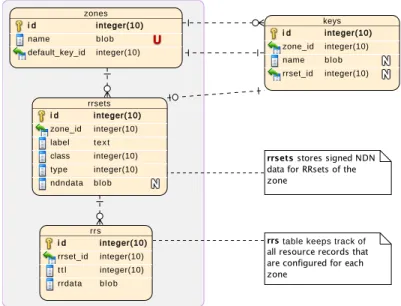
3.12 Database schema for the NDNS prototype of the authoritative name server . . . 45
3.13 Modified version of Rocketfuel AT&T topology with assigned classes of nodes: clients (red), gateways (green), and backbone (blue) . . 47
3.14 The overall structure of the NDNS simulation-based evaluation . . 50
3.15 Absolute number of requests received by authoritative NDNS servers versus cache sizes . . . 53
3.16 Percentage of queries from caching resolvers answered using NDN caches . . . 54
3.17 Example of per-node cache utilization (cache utilization
concentra-tions) for one simulation run with LRU cache . . . 55
4.1 Similarities between security elements of DNSSEC and NDN . . . 58
4.2 Singleton NDNS iterative query response . . . 60
4.3 An example of deterministic NDN name reductions by the applica-tion security policy . . . 62
4.4 NDNS security policy definition . . . 63
4.5 NDNS security delegation example . . . 66
4.6 Dynamic update process in NDNS . . . 68
4.7 Dynamic update generation procedure . . . 69
4.8 Definition of the Interest-based (singular) DyNDNS update . . . . 70
4.9 DyNDNS replay attack prevention mechanism . . . 72
5.1 NDNS-based routing announcement authorization . . . 77
5.2 Proposed deployment of NDNS on NDN testbed . . . 85
6.1 Example of FIB state in the Internet with map-n-encap . . . 90
6.2 Example map-n-encap communication sequence in IP . . . 90
6.3 Example of FIB state in NDN network with map-n-encap . . . 92
6.4 Example map-n-encap communication sequence in NDN . . . 92
6.5 Forwarding hint as an additional Interest selector . . . 95
6.6 Interest processing . . . 97
6.7 Interests in concatenation approach . . . 98 6.8 New FH resource record type to hold forwarding hint information 102 6.9 Iterative NDNS query process in map-n-encap NDN environment 104
7.1 Block diagram of ndnSIM components . . . 113 7.2 Communication-layer abstraction for ndnSIM scenarios . . . 115 7.3 Available forwarding strategies (Flooding, SmartFlooding, and
Best-Route are full realizations, which can be wrapped over PerOutFace-Limits or PerFibPerOutFace-Limits extensions) . . . 123
Acknowledgments
I would like to gratefully and sincerely thank my academic advisor Prof. Lixia Zhang for providing invaluable support throughout my Ph.D. program. I also want to thank my colleagues from UCLA’s Internet Research Laboratory Zhenkai Zhu, Yingdi Yu, and Wentao Shang for their support and valuable discussions, without which this work would not have existed. I am also enormously grateful to our collaborators Prof. Van Jacobson, Prof. Beichuan Zhang (University of Arizona), Prof. Lan Wang (University of Memphis), and many other members of the NDN team for insightful discussions that built up my understanding of the network architecture design in general and Named Data Network design in particular. Also, I have a special thanks to Allison Mankin (VeriSign) for providing many crucial insights on the current DNS protocol design, which influenced many decision made for the NDNS system design. I am also very much obliged to Neil Tilley and Janice Wheeler for the valuable input and suggested corrections to the draft of my thesis.
Vita
2005 B.Tech. (Computer Science), Bauman Moscow State Technical University, Moscow, Russia.
2007 M.Tech. (Computer Science), Bauman Moscow State Technical University, Moscow, Russia.
2011 Exemplary Reviewer IEEE Communication Letters
2012 M.S. (Computer Science), UCLA, Los Angeles, California.
2011–2012 Teaching Assistant, Computer Science Department, UCLA.
2008–2013 Graduate Research Assistant, Computer Science Department, UCLA.
2012 Research Intern, Palo Alto Research Center (PARC), Palo Alto, California.
2012 The IEEE Communications Society Best Tutorial Paper Award (for the “Host-to-host congestion control for TCP” paper)
Publications
A. Afanasyev, N. Tilley, P. Reiher, and L. Kleinrock, “Host-to-host congestion control for TCP,” IEEE Communication Surveys and Tutorials, vol. 12, no. 3, 2010.
the Web,” inProc. of AINTEC, 2011.
E. Kline, A. Afanasyev, and P. Reiher, “Shield: DoS filtering using traffic deflect-ing,” inProc. of IEEE ICNP, 2011.
V. Pournaghshband, L. Kleinrock, P. Reiher, and A. Afanasyev, “Controlling Applications by Managing Network Characteristics,” inProc. of IEEE ICC, 2012.
L. Wang, A. Afanasyev, R. Kuntz, R. Vuyyuru, R. Wakikawa, and L. Zhang, “Rapid Traffic Information Dissemination Using Named Data,” in Proc. of ACM NoM Workshop, 2012.
C. Yi, A. Afanasyev, L. Wang, B. Zhang, and L. Zhang, “Adaptive Forwarding in Named Data Networking,” ACM Computer Communication Reviews, vol. 42, no. 3, 2012.
A. Afanasyev, I. Moiseenko, and L. Zhang, ”ndnSIM: NDN simulator for NS-3,”
Tech.Report NDN-0005, 2012
C. Yi, A. Afanasyev, I. Moiseenko, L. Wang, B. Zhang, and L. Zhang, “A Case for Stateful Forwarding Plane,” Computer Communications, vol. 36, no. 7, 2013.
A. Afanasyev, P. Mahadevan, I. Moiseenko, E. Uzun, and L. Zhang, “Interest Flooding Attack and Countermeasures in Named Data Networking,” in Proc. of IFIP Networking 2013, 2013.
Z. Zhu and A. Afanasyev, “Let’s ChronoSync: Decentralized Dataset State Syn-chronization in Named Data Networking,” in Proc. of IEEE ICNP, 2013.
CHAPTER 1
Introduction
The recently proposed Named Data Networking (NDN) architecture [JST09, EBJ10, SJ09] aims to replace the existing Internet infrastructure, fixing its long-standing problems and better supporting the current communication patterns. In particu-lar, NDN shifts primary communication orientation from point-to-point channels (or connections) to data, which largely reflects recent changes in usage of the In-ternet. In most cases, we are no longer using the Internet to reach a particular host, instead we simply want to get a specific piece of data, be it today’s news page, latest tweets on a particular topic, or a Netflix movie. Many complexities and kludges have been introduced to mitigate this inherent misalignment between the existing Internet architecture and its primary use today, such as DNS-based redirection towards content delivery networks [NSS10], load balancers in front of web servers, application-level (HTTP) caches, and many other systems. NDN architecture aims to provide a direct network-level support for such data-oriented application uses, providing in-network storage and caching opportunities, switch-ing to a receiver-driven communication model, and, most importantly, incorpo-rating a fundamental building block to improve security by requiring that all data packets be cryptographically signed.
1.1
Operational challenges in NDN
Although NDN as an architecture inherently provides numerous communication benefits, it is important to mention that several of these benefits come at an
oper-ational cost. The network is no longer completely application-agnostic, providing just a simple channel-based packet delivery; in fact, the NDN network provides an ecosystem for applications to function. While there is still Interest and Data packet forwarding that is largely independent from applications, the network uses application names directly (same as applications use network-friendly names) for forwarding purposes, and it is vital for NDN to provide adequate namespace regu-lation to avoid unexpected and highly undesirable namespace clashes or conflicts. Another part of the ecosystem is cryptography support. While NDN defines and requires that each Data packet be signed with an application-selected cryp-tographic signature, it is still the architecture’s responsibility to ensure proper publication, storage, and retrieval of the public keys and public key certificates, so the Data packet recipients can verify the signature and decide whether to use the packet or discard it.
Finally, NDN needs a scalable Interest forwarding mechanism. As NDN does not feature a separation between an IP address space for hosts and a namespace for domain names that are mapped to IP addresses using DNS, all communication happens using application-level names, which can be roughly seen as forwarding packets directly on DNS names. Given the existing problems with managing a very limited number of IP prefixes within a global routing system, it is unfeasible to assume that a conventional routing system would be able to handle upwards of billions of NDN names: the current BGP global routing system is struggling to support approximately 600,000 IP prefixes [ATL10], while there are already two billion more of second-level domain names [Ver12]. At the same time, it is unrealistic to assume that a routing system will not be used at all; flooding is not an option on a global scale. Thus, there is a great operational need to have a manageable solution for the scaling problem as NDN achieves wider adoption.1
1One completely different direction that is currently being explored inside the NDN team and is outside the scope of the current thesis is hyperbolic routing [PKB10, BPK10, KPK10], which is a type of a greedy routing that takes into account topology and topological properties
1.2
NDNS
Solutions to the operational challenges in NDN above assume the existence of some sort of authoritative database, which allows for storing namespace delegation information for NDN namespace regulation, cryptographic information for general NDN-based applications (Chapter 5), and mappings between routable or non-routable names (Chapter 6). All of these pieces of information use hierarchical names and namespaces to provide data scoping and localization: all data belonging to a particular user (e.g., his or her cryptographic credentials) can be stored under a single namespace. Therefore, the assumed database has to be directly based on names, and specifically on hierarchical names, to identify individual records and sets of records. Also, the management of these records has to be done in a distributed way, so each individual user or provider can independently decide how much and what data to be stored, without requiring any additional communication or coordination with other elements of the system. Clearly, the one system that exactly satisfies these criteria is the Domain Name System (DNS) [Moc87b, Eas99] infrastructure. While originally designed to provide a simple name-to-IP mapping service, DNS is essentially a large, highly scalable, and highly distributed database that is based on and managed using the hierarchy of names. More than 25 years of deployment and active use proved that DNS made the right designe choices, allowing its use in a wide variety of network and application related tasks.
The present work aims to design NDNS, a scalable and distributed database by applying DNS design choices and concepts within the NDN architecture. The objective of the work is not to merely port DNS to NDN, but to understand how DNS design principles can work within a pure data-centric communication model provided by NDN, which design choices can be borrowed directly, and what should
of Internet-like networks. The main objective of this research direction is to eliminate the need to maintain “full” routing tables and use special coordinates to enable guessing the path on which to forward the Interest, which is comparably good as if it was calculated based on the knowledge of the full topology using the shortest paths algorithms.
be redesigned in order to fully utilize the benefits of the NDN architecture.
1.2.1 NDNS design highlights
DNS, as a protocol, relies heavily on IP-based memoryless channels for packet exchange. For example, every time a request is sent out, it is directed to a specific name server: the selected root server (or its anycasted copy), the selected top-level domain (TLD) server, the selected second-top-level domain (SLD) server, etc. Every time the request is sent, the requester (iterative querier) asks the selected server the same question, while getting back potentially different answers: negative responses, referrals, or final answers, depending on the knowledge held by the server about the request.
Interest packets in NDN are almost equivalent to DNS queries. They both specify the requested name, and both expect to receive one answer. However, there are two fundamental properties of an NDN network that prevent direct translation of DNS queries into Interest packets. First, unlike DNS queries, Inter-est packets cannot be ambiguous: it is not possible to express exactly the same Interest and get two completely different answers. NDN’s Interest must uniquely identify Data; otherwise, in-network storage and caching will prevent retrieval of more than one Data packet corresponding to the Interest.2 Second, since NDN
features destination-address-less communication, the Interest name needs to in-clude directly or indirectly the authority in question. That is, if the query is intended for a SLD server, the SLD server’s authority needs to be included in the Interest, along with a potential hint on how to forward the Interest on toward this authority (Chapter 6).
2Technically, within the current definition of NDN’s Interest, it is possible to use various Interest selectors, including an exclude filter, to retrieve different Data packets using the same Interest name. However, usage of the Interest selectors should be as minimum as possible, as it most likely will result in “slow-path” processing, similar to the current processing of the non-standard IPv6 headers by high-speed routers.
NDNS is making an attempt to solve this problem by modifying some of the basic DNS elements, shifting channel-focused design to a pure data-centricity. In particular, NDNS explicitly separates zones and zone records (labels), making it necessary to send specific Interest packets to specific zones. This is seemingly in contrast to the existing DNS, where a domain name does not explicitly separate zone and labels. At the same time, the underlying iterative query process performs such separation implicitly, relying on IP-based memoryless channels. In other words, NDNS just brings implicit separation to the explicit plane.
The major benefit of the explicit separation is that there is no longer an ambi-guity between different Interests. If the question is intended to be answered by a SLD’s zone, the querier expresses the Interest for a SLD’s zone and the appropriate label. The “location” of a specific zone can be hinted by including a forwarding hint, as described in Chapter 6. The Interest formatted in this manner does not really specify a specific destination, as rather an authority over who should have an authoritative answer to the question; it is still the network’s task to get the requested data as fast as possible using all available means.
1.2.2 NDNS design benefits
Since one of the primary tasks of the DNS/NDNS system is to maintain proper delegations from the root zone toward any other zones and domains (Chapter 3), these delegations can be “abused” for global NDN namespace regulation (assuming that these delegations are properly secured, see Chapter 4). In other words, an application (e.g., NDN web-browser or email client) can restrict the set of acceptable NDN names and namespaces used in this application to ones that have proper NDNS delegation. For example, such an application can consider the Data packet “/ndn/ucla/cs/alex/cv” to be valid and present it to the user only if it is properly signed with the key, which is authorized by one of the higher-level NDNS zones, either by “/ndn/ucla/cs/alex”, “/ndn/ucla/cs/”, “/ndn/ucla”,
“/ndn”, or “/”.
NDNS can also, similar to DNS, be used as a general-purpose storage sys-tem. The current DNS is to some extent “abused” to store various information, including DNSSEC keys, domain-mailserver mappings, IP blocklist, various an-notations, and many others. Since NDN heavily relies on cryptography to secure the binding between name and data, it is crucial to provide a network-supported infrastructure for the storage and management of the cryptographic information, including public keys and public key certificates. While NDNS is not the only option for such an infrastructure, and an initial attempt discussed in Chapter 5 relies on another core NDN element called repo [BZA13], NDNS can provide a more robust, better organized, and simplified management for cryptographic data. Finally, general-purpose NDNS-based storage can be utilized to solve the prob-lem of scaling NDN’s name-based routing. The existing DNS provides an excellent scalability solution using IP architecture: application/service developers use vir-tually an infinite number of domain names, which are mapped to IP addresses and used by clients to actually reach the application or service. While not actually deployed for various reasons, there were several proposals many years ago to scale IP routing based on a so-called map-n-encap approach [Dee96, MWZ07, JMY08, ASB99, GKR11]. In short, these proposals separated the IP space into provider-dependent and provider-inprovider-dependent subspaces, where only very limited subsets of provider-dependent addresses needed to be present in the global routing table. All other provider-independent addresses needed to be mapped to one or more provider-dependent ones, and an additional IP-IP encapsulation/decapsulation mechanism needs to be used for global communication. The required mapping could have easily been implemented using a DNS infrastructure and reverse DNS zone, and it can be naturally implemented in NDNS zones. That is, the NDNS zone can be used not only for namespace delegation, but also to provide “for-warding hints” on where the requested Data can be located. This hint can then
be used in an NDN adaptation of encapsulation, either by extending Interest se-lectors or by prepending the hint to the Interest’s name (see Chapter 6). The actual lookup for such hints could be performed, for example, by the end-host’s forwarding strategy, guessing (or trying several guesses in parallel) which Interests require additional “NDNS resolution” and which do not. While it may look this approach goes against core NDN principles of naming data, not locations, the hint does not really introduce anything new to the architecture; rather, it just helps the network layer facilitate discovery of the best way to satisfy the Interest. The Interest still has to uniquely identify the requested Data, and applications and ap-plication developers can still be completely ignorant of the particular deployment of the application.
1.3
Common NDN simulation platform (ndnSIM)
Understanding the pros and cons of the architectural mechanisms of NDN poses a challenge at this time. These include Interest forwarding strategies, Data packet caching and cache management, and a full understanding of application behavior within the new architecture. The existing NDN testbed is an important step in this direction. However, it may be hard or even impossible in certain cases to utilize the testbed to fully understand possible behavior nuances of prototyped applications: the testbed has a fixed, small-scale topology, and it could be hard to set up individual experiments and obtain desired metrics. In particular, the NDNS system introduced in this thesis aims to solve operational challenges, some of which do not yet exist and are not possible to be emulated on a testbed-scale. Chapter 7 introduces another contribution of the current work and an im-portant component needed for the new architecture: the ndnSIM simulation suite [AMZ12]. ndnSIM was originally designed and developed to understand just network-layer Interest/Data forwarding characteristics (e.g., evaluate options for
the Interest forwarding strategies and routing protocols). Since that development, it was significantly extended by our efforts, along with the help of the community, and was used in many evaluations at different levels of the network architecture: resiliency to various DDoS attacks, measuring performance of different caching strategies, and investigations at the application level, including evaluations of the NDNS system introduced in this thesis.
Since ndnSIM’s public release in summer of 2012, we have witnessed a rapid growth of its user community. A number of indicators suggest that we have made a robust start towards the initial goal of making ndnSIM a common simulation platform for the community to investigate various NDN design choices and system properties. The project’s mailing list was set up to facilitate exchanges among ndnSIM users; it gathered over 150 subscribers from multiple countries and has been generating a great amount of traffic, as can be seen from the list’s archive
(http://www.lists.cs.ucla.edu/mailman/listinfo/ndnsim). Just one year
after the ndnSIM release, there have been at least 15 published papers based on the results from using ndnSIM (http://ndnsim.net/ndnsim-research-papers. html); four of these 15 papers are authored by the NDN team members, the rest contributed by others from the community. The community also started making contributions to ndnSIM development. In addition to bug reports and feature suggestions, there are 17 public forks on GitHub, and a number of users have contributed code development to ndnSIM (https://github.com/NDN-Routing/
ndnSIM/blob/master/AUTHORS).
1.4
Contributions of this work
Contributions of this dissertation can be summarized as follows:
• Design, prototype implementation, and evaluation of NDNS, a distributed database system that largely mimics the structure of the DNS system in
today’s Internet, but operates within the NDN architecture (Chapter 3).
• Design and prototype implementation of security policies that enable strict control over which Data packets can be signed by which key-certificates. The designed and implemented policies essentially provide a way to secure the NDNS design, as well as a simple and yet secure dynamic update protocol for NDNS (Chapter 4).
• Identification of a number of operational challenges to address in order to move Named Data Networking from an architectural blueprint to an op-erational reality, in addition to applying the designed NDNS database to address these identified challenges. This includes the proposal for NDN na-mespace regulation (authorization of NDN prefixes in the routing system) and the design for cryptographic credential management for NDN applica-tions, preserving application control over the published Data (Chapter 5).
• Analysis of the future challenge of scaling NDN name-based routing, and NDNS-based design to mitigate this scaling problem in a global NDN de-ployment (Chapter 6).
• Design and implementation of ndnSIM, a common platform for simulation-based experimentation with NDN architecture (Chapter 7).
CHAPTER 2
Background
This chapter briefly introduces Named Data Networking (NDN) architecture, as well as the Domain Name System (DNS) protocol and its security extension (DNSSEC), which comprise the primary subject of this thesis. The following sections present a short description of the relevant parts of the architecture and protocols. A more detailed description can be found in specialized literature, such as [JST09, EBJ10] for NDN and [Moc87b, Eas99] for DNS.
2.1
Named Data Networking (NDN) architecture
This section gives an overview of NDN architecture, with a focus on its state-ful forwarding plane (refer to [JST09, EBJ10, YAM13, YAW12] for more detail). NDN is a receiver-driven, data-centric communication architecture, where all com-munications in NDN are performed using two distinct types of packets: Interest
and Data. Both types of packets carry a name, which uniquely identifies a piece of content that can be carried in one Data packet. Data names in NDN are hierar-chically structured. An example name for the first segment of an HTML page for the “ndnsim.net” website would look like “/net/ndnsim/www/index.html/%00”. To retrieve Data, a consumer make a request by sending an Interest packet that carries the name of the content desired. Routers use this name to forward the Interest toward data sources, and a Data packet whose name matches the name in the Interest is returned to the consumer by following the reverse path of
the Interest. Similar to IP, Interest forwarding is based on longest name prefix match, but unlike IP, an Interest packet and its matching Data packet always take symmetric paths.
Each NDN router maintains three major data structures:
• A Pending Interest Table (PIT) holds all “not-yet-satisfied” Interests that have been sent upstream towards potential data sources. Each PIT entry contains one or multiple incoming and outgoing physical interfaces: multi-ple incoming interfaces indicate the same Data is requested from multimulti-ple downstream users; multiple outgoing interfaces indicate the same Interest is forwarded along multiple paths.
• The Forwarding Interest Base (FIB) maps name prefixes to one or multi-ple physical network interfaces, specifying directions where Interests can be forwarded.
• A Content Store (CS) temporarily buffers Data packets that pass through this router, allowing efficient data retrieval by different consumers.
When a router receives an Interest packet, it first checks whether there is a matching Data in its CS. If a match is found, the Data packet is sent back to the incoming interface of the Interest packet. If not, the Interest name is checked against the entries in the PIT. If the name already exists in the PIT, then it can be a duplicate Interest (identified by a random number carried by each Interest) and should be dropped, or it can be an Interest from another consumer asking for the same Data, which requires adding the incoming interface of this Interest to the existing PIT entry. If the name does not exist in the PIT, the Interest is added to the PIT and forwarded along the interface chosen by the strategy module, which uses FIB as input for its decisions.
When a Data packet is received, its name is used to look up the PIT. If a matching PIT entry is found, the router sends the Data packet to the interface(s)
from which the Interest was received, caches the data in the CS, and removes the PIT entry. Otherwise, the Data packet is deemed unsolicited and discarded. Each Interest also has an associated lifetime; the PIT entry is removed when the lifetime expires. Although the maximum lifetime is specified by users, it is ultimately a router’s decision as to how long it keeps a PIT entry.
2.1.1 Repo
repo is a new communication element essential for NDN-based communications, providing permanent storage for any kind of NDN Data. Whenever a Data packet is put into repo, the packet can later be used to satisfy any incoming Interests for this Data, in exactly the same way an NDN cache would do. However, there are two fundamental differences between repo and a cache (packet buffer). First, repo, at least in its current definition and implementation in NDN platform code-base [NDN13a], never deletes any element from the underlying datacode-base, so that Data packets being put into the repo stay there virtually forever. The second fundamental difference is the mechanics of how Data packets get into the repo: repo expects an explicit command from the user. At the same time, repo is not exactly an application-level database or a fully managed storage. It is designed to store Data packets regardless of the originating application, and there is no way to issue commands to a specific repo instance.
The command interface that is currently defined requires the user to send an In-terest for the Data that it wants to be put into the repo, attaching a special postfix that is recognized by the repo, configured to receive Interests for such prefixes. For example, if one wants to put an HTML page ofndnsim.netwebsite into the repo, it needs to send Interest “/net/ndnsim/www/index.html/%C1.R.sw/<nonce>” to the NDN network, expecting that it will reach at least one repo. As soon as a configured repo receives and recognizes such an Interest, it may return a Data packet to the user (to ensure Interest/Data flow balance), remove the command
postfix “/%C1.R.sw/<nonce>”, and express one or more Interests for the Data indicated by the user, e.g., “/net/ndnsim/www/index.html/%00”. The number of required segments is determined using the segmenting protocol, which is currently defined to use the “LastBlockID” field in the returned Data packets, indicating the last sequence number of the last Data packet in the sequence.
2.2
Domain Name System (DNS)
The Domain Name System (DNS) [Moc87b] is a global public database system, providing various mapping services from hierarchical domain names. The common usages of the DNS system include mapping DNS names to IP addresses, mapping domains to the list of mail servers, reverse mapping from IP addresses to domain names, mapping for blacklisting purposes, and many others.
root .edu .net ... ndnsim www ... Name servers (authoritative) Name servers /
caching resolvers Stub resolvers DNS name space
docs.ndnsim.net zone
docs Internet
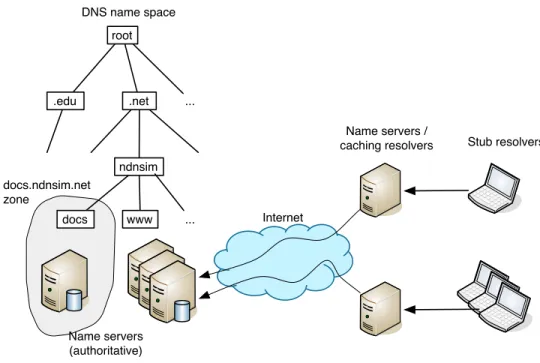
Figure 2.1: DNS components overview
On a high level, DNS consists of four major components: (1) domain name space, zones, domains and resource records (RRs), (2) the DNS protocol, (3) name
servers, and (4) resolvers (Figure 2.1). The domain name space and RRs basically define the name hierarchy and associate different type data to each leaf in this hierarchy (“A” RRs provide association to IP addresses, “MX” RRs associate mail servers to a domain, etc.). This information can be extracted via the DNS query protocol. Name servers are the programs that actually store parts of the domain name space and respond to incoming queries. Depending on the function, name servers are divided intoauthoritativename servers, which maintain definitive versions of RRs in a specific zone (zone is a unit of authoritative information), and
caching name servers (also usually functioning as caching resolvers), maintaining cached versions of the RRs from diverse parts of the DNS name space. The last component of the DNS system—resolvers—are the programs that perform access to the stored mapping by DNS queries; in other words, they resolve the questions to the answers. Depending on the type of queries they generate, as well their position in the system, resolvers are divided into two categories: caching resolvers
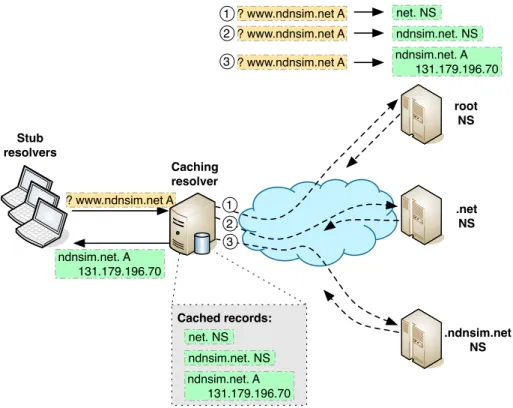
that perform iterative queries and stub resolvers that perform recursive querying (Figure 2.2).
The iterative query is a basic DNS query that allows discovery of the existing mapping (or the fact that such mapping does not exist) with minimal prior knowl-edge about the whole DNS database; it is usually performed by caching resolvers. In particular, the only information that is necessary to initiate an iterative query is the IP address of at least one root server. For example, if the ultimate question is to find the IP address of the “cs.ucla.edu” domain, the query for the “A” RR set for the domain “cs.ucla.edu” will be initially send to one of the root servers. The root server will simply provide a referral (names and IP addresses) to “.edu” name servers, which should know more about the question being asked. In this example, “.edu” name servers should deliver further referral to UCLA’s name server(s). Each time the caching resolver receives a referral, it selects one of the name servers from the referral [YWL12] and sends it the original query.
? www.ndnsim.net A Cached records: 1 2 3 Caching resolver Stub resolvers root NS .net NS .ndnsim.net NS 1 2 3 ? www.ndnsim.net A ? www.ndnsim.net A ? www.ndnsim.net A net. NS ndnsim.net. NS ndnsim.net. A 131.179.196.70 net. NS ndnsim.net. NS ndnsim.net. A 131.179.196.70 ndnsim.net. A 131.179.196.70
Figure 2.2: Example of DNS queries
Eventually, the iterative query process will be terminated, either when one of the name servers returns the queried RR set or authoritatively indicates that the queried RR set does not exist.
The recursive querying is performed usually by the end-host’s stub resolvers and relies on the configured access to one or more caching resolvers, which perform iterative queries on the stub resolver’s behalf. Each recursive query, unlike the iterative counterpart, is expected to return either the requested RR set or an indication that such an RR set does not exist. If the query does not return a valid answer (e.g., returns a referral), then it is assumed there is not a valid answer and no further operations will be performed, except possibly trying to send a recursive query to a different caching resolver.
The key advantages and success of DNS come from its excellent scalability properties. The zone owners can replicate authoritative name servers in different
parts of the world (as the case with the root zone), thus distributing the load and providing failure resiliency. Arguably more important, DNS has extensive caching of the query results by the caching resolvers. For instance, the caching resolver will refrain from repeating queries to the root authoritative server if it has a cached version of the referral from a root, TLD, or SLD name server.
2.2.1 DNS Security Extension (DNSSEC)
The original design of the DNS system contained limited measures to protect against malicious users and intentional attacks. To address these limitations and to provide additional assurances and resiliency against potential future attacks, the Internet Engineering Task Fork (IETF) developed DNSSEC [Eas99], a secure and backward compatible version of the DNS protocol. In essence, DNSSEC cryp-tographically signs each RR set and provides a way to verify signatures following the certification chains to the known trust anchor(s), such as the DNSSEC root zone trust anchor [IV09]. It is worth mentioning that DNSSEC leverages DNS as a general use database to store, manage, and retrieve all necessary cryptographic information to facilitate verification of all signed RR sets.
The following presents a simplified illustration of basic mechanics in DNSSEC protocol. When a DNSSEC-enabled name server replies to a query, it attaches “RRSIG” records to each of the returned autoritative RR set answers. The “RRSIG” records contain the actual cryptographic signature and additional iden-tification of the key (“DNSKEY” RR set) that was used to produce this signature. The identified “DNSKEY” RR set can then be fetched by another DNSSEC query in exactly the same manner as any other DNS RR set, the fetched RR set having as well its own attached “RRSIG” information for further verification purposes.
To ensure that the key used to sign the records in the zone (so-called zone signing key, or ZSK) and the key that is used to sign other keys in the zone (key
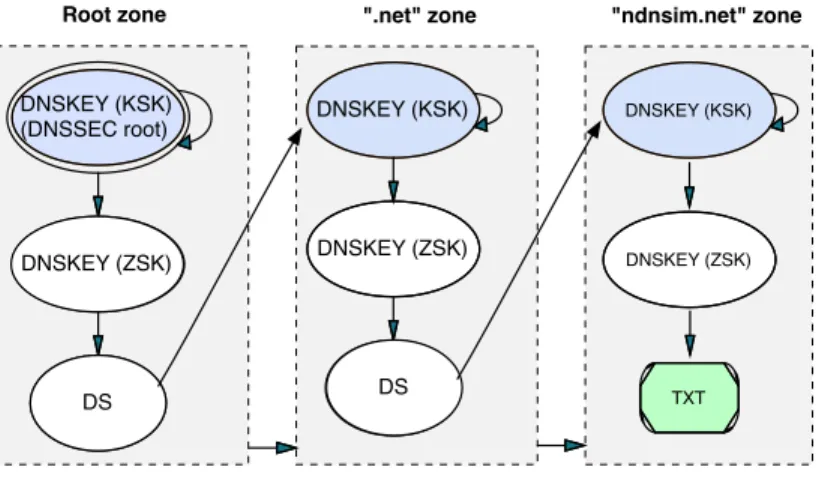
signing key, or KSK) are properly authorized, DNSSEC uses Delegation Signer (“DS”) records that are installed in the parent zone and specify a hash of the authorized KSK for the zone (ZSK is indirectly authorized by providing a proper signature using the directly authorized KSK). The example on Figure 2.3 shows a DNSSEC delegation chain for a “TXT” RR set for “ndnsim.net”: the “TXT” RR set is signed with the “ndnsim.net” ZSK, which is signed by the zone’s KSK, which is authorized by the parent “.net” zone via a “DS” record, and so on. This way, the zone preserves the ownership over the DNSKEY records (i.e., all DNSKEY records are stored in the zone and only in the zone, and it is the author-itative server’s responsibility to maintain them), while the delegation information is stored in the parent zone. The separation between KSK and ZSK was made in an effort to optimize operational overhead in cryptographic key maintenance. In other words, the more exposure of the key (the more frequently it is used), the more often the key needs to be replaced. Being the most exposed, ZSK is designed to be relatively easy to replace without the need to make any changes in the parent zone. KSK usually uses a stronger cryptography, has limited exposure, and can have longer lifetime, as each change would require additional modification of the parent zone.
DNSKEY (KSK) (DNSSEC root) DS DNSKEY (ZSK) DNSKEY (KSK) TXT DNSKEY (KSK) DNSKEY (ZSK)
Root zone ".net" zone
DS
"ndnsim.net" zone
DNSKEY (ZSK)
2.2.2 Dynamic updates in DNS
The basic idea behind dynamic DNS updates is to use a specialized form of the DNS message (DNS Update) containing the name of the zone to update and prerequisite, update, and additional sections. The prerequisite section contains the list of RR states, each indicating that a particular RR set or RR data should exist or should not exist in the zone. The update section contains the list of RRs (RR updates) that indicate addition or removal of the existing entries in zone, in case the zone satisfies conditions specified in the prerequisite section (for more detail, refer to RFC 2136 [VTR97]). The prerequisite section stems from the need to prevent update duplication, i.e., to some degree prevent potential replay attacks on the dynamically updated zone.
The complementary RFC 2137 specification [Eas97], in addition to the basic protocol of the dynamic DNS update, defines the security provisions that enable dynamic updates (secure dynamic updates) for the DNSSEC-secured zones. The specification defines two operational modes that differ on how signatures attached to the updates are used by the authoritative name server. In both modes, the dynamic update generator, along with the updated (or removed) RR data, pro-vides the corresponding “RRSIG” data, which is generated using a key that has a corresponding legitimately delegated “DNSKEY” record in the updated zone. The main difference between the modes is that in one mode, the updated record is installed and later served in the same form to the incoming requests, including the updater-generated “RRSIG” data, whereas in the other mode, the RRSIG supplied by the updater is used only for authentication and authorization pur-poses, and the authoritative name server uses its own zone-signing key to generate “RRSIG” data that is later attached to the updated record, when the record is requested.
au-thoritative name server does not require an online key, thus making it possible to generate stronger signatures. At the same time, not having the online key prevents generation of “NXT” (negative responses) records, and it may prevent AXFR transfers from working: dynamically updated records may need to be managed separately from static records. In the other mode, the server does not feature these limitations, but requires an online signing process, which usually means weaker signatures.
CHAPTER 3
NDNS: distributed database system for NDN
DNS is arguably one of the most successful elements in the current Internet archi-tecture. It not only resolves application-layer domain names to network-layer host addresses, but also is used in many other name-data mapping solutions, includ-ing DNSSEC key management, mailserver management, and literally hundreds of other types of mappings. Given the great success of DNS, which is basically a highly distributed and extremely well-scaled online database system, the main goal of this thesis is to apply principles of DNS in the NDN architecture and enable its use to solve critical operational challenges in the NDN network, including the need for strict namespace management, NDN routing scalability, providing core infrastructure for cryptographic support in NDN, and potentially many others.
However, it is not mere a long history of success that drove our choice to base NDNS design on DNS, but a history-based proof that the design choices made by DNS are the right ones. Managing data using hierarchical namespaces and namespace (zone) delegation provides simple and distributed management, as well as ensures virtually unlimited database storage. Iterative query process that “walks down” the namespace delegation hierarchy guarantees access to the database elements with minimal a priory knowledge about DNS system (i.e., knowing just IP addresses of root servers is enough to access any element in the database). Dedicatedcaching resolvers aggregate and cache database queries from
stub resolvers embedded in user operating systems, ensuring efficient, scalable, and failure-resilient access to the database entries. Therefore, the preservation of these
elements is essential for NDNS, and our choice to follow closely DNS model is just an attempt to minimize potential design errors. In other words, the primary ob-jective is to build on DNS principles within a pure data-centric communication NDN-based infrastructure, and not to port blindly DNS to the NDN architecture. Although the primary motivational example for NDNS was to scale NDN rout-ing (see Chapter 6), the basic concepts of the designed protocol are independent of a specific usage. This chapter provides a detailed description of the NDNS protocol as a generic, highly scalable, distributed database system that is built on top of the NDN architecture, assuming that routers either contain full information about all application-level prefixes or have some other means to discover where to send an Interest for all application-specific prefixes (e.g., can use flooding to forward Interests). Also, this chapter does not discuss specific usage of the NDNS system or its place in the NDN ecosystem, deferring such discussions to the later chapters (Chapters 5 and 6). At the same time, it is our expectation that NDNS can be utilized as a universal database for a multitude of different network and ap-plication needs, including many existing uses of the DNS system, such as domain to mail server mapping, servicing as a database for various blocklists, providing service discovery, and many others.
In the rest of this chapter we introduce all elements of NDNS system and provide a large-scale simulation-based evaluation, showing several benefits of a tight integration between the application and network layers.
3.1
NDNS design
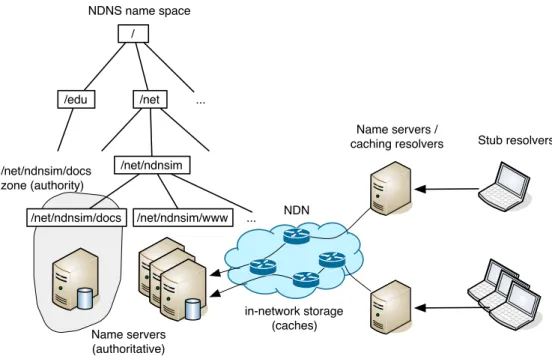
Similar to the conventional DNS system, NDNS consists of four major compo-nents: namespace, protocol, name servers, and resolvers (Figure 3.1).
The namespace used and regulated by the NDNS system is a subset of the general NDN namespace to ensure equivalency to the DNS namespace: an NDN
/ /edu /net ... /net/ndnsim /net/ndnsim/www ... Name servers (authoritative) Name servers /
caching resolvers Stub resolvers NDNS name space /net/ndnsim/docs zone (authority) /net/ndnsim/docs NDN in-network storage (caches)
Figure 3.1: NDNS system overview
name used in NDNS should have an equivalent DNS name (by definition, every DNS name always has an NDN equivalent). Naming in NDN can be very flexible, and NDN imposes no restrictions on naming and name component content, ba-sically allowing any name component to contain any binary blob, as long as the resulting name fits into the Interest and Data packet. However, in order to main-tain equivalency to DNS (i.e., use DNS governance by ICANN and IANA), NDNS requires all NDNS-managed names to contain only lower-case DNS-compatible characters, rejecting any other names like “/EDU”, “/EdU”, and others. This re-quirement/restriction is completely non-technical and comes from the set practice of DNS system usage: typed names (in email addresses or in a web-browser) are expected to be case-invariant and contain only dashes and latin characters or con-form to the internationalized domain names con-format [FHC03]. While it is not a direct goal of this thesis, such a requirement technically allows some interoper-ability between DNS and NDNS systems, where DNS can store and serve data stored in NDNS and vice versa.
The protocol part of the NDNS system contains many major changes com-pared to its DNS counterpart. These changes are due not only to the technical necessity to change the packet format so it conforms to the new communication ar-chitecture, but also to the fundamental changes in the communication paradigm. In particular, as shown in later sections, the switch from a channel-centric IP to a completely channel-less data-centric NDN requires a significant level of re-thinking and refactoring of the NDNS/DNS querying protocol. As pointed out in previous chapters, NDN does not feature the concept of “channels” or destination addresses. Instead, all data exchanges are performed via expressing Interests to the network for a specific piece of data (using the name). The network takes full care to satisfy these Interests with relevant Data packets using any means avail-able, both by forwarding the Interest to the data producer and returning Data from the nearby cache. As a result, it is largely impossible for an end-host to send queries to a specific name server, which is an implicit requirement of the DNS protocol.
The two other parts of DNS—name servers and resolvers—are largely imported as is into the NDNS system design: name servers store and manage zones with domains and resource records, while resolvers perform querying operations either in an iterative (caching resolvers) or in a recursive (stub resolvers) style. However, it should be noted that NDNS contains an additional player that significantly affects the protocol: data-oriented network architecture. As pointed out later in Section 3.1.3 and confirmed via simulation-based evaluations (Section 3.2), there is a shifted importance (towards less significance) of the caching resolver. In other words, while in DNS the caching resolver is a major player that facilitates scalability—namely, prevents duplicate queries from reaching higher-level name servers—NDNS leverages NDN’s in-network storage and caching ability for the same purpose. In essence, NDNS uses the inter-layer shared responsibility of caching resolvers (application layer, guaranteed cache space) and NDN caches
(network layer, best-effort cache space) to provide scaling. At the same time, the recursive resolver function of the caching resolvers, for simplifying and speeding up database queries from stub resolvers, remains as important as in DNS, or can be considered even more important.
3.1.1 Naming
Naming is a critical a part of any data-centric NDN application. Due to the fact that NDN operates directly on application names, i.e., it mashes the network and application layers, application developers must design the data naming model with care, so that it guarantees correct application functionality and leverages all the benefits of the NDN architecture. In particular, applications should be aware that returned Data can be cached anywhere in the network and that the subsequent Interests for the same name (or prefix) would yield exactly the same piece of Data: the application design should not include patterns whereby the same Interest is expected to be satisfied with different Data packets. Moreover, application developers should avoid a system design that mimics the IP-based practice of channel-based communication, e.g., assigning unique/random names to each Data packet and in this process foregoing the benefits of in-network caching. An ideal data-centric design guarantees that each unique piece of Data is named uniquely (retrieved using a unique name in the Interest); at the same time, Interests by independent parties for the same unique Data use identical names.
The primary conclusion from these considerations is that the Data should have the shortest possible (and therefore least specific) name that provides Data uniqueness, enabling potential sharing of these Data between different users in the NDN network. For example, a simple analysis of the iterative query protocol of DNS (see Section 2.2) can reveal that it goes against NDN requirements: the query does not uniquely identify the requested Data. In other words, while exactly the same DNS query is sent out to root, TLD, and SLD servers, the resulting Data can
be completely different, consisting of referrals to the next level or a final (positive or negative) answer.
NDNS design incorporates a substantially changed version of the iterative querying protocol (see Section 3.1.4.1), which includes an explicit separation of questions for the referrals and for the final answers from authoritative servers. The proposed protocol contains a certain amount of guesswork by the resolver and may result in an increased number of required iterations to get the final answer (e.g., the authoritative server cannot give the final answer until it is asked the final question), but the explicit requests completely solve data ambiguity and fully leverage potential of NDN caches. In other words, even though one caching resolver may need to spend several round-trip times to get an answer, another resolver would be able reuse intermediate results of the NDN caches.
3.1.1.1 NDNS naming model
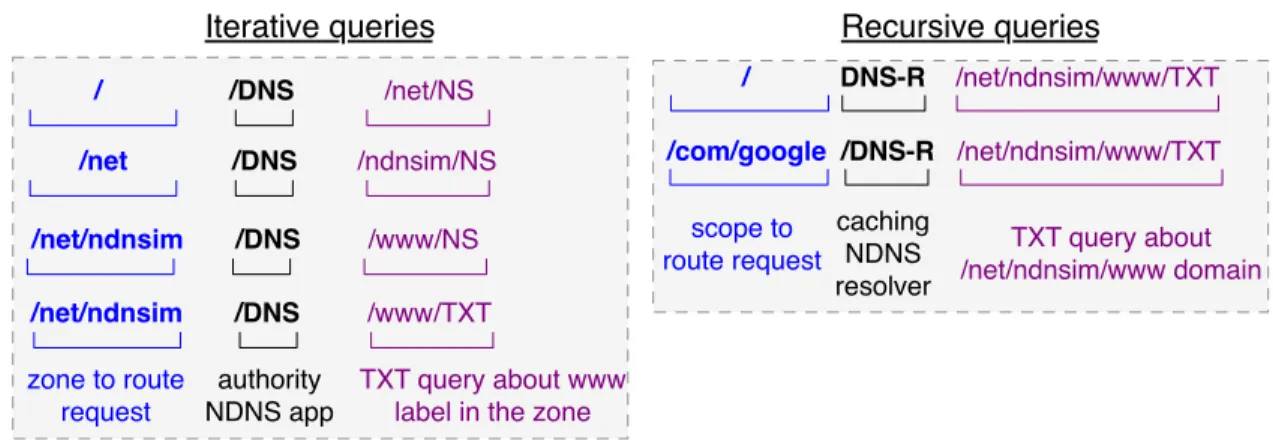
Since an NDN name is used both by an application and by the network, it should contain all necessary parts for proper delivery of the Interests towards the intended Data producers (at least the first Interest for a unique piece of Data), for proper demultiplexing of the Interests to the right application at the producer node, and for a proper selection of the desired application data. In short, the name should contain a “routable” prefix, an application demultiplexer suffix, and the application-specific ending. Figure 3.2 shows an example of names for the iterative and recursive NDNS queries, each conforming to the general three-part naming model.
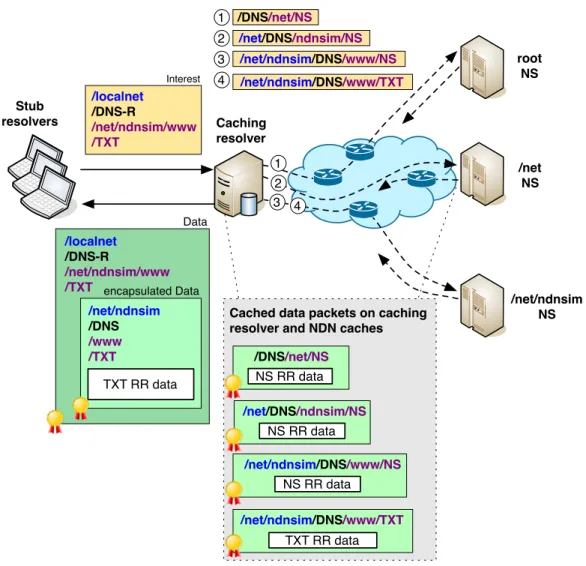
Depending on the query type (which technically are completely different appli-cations), NDNS uses two different application demultiplexer suffixes: “/DNS” for iterative queries (the same as names for authoritative NDNS data) and “/DNS-R” for recursive queries (the same as names of the caching resolver’s data). The
/net/ndnsim /DNS /www/TXT /com/google /DNS-R /net/ndnsim/www/TXT scope to route request caching NDNS resolver TXT query about /net/ndnsim/www domain / DNS-R /net/ndnsim/www/TXT
Iterative queries Recursive queries
zone to route request
authority NDNS app
TXT query about www label in the zone
/ /DNS /net/NS
/net /DNS /ndnsim/NS
/net/ndnsim /DNS /www/NS
Figure 3.2: Example of iterative and reqursive query naming in NDNS routable prefix in two different query types has a slightly different semantic mean-ing. In the case of an iterative query it specifies an authoritative zone name, which is assumed to be properly routed and/or anycasted towards one or more author-itative name servers (see Chapter 6 for a solution that eliminates this unrealistic assumption). In the case of a recursive query, the routable prefix is more or less equivalent to the scope, within which it is expected to be a functional caching resolver. In the above example (Figure 3.2), it is expected that the caching re-solver exists in the network’s Interest multicast domain, largely eliminating the need for additional caching resolver discovery, e.g., using a DHCP-like protocol. (This is also similar to the existing practice of using multicast DNS or simply mDNS [CK13] for local resource discovery.)
For better visual separation between NDNS-namespace names and supplemen-tary information in Interests and Data packets, all such supplemental information (e.g., application demultiplexer and resource record type) is defined to be format-ted in upper case letters.
3.1.1.2 Namespace conversions
As noted earlier, NDNS operates within a subset of the NDN namespace, which has unique bidirectional mapping to and from the DNS namespace. The following defines guidelines for an acceptable subset of NDN names used within the NDNS system, as well as conversion procedures to and from DNS names.
NDN to DNS conversion (dnsification) NDNS requires use of NDN names that are convertible (“dnsifiable”) to DNS format. In order for an NDN name to be convertible, it should adhere to the following constraints:
• Each component of the name is less than 64 bytes.
• The total length of all components plus lengths of implicit 1-byte separators is less than 253 bytes.
• Each component contains only characters from the DNS character set [Moc87b] and only in lower case.
• Unicode characters (if any) are explicitly mapped into the DNS character set using the Punnycode encoding system [FHC03].
Any name satisfying the restrictions listed above can be converted to a DNS equivalent name (“dnsified”) using a simple procedure, as outlined in Figure 3.3: the DNS name is constructed by inverting the order of NDN name components, separating each component with a period (“.”) for the textual representation, or prepending a one-byte length value (or proper offset value, if a DNS compression mechanism [Moc87b] is used) for the DNS wire format.
DNS to NDN conversion (ndnification) The procedure of converting DNS names to NDN names (“ndnification”) is the opposite to dnsification (Figure 3.4),
1: function dnsify(NDN name)
2: DNS name ← empty name
3: for component in NDN name in reversed orderdo
4: if component valid DNS component and is in lower casethen
5: append component toDNS name
6: else
7: raise an error
8: end if
9: end for
10: if DNS name valid DNS namethen
11: returntextual representation or DNS wire format of DNS name
12: else
13: raise an error
14: end if
15: end function
with two exceptions. First, all DNS names are convertible to NDN names, so the conversion operation always succeeds. Second, in order to chain dnsify and
ndnify operations (the ndnified name should allow dnsification), each DNS name
component is converted to lower case.
1: function ndnify(DNS name) 2: NDN name ← empty name
3: for component in DNS name in reversed orderdo
4: append lowercase version of thecomponent to NDN name
5: end for
6: return textual representation or NDN wire format of NDN name
7: end function
Figure 3.4: DNS to NDN name conversion (ndnification)
In any further description of the NDNS protocol, the NDN and DNS notation for zones and domains is used interchangeably, as is more appropriate for the particular context.
3.1.2 Name servers
The concept of an NDNS name server is almost entirely borrowed from the classic DNS design. As in DNS, NDNS name servers are the programs that authorita-tively respond to incoming queries (Interests) in the served zones. NDNS zones can be physically hosted on one or more authoritative NDNS name servers, which can provide efficient horizontal scalability for the NDNS service, as well as ensure zone reliability in the face of potential software, hardware, and link failures and malfunctions.
3.1.2.1 NDN data packet management
There are several notable differences regarding how NDNS zones should be man-aged.1 NDNS extensively uses NDN Data packets, which are basically secure
bundles of named data, providing not only assurances of data validity (see Chap-ter 4 for more detail), but potentially enabling inChap-ternal data integrity maintenance and data corruption prevention. In other words, if a Data packet for a particular RR set is created as soon as the RR set is modified (which implies it is properly signed), the fact of such creating “seals” the RR set, preventing many accidental and malicious modifications.
The process of signing a Data packet is another potentially important element in the implementation of NDNS name servers, as it always comes with a certain cost: the stricter the signature, the more computational overhead incurred in the signing process. As a result, the implementation of NDNS authoritative servers should minimize the number of signing operations and do it proactively, immedi-ately after an RR set is modified or RR set is requested to be resigned (periodically or after the zone’s key change). This model of proactive signing has been adopted by the implemented prototype of the NDNS name server daemon.
3.1.2.2 Zone data synchronization
One of the crucial functions of DNS/NDNS name servers is to synchronize the zone data between primary (hidden primary) and secondary name servers. This synchronization requires very careful attention in the implementation. While zone data synchronization is standardized within the DNS protocol in the form of DNS zone transfer queries (“AXFR”), this is largely an implementation issue. Many existing DNS name server implementations, including the dynamically loadable 1As in DNS, NDNS does not specifically define the way name servers are implemented, and it is still choice of the particular implementation on how exactly to manage the underlying database of resource records.
zone (DLZ) extension of Bind name server [Sti02], require out-of-band methods to synchronize the underlying DNS databases, consciously prohibiting potential disproportionate protocol overhead. For example, if a zone contains billions of records and only one record has been modified, “AXFR”-style synchronization would needlessly require transferring all zone records individually to each sec-ondary server.
Following the current operational trend, NDNS does not define a procedure for how the zone data should be synchronized between primary and secondary name servers. A direction that will be explored as part of future work is to ap-ply the new data-centric application patterns for the zone data synchronization. In particular, NDN enables efficient, completely data-centric and decentralized dataset synchronization using the ChronoSync communication primitive [ZA13], which was successfully applied in simple multi-party text conferencing scenar-ios, as well as within more complex scenarscenar-ios, such as distributed file sharing (ChronoShare [AZZ13]). Essentially, ChronoSync provides a way for a primary name server to notify secondaries that a new RR set has been generated, each RR set corresponding to an individual NDN Data packet. As soon as the secondaries receive such notification, they can immediately start the standard Interest/Data exchange to retrieve the updated records and install them in the local databases. This way, even if the zone has thousands of the secondaries and there are frequent zone updates (e.g., such as in the case of the “.com” zone), the master will never be overwhelmed with the incoming synchronization requests because of the natu-ral multicast support by the NDN architecture, even without building additional synchronization hierarchies.
3.1.3 Resolvers
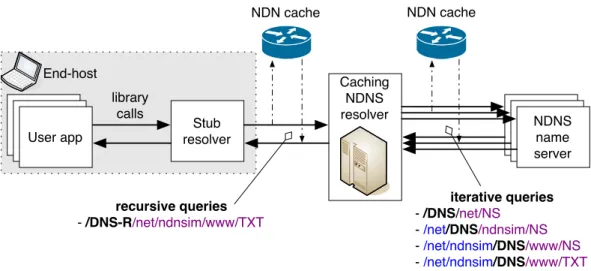
Following the model of DNS, the design of NDNS provisions two types of the resolvers: caching resolvers and stub resolvers (see Figure 3.5). Caching resolvers
are applications installed on dedicated servers inside the ISP networks that are responsible for performing iterative queries in response to the incoming recursive queries from the stub resolvers (see Sections 3.1.4.1 and 3.1.4.2). Stub resolvers are simple programs usually embedded inside applications that perform NDNS queries upon application requests.
App Stub resolver Remote DNS server Remote DNS server NDNS name server App User app Caching NDNS resolver recursive queries - /DNS-R/net/ndnsim/www/TXT iterative queries - /DNS/net/NS - /net/DNS/ndnsim/NS - /net/ndnsim/DNS/www/NS - /net/ndnsim/DNS/www/TXT NDN cache NDN cache End-host library calls
Figure 3.5: Interaction diagram between different types of resolvers in NDNS
Caching resolvers play a crucial role in the DNS protocol: they enable scala-bility and speed up query resolution. In NDN the scalascala-bility function is shared between the application layer of the caching resolvers and the network layer of in-network caches. This makes caching resolvers in NDNS, to some extent, less critical than in DNS. At the same time, the caching resolver is still a necessary component of the NDNS infrastructure, functioning to guarantee application-level cache (NDN’s cache is best-effort and is shared between all NDN applications) and facilitate fast resolution of names from the stub resolvers. In other words, the data-centric iterative querying process (Section 3.1.4.1) may require more In-terest/Data exchanges than the equivalent DNS process, because of the desire to leverage NDN’s in-network caching and share intermediate query results. As a result, the caching resolver can effectively lessen the overhead of NDNS lookups and share query results between different users at the application level.
3.1.4 Query protocol
The initial goal in the design of NDNS is to borrow intact most of the existing DNS design concept, unless modification is necessary or there proves to be substantial benefits from modifying elements.
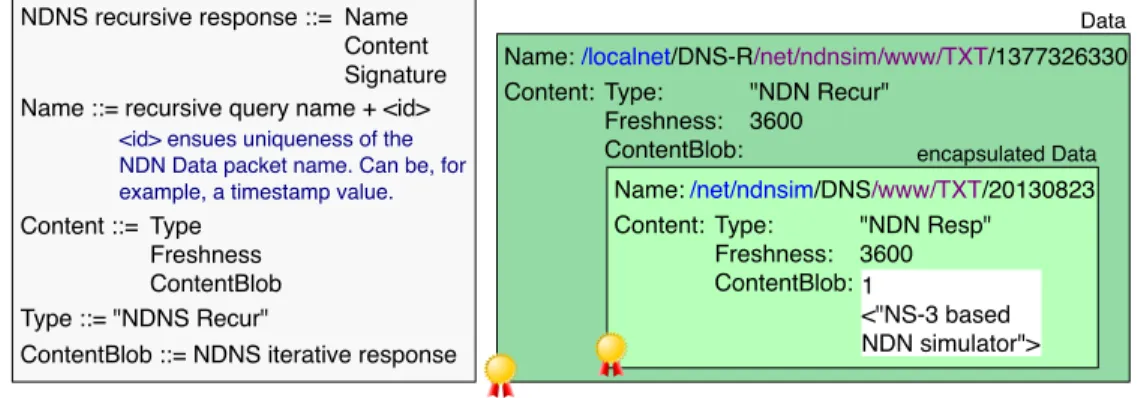
One major change necessary due to the communication paradigm shift is an almost complete redesign of the NDNS query format, and to some extent, both the iterative query and the recursive query protocol. In other words, because of the data-centric nature of the NDN architecture, any request in NDNS has to be in the form of an Interest, needs to be appropriately named, and cannot contain any DNS-like wire format payload. The response, on the other hand, is returned in the form of a Data packet that can contain any payload. In particular, in the NDNS python-based prototype implementation using PyNDN [KB11], all iterative queries yield a Data packet containing a properly formatted response message in DNS wire format as a payload, in addition to other required fields such as name (with version component), freshness, timestamp, and signature. The security and integrity of the NDNS system is discussed in detail in Chapter 4, but it is worth noting here that NDN also imposes another major change to the protocol (compared to DNSSEC): security granularity. NDN secures the Data packet, that is, the whole NDNS response message, not individual RR sets, as DNSSEC does. Although this somewhat restricts flexibility of the protocol, it assures data-centricity and all resulting benefits of the architecture (channel independence, efficient reuse of caches, natural multicast, etc.).
The rest of this section discusses necessary changes to (or new designs of) the iterative and recursive query protocols in detail.
3.1.4.1 Iterative query
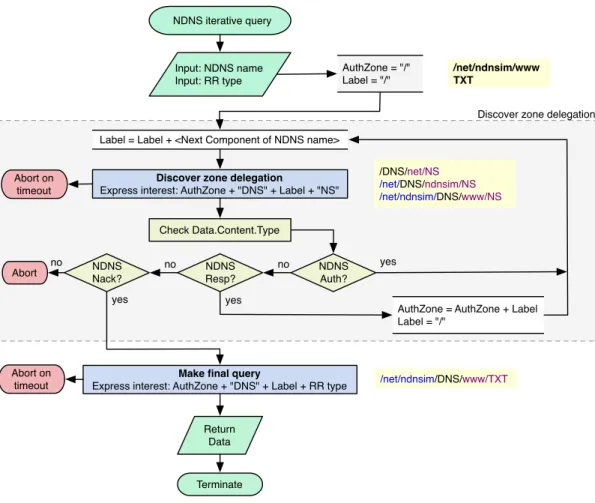
Since NDN inherently does not have the concept of a destination address, there is a need to somehow bring the implicit communication with the intermediate name servers into the explicit plane. In other words, requests for the root zone data should be different from requests for an SLD’s zone data. Also, keeping the objective of leveraging NDN caches, requests from different end-hosts towards the root server asking for a “.com” referral should always have the same name, regardless of what the original request was.
To address these challenges, the proposed NDNS design significantly changes how iterative queries are performed:
• Instead of asking a name server, Interests are expressed for data in a specific zone, with the potential of requesting a hint where the authoritative name server could be located (see Chapter 6).
• Each question to different zones is unique, even if asking about the same domain. This way, referrals can be clearly separated from the real answer or subsequent referrals.
• Each step of the iterative query progressively specializes the asked question: the least specific question is towards the root zone (asking for the SLD referral) and the most specific question is to the final zone authority. In this way, intermediate results can be effectively cached and then reused by later Interests from the same or other iterative resolvers.
The last change is the most intrusive and potentially most violating of basic DNS principles: name servers no longer receive the full question that iterative resolvers are searching for, rather a subquestion for intermediate information. The primary loss is that if the name server somehow knows the answer to the final question, it cannot return the answer, since it is being asked a completely