Web-service architecture for tools supporting liflong
e-Learning platforms
Aleksandar Dimov, Krassen Stefanov
Sofia University “St. Kl. Ohridski”, Faculty of Mathematics and Informatics 5 James Bourchier Blvd.
Sofia, Bulgaria
[email protected], [email protected]
It is widely recognized that modern European society needs adequate means for lifelong adapted access to facilities that support the creation, storage, use and exchange of formal and informal knowledge and learning resources. A key factor to achieve this is the adoption of Information and communication technologies and the work presented here reports on an approach involving the latest concepts of software engineering into lifelong learning solutions. The paper presents a reusable and extensible service-oriented architecture that supports implementation of different tools that support life-long eLearning platforms.
Keywords: Lifelong learning, Social Networks, SOA.
1 Introduction
Currently, the European knowledge economy needs stimulation by providing ubiquitous and lifelong adapted access to facilities that support the creation, storage, use and exchange of formal and informal knowledge and learning resources. This aim also corresponds to the European agenda to stimulate lifelong learning as expressed in national and international policy documents. In the Commission's memorandum on Lifelong Learning [12] it is stated that: "Lifelong Learning is no longer just one aspect of education and training; it must become the guiding principle for provision and participation across the full continuum of learning contexts" (page …). As outlined in [1], lifelong learning refers to the activities that people perform throughout their life to improve their knowledge, skills and competence in a particular field, given some personal, societal or employment related motives.
It is widely accepted that lifelong learning should result in competences that are widely recognized and interoperable and should be adapted to take into account individual characteristics (preferences, needs, language, etc.). The use of Information and Communication Technologies (ICT) and more specifically, Internet, should be the key to achieving worldwide Lifelong competence development. To this end, there is a need for a better integration of existing learning and knowledge dissemination resources and activities. One possibility to involve the strengths of ICT in this process is to create and provide a framework for communication between people, based on similar learning development interests. Social networks are widely recognized as means for connecting people, based on their common preferences, goals and habits. Examples for popular social networks, that have a huge number of users registered, are myspace [17], facebook [14], hi5 [16], etc. Learning network is a very similar term to social network, representing a self-organized, distributed system, designed to facilitate lifelong learning in a particular knowledge domain [7, 8]. Usually learning network consists of:
• Users, i.e. lifelong learners, who are people with the intent to learn and the willingness to share their knowledge in the specified domain. Users may be grouped into different communities, according to their learning interests
• Knowledge resources that represent collections of learning materials, activities and opportunities, that are created and shared in order to exchange knowledge and experience, or to develop competences in the domain.
• A set of defined learning outcomes, or 'goals' (competences and/or specific competence levels). Research in the field has shown [4] that current e-learning and knowledge management environments provide limited support to the users in their various tasks. Also, there has been little unifying work which integrates models and tools for competence development during learning and working and across a lifetime. The TENCompetence integrated project [18], funded by the European Commission, provides valuable approaches for solving these problems, by offering specific models and approaches based on supporting users in their orientation in the social network [13]. In this paper we present a software solution aimed at providing reusable tools that support management and orientation of users within learning networks. We propose Service Oriented Architecture (SOA) framework for the implementation of the tools needed.
Next section of the paper describes the technologies used to implement the architecture. The framework and tools are described in section 3, followed by the concluding remarks section.
2 Technologies used
As a basic technological concept for our work we use Service-Oriented Software Engineering (SOSE), which is a contemporary paradigm in the area of software reuse. However, concepts and definitions are still somehow ambiguous. As stated in [2] service is a broad term that has different meanings depending on its usage context. For example, in computer science the terms of web-service, e-service and business e-service have common meaning. In this paper, we will focus on web-e-services (WS), which are broadly recognized [11] as: loosely coupled reusable software components that encapsulate discrete functionality and are distributed and programmatically accessible over standard Internet and XML-based protocols.
For building the SOA solution presented here we use the REpresentational State Transfer (REST) [5], which is an architectural style [6] aimed for distributed systems. REST is not strictly oriented to service-oriented systems, but still is very suitable for this purpose. It defines rules for how different resources should be identified and addressed, which is very similar to the classic web-service access protocols such as SOAP. REST does not rely on heavy additional meta-model layer, which is typical for SOAP.
Typically, REST regards all units in a system (this also includes system functionality and different states of its modules) or software application as a resource. This resource in turn may be accessed and modified via a Unique Resource Identifier (URI). For web-based systems, as World Wide Web, this URI is equivalent to typical URL (Universal Resource Locator), which is practically a web-address, accessible by any web-browser.
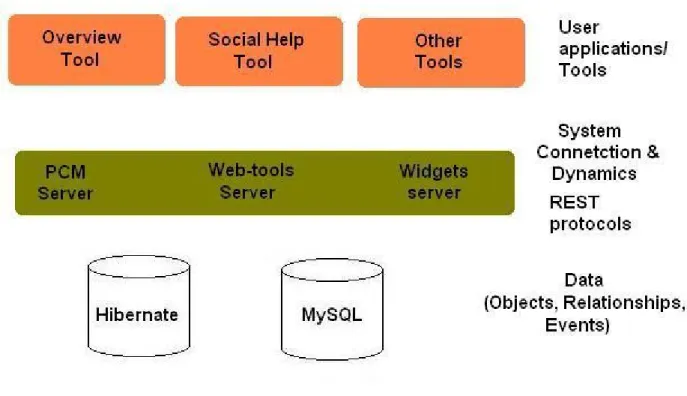
Besides REST we also use the multilayer client-server architectural style [10], which has proved itself as a successful solution for distributed systems. This way our architecture divides the data layer from the service layer (implemented as REST), as shown on Figure 1.
Figure 1: Basic three-layer architecture
The database layer technology in use is Hibernate [3], is a popular open source object/relational mapping (ORM) tool. It offers transparent persistence for typical java objects and makes an abstraction over the classical SQL tables. This way the selected solution increases the reusability of the tools and more specifically the particular architecture, described in next section of the paper.
3 Web-service architecture
Tools presented in this paper are supposed to complement the life-long learning system, developed under the TenCompetence project. The core of this system is a server, that holds all relevant data about users, i.e. their profiles, preferences, competence development plans and etc. This server is called the Personal Competence Management (PCM) server.
Figure 2: SOA architecture for lifelong learning systems
As seen from the picture above, the proposed architecture supports multiple servers, which should fulfill the requirement that support REST. In fact, this is the original goal of TenCompetence project – to
provide IT solutions based on open standards like REST. Based on the services provided by this architecture we have developed two particular tools, supporting the management of lifelong learning. These are the Overview Tool [4] and the Social Help System [9] (also known as Network Management Tool). The technology used for actual implementation of OVT is Adobe Flex [15].
In order to provide the framework for functioning of the tools described above, we have designed a database with several tables, supporting information about:
• users contacts
• users’ best friends (also called buddies)
• personal data
• preferred types of learning resources
3.1 Overview Tool
The goal of the OverView Tool (OVT) is to enrich users' experience by providing data models which will allow more relevant matches between users to be made. It should also provide an integral overview of different Knowledge Resources (KR) that are available to users. In order to stimulate knowledge sharing and communication between people, it should also develop, test and integrate value-added components such as connection agents, simulation and game dynamics embedded in online competence development contexts.
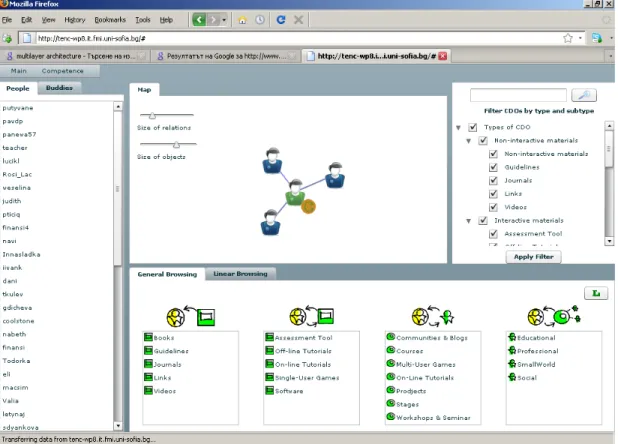
OVT aims to provide an overview of all the possible formal and informal competence development programmes available. It consists of three main parts: Visualization maps, General browsing perspective and Linear browsing perspective. In order to simplify orientation of users for all available KR, they are divided in some categories and subcategories and the general browsing view of OVT gives an overview of all available categories of KR and also lists the subcategories of each category (Figure 3). Further users may explore possibilities for learning development by looking through all particular KR available that belong to a given subcategory. The visualization map gives a general overview perspective in terms of relations of the user with her/his competences (both acquired and desired) and her/his contacts and buddies. It also has the possibility to show the relation of the competence development plan of the user with available KR (learning resources and people over the learning network).
3.2 Social Help Tool
The main problem that motivates the implementation of Social Help Tool (SHT) is the critical necessity to reconsider and alleviate the load (or absence) of tutors and other academics staff needed to support the lifelong learners. The SHT aims to address the lack of individual experts and mentors in the learning networks. It provides users with opportunities to get help about a given learning topic from the learning network community (Figure 4). When the user asks her/his question the tool analyzes it and tries to find other learners from the community, who possess the competences needed to answer the question. After this step a discussion on the question may start either by e-mail or forum.
Figure 3: Overview Tool
4 Conclusion
The work reported in this paper presents an approach to build software tools that support the management of user activities within lifelong learning networks. A scalable distributed architecture based on REST services is developed for this purpose. It makes available integration of different servers that provide services for such tools and other client applications. Some modern technologies as Hibernate and Flex were used to implement the architecture and the Social Help and the Overview Tools presented in section 3 of the paper.
Our plans for future work include user evaluation of the tools and also improvement of their underlying models.
5 Acknowledgements
The work reported in this paper is partially supported by the SISTER project, funded by in FP7-SP4 Capacities via agreement No 205030 and the TENCompetence project, funded by the European Commission, under contract No 027087.
Refferences
1[1] Aspin, D., and J. Chapman, Lifelong learning: concepts and conceptions, in International Journal of lifelong education, vol. 19(1), 2000, pp. 2-19.
[2] Baida, Z., J. Gordijn and B. Omelayenko, A shared service terminology for online service provisioning, in Proceedings of the 6th international conference on Electronic commerce, Delft, The Netherlands, 2004
[3] Bauer, C., and G. King etherlands, Hibernate in action, Manning, 2004
[4] Cheak A., A, Angehrn, and P. Sloep, Enhancing the Social Network Dimension of Lifelong Competence Development and Management Systems: A Proposal of Methods and Tools, in Proceedings of the Learning Networks for Lifelong Competence Development Workshop, Sofia, Bulgaria, 2006
[5] Fielding, R., Architectural Styles and the Design of Network-based Software Architectures, PhD Thesis, University of California, Irvine, 2000
[6] Garlan, D.: What is Style?; In Proceedings of Dagshtul Workshop on Software Architecture, February 1995
[7] Koper, R, The TENCompetence Domain Model, TENCompetence Project Report, July 10, 2006 <http://dspace.ou.nl/handle/1820/649>
[8] Koper, R., et al, A design model for lifelong learning networks, in Interactive Learning Environments (1-2), 71-92, 2005
[9] van Rosmalen, et al, A learner support model based on peer tutor selection, in Journal of Computer Assisted Learning, vol. 24(1), 2008, pp. 74-86
[10] Shaw, M., and D. Garlan, Software architecture: perspectives on an emerging discipline, Prentice-Hall, Inc., 1996
[11] Sommerville, I. (2006) Software Engineering, USA: Addison Wesley.
[12] European Commission Staffworking Paper, A Memorandum on Lifelong Learning, Brussels, 30.10.2000, < http://www.bologna-berlin2003.de/pdf/MemorandumEng.pdf >
[13] D8.1 Report with overall WP8 results during month 1-18, and a roadmap of networks for lifelong competence development RTD <http://dspace.ou.nl/handle/1820/1120>
[14] Facebook – social network <http://www.facebook.com>
[15] Adobe Flex 3 overview, <http://www.adobe.com/products/flex/overview/> [16] hi5 – social network <http://www.hi5.com>
[17] MySpace – social network, <http://www.myspace.com>
[18] The TENCompetence project – Building The European Network for Lifelong Competence Development <www.tencompetence.org>