Wang, X., Tiwari , P., & Chen, X. (2017). Communicating supply chain risks
and mitigation strategies: a comprehensive framework. Production Planning
and Control, 28(13), 1023-1036.
https://doi.org/10.1080/09537287.2017.1329562
Peer reviewed version
Link to published version (if available):
10.1080/09537287.2017.1329562
Link to publication record in Explore Bristol Research
PDF-document
This is the author accepted manuscript (AAM). The final published version (version of record) is available online via Taylor & Francis at http://www.tandfonline.com/doi/full/10.1080/09537287.2017.1329562. Please refer to any applicable terms of use of the publisher.
University of Bristol - Explore Bristol Research
General rights
This document is made available in accordance with publisher policies. Please cite only the published
version using the reference above. Full terms of use are available:
Communicating supply chain risks and mitigation strategies: a
comprehensive framework
Xiaojun Wang
1*, Puneet Tiwari
1and Xu Chen
21.
Department of Management, University of Bristol, Bristol, BS8 1TN, UK,
Email:
[email protected]
,
[email protected]
2.
School of Management and Economics, University of Electronic Science and
Technology of China, Chengdu, 611731, P. R. China. E-mail:
[email protected]
Abstract:
Concerning the increasing emphasis on risk management in this uncertain global environment, there is an urgent demand for practical decision support tools that support supply chain risk communication and management. This research proposes an integrated framework that takes explicit account of multiple types of risk in aiding decision-making, and compares and ranks alternative risk mitigation strategies individually and collectively in indicator basis using fuzzy set theory and multiple criteria decision analysis (MCDA) methods. Through an illustrative case, the research demonstrates that the proposed framework provides a holistic view of supply chain risks and enables firms to foresee, spot and respond to the exposed risks in an effective and efficient manner.
Keywords: Supply chain risk management, strategy evaluation, risk mitigation, fuzzy risk assessment, multiple criteria decision analysis
1. Introduction
Managing a supply chain efficiently to fulfil customer needs is a challenging task. Various sources of uncertainty and complex interrelationships between different entities make the supply chain even harder to manage. Globalization adds further complexity to supply chains which are usually slow to respond to changes and more vulnerable to various disruptions. For instance, the global automotive and electronics supply chains experienced severe disruptions after the earthquake, tsunami and the subsequent nuclear crisis in Japan in 2011. It is reported that the disaster caused supply chain disruptions which costed Toyota $72 million in profits per day (Pettit et al. 2013). The supply chains of Japanese automotive companies with plants in Thailand were disrupted by the catastrophic flooding in 2011, and the same flooding also severely affected the supply chains of computer manufacturers that rely on the supply of hard discs from the region (Chopra and Sodhi 2014). Aon Risk Solution reported in their recent study that the percentage of global firms reporting a loss of income because of a supply chain risk rose from 28% in 2011 to 42% in 2013 (Saenz and Revilla,2014).
To mitigate the negative impacts of supply chain risks, researchers have proposed various strategies such as the real option (Cucchiella and Gastaldi 2006), flexibility (Tang and Tomlin 2008), and buffer strategies (Chopra and Sodhi 2004). In order to adapt quickly and effectively to the changing environment, supply chains need to be flexible and work in a more collaborative manner. Businesses
have recognized the potential competitive advantages of being resilient in a volatile market condition, being agile for coping with increased environmental uncertainty and reacting within smaller windows of opportunity for decision-making (Giachetti et al. 2003). However, implementing appropriate strategies is important, because any strategic investments based on poorly considered ‘competencies’ could be detrimental (Narasimhan et al. 2004; Sawhney 2006). For instance, flexibility in delivery quantity and due date could lead to a reduction of production cost and, at the same time, compromise service by increasing the risk of failing to meet customer demand.Selecting appropriate strategies for supply chain risk mitigation is a difficult task due to the complexity of decision-making. There is a practical need for business managers to effectively communicate the supply chain risks and selecting appropriate mitigation strategies.
Furthermore, Sodhi et al. (2012) pointed that there is lack of empirical research on supply chain risk management especially in the area of response to supply chain risk incidents. Heckmann et al. (2015) also concluded in their recent review on supply chain risk management that there is lack of a clear and adequate quantitative measure reflecting the characteristics of modern supply chains. To address the practical needs and fulfil the research gaps, this paper proposes a comprehensive framework, which integrates fuzzy risk assessment, fuzzy Delphi, and fuzzy TOPSIS for the communication of supply chain risks and risk mitigation strategies. Through an illustrative case of a kitchen appliances manufacturer, the research attempts to demonstrate how the proposed framework can facilitate such communication and support managers in making important strategic decisions on supply chain risk management. The research aims to make the following contributions:
• This research complements the existing literature on supply chain risk management by proposing a comprehensive framework that facilitates an effective communication of supply chain risk analysis and evaluation of risk mitigation strategies.
• This research develops a practical decision-support tool by incorporating several fuzzy based MCDA methods that enables supply chain firms to deal with the complex supply chain risk related decisions in an efficient manner.
• The research also intends to make practical contributions by illustrating how the proposed framework can be employed by industrial organisations to support a resource effective and time efficient decision-making on supply chain risk mitigation strategy.
The rest of the paper is organized as follow. Section 2 provides the review of related work and research approaches on supply chain risk assessment and risk mitigation strategies. Section 3 offers a detailed explanation of proposed framework. In Section 4, a case study is presented to demonstrate its functionality, along with a cost benefit analysis of the proposed framework. Findings from the case study are discussed in section 5, which also provides conclusions and suggests future research directions.
In this section, we mainly review the studies that are representative and relevant to our research, which primarily focus on three streams: (i) supply chain risk management, (ii) supply chain risk mitigation and management strategies, and (iii) supply chain risk assessment methods.
2.1 Supply chain risks management
In a supply chain, uncertainty is a major factor that can influence the effectiveness of supply chain coordination. With the increasing trend of collaboration with international supply partners and extended supply networks, it also brings uncertainties that significantly threaten normal business operations of the organizations in the supply chain. The sources of uncertainty are often classified into three categories: supply, process and demand (Lee and Billinton 1993; Childerhouse and Towill 2002; Ho et al. 2005; Tang and Tomlin 2008). Supply uncertainty is often caused by variability brought by the suppliers such as the faults or delays in delivery. A long logistics cycle affects product availability and increases the risk of inventory obsolescence. Demand uncertainty is often presented as a volatile demand. Mistakes in demand forecasting may either lead to excessive product inventory or loss of opportunities. Process uncertainty, also known as manufacturing uncertainty, is a result of unreliable production process. While process uncertainty has often been discussed in the literature of production and manufacturing studies, demand uncertainty and supply uncertainty are two of the most common supply chain risks that have been widely studied in the literature (Handfield et al. 2009).
Supply chain risk or vulnerability has emerged as a key challenge to supply chain management (SCM). Supply chain risk management (SCRM) is a field of escalating importance which aims to develop approaches to the identification, assessment, analysis and treatment of vulnerable areas and risks in supply chains (Neiger et al. 2009). When assessing supply chain risk, the causes, probability, and consequences for each potential risk have to be collected and documented. A growing number of studies look into risk from different perspectives including economics, finance and international management (Jüttner, 2005). SCM scholars tend to focus on risks associated to supply and demand coordination and uncertainty (Nagurney et al. 2005; Cigolini and Rossi 2006; Tang and Tomlin 2008; Xia and Chen 2011; Chan and Wang 2013) and disruption risks that are caused by labour strike, natural disaster, and terrorism (Kleindorfer and Saad 2005; Tang 2006a; Knemeyer et al. 2009; Wagner et al. 2014). For instance, Nagurney et al. (2005) incorporated both demand and supply side risk sin the development of a supply chain network model. Tang and Tomlin (2008) explored the role of flexibility strategies in managing risks associated to demand, supply, and process. The vulnerability of supply chains to disruption risks is increased due to the globalisation and business initiatives such as lean operation. Kleindorfer and Saad (2005) developed a conceptual framework including both risk assessment and risk mitigation activities that are fundamental to manage disruption risk in supply chains. Knemeyer et al. (2009) looked at the role of proactive planning in dealing with the disruptive risk events. Wagner et al. (2014) investigated the complex supply chain network of the US offshore oil industry with an aim of quantifying possible losses from supply chain disruptions.
2.2 Risk mitigation and management strategies
In order to reduce any adverse impacts, there is a need for supply chain organizations to adapt to such an uncertain environment. The literature in SCRM has provided extensive studies that investigate supply chain risk phenomena and propose models for analysing and mitigating different types of supply chain risks. Among them, Juttner (2005), and Zsidisin and Ritchie (2008) provided comprehensive review of models used for an effective SCRM. Tang (2006b) developed a unified framework for the classification of quantitative models for SCRM. Chopra and Sodhi (2004) highlighted mitigation strategies that manufacturing organizations can apply to deal with different types of risks. Tang (2006a) pointed that robust strategy for mitigating supply chain disruptions can not only manage the inherent fluctuations efficiently but also lead to a more resilient supply chain facing major disputations.
More specifically, Lee (2004) expressed that alignment, adaptability, and agility are the basic ingredients for SCRM. Essentially, alignment and adaptability connote long- and medium- term perspectives respectively while supply chain agility provides a firm the ability to reduce the impact of short-term changes in supply or demand (Tang and Tomlin 2008). Faisal et al. (2006) listed key enablers for supply chain risk mitigation including supply chain agility, information sharing, trust, and collaborative relationships etc. Yang et al. (2009) categorized the tools and strategies for SCRM into four main themes: multi-sourcing, alternative supply sources and backup production, flexibility, and supplier selection. Additional illustrative recent research is presented in Table 1, which summarizes the main supply chain risk mitigation strategies of the highlighted papers, their focus and perspective. Table 1 Strategies for mitigating supply chain risks
Risk type Risk mitigation
strategies Underlining mechanisms Relevant studies
Supply risk
Multiple suppliers Change order quantities between suppliers
Anupindi and Akella 1993; Jüttner et al. 2003; Tang 2006a,b; Babich et al. 2007; Wieland and Wallenburg 2012 Flexible supply contract Make different quantity
orders through time
Tsayand Lovejoy 1999; Lei et al. 2012;
Supplier selection Vendor certification and appraisal
Deng and Elmaghraby 2005; Hwang et al. 2006; Wu and Olsen 2008;
Demand risk
Postponement Change production quantities for different products
Lee and Tang 1997; Jüttner et al. 2003; Yang and Yang 2010; Gualandris and Kalchschmidt 2015;
Responsive pricing Manage demand for different products
Van Mieghem and Dada 1999; Wang and Li 2012; Wieland and Wallenburg 2012;
Process risk Flexible production or manufacturing
Shift production quantities across internal resources
Jordan and Grave 1995; Zhang et al. 2003;
Control strategies
Increase stockpiling and maintain excess capacity in production, storage, handling etc.
Jüttner et al. 2003; Tang 2006a,b;
Disruption risk
Robust supply chain strategies
Strategies aiming at reducing the frequency and severity of risk both at firm and supply chain level
Kleindorfer and Saad 2005; Tang 2006a; Craighead et al. 2007;
Increase supply chain capacity through enhanced partnership
Continuous coordination, cooperation, and
collaboration among supply chain partners
Jüttner et al. 2003; Kleindorfer and Saad 2005; Tang 2006a,b; Chopra and Sodhi 2014.
Furthermore, the importance of information flows in supply chains has been highlighted by many scholars (Lee et al. 2000; Dimitriadis and Koh 2005;Baihaqi and Sohal 2013). Kleindorfer and Saad (2005) emphasised that information sharing across supply chain parties increases the supply chain visibility of vulnerabilities. Tang (2006b) regarded information sharing as one of the strategic and tactical plans for managing supply chain risks. Yang et al. (2009) found that asymmetric information can make a pronounced impact on risk management strategy of a manufacturer. Wakolbinger and Cruz (2011) claimed that information sharing promotes the opportunity for the implementation of best practices throughout the supply chain for identifying and managing disruption risks.
It is important for organizations to be aware of anticipation, preparation and managing the dynamics of the market places and associated risks. However, choosing appropriate strategies for mitigating supply chain risks is not an easy task. For instance, Oh et al. (2013) pointed that although different flexibility strategies were proposed for risk management by many recent studies, how these strategies can be applied to the supply chain still remains unclear. Moreover, the implementation of green strategy will reduce the environmental risks and generate a competitive edge for a firm, and at the same time, a wrong choice of green strategies may result in considerable operational problems (Wang et al. 2012; Chen and Wang 2016). Since most organizations do not have sufficient resource to implement these risk mitigation strategies, it is important to have an effective decision support method that enables organizations to evaluate various strategies based on their specific business needs.
2.3 Risk assessment and multiple criteria decision analysis (MCDA)
Kleindorfer and Saad (2005) emphasized that the foundation of effective SCRM requires three key tasks: specification of sources of risk, risk assessment and risk mitigation. These three key tasks are adapted in our proposed framework for communicating and managing supply chain risks. Among many quantitative and qualitative risk assessment methods, there is a growing number of studies that apply MCDA methods to risk assessment and management, as illustrated in Table 2. The MCDA methods are also adopted in our framework as the evaluation of supply chain risk mitigation strategies also involves multiple factor analysis. While the detail of the proposed decision model is presented later, this section briefly reviews each method that is integrated into the proposed framework
Table 2 Applications of MCDA and fuzzy methods in risk assessment.
Methods Application area Relevant studies
AHP Supply risk; supply chain risk; Wu et al. 2006; Gaudenzi and Borghesi 2006; Chen and Wu 2013.
ANP Supply chain decision making risk Xia and Chen, 2011. Fuzzy AHP Global suppliers; implementation
risk
Chan and Kumar 2007; Wang et al. 2012b.
Fuzzy TOPSIS Environmental risk Paksoy et al. 2012.
Fuzzy PROMETHEE Environmental risk Zhang et al. 2009.
Others:
AHP+ goal programming Supplier selection; Kull and Talluri2008;
AHP+QFD Supplier selection Ho et al. 2011. Fuzzy AHP+Fuzzy TOPSIS Supplier selection; entire supply
chain risk
Viswanadham and Samvedi 2013; Samvedi et al. 2013.
AHP+Fuzzy logarithmic least squares
Strategic risk Arikan et al. 2013.
Fuzzy ANP +Fuzzy logic Environmental risk Liu and Lai 2009.
2.3.1 Fuzzy risk assessment
Most risk assessment problems contain a mixture of qualitative and quantitative data. Often, using quantitative or qualitative risk assessment techniques alone is inadequate for prioritizing risks. Baloi and Price (2003) argued that as most risk analysis tools are developed on statistical decision theory, and organizations rarely use them in practice. In addition, substantial uncertainties and subjectivities in the risk assessment process have hampered the applicability of many risk assessment methods discussed earlier. Nonetheless, the application of fuzzy set theory (Zadeh 1965) in the risk assessment enables qualitative risk assessment descriptions to be modelled mathematically. For instance, Wirba et al. (1996) applied linguistic variables and fuzzy logic to quantify the likelihood of a risk event occurring, the level of dependence between risk and the severity of a risk event. It is an effective way to deal with complicated problems in an uncertain decision-making environment. It enables assessors to quantify imprecise information and incorporate vagueness in the assessment. There have been growing attempts to exploit fuzzy logic in the risk assessment domain. A number of applications of fuzzy risk assessment have been reported recently including: environmental risk (Sadiq and Husain 2005; Chen et al. 2010; Pan and Chen 2012), food safety risk assessment (Davidson et al. 2006; Wang et al. 2012a), and supply chain risk assessment (Chan and Kumar 2007; Samvedi et al. 2013). This research also takes the advantage of fuzzy method in assessing risks. However, one key difference compared to the above studies is that the evaluation of risk mitigation strategies is incorporated in this research in order to effectively communicate and manage supply chain risks.
2.3.2 The fuzzy Delphi method
Delphi is a technique developed by Dalkey and Helmer (1963) to obtain the most reliable consensus of a group of experts. Although it is a flexible technique to explore new concepts and has been widely applied in many management areas including outsourcing (Shishank and Dekkers 2013), servitization (Baines and Shi 2015), and technology transformation projects (Fosso and Ngai 2015), the traditional Delphi method has its own limitations (Joshi et al. 2011). One of the approaches to tackle the shortfalls is the incorporation of fuzzy set theory with Delphi method. For example, Hsu & Yang (2000) used triangular fuzzy number (TFN) to encompass expert opinions and establish the Fuzzy Delphi Method. Their method does not only encompass all the expert opinions in one investigation but also has the advantage of simplicity, which provides a better outcome of criteria selection. Fuzzy Delphi is regarded by many researchers (Kuo and Chen 2008; Leet et al. 2013; Wang and Durugbo 2013) as an efficient and cost effective approach which incorporates expert opinions in achieving the consensus of group decisions
2.3.3 Fuzzy TOPSIS
Among many MCDA methods, TOPSIS is a practical and useful technique for ranking and selecting possible alternatives.The main concept of TOPSIS is to define the positive ideal solution and negative ideal solution (Hwang and Yoon 1981). The most preferred alternative should have the shortest distance from the positive ideal solution and the longest distance from the negative ideal solution. The criticism of TOPSIS in its inability to deal with vagueness and imprecision inherent in the process of mapping the perceptions of decision-makers has also led to its merging with fuzzy theory (Krohling and Campanharo 2011). Fuzzy TOPSIS has successfully been used to solve various MCDA problems such as supplier selection and evaluation (Chen et al. 2006; Sevkli et al. 2008; Büyüközkan and Çifçi 2012), determination of investment regions (Eraslan and Ic 2011), and evaluation of new product design (Kahraman et al. 2007; Wang and Chan 2013).
2.3.4 Adoption of MCDA methods in SCRM
There is a growing literature on adopting the MCDA methods and their fuzzy extensions in SCRM in general because of the multiple factor nature of supply chain risks (Gaudenzi and Borghesi 2006; Wu et al. 2006; Xia and Chen 2011; Wang et al. 2012b; Chen and Wu 2013). Different combinations of MCDA methods have also been used in various frameworks and decision models (Wang and Durugbo 2013, Samedi et al. 2013; Wang 2015). In relation to this study, Samedi et al. (2013) integrated fuzzy AHP and Fuzzy TOPSIS for quantifying supply chain risks. In their study, there is no systematic approach to identify supply chain risks, and instead quantifying of probability and severity of risk, the score for the risk types is estimated through calculating their proximity to the ideal value. Wang and Durugbo (2013) applied fuzzy TOPSIS to evaluate alternative solutions through analysing network uncertainty for industrial product-service delivery. The main focus of their study is centred on
evaluating the uncertainty of service networks that deliver an industrial product-service system but not how to communicate the assessment of supply chain risks and the evaluation of risk mitigation strategies, which is the focus of this research. Using a similar set of MCDA methods, Wang (2015) proposed a decision-making model to support selecting an appropriate green strategy according to firms’ operational resources. Again, different to the focus of this study, the above research mainly concentrates on the evaluation of green operations initiatives in order to achieve sustainable organisational and environmental performance.
Despite the increased attention on risk management in the SCM literature, few studies have focused on the effective communication of risk assessment and risk mitigation strategy evaluation that enables companies to make appropriate decisions for a more resilient supply cairn. This research is different to many other studies as we try to integrate the communication of supply chain risk analysis and evaluation of the available risk mitigation strategies into one comprehensive framework. It enables to take explicit account of multiple types of risk in the analysis systematically and to compare and prioritise alternative mitigation strategies according to organisations’ resources and capabilities. Our focus is to address the industrial needs for practical decision support tool that supports effective risk communication and sensible decision making on the adoption of supply chain risk mitigation strategy.
3. A methodological framework for supply chain risk communication and management
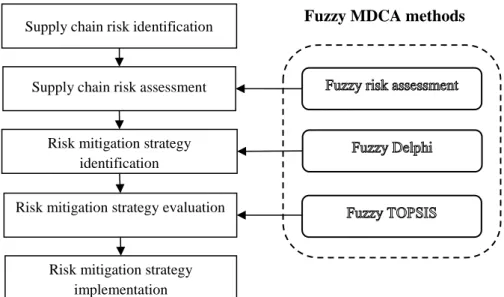
The framework, illustrated in figure 1, focuses on communicating the assessment of supply chain risks and prioritizing alternative risk mitigation strategies through the fuzzy risk assessment and MCDA methods. Firstly, a supply chain risk assessment matrix is proposed to systematically identify relevant risks and conduct an initial assessment. It is followed with quantifying the level of identified risks through the use of fuzzy set theory. Fuzzy Delphi is then applied to extract identified supply chain risk mitigation strategies for further evaluation. Moreover, fuzzy TOPSIS is employed to acquire the priority ratings of identified strategies for mitigating supply chain risks. Finally, the analysis result can be used to develop a plan for implementing appropriate risk mitigation strategies.
According to the Royal Society (1992), “risk is the chance, in quantitative terms, of a defined hazard occurring. It therefore combines a probabilistic measure of the occurrence of the primary event(s) with a measure of the consequences of that/those event(s)”. Hence, risk reflects both the range of possible outcomes and the distribution of respective probabilities for each of the outcomes. This definition could be expressed as:
S
P
R
(1)where R is the risk associated with a hazardous event, P represents the probability (or likelihood) of the occurrence of the hazardous event, S represents the severity or consequence of the event. This definition can also be illustrated in the supply chain risk assessment matrix shown in Figure 2. By positioning various supply chain risks on the matrix, it provides an overall view upon all risks, and makes the risks
that require the most attention visible. In addition, it indicates whether the risks can be mitigated by decreasing their probability or the severity of their consequences.
Figure 1. Supply chain risk communication and management framework
Figure 2 Supply chain risk assessment matrix
3.2 Fuzzy risk assessment
It is essential to assess the risks once a number of potential risks that have been identified. A comprehensive quantitative risk assessment along the supply chain may not be allowed in many cases due to constraints in time, data quality or other resources. Moreover, uncertainty problems cannot be simply expressed by using the concept of probability. Fuzzy theory has often been applied to solve similar problems with uncertain nature.
Supply chain risk identification
Supply chain risk assessment
Risk mitigation strategy identification
Risk mitigation strategy evaluation
Risk mitigation strategy implementation
Supply chain risk communication & management steps
Fuzzy MDCA methods
Supply chain risks
Severity Severe Minor P ro ba bil it y Low High Supply Risks Process Risks Demand Risks
A fuzzy number is a special fuzzy set, such that N = {(x, μN(x), x F)}, where the value of x lies on the real line F[0, 1]. TFN is employed to characterize the fuzzy values of quantitative data or linguistic terms are used in approximate reasoning. We define a fuzzy number N on F to be a TFN and the membership function can be described as:
otherwise
,
0
]
,
[
),
/(
)
(
]
,
[
),
/(
)
(
)
(
3 3 2 2 3 2 1 1 2 1n
n
x
n
n
x
n
n
n
x
n
n
n
x
x
N (2)where n1 ≤ n2 ≤ n3, n1and n3 stand for the lower and upper values of the support of N respectively, and
n2 denotes to the most promising value.
Table 3 explains the qualitative scaling system for severity of the risk, probability of an adverse effect consequential to the risk. Two fuzzy numbers Np and Ns with membership functions Np(x) and Ns(x) define the grades of the two risk factors respectively.
Table 3. Linguistic classification of risk grades
Grade of risk
A qualitative explanation of probability of risk (p)
A qualitative explanation of severity of the consequence (s)
Triangular fuzzy numbers (TFN) 1 Definitely low Definitely no effect (0.0, 0.0, 0.1) 2 Extremely low Extremely minor (0.0, 0.1, 0.2)
3 Very low Very minor (0.1, 0.2, 0.3)
4 Low Minor (0.2, 0.3, 0.4)
5 Slightly low Slightly minor (0.3, 0.4, 0.5)
6 Middle Middle (0.4, 0.5, 0.6)
7 Slightly high Slightly severe (0.5, 0.6, 0.7)
8 High Severe (0.6, 0.7, 0.8)
9 Very high Very severe (0.7, 0.8, 0.9)
10 Extremely high Extremely severe (0.8, 0.9, 1.0) 11 Definitely high Definitely severe (0.9, 1.0, 1.0)
To determine the risk level, the two risk factors are multiplied. To simplify multiplication calculations, a standard approximation is used as:
3 3 2 2 1 1 3 2 1 3 2 1 , , , , , , b a b a b a C B A C b b b B a a a A (3)
To ensure accuracy of the assessment, group risk assessment is incorporated in the model. First of all, a risk assessment team or group is formed. With reference to Table 1, a set of integers (from 1 to 11) are assigned to the two elements for each risk item in the supply chain risk assessment matrix by individual assessors according to her/his analysis of the hazard. Using fuzzy geometric mean, both fuzzy grading for the severity
s
~
i and likelihood ~pi of each item can be obtained using Equation (4) and
n in i i is
s
s
s
~
1~
2~
1~
(4)
n in i i ip
p
p
p
~
1~
2~
1~
(5)With the fuzzy grading, the risk level of identified risk item can be calculated individually as:
i i i
i i i Ug Mg Lg p s g , , ~ ~ ~ (6)whereLgi ,Mgi ,Ugi represent the lower, middle and upper values of the fuzzy grade of the ith risk item. Then, using the Centre of Area (COA) method, the non-fuzzy (i.e. defuzzified) risk value of the ith risk item is given as:
i i i i
ii Ug Lg Mg Lg Lg
g 3 (7)
The higher value indicates a higher risk level of the assessed risk item.
3.3 Risk Mitigation Strategy Identification with Fuzzy Delphi
Many strategies that mitigate supply chain risks have been discussed in the literature as described in Table 1. Although it is good to have choices of strategies for supply chain risk mitigation, how to tailor them with their various features and benefits is still a big challenge for many firms. Furthermore, not all the mitigation strategies discussed in the literature are applicable to many firms. To improve the efficiency and effectiveness of decision-making, it is important to select an appropriate number of risk mitigations strategies. For this purpose, fuzzy Delphi is applied to select relevant risk mitigation strategies for a further evaluation. This study applied the TFN functions to encompass export options and use the fuzzy theory to reach the consensus of group decisions. It is a cost effective and time efficient method as only a small number of samples are required and the outcomes are reasonably objective (Kuo and Chen 2010). Following the sources of Chang and Wang (2006) and Lee et al. (2010), the steps involved in the fuzzy Delphi method are described in Appendix 1.
3.4 Strategy evaluation with fuzzy TOPSIS
After the risk assessment, alternative strategies are then evaluated. Here, fuzzy TOPSIS is adopted to rank how effective alternative flexibility strategies are in managing different risks. Fuzzy TOPSIS incorporates the easiness of implementation of TOPSIS in a fuzzy environment. It is capable of capturing the vagueness of uncertainty in the evaluation of alternative risk mitigation strategies and provides the efficiency in the decision-making (Büyüközkan and Çifçi 2012; Samedi et al. 2013; Wang 2015). Following the sources of Wang and Durugbo (2013) and Wang (2015), the mathematical steps involved in the fuzzy TOPSIS method are described Appendix 2.
4. Case Study
This section presents a case study concerning a manufacturing company evaluating alternative strategies for supply chain risk mitigation. Found in 1984 and located in Ningbo, the second largest port in China, the case organization is specialised in manufacturing kitchen appliances e.g. kettles, toasters, mixers and blenders. In addition to its domestic customers, the company also exports its products to overseas markets including North America, Europe, and Southeast Asia. The company employs over 450 staff and its annual revenues are in excess of 60 million USD. The company has experienced a volatile marketplace due to the great deal of frequent changes with global sourcing and high levels of price competition experienced in the consumer electronics industry.
Its supply chain risks are further aggravated by low predictability of customer demand, high volatility of raw material price, and increasing levels of impulse purchases by its clients. Other issues such as the appreciation of Chinese currency and shortage of skilled labour in the region also create uncertainty on both demand and supply sides of its supply chain. The management team wants to take into account all the potential supply chain risks and formulate an implementation plan of available risk mitigation strategies. Nevertheless, it is a challenging task due to conflicting nature of the objectives. On one hand, organizations want to strengthen its resilience through mitigating supply chain risks. On the other hand, they do not want to increase the cost to a large extent. In the following subsection, the proposed framework is applied to the case company with a view to providing some strategic guidance for managing its supply chain risks.
4.2 Data collection
Data for the empirical inquiry were obtained over a three-stage process. The first stage was a half day workshop involving a panel of five decision makers: the marketing manager, the purchasing manager, the production manager, one engineer from R&D department, and the general manager. This panel selection ensures good experience and understanding of both the demand and supply sides of the supply chain as well as the internal operation. The workshop focuses on the identification and assessment of supply chain risks. A panel discussion was then conducted, and all known or potential risks were identified and placed into the three risk categories: supply risks, process risks, and demand risks. They were then assessed by considering the probability and severity of the risk. For each identified risk, the decision panel was required to give linguistic classification of grades for the two risk factors.
The second stage of data collection concentrated on the communication on risk assessment results and evaluation of supply chain risk mitigation strategies. After the assessment results were informed to the same panel members, a brainstorm session was carried out to initiate the possible mitigation strategies for the identified supply chain risk. The fuzzy Delphi exercise discussed in Section 3.3 was employed to extract the appropriate number of mitigation strategies for a further evaluation. The objective is to establish an appropriate strategy list that represents a consensus of experts’ opinion. Questionnaire was prepared to evaluate the relevance of each strategy illustrated in Table 1 to the case organization and distributed to five panel members to contribute their expertise knowledge. Next, the
fuzzy TOPSIS method was used to evaluate the five remaining strategies. Questionnaires were given to the panel for the evaluation of the selected risk mitigation strategies following the Fuzzy Delphi exercise. The decision panel was asked to give ratings to the extracted strategies with respect to their effectiveness in mitigating the severity and probability of identified supply chain risks. The qualitative explanation of TFNs is described in Table 4.
Table 4 Linguistic classification of strategy evaluation and their corresponding TFNs Rating level Linguistic values TFNs
1 No effective (0, 0, 1/6) 2 Very low effective (0, 1/6, 2/6) 3 low effective (1/6, 2/6, 3/6)
4 Medium (2/6, 3/6, 4/6)
5 High effective (3/6, 4/6, 5/6) 6 Very effective (4/6, 5/6, 1) 7 Extremely effective (5/6, 1, 1)
In the stage three, the general manager was interviewed 18 months after the first two stages. The general manager was asked what the supply chain mitigation strategies were implemented since the initial risk assessment and strategy evaluation and how the implementation has affected its operations and supply chain management.
4.3 Calculation results
The rate of risk g(p, s) was estimated through the fuzzy method discussed in the section 3.2. The assessment result summarized in Table 5 shows that, for the case company, demand volatility (R31) has the highest risk comparing to other risk items, followed in order by supply price and cost (R11), labour shortage (R24), and market changes (R32). As these factors have greater impact on supply chain performance, the uncertainty associated with these factors will make the supply chain more complex to manage and therefore extra attention should be paid to them. It is not surprising to see demand volatility (R31) at the top of risk ranking as the demand in kitchen appliances is very sensitive to the economic environment. The overseas markets that the company exports to are very volatile. It is difficult to predict the demand at moment. It is also easy to explain that supply price and cost (R21) is the second most risky item because of the importance of product cost to the company’s profitability and competitiveness.
Table 5. Decision panel inputs for the supply chain risk identification and the assessment results.
Risk
categories Risk Items
Risk factors
gij(p, s) pij sij
R1 Supply
Risks
R11 Supply price and cost 5.8 7.2 0.304
R12 Supply quality 3.2 6.4 0.125
R13 Supplier capacity 3.2 4.8 0.090
R14 Supply reliability 3.2 5.2 0.099
R15 Supplier insolvency 4.0 6.6 0.175
R2 Process Risks R21 Inbound logistics 3.0 4.6 0.079 R22 Quality 3.0 6.4 0.115 R23 Machine failure 2.8 6.4 0.104 R24 Labour shortage 5.2 7.6 0.284
R25 In-house operations capacity 3.0 5.2 0.091
R26 Product and process design 3.0 4.8 0.083
R27 Outbound logistics 2.0 4.6 0.043 R28 Information accuracy 3.2 5.6 0.108 R3 Demand Risks R31 Demand volatility 6.0 7.6 0.337 R32 Market changes 5.0 6.4 0.223 R33 Competition changes 4.6 6.8 0.215 R34 Forecasting errors 3.8 6.0 0.147
R35 New product introduction 3.2 5.6 0.108
After that, the fuzzy Delphi method is applied to extract appropriate risk mitigation strategies and the results are displayed in Table 6. The geometric mean of the consensus significance value (Gi) of all the strategies in Table 1 was calculated to be 5.94. In order to improve the efficiency of the evaluation process, the geometric mean was employed as the threshold value set to select a proper number of strategies. Through this process, four strategies were removed and five remained for further evaluation including: supply via multiple suppliers (A1), flexible supply via supply contract (A2), control strategies (A3), flexible manufacturing (A4), and responsive pricing (A5). In relation to the case company, supply via multiple suppliers (A1) reduces the probability of disruptions associated with purchase availability. With flexible supply contracts (A2), the company can deal with the disruption risk across the supply chains better. For control strategies (A3), the company can control contingencies from the various risk sources through the use of buffer inventory or excess capacity in production. Flexible manufacturing (A4) enables them adjust to their production plans to react to the disruptions in the supply chain. Similarly, the responsive pricing (A5) enables them to adjust their pricing to react to the real market demand information.
Table 6 Screening of supply chain risk mitigation strategies
Supply chain risk mitigation strategy list Conservative value(lik) Optimistic value(uik) Geometric mean Consensus significance value (si) min max min max lmi
i m
u
Multiple suppliers 3 7 5 10 5.46 8.60 6.40
Flexible supply contract 3 6 7 8 4.86 7.79 6.32
Supplier selection 3 5 6 8 4.13 6.97 5.55
Postponement 3 8 5 10 4.28 6.37 5.81
Control strategies 3 5 7 10 4.32 7.72 6.02
Flexible production or manufacturing 4 6 7 9 5.14 8.16 6.65
Responsive pricing 2 7 5 9 4.94 7.63 6.12
Robust supply chain strategies 3 5 6 10 4.13 6.85 5.49 Increase supply chain capacity through
Next, data collected from penal members regarding the individual strategies’ effectiveness in risk mitigation were used as input for the fuzzy TOPSIS method to evaluate the five remaining strategies. Following the mathematical steps illustrated in Appendix 2, the relative closeness index for each strategy was obtained and the results are described in Table 7. Among the five alternative strategies, flexible manufacturing (A4) has the highest relative closeness index and should therefore be recommended as the first strategy for the case organization to implement in order to mitigate its supply chain risks.
Table 7 The relative closeness index of alternative risk mitigation strategies
d+ d- 𝜑̌ k rank A1 0.731 0.514 0.413 4 A2 0.633 0.612 0.492 3 A3 0.607 0.642 0.514 2 A4 0.408 0.839 0.673 1 A5 0.858 0.389 0.312 5
4.4 Insights from further analysis
The results displayed in Table 7 give a clear indication of which strategies the company should focus on in order to mitigate its supply chain risks. Such analysis is useful to choose the most suitable strategy for the organization to enhance supply chain resilience. It is also noticed that the ranking of alternative strategies is different to the ranking order according to the consensus significance values obtained from the fuzzy Delphi exercise.
Furthermore,
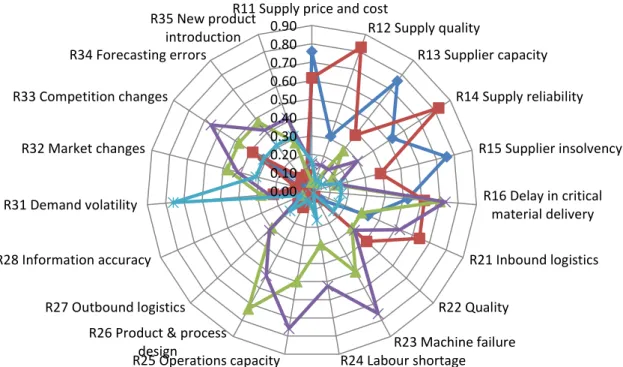
similar relative closeness indexes were obtained for some strategies such as flexible supply via supply contact (A2) and control strategy (A3), although they may be more effective in addressing specific risks than other strategies. It is due to the fact that these indexes take in consideration all the potential risks and the effectiveness of individual strategies in mitigating these risks. This is further confirmed in the analysis of performance ratings of the five alternative strategies with respect to individual supply chain risks as displayed in Figure 3. As expected, all five strategies exhibit their own strengths and weaknesses in mitigating different types of supply chain risks. For the case organization, some risks such as demand volatility (R31), supply price and cost (R11), and labour shortage (R24), are more crucial to the business success, others including outbound logistics (R27), product design and process (R26), and supplier capacity (R13) that show low risk level may be compromised. As expected, the case company has high risk in demand volatility since the overseas market contributes over 80% of the overall sales. Although the exports to the Europe and the US have seen gradual recovery since the banking crisis, their customers are more cautious than before when making purchasing orders. On the supply side, the company has also witnessed more fluctuations in the prices of components and raw materials due to volatile energy and metal prices. Furthermore, like many other labour intensive manufacturers in the region, the company has also had difficulties in recruiting and retaining skilled migrant workers in order to increase or even maintain the production capacity. Itis important for companies to focus on the strategies that do not only mitigate the supply chain risks collectively but also address the risks that pose immediate challenges to the business.
Figure 3 The effectiveness of alternative strategies in mitigating various supply chain risks
Nevertheless, it is difficult to have a strategy that effectively mitigates most of supply chain risks. Although flexible manufacturing (A4) tops the final ranking in Table 7, it is not effective in dealing with supply risks comparing to other strategies. Instead of choosing one particular strategy, a more logical solution for the case organization is to employ a combination of different strategies. Therefore, further analysis was conducted to evaluate different combinations of strategies. Using flexible manufacturing (A4) as a benchmark, four combinations of strategies were assessed through the same Fuzzy TOPSIS approach described in section 3.3. The analysis results are displayed in Table 8. All four combinations performed better than implementing flexible manufacturing alone. Among the combinations, the best solution for the case organization is to implement flexible manufacturing (A4) and multiple suppliers (A1) together in order to manage its supply chain risks.
0.00 0.10 0.20 0.30 0.40 0.50 0.60 0.70 0.80 0.90
R11 Supply price and cost
R12 Supply quality R13 Supplier capacity R14 Supply reliability R15 Supplier insolvency R16 Delay in critical material delivery R21 Inbound logistics R22 Quality R23 Machine failure R24 Labour shortage R25 Operations capacity
R26 Product & process design R27 Outbound logistics R28 Information accuracy R31 Demand volatility R32 Market changes R33 Competition changes R34 Forecasting errors R35 New product introduction
A1 Multiple suppliers A2 Flexible supply via supplycontract A3 Control strategy A4 Flexible manufacturing
Table 8 The relative closeness index of alternative combinations of strategies and its ranking. d+ d- 𝜑̌ k rank A4 0.596 0 0 5 A4&A1 0.198 0.397 0.667 1 A4&A2 0.228 0.368 0.618 2 A4&A3 0.532 0.066 0.110 3 A4&A5 0.411 0.185 0.310 4 4.5 Strategy implementation
Following the risk assessment and mitigation strategy evaluation, recommendations were provided to the case company based on the analysis result. When discussing with the senior management team about the appropriate strategies for the company to move forward, the proposed framework provided a transparent way of communicating the supply chain risks and explained rationally why the selected mitigation strategies are recommended. An interview with the general manager after 18 months of the initial recommendation confirmed that a number of strategies have been implemented to mitigate its supply chain risks since then.
On the demand side, more effort has been made in developing its domestic market. While the customer base has been expanded recently, the company also explores the way to reach more individual consumers through the B2C online channel. In the past 18 months, the export to the overseas market still remains to be challenging. However, the company has seen an increase of overall sales which is mainly contributed by the better performance in the domestic market. On the supply side, some new suppliers have been added to the supply base. The company has also developed a strategic partnership with some of its high performing suppliers. Under the new supply contract, the company outsources some of the manufacturing process to its suppliers. Such a movement increases the production capacity with less capital investment. These responses are in line with the supply chain literature that recommends that companies should have long term relationships which stabilize these issues.
In the meantime, internally, the company has implemented tactical and strategic changes to enhance its manufacturing flexibility. For instance, the company has restructured its management hierarchy to give them the flexibility of adapting to the changing business environment. The role of product managers was created to coordinate different functional departments in order to ensure the finished products meet the final customers’ needs. In addition, extra training was given to the current and new staff to develop a multi-skilled workforce. Such a staff development provides the flexibility to enable workers to move between different production lines if it is required.
Although it has to be acknowledged that not all the strategy implementations discussed above are the direct response to the initial supply chain risk assessment and strategies evaluation, the general manager also confirmed that from a practical perspective, the integrated risk communication and management framework has certainly enhanced their ability to communicate and understand the supply
chain risks that the company is facing and support their decision-making in implementing some of the mitigation strategies.
4.6 Cost and benefit analysis
To change any management practices or implement any new business strategies, firms have to evaluate the cost and benefit before they can commit in the investment of the new practices or strategies. The same rule applies to the proposed supply chain risk communication and management framework. Here, the main costs include the cost involved in risk assessment and strategy evaluation of proposed methodology and the implementation cost of recommended new mitigation strategy.
Regarding the resource and time required for the proposed framework, it offers a systematic tool of assessing risks at a supply chain level without the input of external consultants. Using expert knowledge from the managers who are responsible for firms’ supply chain operations, such an evaluation provides insights into the exposed supply chain risks, leading to important strategic recommendations for companies to develop its supply chain resilience. The risk assessment and mitigation strategy evaluation does not require substantial resources and can be carried out in a time-efficient manner. However, the cost of the new strategy implementation also has a significant impact on firms’ decision on strategic choice. As illustrated in the case study, although the supply chain risks are an important element, firms have to consider their business objectives and market environment in order to make those important strategic decisions. Firms are more likely to invest on strategies that can not only mitigate supply chain risks but also bring other benefits such as sales growth, service improvement and cost reduction. One main benefit of implementing the proposed framework is that it provides a more holistic view of supply chain risks and gives firms a better capability in foreseeing, spotting, and responding to potential disruptions. In addition, adoption of the framework enables firms to more pro-actively assess and address their supply chain risks, and support their decision-making on important strategies.
5. Discussion and Conclusions
With the increasing emphasis on risk management across the industries, effective SCRM tools for understanding, analyzing and communicating risks are now attracting much attention. Many approaches including both quantitative and qualitative methods have been suggested in the literature (Sadiq and Husain 2005; Pan and Chen 2012; Chan and Wang 2013; Samvedi et al. 2013). However, risk management is a complex subject involving vagueness and uncertainty in the decision-making process. While comprehensive quantitative methods are constrained by data quality, time, expertise and resources, qualitative methods are often criticized due to its simplicity and false sense of certainty (Wang et al. 2012). This research provides a practical decision support tool for communicating supply chain risks and evaluating risk mitigation strategies. It seeks to take explicit account of multiple types of risk in aiding decision-making, and compares and ranks alternative strategies in indicator basis individually as well as collectively. The fuzzy approach adopted in the study is also useful particularly
in situations where uncertainties exist in the decision-making process. The analysis is valuable in formulating the strategic plan for supply chain risk mitigation.
A holistic approach regarding risk mitigation strategy evaluation should not only consider the level of various supply chain risks that companies are exposed to, but should also emphasise the effectiveness of different strategies in mitigating identified risks individually and collectively in the decision-making process. As any strategic investment requires substantial resources and time, the decision of adopting appropriate SCRM strategies requires a trade-off between the benefits of implementing such strategies and cost involved. Furthermore, the adoption of risk mitigation strategies often requires the decision from top management team who may not have expert knowledge about risk assessment and strategy evaluation. Therefore, it is also essential to facilitate an effective communication in the decision-making process. The supply chain risk communication and management framework is a step in that direction, presenting a methodology that accounts for the broad issues related to risk mitigation strategy selection and providing a holistic approach to SCRM decision-making process.
This research makes the following key contributions. First, this research develops a comprehensive framework that effectively integrates joint actions of communication of supply chain risk analysis and evaluation of risk mitigation strategies. The novelty of the model lies in the fact that an analytical tool is proposed enabling the specific business preferences to be taken into consideration in making the strategic decision on SCRM. This is different from most of SCRM literature that focus on either the assessment of supply chain risks (Pan and Chen 2012; Wang et al., 2012; Samvedi et al. 2013) or the evaluation of risk mitigation strategies (Tang and Tomlin 2008; Yang and Yang 2010; Xiao ad Chen 2011). Second, through the case application, the incorporation of fuzzy risk assessment, fuzzy Delphi, and fuzzy TOPSIS as an integrated methodology has been proved to be a systematic and practical decision-making tool supporting a very effective supply chain risk communication and risk mitigation strategy evaluation. Furthermore, the risk assessment and strategy evaluation contain considerable amount of uncertainty causing elements and unknown data is often common. The application of fuzzy methodology can help firms to solve the problem of dealing with uncertainty in the decision-making in a timely manner. This paper makes practical contributions as showed in the case study of a kitchen appliances manufacturer supporting a resource effective and time efficient decision-making on supply chain risk mitigation strategy. It is considered to be supportive for managers in making significant strategic decisions on SCRM. Although the case discussed in this study is a kitchen appliances manufacturer, results could be generalised to similar manufacturing or service environments.
Nevertheless, the presented approach also has its own limitations, which imply fruitful directions for future research. For instance, users have to make subjective decisions when conducting fuzzy risk assessment and obtaining priority ratings for alternative strategies. The functionality of the approach highly depends on the knowledge, expertise and communication skills of decision makers. Therefore, one future extension is to consider a more objective and data driven assessment technique such as entropy method and Data Envelopment Analysis. Moreover, the assessment of supply chain risks and
evaluation of risk mitigation strategies were mainly through the input of managers from the case company. However, it requires a coordinated effort from all key parties involved in order to mitigate risks and build a resilient supply chain. Another future research direction is to incorporate the view of other supply chain parties such as suppliers and customers into the process.
References
Anupindi, R., & Akella, R., (1993). Diversification under supply uncertainty. Management Science, 39 (8), 944– 963.
Arikan, R., Dağdeviren, M. & Kurt, M., (2013). A fuzzy multi-attribute decision making model for strategic risk assessment. International Journal of Computational Intelligence Systems, 6(3), 487-502.
Babich, V., Burnetas, A.N., & Ritchken, P.H., (2007). Competition and diversification effects in supply chains with supplier default risk. Manufacturing and Service Operation Management, 9 (2), 123–146.
Baihaqi, I. and Sohal, A.S., (2013). The impact of information sharing in supply chains on organisational performance: an empirical study. Production Planning & Control, 24(8-9), 743-758.
Baines, T., & Shi, V. G. (2015). A Delphi study to explore the adoption of servitization in UK companies. Production Planning & Control, 26(14-15), 1171-1187.
Baloi, D. & Price, A.D.F., (2003). Modelling global risk factors affecting construction cost performance. International Journal of Project Management, 21, 261–269.
Büyüközkan, G., & Çifçi, G. (2012). A novel hybrid MCDM approach based on fuzzy DEMATEL, fuzzy ANP and fuzzy TOPSIS to evaluate green suppliers. Expert Systems with Applications, 39(3), 3000–3011. Chan, F.T.S., & Kumar, N., (2007). Global supplier development considering risk factors using fuzzy extended
AHP-based approach, Omega: The International Journal of Management Science 35, 417 – 431.
Chan, H.K., & Wang, X., (2013). Fuzzy Hierarchical Model for risk assessment: principles, concepts, and practical applications, London: Springer.
Chang, P.C., & Wang, Y.W. (2006). Fuzzy Delphi and back propagation model for sales forecasting in PCB industry. Expert Systems with Applications, 30(4), 715-726.
Chen, C.T., Linb, C.T., & Huang, S.F. (2006). A fuzzy approach for supplier evaluation and selection in supply chain management, International Journal of Production Economics, 102 (2), 289–301.
Chen, X. & Wang, X., (2016). Effects of carbon emission reduction policies on transportation mode selections with stochastic demand. Transportation Research Part E: Logistics and Transportation Review, 90, 196-205.
Chen, P.S. & Wu, M.T., (2013). A modified failure mode and effects analysis method for supplier selection problems in the supply chain risk environment: A case study. Computers & Industrial Engineering, 66(4), 634-642.
Chen, Z., Zhao, L. & Lee, K. (2010). Environmental risk assessment of offshore produced water discharges using a hybrid fuzzy-stochastic modelling approach, Environmental Modelling &Software, 25(6), 782-792. Childerhouse, P., & Towill, D.R., (2002). Analysis of the factors affecting real-world value stream performance,
International Journal of Production Research, 40(15), 3499–3518.
Chopra, S., & Sodhi, M. S., (2004). Managing risk to avoid supply-chain breakdown. MIT Sloan Management Review, 46 (1), 53–61.
Chopra, S. & Sodhi, M.S. (2014). Reducing the risk of supply chain disruptions. MIT Sloan Management Review 55: 73–80.
Cigolini, R., & Rossi, T., (2006). A note on supply risk and inventory outsourcing, Production Planning & Control, 17(4), 424-437
Craighead, C.W., Blackhurst, J., Rungtusanatham, M.J., & Handfield, R.B. (2007). The severity of supply chain disruptions: design characteristics and mitigation capabilities, Decision Sciences, 38(1), 131-156.
Dalkey, N., & Helmer, O. (1963). An experimental application of the Delphi method to the use of experts. Management Science, 9(3), 458-467.
Davidson, V.J., Ryks, J. & Fazil, A. (2006). Fuzzy risk assessment tool for microbial hazards in food system, Fuzzy Sets and Systems, 157, 1201-1210.
Deng, S.-J., & Elmaghraby, W. (2005). Supplier selection via tournaments. Production and Operations Management, 14 (2), 252–268.
Dimitriadis, N.I. & Koh, S.C.L., (2005). Information flow and supply chain management in local production networks: the role of people and information systems. Production Planning & Control, 16(6), 545-554. Eraslan, E., & Iç, Y. T. (2011). A multi-criteria approach for determination of investment regions: Turkish case.
Industrial Management & Data Systems, 111(6), 890-909.
Faisal, M.N., Banwet, D.K., &Shankar, R. (2006). Supply chain risk mitigation: modeling the enablers. Business Process Management Journal, 12 (4), 535–552.
Gaudenzi, B. & Borghesi, A., (2006). Managing risks in the supply chain using the AHP method. The International Journal of Logistics Management, 17(1), 114-136.
Giachetti, R.E., Martinez, L.D., Saenz, O.A., & Chen, C.S. (2003). Analysis of the structural measures of flexibility and agility using a measurement theoretical framework, International Journal of Production Economics, 86, 47–62.
Gualandris, J., & Kalchschmidt, M. (2015). Mitigating the effect of risk conditions on supply disruptions: the role of manufacturing postponement enablers. Production Planning & Control, 26(8), 637-653
Handfield, R., Warsing, D., & Wu, X. (2009). (Q, r) Inventory policies in a fuzzy uncertain supply chain environment, European Journal of Operational Research, 197, 609–619.
Heckmann, I., Comes, T. & Nickel, S., (2015). A critical review on supply chain risk–Definition, measure and modeling. Omega, 52,119-132.
Ho, C.F., Chi, Y.P., & Tai, Y.M., (2005). A structural approach to measuring uncertainty in supply chains, International Journal of Electronic Commerce, 9(3), 91–114.
Ho, W., Dey, P.K. & Lockström, M., (2011). Strategic sourcing: a combined QFD and AHP approach in manufacturing. Supply Chain Management: An International Journal, 16(6), 446-461.
Hwang, C. L., & Yoon, K. (1981). Multiple attributes decision making methods and applications. Berlin: Springer. Hwang, I., Radhakrishnan, S., & Su, L.N., (2006). Vendor certification and appraisal: implications for supplier
quality. Management Science, 52 (10), 1472–1482.
Hsiao, T.Y., (2006). Establish standards of standard costing with the application of convergent gray zone test, European Journal of Operational Research, 168(2), 593-611.
Hsieh, T.Y., Lu, S.-T., & Tzeng, G.-H. (2004). Fuzzy MCDM approach for planning and design tenders selection in public office buildings. International Journal of Project Management, 22, 573-584.
Hsu, T.H., & Yang, T.H. (2000). Application of fuzzy analytic hierarchy process in the selection of advertising media, Journal of Management and Systems, 7(1), 19-39.
Ishikawa, A., Amagasa, T., Shiga, T., Tomizawa, G., Tatsuta, R., & Mieno, H. (1993). The max–min Delphi method and fuzzy Delphi method via fuzzy integration. Fuzzy Sets Systems, 55, 241–253.
Jordan,W., & Graves, S.C. (1995). Principles on the benefits of manufacturing process flexibility. Management Science, 41 (4), 577–594.
Joshi, R., Banwet, D.K., &Shankar, R., (2011). A Delphi-AHP-TOPSIS based benchmarking framework for performance improvement of a cold chain. Expert Systems with Applications, 38(8), 10170-10182.
Jüttner, U., Peck, H., & Christopher, M. (2003). Supply chain risk management, outlining an agenda for future research, International Journal of Logistics, 6(4), 197-219.
Jüttner, U., (2005). Supply chain risk management: understanding the business requirement from a practitioner perspective. The International Journal of Logistics Management, 16 (1), 120–141.
Kahraman, C., Büyüközkan, G., & Ateş, N.Y. (2007). A two phase multi-attribute decision-making approach for new product introduction. Information Sciences, 177, 1567–1582.
Kleindorfer, P.R., & Saad, G.H. (2005). Managing disruption risk in supply chains, Production and Operations Management, 14(1), 53-68.
Knemeyer, M.A., Zinn, W., & Eroglu, C. (2009). Proactive planning for catastrophic events in supply chains, Journal of Operations Management, 27(2), 141-153.
Krohling, R. A., & Campanharo, V. C. (2011). Fuzzy TOPSIS for group decision making: A case study for accidents with oil spill in the sea. Expert Systems with Applications, 38(4), 4190-4197.
Kull, T.J. & Talluri, S., (2008). A supply risk reduction model using integrated multicriteria decision making. IEEE Transactions on Engineering Management, 55(3), 409-419.
Kuo, Y.F., & Chen, P.C., (2008). Constructing performance appraisal indicators for mobility of the service industries using Fuzzy Delphi Method. Expert Systems with Applications, 35(4), 1930-1939
Lee, H. (2004). The triple—A supply chain. Harvard Business Review October, 102–112.
Lee, H.L. & Tang, C.S., (1997). Modeling the costs and benefits of delayed product differentiation. Management Science, 43 (1), 40–54.
Lee, H.L., So, K.C. & Tang, C.S., (2000). The value of information sharing in a two-level supply chain. Management Science, 46(5), 626-643.
Lee, A.H.I., Wang, W., & Lin, T. (2010). An evaluation framework for technology transfer of new equipment in high technology industry. Technological Forecasting & Social Change, 77(1), 135-150.
Lei, D., LI, J., & Liu, Z. (2012). Supply chain contracts under demand and cost disruptions with asymmetric information, International Journal of Production Economics, 139, 116-126.
Liu, K.F. & Lai, J.H., (2009). Decision-support for environmental impact assessment: A hybrid approach using fuzzy logic and fuzzy analytic network process. Expert Systems with Applications, 36(3), 5119-5136. Nagurney, A., Cruz, J., Dong, J., & Zhang, D. (2005). Supply chain networks, electronic commerce, and supply
side and demand side risk, European Journal of Operational Research, 164(1), 120-142.
Narasimhan, R., Talluri, S., & Das, A., (2004). Exploring flexibility and execution competencies of manufacturing firms. Journal of Operations Management, 22 (1), 91–106.